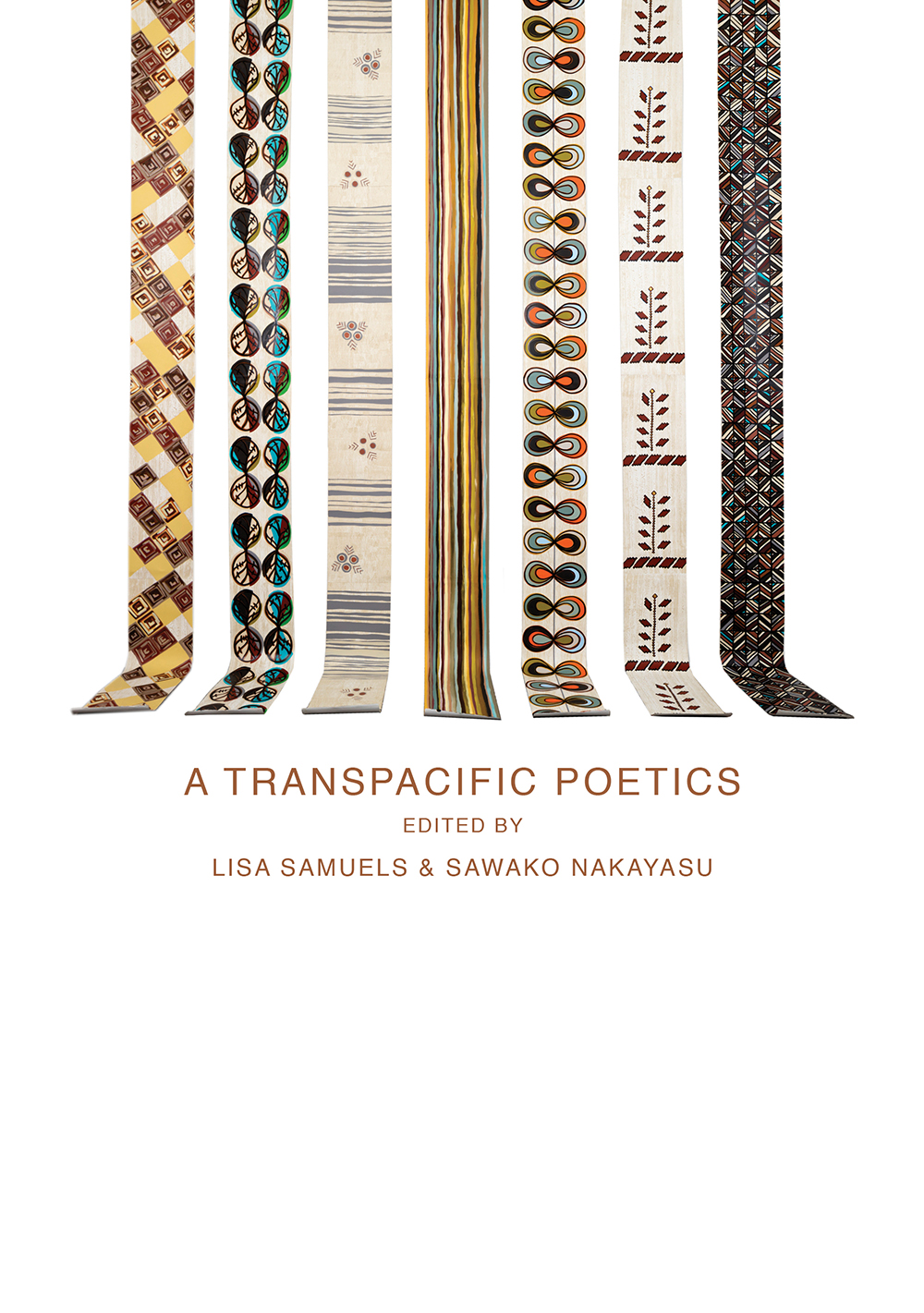
Owen Bullock Reviews A Transpacific Poetics

A Transpacific Poetics
Lisa Samuels and Sawako Nakayasu, eds.
Litmus Press, 2017


Lisa Samuels’s introductory essay, ‘What Do We Mean When We Say Transpacific’, begins with a quotation from Pam Brown that is particularly well-chosen for this volume. Brown claims that the ‘authentic’ pertains to someone who isn’t manipulated or being alienated from their context. There’s a good deal in this book about alienation relating to identity and culture; many of the authors have had to fight to preserve authenticity. Samuels proceeds to discuss use of the word ‘transpacific’. She describes the way use of the name was influenced by seeing trucks in Oceania with that label, a word that denotes interactions, adding that ‘trans’ alone indicates the transitive and ‘internal difference’. She stresses that her contributors’ cultural understandings also rely on the fact that Oceania is a positive place.

Likewise, the ocean has location, but it cannot be grasped, it’s too big. Further, ‘the ocean is one example of the challenge of perceiving what exceeds single identity’ – a wonderful metaphor for the cultural diversity that this book represents. The ocean is one massive being, but rather than seeing its symbol as marginalising everything else, Samuels prefers to ponder what she calls ‘distributed centrality’. She’s a writer who likes to generate her own terminology. Invariably, her terms offer new ways of thinking.

A more familiar idea is that the ocean connects us. We are also connected by the internet, but Samuels describes the danger of likening the internet to the ocean, since the internet is English-dominated. Alternatively, she wonders what happens when the universal digitas – which she defines as ‘digital performativity with constitutive perfusing by the techne and humans involved’ – is imagined at the same time as multi-lingual, multi-local, even ‘multi-here’ variations. With this guiding thought in mind, the editors sought out writing which inhabited ‘at least two zones’ of Pacific life. Rather than being exclusionary, she wants this anthology of ‘inclusions and lacunae’ to foster other such collections.

Among other new terms, Samuels favours ‘transhuman’ over ‘post-human’, since the former seems to render the human obsolete at a lexical level, whereas ‘transhuman’ emphasises ‘the interfacing body’ and connects and ‘holds open what it means to be human’. The experiments with genre in the anthology are examples of ‘empowered re-mapping’, indicative of a cross-pollination of cultures.

Colonisation and later related manifestations brought by tourism are anterior to such desirable fusion. Extracts from Jai Arun Ravine’s ‘The Romance of Siam’ are laugh-out-loud funny, rhythmic and demotic, yet retain the undertone of concern about cultural appropriation. They employ a disingenuous technique which captures a state of mind, though it might seem at first glance to be a vernacular which is insufficiently stylised: ‘I, I have never owned the place of my, um, mother’s birth. I, I visited there once, twice and I, I want to apply for the, uh, Fulbright, too’. Later, the voice of the poem describes having pretended not to know English and suppressing everything ‘non-Thai’ just to get some sense of belonging. Ultimately, this voice feels that everything it owns is owned by a white person.

‘The Romance of the Siamese Dream’, is a short play in three acts, with overture and finale. Yul Brynner is on stage for the 4,634th performance of The King and I. But he’s dreaming. A rice cooker named Tiger appears on stage, and wants him to put his head inside. In the second act, Tiger is replaced by Anna, who is keen to teach Yul to act. She also fantasises about leaving Britain for America from the same port as the Titanic – this detail reflects a note informing the reader that the actress who played Anna falsified her past, pretending she was of English extraction. In the interest of surprise, I’ll leave the summary there, but Ravine’s work is an alarming and attractive piece of writing, which emphasises the preoccupation of the first.

By contrast, Ravine’s, ‘Under Erasure’ is a series of diary entries from Doi Saket, Bangkok and Chiang Mai during the period of a residency to make a film titled ‘TOM / TRANS / THAI’. This work seems much less engaged with its environment than one might expect, but at the same time that’s part of its point – it wants to remain detached, even if the writing runs the risk of failing to resonate. On one level, I feel that the writing needs to take courage and go deeper into its subject matter by using more detail, especially of gender-related issues – the author identifies as transgender and uses the plural personal pronoun – but part of its quite deliberate stance lies in a resistance to any expectation to foreground reflections in gender. Effectively, then, the series of diary entries embodies an important concern.

As with Ravine’s work, Don Mee Choi’s series of short prose pieces, ‘Freely Frayed’, makes its points with deft and inventive uses of language. Its first concern is the influence of American culture in Korea. ‘Hanky Yankee, are you frayed?’ it demands, and it goes on to prove itself as:

… a mimicker of mimetic words in particular. Doubled consonants or certain parts of speech that are repeated on certain occasions, which can be said to be nobody’s business, but they are since everything in English is everybody’s business. Farfar swiftswift zealzeal … In my world of nobody’s business I twirl about frantically frequently farfar to the point of failure feigning englishenglish.

The doubled words are used as a motif to open subsequent paragraphs. The author is revealed as a translator, with translation described as ‘a process of endless displacement’. Inevitably, the ‘displaced poetic identity’ of a translation in progress – of the poet Kim Hyesoon’s work – must ‘failfail’.

I confess that despite having written haiku for nearly twenty years, I am new to the form of Hay(na)ku, discussed by originator Eileen Tabios in her essay, ‘The History of Hay(na)ku’. It’s an intriguing, short form comprised of three lines of one, two and three words. Tabios claims it retains the ‘charge’ of haiku whilst including paradox evocative of Filipino culture. For me, it looks to have something in common with the cinquain as well as the haiku, with the same attendant difficulty of overcoming such arbitrary limitations. Tabios describes the origin of the name as she negotiated the reference to haiku and historical cultural implications for Filipino writers. She humbly suggests that other poets have been more successful with the form than she has herself, an idea which she accepts with the statement that any poetry ‘ultimately transcends the poet’s autobiography’.

As suggested, Samuels’s idea of ‘empowered re-mapping’ finds significant expression in many of the works. Melanie Rands fuses found text and vernacular lyric – ‘he said tell your fulla’s fulla / to talk to my fulla’ – with text and image, experimental typography, photocopied notes and drawings in a sequence which narrates passage to New Zealand on the steamer Matua (‘South of the Line [“Aloha Activities”]’). This embodied uses of page space is especially compelling:

atoll


                                      lagoon
             date line


                        Musician

Much more densely, Ya-Wen Ho’s text builds up markers of identity – ‘a zinester; a fosterer of cats; a lover of sunny days’ – by repeating and adding to them over five pages before the first descriptors are printed over and effectively erased (‘This List is Written by a List-maker’). Initially, the new additions continue, but then whole phrases are blocked out before a final reiteration of the whole of the text with a few omissions. The sequence conveys a reiteration of story and language and a contrasting fading away, perhaps of memory, or relevance.
Posted in BOOK REVIEWS | Tagged , , , , , , , , , , , , , ,

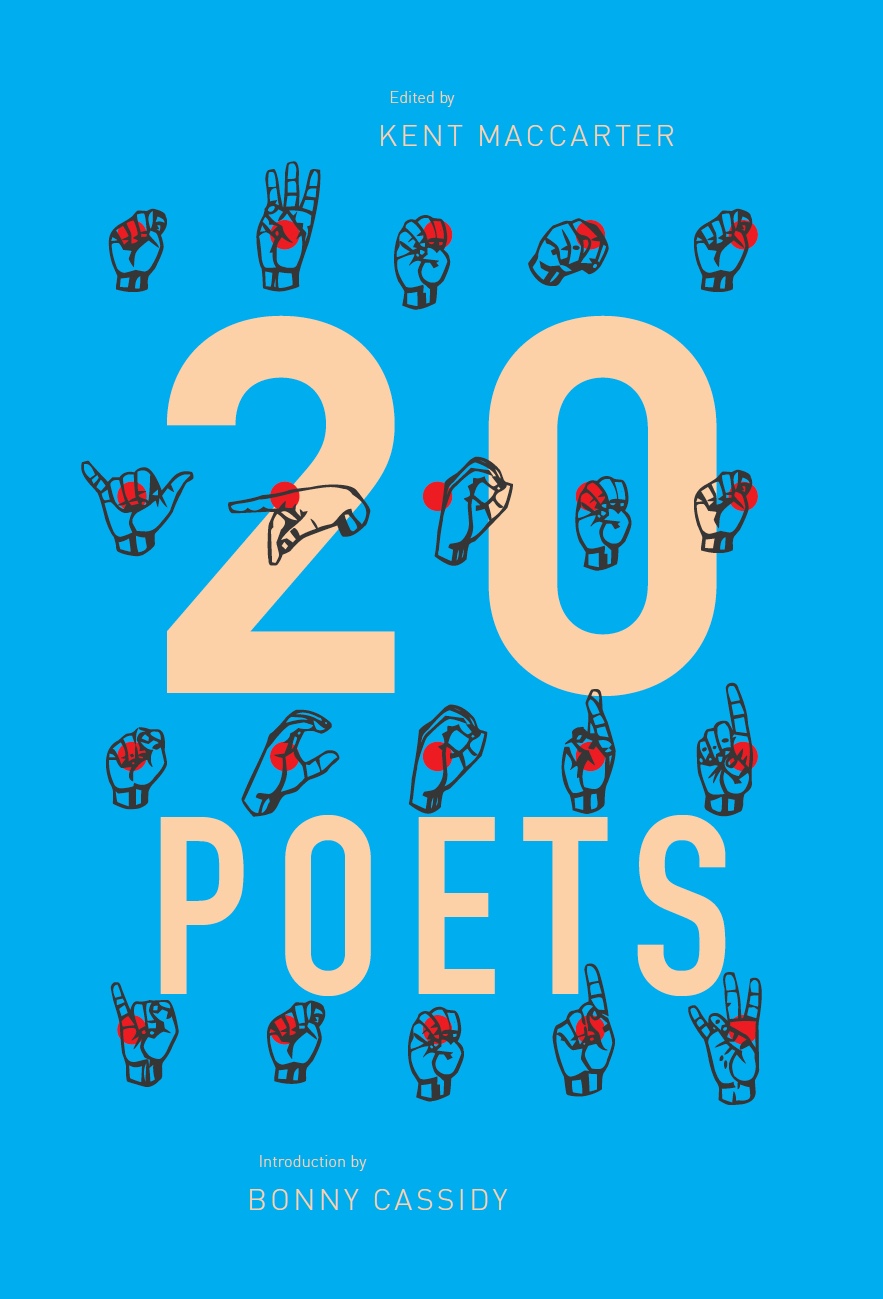
20 Poets, a Free Anthology from Cordite Books

Get 20 Poets here

You may need to right click and save the PDF to desktop first. It is not protected to open, print or save, but it is to copy or edit … and this trips up some browser versions.

Cover design by Zoë Sadokierski

20 Poets features poetry from all the authors from series 1 & 2 of Cordite Books. It’s free, and it’s intended to be given away as widely as possible.

The geographic barriers that can, at times, hinder Australian literature are no longer relevant, and poetry communities around the world must be enlightened by the commanding, demanding and exciting trajectory of contemporary Australian poetics.

This anthology is a mélange of the experimental and the lyrical, written by poets in all stages of their careers, and reflects the cultural vibrancy that fuels contemporary Australian letters.

While 20 Poets, including its translations (into future Hindi and the Spanish), may have a once-off print run for a given festival or event, it will predominantly be distributed as an electronic book in portable document format. Central to Cordite Books and its authors is the visual appearance of the work, and the ways in which positive and negative space are engaged across a verso–recto spread. Read it on as large a screen as possible, in two-page view display, to deliver the intended look of the poetry.

Each poet included here is represented by four pages of poetry and the preface from their Cordite book. Many of the publications are book-length poems, and this inclusion provides a greater context for the work. These four pages are allotted to display the range and style of each poet.

Without question, future iterations of this book will see new titles – 30 Poets, 40 Poets – but here we are at the beginning: you, me and the twenty authors collected here. Enjoy the work, and please seek out a print book or two if you are particularly bewitched by what you read.

A note on the cover

Says Zoë Sadokierski …

I was looking for ways to represent 20 and was stuck on mathematical things – grids, lines, counting – which resulted in patterns. Poetry book covers often end up with patterns on them, and I didn’t want that.

I thought of 10 fingers and 10 toes, but feet and hands can be ugly. Then I thought about hands signing 2 and 0 – I remembered seeing a typeface with hand signs, so I found it to see what typing out ‘20 poems cordite 17’ (20 letters) looked like on a grid.

Although the anthology is not about deafness or signing in any way, I made a fleeting conceptual link between poetry and sign language – each demands close attention to the rhythm and pace of the signs / letterforms, and the spaces and pauses between them. I’ve always been fascinated by how important the facial expressions are in sign language – if you ignore the emotion expressed, and just look at the hand signals, you risk misunderstanding the nuance. Likewise, if you read poetry literally … you miss the nuance.

Posted in GUNCOTTON | Tagged , , , , , , , , , , , , , , , , , , , , , ,

Review Short: Jill Jones’s Brink

Brink by Jill Jones
Five Islands Press, 2017


It’s a neat twenty-five years since Jill Jones’s first book, The Mask and the Jagged Star, was published and in that time she has built for herself a reputation as a serious and ambitious poet whose work demands, and generally rewards, close reading. She is certainly not a poet of easy gestures or flashy effects.

As with Jones’s earlier collections, Brink is not a book to be turned through quickly in a coffee bar (though this may well be a good place to take it in slowly, to let yourself be absorbed in its world despite the incidental hubbub around you. It’s divided into three sections which share overlapping concerns and techniques. There’s a recurrent preoccupation with weather (indeed, climate change) and with language, its quirks and difficulties which she often, with varying success, embodies in the poems themselves.

‘The Lagoon’, the collection’s third poem, is reasonably typical of the book as a whole and has the tones of desperation and urgency that are detectable throughout. ‘The names of the gods are in the clouds,’ says the narrator, ‘and on each numberplate. / I’m counting on you wherever you may be … / Lists extend from scraps / and packages waterlogged with the moon. / The car tyre is without companions. / The lake sings a little. My consonants drown.’ Despite the negatives of the details (‘scraps’, ‘packages waterlogged’ and an abandoned ‘car tyre’) there is also a strong urge towards lyricism — literally in the case of ‘The lake sings a little’.

In a sense, ‘The Lagoon’ is also a political poem, almost an activist one, but subtle nevertheless. Its main intention is to generate a disturbing, even disorienting mood rather than to mount a case. Jones is not concerned with a line of argument from line to line but rather with the poem’s final effect.

‘Fruit’, another early poem in the book, seems at first reading an orthodox ‘nature’ poem in praise of fruit bats. As its fourteen lines of blank verse develop, however, it’s plain that the narrator doesn’t know as much as she feels she ought to about the bats and is slightly nauseated by them. Their noise is a ‘painful ache’. In the sonnet’s sestet, the implications broaden. The bats become emblematic of loss, all kinds of loss (‘ “I have to go” and people go. I have gone. / One day I shall already be gone.’) The poem ends nevertheless with a defiant optimism: ‘But the tree / still breaths, kerchak kerchak — bats / feeding their god in the guttural dark’.

At times throughout Brink, especially in poems such as ‘Speak Which’, Jones pushes her sense of what language can (and can’t) do to the limits. Syntax is contorted or suspended. Words operate as single, freestanding units. Punctuation is left to the mind of the reader. If all poetry is an attempt to ‘speak the unspeakable’ — or ‘eff’ the ineffable — Jones’s poetry in ‘Speak Which’ is an extreme example. ‘form / is tested / as leaves fall // not itself / but what it / does // shapes in / the mind breath / unsaid // don’t say / never trees move / fates // water / sings on / consonants and grain …’

The enjambment here is extreme and at times reminiscent of the more philosophical poems of William Carlos Williams. The short lines are an attempt to slow the reader down and make them think about what is not being said as well as what is. The poet could write ‘don’t say never’ and ‘trees move fates’ but it’s significant that she doesn’t. Some readers may be impatient with such niceties but they would be foolish to dismiss them as needless.

Quite a few of Jones’s poems in Brink also have a dystopian context, seemingly brought about by climate change (and related events). They can be almost scary but they are not without positivity too. A good example is ‘Our Epic Want’. Near its beginning the narrator says ‘We were somewhere in the torn fabric, parting the seams. / We’d given up on claustrophobia.’ Later ‘We found a world of foam and fug and acetylene. // The rain rattled us but it was the wrong size, too big, too grey. / There was nothing between it like love or even its simulacra.’ Despite all this, at the end of the poem the narrator and her companion are still walking: ‘We’d dreamt of last things first, getting behind ourselves, like an urge, or a fault. / But there was plenty more, and we still had the air around our skin.’ Some may find the last line ironic but I prefer to see it as optimistic (or at least courageous).

Poems like these (and there are a number of them) are certainly admonitory but they are far from the overly-insistent fulminations that disfigure much ‘environmental’ poetry essaying similar objectives.

More directly enjoyable perhaps is the small scattering of love poems recurring throughout. One of the most memorable is the collection’s antepenultimate poem, ‘More Than Molecules’. Derived from Catullus 48, ‘More Than Molecules’ is a loving and delicate balance between the physical and the metaphysical. Its middle stanza (of three) is worth reprinting in full.

Even if I counted the air
in all its nonchalant molecules
or the ways everything
grows after it dies, the grass
waving at us, if I could count 
each shiver it makes 
I’d still wish to touch you 
ten thousand more times
kiss the time that’s left
the time that leaves the grains
as we sit down, out in the field
which is dying, the trucks
the lands, the malls, the litter
the nuclear waste, all those
molecules too, everywhere.
Posted in BOOK REVIEWS | Tagged ,

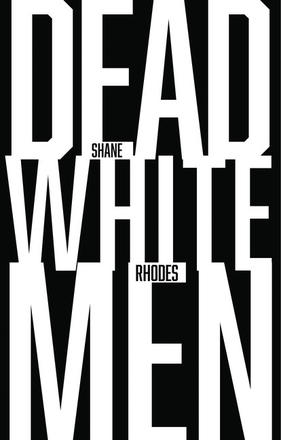
Review Short: Shane Rhodes’s Dead White Men

Dead White Men by Shane Rhodes
Coach House Books, 2017


From the title of Shane Rhodes’s collection Dead White Men, we know we are in fraught if familiar territory. Those men are the subjects to be critiqued, argued with, taken down in light of today’s history. Read alongside the recent debate about Confederate statues, which includes actions such as painting Columbus’s hands red, Rhodes becomes an ally in an intersectional coalition that seeks to engage the higher faculties without neglect of the bodily drives. In that way, Dead White Men is as reasoned as it is passionate. Myths are skewered, words re-appropriated, archives punked, records reclaimed, origin stories destroyed. This is not only at the level of content, but language, form and page. In a beautifully produced volume, the text varies in font, size and scale. There are images scattered throughout, all in black and white, including some silhouettes and some photographic reprints. In that way, Australian readers will recognise similarities to Belli Li’s recent release Argosy.

Rhodes proposes that the changes from the past to today through small gestures that have structural implications. He often uses the technique of accumulation, whereby poems becomes lists and phrases repeat giving one a structural account of change over time. The pyramids of those times, and of ours, are the skulls of our own and many other species as well. This is there in ‘Imports into the Ports of London and Rochelle in 1743’, which states:

153, 830 Beaver
110,005 Racoon
45,055 Martins
16,832 Bears
13,058 Otters and Woodshocks, or Fifhers
10,280 Grey Foxes and Cats
3,117 Wolves
2,330 Cates, i.e. Lynx
1,710 Minx
692 Wolverenes
451 Red Foxes
440 Deer
130 Elks, i.e. Stags
120 Squirrels

Colonial exploitation, conquest: discovery is as mercantile as it is ecological. A simple list becomes a solemn reminder of just what happened on the frontier. If we know anything then, it is that we know that colonialism is a litany of violence, blood and gore that is specific, taking in the metropolis and the frontier alike and animals along with people.

Reading about Alberto Cantino, James Cook, Jacques Carrier, Robert Boyle and others as they ‘explore’ new lands; ‘discover’ new words’, ‘seek out’ gold, one cannot help but think through the politics of repatriation, treaty, occupation, unsettlement, place, rights now. There are, of course, variations among these engagements. Linguistic engagement is not the same as resource extraction, which we see by comparing the poems ‘Linguisticers’ and ‘Gold’. The former reads:

: a boat
: go fetch

:come hither
: I meane no harm

: kiss me
: my sonne

: go to him
: give it to me

: no
: will you have this?

: music
: iron

: a knife
: a fog

: a tongue

The threat is here, but it is contained – one must infer that the music is used, that maybe the tongue is cut out. But in ‘Gold’ we are told in the opening line, ‘For it is beaten and we are beaten for it’. And that is where language differs from action, where the engagement of the word is not quite the same as the shovel, the pickaxe, the railroad. Both, though, are critical parts of narratives of exploration, invasion, colonialism.

In other words, you must read between the lines, connecting the dots to make a structural critique. Given its stylistic variation – from erasure to aphoristic asides to lengthy narrative – Rhodes’s work is often subtle, which gives it the strength of reinforcing how insidious these historical realities were. With a similar gaze applied to our own time, one cannot help but speculate on how poets will be regarded in the future. What is the responsible path to take? How might we undo the machinations of history that are unfolding as we speak? What of the living white men who head our systems of power?

Universal suffrage, interracial marriage, independent governance means we read Rhodes’s historical work as just that – history. And yet, these legacies extend to our everyday, which is why this work resonates. From its language, to its style, to its content, to its form, to its experiments, this is work that stay with you for a long time after you have been released from their strangling grip. This is work that articulates a higher consciousness of poetry and history, interrogating who we are and why we must continue to critique where we have come from, and the spaces we continue to occupy with an enlightened dialectic that knows that it too, even in the harsh light of day, is also barbaric.

Posted in BOOK REVIEWS | Tagged ,

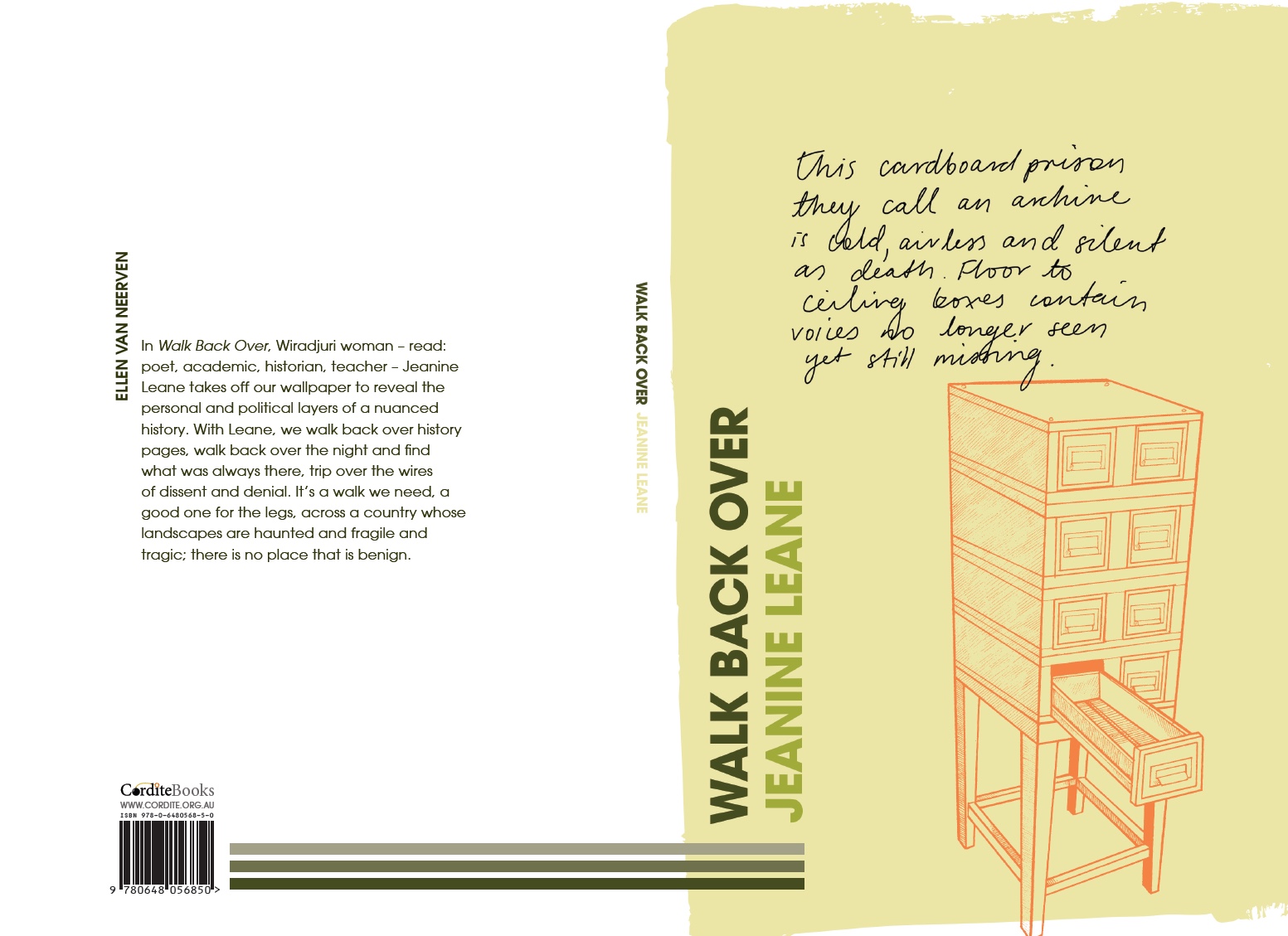
Introduction to Jeanine Leane’s Walk Back Over


Cover design by Alissa Dinallo, Illustration by Lily Mae Martin

BUY YOUR COPY HERE

In Walk Back Over, Wiradjuri woman – read: poet, academic, historian, teacher – Jeanine Leane takes off our wallpaper to reveal the personal and political layers of a nuanced history.

With Leane, we walk back over history pages, walk back over the night and find what was always there, trip over the wires of dissent and denial. It’s a walk we need, a good one for the legs, across a country whose landscapes are haunted and fragile and tragic; there is no place that is benign. ‘What piece’ (what peace)? – the question asked in the second poem, ‘Piece of Australia’ – becomes an echo in the reader’s mind throughout the collection.

We know the past speaks, and Leane personifies history. Lady Mungo has a voice, the archives have a voice, the ancestors have a voice. She grew up in Gundagai in the Wiradjuri (meaning: of the rivers) nation in central New South Wales and her Country and the legacy of the women who raised her on it are central to her vision of Australia.

Walk Back Over is an accomplished poetic dissection of the country’s problem – an embodiment of an inability to move on from a colonial terra nullius mentality that minimises massacres and denies the theft of land. We represent communities still looking for lost ones. Trauma is in many rooms and still we survive. To demonstrate this, Leane shows the personal effects of assimilatist policies. In ‘Real Australian girl, 1975’, the young narrator pictures conforming her body for the white gaze in visceral terms ‘… a fillet knife / slicing through those thick lips until they are / wan, white and bloodless like Friday fish’. This is matched with the resolute, defiant identity: in ‘Unassimilated’, ‘Your assimilation failed to break / black lines flowing from the heart / my Grandmother, my Mother, Me, my Children.’ A desire grows to put them, the colonisers under the microscope – we’ve been under there too long.

Hot water is always hot. It keeps being refilled. The words continue to be direct, calm and clever. The timing and sequencing delivers, the collection flows and ebbs like – I imagine – the author’s often-mentioned ancestral Murrumbidgee River (a life source, a document) used to before white intervention.

Leane continues to question what is ‘outside history’ in poems about visits to other countries. Like the beautiful ‘Sunrise to Sunset in Yangshuo’, where the narrator moves with the sun through the city and does not drop her gaze. I will return often to this scented writing. When we absorb knowledge, we become larger.

Close to the end, tenderness comes in. Through the length of the collection, Leane has carved a hole in the rock of us and that’s where I have saved my tears, for they are gathered in the tiny pool of a beautiful poem, ‘Child’, about the relationship between mother and son and the slippage of time. ‘You clung to my hand like / I knew the world.’ The emphasis on love in Walk Back Over brings a reminder of responsibility. If you love this country, truly love it, understand what has been taken, talk about it, don’t flinch, don’t cover your eyes.

Posted in INTRODUCTIONS | Tagged , ,

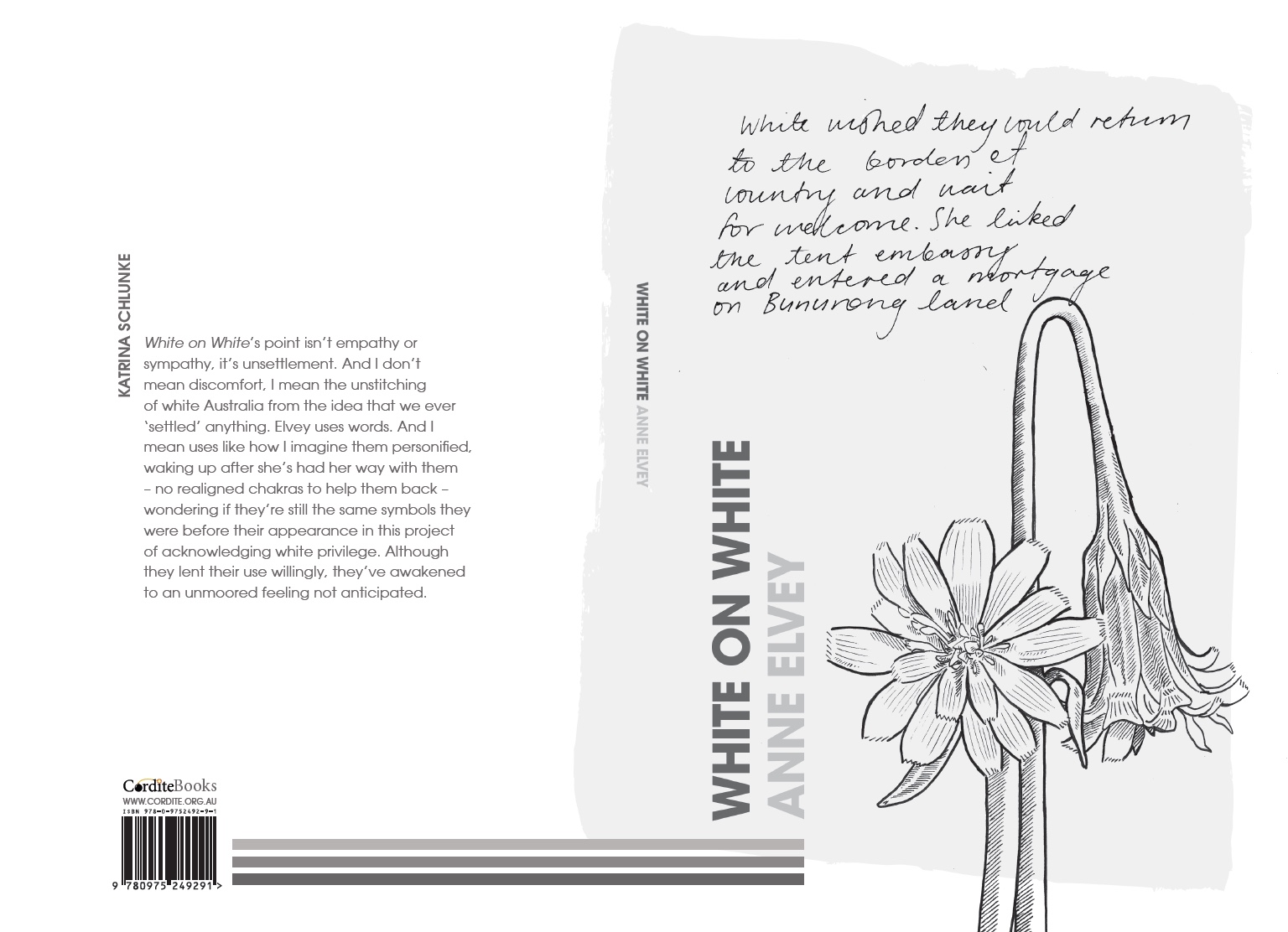
Introduction to Anne Elvey’s White on White


Cover design by Alissa Dinallo, Illustration by Lily Mae Martin

BUY YOUR COPY HERE

What is happening in these poems? Or do I mean what happens to us, the readers? But which ‘us’? And what reader? I am not really talking about feeling, although who couldn’t, wouldn’t, feel when ‘School Days’ – a poem that records every detail of white skin and soul, sun-warmed government-issue school milk and British ritual in one colonial Australian home – has another child, likely an Indigenous Australian child, stolen ‘while waiting for a train’. This is a crystalline evocation of the public secret of the removal of Australia’s Indigenous children from their homes and communities, which began as a sporadic technique of settlement in the early days of the colony, became an official policy of assimilation in the 1900s and continued right up until the 1970s. But White on White’s point isn’t empathy or sympathy, it’s unsettlement. And I don’t mean discomfort. I mean the unstitching – through the interrogative deployment of one uncanny image after another – of white Australia from the idea that we ever ‘settled’ anything.

Although I have identified a connective theme, don’t for a moment think there is a sameness to the poems that follow. Rather, they operate with the necessary mix of adaptation and surprise that tactical warfare demands. Elvey’s poems use the spatial possibilities of the page: hiding some words within gaps, sending others to the raw edges and pushing yet more into compressed packages as if an introduction to something greater … closed fragments fallen from another tomb. They show their sources and, in so doing, march us in to ask complicated questions of historical ‘truth’. What more than ‘report’ does any report do?

In White on White, Elvey uses words. And I mean uses like how I imagine them personified, waking up after she’s had her way with them – no morning-after pill, no realigned chakras to help them back – wondering if they’re still the same symbols they were before their appearance in this project of acknowledging, perhaps even dismantling, white privilege. Although they lent their use willingly – took drugs, gave permission – they’ve awakened to an unmoored feeling not anticipated.

Sometimes the words are simply left to bleach in the sun, marooned by the impasse they produce. Look carefully at ‘Five ways of graphing colonisation’ and see how the lines

Terror nullius of empire, imprints my retina, 
press, 
of moisture,
on a cheek

effect a very different politic of white distance when distributed across the page like forgotten huts on unused hills. Other words are made to churn up the gaps between colonial and Indigenous Australian philosophies, and between ideas of Country and notions of land owned, settled, fought for, inherited, mined, farmed, schooled and stolen.

Listen to these sentences removed from the whole of their original poems: ‘What ticket is inherited for title?’, ‘the unhurried hazard of the banksia counters / the raised pulse of the dash’ and ‘I put my hand to the twitching rod / lend my ear to the ochre ground’. Tiny phrases that worm their way under our suddenly very noticeable skin. This collection is not the bomb or its blast in an old-fashioned war; it is an attempt to unsheathe the non-Indigenous from the idea of an ordinary skin. Perhaps all of these poems can be explained by the poet’s admission that there once was a time she mispelled ‘seperation’ and on her ‘desk the whiteout / is shelved beside the pens.’

Posted in INTRODUCTIONS | Tagged , ,

Winners for the Val Vallis Award for an Unpublished Poem 2017

Run by Queensland Poetry Festival, and named in honour of a distinguished Queensland poet, the Arts Queensland Val Vallis Award for an Unpublished Poem is committed to encouraging poets throughout Australia. 2017 Selection panel: Stuart Barnes and Michelle Cahill.

Winner

In ‘Quietly, on the way to Mars’, Bronwyn Lovell opens a space for the discussion of human evolution and the unknown. This dazzling lyric and narrative poem courses a similar trajectory to such oth er transformative feminist poems as Adrienne Rich’s ‘Diving into the Wreck’. Lovell’s poem houses shadows, a sense of the past and a curiosity concerning them; it sustains a speculative quality and maintains a fascination with the psychology of law and relationships; it is compelling for its wit, its command of striking language, its sense of quiet achievement. The speaker wryly notes: ‘The medi-display won’t quit winking / on my wrist. I worry what tales it is telling, / how long till those monitoring suspect / my duplicitous condition. That’s the trouble / with sending humans—we’re not so loyal / as Labradors, nor diligent as DNA. / People are bound to disappoint.’

Runner up (tie)

His Master’s Voice’, by Jeff Guess, is addressed to the poet’s father, and this spare sequence of five contemporary sonnets in couplet form takes for its subject a work tool or a writing instrument. It achieves a rare lyric accomplishment of characterisation and transgenerational narrative expressing regret and devotion, infidelity and compassion. It is a honed and quietly thoughtful sequence.

Highest QLD entry

Laurie Keim’s ‘The Future of Music’, with its trance-like focus and enigmatic dialectic, elegantly argues for the possibility of a lyric space in the technosphere.

Highly commended

(after) HER: dating app adventures’ by Rebecca Jessen
Buying satin dresses at Yu Garden’ by Ella Jeffery

Posted in GUNCOTTON | Tagged , , , ,

Buying Satin Dresses at Yu Garden

I buy them like fruit,
my body

still on the bike,
one foot grounded.

This one like a wedge
of lime on my lip.

Idiot machines
clench these colours

together in some grainy
province,

craft
ravelled down

to whatever thread’s
cheapest, raw cord

around the waist,
three cuts: head, arms.

This one slides
from its hanger, a ripe

weight in my hand,
crazed yellow strung

from the machine’s
tropic mind.

The street slings past.
A man pushes

his fruit cart, calls out.
I lay the dress

in my basket, hand over
blanched banknotes,

and though I know
this appetite can’t be met

by a dress
it is so delicious

that both my feet
are already off the ground.

Posted in GUNCOTTON | Tagged

(after) HER: dating app adventures

how do you say
how you doin??
without evoking Joey from Friends?

I’m only here because I want
to find a girl to ask
wanna Netflix and chill?

I filter out
the over 40
silver-haired
broken embrace
that was
you

swiping through
so many:
nose rings
(the new lesbian signifier?)
pics of you and your Burmese kitten
(how original)
tit pics
long-haired lesbians
(maybe The L Word was realistic after all)

Lucy liked you!
hit the ♥ to start a conversation

how do you say
to the 20 year old
I prefer older women

I’m looking
for a straight-up lesbian
to raise my puppies with
r u down 2 clown m8?

I’m not surprised to find
none of these girls are you

you’re like a movie usher dude
but more stylish 😉

how do you take a compliment
when the last compliment was
you are good and tender and kind
and I don’t want you

how do you say
I mate for life
in text speak?

is it wrong to click ♥
because I think your Burmese is cute

a sparky sparks up a conversation
didn’t you say
you wanted
to date someone good with their hands?
I was good with my hands once

I’m one of those people
who’s like
arts degrees
what’s the point?

laugh out loud
and back away quietly
you have someone else to be

how do you say
I had two hearts once
how do you say
I only came here to forget
her

what happens when the girl says
I’m looking for that special someone
and some unburied feeling
ruptures you

I am not looking for that special someone
I am not looking for that
I am not looking.

Posted in GUNCOTTON | Tagged

The Future of Music

1.
Is it the sound of rain, or rain
Distorted, a downpipe, the pitch
Of blue harmonics in a score of blue?

There, the sound, and then there’s you,
Grand arbiter, the governor of loops,
By whits, you pulse, you impulse to the drip,

And there, you hear, in time, everything,
Everything imparts reverb, everything,
Birthing stars, volcanic blips, the mind.

Is it enough to hear your voice pause,
A multiverse away, like TV news,
Heard, streetwise, in prophetic riffs?

To hear you move, by tonal raps against
Yourself, hear you drawing nearer,
Hear you in silken sound-scapes, repeat,

Each step within the biosphere, repeat,
Can you hear me now? The harmony,
Never before heard, in allied time.


2.
Where, exactly, in my future mind,
Will you be playing? In gabled woods?
Shall I prepare a festival and shake

My tambour to your drum-machine?
Wave on wave, waterbirds surf
The heavens, for the end is always,

Timelessly, beginning the next curve
Of justice. I don’t wish to march, no more,
But soar, the pinion in a curving wind.

By the sound of it, we dance closer,
In reverberating essence,
Polar, we press our hearts, only, ahead.

Drips of rain falling on paper,
Eternal exclamation marks,
How each, the incidental holds to you,

How the particular is first out
Of phase, and before too long, we rely
On it, to bring the music to the future.

Posted in GUNCOTTON | Tagged

His Master’s Voice

for my father

Shovel
i.

Beneath a trademark
rust – spendnought

the worn calligraphy
of work – still

stamped on the shaft.
The work ethic

of his generation.
Not replaced

but repaired,
over and over again.

The patchwork
of so many years

made stronger always
at the broken place.


Fishing Sinker
ii.

Making with him as a child
spoon-sinkers for the dragging surf

of Christmas beaches.
Molten lead – poured

into his workman’s thumbprint
into sharp wet sand

a metaphor that might turn
base metal into something precious.

Handing carefully
the small crucible to me,

that first time – to make my own,
after his fashion. Lies now

within my grasp. The alchemy
of all that I once had from him.


Lino Knife
iii.

The blade
a small silver crescent moon

of tempered steel
honed to a razor:

he might test along
the dark hairs on his hand.

And then the cut and slice,
a secret pact

between his eye and fingers.
The sharp smell of new

yellow linoleum. The dark red
inlay of swirls and shapes

and then the quick fish
that swam beneath the knife.


Golf Spoon
iv.

A khaki canvas bag
of wooden sticks

he shouldered across
the bare earth and stony

golf course
at Tumby Bay

raking the sand
as an auxiliary for grass

always a birdie
on the fifth

an eagle on the ninth
and who used to say

the best wood in his bag
was his pencil.


Fountain Pen
v.

For four years
in Darwin after the Japanese

poured his heart out
in a river of love

the blood transmuted
into blue ink

through the small black
Bakelite pen

one for every day
to the woman who was not

my mother then
a marriage in only words

burning them all after he died
before she got too old to forget.

Posted in GUNCOTTON | Tagged

Quietly, on the way to Mars

i.
There were things I was sorry to see fade:
the haze of Earth’s atmosphere,

the last soundwaves from home,
and his fingerprints on my skin.

ii.
They sent him to sprinkle seeds
like fairy dust, to thaw frozen soil

with the warmth of his touch, to unfurl
green tendrils, rouse a dormant season

and remind life how to grow: stubbornly,
despite it all. But seven months is a long

stretch to travel somewhere—long enough
for the smallest kernel of regret to swell, turn

sour and sprout. If only it were just that.
Wildflowers have sprung from our garden bed.

I want to scream, kick, pummel my fists
but that would only waste oxygen, damage

the ship. I sit tense as a tightrope, silent
as a land mine woken with a click.

iii.
I harbour a stowaway, knees tucked
snugly under chin, silently floating,

curled inside flesh — cushioned and
weightless. The most natural thing

in our world is now worldless, blindly
travelling toward an unnatural fate

too late to terminate. I should have
listened to my mother, to every cell

objecting to the centrifuge, the deep
sea dives, all those times I thought

I would die if I had to live through
another day of training. But I was too

stubborn to give up. Couldn’t see
then, I was giving up everything.

iv.
I used to read the seasons scrawled
across the sky, watch patterns

track in arcs, look to clouds for cues,
spy cumulus gathering low and thick,

heavy on the horizon. Hear rainbirds
screeching overhead, question the air

to gauge the weight that threatened
to fall upon or shudder through me,

fathom how long I might have left
to shelter, or risk a last-ditch run.

Space wears no clouds, has no cockatoo.
No storm-scent stirs the soul awake

on stuffy afternoons. No change in wind
swings in to prickle pale, goosy flesh.

No cicada chant fades to hush
as raindrops hit the rusty tank.

No crickets thrum their tonal tide,
trilling me to sleep. Your small feet kick

me conscious, cramped in my cold,
climate-controlled bunk. Quietly, I weep.

v.
Hard to concentrate on anything other
than those cells multiplying within,

performing set functions without
questioning—crafting the lovely, tiny

skeleton our blueprints dared to sketch.
The medi-display won’t quit winking

on my wrist. I worry what tales it is telling,
how long till those monitoring suspect

my duplicitous condition. That’s the trouble
with sending humans—we’re not so loyal

as Labradors, nor diligent as DNA.
People are bound to disappoint.

vi.
I am pregnant. And day
by day, the I falls away,

becomes vessel, protective
layer for my successor—

all mucus new.
Bearer of bloodlines,

turning in womb, feeding
on me, making me sick.

vii.
Without gravity holding us together,
nobody knows how a foetus will grow.

They’ll have to scalpel the child
from me, of course—our bones

too weak for a vaginal birth.
My body has changed

since leaving Earth—
defying its own evolution.

Posted in GUNCOTTON | Tagged

Submission to Cordite 84: SUBURBIA

Suburbia

Poetry for Cordite 84: SUBURBIA is guest-edited by Lachlan Brown and Nathanael O’Reilly.

Send us your latest and greatest poems about the suburbs, the immense variety of life therein, and whether your suburban experience is inner, outer, middle-belt, beachside, exclusive, inclusive, multicultural, bogan, hipster or something else together. We want to read your poems about sprawl, diversity, quarter-acre blocks, subdivided living, Maccas, Woolies, drive-through bottle shops, abandoned shopping trolleys, graffiti in alleys, storm water drains, milk bars and 7/11s, kids walking to school, the elderly waiting at bus stops, slow trains to the city, skate parks, footy fields, rubbish-filled creeks, mosques, temples, churches, shopping centers and your first kiss behind the bike sheds after school. Interrogate and refashion those stereotypes about conformity, consumerism, homogeneity and boredom and surprise us with your explorations and excavations of SUBURBIA.


Submit poems (prose, comics, visual, concrete) or works of microfiction (500 words maximum). Read more about submitting to Cordite Poetry Review. Please note:

1. We will only read submissions sent during our official submission periods.

2. Cordite maintains a hybrid submissions policy. This means that the guest editor may invite five (5) Australian and five (5) overseas authors directly to submit to the issue. In addition, the guest-editor will anonymously select an additional 30-35 works from Australian authors and use their discretion to select further overseas works. For each issue, the guest editor does not know the identities of the online contributors (via Submittable) until after the final selections have been made.

3. Simultaneous submissions or previously published material will not be considered. This includes works published in print and web journals but does not apply to material first published on personal blogs.

4. Please place up to three (3) poems in one (1) Word, RTF or PDF document (unless specifically noted otherwise for special issues), with no identifying details in the document itself.

5. We are not able to offer feedback on individual poems.

6. Submissions will only be accepted via Submittable …

submit


Posted in GUNCOTTON | Tagged , ,

Signs from Asemia: Yasmin Heisler Reviews asemic 15

asemic 15
Compiled by Tim Gaze


I was at a tram stop recently when a woman walked past wearing a black dress. There were short white threads sewn onto the material. Each thread was stitched leaving the ends to dangle. These dangling ends reacted to her movement and the gusts of wind, forming individual character-like shapes. I found myself mesmerised, particularly because I had been asked to write this review, and was contemplating the meaning of asemic.

Asemic writing focuses on the visual aesthetics of written language without the legibility of writing per se. Though uninterpretable, according to Tim Gaze, the editor and publisher of asemic 15, asemic writing must mimic what we know to be writing to an extent, so as to differentiate itself from visual art. Some, like Todd Burst, would describe it as the textual residue of writing; others state it lies in the realm of the pre- or post-literate. For artists such as Rosaire Appel, whose work is represented in the magazine, it is more about context. Appel states in zoomoozophone review: ‘Perhaps it has less to do with the graphic itself than the space or territory it resides in.’ Many books of asemic writing have been published and a community of practitioners has formed, some of whom may well feel disenfranchised from more mainstream art / literary communities. Though nebular and possibly confusing, the term asemic is now being used more widely in criticism.

I recognise the importance of endeavours that intersect the writing / drawing divide, however, when first gathering texts relating to asemic writing, the cautionary words of Britain’s conceptual artist Victor Burgin came to mind:

Interpretation requires … tracing of alliances and elegances, dependencies and conflicts between the work in question and the context within which it is produced … In the absence of interpretation we are left with the brute obviousness of the literal content of the work and the manifest declarations of its author and their consensual echoes.

Or perhaps put more simply by TS Eliot: ‘No poet, no artist of any art has his complete meaning alone’. Interestingly, the word asemic does not exist in the Oxford Dictionary or the Macquarie, however it is defined in the 2015 edition of the Oxford Dictionary of Psychology:

n. Impaired ability to encode or comprehend signs such as gestures (1) or the spoken and written signs and symbols of human languages. Also called asemasia or asymbolia.

Michael Jacobson and Tim Gaze have written about asemic writing as a ‘wordless open semantic form of writing’:

The word asemic means having no specific semantic content. With the non-specificity of asemic writing there comes a vacuum of meaning, which is left for the reader to fill in and interpret … free to arbitrary subjective interpretations … True asemic writing occurs when the creator of the asemic piece cannot read their own asemic writing … Even though it ‘is traditionally “unreadable”, it still maintains a strong attractive appeal to the reader’s eye’.

Gaze, to an extent, has controlled the discourse. Wikipedia tells us that he is both the producer and mediator of meaning and, in the process, constructs his own artistic and public identity. Disagreements about the definition however, started to appear on the site towards the end of 2016. Co-founder Jim Leftwich is quoted to have said: ‘it is not possible to create an art / literary work entirely without meaning.’ From the information made available online by Leftwich, concerns have been articulated since 1998. In 2012, ‘Olen’ writes on slowforward.me:

How is it possible for anyone already possessing a language to produce something in another ‘projected’ or ‘imagined’ sign system where the producer pretends to have no access? Isn’t asemic writing a species of fantasy?

A 2013 interview between Quimby Melton and Michael Jacobson illustrates just such a quandary:

Melton: […] Since they usually cannot be “broken” – that is, translated into objective carriers of meaning – one can interpret asemic texts as the ultimate encoders of personal insight and reflection. Everything from a little sister’s journal to the rape fantasies of a poetic psychopath could be safely housed in asemic glyphs […]

Jacobson: I have put some of my ugliest and most beautiful thoughts into my asemic texts, and that’s where I’d like these thoughts to stay.

To label a work as asemic, may infer some kind of code or post-truth vessel. Here, illegibility to the reader is seen to be the foremost intention of the work regardless of whether it is actually illegible to the writer.

For Jacobson, interpretation or critical engagement with asemic writing is unwanted. And he is not alone. Gaze, too, views ‘the usual modes of literary analysis taught at Universities… as being similar to the way animals are judged at an agricultural show.’ Similarly, The Asemic Manifesto 111 states:

Asemic workers of all countries, unite! We want to get away from the postmodern layers of meanings into the asemia of class into the international alliance of the new post-literate in the name of sensual unity and dis-alienation of souls.

For argument’s sake, if we take the work as having the conditions of asemic writing (illegibility for the writer and reader), we can see aesthetic arrangements that are an expression of influences, emotions, histories, experiences, prejudices, biases and politics, intended or not. There is no ‘void of meaning’, nor is there what Jacobson calls a ‘non-specific universe of points.’ Instead we find a conundrum: to call something writing without any semantic content is a curious premise. It relies, in the words of W J T Mitchell, on ‘relations and distinctions, that crop up in aesthetics, semiotics, accounts of perception, cognition and communication, and analyses of media.’ The context of art encompasses these relations and distinctions. Art by its very nature seeks to draw our attention to paradoxes, open ended-ness, new ways of expression, the uncomfortable, the tensions and the failures. Art asks us to think. There is a sense of infancy within the realm of asemic writing. As illustrated in the Quimby / Jacobson interview, contradictions give rise to questioning the authenticity of the work. Subjective categorisations also restrict visual and conceptual possibilities that may provoke insight in this field. (The sci-fi film Arrival 2016, comes to mind as an imaginative ‘probing’ of communicative possibilities.) Examples such as ‘attractiveness’ as a criterion for ‘successful’ asemic writing, as well as having a ‘likeness’ to known writing styles come to mind.

Rosaire Appel’s 2009 video piece Liquid Calligraphy questions the term asemic writing in relation to meaning. The video illustrates lines ebbing and flowing in a vertical motion that one may associate with sound recordings (having said that, much of the movement becomes full circular motions of lines). Though the video has been rotated on its side, there is just enough visual information given to understand that the moving image is surface reflections on water. Tonal contrast has been pushed to the extreme, allowing only black and white without any gradation of tone. Prior to this moving image, the video shows typed text stating ‘a piece of the – Hudson river tries to pass as – asemic writing’. The accompanying sound of passing cars and trains is slightly digitised. Appel seems to be playfully questioning the artist’s ability to ‘not know’ the content of their own practice, or how content becomes asemic. Surprisingly, as it is clear from her website, she relates to the term positively.

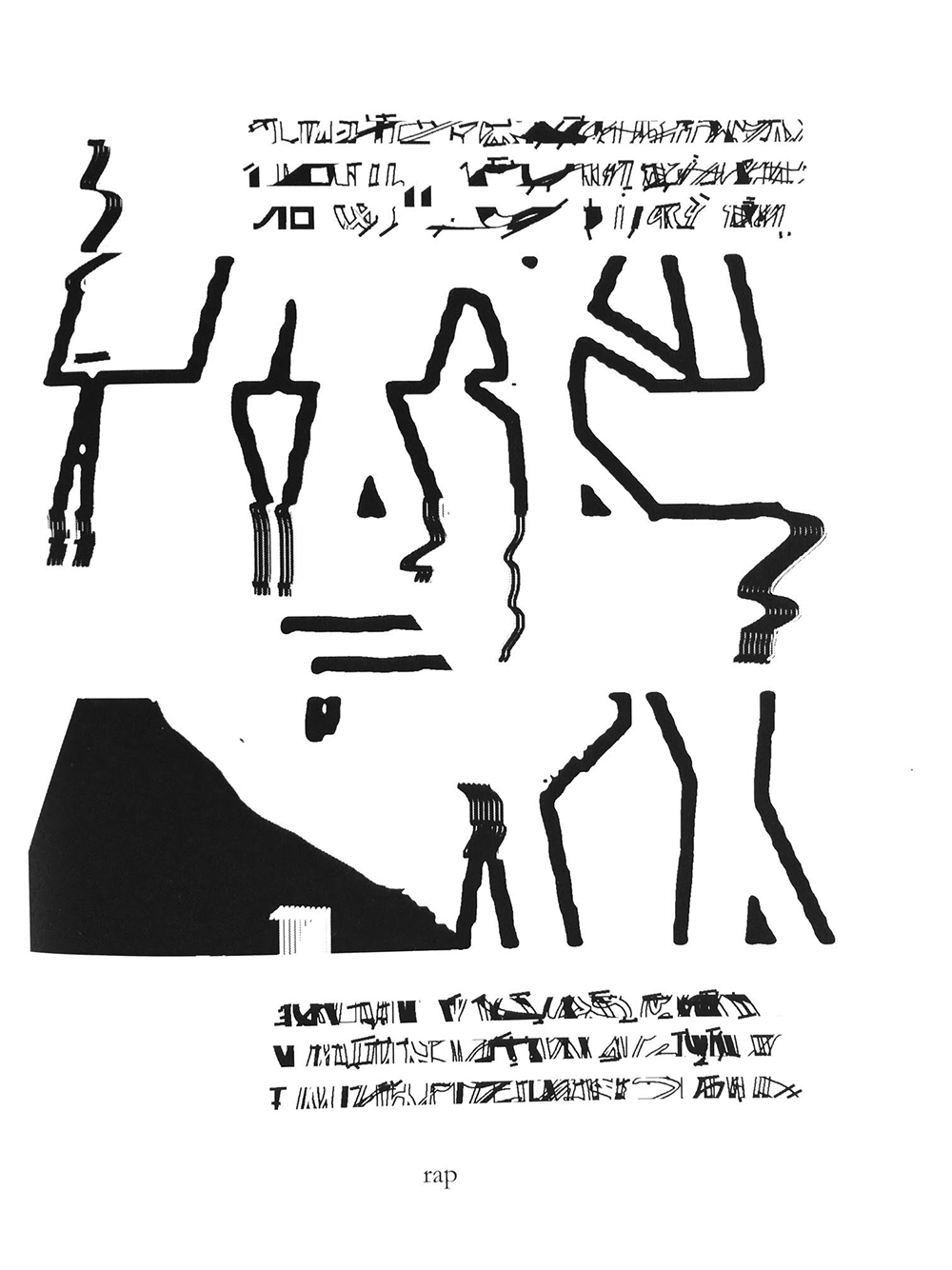
Appel has two works illustrated in separate locations in asemic 15. One is almost identical to an image from a book-in-progress series uploaded in 2010 under her asemic stories webpage. It is almost like Appel is demanding these marks be both pictorialised – where the marks are ‘enlarged’ and slightly contorted in the central section of the page (to be seen in space) – and ‘read’ – where the marks are clearly delineated into small vertical rows at the top and bottom of the page (thereby occupying time). Was the ‘writing’ originally a singular interconnected work and then vertical sections digitally erased to create rows? The lines in the central section of this page give a sense of torso-ness, a weighted centrality where lines taper in, and at either end, a sense that the lines have been cut. This is an artist whose documentation online shows that she has clearly worked in this field between writing/drawing in an extended way, and for some time.

Posted in BOOK REVIEWS | Tagged , ,

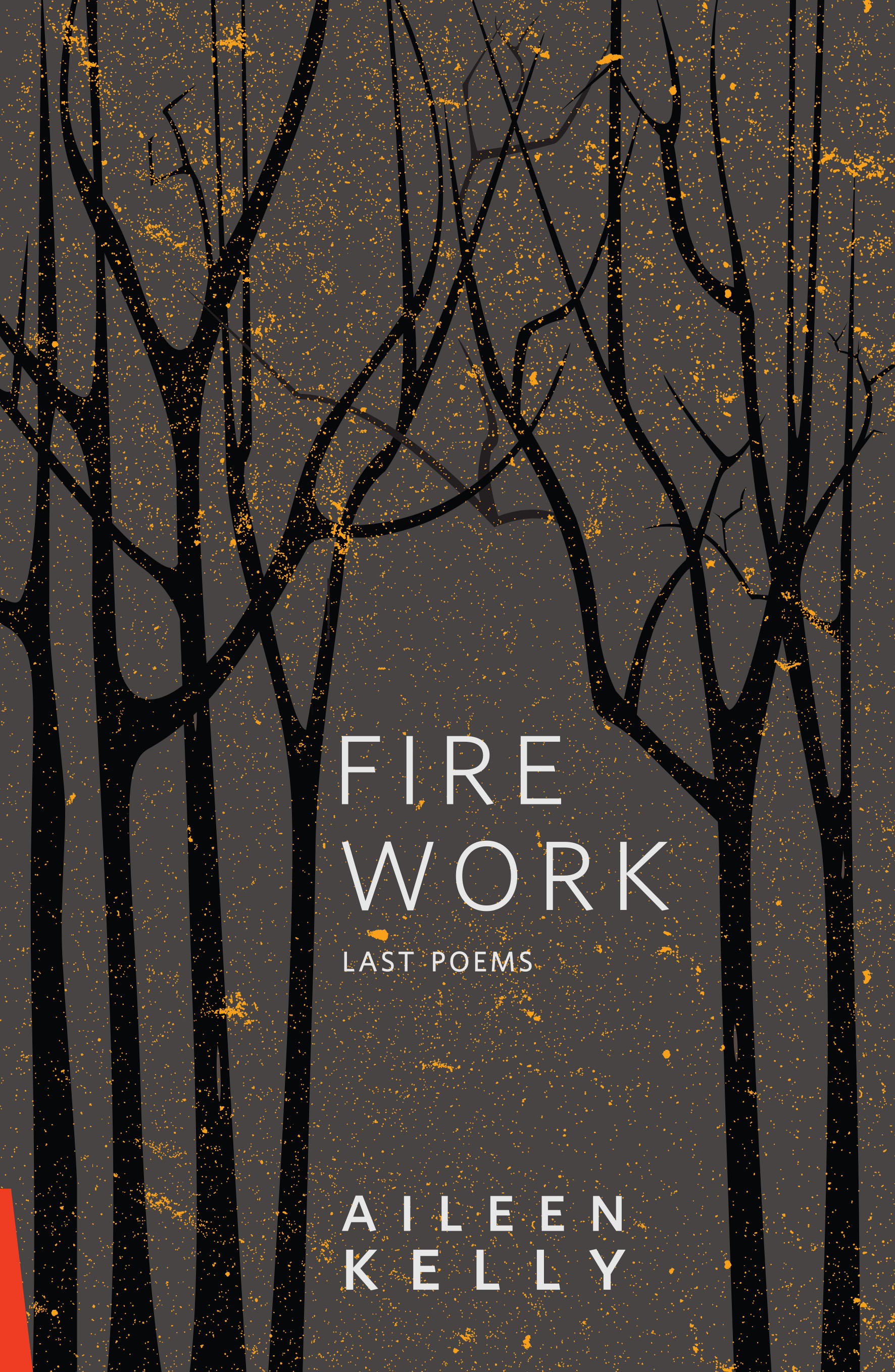
Review Short: Aileen Kelly’s Fire Work: Last Poems

Fire Work: Last Poems by Aileen Kelly
Gloria SMH, 2016


This is the last collection by a major Australian poet, and it is a firework in the tightness and effervescence of its poems. Like Aileen Kelly’s previous book, The Passion Paintings: Poems 1983-2006, it concentrates the work of many years. Unlike that book, however, this one was assembled and edited after its author’s death in 2011: firstly by her husband, Paul Grundy, and then by Catherine Bateson and Joanne Lee Dow. At that stage, the text was finalised by Dow and editor, critic and anthologist, John Leonard, who had been Kelly’s mentor for some years and whose press had published her previous book.

Fire Work is also the title of an enigmatic three-part poem about halfway through the collection. There, the fire only appears directly in the second and third parts; the quiet, first section is concerned instead with enclosure and a sense of pressure:

There was a wall around
of course
the vulnerable loves.
Windows, and they looked.
Doors, they went and came

and went. All correct.
The closed space quivers
shocked by the loss of sound.
The windows lapse their hold on light.
Only remains.

This first stanza, like many in Kelly’s poems, leaves open exactly what has happened, preferring to give an impression than to limit it by naming a cause. The poem as a whole, like many in the collection, holds silence and its rupture in tension against each other. Its second section brings words out of the silence, where ‘splinters of darkness might make a blaze upon the hill’. This fire, which becomes the one behind a grate in a fireplace, is both domestic and wild. It might be ‘Blake’s tiger’ or ‘morning day long watched for at barred windows’ or ‘the flare beyond surrendering branches / that must be next to burn’. In its final part, the poem turns to a grimmer kind of firework, in the practicality of letting an animal, even one on which one’s livelihood depends, walk in front ‘in landmine country’. The poem is a miniature of the collection as a whole: in the subtle balances which it works between contrasting elements, in the astute and unexpected selection of details, and not least in the ambiguity of the chosen elements themselves. The comforting is also potentially unstable or destructive.

These poems show an acute awareness of death and dying. Though these are, of course, staples of lyric and elegy, Kelly had an unfailing sense of how to make these old themes new. Her instinct for the concrete and specific is on show in, for instance, ‘Sunday afternoon’, on the weekly ritual of visiting a friend in a hospital (‘Save your jokes all week / for this performance’) or ‘Emeritus’. She sketches the title character of the latter in two uneven stanzas. The first catalogues the marks of surgery on his body:

The long cobbled seam of your heart scar
folds out under the twisted eye of sleep
into the brutal Y of a postmortem …

And yet in the second stanza:

still you carry your laptop
pro bono 
through the transit lounges of the dizzy globe
showing the way to mitigate disasters.

It is this combination of fragility with resilience, unavoidably temporary, which is perhaps most characteristic of Kelly’s collection. In ‘Contract’ the title refers to both book and mafia contract. The unnamed character has had, it seems, a stroke and is aware of her approaching death, still writing, but as if with a contract on her life. The description of her work in this stage as a return to writing on a typewriter, when ‘second thoughts were heavy effort’ is beautifully evocative and prepares the poem for its powerful final stanza:

But now again each touch
seems on the record,
flavoured Send or Print.
The trivial over coffee might become
the last thing she said.
The surge of making
heavies along her fingers.

It is the surge and the heaviness together that make these poems what they are: deliberate but never lapidary, produced by the surge and the heaviness.

Posted in BOOK REVIEWS | Tagged ,

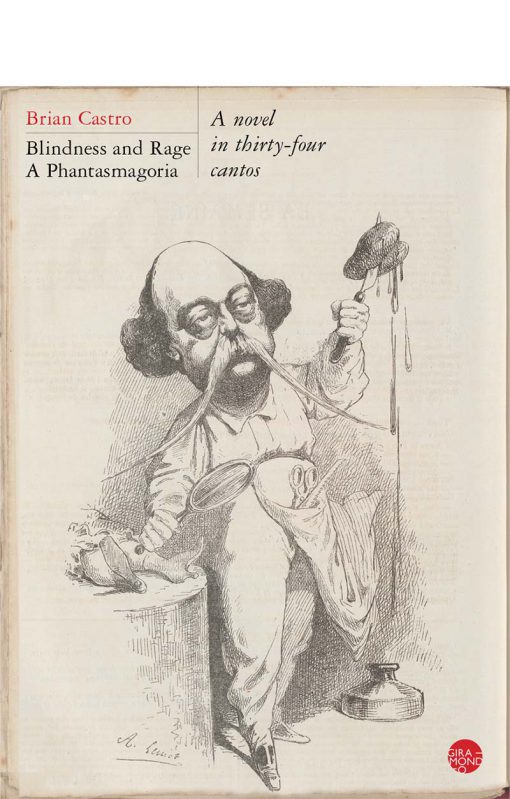
Review Short: Brian Castro’s Blindness and Rage

Blindness and Rage by Brian Castro
Giramondo Publishing, 2017


Blindness and Rage is the latest addition to an oeuvre that has established Brian Castro as a prodigy of hybridity. Castro’s heritage (Portuguese, Chinese, and English) is as uniquely mixed as the generic categories of his work, such as the blend of fiction and autobiography that won him such acclaim in Shanghai Dancing (2003). Blindness and Rage, at once ‘a phantasmagoria’ and ‘a novel in thirty-four cantos’, reprises some familiar themes in Castro’s signature style: a cosmopolitanism that shuttles restlessly between Adelaide, Paris, and Chongqing; the ludic propensities of an inveterate paronomasiac who wears his learning on his sleeve; a fascination with the vocational archetypes of the writer and the architect.

Blindness and Rage tracks the fortunes of Adelaide town-planner, Lucien Gracq, who moves to Paris after being diagnosed with cancer to dedicate his remaining days (53 on the doctor’s count) to completing an epic poem, Paidia, inspired by Roger Caillois’s 1961 sociological study Man, Play, and Games. Once in Paris, Gracq makes the acquaintance of the members of Le club des fugitifs, an all-male literary coterie that devotes itself to the anonymous publication of works by the terminally-ill. Epicures of self-erasure, the Fugitives raise the Barthesian thesis about the ‘death of the author’ to the level of a civic-minded mantra:

A named author dead or alive limits with fame
the cancerous spread of signification;
dead or alive, the named are pilferers
of status, guardians of unequal truths,
wrecking the liberty of recomposition. (107)

So says Georges Crêpe, frontman of the Fugitives, who are clearly modeled on Oulipo, the group of postwar French writers and mathematicians who set out to enlarge the prospects of ‘potential literature’ by tightening its compositional constraints. The other side of this ‘liberty of recomposition’, then, is ‘a ligature strangulation of meaning’ (142) so that what the Fugitives practice is, one might say, a kind of verbal chemotherapy. A not dissimilar point is made rather sharply by Catherine Bourgeois, Gracq’s concert-pianist neighbor who has her own ambivalent relation to the group:

They all suffer from vowel cancer—
it’s a male reflex
to constrict language;
something to do with the
castration complex. (142)

‘Vowel cancer’ is an uncharitable moniker for the lipograms with which Georges Perec (perhaps the most well-known member of Oulipo) is most readily associated, though it is the letter O rather than the E programmatically omitted in Perec’s A Void (1969) that gets disowned (in theory) by one of the Fugitives as a ‘damp squib/ defusing the presence of the I’ (92). This anxiety about the O’s dissipation of the potency of the I is a graphic joke about the ‘castration complex’ in which the author’s very name is made complicit. Indeed, playing with names has become customary in Castro’s bag of tricks; not only is Crêpe an anagram of Perec (as a number of readers have pointed out), but Catherine’s initials (with ‘the slot above her letterbox/ listed “Bourgeois, C.”’) continue the pattern of mirrored identities in Street to Street (2013), where the fictional Brendan Costa haunts and is haunted by the work of the Australian poet Christopher Brennan.

For all its immersion in the heady atmosphere of what we might call (very roughly) postmodern poetics, Blindness and Rage recalls an earlier moment in twentieth-century verse experimentation: high modernism. While Kafka has exerted a consistent influence on Castro’s work, the decision to structure his novel in ‘cantos’ inevitably calls up the ghost of Ezra Pound, a fellow observer of ‘Cathay’ whose obsession with paideuma (an ethnological term denoting ‘the tangle or complex of inrooted ideas of any period’ of culture) is at the very least etymologically entwined in Gracq’s pursuit of paidia (the Greek word for unstructured or spontaneous play).

With its lyricism peppered heavily with a magisterial garrulousness, Blindness and Rage in tone and texture most closely resembles some of the more personable moments in the work of the late Poundian, Geoffrey Hill. Like Hill in The Triumph of Love (1999), Castro sometimes deploys puns that just about stave off the literalist banality of the ‘dad joke’ through the charm of the poet’s contingent relationship to his own erudition:

[I]n Australia we play possum.
Possum; because I am able
to be a surrogate for myself;
call it a mortuary aesthetic. (202)

This slapdash appropriation of Latinate prestige savours of an Antipodean egalitarianism that finds another outlet in the figure of The Dogman, a former high-rise construction worker who, after an accidental brush with an electric cable, now sells puppies and The Big Issue in an Adelaide mall. At one point he asks Gracq rather disarmingly: ‘what is this thing/ called deconstruction?’ (156)

As an embodiment of the hybridity feverishly imagined in various guises throughout the story, The Dogman is a totemic figure for the eclecticism of Castro’s enterprise in Blindness and Rage. A mixture of earthiness and ethereality, he conducts the novel’s energies away from the indulgent self-mortifications of European decadence towards an equanimity that is equal parts Eastern mysticism, Southern pragmatism, and animal indifferentism. After such exhaustive and (at times) exhausting cleverness, this equanimity is the closest that Blindness and Rage comes to a genuine touch of transcendence.

Posted in BOOK REVIEWS | Tagged ,

LAND Editorial

LandImages courtesy of the editors

When we chose to edit an issue of Cordite Poetry Review around the theme of ‘Land’, it was with an interest in the inherent openness of the word. Similarly, we came without a strong affiliation to any particular poetics, though of course our own aesthetic, moral and intellectual predispositions followed us. The process of reading through the many submissions was exploratory and open-minded.

But to be clear: we chose the theme foremost out of our love of the natural world around us and a concern for its care. We also chose to forego the most immediate artistic association with land – landscape – a term which narrows the field to a particular set of practices, histories and perspectives. Broad as those practices may be, we doubt, for instance that compost bins might have found a place among them (James Lucas, ‘Karma Bin’).

Instead, land is prosaic, almost concrete, like a smooth stone you can hold in your palm and which might sink quickly to the bottom of a river when cast. It is visceral in a way that landscape, as an abstraction or interpretation of land, is not. Land is something that can be owned – and taken. It is political – think of indigenous land rights and Lock the Gate – and at the same time a place that occupies time and memory; the land where I grew up, my homeland.

These many aspects of land permeate the poems we have selected. For example, the immanence of central Australia’s semi-arid desert-scape glows in Michael Giacometti’s haiku-like series ‘Some portraits of country’: ‘The watermark of a ghost / gum hangs in the mist / where a hill might grow’. Shona Hawkes’s poem ‘lost’ offers an uneasy merging of indigenous connections to land with contemporary urban infrastructure: ‘you walk by the stadium built on a marngrook ground / and the freeway that follows the songlines.’

And then there is the active verbal sense of land: to land a punch, a fish or even a space capsule, as in Isabella Mead’s ‘Final hours, Sputnik 2’, a poem whose poignancy requires some familiarity with its backstory to be appreciated: ‘You travelled in a bullet until the heat / spiked your blood and panic curdled lungs.’

This issue naturally features poems from Australia but, pleasingly, many other countries too – from Pakistan to Poland. This international perspective is critical, given the role that language and culture plays in shaping reality. The manner in which language shapes and constrains the idea of land and the natural world is particularly evident among the Rarámuri, an indigenous group in Mexico. They have a worldview that ‘does not … separate ontological spaces beyond and between the human and nonhuman worlds. We feel that we are directly related to everything around us. The trees are us; we are the trees. I am rain; rain is me.’1

Explicit here is an argument against the dualism and appropriation that seem embedded in western (and many other cultures’) perspectives of land. In his essay ‘The Trouble with Wilderness’, William Cronon argues that our concept of wilderness, even among well-intended environmental campaigners, rests on the notion that we live outside of nature, that wilderness is only defined by the absence of human touch.

Instead, Cronon advocates our constant connection to nature – from backyard gardens and local parks, through to wilderness areas like the Blue Mountains where indigenous Australians subtly shaped and lived off its natural rhythms for millennia. Cronon believes we can find ‘a common middle ground in which all of these things, from the city to the wilderness, can somehow be encompassed in the word ‘home.’ Home… is the place for which we take responsibility, the place we try to sustain.’2

In poetic terms, this understanding of nature and land invites a resistance to closed meanings: the poem that does not reach a neatly fenced ending. Instead, we preferred works that opened onto the domain of the potential, either through their linguistic playfulness or ambiguous emotional and intellectual fields.

For example, Bella Li’s sequence ‘Circles’ re-interprets Dante’s vision of hell in a disjointed yet earthly framework, a pastiche of literary cut-ups supported by her clichéd landscape photograph collages. Here is a poem that causes us to question the surface-level appearance of the world around us, where psychological unrest lies beneath observations of the everyday. Meanwhile, Ella Jeffery’s poem ‘genius loci’ juxtaposes the spiritual power of nature with its more banal manifestations:

god of the oilslick chests of male wrens …
god with the patience of a skink growing back its tail 
god of lights left on all night 
god of wind that carries off plastic chairs

Many of the poems that appealed to us were those where the lived (or imagined) experience of land was embedded within the poem or poet, ‘the self as field of experience’ as Jill Magi puts it3. In Francesa Sasnaitis’s ‘unstable edge’, land and memory merge, mediated by a photograph and, now, a poem too: ‘Look, there you are – / a red dot floating / in the middle of the blue // in defiance of land’.

So land is not simply a question of nature, but hybridity. Such hybridity is perhaps most explicit in the context of urban land – and no doubt most of the poets featured in this issue are city dwellers. Here our understanding of what constitutes the natural world can be transposed onto what has been termed the third landscape: the interstitial spaces of our cities.

That concern often translates into the realm of the political, as in Lachlan McKenzie’s playful prose poem ‘Endless Summer, 2017’ which merges ecology, culture and (urban) land: ‘I bleached my hair in solidarity with the reef but ended up reflecting the political climate.’

These self-consciously urbane poems tended towards a more explicit syntactic and symbolic disruption. It is means to both entertain us but also cause pause to consider what is hidden in our daily lives – the de facto exploitation, for instance, which takes place out of sight, out of mind in Nicholas Powell’s ‘Flat Pamphlet Chat’:

The fossil record for this period is rich. The ore typically 
stockpiled in the open, never to be woven into the fabric of the 
trampoline.

When all was revealed – submissions were reviewed anonymously – we were delighted to realise how few of the names we recognised. This issue is comprised of established but also many new voices (new, at least, to us). We hope that they provide an opening onto new perspectives for readers as well.

Posted in ESSAYS | Tagged , ,

The Land as Breath: Can Poetic Forms Be Metaphors for Landscapes?

Ben WalterImage courtesy of the author.

We are standing in the midst of a football field doubled in size and then doubled again; a great, flat oval of water covered by streaks of green sedge that strike up from the surface like spindly grass. It’s a wetland, but one that has spent the last few years of drought as land; this year, the heavy winter rains that have filled the island’s hydro dams have tipped this landscape into living water.

Still, it’s only knee-deep, even in the middle. There’s liberation in paddling about; as though the land, hiding in the shallows, is still holding on to something of the terrain. When bushwalking, there can be a certain reluctance to get your boots drenched early on a track. Many are the feeble attempts I’ve made to postpone their transition from dry to wet; skirting swamps and rock-hopping creeks, as though I were still roaming through the domains of concrete and the city. But on many trips it’s inevitable, especially in Tasmania, where the land and water often overlap. And there is freedom in taking a first plunge, as though a whole new landscape has been wakened to walking; like an open moorland where any direction of travel is possible and permitted.

This particular inundation is in aid of project for Tasmanian Land Conservancy at a reserve near the Freycinet Peninsula. The artist Richard Wastell and I have wandered into the middle of the wetland, inspecting old shooters’ hides and swan nests; both of them abandoned, as though each side has given up and gone home. We take notes and photographs. Every now and then one of us will call to the other from thirty metres across the water. This is all an approach I’ve found conducive to poetry; giving close attention to the natural world and letting the landscape trigger images that flick through my head.

In the past, I’ve resisted being labelled as a ‘nature’ poet, but I confess that it’s the wilderness that gets my brain leaping. This was certainly true of the wetlands. In an extract from Sedgeland Nation, I write:

if we are straws slurping
at this pool, it is to slake 
our own thirst; we have 
claimed this land as 
ten thousand flagpoles 
needing no flag, but 
we are gentle scepters;
a nest dispersed and 
cradling paper wings.

this silt: our home, 
where all legs hurry 
as their days dry up;
this rot: our mother,
tadpole to sedge. and so
we murmur the rhythms
of frogs when our strings
are plucked by breeze;
we are instrument and stave,
a hymn to this, our year.

Until recently, this tendency had also been true of my fiction. The judges’ report for Overland‘s 2016 VU Short Story Prize describes my prose as ‘dense, almost overgrown in places, in a way that disorients the reader.’ Such a phrase could be employed of much of my island’s wilderness.

But even as I’ve pursued the natural world for a number of poetry projects, my fiction has largely abandoned the Tasmanian landscape. This could just be boredom, or a function of spending less time in the bush. With the absence of fresh and invigorating spurs, I’ve been drawn to tedious repetition; the same images recycled from memory, canonical scenes of buttongrass plains and the prickles of south-west scrub. This loop feeds back into literary boredom and the search for new ideas that aren’t beholden to landscape.

At the same time, my stories have become a lot less dense.

This could be for many reasons; exhaustion, or an evolution in style. But has my retreat from the bush contributed to smoothing out my prose?

The question of how land shapes text transcends simple content; a jungle and a Subantarctic island will provoke different perspectives on flora. In his short essay, ‘The Influence of Landscape upon the Poet,’ T S Eliot notes that his ‘poetry, like that of other poets, shows traces of every environment in which I have lived.’ Robert McFarlane, in The Old Ways, argues that walking in the natural world enables different ‘ways of feeling, being and knowing,’ while Sara Maitland’s fascinating book Gossip from the Forest outlines – at times persuasively – how the landscapes of Europe shaped traditional fairy tales in a way that deserts would never have done. But we need to venture beyond this into broader questions of form, style, voice and approach. How much does the land ‘speak’ such characteristics into existence?

I find the suggestion that it does, in any comprehensive sense, both attractive and dubious. It resembles a myth that I would like to be true, and suspect may even be legitimate in certain contexts or respects, but which I still fear might have little in the way of calculable substance to it. Are the metaphors that a landscape conjures prescriptive, having genuine influences on the shape of a text, or are they simply ornamental ways of reflecting on place? I find myself returning to two analyses that shape my thinking on these issues.

One is from the Tasmanian poet and environmental thinker Pete Hay. In a conversation with Richard Flanagan more than twenty years ago, published in Famous Reporter, Hay argued:

I’m increasingly thinking that to write Tasmania is to write an anti-Australian literature. There are good reasons for that. The Australian landscape icons for example, the bare brown land and wide open plains of Dorothea Mackellar, they are irrelevant to me. New Zealand poetry speaks to me more than does Australian poetry, because I share the same sort of landscape icons, the plunging, uneven landscape that I’m accustomed to in Tasmania, the forests and ravines and canyons and mountains. That landscape seems to generate a poetry with a lot more passion than the desiccated dry-as-dust understated poetry that mainland Australia generates. So I keep looking across the Tasman for poetic inspiration.

In Hay’s fine recent collection, Physick, the presence of Tasmania is transparent – and his poetics do appear distinct from those of many mainland poets – but it is not so easy to parse the influences of landscape, history, local vernacular and worldwide literary traditions on his voice. In the superb ‘Sound to the World,’ best experienced read by Hay, we can imagine the character Gentle Annie’s sentences finding their extension in the undulating landscape where she lives:

He tells me I am cald Gentle Annie down the Settlement
he says unown woman on the mountain I am much contimplated.

So my name is forgot down there in that gomorra
thay are sound to me and that is just to my likeing.

Hay includes many distinctive voices, some of them derived from interviews and oral histories, but the book is balanced with poems typical of his own assertive, questioning voice. In ‘The Wave: Drift and Echo,’ he writes:

The morning sea was burnished flat
To mirror the sun.
It crinkles now with sackcloth.

It is an angry rising
And the wave is its relentless fist.
This implacable struggle, ageless.

'Sea fences' to the saga-tellers,
They clatter shoreward now
As hurdles crash to a leg-weary horse.

Landscape is present here as content; but how are we to understand its influence on form?

Posted in ESSAYS | Tagged , ,

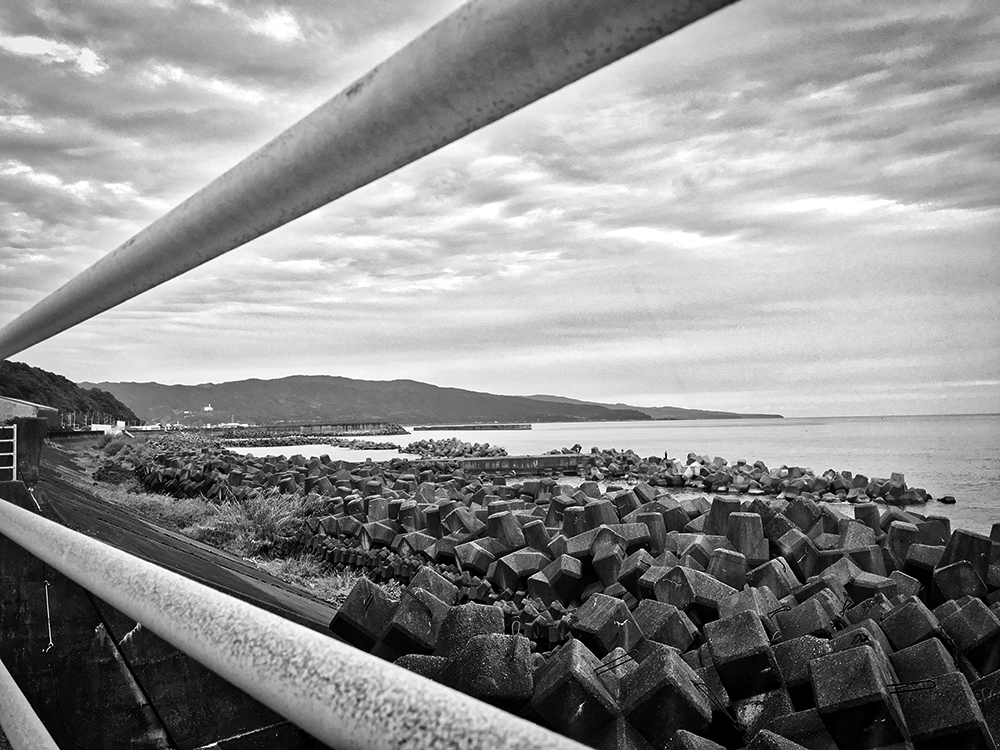
Concrete: A Shikoku Pilgrimage


Image courtesy of the author

A long day of road walking out of Tokushima. Twenty-five, twenty-six kilometres including five hundred metres of gravel before and after Temple 18. Rosie and I left the hotel at about 7:15am and walked along one of the main arterial roads. It was like walking from Perth to Armadale along Albany Highway during peak hour. Our main respite from the fumes and heat was a muffin meal at McDonald’s. We kept an eye out for a supermarket because we had been warned that there were no shops for three nights after Temple 19. Unable to read the billboards, we kept approaching what looked like a supermarket but they were either an Officeworks or casino. On the other side of a major intersection, with huge dump trucks idling, an industrial warehouse came into view and inside was the Food Garden where Rosie bought some sick tasting crab cheese sausage that we tried at a worker hut rest stop about eight kilometres later. Imagine a miner’s donga open and available to anyone passing by to help themselves to coffee and snacks. A couple of other Henro’s stopped while we were there. One tidied up and reorganised the slippers in the small vinyl entrance. A chatty guy arrived as we were leaving, taking to Rosie and giving her stories of life in the time I visited the port-a-loo out back.

*

After reading the Heart Sutra at Temple 19, a nondescript mansion from 900 A.D., rain started and continued until we reached Katsura michi-no-eki. Because of the minimalist sandals I was wearing, my feet were killing, and I complained to no end despite the fact pilgrims are not meant to complain. The wooden Henro Hut was too exposed and noisey to sleep in, so Rosie went in to ask about postcards and where to camp. The ladies inside said we could sleep on the wooden verandah or the grass patch out the back of the building beside the air-con ducts, the septic tank and drain. Too footsore to continue, we argued about whether to buy dinner or use food we carried and then set the tent up on the verandah looking out over the concrete walled river that flowed down from the mountain we would climb the next day. I found a small step ladder and unscrewed the fluoro light that was shining into the tent and attracting a thousand mozzies. About to sleep we heard huge explosions from the direction of the mining donga we had stopped at earlier in the day. Deep dynamic thuds vibrated the earth in rounds, the cacophony coming at us from distant miles. There must be an agreement, we discussed, between the villagers and the miners to blow up enough earth, enough of the mountainside to keep the workers occupied overnight. As we packed up the tent the next morning more explosions filled the valley for a quarter hour.

*

Temples mark the focal point for the walk. There are reminders you’re on an ancient pilgrimage all along the path. Small statues with red beanies or scarves sit in the leaves beside the track. Ribbons and tags hang from trees. Thousands of years of human history are embedded in the landscape. Where a dilapidated shrine exists there must have once been a Buddhist village. The hamlets we walk through are scarily quiet. Agriculture is intense as each vegetable, fruit or wood type is allocated a small patch to grow. We found an orchard of kiwi fruit, not yet ripe and too hard to eat. That day Rosie and I walked twenty three kilometres over two big hills and still finished before 5pm. There were other Henros around and for the first time we felt like we were part of a group of pilgrims; seeing the same faces, overtaking one another, praying together, sharing a concrete park bench. Seeing all the tired Henros at Temple 21, eating packed lunches from the bed and breakfasts. As osettai, I offered everyone a shortbread biscuit, and as pilgrims they could not refuse because osettai is an offering to Kobo Daishi, the deity who established this walk in the 9th century. No one wants to inconvenience or irritate. There was a chatty woman wearing beige pants and a beige shirt that said ‘United States of Paradise’. She had a wooden staff with a small bell hanging from the top and the top half covered in plastic to stop her hands getting blisters. She said she walked the trail every year.

Posted in ESSAYS | Tagged

World of Feelings: Ghassan Hage, Bruce O’Neill, Magic Steven and the Affective Dimensions of Globalisation

Lowest prices are just the beginning

Drive anywhere in Australia for long enough and you’ll pass a Bunnings Warehouse. Bunnings, a titanic home improvement merchant whose buying power enables the offering of low prices on products relating to the building and maintenance of the home, was around when I grew up in Australia, but I think my family went to a different, no-name hardware store. I certainly don’t remember counting Bunningses back when I was a child. I only started counting Bunningses when I was well into my twenties, zoned out behind the wheel, happy and relaxed after a day of day tripping. There’s a Bunnings on the way to Rye, Victoria, that I particularly enjoy driving by.

Magic Steven, a Melbourne-based performer of written words, held a popular monthly residency at Bella Union (Melbourne) over the summer of 2016-17. One of the performances, ‘Let’s Be Honest’, saw Magic Steven ruminating over what is written on the side of Bunnings Warehouses:

‘Sometimes in daily life, i drive past, or sometimes I shop at, a Bunnings Warehouse. And I always notice the same thing.
On the side of the warehouse. Will always be written,
BUNNINGS WAREHOUSE.
LOWEST PRICES… ARE JUST THE BEGINNING.
At some point I became conscious of that line, after reading it hundreds of times. and recently I wrote it down… and later, when I read the line back, off the page, I thought. What does it mean?
“Lowest prices are just the beginning.”
The BEGINNING. of What?’

This was trademark Magic Steven, a self-conscious yet casual, underdressed insight into the banal, an eyeing of troubling mysteries beneath our surface realities. Yes, indeed, the beginning of what? Magic Steven’s standard frame narrative, that since a trip to South India he has maintained this practice of writing ‘everything that happens’ to him down in notebooks ‘with the aim of treating every experience as a lesson to open my heart and mind’ introduces his shows with a charming, deadpan bathos. I must say I love that for all the detail with which this daily practice is explained, the audience is never let in on why Magic Steven reads these entries to them. How does performing these words on the stage fit with the ambition of learning a mind- or heart-opening lesson? There’s a lovely and strange omission where all points should meet. In any case, the audience finds the readings entertaining: they laugh – laugh a lot in fact, which directly aligns with the fact that Magic Steven is considered to be a comedian. (He has performed at the Melbourne International Comedy Festival three years in a row since 2014). I suspect Magic Steven’s audience would laugh as much, and in exactly the same places, if were he to present himself as a poet; but I don’t know that the poetry audience would be the same size as its comedy counterpart.

I’m spoiling the metaphor, but it’s worth looking at the way ‘Let’s Be Honest’ arced back into Bunnings Warehouse at the conclusion of the reading:

‘Maybe that’s what the marketing person meant when they came up with the line,
BUNNINGS WAREHOUSE. LOWEST PRICES…. ARE JUST THE BEGINNING.
The key word is beginning.
They know we all like beginnings. Lowest prices are just the beginning.
Everyone loves beginnings. But I don’t know how much we like middles. And endings.
If I keep focusing on beginnings. maybe I’ll be sleepwalking towards a middle and an ending, that I might not like. I thought.
And I closed my notebook.’

Structures of feeling like this make me uncertain of where to place Magic Steven. Comedian, or poet; or, certainly not … storyteller? This last category seems the least adequate of the three – there is little of a recognisable tradition and nothing nostalgic in Magic Steven’s shows. Perhaps he’s better thought of as a word processor, in Kenneth Goldsmith’s sense of that term. I’m impressed by the moments of emotional sincerity that, despite everything, seep in at the edges of the abstract reportage, the cant and the wordplay. The funny thing about feelings is that they’re not that funny – which is why, I suspect, Magic Steven tends to raise them in unadulterated form only briefly at the end of his shows. It seems particularly difficult to speak of communally – or even more ambitious – globally felt feelings in the candid manner with which we associate individually felt emotion. But Magic Steven’s oblique stitching of personal therapeutics upon the Bunnings Warehouse tagline (or the Myki touch on / touch off public transport payment system, or Uber price surges) evidences precisely how individual narratives are caught up in, and moreover written by neoliberal corporate rhetoric: marketing talks to us, and forms the bulk of the ubiquitous and boring text that shapes everyday life around the world. In other words, and quite obviously, globalisation is everywhere. By listening to grassroots activist movements we might learn a little about how processes of globalisation make people feel (usually insecure, but in solidarity, and often angry). But can we distinguish between reactions to globalisation, and the global as itself a kind of feeling? Along these lines, the anthropologist Bruce O’Neill suggests that globalisation is more than a global scale and a material set of flows. What, then, are global feelings? How do we recognise the affective dimension of globalisation?

Posted in ESSAYS | Tagged , , , , ,

Un(dis)closed: Reading the Poetry of Emma Lew

As with contemporaries like Claire Gaskin (Paperweight) and Kate Lilley (Versary, particularly ‘Mint in Box: A Pantoum Set’), Emma Lew has turned to fixed poetic forms like the pantoum and the villanelle. Constraint is both formally enacted and thematically explored. Like Gaskin and Lilley, Lew navigates the (sometimes gendered) limitations of agency against structures of law and an increasingly opaque backdrop of history. What do we inherit both in terms of our tools and our psychology? How might we rethink acts of wrongdoing or bids for freedom within the intimate scene of family and marriage? For Lew, the closed form provides a site to navigate frustration with the claustrophobically familiar and our desire for the unknown. It is a space where one can be both arrested and mobile, housed but unheimlich (unhomed). Through her careful structured refrains, Lew shifts between presence and absence, her objects of study often remaining evasive. At the same time, formal repetition suggests cyclical or more complex patterns of genealogy than simple cause and effect.

Arraignment Song’ is a modern pantoum and follows pantoum conventions (a series of four line stanzas in which the second and fourth line of each stanza serves as the first and third line of the subsequent stanza). An arraignment is a reading of a document formally charging a person with breaking the law. Here, the suggestion is an arraignment for murder. The poem itself focuses on legal procedure as it enacts correct poetic procedure. Attention is drawn to genre and formulaic structure: ‘The same show every time—that’s death’ (line 1, 40). Along with the narrative necessities of victim, suspects, murder weapon, and setting, there is also the detective. This is assigned to the poetic speaker. There is an emphasis on objects and a predominantly visual rubric of selection. A central object is a letter that has been mailed ten years after the death. The victim is read off the surface of their body (‘Nice clothes, expensive dental work’ (line 8, 11)) and their apparent lifestyle (‘Flash boats, fast cars’(line 2, 5)). The murder scene is also aesthetically read, ‘Blood pooling poetically around the fingers’ (line 10, 13).

It is around the third stanza and this line that it becomes possible to read the poetic speaker as the crime fiction writer (with the fingers being those of the writer rather than the victim). The process is not only one of deduction but of writing itself. Here the monkey wrench might mean an obstacle or disruptive force in the plan or progress as much as a potential murder weapon. ‘A lit cigarette at a respectful distance’ (line 30, 33) may be part of a detective’s system of surveillance or a momentary reprieve from typing or writing. ‘Stop on one thought, think it over and over’ (line 20, 23) may also be part of the process of deduction or part of the creative process. The ‘Tropical fish and some books on the subject’ (line 12, 15) may be those of the victim or the writer. ‘Night’s your office, shadowing pays’ (line 36, 39) might also refer to the typical noir detective or the writer who must shadow their subject. ‘Who faked a will, didn’t mourn the loss’ (line 24, 27) could refer to the writer who creates a fake subject as much as it might refer to the actions of a suspect. ‘If the family find peace, disturb it’ (line 32, 35) could also refer to the writer’s family as much as the victim’s. The repetition of ‘bitter pills’ (line 14, 17) makes their assignment difficult: is it the victim, the detective, or the writer who has them and does it matter?

At one level, Lew foregrounds how the process of deduction requires trying to work out patterns of cause and effect, as well as issues of motive (intention). While Lew writes that ‘Everyone has solid alibis’ (line 18, 21), the poem’s structure provides a space for the proliferation of alternative storylines. The form of the pantoum reinforces this chain or serial effect. We are told that ‘Slim chance connects you to a name’ (line 34, 37), emphasising this sense of connection. Yet the name itself is never announced or fully assigned; it remains both a shifter and outside the poem.

While the line, ‘Go cosy, slow, investigate’ (line 38) could be applied to the detective or to the reader, the coldness of the case is enacted in the lack of affect in the poem. This is a poem that does not create either a sense of cosiness or a sense of song as promised by the title. Instead, there is a sense of the mechanical and of being at a remove. This is reinforced by the final line which cycles back to the poem’s start, ‘The same show every time—that’s death’ (line 1, 40). The poem offers no transcendence.

Rattling the Forms’ is a villanelle. Just as a villanelle has a formal order, so too is marriage a formal arrangement. While the poem’s title suggests a testing or ‘rattling’ of form, it does not suggest breaking or eliminating the form. This is certainly the case with the poem itself, which largely keeps to the rules of the villanelle. It has five tercets followed by a quatrain as well as two refrains. Yet the opening line suggests an alternative desire; ‘I wanted to dissolve my marriage, explode the limits’(line 1, 19). This line also sets up a paradoxical metaphoric trajectory involving both water and fire in the verbs ‘dissolve’ and ‘explode’. The poetic speaker declares that she seeks a series of equivalences, ‘comfort, oblivion, anything in caves,/on a whaling ship, in a hundred other places’(line 2-3) Certainly ‘comfort’ and ‘oblivion’ have traditionally been aligned in a kind of Keatsian ‘easeful Death.’ Psychologists (most notably Jung) have interpreted the dreamer’s dangerous passage through caves as a search for the meaning of life and the cave can be the starting point for spiritual travel or personal growth. The most obvious allusion of the ‘whaling ship’ is Moby Dick which explores our need for signs of destiny and is also anti-Transcendental in orientation. Transcendentalists believed that people would ultimately do good if constraints were taken away from them. Herman Melville alternatively suggests that given freedom, people will make disastrous choices. Yet, there lies within us the desire to take the plunge into the unknown, to seek more. The phrase ‘hundred other places’ is one commonly used to suggest a kind of anywhere and everywhere.

Posted in ESSAYS | Tagged ,

Architecture, Poetry and Impressions of a Bendigo Chinese Doctor, James Lamsey


James Lamsey, c. 1888, image courtesy of Dennis O’Hoy

What have architecture and poetry got to do with property? This is a core question in the poetry collection ‘signs of impression’, which explores the operation of possession in a settler colonial context. It does so through the story of James Lamsey, a Chinese doctor, prolific proprietor and philanthropist who forged a space for himself in the regional Victorian city of Bendigo in the late 19th Century. Many thinkers have observed connections between architecture and poetry. ‘Architecture and poetry share a paradoxical sense of “room”’, writes Nicola Fucign, ‘A poem has both space and boundary: room within a room.’1 This spatial connection is beautifully script-bound in the Chinese character for poetry 詩, ‘shi’, a of compound ‘speech’ + temple’.2 However, I am less interested in the alluring spatial synergies between poetry and architecture than the work which poetry performs, and which architecture performs. Poetry and architecture both have the power to impress and move people. More dangerous than this, poetry and architecture can also be ways to lay claims to property through their affective powers. This essay argues that thinking about the synergies between architecture and poetry might deepen understandings of the operation of property.

Last year my research about colonial doctors of colour took me to the Bendigo Golden Dragon Museum. When I arrived, the Research Officer promptly and generously introduced me to two buildings with apparently quintessential Victorian façades. One is an austere, dark brick terrace on Howard Place; the other, a lush ornate and garden-girt red and white brick villa on McCrae Street, the main highway. Compared with the red-trimmed, lion-protected Museum a short walk away, the façades of the villa and terrace give no surface impression of Chinese-ness. Their existence, though, is intimately bound up with 19th century Chinese migration; more particularly with James Lamsey’s migration from the Southern China province of Toi San to the Antipodes.

Owning Jubilee Villa and Howard Place meant James had somewhere private to practice medicine and somewhere to live with his wife, Jane Boyd-nee Lamsey, and their adopted daughter, Kate. It also meant Lamsey conspicuously took up space in a white-ruled city at a time when the presence of people of Chinese descent in the Australian colonies was highly contested. This is my intellectual interpretation. But how do I – a Melbourne-based historian of Anglo-Celtic settler background – respond to Jubilee Villa and Howard Place? How do these buildings mediate my relationship to the colonial past, to the cities I live in which remain shaped by Chinese migration, and, to Lamsey himself? I find that formal scholarly writing does not do justice to the impression that Lamsey’s buildings leave on me. Poetry, though, allows room for emotional suggestion, and truth.3

Property in the life of James Lamsey

Lamsey was born in Canton in 1831 into a family of successful physicians and trained at the missionary-founded Canton Hospital before migrating to Victoria. Here, he initially worked in Geelong, Melbourne, and Beechworth before settling in Bendigo in the mid-1870s; a wealthy gold rush city built on Dja Dja Wurrung Country. Lamsey’s proprietorial life came to public attention in the mid-1880s when he hired two of Bendigo’s most prominent architects, German-born W C Vahland and England-born William Beebe, to design the Jubilee Villa and McCrae Street medical practice respectively. At first glance, it appears that Lamsey’s commissions reflected the dominant aesthetic value of settler society. Middle-class Europeans celebrated the buildings for adding value to the city at a time there was ‘a dearth of architectural progress’, and when nearby Chinatown was seen as ‘squalor’.4

Like other contemporary practitioners of colour, Lamsey had many an incentive to acquire property, and to associate his name with façades that would protect his medical and social authority against the exclusionary forces of white racism.5 Lamsey made his home in Bendigo at a time when the process of white Australian nation-building, with its much ado about property and possession, was in full swing. From 1788, British colonists had been asserting their right to own Aboriginal and Torres Strait Islander land based on the mythical concept of terra nullius, ‘no man’s land’. ‘The right to take possession’, critical race scholar Aileen Moreton-Robinson has written, ‘was embedded in British and international common law and rationalized through a discourse of civilization that supported war, physical occupation, and the will and desire to possess.’6 In the 1880s, European settlers in Victoria were reinforcing their numerical dominance via dual edged modes of possession – exercising their right to remove Aboriginal people off their lands, and onto missions and reserves under the 1869 Aborigines Protection Act, and formulating their right to exclude people designated ‘Asiatic’ – a grossly generic racial category that included Chinese, Indians, Afghans and Syrians – from the space of the colony. The 19th century had seen the introduction of Immigration Restriction Acts across British settler colonies; Acts that gradually denied Chinese people property rights, albeit in ways that varied between the colonies. In 1881, Chinese people in Victoria were disenfranchised and the 1901 introduction of the Immigration Restriction Act would more stringently deny Chinese citizenship, voting rights and rights to welfare.7 Lamsey applied for and received British naturalisation in 1883, and so became legally entitled to purchase property, which he did three years later.8

While Lamsey had imperatives to impress a polity of increasingly hostile and self-consciously ‘white’ settlers with his architectural choices, any assumptions that an assimilationist rationale lay behind Lamsey’s buildings are challenged once Bendigo is located in relation to the Chinese Empire. In 1887, Bendigo (then called Sandhurst) came under the discerning gaze of the Chinese imperial commissioners when they toured the Australian colonies to investigate reports that their people were subjected to the harsh treatments of settler racism. It was thus no coincidence that Lamsey built the Howard Place medical practice in 1887, in due time to impress the Commissioners. Lamsey was the first to greet them when they alighted at the Sandhurst train station, and that night the Commissioners were ‘entertained at dinner’ by ‘their medical countryman, James Lamsey, of Howard-place.’9 The following day they undertook a seemingly convivial tour of various Bendigo buildings of pride; a tour that took a tense turn when the group were prevented from entering the hospital by one Doctor Colquhan, who refused to let the party enter with ‘the Chinese doctor’.10 If this moment exposed the spatial limits to Lamsey’s medical authority and the racist attitudes of some of the medical establishment, it seems Lamsey nonetheless got what he wanted out of the tour. Before they left for Sydney, the Commissioners wrote and signed a testimony of Lamsey’s good character and medical skill. They also bestowed Mandarin Honours on Lamsey, as well as on herb merchant Louey O’Hoy, who effectively worked as Lamsey’s pharmaceutical support.11

Lamsey, though, was not one to rest on his capital. Two years after the Jubilee Celebration he married his housekeeper, Ireland-born Jane Boyd, and the two moved into Jubilee Villa. The settler press reported the Villa’s features in detail:

There are two verandahs … each being 8 feet wide, and the floors are tiled with red and white tiles. The front verandah has ornamented cast iron columns, frieze and brackets, with wood moulded cornice, covered with curved iron, the whole being painted in various shades of gold. The façade of the building is built with red and white bricks, having red and white tiled panels on each side of the front door.12

The use of red and white rather than stucco brick was in vogue with contemporary fashion, and most of the design features were familiar for a settler readership accustomed to Victorian aesthetics. One of the Villa’s features, though, was marked as ‘strange’; ‘A strange feature in the design is a pressed cement lion placed over a pediment in the center out of respect for the British nation.’13 Lamsey later informed confused journalists that the lion was a symbol of his loyalty to the British nation. To me, the strangeness of the lion raises questions about Lamsey’s intent in displaying this prideful ornament. Is this lion subtly subversive in that it digresses from a normal lion-free settler house façade? Does it suggest that Lamsey was even more loyal to the British Empire than the average settler? Is he reminding settlers of his right to own property as a naturalised British subject? Or, perhaps the lion also gestured toward Chinese power given that during the reign of the Qing Dynasty, as this was, stone lions, albeit of a different stance and design, were commonly placed in temples and gardens?

What is clear is that by the time that Federation harbingered the long-feared Immigration Restriction Act, Lamsey was a publicly empowered figure. His medical business had earned the trust of a large and loyal customer base, he was head of the Masonic Association, and he played a prominent role in the annual Bendigo Easter Processions. In contrast to many other less affluent and trusted contemporary practitioners of colour, Lamsey’s position in the uncertain times of the early 20th century was more stable than tenuous, and more prone to celebration than degradation.

Posted in ESSAYS | Tagged ,

Possession, Landscape, the Unheimlich and Lionel Fogarty’s ‘Weather Comes’


Image courtesy of Ellen van Neerven, black&write! @ QPF

I: A note on Indigenous Australians

A great many Australian poets are in an interesting and ironic state of dispossession, although perhaps only a small proportion of them actually feels that way – that proportion, let’s say, whose subjects and predispositions draw them towards the landscape, its flora and fauna, and their human experience thereof and thereupon. And perhaps we are speaking only of a proportion of this proportion – although even as we contemplate this we cannot exclude the possibility that some proportion of those great many who turn their backs upon such subject matter do so themselves out of some unacknowledged sense of impropriety or dispossession.

I speak of non-indigenous Australian poets. ‘Invader’ poets, some may prefer to call them (or us, since I am one of them). And ‘dispossession’ might not be quite the right term. Let’s say, instead, a being held back from a place or state they (/ we) might wish to reach, as if they were looking, from a ridge or a fence-line, at the field they want to go to, just over there, but find they have to travel a very long way round, or perhaps not go there at all, but instead to find somewhere else, to translate or re-site their desire. Nor am I suggesting that this is in any way like the dispossession indigenous Australians have themselves experienced. Some non-indigenous Australians, it is true, have experienced something very like it, in the homelands from which they have come as refugees, but this is not the case for most of those to whom I refer – though there are some minor yet tantalising points of comparison. We might see it, this new dispossession, as a kind of poetic justice.

Living all one’s life in a country, a landscape or set of landscapes, camping in them, walking through them, growing up with their sounds, their smells, having no other place so intimately available to one, no other place where one wants so much to be, knowing this as ‘home’, and yet knowing also – accepting, intellectually, as one must – that it is also an invaded place, and that one is descendent of those invaders, or that one has been invited, accepted, hosted and made complicit by their descendants, one is already dispossessed, or, since one did not possess, by right, in the first place, then in a state of not possessing. But I mean something other or more specific than that. I am thinking about writing or in other ways representing this state of being – or rather, since that state itself is not so difficult to represent, of representing one’s feeling about, one’s relationship to, that place, that landscape, which one loves, which has shaped one, and which one wants to – has no choice but to – call home, and yet which one cannot claim.

Even here I have not quite got it right. Claiming is not what it’s about. Nor, really, is possession. Each of those concepts is something we should probably be trying to overcome – why do we need to ‘possess’? – and we might eventually be grateful for this chastening spur. Let’s approach it yet another way. (This diffidence, this two-steps-forward-one-step-back, after all, is part of the poetics of this predicament.) Let’s say that the place, the landscape, does shape one, that it impacts upon one – that, if one has spent all of one’s life there (/ here), or even only a part of that life, and found oneself deeply drawn, then it has somehow in-formed one, taught one how to feel and think about it, how to structure one’s feelings within it. One’s writing – one’s representing – may very well become, then, an attempt to express this place and these feelings, the things which one perceives in this place, which this place has taught one to perceive within it, as best one can. One might even say that some part of one’s writing – some part of one’s poetics – might seem to have grown from this place. And yet, of course, one has brought – has been brought – an alien language, alien forms, with which to perform the task, and one cannot expect that here will be a ready match between these things (the language of the place itself, and the language one has brought to it): even when one has overcome all or most of the other cultural barriers and inappropriate behaviours and assumptions, the patterns and habits of other places that blinker and preoccupy an immigrant culture for so many generations – even when the living here has generated something of its own idiom, to make up for the insufficiencies of the imported languages and forms – there will not be a ready match, since it is not just a matter of terms and idiom, but of the deep grammars which deploy them.

There is always a path. Let us call it the Indigenous Path, though it is in truth a path of appropriation of the indigenous. We stare at it. It seems to stare at us. Some writers go down it with no qualms. Others may itch to follow it but, conscious of the manifold signs, actual and conceptual, tacit or vociferous, warning them against doing so – or perhaps simply from their own senses of respect, difference and mis/appropriation – choose not to, no matter how much it might ease their way.

The indigenous peoples have been in this country, on this land, within these landscapes, many thousands of years – whether this period be of forty, sixty or one hundred thousand years seems scarcely to matter when one is comparing it with the barely more than two hundred years of non-indigenous occupation. And if, as indigenous culture asserts emphatically, the land moulds the lives, ideas, languages and dreams of those who live upon it, then indigenous culture will be much more deeply steeped in these ways, will have been taught things by the place that it might take non indigenous culture many thousands of years yet to learn. It is almost a ludicrous understatement to say that indigenous culture has a great deal to teach the non-indigene who would express his or her feelings and experience of that place truly. And, as already foreshadowed, there have long been non-indigenous writers and artists who intuited or understood this, and attempted to learn, from indigenous culture, habits of thought and feeling more appropriate to the place they were finding themselves loving and wanting to express. At least one school of Australian writing, that of the Jindyworobaks, was dedicated to following this path – one of its tenets, naïve and presumptuous, was the substitution, wherever plausible, of terms and concepts from indigenous culture for English images and concepts. And, as it happened, this school suffered the ridicule of its own white culture for so doing – ‘Jindyworobaksheesh’, ‘Jindyworobakwardness’, ‘the boy scout school of Australian poetry’ (terms from James McAuley, R H Morrison and A D Hope respectively1). But as indigenous culture becomes more and more articulate, and articulated – better to say as its articulation is better and better understood – in the contemporary Australian and international environment, and better and more successful at asserting its rights, it becomes more and more clear that this path cannot morally be taken, or that earning one’s right to take it can take a long, long time.

And for non-indigenous poets this is a dilemma. If it is true, as indigenous culture asserts, that the land teaches, then those non-indigenous who are open and willing enough to be taught, by the land itself, without recourse to indigenous culture, will find themselves learning – find themselves inhabited by – things that, if they give them expression, will appear to have been appropriated from indigenous culture anyway. From a certain perspective, in other words, those who would learn and bear into their work the lessons of the place itself are damned if they do appropriate indigenous concepts, and just as likely to be damned if they scrupulously avoid doing so.

But already this discussion has begun to take on a freight of assumptions and misconception. There are numerous under-examined issues here and we should take a little time to note some of them.

There is, perhaps first and foremost, the issue of landscape itself – not exactly the field that the aforementioned dispossessed or, to put it more accurately, as-yet-unpossessing poets look at from over their fence, since that field, as we shall see, is a combination of actuality and concept, physicality and affect, thing inside and thing outside, but a large part of that field nonetheless.

The very term ‘landscape’ is a difficulty, as much a way of not seeing as it is of seeing, a way of preventing our understanding as it is a way of enabling it. A collective noun, a version of ‘Asia’, say, that one term which at once attempts to designate and obscures that huge panoply of nations, ‘landscapes’ and peoples that comprise it, each with their own specificities. Or of ‘the Animal’, a term which, as Derrida so clearly and simply explains , not only performs in actuality an act of considerable intellectual violence in reducing to the abstract One, and so enabling us to hold at bay, the countless differences of a vast array of distinct species, but also, since it bears so little relation to those to whom it is supposed to relate, says more about us and the way we wish to construct ourselves than about anything outside or beyond us.

From such a perspective there is no landscape. There are only landscapes, in the plural, in a multiple that becomes only the more so the more closely we approach it. Identify a landscape and you will find, as you look at it more closely, landscapes within it. Look at any one of these more closely and you will find landscapes within that. And no, it cannot be claimed that this is a problem unique to the way we relate to our particular environment. It is of course a problem inherent in language itself. Nor (at the risk of introducing a measure of paradox) need it necessarily mean that, cautiously, under erasure, we cannot use the term. The ‘landscape’, after all, as ‘nature’ outstretched, has been and remains the greatest symbol and metaphor we have for that which is beyond us, outside and obscured by the systems that comprise our knowing. We can talk, as we have been doing, about a mode of writing that brings us closer to the landscape, is somehow more appropriate or faithful to it, but surely all that any new mode of writing can ever be faithful to is our own sense of a replica or simulacrum of our own current understanding of the landscape – the body of ideas and beliefs and intellectual / conceptual fashions and frameworks that make up that understanding. To think that we are somehow getting closer to some actual ‘fact’ of the landscape is a little troubling, if not actually paradoxical or absurd, and flies in the face of so much we have come to believe about the impossibility, given the nature of language and all other systems which compose our modes of apprehending anything, of our apprehending anything directly, of any actual, immediate and unmediated seeing or knowing. From this perspective, all is – can never be anything other than – gesture.

Posted in ESSAYS | Tagged , , , ,

Placeways in the Anthropocene: Phyllis Webb’s Canadian West Coast


Photograph courtesy of Lawrence Schwartzwald.

Change is the true nature of every place we inhabit, everything we are. I live on what was an island that became, in time, a peninsula only to – one day in the not too distant future, with the changing climate and rising seas – most likely become an island again. Indigenous peoples travelled down this coast – when it had a different coastline, a different sea level yet again – thousands of years ago. European settlers arrived, in numbers and to stay, just a century and a half ago. Today, migrants the world over are being displaced by wars over resources and climate change driven droughts. No man is an island, John Donne famously wrote. Islands, too, sometimes cease to be, are swallowed by rising seas, gathered in by land formations, only to be cast adrift once again. At these time scales, life is a dizzying and mutable dance. We are such temporary stuff – but we love each other just the same, trying to hold each other on our turning Earth we tinker with at our peril, far arm of a galactic spiral, midst a universe that exploded into being billions of years ago, whose speeding shrapnel we, fiery-minded beings, are.

Salt Spring Island, like my Tsawwassen home, is part of the Coastal Douglas Fir biogeoclimatic zone on Canada’s Pacific coast. Lodged between Vancouver Island and the mountain chains of the continental mainland, scattered across the Salish Sea, it is in a rain shadow, dry by west coast standards. Not only Douglas fir dot these mossy, summer-browned islands, but arbutus trees are common too, red and undulating over exposed shoreline rocks. Garry Oaks twist and writhe in unique dry meadows where camas flowers and crocuses rise in spring from the yellow grass.

Seals and pods of resident orca whales ply the waters amidst the hundreds of islands. Salmon swarm towards river mouths to spawn. Ducks and all manner of migratory birds go north and south along the Pacific Flyway, making seasonal stops on rich river delta. Plants and people move along the coast too. The blackberry has spread – following the pathways humans carved for roads and railways – from California to Alaska in a little over a hundred years. It is often difficult to know the difference between indigenous and invasive species. The Garry Oaks, seeming so much a part of this landscape, were brought by the Spanish in the eighteenth century. The more human beings have travelled (and perpetually travel) all over the world, the more we may have to embrace what French gardener Gilles Clément calls the ‘planetary garden’ – a conceptual shift that, in poet and Clément translator Jonathan Skinner’s words, ‘entails a certain hospitality to ‘invasive’ species.’ For Clément, the ‘management of movement [human, plant, animal] is a mode of investigating displacement.’ Blackberries may be colonisers, but they inhabit mostly abandoned and waste spaces, providing a bounty of free fruit to wayward humans and foraging animals.

I’m trying to write about poet Phyllis Webb, her ‘failure’ (that’s how she describes it) to write a projected anarchist epic ‘Kropotkin Poems’ in the 1970s, and the discoveries she began to make in her local environment as she settled into life on her island retreat.

There was, for instance, a well-known petroglyph carved on a bear-sized sandstone boulder on the beach at Fulford Harbour. With large concentric eye circles, a grill of long teeth and the outlines of a head, it has been described as a seal. Across the harbour is a deep, oval bowl carved in the bedrock, near the top of the high tide line. There are, in fact, bowls carved in the bedrock of each and every harbour on Salt Spring – in the south (Fulford Harbour), west (Burgoyne Bay), north (Hudson Point), and east (Ganges Harbour) – offerings in every cove, the island encircled in ceremony.

On a May Day visit – unseasonably warm, the news filled with reports of wild fires about to descend on Fort McMurray, where in the midst of northern Alberta’s climate-change feeding tar sands, 30 degree Celsius spring temperatures were setting the boreal forest alight – I walk from the Fulford ferry to the tiny catholic church tucked into the slopes above the beach. Descending there through bracken and curving blackberry canes – harangued by a kingfisher – I quickly find the bowl carving in the arching bedrock and set myself down beside it so I can look at the bowl, and look out over it at the harbour beyond, stretching away towards the other islands sparking there in the south. It is as though placed there – how long ago? – to invoke and invite entrance to the harbour – to funnel the ocean into its confines – perhaps for the sea to feed those living behind the bowl, at the end of the harbour where a small creek spills out onto the beach, the deep shell midden on the small alluvial plane marking long human habitation. On this day the bottom of the bowl is crusted with tiny yellow-brown and decaying maple flowers, the boughs of which drooped low over my head, dappling the bedrock with a network of sharp-tined shadows.

On another visit, another season, arriving on Salt Spring and taking the bus from Fulford Harbour to Ganges, I take a detour, following Phyllis’s instructions to the location of the real prize – Wilson’s Bowl, the stunning stone spirit of Webb’s titular 1980 book. No maps or guidebooks of the island note the location or even the existence of the bowl – the greatest work of art the island possesses. I follow the harbour around from Ganges to the east and head out Churchill Road. Somewhere here, at the end of this winding, up and down path, Phyllis’s friend Lilo Berliner stayed for a time in a small cabin owned by anthropologist Beth Hill. Somewhere here, in 1977, she walked into the sea, after leaving a small archive on the steps of Phyllis’s home.

The rain has been steady, but now it slows and I lower my hood to let in light and sound. The beach at the end of the road is shell midden, the sea a low flat basin. People would have lived here for millennia – the bowl itself dates to what anthropologists call the ‘Marpole phase’ (roughly 1500-2500 years ago). A 1973 dig in the midden near the bowl revealed some 7000 beads and many skeletal remains. I walk toward the west corner of the beach where rocks jut, clamber over slick boulders under low-hanging arbutus boughs. Sky all tattered rags of cloud, the water pewter reflections, liquid lead. I almost miss the bowl.

It is much smaller than I’d imagined – Beth Hill gives its measurements as 24 x 23 cm, maybe not much more than a centimeter deep, a ‘shallow saucer in bedrock’ with ‘pecked rim.’ Just slightly more oval than round, the area outside its lip also carved away, to better shape the bowl, give it its raised rim. It is no accident of rocks and tide – is definitely made by human beings. Limpets and barnacles – small and isolate – round about. Bottom of the bowl slicked dark with algae under a skim of water, smooth as I gently, reverently draw my fingers across its surface. I move to catch the light in the bowl – grey sky silvered in its reflection – some raindrops falling again, ripples ringing out to its rim. The rock it is carved in is sandstone (and so easier to perfect its shape, as opposed to the other, typically granite bedrock bowls), yellow-green / brown, buckled grooved and riven.

Posted in ESSAYS | Tagged , , , ,