western sydney fugue

1. parramatta

childbirth is as bloody as war & I am
due to give birth soon. I too am being reborn
as a mother, an indian mother, an australian mother.
there are weights attached to me that drag my limbs under.
in every place I’ve been is every other place I’ve been.
we immigrants live out of boxes
in our heads even after
we’ve unpacked the ones in our garages. I was born
in a hospital south of murtala mohammed airport in lagos, but I find
traces of lagos in parramatta, where I teach when I’m
eight months pregnant. there are many of us here,
sudanese, indian, nigerian, pakistani, lebanese, iranian, malaysian,
sri lankan, filipino. my students come from homes where the parents watch
english movies with tamil subtitles & the children
watch tamil movies with english subtitles. within the older boys boils
a khoon-red rage
emasculated
by otherness, by lessness, by being labelled
for every step they take, every word they speak,
the intonations of those words, their gestures, allowed none
of the invisible liberties
white boys enjoy. within the girls & the women is a silt-dark
hunger to be, to be allowed to be, untouched & uncontained,
spoken & heard,
heard, heard, heard.
charred dust & ants in the cracks
of our mouths. our blackness, our brownness, washed
up on the sugar-white shores of a country where
the hospitals aren’t clogged like
sclerotic arteries, their tiles slick with piss & vomit,
where the people aren’t bled like cows
for sacrifice. we are seeking shelter. shelter is seeking us.
our organs grow outside of us, pumping, pulsing, vulnerable
to the knives of the questions we are asked:
where do you come from? when will you go back?
some of us have no choice but to go back. no choice but to stay.
our brothers, our sisters
in detention centres & those of us outside of them with survivors’ guilt
eating away at us like acid. we are journalists, doctors, labourers.
we are farmers whose villages burned, whose crops succumbed to
warfare & drought. we are artists who bleed onto canvases
& lovers who flee beheadings because our bodies happen to be
the same sex. we push & push, birthing a tomorrow
that never seems to arrive. an unending, wracking labour.
when I think about giving birth I consider blacktown hospital
because I live there, but am advised by my obstetrician
to opt for norwest instead. I am upper-middle-class,
with private health insurance. I can afford it,
despite the colour of my skin, despite having been born
across the seas myself, in a hospital where my mother lay
sick & haemorrhaging on an unwashed bed
& nearly did not survive me.
now, my mother puts betel leaves in my mouth
for luck. my child squirms within my belly. across
parramatta the train track stretches,
a dark vein, needle-pricked, inflamed.
there are nerves that spark between the bones of this
place, its vertebrae of concrete & eyes of glass,
the shops the smoke-filled lungs of its body
& the streets its grey-white ribs creaking under the weight
they bear. the heavy quietude of the train station at sunrise
is an unborn child, a conglomeration
of all our silenced words, our terrors, our hopes. I fall asleep
to the rhythmic clacking of that silence, my hand curled
atop my swollen abdomen.
my child, I decide, my child will speak.


translations
khoon: blood

Posted in 104: KIN | Tagged

Rivers

Three rivers run
in my blood, where my mother takes
me home, where mud lives between toes, and rain
is a creature that transforms before my eyes, into river water
falling from rocks into my blood, stepping
carefully along Country, breaking
it gently as it does.

Here where I river-float
with my ancestor brother. I make ripples
he doesn’t. We’re laughing at Dad, tellin again
how Billabong comes from a Wiradjuri word. Old man crow
is eyein us from the banks. We know it’s
Grandfather tellin us youngfullas
“Respect your Elders.”

This River is old
like Earth’s granite bones
endorheic and slowing, for marsh lovers
reed weavers, for migratory mob. This River flows
old magic backwards from sea, makes saltwater
spirits in freshwater
shallows.

This river
is swollen with matriarchy
she’s boiling, flooded and cold
she jumps dams, eats earth with insatiable hunger, dumps fish
on front lawns, puts a couch in the tree
tells the kids “Get in
here NOW!”

This river
inhales and exhales
with the tides, she is connected to the rhythm
of all things, pulled and pushed by the gravity of dark matter
she flows where she wants, grows where she wants
and menstruates mud
along coastline.

River’s name is
changed from the place where
Brolgas played
to the name of a man who once
owned a company, a company that changes the shape
of the river, bares Country of bush
makes it barren
and used.

This English language
is full of polite words for things
that are violent. Ownership. Colonisation.
Non-consensual. Stolen. Dredging. Damming. Irrigation.
Mining. Aqueduct. Rape. River sleeps this year.
Sleeps deep. Where river?
Here river.

My river, my river
my river is a finger of universe
pointing, is spring-fed, is snowmelt
is rain-filled, is flesh warmed on bones, is Country
knowing, flowing, flooding, my river
my body, your river, our body
soon may be gone.

Posted in 104: KIN | Tagged

Kinship Country

~ Written with deep thanks and respect for the Elders, families and land that generously held me as I grew on Aṉangu | Pitjantjatjara |
Yankunytjatjara | Alyawarre | Arrernte Country.

Claustrophobic without the coast
I worry that desert Country
far from salt and sea might landlock me

but she opens with

v a s t

plains
and vocal cords
like winter

o

w

fl er

she sings–
Aṉangu | Pitjantjatjara | Yankunytjatjara | Alyawarre | Arrernte

gifts me
the word I need
kapi

teaches me to
g.a.t.h.e.r. bush
food
in sand ..d:u*n:e..
with her bubbies

tells stories in ochre and earth
akin to ours

c
r e
a t
i o n
s e
r p
e
n
t

( flies like an eagle
– eagle
|
hunting
on-
updraft )

fights
for the same rights
[-o-]

looks at me like my Old People do
over campfire
coals cooking roo
through
sips of tea
sweet and blak

from
panni
kin

She asks
when you coming back again?

I promise

soon

Good she says

Bring your Mum too.

Posted in 104: KIN | Tagged

Introduction to Joan Fleming’s Song of Less

BUY YOUR COPY HERE

A song exists because something has been added to the world. A voice strikes out, human or angel or bird. Hands clap together, skin against skin, or move upon an instrument made from a different animal. Catgut, turtle shell. Horsehair, ivory. Note for note a song carries through the air and our world becomes more because the song is on the air. Add electricity – the song now sounds across vaster distances.

Song of less, then: song of a world without the neigh of horses, cats or crooning dogs or magpies carolling. In this shadeless season, on this blistered earth, a small band of humans, some of whom receive the names of birds, in memoriam, are singing. They are trying to remember; they have tried to forget. They are making up something from the things that are left, which add up to more than nothing but are less than what has been. What might have been.

Once upon a time I heard a talk on climate change and grief; the presenter played recordings of insects in a certain forest, taped forty years ago, then taped more recently. The song of loss – the loss of songs – was palpable, but only due to the jumpcut in time between recordings. One would have had to listen so carefully to catch it as it happened, the singers extinguished in real time. This memory of change and loss, then, must be passed on. It is a part of what a song is for, and has been, in this land of so-called Australia, since time began.

The end already happened, the invasion, the apocalypse. Joan Fleming’s epicedium is not taking place at The End; there will be no time like that. We will not get a time in which to sit and be enthralled by our own demise, like watching a movie. ‘It is hard to believe I used to ridicule other citizens for their habits of entertainment,’ recalls Yana, one of the company here, in a time that has arrived.

Our time of electricity. Our time of songs that have existed thanks to electricity, and how I loved those songs: the ones we wrote on plugged-in instruments and played on the radio and pressed onto plastic. Fossil music. And what did we know that we refused to know, when we sang those songs about the leaves being brown and the sky gone grey? Fossil prophecy.

Time will go on as it does, as we lose songs and their singers. In the absence of an End there will be no Beginning, no place from which we can make (up) the world again, out of whole cloth. We are left with what we are left with; we are salvaging.

The noun salvage dates from the seventeenth century: payment for saving a ship or its cargo from wreckage, or from piracy. The most valuable cargo in that century was human beings, captured and enslaved, the chief commodity of capitalism. We are still living in the wake of that history – everything, including this ( end ), has followed from it.

In salvage is a Proto-Indo-European root, sol: ‘whole, well-kept’, and this root, this ancient note, made its way into the word holocaust, in which the whole of things burn. Holocene: our epoch of many burnings. But also solidarity, this song we will keep singing in the wreckage.

Posted in INTRODUCTIONS | Tagged , ,

Submission to Cordite 105: NO THEME 11

What kind of a theme is NO THEME 11? We see it as a decadent proposition, a call to experiment, to play. Mostly, we want to know how you are. After all, it’s been so long. We want to hear your voice. We want to crowd in close. We want to turn the volume up.

We want … to have a party!

We want the poem that is your karaoke song. We want your poem to go viral. We want poems that look like fly-fishing baits: fuchsia, bitsy, feathered. Poems crammed full of every last piece of junk from your psyche and spray-painted silver like a street mime. We encourage you to feel a little sick about it. We want sweat and glitter; we didn’t think we wanted that, but times have changed, haven’t they, and now we do. We want to appreciate you and all your drama. There’s room for wallflowers, if that’s your vibe. We like vibes. We like tough, we like huge. We like knockoffs and originals, side by side. We like sexy, oh oh, we like that.

We want poetry that is effusive and overwrought and hyperbolic and melancholic and sentimental and dark and cheesy and twisted, that pushes itself so far past the realm of good taste that it glides gleefully into ugliness. Poems that boil and bubble over in excess. We are looking for too much of a good thing. We are looking for the poetry Liberace would have written. Poems hewn from marble. Poems called Romeo and Juliet.

We invite work that takes poetry past its logical limits. That pushes the envelope until it becomes a nappy filled with gold shit. We invite poems that are essays, essays that are comics, comics that are digital works of art, drawings of sound, recordings of drawings. We invite poems that are medieval manuscripts, birdsongs, legal diatribes, gardening guides, showtunes. We invite stylistic play, joyous experimentation, collaboration, hybridity. We want to feel a great rush of energy, very much. After sleeping far too long, we want to be woken up.


Submission to Cordite 105: NO THEME 11 closes 11.59pm Melbourne time Sunday, 13 February 2022.


Please note:

  1. The guest editor(s) has sovereign selection choice for all poems submitted.
  2. Masthead editors will also contribute to the issue.
  3. We will only read submissions sent during our official submission periods.
  4. Please place up to three (3) poems in one (1) Word, RTF or PDF document (unless specifically noted otherwise for special issues), with no identifying details in the document itself.
  5. We are not able to offer feedback on individual poems.
  6. Submissions will only be accepted via Submittable …

submit


Posted in GUNCOTTON | Tagged ,

Rachel Schenberg Reviews Gareth Morgan and Harry Reid

Dear Eileen by Gareth Morgan
Slow Loris, 2020

the best way to destroy an enemy is to make him a friend by Harry Reid
Slow Loris, 2020


Gareth Morgan’s Dear Eileen, is a focused yet restless collection of epistolary-poems addressed to the American poet, Eileen Myles. Published in 2020 in Puncher & Wattmann’s poetry chapbook series, Slow Loris, it is the Naarm-based poet’s first title.

In the past, his published poems have been mostly verse, though in this 24-page chapbook, Morgan (‘gareth’, or ‘g’, as he signs off) writes in prose. The 20 undated letters run on from each other to create what is closer to a book-length poem. While full of digressions, the poems are not discrete, but rather build and accumulate as the author tries to make sense of his conflicted subjectivity as a poet and as a postal worker.

We find out that the author works as ‘a delivery only postal delivery officer, or “dodo”, for short. a cute dead bird’. In the acknowledgements he thanks his father for getting him the job, and also thanks the Post for allowing him to write while at work, to be their ‘unofficial poet in residence’. This ‘residency’ succinctly frames the overlap of his two worlds. Morgan describes being able to listen to poetry podcasts while on his rounds – ‘this poetry-on-the-job is an on-the-go scholarship of nothing and everything, the flipping miracle of everyday life’ – as well as write while riding by speaking into his phone, which sits in his breast pocket. Doing these two things at once, he says, ‘was stealing back time’.

Indeed the language in the letters, bouncy and alive, evoke the feeling of writing while moving. Morgan’s syntax, spelling and style incorporate the casual text-message form using lower-case, shortened words like ‘tho’ or ‘yea’ as if writing in a rush, no time for commas after greetings or farewells and long run-on sentences with little pause for breath. This sense of urgency in the writing highlights the importance of time in Morgan’s day-to-day and how he frames his thinking about postal work and poetry. He even equates time with ‘the letter’ and ‘the poem’:

we are busy attending to our rounds, carrying the letters, which are time, which, i would
like to add, in order to be very clear, is what poetry is. time […] i ride my bike across
cattail grass to get to the mailbox […] in order to deposit the letter, the time, the poem.

The epistolary form is deliberate and feels central to these poems, given the role of letters in postal delivery. It also allows for a level of uncertainty from the author – to write through ideas without reaching resolve. He moves between feeling ‘lucky’ to be employed as a postal worker and in a ‘totally unrelated field’ to poetry, ‘i have told myself – and now you: the reason i am a postie is the potential in it for pleasure’, while also finding the work unbearable, ‘eileen, i am feeling lost in this funhouse’, asking ‘what am I doing this for?’ He casually ponders whether work is a means of getting away from the self, whether poetry is a career, and if poetry can do something about the ‘subcontracting and the doubling down on exploitation and division of the working class?’ My favourite line nearing the end of the chapbook so beautifully and succinctly encompasses the author’s helplessness in his search ‘eileen, i feel like a stone, ripe to be piffed’. Despite reaching for clues, Morgan knows that ‘lucky’ is not what he should be feeling:

[…] i’m lucky that my employment contract as a dodo seems to suit me. and on days like
this, the hottest day of 2019, a total knockout, i still feel lucky, and that is the wrong
emotion.

The letter framing also references, Afterglow, Myles’ 2017 book, which opens with a letter addressed to ‘Eileen’ from their late dog, Rosie’s, lawyer(!). Morgan thanks Myles for this book in his acknowledgements, and mentions it throughout. He draws a number of other parallels with Myles, and it seems intentional for the author to direct his letters towards a poet whose life experience relates, in some ways, to his own. The author particularly notes their relationships with their fathers, both mailmen and ‘dogs’. Myles’s late father was a postal worker and reincarnated as Myles’s pitbull, Rosie, and Morgan’s father, a postman and nicknamed ‘Bulldog’, is also a dog like ‘all mailmen’.

The poems mix with the speaker’s subjectivity through the introduction of other voices. These include books, audio/video recordings and past conversations with friends and fellow poets, revealing Morgan’s approach to poetry through community (seen also in his work with the poetry reading series, Sick Leave, co-run by his friends Ursula Robinson-Shaw and Harry Reid). Morgan creates a fabric of influences through quotation and imitation, and these references lay the landscape of Morgan’s thinking. Myles’s influence specifically can be seen in the accessibility of language, everyday-ness, as well as fluid-yet snappy style of the poems (a style of Myles’s, which they adopt – as Maggie Nelson describes – from ‘the New York School’s love of fast talk’, allowing the movement of deflected thoughts to orient the poem). Morgan also readily acknowledges Myles’s influence within the poems themselves: ‘i wonder if i am just doing so much copying or echoing – of you’, and, ‘i am listening to you again and reminding myself of the time i rode the trains and thought for the first time you and i were one […] i was so in your voice i even thought i was a lesbian’. The poems can be read as a way for the author to channel the voice of his addressee, as well as the voices of other influences, to find answers more than his own.

Posted in BOOK REVIEWS | Tagged , ,

Hardcore Pastorals: Poems by Rebecca Hawkes

Peach Teats
(calves love ‘em)

so much suckling frothy spittle and grunt
a crescent of devotees hunched at the steaming trough

barely able to breathe and drink at once
in quenched surrender to the rubber teat

their pretty eyes their pure thirsty thoughts
no useless knowledge no wondering where

their mothers are only hot sweet powdered milk
and the unique patented internal collapsing flap valve

self cleaning leak resistant flow regulating
like any perfect body or machine

Posted in CHAPBOOKS | Tagged

Citations: poems by Lou Garcia-Dolnik

Aubade

I am overextended. The poem forgets me
but the city says here. Image.

Lights unbury the bodies of abandoned bicycles.
The river architecting assembly lines of women

forgetting their boyfriends. Somewhere
a rave I’m not invited to. The distended dark. Silhouette

of pyjamas, four walls. Joint smoke. The winter shower,
articulate. Splay books over the bed. Courier boxes,

the voided cabinet. Naked feet betray the season’s imperative.
Today, I drink tea. Tomorrow, count the socks that have shrunk

after laundering. Call home. The heart is louder
further from the equator. A little softer, I beg, repatriated

to my supplicant body. Joint pain. The air leaves me gasping.
Most roads lead to coat check. Someone texts me there is hole

in the shape of my person where I left. I left my life
in a city which does not remember me.

This poem riffs on Emily Jungmin Yoon’s ‘Between Autumn Equinox and Winter Solstice, Today’

Posted in CHAPBOOKS | Tagged

4 Róger Lindo Translations by Matthew Byrne

Róger Lindo’s Los infiernos espléndidos (1998) first went to press six years after the Salvadoran Civil War ended. The conflict was horrific and its aftermath equally so. Right-wing death squads roamed the streets of San Salvador and committed atrocities in the remote hamlets of El Mozote and El Calabozo, massacres that remain to this day tattooed in the minds of Central Americans. By January of 1992, when the war ended, an estimated 75,000 civilians were dead, and hundreds of thousands more had fled the long-embattled little country. The UN Truth Commission fifteen months later achieved little in the way of national reconciliation, and, today, nearly thirty years on, old wounds still pour with blood.

It’s this context, I believe, that proffers a few insights into Lindo’s distinctive voice and oblique style. His poems rely on an aesthetic of ambiguity that enumerates the ambling routes a trauma-addled mind will travel. You never quite know what you’ll find around the corner, much less why it’s there. This capacity to surprise readers is Lindo’s gift as a poet. At the same time, he eschews explanation. In the poem WATERY URNS, for instance, we’re shocked to read that ‘clouds shaped like old friends’ are suddenly, and without explanation, ‘slaughtered / at the foot of vertiginous mountain ranges’. Memory gurgles to the surface, but it’s hard to discern anything with clarity. ‘What the hell happened here?’, we wonder. And while Lindo offers no answer, our guts do. The sinking feeling tells us all we need to know.

Traumatised artists often reach for mimesis when the horrors they survive are otherwise unspeakable. Their art often, though by no means always, imitates their disjointed life. Trauma brain reconfigures memories in mysterious ways. Even the most solid of recollections evaporate with the passage of time. Certainty falls away. Here, Lindo is no different. The ‘names’ of flora in A VESPERTINE SNAPSHOT lurch from representing objects as tangible and sharp ‘as navajas’, in one stanza, to haunting ephemera that melt away like ‘snow’ in the next. If the word ambivalent comes to mind, embrace it.

Lindo is a wayfarer, a fact the careful reader learns only by making her way through the entire collection. He begins it in motion – ‘always going because I’ve always been going’ – and concludes it ‘lost’ in a ‘gyre’. ‘WATERY URNS’ bookends the collection, but this isn’t a tomb; it’s more like a way station along a journey as beautiful as it is grim. Infernal Splendour and Other Poems is a whirlwind collection that insists readers view Central America not simply as a place held hostage by history, but as a splendid paradise deferred.

The complete translated collection is forthcoming from Izote Press in late Spring 2022.

Posted in TRANSLATIONS | Tagged ,

‘A poet is a worker in language’: Debris Facility Interviews π.ο.


Image courtesy of Neos Kosmos.

π.ο. is a great poet. He was interviewed in Cordite Poetry Review in 2001, so 20 years later we are able to hear his enlivening words again. π.ο came to the attention of Debris Facility during the course of 2021 and his poetics provide a much-needed structure, formula and horizon from which to orient a practice unseparated from life. To forefront the anarchist politics within poetry is to invest in the liberatory potentiality within the agency of reading and writing. We had instantly been drawn to the power of his practice, its function and what information and meanings we were able to be transmitted through it. The collective modes of publishing π.ο. has committed to resonate with Debris Facility’s methods of multiple agencies and voices. We had bought the available back catalogue of π.ο.’s books, picking them up personally, and paying with cash. The material context of this is relevant, though not the most important. This interview was conducted over a week of emails, at the invitation of Autumn Royal. In acknowledgment of the shared work present, our fee will be divided evenly. This conversation is one step towards what is hoped to be a friendship, which accounts for overlapping and divergent practices, but grounded in solidarity.

Debris Facility: To kick us off, maybe we could clarify some of the circumstances of coming across you and your work, and why it’s got such magnetic pull. You had been invited to perform work as part of the ‘Disorganising’ project at ‘Collingwood Yards’, which used to be Collingwood Tech, where you had studied in the past. My colleagues at Liquid Architecture had shared enthusiasm with me, and about the radical publishing activities you’d been part of in the area also. The resonant force of the performance of your poetry which was about the site, your experience and its history is invigorating. There is a utility to the ways in which your work enfolds historical and factual information which is sharp and generous. Witnessing someone with a commitment to experimental practice with political use within a pretty weak cultural landscape reveals a horizon to work towards. Would you be able to share more about your time on Johnston St Fitzroy, if your time at Collingwood Tafe has much relationship to your work with ‘/*’ (slash asterisk) the anarchist publishing project?

π.ο. : The political poetics in my work comes from (1) life experience – from within the class I grew up in and within the suburb that nurtured me. It did not come from ‘with-out’. It did not come from some kind of understanding of poetic or art practice. often, I would do something and then find out that someone else had already done it or someone else had already thought it, and it would excite me. I found it exhilarating. I subscribe to that notion of you are influenced by everything that went before you even if you didn’t think it had affected you directly. (2) my work contains ‘work’ in it – labour – both poetic and actual, in that it was formed and informed by my socio-economic circumstances, and the realisation of the ‘standing’ / ‘class’ – I’m playing for keeps! – and i pay i.e. pull the money out of my pockets (along with my friends and family and lovers) and bankroll poetry – never made any money – or else it’s donated back to the project etc. I made sure that my poetry didn’t rely on or depend on my work (as a Draughtsman, eventually), didn’t put your art where your money is, and you are free to say as many fucks as you want. I have for far too long seen great writers crushed under the weight of bureaucratic bullshit for funding. (3) subverting grammar, language, spelling, was inadvertently my first huge success – my first book Fitzroy Brothel, had ‘FUCK THE SPELLING’ on the back. cos people at work told me i could be a poet cos i couldn’t spell. I was happy to spell properly, only i couldn’t see where the spelling errors were. (4) Collingwood Tech was important to me, in that it showed me this was not where i wanted to be i.e. being streamlined into the workforce as Industrial fodder, from an all-boys school, cos i was some kind of dumb wog – this is NOT over statement. I had to go to Collingwood Tech cos my Primary School teacher said i had to cos i ‘didn’t have the brains’ to go to High School. (5) years later, literally up the street from Tech we opened up an Anarchist Press (that i bankrolled, rent wise cos i had a job). It taught me how to disseminate information – how to get, work on, and get it out there, along with the insider fighting that inevitable goes on in these organisations – but being Anarchists, i was acutely aware of the dangers of too much flag waving and not enough clear speaking and analysis. (6) i became great when (with all the chutzpah) i first began to say I’m brilliant, i’m fantastic, i’m great. NOTE: not I Am The Greatest – it was a statement of ‘worth’ a statement unto myself. I read that poem i wrote, out loud, on top of a rooftop in the City of Melb – bouncing my voice off the clouds, to all the traffic and the curious textile workers who stuck their heads out the window to see what was going on. A SONG FOR MELBOURNE eventually won the BEST DOCUMENTARY of 1980 for Chanel 0-28 which was in essence SBS’s first award. (7) ‘*/’ was the name i gave to the Anarchist Press which was earlier called Strawberry Press – cos i was always interested in mathematics, and in 1970 i did a small class (night school) on programming and you ended a Fortran program with a ‘*/’ which always sounded to me as ‘slash a wrist’ … which is how i sometimes felt (emotionally) but never ‘actually’ (8) i forgot what i was going to say in this email.

Posted in INTERVIEWS | Tagged ,

‘Poems are Alive’: Aïsha Trambas Interviews Thabani Tshuma

Thabani Tshuma is a Zimbabwean writer and performance poet. His work can be found in publications such as dichōtomi magazine and Next in Colour. Tshuma is also co-curator of Thin Red Lines, was a recipient a 2019 Hotdesk fellowship with the Wheeler Centre, and a featured author with Djed Press. Tshuma was Slamalamadingdong’s 2019 Grand Slam champion, ranked among the top 50 slam poets worldwide at the Individual World Poetry Slam (IWPS) 2019, and winner of the 2019 Melbourne Spoken Word Prize, People’s choice and Conveners’ choice awards. Writing is the aperture through which Tshuma views the world and experiences self in relation to others.

On a congested Google doc, somewhere on the internet in Narrm/Melbourne, I speak with Thabani in a reflective conversation about his ever-expanding practice of word work, and the experiences, connections and orientations that shape it.

Aïsha Trambas: Hey Thabani, we’re back in lockdown 5.0 [edit: 6.0, extended edition] right now as we kick off this exchange. Yikes! But also, maybe not? How are you doing today?

Thabani Tshuma: Today? Haha, time is such a peculiar concept! I feel like even in the brief gap between first receiving this and responding now, worlds have changed within me. And lockdown does that thing where all the days blend into one continuous barrage of uncertainty. Today, I’ve done things I needed to and things just because so that’s a victory by any measure.

AT: A huge victory!

I guess to begin with, I find it’s always important to acknowledge people who contribute to spaces of our growth and expression. There are so many Black African women, in particular, doing dedicated work in media, art and culture in this city. I’ve heard you mention that your entry into the poetry scene here in Narrm (Melbourne) was through the gorgeous portal of poetry nights at Afrohub, which was a space lovingly and intentionally founded and run by Saba Alemayoh and her team, and which I’m sure many people also miss dearly and feel a lot of gratitude for. Is it right that Afrohub was the first place you performed? Do you remember more about that first event you attended or performed at, what led you there, and how you felt in that space?

TT: So, so, so much love for Saba and the squad! Black African women have 100000% shaped, moved, shaken, and nurtured my entire artistic journey. I always feel like I’m going to forget to include someone when acknowledging folks, the list is long and in no way limited to: Tariro Mavondo, Bigoa Chuol, Soreti Kadir, Mariam Koslay, Zaynab Farrah, all of whom have changed my world for the better!

Yes, Afrohub was the first, almost seems like a lifetime ago (there’s that time thing again). And what a space it was! I’m still yet to find somewhere that can fully fill that void. I could probably give a total play-by-play of that entire night! I’d been aware of there being a spoken word scene in Narrm but was always unsure of how to find a point of entry, and not just a way in but a safe space for my words. The nature of poetry and I suppose all artforms is that they come with an inherent vulnerability in the idea of ‘self-expression’, it’s putting your truth out there and the reality is that not every space is capable of receiving you in your fullness especially at our intersections of identity. What I loved most about Afrohub was its blackness and how not just the other performers but also the audience, looked like me and gave reverence to my work through honest relating.

Posted in INTERVIEWS | Tagged , , ,

3 Ni Zan Translations by Aiden Heung

Poem Written for the Painting of Mao Mountain By Wenju

I’ve come again to this road that winds
from the west of Huating, my past
preceding like a ghost I must visit;
The moon hangs above, and cascades
its silver into the river, half
of the surface glittering; Lotuses
have bloomed, silhouetting like hills.

I have with me but drinks ready
to share; I’ll invite him, that old man
who wanders alone in the woods—
He will come, I know, and have
a few cups till our high spirits ebb
into night. And we’ll leave, light-hearted.
Before us, clouds are rising cold
from a grove of pines.


为文举画泖山图因题

华亭西畔路,来访旧时踪。
月浸半江水,莲开九朵峰。
酒杯时可把,林叟或相从。
兴尽泠然去,云涛起壑松。

Posted in TRANSLATIONS | Tagged ,

3 Juan Arabia Translations by Katherine M Hedeen

Nature’s Dislodging

Let’s go down together to feel the dislodging.
Listen to the wind as it swells
above the wheat:
sharp metal war.

A silver racket
rusts the living,
splits up each and every thing
that exists in the world.

The first drops begin to fall.
The fierce confederated storm
takes root
within the city walls.


Desalojo de la naturaleza

Bajemos juntos a sentir el desalojo.
Escuchar el viento que se mueve
por encima del trigo:
la aguda guerra de metal.

Un estruendo de plata
corroe lo vivo,
separa a cada una de las cosas
que existen en el mundo.

Caen ahora las primeras gotas.
La fiera tormenta confederada
se afianza para siempre
dentro de los muros de las ciudades.

Posted in TRANSLATIONS | Tagged ,

‘Permission to write’: Emilie Collyer Interviews Marion May Campbell

In February 2021 I interviewed Marion May Campbell as part of my ongoing research into contemporary feminist creative practice. This text is an amalgamation of the interview that also includes my poetic and critical reflections that emerged as I was transcribing. Many thanks to Marion for her generosity in being open to the interview and the resulting form of our exchanges.

I am nervous before our interview. Deciding what to wear, what kind of impression I will make. The day I drive to Drouin, Victoria, it is raining. The route is straightforward. All the way down the M1 until the turn-off. As I drive my body becomes attuned to the rhythm of the windscreen wipers, monitoring the fog inside the car, the tinny sound of 621 Radio National cranked loud so I can hear two interesting pieces: one about Biden’s Catholicism and another about QAnon.

I came to Marion’s work via her book Fragments From A Paper Witch (2008). I was captivated by her facility with form, how she could shapeshift via words, her serious playfulness, the contrast between density and sparseness in the pieces within this collection.

It is midday when I arrive. Marion is incredibly warm and gracious. She has prepared lunch for us to share before we do the interview. We chat, both a bit nervous I think, finding our way to common talking points. In the back of my mind, I am hoping the conversation doesn’t get too juicy, that Marion doesn’t deliver any gems. Hold off, Marion! We are not yet recording.

We eat veggie frittata and a salad made with fresh leaves, shavings of radish, a tangy vinaigrette. I am not sure whether to put the salad on the same plate as my frittata or on a side plate. I opt for the side plate. Have you had some cheese? Marion asks. Yes, I thank her I have been helping myself, a selection of hard cheese and a melt-in-the-mouth blue. The food is delicious. It reminds of the meals my friend Jude, who lived for more than fifteen years in France and met a French man and cooked for years for French people who, she said, could be particular about their food, would prepare. Always a fresh salad. Always bread and cheese after the meal.

After lunch, we move to a different room. We take cups of tea and set up at a table. Marion’s two beautiful dogs settle in across the room to wait. I click my little voice recorder and ask my first, awkward, self-conscious question. Then the conversation opens and we talk, easily, for nearly two hours.

MMC: Well, I guess primarily […] I’ve written in response to, or in response to reading […] some fiction writers, but especially some poets […] that have really impressed me from the beginning.

So, So, you know, I, I wrote some kind of bad passionate poetry in response to what I was reading and whatnot

and I suppose a lot of that early sort of – it was mostly poetry, but sometimes sort of textured prose that you might call poetic prose or prose poetry – it sort of then increasingly became a response to events in life, you know, reactive responses

Throughout our conversation Marion constantly refers to other writers. Writers whose work was formative and influential for her. Writers she admires. Writers she has mentored. Writers she is reading now.

MMC: but usually […] displacing things through, you know, metaphor and whatnot, because […] I like to [draw and] paint and I think I’ve always let images – let [the] image-logic – drive my work. And, um, with the couple of [fiction]pieces that were first [published] – well they were written up from notes I took in France when I was doing a

[…] maîtrise there, which is a kind of pseudo-masters. It’s like an honours degree, really, but it was called a masters. […] Then, when I returned to Australia, […] pregnant with my first child Morgan, the skateboarder, I wrote these up and I thought, well, they kind of work as a fiction and I [submitted] one of them into […]Westerly and Margot Luke, the editor, who was [a] German lecturer

and also a writer (beautiful writing, but she didn’t write very much because it was too painful, what she was trying to do – [fictionalise her personal experience of the Holocaust]), but anyhow, she was an editor for Westerly and she was enthusiastic. And she said, But where’s the rest? And that really gave me a kind of permission. I thought somebody wants more. That’s amazing.

Posted in INTERVIEWS | Tagged , ,

Stand-up Comedy: A Scene of Paradoxes

After one year, 80 gigs and countless nights worrying, I finally told my parents I did stand-up comedy. As the daughter of first generation migrants from India, I’ve always felt like I’ve been living with a dual existence, especially while following and fostering a career in the arts. Like poetry, which I studied passionately at university, what I love about comedy is its ability to explore and express paradoxes, an art form which in itself carries irresolvable contradictions. I’ve been writing and performing stand-up for five years now and in this essay I outline three areas of comedy which include at the same time as they elude, binary thinking. While there is a disproportionate lack of academic writing on comedy (dating back to the Ancient Greeks), people have long been pondering the question of what makes us laugh. Speaking from my first-hand experience and research, I will explore this question with regard to the process of writing and performing comedy, navigating the politics of performing as a woman of colour, and ultimately co-creating each performance with a different audience.

When I started comedy, I found its honest accessibility, a refreshing change from the academic hierarchies which often govern other art-forms. Due to its populist nature, stand-up comedy is sometimes considered the ‘most democratic of art forms’ (Lintott, 2020, 397). You don’t need any qualifications to understand comedy as an audience member and virtually anyone can try stand-up comedy by signing up to one of many open-mic nights in the city, for free. However, this very anti-institutionalist nature of comedy made it difficult to learn, there was no method except to simply go out there and practice in front of judging audiences. Although it is growing in popularity, comedy is difficult to analyse using the traditional academic methods used to discuss other art forms, due to its use of colloquial language and because its success depends so heavily on changing audiences (Brodie, 2020). In this way, stand-up comedy is elusive. Part of the mastery and technique of a seasoned stand-up comic is to make the act seem effortless. When you watch a great stand-up, it is as if they are re-telling their stories for the first time, to you as a friend. As Ian Brodie identifies, a comic’s ‘technique and mastery’ when interacting with different audiences is as much a part of the act, as the ‘generation of material’ (2020, 402). No other art form is so dependent on particular audiences, with the ultimate goal to be as natural and carefree as possible, on stage.

Furthermore, ‘unlike other aesthetic modes, comedy does not translate or age well’ (McGowan, 2017, 3).

Comedy is highly contextual and what might have been ground-breaking, novel and hilarious in the 1950s, rarely has the same effect today (with the exception of physical comedy due to its instantaneous nature). As McGowan identifies, ‘part of the joy of comedy involves giving oneself over to the immediacy of the experience’ (2017, 3). Nothing can really replace the experience of being in a live comedy venue, watching an act with the particular audience that has gathered to the event. The fleeting nature of the comic moment or event is comprised of much more than simply the written comic material (for example, the venue, the audience, the other acts on the line-up all vary the outcome) and this makes it difficult to universally theorise stand-up comedy (McGowan, 2020).

So then, what makes something funny? There are some general rules to writing comedy that I’ve found useful. In most cases, we laugh when a comic surprises us (McGowan, 2017). This usually happens when two disparate ideas are paired together in an unexpected way, also known as one of the three classic theories of comedy, the ‘Incongruity theory’ (Keisalo, 2018, Green and Linders, 2016, Tully, 2017). For example, Melbourne comic Sashi Perera creates an unexpectedly funny link between the disparate ideas of sunscreen and colonisation:

My partner, he’s white. For those of you who don’t see colour, I’m brown and I find white people wildly confusing. I watch him put sunscreen on in winter and I think ‘How did your people, so successfully, colonise so many countries?’ Was it a night time raid? Is this why you always ‘strike at dawn’? I thought it was a military tactic, turns out it’s skin protection.’

The other two classic theories of comedy are referred to as ‘Superiority theory’, where an ‘in-group’ laugh at the expense of an ‘out group’, emphasising comedy’s ability to further segregate people (Green and Linders, 2016, 243), and ‘Relief theory’, first coined by Freud as a release of tension or superfluous energy (Keisalo, 2018, 118). Australian comic Hannah Gadsby in her famous special Nanette, refers to the essential structure of a joke in a similar vein, as the artificial development of tension and release (Giuffre, 2021, 29). Comedians also often use irony or word-play to convey a funny truth. For example, Melbourne comedian Jonathan Schuster’s joke actualises what is funny about the line, in the sentence itself, and we laugh with recognition:

They say stuttering is hereditary, I got my stutter from my great great great great great great Grandfather’

A popular way of understanding the comic character is as either an ‘insane person in a sane world, or a sane person in an insane world’ (Keisalo, 2018, 123). Australian comedian Anne Edmonds often embodies both of these scenarios. When performing as her much-loved character Helen Bidou, we see an unnaturally tanned, highly strung and outrageous woman in a bright sarong, confronting everyday situations, comedically. However, when Edmonds performs as herself, the situation is reversed and audiences laugh with her as she uncovers relatable truths:

I did the lockdown with my partner, we’ve been together for two years but after that lockdown it feels like we’re about to celebrate our golden jubilee.
(2021, MICF Opening Night Comedy All Stars)

Posted in ESSAYS | Tagged , , , , , , , , , , ,

House Style Lifestyle, Or: Same. Same. Same. Same. Same. Same.


Image by Lauren Connelly.

3920 words. 22-minute read.

Welcome to the world of snackable content.

Listen closely: like an ambient soundscape, its soft tides wash over you and you devour it quickly. Sometimes, it repeats an opinion you’ve already developed, affirming previously held beliefs. From afar this tone appears poetic but zoom in closer and you will see that they are generated to trigger particular affective feeling – what Sianne Ngai describes as ‘the aesthetic experience in which astonishment is paradoxically united with boredom’. Did SEO create this monster? Or was it the inner workings of the thing we now call capitalist realism? The answers lie inside your personal algorithm, an enigmatic void that soothes your soul with its mirrors.

Indeed, non-space (1992) is to Junkspace (2001) is to Airspace (2017). In Marc Augé’s Non-Places: Introduction to an Anthropology of Supermodernity, he defines a ‘non-place’ as one which ‘mediate[s] a whole mass of relations, with the self and with others, which are only indirectly connected with their purposes.’ To Augé, a non-place is a ‘banal utopia’. Rem Koolhaas takes that proposition further – in ‘Junkspace’, he conveys his frustrations in an essay that could be likened to a koan; junkspace is something ‘which cannot be remembered […] Flamboyant yet unmemorable, like a screen saver; its refusal to freeze ensures instant amnesia.’ Closer to the present, Kyle Chayka remixes both to present Airspace, what he observes as ‘the realm of coffee shops, bars, startup offices, and co-live/work spaces that share the same hallmarks everywhere you go: a profusion of symbols of comfort and quality, at least to a certain connoisseurial mindset.’ We sense a collision: each pylon collapsing into one another, its superstructure held together by an ongoing desire for convenience and comfort.

As we collectively dive deeper into this world, one in which that is shaped by larger forces we cannot control, we can see that these facsimiles of feeling arise in situations that maximise rapidly with time, like a slew of cascading windows gone rogue. It reminds me of ‘kipple’, a word made-up by Philip K Dick in Do Androids Dream of Electric Sheep? In the novel, a character named John Isidore tells a girl that ‘kipple is useless objects, like junk mail or match folders after you use the last match or gum wrappers or yesterday’s homeopape.’ It is an unavoidable annoyance that ‘always gets more and more’, akin to Gresham’s law, in which ‘bad money drives out good’. As kipple accumulates – à la Koolhaas’ ‘there is no form, only accumulation…’ – Isidore warns, ‘[…] the entire universe will be moving toward a final state of total, absolute kippleization.’

These thoughts are, in one part, made up of many nodes and functionalities. We arrive at the problems surrounding predictive text. Perhaps it is here that we can ask ourselves, what came first: the human or the machine? Or is this distinction no longer useful in a world where our corporeality have become so entangled with that of technology? Both entities find themselves caught in a forever loop that echoes Nietzche’s idea of the eternal return. It ‘looks like several historical efforts to the same end’, as Crystal Chokshi notes. Through the mechanisations of the recommendations algorithm, it results in ‘the delegitimisation of orality, the construction of a Queen’s English, and the derision of AAVE, to name a few.’ If language has no rules and belongs to no one, then its limits betray its alleged expanse. We need to recycle subversively, or perhaps invent a different apparatus altogether.

Posted in ESSAYS | Tagged , , , , , , ,

On the Holding of Spaces for Essaying Into

*humming

REFRAIN

All
It’s a putting oneself into a space of deliberate uncertainty. Stepping into the unknown. A
practicing in that space. Training. It’s about thinking provisionally. Speaking small. Not for
all.

It’s about languaging. Being attentive to words, to meaning. To the meaning that can be smuggled in however unwittingly.

It’s about taking seriously – which might have nothing whatsoever to do with being serious.

*velco rips

FIVE SOLOS

Peta
I can’t bear it. I can’t bear to do another guest spot from the comfort of my terrarium. And so
I have travelled all this way to share an hour with you within which we may inlay ourselves
upon the essay unfurled.

Yet here I must furl this, instead, my part for this – ummmm – essaimblage. This essaying into.

To be furled is to be gathered into a compact roll and bound securely, such as one might wind a sail against a spar or a flag against a staff. And so, I furl myself this here, now, and lie on the floor in my terrarium curled up in a tight little ball to wait for an online appointment to do an online workout with an online guy who will talk me through a range of motions and exercise I could readily talk myself through, if I only had the will and the wherewithal to make the attempt.

*a round of applause

Posted in ESSAYS | Tagged , , , , ,

‘Seeking to be here, doing this’: Po-Essaying into Agro-ecological Thinking


Missy the pig.

PART I

Turn-Pig

JLW

Turn: We take a wrong turn and travel several kilometres in the wrong direction. A speeding car on our tail forces us onward, but we spot a wide driveway up ahead, indicate, slow and veer off.

Pig: I don’t eat pork. Dislike its taste and texture. Perhaps this is because my mother is a terrible cook, her meats always tough and dry. Her roast pork is particularly terrible, grey and rough on the teeth. Many times, she would say ‘I’m making pork for dinner’ and I would reply ‘I don’t eat pork, Mum’.


Turn: I grew up around these lands but still, we lazily rely on satellites to guide our turns; at one point, the Google avatar tells us to take the fifth exit at a roundabout, where only four roads meet.

Pig: It is difficult to gift someone with the likeness of a pig – via knick knack, figurine, toy, mug, pencil topper, t-shirt. Fat pig. Greedy pig. ‘Pig’ has swerved through language into rough territory. ‘I thought of you and bought you this pig’.


Turn: Left onto an unsealed road, we are running late. I am anxious – I don’t like to keep people waiting. A sign up ahead indicates Jonai Farms. I know Tammi Jonas from my days at Melbourne Uni in the mid-2000s; we were both in the PhD program and involved in a casual poetry reading and writing group with other students. I remember Tammi as a commanding presence, never shy of tongue. I do not want to be late for Tammi.

Pig: Piglet was my favourite character from Winnie-the-Pooh. Regularly depicted with a hand clapped against each cheek and his eyebrows furrowed, his anxiety was clearly out of control. It’s possible that I identify more with Piglet now than when I was a child. My eyebrows are sparse and oddly shaped because I pull the hairs out one by one. I do not realise that I am doing this until I am significantly less capable of facial expression.


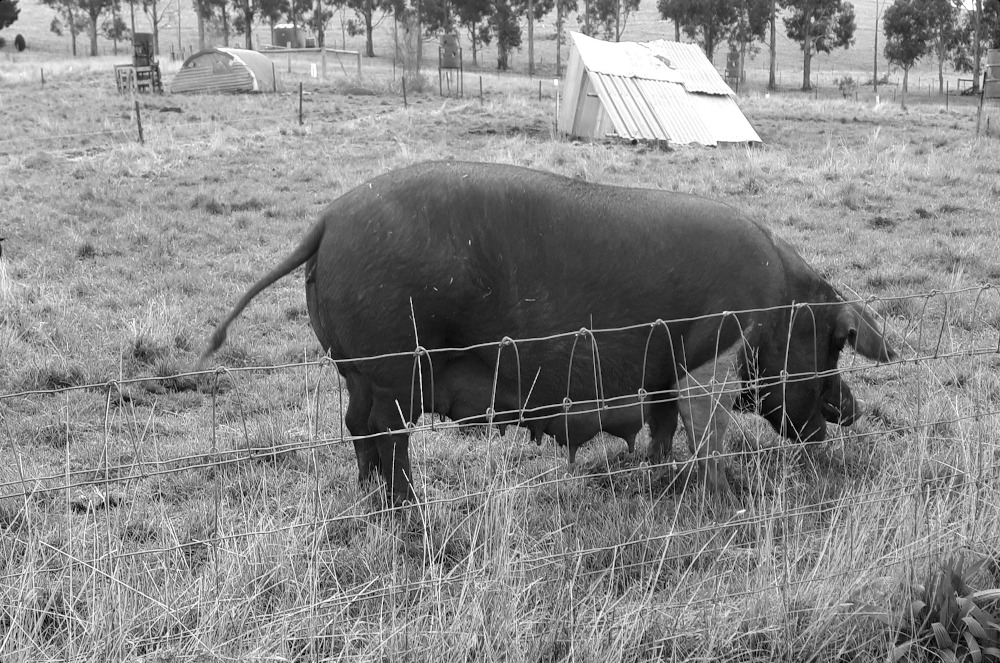
Turn: I read on the website that Jonai Farms does many things, including: raising ‘happy, tasty, heritage-breed Large Black pigs on pasture’; enacting ‘food sovereignty, which asserts everyone’s right to culturally appropriate nutritious and delicious food grown in ecologically-sound and ethical ways’; ‘living a life in common with nature’; diverting organic waste from landfill to feed pigs; and delivering ‘a full nose to tail no-waste offering,’ as pigs are used for cured meat, pate, bone stock, soap and bone char fertiliser.

Pig: My mother uses the word ‘pigsty’ to describe an untidy house. My mother despairs at my pigsty. I, too, despair. I tell her that I am too busy at work and too depressed to tidy my house.


Turn: We park the car and wander around a shed, past a large wooden crate filled with lemons. Winter, the mud is slick on pathways carved by footwork into grassy patches. We are unsure where exactly to present ourselves, but a woman in a vegetable garden recognises our befuddlement and shepherds us through a door into a kitchen – this is, it turns out, the main house. Tammi is in the kitchen frying almonds for a salad. It has been several years since we’ve seen each other, perhaps eight or nine. When her youngest child breezes into the room in a rustic poncho – he’s a head taller than me and now seventeen – I recalculate the reunion at closer to eleven years.

Pig: Homer Simpson doesn’t believe his daughter’s claim that bacon, ham and pork chops all come from the same animal. His ‘BBBQ’ pig-on-a-spit ends up flying a significant distance.


Turn: A friend of mine used to be (still is?) mad on cheap meats; he would stock his freezer with plastic-wrapped, marked-down cuts of steak and chops. This always puzzled me because he had a very well-paid job, could surely afford and enjoy a full-priced rack of lamb or eye fillet. And yet, part of me also appreciated that at least those meats did not wind up in a skip out the back of a supermarket, on the way to landfill.

Pig: There’s an ad on TV where a piglet, supported by a cast of other factory farm pigs and chickens, sings ‘Somewhere’ from West Side Story. Tammi says that Cheap meats are not cheap when you look at the impacts of that food.


Turn: I am guilty, of course I am, of buying too many foods in plastic packaging; of ill-considered air travel; of lazy comforts; too many clothes; too little time outdoors; of turning away from the earth. But guilt alone is not particularly productive.

Pig: A few years back, I meet my grandparents and parents at a small-town art show; we have scones and tea and drift past works on paper, canvas, wood. For the most part, the art is amateur and unremarkable. But there is one piece that draws me in, a big sow standing under cover of trees, a corner of hopeful blue sky in the left-hand corner. The artist has called it ‘Piggly Wiggly’, and I pay sixty-five dollars to take it home and mount it above my mantlepiece.


Turn: Tammi and I catch up on years existing beyond one another’s radar by piecing together the puzzle of common acquaintances and their activities. The picture we construct together is far-flung, multi-scened and speculative.

Pig: In high school a teacher showed us a video of animal testing, and one ‘test’ saw a team of men lift a piglet onto a table and then torch its skin while it writhed in agony. I remember nothing of the rest of the video. Perhaps because I puzzled over their intentions with this activity for days. The similarity between human and pig skin renders them prime candidates for biomedical research, yes, but of course a pig will burn if you set it on fire.


Turn: We are welcomed to a large table with many faces, enjoy pho, bread, cheese, butter and tea with milk and honey and lemon cake—all food made from ingredients gleaned from the farm. A table of fleshy faces is overwhelming in the wake of more than a year of pandemic isolation in Victoria. Tammi passes around a recent newspaper article with a headline characterising this place as an ‘abstract farm’. The whole table laughs.

Pig: When I first spot her in a patch of cavorting piglets she does not have a name, but my eyes home in, my mouth turns down like a sad fish. She is half the size of her siblings, perhaps smaller. Instantly, she is my favourite. We walk on to see other pigs in other paddocks, a couple of boars, some cattle. I want to circle back to the little runt, to maybe give her a pat on the head.


Turn: A recent dream: I am driving my father’s very old Mercedes. It is night, and although I am driving slowly, I am unable to fully control the vehicle. When I veer off the road the car begins to turn over until I am upside down.

Pig: I am assuming from Tammi’s matter-of-factness about the runt of a litter that this is a what-will-be-will-be situation. And here I am, elevating an animal above others for its cuteness. For a brief moment, I think about the yard at the front of my house, how it might become a home for a tiny pig. I know this is the kind of thinking that gets baby animals under Christmas trees and then tossed out for adoption when they grow too big. But, back at the first paddock, the runt now standing alone and shivering in the mud with her head lowered, I begin to squeal.


Turn: Later that night, I receive a text—a photo of Betty snuggled in a box with blankets. Tammi had lifted her out of the paddock and leapt over the electric fence as the big mother sow barrelled towards us, screaming her heft along the fence-line. I don’t think this is the usual way, that all strugglers are swaddled and hand-raised until strong-enough for paddock life.

Pig: Betty will not be saved, will not become ‘pet’. Betty will grow big and strong and enjoy her pig life in wide open spaces. She will nose around in dirt and grind grubs between her teeth. And one day, she will become: meat, pate, bone stock, soap, bone char fertiliser.


Turn: It’s been a particularly tough few months at work; everyone is strung-out, exhausted. Full days in front of a screen, the meetings and tasks are endless. I fantasise about all the things I can do with my pay check – a deluxe holiday that’s nothing but supremely comfortable; a new cardigan that is hand-knitted by a talented old lady and sourced by a boutique in Sydney; a box of expensive cheese delivered from Melbourne; a meal at some over-priced restaurant when we’re out of lockdown. Excess and fear dangle a carrot at the limit point of extreme discomfort.

Pig: I read on the World Animal Protection website that pigs have a very good sense of direction and are capable of finding their way home across considerable distances.

Yesterday, I pushed back from my computer and got down on all fours. I could see cat hairs trapped in the carpet, little clumps of dirt, bits of stuff that had fallen from bodies. I started to shake, too energetic at first, but then I got it down to a slow, rhythmic sway. And after that, I was able to stop completely, and figure out my next move.
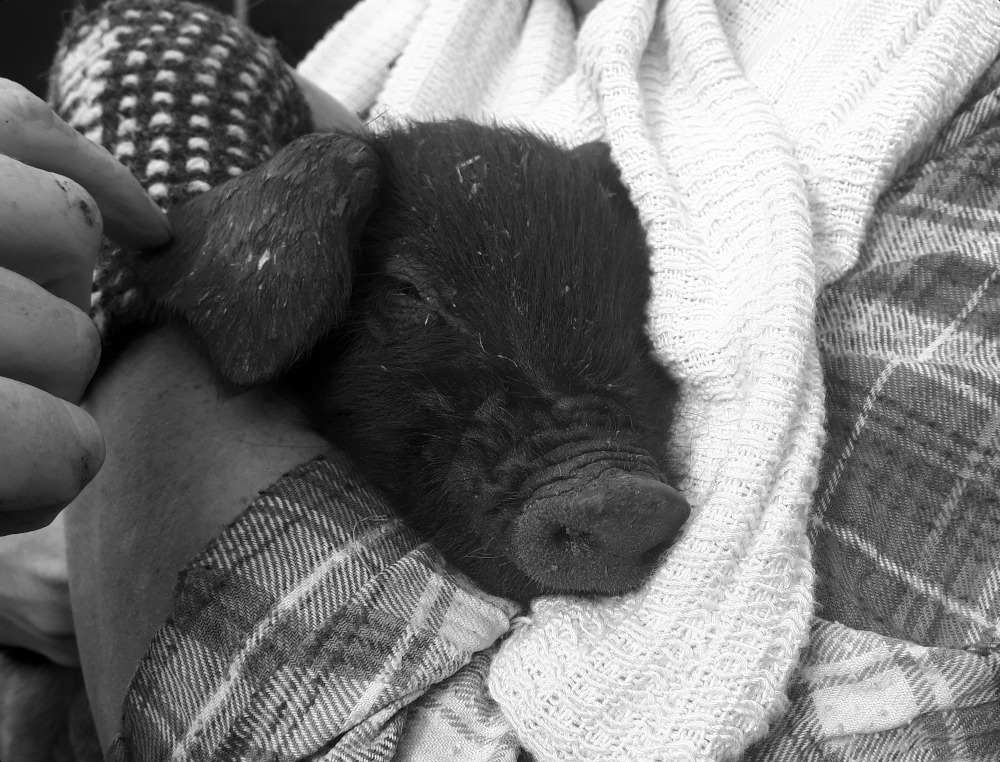

Betty gets snuggled.

Posted in ESSAYS | Tagged , , , , , ,

AMBLE Editorial

SG

As I sat down to write this, I realised that this is the second project that we’ve worked on together during a lockdown. Although we devised the theme for this issue between lockdowns (sitting in a café – imagine that!), the bulk of the reading and curating was done while the city we both live in was well into its fifth (or sixth – I’m losing count) lockdown. And solitude makes for a strange context in which to work creatively, and collaboratively.

I wanted to start by reflecting on the very nature of accepting and rejecting poems for an issue of a magazine. There are so many factors that go into it, not least our own preferences, interests, contexts and poetic leanings (thankfully, we overlapped enough to make the process cohesive!). On top of that though, there is also interpretation of theme, the ways that poems fit in with each other, the fine line between threads of commonality and repetition. Which is all to say that the process of being a gatekeeper, an arbiter of taste, is uneasy and deeply subjective, and there were a lot of wonderful poems we were unable to include.

It’s raining as I write this, and I keep coming back to Jazz Money’s poem ‘if that ghost is still here come morning’ and the way it flows aesthetically across the screen – like water. I remember reading once that scientists believe water can hold memories, and I get a sense of that aliveness through Jazz’s poem, with its ghosts collapsing the linearity of time and place. That collapse – or wormhole, or layering, what W G Sebald aptly calls ‘historical metaphysics’ – is something that we spoke about early in discussions of AMBLE, and as a concept it has come through so beautifully in the breadth of poems that comprise this issue.

EG

I kept trying to find solace in thinking about reading and spending time with poetry as a welcome space in lockdown – the expansion of time it allowed, to help me push back against everything shrinking and slowing. And there was this, but also, as you say, we read these in the context of fifth and sixth lockdowns, and it changed how we organised ourselves around the collaborative process of reading and selecting poems together.

The uneasy and subjective (this is an accurate phrase, so I’m borrowing it) process of selecting poems felt more heightened in this process because of the solitude, I think. But for all the things I wish we could’ve done in this little collab (I’d imagined us on a lounge room floor, reading aloud to each other, revelling in the sounds of the words), I remain impressed by the incredibly high quality of submissions we received overall. To send poems out into the world is a brave thing.

I had imagined AMBLE as a theme to explore its limitations as well as its depths – I had hoped for poems that went beyond what my meagre little lockdown brain could fathom. Poems such as Rosie Isaac’s ‘i saw it in parts’, with its circular, smooth steps, buoyed me. Other poems are quiet but startling. I often come back to Rae White’s line ‘please, register me’ in their poem ‘as climate change descends, i wait to be immortalised’. Its startling simplicity. And Georgia Kartas’s ‘time travels south / into the gut / and pelvis’, in their poem ‘spooky action at a distance’, reminds us of those collapsing categories of physical world, time, body. You mention the Sebaldian wormhole collapse, too – I think it’s that, though I also have even less of a sense of the shape of it. This was perhaps also the challenge for us in this theme – how to create a shape, in the form of selected poems brought together, arranged in tiled links on a screen, from a theme that is in many ways quite uncontainable.

Each poem in this issue brings out a new aspect of AMBLE that surprised, delighted or floored us. Sometimes they took what might have been a predictable interpretation in lesser hands, but executed it in a singular way. I hope readers find joy, solace, solidarity in rage, in this selection.

To end, I want to note that, in contrast to when you wrote the start of this editorial, I am writing this on a bright day – there might be a storm soon but the sky is springish and blue and my body is urging me for a physical manifestation of this issue’s theme.

SG

You’re right in honing in on the expansive physicality of the poems in this issue, and I’m not sure if it’s an effect of the prolonged lockdown or a response to the theme (probably both) but there is a palpable embodiedness in the poems that we received and selected. And by that, I mean the deep sense of interconnection that binds us to one another, to past and future, to air and earth. This is what we were imagining AMBLE could encompass, and the pleasure of the process was finding that it exceeded our own imaginations. In her poem ‘an island is an archive’ Kiki Amberber so deftly finds resonance with this, as you say, uncontainability:

the water exists in a blue dream and its hands are big enough to hold
this, too can slow drip reverberations
or webbed silken promises
the water carves out a new retelling

Time now for me to join you, to leave this screen and step out into the blue.

Posted in ESSAYS | Tagged ,

A Show of Hands: 10 Works by Michelle Leber

My series investigates fragmented, often disruptive histories, relinquishing control to offer the humble hand a narrative. Dutiful, five-pronged, deft-hinged and symbolically arranged – what do those once-arboreal human appendages reveal when words cannot decide? Inside the Greek Alphabet of Altered States, pandemic’s prison and its creative discourse, like Emily Dickinson, I felt my life with both hands to see if I was there.


Michelle Leber | Necessary Agitation with Rampant Undertone | Paper collage | cm | 2021

Posted in ARTWORKS | Tagged

Not Touching the Void, Listening for the Drip: Witnessing Water Cycles


The Watermaker | Catherine Cassidy | 107 x 162 cm | polymers, vinyl aerosol, polycanvas | October 2021.

‘The Watermaker’ by Catherine Cassidy

This year I have recently exhibited a body of work related to my thoughts on ephemeral water, markings and patterns, rivers and lakes that come and go in arid regions of Australia.

This painting titled The Watermaker comes as a natural progression of these ideas. As a landscape painter, used to travelling to remote and arid regions to develop work, I have been very lucky in lockdown to have this storehouse of imagery to dwell on and enlarge and to have had a small window of brief travel opportunity from my Sydney studio into Victoria.

As I researched the area of ancient volcanic ground along the Loddon and Coliban Rivers in Central Victoria alongside my daughter, poet Bonny Cassidy (incidentally my old home grounds) my thoughts pushed further into the origins and beginnings of water systems and I began to think on how water is born, its actual beginnings in deep time.

The idea that a river is born at all and in fact can be born from a volcano, stuck with me and I hope it has made its presence known in this work.

As much as a painting can really only represent its own truth, sometimes it can also hold something of a deeper nature, a resonance of time and motion and hopefully, in this case, a broader echo, almost a journey to the centre of the earth.

As these ideas developed and as imagery began to become manifest, the underground, secret world of water became quite insistent. What is happening, has been happening down there, all that falling and rushing and spilling of invisible water.

Although my research along these Victorian rivers and watersheds have specific names and are bound to maps and technical indications of place, I wanted to unbind them, to make an image which carried a much wider resonance than these written signs we see and follow as travellers.

My understanding of an Eastern view of the ‘void’, a continuous presentation within a painting, is my constant companion as I paint and stands the Western view of the void as a place of almost negation, of nothingness, on its head.

It holds the most generative part of the painting. The water falls, it is always falling, even unseen. My mark making, mingling with thoughts of time and secret tides, became a shower of this continual presence and holds all rivers and their making.

The quote below sits on my studio wall to remind me of the next destination I need to travel to after all the observation and the thinking is done …

‘On the limited surface of a painting, later with the heart, as in the void.’
–Shi-T’ao

Posted in ARTWORKS | Tagged ,

At the National Portrait Gallery: A Short Sequence

– – (Part)

I’m unsure
what is happening even
as it occurs. It’s spring, to

be sure. E.E. Cummings is on
the rise & quickens with the running
sap. (What season was he but spring?)

In this moment, I have lost my train, misplaced
my concentration, and in straying, I’ve discovered
something else and in finding this else I have mislaid
my sense of direction.

– – All of

these accents are mine. (Little gifts the size of
syllables. Little gestures the space
of nodding.)

(- – Whole)

I have wandered into
beauty: magpie chattering

by the lake, foisting
its anxiety, arguing

with itself. The sun wears
a pale yellow dress, twirls, then stands along

the wall minding the clouds.
The security guard calls me

love, and I walk into the building
backwards. Nothing is free,

though there’s no entrance fee.
Everything around me is man-

made, except the water’s ripples & the king-
parrot’s whistling. When impulse lurches,

and I find myself
in an empty gallery,

what are my hands
holding?

Posted in 103: AMBLE | Tagged

Grave

The lovers are taking it slow. They are drawing out
the days of nothingness, making them last.

Who will be the first to go? Who dares to answer
such questions? The lovers in church are praying

only for each other. They are tracing the edge
of the shore with their footprints. What have they

done that they have not yet been forgiven for?
There is still time to replace the curtains,

to oil the gate so it may close again without
crying. Now is the moment. The lovers know this

as they head home now, evening drawing
their bodies closer, slowing their steps

at a momentous pace, as words fold away
into the spaces even memory cannot reach.

Posted in 103: AMBLE | Tagged

Sandstone Caves

Gamilaroi Country
with respect

We rumble the turnoff
Quieting wood song on stone
Pick Hardenbergia sprigs
Purple haze to hang
On the rear view mirror

Empty face staring she
Swivels tack waiting
Out of frame a sphinx looks
Up two steps more a Monaro
In the backyard familial

Alcoves contain only absence
Carved with emu feet walls of
Swirling rain pastel smoke
Faint whispers behind open
Windows on outstretched arms

Framed by spindly trusses holding
Bluest sky sharing Uncle’s
Laminated face incongruous
The only one who shows himself
A ghost or a song we might sing

For ersatz seekers in urban black
Scrambling inside digging footprints
In this sacred dust they say
Well others were here

She turns on her long legs
Faces the heat frozen crest
Marathoners straggling behind
Slowly drink in the clouds

I wait in the wave face shadow
Struggle to reconcile for we
Cannot unhang the purple haze
What’s done has left these
Afterimages of illuminance

Posted in 103: AMBLE | Tagged