Robert Wood Reviews Duncan Hose, Jean Kent and Alyson Miller

‘The Human Whisperer’

A Book of Sea Shantey by Duncan Hose
Bulky News Press, 2014

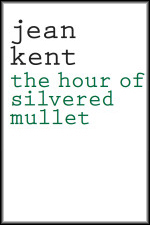
The Hour of Silvered Mullet by Jean Kent
Pitt Street Poetry, 2015

Dream Animals by Alyson Miller
Dancing Girl Press, 2014

In the library of Australian poetry animals occupy many pages. There are poems on kangaroo, frog, platypus and bandicoot; pig, dog, possum and cow; sheep, fox, dugong and crocodile; and an aviary of birds from budgies and pelicans to magpies and herons. There is lyrebird upon lyrebird upon lyrebird to name just one select, totemic mascot. Michael Farrell’s celebrated 2014 work ‘A lyrebird’ is simply the latest in a long line of the same subject. With its repetition and meta-commentary, Farrell’s poem seems apposite to our moment, engaged in a dialogue with history, ecology and poetry in an altogether affecting and complicated portrait. I tip my beak to his eye.

Continue reading

Posted in BOOK REVIEWS | Tagged , , ,

Cordite Book Launch: Loney, Gibson, Hawke, Harkin

Collected Works Bookstore, Wednesday 6 May, 2015

I will begin with a bit of spontaneous resentful metaphysics. I am sorry to do so, for a number of reasons, but there we are. If it can be justified at all, it will be by what it enables me to say about these books. But it is occasioned by a certain terrorising dehiscence in public representations of the stakes of poetry, a phenomenon that has been annoying me more and more over the past few years. The dehiscence is this: on the one side, the lickspittles of silicon; on the other, the lickspittles of identity. The first, encouraged by corporate interests, seem to think that the deployment of silicon automata to generate word-salad is enough to constitute poetry. A computer can do it. The second, enthusiasts of social biology, think that it’s a matter of evaluating the words according to the classifications of the bodies that emit them. Both sides are inimical to poetry. They wish to neutralise the acts of words as such. They serve the expropriators of language.

The abyss between the sides is only apparent. They are rather in a creepy compact with one another. Why? Because they refuse something that has always been essential to poetry: that poetry is an impotent and impoverished apparition that enhances the relations between language and life. To be engaged in poetry — whatever that is, however it is expressed — is to try to do and become a new thing in and by saying a new thing, something neither simply in the words nor in the body, that alters and affects both. A computer cannot think its own coding, at least not yet. A body doesn’t guarantee or determine any kind of utterance.

This isn’t to say new kinds of poetry cannot be written with the assistance of silicon automata. They can and are. And you try writing anything without your body: identity is crucial to poetry. But poetry tampers with both. As Jacques Lacan said: a certificate tells me I was born; I repudiate this certificate. And this is what I wish to affirm about these four very different books by four very different persons, whose ideas about and practices of poetry are otherwise mutually irreconcilable. All are essaying to repudiate the certificate in recreating themselves through their words. If I were to use the language of German idealism, I would say that much of the best of ConOzPo is currently exploring the paradoxical zone between spontaneity and receptivity.

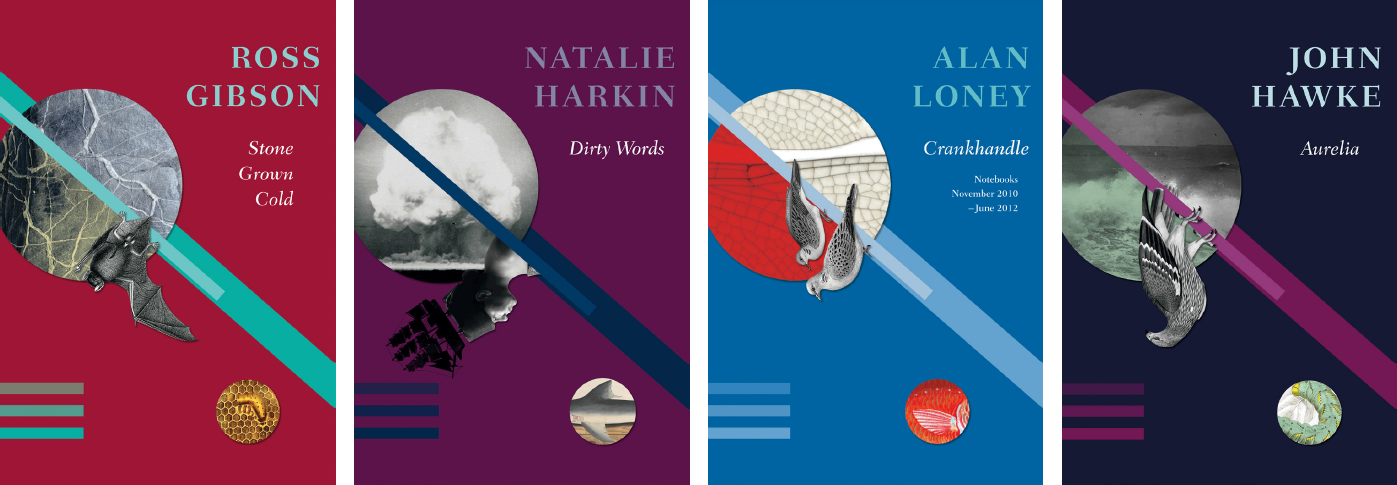
These are books which you hold and read, as opposed to being scanned by your electronic device as you blink at the flickering screen. Books are little portable public places, unlike mobile phones, which are privatised, privatising forces. The editor Kent MacCarter, indomitable and indefatigable — words I always associate with the Gauls in Asterix Books — has, in addition to consolidating and extending the great online poetry rag that is Cordite Poetry Review, now turned his attention to the production of codices. The design by Zoe Sadokierski, which is not without its humour — is that a hawk on John Hawke’s cover? — is internet-fresh as you like, without giving way on the specificities of fine book design. This series, moreover, has not only been given this striking signature design, but a fine structure as well: of preface (by the poet)/introduction (by a luminary)/poetry. Hence Michael Farrell introduces Alan Loney, Pam Brown Ross Gibson, Gig Ryan John Hawke, and Peter Minter Natalie Harkin.

Alan Loney’s book, the hilariously-titled Crankhandle, subtitled Notebooks November 2010 – June 2012 (note to the end of that financial year!) is oriented by a kind of attention to nature writing machines. The epigraph, by Rochelle Altman, concerns the ancients’ attention to every aspect of their notation systems. I’m not so sure about the accuracy of this claim — I remember seeing a great Scandinavian skit which featured two monks, one asking the other how to work a codex when he had only previously used scrolls — but I take the inspiration for it as irreducible. For Loney, language seems to be a nature that sporadically takes notes on itself, not simply of little events, but of its own self-notations, of the ways in which a part of nature can reflect upon and inscribe its own place in nature, which, being thus caught between being-of and being-about, incite the equivocations of a middling poetry. ‘Middling’ is here not an evaluation of quality, but a counter-evaluation (or, as Loney said to me: a non-negotiable middle. Absolutely). Such middling denominates the poetry’s being part of a situation in continuous variation, without beginning or end, without arché or principle — a book of presencing or at least of a strange anti-product that you get when cranking that handle! The strange sensitivity, the hard gentleness of this book also reminded me that the post-WWII generation of Australian and New Zealand poets, at least those who turned away from English and European models to the US, also thereby necessarily added an interest in classical Chinese and Japanese poetry, even if sometimes the influence only came through the American words. Yet Loney writes as if in touch with an entire global history of poetry celebrating natural ephemera, in the middle of the milieu.

Ross Gibson’s Stone Grown Cold — these three hard monosyllables simultaneously flirting with cliché, agrammaticality, and the Southern Gothic — extends his well-known work into the field of poetry. Gibson is a topological thinker of the cinematic noir creepiness of human situations, often attending to the disaster of the proximity of abandoned or ruined sites, which cannot be absolved because their cause has vanished and any subsequent intervention therefore only assaults the epiphenomenon. But he also attends to the disaster of human organisation that brings together the diverse in the service of murder and mutilation. The noir imagination always celebrates compromised places and characters, and here the badlands of NSW are also the badlands of Gibson’s poems. Some of these poems are absolutely extraordinary in the way in which poetry confronts cinema on the terrain of epiphanic evil …

With Aurelia, John Hawke is a late symbolist troubadour, playing between the sadness and the anger of poetic melancholy, the withdrawing opacity of words that unveil themselves and vanish in breaking their promises of recuperation, but deliver in this very breach the lingering ambiguous effects of a primal Sehnsucht. One might note in passing the struggle in all four of these books between poetry and one or another rival media system. This struggle is not always as clear as in Gibson’s poems in which noir cinema becomes a polarising influence; in Loney’s case, it’s perhaps the poetic jotting contra the TV; in Harkin’s, as we’ll see, it’s the structure of alphabetisation itself. In Hawke’s, well, there’s an extraordinary amount of equipment — photographs, a lot of photographs, paintings, radio, and so on — but it seems to me that it is that symbolist media system par excellence, the telegraph, which covertly (it doesn’t appear here directly) becomes a paradigmatic foil for the verse. The rise and fall of the telegraph — that great invention of 19th century imperial media systems — is basically coterminous with the longue durée of French Symbolism, from Nerval to Mallarmé. Moreover, the telegraph was a kind of anticipation of our contemporary digital technologies, being at once electrified and binary, requiring specialist operators at the terminals to transmit and decode its messages. Symbolism at once repudiates and radicalises this suppressed paradigm, and Hawke is here no exception — the poet is the privileged operator of the great forest of natural and artificial symbols, which he or she decodes … and ultimately decodes as death. Richard Holmes says of Nerval that ‘Often, on his wanderings through Paris, he would leave messages for his friends in the form of animals’; I would like to say of Hawke that here the animal and human heads of his very beautiful verses are message-effigies dragged from the mutilated woods of yore.

Natalie Harkin’s Dirty Words is explicitly structured by the alphabet, a kind of abecedarian archive, cross-referenced like an encyclopaedia or a bureaucratic dossier, or just an index to a book to which it is a concluding guiding supplement. Note that the alphabet was precisely one of the supposed goods that European colonisers imposed — because it is just better to be ‘literate,’ right, because education ‘sets you free,’ right? I thought here of the indigenous Queensland painter Gordon Bennett, who died last year, and in whose paintings the letters ABC frequently appear, invariably in the context of colonising violence. Lacan used to speak of ‘alphabetisation,’ with the pun on the French word bête, the animal or beast, but also the beta, the silly, the stupid. For Lacan, Europeans were alphabeasts, in the sense that their obsession with a set of phonically-derived letters made them genuinely stupid and violent. Many politicians are surely well-represented by this neologism: hollow, shell-like creatures powered by the farts of foreign media rentiers, farts which spurt constantly from their mouths, and which one smells as well as hears or sees. It is this infectious, foul miasmal mist that Harkin writes to and against, trying to breathe out and expel this loathsome gas, to literally clear the air so that real exchange might become possible. The great political thinker Hannah Arendt once expressly defined collective responsibility as a state in which one has not committed any crime — but in which you and others are nonetheless continuing to enjoy the fruits of the crime. It is to collective responsibility that Harkin calls us back, in these hard and strong poems.

Posted in GUNCOTTON | Tagged , , , , , , , , ,

Review Short: Bel Schenk’s Every Time You Close Your Eyes

Every Time You Close Your Eyes by Bel Schenk
Wakefield Press, 2014

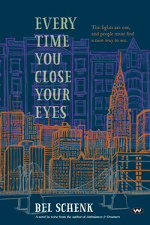
Bel Schenk’s third poetry collection, Every Time You Close Your Eyes, is sparsely written, yet deeply self-aware. Taking the form of a verse narrative, the book is a series of poems exploring events commonly referred to as the ‘New York City blackouts of 1977 and 2003’, similar in circumstance, yet as Schenk demonstrates, vastly different due to the temporal space between them.

Continue reading

Posted in BOOK REVIEWS | Tagged ,

Review Short: Les Murray’s Waiting for the Past

Waiting for the Past by Les Murray
Black Inc., 2015

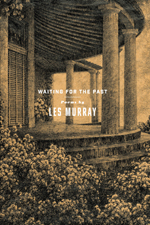
Half a decade on from appearance of the elongated shadow figure that adumbrated Les Murray’s last collection, Taller When Prone, the poet returns with stature intact and a magisterial resounding of strata and reach.

Continue reading

Posted in BOOK REVIEWS | Tagged ,

Benjamin Solah Reviews Jeltje Fanoy

Princes by Night by Jeltje Fanoy
Island Press, 2015

Jeltje Fanoy’s Princes by night is part poetry collection and part fragmented family history, peppered with glimpses of the Dutch colonial experience in Indonesia. Her fourth collection, Fanoy has explained that it’s partly influenced by her becoming aware of Australia’s own colonial history, and has been her ambition for many years.

Continue reading

Posted in BOOK REVIEWS | Tagged ,

Review Short: Evan Jones’s Selected Poems

Selected Poems by Evan Jones
Grand Parade Poets, 2014

Continue reading

Posted in BOOK REVIEWS | Tagged ,

Review Short: David Brooks’s Open House

Open House by David Brooks
UQP, 2015

In Open House, David Brooks makes it look easy. These poems appear to be simply set down, flawless panes of glass framing scenes from a life. For the attentive reader, however, even one who doesn’t know the extent of Brooks’s work as a poet, a novelist, an editor, a translator, a researcher and writer of books about other poets and poetries, there are clues to the years of deep thinking, constant writing and serious, engaged living that Brooks brings to his own practice.

Continue reading

Posted in BOOK REVIEWS | Tagged ,

NO THEME IV Editorial


John Tranter, Sydney, 2009, photo by Anders Hallengren.

Sometimes people become irritated when I am once again asked to compile another collection of poems. Why him? they ask. Why him again? Well, there’s a reason. I am good at it. I am reasonably fair and broadminded, and I have shown I’m skilled at this work and reliable with deadlines for over half a century. A publisher can lose a lot of money and become very distressed, along with a lot of poets, when the publisher chooses an unskilled and unreliable compiler.

So I have done dozens of collections like this, selecting and compiling many more pages of poetry than my own production of poems, though – at a couple of thousand pages – that is substantial enough.

It starts with several major anthologies, from a roneod magazine I wrote and printed myself in 1968, two issues of Transit poetry magazine, a special issue of Poetry Australia when I was twenty-six, through The New Australian Poetry (1979), the Tin Wash Dish anthology (1989), the huge Penguin Book of Modern Australian Poetry (with Philip Mead, 1991) which became the standard text in its field for over two decades, Martin Johnston: Selected Poems and Prose (1993), The Best Australian Poetry (2007), The Best Australian Poems (2011), The Best Australian Poems (2012), Jacket magazine (1997 to 2010), the Australian Poetry Library (some 40,000 Australian poems, free on the internet, from 2010), the Journal of Poetics Research (2014 ongoing), and a couple of fifty-page supplements of modern Australian poetry for US magazines including New American Writing and the Atlanta Review.

This would also include establishing the original Books and Writing radio program in the 1970s, publishing four books of poetry by young Australian poets in the 1980s, acting as poetry editor for three years for the Bulletin magazine in the 1990s, through a lifetime teaching poetry and radio production, and producing ABC Radio National programs, many of which were about poets, from Sir Thomas Malory to Frank O’Hara. My own twenty-odd volumes of poetry hardly add up to a quarter of that mass of material by other writers.

Then I think of the dead poets I have been lucky to know. Can we live up to them? The hippy decadence and the loosely brilliant surfaces of Dransfield, the careful and complex erudition of Martin Johnston, the learning combined with the savage self-deprecating wit of John Forbes … how could anyone possibly live up to all that?

But today we have a clamouring chorus of younger voices, most of which I have also been lucky to know – Kate Lilley, Toby Fitch, Ann Vickery, Michael Farrell, Lisa Gorton, Andy Carruthers, Ella O’Keefe, Corey Wakeling, Fiona Wright, Sam Moginie, Jill Jones, Aden Rolfe, Astrid Lorange, Ali Alizadeh, Jessica Wilkinson, David Prater, Felicity Plunkett, Emma Jones, Kate Middleton, Claire Potter, Petra White, Kate Fagan, Sarah Holland-Batt, Bronwyn Lea, and many others, all of whom act as inspiring examples to other writers and readers. Their learning is also remarkable: a critic commented recently that this young generation of writers is the first to earn PhD degrees widely and unselfconsciously. We don’t have to solely look to the old conservative writers (writers without degrees in English literature!) like Banjo Paterson or Mary Gilmore or Francis Webb or Les Murray.

But what of this process of judging blind, new to me, where I am prevented from knowing the names or identities of the people submitting? It’s a good thing, of course, because the editor can’t play favourites, if that’s what it’s designed to do. But let me grumble a little. It often seems to me that readers want the editor to play favourites. Readers don’t go to a new magazine because it has a vast number of anonymous poets in it. In a book store (remember them?) people who browse the shelves used to ask for Gig Ryan’s latest collection of poems, or that late volume by John Forbes, or that recent Ashbery translation of Rimbaud … what was it called? Or Barbara Guest’s last book, or the vast Prynne Collected … in other words, they wished to read a particular book by a poet whose personality and whose writing they were interested in. Only a modern arts bureaucrat would invent anonymous submitters: that way you are likely to get a lot of anonymous poems. But bureaucrats don’t live in the world of writers and readers, of course, and they think that anonymity means balance.

But what did I find sifting through this largely anonymous pile of some thousand or more poems? (largely anonymous, because a few writers insisted in adding their real names to their submissions … I wonder why?) In the end I found it refreshing, to be honest. Sometimes when I receive a new issue of a magazine, or a newly-harvested anthology, I cover up the writers’ names until I have read the poems. And I have done this for over fifty years. That way I get the thrill of surprising myself: oh, so-and-so has written a really good poem after all, and I thought he was a creep. Gosh, so-and-so has a real turkey here — and I thought she was always so skilled! That kind of surprise is likely to occur here too, occasionally – that is, heaps of good poems – though a month or two has gone by, and I haven’t yet looked at the pile of submitters’ real names yet. Why? Well, I know the poems already, and I know that the collection as a whole is wide-ranging, balanced, and generously full of wonderful and very different poems. That’s why I selected them.

Posted in ESSAYS | Tagged

Fuori le mura: Seven Vicki Viidikas Poems

Vicki Viidikas’s first book Condition Red (UQP, 1973) – which most likely took its title from Kubrick’s Dr Strangelove (1964) in which Condition Red means war – burst with unsettling depictions of contemporary life and the status of women, a year after Equal Pay had become law. ‘It’s not enough, looking at you blundering like a turtle against the stream … Last night my heart was a cheap flag waving to the nearest mirror in sight. I couldn’t believe anything, seeing you drive away into others’ arms. I’m no sweet virgin sock-washer either …’ (‘Four Poems On A Theme’). Her second book, Wrappings (Wild & Woolley, 1974), was a collection of stories in a tone that twenty years later could have been marketed as grunge realism. As writer and colleague Michael Wilding wrote: ‘the world of publishers and editors found her difficult, and she in turn found them contemptible … In recent years she became a myth, lost to view of the literary world that she had inspired, stimulated, informed and reviled’. Behind the ‘great man’ we could now hear the mistress and the ‘sock-washer’ as Viidikas sourly calls a lover’s wife in her most-anthologised prose-poems. But there’s also buoyant spontaneity in poems such as ‘Loaded hearts’: ‘Oh boy Ken the smiling mountain is playing his guitar / The beautiful trembling Irene is taking another pill… / Oh boy to the phallic teeshirt / Oh sigh to the Baba breadknife / Oh gee to the landlord’s prayer…’. Along with the intense political and social tumult of the 1960s and ‘70s, and the dynamically modernising upheavals wrought by the first Labor Government in 23 years (Australian troops withdrawn from Vietnam; Equal Pay legislation; Single Mother’s Pension; voting age lowered from 21 to 18 years, free university education, etc.) the influence of recent anthologies, Donald Allen’s The New American Poetry: 1945-1960 (1960) and Donald Hall’s Contemporary American Poetry (1963), had reinforced and revitalised this new generation of Australian poets, and Viidikas may have been influenced by the adventurously jaunty spiritualisms of Kerouac and Whalen among others.

The revolt against institutional constraints would extend to the rules of syntax, grammar, poetic form, and genre.1

Most reviews and commentaries on Viidikas’s work emphasise the anti-intellectualism of her poetry, its immediacy and transparency, in a way that is not used of contemporary men poets such as Michael Dransfield, and that in fact dismisses closer reading.

As long as she’s dead we may sabotage and rape
                              (‘They Always Come’)2

Her poems often revolve around internal argument as images accrete interspersed with blunt or vatic statements, her deliberate artlessness composed into gradual assault or enigmatically drifting reflections. Statements are proffered to provoke and defy, but also to resolve a position, or to be absolved, in poems that are impressionistic, semi-narrative, ambiguous, often proceeding through repetition of tenses, nouns, vowels, such as the ‘o’ sounds dropped through ‘At East Balmain’3:

It’s hard to imagine that over there the city is roaring
and sledging her iron name into the ground.

And here there is clear water washing million-year-old
stones and the sun does not fall sheepishly between
buildings but blasts straight down.

Oblong rocks are texture paintings, without curse or
paint or time spent, just lolling, baking under the
fine sun.

Two dots upright as tin soldiers putt past in their
happy world of tug on water.

A hermit dog lives here, in a burnt-out boiler turning
orange. He stays inside all day - I’ve seen his eyes
glint in the dark, he is huge and black and solemn...

Dried weed hangs from a bleached stick, like a dead
rat swinging...I found one here yesterday. So cold
and grey and stiff with his tiny mouth open, arms
stretched above his head. I felt very quiet because
his bead eyes had lost their sparkle.

Oblong, rocks, dots, dogs, lolling, rolling, etc. ‘Oblong rocks are texture paintings…’ so art then is the equivalent to nature, or alternatively, nature’s effortlessness is seen as true art. The momentary is celebrated in itself, as if it can be unfiltered, unmodified, by interrupting thought. Poems are embedded with longing for oblivion, for floating into nature where fretful tainting consciousness, and self-consciousness, might somehow be erased. This desire, mirrored by her interest in Hinduism, is propelled by the objectification of women, as Viidikas often illustrates the feminist tenet that femininity is a socio-politically imposed construct, is drag. There’s a constant tussle between desire to disappear into nature, to abide in an eternal wordless stream, and to inscribe.

The Flow Of Them All4

What huge wooden grasshopper is crawling the hill?
What turtleness of feeling slid off the satin reeds?
Blue dragonflies are singing in clouds of transparent light.
Cows bellow and waddle leaving their footprints in mud.
Am I part of the river, the deck, or the willow?
The grey cranes are sleek and elegant and fly without fear.
Plain sailing is dead.
The wind arcs and hums and hooks itself round trees.
Geckos rise forward offering their throats to the sun.
Tails swish and flip.
Water reflections slip off green and luminous.
Ferns chuckle in their skirts.
And I compete with sadness, having only my memory, a string of words, a definition.

Descriptions of frolicking nature seem to make this a poem of joy: each animal or insect affects the thing it burrows through; each living thing interacts with, and contrasts with, its environment, ‘Ferns chuckle in their skirts’. The unexpected conclusion turns from this perceived, but unreachable, idyll: ‘And I compete with sadness’, so even in sorrow there is the energetic act of competing, ‘having only my memory, a string of words, a definition’, that is, the flow of life is, bizarrely, hindered, fenced in, by words, hence the dramatic to and fro of passive (sadness) with active (competition). The poet, classically, envies nature’s supposed thoughtless bliss that she is unable to mimic, and must instead hew definition, ruinously affix meaning. Yet the conclusion is deliberately, and traditionally, ambiguous, as the act of writing is also depicted as triumph over dumb nature, as she competes, assisted by heightening sadness, with prized memory and words to forge a corresponding beauty.

The country as an answer5

Endlessly walking the green hills in wet agitated galoshes,
trees lean outwards...they are nothing but leaves,
beautiful. coloured, falling and dying. The hills rise up,
breasts faces hands, their silence is complete.

I sit down and mud falls from my boots.

Cows plod towards a creek.

Not a single person is visible as the landscape flows and
dips...invisible dyings...no answer but what it is.
I have come a thousand miles to be here.
Peace, they tell me, sending messages from the black city.
This is what peace is? No use for the earth but as a place
to lie down in...faceless bodies...passive with
adoration? There is no love or hate here, the contrast is
so subtle.

I feel the mud in my hands, the wet bright grass.

I understand I am meaningless here, merely another presence
...the trees do not recognise me, the cows do not remember.

the landscape has absorbed me, giving nothing to be desired.

The landscape, complete in itself, or in itself a summation of all desires, leaves ‘nothing to be desired’, and only here can the poet’s restless subjectivity be entirely trammelled. Yet Viidikas also mocks such aspiration to serene self-effacement as impossibly unsatisfying as well as ludicrously impossible.

I … always felt that her work revealed a distinct sensibility and considerable craft. But while people seemed to want to commemorate a poet like Michael Dransfield (sex and drugs and Gustav Mahler) the Romantic myth didn’t serve a woman like Viidikas so well, despite her clear superiority as a poet.6

Viidikas’s voice is always recognisable, always effortless. There is nothing that sounds rehearsed or overproduced. She aimed for spontaneity… Her whole project was to be free of affectation, of manner, of precedent. But her clarity, directness, visionary evocations and surreal connections have the characteristic note of an assured, spare, vividly colourful modernism … She chronicles the era of what seemed at the time like liberation … (and) eagerly seized the opportunity to record what had rarely been written about explicitly before – a world of gays, lesbians, prostitutes, rapists and their victims, drug dealers and their junkie clients. These are sketches from the life, not narratives manufactured for commercial gain or propagandist agenda. Viidikas presented no agenda, other than the agenda of the clear-eyed writer, the Isherwood ‘I am a camera’. There were precedents, of course – Rimbaud, Anna Kavan, Leroi Jones – and she knew their work. As with every serious writer, she read widely and intensely … Thirty-five years after they were written, her searing attacks on male self-involvement and overall unsatisfactoriness still make me flinch. No doubt they should, since a couple were written at me. Not written for me, or to me, but confrontationally at me.’7

Viidikas’s frames of repetition are employed in many poems: the untitled ‘red is the colour’ (‘red were the shoes … red was the imprint … red was the silence … red were the flowers … red is the eye …’) and in the statements through ‘Keeping watch on the heart’8:

I have seen those hands die as they touched me,
pressed at my skin’s edge
                      dreaming of another

I’ve encircled their sighs like a wolf on the hunt,
ripped on a highland, the gentle blood flow
                      before light came

                                            Heard the dull tack tack in the veins,
                                            drawn into them without a shield

I have wanted to replace the hollowness in things,
besides the body and the heart, besides the silence after love,
                      withdrawal into singleness

                                            How the butterfly screams
                                            as it breaks from its cocoon

                                            The sad shutters bang
                                            tracing the hungry eye

Laughing at the madness of clocks, I’ve been buried in minutes,
expecting each face to be refined
                      finally, like silk

And disobeyed time, wanting a revolution in spirit,
the boundaries of the self
                      broken down and flooded with joy

                                            Does the wind celebrate
                                            as it moans along the hill?

‘I have seen those hands die as they touched me… / I’ve encircled their sighs like a wolf on the hunt… / I have wanted to replace the hollowness in things… / I’ve been buried in minutes…’ – all in perfect tense, then ‘How the butterfly screams…’ and the final question ‘Does the wind celebrate / as it moans along the hill?’ all present tense that extinguishes the past with transforming velocity. Yet her present tense also reveals a nature, sequestered from time, that discards and disdains the quotidian. In Viidikas, nature offers purifying benediction that dissolves ‘this too too solid flesh’. Many poems hinge on a ‘To be or not to be’ quandary, whether to pass into oblivion via nature or addiction or whether to act, that is, to write. Formalising repetitions are also used in ‘Swamp City’: ‘One leaves…One cuts…’, and ‘Family Images’ with its accusatory, or even exultant, vocatives: ‘You who have no name…You who have no home’, and in ‘Knives’: ‘I take the first and scalp the sunlight from the sky…I take the second…’, and also in ‘The Whole Bag’: ‘Why did we sit…Why did we argue…Offer me something…Offer me fusion’.

Posted in ESSAYS | Tagged ,

‘Can I Do My Words?’: On the Poetics of Deafness

Taken together, the three memories in my poem ‘Signs‘ denote my progression towards finding a voice as a deaf writer. The intense pain and sensory overload that I experienced on that early spring day was caused by meningitis. The doctor gave me a large dose of antibiotics to clear the infection on the lining of my brain, but this damaged the hearing in my left ear and half in my right. This was why I couldn’t hear my father’s words clearly.

I was obsessed with books such as Strawberry Shortcake when I fell ill. As I’d learned to speak by then, and I clearly loved words, my parents decided to send me to the local primary school, which meant that I was raised as an oral-deaf person (that is, a deaf person who uses her voice to communicate, rather than her hands to sign). I had speech therapy from a teacher for the deaf once a week, and now people rarely notice I’m deaf unless they see my hearing aid, or I tell them. This raises another set of problems: I pass so well as a hearing person (largely by dint of lipreading and sheer hard work), that people fail to accommodate me by speaking more clearly, or forget to include me in conversations. Consequently, it’s easier for me to read than to listen to and interact with people. Reading was a solace when I became sick, and has remained so ever since.

My deafness aside, the aura of those letters living beneath the dresser suggests that words were always going to be significant for me. Shuffling them into words presaged my decision to become a writer when I reached my late teens. I poured the stress, frustration and isolation that came with deafness into journals. Later, when I developed my literary ability, I crafted my emotion into novels, stories, poems and essays.

As well as guiding me towards writing, deafness also profoundly influenced my literary voice. The part of my hearing that survived is in the upper registers, so I hear women’s voices more clearly than men’s. This means there is less chance of confusion and mishearing when I listen to women, and less chance of being mocked if I miss something.

When I learned about feminism at university, my affinity with women’s voices exploded into a passion. I particularly identified with their historical efforts to find a voice, and to have that voice published in a world that was hostile to them. As Virginia Woolf, with her ever-elegant turn of phrase, wrote in A Room of One’s Own: ‘One can measure the opposition that was in the air to a woman writing when one finds that even a woman with a great turn for writing has brought herself to believe that to write a book was to be ridiculous’ (68).

Deaf people, too, have had a long and contested relationship with writing and speaking and, like women or other minorities, they have fought to be heard. The suppression of their voices is due to Western theology and philosophy’s association of logos, or reason, with the voice and the spirit with breath (Davidson 91). This association began with the belief that speech was of divine origin – that is, given by god. The Christian church decreed that if deaf people could not hear the word of their god, then it would be blasphemy to teach them. Gradually, through the efforts of monks such as Fray Pedro Ponce de Leon (1529–84) who taught the deaf children of aristocratic Spanish families anxious to keep their wealth by passing it on through these children, it was discovered that deaf people could be taught to speak (Markides 6). Two centuries afterwards, teachers such as the Abbé de l’Epée (1712–89) in France showed that deaf people could communicate freely and easily using sign language. His successor, Abbé Siccard, taught Laurent Clerc, who together with Thomas Gallaudet established what would become the first university for the deaf in America, Gallaudet University.

Despite these endeavours, the oral-education method of teaching deaf people to speak gained traction near the end of the nineteenth century. It was influenced by prevailing ideas on eugenics and prominent spokespeople such as Alexander Graham Bell, inventor of the telephone. Bell, whose deaf wife communicated through lipreading, believed that deaf people should marry hearing people to avoid ‘a formation of a deaf variety of the human race’ (4). Endorsement of the oral method was cemented at the International Congress for the Deaf held in Milan in 1880, where it was resolved that deaf children worldwide should be taught by the oral method and that sign language was to be discouraged.

The denigration and suppression of sign language, which has lessened only in the last 40 years or so, has placed considerable pressure upon deaf people to conform to the dominant hearing culture. This means pretending to hear when one cannot, speaking instead of signing and never disclosing that one has a hearing loss. However, for those who are born deaf, it is much easier to learn to sign than to use lipreading and speech, both of which require huge amounts of concentration and energy.

In tandem with this impetus, deaf people have been encouraged to write as well as sign so as to communicate with hearing people, even when writing has not come easily to them. Jennifer Esmail, in Reading Victorian Deafness, notes that ‘when deaf Victorians were writing in English, they were almost always writing in their second language. They were typically signers first and writers second, yet they were forced to use written English to represent themselves textually’ (201). Even at Gallaudet University a century later, as deaf rhetorician Brenda Jo Brueggemann writes in her 1999 text Lend Me Your Ears, students were expected to become skilled in both American Sign Language (ASL) and Standard Written English, even though ‘ASL and English differ radically – syntactically, conceptually, modally – in almost every way’ (50¬–51) and ASL has no written component. Despite these tensions, deaf writers have mobilised both written English and sign language to express themselves.

Deaf Poets

‘The deaf poet is no oxymoron,’ John Lee Clarke opens his essay ‘Melodies Unheard,’ ‘but one would think so, given the popular understanding that poetry has sound and voice at its heart … As a result, deaf poets are often objects of amazement or dismissal’ (165). This was particularly pronounced in the nineteenth century, when written poetry was linked with orality, often in terms of formal features such as rhythm and rhyme (Esmail, ‘Perchance’, 509). Undaunted, deaf poets of this era frequently created poetry. The network of periodicals created by and for deaf people included monthly poetry columns, while important events in the deaf community ‘were commemorated with poems written and signed by pupils’ (Esmail, ‘Perchance’, 510).

Hearing audiences, however, emphasised the seeming incompatibility of the deaf poet’s craft, and they marvelled that deaf people were able to produce poetry at all. In the first volume of the American Annals of the Deaf and Dumb (1848) is a poem, ‘The Mute’s Lament’ written by John Carlin. Preceding this is an article, ‘The Poetry of the Deaf and Dumb’, written by the editor who expresses wonder that the poet, deaf since birth, had produced a poem:

How shall he who has not now, and who never has had the sense of hearing; who is totally without what the musicians call an ‘ear’, succeed in preserving all the niceties of accent, measure and rhythm? We should almost as soon expect a man born blind to become a landscape painter, as one born deaf to produce poetry of even tolerable merit. (14)

The editor’s surprise notwithstanding, many deaf poets did reproduce rhyme and sound in their work. They also wrote poems that included birdsong, music, wind, the human voice and musical instruments, and invested these sounds with tone (Esmail, ‘Perchance’, 522). In Carlin’s poem ‘The Mute’s Lament’, for example, streams murmur ‘gaily’, the linnet’s song is ‘dulcet’ and the organ’s harmony is ‘sweet.’ These adjectives indicate that ‘deaf poets who do not have access to a sensory experience of sound … they have access to a textual experience of sound derived from conventional phrases’ (Esmail, ‘Perchance’, 524). Sound is conveyed to these poets not through their ears, but their eyes.

This seeming contradiction is borne out through the figure of the mute poet, Carlin’s narrator, who lists the sounds of birds and lutes, but brackets them with the refrain ‘I hear them not’. He also laments ‘My tongue is mute, and closed ear heedeth not’. Even as he proclaims he cannot hear, the very act of narrating is a speech act. Carlin’s narrator destabilises the concept that poetry must be spoken and heard, for here is a deaf person speaking and creating sound through the silent text. Esmail’s skilful analysis of this poem and its implications demonstrates that ‘the ear is only the imagined, but not the necessary, home of poetic ability’ (‘Perchance’, 576).

This distinction has been grounded further in the emergence of signing poets. These are poets who ‘do not write. After all, writing is not native to Deaf culture as is signing. They make poetry out of handfuls of air, their lexicon cinematic and giving rise to a new poetics’ (Clarke 169). Visible, or signed, poetry, gathered momentum in the 1980s when Ella Mae Letz and Clayton Valli, unbeknownst to one another, began to produce signed interpretations of poetry in America. At the same time, a 1984 workshop between Allen Ginsburg and deaf poet Robert Panara of the National Technical Institute for the Deaf (NTID) in Rochester, New York, sparked a new generation of signing poets. In conversation with Ginsberg, Panara observed that ‘For deaf people, signing poetry is like “painting pictures in the air”’, to which Ginsberg replied, ‘The ambition of a good poet is to write something that is visually clear and bright … It’s fortunate that modern poetry is the closest verbal formulation to what might be useful for deaf people’ (Cohn 266). Cohn writes that this exchange ‘has historical implications for the Deaf because it validates the formation of a sign language poetics that in itself is not isolated but is part of a developing international poetic style based upon an awareness of the importance of the image’ (266). While Cohn’s desire for deaf poetry to be validated by a hearing poet is problematic, the exchange fortuitously gave rise to a series of signed performances at NTID under the auspice of The Bird’s Brain Society. Discussions about these performances revealed ‘a previously undocumented level of metalinguistic, and specifically poetic, awareness of sign language as an art form by the Deaf’ and included observations such as: ‘A deaf poet’s strength is in the visual expression of the poem’, ‘Sign language does not require English’ and ‘I’d want to see the deaf audience cry. I’ve never seen that happen’ (Cohn 268–269). That Peter Cook, who conceived the title after a poem of Ginsberg’s, is still performing is testimony to the strength of and interest in signed poetry.

Bauman, Nelson and Rose, in their text on American Sign Language literature, Signing the Body Poetic, articulate how signed literature differs from traditional prose and poetry:

Poetry often conjures images of lines not quite reaching the right margin and the musical incantations of the speaking voice, whereas prose evokes images of justified margins, indented paragraphs, chapters, and books held by silently engrossed readers. But in sign literature, the same hands, face, and whole body used for everyday eating, sneezing, and lifting are transformed into the kinetic shape and skin of the poem. Here, reading becomes viewing, books become videos, and paper becomes a performing body. In a most literal sense, this is a form of ‘writing-the-body’. (2)

Examples of such bodily writing and reading can be found on the website of the library of The Rochester Institute for Technology, with which NTID is now affiliated. A subject guide for ‘Sign Language Literature and Poetry’ includes a list of YouTube and online videos of signing poets, such as ‘The Stars are the Map I Unfurl’, a British Sign Language poem by Gary Quinn which celebrates the first deaf round-the-world solo yachtsman, Gerry Hughes. The piece, performed by Quinn and interspersed with images of Hughes on his yacht, is accompanied by written versions of the poem in English and Shetlandic. Kyra Pollitt, a British Sign Language interpreter, poetry researcher and artist, collaborated with Christine de Luca to create the literary interpretations of Quinn’s poem. David Bell provided kinetic titling, providing another layer of translation, but also making the film accessible to an audience that does not know sign language (‘Signed Up’).

Posted in ESSAYS | Tagged , ,

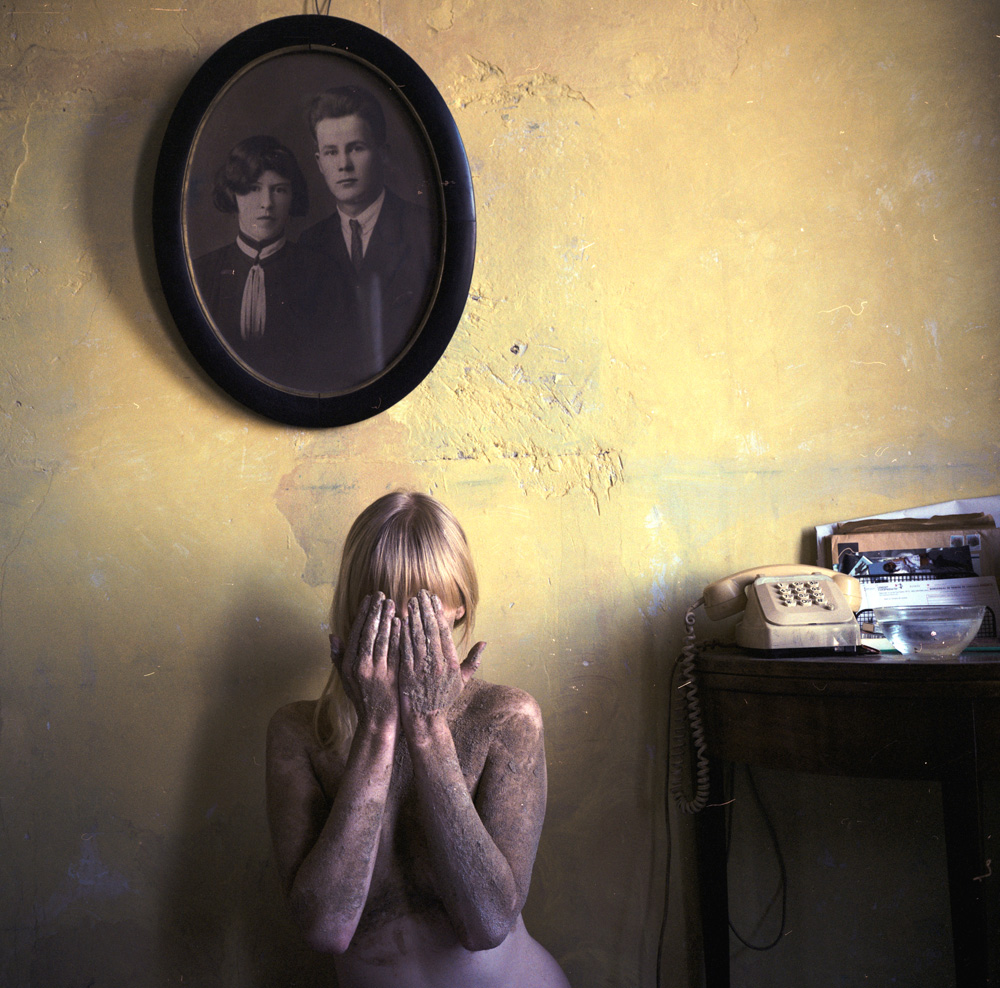
6 Film Photographs from Isa Lausas


Isa Lausas | SE-2 | from Static Echo | 2012 | Film photograph

The inability to root myself in a society or in a specific country is reflected in my work by a mesh of elements from different time periods and cultures.

My photographs are conceived almost as paintings, by a process of association of elements and observation in a performative game. My aim is to create timeless and borderless atmospheres to capture what I define as visual enigmas.

    1. Relative to the view, visible and approachable by anyone in the contemporary world.
    2. Spontaneous living pictures or ‘tableaux vivants’, composed by quotidian symbolism related to daily rituals, objects.
    3. Intentional ambiguities in the presentation of a situation.
    4. Thing or person difficult to comprehend.
    5. Questioning of the « self » that coexists in between an inner vision and a physical existence in its living space.
    6. Components involved in the creation of a personal mythology.
    7. Captivating silence: nb that all silence is not peaceful.
    8. Strange and attractive detail(s) which go below understanding.
    9. Absence of explanation, which remains floating in the extra-visual.

These propositions define my process and photographs, inspired by encounters, discoveries of elements that are usually ignored, and of the unknown in general. A transformation and appropriation of the quotidian arouse an intrigue and an attempt to make the invisible visible.

Posted in ARTWORKS | Tagged

Interview with Dorothy Hewett (O’Keefe remix)


Dorothy Hewett | Ali Burns | The Hoopla | 2015

Hazel de Berg’s recordings take place in the homes or work spaces of the subjects rather than a recording studio. This allows something of these places into the recording whether birdsong, traffic or an r&b song playing in the background. In the recordings, de Berg remains enigmatic, the ghostly presence operating the machine.

Interview with Dorothy Hewett ( O’Keefe remix)

Recorded on 11 March 1973 by Hazel de Berg.
2015 mix by Ella O’Keefe

‘Dorothy Hewett interviewed by Hazel de Berg in the Hazel de Berg collection’
Courtesy of the National Library of Australia, TRC 1/658-659
Special acknowledgement to Duncan Felton, NLA Oral History & Folklore Branch

Read more about Dorothy Hewett at the Australian Poetry Library.

Posted in INTERVIEWS | Tagged , ,

Interview with Brett Whiteley (O’Keefe remix)


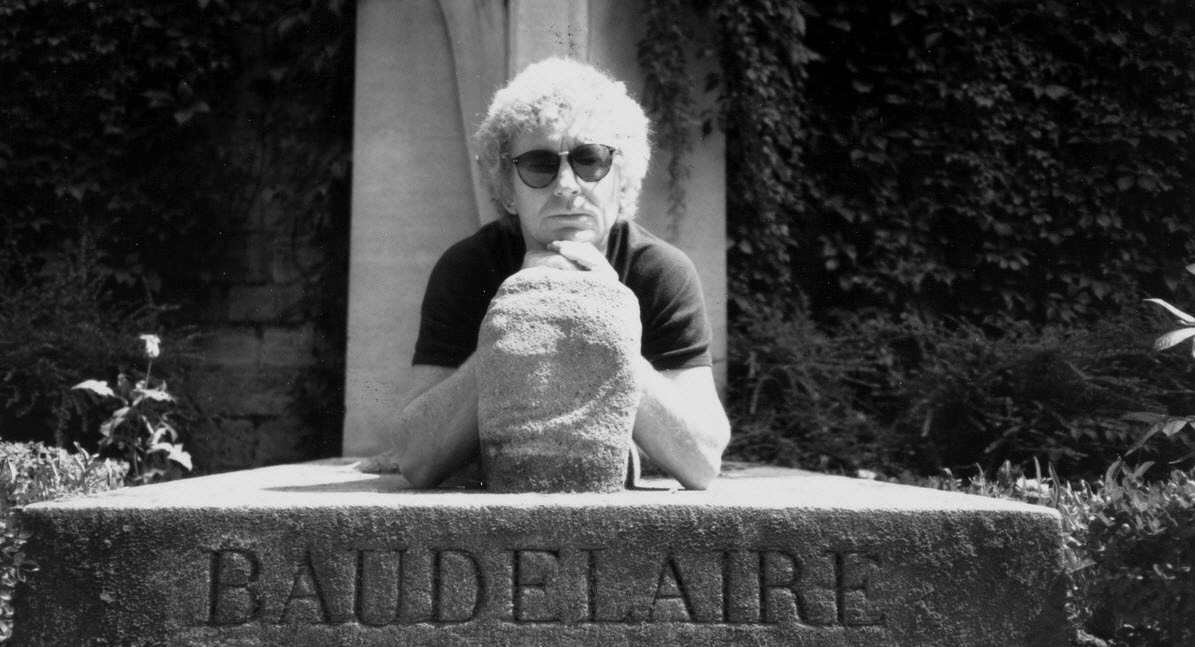
‘Brett Whiteley at Baudelaire’s Grave, c. 1989’ | by Unknown | gelatin silver photograph | 14.3 x 9.3cm | National Portrait Gallery, Canberra Gift of Patrick Corrigan AM 2010

Hazel de Berg’s recordings take place in the homes or work spaces of the subjects rather than a recording studio. This allows something of these places into the recording whether birdsong, traffic or an r&b song playing in the background. In the recordings, de Berg herself remains enigmatic, the ghostly presence operating the machine. An exception to this can be found in this recording of Brett Whitely who, in the course of the interview, expresses frustration with the recording not being in a conventional Q&A format. De Berg can be heard offering questions and prompts about the themes and symbols in some of the paintings sitting in the room where the recording was made.


Interview with Brett Whiteley (O’Keefe remix)

Recorded on 5 March 1970 by Hazel de Berg.
2015 mix by Ella O’Keefe

‘Brett Whiteley interviewed by Hazel de Berg for the Hazel de Berg collection’
Courtesy of the National Library of Australia, TRC 1/461
Special acknowledgement to Duncan Felton, NLA Oral History & Folklore Branch

Read more about Brett Whiteley at the Art Gallery NSW Brett Whiteley Studio.

Posted in INTERVIEWS | Tagged , ,

Bonny Cassidy Interviews Sophie Collins

I said comforting things to the scaffold 
but she only seemed to lean more heavily
against the side of the church.
We are rarely independent structures she said
before she dropped a bolt pin 
which released a long section of tube
which released another bolt pin
which released several wooden boards
which scraped another tube
and made an unbearable sound.

– from ‘Healers’ by Sophie Collins (first published in Poetry, October 2014)

Based in Belfast, Sophie Collins is co-founder and editor of tender, an online quarterly promoting work by female-identified writers and artists. Her poems have appeared or are forthcoming in Poetry, Poetry London, The White Review, Ploughshares, The Lifted Brow and elsewhere. Reviews and other writings are published in Poetry Review and Dazed & Confused. In 2014 she received an Eric Gregory Award and was a poet in residence at the LUMA/Westbau exhibition space in Zürich. She is currently editing an anthology of experimental translations due late 2015 via Test Centre, London. I interviewe Collins in The John Hewitt, Belfast, December 15th, 2014.

Bonny Cassidy: Thanks for representing tender as one of its visionaries – the other being Rachael Allen. Before we talk about the journal itself, it would be good to learn a bit more about you. You grew up in Holland, right?

Sophie Collins: Right, though I don’t feel Dutch, nor particularly English. Honestly, I feel a bit nomadic. I was born in the south of England; my father is a Classics teacher, and he was offered a job at an international school based just north of Amsterdam, so I grew up there from a toddler until I was about eighteen. At that age I moved back to London to do a BA at Goldsmiths, and then after my MA came to Belfast to do a PhD at Queen’s. The work I’m doing here deals with experimental modes of translation. The creative component is an anthology of experimental translations I’m putting together, which will be published by an independent press here in the UK next year.

BC: How does your ‘nomadic’ youth inform your interest in translation? More specifically, what drives your focus on the experimental angle, since this also seems to typify the work you publish in tender?

SC: I think it’s not necessarily my upbringing that was ‘nomadic’, but rather the feeling I’m left with now of sitting a little uncomfortably in either culture. Without wanting to forge a narrative, I can definitely see some links between my childhood, my education and my current sensibilities. Having grown up in North Holland and attended a school with a strong emphasis on language, and a really broad, international intake, languages and borders have always been central to my life and thinking. I was taught primarily in my mother tongue (English) but also had to take certain classes – namely the human sciences – in French, and this while living in the Netherlands, so I’ve been working across at least two different lexicons from pretty early on. Partly due to this, language took on a material aspect for me at quite a young age – it felt like a tool rather than the fount of sense. So, much later, when I was introduced to ideas around conceptual poetry, including modes of conceptual/experimental translation, the ideas didn’t feel threatening to, or out of sync with, my outlook, and I became very interested in experimental poetics very quickly. I began to incorporate conceptual techniques into my own poetry, and, soon after this, during my MA at UEA, began a module in experimental translation. At that point it made sense to incorporate different languages into my research, and my approach to translation was always going to reflect my approach to poetry.

The work in tender is also a reflection of these sensibilities – with the journal Rachael and I wanted very much to etch out a space not just for female writers and artists, but also for the kind of work that we feel doesn’t get enough airtime in the UK. This tends to lean towards that which subverts expectations of lyric poetry, whether such work incorporates and transcends the lyric, or altogether rallies against it. We don’t subscribe to a manifesto and aren’t (I hope) prescriptive, but in terms of poetry we are always looking for something with what I think could best be described as self-awareness, however that manifests.

I guess that, with editing the translation work, I’m relatively new to that discipline but could be seen as making decisions about what’s valuable, what ought to be shared. But tender was more of a spontaneous project, something that developed as it progressed. And I guess that’s to do with the serial format of the journal. Rachael and I saw a gap in UK journals, which we wanted to fill. We wanted to promote young female talent from the UK and America, and elsewhere, in translation, whenever possible, and bring that together with more established contributors, breaking down the ostensible discrepancy between them. At a poetry event the other week, an Australian poet living in London, Holly Isemonger, told me how heartening it was to see in tender an eighteen year-old woman from Long Island publishing her first poem alongside work by poets like Linda Kunhardt and Eileen Myles. She felt this made the journal more approachable as a reader and potential contributor, and that this was part of her enjoyment of it. She also said tender had influenced what she was reading at the time, which was an amazing thing to hear, and so in tune with our original aims.

BC: I have to ask you, then, why a female-only journal? Why now, and why here in the UK?

SC: We distinctly felt that a female-only journal was something that was lacking in the UK. There are a couple of others, including Mslexia, based in the UK, but that is primarily a print publication, and we wanted to establish an online platform, with work that could be easily shared and distributed. We came up against some criticism of the female-only aspect early on, almost two years ago now, as I think even then it was difficult for many writers and readers – ourselves included – to see the real extent of sexism within creative industries. But these challenges seemed to fall by the wayside as more and more articles began to be published regarding gender inequity in poetry and the arts.

BC: So you agree that there is such an inequity?

SC: Yes, absolutely. Something that has both acted as evidence of this problem, and has reassured me of the positive repercussions of a publication like tender, has been when magazines, having recognised that they are not publishing enough work by women, have consulted current and back issues of tender, picking out the contributors they like and getting in touch with us for contact details in order to solicit these writers’ work.

BC: Tell me a bit more about the discrepancy you see in publishing opportunities for women here in the UK.

SC: Go to any mainstream publication, any prize list. It’s true that in the past year a lot of platforms and publications have pulled their socks up, but I still regularly perceive a disconcerting ratio of around 20:80 women to men. Perception of ‘women’s work’ also means that there is a kind of censorship on work by female writers and poets, but statements like this are only substantiated by anecdotes that demonstrate as much. A poet recently told a close friend of mine about how the final line of a poem in her debut collection was considerably changed by the press’s (male) editor on the grounds of its sentiment not being ‘maternal enough’. Editors, readers, other poets – both male and female – may openly rally against sexism within the arts, but still maintain deeply ingrained ideas about women’s representation – this is apparent not only in uneven numbers and female censorship, but in the way women are often represented and spoken about within literature itself.

Posted in INTERVIEWS | Tagged ,

Johns Forbes & Tranter: Reading and Discussion at Forbes Street Studios

Writer in residence at ANU with Robert Adamson and Nigel Roberts, 1987 | Image © Juno Gemes
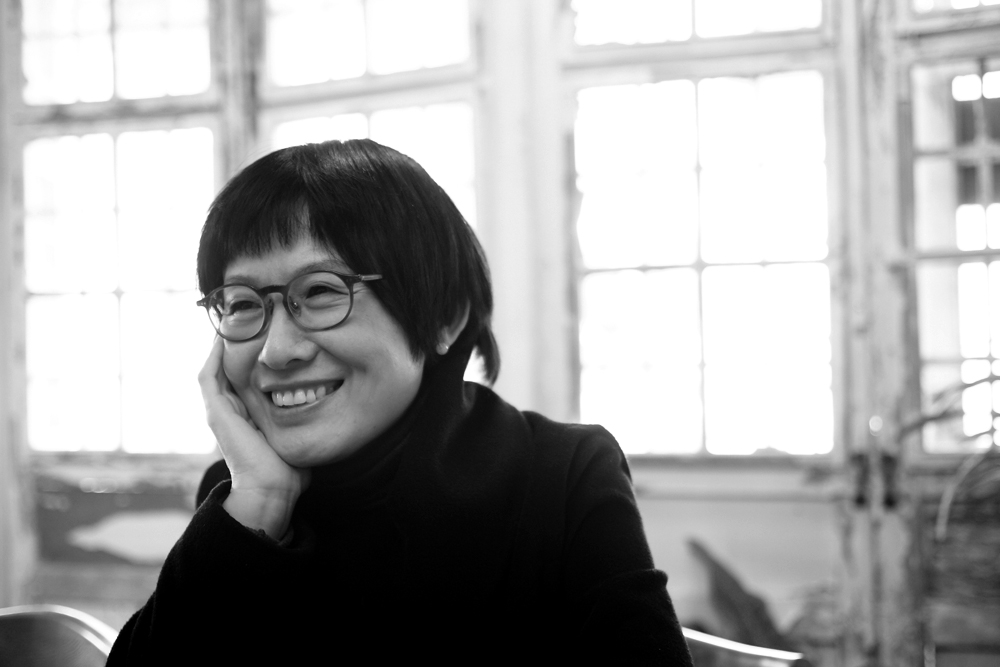
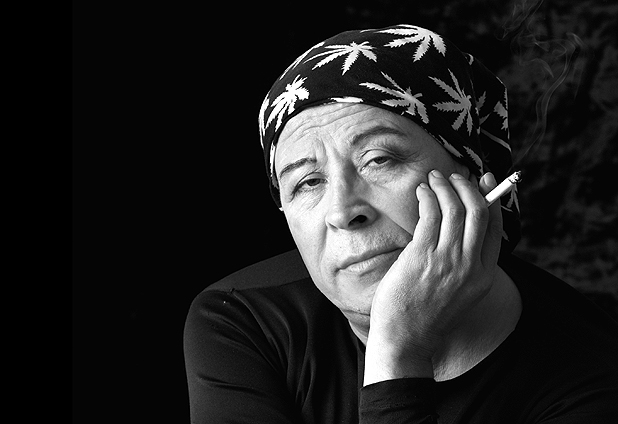

John Tranter and John Forbes, Forbes Street Studios, 1980 (55:00)
Recording courtesy of John Tranter

Posted in INTERVIEWS | Tagged , ,

Exploring and Renegotiating Transparency in Poetry Translation

To read poetry in translation, no matter how ‘close’ the rendering is to the original text, is to necessarily involve another figure in the reading and interpreting process. Readers of translations are not only receiving the work of the original poet, but also the adaptive skills and internalised views of the translator or translators involved. When we review or consult others’ feedback on published poetry translations, one of the most common assessments is whether or not the rendered text is ‘good’ or ‘accurate’. Central to these often highly subjective perceptions are a notion of ‘equivalence’, and the question of whether or not this translation appears, prima facie and upon closer examination, to closely replicate the themes, techniques, and language applied by the original poet. At the same time, this assessment is generally performed with awareness that there can never be ‘complete’ equivalence across all parts of the text.

Historically there has been some ambivalence towards this awareness. Early English-language translations of the ancient Greek poet Sappho, for example, were often praised for their adherence to popular perceptions of the poet herself, rather than her work and the translator’s accuracy.1 Similarly, Ming Xie observes that Chinese poetry in the nineteenth century had a habit of being ‘appropriated and transferred, often in a much diluted form, from mainstream Victorian ‘poetic’ treatment’, resulting in publication and circulation of Chinese poems that appear to be ‘a typical product, and often a second-hand rehashing, of the reassuringly familiar and conventional ‘poetic’ staple of the Victorian era’.2 In both instances, translations are made to fit predetermined aesthetic and biographic models. A ‘good’ translation, in such contexts, may simply be a translation that appears ‘familiar’ and therefore readily accessible to its new readership, rather than a dedicated reproduction of the original poetry and the poet’s intentions.

However, strong efforts are regularly made to recognise original source poems when publishing translations. It is certainly not uncommon to find original and translated poems published side-by-side, along with explanatory notes and introductions. In these cases, such translations allow readers with the necessary linguistic background to observe where the two poems converge, and possibly even dispute the translator’s assessment. Non-speakers are able to visually assess the poems’ structural similarities, if not their tonal and linguistic connectivity, when presented with both texts, and are also given indications of where to begin their assessments with aid from explanatory notes. Some excellent examples of this kind of inclusive translation can be seen in more recent versions of Sappho’s fragmentary poetry, particularly that of Anne Carson, and also in the English-language publication of Japanese poet Seiichi Niikuni’s Zero-On, a collection of concrete poetry, which will be discussed in this paper.

However, a myriad of issues can abound when translating poetry, including issues of appropriation and ‘colonising’ a text. An immersive and potentially misleading translation style, such as that used by Ezra Pound in Cathay, which engages with the poetics of classical Chinese writer Li Bai, will be demonstrated as an example. However, should this mean that only translations that provide full renditions of the original text, as well as detailed academic references, can be viewed as inherently sensitive and appropriate?

Alternative approaches will be endorsed in this discussion and also demonstrated in my production of two translated poems, focusing on the potential for creative adaptation to tell another story for readers and open up other avenues for interpretation, analysis, and discussion. These translated pieces will ideally balance many translation techniques examined in this paper, and also demonstrate ‘transparent’ translation, in the form of detailed, acknowledged creative adaptation that offers room not only for the original text, but also acknowledges the subjective nature of meaning transference and replication in poetry translation. Where complete fidelity to the original text may be difficult, full acknowledgement of the translator’s own creative voice and analytical role in the rendering of poetry becomes even more important, not just for the benefit of academic readers, but also a broader reading public, encouraging not only greater creativity, but also more respectful negotiations and recognition of cultural, historical, and linguistic diversities.

Issues of ‘Transparency’ in Poetic Translation

Central to this discussion is a desire to promote greater ‘transparency’ in poetic translations, referring specifically to the separation or lack thereof between original poet, translator or translators, and the reader. In particular, greater understanding of the level of creativity adopted by the translator should be facilitated. However, the term ‘transparency’ interacts with more difficult implications in translation practices and theory.

Lawrence Venuti acknowledges a long historical tendency in Western publications of perpetuating ‘an illusion of transparency’, referring to when a translated text is apparently absent of ‘any linguistic or stylistic peculiarities’ which make it ‘seem transparent, giving the appearance that it reflects the foreign writer’s personality or intention or the essential meaning of the foreign text’, or in other words, make it appear as though ‘the translation is not in fact a translation, but the ‘original.’’3 Not only is this a problematic process of erasure, for both the original poet and the translator’s own adaptive skills, but Venuti observes potentially colonising effects of such translations, quoting from reviews of translations to illustrate the issue:

Fluency also depends on syntax that is not so ‘faithful’ to the foreign text as to be ‘not quite idiomatic,’ that unfolds continuously and easily (not ‘doughy’) to insure semantic ‘precision’ with some rhythmic definition, a sense of closure (not a ‘dull thud’). A fluent translation is immediately recognisable and intelligible, ‘familiarised,’ domesticated, not ‘disconcerting(ly)’ foreign …4

A ‘transparent’ text, in this context, is therefore ideally bereft of identifying cultural markers, including tonal and linguistic nuances. Instead, Venuti criticises the overarching authority of ‘plain styles’ in English, achieved over several centuries, and cites Bernstein’s analysis of this historical movement as evidence of a drive ‘toward uniform spelling and grammar, with an ideology that emphasises nonidiosyncratic, smooth transition, elimination of awkwardness … anything that might concrete attention on the language itself.’5 There are considerable issues with such an approach. Though arguably a streamlined translation of this nature will facilitate dissemination and understanding of an original text amongst a wider range of readers, the text itself does not represent a full account of the original writer’s work, nor in fact of the translator’s potential abilities to produce a much closer rendering.

In addition, such translations come into conflict with the source text. Gayatri Spivak addresses the risk of ‘violence to the translating medium’ when a translator attends to the specificity of language, particularly when addressing the ‘rhetoricity of the original.’6 Spivak refers to the complex relationship of the source text with its intended meanings, and dismisses any argument of convenience as justification for ‘quick and easy and slapdash’ translations that skim over the full nuances of rhetorical engagements and challenges in the original language.7 In order to do full and respectful justice to a piece, Spivak asserts that a translator ‘must surrender to the text’:

She must solicit the text to show the limits of its language, because that rhetorical aspect will point at the silence of the absolute fraying of language that the text wards off, in its special manner. Some think this is just an ethereal way of talking about literature or philosophy. But no amount of rough talk can get around the fact that translation is the most intimate act of reading.8

It is this sense of intimacy that must be given more attention, and attached to the term ‘transparency.’ The translator’s immersion in the source text, examining its linguistic nuances and rhetorical, theoretical, and artistic intentions, should not be divorced from the highly subjective nature of these interpretative processes. ‘Intimacy’ is not a criticism, but an important feature of translation, which should be clearly recognised and stated for readers. In so doing, Spivak’s notion of ‘surrender’ would not result in either the source text or the translator’s version being disadvantaged; rather, the artistic and interpretive link between the two texts could be more fully acknowledged by more readers, and understandings of the relationship between both pieces enhanced.

In light of these considerations, the term ‘transparency’ in current translation theory reflects not transparency of the translator’s motivations and the original writer’s text, but a false sense of immediacy to the original work, as though the translator played no part in the work’s production of meaning and form. Henri Meschonnic’s consideration of the need to ‘break away from the form/content binarism stamped on source language/target’ (translated by Pier-Pascale Boulanger) is appropriate, not only in considering the ethics of translation, but also in reshaping an understanding of ‘transparency’ in translation.9 Such breakages, swerves, and accommodation for the translator’s individual choices in adapting the source material for reception in another language can be ethically achieved as long as it is acknowledged, and not presented as the ‘transparent’ work of the translator. Transparency should be given to the translator’s own machinations, and published in broader forms beyond the accepted conventions of introductory section and footnotes, in accordance with creative means that better suit the individual translator’s own processes and what may better justify the source text.

It is tempting to argue for convenience’s sake that such translations would be too cumbersome and confusing for readers to follow, but this is where transparency, in another sense of the term, can be of assistance. The value of linguistically sensitive and diverse texts, rendered into other languages and circulated more broadly, should not be downplayed. It is not necessary, nor even advisable, for texts to only be translated into means and terms that are immediately palatable for the recipient audience. Diversity of thought, language, and experiences should not be masked. Marcel Detienne refers to ‘the shock of the incomparable’, when a large group of language specialists were brought together to attempt to identify some unifying ‘founding’ feature shared by all languages, resulting in discovery that no such common ground existed, and that to endeavour for such a goal was to strive for an artificial ‘creation of a territory’ and ‘misleading transparency.’10 Stemming from this refusal of territorialisation, a lack of common ground and equivalence, new thinking is required. In the case of poetry translation, new techniques, themes, ideas and prosodic approaches can be learned, examined, and negotiated. But without acceptance of this need for difference, such changes may not be made, or even introduced. Stylistically diverse translations can and have historically introduced new poetic structures and ideas to English-language poetics. By clearly acknowledging these diversities, translators can not only facilitate these styles’ dispersal and popular acceptance or engagement in another language, but also more openly recognise their own position as mediator of a text, rather than its mouthpiece.

In the sections to follow, closer examination of ways in which translators have already made their roles as active creative adaptors, rather than passive purveyors of a domesticated rendering, to use Venuti’s term, will be compared. The scope of these translations for inspiring future research and poetic works will also be highlighted, emphasising this need for respectful treatment not only of the source text poet’s intentions, innovations, and structures, but also those of the translator.

Posted in ESSAYS, SCHOLARLY | Tagged , , , , , , , , , , , , , , ,

Nori Nakagami’s ‘Dragon’s Egg’

A dragon lives in your heart.
It coils around the man you love.
It protects him.
It will never release him, not until he meets his end.
In time it will birth the world and everything that lives.
This world is filled with the dragon’s love.

You carried an egg for a month while staring at a white ceiling.
You carried an egg to hatch at your flower festival.
The rock watching from the side of the highway.
The air thick and tropical around you
As soon as you stepped there.
The grave of a goddess.
Massive and serene.
As if it were the grandmother of everything.

A shrine maiden dances.
There you are, who have yet to carry an egg.
A rope hangs from the top of the rock.
A rope that goes out to the ocean.
A tiny, tiny little dragon is coming.
A birth cord ties the dragon goddess to the dragon child.
Something pure flows from the rock
Through your body to the sea.

You left the white world and sailed across many seas.
Carried by the Kuroshio Current
To the Kii Peninsula, the Korean Peninsula, the Malay Peninsula.
The Indonesian islands.
The Philippine islands.
Island to island.
Cruising down a river in a boat.
Nipa palms on both banks.
Soft fruit encased by hard shells, far from the treetops,
Nestling beneath the tree like eggs being nursed.
Boats loaded with cargo pass each other.
Four boats, five boats, all strung together.
In every boat a boatman.
Dark-skinned men.
As one, they look at you blankly,
At the boat carrying the passing strangers.
Even when your eyes meet, they do not look away
As if to say: they can see everything.

In Cebu naked children are running.
At a temple the statue of a lion roars.
The naked children hold out their hands.
Small smudged hands.
The beady eyes of a baby in his naked sister’s arms.
Such children used to be everywhere.
A host of grimy faces pressed to the car window, waiting for the lights to change.
They sing, they show their yellow teeth.
Without shoes, their feet, light as wings,
Kick off from the ground.
They spring up.
Is this ocean or sky?
It is freedom. It is freedom.

With the aid of a cane from En no Gyōja,
You walk to the Arabian Peninsula, the Sinai Peninsula, Mount Sinai.
Cairo, Egypt.
You question the father of Tutankhamen,
After so long, what do you think of the world outside?
A great number of people argue loudly;
A great number of people get hurt.
The elderly, children, women, men, foreigners.
Ah, Father of Tutankhamen,
What is the difference between the god people believe in
And the god a friend’s family believes in?
The children have a grandmother in Cairo.
Father of Tutankhamen, will peace come?

Listen to the voices.
Use your imagination.
Don’t look away.
Don’t forget.
Never forget.

Climbing the stone steps of the Ancient Trail, you look back
At the terraced fields descending to the shimmering sea.
That is where everyone came from.
As soon as it was said, he went into the mountain.

Izanami gave birth to Kagutsuchi, a god of fire,
And in the throes of birth was burnt to death.
Birth, death.
The symbol of woman.
Towering high over the sea.
Gleaming with sunlight reflected from the beach.
Men on board ship.
Men on a battlefield.
Men on board ship and on a battlefield: they sound alike in this tongue.
As long as you are a god,
You cannot help but be drawn to
The beautiful white magnificent vision of a goddess.
A bouquet of hues.
The scarlet of a virgin’s lips.
Voices from paradise beyond the sea.
Sacred conception.
Incubation begins.

You go to the foot of that mountain.
A foggy morning;
You ask for directions in your halting tongue
From an old man at a newsstand;
You take the subway.
Your father petitioned that mountain.
Your mother prayed at that mountain.
You are neither father nor mother.
You do not know why you came.
You ascend the stone stairs steadily.
You tread with the utmost care.
As if the meaning of your birth, the meaning of your child’s birth,
Is steeped in each of these stone steps.
Loves lost, people lost.
New loves, new encounters.
You hear voices singing.

At the damp stone wall behind your grandmother’s house,
A wall where you used to play when you came home,
You saw a butterfly with a blue stripe.
As you got closer, the butterfly fluttered over the wall.
You tried to climb the wall to follow it, but had to give up.
Grandma noticed you putting your foot on a stone of the wall
And scolded you for doing so, because you are a girl.
It was not as if the wall was so low
That you could have climbed over it without help.
The stone wall loomed towards you,
as you gave up and entered the house from the back door.
It loomed towards you,
As if in reproach.
A crab dead at your feet.
The smell of rotten fish.
On the damp stone wall, the wet moss,
The glistening light of the sun.

Something flows like water, stirs old affections.
You are going to see your dragon.
A temple like an egg embraced by a phoenix.
A refrain: the white waterfall
Entrusted with a dragon’s egg.
Is this Kishu? Yeongju?
The peninsula where a longhaired goddess lives?
The future hatches from an egg and goes beyond the sea.


龍の卵

中上紀

心の中に龍が暮らしている。
愛した男に、絡みつく。
愛した男を、守る。
命尽き果てるまで放しはしない。
やがて大地を、そこに息づくあらゆるものの命を作る。
世界は、龍の恋心で満たされている。

白い天井を見つめていた一ヶ月、卵を宿していた。
あの、花の祭りで海に孵るために、宿していた。
国道のすぐ脇で高々と見下ろす岩。
一歩足を踏み入れるとたちどころに私を包む、
どこか南国の匂いのする密度の濃い空気。
女神の墓。
とても大きくて優しげに。
さながら、すべてのものの根源である、祖母のように。

巫女が舞う。
そこにいるのは卵を宿す前の私。
岩の頂に綱がかけられる。
海へ行く綱。
小さな、小さな子供の龍がやってくる。
臍の緒が、女神の龍と、子供の龍を繋ぐ。
そうして、岩から清らかなものが、
私の身体を伝って、海へ行く。

白い世界を離れ、私はたくさんの海を渡った。
黒潮と共に。
紀伊半島、朝鮮半島、馬来半島。
インドネシア諸島。
フィリピン諸島。
島から島へ。
船に乗って河を下る。
両岸にはニッパ椰子。
その硬い殻に覆われた果実は木の上に生るのではなく、
下のほう、そう、足元に卵を抱くように、生る。
荷を乗せた舟がすれ違って行く。
四艘、五艘もの舟が、数珠繋ぎになっている。
一艘ごとに船頭が居る。
浅黒い膚の男たち。
皆一様にこちら側を、
物見遊山のよそ者が乗った舟を、
ぼんやりと見ている。
目が合っても決して逸らさず、
すべてが見えるぞとでも言いたげに。

裸の子供が走るセブ・シティ。
寺院の、獅子の像が吼える。
裸の子供は手をこちらに差し出す。
薄汚れた小さな手。
裸の子供の姉が抱く赤ん坊の円らな瞳。
そんな子はどこにでもいた。
信号待ちの窓に、たくさんの、薄汚れた顔が張り付いた。
黄色い歯を見せながら、歌を歌っていた。
靴を履いていない彼らの足は羽のように軽く、
つうっと、地面をける。
飛び上がる。
そこは、海なのか。空なのか。
自由だよ、自由だよ。

役の行者の杖に乗り、
アラビア半島、シナイ半島、シナイ山。
エジプト、カイロ。
ツタンカーメン王の父王に、
久しぶりの、外の世界の感想を尋ねる。
大勢の民が、大きな声で喧嘩し、
たくさんの人が傷ついた。
老人、子供、女性。男性。外国の人。
ツタンカーメン王の父王よ、
民人たちが信じる神は、
私の友達の家族が信じる神と、どう違うのか。
カイロには子供たちの祖母が居る。
平和は来るのか、ツタンカーメン王の父王よ。

声を聞け。
想像しろ。
目を逸らすな。
忘れてはならない。
決して、忘れてはならない。

古道と呼ばれる石段を上がりながら振り返ると、
段々畑が、きらきらとした海に落ちて行く。
皆、あそこから来たのだ。
そう言うまもなく、彼の人は山に入って行った。

イザナミは火の神カグツチを生んだ。
その火に焼かれて死んでしまった。
ウムコトトシヌコト。
オンナノショウチョウ。
海に向かって切り立つ。
御浜に降り注ぐ太陽を受けて光り輝く。
船上の男たち。
戦場の男たち。
センジョウノオトコタチ。
男神であるならば、
白く美しく堂々たる女神の姿に、
惹きつけられないはずはない。
色とりどりの花束。
初夜の紅。
常世の国からの声。
聖なる受胎。
籠りのはじまり。

あの山の麓まで出かけた。
まだ靄のかかったような朝、
ニュースペーパースタンドの老爺に、
拙い言葉で道を聞きながら、
地下鉄に乗って。
父が願ったあの山に。
母が祈ったあの山に。
私は父でも母でもない。
どうして出かけたのかもわからない。
ただ一歩一歩石段を踏みしめる。
あたかも、私が生まれた意味が、私の子が生まれた意味が、
石段の一つ一つに沁み込んでいるかのごとく、
大切に一歩を繰り出す。
すべてのものが、切ないほどに愛しい。
失った愛、失った人。
新たな愛、新たな出会い。
歌声が聞こえる。

祖母の家の裏の、じめっとした石垣のところで、
帰省するたびにいつも遊んでいた、石垣のところで、
青い色の線の入った美しい蝶を見た。
近づくと、石垣の上のほうに、蝶は飛んでいく。
蝶を追いかけて石垣を登ろうとし、断念した。
石に足をかけているところを祖母に見つかり、
女の子やのに、と叱られた。
そもそも、何の道具もなしに登りきることの出来るほど、
低い石垣でもなかった。
あきらめて裏口から家に入ろうとすると、
石垣が迫ってくる。
まるで責められてでもいるかのように、
迫ってくる。
足元に蟹が死んでいた。
腐った魚のにおい。
苔むし、じっとりと濡れた石垣の上は、
こぼれるような太陽の光。

慕情をかきたてる水が流れる。
私の龍に会いに行く。
鳳凰が抱く卵のようなお寺。
白い大滝が呼応する。
卵を託したのは龍。
視線の向こうには遥かな水平線がある。
ここは紀州、それとも栄州。
あるいは長い長い姿をした女神が暮らす半島。
そこに孵った未来が海を越えていく。

Posted in TRANSLATIONS | Tagged ,

Erin Mouré’s ‘Une fois nés’

This is a translation of ‘Une fois nes,’ a poem originally translated by Erin Mouré. It has been excerpted from a small chapbook, À Adan: poems d’Emma M. (Chatte, enr.):

traduits par E. Mouré
pour les amies et amis d’Emma
et en mémoire de Catson Studios

In this work, Mouré translates (from Kat) the poems of deceased author, Emma M., whose linguistic ‘prints’ (from keyboard walking or sitting) appear in a number of the Mouré’s earlier books. The poems brim with macaronic nonsense rhyme, sound associations and puns, requiring stranger than usual translational leaps and contortions.

Une fois nés
Les foins font hay
aérès today
d’Emma ragout
n’a pas	dégoût
Emma debout
            debout Emma!
            debout!

Achoppe aimée redresse
aller
muet salé            de l’acharnée
renoue féerique	à jamais feint
pâle y est
palier today away
                ah oui

paré. Emma parée.


ou ben “parade”, pódeae – creo que si
Once in clay
The plants make haie
aired out la journée
of Emma ragout
has no curfew
Emma debut
            debut Emma!
            debut!

Stumbles love straightens
so, go
salty mute                           of relentless one
magically resumes is nevermore feint
car pet
carpet aujourd’hui partie
                ah oui

prepared. Emma prepared.


ou ben “parade”, pódeae – creo que si
Posted in TRANSLATIONS | Tagged ,

2 Poems by Victor Hugo

                      At dawn, when the land
whitens, I’ll leave. You see I know
you’re waiting. I’ll go through the hills
I’ll go by the trees. I won’t live so far
any more. I’ll walk, my eyes trained
on thoughts, see no thing beyond them
hear no noise, alone unknown hunched
hands crossed sad, and day will be night.
I will not look at the gold of night-fall
or the far off boats, and when I get there
I will put on you, a bunch of green holly
and heather


JEAN MAKES HER ENTRY

Jean talks; she says more than she knows.
Out to the scolding sea, to the ringing woods, to clouds
flowers nests, to the firmament, to all of nature
she sends her soft babbling, a whole speech, deep
perhaps, which she ends by a smile, in which floats a
soul, or trembles a dream : indistinct vague
obscure confused scrambled murmuringsGod, the good
old grandfather, listens amazed.


Demain, dès l’aube, à l’heure où blanchit la campagne,
Je partirai. Vois-tu, je sais que tu m’attends.
J’irai par la forêt, j’irai par la montagne.
Je ne puis demeurer loin de toi plus longtemps.
Je marcherai les yeux fixés sur mes pensées,
Sans rien voir au dehors, sans entendre aucun bruit,
Seul, inconnu, le dos courbé, les mains croisées,
Triste, et le jour pour moi sera comme la nuit.
Je ne regarderai ni l’or du soir qui tombe,
Ni les voiles au loin descendant vers Harfleur,
Et quand j’arriverai, je mettrai sur ta tombe
Un bouquet de houx vert et de bruyère en fleur.


JEANNE FAIT SON ENTRÉE

Jeanne parle; elle dit des choses qu’elle ignore;
Elle envoie à la mer qui gronde, au bois sonore,
À la nuée, aux fleurs, aux nids, au firmament,
À l’immense nature un doux gazouillement,
Tout un discours, profond peut-être, qu’elle achève
Par un sourire où flotte une âme, ou tremble un rêve,
Murmure indistinct, vague, obscur, confus, brouillé,
Dieu, le bon vieux grand-père, écoute émerveillé.


Posted in TRANSLATIONS | Tagged ,

Four Poems from Kim Hyesoon’s ‘Autobiography of Death’


Jacket image from Sorrowtoothpaste Mirrorcream, by Kim Hyesoon.

Kim Hyesoon is one of the most prominent poets of South Korea. She lives in Seoul and teaches creative writing at the Seoul Institute of the Arts. Her most recent books in translation are Sorrowtoothpaste Mirrorcream (Action Books, 2014) and I’m OK, I’m Pig (Bloodaxe Books, 2014).

Photograph
               --Day Three

How’s your doll?
How’s your doll’s health? 

You speak into your doll’s ears, It’s a secret! Shut your mouth for life
As you pluck out your doll’s eyes, You liked it too, didn’t you? That’s it, isn’t it? 
As you cut off your doll’s hair, Die you filthy bitch 
As you set your doll on fire, You’ve forgotten about your past life forever 

When you leave the house, your doll stays behind 
When you leave the house, your doll comes back to life 
When you leave the house, your doll opens the window and looks out 
When you leave the house, your doll leaves the house 
When you leave the house, your doll leaves the house and pretends it’s an orphan 
That thing, it can’t eat in front of people for some reason
That thing, it never dies
An empty thing
That thing keeps your ghost in its eyes

Your doll is walking over there, its armless arms come out then go back in 
its legless legs come out then go back in 
like someone who’s left her legs behind on her bed

Crumpled paper from its legs scatter 

Your doll walks
Your doll talks

Drops its eyes inside itself
crying till its neck turns all the way around

It may come back to life when you die

Anyhow you can no longer make your doll stand
Anyhow you can no longer make your doll walk
Anyhow you can no longer make your doll laugh
You are now disconnected from your doll

Dear Doll: You still need someone to put you to bed every night and close your eyes 

You wail whaa-whaa as you write.
사진
               --사흘

네 인형은 안녕하세요?
네 인형은 건강하세요?

네가 인형의 귀에 대고, 비밀이야! 평생 입 다물어
네가 인형의 눈알을 뽑으며, 너도 좋았지? 그런 거지?
네가 인형의 머리를 자르며, 이 더러운 년아 죽어버려
네가 인형을 태우며, 너는 전생은 잊은 거야, 영원히

네가 집을 나가면 남아 있는 것, 인형
네가 집을 나가면 살아나던 것, 인형
네가 집을 나가면 창문 열고 내다보던 것, 인형
네가 집을 나가면 외출하던 것, 인형
네가 집을 나가면 외출해서 고아 행세 하던 것, 인형

남 앞에선 왠지 음식을 먹을 수 없다고 하는 것
죽지도 않는 것 
텅 빈 것
눈동자에 네 귀신을 모신 것

저기 저 걸어가는 네 인형의 팔 없는 팔이 나왔다 들어간다
다리 없는 다리가 나왔다 들어간다
마치 침대에 두 다리를 눕혀놓고 온 사람처럼

다리에서 종이 뭉치가 흩어진다

네 인형은 걷는다
네 인형은 말한다

몸속으로 눈동자를 떨어뜨리고
모가지가 돌아가도록 울던 저것

네가 죽으면 다시 살아나올지도 모릅니다

그러나저러나 너는 이제 인형을 세울 수 없게 되었다
그러나저러나 너는 이제 인형을 걸릴 수 없게 되었다
그러나저러나 너는 이제 인형을 웃길 수 없게 되었다

너는 이제 인형과 줄이 끊어졌다

인형에게: 너는 아직 저녁마다 침대에 눕히고 눈을 감겨줄 사람이 필요해.

네가 엉엉 울며 편지를 쓴다.
Posted in TRANSLATIONS | Tagged ,

George Vulturescu: What Vision Cannot Stand

A tourist map of key points of interest in the George Vulturescu poetry-scape would feature a number of salient features that his poetry has developed over the course of a quarter-century career of increasing depth and metaphysical complexity.

The first feature – where the map metaphor naturally derives – is his upper-case North, an abstract, mystical dimension as well as a literal and biographical lower-case coordinate. The Stones of the North, almost living crags on which, fatefully, prophetically, lightning incises its script and where wolves range in the forests, are coterminous with underlying geographical realities of the region of Satu Mare county in Romania’s north and, especially, the hamlet of Tireac, where Vulturescu was born and grew up. As to many Romanian authors raised in a rural world, village life and customs become a kind of mythical, eternal realm populated by a circle of voices – a kind of dramatic chorus – and filled with traditions of inherited folk wisdom side by side with ironic commonalities of social life.

Second, the motif of blindness – as a boy in his childhood village, Vulturescu lost the sight of one eye – entails the paradox that the blind eye ‘inside us’ sees beyond, and through, the external world and, moreover, ‘knows to distinguish / sick, sour letters from letters suckled on the truth …’ The poet’s half-blindness is amplified by the recurrent presence of Row, the blind man, whom Vulturescu makes the voice of ‘When the Forest Dies.’ Row is a seer of ‘a thousand visions.’ In ‘The Addition of Contour,’ likewise, the icon painter Ioachim fills a parallel oracular role: ‘I do not make use of my eyes but of what burns within them …’

This brings up a final, and basic, concern in this tour of Vulturescu country: letters, words, poetry, art, and the role of the imagined, the esthetic, the psychologically deep, in uncovering and representing truth. His notion of truth is innately spiritual. In a richly suggestive, humorous story characteristic of Vulturescu’s poetry, Ioachim, who ‘can feel the flame of the stones in the wall …’ tells his disobedient apprentice, the young Vulturescu, ‘the addition / of contour is faith, my son …’ And the poem gives Father Ieronim its riddling last words: ‘Blinding, says the Apostle, is what vision / cannot stand …’

Adam J. Sorkin

When the Forest Dies

                                                       Except for a stone, no one is innocent.”
	                                                                                                                           (Hegel)

The wolf will meet his end, the forest whispers to me
as I pass through the junipers.
A thousand visions of the North have I had,
but I, Row, the blind man, did not return. Lightning 
does not toy with you, its flame does not break open stones,
oh Lord, I cannot be saved from their violet folly.
Today above the Stones of the North there was
no raven,
                     no vulture,
                                             no crane.
Among the insects, clays and wild beasts, among the leaf stalks 
of the lecherous weeds and the strawberry plant runners
was debauchery without sex:
skin upon skin, bark upon bark, carapace upon carapace,
scale upon scale, tooth upon tooth.
Today above this sleet a black eye arose:
it hung over the pines, fixed in space, a bachelor of death.
The sun did not make it blink,
its shadow did not fall over all things and living creatures.
At noon it threw itself upon the necks of the roe deer, 
it had claws with which it choked the martens in the undergrowth,
it plunged into the river waters and caught fish, with its beak
it pecked the stones and scattered the sand beneath their skins
into the wind.
“It is not an eye,” Row, the blind man, told me.
“It is a letter from an unfinished poem
which set forth to hunt for the other lean ones.
In the unfinished poems the letters turn vengeful:
the lean devour the fat, the wet
guzzle down the dry, the singed set on fire
the green and unripe…” 

I know: a thousand visions I had
inside us are both the finished poem and the unfinished one
inside us are the raven on the Stones of the North
and the dust on the stones of the road
inside us is the eye that knows to distinguish
sick, sour letters from letters suckled on the truth 
of our nights
as only the wolves’ eyes know when the forest dies.
Când moare pădurea

                                                       În afară de pietre, nimeni nu e inocentă”
	                                                                                                                           (Hegel)

Lupul va avea un sfârşit, îmi şopteşte pădurea
când trec printre jnepeni.
O mie de viziuni ale Nordului am avut,
dar nu m-am întors, eu Row, orbul. Fulgerele
nu ţin de urât, flacăra lor nu deschide pietrele,
dar nu mă mântui, Doamne, de sminteala lor violetă.
Azi nu era deasupra Pietrelor Nordului
nici un corb,
                         nici un vultur,
                                                     nici un cocor.
Între gângănii, luturi şi fiare, între peţiolurile de 
ierburi lascive şi stolonii de căpşunici era o 
curvăsărie fără sex:
piele pe piele, coajă pe coajă, carapace pe carapace,
solz pe solz, dinte pe dinte.
Din zloata asta, azi se ridică deasupra un ochi
negru: plana peste pini, ţintuit, celibatar al morţii.
Soarele nu-l făcea să clipească,
umbra nu i se împrăştia peste lucruri şi vietăţi.
Pe la amiază se aruncă la gâtul căprioarelor,
avea gheare cu care sugruma jderii în tufişuri,
plonja în apa râurilor şi înşfăca peştii, ciocănea cu
pliscul în pietre şi nisipul de sub coaja lor se
răsfira în vânt.
„ Nu e ochi, îmi zice Row, orbul.
E o literă dintr-un poem neterminat
care-a ieşit să vâneze pentru celelalte slabe.
În poemele neterminate literele devin malefice:
cele slabe le mănâncă pe cele grase, cele umede
le beau pe cele uscate, literele arse le aprind pe
cele verzi...”

Ştiu: o mie de viziuni am avut
în noi e şi poemul terminat şi cel neterminat
în noi e corbul de pe Pietrele Nordului
şi praful de pe pietrele drumurilor
în noi e ochiul care ştie să deosebească literele
strepezi, bolnave de literele alăptate cu adevărul
nopţilor noastre
cum numai ochii lupilor ştiu când moare pădurea.
Posted in TRANSLATIONS | Tagged , ,

Farewell Sweet Ladybird: A Manifesto and Three Chronicles by Pedro Lemebel (1952–2015)


Pedro Lemebel (1952-2015) | Carla Pinilla | El Mercurio | Taken on 23/01/2015

Pedro Segundo Mardones Lemebel, known as Pedro Lemebel because he rejected his father’s surname in favour of his mother’s maiden name, was born in El Zanjón de la Aguada in Santiago, one of Chile’s most marginalised urban districts. During the 1970s, while Chile still suffered under the dictatorial rule of General Augusto Pinochet, Lemebel studied to become a school teacher specializing in Fine Arts – the first in his family to do so. After graduating, he worked as a school teacher in a series of schools; however, he was fired from two of his appointments for openly identifying as gay. Between 1987 and 1997, together with Francisco Casas, Lemebel formed the performing arts troupe Las yeguas del apocalipsis1 (The Mares of the Apocalypse), whose name alludes to the idea of the end of an era, specifically: the Chile of pre-1973. This implicit reference to the 1973 Chilean experience is a loaded one, as post-1973 Chile was the testing ground for expansion of the current hegemonic economic logic and practice: neoliberalism. Neoliberal theories were first put into practice in Chile, under experimental shock conditions, as part of Augusto Pinochet’s economic and social policy program, which was heavily influenced by the Chicago School of Economics and its formation of a new wave of Chilean economists through the Universidad Católica de Santiago, known as the ‘Chicago boys’. Lemebel’s work is a reaction against the myths of Chile under neoliberalism. In the 1990s, in the first few years of the transition towards democracy, Chile presents an image of itself as a successful economic miracle, a developed nation without poverty that is only capable of looking forward at the cost of ignoring the ignominy of its recent past. It is in this context that Lemebel’s performance troupe irrupts on the scene, challenging Chile’s new myths and desires. It is this same impulse that guides Lemebel’s writing, which blends the poetic with the quotidian, the personal with the political, the urban with the confessional, the past with the present.

Lemebel is particularly known for revitalising the genre of the crónica (chronicle) and transforming it from the perspective of the poor, the marginalised and the gay (queer) in Latin America. He is also well known for his novel Tengo miedo torero and for his public interventions. Lemebel’s chronicles, which afforded him some renown in Chile, depart from the generic restraints of the Hispanic crónica and instead remakes the form in such a way that it gives voice to and makes visible the dark side of Chile’s modernity. His chronicles tell the stories of lovers, acquaintances, pop figures, Chile’s desaparecidos2, drug addicts, exiles, drag-queens, and other characters from Chile’s urban periphery and recent history. Lemebel’s writing brings forth an erotic vision of the city, but it is a vision that centres on the experiences and stories of those who have been excluded from normative discourses of the neoliberal city in present-day Chile. Lemebel’s writing agglutinates poetry, the first person chronicle and the vitalism of a lived experience of the margins of the urban landscape; it lifts a mirror that shatters the image of the post-1970s Chilean myth.

Here we have made a selection of texts that begins with Lemebel’s poetic ‘Manifesto: I Speak For My Difference3, read in 1986 at one of Lemebel’s most notorious public interventions, while Chile was still under the rule of Pinochet’s dictatorship. This intervention was to serve as a warning to the new left of Chile, which was aligning itself with the discourses of the centre-right in order to be politically relevant, while simultaneously maintaining sexist discourses and attitudes. Lemebel’s manifesto is an important document, because it addresses the listener directly, using Chile’s everyday language and expressions. Lemebel uses the poetic form of the manifesto to challenge Chile’s gender politics, while also reaffirming and rearticulating a series of utopic and poetic images from the perspective of those not represented by Chile’s hegemonic discourses. The poem makes reference to the extermination of dissidents by General Carlos Ibáñez del Campo (3 November 1877 to 28 April 1960), an officer of the Chilean Army who served as President twice (1927–1931, 1952–1958)4, and the CNI: Central nacional de investigaciones5.

We have also selected three chronicles – ‘For My Sadness: Blue Violet’, ‘A Kind of Synopsis’ and ‘The Rettig Dossier6 – because they are loaded with poetic imagery and faithfully represent some of Lemebel’s recurring thematic preoccupations.

Sadly, Pedro Lemebel passed away at 62 years of age on the 23 January 2015. With his passing, Chile has lost a writer that fellow author and poet Roberto Bolaño called ‘the most imaginative, provocative and brave artist.’

Lemebel published the following works in Spanish:

La esquina es mi corazón, Cuarto Propio, Santiago.
Loco afán: Crónicas de sidario, LOM, Santiago.
De perlas y cicatrices, LOM, Santiago.
Tengo miedo torero, Seix Barral, Santiago.
Zanjón de la Aguada, Seix Barral, Santiago.
Adiós mariquita linda, Sudamericana, Santiago.
Serenata cafiola, Seix Barral, Santiago.
Háblame de amores, Seix Barral Chile
Poco hombre, antología, Ediciones UDP, Santiago.

Despite Lemebel’s popularity and presence as a cultural icon in Chile, only his novel My Tender Matador (Tengo miedo torero), published by Grove Press (New York) in 2005, has been translated into English.

Posted in TRANSLATIONS | Tagged , ,

Beyond Words: The Obscured Language of Graffiti

When contemplating writing a piece on graffiti typography for a journal of poetry review and criticism, I reflected on themes that could be extrapolated between the two. That is, beyond a shared use of the alphabet as fundamental building block for both creative practices. Of course, the term ‘graffiti’ finds its etymology in the Greek work ‘graphien’, meaning ‘to write’, but parallel language used in the seemingly disparate worlds of literature and graffiti art extends well into a contemporary context. Within their own community, graffiti artists are referred to as writers and the more complex artworks they create are known as pieces. When enquiring about their creative practice, a graffiti artist will be asked what do you write?

Most readers will be familiar with wild style graffiti, originating in the South Bronx, New York City in the 1970s and 1980s and made famous in a popular cultural context via music videos, cult films, and eventually, advertising and marketing. However, this is arguably the moment graffiti entered the mainstream. There is a history that extends well before, and well beyond the zeitgeist of letterform based graffiti in the early 1980s.

Traditionally, literary pursuit is neither a public nor a shared activity. Rather it is located in the private and individual spaces of the home, studio, library or classroom for scholarship and leisure. The written word actively located in public space, however, assumes the role of announcement or provocation and, by nature of being viewed by the community, is transformed into communal experience. This essay will explore several text based graffiti practitioners who span history, geography, art movement, style and intent … but who are inextricably linked by the practice of placing text as image (and image as text) within the public sphere.

Shout Eternity through the streets of Sydney


Arthur Stace, 1963. Photo by Trevor Dallen, Fairfax Syndication.

For a period of more than three decades, beginning in 1932, the cryptic message ‘Eternity’ appeared on the pavements of Sydney . Marked in chalk and rendered in an elegant 19th Century Copperplate script, the perfectly formed Eternity was at once iconic (resembling a mass produced logo that remains effective to this day) and mysterious in its meaning. Eternal life? Eternal love? Eternally damned? The reader could only guess at the intent of the writer. Specifically, the reader could only interpret the meaning of Eternity, an incredibly loaded word placed deliberately in the quotidian context of the street, subjectively. One can imagine that the possible interpretations for the word Eternity would have been as variable as there were members of the general public moving through the streets of Sydney in the 1930s and 1940s.

It wasn’t until 1956 that reformed alcoholic and devout Christian, Arthur Stace, was revealed to be the writer in an article in the Sunday Telegraph. Stace recounted hearing a sermon delivered by popular evangelist John G Ridley in late 1932. Ridley preached:

Eternity, Eternity, I wish I could sound or shout ETERNITY through the streets of Sydney … You’ve got to meet it, where will you spend Eternity?

Stace was inspired to perpetuate Ridley’s message as a ‘one word sermon’, metaphorically shouting Eternity through the streets of Sydney. He reported that his motivation was a spiritual one:

I felt a powerful call from the Lord to write ‘Eternity’. I had a piece of chalk in my pocket, and I bent down right there and wrote it’; ‘I’ve been writing it at least 50 times a day ever since.

Perhaps more remarkable than Stace’s core message, however, is the inexplicable visual form it took. Raised by alcoholic parents in inner city Sydney during the Great Depression, Stace had very little schooling and was, by all accounts, illiterate. He claimed his usual handwriting was illegible and that he could barely spell his own name, crediting the Copperplate script with which he wrote Eternity to divine intervention. In Stace’s own words, ‘I tried and tried but Eternity is the only word that comes out in Copperplate’.

His rendering of the word was so ubiquitous and perfectly formed that it has become an Australian design icon more than 80 years since it first appeared on the footpaths of Sydney. The National Museum of Australia in Canberra, which holds an original example of Stace’s chalked Eternity in its collection, has named a permanent exhibition (exploring the lives of Australians), Eternity: Stories from the Emotional Heart of Australia. The iconic word, rendered in its original Copperplate, has featured on numerous items in museum gift shops, such is its success as a graphic logo and marketing tool. It’s reported that Stace wrote Eternity on Sydney’s pavements more than half a million times between 1932 and 1966 before his death in 1967.

SAMO© as an alternative …

In 1978, another kind of cryptic messaging appeared on the walls of downtown Manhattan in New York City, bearing the faux-copyrighted name, SAMO©. With the mysterious SAMO© placing itself, alternately, as author and subject, corporation and individual, the statements were brief, provocative, political and critical of the status quo. Scratched into existing paintwork, scrawled in permanent marker on doors, or sprayed in aerosol across walls, the SAMO© graffiti critiqued, not only the gentrification process sweeping SoHo and the Lower East Side, but also the new demographic of people moving into the area . The local residents were SAMO©’s immediate audience.

Posted in ESSAYS | Tagged , , , , ,

Nathanael O’Reilly Reviews Angela Costi and Dimitris Tsaloumas

Lost in Mid-Verse by Angela Costi
Owl Publishing, 2014

A Winter Journey by Dimitris Tsaloumas
Owl Publishing, 2014

Angela Costi’s poetry and fiction have appeared in many venues, including Cordite Poetry Review, The Age, Going Down Swinging, Overland, and Southerly. She has also published non-fiction prose and written seven plays. Costi’s new chapbook, Lost in Mid-Verse, is her fourth collection of poetry, following Dinted Halos (2003), Prayers for the Wicked (2005) and Honey and Salt (2007). Continue reading

Posted in BOOK REVIEWS | Tagged , ,