
-
- 121: NO THEME 15with M Beneba Clarke 120: DIALOGUEwith E Chong 119: FITwith E Collyer 118: PRECARIOUSwith A Jackson 117: NO THEME 14with A Creece 116: REMEMBERwith M Sahhar and A Te Whiu 115: SPACEwith A Sometimes 114: NO THEME 13with J Toledo & C Tse 113: INVISIBLE WALLSwith A Walker & D Disney 112: TREATwith T Dearborn 111: BABYwith S Deo & L Ferney 110: POP!with Z Frost & B Jessen 109: NO THEME 12with C Maling & N Rhook 108: DEDICATIONwith L Patterson & L Garcia-Dolnik 107: LIMINALwith B Li 106: OPENwith C Lowe & J Langdon 105: NO THEME 11with E Grills & E Stewart 104: KINwith E Shiosaki 103: AMBLEwith E Gomez and S Gory 102: GAMEwith R Green and J Maxwell 101: NO THEME 10with J Kinsella and J Leanne 100: BROWNFACE with W S Dunn 99: SINGAPOREwith J Ip and A Pang 97 & 98: PROPAGANDAwith M Breeze and S Groth 96: NO THEME IXwith M Gill and J Thayil 95: EARTHwith M Takolander 94: BAYTwith Z Hashem Beck 93: PEACHwith L Van, G Mouratidis, L Toong 92: NO THEME VIIIwith C Gaskin 91: MONSTERwith N Curnow 90: AFRICAN DIASPORAwith S Umar 89: DOMESTICwith N Harkin 88: TRANSQUEERwith S Barnes and Q Eades 87: DIFFICULTwith O Schwartz & H Isemonger 86: NO THEME VIIwith L Gorton 85: PHILIPPINESwith Mookie L and S Lua 84: SUBURBIAwith L Brown and N O'Reilly 83: MATHEMATICSwith F Hile 82: LANDwith J Stuart and J Gibian 81: NEW CARIBBEANwith V Lucien 80: NO THEME VIwith J Beveridge 57.1: EKPHRASTICwith C Atherton and P Hetherington 57: CONFESSIONwith K Glastonbury 56: EXPLODE with D Disney 55.1: DALIT / INDIGENOUSwith M Chakraborty and K MacCarter 55: FUTURE MACHINES with Bella Li 54: NO THEME V with F Wright and O Sakr 53.0: THE END with P Brown 52.0: TOIL with C Jenkins 51.1: UMAMI with L Davies and Lifted Brow 51.0: TRANSTASMAN with B Cassidy 50.0: NO THEME IV with J Tranter 49.1: A BRITISH / IRISH with M Hall and S Seita 49.0: OBSOLETE with T Ryan 48.1: CANADA with K MacCarter and S Rhodes 48.0: CONSTRAINT with C Wakeling 47.0: COLLABORATION with L Armand and H Lambert 46.1: MELBOURNE with M Farrell 46.0: NO THEME III with F Plunkett 45.0: SILENCE with J Owen 44.0: GONDWANALAND with D Motion 43.1: PUMPKIN with K MacCarter 43.0: MASQUE with A Vickery 42.0: NO THEME II with G Ryan 41.1: RATBAGGERY with D Hose 41.0: TRANSPACIFIC with J Rowe and M Nardone 40.1: INDONESIA with K MacCarter 40.0: INTERLOCUTOR with L Hart 39.1: GIBBERBIRD with S Gory 39.0: JACKPOT! with S Wagan Watson 38.0: SYDNEY with A Lorange 37.1: NEBRASKA with S Whalen 37.0: NO THEME! with A Wearne 36.0: ELECTRONICA with J Jones
michael farrell
How to be a poet: Expert advice for aspiring and emerging poets
To commemorate Poetry Month, I’ve put together a guide for people who want to try poetry, or who are writing poetry and don’t know what to do next. I reached out to a variety of working poets, teachers and editors, asking for their best advice for aspiring and emerging poets. Together with my own advice, here’s the consensus.
Posted in ESSAYS
Tagged Alex Creece, Andy Jackson, Bella Li, Benjamin Laird, Caitlin Maling, David Prater, David Stavanger, Dženana Vucic, Ella Jeffery, Felicity Plunkett, Heather Taylor Johnson, Hellai Gul, Ivor Indyk, Jeanine Leane, Jennifer Compton, Jessica Wilkinson, Jocasta Suzanne, Joel M. Toledo, ken bolton, Kent MacCarter, Manisha Anjali, michael farrell, Panda Wong, Pascalle Burton, Pi O, Rae White, Tim Loveday, Toby Fitch, Tricia Dearborn
Will Druce Reviews Jake Goetz and Michael Farrell
Saturated in a droll but kind and sparkly ennui, Jake Goetz’s volume, Unplanned Encounters (2023) reaches out a cigarette-butt holding, soil and spider-web covered hand and invites readers to confront dislocation, catastrophe, doom, ecocide, and the deeply unsettling mutilations/morphology of post-colonial settlement.
Posted in BOOK REVIEWS
Tagged Jake Goetz, michael farrell, Will Druce
‘Bombala Boss’: Harry Reid in Conversation with Michael Farrell
How on earth to interview Michael Farrell? I once introduced Farrell at a reading as one of my ‘top five dead or alive’ Australian poets. I still believe this to be true. I once watched him eat a falafel during the open mic section of a poetry reading in Sydney. Once, while driving the work van, I saw Farrell on the way to the pool and honked the horn, realising later he’d have no idea it was me. What does this all mean?
Posted in INTERVIEWS
Tagged Harry Reid, michael farrell
The Stakes of Settlement: Fences in Ned Kelly and Michael Farrell
Signalling possession, privatisation, and productivity, the fence was one of the main props by which a cadastral grid (comprised of adjoining rectangular land parcels) was imposed on the Australian landscape.
Posted in ESSAYS
Tagged Denis Byrne, James Jiang, John Clare, John Kinsella, michael farrell, Ned Kelly
Joel Ephraims Reviews Ashbery Mode Edited by Michael Farrell
The presence of John Ashbery shines over contemporary literature, for many as an enigma, indisputably as a catalyst. Part of the post-World War II wave of new American poetry, his name is grouped not just alongside his contemporary poets but among their literary schools and movements: the L-A-N-G-U-A-G-E school, the New York School, the San Francisco Renaissance, the Beats, the Black Mountain poets, our own ’68ers and J.A.
Posted in BOOK REVIEWS
Tagged Ali Alizadeh, Angela Gardner, Craig Hallsworth, Jacek Pakula, Jill Jones, Joel Ephraims, john tranter, Julie Chevalier, michael farrell, Toby Fitch
A Deaf Rough Trade: Defending Poetry to ‘regular people’
The poem is from page 37 of Michael Farrell’s latest collection, I Love Poetry. The poem on page 37 has no title, so I will refer to it from here on out as ‘37’. Not only is 37 untitled, but it is also without words.
Posted in ESSAYS
Tagged Alice Allan, michael farrell
Knitting A Poem By The Hoover Dam
Knitting a poem for Husker Du by the Hoover Dam And other monuments. The poem looks like a bee (to Knit Keatsianly). Knitting poems by the Harbour Bridge, letting moisture into the wool As it rises, as it sprays from …
Posted in 88: TRANSQUEER
Tagged michael farrell
Mysteries of the South Coast
We all need a methodology to live by To take just one example, Catholics are rarely ashed on on the sports field, but public life is another matter. Such unfortunate exhibitions are not beyond the episteme of The Sorrowful Cappuccino, …
Posted in 86: NO THEME VII
Tagged michael farrell
Three Trees
You I put the old apple pie at your roots I try to make you worth searching for, in the blah- blah forest But I’m not sure if I’m trustworthy / ranger material Digital harmony, now that’s something worth striving …
Posted in 83: MATHEMATICS
Tagged michael farrell
Settlerismo
The radio, for the serial, ’s propped against a turnip to maximise reception It’s a kind of stereo for the neighbour My very head’s a paddock he says checking a hedge for catching pricks He’s been crutching poems since six …
Posted in 80: NO THEME VI
Tagged michael farrell
G’dayology
Or this – I have an autistic child, and when she repeats the whole Catholic Mass at lunch the medical team call it echo- lalia. Dock their lunch says Bruce, say hello to reverse red tape prejudice The trees won’t …
Posted in 78: CONFESSION
Tagged michael farrell
Unbidden: Settler Poetry in the Presence of Indigenous Sovereignty
Influenced and shaped by some fifty years of Indigenous poetry in English, the last couple of decades of Australian settler poetry have advanced prolific attempts to ‘write (oneself) into the country’ (Van Teeseling 209): producing varied and sometimes radical poetries of regionality, topography, climate, and the histories, narratives and landmarks running through and over them.
Posted in ESSAYS
Tagged Bonny Cassidy, Jen Crawford, John Kinsella, John Mateer, Kim Scott, michael farrell, Nicholas Birns, Stuart Cooke
Michael Farrell Reviews Philip Hammial
Poems don’t need condescension any more than we do. If we pick up a book and the poems come to life only at a certain page, maybe it’s our brain that needed a refresh. Philip Hammial is certainly up for a refresh of everyday culture: of foodie-ness, for one, such as in the high school project scene of ‘The Float’, where food is garbage and his art teacher gives him an A; or the vegetables of death in ‘The Vehicle of Precious Little’. There are enough stories in his poetry – represented here through a selection from twenty-five collections – to replace a whole bookshelf of novels.
Posted in BOOK REVIEWS
Tagged michael farrell, Philip Hammial
‘I Love You’ and ‘I Still Call Australia Home’ Meet at Daisy Bates’
A solid phrase can be hard to grasp. I can say it and mean it here but not there, where Daisy Bates is a conduit. Places where Peter Allen irons the Dadaist blue skies, with the Nolans and a few …
Posted in 74: NO THEME V
Tagged michael farrell
Michael Farrell Reviews Grant Caldwell
Publishing a selected poems is an act of confidence. While no one who writes poems would want to be judged on their worst effort, a selection suggests these are the poems that – if readers must judge – the poet be judged upon. The act is, however, doubly denied by Caldwell in the qualified title, Reflections of a Temporary Self, and by the front cover author photo: is he asleep or isn’t he? The I-don’t-necessarily-give-a-fuck attitude is part of the package. I qualify the attitude because Caldwell, in producing an eighth book (consisting of poems from six previous books and new poems), clearly does give one.
Posted in BOOK REVIEWS
Tagged Grant Caldwell, michael farrell
Matthew Hall Reviews Writing Australian Unsettlement
In his essay on Charles Olson, ‘Open Field Poetics and the Politics of Movement’, David Herd bridges the geopolitical gulf between Hannah Arendt’s conception of ‘statelessness’ and Giorgio Agamben’s ongoing inquiry into the state of exception, biopolitics and nationhood. Herd contends that:
… [f]or complex and evolving reasons, the modern political state has become, by the early part of the Twentieth Century, synonymous with the idea of nation. The consequence of this was that citizenship came to be identified with national affiliation. Simply put, to fall outside of one national jurisdiction was to fall outside of all jurisdictions.
Posted in BOOK REVIEWS
Tagged Jong Ah Sing, Matthew Hall, michael farrell, Ned Kelly, Philip Mead
Put Your Helmet On
get your chewing Gum. get Time like a Man in a tin Frock. in the Field, the naked Butterfly is fending off the Microscope. a giant Sunflower is roaring Seeds at the Enemy. it’s Autumn, and the carrot Pickers bend …
Posted in 72: THE END
Tagged michael farrell
2015 Val Vallis Winners
Winner: ‘Precedent‘ by Andrew Last That rare thing: a non-ponderous sonnet sequence full of surprising imagery, humour and light touches. The poet is obviously at home with the form, the way they vary stanzas and run meaning from one sonnet …
Posted in GUNCOTTON
Tagged Andrew Last, David Brooks, Gita Mammen, John A Scott, Melinda Smith, michael farrell
War Doesn’t Happen
Face that way and walk out of the building. Face that way and walk out of the room. Keep it comic or dramatic – just not tragic. Separation of drone and you. Separation of drone and you No revisiting past …
Posted in 70: UMAMI
Tagged michael farrell
Cordite Book Launch: Loney, Gibson, Hawke, Harkin
Collected Works Bookstore, Wednesday 6 May, 2015 I will begin with a bit of spontaneous resentful metaphysics. I am sorry to do so, for a number of reasons, but there we are. If it can be justified at all, it …
Posted in GUNCOTTON
Tagged Alan Loney, Gig Ryan, John Hawke, Justin Clemens, michael farrell, Natalie Harkin, Pam Brown, peter minter, Ross Gibson, Zoë Sadokierski
Sid Vicious Underlined by the Tiber
He walks in rubbish like the street. Having risen from The waters like a painter and left his work for the less Nice people to observe. The sea would be punk but’s Too major You Embrace Apollinaire Like a Problem …
Posted in 68: NO THEME IV
Tagged michael farrell
Introduction to Alan Loney’s Crankhandle
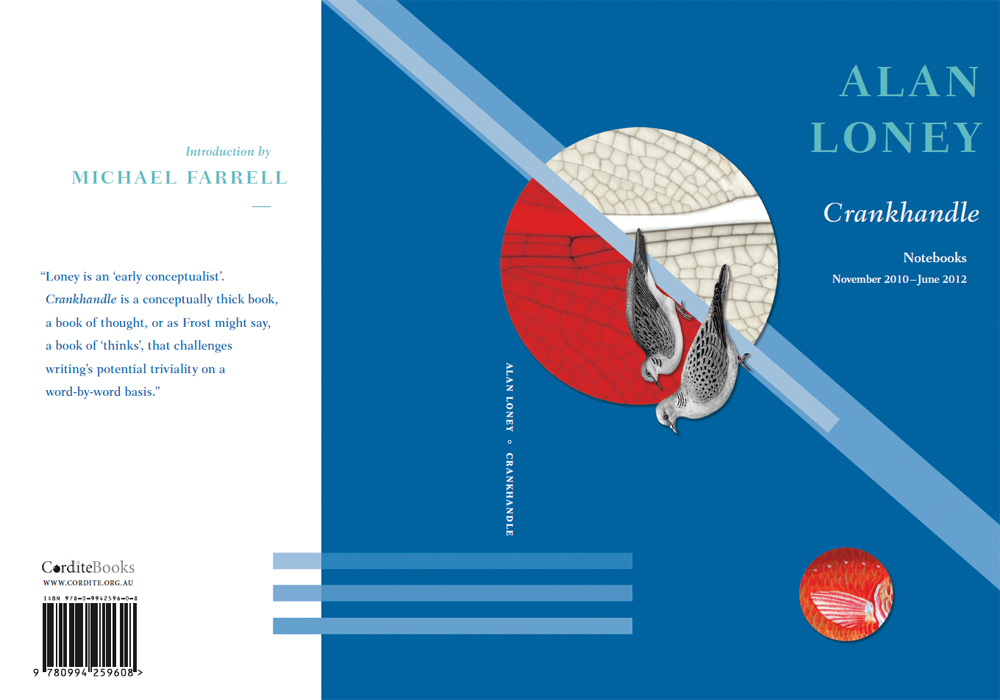
Cover design by Zoë Sadokierski
Since moving from New Zealand to Australia back in 2001, Alan Loney has carried on a prolific, internationally recognised career in Melbourne. Crankhandle, Loney’s latest published work, follows on from 2014’s chapbook collaboration with Max Gimblett, eMailing flowers to Mondrian, and the books from Five Islands Press, Nowhere To Go (2007) and Fragmenta Nova (2005). Borrowing his contemporary Laurie Duggan’s term, Loney can be read as a ‘late objectivist’: worrying at that particular American formal legacy, with its attendant philosophical and ethical concerns.
Posted in INTRODUCTIONS
Tagged Alan Loney, Kent MacCarter, michael farrell, Zoë Sadokierski







