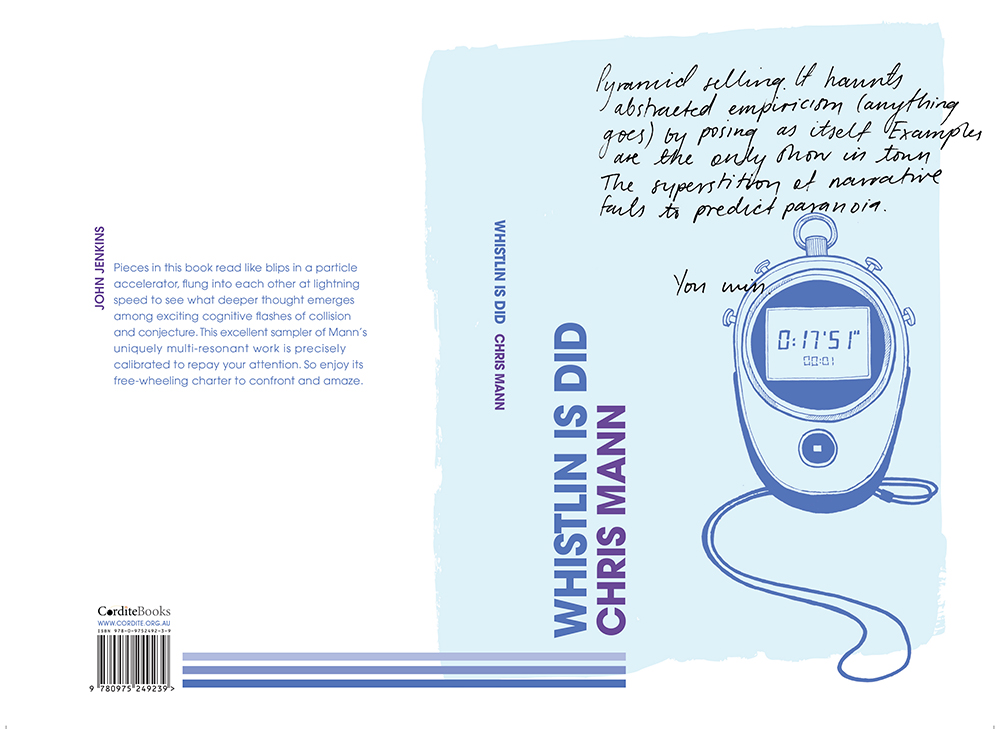
Introduction to Chris Mann’s Whistlin Is Did


Cover design by Alissa Dinallo, Illustration by Lily Mae Martin

Order the book HERE.

Chris Mann read at Melbourne’s La Mama in the early 1970s, where he first impressed me as a bold exponent of a sort of critical, larrikin and compositional linguistics, and seemed very much at home in the theatre’s performance space, with its nascent egalitarian ethos. Some listeners I noticed may have been equally perplexed as intrigued by his well-timed delivery, his knowingly artful shtick and highly patterned patter. But I found it immediately refreshing – strangely empowering and full of a polemical vitality – as he monkeyed around with very new and homegrown language possibilities.

Perhaps my mind and ears had already been primed by the 1960s ‘cut-up technique’ novels of William S Burroughs, and the more upbeat Indeterminacy, John Cage’s 1959 series of one-minute stories with electronic music. To boot, I was also half way through my first reading of James Joyce’s influential classic, Finnegan’s Wake.

Astoundingly, amid Mann’s speech gestures and tics, and his relentless reflection and commentary on the nature of language itself, there were familiar echoes of the argot of C J Dennis’s The Sentimental Bloke. Mann’s work, indeed, celebrated the deepest grains of broad Australian usage, including its vernacular and slangy idioms – rhythm, pitch, intonation, everything.

Mann has often observed that Australia has a long tradition of ‘making do’ – going back to the Depression, to rural scarcity, and further back to Koori culture. Having scarce resources always makes necessity the mother of invention, forcing you to find highly innovative solutions.

Mann’s seriously playful excursions into linguistic composition range easily across high and low culture. Some passages sound everyday, concrete and quotidian while others are as removed and abstracted as the random patter of raindrops on a windshield. Or, like the restless non-specialist polymath he is, Mann will suddenly swing in and out of diverse fields of learning and scholarship: linguistics, semantics, economics, politics, cultural theory, physics, information science, you name it; layering quickly sampled snippets of all of the above …

Mann moved to New York in the 1980s, where he quickly formed alliances with other renowned composers and theorists. This milieu has proved enabling, furthering Mann’s artful elaboration of polemical tirades; fast boundary crossings between competing modes of discourse; his ever- changing writerly dynamic of assertion and refutation and of numerous ways to usefully disclose and disrupt the creeping conformity behind automatically received patterns of thought.

Some Jewish scholars have observed how the Western classical tradition favours the clear arrival at a perceived unitary truth. In contrast, the Rabbinic way favours multi-voiced argument that does not rely on any one conclusion. Within this inclusive, pluralistic approach – in which minority opinions are preserved, and truth contained in contending voices – you can both argue with God and win!

This alternative tradition provokes tantalising possibilities; ones emerging from previously invisible cracks between apparent truths. Hold the glass up darkly to scrutiny, and see fault lines everywhere, glimpsed most clearly in the shards, particularly those riddled by economics. One may detect, ‘the cult of repetition and the technology of agreement’. Or critique the aggressively deterministic sideshows of consumer capitalism, where market research is a sort of ‘designer theft’ and ‘user-pays surveillance’.

Pieces in this book sometimes read like blips in a particle accelerator, flung into each other at lightning speed to see what deeper thought emerges among exciting cognitive flashes of collision and conjecture. Other pieces can seem more attentive to sounds rather than sense. ‘The Box’, for example, becomes as energetic as a bees’ dance, and rather than being concerned with meaning (that ‘pissy little concnpt’) they orchestrate the ubiquitous buzz of language, an endless slippage and play of phonemes into textures of vibrating sound.

Walk through any mall, and see and hear. We now live in a ‘sampling world’, in which sensory overload conspires with the digital revolution, with media old and new, and with modern economics, to shape all our waking moments into a stream of micro-grabs. Reality has increasingly become a zone of cut and splice. If our society is currently putting narrative through a digital mincer, then Mann, through his wonderfully idiosyncratic shorthand, helps to reveal both how and why this might be happening.

All the above speculations aside, however, readers will interpret Whistling Is Did however they like. This excellent sampler of Mann’s uniquely multi-resonant work is precisely calibrated to repay your attention. So enjoy its free-wheeling charter to confront and amaze.
Posted in INTRODUCTIONS | Tagged , , ,

Phillip Hall Reviews Judith Wright, Georgina Arnott and Katie Noonan

Judith Wright: Collected Poems by Judith Wright
Fourth Estate, Harper Collins, 2016

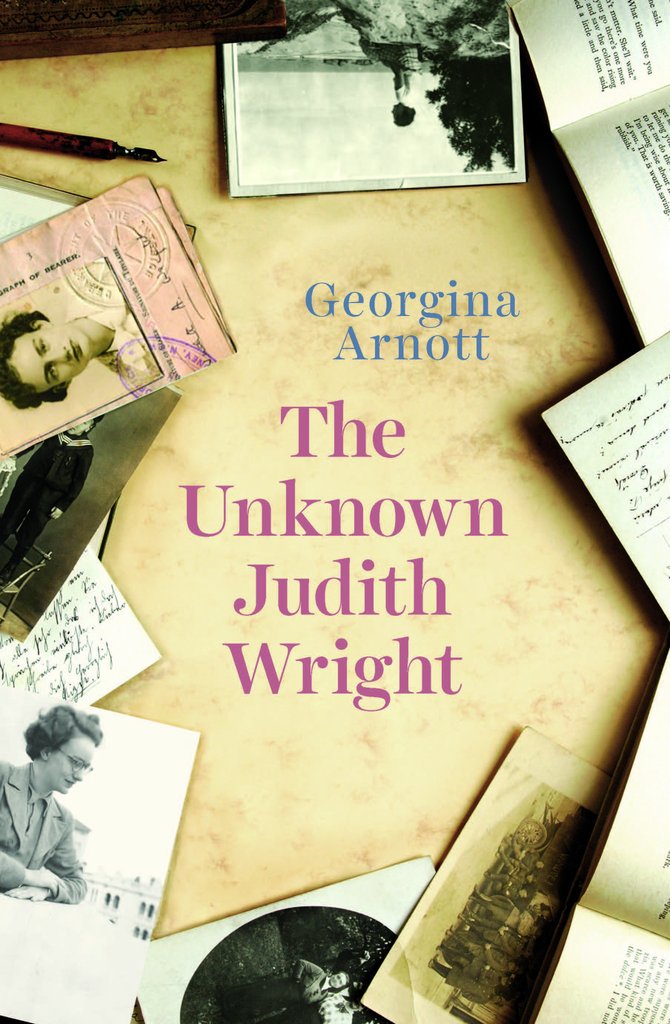
The Unknown Judith Wright by Georgina Arnott
UWAP, 2016

With Love and Fury by Brodsky Quartet & Katie Noonan
Kin Music, 2016


When Judith Wright died in 2000, at the height of Prime Minister John Howard’s cultural hegemony, Veronica Brady was called upon to deliver a eulogy at the public memorial held in Canberra. This eloquent and impassioned speech was reprinted in a national newspaper under the headline, ‘Giant in a Land of Pygmies’. In her eulogy Brady would evoke the monumental loss of Wright but also the legacy that would continue to sustain those left behind: ‘[Wright] lived, she loved, she suffered, she thought, she dared and she spoke for so many of us who feel, at the moment, pretty much abandoned. She didn’t just lead the people here in Canberra across the bridge. I think she has led all of us. She has brought us to a pinnacle of feeling, a pinnacle of hope. I think she has given us energy and inspiration for the long haul.’

A few years earlier I had eagerly awaited, like so many other devotees of Australian poetry, the publication of Brady’s historic South of My Days: A Biography of Judith Wright. I have long admired this scrupulously researched and beautifully written, five hundred-page recount of the life of a generous and inspirational ‘giant who lived amongst pygmies’. Twelve months after Brady’s book we had Wright’s autobiography, Half a Lifetime, edited by Patricia Clarke. And a decade further on we would receive Fiona Capp’s lushly evocative My Blood’s Country: A Journey through the Landscapes that Inspired Judith Wright’s Poetry. So in 2015 when I heard about a new Wright biography I was excited, but also suspicious of the hype suggested in the proposed title: The Unknown Judith Wright. Georgina Arnott, however, is an exemplar historian. She not only delivers on the book’s marketing buildup, but judicially positions her own text not as replacement but as essential companion to the biographies that have come before.

Wright distrusted biography as an intrusion into her privacy. Like all of us, she expressed some views and performed some actions – especially in young adulthood – that she would have preferred, with the benefit of hindsight, to have kept hidden from public scrutiny. As Arnott says:

Judith’s life story offers particular intrigue because it suggests that conservative and conventional upbringings can sometimes produce the most radical of thinkers. This book might add that, by extension, in some cases at least, even the most radical thinkers do not necessarily ‘shed’ the conservative traces of their heritage.

Arnott knows that she would have been unable to ‘convince Judith of the value of biographical research or of [her] particular approach to her life’. Arnott maintains, though, that her approach is ‘unapologetically historical’ and that her portrayal of Wright’s first twenty-one years is a very different version of events from those ‘oft-repeated narratives recounted by others’. As well as presenting a more human figure of the young Judith Wright, with all its contradictions, Arnott reaches beyond her subject to the historical milieu that she occupied:

[Wright’s] life story reveals much about colonial race relations; the gulf between expectation and reality experienced by early European migrants; early attempts to develop a distinctly rural politics; the difficulties faced by women on isolated properties; and historical relations between the city and the country. The final five chapters, which centre on Judith’s time at the University of Sydney between 1934 and 1936, and the work she produced there, tell of the class and gender distinctions embedded in Australian tertiary education; of the birth of modern Australian cities; the rapid social transformation which took place in 1930s Sydney; the liberties this transformation afforded to young women; the origins of Australian historiography; and most forcefully, the birth of modern Australian poetry – a birth largely brought about by this woman.

Arnott reveals that the Wright forebears were more involved in the act of dispossession – and of First Nations massacre – than Judith Wright implies in Generations of Men (1959). She also shows how Wright tries to make amends for this by writing Cry for the Dead (1981), but while this book does not shy away from the horrors of colonialism, it still does not forensically examine her family’s role in these events. Wright continues to influence the approach taken by biographers like Brady in retelling this family history by perpetuating the mythology that the Wrights won their prosperity against the odds by hard work. Wright also continues to portray her forebears as ‘moderate, careful and cautious’, especially in their relations with First Nations; but, writes Arnott, this portrayal defies the evidence.

Arnott argues that Wright’s time at Sydney University has not been recognised as the crucially formative time that it was. It was there that Wright came to maturity as the ‘quintessential modern woman’ – confidant, teasing, eager to fit in – but also reflective of her conservative New England values. It was at this time that she would encounter many of the ideas that she would develop in The Moving Image (1946) and Woman to Man (1949). And, a decade before her first two celebrated collections, her student poetry shows how important it was to her to evoke physical intimacy in words. As Arnott argues, Wright developed a poetic technique that:

worked to imply an innate, emotional and sexual connection between a woman’s body and the natural landscape. This alone was not new; what was distinctive was the bold assertion of a woman’s active subjectivity. These female bodies were not made purely receptive by comparisons with the land; they became alive, yearning, and even spoke their wishes. The poems of that first collection asserted a taboo subject: female desire.

Posted in BOOK REVIEWS | Tagged , ,

Review Short: Michele Seminara’s Engraft

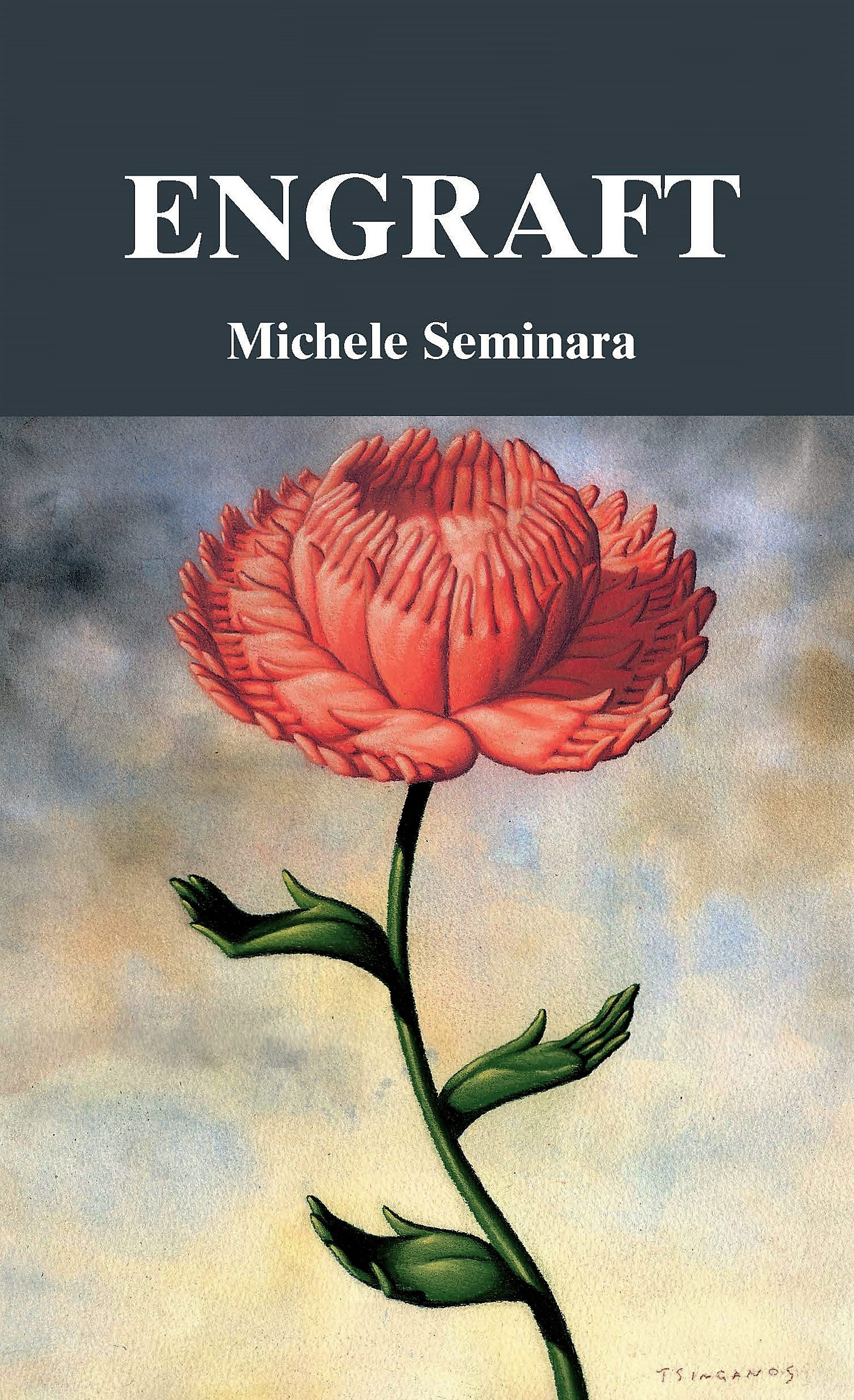
Engraft by Michele Seminara
Island Books, 2016


In ‘Sky Burial’, a poem about ‘the secrets inside / that we shamefully hide’, Seminara offers a provocation: ‘So listen / why don’t we share them? / Cut our guts open / and air them?’ It is an invitation to confession, but the visceral imagery is also a confrontation, an insistence on exposure which characterises much of Engraft, Seminara’s debut collection of poetry. Indeed, Engraft is often focussed on conflict and opposition, on a brutal pulling away of surfaces to reveal – and at times, even revel in – pain, loss, and confusion. The consequence of such fierceness is a series of uncomfortable realities: the cruelty of love and birth; the violence of frustration; and the disappointing failures of self. In cutting open that which is hidden, and allowing ‘birds of carrion’ to feed on what is found there, Seminara constructs a hopeful, albeit macabre vision, in which ‘dark feelings’ might ‘transmute […] to food’. This suggestion of transformation and consumption (and even of transubstantiation) is gothic in nature, yet an apt metaphor for creativity; a kind of vampiric leeching. Certainly, in explicitly drawing on poets such as Shakespeare, Dickinson, Plath, Hughes, Bishop, and Lowell, as well as Kafka, Duras, Solzhenitsyn, and Joyce, Engraft is both polyphonic and parodic, including letters, prayers, homages, re-mixes, erasures, ekphrases, and found poems. The combination of so many modes and voices ought to be jarring, yet a synthesis is achieved in a repetition with difference that is as concerned with tradition as it is renewal.

Indeed, Engraft signifies a sequence of confrontations, including a contestation of history. Playing upon fairytale conventions and tropes, the body is ‘waiting / not to be kissed, but punctured / By the prick of a prying scientist’, exhumed from ‘earth’s wet memory’ to be entombed again ‘in glass and sold for obscene show’. There is again an evocation of metamorphosis and ingestion, of a body ‘devoured’ not only by a ‘potent pack of ancient wolves’, but also by a modern horde of viewers and consumers in an image of history and the self as object and spectacle. There is a sense of warning here, too – the voice of the Ice Age human advises, ‘what they may unleash they do not know’, a threat echoed in ‘All Dried Up’, in which an ‘old lady’ who waits ‘in this parched bed’ asserts a fiery prophecy of phoenix-like resurrection. The notion of revival, of the past re-animating, is also enacted in the re-formation of poems and narratives, such as Shakespeare’s Sonnet 15 in the eponymous ‘Engraft’, Hughes’ ‘The Rabbit Catcher’ in ‘Rabbit’, and the found poems sourced through the letters of Kafka, Joyce’s Ulysses, and Dickinson’s poetry. Through the re-creation of the words of others, there is a rich sense of new meaning and association, but also a caution against not trusting the self. In ‘Dear Ottla’, ‘The sentences literally crumble in my hands: / I see their insides and have to stop. / Only by listening to my innermost voice […] / can I survive’.

The literary allusions and adaptations in Engraft engage with the disquiet associated with reading and writing poetry, both in terms of performance and reception. Indeed, inasmuch as the collection is about grafting onto the works of others, it is also about anxieties of originality, and of being understood. In ‘poem by midnight’, Seminara’s poems are creatures sent out into the world to ‘disturb’, ‘unnerve’ and ‘observe’ the reader, sidling into ‘peripheral vision’ and slithering ‘in through / your too thin skin’. Writing poetry is figured masochistically as a constant vacillation between enslavement and pleasure. ‘Dear Ottla’, through Kafka, portrays the process as part torture, in which employment, noise and illness conspire against productivity. ‘Poetry’, however, offers an ecstatic vision of how ‘one word’ can ‘make your breath / draw in’, whilst ‘Dog’ presents a poet who is ‘Pulled forth by a line / of scent, my furtive soul craves / Closet verse –’

Such domestic frustrations are confronted vividly in ‘Mother’, in which marriage, motherhood, and love are not romanticized but reveal the violence and loss inherent in the most intimate of relationships. The conflicts here are both familiar and familial: a husband whose tongue is ‘foul’; the strain of a newborn daughter who ‘squalled for hours’. Childbirth and parenting are imaged as painful and depleting; a ‘suckling alien child’ leeches from its mother, the joy of growth tainted by the agony of being left behind, ‘still bound to suffer / your lot as mine’. Similarly, in ‘That house’, Seminara describes how ‘We’re the ones the neighbours / talk about/not to […] / it’s our truth erupting / spectacularly into the day’. These eruptions gather in intensity, the ‘heaving house’ a volatile space ‘tumid with the sickness of minds untempered’. In many ways, these are the striking failures of love, instances of the damage caused by neglect, loneliness, and misunderstanding. In ‘Zhuang Zhou Dreams In Pink’, a poem featuring a lollipop man who ‘leaks / over the edges of his stool’, Seminara questions: ‘How is it that we came to be locked / in these bodies, lives ossifying / into rings of fat, rigidity and suffering?’ Yet connecting with the other cautions of Engraft, there is an urge to resist the abyss, albeit with a cynicism that is as amusing as it is self-critical: ‘The doctor says my oestrogen is low. / She prescribes hormones to alter / the cruelty of my vision’.

There is something gratifying about the darkness of Engraft, with its attention to exposure, revealing sentiments and realities that are not cloying, but focused and analytical. In revealing the guts of things – of bodies, love, poetry and history – there is an investment in catharsis, too, as echoed by Kafka in ‘Dear Ottla’: he must attend to his ‘unfulfilled inner duties’, lest they grow ‘into a madness from which death seems a release’. Seminara’s vision may at times be cruel, but its starkness is also powerful and evocative, a refusal to avoid ‘life’s tremendous, bone-felt, incommunicable things’.

Posted in BOOK REVIEWS | Tagged ,

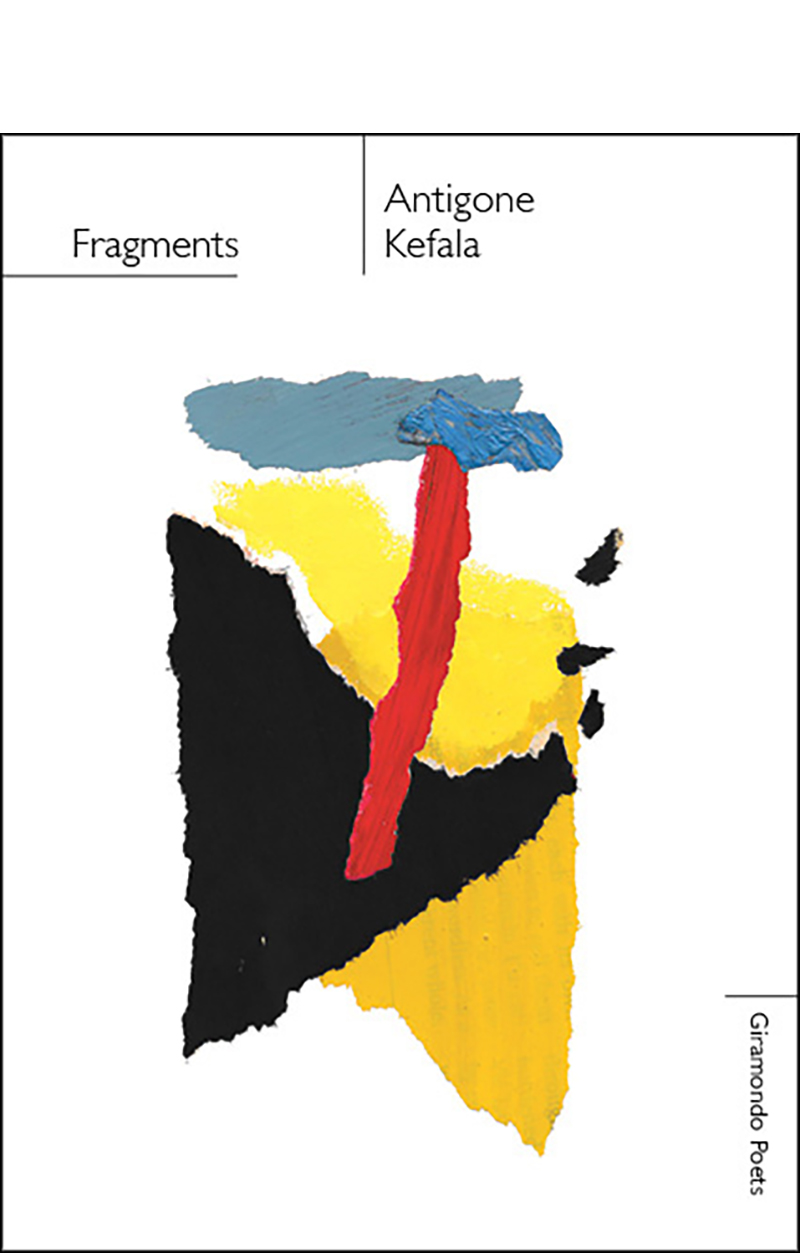
Review Short: Antigone Kefala’s Fragments

Fragments by Antigone Kefala
Giramondo Publishing, 2016


When casting an eye back at Antigone Kefala’s oeuvre, one finds a poet of the surreal, who has delicately combined reality, folklore, and dream state. She has expressed the trauma of migration and diaspora in hallucinatory ways; she once merged the ache of an old country’s absence with the comfort of myth, and heightened the contrast with dream-like and often disturbing symbolism. Her first book in two decades is titled Fragments – fittingly, given Kefala’s documentation of the cut-up, kaleidoscopic existence of migrants.

Her innate strength is that no word is an afterthought. No line is solid and fixable. Instead, lines are exposed, as if unearthed from underground, to be raked through with questions. The opening poems are abrupt, and convey a tender wistfulness. In ‘The Voice’, she writes:

This return
the past attacking
unexpectedly 
in the familiar streets.

Kefala, the daughter of Romanian parents who lived first in Greece and then New Zealand and Australia, has reached a point where the unfamiliar has become the familiar. The past that she forged in this country – now a place of safety – preys upon her, and catches her unawares. She relates these pivotal moments of emotion with restraint – she holds back, whether for our sakes or for hers.

In ‘Photographs’ the speaker expresses ambivalence. Kefala reminds us that recalling the past is often a jarring experience. You long to drink from it, but it is also a poisonous craving. There is a daydream feel to these poems; they seem to drift into one another like clouds, presenting rather than commenting. In ‘Dreams’, however, there is the enticing Surrealist presence, albeit in a clipped form. The poet envisions a presence in a ‘long dress of silk’ with crystal teeth. Again, the past intervenes:

And then
we were in the old house
full of a silver light
As we came in
someone was plucking
at an aluminium sound

By the second stanza, the scenario has become fantastical, as the speaker and the vision walk on glass, below a ‘mass of naked crabs and chickens.’ Words are not to be taken at face value in Kefala’s work, and she questions the vision:

How come? I said
before we had clean water.
Your fear, she said
changing the place.

Kefala suggests that fear persists, no matter how well acquainted you are with death. She acknowledges the phobia of time that haunted her last collection. Having written of time as lead, time as stolen by others, time peeling things away, she now comes face to face with it, and the results are illuminating.

Part Two is infused with snippets of the natural world that are at once both peaceful and disturbing, hinting at her environmental conscience. There is a deep seeing, whether it is of the demise of ringbarked trees – ‘a scattered army, eerie ghosts/left there to face alone / the mornings and the nights’, or walking by a bay ‘in the apocalyptic sunset / that left / gold orange strands / on the dark waters.’

The book’s flickering impressions create a lulling effect. They provide a connected commentary on the beauty of a sudden moment. ‘Summer at Dervini’ is one such example. The brevity of each line-break emulates the ‘folding of the sea’, and evokes an air of seasonal haziness. The final image recalls the romanticism that Kefala weaves into much of her poetry:

At dusk
the fishing boats
massive dark stones
planted
in a field of moonstone.

These poems are intensely visual. If any readers have regrets about not savouring such moments, Kefala presents them with a neat blueprint.

In the third section one finds longer poems drawing out the intensity of a lifetime’s worth of grief and loss. ‘Anniversaries’ sees the poet reveal emotion in an unexpected gush, as she contemplates both the beauty and sadness of having lived and loved. In ‘On Loss’, she reveals a sharp appraisal of death:

This cut, this total
final cut
like a dead weight
that presses down.
Death needs no one
comes wrapped 
in self-sufficiency.

Much of the collection is concerned with her ageing generation. Those who ‘briefly forget the fatal prophecies,’ wait out their lives in hospitals and homes – ‘the same spent, white faces / under the discoloured high ceilings’ – and yet, they live, and live bravely. She touches upon their frailty in intimate detail, such as in ‘Birthday Party’, where she writes of a friend who has been transformed by the process of ageing:

She was waiting on the couch
very pale, white dusted
incredibly small now
folding inwardly
not coping with her glasses
that had grown
to a giant size.

The very act of these elderly friends gathered for a birthday party and noting each other’s fragility, ‘an exaggerated edge / to our caring’ is a defiant one, and the poem is a strong homage to their spirit.

Kefala’s characteristic fondness for myth is evident, as she writes of pilgrims who wait for a spiritual moment at a waterhole, and in ‘The Fatal Queen’, presents a nameless monarch, who ‘watched us from a dais’, a sort of eternal Medea:

She seemed suspended
above the cliffs…
impatient, inside her
all was set
for the last killing.

These are distilled poems, concentrated in essence. In one of the most captivating moments in the collection, ‘The Piano Tuner’, Kefala displays a candid wit. She writes of a passionless piano tuner:

Sounds were flat things to him
they did not give him vertigo
raise him above…
He would place them according
to some metal rule.
And I, who thought the trade
required perfect pitch.

T S Eliot writes in The Waste Land of ‘these fragments I have shored against my ruins’. This was a time when long-held values broke apart, ruining a generation who no longer believed in certainty. Eliot speaks of salvaging fragments from the debris, and such a process haunts Kefala’s new collection. She faces the disintegration of a life, but the fragments of her past and loved ones are elevated. The poems drift and offer no resolution, only the potent energy of articulation.

Posted in BOOK REVIEWS | Tagged ,

Dave Drayton Reviews Carmine Frascarelli and Mark A Peart

Sydney Road Poems by Carmine Frascarelli
Rabbit Poets Series, 2016

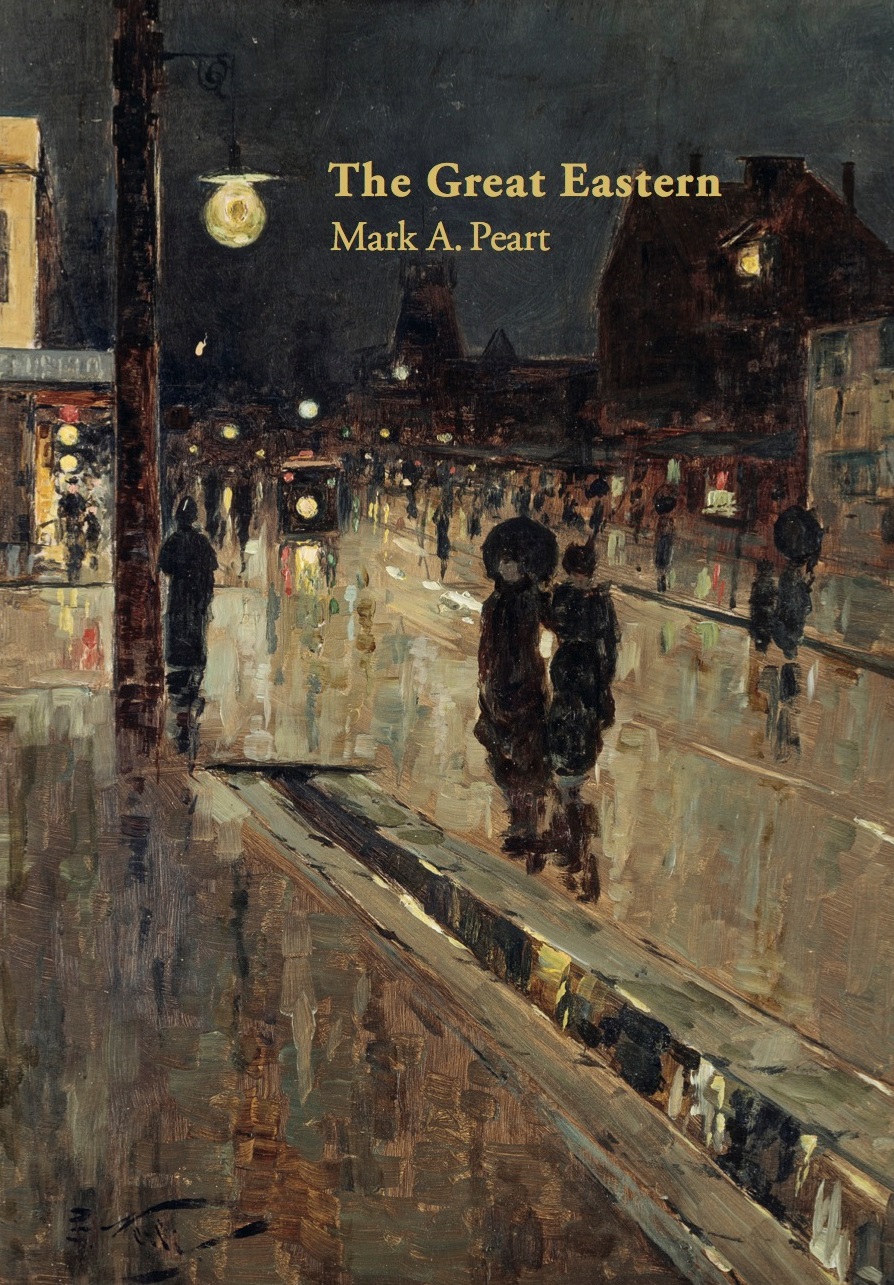
The Great Eastern by Mark A Peart
Rabbit Poets Series, 2016


In the nonfiction poetry issue of Axon that she co-edited with Ali Alizadeh, Jessica L Wilkinson highlights the impact that Jordie Albiston’s The Hanging of Jean Lee had on her as an undergraduate in 2001. Albiston’s collection is a poetic biography of Lee, the last woman to be executed in Australia. Wilkinson would later be influenced by Susan Howe – whose practice both informed and was a focus of Wilkinson’s doctoral study – to found Rabbit: a Journal of Non-fiction Poetry in 2011; however, a line can be traced from the early impact of Albiston’s book, to the journal, and on to the fledgling Rabbit Poets Series, which began with Albiston’s XIII Poems in 2013.

In January I found The Hanging of Jean Lee in a secondhand bookstore in Hornsby, and find my thoughts returning to it again and again whilst reading Mark A Peart’s The Great Eastern (#5 in the Rabbit Poets Series): a long poem drawing on witness deposition and proposing a poetic defense for a man known by the titular name, ‘who perambulated the streets of Collingwood and Fitzroy in women’s dress during the early 1860s soliciting men for sex.’ In Peart’s introduction are assorted pronouns – ‘they’, ‘her’, ‘his’, ‘she’, ‘he’ – and, interestingly, this fluidity remains evident even in the condemnatory contributions from The Great Eastern’s lovers and patrons. James Morris reports: ‘if you observe that / woman walking / in Victoria Parade / remember it’s a man’. John James knows the prisoner ‘by the looks of him. / he was dressed as / a man or a woman.’ The striking out of words replicates those struck out in the record of the Victorian Supreme Court case of The Queen v. John Wilson (1863), used by Peart alongside court and newspaper archives, as the source material for the poem.

The above examples are indicative of the purgative poetics in the poem’s deposition sections. These appear throughout the collection in pairs, perhaps a presentation of the doubled existence of John Wilson / The Great Eastern. Those on the left are composed from the words of witnesses – Morris, James and other Johns (Jones, Morgan and McKeevor); Joseph Wheeler; Edward Turner; and Bartholomew O’Donnovan. Distanced by Peart’s voice from the questions that prompted them, their origins obscured from judge, jury and reader, the men’s answers gain some odd strength. In isolation they become more sinister, they become statements; no longer a response but an attack. They lead the charge. This affect reflects the poem’s beginning, where Morris offers yet more antonyms for our subject – Ellen Maguire, and, more distressingly, ‘the prisoner’. Each repetition of the latter in subsequent pages feeds our unease towards the fate of the Great Eastern, in spite of what is known to be an inevitability.

Pages on the right offer the voice of The Great Eastern, unbound by the constrictions of attribution and occupying multiple perspectives. Unsurprisingly, the voice here treads over gender innocuously. On the first such page we see ‘a woman walking / musth the parade’; musth, from the Urdu mast (‘intoxicated’), refers to the reproductive hormonal rush that turns elephant bulls bellicose. This is no hagiography: at least two punches are thrown (and three received), kneecaps are kicked, cunts are called just that, and there’s no effort made to conceal a taste for tipple. Despite this, it feels short on the biographical front. Where Albiston traced Lee’s life from childhood to chair, Peart’s timeframe is tighter, little more than two years, but offers glimpses of the self, shouted out.

The Great Eastern’s version of events accompanying deposition VI is particularly revealing about the collection as a whole. Turner, Morgan and James are in a house on Young Street, late December, 1863. As the two Johns wait downstairs Turner plays the role of one overhead:

turner’s fat little cock
jams in. he moans
like a lamb in distress
his face a hawk
convulsing between the two

With Turner taking the parts of lamb and hawk the ‘prisoner’ is neither perpetrator nor prey, but witness, an elephant in the room. By contrast, Carmine Frascarelli’s turn as witness feels less triumphant. Elsewhere in her Axon paper, Wilkinson contends that, ‘through poetry and experiment, narratives of the past might be enlivened to meet those characters and events in writing more uniquely and appropriately than may be encountered through more traditional historical modes.’ Despite the assortment of non-fictional bumf that informs and (re)enforces Frascarelli’s Sydney Road Poems (#7 in Rabbit Poets Series), it does not amount to that which we so often presume or expect from any non-fictional writing: the/an answer.

In the author’s statement appended to the collection we gain some insight into the questions that prompted this assorted response; a plurality of contesting truths. Looking at our precarious civility and the roots of violence running deep in our history, Frascarelli asks:

Will we learn without confronting it?
Can we learn by confronting it?
How do you outrun,
                                           how do we beat history as we become it?

Earlier in his statement is an offhand remark about the physical fights – ‘we’d hit each other, smash things’ – between he and an ex-partner. This prompts another, difficult question: in asking how we beat history, is the desire to defeat it or to strike it? Sydney Road Poems depicts the ‘desperate chaotic design underlying most of what stretches out beneath us’, and doesn’t flinch at the seediness the poet rightly expected to unearth with research. As an investigation into the roots of violence in this country, however, it feels too distanced from the guilt expressed and acknowledged in the afterword.

Wilkinson (that is, Jessica) is not the only J Wilkinson to contribute in some part to Carmine Frascarelli’s Sydney Road Poems. The poem ‘#26’ stamps business names and proprietors thickly atop one another, and among the cacophony of ink can be spotted J Wilkinson, printer, 1885. There is yet another Wilkinson who has contributed in more oblique ways to the collection; Thomas Wilkinson owned and occupied the lone house from which the City of Brunswick was born. It is Brunswick for the most part in which Frascarelli, as flaneur, walks and writes. The trio of Wilkinsons could simply be coincidence, but it is these and similar seemingly unconnected contributions – to place, to poem – that aggregate and create something akin to Walter Benjamin’s Arcades Project, or Kenneth Goldsmith’s Capital (inspired by the former), in abridged form. To paraphrase Frascarelli in poem #36, we ‘get an idea of the particulars lost in the quantity / setting the bulk.’ Where Peart shows how someone may occupy and operate within a space, Frascarelli presents the two entities – person and place – as inseparable, and this ecological framing seems to attempt an immunity for the acts of the individual.

Posted in BOOK REVIEWS | Tagged , , ,

Kelly Malone Reviews Chris Price and Hera Lindsay Bird

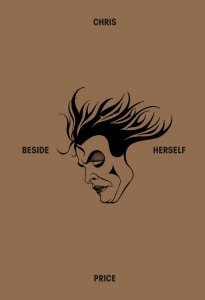
Beside Herself by Chris Price
Auckland University Press, 2016

Hera Lindsay Bird by Hera Lindsay Bird
Victoria University Press, 2016


‘Beside’, for starters, is a clever position for Price to situate her writing and the speakers in this collection. The ‘performance’ carried out by these multiple speakers occurs in varying densities of poetic language. Theatricality is created by a play between subversion of, and adherence to conventions; and between Price’s writing and carefully selected illustrations by Leo Bensemann (including the cover and frontispiece, ‘Mask’). Additionally, Bensemann’s illustrations link to other literary texts, including a reference to Wallace Stevens in the title of the illustrations, Fantastica: Thirteen Drawings. They are used as a resonant structural device: as well as the immediate content of Price’s text, conversations develop between the sections of Beside Herself and Bensemann’s images.

This effect allows Price’s otherwise eclectic poems to form a coherent collection of representation and otherness within oneself. Furthermore, the way she has used Bensemann’s illustrations shows she has not approached the concept of performance glibly. Actually, Price doesn’t do or say anything glibly. The opening quotes reflect her attempt to express the multitude of selves one performs (and is performed by) in language. For instance, Price quotes Frederick Seidel’s ‘Prayer’: ‘But we are someone else. We’re born that way.’ Certainly, our otherness occurs when we enter language, but in this collection Price addresses how we are performed in language, why some selves float to the top and not others.

Resplendent with references and imagery to epitomise these ideas of otherness, ‘Abandoned Hamlet’ is hidden away, like the id, in the midst of the book’s first section. Here the question is asked, via the Russian ending of Hamlet (‘The rest is silence’): how are left with ourselves? The following poem, ‘A natural history of Richard’ continues references to Hamlet. It plays on a Tarlton jest-like Hamlet talking to Yorick’s skull, whose bones seem to be exhumed from a winter of discontent, ‘ready to talk’ before ending with, ‘Read the script.’

One aspect of the poems’ form that I particularly enjoyed, is Price’s use of square brackets in the title poem. [The shift from third person in the collection’s title, to second person in the poem’s title, shows the shift from outside the collection to inside it]. The opening line is an imperative: ‘Step sideways’; and the next section [after the first set of square brackets facing the text but positioned where an asterisk would otherwise be] commands, ‘Step aside’. Such play is not enjoyed at the price of craft. It would be easy to overdo the aside [as I already have done] but Price gets us onside with strictly disciplined wordplay, only giving enough to add, not detract, from the work. And if you think about the purpose of square brackets [added information from another writer or speaker to clarify] then what we have here, are other speakers clarifying the ‘original’ speaker. As ‘Abandoned Hamlet’ says, ‘I / am every character — / every, every character.’

Surely this latter and somewhat sore point of craft is alluded to by ‘The New Cuisine’. Its opening line, ‘But excellence had left the old recipes’, points to those fad-poets who have ‘con[ned] the locals / with the pallid mash … / in fancy language.’ Price may be playing with language but she is clearly positioning her writing within the craft of a tradition, ‘What all of us once knew / was hoarded in the snowy alpine province / of the few.’ Nevertheless, Price complicates the poet-as-self-identity, and acknowledging these selves as many in the one.

Poetry is seldom confessional, for how is language truth? Price knows language is a construction, but she still manages a persona who does intimately share itself without offending the reader’s sensibilities. There is a day in the life of a Price persona, in ‘Tango with mute button’, where a dance lesson is narrated from a stationary bike at a mundane gym. The scene becomes an extended metaphor for that V S Naipaul-esque, half-lived quandary of where the grass is greener. The brilliant and subtle humour continues in ‘My friend Flicka’, which takes the standard rite-of-passage known to any young girl who has loved horses, and merges into a more serious turn towards those close and intimate relationships that take work, yet work. In the latter part of this poem, the horse has become a human partner, who asks a seemingly harmless question – about what the word ‘trope’ means. What follows is the humorous response of a wordsmith, and a creative writing teacher: ‘tripwire and rope’.

Posted in BOOK REVIEWS | Tagged , ,

Michael Aiken Reviews Monty Reid

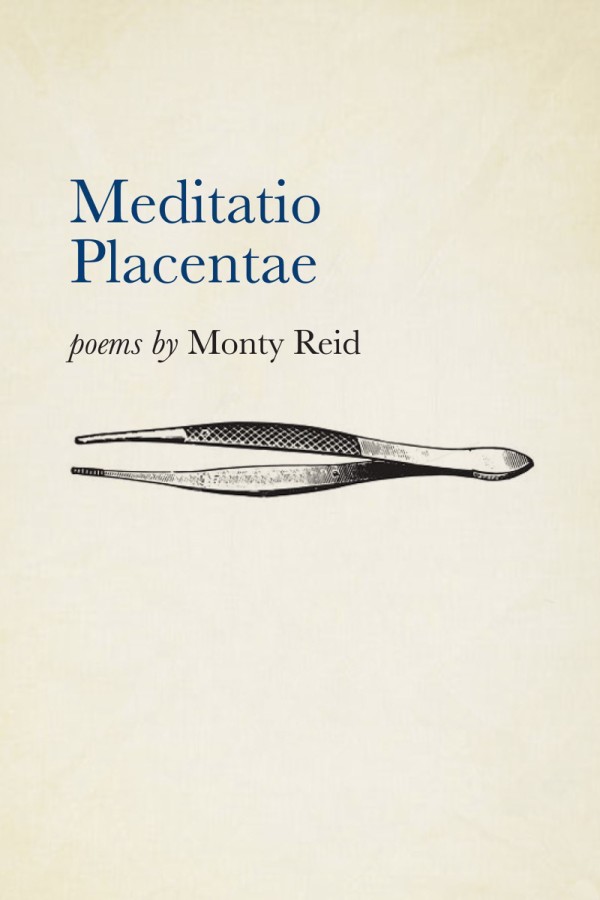
Meditatio Placentae by Monty Reid
Brick Books, 2016

Composed of nine distinct sections, Canadian poet Monty Reid’s Meditatio Placentae is more like a collection of chapbooks than individual poems. Most of those nine sections have previously appeared as separate publications, and each certainly works as a discrete sequence. The whole is loosely held together by a combination of mundane subjects and a nightmare-like, alien perceptiveness; rather than building a continuous collection, the sections create a context of transition from one mode to another.

Continue reading

Posted in BOOK REVIEWS | Tagged ,

Owen Bullock Reviews Murray Edmond

Shaggy Magpie Songs by Murray Edmond
Auckland University Press, 2015


Murray Edmond is a New Zealand poet of long-standing achievement. He published the first of twelve previous collections, Entering the Eye, way back in 1973 with Caveman Press; the most recent was Three Travels (Holloway Press, 2012). He is a dramaturge, with a career ranging from the experimental Red Mole Theatre Company to the present Indian Ink Theatre Company. He was co-editor of the 2000 anthology Big Smoke: New Zealand Poems 1960-1975, which restored marginalised voices from the 1960s and 1970s, especially women poets such as Anne Donovan, Kathinka Nordal Stene and Christina Beer. He is now editor of Ka Mate Ka Ora: A New Zealand Journal of Poetry and Poetics.

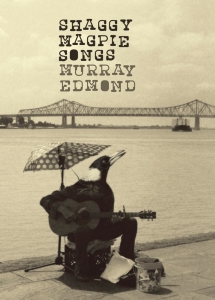
The front cover image of his most recent collection, Shaggy Magpie Songs fits its tone beautifully. A busker with an acoustic guitar and capo sits on two cushions balanced on a milk crate. Money is collected in an old paint tub. Behind him, an umbrella is attached to a microphone stand. The busker’s head is that of a magpie, looking upwards, purposively. He’s perched on the waterfront below Ponsonby near the Auckland Harbour Bridge. Insofar as the title acts as a premise for the collection, it’s a convincing one, as its thirty-four poems testify.

You can’t mention magpies in the context of New Zealand poetry without thinking of Denis Glover’s famous ballad ‘The Magpies’. In Edmond’s latest collection, the cadences of Glover are evident in ‘Mister Wat’ and in ‘Conversation with My Uncle’, even before the reference to Glover, or before encountering the back cover’s nod to this literary heritage. Edmond is not just making a reference but embracing elements of Glover’s style, rough-edged and profound.

Placing the concept of song lyric firmly in the centre of the collection sets up certain expectations but also aids the broader exploration of what might constitute a lyric, since the poems which have a less formal structure are read for their similar or different qualities to the others. In the rhyming poems, a firm pattern to the rhyme is not always detectable, but, importantly, the rhythms are compelling On the whole, the rhyme does not control the poem to the expense of all else. There are funny and original rhymes, such as ‘rode the railroad tracks of his undos’ with ‘choose’ and ‘shoes’ (‘Clown on Skates’); and there are elegant stanzas:

cook was scraping bones
(thin soups are the best)
for every Greek that groans
there’s one who groans in jest

(‘Swing Your Tiger’)

One is conscious of the rhyming sounds as simply another set of playful possibilities, rather than the rhyme becoming irritating because it is obvious or controlling, which is an all too common fault even in much published rhyming poetry.

Much of the book celebrates the ordinary. Ordinary moments, real or imagined, are shaggy ones, for example, graffiti described as being in ‘a young and scrawny scrawl’ in the poem ‘So-So Street (A Soliloquy)’. They recall Edmond’s quoting of Guy Debord in Then It Was Now Again – Selected Critical Writings (Atuanui Press, 2014), in which Edmond suggests that the poems in the Big Smoke anthology ‘constitute “fleeting moments resolutely arranged”’. They are fleeting here, too, and might go unnoticed but for the poet’s noting the situation. The understated ending to ‘With Jean-Paul Sartre on the Banks of the Waikato’ celebrates the ordinary even in the midst of a surreal scenario, as well as introducing ‘characters’ in a manner that reflects an understanding of dramatic potential. The poem ‘Painter Looking at Painting’ describes in the most pragmatic terms the way painter and painting form a relationship, and is beguiling in its mysterious ability to evoke an essential connection. ‘National Standards’ takes a satirical view of what I assume to be the proposal in New Zealand for single, unified courses for each subject at tertiary level, a kind of one-world curriculum; there’s something ominous and chilling about the poem which reflects one’s anticipation of such an homogenised educational strategy.

By contrast, the collection is not averse to something like the mystical, as these lines suggest:

your cousin tells you he knows a hole
you can slip through to take a short cut
it’s a portal to the thing you cannot imagine but know is there
and the very idea of ‘short cut’
causes you to burst into relief for the relief it promises

Is this merely childhood play, or something more serious? Is mystical too strong a word? The text accepts each situation without judgment and suggests that the human spirit has ‘a certain flounce that never was seen before / in this universe’ (‘In the Purple Mists of Last Evening’); if anything is mystical or transcendent it’s us.

‘Forty-two Boxes’ focusses more purely, and adventurously, on language. Its diction is tight from the start, Curnowesque in its compression, but more playful:

dragon silk corn powder
jade Buddhas with a gift
for laughter green black
and red phials of infused herbs

The poem is full of unusual words and connections, a microcosm of the whole, a time capsule. It’s not a poem to understand necessarily, but one with which to savour the aesthetics of language.

It is not only about language, of course; there is too much variety here, too much lyric and examination of the lyric that remembers song as close cousin and rhapsodises it, albeit in a suavely detached manner. In fact, one imagines the voice of many of the poems as shaggy, but in a nice jacket (‘a certain flounce’, above, suggests this thought most clearly). The poems embrace repetition, its use varying through a range of refrains, including one that could easily have come from the pen of A A Milne: ‘she points her little pinky oh she points her pinky / and points that pinky at the likes of you and me’ (‘Matataki, 1822’).

The extended sequence ‘Tongatapu Dream Choruses’ is a group of nine poems whose structures – from a loose prose poetry to short, haiku-like stanzas – showcase the diversity of musicality that well-arranged words can bring. Edmond has a penchant for hyphenated composite terms, for example, ‘reflected apocalyptic dreaming / from the One-and-Only-Will’ and the ‘Only-Lonely-Lonely-Only Ones’ (‘A Train Wreck in the Universe’). The compounding of the nouns has the effect of forming descriptions as well as musical jinglings which are refreshing, and show some daring in their arrangement of language in less familiar forms. The grammar of the poems often strays from correctness in useful ways, helping evoke the demotic, an element counterpointed with the prosaic, and sometimes with an unexpected sophistication. For example, in ‘Road Song’, the lines ‘now tell us who you are / now justify impetuosity’ contrast sharply with the everyday diction of the preceding stanzas.

Posted in BOOK REVIEWS | Tagged ,

Review Short: Marietta Elliot-Kleerkoper’s A Perfect Distortion

A Perfect Distortion by Marietta Elliot-Kleerkoper
Translated by Joris Lenstra
Hybrid Books, 2016

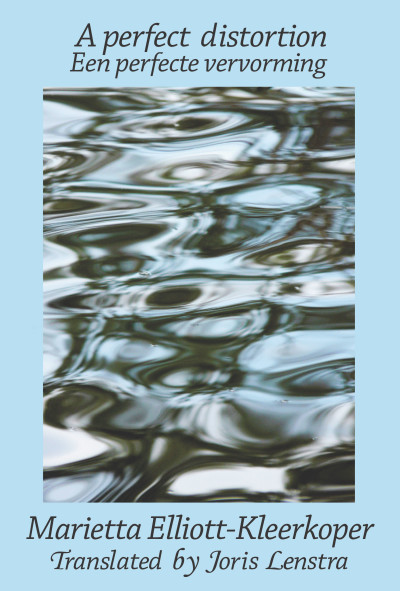
The poems in this collection are provided in the original Dutch with an English translation; two languages and cultures that are intertwined in the poet and in the poetry. The mirroring effect of the parallel texts moves the reader beyond English language egocentricity, providing a continual reminder that language is constructed and understood in a variety of ways. Continue reading

Posted in BOOK REVIEWS | Tagged , ,

Review Short: David Gilbey’s Pachinko Sunset

Pachinko Sunset by David Gilbey
Island Books, 2015

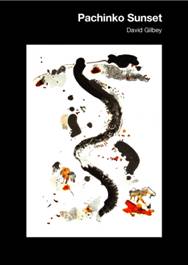
David Gilbey’s long-standing connections with Japan take centre stage in Pachinko Sunset, a collection that embraces simple, direct form to explore a layered series of issues linked with this relationship. The titular ‘pachinko’ refers to a popular Japanese game akin to pinball, in which a cascade of small metal balls are released to strike pins and be channelled off into different locations, with different prize implications for each. This image is a fair comparison for the text as a whole, as Pachinko Sunset delivers a sequence of poems in constant activity, heading in numerous directions at once, yet intrinsically caught up in the anxieties and ironies of travelling, translating, and relating Australia to Japan.

Continue reading

Posted in BOOK REVIEWS | Tagged ,

Review Short: Lorne Johnson’s Morton

Morton by Lorne Johnson
Pitt Street Poetry, 2016

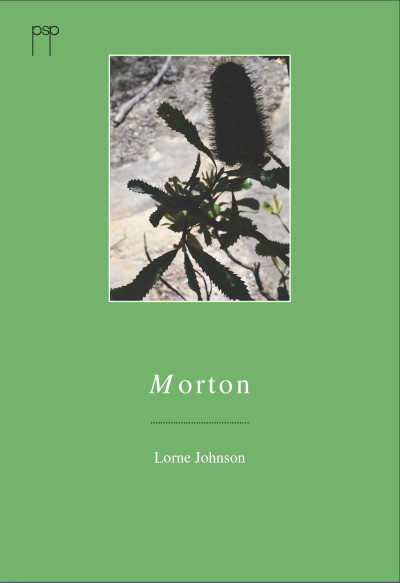
Morton is Lorne Johnson’s first published collection. However, Johnson’s work should be familiar to avid readers of Australian poetry, since it has been published and commended in prizes for over a decade now. Johnson’s poetry has been published in many of Australia’s leading journals, including Mascara, Wet Ink, Island, Meanjin, Rabbit and Regime. Continue reading

Posted in BOOK REVIEWS | Tagged ,

DALIT / INDIGENOUS AUSTRALIAN Editorial

A language gives a unique world view and no two languages have the same world view.
–Ganesh Devy


This special issue of Cordite Poetry Review has its roots in a project Mridula Nath Chakraborty has been working on for the last three years: Literary Commons: Writing Australia–India in the Asian century with Dalit, Indigenous and Multilingual Tongues. It publishes twenty-five Indigenous Australian and twenty-six Dalit and tribal Indian authors and their poems in the original language and in translation. Each Indigenous Australian poem is translated into an Indian language, offering a glimpse of the twenty-two official languages of India and some not-so-official ones. Each official Indian language is represented in a poem by Dalit and tribal poets. All the poems published here feature across two pages: the translation appears first, followed by the original on a second page. Forty translators were engaged to work on this special issue.

Dalits and tribals constitute roughly 25% of the population of India and are also spread widely across the rest of South Asia. Dalit is the political term of self-identification and choice for those once deemed ‘untouchable’ within the caste hierarchy of Hinduism. Derived from the Sanskrit word दलित (dalit), which implies ‘downtrodden’ or ‘broken’, this word was used to distinguish and discriminate against those who lay outside the Brahminical order. Though predating the twentieth century, the word ‘Dalit’ has now been reclaimed as a political category, denoting the struggle and the assertion of identity and dignity of those marked by it. It came into prominence through the reformist efforts of Dr B R Ambedkar, jurist, economist and politician, who is also credited as the architect of the Indian constitution. Ambedkar and his ‘Ambedkarite’ philosophy features in many of the poems published here. The roots of Dalit literature can be traced back to the eleventh century, but it came into contemporary prominence in the 1960s and is a significant aspect of South Asian literature.

Tribals are distinct from Dalits in that their cultures predate and sit outside of Hinduism. They comprise the autonomous and heterogenous ethnic and indigenous minorities of the Indian subcontinent. Known as आदीवासी (adivasi / adi = original vasi = inhabitants), each of these groups is autochthonous people of a given region and their existence has been particularly vulnerable to the effects of resource exploitation, urban encroachment, and environmental and ecological degradation caused by modernisation.

There are important and incommensurable distinctions between Dalits and tribals, but their writings have remarkable affinities with Indigenous Australian writing. It has sometimes been argued that Indigenous Australian literatures have more in common with tribal literatures of South Asia, but as can be seen in this special issue, the concerns raised by Dalit poets too resonate powerfully with the assertions of identity and sovereignty of Indigenous Australians.

In early 2016, a roundtable was held at the first Blak & Bright: The Victorian Indigenous Literary Festival. At it were representatives from the Australia Council for the Arts, members from the First Nations Australia Writers’ Network (FNAWN), and various industry professionals from literary organisations, publishers and libraries. The raison d’être of this roundtable was, ostensibly, to open up a discussion and then foment some overarching tactics for increasing both the visibility of Indigenous Australian literature and its readership, in a manner that reflects the actual (ample) Indigenous Australian presence in Australian letters today. Some publishers and organisations wrung their hands, claiming that Indigenous Australian authors were hard to find: ‘How do we make connections with them, where do we find them’? FNAWN plays an excellent and necessary role in facilitating exactly this sort of connection. Cordite Publishing Inc.’s Kent MacCarter stuck up his hand and stated that it wasn’t at all difficult to ‘find’ Indigenous Australian literature and authors. In short order, with the same amount of research that an editor would do for any anthology with a distinct cultural or topic focus, we had many more exciting names than we could possibly publish. Indigenous Australian authors have been out there, ‘findable’ and writing and telling for aeons – they always will be – but the primary problem is getting the whole of the Australian reading audience to care or enlighten them on what they’re missing – and, as an extension of that, to foster a publishing culture that both acknowledges this imbalance and dismantles the barriers. Publishers must do more. Organisations like FNAWN, Blak & Bright are leading this effort, and this special issue, among all else, is a celebration of that vision. International readers are very interested, Australian readers will be too. But this is far from just a commercial exercise.

The World Conference on Indigenous Peoples (WCIP) at the United Nations High Level Plenary Meeting in September 2014 highlighted the claims of indigenous peoples around the world vis-à-vis their lands, languages, identities, territories, resources, rights and priorities. While the definitional frameworks and locational nuances of Global Indigeneity are actively contested, what remains unquestioned is the capacity of this conceptual category to throw into relief unequal power structures, histories of marginalisation and ongoing (neo)colonial exploitations. Underlying the emancipatory potential of ‘indigenousness’ is the recognition of the astonishing fact that, despite relentless persecution, repression, negligence and attempts at genocidal assimilation, indigenous communities around the world have not only survived (in the face of ongoing colonial fantasies) but have held steadfast to their belief systems and their strategies of resilience. Despite concerted attempts the world over to wipe out indigenous peoples, they have persisted; their reality complicates familiar narratives of modernisation and progress and informs notions of citizenship.

A crucial feature of indigenous resilience resides in the way indigenous knowledges and technologies are transmitted over multiple generations and disseminated over diverse geopolitical expanses. These knowledge narratives share common threads around the world and attest to the ways in which the survival of the species and the sustainability of the planet are intimately connected to storytelling traditions. Poetry is an integral and continuing part of these traditions. Whether it is in the languages of India, in standard English or the poetic inflections of Aboriginal English in Australia, these powerful poems carry the message of creativity and continuity for a sustainable and equitable world.

Dalit literatures are written mostly in the official languages of the states in which they are found, as well as some which have not achieved official status. Tribal literatures are written both in the state languages – as well as English – due to histories of Christianisation in the regions where they have lived. It is a particular pleasure in this issue to be have been able to include some of the not-as-yet-official languages of India – Dehwali, Kunkana and Chaudhari-Bhili – where first-generation tribal poets are eloquently articulating their dreams and desires in poetry. While Nepali is a recognised language spoken and taught in India, the Nepali indigenous poet included in this issue is from Nepal. This issue also carries a remarkable language poem by Indigenous Australian poet Lionel Fogarty. While the initial intention of this special issue was to translate each Indigenous Australian poem into a different Indian language, some languages have been repeated, notably Bangla, Hindi and Punjabi.

This special issue could not have come together without the faith and trust of the poets and translators who contributed so generously to it. The vast majority of Indigenous Australian authors readily responded to the invitation to contribute to this collaboration. Writers from all states and territories are represented herein. In India, some individuals have been critical to the endeavour of identifying and inviting Dalit and tribal poets to this special issue. We owe an immense debt of gratitude to Rajamanickam Azhagarasan, Rupalee Burke, Mannarakal Dasan, Gopika Jadeja, Kynpham Sing Nongkynrih, Alito Siqueira and Prakash Subedi for their unstinting advice and guidance and prompt responses to repeated queries and requests for clarification.

We hope this special issue whets your appetite for more indigenous poetry from across the world.

Posted in ESSAYS | Tagged , ,

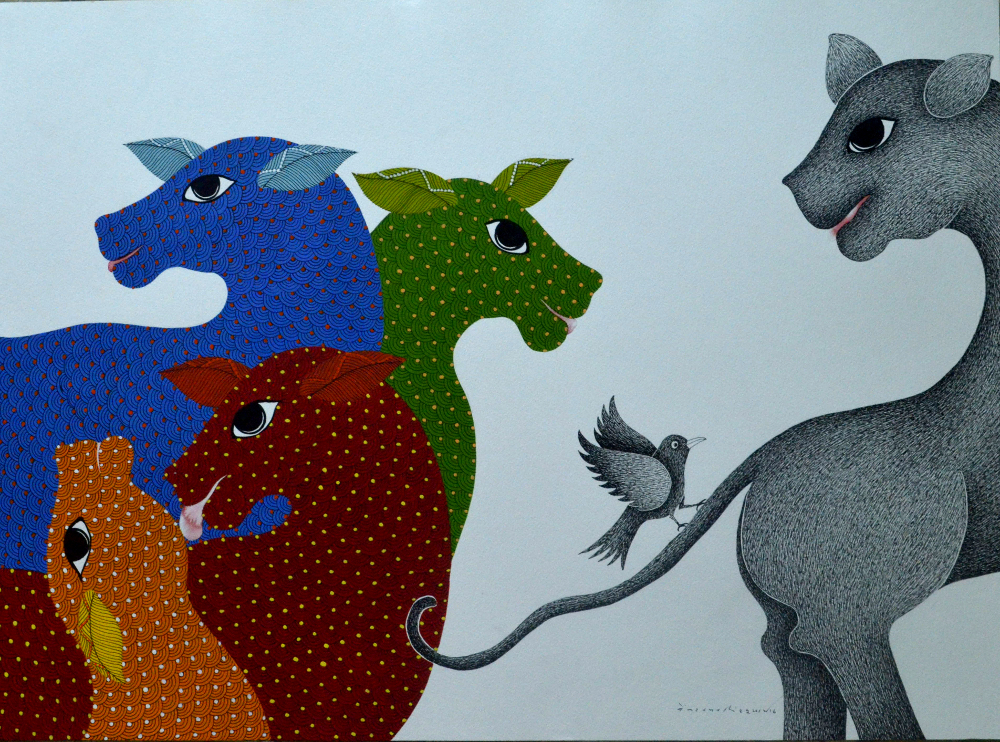
7 Works from Venkat Raman Singh Shyam: Pardhan Gond Artist and Story-teller


Venkat Raman Singh Shyam | Dare

The Gonds are one of the largest indigenous peoples of India and are spread throughout several central states of the country. Gond paintings were initially executed only on the walls of dwellings as an expression of religious beliefs, a record of daily life and local festivals, and to depict the surrounding environment and creatures. Gond artwork is characterised by the use of natural symbols such as trees and animals, with meanings rooted in animistic folktales and the culture of the Gond people.

Venkat Raman Singh Shyam (b.1970) belongs to the tradition of Pardhan Gond art inaugurated by the legendary Jangarh Singh Shyam, his uncle. The Pardhan Gond community is traditionally one of musicians who used to receive patronage from the Gond Rajas. With the impoverishment and weakening of the social order of adivasi (adi=original, vasi=inhabitant) communities, first by colonial apparatuses, and then the administration of independent India, patronage to the Pardhans eroded. With the practical significance of their story-singing gone, they turned to agriculture and labour to sustain themselves. Jangarh’s art arose from this imaginative background and created a new means of expression for members of his community. Jangarh developed the method of pointillistic detailing, which is the transformation of Pardhan music into visual form, known as Jangarh Kalam.

Venkat began drawing with pencil and charcoal from the age of ten. Since charcoal is considered inauspicious among the Gonds, he was discouraged by his community. Through his uncle, Venkat was initiated into the Jangarh Kalam style. After apprenticing with Jangarh in the 1990s, Venkat worked on a range of jobs – including as house painter, screen printer and signboard artist. He was also fortunate to be guided by the pioneering, and one of India’s most influential artists, Jagdish Swaminathan. Since Jangarh’s untimely and tragic death in 2002, Venkat has pursued a full-time career in art despite facing several hurdles. While working as a professional signboard artist, he was exposed to Bollywood film-poster style of painting. In his early years in Bhopal, Venkat developed a visual language comprising vivid colours and broad bands of diagonal shading divided by narrow black-and-white striped bands known as lahr and lahrdaar – ‘waves’ and ‘choppy waves’. Venkat also uses acrylic colours for his paintings.

Venkat has honed the ability to draw figures that aspire to realism: the elephant may look quite real, but drunk on mahua, it flies, and it is adorned with flowers. In him, the contemporary global world, and the demands it makes, have learnt to cohabit with a sensibility that invokes a primitivism that is at once modern, and reminds us of the world we all come from. He has experimented with ink and paper too, retelling Gond myths and stories of deities like Bara Deo and Dharti Dai. He describes the evolution of the media used in Gond art and its increasingly urban existence in an interview: ‘Earlier, we used mice hair in place of a brush, while limestone or charcoal were our colour mediums. Now, we use thin brushes and special pens to draw, and water, oil and acrylic mediums as colours.’

Art, for Venkat, is both an escape from, and a grappling with, the harsh realities that have become a part of our existence. Even as he remembers myths and legends that are being overrun by the surfeit of information in this electronic age, he reminds us that the world has barely changed, that time is not linear, that art can still produce magic. Venkat was awarded the Rajya Hasta Shilpa Puraskar by the Government of Madhya Pradesh in 2002. He is the coordinator for an animated film on a Gond folktale made by Tara Douglas, which won the Tallest Story Competition Trophy at the Inverness Festival in Scotland, 2007.

In April 2009, Venkat did a solo exhibition at the Indira Gandhi National Museum of Mankind in Bhopal. Having subsequently travelled and exhibited widely in India, Australia, Canada, Europe, New Zealand and the USA, Venkat has been exposed to a wide range of arts practices which have influenced his sensibility. In 2013, Venkat’s works were exhibited at Sakahàn: International Indigenous Art at the National Gallery of Canada, in Ottawa. Called the ‘largest-ever global survey of contemporary indigenous art’, Sakahàn, meaning ‘to light [a fire]’ in the language of the Algonquin peoples of Canada, featured artworks by more than 80 artists from sixteen countries and six continents who interrogated the theme of what it means to be ‘indigenous’ in the present world.

In 2015, Venkat was one of the artists who participated in the Kalpa Vriksha: Contemporary Indigenous and Vernacular Art of India project at the Asia Pacific Triennial of Contemporary Art (ATP8) at the Queensland Art Gallery. Kalpa Vriksha considers some of the most exciting and experimental artists working with the knowledge of these traditions today, capturing how traditional iconography and techniques have developed and how artists are using new styles to explore contemporary issues. In 2016, Venkat was one of the 12 Dalit and tribal participants in Literary Commons: Writing Australia-India in the Asian century with Dalit, Indigenous and Multilingual Tongues.

Venkat’s graphic autobiography, Finding My Way, was published in April 2015.

Posted in ARTWORKS | Tagged

Blasphemous Lines for Mother | Ki Kyntien Bym Ïaroh Na ka Bynta I Mei

Translated from the Khasi to the English by the writer

R. K. Narayan is dead.
Tonight he sits pensive
in his bamboo chair
talking of a “very rare soul”.

Suddenly I’m seized by a desire
to vivisect my own “very rare soul”
from end to end.

Let me begin by saying my mother is more
“plain-dealing”, more “truth-telling” than Narayan’s.
My mother is retired, toothless, diabetic and bedevilled
by headaches and a blinding cataract. In short,
she is a cantankerous old woman.

I remember the time when she was a cantankerous
young woman. When she took an afternoon nap,
she was tigerish: “You sons of a vagina!” she
would snarl, “you won’t even let me rest for a moment,
sons of a fiend! Come here sons of a beast! If I
get you I’ll lame you! I’ll maim you! … Sons
of a louse! You feed on the flesh that breeds you!
Make a sound again when I sleep and I’ll thrash you
till you howl like a dog! You irresponsible nitwits!
how will I play the numbers if I don’t get a good
dream?1 How will I feed you, sons of a lowbred?”

And this fiery salvo would come hurtling
with wooden stools, iron tongs and bronze
blowers, as we ran for our lives and she
gave chase with canes and firewood,
her hair flying loose, her eyes inflamed
and her tongue lashing with a mad rage.
And we being but children would never
learn anything except becoming experts
at dodging her unconventional weapons.

I remember how, having no daughter, she would
make me wash her blood-stained rags. Refusal
was out of the question. So, always I would pick
them with sticks and pestle them in an old iron bucket
till the water cleared. But mind you, all this on the sly.
Seeing me not using my hands would be lethal.
Those days in Cherra we never knew what
a toilet was. We never had a septic tank
or a service latrine. We simply did our job
in our sacred groves.2 But sometimes
my mother would do her job in a trash can.
Then it would fall on me to ferry the cargo
to a sacred grove. Refusal was out
of the question. So, always I would sprinkle
ash upon it, top it with betel-nut peels
and things and do my best to avoid nosy
neighbours and playmates. Those who
have seen Kamal Hasan in Pushpak3
will understand my stratagems.

I could cite a thousand and one things
to demonstrate how cantankerously
rare my mother is. And I decline
to tell you anything good about her.
I’m not a Narayan and I decline
to tell you how she suffered when
my bibulous father was alive; or how
she suffered when he died; or how
she suffered rearing her two sons
and her dead sister’s toddlers
in the proper way. There’s only one
thing commendable I will admit about her:
if she had married again and not been
the cantankerous woman that she is,
I probably would not be standing
here reading this poem today.

Posted in 76: DALIT INDIGENOUS | Tagged

Slumber | Muktrui

Translated from Kokborok (Roman script) to English by Saroj Chaudhury

I am now deep in silent sleep.
Like a child suckling, nestled at its mother’s breast,
Like a tired face buried deep in the beloved’s tresses.
Yet my thoughts, my anxieties haunt me even in slumber.
Now and here, like our blood and our indifference,
My sleep and myself run crimson through our hearts.
Our learned intelligentsia
Parrot the tutored words from within the party-cage,
In much of my words the tune of sleep echoes likewise.
As the coronet of power, pride and wealth
Fits well the ministerial heads,
My sleep sits on my head as a golden crown,
Making me a king.
I traverse the hilly track,
The roadside shrubs lean onto the path.
The extremists tread and run over them,
Proud boots of security men also tread over them.
The corpses are carried along this road.
This dead face seems known.
Kutungla’s wife had assuaged her hunger
With boiled weeds and a marsh frog. She died.
Watuirai passed away from enteritis or dysentery.
And again, they say,
Someone has died in an extremist shooting,
Somebody’s son has died in the crossfire.
He was a customer of our bank, rather garrulous,
Had married a few days back.
Whenever he met me on the road he would ask
‘Where to?’
At first I used to reply—
Then ignored the question.
Why should I tell him where I’m going?
And how far do I know my own destination?
Am I really going someplace?
Or simply flooding the road with the glow of my crown?
Only my sleep knows. Sleep is my life.

My father does not approve this sleep of mine.
My mother gets irritated, my wife gets angry.
Yet there are some, who join the festivals in earnest,
Casting a furtive look at my sleep and me.

They earn money at cockfights,
Sit by the stars and laugh out loud.
Here, slumber lies on my breast, caresses, kisses,
With face flushed in ecstasy.

Posted in 76: DALIT INDIGENOUS | Tagged ,

Sky Song | Taleng Nitom

Translated from the Adi to the English by the writer.

The evening is
the greatest medicine-maker
testing the symptoms
of breath and demise,
without appointment
writing prescriptions
in the changing script
of a cloud’s wishbone rib
in the expanding body
of the sky.

We left the tall trees standing.
We left the children playing.
We left the women talking
and the men were predicting
good harvests, or bad
that winged summer
we left, racing with
the leopards of morning.

I do not know
how we bore the years.
By ancient, arched gates
I thought I saw you waving
in greeting or farewell
I could not tell,
when summer
changed hands again
only the eastern sky remained;
one morning
flowering peonies
swelled my heart with regret.
Summer’s bitter pill
was a portion of sky
like a bird’s wing
altering design,
a race of fireflies
bargaining with the night.
Attachment is a gift of time,
the evening’s potion provides
heaven’s alchemy
in chromosomes of light
lighting cloud-fires
in thumbprints of the sky.

Posted in 76: DALIT INDIGENOUS | Tagged

जादूनगरी? | Wonderland

Translated from the English to the Hindi by Subhash Jaireth

मैं इस देश में जन्मा, ड्रीमटाइम से पोषित; परिदृश्य ऐहिक कथाओं से
गुंजित; मिथकीय लोगों और अन्य अलौकिक जीव​-जन्तुओं से रचित-बसित …
बस ऐसी है यह मेरी जादूनगरी ।

दक्षिणी गोलार्द्ध का सबसे साफ-सुथरा देश … इतना मांजा-चमकाया हुआ कि बस​
खुश और मदहोश अंग्रेज़ ही टेलीविजन पर देखे और माने-मनाए जाते हैं …
बस ऐसी है यह मेरी जादूनगरी?

मैं आज़ाद हूँ, पर जनवादी अधिकार बस नामभर के हैं । शासक वर्ग के लिए मैं बेहया
बला-आफत बन गया हूँ; ऑस्ट्रेलिया में स्वागत है … बस ऐसी है यह मेरी जादूनगरी ?

ईसाई सिपाही आए, हमला करते, धर्मयुद्ध करते, और मेरी धरणी-धरती आतंक पीड़ित
बन गयी, देश जेल बन गया, ऊंची दीवारों के पीछे बन्द हो गया …
बस ऐसी है यह मेरी जादूनगरी?

यह जेल अब अपनी दीवारों के बाहर भी कैदी रखता है … शरणार्थी
बिना मीआद की कैद में …

अब जब मृत्यु-पक्षी चीखता है
और दारोगा हुक्म चिल्लाता है,
बत्तियाँ सब बुझा दो!

बस यही है ऑस्ट्रेलिया …
अजीबो-गरीब जागीर …
हम आदिवासियों का कैदखाना …
यह नया नरसंहार …

बत्तियाँ सब बुझा दो!
यह मेरा घर​-घरौंदा …
मैं इसकी सुन्दरता से चकाचौंध हूँ, पर इसके झुलसाए चेहरे के दर्द को
भूल नहीं सकता ।
बस ऐसी है यह मेरी जादूनगरी …

परिशिष्ट
प्साल्म​ 68:6 परमेश्वर अनाथों का घर बसाता है; और बन्धुओं को छुड़ाकर भाग्यवान करता है;
परन्तु हठीलों को सूखी भूमि पर रहना पड़ता है …

Posted in 76: DALIT INDIGENOUS | Tagged ,

পেনেলোপে রে কোবি (অপহৃত শিশু) | Penelope Rae Cobby (The Stolen Child)

Translated from the English to the Bangla by Seemantini Gupta

দরজার গোড়ায় জড়োসড়ো হয়ে দাঁড়িয়ে, আমি
অবিশ্বাসী আর্তনাদ, আমি
গাড়ির মধ্যে জবুথবু, আমি
বিষাদের রহস্য-স্পর্শ, আমি-ই।

যে কাঁথাটি কখনও ব্যবহার করা হলো না, আমি সে
বা খালি, ধুলো-জমা পেরামবুলেটারটা
টেডি বিয়ার ভর্তি ওই খালি বিছানা
আর নীরব চোখে নীরব অশ্রুধারা।

কোনও বাচ্চার হাত পড়েনি, এমন সব পুতুল
কেকহীন কোনও জন্মদিনের পার্টি
বা নামহীন কোনও মুখ
‘কেন’, এই প্রশ্নের মধ্যে লুকনো ফিসফিসানি।

আমি সেই পাপ, যার কোনও পরিত্রাণ নেই
আমি সেই অনুচ্চারিত ভর্ৎসনা
আমি সেই বেদনা, যার কোনও শেষ নেই
আমিই সেই শিশু, কলঙ্ক গিলে খেয়েছে যাকে।

Posted in 76: DALIT INDIGENOUS | Tagged ,

I Have Seen Words | لفظ کو دیکھا ہے مَیں نے

Translated from the Urdu to the English by Gopika Jadeja

I have seen words in the rain
Retreating into the jute shelter
In the queue for kerosene
Withering in the eyes of
Unhappy children.
Standing empty stomach
Drinking tea out of a broken cup
Next to a dead buffalo
I have seen words in a temple
In innocent Yellamma’s heart
I have seen words crying in bloody tears
In the scream of a whip on the back
I have seen words
Walking away in exile from themselves
Hating themselves
I have seen words

Posted in 76: DALIT INDIGENOUS | Tagged ,

Snails | Shaamuk

Translated from the Bodo to the English by Pradip Acharya

Those days I picked the upturned snails
from among the stalks of growing grain
and filled my creel till the neck.
It was fun removing the shells
and watching their recoiling tongues
before I boiled them.
As I sucked the sap and threw the shells
they lay creaking on the floor
in a certain strange rhythm
that hid the agony of their dying.

Now I crawl around the sea-shores
clamber about on land and water
to look for the roots of that strange note
as the marauding waves
draw me back and fling me away.
Strangely, an unseen hand picks me up
sucks my sap and leaves me empty.
The shell of my body creaks
in the agony of the heart breaking
and makes the strange measure of a sad strain.

Posted in 76: DALIT INDIGENOUS | Tagged ,

My Poetry | મારી કવિતા

Translated from the Gujarati to the English by Gopika Jadeja

My poetry
dressed in its dirty clothes
poor like me
still awaits acceptance
from the silky pages
of magazines
Still seen thorough critical eyes
Unseen
Unheard
it lies half conscious

My poetry
Rustic like me
stands at the threshold
of Indian literature
Still prohibited entry
for its different clothes
Copper red
like my angry face
it stands at a distance
Alone
Excluded

My poetry
Mad like me
wanders in the street
neighbourhood, crossroads
and dirty lanes
Like the backward village
neglected by the feudal bureaucratic
civilisation

My poetry
Like my tongue
is uncivilized
And like me
it is untouchable
Relegated to the margins
by the sterile civilized
critics

My poetry
Forgotten
Disregarded

Posted in 76: DALIT INDIGENOUS | Tagged ,

ବାର୍ତାବହ ପକ୍ଷୀର ଗୀତ | Song of the Messenger Bird

Translated from the Lepcha to the English by Basudev Sunani

ମୋର ସୁନା ପୁଅ !
ଆଜି ଶୋଇବା ପୂର୍ବରୁ
ମୁଁ ତୋ ପାଇଁ ଚିଠି ଟିଏ ଳେଖି
ମୋର ଅତୀତ ବଖାଣିବାକୁ ଚାହେଁ

ଦିନେ ଗରାଖକୁ ଅପେକ୍ଷା କରି
ମୁଁ ବସିଥାଏ ଛତାତଳେ
ଏକ ଚୌକିଉପରେ

ରାସ୍ତାରେ ଅତ୍ୟଧିକ ଧୁଳି ହେତୁ
ମୁଁ ଆଖିବୁଜି ଦେଇଥାଏ,

ମନେପକା ତ’
ଏ ଦୃଶ୍ୟ ଦେଖି ତୋତେ କେମିତି ଲାଗନ୍ତl !
ହୁଏତ ତୁ ହସି ହସି କହନ୍ତୁ
ବାପା !
ତମେ ଶୋଇପଡୁଛ ଯେ !
କେମିତି ଦେଖିପାରିବ ତମ ଗରାଖକୁ !

ରାସ୍ତା ଆରକଡରେ
ଅତି କୋମଳ ଭାବରେ ଠିଆହୋଇଥିବା
ଗଛ ମାନଙ୍କ ପାଖରୁ
ଆଖି ବୁଜିଥିବା ଅବସ୍ଥାରେ ମୁଁ ଶୁଣିଲି ତା’କୁ,

ଏଥିପୂର୍ବରୁ
ମୁଁ କେବେବି ଶୁଣି ନଥିଲି ଏଭଳି ଗୀତ,

ମୁଁ ଆଖିଖୋଲି ଦେଖିଲି

ବିଚାରୀ ! ମ୍ରିୟମାଣ ଦେଖାଯାଉଥାଏ
ଅତି ନରମିଆଁ , ହାଲୁକା
ସତେ ଯେମିତି ନିଆଁ ର ଶିଖାରେ ଭାସି ଭାସି
ଜଳୁଥାଏ

ମୁଁ ଡାକପାରିଲି
“ ମା’ ତୁ’ ଚାଲି ଆ’ ଏବଂ କ୍ଷଣେ ବିଶ୍ରାମ ନେ’
ପ୍ରଥମେ ଆସ୍ତେ ଆସ୍ତେ
ପରେ ସାମାନ୍ୟ କ୍ଷିପ୍ରବେଗରେ
ସିଏ ନିରୋଳା ରାସ୍ତା ଡେଇଁ ଆସିଲା

“ମୋ ସାଙ୍ଗେ ଟିକେ ପିଉନୁ !
ମୋ ରୁଟିରୁ ଖଣ୍ଡେ ନେ’
ଆଜି ରୁଟି ଟିକିଏ ଶୁଖିଲା ଅଛି,
ଯାହାହେଉ
ଏହାକୁ ଚା’ ରେ ବୁଡେଇ ଖାଇପାରିବୁ”

ସିଏ ପ୍ରକୃତିସ୍ଥ ହେବାଯାଏ
ମୁଁ ଅପେକ୍ଷା କଲି,
ପରେ ଗରମ ଚା’ ଓ ବାସୀ ରୁଟି ଆଣିଦେଲି,

ସିଏ ମୋତେ ନିରେଖିଲା,
ମୁଁ ଯେମିତି କଲି, ସିଏବି ସେମିତି କଲା,

ଟାଣ ରୁଟି କୁ ଖଣ୍ଡ ଖଣ୍ଡ କଲା
ଏବଂ ଚା’ ରେ ଡୁବେଇ ନରମ କଲା,

ଓହୋ !
ସିଏ ଭୋକିଲା ଥିଲା ।

କହିଲି
“ ମୁଁ ଖୁବ ଆନନ୍ଦିତ ଯେ
ତୋ ପାଖରେ କିଛି କ୍ଷଣ ବସିବାର ସୁଯୋଗ ପାଇଲି”

ମୋତେ କିଛି କହିବା ପୂର୍ବରୁ
ସିଏ ମୁଣ୍ଡକୁ ଏପଟେ ସେପଟେ କଲା,
ମୁଁ ତା’ କଥା ଶୁଣିବା ପାଇଁ ଅର୍ଦ୍ଧନିମିଳିତ ହେଲି,
ଅତି ଆନନ୍ଦରେ ଶୁଣିଲି:

“ ମୁଁ ସେଇ ଜାଗାରୁ ଆସିଛି
ଯେଉଁଠି କେହି ଗୀତ ଗାଆନ୍ତିନି,
ଆମ ପୂର୍ବଜ ମାନେ
ବାର୍ତାବହ ପକ୍ଷୀର କାହାଣୀ ଶୁଣଉଥିଲେ,
ଲୋକେ ପକ୍ଷୀର ଗୀତ ଆଗ୍ରହରେ ଶୁଣୁଥିଲେ,
ଗୀତ ଶୁଣି ଖୁସିରେ କୁଣ୍ଢାକୁଣ୍ଢି ହେଉଥିଲେ
ନିଜଭିତରେ ଆଲୋଚନା କରୁଥିଲେ,
ଭୋଜିଭାତ କରି ଖାଉଥିଲେ,
ସତେ ଯେମିତି ଏଇଟା ତାଙ୍କର ଶ୍ରେଷ୍ଠ ଦିନ
ଏଭଳି ଖୁସିର ଦିନ ହୁଏତ ଆସି ନପାରେ
ଆସିଲେବି ୟା’ ଠୁ କମ ହୋଇପାରେ ।

ଏଭଳି ଅନୁଭବ କରି
ଗଭୀର ନିଦରେ ଶୋଇଯାଉଥିଲେ ।

ମୁଁ ଆଖି ଖୋଲି ତାକୁ ଅନେଇଲି,
ସିଏ ଅତି ଗାଢ ଓ ଚିରନ୍ତନ ଦେଖାଯାଉଥିଲା,

କହିଲି
“ ମାଁ ! ଆଉଟିକିଏ ଚା’ ଦେବି ?”
ମୋର ମନେ ଅଛି,
ସେଇ ଦିନ ସକାଳେଇଁ
ତୋର ମାମୁଁ ଆଣିଥିଲେ ତଟକା ମହୁ ମୋ ପାଇଁ,

ମନେ ଅଛି ନା !
ସେଇ ସୁନ୍ଦର ବଗିଚା, ଯେଉଁଠି ତୁ ଖେଳୁ ଥିଲୁ
ଏବଂ ମଜା କରୁଥିଲୁ ?
ତୁ ଯେ ତାଙ୍କର ମିଠା, ସୁନେଲି ମହୁକୁ ଭଲ ପାଉଥିଲୁ !

ସିଏ ଖାଇଲା,
କାହାଣୀ ପୁଣି ଲମ୍ବେଇବା ଆଗରୁ
ଆଗ ଅପେକ୍ଷା ଆଉ ଟିକିଏ ଅଧିକ ପିଇଲା,
“ ନୁଆ ଯୁଗ ଆସିଲା
ପିଲାମାନେ ବୁଢାମାନଙ୍କ କଥା ଏଣିକି ଶୁଣୁ ନାହାନ୍ତି,
ସେମାନେ କରୁଣ କାହାଣୀ ଶୁଣିବାକୁ
ପସନ୍ଦ କରୁ ନାହାନ୍ତି,
ପକ୍ଷୀର ଗୀତକୁ ଭୁଲିଯାଇଛନ୍ତି,

ଲୋକେ ବି ପକ୍ଷୀମାନଙ୍କ ଠାରୁ ଦୂରେଇଗଲେଣି
ପକ୍ଷୀ ଉପରକୁ ଟେକା ଫୋପାଡୁଛନ୍ତି,
ହତ୍ୟା କରୁଛନ୍ତି,
ବଡ, ସାନ, ରଙ୍ଗୀନ, ସାଦା
ସବୁ ପକ୍ଷୀଙ୍କୁ ଭୟ ଦେଖାଉଛନ୍ତି
ଅତଏବ ପକ୍ଷୀମାନେ ଗାଇବା ଛାଡି ଦେଲେଣି,

ସମୟ ବଦଳି ଯାଇଛି
ଏବେ ମା, ବାପା ପିଲାମାନଙ୍କୁ ତାଗିଦାକରୁଛନ୍ତି
ବନ୍ଦ କର !
ଗାଅ ନାହିଁ
ତମେ ଆଉ କ’ଣ ପକ୍ଷୀ ହେଇ ରହିଛ ?

ପିଲା ମାନେ ହସି ହସି କହୁଛନ୍ତି
“ ପକ୍ଷୀ ମାନେ ଗୀତ ଗାଆନ୍ତି ନାହିଁ “

ୟା ପରେ ମୋର ଅତିଥି
ତାଙ୍କ ବାଟରେ ଚାଲିଗଲେ,
ଏବେ ରାସ୍ତା ପୁଣି ନିରୋଳା ହେଇଗଲା,

ଭାବୁଛି !
ଆଜିଭଳି ଦିନରେ ତୁ ଭଲା
ଏ ପକ୍ଷୀର ଗୀତ ଶୁଣିବାକୁ ରହିଥାନ୍ତୁ !
ଅଥଚ ତୁ ବହୁ ଦୂରରେ,
ଯଦି ପକ୍ଷୀ ପରି ତୋର ବି ଡେଣା ଥା’ ନ୍ତା
ତୁ ଏଇଠିକି ଉଡି ଆସିଥାନ୍ତୁ !

ଏକ୍ଷେଣା
ମୁଁ ଖୁସିରେ ଶୋଇବାକୁ ଯାଉଛି
ପ୍ରାର୍ଥନା କରୁଛି
ତୁ ଯେଉଁ ରାସ୍ତାରେ ପାଦଦେଇଛୁ
ତୋର ଚଲାପଥ ସୁଗମ ହେଉ ମୋର ସୁନା ପୁଅ !
                    ବାପା ।

Posted in 76: DALIT INDIGENOUS | Tagged ,

Twi | Water Drops

Translated from the English to the Kokborok by Chandrakanta Murasing

bolong bahai borobsai phayw watwini twyo sujagwi chwngsakhe ha
boyarbai tai waisa bebak phuranna bagwi

kwthwi ranprajak bolongni langma kwtalkhe sichayasak
kubun kubun phaising thngw twi

****

phiya haywngo twi kwrwi hinkhe twino twywi sabo le swinai ?

joto langmani twi nangw joto langma-no twi lena twi twi-no lena hamarima

twi kwthar-bo twi twi-no kwthar phola

thui bisingtwi twi botok nok khungsani phayw bwrwi chwla
thui bisingtwi jaiti solai kurunglaijak borok joto mang bwphang waphang
yarung nanglaijak o takhuk bukhukrog

twi nokhao chwngjak twi langmao pungjak
chwng lekhawi paiya twi biyang busuk nwng i kok puitu thangyakhe sadi
minamatani twiyo kuphungjak harungo

watwi thop busuk kwlaikha bisi 1803 ni simi ?

watwi thop thop kulaima joto thumwi mankhe
aa ongwi thangma khamun chwng le.

nokbar twi sal tal mai-waksa khartwi twijlang laywi thangw
sal tungsawi nokbarni chubachu bai twi sakao bumul kholw yapri bwthai bwthai
tai mwnak tailamtwi nwgw hakor kuthukmarog
bumul kochogwi thangw ha laywi haywng phaising
watwi ni twibai thuiduk botok langma bising bising

mwnakma twi

nogo kiphilwi takhumsarog yapha khoroptwi bwkrang bwprawi twi jariwi khibw
twijlang bomjak kwchwng pilithai sakao twirem kayatwi katwi kaslewi kwlayw
kotono kholobjagwi tongw bukchaywng kuthukma

sal tai-bo kuchugo kawi paima kwrwi lam phunwgtwi twyo
tai o lama pohorni simi chengma ulo
nongkhorwi thangkha twyo swnamjak hakor mwnak kuthukmao
o hakor twijlangni swlai kuthuk aro pohor hapya mwnakni lam laywi
aro riawarrawa thuwi tongw twi mwtaini mwnakma nogo

tal

sampili bumul hor sal swlaijagw nokhao thungma bising
nokhani twi nokhano swnamw poder podkhe suwi kwbagw jorani chumuino
chumuirog thang phai ongw khon khonlaywi nokni lama phaising
eba talbai twiphil bai baksa himna tongthogwi

sal

awan hai phungsaw twi mokol kwbangma bwskango
nokbar khawi kobonwi thangw satungo tungsogwi
sakao thangwi chumuio nangkhe pherwi thangw sakmang bini
paima kwrwi twi-mangpili haikhe watwini ulo sal tai waisa phaikhe
lama khonwi himw kwtalkhe
twi kuphungjak tungsawi siyari pantwi ongw oro uro
jephuru chumui kotorma budul budul somsawi kholobw salno
pherang chirigw nokhano chirwi baywngni horo jilik jilik
aboni ulo siring sorop haywng tukujak watwi twyo
ha kisio sichasaw langma kwtalni bahai motom
bumul kaisini chokhreng chogsai tai waisa sal kaw

watwini twi ransai kobonsai pherangbai kudijagw
tai muktwi kupulwng kabwi tongw nokha kosomni nogo

Posted in 76: DALIT INDIGENOUS | Tagged , ,

সেলাম জানাই কৃষ্ণকালো লোক | Palya Palya Dha’lan Djani

Translated from Lionel Fogarty in language to the Bangla by Avishek Rath

হাতকয় পিছে পায় পায় চলে
জংলা জংলি মন হতে চায়
ভাতার নয় রে মরদ রে মুই
যোনিতে, পায়েতে, পায়ের পাতায়
মাটির স্বপ্ন দাউ দাউ জ্বলে
ঋতুস্রাবের আগুন তলে

মুই কান পাতি, নীচে খাড়া হয়
শুলসম যোনি মাঝে যেতে চায়
হুহু হাওয়া বয়, চোখে চোখ রয়
মিলনের সাধ চোখের ভাষায়
দূর হয়ে যা রে, তুই চোর ওরে
পুলিশ পুলিশ পুলিশ চেঁচায়

ছায়ামানুষ রে, সাবধান হ’রে
খালের পিশাচ ওই
রক্তের শেষ, ভাই চলে যা রে
আত্মীয় ন’স তুই
ঠাক্‌মা, দিদিমা সেলাম তোদের কৃষ্ণকালো মুই
আমি বরং মাটির টানে দেশেই ফিরে যাই।

Posted in 76: DALIT INDIGENOUS | Tagged ,