sun square on stomach

the charming ring of blinds
I mount the feeling with staggering reluctance,
stumble on the threshold, trip my gown
howm I gonna robiticise this sentence and get

snapcash deposit *now*
I DON’T MEAN RHINESTONES
a plasty will do just fine doctor all I need is another
wound lol
should soften me somewhat
backfoot lie down clean sheet scrub toe organic
cuticle brush
the cis bitch has it so why not?
I will fashion a key unlike any portal ever made
I will cock pit and boiler room and cellar door til
all my cows come home
til the rains, and winter, and equinox, and the
eclipse in my sign (♒♐)
retirement is never and it’s a privilege to get old
beautiful.
Rinse and repeat–take it on–wellness

Light is coming in the backyard and hits cockleshell,
gecko head, plush kmart robe
and green tea evaporates out of the mug that says
“65 and it still works”

Posted in QUEERING MODES | Tagged

MATHEMATICS Editorial

Mathematics
Photograph by Tim Grey

I was already quite a few years into a creative writing PhD titled ‘Generic Engineering’ and flailing around quite spectacularly in a galaxy of words when an academic friend, perhaps hoping to spare me the indignity of a completed thesis and potential employment, flipped to the middle of the 526-page book he was reading. Wordlessly, pointed to a single sentence. ‘Due to a predilection whose origin I will leave it up to the reader to determine,’ it read, ‘I will choose the symbol ♀ for this inscription.’ The symbol had been summoned to designate what the writer called ‘generic multiple’. The generic, the writer noted, is ‘the adjective retained by mathematicians to designate the indiscernible, the absolutely indeterminate’. Another PhD student who was in the room sniggered, disparagingly, I thought, as if dubious that I could be capable of understanding what had been read aloud. In retrospect it was more likely a beleaguered exhalation, a stockpile for the future, of sympathy and despair.

I abandoned almost everything I’d been reading and writing so far and began trying to write my way through Alain Badiou’s Being and Event. Badiou’s grand (and, for some, controversial) innovation is to have substituted language for mathematics as the least compromised way of engaging with the philosophical problems of truth, being, and the infinite. Attempting to understand even the most basic implications of this move turned out to be an impossible endeavor, one that I was impelled to confront afresh on a daily basis for a number of years. In the midst of all of this, I began to write poems. I have heard that reading philosophy can sometimes have this effect.

I still don’t know how to ‘do’ mathematics but in reading through the twelve hundred or so poems submitted to this special issue of Cordite I was looking for traces of the various ways in which it can make its presence felt. Sometimes a physical reaction was all it took to make a decision. In other instances, where I couldn’t have quite articulated what was taking place, I relied on a kind of spatial recognition. Some of the more straightforward lyric poems were compelling for the subtle, inventive, and indirect ways in which they summoned mathematical formulations. Others tugged at long-buried memories of theoretical significances that only occurred to me later, randomly or upon considerable reflection. Certain poems were selected because I liked the way they sounded and it was only afterwards, following fortuitous discussions with their authors, that I discovered their intellectual scope.

Ann Vickery’s ‘In Confederates We Couple’ conjures an iconic poet’s ‘lexicons’ and ‘logarithms’ and offers additional rewards for code-cracking, archive-dwelling readers. Pascalle Burton’s ‘After Michael Winkler’s ‘Where Signs Resemble Thoughts” elaborates on the American conceptual artist’s graphological innovation in which letters of the alphabet are plotted around the circumference of a circle and particular letters are linked by lines to create seismographic word visualisations. Burton’s extension of Winkler’s premise invites the reader to perform a cognitive exercise, one that has physical and psycho-social resonances reminiscent of Yoko Ono’s instruction paintings.

In ‘The Pavanne for Hanne Darboven’, A J Carruthers draws on the precepts of Darboven’s ‘Mathematical Music’ in which accumulated series of numbers are assigned notes in the creation of musical scores. Carruthers supplements this technique with images from Darboven’s artworks to provide a contribution to the library of performable conceptual compositions. The homage can be viewed as a more complicated performance of Dickinson’s famous lines – ‘I died for beauty but was scarce / Adjusted in the tomb, / When one who died for truth was laid / In an adjoining room’. Carruthers re-makes Dickinson’s unimpeachable separation of poetry and mathematics and opens the field to more complex imbrications.

An article published recently in Quanta magazine reported on a 2016 advance made by mathematicians Maryanthe Malliaris and Saharon Shelah. The advancement solves two problems – one related to their initial inquiry into Jerome Keisler’s 1967 investigations into minimally and maximally complex mathematical theories, and another, the problem of ‘whether there exist infinities between the infinite size of the natural numbers and the larger infinite size of the real numbers.’ This problem is related to the continuum hypothesis, posed by Georg Cantor, the inventor of set theory, in 1878 and deemed unsolvable within set theory’s framework by Paul Cohen who invented the mathematical concept of forcing in 1963. As Justin Clemens writes, in ‘The Idea Takes Place As Place Itself, Expanded and Revised Edition with a New Foreword by the Author’

               Luckily 
                              no one was writing
poetry that year; it wouldn’t have come off well;
what poem can compare 
                              to something like that?

The article is well worth reading in its entirety but of particular interest to me here is the way in which Malliaris and Shelah stumbled onto their discovery. In his account of Badiou’s philosophical edifice, Norris explains how a subject’s fidelity to a generic truth procedure ‘can make room, via these concepts of the generic and indiscernible, for the advent of truths that as yet lie beyond the compass of achieved (or achievable) knowledge.’ What at first seems insoluble or paradoxical can be turned via Cohen’s technique of forcing ‘into a fully operative concept’. In proving that the two properties they were working on were both maximally complex, Malliaris and Shelah were also able to show that two infinities (p and t) that were thought to be of different sizes were in fact equal. They did this by ‘cutting a path between set theory and model theory’ in a move that deployed Paul Cohen’s method of ‘forcing’ to solve one of the remaining problems of the continuum hypothesis. The move is reminiscent (in terms of audacity if not scope) of Cantor’s realisation that ‘the scandal of the infinite – of a part that must somehow be conceived as equal to the whole – could in fact serve as its very definition or distinguishing mark.’1

Posted in ESSAYS | Tagged , , ,

Nighthawk, Part 1: Use of Additive Sequences for Generating a Cut-up Poem

Warren BurtImage courtesy of Catherine Schieve.

In 1973, I was a post-graduate student at the University of California, San Diego, working on my Master’s degree in music composition. My principle teacher at the time was Kenneth Gaburo, well known for his work in compositional linguistics which crossed boundaries between music, language, writing, performance, and dance. I was also very good friends with two fellow post-graduate students, Peter Gordon, composer, and Kathy Acker, writer, who at the time were partners. Kathy was mainly working with the performance poet David Antin at the time. Many were the late-night trips to VG’s Donut Shop in Carlsbad, California, in which Peter, Kathy and I discussed artistic issues that seemed quite urgent to us at the time. William S Burroughs, with his cut-up method, and the collage poetics of John Cage were both enormously influential on us, and Kathy introduced me to the work of Jackson Mac Low, who, many years later, I became friends with. And, as mentioned, both Gaburo’s and Antin’s experiments with language-based composition were very important to us.

Kathy’s 26th birthday was coming up, so I decided on methods I had been using for music composition to make a (what I thought would be) small present for her; a collage text of a number of sources that, for one reason or another, appealed to me. My main compositional activity at the time involved the use of random number sequences to create musical compositions. To do this I would create a set of rules which would determine the kind of random numbers that would be used, and how they would be applied. These sets of rules came to be known as ‘algorithms,’ and the kind of music was labelled ‘algorithmic composition.’ For me, this involved two kinds of composing – either making instrumental pieces which were realised as traditionally notated scores on paper (some of which, in performance, involved the use of improvisation), or using electronic musical instruments, setting up processes and patches of equipment on the machines themselves that allowed the machines a great deal of autonomy in producing music. Sometimes I would perform these machine processes live, allowing myself to improvisationally change some of the controls in real-time, altering the output of the process, in an early kind of interactive composition / improvisation with a machine-based partner.

For Kathy’s present, I decided to make two piles of books which contained text I might want to use, or which could provide found material that I would find amusing. I don’t remember what was in each pile, or all of the books used, but I do remember that among them were Roger Tory Petersen’s A Field Guide to the Birds of North America, Modulor I and II by Le Corbusier, various texts of William S Burroughs (of course), Seasoned Timber, a 1930s social realist novel by Dorothy Canfield, a 19th Century harmony textbook by Percy Goetschius, a couple of copies of the journal Perspectives of New Music and a computer manual or two. I can’t remember what source of random numbers I used – I don’t think I had yet acquired a copy of The Rand Corporations A Million Random Digits with 100,000 Normal Deviates, a massive compilation of random number tables – but I used random numbers to pick which pile of books to use, then which book to use, which page to go to and what position on the page to go to in order to find a text. How many words I used was determined by use of numbers from the Fibonacci series.

The Fibonacci series is named after Leonardo of Pisa (son of Bonacci, or filius Bonacci), the 12th Century Italian mathematician who introduced many Indian and Arabic mathematical ideas to the West. Among them was a number sequence, perhaps written about first by Pingala, an Indian mathematician (3rd and 2nd Century BCE), in which each new number is the sum of the two previous elements of the series. So, if the first two numbers are 1, 1, then the next number will be 2. The 4th element of the series will be the sum of the previous two elements, which are 1 and 2, so the 4th element will be 3. The series would begin like so, and then go on to infinity, getting larger and larger: 1, 1, 2, 3, 5, 8, 13, 21, 34, 55, 89, 144, 233, 377, 610, etc.

This series has some rather remarkable properties, such as the ratio between any two successive elements of the series gets closer and closer to the value of Phi (1.61803399 …) as you progress through the series; the number of seeds in successive circular rows of sunflower seeds usually follows this kind of progression; the ancient Greeks used these proportions to design their temple –the ratio Phi was called the Golden Ratio and was felt to embody concepts of balance, form, proportion, and harmony within it – and so on. In music, both Claude Debussy and Béla Bartók, early 20th Century modernist composers, had used elements of the Fibonacci series to structure aspects of their work. Analyses of this usage were just beginning to be published at this time. So there was a great deal of thinking about the Fibonacci series in the air. Especially the Southern California air we were breathing at the time.

Many years later, now, I read about how the Fibonacci series was just one example of a more generalised phenomenon called additive sequences. The rule that generates the Fibonacci series is next N = the previous N + the second previous N. By changing the ‘seed values’ (that is, not always starting with 1, 1), different number sequences can be obtained but the proportions will always tend to be closer and closer to Phi the farther you go out into the series. If you change the rules, for example, next N = N 5 numbers ago + N 6 numbers ago, then you will get a totally different series, and the ratios of that rule will not tend to Phi, but will converge on a different constant. Any values used to start that series will tend to the same unique ratio for that series. Using this principle, in 2006–2010, I generated a lot of different random number routines using these equations for John Dunn’s ArtWonk and MusicWonk software, and I’m still using those generators in my own composition to this day.

Posted in ESSAYS | Tagged , ,

FOB: Fresh Off the Books


Image courtesy of the author.

‘Only idiots and government leeches live in Western Sydney,’ Zekay said to me as he tied up his oily brown hair into a topknot. He was standing in the middle of the grass at Central Park Mall, his hairy arms spread out like he was Jesus on the cross. Zekay was a University of Technology Sydney film student who lived in Surry Hills and loved to call himself the Son of Man while scratching the wiry pubes under his arms. I had met Zekay on Tinder, drawn by his curly hair and long lashes. His skin was as white as bleached notebook paper.

On our first date, I kept stroking the length of his forearm as if I was writing on it or as if I’d find the true talent of his art in the pores of his skin. At around 9pm, I asked Zekay if we could go home, my head lolling towards his lap as I pulled at his peach fuzzed arms. He ran me to the last Western Line train, and when I tried to kiss him goodnight he turned his head and whispered, ‘Don’t be an idiot.’ I fell through the barriers and threw up in my handbag all the way back to Mt Druitt.

There is an assumption that real art only comes from the city, and I wanted to be around Zekay because I thought he was a real artist. I assumed that to be a real writer I had to move into the city, get high, sleep with everyone, male and female, and drink everything until I became one. I thought the only thing stopping me from real writing was Mt Druitt and being Tongan.

It took twenty-one years for me to snap out of this psychology of self-hate, and to realise that I was already in a place to call myself a writer. In this essay, I want to argue about literature; real literature, a kind of literature for those with critical minds, dedicated natures and something new to say. Being a writer is writing what you own, and if there’s anything I own, it’s the literature of being a Fob in Mounty County.

Growing up as the only avid reader in my family, I originally thought that writing and reading was simply for fun. In Year 2, I loved writing poems about spring, flowers blooming, birds hatching, warm wind whistling. Come Year 6, I loved writing about far off dreamlands that had fifty-foot rollercoasters and magic spells. In Years 7–11, I loved writing about vampires that looked like Robert Pattinson and rich boy band members that looked like Harry Styles. My writing then – only about five years back – was a reflection of what was globally popular at the time: Twilight and One Direction, subject matter every teenager with a fan-fiction account was writing about.

I had ignored every chance to tell a new and original story. My fanfics had nothing to do with the fact I wore ta’ovalas every Sunday to my Tokaikolo Church in Granville, or that I have eight siblings or that my best friends from Mounty were Indonesian-Australian, Filipino-Australian and Pakistani-Australian.

My writing got better because I chose to attend university. University is where I learned about linguistics and the mechanics of the English language and its tools, such as where to put commas, full stops, ellipsis and semi-colons in their most effective places. I learned the importance of research as a creative writer: researching subject matter, genre and form. But it was when I’d encountered the work of Chris Lilley, a White man in brown face paint pretending to be Tongan on ABC television, that I came to realise the importance of the kinds of stories we tell, and who should be telling them.

Throughout most of my life, the only widespread representation I had seen of Western Sydney were news reports filled with dole-bludging bogans, violent teen gangs and ethnic terrorists. Now, when I write about Mt Druitt, I go up against national news that manifests itself into wide spread memes on the internet. One particular news-story-turned-meme uses the blond-headed adventurer icon Tin Tin (published by ‘Eshays’). Instead of wearing his trademark blue jumper and red slacks, Tin Tin is decked out in a snapback, Nikes and a bumbag as he walks past Bankstown train station. Bankstown is depicted in this image as a place filled with dead bodies, dog shit, bird shit and and Maccas. Another meme, ‘Tin Tin in Penrith’ (Published by ‘Herpes’) contains a similar message. Tin Tin rocks a redneck mullet as he gaps it with a smoko from drugged-up bogans, feral dogs and passed-out drunks in the Red Rooster carpark.

Another example is ‘Drive By’ by Michael Duffy and ‘Evil in the Suburbs’ by Cindy Wockner and Michael Porta. These kinds of mainstream ‘Western Sydney’ stories are always about ethnic crime, sexual assault, drug-dealers and drive-by shooters. These texts are always written by outsiders, people who do not come from Western Sydney and who do not have any legitimate connection to our region and our communities.

Although I understand that violence, drugs and people of low economic income do exist in Western Sydney, rarely do we ask why some people within my community have formed these gangsta or bogan identities in our suburbs in order to feel empowered. I believe it is because we enjoy the fantasy of power, control and community present in these identities, a feeling we rarely see reflected for us in mainstream Australian media and art.

Posted in ESSAYS | Tagged , , ,

The Ocean’s Tide: Parentheses in Kamau Brathwaite’s and Nathaniel Mackey’s Decolonial Poetics


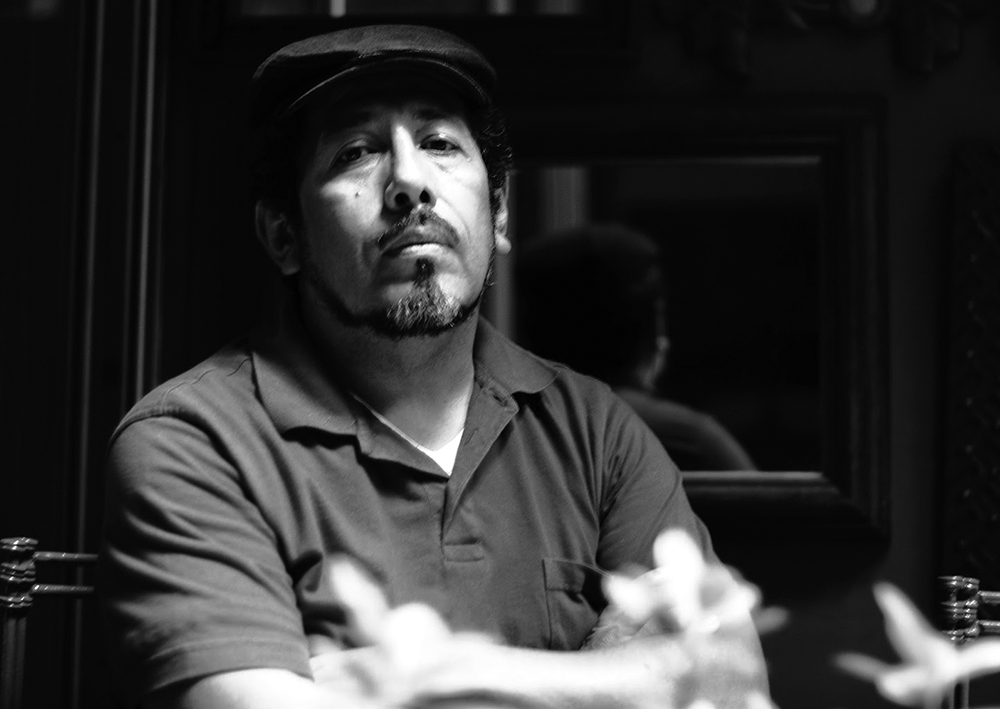
Image of Nathaniel Mackey courtesy of Paris Review.

Rather than rehash reasons why mathematics and poetry are closely linked fields of intellectual practice, this essay assumes their relationship is the case and focuses on one of mathematics’s and grammar’s many functional figures, the parenthesis. Since first appearing in the work of German mathematician and astrologer Christopher Clavius, the parenthesis has been used in mathematics to denote a group of numbers or functions to be dealt with in isolation before its product is applied to its formulaic housing. Here, where the parenthesis is examined as an important poetic device, this grouping effect is taken into account, but, in addition, the parenthesis’s unexpected effects on the line of poetry, on the poem’s meaning, and on the immanent network of poetic relations the text represents will be foregrounded. In particular, I will ask how parentheses interact with aesthetic silence and the metaphor of the ocean’s tide in poetic and theoretical works by Barbadian poet and academic Kamau Brathwaite and American poet and academic Nathaniel Mackey in order to understand the ways in which each renders their decolonial poetics.

Such a project can perhaps only be carried out in an experimentally connective way, in acknowledgement of what American performance scholar Soyica Diggs Colbert calls ‘webs of affiliation’ in which presently occurring performances – in the case of this paper, the textual performance of ideas, punctuation marks, words, and meaning – link themselves in a non-linear fashion into the history of often elided Black movements (6-7). The texts used are Brathwaite’s conVERSations, The History of the Voice and various poetical works; and Mackey’s Discrepant Engagement, Paracritical Hinge and Splay Anthem. Wanting to journey inwards as immediately as possible from the invocation of this catalogue, the essay intends to instantiate in itself the form of the parenthesis, and infer that the parenthesis’s use grammatically and symbolically by these two Afro (I call them Afro, having eliminated all hyphenated addendum, and with the ‘o,’ in reference to being both ‘out’ of, and just ‘of,’ Africa) authors is an investiture of silence into the colonial thought-structure, and, at the same time, a representation of the dynamic, environmental movement and constancy of the tide, to which Brathwaite refers in his concept of a ‘tidal poetics.’

Both Brathwaite and Martiniquan poet and philosopher Édouard Glissant have used the metaphor of the tide to reconceptualise Caribbean and North American colonial history. For Brathwaite, the first step towards identifying a ‘tidalectics’ is to understand it as having an oceanic resonance, in the sense that it aims to access an as-yet unspoken, perhaps subconscious psychological region, and that it denotes not just an forward-moving historical progression, as colonialism does, but a simultaneously backward movement. A tidalectics allows non-linear theories of time to influence one’s reading of a text, and opens history to the revisionist processes so important to post- and de-colonial poetic practice. One of the key markers of a tidal poetics, then, is its acknowledgement of the silence that colonial forces create.

And yet, despite the constant and broad-surfaced emergence with which a tidal poetics comes upon us, when it registers itself in grammar, the idea of the tide has the potential to abruptly puncture the poetic work. Indeed, by reading grammatical parentheses within the tidalectical paradigm of Brathwaite and Mackey’s work, the tidal registers as both the interruption of silent space, and a container full of noise. In his Writing Australian Unsettlement (2015), contemporary Australian poet and critic Michael Farrell provides a compelling framework through which to think about the deconstructive potential of punctuation and other non-alphabetical markings. ‘In order to read in such a way that de-privileges the semantic and grammatical – the privileging of which constitutes literary settlement as such,’ Farrell proposes to examine ‘the material facts of each text as assemblage’ (6). He uses Gilles Deleuze and Félix Guattari’s pliable concept, ‘assemblage,’ with its carriage of its own French origin, ‘agencement,’ to confer agency onto non-human elements. When affectively misapplied, punctuation marks, both conventional and extra-grammatical, can be taken as rupturing the settlement of diction and grammar, and sending a destabilising shockwave through the larger colonial structures that rely on them.

Another pertinent connection to make here is with Roland Barthes’s theorisation of the punctum in relation to photography. For Barthes, the punctum (a word derived from the Greek for trauma) is the highly personal, even discrete, element of a photographic composition that ‘shoots out of it like an arrow, and pierces me’ (Barthes 26). The punctum is disruptive and eruptive. While Farrell’s work is highly localised to the situation of Australian colonial settlement, and Barthes’ is even further removed, they both provide ways of thinking about punctuation that could be applicable to poetry working within other colonial contexts. Closer to the American and Caribbean colonial situation, Eve Shockley argues that poetries responding to the trans-Atlantic culture and economy of slave trading have the capacity for healing via their ‘reckoning with the discursive evidence of [the] rupture’ that epitomises the Middle Passage. And it is a persistent rupture, she argues, which is still enacted by language’s production of African American subjectivity (795). It is reasonable to suggest in consideration of Brathwaite and Mackey’s disruptive use of parentheses, and other related bow shapes in their rendering of poetry to the page, that punctuation plays a significant role in create space for such a subjectivity when the established lexicon does not.

So, there is this part of grammar, punctuation, that can be taken as not only structuring the meaning of a text, but acting on that text of which it is a part in a way counter to its semantics. Not only counter to that semantics, but also on a completely different register to the semantics of a text. Punctures can be read in the same way that we read a pun, for example: as meaning what it says, as well being a kind of nonsense. In Writing Australian Unsettlement, Farrell, like Brathwaite, takes puns seriously, as capable of altering the world to the same extent that the text the punctuation punctures can be said to alter the world. They are holes through which the matter of the text can slip, and also through which matter can re-emerge. As an example of how it is through punctuation that the surface of the text and its chthonic world are connected, we might consider that Brathwaite’s ‘nation language’ word for ‘upon’ is ‘pun’ (conVERSations 75). But a parenthesis is a strange kind of punctuation. Instead of being a bullet-hole in a text, a parenthetical bracket creates space for further speech that is to take place on the plane of the page. In the first semantic movements of Brathwaite’s Masks, for example, parentheses stand for the material of Ghanaian ceremony, most noticeably in the poem, ‘The Two Curved Sticks of the Drummer,’ where the percussive instruments create ceremony’s rhythm, seeming to invoke not only by their impact but by their curved shape, the ceremony’s altered state of consciousness (8-9). These object-bodies are called forth to occupy a place upon the surface of, and that is, the text, or the drum.

Posted in ESSAYS | Tagged , , , , ,

A Poetics of a Politics


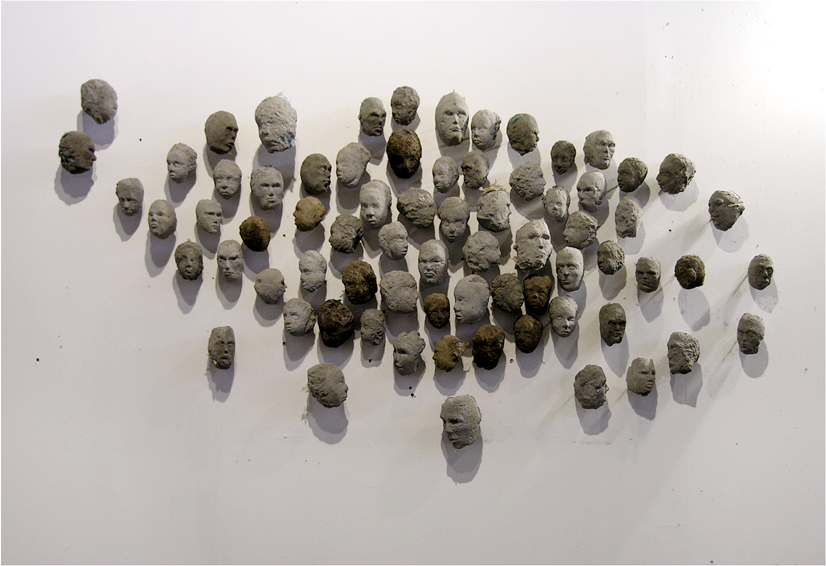
Images courtesy of Ledelle Moe.

When delivering a thesis presentation based on rethinking the methodologies for reading Aboriginal Australian poetics, a fellow postgraduate student asked me, ‘Do you consider your thesis political?’ I was momentarily floored. It was a question I had expected, and yet had not been adequately prepared for. In fact, as it turned out, the question was meant sincerely. As I asked the student in question, it seemed as if it had been asked as an attempt to invigorate and deepen conversation, rather than challenge my research findings. However, as I struggled to talk myself around the question itself, I came to realise that the many hours I had put into my thesis – attempting to raise critical questions regarding the cross-cultural effect of a political, post-colonial poetics might have succumbed to the very pitfall responsible for the fall of the much-maligned moniker, ‘multiculturalism’ that now spells death for any progressive contemporary research attempted in the Arts.

A phrase drawing on the utopic, socially-cohesive imagined future of Australia, ‘multiculturalism’ is now just as resonant for false ties of kinship, superficial cultural connections and eliding real cultural growth as it is for productive cross-cultural conversation. If you mention the word in a grand lecture theatre or any dank tavern across the country, you will be received by a blurry-eyed glare across a frothy beer glass or a lectern, with the result being largely the same – multiculturalism, cosmopolitanism, whatever you want to call it – is not fashionable anymore. However, the impetus remains to present cross-cultural work, or at least that was how I saw it as I began my PhD research. Now I feel as though a real multiculturalism should be revitalised out of spite to the forces making it so unpopular (is this not the case already, with so many axioms and theoretical concepts developed in recent years, such as ‘comparative’ or ‘world’ that make the case for a cross-cultural way of thinking?).

But back to the scene of the crime and to the wide-eyed faces of my peers. It was with a sense of self-effacing horror that I realised as a non-Indigenous academic researcher, I had somehow managed to unconsciously trivialise and politicise the subjectivity of the voices I was trying to explore within academic scholarship. The question resounding in my head was: can research on Indigenous arts be raised in critical conversation without being said to be automatically, and inherently political? Such a question led to a multitude of unwarranted, unconscious reactions on my part (‘oh gosh, perhaps this is how Toni Morrison felt when she was asked why she didn’t write about white people!’). I raise these issues self-effacingly here firstly to highlight the necessity that might grate on Indigenous Australian authors, poets, songwriters, playwrights, artisans and many other cultural producers; as they are asked to subscribe to a certain authenticated Indigenous subjectivity or cultural identity within a community, but also to primarily acknowledge the inestimable legacy of Indigenous thinkers in Australia today as progressive, intercultural literary figures – as was the point of my presentation. Perhaps I hadn’t made my point clear enough.

Following what seems like a century of work on ‘minor literatures’ by august scholars of the likes of Gilles Deleuze, Felix Guattari, Franz Kafka, etc, I sought to work in concert with the theory that to write in a minor language is itself a politicised act, and thereon, to suggest that to write in a minor literature means that – while remaining embedded in politics– we can give it the flexibility, interagency and fluidity of a majoritarian one (2003). To extend these principles in relation to the onslaught of a ‘political’ presentation, I set myself a somewhat dubious task; laying the groundwork for a study of poetics to become intimately entangled with not only its own ‘political immediacy’ as Deleuze and Guattari highlight in their work on Kafka, but the ubiquity of surrounding universes (and universals) in taking up the mantle of a multicultural legacy (n.p.).

Specifically, I pose the speculative question that poet and activist Lionel Fogarty of the Yoogum and Kidjela peoples in Southern Queensland wields a highly complex cross-cultural vernacular, and as such, we should read his breakages in the English language not merely as a ‘offensive weapon’ as many more erudite scholars than I have posed, but as a intermediated straddling of both sides of a borderspace in producing a relational poetic. Such a finding corresponds with a seminal work produced by a father figure of Martiniquan literature, Edouard Glissant, Poetics of Relation (1999).

In his book, Poetics of Relation, Glissant suggested that the intercultural exchanges in the Caribbean could relate complex processes of cultural exchange in the wider world. Heavily informed then, by creolisation, a Poetics of Relation can be described as ensuring that within cross-cultural contact or exchange, one’s culture is both opaque, resistant to objectification or nullification, and yet, is relational, able to be mutually affect others, and be affected. He writes (in an able translation provided by Betsy Wing), ‘The thing that makes the understanding of every culture limitless is precisely the thing that allows us to imagine, without approaching it, the infinite interaction of cultures’ (Poetics of Relation 172).

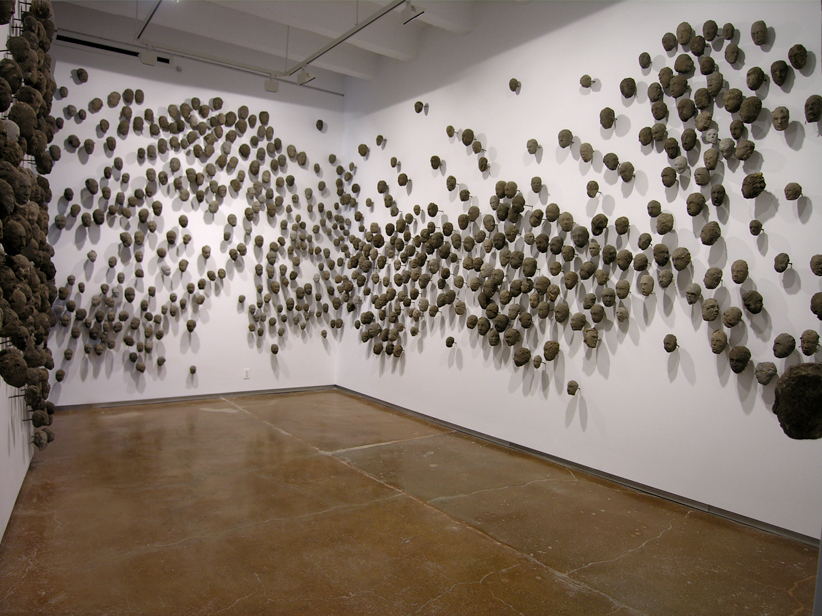
For a better understanding of a Poetics of Relation as a quasi-methodological concept relating to literary texts, consider Glissant’s Relation in a visual form; in the mixed media installation Congregation, an artwork constructed by South African artist Ledelle Moe. In 2006, Congregation was installed in Miami’s Perez Art Museum during a conference on Glissant’s legacy suitably entitled, ‘Poetics of Relation’, and in 2014, it was reproduced in Glissant’s hometown of Martinique, for the Martinique Biennale.

Figure 1: Ledelle Moe, Congregation, 2006 Installation view Pérez Art Museum. Miami Concrete and steel. Dimensions variable.

Figure 2: Ledelle Moe, Congregration, 2006 Installation view Pérez Art Museum. Miami Concrete and steel. Dimensions variable.

Posted in ESSAYS | Tagged , , , , , , , ,

3 Translated Samuel Trigueros Espino Poems


Image courtesy of Festival de Poesía El Salvador


PIGS

‘I have seen friends Circe turned into pigs. Her wheel, her diamond.
The pigs don’t know my hideouts, mercenaries of shadows.’
–Edilberto Cardona Bulnes

I have beheaded pigs, but Circe insists on multiplying them. They were the mercenaries of education, mercenaries of art, mercenaries of public relations, mercenaries of publicity and the marketplace; they were the mercenaries of poetry; they bolted, made friendships, wrote verses; put on costumes and earrings, followed the gymnastics of convenience, weighed cement and nails on the crooked scales of greed; left in their wake an exquisite scent and under its rug lay the corpses. I have decapitated pigs that Circe then revives and employs in the administration of new artificial paradises, in the distribution of miasma. Circe would give garlic necklaces to the employee of the month, a gentle pat on the ego’s shoulder; endlessly she’d massage the crease in the gland that secretes a liquid to burn the world. I hear my decapitated pigs gargling their throats, with constant fresh sutures, their wounds healed with plasters of hypocrisy, with luxurious ointments distilled from red lightbulbs. They were, to a moderate extent, revolutionaries; they all wore red shirts, carried voluminous incunabula of Das Kapital; all of them had swallowed the 86 hour “cure for insomnia” and on their heads shone the mitre of the marketplace. Sometimes—especially in the melancholy late afternoon light—they suffered terrible attacks of conceptual, methodical tenderness. Then it was no problem to see them stand on tiptoes to avoid massacring ants or exterminating geraniums. Experts in the Mexican wave performed behind the back of the oceans’ heart, they, they, domesticated heat, plugged the steaming craters with slogans, decked protest out with the finest valves, accelerated puberty’s motor; stabbed mystery with Truth Commissions, impaled the jurists, established the NGO of filth, they, they, the pigs I decapitated between lines, the pigs, bohemians with glaucous eyes who poured mirages through the bars of my cell, pigs who gilded the concupiscence of diplomas and diplomacy, pigs who sang at my funeral in their puffed-up radiophonic voices, pigs reclaiming their droit de seigneur at my wedding with eternity, the pigs who sponsored my sadness to get a good look at the announcement of my despair, the pigs, pigs, pigs, true friends, pigs I decapitated without knowing it, till now I’ve lost them and see them devouring the ripe apples that fall like red galaxies from the tree I fed with patience and with the dazzling light of my bones.


PIGS

‘He visto amigos que Circe volvió cerdos. Su rueda, su diamante.
Los cerdos no saben mis abrigos, mercenarios de las sombras’
–Edilberto Cardona Bulnes

He degollado cerdos, pero Circe insiste en multiplicarlos. Ellos eran los mercenarios de la educación, los mercenarios del arte, los mercenarios de las relaciones públicas, los mercenarios de la publicidad y del mercado; ellos eran los mercenarios de la poesía: hacían tornillos, amistades, versos; se ponían trajes y aretes, asistían al gimnasio de la conveniencia, pesaban clavos y cemento en la balanza chueca de la voracidad; dejaban tras de sí un perfume exquisito bajo cuya alfombra yacían los cadáveres. He degollado cerdos que Circe resucita y los emplea en la administración de los nuevos paraísos artificiales, en la distribución de miasma. Collares de ajo dio Circe al empleado del mes, palmaditas en el ego, interminables fricciones en la comisura del glande por donde un líquido salía y quemaba el orbe. Oigo las gárgaras de mis cerdos degollados, continuamente suturados, sanados con emplastos de hipocresía, con bálsamos de lujuria destilados de la bombilla roja. Eran, medianamente, revolucionarios: tenían todos camisetas rojas, volúmenes incunables de El Capital; todos se habían tragado las ochenta y siete horas de “The cure of insomnia” y en sus cabezas brillaba la mitra del mercado. A veces –sobre todo contra la melancólica luz de los atardeceres- sufrían ataques terribles de ternura, conceptual y metódica. Entonces era fácil verlos de puntillas evitando masacrar a las hormigas o extinguir los geranios. Expertos en hacer la ola a espaldas del corazón de los océanos, ellos, ellos, domesticaron el ardor, taponaron con eslóganes los cráteres humeantes, pusieron válvulas finísimas a la protesta, aceleraron el motor de la pubertad; apuñalaron el misterio con Comisiones de la Verdad, empalaron a los juristas, fundaron la oenegé del asco, ellos, ellos, los cerdos que degollé entre líneas, los cerdos, los bohemios de ojos glaucos que derramaron espejismos entre los barrotes de mi celda, los cerdos que doraron la concupiscencia de los diplomas y la diplomacia, los cerdos que cantaron engolados con radiofónica voz en mi funeral, los cerdos que reclamaron derecho de pernada en mis bodas con la eternidad, los cerdos que patrocinaron mi tristeza para ver el anuncio de mi desesperación, los cerdos, los cerdos, los cerdos, ciertos amigos, cerdos a los que degollé sin saberlo, hasta ahora que los he perdido y veo devorar los manzanos maduros que caen como galaxias rojas del árbol que alimenté con paciencia y con el resplandor de mis huesos.

Posted in TRANSLATIONS | Tagged ,

Sticker Lady’s Tales of the First World


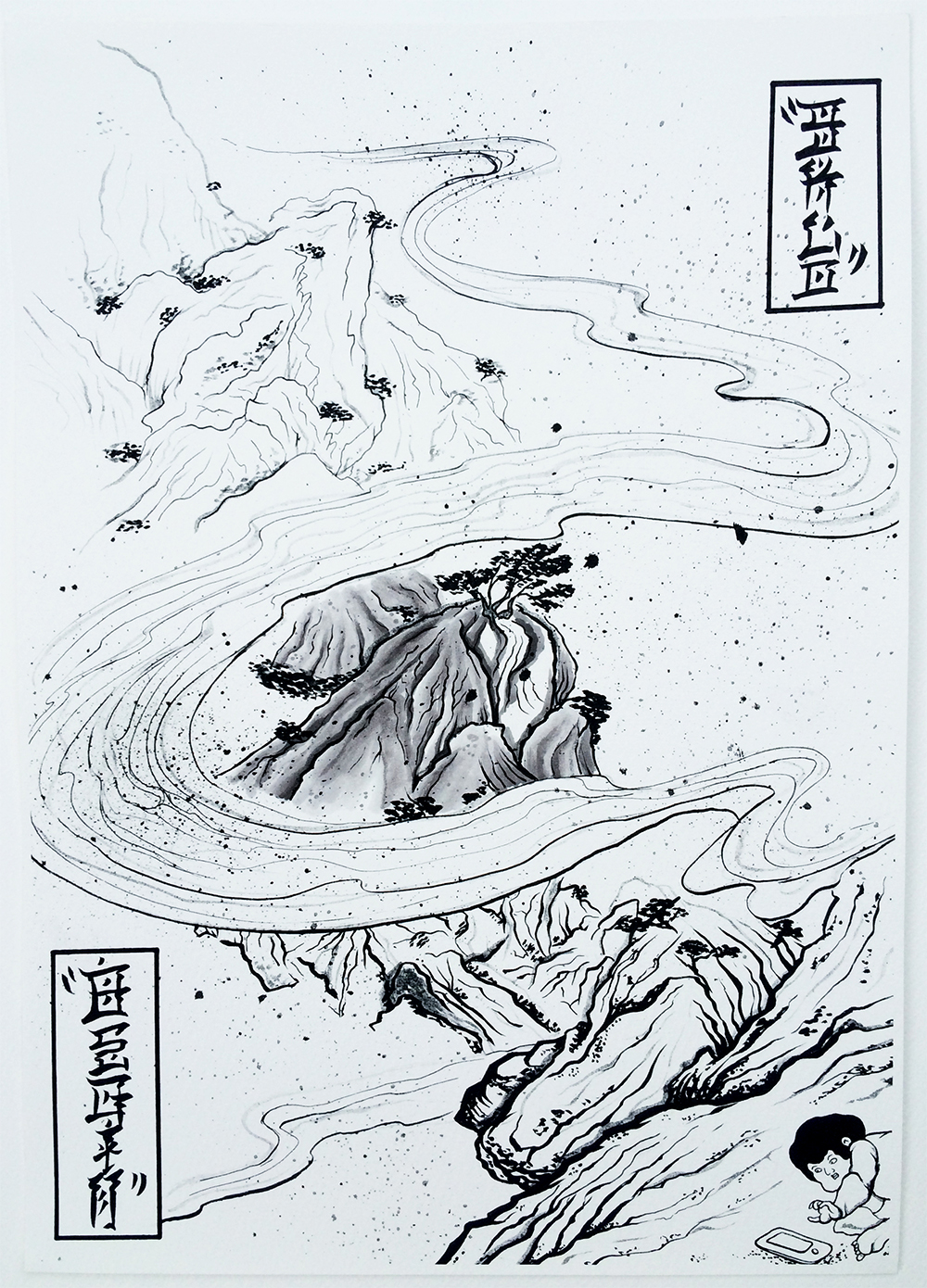
Begin | Tales of the First World | 2014-2015 | ink and watercolour on archival paper

Kintaro the golden boy finds a smart phone.

Posted in ARTWORKS | Tagged

‘I have never understood a single poem’: Chi Tran Interviews Mei-mei Berssenbrugge


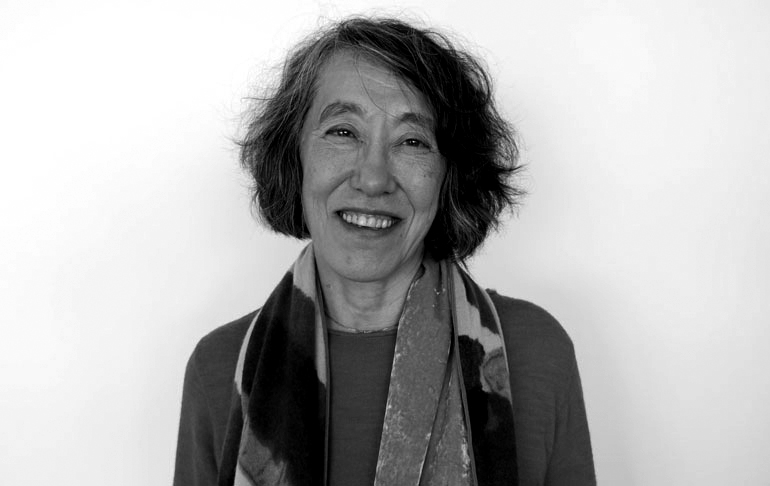
Image courtesy of The Operating System

Mei-mei Berssenbrugge’s poetry may feel to some as very abstract – perhaps to the point where one feels they cannot achieve what is considered to be a thorough or ‘correct’ understanding of the work.

What has come to light from my exchanges with Berssenbrugge is that there is no singular way to understand her work. Perhaps drawing lines around and across differences in understandings poses a bit of a problem (not necessarily one to be solved as such, but to be thought and written through) and only directs us back into a canonical way of thinking, instead of propelling us forward and out.

Berssenbrugge speaks to me about her ongoing relationship with language and understanding(s), and why she chooses to view writing as a service, as a growing source of non-material provisions. How does a thought live on after we think it? And similarly, what happens to a line in a poem once it is written, read, processed?

Speaking to her is an overwhelmingly sensorial experience, despite the fact that we are listening and responding to each other through machines. Her verbal expression is quite similar to that of her poetry; the mundane is made metaphysical, theoretical made personal. Berssenbrugge’s generosity is profound, evident from the time she takes to answer my questions, and her answers are at once secure yet humble, open to being shaken a little bit.

After hanging up on our last video call, I felt many things including a kind of grief.

I also felt incredibly grateful that Mei-mei Berssenbrugge accepted to converse with me. I would like to make explicit that what is being published here is less than a sixth of our full conversations. She afforded me the privilege of being allowed into her material home – as she carried me via laptop into the vast landscapes of New Mexico, across her metres-long writing table, and along her walls of bookshelves – but most generously, she welcomed me into her poetic practice and her branches of thinking, which feel almost greater than the vistas of Albuquerque she showed me from her balcony.

My conversations with Berssenbrugge also created a sense of relief. She explained, in a way that was not explanatory at all but more like an invitation, that poetry and one’s understanding of it is not singular – out of necessity, it cannot be. It occupies a state so multiple that its plurality cannot perhaps even be intellectualised in a way that is fathomable, much like this very sentence is attempting to do. To understand a poem, any poem, is an ongoing process, one where diversion and distraction and delay are perhaps requisite for it to continue moving.

I view Berssenbrugge’s writing as working towards fostering a non-binaristic mode of thinking. Popular couplings such as thought / feeling and poetry / theory exist as spectrums in her mind, and taking into account the work she has made throughout her decades as a writer, she has always been a spectrum thinker, or indeed a spectrum feeler. In her poem ‘Karmic Trace’ from Hello, the Roses (New Directions, 2013), she closes it with the line: ‘I feel joy, but it is relative.’

Chi Tran:

An experience is not one experience.

I go over it again and again, as it assimilates in me.

Repeating becomes more like an associative process.

(excerpt from ‘Winter Whites’, Mei-mei Berssenbrugge)

In preparing for this interview, I asked my friend what makes him gravitate toward the artists that he does, and after citing the wonderful Leslie Scalapino, he said he likes people ‘who don’t really make sense.’ And I related to his response in the way that I find your work at once very challenging but very generous in its attention to time and its attention to change. As a reader of your work, I don’t think I understand it, but my failure to do so does not feel collapsible nor does it feel alienating; in fact, it feels fruitful. As a poet, how do you relate to these ideas of sense-making and understanding?

Mei-mei Berssenbrugge: I think all time is simultaneous, so that remembering is more of a creative process, and so imagination plays a larger role in our perception of reality.

Remembering is progressive; an event that is amorphous can begin to radiate energy or comprehension to you, in your mental solar system or galaxy. So then remembering would be generative.

Each time you remember, it is from a different place and time, from a different point of view or aspect, so there is no repetition. When you remember an event, you are associating to a new event, rather than returning to an “original” event. So associating is creative, a larger range.

I like when memory becomes an iconic story. Like the story of my engagement or when our snake declared herself alpha over our little dog.

I often say that I have never understood a single poem. When I read a poem, I take it in as a whole. In the same way that I do not understand Schubert’s Sonata in D Minor I love so much.

Sense is awareness. Understanding, comprehension, is a ‘grasp’, more fixed.

In this poem [‘Winter Whites’], remembering, associating, helps to construct the diaphanous energetic wholeness of all things. For me, the wholeness of all things is always the sense. (The charge of emotion with respect to association becomes the atmosphere.)

CT: Thank you for your answer to my first question. I am really interested in talking to you about this idea of ‘understanding’.

MB: Yes. Even though I studied poetry in school and I have a graduate degree in poetry, I don’t think I’ve ever understood a single poem in my life. I think there’s an argument to a poem, and then there’s the energetic matrix of a poem. And I think it’s the argument that I don’t necessarily understand in poetry.

CT: What do you mean by an energetic matrix?

MB: I think of a poem as an energetic whole, because the way I reach an expression of energy is through language. I definitely think about the so-called idea or meaning of a poem, but for me, it is more about keeping the energy high. I also want to mention that when I write a poem, I often have no idea of what I’ve said. I make assemblages of notes and put them together, but it’s at the unconscious level that composition occurs, and I think there are more profound gestalts of understanding to be found that way. So I am not somebody who thinks complex thoughts by my will; I find them. A lot of people now say that there are more neurons in the heart than there are in the brain.

Posted in INTERVIEWS | Tagged ,

‘A Fable for Now’: Kate Fagan Interviews Lyn Hejinian


Image courtesy of Graybird Images

In July, 2014, the American poet Lyn Hejinian visited Australia to participate in two events – the ‘Women’s Writing and Environments: 2014 Contemporary Women’s Writing Association Conference’ at the State Library of Melbourne, where she headlined alongside fellow keynotes Alexis Wright, Chris Kraus and Deborah Bird Rose; and ‘Experimental’ at the University of Sydney, where she appeared alongside Carla Harryman and Barrett Watten. She also visited the Poetry and Poetics Project within the Writing and Society Research Centre at Western Sydney University, where she gave a long poetry reading followed by a conversation with poet and musician Kate Fagan. The discussion focused on several of Hejinian’s most recent works including The Book of a Thousand Eyes (Omnidawn, 2012), Saga/Circus (Omnidawn, 2008) and The Grand Piano: An Experiment in Collective Autobiography (Mode A/This Press, 2010).

Listen to the full poetry reading and interview (9 July, 2014) at the WSU Poetry and Poetics Digital Archive.

**

Kate Fagan: I’m so pleased we’ve all had a chance to experience Lyn reading. One of the comments that came back often during morning tea was that people felt they were listening to you for five or ten minutes, when in fact you’d been with us for an hour. Such was the temporal warp generated so beautifully by those incredible readings. I’m now going to say a little more in a formal sense about Lyn.

Lyn Hejinian is a well-published poet with many books to her name. She is the John F Hotchkis Chair of Literature at the University of Berkeley in California. She is an experienced, well-known and respected translator. We have a strong group of translators here today, including Peter Boyle. Lyn is a publisher; she’s published small chapbooks in letterpress editions through the Tuumba Press imprint, but also more recently, a kind of reiteration of that through Atelos Press with Travis Ortiz. Atelos focuses on crossings between the poetic and the philosophical, and ideas of how a poetics can do the work of philosophy and poetry simultaneously. Lyn travelled extensively in Russia at a particular time of her career and forged a fascinating and productive relationship with innovative Russian poetry, from St Petersburg in particular. She was of course foundational to the early clustering of poetic excitement, intensity and crush that was, and is, the Language School of poetry.

I might pick up the conversation around The Book of a Thousand Eyes. This may be a little cheeky, but it’s partly because of a comment you made to me a couple of days ago, that ‘the music keeps getting better’.

Lyn Hejinian: That was a reference to my husband’s playing not mine!

KF: To me this is a book in which the music of your undertaking keeps getting better. And the stakes of the telling also keep getting better. I might talk about form and add a little footnote, and then hand over to Lyn. Some of us here have just attended a series of events [‘Women’s Writing and Environments’ and ‘Experimental’] in which Lyn both has been figuring highly, and very generous; she’s given two keynote conference addresses while here. The first was on the relationship between what Lyn calls the ‘over-signifying’ poetics of the Occupy Movement, very political and vital, and how that crossed with nineteenth century figurations of romance and revolution through the work of Victor Hugo, particularly the character Gavroche. The interpretation of poetical ditty in that paper was fabulous. Then Lyn moved to a discussion of contemporary allegory, something she is talking about in a new work called Wild Captioning. This generated a discussion about notions of the wild – the idea of the feral or the errant, the errant work that points to texts without pointing – and some vital issues about landscape, the pastoral, and also political undertaking. These are really great backgrounds to today’s conversation.

One thing that occurred to me was that poetic form itself has rarely been mentioned across the last week. I’ve heard almost no one say poetic form. What we’ve said is ‘the wild caption’, ‘the allegory’, ‘the challenge’, ‘the crush’. I’m interested here in where form has gone in a bigger discourse about innovation. We’ve heard words like ‘rhapsody’, ‘ekphrasis’, ‘aggregation’, ‘agglutination’. Yesterday someone talked about post-conceptualism, and Lyn you said: ‘I’m so glad we’re post that already … that form has moved on!’ So I guess I’m interested in the schooling or the discipline of what works into a kind of formal likeness, and in the way you radically resist that. Historically, politically, there’s an always-already to form now that is very exciting. So, that’s an entry to the next hour.

LH: I think that part of, or the beginning of, a response is the quite obvious one that will be familiar to most if not all of you, which is the way that in English language the term ‘form’ suggests something static that’s like the glass and then you fill it. The glass is the form and the water is the poetry, and you plop it into the glass and then you’ve got your poem. That’s the way that English language is – so noun based, and imagining the world as having a kind of fixity of givens of things in it. What’s much more productive I think is to imagine the term ‘form’ as synonymous with force. That a form is a kind of engine. And a number of people associated with Language Writing (as with the conceptualist, post-conceptualist, and of course many other schools and non-schools, anti-schools) think about what the work is going to look like, how you’re going to organise it.

Because the options are virtually limitless. And if you’ve got an impulse to get going – whether you know what you’re going to go about or not – it can be very useful to think of kinds of constraints, rules of writing that can tell you how to shape it. Those have been incredibly productive. The trick when launching into a new work is to think of a shape that in some way is going to further the project that you’re embarking on, rather than curtail it or ossify it, or misdirect it.

During the two conferences, the papers that I heard (and I heard a lot of them, all of them at Sydney and a quarter or more of them at Melbourne, because there were four sessions at a time and I couldn’t be at more than one at a time, not because I bailed for 75% of the time) were about theory, like philosophical, social, cultural forces that are in play at this moment. And I think that’s entirely justified – even though most of the people at the conferences were makers, creative writers, or were interested as readers in what is being made, like ‘how does this car work?’. Nonetheless, one of the themes that’s been recurrent and urgent is the fact that so many of us feel that we’re living in a time of terrific political, cultural, economic and environmental crisis. We’re in an emergency. So to talk about ‘how many stresses before you make a line break’ seems, at the moment, to be peripheral to the major conversation that needs to be engaged in. If we had a year, all in this room, occupying the building, then we could talk about all of these issues. And then we could also talk about how many stresses or beats in a line before the line break. Or we could argue about it. I think that’s one reason that form just didn’t come up. I could be completely wrong; but I think it wasn’t the thing of the moment.

The second thing that occurred to me as you were asking that question is what I have experienced as two impulses, now that I’m a ‘truly proper professor’ in a ‘truly proper academic situation’. And I really love it, and I love the kinds of scholarly critical work that my colleagues and students do. There’s a real draw to interpretation. I believe all creative writing is interpretive in some way. It makes inquiry, it’s investigative, it maps, it wonders, etcetera. But the academic is apt to want to categorise. Some of that can be interesting, but I think it’s terrifically dangerous. One of the things I keep thinking about is how to be an interpretative thinker who isn’t a terminal thinker, who doesn’t say: ‘we’re going to slot these four writers into the post-conceptualist school and these into the anti-lyric tradition and this little cluster over here is the epic narrators’. That’s just bogus. But you do see dissertations like that. So I think that’s a kind of canon formation or school formation that rhymes with poetic form, but I think does a similar disservice, toward a kind of ossifying. I don’t love categorising, but I do like the kinds of scholarly thinking going into archives, the kind of work that Ella [O’Keefe] does.

Posted in INTERVIEWS | Tagged , , , , ,

‘through worlds & worlds & worlds’: Joan Fleming interviews Jordie Albiston


Image courtesy of Nicholas Walton-Healey

Dr. Jordie Albiston is one of Australia’s premiere contemporary poets. She is the recipient of numerous literary prizes, and the author of nine collections of poetry, three of which are documentary in nature.

I first met Albiston in a taxicab in Wellington in November of 2014. When she learned that ‘Fleming’s pool’ near her home in Altona is named after my direct ancestors, she said, ‘All right, no more conversation now. I need to think about that.’ Jordie is a solitary and self-contained poet. She has vowed to give no more public readings, so her reading at the launch of Euclid’s Dog was a luminous and generous surprise.

Euclid’s Dog is a book driven by formal concerns. It is inspired by the elegance and logic of pure maths. Its patterns are musical, highly considered, both light and heavy, and subtly autobiographical. This interview digs into the love affair between mathematics and poetry, the questions one might ask Emily Dickinson, how to be a bad mother to one’s own poems, and the deep joys of bell ringing. Albiston has refused to answer some questions, as is her right.

Joan Fleming: You’ve said you’d like poetry and mathematics to be a larger part of the Australian conversation – why?

Jordie Albiston: The poetry/mathematics relationship has always been, and will always be: articulated, or not. Mathematics is intrinsically connected to poetry. Whether it is the five units of the tanka, the six repetends of the sestina, the fourteen lines of the sonnet, or the less visible computations of a free form poem, all poetic structure possesses a mathematical basis to a larger or lesser degree. I don’t think anyone would disagree with that. However, this relationship – as a living, contended colloquy – seems to enjoy greater transparency and rigour in places like France, Denmark, Canada, America and New Zealand than here at home in Australia. I would love to see mathematics play a more interrogative role in the Australian poetry conversation because of its potential for producing unexpected and beautiful results.

JF: What are the intersections and agitations between these worlds that compel you?

JA: I enjoy writing within restrictive form – syllabic, metered, rhymed, or structured according to verse, music or number theory – and this approach seems to work well with the kind of feeling that arrives before the sun, which is when I tend to write. Not all my poems survive the constraints I apply, but I am a firm believer that for every rule imposed, there exists a window of opportunity; and it is this awkward place – between content and form, liberty and law – that absorbs me. My belief in the rudiments that make go a poem’s inward and outward design, and the effect of such rudiments on the generation of a poem is key. I am preoccupied by unity, counterpoint and conflict, and the extent to which I can bend language without breaking it. For me, this has always been the centre of origin for a poem.

Over the last few years I have become interested in the application of solid mathematical formulae to poetic language, and the shiver or thrill that may be released at the interface between these two codes. I particularly like working with Euclidean concepts, for their innate clarity, soundness and harmonious proportions: ideal for corralling chaotic content! Algorithmic structures are perfect for poetry. There is nothing too complicated here: it is simply a matter of relationships and shapes. The forms I have been working on often surprise me with their foreignness and their acquaintance, and consistently provide me with a fresh set of perspectives. I feel mathematics – as pure science, as the language of nature – offers a goldmine of architectural possibility that is productive and filled with joy. I might also add that sometimes a poem cannot bear too much outward pressure, and it folds up and dies before my eyes …

JF: Euclid’s dog is driven by formal experimentation. The eight forms you have invented for the book are described as ‘stable, just, and have as their unifying principle order.’ I’m a person who has no head whatsoever for mathematics, but I’m intrigued by this language – what is meant by ‘just’? Can mathematics be moral?

JA: The concept of morality is alien to mathematics. You cannot pretend or deceive or bribe your path to a correct mathematical solution: there is only right or wrong: true or false. However, the notion of justness may perhaps be applied more elastically to poetry. At the apex of ‘false’ is plagiarism: at the base, form without purpose. I have always seen a poem as a problem that needs to be solved, and I love how the word ‘problem’ houses the word ‘poem’ within itself. For poetry – as opposed to mathematics – there may be numerous possible final solutions. As a formalist, I like a sense of resolution in terms of matter and frame. I suppose that equates to form with function. If a poem is divided into tercets or whatever for nothing more than visual pleasure, I feel it has failed. Many of my poems fail in this way. But if the form creates a sense of kinetic energy that is naturally (or disruptively, even violently) figured with its content, that, I feel, is a ‘just’ poem.  

JF: Yes, I see this frisson in the book: between the rightness of mathematics, and the ambiguity of language. Or, between the possible and the impossible. This is a tension I’m also driven by. Your opening poem is a fine case in point, as it proceeds like a logic proposition: it opens with ‘if’ and with ‘possibility,’ and all the steps are laid out with care, and then at the last, the reader is jolted back to the impossible.

JA: Interesting that you point out the first poem, as it is taken directly from Euclid’s Elements. All I have really done is redact the original according to the hexahedral form (put simply: the first line of each quatrain somehow mirroring the last line of the preceding quatrain; and the whole composed in decasyllables). This poem is one of six found (or partly found) poems in Euclid’s dog. It and the final piece – a square pyramid poem – are the purest of these found poems, taken from Proposition 7, Book 1 and Proposition 35, Book 7 respectively. And so they are actual propositions! I wanted the collection to be bookended in a manner that openly paid tribute to Euclid.

JF: Do you find the work of being a writer and producing books a sort of bathetic experience? What I mean is – I know some writers always burn a copy of every new book, to pay homage to the book in their imagination, the book they wanted to write, but couldn’t – it’s sort of a recognition of the breach between what they wished they could write, and what they did write. Do you grieve the fall from perfectly boundless formal and poetic possibility, to actual poems?

JA: Not at all. If there is a fall, it is an upward fall. That is my perception. I love the physical sensation of the exact moment a poem becomes, that feeling like the c-l-i-c-k of a Porsche door … Having said that, I lose interest quite quickly once a poem has completed itself, and move on to something else. The only poem I truly believe in is the poem I am working on now, and that poem I would defend to the end. Then, of course, once it is solved, I pretty much abandon it to its fate. I am a bad mother that way.

JF: Did Euclid have a dog? 

JA: I don’t know if Euclid had a dog. Euclid – as man, as supposed author of Elements – inhabits an historical twilight zone, similar to Jeremiah and The Book of Lamentations. Was there only one author, or a conglomerate? If one author, do we have his correct name? Only two facts are known about Euclid: that he lived after Plato and before Archimedes; and that he worked in Alexandria at some point. Euclid’s Elements is one of a number of Classical Greek treatises by the same title (for example, Elements by Hippocrates). Euclid was known as ‘The Geometer’ in ancient times, and there was a school dedicated to his achievements, not only in mathematics and geometry, but astronomy, optics, and music. But did he have a dog? Who knows. In my book, the term ‘dog’ is used in two ways. The first is (sort of) literal: my dog Jack, who was a quite odd dog with a particularly exact take on life (see pp. 74-77). The second is more metaphorical: me, as poet, doggedly chasing Euclid’s theorems for usable crumbs of truth …

Posted in INTERVIEWS | Tagged , , ,

Innocent Eyes!: Ekphrasis and the Defiant Multiplicity of the Female Gaze


Keira Hudson | Angela Serrano Innocent Eyes! 1 | with Judy Hudson & Kyl Jones


The male gaze has been discussed at length. The female gaze, not as much. This ekphrastic project is about the latter. It is about the female gaze of the photographer who created the images that inspired these acts of ekphrasis;the reflexive gaze of the model, a young woman of colour who also writes, who conceptualised the project; as well as the gaze of the poets responding to the images – poets who are also young, Indigenous, and migrant Australian women of colour. This is a collaboration featuring the work of emerging creatives whose voices are underrepresented, underrated, and still largely unsupported in mainstream Australian art in general, and in contemporary Australian poetry in particular.

If the male gaze in lens-based media regards the woman as nothing more than a masturbatory aid, or a plot device that advances the story of a richly developed and complex male protagonist, what does the female gaze do differently?

‘The imagery of women has to catch up with the imagery of men,’ photographer Annie Leibovitz says (Sheets). Her late partner Susan Sontag writes of her book of portraiture of women that it ‘defies the tradition of photographing women for their beauty rather than their character’ (ibid.). The New Yorker’s Lizzie Widicombe describes the portraits of Tate Modern-exhibited twenty-four-year-old Canadian photographer and model Petra Collins as ‘moody inward moments that emphasise their interiority and hint at a larger narrative’ (Widdicombe). Former Rolling Stone art director and fashion photographer Bea Feitler has produced images of women in poses inspired by architecture, where they are portrayed as energetic and expressive rather than placating and passive (Gavin). In all these notable examples of the female gaze, the female subjects are portrayed as having inner worlds, universes even, a sense of coming from somewhere, a sense of heading for something. They are not still-life objects like a flower or fruit arrangement. They are photographed in the midst of onward movement. There is more to them than the documented moment.

Alison Whittaker: three poem suite
Ellen van Neerven: workshop
Saaro Umar: ode:     to blue

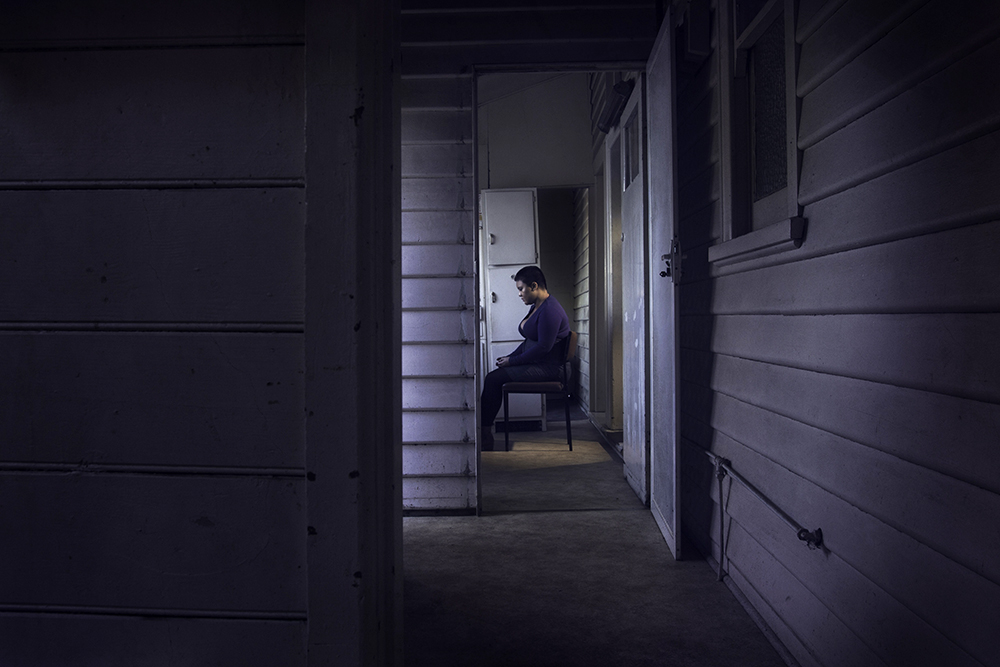
The first image, above, is of the dimly lit bowed, baldish figure in the hallway of an old home, the only curved shape in a space comprising angles upon angles, an endless accordion of squares.

Posted in CHAPBOOKS | Tagged , , , ,

from Numbers


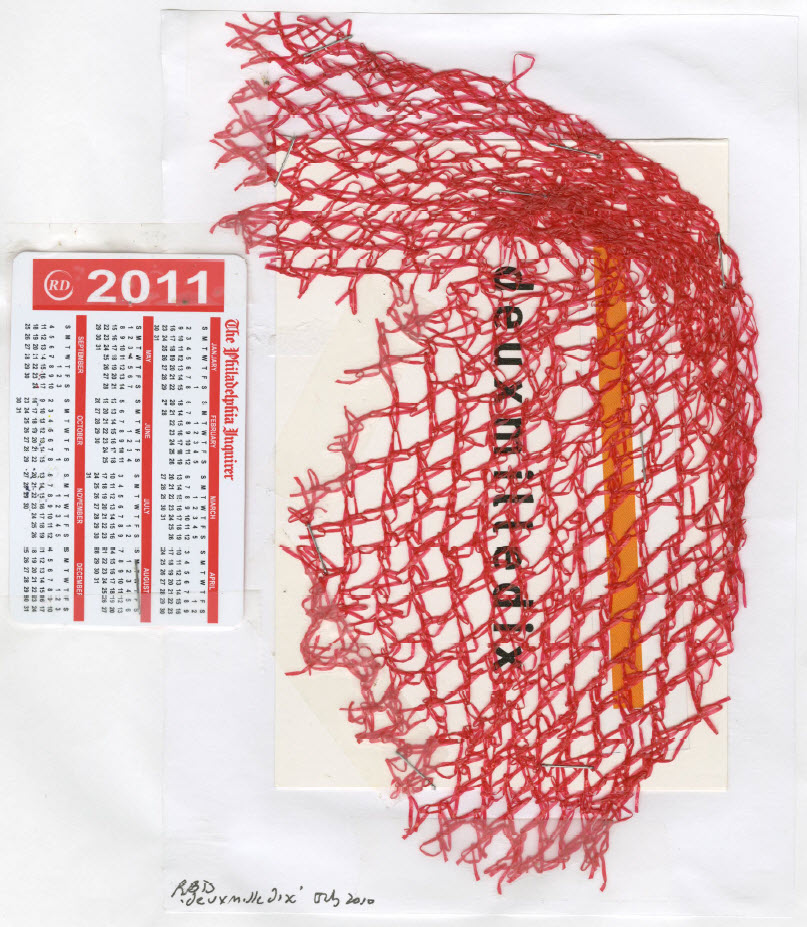
Numbers is one of several of my new books and chapbooks that are collage-poems or collage with matching poems.

Numbers features poems and facing page collages in color. There are forty-five poems and matching collages. This new work, with collages composed between 2010 and 2015, concerns the numbers one through five with π in its appropriate place between three and four. Like a good deal of my work, it concerns cosmological mystery – both π and numbers have plenty of that – along with meditations on the nature of our lives. In part, these meditations try to fill numbers with the same interesting ambiguities as words. That’s at least one theme. Another is imperfection – π, as you know, is an irrational number and no one has yet found it to repeat, though people have tried out to more than a trillion places. Yet the circle – whose circumference is calculated using a ratio of π – is a ‘perfect’ geometric figure. These poems go into that gap between the perfect / complete and the imperfect / continuing and try to investigate. These are not the poems of a mathematician, just a person. The poems are gnomic, playful, direct, meta-numerical and meditative in about equal measure. The collages are – how to describe such work? – abstract with a strong sense of color. They link directly to each of the poems without being illustrative.

Rachel Blau DuPlessis: Deux mille dix
Rachel Blau DuPlessis: Fifth Room
Rachel Blau DuPlessis: Four Quatrains
Rachel Blau DuPlessis: Zero and π
Rachel Blau DuPlessis: Zero Full

This work, as a whole, will be published in book form by Materialist Press, edited by Julia Warner and Ariel Reznikoff, in 2018.

The Collage Poems of Drafts published two of the separate cantos in my long poem Drafts, works which were conceived as collage – ‘Draft 94: Mail Art’ and ‘Draft CX: Primer.’ Graphic Novella is a visual-text book of loosely political meditations in prose poems and poems matched with black and white collage.

‘Churning the Ocean of Milk,’ collage-poem chapbook from 2014, was done as a cosmological meditation after a visit to Cambodia with its chilling recent history of crimes against humanity – specifically, governmental genocide against its own people. It was published on line at Alligatorzine.

A 2017 collage-poem book called Life in Handkerchiefs has appeared in on-line groups in periodicals such as Journal of Poetics Research and Alligatorzine. Other collage poem series are Storyboard, Old News and 13 R AY S. My most recent book of poems, Days and Works also features unaltered newspaper clippings as part of its text.

Posted in CHAPBOOKS | Tagged

Queer Modes: New Australian Poetry


Tina FiveAsh | Queer Love | 6 x C-type photograph | 1997

I acknowledge that the land I live and work on is the land of the Kaurna people. Land where sovereignty has never been ceded. I pay my respects to elders past, present, and future.


Ellen van Neerven: in this community
Annabell Evitts: Spoken
Rosslyn Prosser: How to Make Whips
Adolfo Aranjuez: Motion
Molly Lukin: House
Ainslie Templeton: sun square on stomach
Cee Devlin: TIDE
Virginia Barratt: mMouth hHouse pPanic cCathedral
Quinn Eades: Binding
Romy Durrant: Sometimes we meet in hotels

Plenary: an introduction

I did not want to build a falling-down house of rhetoric
Or even one that could stand all the huffing and puffing

I did need something gentle
So many gentle things
To stick together the words of others
               To find some gentle
Rhythm to walkwork through words 
I seek I sought I see. 

I do not want your letter back in my alphabet.
Small as it is,
There’s no room.

Reading—
Trip along the whip crack of associations
Reaching for open space 
Wound up, collected, in a no place no place
—would my skin make leather words? 
Working over, rubbing, and smoothing out lines
that are laughter, 
lines—history of touch, 
               sun-split               sun-kissed 
wearing the shore in corners of eyes,
It might be beautiful to grow old.
If I 
                              (ifs ands or buts) 
multiply the sweetness of experience
if we are alone and
bordered by suspicion     longing
beaches open and close
when there is no home to go to
just a line of sunset 
gambling luck and lycra
bad luck               deep curve 
lock and key 
the lack lack in
this place 
multiplied by grief 
               and the red dirt rift of memory on the body               on skin               on land 
               the road taken 
               slow motion bark 
               all red and blue and sand
Not here
It never happened (and then it always did). 

Every map I can’t read,
Unknowing names and places.
Skin unfolds in a dream, 
On a sun               square stomach.

Garden plump ripe with ache and promise
I read the wall again. 

And if I could borrow your panic
For a minute
To gestate this archaeology 
Of scribbles and correspondence 
I would unravel my intestines too 
And shake out that Freudian creed 
Knowing my debt
To words
To language
Falling out of every house
Trapped in the archipelago of light
And the pace of breath
In the travelogue of breath 
In lieu of an introduction 
Like Stendhal’s prefaces to Love
I want to trust you with the offering 
And break the cathedral prayer by prayer. 

All the while 
I go on reading
And drive my love in
Pressing my cheek to the tide 
Falling from grace I’ve never known.


In 2015, at the Experimentalies symposium convened by myself and Rosslyn Prosser at The University of Adelaide, Professor Marion May Campbell presented the plenary address. She performed a poem made of the titles of and observations about the papers given over the three-day event. I have taken inspiration from this in introducing this collection of work. ‘Plenary: an introduction’ souvenirs the works generously contributed here, and I would like to thank the writers for their insights and for being open to this process of collection and publication.

Posted in CHAPBOOKS | Tagged , , , , , , , , , , ,

How to Make Whips

Take skin
fold, rub and hold it.
Plaiting across and down
the spine, the legs.
Left to right.
Tighten the plait occasionally, if needed.
Bring all out into an open space, trees,
sound of a creek,
dawn birds.

Pull skin tight again
and oiling with dubbin or equivalent
lengthen the plait by introducing new elements
teeth scored along the surface
hair wrapped around fingers.
Stretch the plait until a circular arrangement of skin/leather
strands take shape.
Your whip is formed around the idea of a body.

In out/back places make long wide stories accumulate breath and reason
tyre tracks, tea breaks, heat, heat.
Into your whip build silence
fingers on clavicular space, open eyes to whip.

Hang whip where it will appear as natural.
Touch keeps your whip supple
passing sweat from your hands onto the surface
keep ready the possibility of whip return as you flick and crack beaten path of whip.
Between and lying beside us, hanging down to remind.
Whip is whip.
Your whip should soon be ready, your plait tight yet flexible.
The tone of it better with age and use.
Take care of your whip, use it sparingly.
Allow the aesthetics of whip to play out, cut on cut.
The immediate character of your whip may be seen and with use: change and bend.

Posted in QUEERING MODES | Tagged

mMouth hHouse pPanic cCathedral

in the panic cathedral
of the divine ratio in laon
where uncanny angels
sing mall music for the devout

i leave my body behind

the
umbra
of me
—a
dark
ghost
rising—
ascending
in perfect
spirals of
slowfast
intensities
into her
ribbed
arches

outside the cows peer over the parapets
the patient cows
carrying the weight of church and state
in the service of

man god man

interior: day. there is enough room here
—buttressed, soaring, arced and naved—
to leave myself behind
this is an architecture abject enough to hold
the porous poetry of affects
i vomit out of the million million holes that i call a body

for the nth time today i die with a mouthful of incoherence and

while waiting for beckett

the dirt from your cobbledstreeted shoes
and if writing be speaking
and listening and reading, then
today i die without a whisper under the pen’s beak
without a stutter, an utter, a mutter
escaping from the vaulted architecture of the throat

you know i am indebted to language but feel sick with it

st therese, creamy, in her mercy asks me:
how long can you keep this lead on your tongue?
how many stones in your mouth?
how much the taste of iron, tongue clamped by molar and canine?
how tolerable

the
shape
of a triangle
ringing at 12700 Hz
impossible

i grapple with my unbodied jaw to release ictic plosives
they skitter across the floor
they fall all the way down the stairs
they leap out of chairs in fright
they rattle like 2 pastel pills in a cup
they crawl under the blankets
they are loosed like frightened birds upon the air

they repeat, uselessly, more than once but never enough:

there’s nothing to be done

but
all those contortions without which … no speech possible

i will fail trying

Posted in QUEERING MODES | Tagged

Spoken

we tried to write
bodies
but they only
smoked out
into dry curses,

no
wetness,
blood or
meat
like this.

i nurse sorrow
behind my teeth,
until it
turns
hot –

we could be
forgotten, imagine –

no trace or
scent of sex,
i chew on
blue
relics

(when
what i
want
is you,
slowly –

when
what i
want
is to be drawn
down low).

here:
we wash ourselves

in midnight gardens,
this green
dark,
knees in the
dirt

you were
touching me
a fat dogged
love
on my tongue

in a place
where
you might have
trapped a star
in your mouth

but you had lost
the taste for reaching out

so
we stayed red
and close together
licking pink salt off of
fingers

soft mirrors that fall from
thighs

this would be enough
to cut me loose.

Posted in QUEERING MODES | Tagged

House

The clothes are unwell 
Note the hinges that close the door 
Knock a wall to its knees 
Move the furniture about 
Stretch the words 
Learn comfort in failure 
Or sign a new lease 
New and cruel windows 
Just one body per life 
A pot of boiled water 
Tipped over linoleum floors 
The older it gets 
The further from woman 
Home is 
Gender too weak 
A word to hold 
The hope we have in it 
Folding under the weight
Of expectation 
I scold it like a child

Posted in QUEERING MODES | Tagged

in this community

Boonwurrung country June 2017

mutual suspicion
in this community

whitefella owned homes gated & locked
blackfella hired house magpie-guarded

sugared study afternoons
walks on dusk

scaling fences & stretching thick-grassed vacant lots
trespassing to find the ocean

waves eating activewear
sand lining lycra

our beaches are open
they are not places where bloodied mattresses burn

not in Aus, mate
bad things don’t happen here

through roads & gates
slip teatree shapes

on the way home a need to ask
if we feel free

Posted in QUEERING MODES | Tagged

Garden Musings

1. 
his racism compels an energy that grows me 
a garden his Team Australia digs 
my shovel deeper his Northern Territory 
Intervention layers my compost-pile higher his 
Operation Sovereign Borders pulls my 
noxious-weeds faster his Forced Closure of 
Remote Aboriginal Communities renders my 
pruning-saw blunt and his Climate- 
Change Denial distils my rage to 
sweat drip soak feed every seed sown 
for transformation.

2. 
my daughter makes potions from this 
garden she slices lemons with oyster-shells soaks 
violets herbs and curry leaves with eucalyptus- 
blossom a cultural-fusion concentration brews 
her tea-pot and a big sky-full of love and 
glitter swills her offerings I recite queer 
and decolonisation-poetry to my children in this 
garden resistance-poets agitate the soil their 
words germinate uprisings on the freesia-scent 
of spring every new bud tells a survival story we 
raise our potion-filled tea-cups to the sun to 
thank them.

3. 
Dear Prime Minister your leadership ignites 
alchemy in this garden making rich 
soil brewing potions and shaping little 
activists who harvest sweet-offerings to counter 
the bitter after-taste of you remember 
this we are your deepest roots your 
legacy we won’t cultivate fear and 
bigotry we will blister our hands sow seeds of 
hope and tear down your white-picket-fence 
borders we will light our fires to sit around share 
food sing to our Old Ones we will 
pollinate humanity with rainbows on every 
horizon under a float of red-black- 
yellow this our every garden. 


Originally published Wasafiri, International Contemporary Writing, Vol. 31, No. 2, June 2016, p. 26.

Posted in QUEERING MODES | Tagged

Motion

I still think of how this road was made
for us. The sun is different here. Wear
our love like a talisman, ward off

the lines I wrote to demarcate you
from me. They aren’t incarnations
to summon you. I don’t think

this means I really want you
back. In my life, I’m happiest
when I’m moving. Away

from shards of geography, this us
is genealogy leaving imprints
in the shade. If you can’t then I can’t

help you. I’ve been writing poems
about you. I’ve passed moments
around you. What they don’t tell you

is you don’t win. In films
you sit in the rain and sound
cuts out and ring turns to

whistle, and blood cells grid-
lock in your temples. Then
to swelled symphony you press

two legs against cement and march
up to his door. Say I’m sorry and
I love you, except you don’t

’cos your psych says
You have impulse issues.
Don’t turn him away with another

display of manipulation so just
dream in the driver’s seat while wet
through half-open window
seeps through the lens.

Posted in QUEERING MODES | Tagged

TIDE

Who named you
White hot strike?
Decided this here:
Touch each of my hairlines
Who spoke of clean cut or dash or steel-toed?
As though you don’t crawl beneath the carpet
Rotten space you’ll smell for the rest of days

The other night I held another’s head
In ecstasy, shook you loose
Cradled between sinking bones I felt the return slow
I said: It feels like you’re sucking my cock
I meant: we’re not alone

See there – that sting in the curl of one nostril?
You’re nothing without this
Each time you lope through skin I hear your double negatives
Something sickly slides against the busted lock

This is what is pulled loose
Scraped half-circles low and dark and unseen
Even when I wear your cum to bed as a shield

I want this aching constellation you left/to make it count for us
Instead I have it all
(So much less)
Though I know
We could make it out alive

Posted in QUEERING MODES | Tagged

Binding

Today it is raining and I am glad for this falling down house that still keeps the wet out. I write in pyjamas. I write with a mosquito bite on the arch of my left foot. I write with a throat that gets sorer as the sun fights its way through water to get to the drops on the window so that it can refract in at me, at this page, at these words. I write with a restless fly climbing over the knuckles of my right hand; it will not stay still it wants to tickle walk across my skin it wants it wants it wants. I write with you. I write with your voice inside my head, the rasping depth of you, the way your words stay long after you have stopped speaking.

Today it is raining and we live nine-hundred kilometres apart and you wake each morning with an anxious chest that you will bind and cover with a black t-shirt so you can move into the day being held. I imagine that I am your binder, that double layer of nylon and lycra that flattens your chest, that wraps around you, that is where you are, holding you when you cannot hold yourself. Today it is raining and I am sky water in your hair, on your cheeks, down your back. I am kiss on your lips, tongue in your mouth, hands on the small of your back, smile in your eyes. Today I am green grey the weight of love today I am sending myself to you wrapping around around around, binding you, walking you through the minutes where you do not know what comes next. Today I hold you.

Posted in QUEERING MODES | Tagged

Sometimes we meet in hotels

I

Which brings us to the strap-on—

thrusting manufactured

without the shame of connected tissue—

and, accordingly,
my gaze which he has named demonic.


II

From the Greek daimonikos.

Opened for gloating spear
twelve floors in sleepless indigo.

Above sin, divorced from Maat.


III

I have had but kept none.

The woman I loved escaped and

my only hold is to his cheek
while I drive my love in.

Posted in QUEERING MODES | Tagged