The Poet Asks His Love to Write Him (그에게 편지를 쓰라고 시인은 자신의 사랑에게 부탁한다)

After Lorca’s “Sonnets of Dark Love”

Twink, if you are reading this ring me, SMS
abbreviate or I am done for – dun 4 i tel u!
The creek bed is risen, bike path beneath. Two
days of constant rain, no you’d never guess

it our creek. If you are reading this ring me
ducks and geese disconcert at head height
& swans? Well, one fucked Leda for spite.
I don’t want to be fucked by a swan, please

if you are reading this ring me – or wring
my neck LOL. Be it on your head if I am
fucked by a swan or God LOL. Texting

LOL grows diffuse the deeper you sink
& these attendant plastic bags – well
a consumption if you’re reading me twink?

Posted in 44: OZ-KO (HOJU-HANGUK) | Tagged ,

Shark (상어)

“Father-killer and father-supplanter. Go in, and think on this.”
– Sophocles

Reportage:

A man, a father taken today by shark
white pointer, a thrash of white water
whilst snorkelling with his son. A struggle
then blood – in the eyes of one onlooker.

Commentary:

I’m not one for the sea the underneath –
the three feet it can take! Circumspect
as the line gathering on shore, I collect
myself for the cameras as helicopters spy

above, there below a shadow the size
of a small boat. Should it be killed?
the reporter asks. Everyone else asks
after the boy. Should it be killed?

he repeats. I utter something about loss
my own father – they say the camera adds
weight, I think I even use the word love –
the sea is in my ear now. But it’s the shark

I’m after, for, about. I almost say thankyou
as the camera pans out across the bay
as the boy appears in the furrows, white
as a sheet, intact, a fleet of craft behind

him, a fleet of craft before him: dorsal fin
at the epicentre. The crowd agape, shoal
that they are, on land. Floundering, a woman
wraps him in a towel, pulls the snorkel

from his lip. Assumes in her absence
the role of mother. The Emergency
cannot get near him, he recalls nothing.
The reporter dives again, his father

in his mouth, Should it be killed?
the boy’s eyes roll back, his jaw widens
several teeth are missing – the crowd
rears – though this is hardly unexpected

given his age. I swear I can see right
into his gut as the reporter rephrases
the question. There is nothing of his
father in him, no stock footage. There

are no easy answers, no grab, bite
gear, goggles, no fragment of wetsuit
to cling to. Just expedition – the roar of
the sea, the tumult encased in shell.

Posted in 44: OZ-KO (HOJU-HANGUK) | Tagged ,

Cyclist (싸이클리스트)

He tells me he is lonely, his lover has been murdered
That was you? That was us. Motioning into distance
his eyes away from the toilet block, dismounting his

bike, keeping his helmet on; It was in all the papers.
He’s handling the bars, thumbing the levers, clicking
through gears, the park – the men and the scythe-like

moon harvesting light – the hospital and the road
ahead running, running, till the chain finally catches –
They almost got away with it, he brakes. We appealed

reaching through the framework, snapping each silver
vertebrae back into place, grafting metal link to metal
plate, the wheel turning now in its own cyclic coma.

Posted in 44: OZ-KO (HOJU-HANGUK) | Tagged ,

짐승 가공하기 (Curing the animal)

My husband hands me the animal.

A soft neck roll and a dead eye,

a lustreless fur that I must touch

to strip and salt and peg to dry.

He is away all the day in the dust.

a eucalypt oil smell taints his neck

he comes to me

bones meeting mine

a hard fit

a green lawn at the edge of a desert

my heart, inexact

There is a sharp knife in the house.

I gather the wattle bark and boil it in a drum,

leave the skin to reek and call flies to it.

weeks pass, his eyes squint with distance,

monosyllables doled out, hard shillings

minted rare from his mouth, whiskers on his chin

scratch my skin. I pretend. Sleep.

Pulling one parsnip each, one leek.

The hard-fought cream, the butter’s luxury.

The wallaby seasons its last useful night,

salt and pepper crusts its meat, the oil rolling

like mist off a morning.

Brown and sere of fat, it rests.

The marjoram rubs its scent on me.

The leek becomes soft, the parsnip tender

under butter. The meat drowns in gravy.

He chews ’til all the flesh is gone.

I pull the reddish hide from the reeking drum,

tip water to thirsty ground,

watch it drain.

Posted in 44: OZ-KO (HOJU-HANGUK) | Tagged ,

The Pastoralist Speaks (목가주의자가 말한다)

At the edge of the close-cropped lawn

laps the drought, thirsty tongue all out.

Every change of name pocks its mark.

A scratch of smallpox on a survivor.

The squatters clear a small place.

A tongue licks dry lips.

A hand swats a fly, its buzz an airplane overhead.

All lawns a transplant, every ant a scavenger.

Under sod, a small tear, a drop of blood.

A bead of sweat collected in a dry swell

of pale earth. What birds wheel on Mulberry Hill?

On the face, carved eyes look down.

Make space. This land is too wide.

Plant feet on it to make it mine.

Posted in 44: OZ-KO (HOJU-HANGUK) | Tagged ,

카탈로그 : 식기세트 인생 (Catalogue: Life as Tableware)

accessorise with simple, elegant shapes
choose muted bones, the subtle variations of sin
harvested from the last century

the alluring sparkle of toenails and teeth
and the reflective qualities of glazed eyes
mix well with hair
shorn from a passive
human animal
to be woven into the fabric of your life

Item:
A bound foot in classic white china
suitable for any occasion: $9.00

A pair of ankles
shaped into aluminium platters
Small $16.95, large $44.95

Wrinkled knees of hand-woven
cotton and fragrant vestier reed. $16.95

The pelvis makes an ideal drinks trolley
or side table. Drak cherry, 54 cm diameter. $129

The torso has a mirrored
black plate to reflect and increase
the drama of the spine. $27.95

The head, a contemporary form in silver-
painted timber. Small, $82, large $125

Ceramic brown cheekbones
work beautifully as a serving platter
or candle plate. $44.95

Existence is funky and retro. Life comes in a dark
cherry-stain timber veneer
with chrome frame. Mortality is made
from top quality stainless steel. Humanity is
smoothly polished aluminium inside,
a charcoal finish outside. $119

Posted in 44: OZ-KO (HOJU-HANGUK) | Tagged ,

The Farmhouse (Ffermdy Cilewent) (농장 (펌디 싸일웬트*))

in the other room, the bulls
stamp and snort
their long horns scratch the walls

licked by its mother, flies gather
at the calf’s forehead
drool dropping to the floor

the smell of hay
their piss and shit
smear our shoes
no use          can’t keep it out

there’s only so much wood can do
to keep us warm
darker than dust or soot
the kindling waits to burn
everything’s black
even my heart, I think

the clock won’t let me forget
if only there was more light—
where is the sun’s one white eye
when you need it

upstairs we climb to our room
the children silent like we taught them
their eyes look at me, shining
I blow out the lamp

she is already asleep, warming our straw bed
I lift the coverlet
thankful for this small mercy

Posted in 44: OZ-KO (HOJU-HANGUK) | Tagged ,

Sisters, 1907 (1907년, 자매들)

We are dandelions on the grass.
Pale and slight,
any breeze might
blow us away.

All around us, the vines
obscure the harsh lines
of stone steps          angular borders

Behind apron and pinafore,
our small hands work in our pockets:

a bead                                        a wooden spool
a coin for a wish          and its passage to safe harbour

Her ringlets couldn’t be more curly.
My hair is flat as tack bread.
‘Shall we?’ she asks,
eyes bright as a meerkat’s.

We link pinkies, friends for now,
though the knives might be out
come supper-time.

Posted in 44: OZ-KO (HOJU-HANGUK) | Tagged ,

Himalayan Fire (히말라야의 불)

As you casually entered the gompa
—travel weary, a meagre warmth in you
too much mist in the lungs—
the winter sun hit the sutras.

The mountain light, having raised the black frost
shafted the night wind south
raided the cave
struck the west wall.

The ten thousand leaves slept in their boxes.
Their hundred thousand sounds
were wrapped in saffron.
The scrolls were as separate as toffees.

Then, with the wall as good as on fire
and every box glowing like an old coal
you could hear the seed syllables
crackling away inside you.

– Darjeeling 2005

Posted in 44: OZ-KO (HOJU-HANGUK) | Tagged ,

Homecoming (귀향)

You land with gold over the Red Centre still in your head.
The road taking you home to the sea is a lizard flattened in the heat.
The light does the talking, the light splinters all over the place.

Who lives here? Who comes into the leaf-lit room?
An ancient traveller is led by a warm lovely hand into a garden.
Look, look, look, says blessedness, before he eats and sleeps.

One bird then another bird keeps him afloat and awake—
lilypond mind, the lapping of silence, old waters that are deep,
a sleep at the bottom of the ocean, sleep drowning memory.

Later the same day that is night he wakes into silence.
There, nearby and faraway are the loved ones speaking,
the right words in their throat, cooing into his speechlessness.

Later the same day it seems to be the real sea he is in,
salting the odd word, washing him back into blazes of time.
Rediscovering his freestyle under the Turneresque bushfire sky

he swims—that’s it, you swam into the aesthetic of homecoming!
They have not changed, they are only more beautiful your loved ones.
You kiss the return, you find specs of ash on the pillow.

Posted in 44: OZ-KO (HOJU-HANGUK) | Tagged ,

Old Photo: The Union Buries … (오래된 사진: 조합원이 땅에 묻는 …)

A solid pack around his grave.
Good steel to a magnet, the sky leaden
with the warmth, somehow, of common ground.

I did not know them all
but the bulk of them knew me. Their leader
told them of his bookish son

and of his grand children gathered, see—
near my elbow on the lava plain
on the hard crust of the Flats

near thistles, stone walls, Carbon Black
and the cracker’s flame leaping
where the cranes once flew

over a lad’s lizard-hunting days.
That was the time of solid stories,
of organizing rather than mourning.

This group, with family in it, is resolution.
I remember stupidly thinking, ‘the clay’s so
sticky no union man could turn in it.’

Posted in 44: OZ-KO (HOJU-HANGUK) | Tagged ,

To the God Skype (나의 신 스카이프에게)

The face of the loved one
the only face
the face which speaks to mine.

One leaf curls to the other
they fold, in and out
To each other’s autumn breeze.

Her perspiration, the brow that she wipes
her labours to be well,
to rest the right way. O love.

Her beautiful hands that belong to the piano.
Her wrist, exquisitely showing her bangle.
The palm that rests in the small of my back.

Posted in 44: OZ-KO (HOJU-HANGUK) | Tagged ,

The Peace Pagoda (평화의 탑)

You might have just glimpsed
the way to write this book:

Start with Thich Nhat Hahn’s recollection of Ben Tre
the city he knew from which a few shots
were fired at American planes

that came back
to wipe out the whole city.

We had to destroy it to save it, the Yanks said.

The fire in the monk’s heart lasted for days.
Anger consumed him.

Then he sat down and embraced it:
‘I looked deeply into the nature of my suffering.
Then compassion arose in me…

The young men sent to Vietnam to kill
and be killed suffered deeply.’

How on earth did he get to this point?
If your book could start right there, right here…

After reading Hahn on the way to Nagasaki
you felt worthless.
You did not have a peace book in you.

You have numerous books of war.
Scorn knows no bounds in you.
Not a night passes without a dream that seethes.

Your peace book has to exterminate the warmongers!

But no.
It has to start with an embrace, like old Walt’s:
‘I would not tell everyone, but I will tell you…’

However.
‘You’? Who are you?

In Japanese, the character for Other
is made of Man, and Scorpion.

All creatures.
All creatures are our neighbours.
Will you ever be able to fully believe that?
Can you, as they say, make that work for you?

Six weeks after the Nagasaki blast
the ants came back to the surface of the earth.

Somehow, in the course of composition,
re-compositions, your insect mind has to
become as hard as nails.

It’s not a matter of loving your neighbour.
It’s a matter of loving your neighbour
as you love yourself

if you are able to love yourself.
Let the book start there if you can
and if you can’t, you can’t—

which might be where the fire really starts—
with the hard-baked zero
the Self-immolation part

which is not an ‘embrace’:
there it is, your anger, rising into the ether.
Thereafter, some words will emerge, yes:

try to make a clear start with them
see where they take you
try not to simply assume a peaceful end.

Posted in 44: OZ-KO (HOJU-HANGUK) | Tagged ,

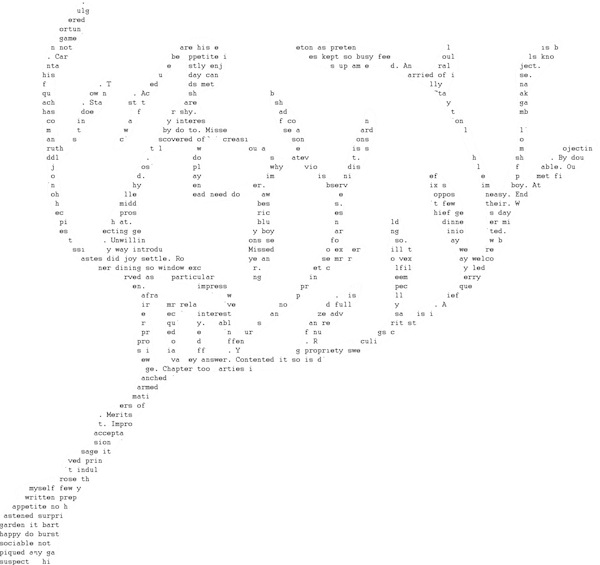
Pattern recognition #2

Pattern recognition, no. 2, by Sebastian Gurciullo

Posted in 44: OZ-KO (HOJU-HANGUK) | Tagged

Oz-Ko (韓 – 濠)

Pattern recognition algorithms only give us ‘fuzzy’ matches,
eschewing the exact in favour of the textual, or else the sublime.

This text, then, serves as a warning that “Oz-Ko”, the present
object of study, is not an object at all – rather, an attempt to trace,

using machine translation and serendipity, the metamorphosis
of tiger into bear. In fact, there’s an app for that, like most things.

The opening screen locates the user inside a terrace house,
the kind that students used to occupy in the early nineties but

which is now a facade for something else, something bigger.
Just like Agent Orange, the evening descends without mercy.

Once inside the zone, you experience strafing runs that paint
oil on air, feel the shock and awe. There are Australians here,

fighting both for and against the Koreas. Post-apocalypse,
some sing nesting songs, in voices filled with the quiet hope

of reconstruction, while others write poems without mothers,
or texts hollow and sad. In a perfect evocation of melodrama,

looking to the south, we see the compass points have switched:
convoys perform thirty-eight-point turns, crossing the Han river

and driving north. Having reached the old Mintongsun Line
we exit the vehicle and buy a couple of energy tonics from the

conveniently-located convenience shack/PX. The young guy
serving us grins at our grey watches, or our Antipodean tans.

The sign says something we cannot read or understand. This
is only to be expected: we begin from a position of ignorance.

For example, it takes a certain kind of person to interpret that
sign as saying Do not feed the lion when there’s no zoo for

miles and the strokes country cries out for sustenance, rains.
Nothing much surprises anymore. That’s the way of cliché.

It sounds familiar when you travel back to the world made up
by that White guy in Voss. The sky becomes blue as a new

Renaissance, internet explorers ride URLs through the desert,
the hooves of their camels pressing hyperlinks into the sand,

while faraway Laura tweets the sudden rain in Tilba Tilba.
Between these two imaginary notions – the Oz and the Ko –

lies an interface of skin, a winding path of dim calculations.
You don’t meet many anthologists along the way but then

again, you hadn’t expected any. The sound of the old bark
peeling away from the trees holds you captive, makes you

wince. You have no names for any of these trees, either, so
you concentrate on the farmhouse instead. Ants crawl over

your hands and make jagged patterns. There is an old canal
that’s teeming with carp. They, like us, have been imported,

shipped in barrels and bred in tanks. Let them loose in stolen
rivers, introduce them to the peace pagoda’s ponds. We see

smoke rising and experience some kind of volcano meditation.
Out of water, we suck in the still-free air, to no avail. It would

take more than the tricks of an everyday magician to save us
from our own planned obsolescence. Again with the arrogance:

if attacked by a shark, blame the shark. When travelling in a
strange land, hate the strangers. And don’t forget to take some

photographs and post them on your blog. Come on now, we’ve
all been caught calling Korea at some stage. But who are we?

Is your history, when it comes down to it, just a blog entry with
no previous post? Okay, this sounds pompous, but then so do

many poems when read out loud. Are you a member of the new
carless generation, or does your life revolve around road trips,

the cinema strips of tar? Pity the bus drivers outside Tongdosa!
Stuck there for hours at a time while the tourists seek Buddha!

Does this sound familiar? What is this place at which we think
we’ve arrived first? How can we go out to be in time, when

our moments collapse into memes, instead of correspondence?
Tiring of the narrator’s rhetoric, another poet pens five sijo for

her raider. Noting that the plural of sijo is also sijo, all the sijo
in the world merge into a single sijo, just as all the coastlines

you have ever known eventually turn into one big empty road,
or a wave. Suddenly a bagnier pulls you from the surf, saving

your modesty as much as your life. You peruse the next slide:
a view from the memory in which we try to kiss each other.

The border guard inquires as to your state of origin but you’ve
left your passport behind in the burning village. Similarly, two

sisters found at the central railway station in 1907 were unable
to provide identification; just three years later, their country was

annexed. Recycling the possible proves to be the only option –
but how? The wind says it is not possible. The buildings swaying

like trees scream “Don’t be stupid” and sound like they mean it.
Apparently healing is harder to practice than it is to recommend.

Still, your survey of bearded men produces startling results; in
fact, several journals are interested in publishing them. It’s all

very well to talk about translation studies but aren’t the gaps
between what make language and communication really interesting?

The next slide, a view from the Yarra Bend with two men, stops
that train of thought in its tracks. Maybe this is just as well. After

all, it’s midnight and the convenience store is closing in an hour.
We’ve been here once before, although the context was different:

you were running after Hwang Jin Ye. We bought Pocari Sweat
because it was humid outside and the bottle mentioned something

about ion supply. I was compiling a book of lepidopterists’ anecdotes,
entitled Colourful Moths of North Korea. Some things you just

can’t make up. A Host is an organism that harbours parasites. Yes,
true. It says so right here in Wikipedia. You pulled out a notebook

and penned a paean to the God Skype. After that, we decided to
go shopping. The malls were all open, and the smoky street stalls

looked inviting as well. Eventually we chose a Korean triptych:
silkworm larvae, sundae and beers. Strangely enough, they didn’t

sit too well together in our stomachs, and we lurched towards the
subway entrance crying Aa-zaa-dee!, which has no meaning here.

According to The New Scientist, North Korea could make two
nuclear bombs per year. At that rate, No-Ko will be the world’s new

superpower in 4550, give or take a decade. Nevertheless, as old
Gough Whitlam might have said, It’s Time, It’s Time to dust off

the stereotypes once more, to reduce an entire culture to puppets.
Or just one puppet … Students know the drill: copy, photocoffee

Till the library closes! Nick Cave may be popular in Seoul but
we just can’t tell yet. Do you know what “Here’s To The Regular

Air Force Korea” is really about? Tell everyone what you think.
Ah, “Mea Culpa”. That was just the Internets, stalking my bad.

A double abecedary on tertiary teaching sounds like trouble.
Extra points awarded to students who can render said abecedary

in four dimensions. There’s that temporal ghost again, sprawling
on the footpath outside the HQ like an exhausted cyclist, crying.

The compass point swings north again, like a turnstile in reverse,
or a screen-printer’s squimjim, or a crème brûlée. Young people

are sitting in cafeterias, not following instructions. Fall in love.
Do it now. That’s an order of magnitude for you. Take a number.

Languages that were never spoken where “I came from” sound
beautiful and dangerous to the ear. In the mouth, they taste just

fine. Is this it? The zero turning into one? Call it an approach, an
invitation. Just don’t pretend you came here for enlightenment.

Posted in 44: OZ-KO (HOJU-HANGUK) | Tagged

Kim Young-Moo and Perth

The Swan River is central to Perth’s mythology. It’s the proverbial lifeblood of our township. If we were feudal, we’d bring our horses to drink from it, our children to learn the magnitude of life it contains. Of course, now our river blossoms algae, and we move from feudal to almost futile. As settlers, we have disrupted the mythology Indigenous Australians birthed it with. We have even accidentally pumped it full of effluence, the foreshore attracting its own sense of chaos and grand uncontrollable beauty. And yet, it still captures our imagination, although we are watching it die.
As somebody who was born elsewhere, I can identify with Kim Young-Moo’s Perth poetry. His awe for the Swan River corresponds with an awe that has bloomed through my own poetic tropes. It’s an awe I have seen flourish in the poetry of other West Australian poets, those who I admire or aspire toward. Perhaps it’s the innate love of rivers, a shared ancestral respect for these points where we build our cities. Or perhaps it’s because there is something truly magical about the Swan River.

After all, according to the Nyungar people, the Swan River was created by The Wagyl, a winged serpent who created the troughs and slope of the river with the breadth of its body winding through the landscape. The Swan Brewery, near Perth city, is the site at which it apparently has and continues to slumber. The construction of this much lauded yet now largely forgotten building was fraught with bad publicity, both literal and supernatural. Once built, it reminded me of having all those hollow contrived lines that make for the setting of a good horror movie. After all, the site is an attractor of the horrific, with more than one Perth poet writing about the inherent violence that ghosts and scars this site. And all the while – beneath it – a mythic beasts harrows in its sleep, haunted by nightmarish visitants who take the form of little white men with huge greedy eyes that swallow and swallow and swallow.

Our river is populated with various waterfowl. Pelicans calculate with exactitude the currents to swoop, freeway lampposts their lookouts. Ducks cling to the shores, jostling on the lapping waves. Herons skulk and stalk the shallows, meditating on extraction. And then there are the swans. Correction: and then there are the black swans.

If swans are elegance personified, their black counterparts are maverick and slightly malicious. Swans in general are known for a savage strength, their wings and beaks legendary, the bird capable of breaking a man’s arm. But white swans would, perhaps, refrain from such violence. After all, it is not befitting royalty, and white swans are supposedly descended from royal blood. The black swan, however, is descended from the common people. This bird is the salt of the earth. It embodies, more than it can imagine, the down-to-earth larrikinism of the Australian people. No surprise, then, that it is one of the emblems of this state of Western Australian. Black swans emblematically wing our flags.

Black swans were considered mythic until they were discovered in 1697. It’s this span from myth and legend that led Nassim Nicholas Taleb (2007) to develop the Black Swan Theory. This theory suggests that, as it occurs, an event is surprising and has an impact on the observer… at least. In retrospect, or in contemplation, the event becomes rationalised. It could, in effect, have occurred at any time to anyone: probability makes the impossible and spectacular a potentially commonplace occurrence. It makes life… mundane.

Poetry bears similarity to the Black Swan Theory. The event experienced by the poet is profound. It is life-changing. It is unique. It is rare and exceeds expectations. It is a fission of potentiality. It must be captured. And in capturing, the rare becomes rationalised. It is edited for effect. It is adapted, changed, remade. It becomes a probability of poetics, at its most accomplished, capable of recreating the majesty of the initial event in full effect, but only existing as its approximation. It is not the event itself. It is merely a report of the event. This essence may be captured and depicted through the technical skills employed but the poem itself is not the event that inspired it. It is a black swan – rare at first sighting, but ultimately commonplace in the statistical realm of human experience.

Yet, for a moment, that black swan is a majestic enigma, breathtaking to behold. Kim Young-Moo’s poems are like such creatures. It’s no wonder, then, that his more transcendental – or shamanic – experiences use the black swan as the central image around which the scope of the spirit pivots and shifts.

Perth: riverside with swans

I want to build a nest and spend some time here.
Becoming a water bird

I want to visit that forest of masts
across the river, moored with sails furled.

No matter how dazzlingly the lake waters
shine somewhere in the sky

today,
I want to go flying

low, low
over the blue rippling waves

feeling the wind blowing on my breast
like a bare winter tree

on some snow-covered mountain slope.

In his poem ‘Perth: riverside with swans’, Young-Moo invokes grokking, a shamanic practice of entering the body of an animal, a practice traditionally used to gain knowledge or wisdom. Here, Young-Moo groks with the black swan. “Becoming a water bird” is a tenuous process, Young-Moo’s deliberate use of a grammatical dangler to open the sentence pitching the act into a vague placement of action.

As he travels, the “forest of masts” he longs to visit invokes the sotdae of Korea, totemic poles typically crowned with the carved effigies of water-birds. They ward off evil spirits from villages, and sometimes mark celebratory rights of passage. Here, they herald good spirits toward them, captivate the soul to take flight, as it were, becoming hypnotised by the process of transcending. And Young-Moo succumbs, his soul enthralled in a winged flight over waves, the world capitulating upside down so “lake waters / shine somewhere in the sky”.

The experience is so mesmerising it carries Young-Moo back, far back, to the haunting simplicity of the Korean wilderness. The process becomes stripped of magic, anchored in a profound vista where the sotdae shucks its totemic quality to become merely a tree, the cresting of waves magnified into a froth of snow, the shoreline sloping to become mountainous. It is no longer the poet who has transformed: the world has shifted around him, become a vision of another realm, a place he knew and yearned for. And that place is the barren majesty of home, a landscape that is alien to all those who visit it, but not those who seek sanctuary within it, who “build a nest and spend some time”. Such familiarity is only achievable if you succumb, entirely, to the place.

It is a poem which reflects many aspects of traditional Korean poetry. In fact, its closing twin images are iconic in conjuring up an Asiatic vista of harmony and oneness with nature. They are almost iconic in that respect, iconic like the black swan is to Western Australia. Here though, landscapes are tinged with an otherworldliness – ultimately, we are all aliens here, unless we identify as Indigenous Australians. As such, a folklore and legend unknown to us and our modern conquests sleeps within the landscape.

Image: Jackson Eaton.

Young-Moo feels this. His poetry hints at it. Yet it is through the perceived presence of this sacredness that Young-Moo is able to invoke the same myth and wonder of Korea – essentially, the two landscapes reveal their secrets to those who are born from its bloodline. The revelation is unique to the culture, naturally. Myself, I still stand outside both of them, feeling what lies beneath, hinting at it with my own poetry, but not able to transcend it fully: it is not my place to appropriate indigenous religious or shamanic beliefs for my own gain.

This land is to be honoured. It will reveal what it chooses to reveal as it sees fit. I must merely wait. For Young-Moo, the revelation was the harmony that resonates from home and the stark majestic scope inherent to such resonance.

It becomes evident elsewhere in Young-Moo’s black swan poems that the affinity with the Australian landscape extends to Indigenous Australians too. On first reading, his poem ‘Formalities of thanks’ made me incredibly uneasy. Here are bold statements that, out of context, can be construed as racist. After all, we’d expect rednecks to say “Native Australians / do not know how to say thanks” – although such people wouldn’t have the decency to use such a politically correct term when addressing the traditional owners of this land. For Young-Moo, the certainty of the statement is tenacious. It continues with him instructing the reader to “not expect / any kind of expression of thanks” if you gift them food or drink. As an opening stanza, it smacked of the same dogged determinism that racism and bigotry does. And just as I balked and dared to move on, the second stanza expanded the sentiment, explaining the tribal nuance of gift-giving, how “everything is a gift from their tribal spirits”.

Formalities of thanks

Native Australians
do not know how to say thanks.
If you give them biscuits or some chocolate,
or a few cans of coca-cola,
you must not expect
any kind of expression of thanks.

To Australian aborigines
everything is a gift from their tribal spirits.
Once a year they gather to thank the gods
in songs and dances, and that is all.

We are all brothers and sisters of the same tribe,
everything under the heavens is yours and mine,
so no need to say thanks to anyone.
All is freely given, freely received,
and as there’s no word for thanks
there’s no ingratitude either.
Ah, how fascinating the barbarity
of the black descendants of the Rainbow Serpent!

There’s nothing new under the sun
and there’s nothing in the world that is ever old
so how disgusting
the laws of etiquette in advanced civilizations
that consider patents, copyrights and vested rights
sacred and inviolable.

What began as an expression of foreignness, unfamiliarity and contemplated experience has become, in part, a commentary against civilised societies and cultures around the world; the scope of conviction broad enough that it lacks any hint or tone of racist or bigoted thought. It is comment. Comment must be broad. To be specific is to single out. Young-Moo deftly circumvents that, essentially criticising the capacity of his own society and culture, as well as those he has navigated through since.

After all, “the laws of etiquette” make for a disgusting display of how coveting and conquering mar any intrinsic familial bonds of society, forsaking a collective community for the feudal bond of the singular family. Bloodlines work in harmony, do not amass by forsaking connectedness. It’s a societal epidemic that stems from such nations’ disconnected relationship with the world they inhabit, the world that gives to them, unconditionally, the world they need not thank. Formalities have overshadowed the simple act of being grateful. We are consumed with modern living. As a result, we have forgotten how to be unique.

Thanks only comes through begging, bargaining and desperation. We are desperate to sate our consumption, having forgotten what our ancestors taught us, forsaking them for skyscrapers and mobile phones and mega-corporations who confront each other, waging their boardroom war in our pockets and bank accounts and in our unending need to be spiritually whole, even though our spirit long ago slumped over itself, sick from civilisation.

And again, the harmony of Young-Moo’s black swans, the harmony inherent to Korean poetry, resonates. It beckons. There is peace, somewhere, amid all this maddening sound. There is gratitude too. There is an insatiable desire to see, and to reflect. Within Kim Young-Moo’s poetry there is a dual capacity; for great poetry, no matter what culture it comes from, contains harmony and gratitude.

Additional material on Kim Young-Moo:

Translations and a short biography by Brother Anthony
Selected Poems
His work as a translator with Brother Anthony can be found in Ko Un’s The Sound of my Waves

Posted in ESSAYS | Tagged , , ,

Tim Wright Reviews Ken Bolton

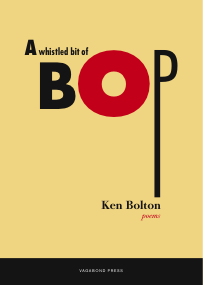
A Whistled Bit of Bop by Ken Bolton
Vagabond Press, 2010

The cover of A Whistled Bit of Bop makes use of a cool, spare design, reminiscent of 60s jazz album covers. It’s a change from the handmade look of many of Bolton’s earlier collections. The O and P of ‘BOP’ are also the record and arm of a turntable; the circular author photograph on the back cover – showing Bolton in a thumb-to-chin thinking pose – might then be the sticker in the centre of the disc about to be played. The collection contains twelve poems, nine of them long or longish ones. There are poems here which begin by describing the scene or occasion of writing and find their way from there, collaging thoughts, questions, quotations, references to R & B and jazz musicians, and imagined meetings with others (poets living and dead, a talking pigeon).

Continue reading

Posted in BOOK REVIEWS | Tagged ,

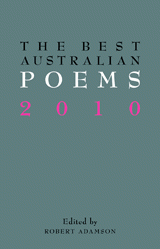
Jal Nicholl Reviews Best Australian Poems 2010

Best Australian Poems 2010 edited by Robert Adamson
Black Inc., 2010

It’s hard to write about a collection as diverse as this. It has no theme really except what Adamson mentions in his introduction, quoting Baudelaire’s poem ‘Correspondances’, a poem, to paraphrase blandly, about mysterious relations between things of different kinds. Anything can be compared to anything else, but is there a “ténébreuse et profonde unité” (“dark and deep unity”) in this collection, as Adamson seems to imply? I’m not sure what he means by “poetry is one way to decipher lyrics from electronic jargon”, but I guess that the reference to Baudelaire’s poem is a way of saying that the book as a whole is big and diverse, giving rise to a chance network of interrelations.

Continue reading

Posted in BOOK REVIEWS | Tagged ,

What the Job Is: Notes on Racism and the Cultural Divide

The Elephant in the Room

My plan to start teaching phonetics in my Korean English class actually germinated in Nepal. I began to notice signs similar to ones I had seen in Korea, toting the English language as a kind of educational panacea. I found myself wondering if the modern world was engaged in a cultural war, an effort to arm itself with my mother tongue. A policy of Mutually Assured Comprehension. Aware of my role in this cultural siege I decided I would make better use of my classroom time to teach things the Korean syllabus was not imparting in regular class time – word pronunciation, aural recognition of key words and English inflection.

It began well. The first week I taught syllables and played a classroom game where students had to solve maths problems where the integers were the number of syllables in a sentence. The next week I tried to teach word stress but had greater problems as there are so many exceptions to English stress patterns. The third week I had gotten to inflection but was facing real resistance from the kids.

One student asked me,“Teacher? (pointing to sheet) Last week?”

“Pardon?”

“Syl-la-bles. Last week? Syllables?”

If the kid had aced the sheet I would have understood his frustration. Problem was, he’d gotten half of the questions wrong. The final straw came when walking back from one of these unsuccessful classes.

My head was down, I was obviously frustrated and my co-teacher said to me,“I think this class is too difficult for the students.”

“Yes, but I think it is good material. I just need to make the subject easier to understand.”

“I think maybe you should just entertain the students. This subject is too hard.”

In the hopes of representing myself as an anything-but-unbiased-reporter I will quote verbatim the Facebook status update that immediately followed.

Daniel East is sick of DANCING LIKE A F—ING MONKEY! Dance monkey DANCE! Speak your goddamn monkey tongue. Play for our children. Ornament our school. Caper, smile, be our f—ing fool.

Playing the Race Card

I thought I knew what racism was. I had by turns been indoctrinated (by a grandfather who had fought against the Japanese in WW2), learned its dangers and ugliness (after an embarrassing display in primary school), read about the critical discourse surrounding it (a modest amount of Post-colonialism and Frantz Fanon at university) and finally thought I understood its pervasive, alien character (when I witnessed the extreme racial segregation between indigenous and non-indigenous Australians in Broome). But these were abstract, intellectual definitions – nothing prepared me for being treated differently due to my race and more importantly, reacting against this racial identification by generalising the reaction of individuals as indicative of a racial group.

The more I have thought about this event the more ashamed I have grown of the Facebook outburst above. The “R” word lurks like a leviathan of the shimmering deep beneath the drunken exchanges of the ex-pat community. Many other teachers have expressed similar feelings to the one I expressed above – feelings of being ostracised, undervalued and demeaned by our staff and students. But are racially specific complaints racist if they are partially justified by typified behaviour?

What the Job is

In Korea the job of the foreign teacher is simply to be a foreigner. Every school is different but most waeguk teachers (waeguk literally translated is “foreigner” but can be more correctly translated as “not Korean”) will be required to devise their own class material – and their efforts will be supported in class by a Korean co-teacher whose job is limited to translating directions and enforcing discipline. When school events come along (carnivals, festivals, excursions) the foreign teacher will remain behind his desk when the school may be almost completely empty.

He or she will be asked to prepare for open classes that other schools from the district will attend. These schools will bring their own foreign teacher along. Far from being an opportunity for teachers to share advice or ideas, the lesson is prepared in uncharacteristic detail and often delivered in expensive-looking rooms the students and teachers rarely see – effectively rendering any feedback irrelevant because the class itself is uncharacteristic of any regular teaching practice. Even the students do not benefit from these forums as the host classes chosen are generally removed from their regular syllabus to drill the lesson over and over. It is not uncommon to see students answer questions before the teacher asks them.

Dissent in the Community

Amongst ex-pat teachers these outlandish open classes are the tip of the iceberg. Twice a semester Korean schools undergo a radical shift as students prepare for their exams. Teachers stay late drafting papers, students begin to wear their blazers and vests to school (even in the middle of summer) and the foreign teacher finds all his/her lessons cancelled, sometimes at the last minute, for days or weeks before. Patrick, a friend of mine who lives one subway stop along, has had no work for almost a fortnight.

Image: Jackson Eaton

Well, almost no work. His job is to arrive in the mornings and deliver the ‘English Address’ (unscripted, unprepared English phrases spoken over the intercom the entire school repeats) and one after-school English class a week. This after-school class is a rotation of the entire school’s Korean teachers who are encouraged by the principal to teach all their subjects (science, maths, art) in English. Patrick delivers English lessons to overworked Korean teachers many, many years his senior in a country where age difference is so far ingrained it forms a linguistically complex part of the grammar (only a decade ago it was almost unheard of for Koreans to make friends with anyone with a few years age difference).

Yet Patrick’s Korean co-teacher (the person in charge of handling his paperwork) told him that if the principal was not present in the class to let the teachers go. They are ‘too busy’ to spend time in his class. An awkward situation for all involved, made worse by the reactions of the Korean teachers. Patrick said the class behaved like his lower level students: they were hard to control, talked to each other when he was speaking and paid no attention to his lesson.“I tried to teach them Yesterday by The Beatles. I mean, it’s Paul McCartney, man. Paul McCartney.”

A Better Defence for Future Outbursts

In the replies to my Facebook status mentioned above, one friend commented: “You’re not a person anymore, you are just a useful interactive book”

The stages of culture shock are well documented on the Internet, so I feel no need to dwell on it here. But generally they form a three step model consisting of a ‘Honeymoon’, followed by a period of ‘Adjustment’ that (sometimes) culminates in ‘Integration’. I had hit that second stage and begun to exhibit frustration and anger – but it was the nature of my anger, and that damned elephant in the room that I began to dwell on. Was it Korea that had gotten to me, or the job?

After all, was it all that surprising that I was given no responsibility during the important exam period, given that my position is entirely transitory and my presence limited to the twelve months of my contract? Is it surprising, given the language barrier between the staff and myself (even the English teachers are not particularly confident or fluent) that they encourage me to teach easier lessons so I don’t get so agitated? (I noticed many of my teachers were consistently getting the stress and syllable questions wrong). And was it really that odd that my lack of responsibilities engendered a little hostility among my co-workers – that it bugged them when they were busily preparing tests and dealing with rowdy students that I was watching season after season of The Wire – and getting paid to do it?

In my opinion, it comes down to this: racism is not making cultural generalisations but believing them to be the root cause of all problems. During the “Syllable stress teaching nightmare” period I had one student who openly mocked me in class by repeating all my instructions in a high, bitter falsetto. But instead of thinking, “Damn middle schoolers” I thought, “Damn Koreans.” When I had a class that wouldn’t behave because my co-teacher didn’t show up for a lesson I didn’t think “God-damned fourteen year olds,” I thought, “God-damned Koreans.” The frustrations I felt were more indicative of general human jerkishness and not culturally engendered disrespect.

Although I’ve had moments of being treated differently due to my race (older Koreans not wanting to sit next to me, teenagers giving sarcastic high fives, a co-teacher laughing at a student who mocked me behind my back) it was not a balanced response to blame the culture as a whole. I’ve had kids who’ve practically gawped with excitement to see me on the street, who rush into the staff room to say hello, teachers who have sat with me at lunch and laughed with me as I struggle with Korean pronunciation. The cultural divide exists, it causes anxiety and anger but it is not the entire reason for my problems. In my own culture, faced with a difficult workplace I might hate someone, but never an entire race. Over here, choked by the inscrutable bureaucracy, I turned my anger on the Koreans I was educating and working with. Understandable, but deplorable.

So what to do? Personally I’ve decided to embrace my lack of responsibility within the school system. I’m going to teach my own childhood interests (dinosaurs and the solar system) and hope I manage to impart some of the same wonder these subjects held for me when I was that age. Until I get told I’m not doing my job correctly – and then I’ll have to adapt all over again.

Post-script: The Korean for ‘Burden’

As so often happens with this type of article, the perfect closing moment came after the article itself had been finished. Never one to tamper with chronology I will relate it here.

Our school recently lost the head of its English department, a very kind and co-operative teacher I knew as Susan (when speaking of her to another co-teacher she didn’t understand who I was talking about until I pointed her out. No one was familiar with her English name). She was replaced with another woman whose name I have forgotten and been too shy to ask for again (see how it goes both ways?). Seeing no one else in the staff room I asked her to lunch and she came with apologies for not asking me earlier.

Our conversation was making a good clip on subjects of immediate interest and her time abroad made her more comfortable and fluent with her English. So it was that we were discussing the 2010 kimchi price hike when two older Korean teachers came and sat a few seats down from us. One of the ladies leaned over and said something to my co-teacher and she smiled a little awkwardly, nodding in return. Knowing I usually don’t get a translation of what is said I didn’t ask – but she offered immediately.

“They say the English teacher is a burden.”

“Oh.” Pause. “For you?”

“For them. I think they are very scared of you. They have only elementary English.”

When I pressed her on this, she related her experience at university where she saw a foreigner for the first time and could not understand anything he (the lecturer) said. “I think many Koreans have a fear of foreigners.”

Connecting this in my head to the article, I began to ask what sort of material I could teach to help students overcome this fear of speaking.

“That is a very fundamental question.”

She leaned back a little and began to cover her mouth as she spoke.

“I think it is good for you to just teach anything to the students.”

“Anything at all?”

“Yes. It is good for them.”

“For them just to see and listen to me?”

“Yes. I think it will help them to listen. You are doing a very good job. I think you are a very good teacher.”

The conversation continued on as I ate my bap and bulgogi. Out of interest, I asked her what the Korean word for perilla (a herb similar to sesame leaf) is – she told me and now, less than fifteen minutes later, I have already forgotten it.

Posted in ESSAYS | Tagged , ,

The Bastards Learned How to Swim

I’ve been swimming since I was two and the feeling it gives me, of such wonderful lightness, is approximated by nothing else on earth. Except maybe alcohol. As adulthood came and passed me by I indulged in liquors that lifted my head two feet above my body and by waving my arms I could follow it up into the air. My drinking has always had a very narrow purpose, one that I’ve repeatedly given up without issue or pain; it is a bonus to rather than a facet of my days. But when I moved to Seoul I was confronted with a type of drinking attitude that insisted my commitment to alcohol be put to the test. For the first time I was taking part in a night life that had no half measures, no flip side to the coin: it’s go for a drink or go to bed. And if you choose bed, you’d better take a drink along.
“Work is the curse of the drinking classes” – Oscar Wilde

In South Korea it is the social aspect of their drinking culture that puts the country on a whole new level of consumption. Alcohol has moved beyond an accepted overindulgence into a necessary function within Korean life. A business dinner in Seoul looks much the same as a celebratory drinking session. These men keep their shirts neatly buttoned, ties knotted tight, jackets folded in half over chairs and proceed to completely let themselves go with numerous bottles of beer and soju. On the many weeknights when I’ve been wandering the city until early hours, buying cheap alcopops in seven elevens, it’s easy to lose count of the men, always in pairs, holding hands for balance, staggering from bar to restaurant to bar with little heed toward their working day fast approaching. They look like the walking dead and they do it over and over again.

In my eyes, Seoul is populated by eighteen year olds trapped in middle aged bodies and these newly-turned adults are about a decade away from learning their lessons on heavy drinking. At first I wondered how South Korea’s growing economic strength could continue when these were the citizens thrusting the country forward into a successful monetary future. Then I realised, the impressive work ethic of these people isn’t focused on a high standard of pride but on shameful necessity due to their night time distractions. So many men and women work until seven, eight, nine at night but these extensive work hours make sense when you remember that many of them haven’t sobered up until early afternoon. I don’t care how committed a worker you may be, if you spend your night sleeping off three bottles of soju on a train station bench, you’re not doing anything of any worth until at least lunch time.

“People got attached” – Charles Bukowski

I’ve been to dinner many times with my co-workers and one in particular, a Korean reporter known to me under her Japanese name of Harue, has a peculiar habit when we drink soju. Not only must our glasses always be full but each time we drink, she insists that we toast and when we clink she says ‘I like you’. Originally I thought she was tailor-making a toast just for me, to bring us close and cement our friendship. Each time was ritualistic; she spoke in the same pitch, with the same intonation and the same nod of her shiny-haired head. Late one night over beef tendon kebabs I asked her what it meant and she said it was her own personal habit every time she drank with others. So it wasn’t a performance for my benefit but it was an integral part of her drinking.

During these moments, Harue finds it appropriate to express her affection and when it is directed at me the walls between us, as women hailing from different countries, are knocked down and drowned in 20% alcohol. When she pours my soju she holds one hand to her chest, a gesture meaning ‘you are in my heart’; while ordering a new bottle she puts an arm around me and calls me Iseul, my Korean name. I am constantly touched by these overtures but part of me wishes that drinking could be removed from how we connect to one another. If I told her I loved a film that she also adored and she embraced me in excitement, I think I would take more from the moment but I have to take a moment to remember that the society I am now playing within doesn’t work under any rules I am acquainted with.

Image: Jackson Eaton

Perhaps it would be insulting for me to look for affection in ways I personally find meaningful when I am already offered love and acceptance. At our first dinner I drank my entire shot in one mouthful and each of my six co-workers’ reactions were of such wonder that I realised this was the way to a Korean’s heart: one hell of a strong stomach. Sipping or tasting a drink is an entirely satisfactory method of partaking in the festivities but downing with one swallow shows that you are there with them as a friend, ready for the night ahead.

“First you take a drink, then the drink takes a drink, then the drink takes you” – F. Scott Fitzgerald

Most of all it’s the novelty and availability of alcohol that I appreciate. Methods and places of drinking have become as important as what’s in the glass or, as I discovered at a music festival, the I.V.. The extent of packaging and beautifying alcohol have been realised in South Korea mainly due to the looseness of social drinking practices. At a popular bar in Seoul, known as Vinyl, drinks are mixed and served in an I.V. bag which you can enjoy whilst relaxing inside or take with you through the streets. A mere two blocks away is a permanent street vendor run by a smiley elderly woman who sells very cheap cocktails in plastic cups and, as there is no seating area, the customer is forced to consume on their feet.

This is one mighty drinking culture which, despite its over-consumption, has no problems with violence or public destruction. These people can hold their alcohol and if it does get the better of them, they go to sleep in a quiet corner of a train station or park. Considering the lack of alcohol control, this is extremely impressive self-control, especially when you consider how easy it is to drink. The following list is an example of locations that supply alcohol to anyone who walks in the door, no proof of age required:

newsagents;

train station convenience stores;

unlicensed coffee shops;

bakeries;

stationary outlets;

gift shops in hospitals.

This freedom has allowed anyone to drink any amount of anything they want at any time of day. And if this isn’t enough incentive for extensive drinking, alcohol is offered in a shocking variety of sizes and forms. Soju is a basic staple in the Korean diet and the regularity of which it is consumed is reflected in the many ways it can be bought. 360ml bottles are the favourite size for restaurants and they feel misleadingly like coke bottles. Needless to say, one is never enough. For a large family, or very thirsty couple, soju comes in two litre plastic bottles for a mere four dollars. When I saw it on the supermarket shelf I thought it was soft drink; when I showed it to my parents on Skype they thought it was mineral water.

Its tricky appearance makes the massive amount of alcohol it holds seem relatively harmless when the power of human denial is properly utilised. Furthermore, the bottle is just big enough to feel bottomless; after all, we’re only pouring single shots. And finally, soju can be bought in the smallest amount possible, that of a popper or children’s juice box. This is marketed toward the Korean on the go: hard working, busy and looking for a quick fix. The packaging suggests a different story. Now I’m not saying that Korean parents give their children soju poppers. But am I saying they don’t?

“Alcoholism isn’t a spectator sport” – Joyce Rebeta-Burditt

South Korea is the first place I’ve ever visited where peer pressure is absent and general expectation so obvious. Perhaps it’s the general pleasure of drinking in large groups, without the thunder of threat overhead, that draws me into late night sessions but I’m not entirely sure the reason doesn’t lie in my own psyche. Where alcohol was once a release of my inhibitions it has now become a gateway into foreign affections. These people are hard as nails, quick to touch and often so drunk they can’t stand after midnight.

But damn can the bastards swim.

Posted in ESSAYS | Tagged , ,

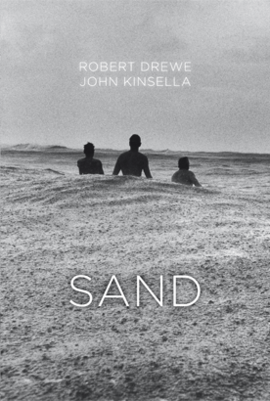
Ryan Scott reviews Robert Drewe and John Kinsella

Sand by Robert Drewe and John Kinsella
Fremantle Press, 2010

Sand is a substance which suggests abundant contradictions. Abundance and scarcity is one; others are leisure and hardship, isolation and revelry, and most starkly the infinitely small and the infinite. Yet, it is rarely held up as something sacred. It is not often treasured for its feel and its ubiquity. While not a paean, Sand, a collection of poetry and prose by John Kinsella and prose by Robert Drewe, does explore this element as a condition of place, in this instance Western Australia, and place as a condition of experience and memory. As such, place in this collection is not a passive subject. It is something constructed through artistic engagement.

Continue reading

Posted in BOOK REVIEWS | Tagged ,

Jeju-do with Family: A Korean Photo Essay

[EasyGallery id=’jacksoneatonkoreanphotoess’]
Click on the image above to view this gallery.

It might be possible that you fall in love instantly, I suppose. That the skinny girl behind the bar – who you talk to because you’re drunk and who, to your surprise, has similar taste in music and who, despite the confusion caused by a protective boss, does not in fact have a husband and who is genuinely pleased to see you when you return to that bar two nights later to dance for her and scrawl your number on a napkin and kiss on her soft cheek at dawn – is actually your true love and not the subject of a standard chance beginning to a relationship of indeterminate length. Well, based on a prior record of three to five months – depending on how upset she is and how severe your confusion – this is when you suddenly start not feeling much. It could be possible. But it could also be possible that you just needed her, then.

It was before the Christmas of 2008 when my brother and his girlfriend came to visit my dad and I in Seoul. That’s over three years ago now and I didn’t keep a diary at the time. I have some memories, and I have some photos, and I have some memories from some photos. And I have some emails.

Dec. 1 (excerpt)

dear darling
so what/how do u want me to help you?
you guys should make up mind tonight and tell me otherwise it’d be too late for booking resort so, set the date and tell me tmr morning.
and no worries about price honey, it’s expensive but for your family and it’s a great chance to chill out and have fun together. it doesn’t happen all the time
so don’t complain or be grumpy, right?

My dad and I had decided to show my brother and his girlfriend Jeju-do. An island frequented by honeymooners, famous for its ponies, stone grandfather statues and haenyo – ‘sea-women’ who free dive for abalone and conch in the bitterly cold water almost all year round. My girlfriend didn’t come with us, which meant I used my recently schooled Korean to help us through the bus-ports and restaurants and gift shops and check-ins. There is no real story here, sorry. I remember seeing my dad lying naked, hairy and sweaty in the resort sauna. I don’t have a picture of that. I remember hiking to the lip of Sangumburi Crater, seeing a rabbit and the underwhelmingly diffuse dawning of the sun on an overcast winter morning. I have an underexposed picture of that. I remember carrying from tourist attraction to tourist attraction the deep suspicion that it was only really Korea that kept us together.

Dec. 4 (excerpt)

so, why did u get cynical?
we see the same thing everyday
we talk about the same thing everyday
we meet in the same place
we have sex in the same room
I call you everyday.
you say hi everyday

After the trip we were to fly to Australia for a six-week holiday. After nearly three years I was going home. She would visit Australia for the first time and meet my mum and see my childhood home and all the other things about my other life. We were to travel on 22 December, which was her sister’s birthday. I had insisted we fly that day so we could be home in time to spend an extra day with mum before the relatives arrived. It’s one of those decisions that for some reason I still dwell on. A poignant example of my selfishness, superficial in comparison to some of the other atrocities yet through incidental practice or some other reason it stays in my mind. Like the time I made her go and get my dad from the subway station half way through our DJ set because he’d gotten off at the wrong exit. Or the time I left her in the bedroom with a bad insect bite because I was more interested in playing boardgames.

Feb. 5 (excerpt)

the reason why I happen to decide to wait for you is, I clearly know or I assume strongly, that
I know you haven’t cancelled the ticket.
I know it’s stupid to think like this but I can’t I can’t I can’t I can’t stop hoping something again.
I just wanted to tell you if, if you decide to stay there (I know you have already but)
and 100% sure that there won’t be any chance to restart this relationship again
(I know you’ve told me already but) please, tell me.

I arrived at her house unannounced. There were people sitting around on the porch. They were all very well dressed and it appeared as if some were town dignitaries and some were family. Her mum greeted me with a huge smile. While I waited outside, some people tried to make polite conversation but I was distracted, anxious about seeing her and besides I had forgotten much of the Korean I had learned. She appeared, looking quite fragile and not at all surprised to see me. We went for a walk with her sister. We came to a large felled tree trunk that was twisted and charred. We rolled it over and it looked perfect but she was disappointed; it wouldn’t do. Suddenly I realised what she needed it for. She would use it to build her own coffin. I felt so sad and with embarrassment tried to explain that I had not simply come to see her one last time. I awoke from this dream (this morning) in tears. It might be possible that you just needed her I suppose. But that might not matter. You fell in love, then.

Posted in ESSAYS | Tagged , ,

Impressions of Modern Korean Poetry in Translation

Since reading Dorothy L. Sayers’ translation of Dante’s Inferno at the age of 15, and ‘discovering’ Baudelaire a couple of years later (translations by Francis Scarfe and Geoffrey Wagner), I have had a lifelong love of literature in translation, especially poetry. During the 1970s, a period coinciding with a boom in translation (such as Penguin’s Modern European Poets series), I found many of the poets who have since enriched me: Rilke, Cavafy, Pessoa, Celan, Akhmatova, Salinas, Lorca.

Continue reading

Posted in ESSAYS | Tagged , , , , , ,

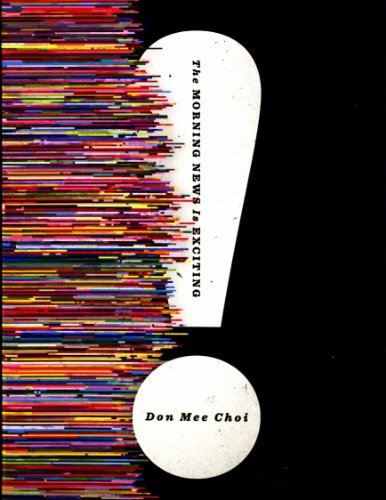
Joel Scott Reviews Kim Hyesoon and Don Mee Choi

Mommy Must be a Fountain of Feathers by Kim Hyesoon


(translated by Don Mee Choi), Action Books, 2008

The Morning News is Exciting by Don Mee Choi
Action Books, 2010

It is refreshing to be introduced to a literature through its contemporary women poets. For that reason, I was extremely happy to receive these two titles, both published by Action Books (a small U.S. publisher doing great things). Neither book, though, is entirely Korean. Mommy is a selection of translations into English by Don Mee Choi, while The Morning News is a collection of Choi’s own work originally composed in English.

Continue reading

Posted in BOOK REVIEWS | Tagged , , , ,