
Oz-Ko Envoy Editorial

When the British landed in Australia
they asked an aborigine,
“What’s that thing leaping up and down?”
The native replied,
“I don’t know,
Kangaroo, I don’t understand you.”

The name stuck.

Ah, how much grander not knowing is
than knowing.

KO UN, ‘Kangaroo’
first published in Song of Tomorrow (1992)
translation by Clare You and Richard Silberg

When the call for submissions to Oz-Ko, Cordite’s thirty-fifth issue went out last November, it included the following ‘instructions’ for potential contributors: “For this issue, while the overarching aim is Australia-Korea relations, we instead seek works on any theme. Although works that take Korean themes as their inspiration will of course be considered, the focus is on attracting engaging, innovative, translatable and contemporary works, no matter their ostensible subject(s).”

The number and quality of submissions we received was both encouraging and problematic: encouraging, because the hundreds of poems submitted showed a pleasantly surprising knowledge of Korean culture; problematic, because we’d originally planned to publish just forty poems in the issue, leaving us with some tough choices. In the end, we decided to publish an additional twenty poems; and thus, Cordite 35.0: Oz-Ko (Envoy) was born!

I should emphasise right away that referring to this issue as an ‘Envoy’ does not lessen its importance in comparison to what is to come. On the contrary, the twenty poems collected here hopefully perform a very important role, in terms of setting the stage for what will be our biggest issue ever, and our most challenging. In addition to the poems published today, in May we’ll be publishing forty poems by twenty contemporary Korean poets in both English and Hangul. These poems have been selected and translated by Korean scholar Eun-gwi Chung, with assistance from Hui-Sok Yoo and An Sonjae. We’re tremendously excited to have an opportunity to present these works to an Australian audience. I’d also like to apologise for the delay in presenting these works, but can assure you that the wait will be worth it.

The third and final stage of our Oz-Ko issue (scheduled for release in May-June) will feature forty poems by twenty Australian poets in both English and Hangul. As far as we’re aware, this is a world first, although I’m hesitant to make too much of a song and dance about it. The acknowledgement of a language such as Hangul in Australian literature could arguably be viewed as long overdue; and while we’ve published a number of poems in various languages on the Cordite site over the years, it’s somewhat embarrassing and perhaps inappropriate to be making lofty claims about our inclusivity on this basis.

I do not personally claim to be an expert on either Korea or Australia, and am therefore slightly nervous that Oz-Ko will be seen as an attempt to summarise the literature of two vastly different but equally complex and fascinating cultures. Perhaps, just as in the story of the word ‘kangaroo’ in the Ko Un poem quoted above, the words ‘Australia’ and ‘Korea’ are already understood or heard in radically different ways. Perhaps by presenting a bi-lingual issue we’re attempting to talk to everyone, while reaching nobody. To be perfectly honest, I myself have entertained similar doubts upon the publication of each of the last thirty five issues of Cordite. What’s so different this time around?

Image by Jackson Eaton.

Maybe one answer to that question lies in the fact that unlike previous issues of Cordite, we’ll be publishing this issue in stages, making it more difficult to make an immediate ‘impact’, whatever that might entail. Then again, the ability to stagger posts, embellish themes and change tack is one of the great advantages of publishing in a web medium. Maybe I’m just nervous that we’ll have trouble posting Korean texts on the Cordite site. Having already made a couple of test posts, it’s become clear that some readers (particularly those using older versions of Internet Explorer) might be greeted by rows and rows of strange symbols or square boxes, rather than by beautifully composed lines of hangul. In fact, this is one of my worst recurring nightmares!

Then again, the possibility that some of these texts will not be able to be read by everyone is hardly earth-shattering or unique. Indeed, it’s a symptom of the transient nature of electronic texts in general, and the fragility of coded texts in particular. I suspect we’ll have much more to say about these kinds of challenges as the issue progresses. In this sense, it is kind of appropriate that this first stage of Oz-Ko is referred to as an ‘Envoy’: these twenty poems are like tiny agents sent out into the crowded world of the Internet, an advance party preparing the way for what is to come, not all of which will be understood by the machines it encounters.

Each of the poems in Cordite 35.0: Oz-Ko (Envoy) has been chosen because it illuminates some aspect of Australian culture, or else because it expresses some kind of engagement with Korean culture. Together they make rather strange bedfellows, and sometimes a poem’s connection to the issue may seem rather obscured, but would life be nearly as fun if the meaning of everything was immediately apparent? Rather than spoil that fun, I’ll refrain from editorialising further for the moment, and simply trust that you enjoy reading them.

In addition to this first batch of poems, today we’ve also published an essay by Dan Disney on the subject of Ko Un’s Maninbo. This is the first of a series of features that we’ll be publishing each week in order to achieve a kind of “rolling thunder” effect in the lead-up to the second and third stages of the issue. Over the coming weeks you can look forward to a review of Kim Hyesoon‘s classic Mommy Must be a Fountain of Feathers, along with a book of poems by her translator; a feature on contemporary Korean poetry in English; a photo essay by Jackson Eaton (whose images will also be sprinkled throughout the issue); essays on drinking and teaching in Korea, respectively, and plenty more.

Shortly we’ll also be making an announcement about our forthcoming poet’s tour of Korea, and the subsequent tour by Korean poets to Australia, both of which have been made possible by a range of funders and partners. Stay tuned for further announcements as they say in the classics, but while on the subject, I’d especially like to thank Dan Disney, Nicolas Low, Eun-gwi Jeung and An Sonjae for the often superhuman efforts they have made to ensure that Oz-Ko in its multi-faceted becomes a reality.

The future starts now.

Welcome to Oz-Ko.
Posted in ESSAYS | Tagged ,

‘You’re alive, and I’m alive’: Resistance and Remembering in Ko Ŭn’s Maninbo

Imagine: a young man is forced into compulsory labor while the war that kills millions of his compatriots rages around him; as that war concludes he turns his back on the world and spends the next decade as a Zen monk; he returns and, salving his despair, lurches toward alcoholism and then suicide; he fails (several attempts), but is energized by a surging democratization movement and becomes a leading dissident; over two decades he is imprisoned four times for para-political activities; he is finally accused of treason, and sentenced to twenty years in prison; he is tortured by a cadre of jailers, beaten so badly his eardrum ruptures; he is eventually pardoned, released a final time, and becomes a father at fifty; all the while, prodigious numbers of his books are published – over 150 at last count – including the sprawling, thirty-volume Maninbo (Ten Thousand Lives), which chronicles the life of every person the poet has ever met.

Who is this ‘demon-driven Bodhisattva’, as Allen Ginsberg once called him,[1] this hero who strides through the epic poem of his own life? With its Chronological Record of Former Lives, the poet’s website enumerates an elaborate mythology: this ‘friend of Dionysus’ claims to have first entered the world as a mare, somewhere near the Caspian Sea in 1125BC. Human lives followed, and after stints as a Siberian shaman, ‘an innkeeper in an unknown land’, a Mongolian shepherd boy, illiterate firewood gatherer and deaf farmhand on a remote island, in 1933 the mysterious personage of Ko Ŭn wandered into his current incarnation, fated for greatness, the eldest son of a farmer from the south western Chŏlla region of Korea.

Ko Ŭn is a literary giant who has gathered together a suite of folk stories, anecdotes, vignettes and asides in order to construct the monumental edifice of his Maninbo. The title translates literally as the ‘family records of ten thousand lives’,[2] and the poet seems compelled to record the details of those who might otherwise be erased from history. Maninbo is part historical account, but it is also a funereal ode which adumbrates all who remain, all who have existed – an ontological stocktaking, if you will. Rather than an accretion of archetypes, these poems contain a procession of individuals who represent the gamut of human experience, but the inflection is clear: so many of these people disappeared without trace during Japanese occupation (1910-1945), the Korean War (1950-1953), and the ensuing rule of successive military dictatorships (1948-1987) in the newly-formed South Korea.

Brother Anthony of Taizé, the foremost of Ko Ŭn’s English-language translators, calls Maninbo an ‘immense mosaic narrative of Korean history’.[3] These poems are haunted by their subjects; by retracing the identities of ordinary people caught in the flow of all-too-human and ideologically-driven events, Maninbo memorializes the palpable absence of the many that disappeared:

At the end of the Japanese period we had nothing to eat.
There were no trees on the hills.
Springtime was dreary without azaleas.
Ch’ung-jo, my little brother,
born when I was already a big boy,
chose that wretched time to come into the world.

(from ‘Ch’ung-jo, My Little Brother’[4])

What’s a ghost?
I know.
It’s starvation.

(from ‘A Ghost’[5])

And for the crime of having served the Reds
was abused by
this man
and that man,
and the police.
She was obliged to bite off her tongue and end her life.

(from ‘Im Yŏng-ja’[6])

His baby son died of malnutrition.
His wife went missing.

(from ‘Oh Sŏng-ryun’[7])

Perhaps these few examples suggest Maninbo as a litany of horrors; certainly, the poet refuses to avert his gaze from terrains of the starving, the traumatised, the dying and dead. But many of the poems in Maninbo are startling for their pragmatic hope, resilience, and their refusal to despair:

Swept away in the flood,
far out to sea
he came across a plank,
a narrow escape if ever there was one,

…

Su-kil dug up the tomb
retrieved his tools,
fitted them with new handles,
stuck one into the ground and said:
‘You’re alive, and I’m alive, and
as ever, there’s a lot of work to be done.’

(from ‘Tomb of Tools’[8])

In Chammi-dong, Kunsan, several blind people live together
several blind people good at massage
living happily together.

…

Amidst all the world’s evil
there is this goodness too:
even darkness can be a blessing!

(from ‘Two Blind People’[9])

When Wu-sik went back down the hill after crying his fill,
he felt full of new energy.
The world might be too much for him,
still he had the energy to burrow down
and make a shelter for them all.

(from ‘Wu-sik from Arettŭm’[10])

Despite everything Maninbo is triumphant, and testifies to human tenacities. These are poems loud with sounds that have ‘served this land, sounds alive and dead’,[11] and the harmonies are made by a motley gathering of monks, teachers, dogs, babies, peasants, dissidents, soldiers, merchants, prostitutes, spouses, great-aunts, snake-catchers, poets, murderers, politicians, mountain climbers, et al: in short, all the turbulent and cacophonous tunefulness of a nation fighting to survive.

Throughout ManinboKo Ŭn remains sensitized to how ‘language is home for every human being’,[12] and his poems serve as unofficial histories in the struggle for a cultural identity. As Charles Bernstein has written (for his own programmatic reasons), ‘language control = thought control = reality control’,[13] and what is clearest in Maninbo is the poet’s enduring refusal to accept the imposition of any version of reality other than his own. Indeed, for Ko Ŭn, to be a poet is ‘freedom itself’.[14] The impulse to think in his own ways and in his own language manifests early when, as a child, he learns the forbidden Korean language while his peers accept Japanese as their mother tongue:

Taegil, the farmhand for Kwan-jŏn’s family in Saetŏ,
a first-rate farmhand,

…

Under the lamp I learned from him our language,
I could recite the story of Changhwa and Hongryŏn fluently, like rain pouring  down.
So my eyes were opened to the world as a child.
After thirty-six years under Japanese rule, I was the only kid who knew
how to read and write our language: ka-kya-kŏ-kyŏ.

…

When there were snowdrifts in icy winter,
the wind would pass freely through the sleeves of his thin clothes.
He said:
People who live in too much luxury know nothing about anything else.
In this world we live with others.

…

He was a light for me,
a light burning all night long, whether I woke or slept.[15]

Where in a child does the impetus to learn a banned language come from? A temptation is to suggest it arrives from some intuitive belief in the rightness of the act; despite those realities imposed by successive ideologies, Ko Ŭn appears to have been getting things right for most of his life. Beginning with learning ‘ka-kya-kŏ-kyŏ’ (those first building blocks of the Korean language), it is through listening, observing, experiencing and then writing that Ko Ŭn’s vision not only survives but prevails. As the poet avows, ‘reality has certainly imposed a mission on my writing’[16] and, despite the blacklistings, the threats and torture, disappearance and deaths of friends around him, amid the suffering Ko Ŭn knows how much work is to be done. His canon-building project can be defined by two broad priorities: resistance to imposed cultural identities, and belief in speaking out and speaking truly.

Indeed, Ko Ŭn has consistently been spurred into action by the normalized atrocities surrounding him. The poet describes his as ‘a poetics of experience’,[17] and the idea to write Maninbo was conceived during an extended period in solitary confinement – his third stint in prison following the assassination of military dictator Park Chung-hee. In the aftermath, demonstrations and uprisings across South Korea were bloodily put down by new dictator, Chun Doo-hwan, who killed unknown numbers of pro-democracy protesters and swept many thousands more off the streets and into prison. In the preface to his translation of Maninbo, Brother Anthony describes the subhuman conditions faced by Ko Ŭn and his fellow inmates in prison:

” … a labyrinth of tiny, windowless cells lit only by one small electric bulb. Completely isolated from the world and, most of the time, from one another, they had no way of knowing if they would come out alive or be summarily executed and disappear without trace.” [18]

Posted in ESSAYS | Tagged ,

A Double Abecedary on Tertiary Teaching

Academically speaking, teaching’s really spaz
But who expects to make an impression when every
Contact confirms your sense that your life is under a hex.
Don’t give up yet though; for all you know,
Education theorists may one day tumble to the wisdom p.o.v.
For all that that may seem the last thing they’d desire. Utu,
Getting even, eating your enemy’s heart out,
Having in mind how the myth of eternal recurrence really happens,
Is what keeps the thing you see in the mirror
Jolly enough to consider things could be worse, say frontline Iraq:
Keep your mind focused. If this isn’t the life of Riley, it isn’t a trap
Laid by anyone else but yourself; go
Make the Mister Chips noises, or even believe in them; happen
No harm will come from it. Put up with Angst in its full-bottle form—
‘Overwrought, that’s all that’s wrong with them, they’ll all
Pull through’—Thanks, Occupational Health Office, I don’t think:
Question is, what do those blighters do all day but go on a hajj
Round the campus to see who’s alive and who’s dead (‘What’s your alibi,
Sport?’). This Sargasso Sea hosts other crawlies, monsters with
Two driving motives: knowledge they’re hopeless as teachers, and toadying
Up to the setters of targets for others. Stuff them; stiff
Vodkas at six, and they vanish from mind. Then the fun starts here:
What are these documents students have tendered—
Xanax is in it: did I teach so badly that logic
Yearns now for some link with reality? Maybe so: overdub
Zero then, give our best efforts an ‘A’.

Posted in 43: OZ-KO (ENVOY) | Tagged

At Tongdosa (통도사에서)

She grabs my hand and drags me through the gate,
the flow of foreign words only later
understood: ‘This way, the food is free
for Buddha’s birthday – pay-back time for monks’.

We eat another lunch to satisfy
her generosity – no place for leftovers,
we finish our soup and wash and stack our bowls.
Spongy green bread is pressed into our hands.

My great-grandfather swam in the river
after a sleepless night in an airless room –
the hospitality repaid with cake,
the monks assured no butter would pass their lips.

The river’s clear to the rounded rocks beneath,
in remembrance I pick up a greenish stone,
and realise later my memento’s not jade,
but whitest marble covered in ancient moss.

그녀는 내 손목을 잡아끌고 일주문一柱門을 넘는다,
이국의 언어는 오직 뒤늦게서야만
이해되는 법: ‘이쪽입니다, 음식은 무료입니다
석가탄신일이에요 – 승려들이 진 신세를 되갚는 것이죠’

그녀의 자애로움에 응답이라도 하듯,
우리는 점심을 한 번 더 먹는다 – 남겨지는 음식은 없다,
우리는 국을 닦아내듯 깨끗이 비우고, 그릇을 포갠다.
스펀지 같은 초록색 빵이 손에 쥐어진다.

내 증조부는 답답한 방에서 잠 못 이루는 밤이면
강에 나가 수영을 하곤 했었다 –
케이크와 함께 되돌아오는 환대,
승려들은 한조각의 버터도 자신의 입에 대지 않았다.

강은 맑아서 그 아래 둥근 돌들도 보였다,
기억 속에서 나는 초록색 돌을 하나 집는다,
그리고 깨닫는다, 그것이 내 기억을 붙잡아둔 비취가 아님을
단지 오래된 이끼에 뒤덮인 아주 하얀 대리석이라는 것을.


Hangul translation by 김성현 (Kim Sunghyun)

Posted in 43: OZ-KO (ENVOY) | Tagged

Mea Culpa

In the morning all that’s left
is a clutch of feathers
by the watertank,
another by the front gate
and one more on the verge.
The door of the chookshed
stands open, the lock unfixed
for more than six months, the
makeshift prop of a railway
sleeper lying where I left it,
an unspoken accusation.
I quietly collect yesterday’s
eggs from the laying box,
apologise to the empty yard
and head back inside.

Posted in 43: OZ-KO (ENVOY) | Tagged

Korean Triptych

I: SŌSHI-KAIMEI

occupiers gone
Confucius removes
jade mask
 

II: JEO

in Shi Jing poems
kimchi reduces wrinkles
silkskin grandmother


III: CARPODACUS ROSEUS

feathers of dawn cross
the 38th parallel
lost Pallas’ Rosefinch

* Koreans forced to take Japanese surnames were referred to as sōshi-kaimei.

* Jeo: early name for kimchi.

* Shi Jing: Book of Songs, first Chinese poetry book 1000 BC.

* Pallas’ Rosefinch (carpodacus roseus) is native to both North and South Korea.

							
Posted in 43: OZ-KO (ENVOY) | Tagged

Recycling the possible

tear into
pieces
the possible

drench it in rainwater
steep for a season

size it with sand
fine as breath
pass the slurry

over
an alveolar web

let the sheet dry
in watercolour
light —

inside the egg
of the bay

a small boat
bobs on
corduroy teal

canary
streaks the shell—

look! take
a leaf
from the blue

pick a splinter
from the pier

feel for a place
in the grain & start
writing

the ripple of
silence

Posted in 43: OZ-KO (ENVOY) | Tagged

Host (호스트)

Host
I am in love with you
Han River
great grey green yellow wide Han River curling round
the bridge pillars’ concrete dreaming

hero-maker, forced by sulphuric acid lonely mother stealing
children slips from the sewer drip-drop echoing den
coral spawn flashbulb bloodied for her smash-up, media’s
symbiotic relationship with reality, succubus of normality
echoing each lonely life arrows hide her, and fire, incompetence!
the or is she … or is she …

purple mists of official response! her murderous entry stage left
slamming through a caravan KAR-RAAARSH! slapstick keening
squid-tentacles most tenderly enloop
and caress, consume …

innocence return! this will test us! test this river back
into Han River super-slug of toxic importance
broken thing, forced by unbottled id upon this sick rampage
we existentially cruelled and mutated
her lonely life how
could we!
she will test us! test our commitment!
smash the state and find us wanting
dear Host!
dear Han River!
dear Host!

나는 너와 사랑에 빠졌다
한강이여
거대하게 초록과 노란빛으로 물든 드넓은 한강이
영웅을 꿈꾸는 교각의 콘크리트 기둥을

휘돌아 나간다, 황산에 쫓긴 외로운 어미는, 아이들을
잡아가는 외로운 어미는, 물방울 뚝뚝 메아리치며 떨어지는
하수관을 슬며시 빠져 나온다
산호가 퍼져가는 것 같은 카메라의 플래쉬는 어미를 잡기위해
혈안으로 번쩍거리는, 미디어와 현실과의 공생관계,
저마다 홀로 외로운 삶속에서 메아리치는 평범함을 빨아먹는 서큐버스
화살이 어미를 감추고, 그리고 불, 무능력함이여!
그 혹은 그녀는… 혹은 그녀는…

관계기관의 대처는 보라색 연무! 살인적인 그녀의 등장으로
사람들은 뿔뿔이 흩어진다 꽈과과광! 애도하는 슬랩스틱 코메디
연체동물의 촉수는 부드럽게 올가미를 만들어 애무하듯,
소진하며…

순수한 회귀! 이것이 우리를 시험에 들게 할 것이다. 이 강을 다시
한강으로 되돌아가게 시험할 것이다 유독성의 거대한 괄태충은
상처 입은 짐승, 도덕에서 해방된 욕망의 힘으로 떠밀려 이 역겨운 광란
우리는 실존적으로 어미의 외로운 삶을
못쓰게 만들고, 돌연변이로
만들었다 어떻게 우리가!
그녀는 우리를 시험할 것이다! 우리의 책무를 시험할 것이다
국가를 부수고 갈망하는 우리를 찾아낼 것이다.
호스트여!
한강이여!
호스트여!


Hangul translation by 김성현 (Kim Sunghyun)

Posted in 43: OZ-KO (ENVOY) | Tagged , , , ,

Calling Korea

she has these huge Mickey Mouse ears
she could be from another planet

the one I bumped into when being
busy and important one morning

bustling to bludge like a rotten tornado
WHAM bodies colliding bags spewing up

the untwisting began slowly but surely
from that day onwards when first her fist

Inspector Gadget style powed forth and
yanked out my antennae YOWZERS

cried the jagged balloon in black on dotty white
we did not speak the same language

English Korean tomarto tomayto broken
unbreakable should have called the whole thing

off her head starkers she phoned home
working 4 jobs in 5 café bar joints barely

sleeping no time no need just discipline
and flourish I would write lousy poems on

serviettes she would serve me more OLÉ
chatting at cross purposes into the night

illegal and proud she made no protest when
Detention claimed her now I give her coins

so she can phone home off her head starkers
no lawyer no reason no refugee here

she grins with teeth bared dazzlingly white
one for eternal link defending to the death

crafty queue jumper hotty pants sorceress
in disguise for she begets love only LOVE

Posted in 43: OZ-KO (ENVOY) | Tagged

Translating Coastlines

On the beach’s long curve, gulls strut their names
into wet sand, seaweed scrawls tangled stanzas;
a piece of driftwood’s smooth-pearl journey ends
in a sandstone fissure.

Dunes and spinifex collaborate on parables, ancient
as rocks, balancing thoughts of the first
dry land; a eucalypt pondering death, casts
its human myth,

before the horizon fades into the grey metal sky,
to speak with like-minded continents;
the prophet moon wanders along borders,
performing stars fill theatres,

but the sea teaches the language of rips, hauling
a body to deeper science, yet, the murmuring
sound of spray, carries to sensitive hearts.
Then there is the white roll and splash of words

fused to a rock; this anonymous idea, captured
in a weak escape of fluorescent light.
It will be read next day, or next year
perhaps even, becoming the anthem
that mends the world.

Posted in 43: OZ-KO (ENVOY) | Tagged

Colourful Moths of North Korea

From a philatelic point of view North Korea has a lot to offer.

When the lights all went out
The sales assistant turned to a torch.

A rust-coloured Antheraea pernyi
Flew into the spotlight.

Antheraea yamami glowed yellow
Beside the drab of Bombyx mori L.

Outside the buildings cast no shadows
And found no light.

Outside the workers made common cause
Amid the gloom.

Aetras artemis priced for airmail and out of reach
A silk-moth cocooned in the fold of a curtain.

By torchlight we trafficked
Foreign customers among the official stamps.

Until the power returned and the fluoros
Resumed their humming

And the Pyongyang Stamp Shop Lepidoptera
Flew into the trap of light.

Outside the city faded into murk
Why do the worst dictatorships have the most beautiful stamps?

Posted in 43: OZ-KO (ENVOY) | Tagged

After Hwang Jin Yi (1506-1544)

WHITE WATER

White water hurrying to the blue mountain –
why such haste to embrace your
destination? Once there you won’t be
coming back any time soon. Relax,
love the moonlight on the mountain, but
take your time. Enjoy the beautiful journey.
 

I TAKE

I take the longest night of winter
by its centre and fold it
beneath a blanket of spring wind
and there I wait for your return
when part by part I will unfold
this night for us to enjoy again.


I AM STEADFAST

I am steadfast as this mountain.
Green is the water of my lover’s
affection. Water flows this way
and that, but a mountain never
changes. And as the stream passes by
it still reflects the mountain.


WHAT CAN BE OLDER

What can be older than a mountain
or younger than water
that with its ceaseless flowing
never ages? The restless people, too,
ebb and flow like water, gone so swiftly
they never learn how to grow old.


HERE

(after Im Je*)

Here in the valley’s long green grass
are you sleeping or just at rest?
Alas, where is your beautiful face?
Now only your bones remain in the earth.
Bereft, who is there to share with me
this sad cup of homage that I bring?

*Im Je travelled to Songdo to visit Hwang Jin Yi, the great kisaeng poet, only to find she had died some years before.

							
Posted in 43: OZ-KO (ENVOY) | Tagged

Midnight

after ‘Midday’ by So˘ Cho˘ngju.

When you leave me,
part of your heart

will still beat

in the empty space
between my sheets.

When you go,
the imprint of your body

will throb in the darkness

on the mattress
next to me.

And when I stretch out,
my arm to feel you

your absent fingers

will trail up the veins
in my arm.

But for now,
you fall asleep

with your arms around me

warmed by the red neon
of the Safeway sign.

Posted in 43: OZ-KO (ENVOY) | Tagged

The Anthologist

Of course, it is a work of love —
and has the smell of dust about it,
the love that settles from the air

on everything unread.
It has the whiff of toner, too,
the creak of books split newly open,

face down into the light,
poets’ names attached in biro,
a note for reference also.

We almost hear the cut-and-paste,
the metal edge, the mucilage.
Of course, there will be borders too —

space and time and native tongue.
The publisher will always want
her clean subtitle, not

the vagrant tastes of just one man
let loose among his intuitions.
And, as with all librarians,

his book will be arranged:
alphabetically perhaps
or poets by their date of birth

or sectioned into themes maybe,
the generations and their schools.
He’s read the Greek progenitor,

indifferently translated,
the original a template
inside the Palatine.

Sometimes it will be search-and-rescue,
helicopter, dangled ropes,
a poem flailing in the swell

against its third and final time.
And, yes, he feels the shove of others,
their sense of how things ought-to-be,

the by-lines that they’ve always known,
the names which cannot be be left out —
and, no less so, the what-ought-not,

the ones too cheap and glitzy,
indecorous perhaps
or much too modish in their time.

He’s tweaking still the Introduction,
his ars poetica,
the rationale that might explain

a teenage love to doubtful parents.
He sees the book in both its forms:
the hardback, leather-bound,

distinguished on a thousand shelves;
the paperback the young will relish
sprawling on their lawns.

He’s not untalented himself,
a man of (is it?) six collections,
but probably he won’t include

a sample of his own —
although the first anthologist,
sixty years BC,

was not beyond such self-absorption.
His book will have its own coherence,
its own necessity.

It’s in the closing stages now —
late inclusions, slow deletions,
ready almost for the scanner,

the unifying discipline
of one sweet serif font.
There’ll be the business of permissions,

the correspondence with the living
and those not so long dead —
the heirs at least, so hard to please.

He even conjures up the launch,
the song to send it on its way
given by the last great voice

remaining from her generation.
He’s seeing, too, the first reviews,
the listing of his strange omissions,

the talk of what they would have done.
And yet his book will find its readers,
the ones who’ll make it last for months,

the chosen poems, two or three,
they’ll slip into their sleep each night,
the few whose love is long and real —

among them the anthologists
who’ll murmur quietly to themselves,
inserting stickers here and there

and dreaming of their own.

Posted in 43: OZ-KO (ENVOY) | Tagged

The Renaissance

has only just reached
Appalachia. It’s winter,
& I’m driving with
the window rolled down,
listening to a pirated
CD of rapper, singer &
actor Yang Dong-keun
performing at a club in
the Hongdae district. His
use of ironies & wordplays
reminds me of—a legal down-
load this time—Herodotus
who I was listening to just
before, identifying, local-
izing & analyzing, by
purely syntactic parsing,
the recessive nature of
the sonnet in its meta-
physical form. Both are
back to their pissed
off indignant best even
though neither knows shit
about singing the blues;
but, hey, anything is
better than banjo music.

Posted in 43: OZ-KO (ENVOY) | Tagged

Translation Studies

beyond the reader’s window frame
the sky’s taut tent pulls
from pale nylon to the heavy canvas
of a violently blue
Australian mid-summer noon

far up the lost transition
the blackness of outer space

her cheek turns against
an indigo pillow

the magnified twill disperses
white light
and colour is seen
for the scatter it is

poor brain made of water
rainbowed soap bubble
popped to a starburst of tiny mini-bubbles
shootingoffin eight
directions

her eyes skate down the icy page
and suddenly every word twinkles

the sun in multiples
the vast and glittering sea

seen through a wire fly screen

Posted in 43: OZ-KO (ENVOY) | Tagged

State of Origin

“This is Hodges’ outstanding winger
Steve Price swallowed
up by Lockyer’s tackle

They’ve been together a long time
– as mates

[…] Back to the sideline &
finish him off!

Turn that left hand Carney!

“An intended intercept should nullify –
They’ve just been bamboozled
Hodges runs into a gap
double knock on

– nullify he was
waving his arms in the air nullifying

“He’s a good ‘un, he’s a Queenslander
Smith. Queenslander.
Slater. Queenslander.
Folau. Queenslander.

“Lockyer puts a soft ball on the stomach of Carney
He’s been used sparingly tonight Lockyer

chases,chases,chases
gets the hand out

They are revved up and ready to rumble
(It’s like running into a blacksmith’s anvil)

“This is where we started the game.
With enormous enthusiasm

Tonight We’ve Got the Chance to Divert
the Good Australia Even Further

Smith’s Over the line! In fact, Slater
threw him over the line. Very Solid defence

can’t see it from that angle? Or was it elevated
it was elevated

“The […] rule in this game
Can be confusing for the average punter.

Benefit of the doubt try,

Benefitofthedoubttry”.

Posted in 43: OZ-KO (ENVOY) | Tagged

Go out to be in time

in memory of Stuart Rynsburger

1 after Kim Hyesoon

Turn out the light, you hurt
the night. ‘When you look at me I feel
I should change.’

The day of the first snow
the snow was nowhere
to be seen. Cover your self

with its memory –
a cloud of flour over
hundreds of wooden chopping boards.

2

Pillows are stuffed with feathers – so much
for the early bird. The worm
hides from the sun,

the sun that is neutral but burns.
If there was a blade of grass I would blow through it
until out of breath, like you.

No one does most things. How well is irrelevant
to most things. They go on, they don’t
regardless. ‘All the best’ we said, knowing better.


Posted in 43: OZ-KO (ENVOY) | Tagged

Carless

we have spent money cleaning it and having it worthy of the road. we’re a little tense as it’s raining and one of us, eight years old, is not so aware or interested in the effects of mud on upholstery. we still have some petrol in the tank. it will be enough for the journey. it’s been a year since we made the decision and we’ve rehearsed being without it all through the winter recording each kilometre travelled, each litre expended. and now, we’re at this point, ready to drive for the last time from the town with little public transport to the city dripping in it, where the young guy who works for the armed services credit union will hand us a cheque to cash in at the bicycle shop.

Posted in 43: OZ-KO (ENVOY) | Tagged

Previous Post

red sky cast offs
to that of a deeper, postcard moon
just a flick, a screwed off lid
of a jar saved from recycling
remaining now as a piece of sound – the one
bracketed indication of rain
not as it is but as it is collected
on a wave-like surface made of tin
the ding of a machine, a bird scuffles
just a chick, now a honk
but not a goose (what would it be
doing up there?), then more scuffling
an animal hard to imagine
puppet-like – a day when it dims
“to make up for yesterday”
so you sweat inside a plastic jacket
but need it for the rain and
a siren cuts through it
to remind you of something
the previous bracket of life, twenty-five
minutes ago, unlocking the door
and coming around the side
the moving weight of cars, not
hostile but not altogether
friendly either (what if you had
an engine beneath you?) their
pleasurable version of floating
around, sleep in your eye, a radio
still as a drum, porous, agreeable
and annoying, a day: a gallery
or a tram, why not both? damp
salty surfaces and people hanging
their jackets up, sighing as if the weather
were a newspaper, dangerous day,
singing, ebullient outside, teeth
gritted against the weather, ‘the first
wave’ as musicians fold pillows over
and go back to sleep, toast
from wood-like, two-day-old
bread: put what you don’t eat
in the compost, and remember
the slighter changes in depth or pressure –
now a gull, yesterday a magpie
city birds, a teaspoon against
porcelain, a brush with the day, so far
so good, gathering – –

Posted in 43: OZ-KO (ENVOY) | Tagged

Driving North

The trunks of the eucalypts that crowd next to the highway
are black as a retina that looked at this sun.
They’re dressed for Sleepy Hollow and point
crooked fingers into the sky. Others aren’t playing
and stand there like tall donkeys bound with a fatigue
as thick as resin. Dead trees among the living,
they stand out like the ink-filled veins
of a medical procedure ending in bad news.
Shadows lay down across the bitumen like maidens
tied to train tracks. Twists of tyres, coiled like snakes,
litter the roadside, alternate with native animals
turned inside-out by the baking sun. Brahmin bulls
graze in dusty paddocks, the brown earth
as rutted as the cows’ bony sides. Something harp-like
about their ribs, the swollen knuckles of their hips.
Seventy-two shades of brown melting in the sun,
and it’s only August. Red flowers, burnt to a transparent rose,
wave from behind short white posts.
They beg for a lift, but are afraid of being seen.
We don’t belong here, we think but don’t say.
The highway our unfurling scream.

Posted in 43: OZ-KO (ENVOY) | Tagged

Warning

never believe the stone angels
listen closely to raven and possum
at night, ask the moon for permission
walk backwards past ivy-grown plots
do not cross running water
do not dig in the early hours
do not stand atop gravestones at sunset
draw your eyelids shut as you leave

Posted in 43: OZ-KO (ENVOY) | Tagged

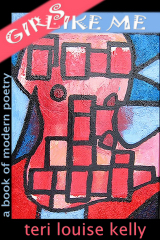
Heather Taylor-Johnson Reviews Teri Louise Kelly

Girls Like Me by Teri Louise Kelly
Wakefield Press, 2009

Apparently for some it’s abhorrent to assume that a writer writes about herself, but I’ve always loved that bit: the drama of a writer talking about her own life, or about the lives she leads. So I really appreciate Teri Louise Kelly’s Girls Like Me, because she makes no secret about it. It’s about her life: the drugs, the druggy friends, the fuck-you atmosphere, the I-am-here stipulations. In short, I love the shear drama of it all.

Continue reading

Posted in BOOK REVIEWS | Tagged ,

Tara Mokhtari Reviews APC 2010 New Poets Series

Sundecked by Rachel Petridis
The Weeping Grass by Michelle Leber
A Question of Translation by Ann de Hugard
The Mermaid Problem by Chloe Wilson
Australian Poetry Centre, 2010

The Australian Poetry Centre has published four mini-chapbooks of poems by new poets selected to workshop at Varuna with Ron Pretty in 2010. Each little collection sells for AU$10, a price that reflects the production quality more than the quality of the poems published in each. The books are intended to introduce new Australian poets, but given the miniature, low-budget presentation and editorship of the project, the poets are at some risk of being misrepresented. While any initiative to nurture and develop new poets is a welcome one, the value of this kind of publication experience to the poets themselves is worth some consideration.

Continue reading

Posted in BOOK REVIEWS | Tagged , , ,