Day in the Mind of the Life in the Garden

four weeks since the night        fed ice      fed you cube by melting cube

on a certain day of July in 2012    commenced sunshine day’s early on
secret smoke     the Bosnian bedsocks toed out in sandals

garbage out fire fixed lit compost gone recycling chimney checked smoke blue sky sunny bathmat dry already  8 32     15 inside  12 out            burning something green needs attention only down last week

for a first thing blue persisting    the dream remembers me now – I made a waterfall out of milkcrates doesn’t matter which colours      there’s some bamboo structure I explain to Max from next door remains of something I built with Halliday    I can’t tell what it was anymore      certainly not my place but of course it has to be      continents drift all night like this     I dream the perfect virus    wipes everything you look for      and following Elpenor to some unnamed town in Hell, he re-enacts the roof tumble which is when everyone’s head comes off and we go to the real underworld    torsos left frozen   the kids upstairs put rubbish on those clean cut neck plinths     and what can you say but how would you like it if someone did that to you when your head was off …
… a night of such toil and scribble it down

see in the blue that old cloud      comes for me time to time       and up to the dairy for inksports    for colour    drift for the grist    oh pleasantly pleasantly     by saliva we wash o pups    slush tongue   of the place        Ganesh hello in passing         and shall I so visit the elephant kin?   be out in the lemonfall garden       be winterchipping    show growth      for winter is the season of garden      to lurk and to linger in sickness and health

they came at you with knives

here’s hoe it has a handle   x     x     x     then up the garden path as recently set in stone
who knows where next appreciate it            and while with the spin of words       fresh yellow
someone with some arse to echo          birds through the tree

so many mail order green things to ground   to mulch   to water
the fire worries me      that plate at the back     needs someone stronger than me to shift

best to be under when they come at you    best to be talked down   those some seconds
by a radio voice and personable    best to go gently     dreamless into the tug and tear

something between rumble and flutter    and the lowing ruts    lower reaches     as here the wrens
do flit of hommage     and then the radio is with us      pianos of the competition

gout and bunion fungus toe    you can see why ghosts forego feet

four weeks since the ice night womb went     praying for rain now the pump is fixed

behind the back dam a shag suns wings         and fans to aid damp rays
only the winter bird does that    weed beguiled    the rendered spell is timber
saw and splutter and axe betide                 so many ways surviving

you see I’m in the dreamt of place     subtle of the sight before      writing on brown paper
in the one secret day of July      available among the notes keyflung     strung      mr smokey say

Posted in FALLING ANGELS | Tagged ,

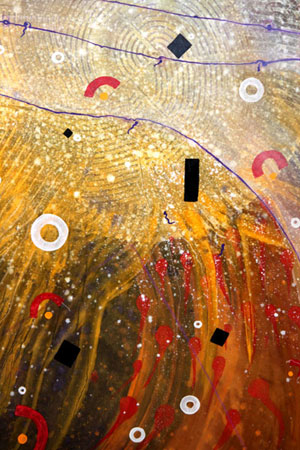
(untitled)

untitled

untitled | kit Kelen | 2012 | acrylic and mixed media |40 X 40cm

Posted in FALLING ANGELS | Tagged

Angels

When I was very young, angels were falling from the sky onto the ground. They were weak with atrophied wings due to a lack of favourable winds. Still they were attracting attention. Children would run after them asking for a free ride to the moon. The poor would run after them demanding they intercede with God to save them from poverty. Their presence was causing suspicion. The police took precautions and set up spy networks. When the angels got used to gravity and found their balance they began to demand absolute freedom for dreaming. Their demands were scrutinised. It was established that they had the wrong dreams and were flying against the wind. They were ordered to comply with Security’s recommendations immediately. Some folded up their wings in despair and tried to live without dreaming. Yet they were still mistrusted and ended up in prison. Those who refused to comply, empowered their wings with guns and took to the mountains to be near God. But God disappeared into the clouds. So the angels became victims of steel vultures and other predators while the country sank into a long-lasting lethargy.
Posted in FALLING ANGELS | Tagged

Installations 1 & 2 at Queen Street, Glebe, NSW

sculpture installations 2 in Queen Street Glebe

sculpture installations 2 in Queen Street Glebe | Hilik Mirankar | wood carving & mixed media | Image by Anna Couani

sculpture installations 1 in Queen Street Glebe

sculpture installations 1 in Queen Street Glebe | Hilik Mirankar | wood carving & mixed media | Image by Anna Couani

Posted in FALLING ANGELS | Tagged

Birth of the New Universe

Birth of the New Universe

Birth of the New Universe | Suzanne Bellamy | 2010 | acrylic & fabric on canvas | 2 x 2.4m

Posted in FALLING ANGELS | Tagged

Libby Hart Reviews Kate Fagan

First Light

First Light by Kate Fagan
Giramondo Publishing, 2012
Poetry, Paperback, 96pp

First Light is Kate Fagan’s long-awaited second full-length collection. It was published in March 2012, almost ten years to the day after her successful debut, A Long Moment, was released. Ten years is a mere blip in time for planet Earth, but what does it mean to a poet and her history? Ten years can bring a well of experience and an abundance of living – of living the poet’s life and the musician’s career, and of the academic’s savoir vivre. Labels such as lover, wife and new mother are also pertinent to this slow burning collection.
Continue reading

Posted in BOOK REVIEWS | Tagged ,

Words Wrought in the Rockies

George Bowering

This week, Canadian poet Caitlynn Cummings, editor of the Calgary-based journal filling Station, gives us the lowdown on the recent Canmore artsPeak festival, which took place in the Canadian Rockies in June.
Continue reading

Posted in ESSAYS | Tagged , ,

Notes from Narrogin and the Great Southern

I’ve led a spoiled existence over the past few decades when it comes to living in communities with thriving programs of literary activities and writers’ festivals: firstly Perth, then Albany and Geraldton. My move last year to Narrogin has found me in much quieter environs. I’m enjoying exploring my new neighbourhood. After decades living on the coast, the landscape of the wheatbelt is slowly working its way into my poems.

My new home is not without literary connections. We are 30 minutes from Wickepin, a town proud of its association with Dorothy Hewett and Albert Facey.

Foxes Lair Woodland

Foxes Lair Woodland | Image by Barbara Temperton

Narrogin is small (pop. approx. 5,000) and is the regional centre for a district where the emphasis is on farming and associated industries. The town is feeling the effects of the rural downturn. The last video store is about to go the way of the bookshop and the drive-in, but the locals are friendly, helpful, welcoming. Life is pretty subdued most of the time, but the town has a small, but very busy regional library that is at the heart of the community’s cultural life. In terms of literary-type activities, the library hosts visiting writers for talks and workshops, conducts book launches, children’s book week activities and hosts a writers group which meets monthly. In addition, ARTS Narrogin – the public face of the Narrogin Arts Council – promotes and develops the Arts in the district.

Lake Dumbleyung

Lake Dumbleyung | Image by Barbara Temperton

A bi-monthly Poet’s Café started last year in response to community consultations which uncovered a desire for a café culture in Narrogin. The Poets’ Café, where I emcee and perform, is sponsored by the Arts Narrogin and the Library, and hosted by Just Jesse’s Cafe. In order to encourage the reading, writing and performing of poetry, the Library invited Perth poet and actor Vivienne Glance down earlier this year and she presented a very successful workshop (thanks to funding from WritingWA). Performers of their own work at the Poets’ Café are short on the ground, but we all have a good time. Audience members happily perform their favourite classic and contemporary poems, and we sometimes include short writing activities. I place particular emphasis on promoting Australian poets and their work.

Dennis O’Driscoll in Albany

Dennis O’Driscoll in Albany | Image by Bookmark

I commute frequently to Albany for writing events there. I’m a member of a writers’ group that’s been working together now for over ten years and I try to make as many meetings as I can. Albany’s writing scene is an active one, supported by a very engaged community of writers and readers, the Albany Public Library, local bookshops, and by Bookmark. Bookmark, a project of Creative Albany, is about bringing reading and writing activities to the Great Southern region. In February this year Bookmark, in collaboration with the Perth International Arts Festival, presented the Write in the Great Southern festival, which tag-teamed with the Perth Writers Festival and featured – amongst other visiting writers – the Irish poet Dennis O’Driscoll. I had the opportunity to show Dennis some of the sights of Albany, and later we both enjoyed an animated “In conversation” with poet Graham Kershaw as part of the WIGS festival program.

Dark Diamonds

Dark Diamonds | Image by Graham Kershaw

Denmark, WA-based Graham Kershaw (Hallowell Press) has been working for some time now on the production of the poetry anthology: Dark Diamonds: poems from the south coast of Western Australia. Dark Diamonds has been printed on a treadle platen press – an Arab, designed in the 1870s – using traditional letterpress techniques, with Centaur metal type imported from a foundry still operating in California. The books are hand-bound, as cloth-lined hardbacks. Alison Kershaw’s illustrations are copper relief etchings printed on the Arab. Dark Diamonds will be launched at 3pm on Saturday, August 25th, at the Butter Factory Studios, 8/12 Mt Shadforth Road, Denmark.

Posted in ESSAYS | Tagged , ,

Chair Insider: An Intimate Access in Photo Narratives

[EasyGallery id=’junogemes’]

Click on the image above to view this gallery. Images can be expanded to full size at top right of each image

Andrew Sayers, director of the National Portrait Gallery, wrote of my work, ‘Trust is an important quality in portraiture. Trust is self evident in Juno Gemes’ photographic portraits’. The portraits published here were created in trust with literary friends.

Continue reading

Posted in ARTWORKS | Tagged , , , , , , , , , , ,

Adam Aitken Reviews John Mateer

Southern Barbarians

Southern Barbarians by John Mateer
Giramondo Publishing, 2011

Southern Barbarians is a book that explores both the colonised and the colonizing impulse through the inflections of the Portuguese epic Os Lusíadas by Camões, the explorer/soldier/poet-traveller and heroic poet of the Portuguese. The book ranges from Lisbon to Macao, taking in Indonesia, Malaysia, Warrnambool, and Japan on the way. This is a world where African businessmen in Macao see ‘African wildlife’ in a travel agent’s window, in an image of savannah they are no closer to than the Macanese.
Continue reading

Posted in BOOK REVIEWS | Tagged ,

Translating Hidayet Ceylan and the Melbourne PEN Freespeak Reading

In his introduction to The Random House Book of 20th Century French Poetry, Paul Auster quotes the great French thinker Maurice Blanchot: ‘Translation is Madness.’ Anyone even beginning to attempt such an activity (perhaps, especially, when dealing with poetry) soon senses the truth in this statement. However, I would add that it can be a pleasurable kind of madness and that for me, working with Hidayet Celan on translations of his own Turkish poetry, the process has always been a genuine pleasure … and only very occasionally maddening. Over the last five or six years of our friendship, Hidayet and I have together translated nine or ten of his poems. He has recently translated one of mine into Turkish.

It must be said, though, that we are friends first, and literary colleagues (of sorts) only after that. Unlike the large majority of poetry that is rendered into languages other than its original, ours is done so without any real thought of profit, or even necessity. Unsurprisingly, our efforts proceed slowly.

Often I’ll ask Hidayet the meaning of a work and he’ll explain it by means of a long and ancient parable, at the end of which I’m none the wiser. Despite the fact that we are both ‘amateurs’ at the art of translation, we still manage to satisfy the other in the end. After all, the word amateur itself comes from the root of the French word ‘to love’. We work together in such a way that it’s not truly work at all: I’m learning his language a little – as I don’t speak Turkish at all – but am at least bringing an affinity of his sensibilities to the process, and the ability to write poetry in English. Plus, there’s a mutual discovery in the intricacies and delights of each other’s world-view and the way it’s expressed.

In the piece of mine which was recently translated for the Melbourne PEN reading, it became abundantly clear to me that my poem (rather Australian in that even while protesting a particular mind-set, it remained agonistic in a dry, almost understated way) was being carried over into a totally different style – dramatic, impassioned, even theatrical. It’s a delicate balance, but often when we translate, we can at best only make the foreign work into something like what the writer would write if he or she was writing in our language, from our culture.

This phenomenon is apparent in a particular way when one experiences directly the musicality of different languages. This was especially pronounced at the recent ‘Freespeak’ reading at Federation Square in Melbourne’s CBD.

The writers and translators represented present were Nguyen Tien Hoang [Thường Quán] and Gig Ryan (Vietnamese), Anne Talvaz and Jennifer Harrison (French), Rochelle D’silva (Hindi – mother tongue, Konkani), Lauren Williams (Spanish), Ajak Mabia (Dinka), as well as Hidayet and myself. The environment itself was perfect for the event: a clear sound-system, quiet, attentive audience that was large enough in number to fill the room – itself arranged so that the focus was on the performers, not other distractions.

Significantly, a number of the pieces were sung rather than spoken – reminding us of the oral origins of poetry and therefore literature. Ajak encouraged the audience to clap in time and rhythmically chant – underneath parts of one of her pieces – the words ‘ya habib’ (my love/dear friend). As a translator and poet performing their work, it had exactly the kind of ambiance one would wish for. The variety of languages and approaches, as well as the brevity of the pieces, meant that very little appearance of the familiar ear/brain fatigue occurred, common at many poetry readings. I represent the views of all those involved in saying that the organisers should be congratulated, and one can only wish that such events were more frequent.

For those who wish to see a video recording of the event, it will be available for streaming on Channel 31 TV’s Red Lobster at some point in the near future, as well as at Melbourne PEN.

Posted in GUNCOTTON | Tagged , ,

Susan Hawthorne Reviews Robyn Rowland

Seasons of doubt & burning: New and selected poems

Seasons of doubt & burning: New and selected poems
(Five Islands Press, 2011)

Robyn Rowland’s poetry career spans thirty years, with her first book, Filigree in blood, appearing in 1982. Reading this volume of new and selected poems is a journey in memory, an almost autobiography. I first heard Rowland read in 1982 at the Sydney Women Writers Festival and I was very taken by her ability to phrase poems in just the right way so that a listener can follow and take in her meaning. Indeed, for some of her poems in this collection, it was as if I had Rowland’s voice in my head – no easy task for a writer to achieve that. It means that the rhythm or pace or vocabulary is just right.
Continue reading

Posted in BOOK REVIEWS | Tagged ,

Re-inscriptions of ‘Aus-lan’

Soundscapes Soundscape II | Annette Iggulden | 28x29cm | Image courtesy of the artist and Watters Gallery, Sydney

We relate strongly to the way women have, throughout the centuries, found alternative avenues for their voices using different aesthetic forms. Our interest is with words, images, the interplay of verbal and visual languages in art, the role of words as images and the state of ‘silence’ created by cryptic or unintelligible scripts.

Annette Iggulden has exhibited extensively in galleries throughout Australia. Her work is represented in major Australian collections and at the Victoria & Albert Museum in the U. K. Her doctoral exegesis, Women’s Silence: In the Space of Words and Images (2002), is held in the Research Libraries of The TATE (UK), the National Gallery of Australia and other major state libraries. She has been awarded several artist residencies in Australia and overseas.

During Iggulden’s artist-in-residency (The Australian Tapestry Workshop, Melbourne: November 14 – December 2, 2011), she commenced an investigative series of works on paper, re-writing the words from ‘Aus-lan: Australian sign language’ by Australian poet, Jennifer Harrison.

Says Iggulden …

‘During my three-week residency at The Australian Tapestry Workshop, I concentrated on several investigative series of works on paper drawing from the poem ‘Aus-lan: Australian sign language’ (1994). This inspiring work looks at how the ambiguities of life might be expressed in different ways including ‘signing’ and other bodily performances of language, written, spoken, felt and experienced. Soundscapes is one of those series.

I am always moved to learn how groups of people have, throughout the centuries, expressed their ‘silence’ by creating their own language and forging alternative avenues for their voice. I copy the words of others, re-writing their words using the two cryptic scripts I have derived from alphabetic writing in my art practice. My intuitive method of re-inscription changes the written text into a visual image. The act of writing then takes on the role of drawing. The handwritten scripts retain a sense of the voice while enhancing the nonverbal aspects of the narrative, its ‘silences’. My intention is never to illustrate the text but rather create a different experience of its content’

This work looks at how the ambiguities of life are expressed in different ways – including ‘signing’ and other bodily performances of language, written, spoken, felt and experienced. Iggulden’s does not illustrate the text, but expresses it in a different, visual language. We wanted to explore how technological workshop methods might transform words/images when embedded in cloth.

Aus-lan: Australian sign language


My deaf friend said to me: our conversations
			  are overheard, everywhere we speak.
He teaches me the sign for Sydney: the shape

of a harbour bridge, skin webbing blue water.
			  I hear a quiet voice in my hands
in the silence when I am speaking

and foam, rubber, snow and glycerine
			  seem softer in the fingering span
than spoken words falling short of what they name.

I once saw a baby catching sunlight in his hands—
			  everywhere the child touched
he laughed at what he could not touch

until language wheeled his pram away
			  and he learned that silhouettes and sun
were called chair and where.

Precisely, in mother tongue, we categorise
			  the conch shells, sea hollows
the safety pins and taboos.

My friend said: I will teach you
			  what you need to know...
other signs belong only to the deaf.

He teaches me the sign Forget
			  it is a fist placed against the right temple
the hand opening, flicking sun away from the head.

Soundscapes Soundscape I | Annette Iggulden | 28x29cm | Image courtesy of the artist and Watters Gallery, Sydney

Posted in ARTWORKS | Tagged , ,

Adam Ford Reviews Thirty Australian Poets

Thirty Australian Poets

Thirty Australian Poets (University of Queensland Press, 2011)

Thirty Australian Poets is a new anthology out of UQP that focuses on the work of poets born after 1968. It’s an intriguing conceit that invites comparison with the work of the Generation of ’68 without actually issuing a challenge per se, but at least prompting a ‘look where we are now’ conversation. Since this constraint naturally excludes both poets who make up Australia’s vibrant live poetry scene (who tend not to be as widely published on the page) and also talented poets whose work may not have yet been collected, the poetry on offer does tend toward the formal.
Continue reading

Posted in BOOK REVIEWS | Tagged , ,

Notes from the NT: EZB on WordStorm 2012

Coming from Melbourne, the best thing about arriving in Darwin was seeing that ol’ stranger, the Sun, shining in the sky like a big yellow present to me. I spent the first three hours rolling on the grass like a dog that had been locked in a shed for a week … but I cleared my throat, looked around self-consciously and straightened my skirt. I was here for words.

I grabbed the program and began to circle. It was stuffed full of fabulous guests, events and panels. Despite its small population, the NT has a large community of writers – the festival was packed with both local and interstate poets, novelists, writers and speakers. This year the Writers’ Centre had merged with Australian Poetry to bump together their biannual poetry festival with WordStorm. There promised to be ample Australian Poetry (AP) events mixed in with the main program – some were streamed live around the world and are still available here.

I went head first into the festival opening with a slam I co-hosted with Brisbane performance poet and cabaret superstar Ghostboy. The slammers consisted of locals and participants from the festival, all were judged by the audience. We named the winner, Nigel Ford of SA. The Darwinner (BAM!) Highlights included a poem by Lyndal Cairns made using words she learned from her Nokia phone dictionary – a girl who claimed she wants to start a movement where women carry round wet wipes in case they see 10-year-old girls wearing make-up. There was also a man who stripped down to nothing while performing his poem, leaving nothing but a half-eaten hotdog squeaky toy to cover his business. It was all quite marvelous and I do hope this is a trend we see spreading through the slam scene in Australia.

I performed a poem about being wet – a poem which the locals replied, ‘you have no idea about wet until you come here during Jan/Feb … you can’t write poetry about that … it’s inexpressible.’ This I immediately took as a challenge.
Darwin’s wet season sounds like an unbearable feat of human endurance. I later learned that it can come with uncontrollable weeping. Somehow the body – like the sky – just produces a torrent of falling water and there’s nothing you can do about it.

I got a small glimpse of The Wet the next night when I attended SlamTV, a showing of poetry ‘film-clips’. The two poems that stood out were by local Darwin writers; ‘Two Men’ by Dominic Allen and ‘Postcard from Hell’ that captured the horror of the wet season. It’s worth checking out on the Slam TV website. Clips were around three minutes, some were animated, some were shots of the poets performing and some were thick and arty. Most of it was fantastic. Some of it, awful. A real slam, only filmy!

The next day started with a reading in Civic Park which continued through the whole weekend, people gathered under a huge tree to hear poetry and stories from all sorts of writers, including Nam Lee (who was astonishingly underused), Lionel Fogarty, Jenifer Mills and Sam Wagon Watson amongst many more. It was kinda fantastic sitting out in the open, but was also kinda right next to the coffee machine. Readers were perpetually being sound-tracked by grinding and frothing … which is fine if all your poems are about zombies, but surprisingly, most weren’t.

My next event was a panel; ‘Ut Pictura Poesis: The Aesthetics of Poetry’ which, along with myself, included highly acclaimed Chinese poet and translator Ouyang Yu, Ghostboy, Australian Poetry Slam Champion Kelly Lee Hickey, Multiple award-winning poet Bronwyn Lea and American writer and teacher Ryan Van Winkle. I was excited to talk about the aesthetics of poetry, the essence of it, what turns you on as a reader and writer, what makes poetry poetic, beautiful and astonishing. But the discussion inevitably led down the old Stage vs. Page route which I find flaps on like a pair of old jeans on the line.

Things got a little blurry after that as we went out for drinks in the nearby bar. There may have been a heated political argument with actor William McInnes. I can’t be sure. Overall, it was a rewarding festival. I had to leave early on the last day so I missed the poetry debate ‘Are Sonnets Better Than Sex?’ I heard it was great though, and that poetry sex, as usual, won out in the end.

I’ll see you again soon, Darwin, armed with tissues, towels and a waterproof pen …

Posted in GUNCOTTON | Tagged , ,

A Series of Fives: Notes from Seoul

This is a country of ghosts and robots. A country of seven thousand living poets – none of them talking to one another. The once-hermit kingdom, where all but gentry were garbed in white, now spills the neon of frantic consumerism. Seoul is a city-state; big government doing big deals in big smiles (when they’re not throwing punches or teargas canisters across parliament). At its centre, Korea is fractured – shaded by the shadowy near-history of military regimes morphed into what now passes for democracy. Beyond the DMZ and the world’s strangest brother / neighbour, the DPKR, is a dim but palpable, threatening absence.

Underpassing in Korea

Underpassing in Korea

Is it unfriendly to claim Seoul is a city dislocated from itself? Unlike Warsaw’s old town, meticulously rebuilt after WW2 – brick by original brick – Seoul of the 1950s was terra-formed with the pragmatic architectures of a starving, cold people: concrete smeared over the razed post war landscape. A generation of socialist-minded poets traipsed across the border and disappeared. The civilian war dead numbered in millions.

Now business howls in the aeries here. The ambience is eerie; luxury everywhere while ghosts mill underground in metro stations. The shaman have vanished, and Buddhist temples un-favoured by Korean hipsters who flock instead to cathedrals to sing hymns. In this post-textual place, where internet is a sixth sense, it seems that all the songs sung belong to someone else.

Each ‘robot’ has a smart phone; pushing ghosts out of the way to clamber aboard the early morning commute. Do these multi-taskers ever really leave work?

Lobe 1

Lobe 1

Lobe 2

Lobe 2

Big busy-ness = an inter-generational enchantment. This is what makes skyscrapers grow at velocity and industries into empires. This obsession is what makes these emergent humans, so profoundly linked and connected, paradoxically atomized.

The young poets I know are non-participants, outsider offspring of two competing schools: the Ch’amyŏ’p’a Group, who critiqued Korea’s socio-political unevenness, and the Sunsup’a Group, who maintained a purely literary focus. The poets I talk to are writing about body modification, schizophrenia, collective exhaustion, and a patriarchy gone wild.

Seoul is a mono-cultural megalopolis where at any moment you’ll find five preferred haircuts / five fabricated pop tunes on high rotation / five fashion statements to choose from. In this rule-bound plutocracy, a poem (as always, and with thanks to Badiou) is a lawless proposition and necessary transgression.

Gridlocked = the state of traffic and mind; any voice that challenges these systems speaks independently and courageously. What is less heartening is that none of my students of English Literature reads contemporary Korean poetry. Their focus is elsewhere.

They want someone else’s avant-garde. The English canon = enhanced language skills = (potentially) escape to (a perceived) utopia (eg, elsewhere or upward).

The Korean education system is as mythological as the rate of youth suicide; those who do not simply cope (itself a feat) but thrive, arrive at university pre-programmed with three or four languages, maybe a blackbelt or municipal chess championship trophy, and the heaviness of an aggressively high pressure future upon them. Can they do English language poetry? With gusto. Tell them to think for themselves and these second-language users cannot stop: whether I throw Bernstein or Bök at them, they get it … perhaps because they’re from a place where ‘language control = thought control = reality control’.

What they want is critically literate English, in all its otherness and nuance. What they want it for is altogether another matter.

Posted in GUNCOTTON | Tagged ,

Heather Taylor Johnson Reviews Young Poets: An Australian Anthology

Young Poets: An Australian Anthology

Young Poets: An Australian anthology, edited by John Leonard
John Leonard Press, 2011

I’ve respected John Leonard Press since its beginnings in 2006, and over the years a theme has formed across its publications. Leonard’s poets have a lot in common. There is nothing slapdash about any of them. These are poets clearly enticed by language and by the theories of life. Don’t expect rhyming. Don’t expect clichés. And do not, above all, expect anything simple.
Continue reading

Posted in BOOK REVIEWS | Tagged , , , , , , , ,

You Are Here: Canberra, March 2012

You Are Here

You Are Here

I lived in Canberra for five years. It rocked. But it is very true that Canberra’s literary credentials do not make themselves readily known to casual visitors. Used in the short, Canberra is more commonly code for a kind of politicking: bureaucracy, tax, meetings, money, rah rah rah; Abbott, Gillard, et cetera. Yet as many residents will tell you, there exists sleeper cells of activity dispersed in backyards, small hidden venues and local park halls throughout the inner suburbs and beyond. Smiths Alternative Bookstore, Gorman House, The Phoenix, The Front. These are your passwords.

The second You Are Here festival, held over ten days in March, sought to ‘showcase the best of Canberra’s diverse independent and experimental arts and culture’. I hope they don’t mind the comparison, but You Are Here is sorta like TiNA, utilising traditional and non-traditional city spaces as a testing ground for all manner of wild pursuits.

This year, these wild pursuits included four poetry events, all of which accommodated jam-packed crowds. Poetry is pretty well represented in Canberra, from Geoff Page’s longstanding Poetry at The Gods reading series, to regular slams and open mikes, and small creative journals such as the now-defunct Blast and Block (cough…I was one of the editors of the latter for a while) and newcomer Burley.

During my years there, the Traverse poetry slam held at The Front in Lyneham, was the epicentre of my social and creative life. It is not too OTT to say that I’ve never experienced a stronger or more vibrant creative community. Although technically a slam, this event was always a lot more diverse than that, and became a place where print-outs and pamphlets were exchanged and dangerous ideas debated well into the am hours. With bitter-sweet timing, this slam’s founder and organiser for the past six years, Julian Fleetwood, announced just last week that he is putting the mike down to rest.

So, You Are Here. I didn’t make it to the festival this year, but for this blog I’ve invited three people involved to give their take on the poetry events that happened over the ten days. David Finnigan, playwright, performer and festival co-producer; Andrew Galan, co-founder of the BAD!SLAM!NO!BISCUIT! poetry slams and accomplished poet; and Miranda Lello, a formidable poet who represented the ACT in last year’s Australian Poetry Slam final. All photos are by Adam Thomas, YAH’s official photographer, reproduced under a Creative Commons license. You can view more of Adam’s work.

Andrew Galan

Andrew Galan

[David] The Tragic Troubadours presented poetry in the Civic Interchange at peak hour (8-9am and 5.30–6.30pm) over four days. I came along to the first iteration to keep an eyeball on it – the risk management part of my brain was envisioning sleepy white collar peeps being harangued by frothing poets on soapboxes – but the reality was actually really lovely. I approached the quartet of poets and pretended to be a real person. They offered me a choice of four poems and I chose the one about a late night cup of tea.

Tragic Troubador Bela Farkas and You Are Here co-producer Adam Hadley at B!S!N!B!

Tragic Troubador Bela Farkas and You Are Here co-producer Adam Hadley at B!S!N!B!

[Andrew] Through The Tragic Troubadours the You Are Here Festival walked out of venues and into Civic to offer itself to anyone willing to take the chance of saying yes to the surprising offer of a poem with no strings attached.

[Andrew]People who turn up for Bad!Slam!No!Biscuit! know they can be involved, people there by accident come back, and we are seeing great poets emerge from this, as well as seeing more and more people who will listen to the poems and then be vocal in their opinions of the pieces.

Traverse poetry slam organiser Julian Fleetwood

Traverse poetry slam organiser Julian Fleetwood

[David]The Even More Secreter Gig at the festival hub on Monday 12th was a festival highlight for me, partly because it was the exact opposite of that. 50–60 people crashed out on couches listening to four poets read their work. It was mellow and for me, at least, when you’re crashed out somewhere comfortable, your mind is free to go wandering.

Above: Miranda Lello, Mathew Abbott, and interstate guests Zoe Norton Lodge and Pip Smith perform at the Even More Secreter Secret Gig.

[Miranda] Sitting on an armchair in an abandoned newsagent I’m fairly sure not everyone can see me reading my poem. But I figure that no one cares too much. I read an old poem about sex and Charles Bukowski. Everyone’s listening, but it’s hard to tell whether they’re on board the poetry train or not.

David Finnigan and YAH coordinator Sarah Tamara Kaur on board the poetry train at EMSSG

David Finnigan and YAH coordinator Sarah Tamara Kaur on board the poetry train at EMSSG

[Miranda] Someone circulated a flyer saying We are everywhere urging us to turn the artistic content of the festival into a generalised feature of existence in Canberra. Can we have poetry in the sunshine, in empty buildings, without a ‘festival’? I think about that leaving the newsagent, having told none of my friends from work I was performing – why does poetry always live in boxes, in particular spaces. Can we bring it into our lives? Can You Are Here be a model for different kinds of creation in all the spaces of Canberra?

Posted in GUNCOTTON | Tagged , , , , , , , , ,

Submissions for INTERLOCUTOR Now Open!

INTERLOCUTOR, guest edited by Libby Hart

Libby Hart circa This Floating World

Beginning with this issue of Cordite, we will accept up to four poems per submission. This includes text, sound, image, video and other digital forms of poetry. INTERLOCUTOR will include features, interviews, updates and more from just about every angle this theme can be approached from.

Poetry is in nonstop dialogue with the world. Each symbol, line, frame, beat or stanza enters into a conversation. They question. Poetry is interrogation. It is instruction.

In fact, it can be most anything you want it to be. Absurd. Open-minded. A fragment of a speaker’s speech that becomes whispers and shouts of drama or humour. A Glaucon to your Socrates. A Casio to your Moog to your Farfifsa. Who is the speaker? Who is listening? Are you willing to have a conversation? If you play Defender, can you be our hyperspace?

Cordite 40: INTERLOCUTOR will be guest-edited by Libby Hart and feature artwork from Melanie Scaife and James Bonnici.

Libby Hart’s most recent collection of poetry, This Floating World, was shortlisted for the Victorian Premier’s Literary Awards and The Age Book of the Year Awards. Her first collection, Fresh News from the Arctic, received the Anne Elder Award and was shortlisted for the Mary Gilmore Prize. She is a recipient of an Australia Council for the Arts international residency at the Tyrone Guthrie Centre at Annaghmakerrig (Ireland) and a DJ O’Hearn Memorial Fellowship at The Australian Centre, The University of Melbourne. Her poem, ‘The Briefcase Phenomenon’, was chosen for the inaugural Poetry in Film Festival in 2010 and filmmakers produced short films inspired by it. In the same year, This Floating World was devised for stage and performed by Teresa Bell and Gavin Blatchford. These performances received the Shelton Lea Award for Best Group Performance at the 9th Melbourne Overload Poetry Festival Awards.

Please read Cordite‘s full submissions guidelines before you submit.

Posted in GUNCOTTON | Tagged , , ,

Divertimenti: Hemensley on the Time of Vleeskens

Title page of Divertimenti

Title page of Divertimenti

In memoriam: Cornelis Vleeskens, 1948-2012

Reading Cornelis Vleeskens’ divertimenti on random days (Earthdance, 2010), has me thinking of Franco Beltrametti, as occasionally I do. We almost met, courtesy of Tim Longville and John Riley, who’d advised that Franco, our fellow Grosseteste Review contributor, would be visiting London in ’71 – or was it shortly before the Hemensleys returned to Melbourne in ’72? – but that was cancelled. Any meeting in the flesh was forever thwarted by his Beltrametti’s death in 1995. He remains an exotic correspondent, then, from the golden age of hand and typewritten letters, always missed now as though a friend.

And Vleeskens’ book instantly recalls Sperlonga Manhattan Express, an international anthology edited by Beltrametti (Scorribanda Productions, San Vitale, Switzerland, 1980), because of the A-4 / 210-297mm dimensions and the visual content – Franco’s pictures from all hands and lands (e.g, P. Gigli’s photo of the Berrigans, poems by Koller, Raworth, Gysin, Whalen postcard/cartoon, J Blaine, G D’Agostino, et al); Cornelis’ own montage, drawings, calligraphy, typography – the same mail-art internationale, Fluxus, neo-Dada style more readily recognized from Pete Spence’s affiliations and practice, particularly relevant here because of the latter’s regular appearance in the divertimenti.

Vleeskens and Beltrametti are both Europeans who’ve crucially intersected with the anti-formal (looser, casual) English-language poetry – are they ‘casualties’ then? – especially the post WW2 Americans, progeny of Pound and Williams, New York, San Francisco, the West Coast, at a time when Europe was reaffirming its own liberatory tradition (Dada, Surrealism, etc) and, similarly, opening to new worlds. Because they’re not British or North American or Australian, except by adoption, their European origins and references are never out of mind.

Not an exact match, by any means – but somewhere along the line they’ve both decided to riff on life and not on literature, though there is a literature of just that sort of thing, and a life that contains literature, music, painting, etc. But theirs is another reminder of the efficacy of the un-made, journal-esque writing – as clear and direct as we reconstruct the Ancient Chinese and Japanese to be, and whose transparency doesn’t necessarily prefer the naive to the esoteric or the well-known to the uncommon (take the music Vleeskens listens to daily and records in his communiques, or his philately habit or the breadth of his correspondence, all noted).

Beltrametti’s poem ‘The Key’ might be a credo for Vleeskens too:

What was well started shall be finished. / What was not, should be thrown away.
Lew Welch, Hermit Poems.

1 ) the place & the season : winter
2 ) somebody (myself) right here : real & unreal
3 ) what is he doing & what’s going on in his head
4 ) how & why is he saying it
5 ) to somebody else (you) elsewhere
something happens?
the circle (real & unreal)
isnt closed

[27/1/72]

Divertimenti: to amuse himself and his friends, to divert and be diverted. Diverted from what? Old cliche: the bind of daily life. But hardly, since it’s all this poetry’s made of. His note, ‘These divertimenti originally appeared as individual leaflets and were written for the poet’s own amusement and that of the handful of friends who were lucky enough to receive the odd one in the mail or at a poetry reading during the last two years of his life on the Victorian coast … he now lives a totally different existence on the NSW Northern Tablelands.’

Introduction to Divertimenti

Introduction to Divertimenti

How would you know?

His latest Earthdance chapbook, Sandals in Camel (drawings & poems), is surreal as a narrative and peppered with elsewhere’s place names and distinctions (New York, Parisian, Berlin, Belgian, Catalan, Japanese, Thai, Italian etc), persuading one of his long assumed cosmopolitan ambit. Interesting inference though – ‘texts’ of the life as lived versus ‘poems’ (importantly, formed in the cross-wires of Dutch and English).

An earlier collection, Ochre Dancer (Earthdance, 1999), has the same atmosphere and tone of divertimenti or better said, the divertimenti are cut from his familiar cloth differing only in the attitude of making or framing.

That’s the discussion then, in the blur of any such distinction these day … bits of life (titles and notes of musical recordings, books, lists of food and drink bought and consumed, incoming mail) intersect with thoughts, observations, conversation.

Recalling Kath Walker’s – Oodgeroo of Noonucull – admonition not to appear like a preacher or a politician, Vleeskins muses, ‘Sometimes I wanted to PREACH / But now I just want to share / some of the ordinary things / in the days of a retired poet …’

Diversions from the notion of retirement? Retirement from poetic ambition (craft and career)? I identify with that myself. Breaking the cast but keeping one’s hand in, and surprising oneself when something more poem than antidote happens along. The list/letter/journal poetry of our time makes it harder to distinguish source from artefact, but found or made they provide as many pleasures as there are days.

‘Ah! a new month!
So I turn the calendar to March
A Corneille arial landscape
looking like a cross between
Mondriaan’s sketch of a jetty
jutting into North Sea waves
and Clifford Possum Tjapaltjarri

The calendar was published
for Corneille’s 70th birthday
11 years ago but I still
flip over each month
to show that not all days are the same’

Divertimenti is a book which can be taken up anywhere. It invites flicking because of the open-endedness of its narrative.

‘Find an image
of the sun’s atmosphere
in The Nature of the Universe
by Fred Hoyle (1950)
so reach for Catherine de Zegher
Untitled Passages by Henri Michaux
hardback catalogue
of the exhibition at
The Drawing Center, New York, 2000

& put on an old vinyl recording
of Peter Sculthorpe’s Sun Music #1
for Orchestra (1965)

The sun sets at 5-58

Broodje haring
broodje kaas
en ‘n zure bon

Enjoy a glass or two of red
& the clear sound of Marion Verbruggen
playing airs from van Eyck’s
Der Fluyten Lust-Hof

ah!

ah! | c'Est mon daDa series | Red Fox Press, 2011

So many dates and times of day, month, year, but the book is always written in present tense, and a sense of the present, in which historical time is subsumed, pervades. All times in diverimenti are concurrent; even the different places defer to the here of Vleeskens’ whereabouts.

Despite it being a kind of ‘in-lieu of writing’ (an ‘in-lieu-of-writing writing’?), possessing the light touch of genial conversation and a journal’s talking-to-oneself, it also teases one as a discourse on time and place, and of poem as its own place where, paradoxically, its own mercuriality might be traced.

Unsurprisingly, much of this has been the preoccupation of divertimenti‘s fellow classical and modern music afficianado Pete Spence – typically recalled by Vleeskens at one point, ‘I think up these lines / while walking home / after putting Katherine / on the 6.37 a.m. bus for Melbourne / but have to wait to write them / till the telephone wakes Pete at 10.35 / My pen & paper are on the desk / in the guestroom where he snores on’


This is an excerpt from Kris Hemensley’s blog, Poetry & Ideas.

Posted in ESSAYS | Tagged , ,

Notes on Five Canadian Small (micro) Publishers

The Five: Apt. 9 Press, The Emergency Response Unit, AngelHousePress, Nomados Literary Publishers and Greenboathouse Press

Canada has had a wide array of small literary publishers over the past few decades. Most notably, the small press explosion in the 1960s created small presses such as Coach House Books, blewointment, Talonbooks and Oberon Press. These days, some of the most compelling works of poetry and fiction in the country are produced through presses such as Toronto’s Coach House Books, BookThug, House of Anansi Press and Mansfield Press, Vancouver’s Talonbooks, CUE, Arsenal Pulp, Line Books, New Star Books, Anvil Press and Nightwood Books’ blewointment imprint, Edmonton’s NeWest Press and University of Alberta Press, Calgary’s Freehand Books, Montreal’s Snare Books and Nova Scotia’s Gaspereau Press, among plenty of others.

There are quite a number of micro-presses across Canada that have been producing smaller-run items, hand-made and otherwise limited-edition books and chapbooks that rarely make their way into bookstores. These are distributed through individual hand-sales, small press fairs, mail order, trades, or the gift economy of producing small press works. One of the interesting features of many chapbook publishers across the country (most likely similar to publishers in other countries) is in the number of presses started by writers themselves. Often (but not necessarily), these start as self-publishing ventures that expand, whether as initial concept or further down the line, to producing work by others.

Originally, I sent a series of questions to about a dozen small and micro publishers across the country, but only a handful were able to respond, providing only a fraction of what is a much larger canvas of Canadian writing and publishing. Apart from the publishers featured here, a more expansive list (not pretending to be complete, by any means) might also include:

David Zieroth’s The Alfred Gustav Press (North Vancouver BC), Caryl Wyse Peters and Shane Neilson’s Frog Hollow (Victoria BC), Ursula Vaira’s Leaf Press (Lantzville BC), Janet Vickers’ Lipstick Press (Gabriola Island BC), Rob Budde’s wink books (Prince George BC), Barry McKinnon’s Gorse Press (Prince George BC), Jenna Butler’s Rubicon Press (Edmonton AB), Trisia Eddy’s Red Nettle Press (Edmonton AB), Derek Beaulieu’s NO Press (Calgary AB), the collaborative JackPine Press (Saskatoon SK), Karen Schindler’s Baseline Press (London ON), Kemeny Babineau’s Laurel Reed Books (Mt. Pleasant ON), Jay Millar’s BookThug (Toronto ON), Sarah Pinder’s bits of string (Toronto ON), Marcus McCann’s The Onion Union (Toronto ON), Gary Barwin’s Serif of Nottingham (Hamilton ON), Stuart Ross’ Proper Tales Press (Cobourg ON), JW Curry’s various publications through his Room 302 Books (Ottawa ON), Carleton University’s In/Words (Ottawa ON), Bardia Sinaee’s Odourless Press (Ottawa ON), Nicole Markotić’s Wrinkle Press (Windsor ON), Andrew Steeves’ Devil’s Whim imprint of Gaspereau Press (Wolfville NS), Joe Blades’ Broken Jaw Press (Fredericton NB), Marnie Parson’s Running the Goat (St. John’s NFLD), and possibly even my own above/ground press (Ottawa ON).

Apt. 9 Press, Ottawa ON: Cameron Anstee, editor and publisher

Cameron Anstee

On August 24, 2011, when Apt. 9 Press publisher/editor Cameron Anstee hosted a launch of his two most recent Apt. 9 Press titles – Leah Mol’s And I’ve Been Thinking Dangerously and Justin Million’s HADRON – he mentioned the possibility of the press taking a temporary break. He expands on this in an email: ‘I’ve just started a PhD in English Literature and want to get settled into that before returning to publishing. In the longer view, I’d like Apt. 9 to be around for many years. The books are demanding of my time, energy and focus. I don’t want to give them half of what they deserve because my attentions are elsewhere. A few months or a year being quiet will not seem such a long time ten years from now.’

Over the past two years, Ottawa poet Cameron Anstee has produced nearly two dozen titles in a series of limited-edition chapbooks and broadsides of poetry, fiction and non-fiction. Each are hand-sewn and numbered in editions of 50 copies. Apt. 9 Press has published single-author collections by writers such as Sandra Ridley, Stuart Ross, Michael Blouin, Michael Dennis, Leigh Nash, William Hawkins, Ben Ladouceur and Monty Reid. Copies are distributed at venues such as the Ottawa small press book fair, Toronto’s Meet the Presses, Ottawa’s VERSEfest, and reading series including The TREE Reading Series and the In/Words Reading Series, as well as through Apt. 9 Press’ own launches throughout the city.

It has been interesting to watch the development of small press in Ottawa over the past decade or two, with publications over the years from Amanda Earl’s AngelHousePress, Christine McNair’s cartywheel, Steve Zytveld’s Dusty Owl, jwcurry’s 1cent/Room 302 Books, Adam Thomlison’s 40-Watt Spotlight, Grant Wilkins’ The Grunge Papers, and Rod Pederson and Rona Shaffran’s The TREE Reading Series, among others. In his ‘12 or 20 (small press) interview’, Anstee talked about being at Carleton:

My introduction to small press publishing came during a Canadian Literature survey taught by Prof. Collett Tracey during the second year of my undergrad. She gave a lecture on [Raymond] Souster, [Louis] Dudek, [Irving] Layton and their Contact Press that absolutely floored me. I’d never heard anything like it and couldn’t understand why they didn’t teach THAT in high school. From there, I became involved in the student-run campus little mag and chapbook press (In/Words at Carleton University).

When my time at Carleton was drawing to a close, I was hooked and needed to start something of my own to keep myself in that world.

An Ottawa native, he recently completed a M.A. in English Literature at Carleton University, writing a history of the infamous Contact Poetry Readings, which is considered the first poetry reading series in Canada (‘Because it brought the world to us:’ A History of the Contact Poetry Readings (1957) 1959–1962). While at Carleton University, In/Words Magazine and Press published his own work, and later he edited publications by newer writers, including Jesslyn Delia Smith. According to their website, founded through the English Department in the fall of 2001, In/Words ‘…began as a reaction to a first year seminar course taught by founder Professor Collett Tracey in which students were encouraged to write.’ They now produce an ongoing journal, and a small stack of chapbooks of poetry and fiction, all distributed for free, as well as various incarnations of regular readings and writing workshops. In many ways, Anstee’s work with Apt. 9 Press could be considered a continuation of the work started at In/Words, furthering and maturing the lessons begun through Carleton University’s English Department, and his own published writing, none of which has appeared with Apt. 9 Press, includes the poetry chapbooks Remember Our Young Bones (Ottawa ON: In/Words Magazine & Press, 2008), Water Upsets Stone (Toronto ON: The Emergency Response Unit, 2009), Frank St. (Ottawa ON: above/ground press, 2010), She May Be Weary (Ottawa ON: St. Andrew Books, 2011) and The Turning of Pages Should Not Be Audible (Ottawa ON: St. Andrew Books, 2011).

Despite the scheduled break, it’s completely impossible to remain partially in publishing; in December, 2011, it was announced that one of Anstee’s titles, Claudia Coutu Radmore’s Accidentals (March, 2011), had won the bpNichol Chapbook Award. ‘I’ll be in course work until next summer. I’d love to come back with a new project or two in time for the summer small press fair(s). That being said, I don’t have anything firmly set in my mind. When I have the time, and more importantly the right project, Apt. 9 will be active again.’ He continues, saying, ‘I’ve been thinking about different ways of binding, longer projects, shorter projects, more broadsides, more non-fiction, and on and on. I’ve also got an always-growing list of people I would love the privilege of publishing, local and wider. Thinking again about a longer view, I’d like variety and depth over the lifetime of the press. These first two years have been wonderful, with sixteen books, two broadsides, and a non-fiction folio. I’m actually amazed that so much was produced, and I remain proud of each title. I want to maintain that feeling of pride in each project, and also keep the process interesting and challenging for myself.’

Posted in ESSAYS | Tagged ,

Islanding the Antipodes? Notes on Archipelagic Poetics

In early April, Peter Minter provided the opening address to The Political Imagination: Contemporary Diasporic and Postcolonial Poetries Symposium held at Deakin University in Melbourne. His paper, ‘Toward a Decolonised Australian Poetry’ raised a radical, timely revision of approaches to reading our local poetic traditions. Minter’s key contention is that ‘nationality’ (i.e. what is un/Australian) is no longer a convincing way of viewing Australian poetry’s trends, and I agree wholeheartedly. As an alternative, he proposes not a nation-shaped block of poetic endeavour, but an ‘archipelagic map’ of localised activity. Such a map aims to ‘reassess the monolithic’ image of poetic development as assimilative. In doing so, Minter’s archipelagic model offers alternative images of ‘outcrops of non-Anglophilic’ poetic diasporas and ‘psycho-geographic intensities’.

The result of this alternative view of Australian poetry, argues Minter, is a ‘more ethical set of metaphors’ to describe the intentions and movements of Australian poets and the affects of their work. Such metaphor would include, for example: distance; poetry as diplomacy; and poetry as survival, among others. Another result of archipelagic understandings of Australian poetry is that critical terms must be shifted. Those that hinge upon the concept of a national poetry tend to disintegrate: transnationalism and multiculturalism become complicated; even globalism, moots Minter, could become a less useful view of our archipelagic relationships.

These are exciting ideas. They articulate the ways I’ve come to view my own work and that of many other Australian poets over the last few years. I’ve been thinking about how Minter’s archipelago could be further expanded and detailed. For what they’re worth, here are some questions I’m currently asking myself as I think about how the archipelagic map could prompt new critical discussions:

  • How would ‘offshore’ areas of Australian poetic activity be included in the archipelagic map? Recently I wrote an essay for So Long Bulletin about travelling to Antarctica, and considering the tradition and function of literature written to/from there. While no longer attached to Australia, parts of Antarctica are Australia’s scientific territory and Australian poets have interacted with them. Potential poetic outcrops such as Antarctica and Norfolk Island sit alongside those of mainland, federally governed and permanent populations.
  • Stemming from this, I wonder how Australian poetic travel might be figured in the archipelago—including trans-Tasman exchanges and physical sites of cumulative poetic activity such as Asialink host venues. These seem to me to constitute another image of poetic activity: hauntings.
  • Psycho-geographic intensities could include those sites that have attracted repeated poetic attentions—anywhere from Bunda Cliffs to New England. On the archipelagic map, they might appear as palimpsests or 3D exposures. The Red Room Company’s current project, The Disappearing, reveals a way that such sites might be represented for a reading public. The Disappearing collects poems about locations including Melbourne, Sydney, Adelaide and later regional towns and areas and ascribes them GPS coordinates in a mobile mapping app. This is a whole new way of reading-in-space, perhaps one closest to the way we remember poetic images.
  • How might extra-poetic activity inform this kind of mapping? Australia’s long tradition of overlap between visual art and poetic practices has often drawn upon geographical sites, be they Hobart or the Pilbara. How could this kind of interdisciplinary intensity be more frequently considered in our approaches to Australian poetic development?
  • And what reality do we give to imaginary localities within Australian poetry? Antarctica comes to mind again; its literature, hampered by the continent’s inaccessibility, has often been more ‘psycho’ than ‘geographic’. Yet it has a place on the poetic map. There are less specific examples, such as the sometimes-revealed, sometimes-hidden localities in Anthony Lawrence’s ‘The Welfare of My Enemy’, the named-yet-obscured setting of Jaya Savige’s ‘The dreamworld murders’, Alan Wearne’s invented suburbs in ‘Out Here’, or the imagined landscapes in my own long poem, ‘Final Theory’.

  • The archipelagic model is primarily about poetry’s relationships to place, in which are nestled society, culture and government. Minter may be signalling a way to break down that vague, North American term, ‘ecopoetics’, into more specific accounts of our island poetics.

    Posted in ESSAYS | Tagged

    Gig Ryan’s New and Selected Poems


    Image courtesy of Polixeni Papapetrou

    In her piece in The Reader titled ‘Some Random Notes about Contemporary Poetry’, Gig Ryan asserts that, ‘Poetry is our response to the world, but it’s also the thing we poets find the most taxing, the best of engaging our brains. Ideally – like all good art – it should make us think.’ Yet, as she also acknowledges, meaning is often secondary when reading poetry. That is, it is intensified and made more complex by the poem’s sensual materiality and the affect it may evoke.

    Both an avid reader and teacher of Ryan’s poetry for the last past two decades, I had been excited to hear that Giramondo was publishing her New and Selected Poems. And when it arrived, it did not disappoint. Being of a comparable size and quality of production to Brandl & Schlesinger’s Collected Poems of John Forbes, I think it will become, much like Forbes’s Collected, one of those staples among the bookshelves of local poetry lovers and eventually of a more international audience, for it includes some of the best Australian poetry written over the past thirty years.

    A number of reviewers have called Ryan’s writing difficult and that difficulty registers at intersecting levels of form, emotion, and politics. Yet, it is also this demanding relationship that her poetry sets up with the reader that generates a sense of taut intimacy and imprints it upon one’s psyche. Accordingly, this review emerged more slowly than intended, for engaging with Ryan’s poetry challenges one’s complacency with the world and with one’s self. It moves the reader, quite painfully at times, but also across the spectrum toward radicalised laughter, as much as it makes one think.

    In beginning this review, I find myself contemplating Ryan’s own cynicism at how critical reception packages and delimits poetry. In ‘Profile’, she writes:

    I started out with a frayed and urgent lyric
    I suppose it was a comparative poverty
    then learning appealed to me, though the past scared
    then the Orpheus poems
    a sort of self-commentary
    You’ll see in my second book how I’ve
    tackled national themes
    My spoken word CD
    was the people’s voice for a while
    Later I was avant-garde
    You can read the accompanying text’s
    explication of process

    The poem ends with ‘Priests gather at the table / and swim in the pages of my future / to a world I’ve barely crept on’.

    Far from reifying Ryan’s poetry through a messianic bent, this review undertakes a brief apprentice-like meandering through some of her work, not as an ‘explication of process’ but rather to indicate the range of themes and the poetry’s compositional richness. Ryan’s first volume, The Division of Anger, appeared in the summer of 1980-81 and contains some of her best-known and provocative poems. The emotional punch of a number of her poems comes from a slippage of ontological boundaries, sometimes surrealistically but often sharply apt, so that our modes of perception are challenged. In ‘Getting It’, for instance,

    He kisses, his pale guilt blowing
    like a flower. You’re luxurious, unsure.
    Your eyes opening like telescopes
    on a clear brain.
    You’re so silly in the kitchen, like a new appliance.

    In this moment of intimacy, ‘pale guilt’ blows ‘like a flower’ rather than romance blooming Renaissance-style. Mobilising the old metaphor of eyes being the windows to the soul, Ryan suggests a crucial lack of insight. While telescopes illuminate what’s in the distance, here they are turned inwards, focusing on a brain that might be ‘clear’ of affective response, including a mirroring guilt. The feminine over-analysing that is often dismissed as ‘being silly’ becomes part and parcel of love as human mechanics: like a ‘new appliance’, intimacy is something both domestic and strange, its presence making one feel both ‘luxurious’ and ‘unsure’. Later in the poem, Ryan writes:

    Across the wide car’s seat, she’s miles away.
    Your head severe behind the dashboard, smoking.
    He’s in some pale yellow room,
    the skirting-boards sealing like band-aids,
    the nature strips outside.

    Again, there is a lack of connection between the speaker and the male figure. Even as they occupy the same small space of the car, she is ‘miles away’ mentally. Alternatively, he’s in an interior reminiscent of Charlotte Perkins Gilman’s The Yellow Wallpaper, the sense of claustrophobia heightened by the ‘skirting-boards’ which are ‘sealing like band-aids’. The sense of his apparent (perhaps well-staged) vulnerability that the reader apprehends earlier in the poem is reinforced here as the ‘sealing’ of a ‘band-aid’ over an open wound, while the term ‘sealing’ also puns upon the idea of an encroaching ceiling that is closing in over the ‘skirting-boards’. The sense of ‘skirting’ heightens the lack of groundedness, as one skirts round a fixing of the relationship. The idea of ‘nature strips outside’ extends the sense of exposure, as Ryan puns upon the term ‘nature strip’. In bringing together terms like ‘nature strip’ and ‘skirting-boards’. Ryan juxtaposes cultural boundary-markers against the couple’s free-floating affect. The title of the poem, the colloquial ‘Getting It’, is one that is put to the question, although we may slowly “get” the layered sense of the speaker’s anxiety and her resulting emotional distancing-cum-safeguarding against the male figure’s more unthinking embracing of vulnerability, as emphasized in the final line, ‘He sleeps like a dream’.

    In poems such as ‘Not Like a Wife’, there is a sense of bleakness in the single woman’s situation, unacknowledged by the male figure who reads it as a code for female creativity, ‘You like it here, yes, you find character in poverty?’ While he laughs at the cracking plaster, the female speaker attempts reassurance:

    It’s alright, really, tense as a movie,
    Watching carlights flash above the bed.
    He loved me once. You’re new, aren’t you.

    In the citational circulation of female identity, the single woman’s value is as an item of novelty and ready sexual consumption. The speaker’s inability to rehearse other forms of feminine value, particularly in the areas of appearance and service, is reinforced serially as one who was ‘never blonde’, ‘never looked American enough’, ‘can’t cook’, and culminates in the final lines:

    The sink’s blocked in Darlinghurst.
    I never could eat spaghetti effectively,
    too unmarried or something.

    The sardonic tone is typical (I hesitate to use the term ‘trademark’) of Ryan’s poetic voice. In ‘Dying for It’, Ryan writes:

    Into the taut blue bridge I was delivered
    adrift the ceaseless water, blue as flowed,
    pale blue like ‘This is fun’

    Ryan’s best-known poem from this first collection is ‘If I had a Gun’:

    I’d shoot the man who pulled up slowly in his hot car this morning
    I’d shoot the man who whistled from his balcony
    I’d shoot the man with things dangling over his creepy chest
    in the park when I was contemplating the universe
    I’d shoot the man who can’t look me in the eye
    who stares at my boobs when we’re talking
    who rips me off in the milk-bar and smiles his wet purple smile
    who comments on my clothes. I’m not a fucking painting
    that needs to be told what it looks like.
    who tells me where to put my hands, who wrenches
                             me into position
    like a meccano-set, who drags you round like a war
    I’d shoot the man who couldn’t live without me
    I’d shoot the man who thinks it’s his turn to be pretty

    Here, Ryan catalogues the everyday and everywhereness of female objectification and diminution in a way that makes the skin crawl. Lines like ‘who says Baby you can really drive like it’s so complicated’ or ‘who says Was that good like a menu’ are memorable for triggering those recognised responses that women generally keep internally. As culturally conditioned ‘good girls’, women often don’t critique or answer back to male judgement. And as such are taken advantage of: ‘Women are full of compassion and have soft soggy hearts/you can throw up in and no-one’ll notice / and they won’t complain’. The poem is as much about men’s need for confirmation while keeping women in place as intellectual and aestheticised Other: ‘I’d shoot the man who can’t look after himself / who comes to me for wisdom who’s witty with his mates about heavy things / that wouldn’t interest you’. Ryan’s speaker refuses such a role and instead desires to do extreme violence to such cultural assignment. The repetition of ‘I’d shoot the man’ is effective in building up a sense of power; the phrase’s citation is, in itself, performatively empowering. ‘If I Had a Gun’ is reminiscent of Jayne Cortez’s poem, ‘Rape’, in which Cortez celebrates two rape victims of the 1970s responding to aggression with lethal force. Ryan’s poem is perhaps even more ethically ‘loaded’ for the use of deadly force seems excessive and morally untenable as an ideological intervention to the insidious putting-down of women.

    Posted in BOOK REVIEWS, ESSAYS | Tagged ,

    SYDNEY Editorial

    Astrid Lorange launching a new book by Pat Grant

    This time last year, I returned to Sydney after almost two years away. For those years, Sydney had existed for me as a terrible video screen, an occasional and discomfiting image through choppy internet connections; or else, as a perfect memory of beauty and hard-angled sunlight. I found myself remembering beaches I’d never been to, or imagining the thick plugs of warm rainforest in middle harbour, as if I knew each inlet and crest. I was aware that this was a fantastic Sydney, one I had drummed up in order to project my uncertain feelings about home. A place I knew to be beautiful – painfully so – and yet a place that had always managed to make itself unavailable, imperceptible. My sense has always been that Sydney is a space that encourages – demands even – forgetting. I do not claim any of my memories; they are memories of forgetting, patched up by secondary materials, scrapped and approximate. Every time I land again I have to construct a new history of being here. I have to begin the archive over.

    But what does it mean to write of a city? Certainly, one can’t write about a city, since a city is never quite available as a subject. But one can write of, perhaps in, across, or with a city. Since each is in itself, an abstraction, all cities are the same: they are functionally identical. And yet, any city is a particular city, with specific realities. From this first contradiction – all the cities are the same and all cities are different – there is the second question: What does it mean to write of Sydney?

    Sydney is an odd place. Its oddness manifests in its undense and illogical spread across a huge tract of wet, porous, scrubby and hilly land, with water networks proliferating infinite coastline. There is no centre, no flush angle, no punctum. Like all colonised sites, Sydney is an unsettled settlement, crippled by the trauma of its foundational violences and criminal occupation. Though the city today is a place of actual diversity, it self-identifies monolinguistically and monoculturally at the level of media and political representation. (Here, we must recognise the Howard-era rhetoric of ‘tolerance’ in diversity as a markedly monocultural, paternalist, and racist anxiety.) Sydney misrecognises itself, taking ‘global’ as a trademark of a luxury economy of objects, rather than the lived realities of people.

    It is, therefore, the broad set of unofficial Sydneys – the tiny cities sharing the same abstraction and the same name – that appeals to me. I am interested in a poetics that emerges from this city-set as an assemblage of processes and events, intensities and densities, solidarities and resistances. I am interested in a poetics that registers, rather than represents, the activity of a city as it is made, unmade, and remade by its minor players. There is no Sydney, only the rabble of Sydney players – and this is its most exciting feature.

    In reviewing the submissions for this issue of Cordite, I have chosen a group of poems that suggest Sydney in its excessive discursiveness and insistent phenomena. Many of these poems engage chance- or constraint-based compositional techniques such as collage, cut-up, erasure, deformation, recombination, and/or substitution. With the city as set of minor citylets, the experiences of being-in and writing-from the city-space enable the collective task of appropriation: the city as seed text, the poem as rewrite. These poems engage language similarly: the poems do not claim to possess the language they are composed from, but they are accountable for the language nonetheless. In other words, the poems are not expressions of their makers, nor do they claim fidelity to a particular identity or characterisation. They are collections and arrangements of language, the found and partially perceived materials ‘of’ a certain city. And yet, they are by no means arbitrary, for the fact that the poets are always responsible for the language, for its perceiving, collecting, and for its ultimate assemblage. Too often, so-called experimental poetry is accused of being purposefully and defiantly obscure. Such a charge assumes that there is something being obscured in the first place. But the dichotomy of transparent/obscured is only relevant if we assume that meaning is accessed, rather than made, and that a poem’s business is to grant this access, rather than to facilitate meaning-making. If the poems in this collection are obscure, it is because the experiences of living, writing, thinking, walking, eating, speaking, working and not-working in the city are in themselves thoroughly obscure. One is always standing somewhere, looking somewhere, blocked and blocking the view. To write of Sydney is to write of countless obscurities, dead-ends and blind spots.

    Non-possession plus accountability is my chief concern here. To live and write in a city, one must deal with the fact that a city profits from inequity, debt, labour exploitation, and the dodgy racket of land and property ownership. Perhaps the only way to deal with this fact, as a poet, is to renounce ownership and take responsibility. For my own part, poetry provides a way of studying, testing, interrogating and interfering with the linguistic and symbolic processes that become naturalised in praxis. As such, poetry is methodology: a way of working around and against these processes in order to understand the way they affect and are affected in use. The poems in this collection engage different methodologies for approaching, appropriating, reforming, the city. There is, for example, documentary forensics in ‘Sorry’s Essence’, neurotic sublime in ‘Not the Name I Call’, techno-calligrammatics in ‘Transpacific’, poco-eggtart psychogeography in ‘Western Triv’, neo-baroque timewarps in ‘Sweet Meats’, conceptual community-harvesting in ‘Net’, ratbag counter-meal spew-ups in ‘Juvenilia’, and scant lyric motes in ‘Worldless’.

    I would like to comment on two recurring tropes in the submissions. For the most part, these tropes surfaced in poems that are not featured in the issue; precisely for this reason, I want to address them here. In the first instance, there were a number of poems that cited an indigenous subject, seemingly for the sole purpose of pointing to indigeneity per se. Such construction, to my mind, only manages vague rhetorical commentary, by way of a reified and poeticised gaze, and the representations that they produce, even when well intentioned, often serve to reinforce interpellations of indigenous subjecthood otherwise reproduced at every level of non-indigenous Australian culture. To be clear: I am not trying to argue for what can and can not, should or should not, pass as representation or identification. What I am suggesting is that the trend of ‘poeticising’ subjectivity in order to symbolise otherness is counter-productive: while it attempts to point to voicelessness or disempowerment, it often does so by affirming voicelessness and disempowerment through voiceless and bodiless avatars. My issue here is with the trend of ‘writing’ legible subjects, who by their rhetorical function are always and essentially other.

    And in the second case, there were a number of poems that describe the city ‘as’ a whore, or else metaphorise the experience of being-in-the-city as an experience of prostitution. It is interesting that the particular kinds of alienating intimacies encountered in a city are so often imagined in terms of prostitution: the paradox of feeling violated because of proximate engagements seems to lend itself (however problematically) to this particular analogy. And in many ways, the prostitute figures as a subject intrinsic to the mythology and history of the city. It is also interesting that this analogy deals with a specifically gendered economy. However, that the whore-trope persists in the metaphorical city while discussions of how gendered economies operate in the actual city are chronically lacking, is a problem. There is enough to deal with in talking about women’s bodies and their relation to public space and public discourse, without dragging aged metaphors into our contemporary poetics. This is not a prudish rejection of the figural use of prostitution, as if the charge of prostitution is the issue. Prostitution is not mere metaphor, nor mere slander, but an actual and complexly positioned vocation: one that is so often neglected in discussions of the city and its individuals.

    Cordite’s anonymous submissions policy makes for an interesting editorial process. I believe that a poet’s social context matters, since I believe that a poem is never a neutral object. In this issue, I do not know whose work I have chosen. The poems I selected are poems whose language I am willing to be accountable for, whose language has been the germ for my thinking. Part of the great privilege of being the editor of this issue, aside from the immediate pleasures of selection and assemblage, is the opportunity to find relations between poems. Texts, when read together, will form social, referential, and dialogical relationships, and their affinities and disagreements produce shared concerns as well as incommensurate politics. A poetics is an orbit. This collection emphasises something fundamental to the activities of thinking and writing: more-than-one thing will occupy the same signifier, the same position, the same duration, and their co-existence, no matter how paradoxical, is always meaningful. My editorial imperative here is to point, as in an index, to a selection of texts that themselves point to the city’s many city-texts. As is the case with this city, I’m somewhere between the sublimity of excess, and the disorientation of inexactness. I hope you find disequilibrium, too.

    Posted in ESSAYS | Tagged ,