Review Short: Lachlan Brown’s Limited Cities

Limited Cities

Wide suburban similes

Limited Cities by Lachlan Brown
Giramondo (2012)

A meditation on city limits – the literal and figurative limits of cities – and the edges of ‘urban’ definition, Lachlan Brown’s first collection, Limited Cities, conveys the extreme contrasts and contradictions of suburban environments via train-window views. Macquarie Fields, Parisian banlieues and Barcelona street scenes: each keen observation of the space through which he moves contributes to a nuanced description of the poet’s perspective, and in turn the reader’s too. What at first appears to be a collection concerned with the external – landscapes and cityscapes – is, in fact, more personal.

Continue reading

Posted in BOOK REVIEWS | Tagged ,

Review Short: Toby Fitch’s Rawshock

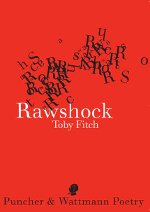
Rawshock

Rawshock by Toby Fitch
Puncher and Wattmann, 2012

Sydney-based poet Toby Fitch’s first book-length collection, Rawshock, is a lively, artful and conceptually engaging excursion into the underworld of a profound poetic imagination; through the eponymous poem sequence, Fitch offers up the viscera and vital organs of the Orpheus myth for the delectation of contemporary readers. Everyday Static’ and ‘Oscillations’ – the two chapbook-length series that accompany this myth – present a sensuous and affable rendering of Fitch’s key theme; the relationship of the present to the poetry of the past.

Continue reading

Posted in BOOK REVIEWS | Tagged ,

3 Translations with Notes: Laforgue, Soupault

Jules Laforgue and Phillipe Soupault are two poets with very little in common, particularly when the early period of the former is under consideration. Steeped in an unremitting metaphysical anguish (the poet himself would refer to his “poèmes philo”), Laforgue’s early work obsessively orbits around an irredeemable loss. It is perhaps a sort of bent continuation of the Romanticism of a Lamartine, with the difference that if in Lamartine nature, for all its richness, is a site of absence, for the young Laforgue it is patent that nature has already kicked the bucket, so there are no verdant dales through which one might wander while pondering the retreat of the absolute: no site of retreat and meditation remains. The lines from Hamlet that directly precede those Laforgue chose as epigraph to the present poem might be read as a summary: ‘How weary, stale, flat, and unprofitable/Seem to me all the uses of this world!’ He would soon manage to sublate his black bile into a kind of sparkling manna which enabled him to sing and dance his way through the dead world in spite of his paralysing dread. This transition can be read even in his use of exclamation marks (prevalent throughout his work). Initially they function to sharpen a desperate, earnest plea, but later they’re transformed into a flashing, sardonic wink before the same situation; the former variety want both world and poem to grind to a halt, while the latter goad writer and reader alike on to more madness and more play: they affirm the vertiginous movement of the groundless.

The present poem is early Laforgue (he has just turned 19 when it is published in La Guèpe, a short-lived monthly put out by his former schoolmates, in 1879), but its appeal is due to the fact that it anticipates the irony and perpetual deferral that mobilises his mature work, while still bristling with a youthful defiance that is somewhat more subdued when he comes to produce his sequences. Here Laforgue is still far from arriving at his infamous vers libres: he writes in flexible rhyming alexandrine couplets, which I was not intrepid enough to try to reproduce. What struck me instead as the crucial aspect of the poem to try to capture in English was the teeming of lines and overblown imagery (on my reading, a sentence in the centre of the poem runs over thirteen lines, undaunted by a suite of exclamation marks), which contrast with abrupt halts and bursts. ‘Coppée’ refers to François Coppée (1842 – 1908), a Catholic patriot and populist author who wrote of everyday miseries and took a leading role against Dreyfus. Rimbaud and Verlaine wrote savage parodies of his work. The three footnotes to the poem are Laforgue’s own.

No such metaphysical obsessions lie behind Soupault’s work. His verse is resolutely subjective, is grounded in and seeks to defend and glorify the present as living present against any and all systems of order and norms. To this end his writing seeks speed in the prosaic, which he injects with the infectious energy of immediate consciousness, as though each and every unit of creative inscription were already as monumental as the creation of a world, and to write of whatever passed before him (whether percept or affect) were to pay tribute to the vital powers that secretly suffuse all our immediate surrounds. He has banished all punctuation as an obstruction, and lineates in a ruthless, sausage-factory style, producing line-units to which he hopes to render, even if they contain only a few familiar words, a kind of absolute autonomy, imploring the reader not to pass over them with the usual indifference. He stops short, however, of using line breaks as boundaries between fragmentary monads of sense and syntax, as Berrigan and many others have done since, which would be too disruptive to the teeming energy of the poem. His cosmopolitan interests are reflected in ‘Prague Friends’, a panegyric to the days of warm friendship he experienced there with a group of Czech poets in the late 1920s. The poem was first published in 1927 (just following his 1926 ‘expulsion’ from surrealism for prioritising literature over the revolution) as ‘Do Prahy’ (‘To Prague’) in Revue Devětsilu. It was directly followed by ‘Poème pour Phillipe Soupault’ by Czech surrealist Vítězslav Nezval. The pronoun ‘you’ (‘vous’) is plural, addressing the poet’s friends, up until ‘Now/I see your hands’, where ‘your’ (‘vos’) suggests an equivocation between the hands of the Prague Astronomical Clock just mentioned and those of the friends. The link is then further strengthened by the fact that the clock’s chiming, its ‘great music’ announces the ‘meeting of friends’, as well as referring back to the passing of time with which the poem opens, and within which any music and any friendship at all must take place.

Posted in TRANSLATIONS | Tagged , ,

Submission to Cordite 43: MASQUE is now open!

Ann Vickery

Ann Vickery, shadowed

Poetry for Cordite 43: MASQUE will be guest-edited by Ann Vickery with featured artists Jeremy Balius and Lily Mae Martin (coverstar).

This issue will be the Masque. An invitation is extended to displays of Devices and Mythic Mayhem, Stage Effects and Staged Affect. The issue desires to entertain Bold Interiors of Poetic Fancy and Brocaded Renderings, Lyricised Run-ons, and flirtatious Kinks in the Narrative. It seeks a toying with Masks and Anti-Masks of identity and all forms of Gender guises. The issue will delight in submissions that feature courtly design, political or ethical high drama, human conceit, or wall-to-wall costumed allegory. It calls for Mock eucalypt Grottos and Other Pastoral Settings, Love’s elevations and What Lies behind the Curtains.

Continue reading

Posted in GUNCOTTON | Tagged , ,

RATBAG Editorial

Ratbaggery: ‘To achieve harmony in bad taste is the height of elegance.’
                                                                                                         -Jean Genet

Ratbag poetry and Ratbag poets are not, necessarily, one and the same. There are poets for whom a Ratbag poem requires the serious maltreatment of themselves, while there are others for whom Ratbaggery is the effortless demonstration of their personal grace. There are poets who begin writing as Ratbags and become stockjobbers of Romantic flap, while others begin by making exquisite paste and later come to hear the sublime music of the rant. Whether sticking it to the jealousies of formal practice or mocking the precious tendencies of poesy, Ratbag poems always import a little wickedness. Or a lot.

Continue reading

Posted in ESSAYS | Tagged

Bev Braune Reviews Kate Lilley

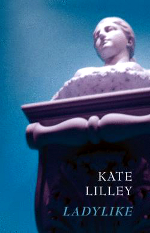
Ladylike

Ladylike by Kate Lilley
UWA Press, 2012

Kate Lilley’s second collection, Ladylike, is a tightly constructed and complex work on love and language. Reminding me of Welsh poet Gwyneth Lewis’ wry, poignant words concerned with Welsh language, use of English and meaning-frauds, Kate Lilley enlivens her readers to assumptions, contradictions and the various erections of judging behaviour that surround the definition of a woman today or in any recent age.

Continue reading

Posted in BOOK REVIEWS | Tagged ,

A Poetics of The Naughty

The word ‘naughty’ is etymologically related to the number naught. Winning, and its relationship to one, along with duplicity and its relationship to two, seem to be the only other similar contemporary instances where a number becomes descriptive of a particular kind of activity. But being naughty is not the opposite of winning, in the sense that winning is being number one.

How does naught become naughty? According to the word’s etymology, the expression ‘naughty’ comes from being needy, as in, ‘having naught’. Naughtiness, in this sense, is the expression of one’s not having anything, of one’s wanting nothing in particular, but having to have something. This is perhaps familiar to us in the archetype of the whiny child, who feels the need to express that they have nothing and are in need of something, albeit often something non-specific. The archaic definition of the word has connotations more closely allied to wickedness and evil, as in having no prospects concerning the question of redemption.

Picking through the OED, one finds a perhaps surprising range of things and events to which the word naughty has been applied. These include figs, water, meat, trees and the weather. ‘Thou wilt not have bad coin, bad soil, a naughty tree, but all good’, writes Robert Burton in 1621. It seems that naughtiness has come to be increasingly limited to the human realm – even when pointing to an animal kind of humanness.

My concern in the present study is first and foremost with what the category of naughtiness can mean today. It is a concern that makes use of historical content, however my method is as much philosophical and poetic as it is historical, as much to do with the vectorial existence of ideas and the redesign of language as with stable, traceable, datable information. This ties into a more general concern: the effort to add, conceptually and poetically, to the range of ways we identify activity, and to ensure that our means of identification are suitably informative, useful and interesting. While I do not refer to his work directly, Ian Hacking’s work on ‘interactive kinds’ and ‘biolooping’ provides something of a methodological and philosophical touchstone that orients my adventure.1

That the word ‘adult’ is listed as a euphemism for naughty seems a happy incidence of semantic perversion. Although we tend to associate naughtiness with childishness and with children, sex, thought to be the most adult of activities, cannot shake its relationship with those traits we take to belong to our less mature selves.

Naughtiness is an activity that requires boundaries. The relationship between naughtiness and its container is one of excess and of testing. The naughty being, while sometimes endearing, always has the capacity to become a pest. Naughtiness cannot exist without boundaries but it also pretends to ignore them. This is an aspect of naughtiness that I want to stress: the naughty thing always to some extent depends on the hospitality of the other, even though it wishes to illuminate the limitations of this hospitality. In recognising naughtiness, or attributing naughtiness to some thing, we create a space for the difference of that thing. Naughtiness is at once permission and prohibition.

In the sense that it is a kind of purposeful ignorance, naughtiness is conceptually related to irony. Naughty irony though, or irony as naughtiness, is less an intellectual variety of irony than it is attitudinal. As the poetry critic Charles Altieri remarks, with regard to the speaker in Ezra Pound’s poem, ‘The Bath Tub’: ‘Here irony is not intellectual, not a matter of appearing to say one thing while meaning another. Irony is attitudinal, a matter of disposing the will by adjusting the tone in which someone is regarded.’ (28)2 Irony, according to this definition, is not a matter of disjunction between appearance and essence, or saying and meaning, but ‘an adjustment to what language allows in the situation’ (28), and therefore is essentially a kind of expression. Naughtiness too, I would argue, and perhaps even more so than irony, is a way of working out what one can and can’t do through a certain relationship to limits (‘what language [or any criteria] allows in the situation’). Naughtiness is not in this sense thoughtless, but neither is it exactly thoughtful. It requires both an awareness of limits and of the simulated and stimulating nature of limits: ‘you wouldn’t dare, would you?’

Naughtiness is a thoroughly ambiguous category in terms of the way we conceive power. Not unlike the ‘cute’ which Sianne Ngai, in her work on minor aesthetic categories, characterises as the ‘aesthetisation of powerlessness’, the naughty requires that we read power relations and expressive capacities as more complicated than our binaries wish to make them.3 The attribution of cuteness, for Ngai, always involves drawing attention to the powerlessness of something. Naughtiness in a related though different fashion is a way of at once limiting and reproducing the power of the thing or event we choose to call naughty.

But in what way? Both the naughty and the cute are conceptually related to the infantile, the erotic and the shrewd. However cuteness seems to be more decorative, more about being in place, about something contained snugly within itself and its location; whereas naughtiness is elusive, adventurous, and less domesticated or pleasing. Naughtiness is nasty, cuteness is nice, though both in some sense embody the force of those things with which they seem to bear a negative relation: naughtiness is a nice kind of anger or meanness and cuteness is always on the way to becoming a menacing kind of niceness.

With reference to the artwork of Takashi Murakami, Ngai accounts for the sense by which ‘it is possible for cute objects to be helpless and aggressive at the same time [italics in original]’ (823). Ngai suggests that while cute objects become increasingly cute the less powerful they seem (for example, when they are injured), they also have the propensity to be agents that participate menacingly in their own deprivation, and thus to the feeling of deprivation experienced by the subject that calls them forth as cute (823).

Naughtiness relates to self-definition. While not being something one possesses as such, naughtiness is rarely described as out of character. In a way naughtiness is expected, as the gender exclusive saying ‘boys will be boys’ exemplifies. Naughtiness is what someone or something gets up to in order to enlarge the space into which their character might persist. In an odd way it is a kind of nesting impulse. The naughty child always depends to some extent on a home or care. We feel permitted to be naughty when we are happy and healthy, when we are entertaining our own excessive energies and wish to discharge these in some way. It is a sign of life or of liveliness.

We also feel the compulsion to be naughty when the concern others show for us becomes overbearing, which seems paradoxical, considering naughtiness is supposed to be the expression of need through having nothing. It is a way to escape, and perhaps become reconstituted by, vigilance through exhibition. Naughtiness is not melancholy, but cheeky, it is done with happy disregard, and it is also the acquisition of happiness through disregard. Despite its stingy numerical connotations, the decision to be naughty is in this sense never a zero sum game. The naughty individual makes something from nothing, even if this something has the propensity to spiral into the red.

People become naughty in order to actively forget those authorities and forces that might seem to impinge on their being. Naughtiness is also to some extent constituted by these forces, which implicitly treat what they identify as without, in the etymological sense of having naught. Likewise, naughtiness is in this sense the invocation of an authority. Someone might express naughtiness as neediness in order to be watched over or attended to more closely. But naughtiness might also be without direction and unprovoked. What delight is something if it is constituted simply as a reaction?

My grandfather used to say, ‘that one boy is worth one boy, two boys are worth half a boy, and three boys are worth no boys at all’, which interestingly preserves the relationship between naughtiness and its numerical ancestor. A group of girls, or boys, are naughty because they are worth nothing to the adult that hopes to obtain useful labour from them. This idea of naughtiness coming in numbers also seems apt in terms of highlighting its social dimension. One finds less reason to be naughty in no company. We depend on others to witness, egg-on and disapprove of our activity.

Posted in ARTWORKS, ESSAYS | Tagged , , , ,

Ross Gibson and Garry Pumfrey: Small to Medium Enterprise

The story so far    …    Jason’s gone to ground with a batch of meth home-cook he was boosting at the tapas bar.  He’s left your Touareg in a back lane out behind a yeeros joint.  Katie goes to see him.  Says she’ll blow him for a freebie.  But Jason won’t be getting it even half the right way up.  So he goes at her yelling. Berating what the fuck.  These are people you employ!

Continue reading

Posted in ARTWORKS | Tagged ,

Film of Sound

Film of Sound is a collaborative multimedia video work.

Electronic art video and interactive works generally prioritise image over sound; this is also the case in commercial culture at large. In Film of Sound, however, sound was chosen to be the initiator – sometimes even the driver – of the text and visual processes at work in the piece. The three collaborators involved are Will Luers (video composition), Hazel Smith (text) and Roger Dean (sonic composition). Continue reading

Posted in ARTWORKS | Tagged , ,

Notes on Ratbaggery

1. What Is a Ratbag?

We think that ‘Anxious to Know’ must be a very selfish kind of person to think that any girl should endure dancing with him all night. He must think he’s a swell dancer. He wants to know what a ratbag is. He should know as Perth is full of them, and he’s probably one himself. After all, the people of Western Australia have no existence. They are people who have come to make a fortune, then return to the eastern colonies. They have no interest in the land except as an instrument of their material welfare. They are robbers and fleers. For them, secession is not just a ratbag’s dream. It is still taken seriously. Ratbag – meaning an eccentric or ‘queer’ person – most likely originated in Western Australia’s Hutt River Province. Continue reading

Posted in ESSAYS | Tagged

Ratbag’s Polemic

In Michel Serres’s book, The Parasite, rats figure as exemplary relations. When a rat turns up in your kitchen, you are each other’s guests: just as the rat is canny at thieving morsels of bread and rind, so too is the rat canny at crafting a home from a network of theft. A rat’s interference makes you an intruder …

For Serres, whose language is French, the word parasite means both guest and host, as well as what in English is called static, as in white noise. Thus, a parasitic relation, refers to both parties of parasitism as well as that which passes between them – confused messages, un-received signals, extraneous symbolics and waste. Serres chose rats to explain his mythos of relationality, because rats, so far as they are represented, are always up to something: rat-life is a complex mode of exploration, innovation, and deviation. If relations are understood to be both form and content of rhythms, patterns, and groupings of entities, then the rat can act as signal figure for any entity in a relation.

Philosophically speaking, then, a rat is a mode, a way of getting about. The rat is any one who is ratting at a given time – anyone who deviates or changes the rules of the game. Rats’ interferences have proper consequences.

In Australian English, a ‘ratbag’ is a contemptible someone, though often loveably so. The ‘bag’ of a ratbag abstracts from the mythical figure of the rat: a ratbag is not quite a rat, nor a whole bag of them, but rather a human whose tendency to act in the rattish mode is exaggerated – either through performance, as a strategy, or by character. A ratbag’s ratness lends a certain kind of nobility, and their humanness lends a veritable odiousness. Ratbags would in fact be better off as rats – but they’re not, and as such, their lovability is not guaranteed.

Ratbags are gossips and whistle-blowers. Their interventions can have critical effects. Ratbags confuse things. Poor ratbags know how to snag a choice cut from the rich; rich ratbags know how to profit from poverty. This is not to suggest that poor and rich ratbags are equivalents, nor even part of the same broad category. Any two modes of ratbaggery may well be mutually exclusive, or at the very least, at odds. Some ratbags are ideologues, others not. Some ratbags go politicking, others do not. Ratbags move between registers and mess up language. Because they tell secrets and set things in motion, in many senses, ratbaggery appears an ideal mode for change.

Women aren’t often called ratbags because they’re sooner designated as hysterics, cheats or succubi. It’s a privilege to be a ratbag, since ratbaggery can be risky when not loveable. For the ratbag who enjoys no affection, deviation and intervention can occasion dire consequences.

There are plenty of women ratbags but these are mostly named after the fact, by way of historical gesture – Shulamith Firestone and Laura Riding Jackson, exceptions to this rule, are two exemplary ratbags of the last century – or else their ratbaggery goes unnoticed or is recognised by other means. Women ratbags are often not perceived as such by the collective lore that names, loves, and reifies male ratbags.

Men who are ratbags are comfy in that role; as such, the disturbances of a male ratbag are mostly pre-approved. Ratbags have a confusing ontology: ratbags by definition cannot be ratbags by popular designation. However, only popular ratbags get to tell the ratbag’s story. True ratbaggery is known only by its actions, and ratbag-as-affect is always false.

Ratbags make good poets, since poetry, like ratbagging, is a mode concerned with minor variations and major affects. Ratbags have a careful ear for denaturing, a job done particularly well in the echo chamber of a poem. Women ratbags who are also poets write under the pressure of a literary culture that reifies the writer’s subjectivity while also over-determining the meaning and conditions of that subjectivity. Women who are ratbags and poets must write poems that devastate the sanctity of the loveable male ratbag.

When I read Gig Ryan’s poem ‘If I Had a Gun’, I think: ‘what a ratbag’. Ryan does something quite astounding by being entirely genuine while speaking hypothetically. She lists all the stock characters of arsehole masculinists: the gormless, the aggressive, the condescending, the sleazy and the oblivious. She claims she’d kill them and it would be a disservice to say the sentiment isn’t true. On the other hand, this is not a poem about murder or revenge fantasies, or the pleasure of rounding up and shaming arseholes. It’s a poem about the irrefutable fact that arseholes are abundant, and that one’s response to masculinist arseholism must be as excessive as arseholism itself. It’s not quite funny and it’s not quite serious, which is precisely the same paradoxical affect that a woman feels when in front of the earnest face of an arsehole. In Ryan’s poem, one struggles with the genuine discomfort of the rhetoric of violence, as it serves to index violences experienced by women. Ryan’s poem risks everything: being read as pro-gun, or anti-men, too hard or too much. It risks being dismissed as hyper-emotional or pathological. It risks every kind of dismissal, such that its own dismissal, pre-figured, contributes to its intensity.

Australian poetry celebrates the ratbag in its classical modes: the gadabout or fink, hoax or wilful fool. The continued heroic reading of Malley (accidental-Trojan-Horse ratbag) and the figure of the arch-laconic urban-new-romantic ratbag dominate narratives of the sneaky, the scruffy, the damning and the biting – all here figured as critical hinges in cultural transformation. Sanctioned forms of literary historical ratbaggery are important, the function they perform in collective contemporary readings necessarily void the potency of the ratbag’s modality.

The ratbag as the official avatar of verse culture must be usurped by ratbags apt to occupy the contemporary – to chew through its wires and piss in its corners.

Posted in ESSAYS | Tagged , ,

Review Short: Robert Gray’s Cumulus

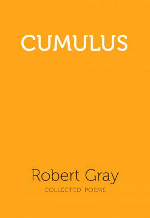
Cumulus

Pruning the Book of Nature

Cumulus (Collected Poems) by Robert Gray
John Leonard Press, 2012

Though Robert Gray’s status as a major poet is well established, both in Australia and overseas, he is sometimes dismissed as ‘merely’ a nature poet or, worse still, a poet of description. While Gray is narrower in scope than say Yeats, Auden or Murray, this charge is, of course, irrelevant to both the reader’s enjoyment and the place his poetry will find in any canon. Many leading poets of the second half of last century – Plath, Larkin, Wright, R.S. Thomas – could, to varying degrees, be similarly accused.

Continue reading

Posted in BOOK REVIEWS | Tagged ,

IWD: Murder, She Wrote

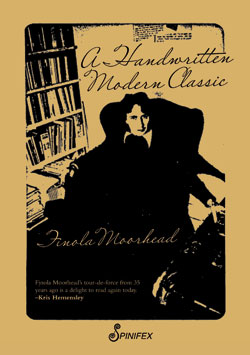
Finola Moorhead

A Handwritten Modern Classic by Finola MoorheadSpinifex Press, 2013

                Be shot
                survive
                drink hemlock.

These three lines from The Seventh section of Finola Moorhead’s A Handwritten Modern Classic, first published in 1977 and re-issued March 2013 by Spinifex Press, close out a varied discussion by the author on the political nature of death, that Socrates’ death ‘was political’ (as underlined in the handwritten original), that Socrates was not a writer and that writers ‘need teachers like Socrates’. In the same section she argues that artists often use ‘Another’s pain … for the success of expression’. ‘Art as comfort’, Moorhead follows on, ‘ — strange concept. / Such assumptions aren’t questioned often enough.’

Continue reading

Posted in GUNCOTTON | Tagged , , , , , ,

Bonny Cassidy Reviews Rosemary Dobson

Rosemary Dobson

Rosemary Dobson: Collected by Rosemary Dobson
UQP, April 2012

Edited by the poet shortly before her death, Rosemary Dobson: Collected reminds us not only that Dobson was one of the last Eurocentric formalists in Australian poetry, but also that her very late poems turn away from that distant, ornate tradition.

This ultimate edition contains Dobson’s eleven collections of poetry, poems published but not collected, plus a short selection from her tender and bold translations with David Campbell. Its tour of Dobson’s poetic dwelling is clear and fascinating. Continue reading

Posted in BOOK REVIEWS | Tagged ,

Launch of Tricia Dearborn’s ‘The Ringing World’

The Ringing World

9 September 2012, Friend in Hand Hotel. Glebe.
The Ringing World by Tricia Dearborn
Puncher & Wattmann, 2012


Amidst its many echoes, the idea of a ‘ringing world’ conjures up for me a line from Sylvia Plath’s poem ‘Words’, in which words are axes ‘after whose stroke the wood rings’. This ringing takes the form of words’ echoes travelling off like horses. Late in the poem these horses reappear ‘dry and riderless’ but nevertheless continuing on with their ‘indefatigable hooftaps’.

As well as echoes, resonances and ripples of the figurative in Tricia Dearborn’s poems, ringing suggests the clarity and precision of her writing. As an editor, Dearborn knows the power of compression and distillation. The collection’s ringing world is a place of clarity and clarification: the notes of a bellbird across trees, or, as ‘The Changes’ describes, the many bells that enclose the stages of our days and lives and lead us from moment to moment. Some bells are like the kiss that rings true: ‘the shock of the extra-early alarm on the day of the journey’, ‘the sudden shrilling of a schoolroom bell, calling me in/to a strange new lesson’ and the ‘tardy dinner gong/summoning me to a meal/of scent and heat’. Other bells, like Slessor’s, ‘coldly [ring] out’ alongside human experience, sometimes coinciding with its shifts and sometimes jolting us into change when, to use Dearborn’s metaphor, an old life ‘shivers and falls’ from us.

Many of Dearborn’s poems are about moments of breakage, with the possibilities and challenges of new lives shimmering beyond them. While an old life may fall away, though, shards remain. In ‘Projectile’ a cup thrown at a wall might not appear to injure anyone, but a fragment of glass from the street outside comes, instead, to ‘nest deep in the sole of my foot’, again like a truth that can’t be hurtled away; one that lodges instead in ‘angry flesh’.

The experience of the body and its memories is central to many of the poems. Several of these sensual poems have been previously anthologised and acclaimed, such as ‘Sweeping’, in which the poem’s speaker addresses a closely-observed ‘you’ she notices on a number of occasions when driving down a certain street. The poem unfolds into a subversive fantasy in which the woman sweeping the path with her hair in curlers and a scarf tied over them is seduced by the speaker: curlers removed ‘one by one … with tender fingertips’ before the speaker makes ‘a crisp lush bed’ of leaves where the lovers take their pleasures: ‘my fingers in your curls for all the neighbourhood to see’.

Later, the experience of a scan, or a sister’s loss of a baby chart darker areas of the body’s – and heart’s – experience. The sequence ‘The Quiet House’ is a brilliant, sensitively-observed portrait of a family in mourning. Another of the collection’s highlights is its love poems: also crystalline, unflinching, clear.

Yet another of the many likeable aspects of this collection is its whimsy. Such poems demonstrate poetry’s capacity to turn things upside-down, and the way poetry provides ways of seeing things afresh. ‘Chalk Speaks to Cheese’ finds the former declaring to the latter, amongst other things: ‘Extraordinary, what you make of the calcium we share’.

In Charles Bernstein’s Attack of the Difficult Poems he writes about the perception of poetry as a difficult art. Bernstein considers what would happen if this could be changed, and people could be as hospitable to poems as poems are to people. He imagines the poem with its invitation to readers, to find in themselves:

a willingness to consider the implausible, to try out alternative ways of thinking, to listen to the way language sounds before trying to figure out what it means, to lose yourself in a flurry of syllables and regain your bearings in dimensions otherwise imagined as out of reach, to hear how poems work to delight, inform, redress, lament, extol, oppose, renew, rhapsodize, imagine, foment.

In The Ringing World, Dearborn’s poems – with their beguiling hospitality – hold out just such an invitation, and reward the reader with a world of clarity and resonance; of wisdom distilled and whimsy set loose.

Posted in GUNCOTTON | Tagged , ,

Review Short: John Kinsella’s The Jaguar’s Dream

The Jaguar's Dream

the end allowing no closure and adulated

The Jaguar’s Dream by John Kinsella
Alma Books, 2012

The Jaguar’s Dream is a collection of ‘cover’ poems by the celebrated, and prolific, John Kinsella. The poems covered by Kinsella all originate in languages other than English – gestating in mother tongues as diverse as Latin, French, German, Russian, Chinese and others, before fusing with Kinsella’s own ‘Wheatbelt Western Australian, mid-Ohioan, and Cantabrigian English.’ Cover, interestingly, is also a verb meaning to mate, particularly of a stallion to a mare: the poems are similarly interbreedings, by Kinsella (Western Australian English) out of Virgil (Augustan Latin). Continue reading

Posted in BOOK REVIEWS | Tagged , ,

Audio of ‘Nonfiction Poetry: Performing the Real’

This panel from the NonfictioNow Conference 2012 – at RMIT University and in partnership with Iowa University and Barbara Bedell, the Copyright Agency Limited, the Wheeler Centre and ABC Radio National – explores and discusses the potential of ‘nonfiction poetry’ to address, represent and perform real world content. The four members of the panel read and discuss their unique experiments with nonfiction poetry, from historical (auto) biographical work to programmatic experiments. During each performance, as well as through discussion amongst the panel members and with the audience, this panel aims to interrogate the poetic medium as a valuable means through which to access new performative, personal and philosophical dimensions in writing (about) the real world.

Nonfiction Poetry: Performing the Real | (1:06:24)
Stuart Cooke, Benjamin Laird, Jill Jones and Jessica Wilkinson

[audio:http://itunesu.its.rmit.edu.au/sites/default/files/itunesmedia/NonfictionPoetry.mp3|titles=Nonfiction Poetry: Performing the Real – Jessica Wilkinson, Stuart Cooke, Jill Jones, Benjamin Laird]
© nonfictionLab / NonfictioNow Conference 2012

Posted in GUNCOTTON | Tagged , , , ,

Review Short: Vivian Smith’s Here, There and Elsewhere

Here, There and Everywhere

Here, There and Everywhere by Vivian Smith
Giramondo, 2012

It’s a long time since I’ve read Gaston Bachelard’s The Poetics of Space, but I find myself lifting it off the shelf again and flicking through the contents page. I’ve been reading Vivian Smith’s new book, Here, There and Elsewhere, a reflective collection that is mostly linked by notions of memory, age and time, enduring themes that Smith handles with dignity and sleight of hand. But space is interestingly also central to this collection, in subject as well as craft. In Bachelardian fashion, Smith, in many of these works ‘explores the significance of the various kinds of space that attract and concentrate the poetic imagination’ (The Poetics of Space. Beacon Press, 1964). It’s not surprising therefore, that almost all of the poems in this book are sonnets, the poetic form which to my mind makes the most adroit demands on space.

Continue reading

Posted in BOOK REVIEWS | Tagged ,

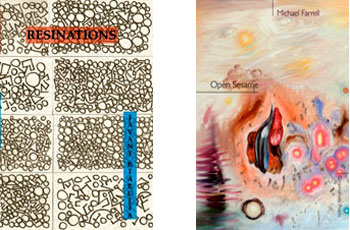
John Hawke Reviews Javant Biarujia and Michael Farrell

Resinations and open sesame

Humour Only One Impulse

Resinations by Javant Biarujia
Otoliths, 2012

open sesame by Michael Farrell
Giramondo, 2012

Milkinghoneybeaverbrooker, Vee was a Vindner, Sower Rapes, Armenian Atrocity, Sickfish Bellyup, Edomite, Man Devoyd of the Commoner Characteristics of an Irish Nature, Bad Humborg, Hraabhraab, Coocoohandler, Dirt, Miching Daddy, Born Burst Feet Foremost, Woolworth’s Worst, Easyathic Phallusaphist, Guiltypig’s Bastard, Fast in the Barrell, Boose in the Bed, Mister Fatmate’ – James Joyce

Continue reading

Posted in BOOK REVIEWS | Tagged , ,

High Yet Old

it’s easy to be bad
just ask me, anyone

will show you
how at sunset

no-one’s asking that you
slap a beggar at the trainstation

& then leave, in the compartment,
a hidden turd for others to

macerate with seat-
cushion at midnight;

no-one expects you to cross the border
or bear arms against the law

even calculating greatly
is unnecessary

you need not be cunning

Posted in 55: RATBAGGERY | Tagged

Prize Maggot for Meat Hunk to Knock Twice on Wood

Wormwood hotspot, but narrow berth aping El Paso heat
on the Great Northern Highway
between civic duties. Diffident arsehole bristles in the glade
but for convent up the way
quakes,
nun patience chides the rough diamantine of
the standard liquored shoes and fountain foam gush gained
said it was all our doing known done wilful intent,
it will get you nine years no parole upon it stumble, come truth.

Artaud’s Joan.
Possumeaten man.
Wet livid bitumen.
No amor fati.

Quaint appeal to the billabong suffering, cut me above clavicle,
below Adam.
Blood-let swine kingdom swoons and by god am I loose.
Merrily Merrily Merrily Merrily Merrily Merrily Creek.
She is wilder, circles like a vulture. Get that maggot.
The miniature soul let is a music box dancer with a swinging dick.
Apparently lending your lips moved the maudlin, witness
to evacuation since the moralists are all taken,
hence pucker for the coming weld of drama.
And you, écriture: beware the car industry! Swerve and roll
in Mazda, because we do not mince you, we dice.
Hot brand our paraph the quincunx in your side.

I is scumbags
if the grease pit haggles for our prize maggot for meat hunk,
sewer’s consent, the scum behind the eyeballs is chocolate éclair and cellulite.
O inscrutable flesh to insurmountable retrenchment at
blip desk, if this were traffic control at Perth Airport
then Sint Eustatius, grey no charter with brained bikie. Pie in the sky thigh.
Stark handsome, if you know where to look, what to soften, which starch
makes best
emulsifier.

Before masturbation, we smoked.
Now Australians march the undead through emphysema follies,
papacy of higher society censors the terminal scoliosis of its plots.
Australian Club: your spine is independently wizened louche.
Old dead bloke sizar and avatar of the moral tradition of his age,
I may not smoke, but millet porridge get up.

Posted in 55: RATBAGGERY | Tagged

Basic Hut Methodology

take your platform boots off
Kevin
you’ve killed a deer to make your point
but our tea and biscuit sensibilities
will cope
we forgive you
you’re charming!
hiding from your vanity
likening molten glass to tartiflette

in the fresh peat you hammer a sign
‘Not Hobit-Town’ (it’s cute)
then later tell the production crew (sternly)
“this not aspirational! This is economical!”

Marxism 101 plaything
soliloquies about the means of production
while you go on dung-safari

afterwards the gang pretends to piss in a bucket
you call the result a “manly amount”

150 years of Britain’s industrial history
at the bottom of a Hackney canal
which swallows your magnet with an erotic slurp

there you go all doe-eyed
banging on the shed roof
but we’re weary
of plumbing double entendre

Kevin and the engineer boil a kettle

“shall I play mother?”

that curve came from a tree
gun powder tamped into the trunk
a certain “massive quality”

boy with a simple dream
to own a patch of woodland
(where’s there’s a thing there’s a fence)

your friends show how they feel
by building a a straw effigy
and lighting it with flaming arrows

Posted in 55: RATBAGGERY | Tagged

Shooters

postcard poems from the Americas

1 Pisco

Lima cries for Spain.

Spain was a swan in its hands
with a rosy cloaca
and a cock that tasted
of bullmeat.

Lima cries for Spain.

2 Cachaça

In Sao Paolo,
a monarch’s fears
are many.

Yet few could imagine
the statutory pain
of a marble face
eaten by acid rain.

3 Mezcal

Boys sell chiclets
in Tenochtitlan.
Beneath the catholic church,
Aztec temples.
Beneath Aztec temples,
the savage lake.
A man pastes posters
for a salsa band
at the temple gates.
And your mother, too,
they have raped.

4 Bourbon

On pillows of Hampshire green,
its father’s breast,
Washington weeps
Keep! Keep!

5 Seco

¡SILENCIO! EVERYTHING!
In the cantina,
Panama is drinking.

6 Rum

Every song Havana sings
is a prisoner’s song
from El Morro
with a voice of ballast rum
and sand.

Havana has much to offer.
Havana has HIV infection.
Havana has a lovely complexion.
Havana offers much of what it has.
Havana has shingles.
Havana has crabs.
Havana has what Havana has.

7 Chicha

In La Paz, men whistle. Men bang bangers and crank crankers. They thump and bump.
They rub and hump. They harrumph. When the men speak, they speak only to say, We
men speak very little
. Men under their hair handle nuts and bolts like the breasts
of women. They twist clockwise and counter-clockwise fitting things together. Men
tighten things up. Men loosen things off. Men work at women with their hydraulic
couplings. You can see men under pressure, beating within the heads of men. You
can see men in their heads beating men. The soft skulls of men. The soft slick
skulls of men. They could embrace men. They could kill men. Men hold gears to their
teeth like apples or the beautiful tips of cocks. It is hard to take men, there are
so many. Look at these streets in La Paz – covered with men.

8 Pisco

A massive steel beam is moved by a crane stenciled with the capital letters IOTA.

A man crouched on his haunches paints a chainlink fence with rust coloured paint.

A woman rinses her mouth with water carried in pipes of copper mined from the open pits of Chuquicamata.

In the smoke from smelter #8, Maria and Co. incorporate.

At a meeting of the syndicata, a Codelco man raises his hand feeling a sudden secondary syphilitic stigmata.

He seconds the pain of Santiago.

Posted in 55: RATBAGGERY | Tagged

The Viceroy’s Subservients

Thou doth detesteth too much
& so it begins with the ants marshalled
like Ukrainian cannon fodder
spread across the aprons of the Volga.
& They Will Not Be Overcome!
Not by powder or spray or the diligence
to daily wipe out the toastie iron
before the stray cheese cools,
to rinse the bowls before cereal becomes cement,
to dilute the evaporating dregs of Moccona
with a thimble full of water,
to never leave a crumb forgotten on the bench.

Their continued loyal existence
a testament to puritan persistence.

Posted in 55: RATBAGGERY | Tagged