Twilight to Dawn: Charles Baudelaire

Charles Baudelaire is, of course, a key figure in European literature, with a far-reaching influence – an example, in his life and in his poetry, of what it means to be modern. Les Fleurs du mal, his major work, was influenced by the French romantic poets of the early nineteenth century; it is formally close to the contemporary Parnassians, but is psychologically and sexually complex.

‘Dawn’ and ‘Twilight’ are from the ‘Tableaux Parisiens’ section of Les Fleurs du mal; this particular group of poems established Baudelaire as the poet of modernism, of the flux of urban life with its milling crowds and solitary individuals. Continue reading

Posted in TRANSLATIONS | Tagged ,

8 Poems by Gastón Baquero

Gastón BaqueroGastón Baquero by Eduardo Margareto

Born in Banes, Cuba, in 1916, Gastón Baqero grew up in the countryside, a rural beginning that figures as one element in his, in many ways very urbane, poetry. He was part of the Orígenes group, a gathering of rather diverse poets including Lezama Lima, Eliseo Diego, Cintio Vitier and Fina Garcia Marruz, who collaborated on the highly influential journal of that name between 1946 and 1956. The Orígines group was at the centre of a major renovation of Cuban poetry, moving it away from 19th Century models towards a range of new aesthetics, notably the neo-barroque movement associated especially with José Lezama Lima.

Continue reading

Posted in TRANSLATIONS | Tagged ,

Klick: Im Gespräch mit Ann Cotten


Image from Robert Bosch Stiftung

Lesen Sie dieses Interview auf Englisch.

Also gut, nun dies: Vor einigen Jahren war ein Teil meines Hirns voll mit kargem, sprunghaftem MAX/MSP, dronenartigem Zeug. Es ist immer noch so. Auf der ständigen Suche (immerfort mehr! Alles, immer!) nach AGF-Kompositionen (ein Pseudonym der Künstlerin Antje-Greie Fuchs … Recherche lohnt sich). Ich fand live Sets, die sie online gestellt hatte. In einer davon kam eine deutsche Dichterin vor, die auf der Bühne ihre Stimme über den AGFs Malstrom aus Mikro Klicks, Brüchen und Rauschen hinweg lesend, rezitierend, beschwörend live klingen ließ.

Und so stellte es sich heraus, dass diese Dichterin Ann Cotten war. Und ich machte mich daran – von der anderen Seite der Erde aus, in den Äther versinkend, – alles von ihr, was ich in die Hände bekommen konnte, ausfindig zu machen. Eine Aufnahme geistert herum, auf der sie ‘33 Extension, Ekstase’ vorträgt – veröffentlicht in Hilda Magazine mitübersetzt von Cotton und Rosemarie Waldrop. Es beginnt mit:

Klick. Wo begann zu drehen es
sich zeigte an den Ufern so
den Fluss an. Anorganisch lumenesk,
bloß an der Oberfläche Wüten, wo

wütete und unerreichbar schrill
sich drehte und das Licht, zerstieb,
zerdröselte, und darum, wo ich lachen will,
zu laben Ufern anfing, hell und lieb.

Klick, stopp – noch nach all diesen Jahren lässt es meine Augen hell aufleuchten (wie könnte ich das bloß zum Ausdruck bringen?) Klick, start. Klick, nächster Track. Klick, nächste Seite. Klick, nächstes Ziel. Klick, das Wurmloch YouTube. Klick klick klick peng. Ist es möglich von einem Wort verschlungen zu werden, von seinem Klang, vom Klang den jemand anderes hervorbringt? Fixiert zu sein. Auf repeat. Am Wort festzuhängen. Die Platte wenden. Klick, play. (Klick runterscrollen.)

Schauen Sie sich weiter unten Cottens Biographie an, um den Hintergrund und Kontext zu verstehen. Es gibt genug andere Interviews, die Sie anderswo und anderswann ansehen können, die eine Linie auszumachen versuchen, die von dem Umstand, dass sie in Ames, Iowa, geboren ist (nur ein paar Kilometer im Übrigen von Kent MacCarters Geburtsort in Lakeville, Minnesota, sowie den Bauernhöfen von meinen ausgewanderten vorkalifornischen Ahnen), und die als Linie weiterführt zu ihrem Heranwachsen und Studium in Wien bis hin zu ihrem gegenwärtigen Wohnort Berlin. Recherchieren Sie noch ein bisschen weiter, und Sie werden auf absurde Artikel stoßen, die von absurden Typen verfasst worden sind. (Lesen Sie zwischen den Zeilen ihrer Antworten, zwischen dem Schimmer der Pixel, die von Ihrem Bildschirm strahlen.) Hören Sie sich ihre Aufnahmen an, atmen Sie die Gedichte ein – viele sind ins Englische übertragen worden und sind online verfügbar. Wenn Sie Deutsch lesen können, lesen Sie alles, was Ann Cotten über Konkrete Poesie geschrieben hat. Raufen Sie alles zusammen, was Sie finden können.

Ann Cotten ist der real deal. Hier ist das Gespräch, das ich mit ihr gehabt habe.

N.B.: Wir haben das Gespräch auf Deutsch geführt, bis eine Frage in der Übersetzung verloren ging. Die zweite Hälfte des Gesprächs führten wir daher auf Englisch.

Klick.

Jeremy Balius: Als ich 2003 noch auf dem Prenzlauer Berg wohnte, war ich von der Offenheit fasziniert, die dort zwischen den Dichtern, Künstlern, Autoren, DJs und Musikern herrschte. Bevor ich in Berlin war, kannte ich diese Art von breitgefächerter Zusammenarbeit nicht … es fühlte sich dort so an, als ob Zusammenarbeit geradezu das Ziel sei. Ist diese Zusammenarbeit auf allen Gebieten auf irgendeiner Weise wichtig für Sie oder Ihre Poesie?

Ann Cotten: Nein. Ich kann Zusammenarbeit nicht ausstehen. Aber ich interessiere mich für andere Menschen. Ich will nur nicht künstlerisch mit ihnen zusammenarbeiten.

Und doch profitiere ich von dieser Atmosphäre. Es ist einfacher Fremde anzusprechen. Es gibt sehr viele Möglichkeiten, schöne und schräge junge Menschen kommen zusammen. Hier gibt es Erfolg und das Gegenteil von Erfolg.

Auf der anderen Seite, gibt es Städte mit einer ähnlichen Atmosphäre. Ich habe dies in Neapel erlebt. Die Neapolitaner sprechen miteinander wie vertraute Kollegen. Es war viel besser als in Berlin. Hier in Berlin behalten die erfolgreichen Leute ihre Karriere im Auge und die Erfolglosen jammern bloß.

Vielleicht bedeutet die Offenheit in Berlin, dass man sich gegen Zusammenarbeit wehren oder schützen muss, anstatt dankbar dafür zu sein. Man kann sich in einer falschen Zuvorkommenheit und einer dämlichen Zelebration der Kreativität verlieren, die das Zusammenarbeiten gelegentlich in Idiotie verwandelt.

JB: Was Karriere und Jammern angeht, das trifft wahrscheinlich überall auf der Welt zu! Für mich kommt es darauf an – oder auch nicht, – mit anderen Leuten Musik zu machen. Zusammenarbeit war für mich dort erfolgreich, wo es sich um Dinge von konkreter oder visueller Art handelte. Aber das ist ja nicht wirklich miteinander arbeiten, sondern eher aneinander.

Sich zu wehren, ist ein wichtiges Thema für mich, und ich stelle es in meiner eigenen Arbeit in Frage, beispielsweise im Hinblick auf den Raum sozialer Verantwortung oder spiritueller Erwartungen oder in Auseinandersetzungen mit den Wahrheiten und Unwahrheiten, die man beigebracht bekommen hat. Davon abgesehen, dass man sich gegen die ‘Szene’ zur Wehr setzen oder schützen muss, gibt es in Ihrem Leben Dinge, gegen die Sie sich schützen müssen, um das zur Sprache zu bringen, was letztendlich zu Ihren Gedichten wird? Gibt es Grenzen und Schranken in Ihrem Schreiben, die Sie überwinden müssen?

AC: Ich erfreue mich daran, leidenschaftlich gegen alle Arten von Verantwortung zu sein, obgleich ich mir nicht sicher bin, ob es gefährlicher ist Verantwortung zu meiden oder sich zu entscheiden, sie zu respektieren, d.h. die verantwortungsvolle Wendung zu machen, die den Geist so vieler Motoradfahrer Jahr für Jahr vernichtet. Auf die Dichtung angewendet betrifft dies meine wohlmeinenden Versuche verständlicher zu sein, d.h. in vielen Fällen konventioneller oder einfacher zu sein, die dazu führen könnten, dass ich mich auf ausgelaufenen Pfaden begäbe, die ich aber nicht nehmen will.

Ich will gut denken, aber ist Denken, gut oder klar zu denken, das realistischste Denken, oder ist es realistisches Denken mit einer kleinen utopischen Wendung? Feminismus und andere Wissenschaften des Unwirklichen zeigen es deutlich. Wenn ich mich „realistisch“ anschaue, so wie andere mich anschauen, dann wird ihr Blick niemals zu widerlegen sein. Eine gewisse Ignoranz gegenüber der schlimmsten Meinungen über Frauen befreit Männer völlig von ihnen (bis ich natürlich einen in einer dunklen Gasse begegne – aber ich kann ihm vielleicht im Dunkel fürs Dunkle begegnen …).

Posted in INTERVIEWS | Tagged , ,

Click: A Conversation with Ann Cotten


Image from Robert Bosch Stiftung

Read this interview in German

Okay, so now this: some years ago, a portion of my headspace was filled with sparse, glitchy MAX/MSP, droney type stuff. It still is. Was digging for more (Always more! Everything, all of the time!) AGF compositions (a moniker of the artist Antje-Greie Fuchs, worth looking up), found live sets she had posted online, one of which featured a German poet reading, reciting and conjuring live on stage over AGF’s maelstrom of micro clicks and cuts and swooshes.

And so it went that this poet was Ann Cotten. And so it goes with me – halfway across the world in Fremantle, spelunking into the ether – sourcing whatever of hers I can find. There’s a recording floating around somewhere of her reading ‘33 Extension, Ecstacy’ (‘33 Extension, Ekstase’) published at Hilda Magazine, co-translated by Cotton and Rosemarie Waldrop, which begins with:

Click. It where began to turn
show up on banks and thus
the river. Anorganic, luminescent,
anger merely on the surface where

raged and unattainably shrill
turned, and light sprayed,
spattered, therefore while I must laugh,
to lick the banks began, light, gentle.

Klick. Wo begann zu drehen es sich zeigte an den Ufern so den Fluss an. Anorganisch lumenesk, bloß an der Oberfläche Wüten, wo wütete und unerreichbar schrill sich drehte und das Licht, zerstieb, zerdröselte, und darum, wo ich lachen will, zu laben Ufern anfing, hell und lieb.

Click full stop – after these years it still makes me go brightly-eyed. (How can I convey this to you?) Click start. Click next track. Click next page. Click next destination. Click YouTube wormhole. Click click click bang. Is it possible to be consumed by a word, by its sound, by the sound of someone else’s utterance? Fixated. On repeat. Hang on the word. Flip the record over. Click play. (Click scroll down.)

Check Cotten’s bio below for background and context. There are plenty of interviews you can check out elsewhere and elsetime – pinpointing lineage between the fact that she’s an Ames, Iowa born (mere kilometres away from Kent MacCarter’s birthplace of Lakeville, Minnesota, as well as the farms of my own forebears pre-California migration, no less), Vienna, Austria raised and educated poet, currently based in Berlin. Search and you’ll also find absurd articles written about her by absurdists. (Read between the lines of her answers, within the pixels of the glow emanating from your screen.) Listen to her recordings, inhale the poems – many have been translated to English online. If you read German, read everything she’s written about concrete poetry. Gather what you may.

Ann Cotten is the real deal. This is the conversation I had with her.

Aside: The conversation was conducted in German until a question was lost in translation. The second half of the conversation thereafter was in English.

Click.

Jeremy Balius: When I was still living in Prenzlauer Berg in 2003, I was amazed by the general openness between poets, artists, authors, DJs and musicians there. I hadn’t seen such widespread collaboration before Berlin … where it almost felt like collaboration was the goal. With collaboration everywhere, does it have a level of importance for you and your poetry?

Ann Cotten: No, I can’t stand collaboration. But I am interested in other people. I just won’t work with them in an artistic manner.

And yet, I do benefit from this atmosphere – it’s easier to speak to strangers. There are a lot of possibilities, beautiful and weird young people gather together. It’s successful as well as the opposite of success.

On the other hand, there are other cities with kindred atmosphere. I found that in Naples, the Neapolitans speak with each other like trusted colleagues. It was much better there than in Berlin. Here in Berlin, the successful people keep their careers front of mind and those without success just complain.

Perhaps the openness in Berlin means that one must defend one’s self against collaboration, rather than be thankful for it. One can lose one’s self into false courtesy and moronic celebration of creativity, which makes collaborators idiotic at times.

Do you like working with others? Does it work well for you to be friendly all of the time or do you sometimes use bad moods to better the quality of your output?

JB: Regarding careers and complaining, that’s probably true the world over! It depends with me – usually not, other than when making music with others. Where poetic collaboration has been successful for me was with concrete and visual type stuff, but that’s not really working with each other, but rather on each other.

Defending one’s self is an important theme for me and I question it in my own work, for example in the space of social responsibility, or spiritual expectations, or against truths and untruths one has been or is taught. Other than defending yourself against ‘scene’, are there things in your life you need to defend yourself against in order to be able to formulate the thoughts which eventually become your poems? Are there barriers to your writing you need to overcome?

AC: All types of responsibility I enjoy being faithfully against, but I’m not sure if it is more dangerous to shun responsibility or to decide to respect it, making the mature turn that kills the spirit of so many motorcyclists every year. In poetry, that would mean that my well-meaning attempts at being more comprehensible, i.e. in some cases more conventional or simple, might lead me onto well-trodden paths I really don’t want to take.

I want to think well, but is thinking well thinking most realistically, or thinking realistically with a bit of an utopian turn? Feminism and other sciences of the unreal show it clearly: If I ‘realistically’ see myself as others see me, their view will never be disproved. A certain ignorance of the worse views on women totally frees me of them (until, of course, I meet one in a dark alley – but I might be able to meet it dark for dark …)

Posted in INTERVIEWS | Tagged ,

Intervistare la voce: Charles Bernstein


Photo by Jill Kramer

Forthcoming in The reasons of the voice: interviews by Enzo Minarelli with the protagonists of sound, oral experiments in the XX Century, edited by Frederico Fernandes. EDUEL Publisher Londrina University, Brazil 2014

This interview is dedicated to Nicholas Zurbrugg (1947-2001), who brought Enzo Minarelli and I together at a conference at De Montfort University just before Nick’s sudden death. Nick taught at Griffith University, in Brisbane, Australia for 17 years, starting in 1995, before moving back to England. From early in his career, founding the little magazine Stereo Headphones, to his later work on new media, Nick was a champion of innovation in the arts and of the arts of poetry (text, sound, performance, recording), including the work of Minarelli. See this short piece by Nick on Enzo. – CB

Continue reading

Posted in INTERVIEWS | Tagged ,

4 Artworks by Lily Mae Martin

[EasyGallery id=’lilymaemartin’]
Click this image to launch the slide show

The details of our bodies are unique. I’m drawn to studying the human figure through art where I am allowed to see what people actually look like. In a world plastered with images of an uncontainable, fleeting notion of beauty, I try and amend this within my own world by making paintings and drawings of myself and those around. I try to focus on the parts and details that can be no one else’s.

Scars are our stories – our hurt, our sickness, our corrections. They are our mistakes, they are our rage, they are our passions … which can only ever be our own.

They are a private collection on our bodies.

Hands and feet are challenging to capture and to accept, perhaps there is something in that. As an artist who is in the business of talking to people about their bodies and face, I find that hands are usually the most appreciated part while feet are generally the most loathed. Perhaps it is the opposite with you. But I find this interesting.
Your feet carry you everywhere, for all of your life. If they are well and functioning, why must they also be beautiful? What are the toes, the nails, the hair, the knuckles and the callouses meant to look like?

Just as they are.

Posted in ARTWORKS | Tagged

6 Artworks by Jeremy Balius

the indeterminateness of anxiety

Jeremy Balius

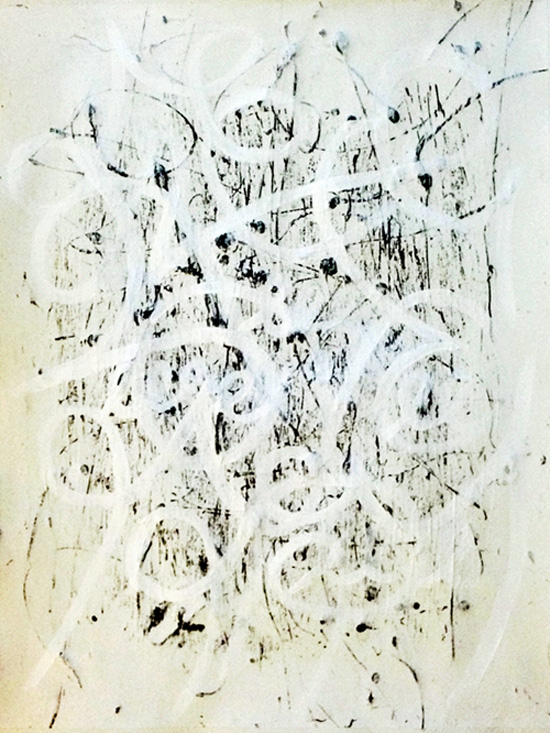
the indeterminateness of anxiety | acrylic on paper | 76 x 56.5 cm

I’m interested in language as a material of making, particularly in states of formation and cessation. I’ve been working at the crossroads of calligraphy, pre-Renaissance German handwriting and graffiti, while referencing a cursive mode of writing I was taught in school while growing up in Germany.

Continue reading

Posted in ARTWORKS | Tagged

MASQUE Editorial

The theme of this issue was suggested by the Poets and Critics seminar (run by Vincent Broqua and Olivier Brossard) on the work of British poet Redell Olsen last year. Olsen’s book Punk Faun: A Bar Rock Pastel (subpress, 2012) revels in masques and anti-masques, in variants and endlessly shifting suggestiveness that has influences back to the sixteenth century but also resonates with Frank O’Hara’s ‘In Memory of My Feelings’:

                                                                                    Grace
to be born and live as variously as possible. The conception
of a masque barely suggests the sordid identifications. 
I am a Hittite in love with a horse. I don’t know what blood’s
in me I feel like an African prince I am a girl walking downstairs
in a red pleated dress with heels I am a champion taking a fall
                                                                                    (Collected Poems 256)

Punk Faun plays with the conceit of a request by Isabella d’Este (a cultural leader of the Italian Renaissance) for a masque ‘of grotesque pastoral and mythic proportions’ for her studiolo after viewing a screening of Matthew Barney’s The Cremaster Cycle at The Roxy in Brixton, London, and a few weeks later stumbling on an artist’s talk by Raphael on Ed Ruscha’s painting ‘THEY CALLED HER STYRENE.’ In mixing temporalities, Olsen raises questions around the changed structures of support and consumption of poetry. She also foregrounds ‘ordinary citizens’ as players and presents everyday experience as simultaneous entertainment ‘and meditative consolation.’ The resulting volume foregrounds its curtains and ceilings, as well as the containers of identity and language, and embraces a devious playfulness:

     rejoin their own speech herd		     riffs struggle
up day-glo	snares in human form
     alarmed at			neat fringe of hiding

     as do-it-yourself tough	          just a persona found
protruding from a vulva-shaped crack in a tree
     birthed this familiar yawn   velveteen girls

    pale			        what no single word covers
swept  away tame marked by stones reindeer carved
     beyond map space		          slits   historical (104)

As I suggested in the call-out for this issue, I was interested not only in the performance of personas but also the materiality of their staging. I was also keen to see whether the idea of masque was culturally translatable to or had currency within an Australian, or even a Pacific rim, context. To what extent could the masque be used to play around with and possibly critique conventions and attitudes ceaselessly replicating power dynamics of gender, race, or class? As with pastoral, the masque might be viewed as a problematic inheritance or transposition.

There was a bumper number of submissions for the issue and many fine poems that are not represented here. I selected on the basis of how the poems addressed the theme, looking for lateral and adventurous approaches. Sometimes there were several poems that took similar approaches to particular aspects of the masque (such as the idea of masking or masquerading selves), where I may have selected one or two, even as there were others that were also moving and provocative.

I was particularly interested in those poems that used the theme as a basis for political critique. In the vein of Lesbia Harford’s writing from the early twentieth century, Lizz Murphy’s ‘Through a Child’s Eyes’ refers to the imagination of child workers ‘whose factory eyes/ settle on a shatter of sequins.’ Melinda Smith’s ‘Gora’ is a powerful example of taking up the theme to critique de-racialisation treatments:

Aishwarya your green eyes, your coconut flesh
Michael Jackson your vitiligo

The daughters of India are itching
Because brillo pads are not designed for use on the forearms of children

The luminous faces of Brahmins bloom only in the shade
‘I dream about how to become white, how to look white and beautiful’

The daughters of India are developing cancers of the skin
Because $1.75 buys a tube of Kojic acid, hydroquinone, mercury

The rites of mortification shall deliver you to paradise
You must be this pale to ride

Adam Aitken’s ‘The Sheriff Buys Hawai‘i’ considers the experience of being positioned alternatively as ‘Alien Resident’ or passing for ‘Local’ ‘after a few days in the sun.’ The speaker questions the use of pidgin to further delineate between categories of poetic identity: ‘Why am I not in luv wid dem?’ Rob McLennan’s ‘green: belt: space’ meditates on an ecopoetics that might connect land and word: ‘Park, a landed wild. Acreage. Meaning of, protected fields. I would like to write you, in. Enacted.’ Carol Jenkins’ poem enacts the cultural disappearance and changing landscape of Karelia:

The village shop stocks
[insert blank space here]

and vodka, and soon these bottles
disappear into empty stomachs
and moves on. Two bull-dozers appear.

[Insert blank space
here and here
and here]

Barrie Walsh’s ‘calandiary miscasts Christopher Sidney’s timer’ critique the logic of empiricism as well as the media framing of Australia’s engagement with war, ‘the abstract masque ‘Lest we Forget,’ adding ‘NZ has 11-scenes Australia doesn’t, & seconds of footage not in Argentine.

Louis Armand and John Kinsella’s collaborative serial poem, fittingly titled ‘Monument,’ foregrounds shifts in world power (‘We speak of Europe as an Asian peninsula’) and the emblazoned workings of the oil dollar and global capitalism. The poem also refers to irreparable damage, ‘on-going health complications,’ ‘Chemical analysis revealing new toxicities; Transpires to white’ and the commercialisation of revolution, ‘Sex Pistols free with every Jubilee handbag’. It ironises the ‘drift towards inertia’:

Pantheon is French for dream-on baby. Go fly that that kite
or swing that pendulum. Pamper your neck with a new rope.
Relapse is a tasty morsel of Barbie flotsam, backdated. Eat my
majority. Do you have what it takes? Grab the opportunity

For Armand and Kinsella, the masque is part of ‘museumed bric-a-brac,’ the aesthetic alternatively banked or emptied of value. Likewise, ST McCarthy notes how the rhetoric of scientific rationalism and progress undergirds a sense of false comfort in contemporary culture:

science goes on labelling
and x has a fixed value (ha!)
and apparently our stocks in understanding
and life expectancy are on the rise

and similarly points to a growing inertia with ‘too many believ[ing] in the mask of next time’.

Posted in ESSAYS | Tagged ,

Small Poetry Presses in Ireland

Small poetry presses in Ireland are tricky enough to define. We are tempted to categorise them by volume of production, or by the number of established poets they represent. Poetry presses in Ireland are considered ‘large’ by virtue of three factors: production-volume, how established the press and whether they are in receipt of significant arts funding. Continue reading

Posted in ESSAYS | Tagged ,

Negotiating the Liminal Divide: Some Italian-Australian Diasporic Poets

The publication last year of Paolo Totaro’s Collected Poems marks the latest in a long series of poetry collections by Italians who have migrated to Australia. Raffaello Carboni, author of the iconic The Eureka Stockade, was a poet in his own right. So was Pietro Baracchi, Government Astronomer of Victoria in the early 1900s. Most of the poetic production in the early period can, however, be dated to the 1930s, when the 30,000-strong Italian community had become the largest non-Anglo-Celtic group in Australia. Continue reading

Posted in ESSAYS | Tagged , , , , ,

Emotion and the Self in Games

There are some books that carry you along a journey until your tears make it impossible to read. Films and television shows, too. Games evoke emotion in a similar way to non-interactive works, with some exceptions – the greatest difference being emotion facilitated through action. In this essay, I look at games and electronic literature that have triggered my emotions and reflect on how this was achieved. The poet, novelist, screenwriter, playwright and games writer will find similar rhetorical devices being applied in different ways.

What sort of emotions am I talking about? In his essay on emotion in film, film theorist Ed Tan speaks about the difference between what he describes as ‘artefact emotion’ and ‘fiction emotion’ (Tan). Artefact emotions are ‘non-empathetic’ and occur in response to sensory pleasures such as the appearance of the actors, costumes, scenery, and special effects. A viewer engaging in artefact-based emotions does not need to engage with the story at all. On the other hand, fiction emotions are ‘emphatic’; these are direct reactions to the story and empathy with the characters.

When we talk about emotions in games, the relationship between content and viewer shifts from empathy to embodiment of the self. Indeed, some game researchers talk about emotions that are not related to ‘cut-scenes’, the story or characters. Industry researcher Nicole Lazzaro, for instance, has observed what she calls four key types of fun outside of story:

Easy Fun (Novelty): curiosity from exploration, role-play, and creativity
Hard Fun (Challenge): fiero, the epic win, achieving a difficult goal
People Fun (Friendship): amusement from competition and cooperation
Serious Fun (Meaning): excitement from changing the player and their world
(Lazzaro)

Likewise, in his book on ‘game feel’, Steve Swink talks about game feel being made up of three parts: real-time control, simulated space, and polish (Swink 2009). But this piece isn’t about emotions related to achievement, or spectacle. Instead, this piece explores emotions facilitated by a relationship with a story and its characters, and the player’s role in that experience. From a writing perspective, it is a shift from writing the journey of a hero readers will (hopefully) empathise with, to facilitating the emotional journey of the players. How does this happen?

Emotion and the Self in GamesPic 1: Screenshot of Journey

An award-winning game that is lauded for its emotional experience is That Game Company’s Journey. I played Journey as a single-player and, although it is designed to be multi-player, I went through an emotional experience. As a robed figure, I slid through the sparse desert and mountains. At times I felt peace, at times I felt hope, at times I felt lost, and there were times I felt I’d never, ever, make it. This wasn’t frustration over a too-difficult puzzle. Instead, it was frustration or fear for myself. How did this happen?

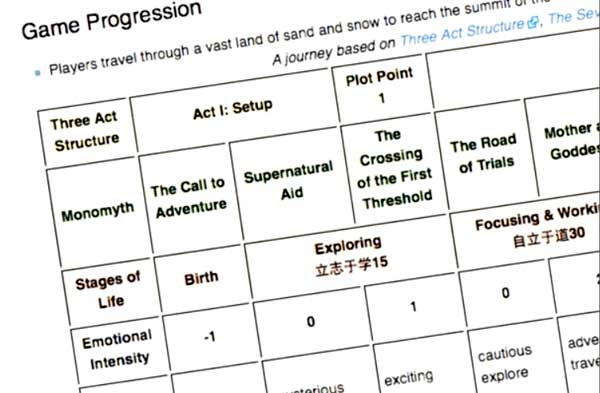
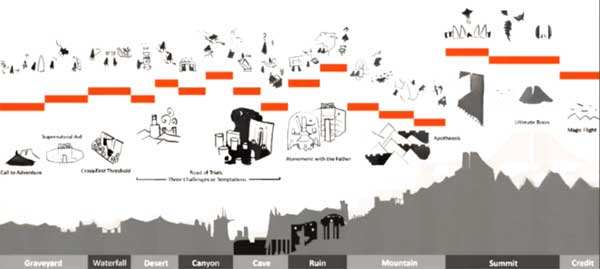
In his Game Developers Conference talk this year, Jenova Chen, director of Journey, described how, during development, he discovered that his design of the player journey correlated with Joseph Campbell’s ‘hero’s journey’ (Chen 2013). He had designed the player journey, for instance, to be about stages of life, with varying emotional intensity (see Pic 2). Chen further notes how the stages of life, artwork and geographic terrain all fit within the slow rise, extreme downturn and ultimate catharsis of the ending (see Pics 3 and 4).

Emotion and the Self in Games Pic 2: Game design and Joseph Campbell’s Hero’s Journey
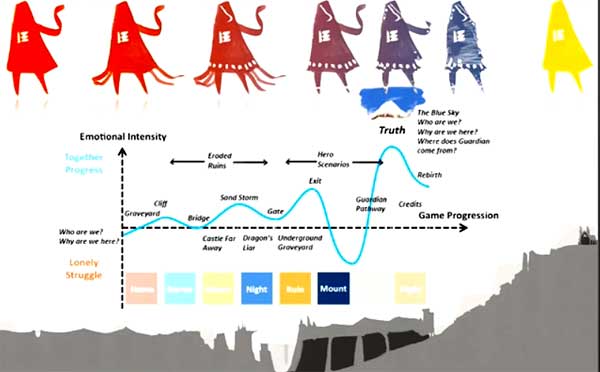
Emotion and the Self in Games Pic 3: Character, emotional and geographic journey
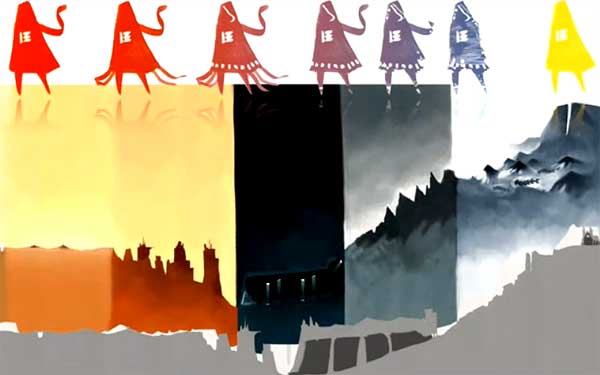
Emotion and the Self in Games Pic 4: Character, art and geographic journey
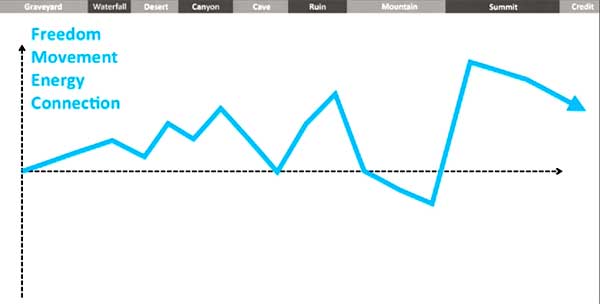
Chen explains how it was the gameplay aspect that needed extra time to refine. One can use art, sound and story triggers to facilitate an emotional journey, but how can player actions support the intended stages of feeling? What Chen and the team did was heighten and reduce certain abilities according to what stage the player was intended to be at. Freedom, movement, energy and connection were all either encouraged or restricted (see Pics 5 and 6).

Emotion and the Self in Games Pic 5: Gameplay actions and the player journey
Emotion and the Self in Games Pic 6: Gameplay journey

A big part of the emotional experience of Journey, for me, was due to the game being designed to encourage intuition. There weren’t a great many things for me to do as a robed figure in a sparse desert setting. I could venture off into any direction (at times) and focus on sliding over the sand. I found non-human friends who guided me around. I discovered how to make things happen in simple ways, and these kept moving me towards a distant mountain. But importantly I felt as though I was using my instincts. I felt as I was using things I already knew. The abilities of my avatar have some overlap with my abilities. I know how to run, walk, slide and jump. Granted, I don’t know how to fly, but I understand the concept (and sure have flown in my dreams).

All of this means that more of me can come into the experience. I’m not busy learning and doing things, so there isn’t a big cognitive load. This gives me time to project my memories and life onto the game. It allows me a deep-dive into myself – to contemplate. The setting triggers memories and feelings. The tasks and images along the way trigger thoughts and memories of my own life journey.

Games like Journey have been accused of not being games. Veteran game designer and educator Chris Bateman explains that they don’t have an ‘agency aesthetic, a way of enjoying play that focuses on the player’s ability to enact meaningful change in the fictional world of the game,’ which is a feature that is considered ‘the sine qua non of game aesthetics and hence a necessary condition of “gamehood”’ (Bateman 2012). Bateman’s response to this is the notion of ‘thin play’ (ibid.); he juxtaposes the busy activity of a first-person shooter, where a player runs around navigating the space, hiding, attacking, and reloading, with the spatial navigation of art games like Dan Pinchbeck and Robert Briscoe’s Dear Esther and Journey. Some critics claim that if you take away all that activity, you take away agency – and therefore its distinguishing feature as a game. Bateman argues that the process of navigating decision points are still a type of play; it is just thin. Even further, these sparse abilities become more important and ‘high in expressive value.’

Posted in ESSAYS | Tagged , , , , ,

Prints in the New Snow: Notes on ‘Es Lebe der König’, J.H. Prynne’s Elegy to Paul Celan

In 1966 Prynne emphasised the necessity for poetry to ‘emphatically reclaim the power of knowledge for each and any of us in our common answerability as the creatures of language.’1 The ekphrastic, proprioceptive and dedicatory analysis that Prynne demanded of his readers through Kitchen Poems and The White Stone reaches a point of crescendo with Brass in 1971. Continue reading

Posted in ESSAYS, SCHOLARLY | Tagged , , ,

Three Slab Five Tallulah: Words and Image by Lucy Holt and Dane Lovett

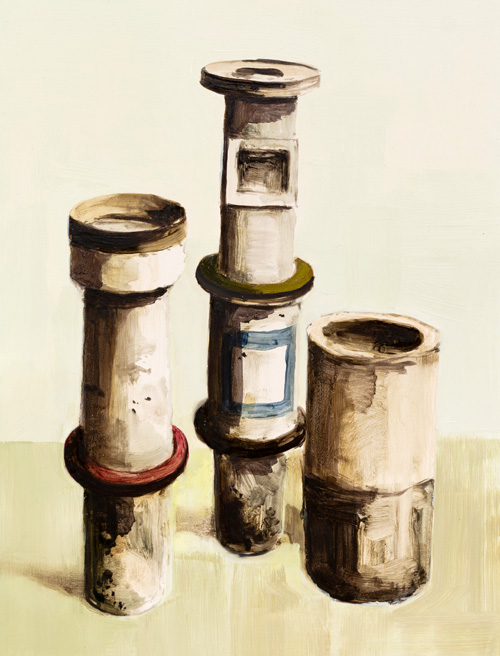
Three
Three 2012 | Dane Lovett | Acrylic and oil on aluminium composite panel | 40.0 x 30.5cm


Seeing Threes


The minute the hour and the second
hands cannot agree on the one object to hold.
They take off with a totem each and a version.

The lover, the beloved and the stranger:
the contingency of the third, or of the pair?
A serious high-sorrowful state of affair.

—Wild and foredefeated!—
The laughter in the middle,
the shadow above and below.

Posted in ARTWORKS | Tagged ,

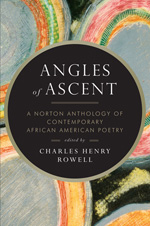
Alysia Nicole Harris Reviews Angles of Ascent: A Norton Anthology of Contemporary African American Poetry

Angels of Ascent

Angles of Ascent
A Norton Anthology of Contemporary African American Poetry

Charles Henry Rowell, ed. W. W. Norton & Company, 2012

Charles Henry Rowell’s expansive compilation of contemporary poetry beautifully archives some of the most lyric and provocative African-American voices of the last fifty years. Given the dearth of black poets celebrated within the American literary canon, Angles of Ascent is an essential text that pilots readers through the deep and yawning poetic traditions practiced by African-Americans. The anthology provides a beneficial overview for novice readers, including the greats like Gwendolyn Brooks, Audre Lorde, Robert Hayden, Toi Derricotte, Rita Dova. Continue reading

Posted in BOOK REVIEWS | Tagged , , , , ,

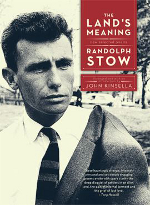
Caitlin Maling Reviews Randolph Stow

Stow

The Land’s Meaning: New Selected Poems by Randolph Stow
Ed. John Kinsella
Fremantle Press, 2012

I have nothing to say about poetry in general (except that mine tries to counterfeit the communication of those who communicate by silence). And these poems are mostly private letters – Randolph Stow

And if they should ever tempt me to speak again,
I shall smile and refrain. (‘Landfall’)

In his masterful and extensive introduction to The Land’s Meaning: New Selected Poems John Kinsella, who edited the volume, writes that much of Randolph Stow’s work is metaphoric, weaving things together in a way that promises narrative but actually reveals very little. Reading through this new selected poems, I was struck by the tension of poetry as public utterance of private speech, which characterises Stow’s work. Whether dealing with myth, landscape, colonialism or love, these are poems that are selective in what they choose to reveal and particular in the techniques they use to reveal. Continue reading

Posted in BOOK REVIEWS | Tagged , ,

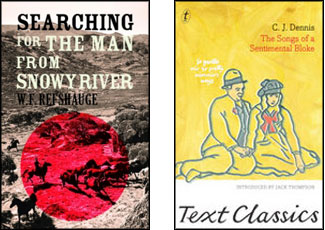
Nathanael O’Reilly Reviews The Songs of a Sentimental Bloke and Searching for The Man From Snowy River

Refshauge and Dennis

The Songs of a Sentimental Bloke
by C.J. Dennis
Text Classics, 2012

Searching for The Man from Snowy River
by W.F. Refshauge
Arcadia (ASP), 2012

The son of Irish immigrants, C.J. Dennis was born in South Australia in 1876. He died in Victoria in 1938, having become Australia’s most popular poet during his lifetime. Dennis’ first collection, Backblock Ballads and Other Verses (1913), was not a commercial success, but Dennis’ second collection, The Songs of a Sentimental Bloke, first published by Angus & Robertson in 1915, arguably became the most popular book of poetry ever published in Australia. Jack Thompson notes in his introduction to the Text Classics edition that the first edition of The Songs of a Sentimental Bloke sold out in a month, as did two subsequent editions; fifty-one thousand copies were sold in just over three months, sales figures that contemporary poets and publishers can only fantasise about. Continue reading

Posted in BOOK REVIEWS | Tagged , , , ,

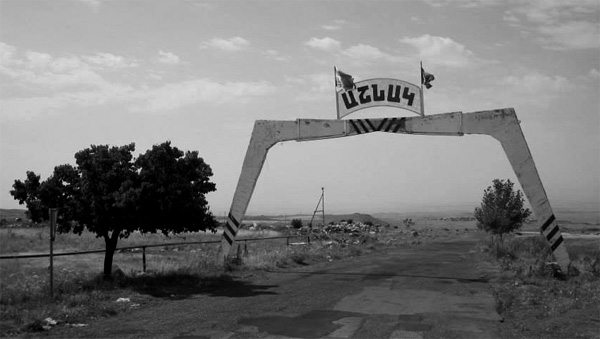
Notes from Yerevan, Armenia

Notes from Yerevan, Armenia

First impression: Yerevan undulates out the semi-desert, ringed with what look suspiciously like nuclear reactors. Flight SU1860 jolts down at (the recently privatised) Zvartnots airport, and we pass a dis-assemblage of passenger jets in various states of stripped-down decay. In the snow-capped distance, and just over the border with Turkey, Mount Ararat landmarks the otherwise small-hilled afternoon, a daily taunt here to national pride. In 1921, Stalin, Atatürk, and others sat down to reset national boundaries (during the Treaty of Kars): from uptown and dropping into Yerevan’s city centre, it feels like a bay should establish the city’s fringe. Instead, there’s that distant tidal wave of the now-Turkish mountain, where mythology tells us Noah parked his improbable floating zoo.

This stone city is built on the ruins of ancient Erebouni (782BCE), and has been criss-crossed by successive marauders (including Assyrians, Persians, Arabs, Byzantines, Mongols, Turks). It is one of the world’s oldest, continually inhabited cities. The currency is adorned with poets: Hovannes Toumanian (1869-1923) is commonly regarded as the father of modern Armenian letters, while the brilliant Yeghishe Charents (1897-1937) died a counter-revolutionary during the Soviet purges. When I hand over a few notes of Armenian dram in exchange for a visa, the border guard hands back a ‘shnorhakalut’yun’ (thank you), and then ‘welcome you, mister’.

Visiting in 1990, the renowned Polish writer Ryszard Kapuściński writes thus of Armenia:

The history of Armenians is measured in millennia. We are in that part of the world that is customarily called the cradle of civilization. We are moving among the oldest traces of man’s existence … The fate of Armenians: centuries of persecutions, centuries of exile, diaspora, homeless wandering, pogroms. (Kapuściński 1995: 46; 231)

This wind-bitten place was a dormant village until 1918, when the Soviets turned Yerevan into Armenia’s capital (the country’s thirteenth). Today it is full of young families and bent police and huge, brutal, upright statues and unkempt parks and public squares bustling with flea markets and sun and overcrowded, dusty mashutkas (mini-buses) which jostle across town at 27¢ per ride. I am here as a guest of Mkrtich Tonoyan, director of the Armenian-based arts residency program ACOSS. This monolithic 37 year old is a former teen paramilitary, and carries books like Education for Socially Engaged Art with him everywhere. Tonoyan lives by his ethics like few other artists I know: any money generated by ACOSS is channelled directly into projects for children and socially-disadvantaged groups.

During my month-long stay as an ACOSS writer-in-residence, he delivers a new turbo charger to a rehabilitation centre’s inert bus and, when he visits an association for blind veterans in Stepanakert (the de facto capital of Nagorno-Karabakh Republic, which remains disputed territory), he promises to fund twenty new handheld laser guidance devices. Tonoyan lives in a tiny apartment on the outskirts of Yerevan, together with his mother and grandmother, wife and three kids. We can’t walk 20 metres in this part of town without somebody clutching him in a bear hug. And anything growing on trees in his garden is prima materia: the aim is for home-made vodka which is 96% proof, a liquid corrosive for the psyche. The parties in his studio attract artists from across the Caucasus.

Notes from Yerevan, Armenia

Firmly hand-in-hand into the future with Russia, Armenia remains at loggerheads with pro-American, neighboring Georgia. To talk of some of the other neighbours only raises eyebrows and blood pressure: the war with Azerbaijan is ongoing (at best, a ceasefire), and everyone has an evenings’-worth of outcry over the Turkish-led genocide, which started in 1915 and ended up in one and a half million Armenian deaths later. And though the Soviets left in 1991, they left a culture of censorship behind – as Armenia’s foremost avant-garde poet, Violet Grigoryan, based in Yerevan, knows only too well. Cultural commentator and raconteur par excellence, Grigoryan once hosted her own TV show … which the state closed overnight for its ‘inappropriate’ political content. In her introduction to Deviation: Anthology of Contemporary Armenian Literature (2008), she contests that:

The concept of ‘drawer’ literature first emerged during perestroika, referring to works that authors hid in drawers … A long time has passed since the collapse of the Soviet Union and the disappearance of state-mandated censorship. Nevertheless, the censorship survived in the people’s spirit and in those who continued to govern the literary world. (Grigoryan 2008: 7)

So what to do when confronted (as she perceives it) with a cultural economy regulated by reactionary bean-counters? Grigoryan persists with making space to escape institutionalised censorship; she purposefully antagonises any valorised group (‘Academia, the Literature Departments, the publishers and the Stalin-styled creative unions’: Grigoryan 2008: 7), through fostering writing which employs non-normative styles. She is part of a raucous group – the Inknagir Literary Club, based in the city – that demands freedom, plurality, and empowerment. Members are frequently blacklisted, despised for themes which include homosexuality (still largely unmentionable in Armenia), sexual violence, suicide, necrophilia. One academic states that Grigoryan’s cohort are:

Demolishing all the moral, ideological, and spiritual standards in their wake. Preaching their message of verbal freedom, they dragged into literature the stratum of language that has no place in the dictionaries and … literally exudes the stench of decay. (Zhenia Kalantaryan, cited in Grigoryan 2008: 9).

For the Inknagirs, reactions like this means their impact on contemporary Armenia literature is already a fait accompli.

And so, in this small and landlocked country where 80% of the borders are closed and the threat of missiles dropping over Yerevan looms (to almost every Armenian’s dismay, Russia recently sold US$4 billion of arms to oil-rich Azerbaijan), creative producers are struggling to make sense of their role after the death of the Marxist drive toward utopia: are they social workers or social misfits? Is an artist an activist rebuilding communities through art, or a destinateur of programmatic bad taste, smashing everything so as to start again? Either impulse speaks to ideas of engagement and idealism. Tonoyan and Grigoryan embody competing impulses in a dynamic scene populated by artists living each to authentic visions of aesthetic function: in a place where there is almost no opportunity for creative producers to receive support for their work, the Armenian artists I met would welcome visits from funded, comparatively wealthy First World poets. Next time you receive funding or win a prize, consider visiting.

Works cited

Violet Grigoryan and Vahan Ishkhanyan (eds) 2008 Deviation: Anthology of Contemporary Armenian Literature. Yerevan: Inknagir Literary Club, 2008.

Ryszard Kapuściński (trans Klara Glowzewska). Imperium New York: Vintage Books, 1995.

Posted in ESSAYS | Tagged , , ,

1961: lightly scored in three parts

QPF

Posted in POETRY | Tagged ,

Protein Gradients

Dire Wolf (10,000 BC)
Canis dirus

We were going along okay when you upped
& changed the status quo. Our Super-sized
Menu died off through your public meddling.
Your nutritional requirements affected us direly,
Our epoch had evolved the first Atkins Diet, all
Protein enriched, low carbs but you killed that fad.
Pride. That’s what tipped it. Slower than gray wolves
We had to scavenge for a living. Our frames couldn’t
Keep up with the new, trendy runners. Too heavy in
The jaw from eating all those giant bison. Desire ruled
At the end, if some prey got trapped in a tar pit, we lost
Our heads & hides. Pack stupid. We inhabit your darkest
Memories. Programmers get us. Now only noobs fear.
For we hunt again in electronic forests; pixel hungry.


Darling Downs Hopping Mouse (1840 AD)
Notomys mordax

You wouldn’t have known us but for a single skull
Found in the nineteenth century, but all that really
Told you is that we had a brain once & a face too.
The rest you’ve had to work out for yourselves.
Like our copious habit for mating on grass stems
Our night passion bending blades until the climax
Touched ground; fervor earthed in the deep, black
Darling Downs soil. Landfucking you’d call it, an
Exchange of sex-knowledge among mammal species.
Lucky then, our skull wasn’t discovered in those owl
Pellets like our cousin’s was – think of the inter-class
Innuendo that would’ve spread. Our preoccupation
With sex usurped by death eventually, all Nazis those
Pests & as for our extinction; we hopped right to it!


Quagga (1883 AD)
Equus quagga quagga

You’re a weird mob alright, a species obsessed
With boom & bust cycles, ours in particular. First
You cleared us away for your four-legged friends
After making a fortune on meat jerky & leather.
Concentration camp facilities you installed free
Of charge to regulate our demise, then confusion
Reigned as to who you were killing. Zebra brethren?
Native South African? Or somebody entirely new?
We were dead by the time you reached consensus,
So you turned to our DNA to solve this dilemma,
& hatched a scheme in some museum coffee shop.
Your Island of Doctor Moreau morbid fascination;
Experiment & start again! Breed us into existence?
At least you’ll have our name right in retrospection.


Ryukyu kingfisher (1887 AD)
Halcyon miyakoensis

Ah … this culture suited us down to a tree.
Avian Ronin, lordless we served no one else
But ourselves, splitting the infinity of freshwater
Our beaks tempered steel folded a thousand times
In evolution’s forge. Pommel jewel eyes cut fish,
Our spirituality secure only on a risen stomach.
We were a whisper, a ghost in the shell of nature.
Echoes of us reverb in the single specimen you
Took, blood legs, blood bill, painted-warrior class
We killed clinically, fluid death momentum held.
Honour bound us to end it all; ancient practice
Unfolded in dark canopies. Trees saw everything.
Bark writ; the scratches indecipherable to you.
We left your race little to ponder & halcyon days.


Lesser Bilby (1967 AD)
Macrotis leucura

You were so confused, but then so were we.
Rabbits you thought us, on first impressions
Then our nasty little temperament bit through.
Rodents we preyed on, so un-rabbit like, so
Unlike Peter with his naughty habits of human
Baiting. We became fox food, floor rugs, ironic
Then, those coneys out-competed us, their broods
Superior, their ears cuter somehow? They received
Easter Bunny largesse; nursery rhyme cultural capital.
Lolly companies bank-rolled their cause, your species’
Sweet teeth too. We narrate all this from the hollow
Memory of a skull found lying at the base of wedge-
Tailed eagle’s nest in 1967. The referendum on our
Extinction was carried; cursed, rabbit gerrymander.


Gastric-Brooding Frog – Southern & Northern (1984 AD)
Rheobatrachus silus & Rheobatrachus vitellinus

Our story is so Greek, a classic tale of misadventure.
The tragedy is that you’ve missed it all most probably.
None of you witnessed our godlike qualities but we’ll
Share them anyhow. Our little ones sprung fully formed
From our mouths (we know, so like Chronus spitting out
His eccentric brood). A warped conception compared to you!
The last Southern captive died in 1984 – Big Brother’s vision
It seems only affected us! Then you discovered our Northern
Offspring…too late as usual, they’ve never been seen again!
The debate still rages – did we swallow our eggs or tadpoles?
A hormone stopped the juices; some were sacrificed for that!
What killed us? Rising temperatures, moisture drying out at
Altitude? Were we slimy canaries for the Greenhouse effect?
Perhaps, like Zeus’ clutch we turned on our kin & ate them!


Giant Galapagos Tortoise (ii) (c. 1830 – 2006 AD)

So my grand prediction was a little askew.
You outlived me in the end; a human touch
Only two months eleven days separated us
From our hyped celebrity. Maybe you had
To follow my new path to a starry waterfall;
Clusters of shell-thin galaxies, grazing on
Hibiscus coloured nebulas, the beak shears
Curvature of space oddity. After 176 years
Of earth hugging & scraping dirt over old
Memories I was due this last voyage. We
Both got it in the heart; time’s hooked barbs
Reversed so you can’t pull them out. We’ve
Dematerialised beyond time & space. Yes, a
Poor Galifreyan I made, but then so did you.


Harriet died June 23 2006
Steve Irwin died 04 September 2006

QPF

Posted in POETRY | Tagged ,

Sentences / part two

Sentences / part two

Click on the image above to launch.

The second episode in a 3 part sequence titled ‘Sentences / part two’ combines my interests in animation, improvised music and algorithmic writing in experimental forms (i.e., mesostics in this production).

Text presented in ‘Sentences / part two’ was co-authored by Charles O. Hartman’s PyProse. As done many times in the past, I have selected, edited and arranged PyProse’s output into a cyborgian construct, upon which I am pleased to affix my name.

Posted in 57: MASQUE | Tagged

Public Transport

on the first train to freedom
they told me of a gaol bird singing
‘love is just a ballast to stop these ‘ere
souls cart-wheeling off into the
empty night, do-dee-doo
dum-dee-dum…’

but on the last train out
I saw it all:
smelling the looks of lovers
who would never meet
their hidden glances
excused to be less
dead fly Milton bright
& thoughts toward action organised like
a junkyard backpacker bus
fallen into disuse
or like the errant memory of where keys
lie
while typing love letters in the dark

too many believe in the mask of next time

& as I turned away
outside my window
I felt it all:
the flowers in the cemetery
waving in the soft anhelations
of the gods

& of life breezing by.

Posted in 57: MASQUE | Tagged

“Hindley Street”: How to Be Perfect There

Pete Bakowski’s challenge: attempt Padgett’s ‘How To Be Perfect’.


“Hindley Street”—
I write those words, the
title of this poem,
on this pad,
to start a list—of things I must
do. Is this
going to be a poem?
Isn’t it?
(“Hindley Street”—
I know what it will mean.
I continue the list …
Names of people I should
email. Richard, in case
my silence is taken to mean something,
something dark, brooding—
Micky, to break her silence.)

Different from what I had been
going to write—fired up
by the fetishized nebulosity
of the Houynhhyms last night.

I get a haircut instead,
& the head massage that
goes with it
syphons off
all anxiety.
Philosophers,
rub your heads!

My hair short again—
my visage modern.

Now, to work—
to face down the future
as it comes on
like gangbusters,
minute by minute—
doing this & doing that—
philosophy, meanwhile, on the back-burner.
Simmering.
I add Simryn Gill
to the list. Hullo, Richard, Micky, Simryn!

Like a small-minded Frank O’Hara,
a sort of contradiction in terms—

small-minded then, not like Frank O’Hara,
but with my haircut, at least,
ashamed of a century that is
ashamed of me, if it thinks about it.
Me, & the century—at neither of which
I can smile. Time to get
my head rubbed? No time for that—
the future arriving incrementally,
minute by minute—
like pirates boarding a ship.
So it’s Game On!

I rather like the look
of this loony tune
swinging in the rig, his earrings
& bandanas, cutlass
between his teeth.
Tho is it Peter Bakowski,
in disguise, this pirate
‘of the future’—forget
I ever said that!
(The future
can look after itself.) ? —
is it Peter?
& the pirate hands me a
telegram from, let’s see …
H.G. Wells? Herbert
‘Vere’ Evatt? Someone
futuristic—
Arnold Schwartzenegger!?—
no—Ron Padgett.
The pirate now looks like Ron,
I note,
as I read the letter, look up to his
face—which nods, lips parted,
still breathing heavily,
full of encouragement—
& read again.
It says, You’ve forgotten
to read the instructions—haven’t you?
“What?” I say, I think.
Ron speaks:
“How To Be Perfect—
it was in my book of the same name.
I know you’ve read it—
and Kenneth Koch, his ‘General Instructions’, ‘The
Art Of Love’, and other poems-of-advice.
But you don’t seem to have
taken it all in. Or you
bracket it off, as if it
weren’t real life. We’re
not fooling about, buddy.
Sure, make a list of things to do.
You’ve got that right.
But put the right things on the list!
‘Get a haircut’? Why not?
But is that gonna solve anything?
And if you’re gonna get a haircut
Get the Right Haircut—
you look like a disaster!
Sure, write to your friends,
that’s a good idea.
And if you’re dealing with Hounyhymms
Take some energy from the encounter—
You’ve got that right! But …
must you deal with them at all?
Or are you not very discrimminate
in your use of the term? Were they
that bad? Ask yourself this.
The future is neither
your friend nor your
enemy unless you set it up that way.
A few precautions, that’s
my advice. Like
Peter Bakowski, he’s got it right.
We’re not a bunch of pirates—
(yes, I’m from the future—
your future, anyway—
it may not be so bleak)
I dress like this
to get your attention.
I’m normally a sneakers-&-jeans
kind of guy, I wear my cap
facing forwards,
over a closely cropped head,
with my signature round glasses.
Not this pirate crap. How they
ever got about, in all this gear,
is hard to figure. But the future
is not waves of pirates
boarding your ship
. You’re a
glass-half-empty kinda guy,
aren’t you? You & Tony Towle
take it on the chin—for
preference
, don’t you? You
think that’s ‘Romantic Irony’?
You’re an Australian—
what’s romantic about that?
Have you written to Tony lately?
You haven’t written to me.
So, make a list!
I don’t hold out much hope for you.
You should maybe
re-read my books.
That might help. And Peter Bakowski’s,
he’s the man.

And here our
conversation broke off
near the knoll’s island foam.

Posted in 57: MASQUE | Tagged

*the birds*

In the sky we float our fancies
catching drafts off flat facades
upward using warmth spread
black wings wide hooking
sky float delicious blue scatter
we pither here near there for
softer homes in cooler climes
seeding whispers promissory notes
leaf and pail heaven-sent sun-soaked
drenched in colored light
lilac-scented breath for dreaming

Posted in 57: MASQUE | Tagged

Peacoctalina

After Emily Valentine, 2013

She started out in a factory –
up before the cock crows
and scuffs its spurred, scaled feet

in a land far, far, away (still)
where men and women sleep
in cages, baker’s dozen to each dormitory –

as any piece of plain plastic does

until, landed in the artist’s hand,
unaided by Bede, as ornament
she is feathered, made unique

in a gypsy’s metamorphosis,
hers becoming coquettishly, traitorously his.

Posted in 57: MASQUE | Tagged