‘Can I Do My Words?’: On the Poetics of Deafness

Taken together, the three memories in my poem ‘Signs‘ denote my progression towards finding a voice as a deaf writer. The intense pain and sensory overload that I experienced on that early spring day was caused by meningitis. The doctor gave me a large dose of antibiotics to clear the infection on the lining of my brain, but this damaged the hearing in my left ear and half in my right. This was why I couldn’t hear my father’s words clearly.

I was obsessed with books such as Strawberry Shortcake when I fell ill. As I’d learned to speak by then, and I clearly loved words, my parents decided to send me to the local primary school, which meant that I was raised as an oral-deaf person (that is, a deaf person who uses her voice to communicate, rather than her hands to sign). I had speech therapy from a teacher for the deaf once a week, and now people rarely notice I’m deaf unless they see my hearing aid, or I tell them. This raises another set of problems: I pass so well as a hearing person (largely by dint of lipreading and sheer hard work), that people fail to accommodate me by speaking more clearly, or forget to include me in conversations. Consequently, it’s easier for me to read than to listen to and interact with people. Reading was a solace when I became sick, and has remained so ever since.

My deafness aside, the aura of those letters living beneath the dresser suggests that words were always going to be significant for me. Shuffling them into words presaged my decision to become a writer when I reached my late teens. I poured the stress, frustration and isolation that came with deafness into journals. Later, when I developed my literary ability, I crafted my emotion into novels, stories, poems and essays.

As well as guiding me towards writing, deafness also profoundly influenced my literary voice. The part of my hearing that survived is in the upper registers, so I hear women’s voices more clearly than men’s. This means there is less chance of confusion and mishearing when I listen to women, and less chance of being mocked if I miss something.

When I learned about feminism at university, my affinity with women’s voices exploded into a passion. I particularly identified with their historical efforts to find a voice, and to have that voice published in a world that was hostile to them. As Virginia Woolf, with her ever-elegant turn of phrase, wrote in A Room of One’s Own: ‘One can measure the opposition that was in the air to a woman writing when one finds that even a woman with a great turn for writing has brought herself to believe that to write a book was to be ridiculous’ (68).

Deaf people, too, have had a long and contested relationship with writing and speaking and, like women or other minorities, they have fought to be heard. The suppression of their voices is due to Western theology and philosophy’s association of logos, or reason, with the voice and the spirit with breath (Davidson 91). This association began with the belief that speech was of divine origin – that is, given by god. The Christian church decreed that if deaf people could not hear the word of their god, then it would be blasphemy to teach them. Gradually, through the efforts of monks such as Fray Pedro Ponce de Leon (1529–84) who taught the deaf children of aristocratic Spanish families anxious to keep their wealth by passing it on through these children, it was discovered that deaf people could be taught to speak (Markides 6). Two centuries afterwards, teachers such as the Abbé de l’Epée (1712–89) in France showed that deaf people could communicate freely and easily using sign language. His successor, Abbé Siccard, taught Laurent Clerc, who together with Thomas Gallaudet established what would become the first university for the deaf in America, Gallaudet University.

Despite these endeavours, the oral-education method of teaching deaf people to speak gained traction near the end of the nineteenth century. It was influenced by prevailing ideas on eugenics and prominent spokespeople such as Alexander Graham Bell, inventor of the telephone. Bell, whose deaf wife communicated through lipreading, believed that deaf people should marry hearing people to avoid ‘a formation of a deaf variety of the human race’ (4). Endorsement of the oral method was cemented at the International Congress for the Deaf held in Milan in 1880, where it was resolved that deaf children worldwide should be taught by the oral method and that sign language was to be discouraged.

The denigration and suppression of sign language, which has lessened only in the last 40 years or so, has placed considerable pressure upon deaf people to conform to the dominant hearing culture. This means pretending to hear when one cannot, speaking instead of signing and never disclosing that one has a hearing loss. However, for those who are born deaf, it is much easier to learn to sign than to use lipreading and speech, both of which require huge amounts of concentration and energy.

In tandem with this impetus, deaf people have been encouraged to write as well as sign so as to communicate with hearing people, even when writing has not come easily to them. Jennifer Esmail, in Reading Victorian Deafness, notes that ‘when deaf Victorians were writing in English, they were almost always writing in their second language. They were typically signers first and writers second, yet they were forced to use written English to represent themselves textually’ (201). Even at Gallaudet University a century later, as deaf rhetorician Brenda Jo Brueggemann writes in her 1999 text Lend Me Your Ears, students were expected to become skilled in both American Sign Language (ASL) and Standard Written English, even though ‘ASL and English differ radically – syntactically, conceptually, modally – in almost every way’ (50¬–51) and ASL has no written component. Despite these tensions, deaf writers have mobilised both written English and sign language to express themselves.

Deaf Poets

‘The deaf poet is no oxymoron,’ John Lee Clarke opens his essay ‘Melodies Unheard,’ ‘but one would think so, given the popular understanding that poetry has sound and voice at its heart … As a result, deaf poets are often objects of amazement or dismissal’ (165). This was particularly pronounced in the nineteenth century, when written poetry was linked with orality, often in terms of formal features such as rhythm and rhyme (Esmail, ‘Perchance’, 509). Undaunted, deaf poets of this era frequently created poetry. The network of periodicals created by and for deaf people included monthly poetry columns, while important events in the deaf community ‘were commemorated with poems written and signed by pupils’ (Esmail, ‘Perchance’, 510).

Hearing audiences, however, emphasised the seeming incompatibility of the deaf poet’s craft, and they marvelled that deaf people were able to produce poetry at all. In the first volume of the American Annals of the Deaf and Dumb (1848) is a poem, ‘The Mute’s Lament’ written by John Carlin. Preceding this is an article, ‘The Poetry of the Deaf and Dumb’, written by the editor who expresses wonder that the poet, deaf since birth, had produced a poem:

How shall he who has not now, and who never has had the sense of hearing; who is totally without what the musicians call an ‘ear’, succeed in preserving all the niceties of accent, measure and rhythm? We should almost as soon expect a man born blind to become a landscape painter, as one born deaf to produce poetry of even tolerable merit. (14)

The editor’s surprise notwithstanding, many deaf poets did reproduce rhyme and sound in their work. They also wrote poems that included birdsong, music, wind, the human voice and musical instruments, and invested these sounds with tone (Esmail, ‘Perchance’, 522). In Carlin’s poem ‘The Mute’s Lament’, for example, streams murmur ‘gaily’, the linnet’s song is ‘dulcet’ and the organ’s harmony is ‘sweet.’ These adjectives indicate that ‘deaf poets who do not have access to a sensory experience of sound … they have access to a textual experience of sound derived from conventional phrases’ (Esmail, ‘Perchance’, 524). Sound is conveyed to these poets not through their ears, but their eyes.

This seeming contradiction is borne out through the figure of the mute poet, Carlin’s narrator, who lists the sounds of birds and lutes, but brackets them with the refrain ‘I hear them not’. He also laments ‘My tongue is mute, and closed ear heedeth not’. Even as he proclaims he cannot hear, the very act of narrating is a speech act. Carlin’s narrator destabilises the concept that poetry must be spoken and heard, for here is a deaf person speaking and creating sound through the silent text. Esmail’s skilful analysis of this poem and its implications demonstrates that ‘the ear is only the imagined, but not the necessary, home of poetic ability’ (‘Perchance’, 576).

This distinction has been grounded further in the emergence of signing poets. These are poets who ‘do not write. After all, writing is not native to Deaf culture as is signing. They make poetry out of handfuls of air, their lexicon cinematic and giving rise to a new poetics’ (Clarke 169). Visible, or signed, poetry, gathered momentum in the 1980s when Ella Mae Letz and Clayton Valli, unbeknownst to one another, began to produce signed interpretations of poetry in America. At the same time, a 1984 workshop between Allen Ginsburg and deaf poet Robert Panara of the National Technical Institute for the Deaf (NTID) in Rochester, New York, sparked a new generation of signing poets. In conversation with Ginsberg, Panara observed that ‘For deaf people, signing poetry is like “painting pictures in the air”’, to which Ginsberg replied, ‘The ambition of a good poet is to write something that is visually clear and bright … It’s fortunate that modern poetry is the closest verbal formulation to what might be useful for deaf people’ (Cohn 266). Cohn writes that this exchange ‘has historical implications for the Deaf because it validates the formation of a sign language poetics that in itself is not isolated but is part of a developing international poetic style based upon an awareness of the importance of the image’ (266). While Cohn’s desire for deaf poetry to be validated by a hearing poet is problematic, the exchange fortuitously gave rise to a series of signed performances at NTID under the auspice of The Bird’s Brain Society. Discussions about these performances revealed ‘a previously undocumented level of metalinguistic, and specifically poetic, awareness of sign language as an art form by the Deaf’ and included observations such as: ‘A deaf poet’s strength is in the visual expression of the poem’, ‘Sign language does not require English’ and ‘I’d want to see the deaf audience cry. I’ve never seen that happen’ (Cohn 268–269). That Peter Cook, who conceived the title after a poem of Ginsberg’s, is still performing is testimony to the strength of and interest in signed poetry.

Bauman, Nelson and Rose, in their text on American Sign Language literature, Signing the Body Poetic, articulate how signed literature differs from traditional prose and poetry:

Poetry often conjures images of lines not quite reaching the right margin and the musical incantations of the speaking voice, whereas prose evokes images of justified margins, indented paragraphs, chapters, and books held by silently engrossed readers. But in sign literature, the same hands, face, and whole body used for everyday eating, sneezing, and lifting are transformed into the kinetic shape and skin of the poem. Here, reading becomes viewing, books become videos, and paper becomes a performing body. In a most literal sense, this is a form of ‘writing-the-body’. (2)

Examples of such bodily writing and reading can be found on the website of the library of The Rochester Institute for Technology, with which NTID is now affiliated. A subject guide for ‘Sign Language Literature and Poetry’ includes a list of YouTube and online videos of signing poets, such as ‘The Stars are the Map I Unfurl’, a British Sign Language poem by Gary Quinn which celebrates the first deaf round-the-world solo yachtsman, Gerry Hughes. The piece, performed by Quinn and interspersed with images of Hughes on his yacht, is accompanied by written versions of the poem in English and Shetlandic. Kyra Pollitt, a British Sign Language interpreter, poetry researcher and artist, collaborated with Christine de Luca to create the literary interpretations of Quinn’s poem. David Bell provided kinetic titling, providing another layer of translation, but also making the film accessible to an audience that does not know sign language (‘Signed Up’).
Posted in ESSAYS | Tagged , ,

6 Film Photographs from Isa Lausas


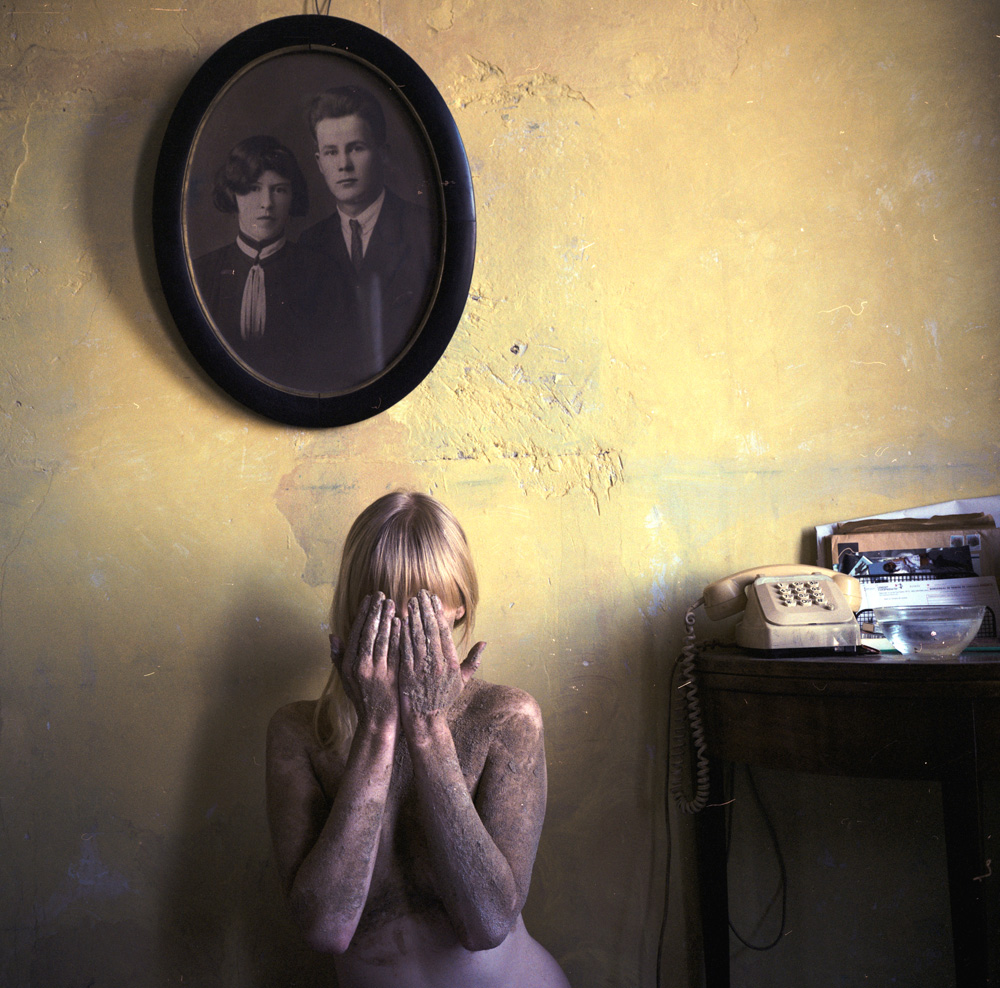
Isa Lausas | SE-2 | from Static Echo | 2012 | Film photograph

The inability to root myself in a society or in a specific country is reflected in my work by a mesh of elements from different time periods and cultures.

My photographs are conceived almost as paintings, by a process of association of elements and observation in a performative game. My aim is to create timeless and borderless atmospheres to capture what I define as visual enigmas.

    1. Relative to the view, visible and approachable by anyone in the contemporary world.
    2. Spontaneous living pictures or ‘tableaux vivants’, composed by quotidian symbolism related to daily rituals, objects.
    3. Intentional ambiguities in the presentation of a situation.
    4. Thing or person difficult to comprehend.
    5. Questioning of the « self » that coexists in between an inner vision and a physical existence in its living space.
    6. Components involved in the creation of a personal mythology.
    7. Captivating silence: nb that all silence is not peaceful.
    8. Strange and attractive detail(s) which go below understanding.
    9. Absence of explanation, which remains floating in the extra-visual.

These propositions define my process and photographs, inspired by encounters, discoveries of elements that are usually ignored, and of the unknown in general. A transformation and appropriation of the quotidian arouse an intrigue and an attempt to make the invisible visible.

Posted in ARTWORKS | Tagged

Interview with Dorothy Hewett (O’Keefe remix)


Dorothy Hewett | Ali Burns | The Hoopla | 2015

Hazel de Berg’s recordings take place in the homes or work spaces of the subjects rather than a recording studio. This allows something of these places into the recording whether birdsong, traffic or an r&b song playing in the background. In the recordings, de Berg remains enigmatic, the ghostly presence operating the machine.

Interview with Dorothy Hewett ( O’Keefe remix)

Recorded on 11 March 1973 by Hazel de Berg.
2015 mix by Ella O’Keefe

‘Dorothy Hewett interviewed by Hazel de Berg in the Hazel de Berg collection’
Courtesy of the National Library of Australia, TRC 1/658-659
Special acknowledgement to Duncan Felton, NLA Oral History & Folklore Branch

Read more about Dorothy Hewett at the Australian Poetry Library.

Posted in INTERVIEWS | Tagged , ,

Interview with Brett Whiteley (O’Keefe remix)


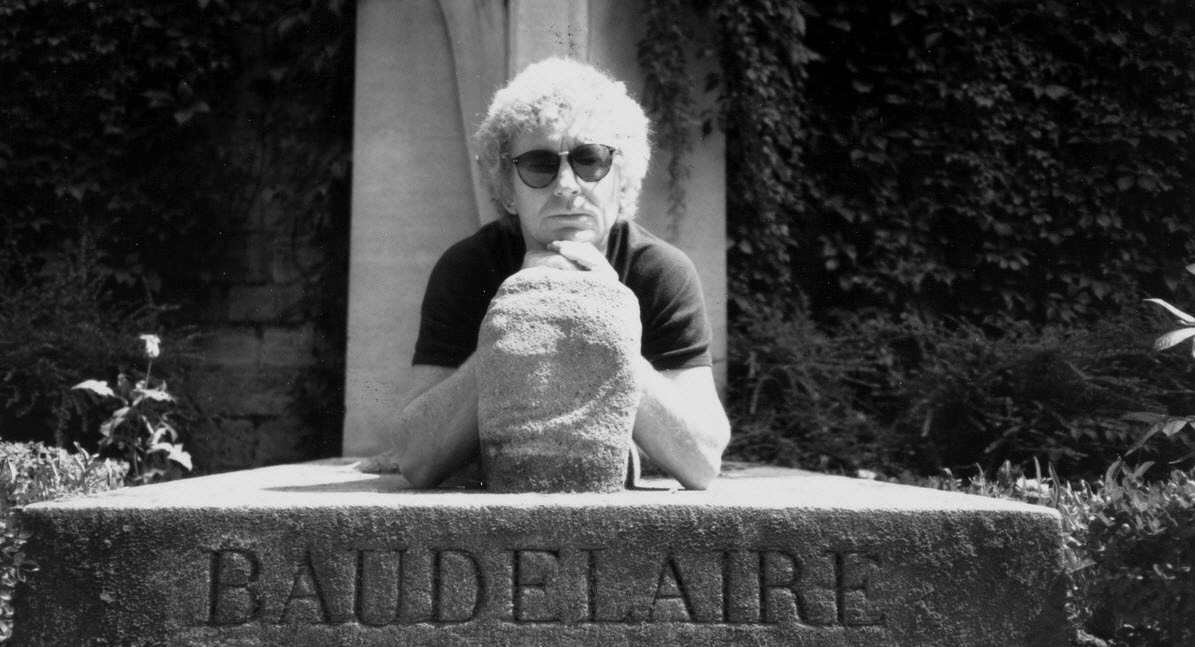
‘Brett Whiteley at Baudelaire’s Grave, c. 1989’ | by Unknown | gelatin silver photograph | 14.3 x 9.3cm | National Portrait Gallery, Canberra Gift of Patrick Corrigan AM 2010

Hazel de Berg’s recordings take place in the homes or work spaces of the subjects rather than a recording studio. This allows something of these places into the recording whether birdsong, traffic or an r&b song playing in the background. In the recordings, de Berg herself remains enigmatic, the ghostly presence operating the machine. An exception to this can be found in this recording of Brett Whitely who, in the course of the interview, expresses frustration with the recording not being in a conventional Q&A format. De Berg can be heard offering questions and prompts about the themes and symbols in some of the paintings sitting in the room where the recording was made.


Interview with Brett Whiteley (O’Keefe remix)

Recorded on 5 March 1970 by Hazel de Berg.
2015 mix by Ella O’Keefe

‘Brett Whiteley interviewed by Hazel de Berg for the Hazel de Berg collection’
Courtesy of the National Library of Australia, TRC 1/461
Special acknowledgement to Duncan Felton, NLA Oral History & Folklore Branch

Read more about Brett Whiteley at the Art Gallery NSW Brett Whiteley Studio.

Posted in INTERVIEWS | Tagged , ,

Bonny Cassidy Interviews Sophie Collins

I said comforting things to the scaffold 
but she only seemed to lean more heavily
against the side of the church.
We are rarely independent structures she said
before she dropped a bolt pin 
which released a long section of tube
which released another bolt pin
which released several wooden boards
which scraped another tube
and made an unbearable sound.

– from ‘Healers’ by Sophie Collins (first published in Poetry, October 2014)

Based in Belfast, Sophie Collins is co-founder and editor of tender, an online quarterly promoting work by female-identified writers and artists. Her poems have appeared or are forthcoming in Poetry, Poetry London, The White Review, Ploughshares, The Lifted Brow and elsewhere. Reviews and other writings are published in Poetry Review and Dazed & Confused. In 2014 she received an Eric Gregory Award and was a poet in residence at the LUMA/Westbau exhibition space in Zürich. She is currently editing an anthology of experimental translations due late 2015 via Test Centre, London. I interviewe Collins in The John Hewitt, Belfast, December 15th, 2014.

Bonny Cassidy: Thanks for representing tender as one of its visionaries – the other being Rachael Allen. Before we talk about the journal itself, it would be good to learn a bit more about you. You grew up in Holland, right?

Sophie Collins: Right, though I don’t feel Dutch, nor particularly English. Honestly, I feel a bit nomadic. I was born in the south of England; my father is a Classics teacher, and he was offered a job at an international school based just north of Amsterdam, so I grew up there from a toddler until I was about eighteen. At that age I moved back to London to do a BA at Goldsmiths, and then after my MA came to Belfast to do a PhD at Queen’s. The work I’m doing here deals with experimental modes of translation. The creative component is an anthology of experimental translations I’m putting together, which will be published by an independent press here in the UK next year.

BC: How does your ‘nomadic’ youth inform your interest in translation? More specifically, what drives your focus on the experimental angle, since this also seems to typify the work you publish in tender?

SC: I think it’s not necessarily my upbringing that was ‘nomadic’, but rather the feeling I’m left with now of sitting a little uncomfortably in either culture. Without wanting to forge a narrative, I can definitely see some links between my childhood, my education and my current sensibilities. Having grown up in North Holland and attended a school with a strong emphasis on language, and a really broad, international intake, languages and borders have always been central to my life and thinking. I was taught primarily in my mother tongue (English) but also had to take certain classes – namely the human sciences – in French, and this while living in the Netherlands, so I’ve been working across at least two different lexicons from pretty early on. Partly due to this, language took on a material aspect for me at quite a young age – it felt like a tool rather than the fount of sense. So, much later, when I was introduced to ideas around conceptual poetry, including modes of conceptual/experimental translation, the ideas didn’t feel threatening to, or out of sync with, my outlook, and I became very interested in experimental poetics very quickly. I began to incorporate conceptual techniques into my own poetry, and, soon after this, during my MA at UEA, began a module in experimental translation. At that point it made sense to incorporate different languages into my research, and my approach to translation was always going to reflect my approach to poetry.

The work in tender is also a reflection of these sensibilities – with the journal Rachael and I wanted very much to etch out a space not just for female writers and artists, but also for the kind of work that we feel doesn’t get enough airtime in the UK. This tends to lean towards that which subverts expectations of lyric poetry, whether such work incorporates and transcends the lyric, or altogether rallies against it. We don’t subscribe to a manifesto and aren’t (I hope) prescriptive, but in terms of poetry we are always looking for something with what I think could best be described as self-awareness, however that manifests.

I guess that, with editing the translation work, I’m relatively new to that discipline but could be seen as making decisions about what’s valuable, what ought to be shared. But tender was more of a spontaneous project, something that developed as it progressed. And I guess that’s to do with the serial format of the journal. Rachael and I saw a gap in UK journals, which we wanted to fill. We wanted to promote young female talent from the UK and America, and elsewhere, in translation, whenever possible, and bring that together with more established contributors, breaking down the ostensible discrepancy between them. At a poetry event the other week, an Australian poet living in London, Holly Isemonger, told me how heartening it was to see in tender an eighteen year-old woman from Long Island publishing her first poem alongside work by poets like Linda Kunhardt and Eileen Myles. She felt this made the journal more approachable as a reader and potential contributor, and that this was part of her enjoyment of it. She also said tender had influenced what she was reading at the time, which was an amazing thing to hear, and so in tune with our original aims.

BC: I have to ask you, then, why a female-only journal? Why now, and why here in the UK?

SC: We distinctly felt that a female-only journal was something that was lacking in the UK. There are a couple of others, including Mslexia, based in the UK, but that is primarily a print publication, and we wanted to establish an online platform, with work that could be easily shared and distributed. We came up against some criticism of the female-only aspect early on, almost two years ago now, as I think even then it was difficult for many writers and readers – ourselves included – to see the real extent of sexism within creative industries. But these challenges seemed to fall by the wayside as more and more articles began to be published regarding gender inequity in poetry and the arts.

BC: So you agree that there is such an inequity?

SC: Yes, absolutely. Something that has both acted as evidence of this problem, and has reassured me of the positive repercussions of a publication like tender, has been when magazines, having recognised that they are not publishing enough work by women, have consulted current and back issues of tender, picking out the contributors they like and getting in touch with us for contact details in order to solicit these writers’ work.

BC: Tell me a bit more about the discrepancy you see in publishing opportunities for women here in the UK.

SC: Go to any mainstream publication, any prize list. It’s true that in the past year a lot of platforms and publications have pulled their socks up, but I still regularly perceive a disconcerting ratio of around 20:80 women to men. Perception of ‘women’s work’ also means that there is a kind of censorship on work by female writers and poets, but statements like this are only substantiated by anecdotes that demonstrate as much. A poet recently told a close friend of mine about how the final line of a poem in her debut collection was considerably changed by the press’s (male) editor on the grounds of its sentiment not being ‘maternal enough’. Editors, readers, other poets – both male and female – may openly rally against sexism within the arts, but still maintain deeply ingrained ideas about women’s representation – this is apparent not only in uneven numbers and female censorship, but in the way women are often represented and spoken about within literature itself.

Posted in INTERVIEWS | Tagged ,

Johns Forbes & Tranter: Reading and Discussion at Forbes Street Studios

Writer in residence at ANU with Robert Adamson and Nigel Roberts, 1987 | Image © Juno Gemes

John Tranter and John Forbes, Forbes Street Studios, 1980 (55:00)
Recording courtesy of John Tranter

Posted in INTERVIEWS | Tagged , ,

Exploring and Renegotiating Transparency in Poetry Translation

To read poetry in translation, no matter how ‘close’ the rendering is to the original text, is to necessarily involve another figure in the reading and interpreting process. Readers of translations are not only receiving the work of the original poet, but also the adaptive skills and internalised views of the translator or translators involved. When we review or consult others’ feedback on published poetry translations, one of the most common assessments is whether or not the rendered text is ‘good’ or ‘accurate’. Central to these often highly subjective perceptions are a notion of ‘equivalence’, and the question of whether or not this translation appears, prima facie and upon closer examination, to closely replicate the themes, techniques, and language applied by the original poet. At the same time, this assessment is generally performed with awareness that there can never be ‘complete’ equivalence across all parts of the text.

Historically there has been some ambivalence towards this awareness. Early English-language translations of the ancient Greek poet Sappho, for example, were often praised for their adherence to popular perceptions of the poet herself, rather than her work and the translator’s accuracy.1 Similarly, Ming Xie observes that Chinese poetry in the nineteenth century had a habit of being ‘appropriated and transferred, often in a much diluted form, from mainstream Victorian ‘poetic’ treatment’, resulting in publication and circulation of Chinese poems that appear to be ‘a typical product, and often a second-hand rehashing, of the reassuringly familiar and conventional ‘poetic’ staple of the Victorian era’.2 In both instances, translations are made to fit predetermined aesthetic and biographic models. A ‘good’ translation, in such contexts, may simply be a translation that appears ‘familiar’ and therefore readily accessible to its new readership, rather than a dedicated reproduction of the original poetry and the poet’s intentions.

However, strong efforts are regularly made to recognise original source poems when publishing translations. It is certainly not uncommon to find original and translated poems published side-by-side, along with explanatory notes and introductions. In these cases, such translations allow readers with the necessary linguistic background to observe where the two poems converge, and possibly even dispute the translator’s assessment. Non-speakers are able to visually assess the poems’ structural similarities, if not their tonal and linguistic connectivity, when presented with both texts, and are also given indications of where to begin their assessments with aid from explanatory notes. Some excellent examples of this kind of inclusive translation can be seen in more recent versions of Sappho’s fragmentary poetry, particularly that of Anne Carson, and also in the English-language publication of Japanese poet Seiichi Niikuni’s Zero-On, a collection of concrete poetry, which will be discussed in this paper.

However, a myriad of issues can abound when translating poetry, including issues of appropriation and ‘colonising’ a text. An immersive and potentially misleading translation style, such as that used by Ezra Pound in Cathay, which engages with the poetics of classical Chinese writer Li Bai, will be demonstrated as an example. However, should this mean that only translations that provide full renditions of the original text, as well as detailed academic references, can be viewed as inherently sensitive and appropriate?

Alternative approaches will be endorsed in this discussion and also demonstrated in my production of two translated poems, focusing on the potential for creative adaptation to tell another story for readers and open up other avenues for interpretation, analysis, and discussion. These translated pieces will ideally balance many translation techniques examined in this paper, and also demonstrate ‘transparent’ translation, in the form of detailed, acknowledged creative adaptation that offers room not only for the original text, but also acknowledges the subjective nature of meaning transference and replication in poetry translation. Where complete fidelity to the original text may be difficult, full acknowledgement of the translator’s own creative voice and analytical role in the rendering of poetry becomes even more important, not just for the benefit of academic readers, but also a broader reading public, encouraging not only greater creativity, but also more respectful negotiations and recognition of cultural, historical, and linguistic diversities.

Issues of ‘Transparency’ in Poetic Translation

Central to this discussion is a desire to promote greater ‘transparency’ in poetic translations, referring specifically to the separation or lack thereof between original poet, translator or translators, and the reader. In particular, greater understanding of the level of creativity adopted by the translator should be facilitated. However, the term ‘transparency’ interacts with more difficult implications in translation practices and theory.

Lawrence Venuti acknowledges a long historical tendency in Western publications of perpetuating ‘an illusion of transparency’, referring to when a translated text is apparently absent of ‘any linguistic or stylistic peculiarities’ which make it ‘seem transparent, giving the appearance that it reflects the foreign writer’s personality or intention or the essential meaning of the foreign text’, or in other words, make it appear as though ‘the translation is not in fact a translation, but the ‘original.’’3 Not only is this a problematic process of erasure, for both the original poet and the translator’s own adaptive skills, but Venuti observes potentially colonising effects of such translations, quoting from reviews of translations to illustrate the issue:

Fluency also depends on syntax that is not so ‘faithful’ to the foreign text as to be ‘not quite idiomatic,’ that unfolds continuously and easily (not ‘doughy’) to insure semantic ‘precision’ with some rhythmic definition, a sense of closure (not a ‘dull thud’). A fluent translation is immediately recognisable and intelligible, ‘familiarised,’ domesticated, not ‘disconcerting(ly)’ foreign …4

A ‘transparent’ text, in this context, is therefore ideally bereft of identifying cultural markers, including tonal and linguistic nuances. Instead, Venuti criticises the overarching authority of ‘plain styles’ in English, achieved over several centuries, and cites Bernstein’s analysis of this historical movement as evidence of a drive ‘toward uniform spelling and grammar, with an ideology that emphasises nonidiosyncratic, smooth transition, elimination of awkwardness … anything that might concrete attention on the language itself.’5 There are considerable issues with such an approach. Though arguably a streamlined translation of this nature will facilitate dissemination and understanding of an original text amongst a wider range of readers, the text itself does not represent a full account of the original writer’s work, nor in fact of the translator’s potential abilities to produce a much closer rendering.

In addition, such translations come into conflict with the source text. Gayatri Spivak addresses the risk of ‘violence to the translating medium’ when a translator attends to the specificity of language, particularly when addressing the ‘rhetoricity of the original.’6 Spivak refers to the complex relationship of the source text with its intended meanings, and dismisses any argument of convenience as justification for ‘quick and easy and slapdash’ translations that skim over the full nuances of rhetorical engagements and challenges in the original language.7 In order to do full and respectful justice to a piece, Spivak asserts that a translator ‘must surrender to the text’:

She must solicit the text to show the limits of its language, because that rhetorical aspect will point at the silence of the absolute fraying of language that the text wards off, in its special manner. Some think this is just an ethereal way of talking about literature or philosophy. But no amount of rough talk can get around the fact that translation is the most intimate act of reading.8

It is this sense of intimacy that must be given more attention, and attached to the term ‘transparency.’ The translator’s immersion in the source text, examining its linguistic nuances and rhetorical, theoretical, and artistic intentions, should not be divorced from the highly subjective nature of these interpretative processes. ‘Intimacy’ is not a criticism, but an important feature of translation, which should be clearly recognised and stated for readers. In so doing, Spivak’s notion of ‘surrender’ would not result in either the source text or the translator’s version being disadvantaged; rather, the artistic and interpretive link between the two texts could be more fully acknowledged by more readers, and understandings of the relationship between both pieces enhanced.

In light of these considerations, the term ‘transparency’ in current translation theory reflects not transparency of the translator’s motivations and the original writer’s text, but a false sense of immediacy to the original work, as though the translator played no part in the work’s production of meaning and form. Henri Meschonnic’s consideration of the need to ‘break away from the form/content binarism stamped on source language/target’ (translated by Pier-Pascale Boulanger) is appropriate, not only in considering the ethics of translation, but also in reshaping an understanding of ‘transparency’ in translation.9 Such breakages, swerves, and accommodation for the translator’s individual choices in adapting the source material for reception in another language can be ethically achieved as long as it is acknowledged, and not presented as the ‘transparent’ work of the translator. Transparency should be given to the translator’s own machinations, and published in broader forms beyond the accepted conventions of introductory section and footnotes, in accordance with creative means that better suit the individual translator’s own processes and what may better justify the source text.

It is tempting to argue for convenience’s sake that such translations would be too cumbersome and confusing for readers to follow, but this is where transparency, in another sense of the term, can be of assistance. The value of linguistically sensitive and diverse texts, rendered into other languages and circulated more broadly, should not be downplayed. It is not necessary, nor even advisable, for texts to only be translated into means and terms that are immediately palatable for the recipient audience. Diversity of thought, language, and experiences should not be masked. Marcel Detienne refers to ‘the shock of the incomparable’, when a large group of language specialists were brought together to attempt to identify some unifying ‘founding’ feature shared by all languages, resulting in discovery that no such common ground existed, and that to endeavour for such a goal was to strive for an artificial ‘creation of a territory’ and ‘misleading transparency.’10 Stemming from this refusal of territorialisation, a lack of common ground and equivalence, new thinking is required. In the case of poetry translation, new techniques, themes, ideas and prosodic approaches can be learned, examined, and negotiated. But without acceptance of this need for difference, such changes may not be made, or even introduced. Stylistically diverse translations can and have historically introduced new poetic structures and ideas to English-language poetics. By clearly acknowledging these diversities, translators can not only facilitate these styles’ dispersal and popular acceptance or engagement in another language, but also more openly recognise their own position as mediator of a text, rather than its mouthpiece.

In the sections to follow, closer examination of ways in which translators have already made their roles as active creative adaptors, rather than passive purveyors of a domesticated rendering, to use Venuti’s term, will be compared. The scope of these translations for inspiring future research and poetic works will also be highlighted, emphasising this need for respectful treatment not only of the source text poet’s intentions, innovations, and structures, but also those of the translator.

Posted in ESSAYS, SCHOLARLY | Tagged , , , , , , , , , , , , , , ,

Nori Nakagami’s ‘Dragon’s Egg’

A dragon lives in your heart.
It coils around the man you love.
It protects him.
It will never release him, not until he meets his end.
In time it will birth the world and everything that lives.
This world is filled with the dragon’s love.

You carried an egg for a month while staring at a white ceiling.
You carried an egg to hatch at your flower festival.
The rock watching from the side of the highway.
The air thick and tropical around you
As soon as you stepped there.
The grave of a goddess.
Massive and serene.
As if it were the grandmother of everything.

A shrine maiden dances.
There you are, who have yet to carry an egg.
A rope hangs from the top of the rock.
A rope that goes out to the ocean.
A tiny, tiny little dragon is coming.
A birth cord ties the dragon goddess to the dragon child.
Something pure flows from the rock
Through your body to the sea.

You left the white world and sailed across many seas.
Carried by the Kuroshio Current
To the Kii Peninsula, the Korean Peninsula, the Malay Peninsula.
The Indonesian islands.
The Philippine islands.
Island to island.
Cruising down a river in a boat.
Nipa palms on both banks.
Soft fruit encased by hard shells, far from the treetops,
Nestling beneath the tree like eggs being nursed.
Boats loaded with cargo pass each other.
Four boats, five boats, all strung together.
In every boat a boatman.
Dark-skinned men.
As one, they look at you blankly,
At the boat carrying the passing strangers.
Even when your eyes meet, they do not look away
As if to say: they can see everything.

In Cebu naked children are running.
At a temple the statue of a lion roars.
The naked children hold out their hands.
Small smudged hands.
The beady eyes of a baby in his naked sister’s arms.
Such children used to be everywhere.
A host of grimy faces pressed to the car window, waiting for the lights to change.
They sing, they show their yellow teeth.
Without shoes, their feet, light as wings,
Kick off from the ground.
They spring up.
Is this ocean or sky?
It is freedom. It is freedom.

With the aid of a cane from En no Gyōja,
You walk to the Arabian Peninsula, the Sinai Peninsula, Mount Sinai.
Cairo, Egypt.
You question the father of Tutankhamen,
After so long, what do you think of the world outside?
A great number of people argue loudly;
A great number of people get hurt.
The elderly, children, women, men, foreigners.
Ah, Father of Tutankhamen,
What is the difference between the god people believe in
And the god a friend’s family believes in?
The children have a grandmother in Cairo.
Father of Tutankhamen, will peace come?

Listen to the voices.
Use your imagination.
Don’t look away.
Don’t forget.
Never forget.

Climbing the stone steps of the Ancient Trail, you look back
At the terraced fields descending to the shimmering sea.
That is where everyone came from.
As soon as it was said, he went into the mountain.

Izanami gave birth to Kagutsuchi, a god of fire,
And in the throes of birth was burnt to death.
Birth, death.
The symbol of woman.
Towering high over the sea.
Gleaming with sunlight reflected from the beach.
Men on board ship.
Men on a battlefield.
Men on board ship and on a battlefield: they sound alike in this tongue.
As long as you are a god,
You cannot help but be drawn to
The beautiful white magnificent vision of a goddess.
A bouquet of hues.
The scarlet of a virgin’s lips.
Voices from paradise beyond the sea.
Sacred conception.
Incubation begins.

You go to the foot of that mountain.
A foggy morning;
You ask for directions in your halting tongue
From an old man at a newsstand;
You take the subway.
Your father petitioned that mountain.
Your mother prayed at that mountain.
You are neither father nor mother.
You do not know why you came.
You ascend the stone stairs steadily.
You tread with the utmost care.
As if the meaning of your birth, the meaning of your child’s birth,
Is steeped in each of these stone steps.
Loves lost, people lost.
New loves, new encounters.
You hear voices singing.

At the damp stone wall behind your grandmother’s house,
A wall where you used to play when you came home,
You saw a butterfly with a blue stripe.
As you got closer, the butterfly fluttered over the wall.
You tried to climb the wall to follow it, but had to give up.
Grandma noticed you putting your foot on a stone of the wall
And scolded you for doing so, because you are a girl.
It was not as if the wall was so low
That you could have climbed over it without help.
The stone wall loomed towards you,
as you gave up and entered the house from the back door.
It loomed towards you,
As if in reproach.
A crab dead at your feet.
The smell of rotten fish.
On the damp stone wall, the wet moss,
The glistening light of the sun.

Something flows like water, stirs old affections.
You are going to see your dragon.
A temple like an egg embraced by a phoenix.
A refrain: the white waterfall
Entrusted with a dragon’s egg.
Is this Kishu? Yeongju?
The peninsula where a longhaired goddess lives?
The future hatches from an egg and goes beyond the sea.


龍の卵

中上紀

心の中に龍が暮らしている。
愛した男に、絡みつく。
愛した男を、守る。
命尽き果てるまで放しはしない。
やがて大地を、そこに息づくあらゆるものの命を作る。
世界は、龍の恋心で満たされている。

白い天井を見つめていた一ヶ月、卵を宿していた。
あの、花の祭りで海に孵るために、宿していた。
国道のすぐ脇で高々と見下ろす岩。
一歩足を踏み入れるとたちどころに私を包む、
どこか南国の匂いのする密度の濃い空気。
女神の墓。
とても大きくて優しげに。
さながら、すべてのものの根源である、祖母のように。

巫女が舞う。
そこにいるのは卵を宿す前の私。
岩の頂に綱がかけられる。
海へ行く綱。
小さな、小さな子供の龍がやってくる。
臍の緒が、女神の龍と、子供の龍を繋ぐ。
そうして、岩から清らかなものが、
私の身体を伝って、海へ行く。

白い世界を離れ、私はたくさんの海を渡った。
黒潮と共に。
紀伊半島、朝鮮半島、馬来半島。
インドネシア諸島。
フィリピン諸島。
島から島へ。
船に乗って河を下る。
両岸にはニッパ椰子。
その硬い殻に覆われた果実は木の上に生るのではなく、
下のほう、そう、足元に卵を抱くように、生る。
荷を乗せた舟がすれ違って行く。
四艘、五艘もの舟が、数珠繋ぎになっている。
一艘ごとに船頭が居る。
浅黒い膚の男たち。
皆一様にこちら側を、
物見遊山のよそ者が乗った舟を、
ぼんやりと見ている。
目が合っても決して逸らさず、
すべてが見えるぞとでも言いたげに。

裸の子供が走るセブ・シティ。
寺院の、獅子の像が吼える。
裸の子供は手をこちらに差し出す。
薄汚れた小さな手。
裸の子供の姉が抱く赤ん坊の円らな瞳。
そんな子はどこにでもいた。
信号待ちの窓に、たくさんの、薄汚れた顔が張り付いた。
黄色い歯を見せながら、歌を歌っていた。
靴を履いていない彼らの足は羽のように軽く、
つうっと、地面をける。
飛び上がる。
そこは、海なのか。空なのか。
自由だよ、自由だよ。

役の行者の杖に乗り、
アラビア半島、シナイ半島、シナイ山。
エジプト、カイロ。
ツタンカーメン王の父王に、
久しぶりの、外の世界の感想を尋ねる。
大勢の民が、大きな声で喧嘩し、
たくさんの人が傷ついた。
老人、子供、女性。男性。外国の人。
ツタンカーメン王の父王よ、
民人たちが信じる神は、
私の友達の家族が信じる神と、どう違うのか。
カイロには子供たちの祖母が居る。
平和は来るのか、ツタンカーメン王の父王よ。

声を聞け。
想像しろ。
目を逸らすな。
忘れてはならない。
決して、忘れてはならない。

古道と呼ばれる石段を上がりながら振り返ると、
段々畑が、きらきらとした海に落ちて行く。
皆、あそこから来たのだ。
そう言うまもなく、彼の人は山に入って行った。

イザナミは火の神カグツチを生んだ。
その火に焼かれて死んでしまった。
ウムコトトシヌコト。
オンナノショウチョウ。
海に向かって切り立つ。
御浜に降り注ぐ太陽を受けて光り輝く。
船上の男たち。
戦場の男たち。
センジョウノオトコタチ。
男神であるならば、
白く美しく堂々たる女神の姿に、
惹きつけられないはずはない。
色とりどりの花束。
初夜の紅。
常世の国からの声。
聖なる受胎。
籠りのはじまり。

あの山の麓まで出かけた。
まだ靄のかかったような朝、
ニュースペーパースタンドの老爺に、
拙い言葉で道を聞きながら、
地下鉄に乗って。
父が願ったあの山に。
母が祈ったあの山に。
私は父でも母でもない。
どうして出かけたのかもわからない。
ただ一歩一歩石段を踏みしめる。
あたかも、私が生まれた意味が、私の子が生まれた意味が、
石段の一つ一つに沁み込んでいるかのごとく、
大切に一歩を繰り出す。
すべてのものが、切ないほどに愛しい。
失った愛、失った人。
新たな愛、新たな出会い。
歌声が聞こえる。

祖母の家の裏の、じめっとした石垣のところで、
帰省するたびにいつも遊んでいた、石垣のところで、
青い色の線の入った美しい蝶を見た。
近づくと、石垣の上のほうに、蝶は飛んでいく。
蝶を追いかけて石垣を登ろうとし、断念した。
石に足をかけているところを祖母に見つかり、
女の子やのに、と叱られた。
そもそも、何の道具もなしに登りきることの出来るほど、
低い石垣でもなかった。
あきらめて裏口から家に入ろうとすると、
石垣が迫ってくる。
まるで責められてでもいるかのように、
迫ってくる。
足元に蟹が死んでいた。
腐った魚のにおい。
苔むし、じっとりと濡れた石垣の上は、
こぼれるような太陽の光。

慕情をかきたてる水が流れる。
私の龍に会いに行く。
鳳凰が抱く卵のようなお寺。
白い大滝が呼応する。
卵を託したのは龍。
視線の向こうには遥かな水平線がある。
ここは紀州、それとも栄州。
あるいは長い長い姿をした女神が暮らす半島。
そこに孵った未来が海を越えていく。

Posted in TRANSLATIONS | Tagged ,

Erin Mouré’s ‘Une fois nés’

This is a translation of ‘Une fois nes,’ a poem originally translated by Erin Mouré. It has been excerpted from a small chapbook, À Adan: poems d’Emma M. (Chatte, enr.):

traduits par E. Mouré
pour les amies et amis d’Emma
et en mémoire de Catson Studios

In this work, Mouré translates (from Kat) the poems of deceased author, Emma M., whose linguistic ‘prints’ (from keyboard walking or sitting) appear in a number of the Mouré’s earlier books. The poems brim with macaronic nonsense rhyme, sound associations and puns, requiring stranger than usual translational leaps and contortions.

Une fois nés
Les foins font hay
aérès today
d’Emma ragout
n’a pas	dégoût
Emma debout
            debout Emma!
            debout!

Achoppe aimée redresse
aller
muet salé            de l’acharnée
renoue féerique	à jamais feint
pâle y est
palier today away
                ah oui

paré. Emma parée.


ou ben “parade”, pódeae – creo que si
Once in clay
The plants make haie
aired out la journée
of Emma ragout
has no curfew
Emma debut
            debut Emma!
            debut!

Stumbles love straightens
so, go
salty mute                           of relentless one
magically resumes is nevermore feint
car pet
carpet aujourd’hui partie
                ah oui

prepared. Emma prepared.


ou ben “parade”, pódeae – creo que si
Posted in TRANSLATIONS | Tagged ,

2 Poems by Victor Hugo

                      At dawn, when the land
whitens, I’ll leave. You see I know
you’re waiting. I’ll go through the hills
I’ll go by the trees. I won’t live so far
any more. I’ll walk, my eyes trained
on thoughts, see no thing beyond them
hear no noise, alone unknown hunched
hands crossed sad, and day will be night.
I will not look at the gold of night-fall
or the far off boats, and when I get there
I will put on you, a bunch of green holly
and heather


JEAN MAKES HER ENTRY

Jean talks; she says more than she knows.
Out to the scolding sea, to the ringing woods, to clouds
flowers nests, to the firmament, to all of nature
she sends her soft babbling, a whole speech, deep
perhaps, which she ends by a smile, in which floats a
soul, or trembles a dream : indistinct vague
obscure confused scrambled murmuringsGod, the good
old grandfather, listens amazed.


Demain, dès l’aube, à l’heure où blanchit la campagne,
Je partirai. Vois-tu, je sais que tu m’attends.
J’irai par la forêt, j’irai par la montagne.
Je ne puis demeurer loin de toi plus longtemps.
Je marcherai les yeux fixés sur mes pensées,
Sans rien voir au dehors, sans entendre aucun bruit,
Seul, inconnu, le dos courbé, les mains croisées,
Triste, et le jour pour moi sera comme la nuit.
Je ne regarderai ni l’or du soir qui tombe,
Ni les voiles au loin descendant vers Harfleur,
Et quand j’arriverai, je mettrai sur ta tombe
Un bouquet de houx vert et de bruyère en fleur.


JEANNE FAIT SON ENTRÉE

Jeanne parle; elle dit des choses qu’elle ignore;
Elle envoie à la mer qui gronde, au bois sonore,
À la nuée, aux fleurs, aux nids, au firmament,
À l’immense nature un doux gazouillement,
Tout un discours, profond peut-être, qu’elle achève
Par un sourire où flotte une âme, ou tremble un rêve,
Murmure indistinct, vague, obscur, confus, brouillé,
Dieu, le bon vieux grand-père, écoute émerveillé.


Posted in TRANSLATIONS | Tagged ,

Four Poems from Kim Hyesoon’s ‘Autobiography of Death’


Jacket image from Sorrowtoothpaste Mirrorcream, by Kim Hyesoon.

Kim Hyesoon is one of the most prominent poets of South Korea. She lives in Seoul and teaches creative writing at the Seoul Institute of the Arts. Her most recent books in translation are Sorrowtoothpaste Mirrorcream (Action Books, 2014) and I’m OK, I’m Pig (Bloodaxe Books, 2014).

Photograph
               --Day Three

How’s your doll?
How’s your doll’s health? 

You speak into your doll’s ears, It’s a secret! Shut your mouth for life
As you pluck out your doll’s eyes, You liked it too, didn’t you? That’s it, isn’t it? 
As you cut off your doll’s hair, Die you filthy bitch 
As you set your doll on fire, You’ve forgotten about your past life forever 

When you leave the house, your doll stays behind 
When you leave the house, your doll comes back to life 
When you leave the house, your doll opens the window and looks out 
When you leave the house, your doll leaves the house 
When you leave the house, your doll leaves the house and pretends it’s an orphan 
That thing, it can’t eat in front of people for some reason
That thing, it never dies
An empty thing
That thing keeps your ghost in its eyes

Your doll is walking over there, its armless arms come out then go back in 
its legless legs come out then go back in 
like someone who’s left her legs behind on her bed

Crumpled paper from its legs scatter 

Your doll walks
Your doll talks

Drops its eyes inside itself
crying till its neck turns all the way around

It may come back to life when you die

Anyhow you can no longer make your doll stand
Anyhow you can no longer make your doll walk
Anyhow you can no longer make your doll laugh
You are now disconnected from your doll

Dear Doll: You still need someone to put you to bed every night and close your eyes 

You wail whaa-whaa as you write.
사진
               --사흘

네 인형은 안녕하세요?
네 인형은 건강하세요?

네가 인형의 귀에 대고, 비밀이야! 평생 입 다물어
네가 인형의 눈알을 뽑으며, 너도 좋았지? 그런 거지?
네가 인형의 머리를 자르며, 이 더러운 년아 죽어버려
네가 인형을 태우며, 너는 전생은 잊은 거야, 영원히

네가 집을 나가면 남아 있는 것, 인형
네가 집을 나가면 살아나던 것, 인형
네가 집을 나가면 창문 열고 내다보던 것, 인형
네가 집을 나가면 외출하던 것, 인형
네가 집을 나가면 외출해서 고아 행세 하던 것, 인형

남 앞에선 왠지 음식을 먹을 수 없다고 하는 것
죽지도 않는 것 
텅 빈 것
눈동자에 네 귀신을 모신 것

저기 저 걸어가는 네 인형의 팔 없는 팔이 나왔다 들어간다
다리 없는 다리가 나왔다 들어간다
마치 침대에 두 다리를 눕혀놓고 온 사람처럼

다리에서 종이 뭉치가 흩어진다

네 인형은 걷는다
네 인형은 말한다

몸속으로 눈동자를 떨어뜨리고
모가지가 돌아가도록 울던 저것

네가 죽으면 다시 살아나올지도 모릅니다

그러나저러나 너는 이제 인형을 세울 수 없게 되었다
그러나저러나 너는 이제 인형을 걸릴 수 없게 되었다
그러나저러나 너는 이제 인형을 웃길 수 없게 되었다

너는 이제 인형과 줄이 끊어졌다

인형에게: 너는 아직 저녁마다 침대에 눕히고 눈을 감겨줄 사람이 필요해.

네가 엉엉 울며 편지를 쓴다.
Posted in TRANSLATIONS | Tagged ,

George Vulturescu: What Vision Cannot Stand

A tourist map of key points of interest in the George Vulturescu poetry-scape would feature a number of salient features that his poetry has developed over the course of a quarter-century career of increasing depth and metaphysical complexity.

The first feature – where the map metaphor naturally derives – is his upper-case North, an abstract, mystical dimension as well as a literal and biographical lower-case coordinate. The Stones of the North, almost living crags on which, fatefully, prophetically, lightning incises its script and where wolves range in the forests, are coterminous with underlying geographical realities of the region of Satu Mare county in Romania’s north and, especially, the hamlet of Tireac, where Vulturescu was born and grew up. As to many Romanian authors raised in a rural world, village life and customs become a kind of mythical, eternal realm populated by a circle of voices – a kind of dramatic chorus – and filled with traditions of inherited folk wisdom side by side with ironic commonalities of social life.

Second, the motif of blindness – as a boy in his childhood village, Vulturescu lost the sight of one eye – entails the paradox that the blind eye ‘inside us’ sees beyond, and through, the external world and, moreover, ‘knows to distinguish / sick, sour letters from letters suckled on the truth …’ The poet’s half-blindness is amplified by the recurrent presence of Row, the blind man, whom Vulturescu makes the voice of ‘When the Forest Dies.’ Row is a seer of ‘a thousand visions.’ In ‘The Addition of Contour,’ likewise, the icon painter Ioachim fills a parallel oracular role: ‘I do not make use of my eyes but of what burns within them …’

This brings up a final, and basic, concern in this tour of Vulturescu country: letters, words, poetry, art, and the role of the imagined, the esthetic, the psychologically deep, in uncovering and representing truth. His notion of truth is innately spiritual. In a richly suggestive, humorous story characteristic of Vulturescu’s poetry, Ioachim, who ‘can feel the flame of the stones in the wall …’ tells his disobedient apprentice, the young Vulturescu, ‘the addition / of contour is faith, my son …’ And the poem gives Father Ieronim its riddling last words: ‘Blinding, says the Apostle, is what vision / cannot stand …’

Adam J. Sorkin

When the Forest Dies

                                                       Except for a stone, no one is innocent.”
	                                                                                                                           (Hegel)

The wolf will meet his end, the forest whispers to me
as I pass through the junipers.
A thousand visions of the North have I had,
but I, Row, the blind man, did not return. Lightning 
does not toy with you, its flame does not break open stones,
oh Lord, I cannot be saved from their violet folly.
Today above the Stones of the North there was
no raven,
                     no vulture,
                                             no crane.
Among the insects, clays and wild beasts, among the leaf stalks 
of the lecherous weeds and the strawberry plant runners
was debauchery without sex:
skin upon skin, bark upon bark, carapace upon carapace,
scale upon scale, tooth upon tooth.
Today above this sleet a black eye arose:
it hung over the pines, fixed in space, a bachelor of death.
The sun did not make it blink,
its shadow did not fall over all things and living creatures.
At noon it threw itself upon the necks of the roe deer, 
it had claws with which it choked the martens in the undergrowth,
it plunged into the river waters and caught fish, with its beak
it pecked the stones and scattered the sand beneath their skins
into the wind.
“It is not an eye,” Row, the blind man, told me.
“It is a letter from an unfinished poem
which set forth to hunt for the other lean ones.
In the unfinished poems the letters turn vengeful:
the lean devour the fat, the wet
guzzle down the dry, the singed set on fire
the green and unripe…” 

I know: a thousand visions I had
inside us are both the finished poem and the unfinished one
inside us are the raven on the Stones of the North
and the dust on the stones of the road
inside us is the eye that knows to distinguish
sick, sour letters from letters suckled on the truth 
of our nights
as only the wolves’ eyes know when the forest dies.
Când moare pădurea

                                                       În afară de pietre, nimeni nu e inocentă”
	                                                                                                                           (Hegel)

Lupul va avea un sfârşit, îmi şopteşte pădurea
când trec printre jnepeni.
O mie de viziuni ale Nordului am avut,
dar nu m-am întors, eu Row, orbul. Fulgerele
nu ţin de urât, flacăra lor nu deschide pietrele,
dar nu mă mântui, Doamne, de sminteala lor violetă.
Azi nu era deasupra Pietrelor Nordului
nici un corb,
                         nici un vultur,
                                                     nici un cocor.
Între gângănii, luturi şi fiare, între peţiolurile de 
ierburi lascive şi stolonii de căpşunici era o 
curvăsărie fără sex:
piele pe piele, coajă pe coajă, carapace pe carapace,
solz pe solz, dinte pe dinte.
Din zloata asta, azi se ridică deasupra un ochi
negru: plana peste pini, ţintuit, celibatar al morţii.
Soarele nu-l făcea să clipească,
umbra nu i se împrăştia peste lucruri şi vietăţi.
Pe la amiază se aruncă la gâtul căprioarelor,
avea gheare cu care sugruma jderii în tufişuri,
plonja în apa râurilor şi înşfăca peştii, ciocănea cu
pliscul în pietre şi nisipul de sub coaja lor se
răsfira în vânt.
„ Nu e ochi, îmi zice Row, orbul.
E o literă dintr-un poem neterminat
care-a ieşit să vâneze pentru celelalte slabe.
În poemele neterminate literele devin malefice:
cele slabe le mănâncă pe cele grase, cele umede
le beau pe cele uscate, literele arse le aprind pe
cele verzi...”

Ştiu: o mie de viziuni am avut
în noi e şi poemul terminat şi cel neterminat
în noi e corbul de pe Pietrele Nordului
şi praful de pe pietrele drumurilor
în noi e ochiul care ştie să deosebească literele
strepezi, bolnave de literele alăptate cu adevărul
nopţilor noastre
cum numai ochii lupilor ştiu când moare pădurea.
Posted in TRANSLATIONS | Tagged , ,

Farewell Sweet Ladybird: A Manifesto and Three Chronicles by Pedro Lemebel (1952–2015)


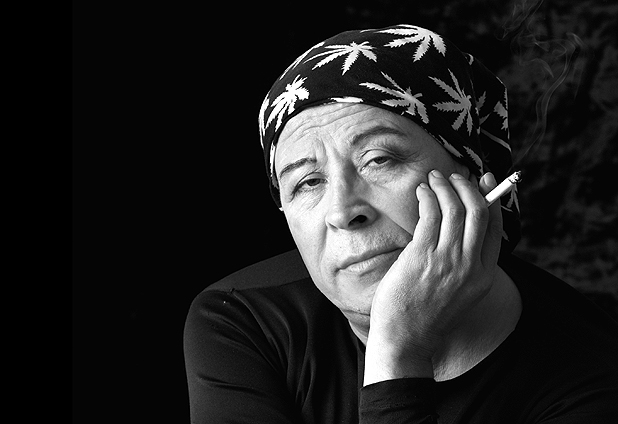
Pedro Lemebel (1952-2015) | Carla Pinilla | El Mercurio | Taken on 23/01/2015

Pedro Segundo Mardones Lemebel, known as Pedro Lemebel because he rejected his father’s surname in favour of his mother’s maiden name, was born in El Zanjón de la Aguada in Santiago, one of Chile’s most marginalised urban districts. During the 1970s, while Chile still suffered under the dictatorial rule of General Augusto Pinochet, Lemebel studied to become a school teacher specializing in Fine Arts – the first in his family to do so. After graduating, he worked as a school teacher in a series of schools; however, he was fired from two of his appointments for openly identifying as gay. Between 1987 and 1997, together with Francisco Casas, Lemebel formed the performing arts troupe Las yeguas del apocalipsis1 (The Mares of the Apocalypse), whose name alludes to the idea of the end of an era, specifically: the Chile of pre-1973. This implicit reference to the 1973 Chilean experience is a loaded one, as post-1973 Chile was the testing ground for expansion of the current hegemonic economic logic and practice: neoliberalism. Neoliberal theories were first put into practice in Chile, under experimental shock conditions, as part of Augusto Pinochet’s economic and social policy program, which was heavily influenced by the Chicago School of Economics and its formation of a new wave of Chilean economists through the Universidad Católica de Santiago, known as the ‘Chicago boys’. Lemebel’s work is a reaction against the myths of Chile under neoliberalism. In the 1990s, in the first few years of the transition towards democracy, Chile presents an image of itself as a successful economic miracle, a developed nation without poverty that is only capable of looking forward at the cost of ignoring the ignominy of its recent past. It is in this context that Lemebel’s performance troupe irrupts on the scene, challenging Chile’s new myths and desires. It is this same impulse that guides Lemebel’s writing, which blends the poetic with the quotidian, the personal with the political, the urban with the confessional, the past with the present.

Lemebel is particularly known for revitalising the genre of the crónica (chronicle) and transforming it from the perspective of the poor, the marginalised and the gay (queer) in Latin America. He is also well known for his novel Tengo miedo torero and for his public interventions. Lemebel’s chronicles, which afforded him some renown in Chile, depart from the generic restraints of the Hispanic crónica and instead remakes the form in such a way that it gives voice to and makes visible the dark side of Chile’s modernity. His chronicles tell the stories of lovers, acquaintances, pop figures, Chile’s desaparecidos2, drug addicts, exiles, drag-queens, and other characters from Chile’s urban periphery and recent history. Lemebel’s writing brings forth an erotic vision of the city, but it is a vision that centres on the experiences and stories of those who have been excluded from normative discourses of the neoliberal city in present-day Chile. Lemebel’s writing agglutinates poetry, the first person chronicle and the vitalism of a lived experience of the margins of the urban landscape; it lifts a mirror that shatters the image of the post-1970s Chilean myth.

Here we have made a selection of texts that begins with Lemebel’s poetic ‘Manifesto: I Speak For My Difference3, read in 1986 at one of Lemebel’s most notorious public interventions, while Chile was still under the rule of Pinochet’s dictatorship. This intervention was to serve as a warning to the new left of Chile, which was aligning itself with the discourses of the centre-right in order to be politically relevant, while simultaneously maintaining sexist discourses and attitudes. Lemebel’s manifesto is an important document, because it addresses the listener directly, using Chile’s everyday language and expressions. Lemebel uses the poetic form of the manifesto to challenge Chile’s gender politics, while also reaffirming and rearticulating a series of utopic and poetic images from the perspective of those not represented by Chile’s hegemonic discourses. The poem makes reference to the extermination of dissidents by General Carlos Ibáñez del Campo (3 November 1877 to 28 April 1960), an officer of the Chilean Army who served as President twice (1927–1931, 1952–1958)4, and the CNI: Central nacional de investigaciones5.

We have also selected three chronicles – ‘For My Sadness: Blue Violet’, ‘A Kind of Synopsis’ and ‘The Rettig Dossier6 – because they are loaded with poetic imagery and faithfully represent some of Lemebel’s recurring thematic preoccupations.

Sadly, Pedro Lemebel passed away at 62 years of age on the 23 January 2015. With his passing, Chile has lost a writer that fellow author and poet Roberto Bolaño called ‘the most imaginative, provocative and brave artist.’

Lemebel published the following works in Spanish:

La esquina es mi corazón, Cuarto Propio, Santiago.
Loco afán: Crónicas de sidario, LOM, Santiago.
De perlas y cicatrices, LOM, Santiago.
Tengo miedo torero, Seix Barral, Santiago.
Zanjón de la Aguada, Seix Barral, Santiago.
Adiós mariquita linda, Sudamericana, Santiago.
Serenata cafiola, Seix Barral, Santiago.
Háblame de amores, Seix Barral Chile
Poco hombre, antología, Ediciones UDP, Santiago.

Despite Lemebel’s popularity and presence as a cultural icon in Chile, only his novel My Tender Matador (Tengo miedo torero), published by Grove Press (New York) in 2005, has been translated into English.

Posted in TRANSLATIONS | Tagged , ,

Beyond Words: The Obscured Language of Graffiti

When contemplating writing a piece on graffiti typography for a journal of poetry review and criticism, I reflected on themes that could be extrapolated between the two. That is, beyond a shared use of the alphabet as fundamental building block for both creative practices. Of course, the term ‘graffiti’ finds its etymology in the Greek work ‘graphien’, meaning ‘to write’, but parallel language used in the seemingly disparate worlds of literature and graffiti art extends well into a contemporary context. Within their own community, graffiti artists are referred to as writers and the more complex artworks they create are known as pieces. When enquiring about their creative practice, a graffiti artist will be asked what do you write?

Most readers will be familiar with wild style graffiti, originating in the South Bronx, New York City in the 1970s and 1980s and made famous in a popular cultural context via music videos, cult films, and eventually, advertising and marketing. However, this is arguably the moment graffiti entered the mainstream. There is a history that extends well before, and well beyond the zeitgeist of letterform based graffiti in the early 1980s.

Traditionally, literary pursuit is neither a public nor a shared activity. Rather it is located in the private and individual spaces of the home, studio, library or classroom for scholarship and leisure. The written word actively located in public space, however, assumes the role of announcement or provocation and, by nature of being viewed by the community, is transformed into communal experience. This essay will explore several text based graffiti practitioners who span history, geography, art movement, style and intent … but who are inextricably linked by the practice of placing text as image (and image as text) within the public sphere.

Shout Eternity through the streets of Sydney


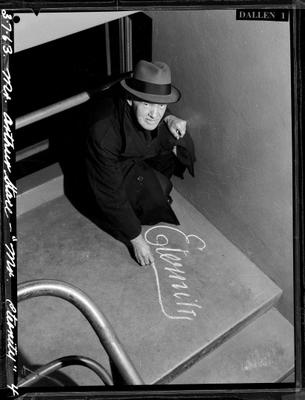
Arthur Stace, 1963. Photo by Trevor Dallen, Fairfax Syndication.

For a period of more than three decades, beginning in 1932, the cryptic message ‘Eternity’ appeared on the pavements of Sydney . Marked in chalk and rendered in an elegant 19th Century Copperplate script, the perfectly formed Eternity was at once iconic (resembling a mass produced logo that remains effective to this day) and mysterious in its meaning. Eternal life? Eternal love? Eternally damned? The reader could only guess at the intent of the writer. Specifically, the reader could only interpret the meaning of Eternity, an incredibly loaded word placed deliberately in the quotidian context of the street, subjectively. One can imagine that the possible interpretations for the word Eternity would have been as variable as there were members of the general public moving through the streets of Sydney in the 1930s and 1940s.

It wasn’t until 1956 that reformed alcoholic and devout Christian, Arthur Stace, was revealed to be the writer in an article in the Sunday Telegraph. Stace recounted hearing a sermon delivered by popular evangelist John G Ridley in late 1932. Ridley preached:

Eternity, Eternity, I wish I could sound or shout ETERNITY through the streets of Sydney … You’ve got to meet it, where will you spend Eternity?

Stace was inspired to perpetuate Ridley’s message as a ‘one word sermon’, metaphorically shouting Eternity through the streets of Sydney. He reported that his motivation was a spiritual one:

I felt a powerful call from the Lord to write ‘Eternity’. I had a piece of chalk in my pocket, and I bent down right there and wrote it’; ‘I’ve been writing it at least 50 times a day ever since.

Perhaps more remarkable than Stace’s core message, however, is the inexplicable visual form it took. Raised by alcoholic parents in inner city Sydney during the Great Depression, Stace had very little schooling and was, by all accounts, illiterate. He claimed his usual handwriting was illegible and that he could barely spell his own name, crediting the Copperplate script with which he wrote Eternity to divine intervention. In Stace’s own words, ‘I tried and tried but Eternity is the only word that comes out in Copperplate’.

His rendering of the word was so ubiquitous and perfectly formed that it has become an Australian design icon more than 80 years since it first appeared on the footpaths of Sydney. The National Museum of Australia in Canberra, which holds an original example of Stace’s chalked Eternity in its collection, has named a permanent exhibition (exploring the lives of Australians), Eternity: Stories from the Emotional Heart of Australia. The iconic word, rendered in its original Copperplate, has featured on numerous items in museum gift shops, such is its success as a graphic logo and marketing tool. It’s reported that Stace wrote Eternity on Sydney’s pavements more than half a million times between 1932 and 1966 before his death in 1967.

SAMO© as an alternative …

In 1978, another kind of cryptic messaging appeared on the walls of downtown Manhattan in New York City, bearing the faux-copyrighted name, SAMO©. With the mysterious SAMO© placing itself, alternately, as author and subject, corporation and individual, the statements were brief, provocative, political and critical of the status quo. Scratched into existing paintwork, scrawled in permanent marker on doors, or sprayed in aerosol across walls, the SAMO© graffiti critiqued, not only the gentrification process sweeping SoHo and the Lower East Side, but also the new demographic of people moving into the area . The local residents were SAMO©’s immediate audience.

Posted in ESSAYS | Tagged , , , , ,

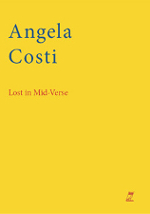
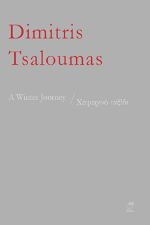
Nathanael O’Reilly Reviews Angela Costi and Dimitris Tsaloumas

Lost in Mid-Verse by Angela Costi
Owl Publishing, 2014

A Winter Journey by Dimitris Tsaloumas
Owl Publishing, 2014

Angela Costi’s poetry and fiction have appeared in many venues, including Cordite Poetry Review, The Age, Going Down Swinging, Overland, and Southerly. She has also published non-fiction prose and written seven plays. Costi’s new chapbook, Lost in Mid-Verse, is her fourth collection of poetry, following Dinted Halos (2003), Prayers for the Wicked (2005) and Honey and Salt (2007). Continue reading

Posted in BOOK REVIEWS | Tagged , ,

A J Carruthers Reviews Holly Childs

Writing written over writing

Danklands by Holly Childs
Arcadia Missa, 2014


What Walter Benjamin identified as ‘aura’ finds curious analogies to the ‘post-medium’ present. Tan Lin writes of how for Andy Warhol ‘Language is a means of exchanging who we are (our product) for someone we aren’t (our aura)1.’ Similar to a psychotheoretical split between our Symbolic and Real personae, the contemporary ‘aura’ is something like the sheer secondary quality of everyday life; the curious, removed, if symbolic fascination of what might be happening when nothing is happening: the generic publicity and ‘intermundane’ privacy of relaxation (if we can here call ‘intermundane’ the vacuous yet binding, commodified space between earthly bodies).

writing written over writing
layers
similar words superimposed
loved it when I found it on Napster
Björk with a crystal in her mouth
isolation of the island
two hot metals meet
once you lost your voice
(Danklands, 15).

Intermundane life can be less-than-meditative. Lin, again, writes that ‘ONLY POETRY CAN BE TRULY MORE RELAXING THAN TV.’2 We can think of how our online aura (Facebook, Twitter, etc.), is a poetics of the obvious, the sleepy, the typical, and if relaxing, the intermundane. If poetry can by more relaxing than TV, perhaps we need to start paying less attention to it. This doesn’t mean we need a revival of the ‘death of poetry’ or other similar alarmist rhetoric, it is simply to say poetry might thrive better if it were part of everyday life, just like background music. Writing might be written under other writing like graffiti, or Brian Eno; layered and looped.

The special literary quality of what happens when nothing special is happening has been staple foci in varying intensities across the different arts. Danklands, Childs’ second major release after No Limit (Hologram, 2014) is interesting because it doesn’t necessarily try to be interesting, even though it is. The great writing of our time is able to capture just stuff, mundane stuff happening brought to the reader because it probably would have been ignored.

The world is ambient in affect and in characterisation. In fact, Andre, one of the book’s several persons, has an exhibition Selected Ambient Works that another person, Stan Sage, will attend. Gallery spaces linger and haunt at the edges of the book. There’s even an artist proposal for a collaborative ‘dank dreamscape’ (76-7). The cover artwork is, in fact, that of the Australian artist Marian Tubbs, an extraordinary image of pinks, gelatinous greens and what looks like a distorted, pixelated Sanrio puppy.

Yet what the life of the imagined exhibition does say something about the curious status of material life in the book. Weirdly immaterialist readings of materiality return, again and again, in the book: why do we still enjoy the printed book, an object with considerably low market value? The often indexical textures of Holly Childs’s Danklands suggest an engagement with the material text at the same time that its conceptual parameters immanently question the material text. Book/Björk: ‘it’s not against the rules to listen, is it?’ (Selma in Von Trier’s Dancing in the Dark). Is it ok to lose your voice in the book? Does the reader understand?

The book is probably post-genre, and certainly post-medium, even though it is printed, and writing. But this is writing with an indeterminate status: Danklands is, variously, part novella, part diary, part chatlog, ‘hypoballad,’ and part list-poem. Astrid Lorange, blurbing Danklands, calls it a kind of ‘long poem’ and I would agree with that designation. Its chapter divisions could be also read as modular parts – partly narrative and partly not. But these are monikers for modes of writerly work that will cross camps, get expansive, document and demediate its own poetics. Danklands is a quintessential genre-crossing, genre-obliterating work, whose social narrative is both generic and specific, subjective and allocentric.

#POETRYSUPERFLAT

Reading Holly Childs in the living room. Reading Holly Childs on the computer. Reading Holly Childs on the street. Reading Holly Childs in the kitchen. Reading Holly Childs in the bathroom. Reading Holly Childs in the bedroom. Reading Holly Childs in the study. Reading Holly Childs on the tram. Reading Holly Childs at the tram station. Reading Holly Childs in a building. Reading Holly Childs on the bus. Reading Holly Childs while asleep.

These are just some of the places I had read Holly Childs. Danklands is more readable, relaxing and ambient in its style than most novels. If it is gripping, the grip is loose, and that’s a good thing. The place, pace, or scene of reading may vary. You will be introduced to five settings early on in the book:

five settings:
            swamp
            office
            toilet
            graffiti
            bedroom
	       
            possibly you'll want to get on board once I have more of the
story mapped out
            writing a book is just making decisions

*PLACE EACH PIECE OF INFORMATION IN ORDER IN THE
                                                            TEXT*

There is no doubt that, textually speaking, Danklands is writing with depth-perspective. It’s writing written over writing: layered, messy, bodily, documentarian, anti-narrative, narrative, unflinchingly a presentation of the infinite biotic and virtual adaptability of Pharmako-Capital. In short, Danklands is clearly open in its work with language (in the sense of work). It’s a text that includes evidence of its own making: an open, dissipative, breathing structure: ‘reader writer breathe slow’ (47). But there is also a sense that the writing is flat, as much about information management, ‘just making decisions.’ Writing is a question of placement, planning, proofing. The writer is just someone who places piece of information in order. This doesn’t mean that the scene of writing is a place of ease:

                              Eyes hurt. Sleep now. Restart computer and f.lux is
activated 
            again. screen kind of grey. The sun is about to come up.
                          blue to sleep
                          purple for a quick sunrise
                          clear light blue breakfast

Notice in particular how narrative depth but perspective is flattened. Each of these lines, a different ‘colour’ (and affect) exist side by side both as continuous lines and as separate, unrelated object-forms. There may be something of the artistic movement ‘Superflat’ here: a repudiation of the three-dimensional.

CHATLANG IS THE NEW VERNACULAR

Most of us chat online. All of that language, or ChatLang (what you say on Facebook Messenger or text message) is now emphatically the contemporary vernacular. Why should there be a special language for poetry, a pure or untainted language, untouched by the contemporary vernacular, the language we all speak? Think, for instance, how fake conventional lyric language now sounds. Some still claim that the ‘average reader’ is on the side of the verse-lyric. Like, really? Nobody speaks in the official verse-lyric voice when they go about their daily lives just doing things. The ‘average reader’ will totally get the following lines which are really lyrical free verse, but with an alternate tonality to the normative sonic texture of the lyric:

Lana del Relationship
long distance nothing
go to sleep
trying everything
sleeping beauty, colour therapy
chronic fatigue
drone boning
i love flying; poems
bratz doll
what will i write for you
when will i be finished?
what am i writing?
universal light
paper and pen in your altered state
feel like vomiting
open yourself up
for all the stories and parts i didn't write down
will write a chapter a day
write/unite
bottled water as lover ... bubbles, pressure
desert fashion. Qatar
don't know everything/anything
reviews of Holly Child's No Limit
perhaps i need to put it like this, scared
write a plan, a chapter per day
Posted in BOOK REVIEWS | Tagged ,

A Kind of Synopsis

I could write clearly, I could write without so many nooks and crannies, without so many useless twists and turns. I could write telegraphically for the globe, symmetrically, in order to appease the languages that have submitted and kneeled to English. I’ll never write in English, with any luck I can say go home. I could write novels and great tomes full of rational stories and symbolic silences. I could write in the silence of Tao, with the sumptuousness of choosing the correct words and I could also keep the adjectives under my tongue. I could write with no tongue, like a host on CNN, bluntly and without accent. But my tongue is sharp and my vocal chords choose to sing, instead of educating. I could write in order to educate, to give knowledge, so that the babel that is my tongue might learn to sit, without uttering a word. I could write with my legs together, with cheeks firmly closed, with a Sufi push and an oriental economy of language. I could better language by sticking my corroded metaphors, my stinking desires and my confusing and gay head up my ass, without a sunshade or with my umbrella, in reverse, and I could do this in full daylight, so that globalisation could make me go worldwide, exportable, and translatable even in Aramaic, even if it sounds like a flowery fart. I could keep my ire and the plumed1 rage of my images to myself, feed the violence back into itself and sleep well, content with my cheesy stories. But that’s not my name. I invented a name for myself, one that sticks, and sounds like a gay-tango, rock-bolero or a transvestite-showgirl. I could be the chronicler of the high life and regret the hard to swallow nature of my writing. I could leave the riff-raff for the riff-raff and instead become an archaeologist of the Spanish language. But I didn’t come here to do that. The world is already full of writers that wear suits and ties and come equipped with flowery fountain-pens in their miserly breast-pockets. I didn’t come here to sing, ladies and gentleman; but I sing anyway. I don’t know how I got here, but here I am. And my language emerged like a stiletto, without words, like an extension of my hand, a growl or a cry. They sound like the cries of a cowardly woman, said the writers from the right wing soap opera. I came to writing without wanting it, I was going elsewhere. I wanted to be a singer, a trapeze artist, or an Indian-bird trilling at the sunset. But my tongue curled-up out of impotence, and instead of clarity or refined emotion, I produced a jungle of noise. I did not sing in the sweet sounds of rhyme, nor did I sing to the ear of transcendence in order to be at the right-hand of the gods of this neoliberal paradise. My father would ask himself, why do they pay you to write, when no one had ever payed him for his efforts. I learnt it by force. I learnt to write as a grown-up. Like Paquita la del Barrio2 says; writing was not easy for me. I wanted to sing, but was battered with grammar. Strike after strike, I learnt onomatopoeia, diaeresis, the art of composition, and the big breasted rules of orthography. But I forgot it all quickly, so many rules made me ill, like so many crosswords of written thought. I learnt out of hunger, out of necessity, out of the need to work, to become like a pimp. But I had started to become sad. I could have had nice handwriting and written like a well- educated person, with clear writing, clear like that of the water that runs in the rivers of the south. But the city was bad to me, the streets mistreated me, and sex spat on my sphincter. I say I could have, but I know that I couldn’t. I lacked rigor and was won over by drowsiness and the sordid appeal of the lies of love. And I believed like a fool, like a wilted dog I let myself be swindled by baroque allegories and word games that sounded so very beautiful. I could have been different, my teachers said, drooling all over their prophet-like hairs. Despite everything, I learnt, but sadness fell over me like a veil. I didn’t become a singer, I tell you, but music was the only spot of Technicolor in my unsettled biography. Here goes this pentagram, where the story danced to its own tragic rhythm. Whether you like it or not, here I press play and let loose this songbook of memories.

Posted in 68: NO THEME IV | Tagged , ,

Manifesto (I Speak For My Difference)

I’m not Pasolini asking for explanations
I’m not Ginsberg expelled from Cuba
I’m not a fag disguised as poet
I don’t need a disguise
Here is my face
I speak for my difference
I defend what I am
And I’m not so strange
Injustice stinks
And I suspect this democratic dance1
But don’t speak to me of the proletariat
Because to be poor and queer is worse
One must be tough to withstand it
It is to avoid the machitos2 on the streetcorner
It is a father that hates you
Because his son is a queen
It is to have a mother whose hands are slashed by bleach
Aged from cleaning
Cradling you as if you were ill
Because of bad habits
Because of bad luck
Like the dictatorship
Worse than the dictatorship
Because the dictatorship ends
And democracy comes
And right behind it socialism
And then what?
What will you do to us, compañero?
Will you tie us into bails by our braids, destined to arrive in some AIDS-ridden
quarter of Cuba?
Put us on some train to nowhere
Like general Ibáñez’s ship
Where we learnt to swim
Although no one reached the shore
That is why Valparaiso turned off its red lamps
That is why the whorehouses
Offered a black teardrop
To the queens that had been eaten by lobsters
In that year that the Human Rights Commission doesn’t remember
That’s why, compañero, I ask you
Does the Siberian train of reactionary propaganda still exist?
That train that passes across your eyes
When my voice becomes too sweet
And you?
What will you do with those memories of us as children wanking each other,
amongst other things, on holiday in Cartagena?
Will the future be black and white?
Day and night, without ambiguity?
Won’t there be a fag on some street-corner, destabilising the future of your new man?3
Will you let us embroider birds onto the flag of the free fatherland?
I will leave the rifle for you
The coldblooded one
And it’s not that I’m afraid
The fear wore away
Used to blocking knives
In the sexual underground where I used to be
And don’t feel offended
If I speak to you of these things
And look at your package
I am not a hypocrite
Don’t a woman’s tits make you lower your eyes?
Don’t you think that, all alone, up in the ranges, we might have gotten up to something?
Although you would hate me later
For corrupting your revolutionary morality
Are you afraid of life becoming homosexual?
And I’m not talking about putting in and taking it out
And only taking it out and putting it back in
I’m talking about tenderness, compañero
You don’t know
How hard it is to find love
Under these conditions
You don’t know
What it is to deal with this leprosy
People keep their distance
People understand and say:
He’s a fag, but he writes well
He’s a fag, but a good friend
Really-cool
I’m not cool
I accept the world
Without asking for coolness
But they laugh anyway
I have scars on my back from being laughed at
You think that I think with my ass
And that with the first electro-shock from the CNI
I was going to spill it out
Don’t you know that my manhood
Wasn’t learnt in the barracks
My manhood was taught to me by the night
Behind a street-post
That manhood that you boast about
Was stuffed into you at the regiment
A military killer
Like those that are still in power
My manhood wasn’t given to me by the party
Because they rejected me with laughter
Many times
I learnt my manhood by participating
In the toughness of those times
And they laughed at my fag voice
Yelling: ‘And it will fall, and it will fall’4
And although you yell like a man
You haven’t been able to make him leave
My manhood was the gag
It wasn’t going to the stadium
And starting a fight for Colo Colo5
Football is another hidden homosexuality
Like boxing, politics and wine
My manhood was to bear the mockery
Eating rage in order to not kill everyone
My manhood is to accept myself as different
To be a coward is much harder
I don’t turn the other cheek
Instead I present my ass, compañero
And that is my vengeance
My manhood waits patiently
For the machos to get old
Because at this stage of the game
The left sells its flaccid ass
In the parliament
My manhood was difficult
That’s why I’m not getting onto this train
Without knowing where it will go
I will not change for Marxism
That rejected me so many times
I don’t need to change
I am more subversive than you
I will not change
Because of the rich and the poor
Try that on somebody else
Nor will I change because Capitalism is unjust
In New York, fags kiss on the street
But I’ll leave that to you
Who is so interested
The revolution must not rot entirely
I’m giving this message to you
And it’s not because of me
I am old
And your utopia is for future generations
There are so many children that will be born
With a broken wing
And I want them to fly, compañero
And that your revolution
Gives them a red piece of the heavens
So that they might fly

Posted in 68: NO THEME IV | Tagged ,

For My Sadness: Blue Violet

The first of November has just passed, the only day of the year in which families migrate en masse to holy grounds and the various cemeteries that the marketplace of death has on offer. If on that day you don’t go, if instead you stay in bed watching the very ordinary TV broadcast, if drowsiness wins and you don’t pay tribute to those who are absent, then you will feel a claw press against your chest, leaving you with a heavy heart. That happened to me this week, and it’s because my mami used to say that, around this time of year, the forgotten tombs would always look so sad, full of weeds coming up through their cracks. Tombs split and cracked open where spiders weave and undo their spindles of gauze. Dead tombs where the moss bleeds on the gravestones like so much rust on metal. Tombs where no flowers brighten up the mortuary carnival that is this public holiday. This is the reason I left off early this morning, to the Metropolitan Cemetery, which borders the Panamericana Sur. The truth is that, although it is far, and I have to do a thousand pirouettes, getting on and getting off of the Transantiago1, it is the best possible resting place for my mother’s remains, because she is surrounded by so much floral merriment. It is the best, most humble earth where the decorative variety, a party of colours, flanks the tombs, in-line, in a last goodbye. My mami always asked to be there. I want to be with the poor, together with those of my class, she would say. She always found the scenery of this cemetery to be so cheerful and generous. The prole2 spend fortunes on bouquets of calla lilies, chrysanthemums, gypsy deep rose, and on so many other types of fresh petals offered by the ladies that sell flowers on the side of the street.

Bouquets for 1000, boss.
But these flowers look more wilted than I do.
It’s the heat, boss.
It looks like you make these bunches out of leftovers.
Well, if you want them, then you can take them.

And they keep singing out the tired melody of their flowery offerings: sempervivums, snapdragons, madonna lilies, lilies, dianthus. The ladies run around all day with the flowers in their hands, in their hair, paper-flowers on the tribute cards, saying ‘Mum, I remember you’. Plastic flowers on the flag that prays: ‘grandpa, why did you leave?’ The ladies run back and forward like paper windmills made out of sunflowers that spin in the mouldy tombs of a departed childhood. More: the plaster figure of a dog and sun-bleached teddy bears hanging from the cross of a little angel3 that has died. Mum wanted to be in the Metropolitan cemetery, where her mother was, amongst many good neighbours, like Mario Palestro4, miss María5 and the market next door selling hot dogs at 500 pesos and mote con huesillos6, 2 glasses for 1000 pesos. It was a good choice to leave her in the pop-commotion of that urban mourning. Upon her tomb I had this phrase engraved: ‘here I will remain, forever tied to your remains, mama‘; but the engraver did not want to write my name on the tombstone, because it’s against the law to include the names of the living. But he wrote it anyway. I thought to myself: Whoever knows me and reads this phrase as they pass by will leave a flower on this maternal abode. And there you stayed, Violeta Lemebel, after so much loving, smiling and dancing to the tango of this wretched life.

The day of the dead in the Metropolitan cemetery is a carnival where the poor adorn their sorrows until their sorrows become baroque objects. They seem to console themselves by accumulating Christmas knick-knacks around an altar for the deceased. Butterflies from Hong Kong and doves from Taiwan shine on the tombs. And even the tears shine like Christmas lights on the cheeks of the mourners. My mami, Violeta, wanted to be here, near a group of gypsies. She loved gypsies, they suffer so much, but they dance and sing their weary expatriation. And it was almost a miracle that the tombs of the Nicolich7 surrounded her sepulchre. They come in their vehicles, with their sunshades and umbrellas, rolling out the rugs where the gypsy ladies sit, with their golden and turquoise veils. And there, they spend all day, drinking mate, yelling in Romaní at their zíngaro children playing between the tombs. Sometimes the gypsies sing. Sometimes a thick tear rolls down the creased cheek of a matriarch. Sometimes the gypsies, my mother’s neighbours, sing, and a young woman shakes her hips in the afternoon. Sometimes the gypsies sing and they cheer-up the twilight, as I leave the cemetery, after leaving a bouquet of violets at my mother’s resting place.

Posted in 68: NO THEME IV | Tagged , ,

The Rettig Dossier

There were many blows, so much love destroyed and blasted into the open by the violence of the raids. There were so many times that they asked us about them, over and over again, as if they were returning the question, giving it back to us, pretending they were innocent, as if they were joking, as if they didn’t already know the exact place where they had made them disappear, where they swore on the dirty honour of the fatherland that they’d never reveal the secret. They would never reveal in which part of the pampa, in which fold in the mountain range, in which green and wavy section of the sea they had lost their bleached bones.

That’s why, in the long run, after so much running around and rattling our sorrows through military tribunals, ministries of justice, offices and courtroom-windows, they would say: it’s those old hags again with their stories of the disappeared, where they would make us wait for hours while they would process the some old response: lady, forget it, lady, bore yourself, lady, there’s no news. They must have left the country; they must have run away with the terrorists. Ask in the investigations department, in the consulates, in the embassies, because it is pointless to ask here.

Next person, come through.

That’s why, in order to avoid that muddy wave of depression that would tempt us into desertion, we had to learn how to survive by carrying our Juanes, Marías, Anselmos and Carmens, Luchos and Rosas by the hand. We had to take our disappeared ones by the hand and become responsible for their fragile load, walking through the present with the heavy load of that search. We couldn’t leave them barefoot, unprotected against the cold, in the open, trembling. We couldn’t abandon them, dead in that no man’s land, in that barren land, fragmented beneath the earth of some non-place. We couldn’t leave them there, detained, tied-up, under a steel sheet, beneath a metallic sky, in that silence, at that time, in that infinite minute of burning bullets, with their beautiful mouths open as if they were uttering a deaf question, a question aimed at the executioner who was aiming back at them. We couldn’t leave those beloved eyes all alone, like orphans. Perhaps they were terrified in the darkness of their blindfolds. Perhaps they were trembling, like excited children entering a cinema for the first time, stumbling in the dark and after a minute finding a hand in the dark to guide them. We couldn’t leave them there, so dead, so erased, burnt like a photo that evaporates in the sun. Like a portrait that becomes eternal, bathed in the rain of its final goodbye.

We had to reassemble their countenance every night, every night their jokes, gestures, tics, loathings and laughter. We forced ourselves to dream them, to remember time and time again their way of walking, their special way of knocking at the door or of sitting down after coming home from the street, work, the university or high school. We forced ourselves to dream them, as if we were drawing the faces of our lovers against an invisible backdrop. As if we were returning to our childhood and putting together an endless puzzle of a face destroyed, at the very moment of placing the last piece, by the force of a gun-shot.

Even so, despite the cold that enters uninvited through the cracks of the doorway, we like to sleep in the velvet warmth of their memory. We like to know that every night we will exhume them from that aimless swamp, without address, without number, without direction, nor name. It couldn’t be any other way. We couldn’t live without touching, in each and every dream, the frosty silk of their brows. If we let the perfume of their breath evaporate, then we couldn’t stand straight.

That’s why we learnt to survive by dancing Chile’s sad cueca1 with our dead ones. We take them everywhere like the warm sun of the shadows in our hearts. They live with us, silver-plating our rebellious grey-hairs. They are the guests of honour at our table and laugh with us and dance with us and sing and dance and watch TV. They also point at the guilty when they appear on the screen, talking about amnesty and reconciliation.

Each and every day our dead are more alive, younger, fresher, as if they were rejuvenated forever in a subterranean echo that sings them, in a love song that rebirths them, in the tremors of an embrace and in the sweat of one’s hands where the stubborn humidity of their memory never dries.

Posted in 68: NO THEME IV | Tagged , ,

SPSS

Please allow a few (or quite a few) moments for this film to load. Vimeo buffers at varying rates depending on where you are on Earth and when accessed. It is WELL worth the wait.

Posted in 68: NO THEME IV | Tagged

BEE-­WHICHED!®

BEE‐WHICHED!®

“The Buzzzz Comes From Below”
an operatic game for all ages and castes
Rules of the Game
MINIMUM TO PLAY: 60,000 workers [sexually immature females], 1 queen [sexually developed female], and several hundred drones [sexually developed males]
Contents: a wonderland of minxy flowering crops and gardens [e.g. apple trees, pear trees, roses, almond trees, cherry trees, plum trees, etc]. * roving agricultural industrialists not included, but yr play, if any good, should draw them out of the woodwork
SPEED DIE RULES: honeybeebees! learning how to play with the SPEED DIE is as fast as playing with it!! load the die with yr caste and ROLLL for an acccelerated game
THE PLAY: “Gather ye rose buds!” the game begins with the DRONE to the left of the QUUEEN: ‘hivework aria’

flor flor flor!
as it were flo‐‐‐‐‐o
ral li‐‐‐‐iiives
bees with
oouut bees
gathered
flor o flor o!
(repeat all, in round)
QUUEEN: (descant) still a‐flying this same tomorrow be… still a‐flying this same tomorrow be… still a‐flying this same tomorrow beee… still a‐flying this same tomorrow be… still a‐flying this same tomorrow will beeeeee…
Once begun, by dint of native superiority AND liking for everything self‐dependent, ‘ambitious civilization’ shouts the name of the game clock‐wise and the phases of play & prod unfurl!!
MASS‐FLOWER FUCK, THE OPENING PLAY:

together, the DRONES, in traditional garb:
‘woodwork recitative,’
minuus tho‐‐‐‐
‐‐‐orns minnnnyy
orrrmmss
we‐we’re‐we‐we’re‐we a‐‐‐re yrrrrrrrr
best pa‐‐‐‐‐arts
stickaaa‐stickkyo‐‐‐‐‐‐‐ou
tooo! (mold spores mold spores!)
tooo! (cheese mites cheese mites!)
tooo! (flour flour flour!)
tooo! (coal dust dust!)
tooooooooooooooo!! (sawdust sawwwwa!!)
yr pee‐‐eetals, yr see‐‐eepals
minnnny tho‐‐‐‐
‐‐‐orns ninnnnyy
wo‐orrrmmss
stttiinnggga‐‐‐‐, stingggaaaaaa‐‐‐‐
THE 1:1 RULE: a seldom discussed rule of the game. if, as the game progresses, any single player butts bums with a roving industrial apiarist or agricultural industrialist, that player must roll the SPEED DIE immediately

EXCEPTION TO THE 1:1 RULE: if, however, the industrialist’s industrial throat closes over beyond industrial remedy and swifter than industrial time, the player is free to play onnnnnnn
THE ‘ABEILLEANCE’ PHASE or ‘ON THE RO‐OAD AGAIN’: whenever the industrial agriculturalists brush feet with the industrial apiarists, all players must form a line and buzzzzzz to the beat of the truck

[setting: any country peach or cherry orchard]
‘buzzzzz chart for fretting beezzzz’
wax‐‐‐‐‐‐xxx wax wax‐‐‐‐‐‐xxx
dripppin’ flaural lyrikkkks
wax‐‐‐‐‐‐xxx wax wax‐‐‐‐‐‐xxx
and reverrrrrrry and reverrrrrry
if bbbrrrees
are few
if bbbrrreeeess are
wax‐‐‐‐‐‐xxx wax wax‐‐‐‐‐‐xxx
if the players cannot withhold from syncopation, it is the QUUEN’s turn to roll the SPEED DIE, ending this particular game phase
‘ROSES ONLY’: A SEA OF THORNS: this is a non‐player phase. in this phase of game play, no players play. they watch the Rose Show

Rose Show (a peep sketch)
[voiceover by indie agriculturalists & apiarists]
happy
sick rosssse!
selfffff o
o oo oo ooo OOOOOO!
OUT thy bed of (onananananana)
OUT thy bed of (ovavavavavavavavava)
crimson jo‐‐oying!
thy selves wo‐‐orms
invvvvvisible and
new and siccccck
newsticcccckkkkkk
ROSES: (to the summer sweet, to the summer…)
{STAGE LEFT, a ‘rather sordid tuft’, old and overly made‐up, ridiculous on her stem tries to keep up…}
**players who appear uneasy or off‐color during the Rose Show must roll the SPEED DIE on thr next turn
COLONY COLLAPSE!!!: at any point in the game any worker or drone player may yell “COLONY COLLAPSE!!!” while fricting their wings together. this will initiate the COLONY COLLAPSE!!! phase of the game.

all players roll the SPEED DIE until no players remain
“PREDATORY HAND”: an endgame phase, more confusing than disrupting, and doubly ultimate

reprise of the ‘woodwork choral interlude’ [a shadowplay; a ‘delightful happen‐so’ performed, sans accouterment, by the agriculturalist & apiarist ensemble, with thanks to their sponsor for the golden pollen cloud marionettes and prodding rods]
stickaaa‐stickkyo‐‐‐‐‐‐‐ou
flow’r firstyywirrrstyy‐‐‐y
fli‐‐‐rrrrty ferrrtttteee
ferrrtttteee‐f—rrtittittyyyyy
stickaaa‐stickkyo‐‐‐‐‐‐‐ou
::waxwork coda::
Posted in 68: NO THEME IV | Tagged

Tchaikovsky’s Tchotchkes

Tchaikovsky’s tchotchkes, cluttering up
Tchaikovsky’s office. By which we mean
the salon, its instruments, the vacant staves
waiting for semiquavers to swing from them,
like apes. Did Tchaikovsky crack his knuckles.
Did he flex his toes, constrained though they were
by stocking and buckle. Did he annoy
the local graveyards, local farmers – did he
irritate his neighbours, did they grumble
as he wrangled with overtures and pas de deux.
Did he suspect that his vocation might
have been a gamble, business hours spent
tinkering with scales, with refrains, with phrases
that longed to resolve themselves, simply. Did
Tchaikovsky contemplate his legacy, his rivals,
the lottery of reputation, did he wonder to whom
the honours would be allotted, in the end. Who
can tell us – who bore witness? The knick knacks,
of course, the artefacts, busts with their marble
cataracts, the listening figurines. They’re protected,
now, up on a high shelf or tucked into a vitrine
whose temperature is always pleasant. They’ve
been arranged alongside all the familiar debris
on which a genius finger might have alighted.
Are they delighted at the rapt attention they receive,
these inheritors, this former bric-a-brac, and
do they think about Tchaikovsky – do they
catch up and reminisce, the tchotchkes, now that
they’re valuable. Now that they’re treasures –
do they remember – are they grateful.

Posted in 68: NO THEME IV | Tagged

Sydney Road #1

Exit left from an X, first glares, then stares
aimed off in the late light and
hit me sat on the three church steps.

I’m just waiting for food (“ready in 10”)

Less restraint, “he”
with other hungered eyes;
note taken
-the burdens of us animal fruits-

Amid the scattered spring,
pollens lust up a nose
shrink a head, burst the bank and I know
this season, there will be a demand for sperm & spring rolls.

I send no sentence, place no crime.
But he gets it, more out the X. Bright red, the X
A redness of red (?), man too (?) in a white shirt,
under that hot light.

Yen – packaged & heavy – heft up & down this road,
where the old prison & religions ran out of money.

(the walk home)
Gentrified no gentlemen
Hill-side of the Green Field.

After foods
After all its’
we exit to a tin bell & a

P
i
n “see you next time”
g
!
! !
! !
Drip. A coin drops.

Posted in 68: NO THEME IV | Tagged