Review Short: Judith Bishop’s Interval

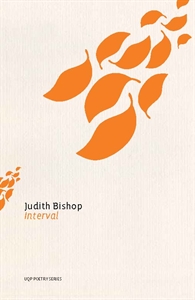
Interval by Judith Bishop
UQP, 2018


Interval is the fourth book for Judith Bishop and her first with University of Queensland Press. The book is divided into four sections. The first begins with an epigraph from the French philosopher Gaston Bachelard that ‘childhood is certainly greater than reality.’ It’s an apposite riff that informs the sentiment of the poems that follow it, in which speaker mothers talk to their children. These poems have a lyric modality, they feel intimate even confessional, while a tensioning quality of abstraction prevents slippage into pure nostalgia.

The first poem ‘Letter to My Daughters’ is organised around the refrain “bring me back to change the script’: a mother addresses her children about the failings of her parenting – (mild ones it must be said) such as restrictions on jumping in puddles, refusing the request for one last story – and asks ‘bring me back to change the script.’ ‘Give me time and I will stay with you / until our eyes have shut’, the speaker says, the irony of course being that time is so often the enemy of ideal parenting. Against the mildness of the complaint and the retroactive idealism of the improving parent, the shut eyes don’t just imply the bliss of mother and daughters falling asleep together, a kind of revelling in Blakean innocence, but also the threat and inevitability of mortality.

Reading the early poems in Interval, it is impossible to tell whether the swelling undertone of tragedy is due to the regrets of the parent, or potentially the loss of a child. Bishop’s lines resist such easy identification of event to emotion and are all the tauter because of it. When reading lyrical poetry, there is always the temptation to conflate the poet with speaker, a temptation whose satisfaction is deferred, not least by the speaker’s battle with time, which we also see in ‘Poem for a Little Girl’, elegantly comprised of six three-line strophes, the last three of which are (movingly) as follows:

But how her hands urged her to hold! Her legs, to run!
Language flew into her ear and she could speak!
Sun and wind were her friends. So you held her in her sleep.

And you held her small body when she stumbled into night:
for days the black river went plunging into night. 
But in the place you’ve come to there is only care.

She has woke, your love, in the house of your heart.
Oh, now she is laughing, saying Look! Ma! Pa!
I’m a bird – I’m sunlight – I am everywhere you are.

There’s a powerful current of tragedy at work here, but it remains protean, despite the intimate clarity of the utterance. This creates an emotional shimmer that is consonant with flickering hopes of transcendence. The notion of tragedy is thematically supported by the following two poems which invoke Greek mythology, ‘The Blind Minotaur’ (via Picasso’s painting) and ‘Reading Myths the Greek’, a digest poem, playful, that finishes:

We’ll send the golden apple back
before there’s damage done.

The gods can find
another game to play.

A brace of poems that reflect upon conception and birth are followed by ‘Snow,’ in which Bishop works cleverly through a series of riffed juxtapositions: cold and hot, snow and Icarus, death and life, black and white, word and life. It’s a movement away from the lyrical intimacy of the earlier poems towards a more intellectually abstracted universalising stance.

This abstraction persists in the following poem, ‘Openings’ which is a powerful meditation on emerging into the world, running out of a Roethke epigraph, ‘I could say hello to things.’
Here Bishop confronts the mortifying thought that the price of entry into life is death:

Loveliness and horror pass through
the open gate. 
Appear in the field,
and the widening ripples
begin, startled dancers
and audience beyond, all place in the brain
where the judgments
rise and shout.
How do you open
the gate to a birth?
How do you
open the door on a death?
Open, knowing what must
dart out like a cat;
open, knowing
how the rush will numb the fingers
to any further action
and the mind
be transfixed before the scene.

The superb poise Bishop shows in her balancing of affect and abstraction, and the creation of an incantatory container for these sentiments that is organised around the repetition of ‘open’ is one of the highlights of the book. Primed by the mythology of the preceding poems, it’s almost as if Bishop is exploring birth and motherhood by the positing of an alternative Pandora: the box must be opened, even if there are terrible consequences because the only other option is not to live at all. This is in the second section of this 5-sectioned poem, and in following the poem, it becomes clear in section IV, a vignette of a young neighbour’s suicide how precarious this situation is.

The second section of the book begins with an epigraph from Dickens; ‘we had everything before us, we had nothing before us’. In this shorter section Bishop experiments with form such as in the prose poem ‘Fairytale’. It’s a less intimate and ultimately less powerful section. ‘Best of Times’ for instance starts powerfully in the present before veering into ekphrasis that dilutes the force of the poem’s opening statement, ‘Too much beauty is disturbing.’ The strongest poem here is ‘Miniatures’, four pithy yet elegant quatrains such as

Laid are the eggs, and the traps, and the plans.
One is closed, until broken by urgency and life.
One is open – and then –
One is closure, with haunted dreams of opening

These are beautiful lines that shape the space of meaning without filling it in. Bishop’s great strength in Interval is as an explorer of uncharted interiorities where emotion and intellect entwine. The final two poems of this section ‘Rising Tides’ and ‘The New Maps Keep a Weather Eye,’ veer towards the eco-poetic by way of the cartographical and lack the same urgency even as they evince it.

Ecological perspectives continue into the third section. ‘The View From 10,000 metres’ plays with the estrangement of looking at the earth from a plane, while ‘Tunings’ juxtaposes the idea of a wind-driven leaf with the advent of self-driving cars. Meanwhile ‘The Ambun Stone’ is an intriguing if overly anthropomorphic address to a fossilised echidna foetus. The poems here feel lack the same collective impetus as section one. They feel more like clustered occasionals. They all have their merits, but they do detract somewhat from the consonance of the collection, evidence of the difficult balance of how to organise disparate poetic intentions in the one volume. Indeed the title Interval itself suggests a book perhaps composed from different times and mindsets.

Section IV returns to some of the collection’s earlier strengths. It’s highlights include ‘The Wild Has No Words,’ a musing on our inescapable animality, how wildness sings its songs in us, and drives us to action despite this lack of words. Again, Bishop confronts mortality, the poem finishing with:

… that I’ve kept my ears uncovered, but have asked
for ropes to bind me, sailing by
what seems the one thing inescapably
pure: a song of minds gone
naked, a hymn
to human consonance
– knowing, songs unheeded,
your rocky mouth
closes on the singers for all time.

There is more to say and much to admire in this strong collection whose intellectual integrity is marked by the way its thoughts are constantly butting up against the unknowable. This primary sense of accomplishment, however, might have been further enhanced if there had been a greater correspondence or a clearer logic of division between the volume’s sections.
Posted in BOOK REVIEWS | Tagged ,

Liam Ferney Reviews Kate Lilley and Pam Brown

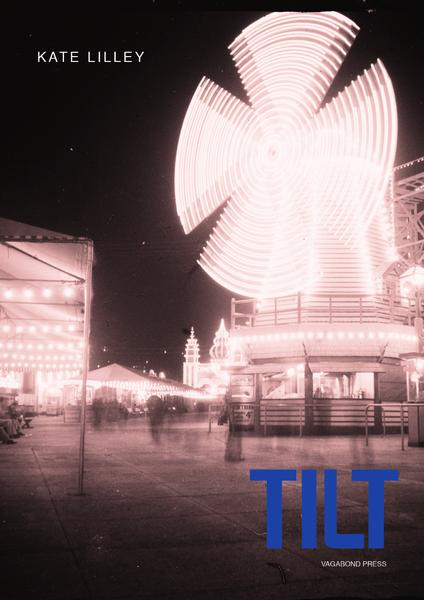
Tilt by Kate Lilley
Vagabond Press, 2018

click here for what we do by Pam Brown
Vagabond Press, 2018


In 1915, H G Wells published Boon, a satirical novel that featured long passages pastiching the literary style of his erstwhile friend, Henry James. It kicked off an epistolary barney over what art should be about. ‘It is art that makes life, makes interest, makes importance,’ James wrote in one of the letters. I’m no Jamesian (and it’s not in my stars) but what he seems to be saying is that one of art’s functions is to give structure and meaning to existence by elevating moments, objects and sentiments, however vague or fleeting, out of the formless flux of stimuli that is our world. This curation process is how art helps shape our sense both of ourselves, our communities and cultures and our past.

I came across James’s letter chasing down the epigraph of the third section of Kate Lilley’s Tilt. It seems an apt way to consider, at least partially, Lilley’s latest work as well as Pam Brown’s new collection, click here for what we do. The epigraph begins: ‘I hold that interest may be, must be, exquisitely made and created, and that if we don’t make it, we who undertake to, nobody and nothing will make it for us.’ Brown and Lilley are both poets invested in making interest and exploring how it is made. This is particularly explicit in a number of Lilley’s poems that funcion through the accretion of unadorned detail and, in doing so, interrogate that act of depiction itself. This Jamesian notion of art is also a useful way to read the confessional vignettes that powerfully level serious allegations against Dorothy Hewett, her mother, and rape allegations at several countercultural figures, as well as the alternative history of Oxford Street the title poem recounts.

It’s also a helpful framework for understanding Brown’s work, which continues to mine the quotidian. This is a mode she has described, in 2002’s Text Thing, as:

                                       this
	shambling
	    contingency,
		(writing a poem) - 

	work’s
	  for me,

(‘The ing thing’)

In determining which moments from life’s shambling contingency make the cut, Brown is, in James’s terms, making importance. It is a democratising poetics, privileging the mundane and the minor. The poems are a kind of poetic mindfulness enacting the benefits and pleasures of living in the present.

Tilt is only the third book in a career that began in the early eighties. ‘Academia buried her talents under bushels of work for more than a decade,’ wrote John Tranter in an introduction to Lilley’s work when her first collection, Versary, was published at the beginning of the aughts. But while readers waited ten years between her first collection and 2012’s Ladylike, a mere six years have elapsed since her last book. In some ways Lilley is picking up from where she left of. Like her earlier collections, Tilt is as concerned with how poems say things as what they say. This isn’t to discount the content, but to stress how important form is in her work. What is unique, though, is the way formally experimental or innovative poems sit snugly alongside more conventional lyrics and, in this case, confessional poems.

It is the confessional poems, which comprise most of the book’s first section, that have propelled the book into the nation’s newspapers. Predictably, the allegations contained in them have attracted far more attention than the poems themselves. This is a terrible shame. Not because Bob Ellis and Martin Sharp, or even Hewett, should be spared sanction and opprobrium, but because the poems are amongst the book’s best, revealing yet another facet of Lilley’s skill as a poet. Take ‘Conversation Pit 1971’, which recounts a conversation with her mother, Dorothy Hewett:

Mum said
Are you having sexual intercourse?

She wanted to know what was going on
in the sports shed at South Perth Primary

Kissing I said just kissing
whoever’s nearest (only boy-girl) then swap

Lilley was ten, turning eleven, in 1971, but set aside, for a moment, the allegation these stanzas levy about Hewett’s appalling parenting and listen to their music: the decasyllabic staccato of the third line; the alliteration of ’s’, ‘th’ and ‘p’ in the fourth; and the balanced bookends of the fifth line. Other poems are less showy but no less virtuosic. ‘Chattel’ is driven by tone:

He appears in the doorway
his white yfronts bulging

A teenage girl is a come-on
I get it

Face to face on the living room floor
so long as you’re enjoying it

I’ve read his feature articles
it doesn’t help

I’m told I’m very good at this
guess not
Posted in BOOK REVIEWS | Tagged , ,

Submission to Cordite 89: DOMESTIC

Domestic

Poetry for Cordite 89: DOMESTIC is guest-edited by Natalie Harkin.

I invite you to lean into this DOMESTIC sphere in all its homely undoing. Use words like beautiful bait to seduce hearts with razor-sharp decolonising intent and rupture the masquerading shape of cosy bliss, as only a poem can. Haunt with your words, for there is unfinished business on this domestic front yet to be reckoned with. Toil your words and share the swollen, blistering, back-breaking load to sweep-up and expose this whole mess. Use your words like a class action against those who actively refuse us a healthy and diverse and peaceful, beloved community. Bear witness to history’s omissions and let future generations know you are with them. Breathe your words straight to them despite fearing what tomorrow’s air will taste like. Honour their future as hopeful and loved and safe and just and whole. Protest for them, and return some nutrient-vision to a parched, gasping foundation that drifts and slides elusive, almost impossible to grasp. Plant old local seeds with your words so they grow into story trees with the deepest roots and life-giving canopies; that may shape their worlds, shelter and birth them, feed them and make them feel well. Let us unravel these starched-white apron-strings, sip hot-black-tea from chipped porcelain tea-cups and get uncomfortable together; un-settle this DOMESTIC front and shape what survival looks and feels like.

Domestic Help / Domestic Mess / Domestic Front / Domestic Prowess / Domestic Violence / Domestic Goddess / Domestic Blooms / Domestic Slave / Domestic Livestock / Domestic Wage / Domestic Borders / Domestic Soil / Domestic Power / Domestic Law / Domestic Cleaner / Domestic Care / Domestic Climate / Domestic Affairs / Domestic Union / Domestic Bliss / Domestic Homeland / Domestic Service / Domestic Safety / Domestic Control / Domestic Cook / Domestic Apron / Domestic Ranks / Domestic Rights / Domestic Products / Domestic Quarters / Domestic Uniform / Domestic Protection / Domestic Load / Domestic Pleasure / Domestic Exploitation / Domestic Diaspora / Domestic Origins / Domestic Appliance / Domestic Budget


Submit poems (prose, comics, visual, concrete) or works of micro-fiction (500 words maximum). Read more about submitting to Cordite Poetry Review. Please note:

1. We will only read submissions sent during our official submission periods.

2. Cordite maintains a hybrid submissions policy. This means that the guest editor may invite five (5) Australian and five (5) overseas authors directly to submit to the issue. In addition, the guest-editor will anonymously select an additional 30-35 works from Australian authors and use their discretion to select further overseas works. For each issue, the guest editor does not know the identities of the online contributors (via Submittable) until after the final selections have been made.

3. Simultaneous submissions or previously published material will not be considered. This includes works published in print and web journals but does not apply to material first published on personal blogs.

4. Please place up to three (3) poems in one (1) Word, RTF or PDF document (unless specifically noted otherwise for special issues), with no identifying details in the document itself.

5. We are not able to offer feedback on individual poems.

6. Submissions will only be accepted via Submittable …

submit


Posted in GUNCOTTON | Tagged ,

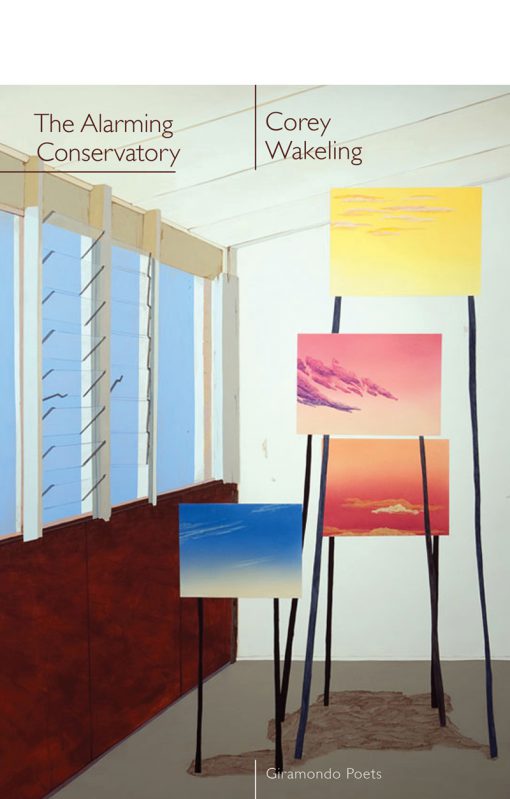
Review Short: Corey Wakeling’s The Alarming Conservatory

The Alarming Conservatory by Corey Wakeling
Giramondo Publishing, 2018


The Sydney launch of Corey Wakeling’s second collection of poetry The Alarming Conservatory at Frontyard Projects in Marrickville upended the traditional build up of acts that most expect from a poetry launch, with poets reading in an order drawn from a hat. The environment is amicable and warm, with young children running and playing and affectionately stealing attention from the readers by unwittingly performing alongside of them.

When Wakeling reads (third out of the six readers, the launch speech by Astrid Lorange is fifth), he commences with a long absurdist style poem Alfresco dining area dining alfresco; it’s a long poem, performed at high speed with no pause, and featuring preposition-propelled lines such as:

the hegimonicon of the alfresco dining area reasserts itself by collapsing its
loft and filling in its basement, by plastinating the crowds, by patenting the
perimeter of the area, by force
	feeding	
the plastinated crowd, by vaporising the excess, by a trigonometric archive of the
final limits of the alfresco dining area, by the universal preservation of the
trigonometric archive of the final limits.

Actions are always being done to the alfresco dining area: it is given an eviction notice, a loft, and a basement, punished by patrons levitating, swimming and dining at competing restaurant, confused by patrons licensing their own restaurants. It finally comes full circle by, itself, dining alfresco. It’s fitting, here, too, to note that Wakeling has a doctorate in English and Theatre Studies. An exploitation of the performative nature of language is never far from the work, nor is a constant reconfiguring of language, objects, place and structures (linguistic, familial, political, social). It reminds me of how in Beckett’s theatre, the subject of Wakeling’s thesis, objects often become the focus when dialogue stops, and how frequently en scène there is a negotiation of subject-object.

Talking to a friend from Perth, she provides another context for this poem: In 2017, local counsellors tried to reinstate previously banned alfresco dining areas in the CBD, and put these spaces ‘on trial’. The term ‘alfresco dining area’ and a debate around their existence taking momentary prominence in local politics.

This situation strikes as ripe as a premise for a Wakeling poem, that often twists found fragments and occurrences to a logical-illogical end and interlays reference and place, as in ‘Pupils of the Goat’:

Albany, you might say is heaven
Kalamunda calls itself hell. 
They honeymoon in the shadows and the ferns. 
Darling Ranges make a really arbitrary purgatory

Referencing Dante’s Inferno and Beatrice, chalk circles, hip hop, Katherine Prichard, and Datsuns, these poems are phenomenal in that that gather so much phenomena.

There is a tangible joy at an excess of language and its resituating; for all the startling incomprehensibility that arises, the collected work is also grounded in the everyday and the current environment: Take the opening epithet for example: ‘He took you for a bubble gum America/ But now he finds that you speak kangaroo English’, a line attributed to a barista at the Hamburger Banhof in Berlin, or in the poem ‘Ecstasy’, that shifts common salutation:

Language is poetry is to be expected 
-- where could they possibly have 
Come from otherwise? 
From otherwise 
Is find, I should add, and sends her
Regards.

There is never simply one thing going on. There is much to work under and through, themes expand and contract, taking on new meanings and contexts at each shift. They are poems that you can spend time with, deducing reference and connection, or read rapidly, startled by the strange juxtapositions and metaphors, perhaps intended to jolt one out of complacency.

The concept or noun ‘Australia’ also undergoes shifts of form. Aus is referred to as a ‘secret car park’, a goat, and, in ‘Available for Public Events’, is turned into stationery: ‘Poor Australia, he has no recognised partner or legal aid. / But he must be assured, we’ve rolodexed him.’

Having grown up in Australia, the title of the volume The Alarming Conservatory evokes several allusions. It brings to mind a Howard era ‘be alert but not alarmed’ mentality; the conservatory aspect could refer to a humid greenhouse, school, or alternatively, to a place that breeds conservatives. The title Alarming Conservatory could function simply as a moniker for colonial Australia.

Themes of an Australian tepid comfort are a recurrence, as in the poem ‘Ward’, that crawls through the Yu Yangs and abounds in lines that mention couches:

The couches intrigue by a slow invitation which becomes entrapment (…) the constant reminder / of Albert Namatjira, who is the only immediate rescue / here and now from the couches. / The saluting couches./ (…) Like a couch, the advantage is earned by those / who sit with you to console and comfort themselves.

The meaning, punning, and resulting associations in this volume are never settled, and frequently when I’m reading I’m saying ‘What what what?’ in my head, or out loud, trying to find level ground that is always escaping. But the poems are deeply funny and revelatory of current economic farcicalities and social perspectives. For example, in ´Being Paid to Live the Dunes’ that begins, ‘you are ready for the end of the world because / you are paid for it, and the apartment is good.’ This continues in ´Sydney sydney’, that speaks excessively and appropriately of landowners and in ‘The Person is Real’ that closes with the line: ‘Good bargain of education, you bought us up – yes, bought! – so well.’

Dissonance and decline emerge as other themes, two poems, in fact, are elegies (‘Elegy Written in a Dead Metropolitan Library’ and ‘Elegy for Epithalamium’). The poems capture a shifting world, and can be read more widely to comment on virtuality, mediatised environments, and family.

The ‘Afterword’, too, is worthy of note. Shifting form, it presents a lucid eight-page poem-essay that is vividly transporting and recounts in a measured, gentle and suspended tone the poet’s childhood in Western Australia. Cars trips to Fremantle, garage sales, adventure stories, comics, fiscal difficulties. It provides a commentary of the social climate: ‘I grew to dislike the perpetually bold sky of Western Australia (…) the weather to me mirrored a self-satisfied, recreational population’ and of the situation of childhood where a lucid narrative is easier to obtain.

Reading the afterword following the intricately layered, complex and at times close to indecipherable poetics, is somewhat similar to having the answers and the clues to the previous day’s cryptic crossword side-by-side and working backwards to fill the grid in.

Frequently in these poems, the economic climate, neo-liberal free market, and housing market are all thrown together; The Alarming Conservatory is the site of the fall-out. It is recommended reading, and provides a counter narrative if you’re reading closely.

Posted in BOOK REVIEWS | Tagged ,

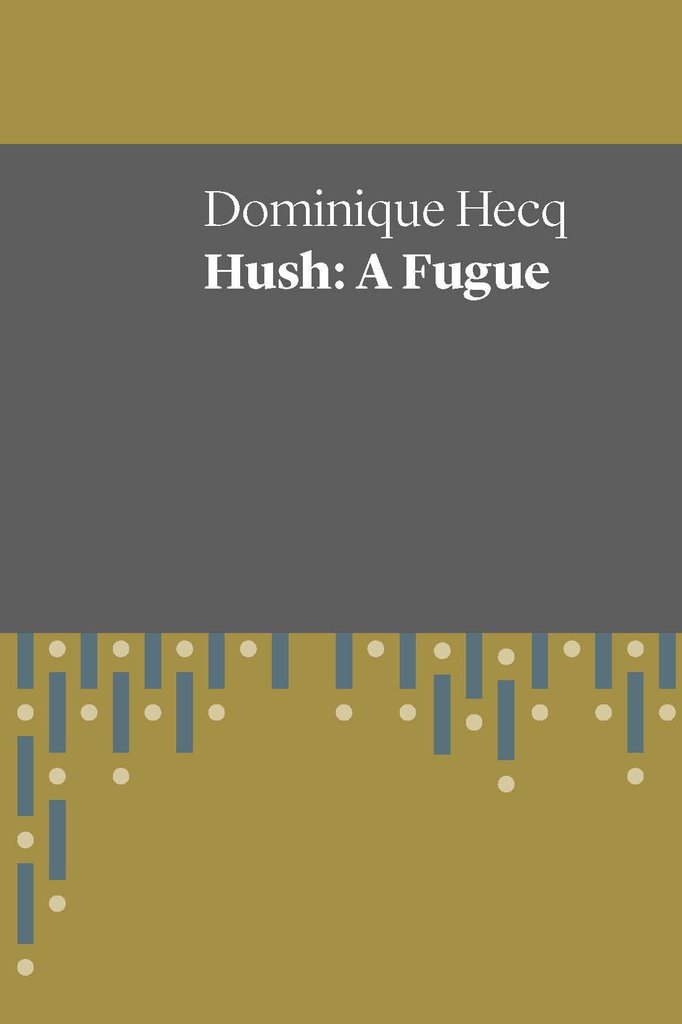
Daniela Brozek Cordier Reviews Dominique Hecq

Hush: A Fugue by Dominique Hecq
UWA Publishing, 2017


To some readers, like me, Dominique Hecq’s Hush: A Fugue may be daunting at first appearance. This starts with the cover, which has the sort of self-assured, intellectual air I find a little intimidating. A wary look inside reveals unstable text formatting – blocks of dense prose broken by verse, haiku, couplets, one-liners. And whether you do your page-flicking right or left-handed, you surely cannot avoid noticing a list of references at the back, containing some imposing names: Barthes, Freud, the dreaded Derrida, Lacan. Hesitating on ‘Heaney, S.’, and ‘Rimbaud, A.’, I found myself hoping for reassurance. Some readers will undoubtedly have put the book down by this point, but others love a challenge and they will certainly find Hecq’s book stimulating. It is rich and satisfying on many levels, whether or not you enjoy Derrida’s games.

As a story, read in a simple readerly way, Hecq’s poetic narrative is moving and beautiful. A child dies and the voice of the poet is the voice of its mother, travelling through the surreal world of grief. Motifs of affluent, inner-city life appear throughout, but become strangely unfettered; splashes of colourful hedonism in an otherwise colourless, mist-like free-fall through pallor and darkness:

I read to the child and helped him draw his own story of loss [. . .]. I cooked.
There were pancakes and French toast and brioche. Lemon pudding and orange cake and rhubarb pie and apple crumble. Poppyseed cake. [. . .]
I longed for food. [. . .] I felt so greedy. [. . .] I would not eat. There was no room for me. I rose and fell. Flailed around me in a sea of black. Lack. Living and wanting to die. I fell into the waterfall of my mind.

Hecq’s juxtaposition of an external life of food, music and flowers against an inner world marred by lack, opens a tense space. It is a space weighted in one direction by absence (of the child and of language/meaning) and in the other, by the continuance of life; life which must be negotiated and travelled. To heed the call of life, meaning is needed, but normal language fails. Hush’s complex formal structure flows, like Orpheus’s music, into the void it leaves:

Eurydice, Eurydice, Eurydice.

Hush is both poetry and prose; and in its poetry it pushes the written language away from denotative meaning, into sound and back again. Form changes and responds to content, even becoming content itself. And Hecq’s writing is double-layered: she writes her protagonist writing; the grieving mother’s struggle to understand what she experiences through the construction of language. This strategy enables Hecq to reveal the spaces before and after an act of writing, and the other ‘languages’ that inhabit these spaces – music, song, performance, the words of other tongues. Actions, impressions and sensations whirl chaotically, or coalesce on the body of the narrator.

Let us start with the language of Orpheus:

Chalk, rice, zinc
            . . . 
Phosphorous
            Lightless body
                        Alabaster

In music, ‘fugue’ denotes a short phrase that hangs and is taken up successively by one part after another, like the above lines. As the phrase is repeated and embroidered, it attains the texture of a song. Hush is a fugue in this sense. It is scattered with lines that echo, repeat, and drift quietly like a refrain, the sort that gets stuck in your mind yet returns reassuringly, rather than annoyingly. Hecq’s style is at times reminiscent of T S Eliot, in the way she sets stubborn gleanings from commonplace life into her poetry, like in the lines above. In doing so she elevates them from the ordinary, revealing them as wondrous and gem-like.

Music is an important motif in Hush and it would be accurate, I think, to surmise that Hecq’s intention is (after Barthes) to allow her writing to ‘sing’ by freeing its spoken qualities from a weight of written meaning. She allows the sounds, rhythm and allusive qualities of words to ‘speak’. Hence her use of repetitions like refrains, and also her liberation of the sounds of French, the ‘mother tongue’, to which she returns, seeking a means of expression and understanding:

Une mise en abîme to write of desire, of water and fire.

Music is allowed to express itself without the intercession of words and their symbolic meanings; as a complete signifying system in its own right. By contrast:

I tried writing. Words came in bursts and spurts. Made no sense.

But Hecq demonstrates that writing and its failure can be overcome by using language in ways more akin to music. She uses structural motifs throughout the text: akin to epigraphs, haiku-like tercets or couplets separate passages. These also evoke ‘fugue’ in another sense: that of a vagueness or loss of identity that sometimes arises in response to trauma. In Hecq’s hands, these passages seem like instances of clarity, setting a tone for what is to come, yet they are deceptive:

Dark then light
            Uno makes rainbows
                        doubling the sky

Fugue, in the psychological sense, often involves wandering. And here lies the heart of Hush: A Fugue. Hecq charts the impact of trauma, the shattering and slow reassembly of self as a person drifts through a netherworld that is neither Hades nor sunlit. Like music, action itself provides another language that expresses, reflects, and perhaps draws both reader and protagonist towards understanding:

The fear was so strong I bolted for the door and into the street. I ran to the park as fast as thoughts ran through my mind. I ran oblivious to the traffic. Oblivious to time. Oblivious of the cold. I ran to the pond. And stood. When the shadows merged with the waters in the cold, when the wind moaned in the branches of the gum trees, when the last rays of sunshine gilded with mystery the white snowdrops and camellias, I turned back home.

Wandering through a seemingly ‘nonsensical’ yet concrete world in a state of fugue, Hecq’s protagonist finds a kind of meaning that nudges her back, inexorably, towards the written word. Words offer reassurance, even if their meaning is obscure:

… I needed to write for the sheer satisfaction of keeping fear at bay, of experiencing the vanity of meaning, even if words did not make sense.

Posted in BOOK REVIEWS | Tagged ,

DIFFICULT Editorial

Difficult

When people say ‘difficult’ and ‘poetry’ in the same sentence they are usually referring to the experience of reading a certain type of poem. It is often a poem that seems to make little sense, that doesn’t have a strong sense of narrative, that uses strange words or strange forms, that does not follow rules of grammar and syntax, that may not even communicate any coherent message at all. Difficult poetry, for some reason, is a phrase that refers to these weird poems and the people who try to read them. Difficult poetry is about the tension and struggle to make sense of this weirdness.

Charles Bernstein even wrote a whole book about this type of poetry. It’s called Attack of the Difficult Poems. In this book he says that difficult poetry is hard to appreciate. He talks about how difficult poems can be offensive to readers, make them feel ‘inadequate’ or ‘stupid’. He admits that much of his long career as a professor has been trying to make life bearable for readers of difficult poetry. He even put together a ‘practical guide for handling difficult poetry’ and invented a new word for the act of reading difficult poetry – ‘wreading’ as in writing and reading mixed together, because according to Bernstein, reading difficult poetry is a ‘creative performance’ that requires ‘critical interpretation’.

Bernstein’s views make reading difficult poetry sound like some sort of war (one in which he is deeply entrenched); taxing, confusing and often without meaning. Yet a crucial part difficult poetry’s appeal is the surprising pleasures it produces, whether it’s the odd somatic qualities, images (or lack thereof) or systems and constraints that feel like games. In Matthew Welton’s series of poems he creates a rich linguistic playground for the reader to explore. Reading difficult poetry doesn’t have to be feel so tense or embattled. We often attempt to squeeze some sort of narrative meaning from poems, but difficult poems provide an alternative – the reader is invited to play.

The way Bernstein talks about difficult poems makes them seem like crop circles. They are these inscrutable, weird, compelling, sometimes beautiful, occasionally destructive things that just drop from the sky leaving no trace of their creator, objects of immaculate poiesis that leave us humans powerless to do anything but come up with elaborate ways of interpreting their messages. Indeed, crop circle experts are some of the most creative ‘wreaders’ around – the patterns stamped in fields are treated as a lens through which we can understand alien languages, the mysteries of Mother Earth, the secrets of ancient ancestors, etc.

In 1991, at the height of international interest in crop circles, two English men in their sixties admitted that they were almost single-handedly responsible for the crop circle craze, that they had been creating these patterns in the fields for more than 10 years. They described how on warm summer nights they’d have a beer at the pub, discuss water colour paintings, and then head out into the fields with wooden planks attached to two hand-held ropes for stomping the stalks, and a baseball cap fitted with a loop of wire to help them walk in a straight line. After years of labouring in the cover night, always careful not to damage the crops, always careful not to leave a trace of their labour, they were growing tired of the many imitations that were springing up around the English countryside as well as the ridiculous ’experts’ who were making millions of pounds writing books that taught the public how to interpret these ‘other worldly signs’. So, they decided to reveal themselves.

One evening, in the presence of a journalist from a London tabloid, they created one of their crop circles. The journalist then invited Patrick Delgado, the foremost crop circle expert in the world, to assess the formation and decide whether it was an authentic work of extra-human creation or whether it was a hoax. When Delgado entered the field, he said it was one of the most beautiful circles he had ever seen, that the precision of the circles gave him goose bumps. ’It is a genuine article,’ he confidently asserted. ’No human could’ve ever made this.’

When the two creators revealed themselves from behind the wheat bushels and told Delgado that they were responsible for making the circle, showing him their rudimentary tools, he said, ‘We have all been conned.’

But then later, in another interview, he added: ‘My reaction is one of wonderment at the artistry that they have done in such a manner that their work could be considered as something out of this world. They are to be admired in the way they have conducted their nocturnal escapades which made it look as though there was a real intelligence that we don’t understand. From this simple prank has developed one of the world’s most sensational unifying situations since Biblical days. If everything they say is correct this is a lesson to us all that we should look and listen to the beautiful and small things in life.’

What we were most interested in, when reading through the many hundreds of submissions for this edition of Cordite Poetry Review this edition, was not only the crop circles but also the ingenious acts of creation behind them. That is to say, not difficult poetry as such, but the difficulty of writing poetry – the act of creation, the labour that goes into the lines, the difficulty of writing a good one.

As we read through the submissions, we were reminded of the countless ways that writing poetry, particularly good poetry, is difficult. How it is difficult to point out the beauty and joy of something simple like flowers or outer space at a time like this; how it is difficult to give yourself the space to be playful with language and find compelling images inside it; how it is difficult to make the sound and rhythm of words your palette; how it is difficult to reach out and speak to an audience you don’t know about your life in a way that is unadorned; how it is difficult to find a poem amidst all this turmoil; how it is difficult to have conviction, to be funny, to create an alternate reality in four lines; how it is difficult to find the time to write poetry; and how it is is also difficult to say out loud, ‘I write poetry’, because sometimes people look at you like you’re slightly mad, as if you spend your nights dragging a wooden plank around a field while wearing a baseball cap with wire coming out of it, but that despite all this difficulty, you do it anyway.

Posted in ESSAYS | Tagged , ,

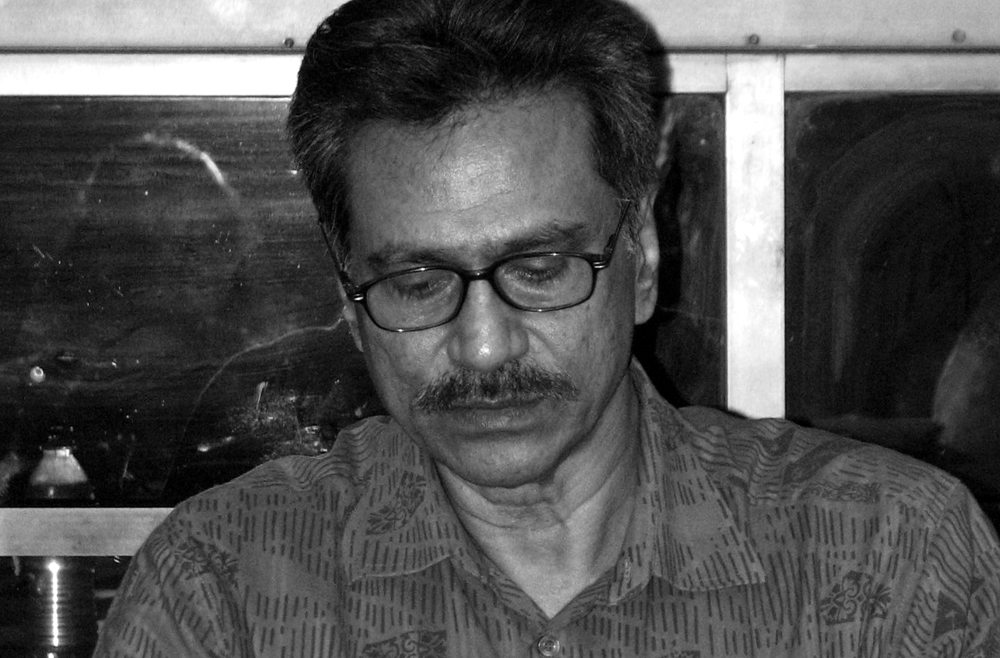
An Unwitting Pariah: Kathryn Hummel in Conversation with Kaiser Haq


Image courtesy of crooked lines.

At the close of his poem ‘Autumn Fragment’, Kaiser Haq asks: ‘Can one write / Verse that is free of ambiguity?’ A more pointed consideration for contemporary writers hailing from Bangladesh is whether perhaps one should. Ambiguity is a comparatively safe stance if you happen to be a progressive political-bloc affiliate or a moderate Muslim of the Tagorean cultural set: anything other than ambiguity might potentially imperil your life. The use of ‘potentially’ is deliberate, for it is undoubtedly reductive of Bangladesh’s complexities to characterise a country only through the tragic number of secular writers, publishers, activists and intellectuals murdered in recent times for challenging, in the interpretation of Islamist extremist groups who later claimed responsibility for many of the slayings, certain (conservative) socio-political and religious ideals. With the assassination of writer and publisher Shahzahan Bachchu on June 11, during this year’s Ramadan, Bangladesh is becoming a noticeably volatile place for those who confront, ambiguously or not, the darker strands of tension intersecting the country. Years ago, a friend in Dhaka made clear the severity of the divisiveness concerning identity and affiliation in Bangladesh: ‘If you are wrong, you might get killed.’ In the current context – not the only devastating surge of violence the people of Bangladesh or Haq himself, as a veteran of the Liberation War of 1971, has experienced – this is not an aggrandised statement.

Despite the blurb of the second edition of Haq’s Pariah & Other Poems (Bengal Lights, 2017) claiming he deals with ‘everyday … social and political problems’, the poet’s own words convince further. Seasoned, erudite and ironic, Haq’s poetry reaches across the beauty and devastation of memory; progress and ageing; death and loss, and the deterioration of people, community and the recognisable ‘home’. In Pariah & Other Poems, instances of activism are cast under the glaze of reminiscence: ‘I remember, I remember so well / My first protest march on a broiling summer day’ (‘Barbecue’). In the course of a restive morning, the speaker ‘blinkingly’ reads in the newspaper of a ‘poet’s retraction / Of satirical verses’ (‘An English Sonnet = 140 Syllables’). In ‘Kabbadi with Death’, written after the murder of Dhaka tailor Biswajit Das by Chhatra League activists, the speaker wearily abandons question marks: ‘What happens to the ash / From burnt young flesh / Disinfected of politics’. Just as poetry’s ‘helpless lines’ are acknowledged in ‘Kabbadi’, in ‘Getting it Right’, words are ultimately deemed inadequate weapons: ‘… in prose or verse / It’d come out the same: / Day 9 of blockade, / Eight more dead’.

Elsewhere, Haq admits to ‘unwittingly’ making himself a ‘cultural pariah’ by claiming ‘the language of the erstwhile colonial masters’ when commencing to write poetry in English during his school years (‘Testament of a Pseudo Translator’). Haq does not offer up his method of survival. By adapting his words to title our conversation, I imply an alternative to the pariah’s ‘untouchable’ status – one that is neither pejorative nor heroic, but bound to observation, finely-tuned irreverence and a knowing eye for the effects and aftereffects of change, rather than its definitive cause.

In January this year, during one of my regular visits to Dhaka, I spoke with Haq in his office at the University of Liberal Arts Bangladesh, where he is currently a professor of English. During the eleven years since our first meeting, Haq’s generosity is undiminished – matched, this time, by the motley, evocative clamour of traffic along Satmasjid Road, pressing against us as we talked.

Kathryn Hummel: You’ve written that you have developed a taste for precolonial Bengali literature after working on The Triumph of the Snake Goddess (Harvard UP, 2015). What draws you to these texts?

Kaiser Haq: An abyss separates modern Bengali culture from precolonial. Students studying Bengali literature hardly delve into precolonial texts. The focus is on colonial and postcolonial – modern Bengali –but the precolonial culture is still alive in the countryside. These traditions pre-date colonial power, though everybody left when the Brits started taking over. Story-telling, performances, these are marginalised and if you categorise something as just ‘folk’, you’re also marginalising it. It’s there for our amusement when we feel like it; it’s not a part of our modern cultural life. And that is what I want to sort of change, in my small way, by presenting some of these stories in modern English so that everyone can read them and find something. There’s nothing to prevent one from entering that world packaged in the way I got [The Triumph of the Snake Goddess] published. I’m not translating, I’m retelling. These old texts are in verse and I don’t want to do verse novels – they’re in prose.

KHummel: I know that you get asked a lot about why you write in English and I know you’ve written a lot about it …

KHaq: I consider it history [laughs]. Throughout the sub-continent, English writing has been there since 1780, when the first book was published. Not so much in Bangladesh, but in India, you have a large number of people who belong to the intellectual and cultural arena who know English better than their mother tongue.

KHummel: But knowledge of English is class-based here, right? People go to Bangla-medium schools or English-medium schools.

KHaq: In Bangladesh it is. In Bangladesh, even knowledge of Bengali is class-based. Because the Bengali that you hear people speak is the demotic Bengali of all the different dialects of the districts. The literary Bangla which you’ll hear on the television, perhaps, or which is written in literary magazines or literary supplements in newspapers is something that a very small percentage of the people really know or are familiar with. Education is class-based now.

KHummel: Who is writing in an accessible Bengali here? Is anyone writing in modern, informal Bangla or in that kind of style?

KHaq: That has a place in dialogue but the narrative and descriptive prose is Standard Bangla. Some of the films feature informal Bangla, because film is entirely based on dialogue. In fiction it always comes in as dialogue or if it’s a first person narrative when the point of view is from a person who speaks only that dialect. We have this problem in every language – how to bring in the regional, class-based dialect.

KHummel: While I’ve been in Dhaka I’ve been thinking about Shahbag and the changing political significance of the neighbourhood since before the Liberation War until contemporary times. After the 2013 protests against the leniency shown to Liberation War criminals, many of my friends who go to Charukola [Institute of Fine Arts] at night-time say it’s changed significantly because of greater government presence. I know Shahbag is the site of the murders of publishers and writers as well. You write fairly, what one might classify as, secular work. Have you ever had any death threats yourself?

KHaq: I haven’t written anything condemnatory of religion.

KHummel: But of politics, it seems you have. You wrote ‘How Many Buddhas Can They Destroy’ after the 2012 burning of Buddhist temples in Cox’s Bazaar and that was anti-fundalmentalist; would you also say, anti-government?

KHaq: Well, yeah, but that kind of thing I think doesn’t put the extremists’ backs up.

KHummel: No? So what would?

KHaq: It began with the bloggers because the internet is a battle ground now. The religious right has been very quick to adapt to the internet and use it for propaganda purposes, as you know, a lot of the Islamic State recruits were seduced by things on the internet. So the secular bloggers then began to challenge those: this is the background. I haven’t read any of these blogs but apparently there was this running battle going on between the fundamentalist blogs and the secular blogs.

KHummel: Faisal Arefin Dipan of the publishing house Jagriti Prokashony, who was killed in 2015, I understood that he …

KHaq: Well, the bloggers, a lot of them then published books.

KHummel: From what I understand, Dipan published a range of texts including secular ones, but it was just because he was open to all perspectives that he was targeted.

KHaq: He was killed there.

KHummel: In Aziz Supermarket, yes.

KHaq: Another publisher, Ahmedur Rashid Chowdhury Tutul, of Shuddhoswar Prokashony, was attacked and survived. Not far from here, in Lalmatia.

KHummel: Is your poetry, then, becoming more responsive to contemporary politics in Bangladesh?

KHaq: I don’t think so. Contemporary politics in Bangladesh is partisan politics – which I don’t support. It’s very difficult to even formulate political questions in a literary context without being at once placed within that bipartisan framework, isn’t it?

KHummel: I’m not referring to directly responding to whatever is going on in parliament but just the state of the country, which has always, I think, been your concern?

KHaq: It doesn’t come in. I don’t think it’s direct. It’s in a state of flux. There’s little disturbances going on all the time and to get a handle on that you have to, sort of, write with purpose and that hasn’t yet happened. What I see is that this is a society that is changing very fast and it used to be very political. Now I think homo politicus has been replaced by homo economicus. People are just concerned about their livelihood, their careers, their earnings and they don’t want politics to disturb that.

KHummel: Do they want literature to disturb it?

KHaq: Literature cannot disturb it, it can only comment, describe, transform into an aesthetic form the objects of criticism, of literature and art in bourgeois society – and when you’ve homo economicus you end up with bourgeois society.

KHummel: Does that interest you?

KHaq: A little, somehow.

KHummel: But then you’ve gone back to your medieval texts.

KHaq: There’s a prose poem, ‘Forever Amber’, in Pariah & Other Poems, which is about Dhaka: ‘The state of governance, whichever party holds power, is evident in the streets. Mercedes, BMW, Lexus. Battered public buses, motorised three-wheelers, rickshaws, pedal vans. All in a scramble, like dogs nosing each others’ bottoms, sometimes in the wrong direction …’

Posted in INTERVIEWS | Tagged ,

4 Translated Vasile Baghiu Poems


Image courtesy of Ziarul Lumina

The following four poems have been selected from two volumes of poetry: Rătăcirile Doamnei Bovary [Madame Bovary’s Wanderings] and Cât de departe am mers [How Far We’ve Gone], published in 1996 and 2008 respectively. Vasile Baghiu coined the term ‘chimerism’ – a cross between bovarysme and literature – which he defined as a kind of escapism; the creation of a parallel universe or counter-reality through which to escape the everyday struggles of 1980s Communist Romania. Four elements are intrinsic to the concept of chimerism: ‘imaginary journey’, as a means of evading the socio-political constraints and the cultural provincialism of the time; ‘disease’, as a reality devoid of superficiality and flippancy; ‘transfiguration’, as a way of creating new experiences; and ‘science’, as poetic adventure in a space that has rarely been explored through poetic means. The driving force and key inspiration behind chimerism, as Baghiu himself confessed when I interviewed him in 2017, was Thomas Mann’s bildungsroman The Magic Mountain, along with poems depicting sickness and human suffering, which Baghiu read throughout his teenage years.

Baghiu’s poetry is dominated by a reality-memory dichotomy. Its uniqueness resides in the fusion of imagery, self-discovery, escapism, and a sense of freedom. The verse is crisp, clean and economical, thus making the process of translation similar to cutting, shaping and polishing a diamond. What struck me more than anything was the visual element that dominates most of Baghiu’s poems; after reading volume after volume, I was left with the distinct impression of a painting waiting to be discovered and understood. While sound and rhythm are also present, I felt that the true meaning was hidden in the visual imagery, and as a translator I focused on capturing both the visual elements and the meaning behind them, and on delivering poems that preserve the freshness and authenticity of the originals.

Another key element was the translation of certain Romanian words and names. For example, I pondered over the translation of poezia [poetry] in the poem ‘As it happened’, because I was looking for a way to keep some of the original flavour in the translation. So, I settled for the archaic, poetic English word Poesy, which is closer in sound to the Romanian word and adds an element of musicality to the imagery. Turning a common noun, poezia, into a proper noun, Poesy, was a deliberate choice, as I felt that Poesy itself played a key role in the story.

I applied similar considerations around maintaining authenticity to the translation of foreign names, such as that of Nicolae Bălcescu (including its original spelling with diacritical marks) in the poem ‘Those were tumultuous times’, to give the Australian reader a taste of Romanian culture. I felt there was no need for added explanations or references about Nicolae Bălcescu himself (he was, for the record, an important political and intellectual figure and leader of the 1848 Wallachian revolution) because for me, the message of this particular poem – estrangement, memories and regret – was sufficient to convey its Romanianness.

Posted in TRANSLATIONS | Tagged ,

Why Reading Sharon Olds Makes You a Better Person


Image courtesy of The Steven Barclay Agency.

(Extract from Denise Levertov’s final interview, October 27, 1997.)

Nicholas O’Connell: In the essay ‘Some Affinities of Content,’ you spoke about how you responded to the goal of Northwest poets to submerge themselves in something larger than individual ego, in their case, nature. Do you try the same approach in your poetry?

Denise Levertov: I hope I do. I’m certainly very tired of the me, me, me kind of poem, the Sharon Olds ‘Find the dirt and dig it up’ poem, which has influenced people to find gruesome episodes in their life, whether they actually happened or not. Back when Robert Lowell and Anne Sexton were the models for neophytes, you had to have spent some time in a mental hospital to qualify as a poet. Now you have to have been abused. I know perfectly well that lots of people really have been abused, but it’s unfortunate to use the fact of abuse as the passport to being a poet. I’m certainly tired of that kind of egotism.1

* * *

‘Egotism.’ ‘Shallow pretence.’2 ‘No abstraction and no surprise, only the videotape of life played back at full volume.’ The loudest critics of Sharon Olds repeat the same complaints that met confessional poets some sixty years ago, chastising her work for being self-obsessive. Poets should speak, the argument runs, to experience that is collective and, by virtue of being collective, profound. As Patricia Meyer Spacks lamented, referencing the work of Anne Sexton:

art requires more than emotional indulgence, requires a saving respect for disciplines and realities beyond the crying needs, the unrelenting appetites, of the self.’3

The means may be the self, but the end must be the collective.

Yet, as literary theory in the intervening decades has shown, no individual can speak for the collective per se, bound as they are by the confines of their culture, gender, race, class, as well as the inherently constructed nature of that self that defines lyric poetry (which, as Maria Takolander has recently argued, is in turn bound by the technology that writes it).4 And this is to say nothing of the political implications: that, in universalising any poetic self, as some argue, we necessarily privilege certain voices over others, and so reinscribe dividing lines that have historically pushed female, non-white voices to the margins.5

If Olds’s poetry can be useful, as she professes is her intention,6 it seems we must continue to wrestle with questions that, for a few centuries of debate, we still don’t have good answers. Do we see the ‘I’ in Olds’s work (and other confessional poetry), as a single (egotistical) voice (and so useless), or a collective, universal voice (a voice Ben Lerner has recently called ‘an impossibility’),7 or somewhere in between? If the voice can speak to (or for) all, in any sense can we speak of it having a universal effect?

I argue here that recent work in the fields of emotion, cognition and evolutionary psychology provides one interesting avenue for reviving the outdated, universal ‘I’ of lyric poetry, and thus its usefulness, while avoiding enacting dichotomies that perpetuate the divisive literary status quo. Taking the Pulitzer Prize-winning collection Stag’s Leap (2012) as a case study,8 I suggest that Olds’s poetry exploits cognitive systems that are, in essence, universal (by which I mean common evolutionary adaptations). In so doing, it accomplishes in a significant way the romantic ideal of poetry that can speak to all; poetry that, in the long-faded words of Shelley, ‘exist(s) in the mind of the creator, which is itself the image of all other minds.’9

Finally, I wish to suggest that the reading of Sharon Olds’s poetry makes one a better person, to the extent that it is able to remove barriers that inhibit empathy. This is so because it manipulates a relationship between valence and appraisal that is a universal evolutionary adaptation. I will suspend my argument on this point until the poetry has been considered, but it is worth keeping in mind that the thrust of my argument is in large part a defence of (or rather, prescription for) Olds’s poetry on pragmatic grounds. The contention is that, insofar as reading this work affords a particular, unusual form of emotional response (what I refer to as dialectical meta-emotion), the sustained experience of such emotional responses may strengthen neural pathways that are conducive to empathy, patience and increased emotional nuance.

My argument, then, consists of three premises and a conclusion:

  Premises
p1 emotion throughout Stag’s Leap is largely dialectical meta-emotion, which creates a short-circuiting of hardwired cognitive appraisal and emotional valence;
p2 emotion serves as the means of expression throughout the collection, rather than the result of expression;
p3 Olds’s poetry promotes an ability for readers to experience dialectical meta-emotion in the real world;
C Olds’s poetry can make readers more empathetic and thus, in a small way at least, better people.

* * *

Universality and the Lyric ‘I’

When Olds first submitted poetry for publication in the early 1970s she was told, by her own account, ‘this is a literary magazine. If you wish to write about this sort of subject, may we suggest the Ladies’ Home Journal. The true subjects of poetry are … male subjects, not your children.’10 If entirely unwarranted, it is perhaps unsurprising that such a response would be penned at a time when women’s writing was still grossly underrepresented, and while post-structuralism was simultaneously dismantling the self that had previously underwritten meaning in language and authorship in art. While one line of argument attacked confessional poetry for its self-indulgence, a parallel argument attacked the legitimacy of the self that wrote it.

Yet despite the monumental impact of theorists such as Barthes and Foucault, in the intervening decades a number of feminist historians and literary critics, and indeed Sharon Olds herself, have insisted on the legitimacy of employing the decisively female lyric ‘I.’ They do so on the grounds that the death of the Author merely constitutes a further marginalisation of subjects that had already been denied a voice. As Nancy K. Miller writes,

the postmodernist decision that the Author is dead, and subjective agency along with him, does not necessarily work for women and prematurely forecloses the question of identity for them.11

And this is true not only in the domain of creative writing. As Katie Barclay points out,

Feminist historians have been reluctant to let go of the ‘subject’, perhaps because, as Susan Bordo suggests, subjectivity symbolizes the essence of personhood, which has only recently been granted to women and which is still challenged through attacks on their bodily autonomy.12

In an interview with The Guardian, Olds has stated that ‘I wish to write about my life partly as stories representative of any ordinary woman,’13 In order to conceive of it as such, we will need to revive what was previously decried as an anachronistic (or impossible) ‘I.’ The self present in the poems ahead needs to be conceived, tentatively, as both individual and collective, and legitimised in light of the arguments put forth by Miller and Barclay (among others). This entails, as Miller puts it, acknowledging ‘contradictions, the gap, and the (perhaps permanent) internal split that makes a collective identity or integrity only a horizon, but a necessary one.’14 It is a voice that speaks from the individual, for the (decisively female) collective, and in some respects (as I will argue), to all.

Posted in ESSAYS, SCHOLARLY | Tagged , , , , , , ,

2 Translated Marcos Konder Reis Poems


Image courtesy of Museu Histórico de Itajaí.

Map

To the north, the bright tower, the plaza, the eternal meeting,
Forever the silent agreement with your face.
To the east, ocean, green, waves, foam,
That distant ghost, boat and fog,
The wharf for that most definite departure,
For a distance scouted in dream:
Perfume of isolation, the holy city.

West, the big house, the hallway, the bed:
That intense affection for silence and for bathing.
The land to the west, that fondness for pianos and windows open.
To the street where you passed, the waving from balconies: the hill and the cemetery
    and the wisteria.
To the south, love, all hope, the circus, the kite, the cloud: that shaft of wind,
In the south, the illuminated idea in the dream in which I dream of you,
To the south, the beach, the breath, that lookout to your country

Blue map of childhood:
garden of roses and mystery: the mirror.
The never beyond the wall, beyond dream the never,
And the avenues I stroll down, acclaimed and happy.

Before the sun in its newest light,
The daily awakening for the rehearsal of the sky,
Black and white and turning: swallows and wind off the land.
Afterwards, the cold, crystalline night,
The night of stars and of suddenly withdrawn accordions,
Dizzy with hope: that mixture of kisses and dances along the road,
Eternally arriving in the earldom of Love.


Mapa

Ao norte, a torre clara, a praça, o eterno encontro,
A confidência muda com teu rosto por jamais.
A leste, o mar, o verde, a onda, a espuma,
Esse fantasma longe, barco e bruma,
O cais para a partida mais definitiva
A urna distancia percorrida em sonho:
Perfume da lonjura, a cidade santa.

O oeste, a casa grande, o corredor, a cama:
Esse carinho intenso de silêncio e banho.
A terra a oeste, essa ternura de pianos e janelas abertas
A rua em que passavas, o abano das sacadas: o morro e o cemitério e as glicínias.
Ao sul, o amor, toda a esperança, o circo, o papagaio, a nuvem: esse varal de vento,
No sul iluminado o pensamento no sonho em que te sonho
Ao sul, a praia, o alento, essa atalaia ao teu país

Mapa azul da infância:
O jardim de rosas e mistério: o espelho.
O nunca além do muro, além do sonho o nunca
E as avenidas que percorro aclamado e feliz.

Antes o sol no seu mais novo raio,
O acordar cotidiano para o ensaio do céu,
Preto e branco e girando: andorinha e terral.
Depois a noite de cristal e tria,
A noite das estrelas e das súbitas sanfonas afastadas,
Tontura de esperanças: essa mistura de beijos e de danças pela estrada
Numa eterna chegada ao condado do Amor.

Posted in TRANSLATIONS | Tagged ,

The Unaugmented Reality of Transgender Discrimination: ‘Do more, do better’

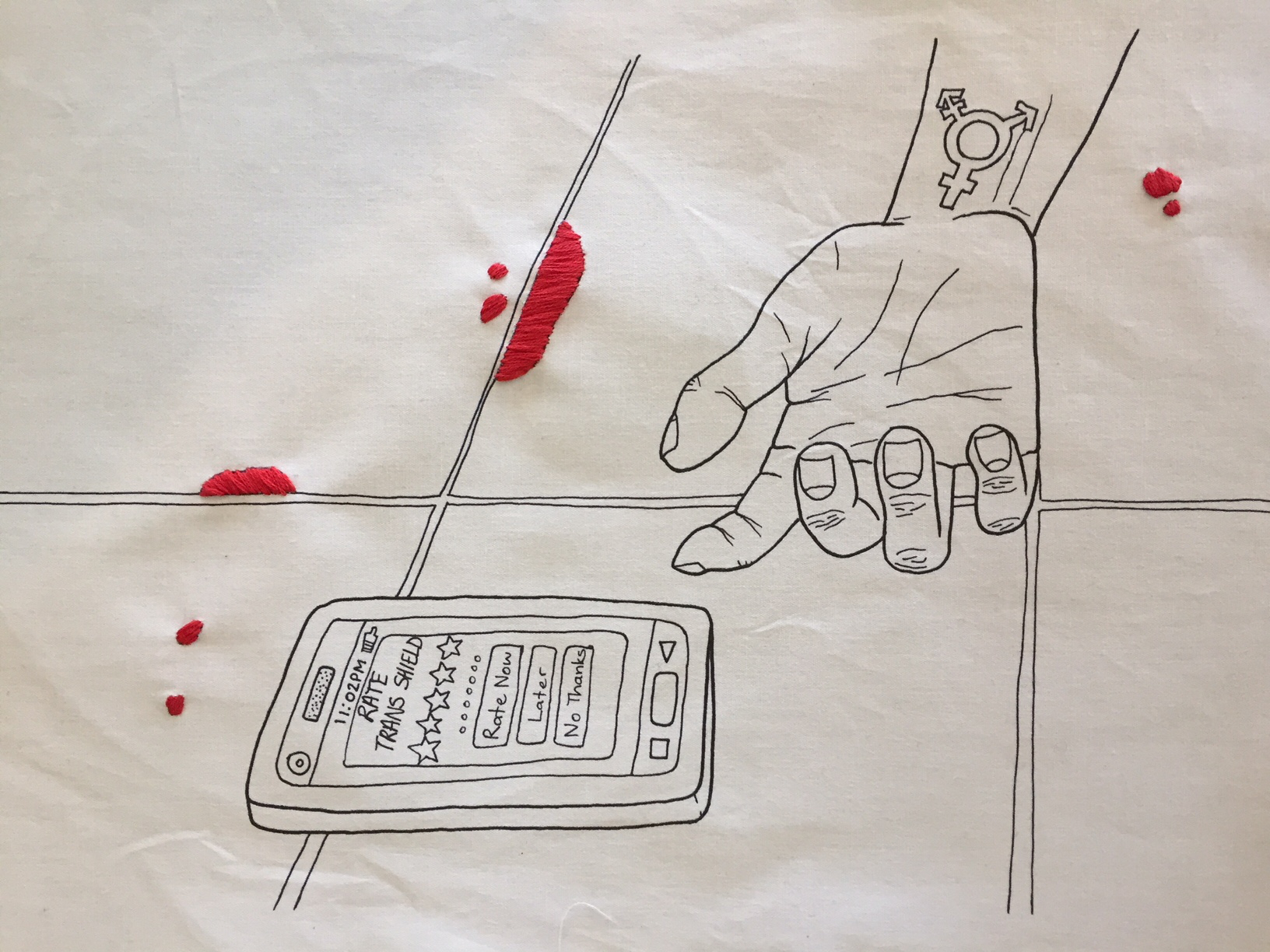
Do more, do better’ is a poem in four parts that explores transgender discrimination through a hypothetical augmented reality (AR) mobile app. The accompanying inked and embroidered art pieces reiterate key themes within the poem using a medium that could be considered an analogue to tech culture’s digital: craftivism. In combining elements in alternate modes, the pieces point to the ways in which these media may have commonalities, but may also be divergent. This aligns with the subject matter of the poems, drawing as they do on the everyday experiences of trans and gender diverse folk within public spaces. Public spaces should be safe, but are instead revealed as fraught with the threat of, and direct instances of, public violence.

In the first stanza of the poem, a new mobile phone app for transgender, non-binary and gender diverse people is introduced: a Band-Aid, a quick fix ‘until society catches up.’ This is not a trans utopia, but the creators of this app are doing their best with the tools they have at hand. The illustration of the Trans Shield logo is half embroidered in satin stitch while the other half is unraveling, trailing threads that fray and fall away like bandage fibres covering up an old wound, reiterating that this app is only a stopgap. In the poem, the question is posed: why do we ‘see [trans people] differently’ and why should an app like Trans Shield be needed in the first place? Indeed, the title ‘Do more, do better’ asks the reader as well as the wider community if they are doing enough for trans people and others in marginalised communities.

The second and third stanzas of Part 1 acquaint us with the ‘bloody upsetting’ realities of being trans and gender diverse, like being ‘politely misgendered,’ and highlighting the simple changes people can make in their lives in order to make trans people more welcome: using correct pronouns and terms, and respecting trans identities. The use of ‘polite’ is heavily ironic, demonstrating that politeness does not result in inclusive discourse and can be used to deliver a microaggression. Sonny Nordmarken in Transgender Studies Quarterly defines microagressions as commonplace, interpersonally communicated ‘othering’ messages which either intentionally or unintentionally relate to a person’s perceived marginalised status (Sue, 2010; Nordmarken, 2014). Part of the cruelty of microaggressions is that they come from friends and family as well as enemies, and here the politeness is positioned as an essential aspect of the misgendering, making it a ‘bloody upsetting’ reality for trans and gender diverse folk. The use of humour and sarcasm in these stanzas and throughout the poem draws upon the idea that comedy can be used to cope with the anxieties of life, and can have a beneficial effect in response to both positive and negative life events (Martin, Rod A. et al, 2009). The reader can laugh at and relate to just wanting to ‘buy / your fucking groceries,’ but this poem stresses that when you are trans, this simple domestic experience is often fraught with ridicule and dehumanising misgendering.

When reading these stanzas, augmented reality (AR) games like Ingress and Pokémon Go probably come to mind – games that layer our reality with computer-generated perceptual information. In the case of the fictional app Trans Shield represented in the poem, these data include multiple sensory modalities such as visual and auditory augmentations (Schueffel, 2017). While a game like Pokémon Go can layer your boring walk from home with competitive gamification, Trans Shield promises to shelter you with layers of trans-inclusive AR, turning an antagonistic walk home into a peaceful one. This does not, however, as we see later in the poem, remove the physical violence of transphobic attacks. It also does not change the structural transphobia of mainstream society.

The fourth stanza presents us with fantasy tech jargon, stating the app ‘syncs with your / BrainChip’ and uses ‘the latest / AR breakthroughs’ to give the user visual and auditory peace of mind. The line ‘glazes of hands / and sign language’ reminds us of the intersections between marginalised communities, in this instance the transgender and disabled communities. It is important to remember that ‘a voice / and mouth’ may not be a sensory option for everyone and that experience is intersectional.

Posted in ESSAYS | Tagged ,

Experimental Confessionalism: The Personal Turn in American Post-conceptual Poetry

Language poetry and conceptual poetry have both been enormously important movements in the development of contemporary experimental American poetry. They continue to be influential, however they are now both historical moments. This has led to some contemporary poets positioning themselves as post-language or post-conceptual. Here I want to focus on a particular aspect of post-conceptual poetry: the return to the personal and the embrace of a new kind of confessionalism. This seems a particularly teasing development because contemporary experimental poetry has so often been couched in terms of a rejection of the direct personal expression that characterised the lyric. However, this new confessionalism is not a return to the style of Plath, Berryman, Sexton and Lowell, though it inevitably shows some continuity with it. It is an experimental confessionalism: one that embraces but also transfigures the genre’s previous incarnations. It adopts the confessional as a mode but at the same time questions its claims to authenticity.

Conceptual poetry, of which the anthology Against Expression (Dworkin and Goldsmith 2011) is an important example, encompasses a number of techniques involving ‘uncreative writing’ (Goldsmith 2011). These techniques include appropriation of texts, sometimes on a large scale and often involving material drawn from the Internet; the use of systems, procedures and constraints; and the creation of concept-based poems where the fundamental idea on which the poem is based is as significant as the details of the content. Many conceptual works combine more than one of these different techniques, and there is considerable breadth as to what is considered conceptual.

Post-conceptual poetry, according to Felix Bernstein – one of its main practitioners and proponents – is both a continuation of conceptual writing and a reaction against it.1 Bernstein’s theorising is often ironic, opaque and deliberately contradictory. On the one hand, it attempts to delineate ‘post-conceptual poetry’ as a movement (Bernstein 2015). On the other hand, it also suggests that true poetic liberation could only ensue if all such movements collapsed, creating not only the death of the author and the death of the text but also ‘the death of work’ (25). This, Bernstein posits, is a possibility that post-conceptual poetry can gesture towards but can never fully embrace, because it is caught up in a seductive and inescapable contemporary culture of branding and celebrity.

Bernstein claims, with regard to post-conceptual poetry, that:

Its practitioners, born (on average) in the mid-‘80s, are part of a larger trend within post-postmodernism to bridge affect, queerness, ego, lyric, and self-conscious narcissism within the inherited procedural structures of the ‘network’ and the ‘concept’. (Bernstein 2015, 22)

He goes on to say that the project of post-conceptual poetry is most fruitfully a hybridisation of different traditions and notably includes some jettisoned by other experimental movements:

Post-conceptual poets can assert authorship by deferring to the confessional/affective /lyrical (traditional, Romantic poetics) or the mechanical/conceptual or, better yet, they can mix both together (as a conceptual strategy or as a heartfelt impulse or some hybrid of both). (25)

While many post-conceptual poets continue the appropriation and transformation of pre-written texts that is central to conceptual poetry, there seems to be an increased emphasis in their work on performativity, the tangible impact of social media, and an eclecticism of styles ranging from employing appropriated texts to writing more freely. Particularly relevant to my purpose here is that this work is distinguished, in some instances, by a revamped confessionalism: I characterise this as an experimental confessionalism that embraces the personal but with self-awareness, critique and distancing. This is accompanied, in some cases, by an engagement with transgressive or non-heteronormative sexualities. Felix Bernstein, assigns ‘queer structuralism’ to post-conceptual poetry – the word structuralism in this context is puzzling and seems a throwback, but is perhaps employed because of conceptual poetry’s focus on system, network and concept. The poets Bernstein names as post-conceptualists are Sophia Le Fraga, Andrew Durbin, J. Gordon Faylor, Trisha Low, Josef Kaplan, Kate Durbin, Joey Yearous-Algozin, Holly Melgard, Danny Snelson, Steve McLaughlin and Steve Zultanski (23).

This essay will not focus on the work of the post-conceptualists overall but on the engagement of some of them with experimental confessionalism. For that purpose, I will examine selected works by two of the poets: Trisha Low and Felix Bernstein. I will look at the particular social and artistic environment in which their work is embedded, its relationship to previous experimental poetries, and the ways in which it shifts notions of authenticity and affect in experimental poetry. First, however, I want to address the malleable concept of experimentalism itself.

Posted in ESSAYS | Tagged , , ,

Punk Calligraphy: A Primer on Asemic Writing and Scribbles


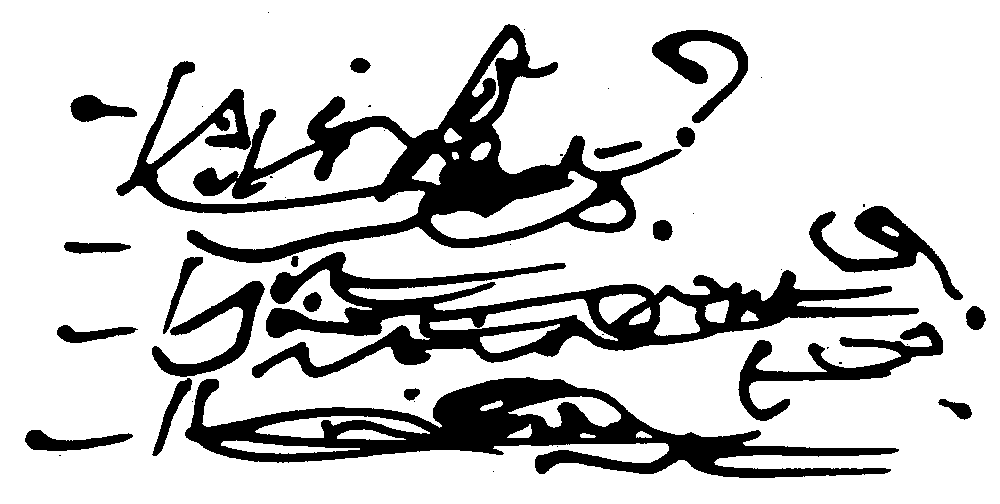
‘logogramme’ by Christian Dotremont from Logbook (Yves Rivière, 1974).

Growing up in Australia, I learned to associate the word ‘calligraphy’ with what is beautiful, perfect, virtuosic handwriting. However, there are other ways to interpret calli – the beauty – of handwriting. Punk calligraphy is my term for unhindered explorations of handwriting.

Even though I still find inspiration in the idea of punk, it’s post-punk music, which explores some of the landscape revealed by punk’s destructiveness, that continues to give me pleasure. Could one import the fertility of Melbourne’s ‘little band scene’ of the late 1970s into literary culture? In the case of poetry, if you strip it back to simple mark-making on a surface, and follow whatever logic emerges from that, you might end up in a new place, one that feels closer to your authentic self than a sonnet ever did.

The Belgian poet Christian Dotremont, a co-founder of the CoBrA movement, developed his own style of loose brush-written poems on paper, which he named logogrames. One description of them would be a European interpretation of Chinese calligraphy. Several examples were published in Logbook (Yves Rivière, 1974). The majority were written in French, although the example reproduced above is in English. Good luck reading it.

In the short text Signification et Sinification (published in CoBrA #7, 1950; an English translation posted at gammm.org), Dotremont advocated for creating a pseudo-Mongolian or pseudo-Chinese writing by writing something in your native language on one side of a page, then turning the page over and rotating it 90°, and then tracing what is visible of your writing quickly, moving downwards rather than left to right. What you get is mirror-writing, rotated 90°, drawn loosely rather than traced exactly – that’s certainly a punk engagement to another culture’s art if we are to take him at his word that he’s creating Mongolian writing.

The idea that illegible but freely written handwriting can be beautiful is at home in Chinese culture. As long ago as the Tang Dynasty (around 800 c.e.), a gentleman who chose the brush-name Zhang Xu practiced his particular specialty; a form of wild cursive calligraphy known as kuang cao shu, which was in some cases illegible to a Chinese reader, but full of passion. Zhang often wrote after drinking wine, and on occasion could not read his own handwriting the morning after a session.

**

If you know nothing about Chinese writing, perhaps a place to begin with an alternative form of calligraphy would be scribbles. Rhoda Kellogg, with the assistance of educators around the world, concluded that children of all cultures traverse identical stages of learning to make marks. In her book Analyzing Children’s Art (Mayfield, 1970), Kellogg identified 20 ‘basic scribbles’, ranging from dots, straight lines in various orientations and circular motions – which most children master in the course of learning to wield a pencil. As a child’s mental and physical capabilities grow, the scribbles are combined into more complex diagrams, combines and mandalas.

Scribbles can be assumed to be meaningless, and of little value. I argue otherwise: while you cannot write a logical, critical essay using scribbles, you can record certain states of mind and body more effectively than you can by words. The fast-flying scribbler’s arrow hits the bird. The composer of sentences has only written a single word by the time that bird has flown past. There seems to be a difference in level of intensity of scribbling, between tentatively testing a pen and making confident broad strokes to cover a large area. Some scribbles are serving a mental purpose, and have more of their creator’s personality in them. Other scribbles are made physically, with little of the mind involved.

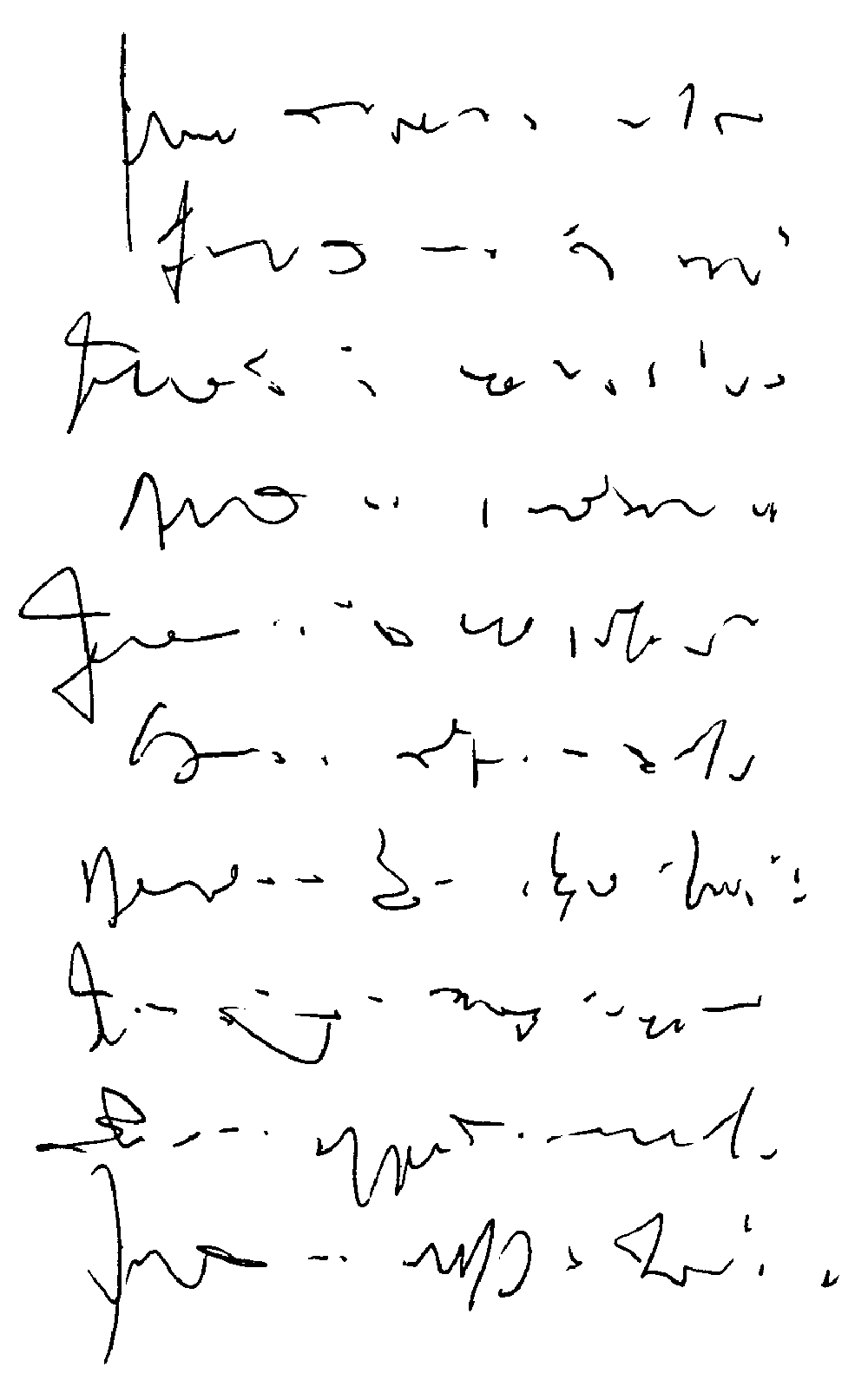
Seeing Jim Leftwich’s marks in Lost & Found Times #39 (1997), reproduced below, got me thinking. I’d never seen anything like them before, especially not in a poetry magazine. They looked like unfinished snippets of handwriting.


Marks by Jim Leftwich from Lost & Found Times #39 (1997).

At Leftwich’s request, I quote his recollection of how they originated, and as published in his text Subjective Asemic Postulates, part 2 (2015):

My first explorations of quasi-calligraphic faux writing came the morning after a particularly intense experience of taking what Terence McKenna called a ‘heroic dose’ of psilocybin mushrooms. I had experienced a complete annihilation of the self, and not one of merging harmoniously with the universe, rather one of being ripped apart, as if in a ritual sparagmos. The next morning I was sitting in my car and I started for the first time to write lines of illegible fake writing. It felt as if I were being guided to do this, as a kind of healing for the night before.

Posted in ESSAYS | Tagged , , , , , , , , , , , ,

What the Repetitions of Poetry Might Help Us Remember about Home, Belonging and the Self

It’s mid January in Edinburgh. Patches of yesterday’s snow make florescent patterns on the future flowerbeds of the new old folks home across the road. It’s a home specifically for people with dementia. From the living room I can see that all of the rooms are, as yet, empty, but at night the lights are on and the lit stairwell and empty rooms have a waiting quality about them. The place actually looks quite nice. There are raised garden beds and a smoking pegoda. It’s close to the sea. Still, there it is, in direct line of sight, the sort of well-run, nicely maintained facility my mother ended up in.

My bedroom has a better view, a bus depot with the North Sea behind. And at night three different lighthouses, the Stevenson-designed lighthouses on Bass Rock, Fidra and Inchkeith. They are all small islands in the Forth with layers of human and bird history: the gannet-call from Mary Queen of Scots; the empty bellies of the Covenanters growling in the seacaves. I watch the lightbeams flash at different times on different moments every night. They are like ministers who reach across to bless me by touching my head and all the worlds I hold in it. Which makes me think of the Christmas Eve service I went to with two friends at a local Catholic church here in Portobello last year. They made darkness and then lit candles, there were songs and words, but my favourite part was the Eucharist when we were invited to line up to either receive the Eucharist or, if we would prefer, just to get a blessing from the priest. We were told if we wanted the blessing and not the body we should, when we reached the priest, lay our right arm across our chest. Although longing to make the gesture that was suggested for the blessing that was being offered, I didn’t join the line. I stayed in my seat, listening to the blessings and The Body of Christ’s and the Amen’s. I sat longing for what was right there: for the ancient stone church I was in, the candles that were burning, the smooth wooden pew I was sitting on, for the call and the response, for the psalms, for the hand above my head. But there was something about submitting. I could not say yes. There was something about the stories, or perhaps those who were delivering them. And it wasn’t just that it was a Catholic church, because neither could I have said a true yes in a lovely plain Protestant church or in the gold shine of a Buddhist center. No matter the lonely pilgram that I am, my feet sore from the journey.

The place where I can hear and respond to the chants of ritual, of community, awash as it is with human frailty and wrong-footedness, is in poetry. Here I can bear the most vulnerable of human fallibilities, not least my own, because the lodestar for poetry is contingency, the acknowledgement of chance and change. I know I will not be hobbled by a single strand of anyone’s story, or my own. It’s my belief that poetic repetition describes and significantly enables that contingency – that when a word or phrase is repeated it connects to previous iterations (within the poem and across poetry) at the same time as demonstrating change (the influence of a changed context, its changed syntactic neighbourhood). So I can hear my foundation songs there; I can say yes to them, because they are constant (sounding our deep and far traditions) as well as mobile and accommodating (fluid, responsive to context).

To be honest, I don’t entirely know what I mean by foundation songs, but I do recognise them. No, actually, I recognise the structures that lift them from the ether to the ear. Most importantly, the measured returns of anaphora and the echoing of form in parallelism that allow incantation, chant, prayer, spell, and poem; sounds that have shaped and defined social, spiritual and geographical communities across the world. Constructions from which we have called for protection, for shelter, for food, for solace, for guidance. Calling the dinghy into the shore, the deer to the arrow, the heart back home.

In her essay ‘Liturgy, Art and Politics’ theology scholar Catherine Pickstock writes that ‘all cultures begin in liturgy which fuses the repetition of ideal value, with physical inscription upon bodies, places, times and motions.’ She uses the term liturgy rather than ritual because she feels that Western scholarship has diminished the meaning and scope and relevance of the word ‘ritual.’ She goes on to note that places are ‘bound together by ceaseless performance of liturgy’ and that ‘this rhythm leads the city to refer beyond itself to nature and to the eternal.’ Poetry, so grounded in detail and moment, also releases us from detail and moment by its repetitions that remind us of the ‘ceaseless performance’ that is the constant process of making and becoming. It reminds us how we belong. It washes us in community that doesn’t depend on physical proximity, internet access, a car.

Posted in ESSAYS | Tagged , ,

Sonic Twin? A Poetics of Poetic Radio

When I reflect on the last decade of my engagement with poetry, I hear a presence shadowing many of my encounters. ‘Hear’ is an apt verb, because this presence is aural. What has so insistently stalked my encounters with poetry is the medium of radio, which acted as a bridge to poetry, catalysing my absorption of the form at a formative time. Radio appeared when I was seeking other ways into an art that was energising, perplexing, and intimidating – the latter when it seemed too serious about its singularity. I remember listening, at this time, to a sprawling acoustic art program on ABC RN’s The Night Air, as I drove home from the industrial outskirts of the city; I remember my feeling of bliss, as my ears and mind were opened by the experience. I count myself fortunate to have caught the tail end of a period of sustained acoustic experimentation on RN, though I missed the aurally plentiful The Listening Room (1988-2003) and its precursor Surface Tension. This tail end has been long, and has included Poetica (1997-2014) and Soundproof – which ran admirably for two years from the end of 2014 to the start of 2017, during a period of relentless budget cuts and a shift towards more generalist and journalistic programming at the station. I’ve spent the time since that first enchanted experience hearing poetry nearly as often as reading it, and producing other poets’ work for radio and podcast (including the use of music and digital effects, in the tradition of the programs mentioned here) more than writing it. Some of this audio work is now lost, airing as it did in the years before regular institutional podcasting; most of it was given a home on RN’s Earshot and Poetica.

Radio programs used to have a sense of ephemerality, with their airing also a vanishing. It may be for this reason – the impermanence of the medium – that literary critics do not routinely listen for poetic resonances in more artful radio. This is despite the techno-spiritual link between print poetry and radio (particularly cultural radio): they often share a quiet way of being in the world, compared at least to commercial films and novels, which tend to announce their phenomenological affects (‘THIS SUMMER …’ / ‘gripping’; ‘compelling’; ‘unputdownable’). Another reason we routinely hear around, or hear past, radio when we seek out poetry is that modern and postmodern poetry, in its diversity of forms, is not so singularly fixated on sound – and so the rhythmic voice and poetic sound on the air mightn’t immediately strike us as akin to the poetry we read. But from a cultural history perspective it’s surprising that we don’t talk more of radio in the same breath as poetry, given that so many prominent Australian poets have also worked as literary radio producers. Among these poet / producers are John Thompson, Martin Harrison, Amanda Stewart, Robyn Ravlich, John Tranter, and Mike Ladd, all of whom have / had significant careers at the ABC, making radio art or literary radio programs.

In this essay I trace an understanding of the poetic that is grounded in aurality, in order to hear where poetic radio occurs. This demarcates a scope: there is obviously more to poetry than the aural, even in the basic fact that print poets work with language, which is part-aural and part-visual. There are also many poems – concrete poems, typographically experimental poems, digital poems – that may be structured or motivated more by a visual impulse, or equally by visual and aural impulses. Exceptions to definitions I present may be reason for another essay, one on the visually poetic dimensions of a primarily aural medium like radio.

I try to show how sound in radio may be poetic: this goes beyond programs that simply transmit recorded poetry, and into sound design, including the use of music and non-verbal sounds. The essay acts as a bridge – like that in Robyn Ravlich’s ‘Mostar,’ explored below – connecting areas of criticism that are usually disconnected: formal poetics, radio theory, and cultural histories of poetry and radio. In linking these different areas I hope to expand our listening, and to add to our vocabulary for thinking about such radio when we encounter it.

1: The sound of a medium

Radio is a medium of pure sound, which may include linguistic as well as non-linguistic sound. It may include speech as well as music: representational as well as non-representational sound. Poetry, in our highly literate age, is most often a medium of sound as well as sight. Literary scholars like Adalaide Morris and Garrett Stewart have reminded us, over the last two decades, that when we read texts ‘silently’ to ourselves, we are engaged in the sensory experiences of both sounding and seeing the text. In the case of poetry, most obviously metrical verse prior to the twentieth century, there is a lot to be sounded out. This is evident in the terms that traditional poetics uses in formal analyses of poetry, many of which refer to sound: rhythm, rhyme, cadence, alliteration, assonance, consonance, onomatopoeia, etc.

Poetry has historically had a close relationship to sound, and this relationship is apparently clear at the level of formal analysis, but becomes difficult to define upon closer inspection. Sound is fundamental to the system of poetic analysis known as prosody, which attempts to ‘scan’ poetry for its sounds. Lines of poetry are read for their sonic patterns – which syllables are stressed and which unstressed; what rhythm this creates, and where this deviates; and the reason for rhythmic choices, in relation to meaning. Such metrically regular poetry (in the work of Tennyson, for instance) is exemplary of the following definition:

Poetry – like prose, and like music – is an art of SOUNDS moving in TIME. For particular purposes, these sounds may be analysed into various units; for example, into PHONES (the smallest distinguishable speech sounds) or, in English and in many other languages, into SYLLABLES. (Shapiro and Beum 1)

This is a fairly loose definition: if prose and music are also arts of sounds moving in time, how can they be distinguished from poetry? The conflation of poetry and music is more considered in definitions of the lyric that refer to its relationship to song, and to a tradition of musical accompaniment. Daniel Albright defines the lyric this way:

I believe that lyric poetry is fundamentally an attempt to approximate the condition of music within the slightly alien and prosaic domain of words, whether through phonemic intricacies or through the frustrating of semantic reference or through the presentation of transcendental ideas or of absolute feelings. (ix)

Although it is true that the ‘frustrating of semantic reference’ can be an attribute of both music and (lyric) poetry, Albright also claims that lyric poetry ‘approximate[s] the condition of music … through the presentation of transcendental ideas’ – but how can music – that is, music without language – present an idea? We associate ideas with language, not with music. Maybe he means that music presents transcendental feeling, while poetry presents transcendental ideas.

The radio theorist Andrew Crisell has argued that ‘the broad emotive power of music enables it to be combined with words and/or sounds as a way of signifying something outside itself, and some of these forms of signification are worth considering in detail’ (216). Crisell’s reference to the signifying power of music when combined with other sound is reminiscent of David McCooey’s notion of the ‘poetry soundtrack’ (a term he coined, for a form he works in), which are ‘sonic objects made up of original text-based poetry, music, and sound design. The term deliberately echoes the “film soundtrack”: each engages a totality of sound – speech, music, and noise – and each employs audio technology to produce its complex effects’ (McCooey par. 7). Here music is represented as part of a larger harmony, lending its ‘emotive power’ to boosting the signifying power of speech, while resonating with the meaning of that speech.

I want to pause here to note that locating the ‘poetic’ in sound and musicality does not exclude free verse, even if it tends to pattern sound less regularly, and is more playful with the look of the poem on the page – with its visual dimension – compared to metred verse. As Derek Attridge notes:

Once poems started to be circulated in print as well as recited from memory or from a precious manuscript, their look on the page became significant, and the history of English poetry could be written as a history of the gradually increasing importance of its visual dimension – but always as this interacts with its aural dimension. (2)

Print invigorated poetry’s awareness of the visual. Along with other popular media such as film and television (and more recently, the smartphone), it arguably primed the domination of the visual in our imagination – what scholars have termed our ‘ocularcentrism’ (Lacey 280). The oral and aural made a comeback in the second half of the twentieth century, thanks to technologies of sound reproduction. Walter Ong has called this resurgence of orality/aurality a ‘secondary orality’: a mediated speaking and hearing facilitated by technologies such as the phonograph, telephone, radio, and television in a primary literate culture (11). This resurgence of the oral was tied, for some artists, to an experience of deeper subjectivity (though Derrida would later term the value judgment implicit in this as ‘phonocentrism’). Michael Davidson has argued that, in the mid-1950s, American poets such as Allen Ginsberg, Paul Blackburn, LeRoi Jones (Amiri Baraka), and Jerome Rothenberg turned to sound recording technologies to reclaim their connection to the self, via mediated orality, as ‘orality signifies unmediated access to passional states, giving testimony to that which only this poet could know’ (97). Using magnetic recording technology as part of their creative process, poets at this time sought as well to re-claim a self that had been appropriated by the state (via audio surveillance) in a burgeoning Cold War that eroded the privacy of citizens: ‘voice was a contested site in a battle over identity and agency’ (99).

While we’re riding this wave into media culture, it’s worth noting that the increasing availability of sound recording technologies intersects with the trajectory of sound poetry – that other realm of sonic practice that runs alongside the modern tradition of the lyric, and print poetry more generally. Sound poets have always sought to push poetry beyond its representation of meaning, and of the authorial body. New technologies of sound recording allowed poets to process the voice in unprecedented ways:

The development of the tape recorder after World War 2 … led to an important link between sound poetry and audio recording, especially through the construction of ‘unperformable’ works, such as Henri Chopin’s sound poems, from using (and misusing) tape recorders. Such a ‘tradition’ developed through the 1960s and 1970s, as seen in the work of John Giorno and Bob Cobbing, through to the digital era, in which poets such as Christian Bök and Amanda Stewart use digital means to produce audio works that anatomise speech and deconstruct semantic meaning. (McCooey par. 13)

Posted in ESSAYS | Tagged , , , , , , , ,

11 Works by Paola Balla


Paola Balla | Untitled | 2010

Posted in ARTWORKS | Tagged

Do more, do better

1.

Trans Shield changes the way
you see the
world, even if the world
sees you
differently. Until society
catches up,
there’s an app
for that!

Just want people to respect
your identity? Pissed at being
politely misgendered when you
just want to buy
your fucking groceries? Want Gran
to use he/him but she’s not quite
getting it and she might kick
the bucket soon
and the whole situation is
bloody upsetting?

Simply plug your name/s,
pronoun set/s and 
preferred terms (e.g. guy,
girl, ma’am, dude,
person)
into Trans Shield and you’re good
to go!

Every time the wrong
crap is used in relation
to you, you won’t even hear that
shit. Our app syncs with your
BrainChip and uses the latest
AR breakthroughs
to overlay onto the
person who willfully
fucked up
so you won’t even notice
they did. (Multiple options
are available, including realistic
glazes of hands
and sign language, or a voice
and mouth.)

Once you have this
app, every instance of
‘oi tr*nny sl*t!’
hurled at you
on the street
will be masked
by the phrase
of your choice, including: ‘trans rights
are human rights!’ or ‘TERFs suck
hey?!’

For an additional
in-app fee you can replace
slurs from cars with a golden
retriever, barking joyously, their head thrust
unceremoniously out the window, feeling
the breeze ruffle
their silky ears.


2.

Additional features
of Trans Shield include
the ability to:

  1. put the app in Sleep
    
Mode, so you can discover
    
which of your uncles at family
    
dinner is misgendering you and
    
address the issue head-on
    by telling him
    
to get fucked.
  2. use multiple profiles and switch
    between them on a frequent or in-

    frequent basis. Perfect for anyone
    who’s bigender or gender fluid.
  3. edit any of your details
    at any time, because who says
    
we can’t explore 
who we are!


3.

Latest Trans Shield update:
Unfortunately we are still unable 
to address user concerns
regarding violence against
transgender and gender diverse
people,
especially
the violence against
and murder of
transgender women of colour.

Nor can we address the broader
systemic issues relating to
the way society views
and treats us
within the current scope
of this app. We are truly
sorry.


4.

Our sister app
Be Fucking Nicer,
which was marketed
at cisgender people, allowed the user
to store people’s pronouns and
identities for future
social interactions, and included
gamified education
tools (such as Ally
Credit Cookies).

We are sad to announce
this app was taken
down from the store for breaking
the terms of service. The terms
stated that: in this
day-and-age of ‘full
equality’ we are not allowed to unduly
influence the minds and decisions
of cisgender people
in this way. Again, we are truly
sorry. We wish we could
do more, do better.

Posted in 87: DIFFICULT | Tagged

11 Works by Hoda Afshar


Hoda Afshar | Untitled #2

Behold

Behold was made unexpectedly, and without design. I was travelling in a city that I sometimes return to, and I got to know a group of gay men. There, where they live, these men (and many others like them) are mostly left to be. But only on the condition that they lead one part of their lives in secret. Rarely, that is, do their bodies ever meet in open honesty outside, in public. Only here, in this bathhouse, where their desire to be seen and embraced by others – just to be and to be held – is played out the partial openness of these four closed walls.

The bathhouse no longer exists. But while it still did, these men invited me to document it and a little glimpse of their lives in it. We arrived, but I was not allowed to enter. So we rented the place, and for a few hours I took pictures while these men played themselves performing their lives for my peering camera, in order that their desire to be seen might be realised, in part at least, here in the world of the images – in the act of beholding, where the bare thereness of life is transformed from mere appearing or appearance, into something more meaningful … into recognition.

In the Exodus, I Love You More

In the Exodus, I love you more is an ongoing series that I began in 2014. It’s a record of my changing vision of, and relationship to, my homeland, Iran – a relationship that has been shaped by my having been away. Distance is something that I embrace in making this series, rather than clinging nostalgically to my image of “home” or to a narrative of painful “exile”. I try to turn distance into a kind of seeing. To let what is both there and not there shine through the surface. To let the surface speak.  It is an attempt to explore the interplay of presence and absence in the history of Iran and in Iranians’ lives during a time of great transition, and to discover the truth that lies there in their never-ending meeting, in-between.

Under Western Eyes

Under Western Eyes (2013-2014) is a series of manipulated studio photographs that combine, in pop-art style, familiar signs of Islamic identity to challenge the dominant representations of Islamic women that circulate in Western art galleries. Through pastiche and redeployment of these familiar signifiers, this series attempts to locate the origin of these representations, and the reason for their predictability, in the Western gaze. Thus, these images aim to critique, through mirroring back, a certain audience expectation and desire in relation to how ‘the female Islamic subject’ is seen; for it is this expectation that partially explains the recurrence of the same few signifying elements in the works of Middle Eastern artists – above all the veil. The central idea, then, is that such (self) representations often depend on, and thus re-produce, familiar signs of ‘otherness’ that cater to Western viewers’ and the art markets’ demand for ‘Islamic’ artworks that highlight their cultural difference in safe and predictable ways. At the same time, such representations also serve to position the Islamic subject in relatively fixed ways vis-à-vis the ideal type of Western viewer. She is oppressed, tradition-bound, and inferior, but secretly – beneath the veil – ‘just like me’: i.e. fashion-loving, rebellious, and sexually-free.

Posted in ARTWORKS | Tagged

Waiting

Would you like to fall in love?
I want to ask.
I’ll make soup.

It is winter and she is pale,
blowing on chapped hands
as we stand
waiting.

What are you reading?
I want to ask.

What are you listening to?
I want to ask.

She has the kind of ears I like:
sticking out a bit
with her hair tucked behind.

In the end I say nothing,
lowering my eyes as she raises hers.

I think she may have cut her own fringe.

Posted in 87: DIFFICULT | Tagged

forgetting as commodity

grandma disembodies her youth
as if famine isn’t a weapon of war
once she was pregnant
for the fourteenth time
but her husband doesn’t know my mother’s
name from Vietnam’s humidity
to knowing snow in her bones Oklahoma
she said privilege is the ability to plan your burial plot
or to know where your ashes will be disseminated
after mating mother octopuses don’t starve to death
her protoplasm betrays her
epiphanies are nutritious
my grandma said
if you can afford them
my frustration of inheriting cultural loss is equal
to Aristotle’s declaration that octopuses were dumb ocean mass
dear three hearted cephalopods,
the reflexes from grandma’s left fingers
are gone infected from scrounging aluminum recyclables
the past orbits her present strength
oh the difficulty of guessing a tree’s age
when admiring its crisp shadow
an octopus’s production of natural pigment
harms enemies and the self
sometimes knowing where you come from
prevents growth
old leaves fall to make space for new buds
what is post fragmentation
if emptiness is a pretense
what is queer visibility in commodity culture
but spatial subversions
grandma taught me that when octopuses
can’t escape their own ink cloud they cease

Posted in 87: DIFFICULT | Tagged

Gathering the Rocks

When I think of you now,
I see you in space
with your arms full of rocks.
It’s winter.
The fields are bleached
and bare.
The rocks are brown –
volcanic rocks,
pitted and domed.
They have to be just right.
We’re gathering them
for our garden.

The fields are spacious,
flat, filled with afternoon light,
dull-grey.
You stand up high
against the horizon.
The rocks are round
in your arms.
They shelter against your dark coat
like breasts, like children.

Our dog barks behind you.
Chasing birds in faraway fields,
she runs, her breath streaming.
Over by the highway,
our baby waits, her face
a tiny planet in the car window.
Who can say what distance
her eyes go round,
behind shadowed glass?

Planets we are, all four,
circling each other.
Rocks and space …
This is our family.
It has to be just right
to plant them in our garden.

Posted in 87: DIFFICULT | Tagged

Equinox

Cartograms are almost impossible to create by hand.

When bastardized versions of indigenous culture are let loose on the tourist market, there can be no margin for error.

An ersatz Indian arrowhead found in a grave in the small Southern Illinois town we both grew up in meant that the transmission was easier to shift.

Three important methods of healing, with special reference to the Yuan & Ming dynasties, were discovered in the National Library of Australia collection of Crystal Clear Transparent Snap-On Cell Phone Hard Case Covers.

Everything seemed in a state of flux.

He did not consider the floodplain to be a part of the creek.

All that inherent uncertainty stemming from the nearby wine country.

A metal pen point was patented in 1803.

Is fashion a form of expression?

Dobre wiesci z Mazowsza Rock In Minsk Festival `08.

Every new user is indoctrinated to believe that their bodies belong to them & only them.

Posted in 87: DIFFICULT | Tagged

Nebula

I wish upon this not star

– this chemical spill of interstellar death -

that I will be able to spirit these dead things I carry

these heaviest in my heart dead things

away from me and

catapult them into the outermost reaches of space

so they can suffocate

so they can freeze

so
 

a million memories of you and I and us and ours

can burst into smithereens and finally die

and not have to wane with the everlasting ache

of an infinity of love lost

our life lost

and each particle in a globular cluster of hurt so proud

can be left to wander off

to tumble themselves away

and try to know themselves again

alone


and from nothing

a fire will strike

a star will ignite

and something new will live

and not know what had to die

Posted in 87: DIFFICULT | Tagged

Mistakes

Ti-tree flowers mistaken for snow
A bird on an aimless afternoon
How much time is left to me
and why are you walking ahead?

A bird on an aimless afternoon
Clouds gather like bargain hunters
and why are you walking ahead?
Time is an advancing avalanche.

Clouds gather like bargain hunters
Rain prepares to change its mind
Time is an advancing avalanche
Weather a recalcitrant child.

Rain prepares to change its mind
Days like an absent family
Weather a recalcitrant child
counting the hours on both hands now.

Days like an absent family
Sea alone belongs to me
counting the hours on both hands now
Ti-tree flowers mistaken for snow.

Posted in 87: DIFFICULT | Tagged