John Who Wears Black

12th June 2019, Admiralty, Hong Kong

protests alongside ten thousand youths now called rioters now reduced to statistics
disregarded by the one in power the dowager who holes up in the golden
interior of her palace

her yellow curtains her white couture her private prison she dares not step out into
the light which burns her skin to the streets where people whisper murmur pronounce
their rage

each sparked each cradling a little hope that the second week of June
2047 will not be as red-sinister as what everyone has just lived through

so much growing-up is forced upon the young in the seven days of rain thunder
the manmade mist which makes eyes tear and the sun scalding their cheeks their necks
their sweat-soaked shirts

stuck on their backs but that’s okay because now they hoist umbrellas enduring
the facemasks and goggles not minding the dirt on their names chanting
what is right is right

until the police lunge at them with long shields and batons and while on the move
John hands over his umbrella and helmet to the also-running reporter

the teargassed cameraman holds fast and films a master shot of humans being human
this stripped-down kindness is the light the heat the verve which moves me moves you
moves whoever is watching

this city needs John who grasps Jane’s hand and turns back for Jason and his friends
and behind them two million flames

Posted in HONG KONG | Tagged

Hong Kong Now

Hong Kong has experienced almost a year of political and social turmoil, with the aftershocks of last year’s protests continuing to be felt, and many of their grievances unaddressed. We did succeed in weathering the COVID-19 outbreak well enough, largely due to our readiness to adjust our lives and make necessary sacrifices, not to mention the prior experience of SARS in 2003 which claimed 299 lives here.

As a city, we face continual challenges and our will is strong. Hong Kong’s unique qualities and strengths have been forged in the city’s colonial past and its more recent political struggle.

Still, I can’t help but think that Hong Kong people are now perpetually in a state of emotional exhaustion. There is a heavy and frustrating feeling in the city. As I write this, there is an ominous air because of the impending National Security Law. People here have no doubt that Beijing will use it in as broad and vindictive a way as possible, and there are even concerns that it might be used retroactively. The fact the Hong Kong government is showing little interest in consulting the public about the law tells you all you need to know about their intentions.

Six exquisite artworks were commissioned to respond to some of the poems: 6 Artworks by Anthea Y

Belle Ling: Nebulous Vertigo
Belle Ling: Dining Alone
Marco Yan: Midsummer
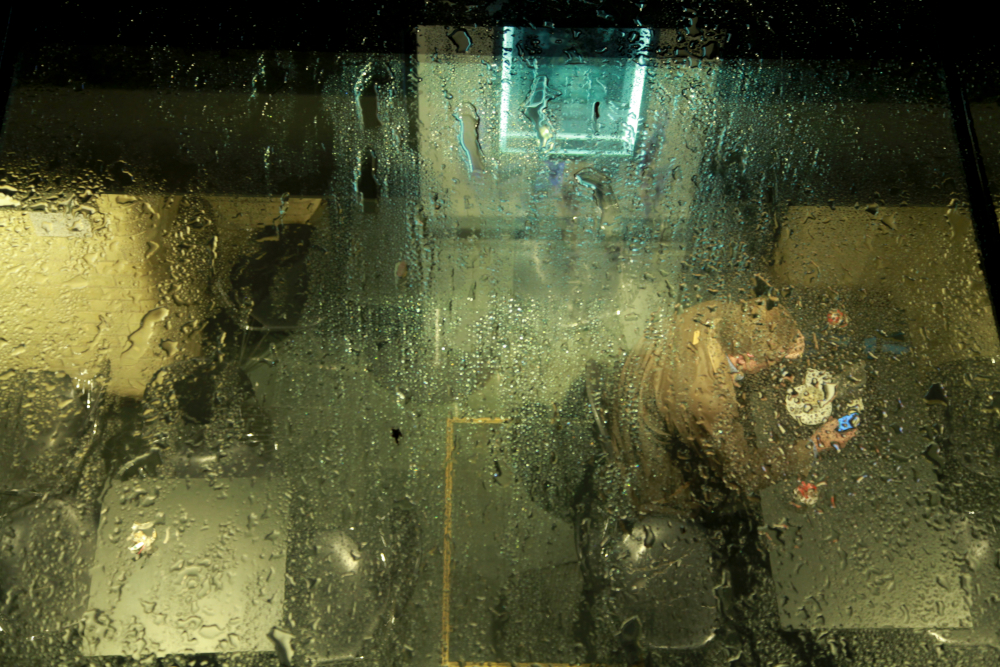
Marco Yan: John Who Wears Black
Collier Nogues: Article XII: Autonomy
Collier Nogues: Preface: Important Notice
Wawa (a.k.a. Lo Mei Wa): 1.
Wawa (a.k.a. Lo Mei Wa): 2.
Akin Jeje: Last Days of August
Akin Jeje: Passing
Akin Jeje: Pak Tai Street
Akin Jeje: Almost Greatness
Cheng Tim Tim: Annie, Anyone?
Cheng Tim Tim: Students Said
Tammy Lai-Ming Ho: Your Name in My Lexicon Means Yes
Tammy Lai-Ming Ho: This May Be a Love Poem
Tammy Lai-Ming Ho: Tomorrows
Tammy Lai-Ming Ho: The Visitation
Tammy Lai-Ming Ho: One Person


It is too early to say for sure if this will be the end of Hong Kong, but it certainly does not bode well. The last few years have shown that Beijing has little respect for the Sino-British Declaration it signed 35 years ago and it is grasping every opportunity to have a greater say in how Hong Kong is governed. If the law is passed, and it is likely it will be, the legal firewall between Hong Kong and the mainland will disappear and people the Chinese government deems troublesome stand to be pursued even more easily than the proposed extradition bill last year would have allowed.

But at times we manage to be cautiously optimistic about what the future will bring. Moments of lightness seep through cracks of heavy, seemingly impenetrable walls of doom. I believe many Hongkongers want to arrest the erosion of what makes Hong Kong special and distinctive. This is encapsulated in the slogan ‘Let Hong Kong be Hong Kong’, worn on T-shirts in the city.

One of the many things that make me proud of Hong Kong is the coexistence of multiple languages, including English, spoken and written by its people, despite Chinese being the majority language. True, there are far fewer creative writers writing in English than I would like to see, but the mere fact they write and are published at all points towards a degree of diversity in creativity. In this small collection, I am pleased to present some of the active poets from Hong Kong or living here who are writing today, who explore different topics and concerns in their works. For some of them, English is their first language. For others, English is an adopted writing language. A city is built by the wisdom of its citizens, Bertolt Brecht wrote. It is also built by the words of its people. Here are some words.

Posted in CHAPBOOKS | Tagged , , , , , , ,

Midsummer

Pale sky high clouds the heat soaks into the concrete
making shadows out of everything it’s the Establishment
of Summer again the city open to light and humidity
see the dust gnats pollen tinsels of pollution
the sweat on my arm coursing through the hair
like cars along the winding coastline where my brother and I
swam and paddled as dogs swallowing brine small stones
our own piss our mouths embittered only to spit
at each other’s face the length of the shore measured
by the clams we picked then dropped into the blue bucket
we laid the shells on charcoals at night watched them
crackle their meat dead and full of sand
the sand of some other beach where my childhood
friends and I dug with our hands nails collecting grains
a pit to bury driftwood crabs and soda cans
a treasure chest we made no map to wouldn’t uncover
even if we stood on the X one more time we shouldn’t
ask for the keepsakes we’ve gifted to the land let the land
remember us let it remember for us because I can’t return
to the time the girl I liked lay next to me the damp towels
the fearful sun the angst of not knowing how to talk
without leaving a clue of what I wanted we ran
to the waves and sank ourselves so we could touch
spume clinging to our skin a straitjacket of salt
we struggled to strip off it was sticky it was
bliss eternally thick on these bodies of ours dear
brother dear friends my dearest girl here we are
look how much we’ve perspired on this day
there are things we can never wash off can we

Posted in HONG KONG | Tagged

Tomorrows

If I walk on a Hong Kong street
for long enough,
I will eventually bump into someone I know
from a long time ago.
So long ago that each of us wilfully resorts to
deceptive amnesia.

There are streets in this city
that are almost unwalkable:
they are too neat, they lack
cigarette smoke, the old women
no longer sit on the pavement.

Sometimes a word said by a stranger
presents itself intimately, enters my ears
like a curse. I turn around,
it’s a group of shadows
counting tomorrows.

Posted in HONG KONG | Tagged

The Visitation

My paternal grandmother came to me
in a dream and said:
I have no money and I’m cold.
I recounted the visitation to my parents—

They had forgotten to burn
for my granny paper money,
paper clothes—offerings
sent to the fire and received

by imaginary ghosts.
Except I hadn’t imagined granny’s
animated agony. It was a song she sang
when dealing Hakka cards:

I have no money and I’m cold.
I have no money and I’m old.
For years I haven’t seen these cards,
their characters now even more foreign.

I remember the strangeness
of the names the cards were called.
White strands in a water basin
when granny slowly washed her hair.

The humble dishes she cooked
in the warm windowless kitchen:
lean pork, steamed egg, rice in soy sauce.
Her lingering odour in summer.

Talking to a friend, Hakka words barked
into the receiver of a black rotary phone
with a long curly cord.
I sat there, understanding it all.

Now, I sing her song
on an odd, hot Hong Kong night.
I’m not allowed to forget:
I have no money and I’m old.

Posted in HONG KONG | Tagged

6 Artworks by Anthea Y


Anthea Y | Article XII Autonomy

Collier Nogues: Article XII: Autonomy

This poem and artwork is part of the Hong Kong Now chapbook curated by Tammy Lai-Ming Ho.

Posted in ARTWORKS | Tagged , , , ,

One Person

If I tell you my full name, will you only say it when I drown or fall? Which protest poster will you carry around close to your chest like an oversized pendant? Have you been served gas or spray? Where to meet next, a nearby MTR station or the airport? When they used water cannon they hijacked our story—our story. Can we rehearse running away, not from our family, but from the gangsters, the police? Can you chant louder, please? We don’t have a microphone or an elaborate stage. Tell them not to look at us as though we are in a clichéd narrative. Sometimes, when we are all together, I just want to see one human face. All the voices in the dark enlivens this street in the poorest neighbourhood in Hong Kong. You are in my memories, emerging from engulfing smoke, your helmet broken in symmetrical halves. Don’t tell me sleep is good when armed men with dazed eyes are still out there. Throughout epochs, time is the epitaph, the answer. Remember: history will not desert us. We are everything: the pavements, the schools, the little shops, the young women violated, the protest songs sung over the Chinese national anthem, the placards that enthusiastically say Add Oil, the walls covered with post-its and graffiti: ‘You taught me peaceful marches are useless’. The moon does nothing but watches, for she knows our destiny. It mourns lives lost. We are time and we witness and we flow, in motion, but we are not silent. One of us holds up a sign, millions of us mouth the same words, solitarily, across this tiny, insignificant port city, which is my city. Millions. Millions.

(5 September 2019)

Posted in HONG KONG | Tagged

Your Name in My Lexicon Means Yes

Once, you talked to me on the phone,
I complained about the loud wind
obscuring your voice. You responded:
Baby, I can’t make the wind stop.

The creation of meanings
takes three steps: saying yes,
singing no, unbinding maybe,
and be understood, un-annotated.

My Cantonese knows no new slang.
Your plurality of languages,
body, eyes, fingers like lovers,
speak of unfeasible eras.

You called me petty, naive, dishonest,
too cultural and too self-aware.
I said the latest version of you
legitimises your superiority.

Posted in HONG KONG | Tagged

This May Be a Love Poem

We are ugly but we have the words,
even if no one reads them.
We carry no axes, unready to kill.

Or turn on the oven until it warms.
trains have passed us
since the day we were born

and none have crushed us.
We don’t scheme to
drown in a shallow pond.

Tell me again
how you intend to dig
a grave into our bed.

And how, after all these years,
nothing else but you fills the air.
It’s forever your season: loud & clear.

Posted in HONG KONG | Tagged

Nebulous Vertigo

It is one of the days that I sit
here like an abyss.

The sky, soft and introspective, my mind
opens a gap that opens
another gap

that is not simply air, but a circling coolness when shame
jars the air. She doesn’t blame.
She sits at an edge that polishes

lights. Much white.
She grabs two eggs, crushes one, drops
the other, saying:

“to be exposed is to be real.”
I tell her that I really miss him.
A sight jumps to another sight in the mirror,

with a flick of impromptu
wantonness.
She presses the button, and now in the blender

the whole morning is wrung. Force,
akin to clouds, giant and mesmerizing. It invents
trajectories, and precipitates nothing

but itself. “Hear an egret?” Where?
“It screams but you can’t see—”

That warp of milk, a nebulous vertigo.
Finality, serene after the last squawk, checking
each feather of the egret.

The ending, turned inside out,
smooth and silky. I dare not climb
over it.

Posted in HONG KONG | Tagged

Article XII: Autonomy

The autumn shall be a desert of the hard road,
which shall enjoy a high degree of brightness and floating clouds directly under the
white sun.

The white sun shall be the bright blanket of heaven,
which shall enjoy a high degree of sheltering the people spreading
directly over the hard road.

The hard road shall be an immensity of people,
which shall enjoy a high degree of perching and nesting
directly under umbrellas.

The people shall be a sword of ten thousand umbrellas,
which shall enjoy a high degree of brightness and billowing wind
directly under heaven.


This poem remixes Article XII of Hong Kong’s Basic Law with imagery from Li Bai’s “Ancient Air (39”) / “古风 (39)”

Article XII text:
The Hong Kong Special Administrative Region shall be a local administrative region of the People’s Republic of China, which shall enjoy a high degree of autonomy and come directly under the Central People’s Government.

Posted in HONG KONG | Tagged

Dining Alone

The sky watches like yesterday.
The stars haven’t finished predicting.

The door doesn’t drag on—
A fly, sprawled, pushes to enter.

The candles bruise their souls,
the wind, outside, refrains

from stepping in once more.
Dinner comes, doesn’t know where

to begin. The windows can’t eat.
Their faces, thirsting for a glass

of water, nearly break
into a pitch. I raise my hand

to the glass,
picking up gravity.

Posted in HONG KONG | Tagged

Preface: Important Notice

This poem repurposes text from the first page of the publicly-distributed, print version of the Basic Law, Hong Kong’s constitution.

This booklet is not
the Basic Law.

This booklet contains
the Basic Law but is not
the Law itself.

The container has
no legal status,
and should not be
relied on.

Refer to the Government
for the official version.

What, then, is contained here?

An instrument
a state

a con
a form

a leaf
a boot

some men
a foot

more men and women

Are we contained?

Are we these leaves,
the foot in this boot?

How does it fit?

Can this be
our boot, our instrument?
Can we edit it?

Posted in HONG KONG | Tagged

Almost Greatness

Superficiality just kills here, from its concrete roots to its bamboo tips.

The nakedness of the city unravels as the MTR zips down the navel
Of its shorn planes, towards the exposed tip at the edge of the harbour.

There was a moment, a memento that served as mnemonic last night,
To the tempo of the cold drizzle of a Saturday December evening,
Between Tai Po Market and Kowloon Tong, where greatness was almost achieved on the shiny-steel-toy-Meccano cleanness of the East Rail MTR line, more streamlined Ikea than chaotic Kolkata, hurtling away from the border, where heavy brush and fused branches in thickets and high ranges draw thicker and denser and closer.

It passed, knowledge and fire and fields, stop by stop, as the engine hurtled towards its future, heedless of a hard-won past.

After the next alighting, the train and its predestined path sink back into the night, into the grinning artifice of the holiday lights.

Posted in HONG KONG | Tagged

Passing

Passing by the quiet morning street on June 4th, in one shop there were three young hogs lying dead, streaked in their own blood next to the crimson family shrine, the last of the incense burned to the base.

One corpse was splayed, split to the spine, as the butcher stripped and carved his remains, heavy eyebrows knit in deep focus as strips of moist flesh came away, the disappearance timed and deliberate, to re-appear under a mild orange sweet and sour glaze, or the roast crispness of siu yuhk on cotton-white rice, gardened by verdant, steamed choi sum.

Their deaths were for public consumption, but since most never saw the massacre, the squeals of agitation, the throes of agony, the desperation of the sacrifice, the meat, to most, remained un-tinged by bitterness, only a curious absence.

Further on, at the curb of the sidewalk, a small, grey mouse, crushed by what she had seen, also lay dead. Her demise provoked consternation among the passersby, for who knows, if left unchecked and exposed, what these vermin will spread!

Posted in HONG KONG | Tagged

Pak Tai Street

Sundays on Pak Tai Street, outside the royal blue and ornate gold of the no-longer regal Jockey Club, flocks of strange birds with rectangular wings are gripped by gnarled hands stained with black ink, congregating on gritty, uneven sidewalks and ash-flecked tiles, grimacing strained lopsided smiles.

Prize fowl flutter feathers embroidered with ads for watches, restaurants and mobile phones, stats on steeds with evening dreamlove petnames like Dreamscape, Midnite Promise, Kowloon Star, Tears to Your Eyes and Ultimate Glory. The men who tend their beauties shake fists at screens in weekly vain to alter their foregone stories.

It is an overcast and windswept day on the street, crowded with red-top minibuses, clusters of chattering filial crowds that make even leisure time insufferable, stalls and shrieks selling everything from pots to toothpaste to ginger to paradise in a clasp, wok or sizzle, as gamblers join the choruses of touts, hawkers, hagglers and fiddles. Above the din, cries amplify, as pages ripple, cooing in anxious hands, promising so much, but delivering little.

Later, after the sky sets on even the most fervent punters, the most rabid bidders, greyed and blackened carcasses remain, smudged, flat. They lie muddied, foot-trod, drained of the visions they promised earlier, drowned in grime and spittle.

Posted in HONG KONG | Tagged

Last Days of August

It’s a concrete August swelter in Hong Kong this year,
Where even the sidewalk cracks melt into uniformity,
Steamed by the slower, sun-broiled diminished crush of the city,
Lower Kowloon’s consumed in a rare seasonal siesta,
Its denizens for once sauntering, rather than scampering

Deep-chilled from the fiercely arctic conditioning of Nathan Road’s shopping empires,
Lured by the lurid, the garish displays and ice-fire,
The city, in its rest, has gained what I thought it never had,
A sweet, clean, hard resonance of jazz,
That straight-ahead, vibrating-off the tenements and glass skyscrapers alike
Wayne Shorter horn, deep, brassy, bright,
In contrast to the sodden, stale haze silhouetting the sky,

Even that’s almost acceptable, something near alright,
As the heat gives way to the evening breeze, and the sun gives way to streetlights.
On the edge of the peninsula, last ferry of the night, I give into saudade,
A bittersweet Brazilian Stan Getz inflected nostalgia,
In tribute to the last days of August,
In memoriam to the last day of August,
Final note fluttering into the fragrant smoke the second I alight.

Posted in HONG KONG | Tagged

2.

Translated from Chinese by Henry Wei Leung.

pure spring gush · mirror heaven earth karmascape
life death since · no-name water
· no return no advance
great sea small raft · docking at the last life
farewell beneath a harbinger sky · smoke rising
ten-directioned offertory sea of samsara
all life holding forth · incense cloud · horizon-severed
animae et animi · roots coiling ten thousand miles
body of ash · interred in sea
from then on · eyes closed
walking on sky


清泉湧映天地緣境
生死以來 無名水
無歸無去
大海小舟 泊岸前生
陰陽天送別 煙起
十方苦海回向
萬物傾盡 香雲 天邊斷
千情萬意 根連萬里
一身灰燼 同葬大海
從此 閉目
空中行

Posted in HONG KONG | Tagged

Annie, Anyone?

Annie, anyone petrified
by loving ones, manufacturers
into placid, plastic smiles
kissed by many practitioners
who must learn to say

‘Annie, anyone, are you okay?’
Annie, anyone’s chest’s pressed
in case of cardiac arrest.
Some stormed out of the room
after a few rounds but resumed.
Old failures haunt the mind

‘Annie, anyone, stay alive.’
Annie, anyone could save you
if they care to learn how crude
one suffocates, bones protrude,
blood runs into wrong places —
as in news’ unresolved cases
‘Annie, anyone to save the day?’

Posted in HONG KONG | Tagged

1.

Translated from Chinese by Henry Wei Leung.

empty sea empty · this wave comes
that wave goes
thousand-year wave watching the wind
can’t see the last life · can’t see the next lifetime
straddling water · Guan-beholding-pitchblack-sound-yin
to have nothing but all life
go back to naught · go forth for naught
no blossom overhead · no root underfoot
the sky heeds not · the earth asks not
may both be with you


空海空 此浪來
彼浪去
萬年浪望風
不見前生 不見來世
立水中央 觀漆黑之音
與萬物廝守
無所歸 無所去
頂上無花 腳下無根
天不聞 地不問
與天地同在

Posted in HONG KONG | Tagged

Students Said

‘he was next to me’ students said
‘i could only run away’ students said
‘when the baton hit his head’ students said
‘i ran away’ students said
‘when he was caught’ students said
‘he screamed his name’ students said
‘and his school’s name to the camera’ students said
‘i can’t sleep’ students said
‘people never wake’ students said
‘don’t cry for us’ students said
‘when you’re on the frontline’ students said
‘there’s no time to cry’ students said
‘don’t say you’re sorry for us’ students said
‘this is not helping’ students said
‘my friends were caught’ students said
‘i can only wait at the court’ students said
‘i can only watch’ students said
‘this is not enough’ students said
‘i’m not going home’ students said
‘i can’t’ students said

Posted in HONG KONG | Tagged

Introduction to Em König’s Breathing Plural

BUY YOUR COPY HERE

Will we miss nature, asks Em König in Breathing Plural? In ‘dreams of stale breath’, maybe. Or ‘in another life, on another planet … maybe’ (echoing The Only Ones’ only hit). Glenn Albrecht says in Earth Emotions, ‘It [nature] effectively no longer exists’. We know, and it’s not a recent problem. Timothy Morton’s 2007 book was titled Ecology Without Nature. Gary Snyder’s 1992 new and selected was called No Nature. Bill McKibben published The End of Nature in 1989. Just for starters.

Em König knows this relationship is/was the difficult one. So how can we humans mourn or acknowledge the break, the loss? To feel it as lovers do, as mothers and children do, as friends and companions do. Because we are breaking up with nature, they say in ‘Dear Nature’. And Nature is breaking up with us.

We’ve worn each other
thin. Lake dry. We’re arid,
dear Nature. I will miss you. Love ebbs
And carries big.

Thankfully, König’s Breathing Plural is not disaster chic, nor is it wilderness kitsch. I don’t want to burden the book with a label such as queer ecopoetics (but there, I said it) but for König, no one is one, things aren’t straight, and neither, obviously, is the planet. We exist in multiplicity. So this book might also be asking, is the poem splitting up with Poetry, or with the page, or the single readerly eye, the single poet’s voice? What might this mean, especially now in the climate and virus emergency, to compose or recompose, to decay or adapt?

This book’s queerness is queer in structure, not just content. It queers edges rather than flirting with centres (there is flirting in it, by the way). It’s unstable, multiple and accessible in the way you can read it anyway you like, backwards, upside down, pick ’n’ mix. You only have to open it to see that. In it, form disrupts the normal, the expected, sanctioned ways of reading, and disturbs hierarchies of long and short, front and back, as well as top and bottom, dare I suggest, in various senses. König places poetry’s upside-downness literally on the page. These effects haunt the book through iteration, erasure and doubleness as its words multiply, diminish and spawn across and around the pages.

This generative and fluent (even effluent) work also traverses bodies, inside them as well as outside, from permed hair to arsehole, wet spot to herpes blister, as well as through grounds and positions, over terrains as diverse as a club, a bed, an outback town, a London street, the Adelaide suburbs, the banks of Karrawirri Parri (the Torrens River).

It’s a book you can do things with and one you can also do things along with. You could read it in self-isolation, on the bus, during sex, or on a walk, say, by the Torrens. It’s a book you can make into another book, taking apart its language as König does, to see how it fits, falls, fucks, tumbles and mulches with other things. Try it.

König’s queer decomposing always leads to something new and shows us that our self-composition is more than simply identity. Who we are is part of ‘we’ as well as ‘I’. These poems enact entanglements with things/beings, with desires and unnatural natures, what’s happening in neglected places, the cracks (including the body’s cracks), as well as our mundane rooms and houses.

Breathing Plural is bracing, sometimes scary, camp, funny, vulnerable, angry, ironic and tender. It’s the breathing work of poetry and you need to read it, whoever your ‘you’ is or is becoming, in whichever way the all-that’s-you choose.

Posted in INTRODUCTIONS | Tagged , , ,

James Jiang Reviews To Gather Your Leaving: Asian Diaspora Poetry from America, Australia, UK & Europe

To Gather Your Leaving: Asian Diaspora Poetry from America, Australia, UK & Europe
Edited by Boey Kim Cheng, Arin Alycia Fong and Justin Chia
Ethos Books, 2019


An anthology like this one that aims to be so broadly representative puts itself in a paradoxical position where the failure to articulate a coherent voice amounts to a kind of success. Towers of Babel are invariably more interesting than angelic choruses and it is a credit to the editors that one comes away from To Gather Your Leaving not entirely sure what poetry of the Asian diaspora ought to look or sound like. The sense of intractable heterogeneity about this volume—its ‘sand-grain variousness’ to borrow a phrase from Suji Kwock Kim—is certainly an effect of its capacious size and ambitious sweep. A handsome soft-cover weighing in at almost three quarters of a kilogram, To Gather Your Leaving devotes over 600 pages to poets with Asian heritage writing out of the Anglophone ‘West’: America, Australia, the United Kingdom and Europe.

The continental scale of this volume allows it to sidestep the essentialising slide of other more localised diasporic categories such as Asian American, Asian Australian and British Asian. Part of the problem has to do with the very concept of diaspora. As Ien Ang pointed out not so long ago, ‘diaspora is a concept of sameness-in-dispersal, not of togetherness-in-difference.’ As such, it may point not so much towards the dissolution of the individual nation-state as an intensification of sentiments of ancestral rootedness and belonging; not so much a transnationalism, then, as a nationalism sans frontières. But set against the centripetal force of diasporic identification is the sheer size of that sprawling variegated landmass: Asia. ‘Where are its boundaries?’ the editors ask in a handy if slight introduction. While the volume ends up with a ‘focus on South, and East and South-East Asia’, they are careful ‘to stake out boundaries without trying to dictate what Asia should be’. Whether one draws the border at Pakistan or Iran, Asia in this book is less a fixed geographical zone than a marker of collective difference, a natal horizon ever receding from those, like the speaker in Nguyễn Tiên Hoàng’s ‘Hàn River’, left ‘tast[ing] the fluid of accident’: water, blood, history.

But while the poems are grouped according to continent, they might well have been arranged generationally. The volume spans four decades of work by two, arguably three, generations of poets: from Ee Tian Hong (b.1933), who emigrated to Perth from Malaysia in 1975, to Ocean Vuong (b.1988), the Vietnamese-American winner of the T.S. Eliot Prize in 2017 (he also gifts this collection its elegant title). Generational distinctions have become somewhat hackneyed, but they provide a useful way of tracking the longitudinal stylistic shifts observable in an anthology as capacious as this. Making one’s way from the Boomers to the millennials born in the very decade that the former began to receive recognition from the Anglophone literary world (Vuong was 8 when Shirley Geok-lin Lim won the Commonwealth Poetry Prize), one notices, very broadly, a growing linguistic self-consciousness that attempts to ‘weird’ English (to borrow Evelyn Nien-Ming Ch’ien’s term) through polyglottal fluency as well as the increasing influence of other media, particularly the visual arts (photography, film, collage), on these poets’ textual practices. Even in a collection wedded to a fairly conventional idea of what constitutes poetry, one gets the impression that the future of Asian diasporic art will be multimedial.

It isn’t entirely surprising that of the book’s three sections, the first group of poems written out of America is by far the most substantial. Asian American writing arrived relatively early on the scene (compared to the other Anglophone contexts considered here), emerging as a distinct field of literary, cultural and political activity in the seventies through collections such as Roots: An Asian-American Reader (1971) and Aiiieeeee! An Anthology of Asian-American Writers (1974). But the selection of Asian American poetry presented in To Gather Your Leaving is less representative of the field’s polemical birth than it is of its maturation in the mainstream. A large part of this recuperative process can be put down to academic institutionalisation: the preponderance of the book’s American contributors work at universities and colleges, in English and/or MFA programs. The wages of institutionalisation are counted with ambivalence in Kimiko Hahn’s ‘Asian American Lit. Final’, a poem which alternates between the programmatic questions on an exam paper (‘How does the Asian American body appear in Jessica Hagedorn’s poem—/ In Cathy Song’s poem—/ In Marilyn Chin’s poem—’) and a more vulnerable mode of questioning recorded in diary excerpts (‘Do I recycle images hoping they will endlessly ignite? Do we all recycle them? make our own clichés?’). Through this alternation, the poem registers the burgeoning gap between the diagnostic confidence of a specialised discourse and the uncertainties of a living (and lived) tradition.

For the most part, the American poems just about manage to skirt the pitfall of cliché through the competence and consistency of their craftsmanship. But more than anywhere else in the volume, one gets the impression here of a lyric sensibility unified around memories of warfare, scenes of filial piety, and migrant melancholia. Two poets, however, felt like outliers. Bhanu Kapil’s work is impossible to mistake; her divagations on monstrosity, feral children and psychosis bring the relief of a perverse strangeness to a routine of respectable estrangement. In ‘Notes on Monsters: Section 2 (Wish)’, the migrant is transformed from a forlorn wanderer to an insatiable hitchhiker—equal parts monster and cyborg. Lyric perception is spliced with the uncanny (‘It’s as if the day has a memory of her and not the other way around’) in Ovidian fables where the boundary between bodies is always provisional.

As mnemonic and mourning, songs have always been a potent trigger for the diasporic imagination, but in Pimone Triplett’s verse there is musicality to match. Her poems are a fair way in from the experimental edge of Kapil’s work, but there’s something irresistible about Triplett’s command of cadence. The speaker of ‘Driving Eye’ lays out a stereoscopic vision of Bangkok in a freewheeling approximation of sprung rhythm:

drifting in instances, a grit
in wind worrying
the surface, the facts,

                                     out to finger the invisible
                                     gap we would inhabit, pulsing always
                                     in between.

There’s evidence, too, of the sharpness of Hopkins’ reverential eye in ‘On Pattern’, an intricately arranged poem in which the speaker’s commitment to formalism in both art and ritual opens a way to being maintained by tradition (‘how your vessel is rented,/ a work/ to be given back’).

Posted in BOOK REVIEWS | Tagged , , , , , , , , , , , ,

Nicholas Birns Reviews Modern English Poetry by Younger Indians

Modern English Poetry by Younger Indians
Edited by Sudeep Sen
Sahithya Akademi, 2019


Postcolonial poetry has always lagged behind postcolonial fiction on the world market. Yet in most cases, this is attributable to poetry generally lagging behind fiction in sales and publicity. In Australia, for instance, the profiles of Tim Winton and of John Kinsella, internationally known Australian writers of comparable achievement, are about what one would expect given the different profiles of the genres they are best known for writing in.

The disparity between Indian and Indian-diaspora fiction and poetry, though, seems even greater. Every even barely conversant reader can reel off ten or so prominent novelists of Indian background that are part of the world literary conversation on its most basic level, but few could come up with any Indian poet. And those that would be mentioned—Nissim Ezekiel, Meena Alexander, Dom Moraes, A. K. Ramanujan—are no longer on the scene.

Sen’s anthology is an adept guide to an emerging body of work not as known, in a literary world that thinks itself multicultural and cosmopolitan, as it should be. It does not favor or prescribe one sort of poem or one poetic modality. There are some formal poems (sonnets, ghazals, rhymed quatrains) but also many free-verse poems bound together by imagery and insight, and a generous amount of prose poems, which comprise some of the most stimulating aspects of the book. The formal aspect is well-represented by Uttaran Das Gupta’s “Iron In The Rain”:

Or will my clockwork stop its endless run
on its own? There’s no medication,
no bulwark against this growing mistrust
that eats away my iron coat like rust. (131)

This poem bears effective witness to environmental damage, delves into the apparent consciousness of the nonhuman, and also is very urbane in its sense of panache and style. Just as the formal verse is vitally contemporary and does not smell of the lamp, so are the prose poems engaged with life and not stuck in the avant-garde miasma which so often afflicts the genre. Umit Singh Dhuga also is an absolute master of form:

How many loads of laundry can I do
to pass the time until I might or might
Not be hearing back again from you?  (135)

Dhuga is arguably one of the best poets of his generation in English today, and certainly the one whose formal achievement seems the most effortless. Other poets shadow classic forms, as Hinali Singh Soin does in ending “Invisible Poetry”, her seventeen-line poem: “Sonnet like wandering and wondering. Sonnet like all fourteen lines. like one.” (192) Navkirat Soodhi’s micro-poems, though not rhymed, are so concise to be exquisite in form, as in “Act Three”:

We begin to leave
Just as we
Begin to love (232.)

Rohan Chhetri’s “Everything For Me Is Something Else” is both observational and surreal, sensitive to feeling but also holding back some level of awareness, or stretching at communicating something ineffable:

Outside the Public Library in New York, a man pushing an empty pram
on the sidewalk, a woman behind him with a drowning face screaming
at the back of his head. A little girl whose eyes I once looked at through
the pale webbing between her fingers clawing mechanically on the glass
window, beggaring at an intersection in Bombay. Rainwater awning
over her eyelashes, her hair plastered on her skull, & lips trying to
spell something inconsolable.

Rochelle Potkar’s “Transmogrified,” about the love between a he-snake who first loves a she-snake but then, as he changes species, has different encounters with lovers bound to the one species, was my favorite poem in the book. Its vision of interspecies samsara is both catchy and droll, and evocative of traditional Hindu metaphysics, Darwinian evolution, and the dangers of the Anthropocene all at once. The poem’s closing line, “Sometimes evolution and progress is so fast, blessings and curses are all mixed up, and One” (192) would be apophthegmatic inverse but as a prose poem it is pleasingly grave, arch, and dry at the same time.

Modal diversity is accompanied by diversity in tone. Though most of the poems stay in a high, ceremonial register, some, such as Nawaid Anjum’s “A Poem”, are refreshingly colloquial and conversational:

“I don’t hold with this,” you say, “how is this possible?
this doesn’t, what do they say, hold water.”
“It happens with me. I must be real weird.”
I blabber on, even as you look at me with
disbelieving eyes. “No, you’re not gonzo.” (51)

The conversational energy here is between the lines of the clichés, in the rapport and critical attention of the dialogue. The poets included here operate as much by the ear as the eye, and this is especially important in conveying to non-Indian readers the sound and the beat of contemporary poetry from the subcontinent. The Canada-based Priscilla Uppal, who sadly died of cancer in 2018, is engaging in her first-person honesty, as when she says, of her own body, “I am no/longer the love of your life” (251).

Posted in BOOK REVIEWS | Tagged ,