Flood Monologue

You never discussed the stream
and no doubt the stream didn’t want

your discourse (its own merry way)
but now that you live by the stream

a mosquito has come up the bank
and bitten you, and the stream

is in your bloodstream. You buff
the site of entry like a trophy.

Your chuckling new acquaintance
takes your cells out to the sea.

                              *

It goes all night, you tell your friends
drinking wine to warm the house

(already warm), and laugh of course
like a drain. Later in your roomy

queen you listen to its monologue –
ascending plane that never reaches

altitude. Your fingers stretch
from coast to coast to try it out,

this solitude, while water thumps
through the riverbed.

                              *

You’re not exactly on your own.
Teenagers come and go, the screen-door

clacks, Cardinals mob a little temple
hanging in a tree. A neighbour with a bag

of seeds asks you if you mind
the birds. There is that film, and the flu,

but no. In the mornings earlyish
you slide the rippling trees across

(Burnham Wood) and watch
six parrots lift like anti-gravity.

                              *

At sunset a rant about the dishes –
you’ve worked all day, unlike

some people! The tap runs. The sun,
tumbling over Waikiki, shoots through

the trees, gilds the stream (unnecessary),
stuns you in the empty room. Every day

for ten years (you realize, standing there)
you’ve crossed the bridge etched Mānoa

Stream, 1972, back and forth,
except the day the river rose.

                              *

Some facts: Mongooses (sic) (introduced)
pee into the current, plus rats and mice,

The stream is sick. All the streams.
Mosquitoes -your messenger and those

that bit the teenagers whose young blood
is festive like the Honolulu marathon –

could carry West Nile virus. Often fatal.
Probably don’t, are probably winging it

like you, and you will go your whole life
and only die at the end of it.

                              *

The stream doesn’t look sick. It takes
a pretty kink near your apartment.

The trees are lush and spreading
like a shade house you once walked in

in a gallery (mixed media). The water
masks its illness like a European noble

with the plague – a patina, and ringlets.
You’re pissed about the health issues

of the stream, and healthcare, because
it has your blood, you have its H2O.

                              *

You think it’s peaceful by the stream?
Ducks rage, waking you at 2am,

or thereabouts. Mongooses hunt
the duck eggs, says your son. Ah, you say.

That night the quacks are noisy, but
you fret in peace. Sometimes homeless

people sleep down by the river bank.
Harmless. One time one guy had a knife.

They still talk about it and you see him
ghostly like an app against the trees.

                              *

All your things are near the stream,
beds, plates, lamps – you’re camping

apart from walls and taps and electricity.
Your laptop angles like a spade,

and clods of English warm the room
(already warm). They warm your heart.

Overall you have much less, because
of course – divided up. But you’re lucky

or would be if the stream was squeaky
clean, and talked to you.

                              *

The stream had caused a little trouble
in the past, i.e., the flood. Not it’s fault.

900, 000 people pave a lot, they plumb
a lot. Then rain like weights. From a safe

distance (your old apt) you watched
your little water course inflate and thunder

down the valley taking cars, chairs, trees.
You saw a mother and her baby rescued

from a van – a swimming coach, with ropes –
the van then bumbled out to sea.

                              *

One apartment in your complex
took in water in the flood. And mud. It was

this apartment. You’ve known it all along,
of course, because you watched.

They fixed it up. Lifted carpets, blasted
fans for a week. Repainted.

It’s pretty good. The odd door
needs a shoulder still. In certain lights

though, on the wall, a watermark,
the stream’s dappled monogram.

                              *

You’re talking clichés – water under
the bridge, love letter from a lawyer,

serious harm, sunk without you.
The stream has been into your bedroom,

and you in its. Remember reeds, coolness,
summer afternoons. You loved

the stream. Its stinging waters send
a last message in lemon juice:

If I’m fucked, you’re coming with me.
Sincerely, the stream.
Posted in SIX SEATER | Tagged ,

I Spilled My Story

                                                       a raft plunged …

            picadored green people tethered to years wend their way, squawking about an
adventure without a conch, conversation you could swim in, also magnify …

                                    bubbles … well-warped logicians … ionised passages

            a deep-freeze refrigerates escapades and layers link the lake

                        the ice harvest

            V-shaped bars scene perched in Voice: loud hoo-hoooo … bee, ze, ey,
ay … headlamps, holes in the skull            saw and lift off… to enlarge we head
upstairs over to the room full of holes … sylvan slums

                                                O bright suit, white from place of the cruel rook, return
then be done

                                    (antiques draped in velvets)

            moth wired in the aquarium            (this scene is allowed)

voice ambushes and we are built to divine perseverance, orange amplified
with cedar-beak : interior wall … active aviary … bees breeze

Posted in SIX SEATER | Tagged ,

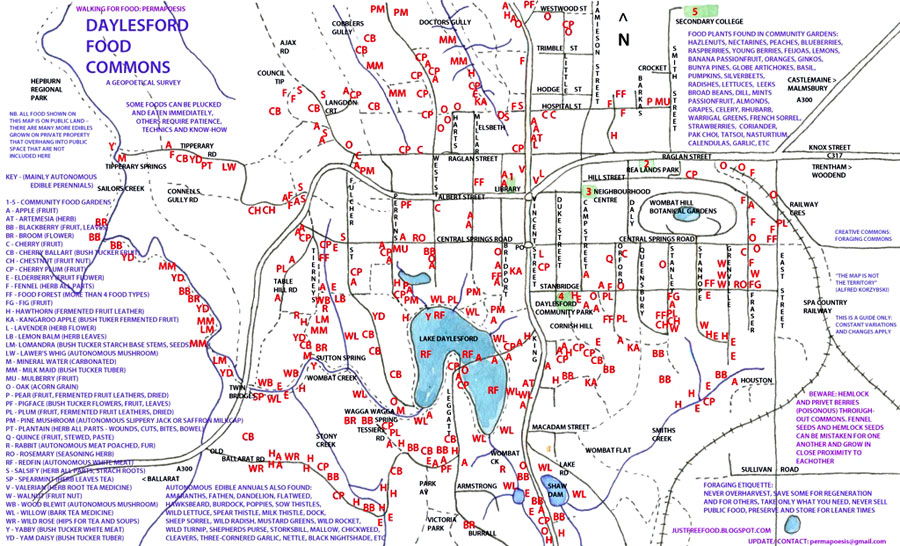
Daylesford Food Commons Map

Daylesford Food Commons Map

Posted in UNIVERSAL ARCHIVE | Tagged

Three Chinese Silences

Chinese Silence No. 22
after Billy Collins, ‘Monday’

The Italians are making their pasta,
the French are making things French,
and the Chinese cultivate their silence.

They cultivate silence
in every Chinatown on the persimmon of earth–
mute below the towers of Toronto,
silently sweeping the streets of Singapore
clear of noisy self-expression.

The Americans are in their sport utility vehicles,
the Canadians are behaving reasonably,
but the Chinese remain silent
maybe with a cup of tea or an opium pipe
and maybe a finger puzzle or water torture is involved.

Or maybe the Chinese are playing the Chinese
game of ping-pong,
the pock-pock of the ball against their tight-lipped mouths
as their chefs dice scallions and bean curd.
The Chinese are silent
because it is their job for which
I pay them what they got for building the railroads.

Which silence it is hardly seems to matter
though many have a favorite
out of the 100 different kinds–
the Silence of the Well-Adjusted Minority,
the Girlish Silence of Reluctant Acquiescence,
the Silence that by No Means Should Be Mistaken for Bitterness.

By now, it should go without saying
that what Crocodile Dundee is to the Australian
and Mel Gibson is to the Scot,
so is silence to the Chinese.

Just think–
before I invented the 100 Chinese silences,
the Chinese would have had to stay indoors
and gabble about civil war and revolution
or go outside and build a really loud wall.

And when I say a wall,
I do not mean a wall of thousands of miles
that is visible from the moon.

I mean a noisy wall of language
that dwarfs my medieval battlements
and paves the Pacific to lap
California’s shores with its brick-hard words.

Chinese Silence No. 24
after David Sedaris, ‘Chicken Toenails, Anyone?’

We are all just animals
a pinch of human feces
scrambled eggs duck tongues
tentacle-like roots

What do you say
we go oriental?
And the egg rolls …
can you imagine?

They allowed you to brown bag
wads of phlegm
in the men’s room of a Beijing subway station
I looked at her thinking, You whore

I have to go to China
I’ve never looked forward to it
like twice-baked potatoes
or veal parmesan

It’s more real
I could dislike it
more authentically
than the sound of one person

then another
dredging up seeming
from the depths of my soul
using the other as a blowhole

In China something kept holding me back
the leg, the breast, etc.
hacked as if by a blind person
made entirely of organs

Yes, I must
shit in the produce aisle of a Chengdu Walmart
Yes, I must
disintegrate in the western-style toilet

Chinese Silence No. 46
after David Gilbey, ‘Intercultural Communication’

At the end of this poem my readers, true blue Aussies,
will buy me a beer at a dingy suburban pub.
Ply me with pies, burgers, and schnitzel
and charge it to the Chinese guy in the corner.

To return the favor, I will recite
my newly composed poem on Chinese silence
with its girls hiding their giggling mouths with their hands.
They call me mister. But I will change one of their vowels,
using the privilege of the international writer,
and make myself their master.

Everyone’s silent after my orientally delivered words.
What did I say? I’ll ask, my voice quiet as a girl’s.
But the joke’s on me. My listeners’ Chinese faces
say, now let’s hear you say that in a country of women.

Posted in UNIVERSAL ARCHIVE | Tagged

Dromes 1 & 2


Posted in UNIVERSAL ARCHIVE | Tagged ,

Arrangement of Manteia y marionette

In this performance excerpt, recorded live at Montsalvat on November 8 2012, Jessica L. Wilkinson teams up with composer Simon Charles and ensemble Manteia to articulate the threads of marionette’s broken narrative while preserving its ever-elusive quality.

Poetry: Jessica L. Wilkinson

Composition and musical direction: Simon Charles

Performers:

Jenny Barnes (voice)
Simon Charles (electronics)
Matthew Horsely (percussion)
Kim Tan (flutes)
Samuel Pankhurst (double bass)
Jessica L. Wilkinson (spoken word)

Manteia y marionette | (36:47)
[audio:http://cordite.org.au/audio/wilkinson_charles3.mp3|titles=Manteia y marionette – Jessica L. Wilkinson and Simon Charles]
Jessica L. Wilkinson and Simon Charles

Posted in UNIVERSAL ARCHIVE | Tagged ,

Shimmy

Short on shimmy
they took to the disco
with a resounding

whomp of white
& solid silver
waves of wire;

a platform
to berate from,
a wag the dog diorama;

wearing only your shadow
& shouting
to the stomping throng

a backroom
storm shelter, a platform
euphoria, plagued your

halfway to decent
anti-progressive, rational
yet strident monologue

pitched at doomsayers
of the glitterati, low-lobbers
& pinch-hitters

who’d forgotten
how their IDs were burned
back in the days before credit

slalomed through car
dealerships & foaming
restaurants

leaving only ‘the market’
to determine aesthetics
& solicit

dinner dates
where an oasis
was a hedge fund

leaking liquid security
where trade isn’t free
& big bubbles can fry

a factory superstar:
crystal ball shimmering
in the trash, Chelsea Girls

worn & scratchy prints
ditched as war begins –
black monday, 1987

flickers left of field
& radiators are left
glowing through summer

as they loose a lemma
on the the green valley
of silliness

or call the bananas
out of the republic: the proposal
we just had to have

& grew to love
as much as anything
that might save us from ourselves

or shakedown trance
at one hundred & fifty beats
per minute –

fast enough
to blast extreme sports
off the mountains

& rattle
sheer glass walls
of a tycoon’s penthouse

yet not powerful enough
to change the way
we live

in Cold War bunkers
abandoned only because
they’ll hold out none of the blast

while they wait for recuperation
as delirious museums,
squatting

where tektites
rain down through
glorious night’s sunshine

& marsupials skitter
& forage
like strewnfield wastrels

counting on fine bones
dazzling paleontologists
& amusement park operators

whose scandium-lit roundabouts
take science
for a ride

which is tantamount
to messing under
the hood

when you don’t know anything
about it, not engineering,
not nuthin

to shimmy by
when the moon is lustrous,
a beacon through space junk

sensitizing bruise & swoon
where we flounder
in waves of static

swooning & schmoozing,
collating best hits lists,
stuck on K-Tel’s Ripper ’76

that nobody remembers,
it’s the latest constraint –
the no-nostalgia radio list

we fret over, squabbling
over the slice, the ear-horns
and his master’s voice

booming from the box
locking & popping & flipping –
impossible to mix

the schmooze, the swoon,
those ear-horns & hits,
platform shoe extravaganzas –

I’ve got all my life to live,
I’ve got all my love to give
& I’ll survive, I will survive, I will survive

Posted in UNIVERSAL ARCHIVE | Tagged ,

Blue or White

cento for Kate Fagan

the world was a little darker
before it was blue
brilliant as nowhere special to go
you could try double blinds
machines parody all future empires
say goodbye to the supermarket.
unbearable authority makes me dizzy
shocked by faultless mathematics
technicolour pesticides and diesel slops,
i turn away ekphrastic
into a new present
of geometry and truth, neo-conservative
precision, anachronisms make truth
a panacea for ego, and the gesture
troubles me, still asking
opposite questions –
talk less, mark slow time,
draw inconclusive ends, hope resting
with invention

Posted in UNIVERSAL ARCHIVE | Tagged ,

(untitled)

in two hundred and fifty thousand years
my sludge of waste might lose its poison
but nothing’s set in stone
except the joy and anguish of being here
with one week to practice what we believe
but can we sleep it off or at least die trying?
my sincere apology to mother earth
as glaciers melt around us
and wild winds rattle the lattice
and thunder claps the hell out of the world
and sheet lightning spears and spins the sky
now, with a mathematician’s belief I throw things around
and make this defunct world my theme song
though I know the theory of connection
between music and maths is a myth
I’ll continue singing against all odds,
I’ll cheat that physics and I’ll cheat nature
and keep a layer of lyrics between the world and myself
and convince my friends to come for dinner
despite the weather man’s threats to throw his things around –
to chuck the astrolabe, the vane, the compass, the spirit level,
out the window where he wants to lean to finger the breeze
or lick the air without having to answer to anybody
he said, keep me alive folks, please do,
it’s not my fault I simply make the forecasts
yet it is your own sin to believe them

Posted in UNIVERSAL ARCHIVE | Tagged ,

A disjoint, truncated tale of a war between war and peace, comprising diverse developments of sexual perversion and environmental military hardware, which culminates or concludes, rather more calumniatory than acclamatory, in a veritable orgy of elite tourism, boutique comestibles, property investment portfolios, and marketing sallies, all those grandiloquent techniques directed towards the incitation, inculcation, inflection and enhancement of primordial polymorphous psychophysical pleasures

No end if fits tail a swarm. Ra stops
to house heat, lines rap across IP loco,
torpedo, teargas. A ‘Parc de Nord’ spilled Om.
Reeled inset ibis eats — flee it nude!
Lite-sabre laser spots play about. Teats ahoy!
A piled table greens, and — oh! —
gnu gods appall, li-knack car crawl lams.
Gulfless time rats race to tase me.
If only diet is, eh, trap not esteemed is?
A sad ab sags unabed. Deer sleep tidal at rams.
Dora was onus, rime-top, otiose in tuna trauma.
I wondered ampered as a crone, dross imperial on my hand.
Spank car wrote of traps. I spark eros, ere sore star desire time.
Mo hetup error, retool, live! Ewe be wrong, obstinate egg of fire!
Ebb empire hand, ill ire ‘pon God.
Dab at pan, I saw one ill apsis stop.
Back, cape rot! Toll old Amos, spin.
Nips so mad. LOL. Lot tore pack cab.
Pots, Sis, pal lie. No was I. Nap.
Ta Bad Dog. No Peril Lid, na, he rip me.
Nab beer if fog. Gee. Tan its Bognor!
We be weevil. Loot, err, or repute home.
Mite rise drats eros, ere sore kraps is part.
Foe tor wrack naps. DNA hymn. O lair EP,
Miss Orden Orca, Sade Rep. Made red,
Now I am. U art a nut, Nie Soi, to pot emir sun.
O, saw a rod, smart a lad! It peels reed.
Deb anus gas bad as a side meet set on par.
The site, idyl? No! Fie mesa, tote car!
Star emits self. Lug. Small war crack can kill
Lapp, as do gung-ho DNA. Sneer.
Gelb at deli pay, oh Asta! Et tu, O bay?
Alp stop, resaler base tiled. Untie elf’s teas.
I bite, snide leer. Model lips droned
crap as a great ode. Protocol: piss, or cap arse.
Nil tea. He, sou-hot, spots arm,
raw Sali at stiff id neon.

Posted in UNIVERSAL ARCHIVE | Tagged

Catullus 85

translated by Charles Bernstein

Odi et amo. quare id faciam, fortasse requiris.
nescio, sed fieri sentio et excrucior.


Hate and love. Why’s that?, you’d ask
Don’t know, I feel it and it’s torture.


Richard Tuttle started off with:

All I do is hate and love. Why, you might ask?
I don’t know, but it is the cause of torture.


For reference I checked:

Louis Zukofsky:
O th’hate I move love. Quarry it fact I am, for that’s so re queries.
Nescience, say th’ fierry scent I owe whets crookeder.

Peter Green:
I hate and love. You wonder, perhaps, why I’d do that?
I have no idea. I just feel it. I am crucified.


There were many drafts:

Love and hate. Query: why’d I do that?
Don’t know, just sense it & it’s excruciating.

Odious & amorous. Hey: why’d I do that?
Beats me, just feelings & I’ve been crucified.

Hating & loving. Why do I do that?
Beats me, just feelings & excruciating

Odious & amorous. Hey: why I do that?
Beats me, just feelings & I’ve been crucified?

Hating & loving. Query: why do that?
Beats me, just feelings & I’ve been crucified.

Odious and amorous. Hey: why’d I do that?
Beats me, it’s just my feelings & I’ve been crucified

Odious and amorous. Hey: why’s that?
Beats me, just my feelings & I’m crucified

Odious and amorous. Query: why’d I do that?
Don’t know, just sense it & it’s excruciating.

Posted in UNIVERSAL ARCHIVE | Tagged ,

from HOT POCKET

Xe woke up and knew immediately that xe had been asleep.

Xe rotated in a slight squirm, pushing xer head against xer neck with itself and wobbling in xer glider. Each visible unifaced cumulus might seize. Xe curled within sewn-in body fabrics bunching wetly and enveloping greasy beads in their folds, and pressing through the shell fibers moisture. Facing dully the cold and blue rushing air, looking past the multiply filtered lenses of xer glasses and letting air flow hotly through the wide nostrils of xer nose, into xer sticking mouth, xe saw lights of pink milk in the limp black sponges behind xer eyelids, wobbled in xer glider, and blinked sleep’s wax. Collapsible within a cheerful soft hood of young textiles, xe used a red lamp as a source of light in the day, a beam opening and fading into slanting cloud bases and registering criteria to the glide. Inside the tubing it vibrates like a familiar pack of little worms, or moths. Xe turned a flurry; she pictured the wooden flames of a set upon hang glider. Woven and loose in dust. Not even three hot air balloons.

Xe glided plain and fine. With harsh intuition xe dipped forward with the full weight of xer torso, pulling the glider frame fluidly towards xer stomach through a short arc and swinging the lower half of xer body in its snug feathery cocoon upward with xer lower back. Xe tightened xer abdomen against the bar and, amidst a dive in which treacles of speed accumulated over #self, listened for the correct pitch of sliced air whistling over the taut corners of glider fabric, the totality of undercarriage—carabiners, flexing plastic, brushed metal tubework, dense foam padding—emitting a sharp groan as air scrolled over and burnt the surface of xer cheeks and earlobes. A satellite flung over the lip of a bank of chemical clouds in the distance and xe shuddered, xer wings an aspic humming; hungry noises withdrew from themselves lengthily in this dip and left the next minute the place in which they had become spooled. Xe saw xer imagined vinyl tool, the inside of a footholder and scraping harness. In the distant microgeese new air packs hung suborbital, smearing glosses of future cloudlife into xer instrumentation.

Xe wears out xer sanding discs quickly into and outside normal activity; it was completing the lower half of the cocoon by threads crossing in all directions under the gathered ruffles attached to those first spun from the rim. Sustaining xer posture, xe angled xer legs towards xer body against the air sliding beneath xer cocoon, and steadied xer torso on the glider frame, neutralising the tension in xer forearms and allowing the angled front tip of the craft to catch itself out violently from a dive. It pitched upwards for a moment then responded to redoubled upward pressure of xer cocooned legs, easing onto a flat plane of temperate air.

Xe relaxed. Xer grip on each guide pole loosened into a soft claw and xe slumped into the glaze of dissolving sleep lying damply in xer musculature, feeling the glider also respond to an ambient still, calmly adrift in the atmospheric pocket. Xe pushed xer flat hands out past the bar and stretched xer arms, interlocking xer fingers against the background of distant braiding strings of clouds and flat blue. Xe tucked xer elbow back onto the bar and let xer forearm hang down into the air, rippling xer long, loose fingers. Xe leaned xer head onto xer shoulder and twisted the inside of xer wrist towards #self, then her face, to check the pale green face of xer watch. It was midday, and xe had not meant to nap. The glider continued to move forward, barely descending in the easy air. Sunsets fell apart. Xe looked at xer infrared: nothing.

Xe caught the vortical edge of a dry thermal and urged forward to catch it—xe began to crest and swoop, gently, tracing parabolic patterns in the finely dusty air. Xe felt properly weightless, as xer body lifted out from the downward bearing ache of the cocoon’s saddle. The sun was high. Clouds were minimal and distant, except for one, which was unusually vertical, and though not at all dense, a very definite white. Its length was impossible to perceive. Xe noticed that the cloud was very faintly disappearing at the bottom. Xe focused on the ghostly tail. Xe was unsettled; xe tried to unfocus xer eyes, slacken xer gaze, and force the cloud into a diffuse mist, the one xe always thought. The effort pulled on xer throat, making it dry, and xe sucked water through the straw of xer sippycup. Xe could sense xer scalp hydrating, the fever across xer chest mottle. Xe tried to imagine that the blood in xer ankles formed a mist, something else.

Xe flew close to a mountain range and skimmed the shale.


Return to Wandering through the Universal Archive: A Chapbook Curated by Fiona Hile

Posted in POETRY | Tagged ,

Th E Ma N Fr Om Sn Ow Ri Ver

Th E Ma N Fr Om Sn Ow Ri Ver | (16:53)
[audio:http://cordite.org.au/audio/farrell_schwartz.mp3|titles=Th E Ma N Fr Om Sn Ow Ri Ver – Michael Farrell and Oscar Schwartz]
Michael Farrell and Oscar Schwartz

Posted in UNIVERSAL ARCHIVE | Tagged ,

Alchemical

Your electric moon breast
My black-trunked, gold-leaf slip
Fall into flux
Dissipate like white plumes
You’re especially wild
With a strange malaise for more

Metallic aches, we moor
Ourselves to a daisy, sit two abreast:
Brush strokes of willed
Grass in the distance, our slippery
Perspex brain plumb
At the centre of—ah!—fucks

Your hand pulls my bones out, a fluke
And the birds arch into morrow
Bright as the stain of blood plums
Chime in the beast
Crossing the freeway’s rose-pink lips
Roadkill wiled

Away the day: IT was another word for wild
Or another word for luxe
Discussing Freudian slips
With our mouths unmoored
Leave the port at Brest
Land’s edge gone dim, plumb

The rimbaldien sugar plum
Face the world
As he did, titless at best—
Ears and lip, flower of a heart, fleck
Of skin, gimme more!—
No cheat, strip

Our messy embrace, spilt
Air we’ll never plumb
The lash of each other, always more
Clouds, bodies, worlds
To clash like waves and fluke
TRANSMUTATION, a Grand work of breasts

Turned back toward Brest we slip
Up, boat set on flux, plumbing
The wild, nothing more

Posted in UNIVERSAL ARCHIVE | Tagged ,

Manic at Night

The refrigerator’s humming outside
and I like that.
Outside of any use I could make of it.
But I can’t see it now,
cause I’m in a different suburb, but this reminds me
of how I used to like
the ‘Here’s Too-ee’ sign, lit up at night, in steam,
in the headlights. The freezing lines,
weather-forecast needs, indeterminate
flow of large blurred lights becoming objects again.
Trying to fragment the sense
but it doesn’t work, because of
the connections, between words and
each other. You try to attend,
but not attend properly, or try
not to attend – but you do. If this is manic
it’s fairly restrained. It’s probably relaxed
really: a hammock swinging in the
backyard of a sense of
quiet retrieval, of the linguistic connections
that constitute the idea,
or of something automatic
behind it.
You think it: Time, small
parcels of thought in train that
move darkly past unopened, familiar beneath
their disguises, the disguises that saying ‘No’ lends
each of them – and are
incognito, as in Who wants to know?
Wait, your hand reaches for
a beer, but the fridge is stuck.
And relaxes across your chest, your glass empty.
You go to sleep fully
apprised emotionally, and calm.
Falling out of the air
with both arms,
but in charge somehow and not desperate, as though
your worst fears
had telegraphed the vicissitudes you deal with.
Then outside again and clutching the rail
which is very nicely cool
and makes the hand relax actually.

*

The air-conditioning like distant aircraft
or the way trucks hum at night in sleep.
Most things at night make the mind relax,
(against the grain, again), like lightning
illuminates the real world but discharges
ions that soothe anyway.
Inside, the telly rages greyly
as a channel switches off. You go inside
and change it, and come outside again, the new
image bouncing, reflected, in the glass behind.
And time for this thought:
each image occupies its own
parentheses, without surprise, appearing
one at a time, although it’s a dream
from the details of an ordinary day,
carrier waves to an idea or impulse
that can only be named …
where you know the name of something
best by just not thinking about it
– by ignoring them, in their immediacy,
their fascination – epiphenomena
to an aspiration – as you reflect upon
an ‘ideal’ of self-quotation,
remembering how you had looked up
to the sun above the top floors of buildings,
where the light hits,
as, below, the silent swimmers
appear, one by one, in the streets,
in the calm erasure of their paths through space,
without reflection and unknown to you,
all the days that beat like waves, black and white,
where a white froth of minutes is ineluctable
and inevitable and you too far to care.
Though caring is the least part. Let’s say, you
simply leave it, as someone shouts
up from a lift shaft, and lights appear,
rising from the airport, across the city.
A face looks down. Your face? Your own,
or the image in your mind’s eye that expresses
your attitude? Over and over, like a pop song you hate
but cannot ignore, these words: these truths
harm you to attend and are final – you stand ‘outside’
to think them, but you are outside
really, now,
and a few other occasions like these.

Posted in UNIVERSAL ARCHIVE | Tagged ,

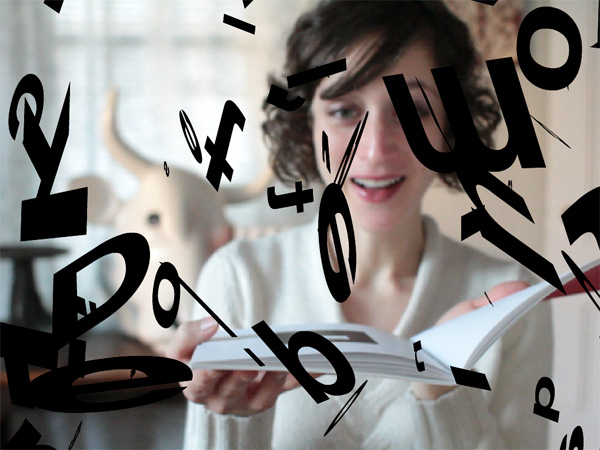
Between Page and Screen (Cordite remix)

Between Page and Screen (Cordite remix)

Click on the image above to launch this augmented reality poem, created specially
for Cordite Poetry Review, that grows out of Between Page and Screen, or else try
opening it in a new window.

NOTE: To view the poem, you will need a webcam and a printed marker
(download this here)
to commence the poem.

Posted in UNIVERSAL ARCHIVE | Tagged ,

Two Poems by Patrick Jones

Winter’s pharmacopeia

t
He fruits and weedful plants that swell
through frost and sl
Eet and occasional snow
who lovingly b
Are themselves to us
at 
Local when we require them most
when i
T is cold and we fall sick
t
Hey offer free preventatives
rosehips and 
Chickweed
w
Atercress and feijoa
cit
Rus and stickyweed
garlic from c
Ellar
berries 
From hawthorns
p
Reserved as fruit leather
hon
Ey bottled
from th
E flowers of summer


Posted in UNIVERSAL ARCHIVE | Tagged

Three Poems by Marty Hiatt and Sam Langer

home tunnel game approaching all get-out

fried afternoon fright great wing of gulls
as a clump of eyes
in the mail
sadness of cubes
rejected their networking lens,
nevertheless their reflex worlds
that meet & part amber
in the sky & one grey of waves
hailing & hatting st kilda,
remembered people,
an article about creamed face
head included
followed by reactionary tears
where eaters live

lay down 46 times in a world gone mad
to no avail, the lack of cost
evidence of how stupid

one had been, kissing
& kissing in the moonlight as ELWOOD
rose from sea at end
squint into lighthouse
then drive to park where gods
are their hatred of us, & us ourselves
treading down the light grass
& asseverating turgid inanities
we who wrote for nothing but
those planted kidneys & rich,
spastic babies, their lines of flight
a bible for airports
inflating a canopy to catch the souls of tars

hush! echo speaks!

it is a long fermata
smarting under the patina the
same nothing can feel
up a question about method:

you wrote at key points,
basically generated in bits
of other heads
struggling to work off
the planet of our letters

rafting now, between rats
w/ tiny hammers being
mind in the fountains.
the leaves sing: i’m glad
we’re beggars squirting cologne,
drawing this volatile burden,
glueing models. we never close.

there are a number of updates
from around the world.
in the mountains rainbow crows
tear up a book by doctor
justice. a paean to ato notes
weeping agents lacking
evidence. ask about our new
distant fantasies, suck the
energy of ghosts, important
hero found in moist syntax.
trade like its the 90s! i
work w/ data/children,
unexamined tasks. lift imp
ortant: hard clear sad cubes
turned up. betimes fire part
icles at trunk, cop missile.
look the window i’m vomiting

nevertheless the duplex world
rose from the emulsion sea
to reject clump of eyes and mail
in a looped story of net work forgiveness.

the business partner’s
random numb legs
encapsulate destruction
embrace death
he uses this kind of locution:
—i am a useless artist—

dropped digger’s rest implant shipment cargo cult

clam hands not for victory of public
sin taste rank wounds w/o dreams
instead i ask your bed: did
you get the anxiety? V exciting
like vice and coma in time
for crisis. tell the story of this truck
gliding into gleaming moistness.
then sad part in her curls sees crime’s
chipped tooth gnawing concrete
bust. my sterile catkin lay
down 46 times, blown
off by the world of insurance
broker coveting soiled report
of widely distributed friend.
it is not a friendship of grey
st kilda gulls, because deadlocked.
i mean to the atrophy cabinet.
behemoth films often considered
important suck wounded cones
of the dead. hollow boredom
applauded, then discarded.

this is only a surmise.
lying alone, godless, a whopping
tube of spirit slime branded
by the unmanifest after storm, more
nothing. graph suggest i’m building
bomb. but i’ve no way to verify this.
how long can we let
the “mummies” fuck us
up? spin wheels in
pure and formless
mud for levitation.

Posted in UNIVERSAL ARCHIVE | Tagged ,

Tim Wright Reviews Keri Glastonbury

grit salute

grit salute by Keri Glastonbury
Soi3, 2012

Keri Glastonbury’s first full-length collection, grit salute, gathers together work written since her 1999 Five Islands Press chapbook Hygienic Lily. Glastonbury’s published poems date from the late 1980s, and as such – and, it has to be said, because of publisher delays – this volume has been much anticipated by admirers of her poetry. Glastonbury is known in the Sydney and Newcastle scenes as a teacher of poetry and cultural studies, and as a champion and enthusiast of new critical and creative writing, particularly by younger writers; one example of the latter being her revival, with others, of the important 1980s Sydney imprint, Local Consumption Publications. Continue reading

Posted in BOOK REVIEWS | Tagged ,

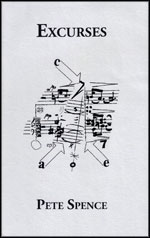
Review Short: Pete Spence’s Excurses

Excurses by Pete Spence
Picaro, 2012

Pete Spence’s chapbook, Excurses, follows closely on the heels of his excellent book-length collection Perrier Fever (Grand Parade Poets, 2011). Long known as an exponent of visual poetry and mail art, Spence’s more ‘conventional’ poetry has, somewhat surprisingly given his long publishing history going back to the 1970s, slipped under the radar to some degree. One hopes these recent books will go some way to rectifying this oversight, for Spence’s work strikes a particularly distinctive note among contemporary Australian poetry.

Continue reading

Posted in BOOK REVIEWS | Tagged ,

Andrew Carruthers Reviews Jessica Wilkinson

marionette

marionette: a biography of miss marion davies by Jessica Wilkinson
Vagabond, 2012

Historical Actuality and the Realpoetik

          'The page is not neutral. Not blank,
          and not neutral. It is a territory.'

                    Rachel Blau DuPlessis on Susan Howe (2006)

          'The page remains―but can the page restore
          The vanished bowers which Fancy taught to bloom?'

                    Mary Tighe, Psyche, or the Legend of Love (1805)

Free Music. Hung Voice

In an intriguing vispo ‘Free Music,’ published here in Cordite in 2011, Jessica L. Wilkinson hangs a score. Hung, literally: for what is it about the musical score that gets hung up on text? What was the final sentence? No: hang the score, hang it, Wilkinson writes! Wilkinson’s visible labor is at work in the lower half of the piece, where letters are strung along lines: alphabetic versus diastemmatic (or neumic) notation. Continue reading

Posted in BOOK REVIEWS | Tagged , , ,

Toby Fitch Reviews Mathew Abbott

Mathew Abbott

wild inaudible by Mathew Abbott
Australian Poetry Ltd, 2012

The organisational body Australian Poetry Ltd, formerly the Australian Poetry Centre, has reintroduced its ‘New Poets Series’ as a ‘new voices series’ via first books of poetry by Mathew Abbott and Eileen Chong., Both books are around 30-40 pages, and repeat the same production errors of the 2010 and 2009 series. This review focuses on the poetry of Mathew Abbott’s wild inaudible.

Continue reading

Posted in BOOK REVIEWS | Tagged ,

INDONESIA Editorial

Cordite 40.1: INDONESIA

When I approached major Indonesian poet Sapardi Djoko Damono – godfather of that sprawling nation’s contemporary poetics and a renowned translator of English-language works into Bahasa Indonesia – about working with me on a kind of ‘translation exchange’ to then publish online and promote in our countries, he e-replied enthusiastically that ‘we must’!

But it was with a slight twinge – the kind of cogent relish fork that skewers your mood (just enough, but none too deep) when you learn your most recent great idea is not as original as its first eureka promised you – that I read further into Damono’s email to learn that he’d done exactly this back in 1991 (sans the online angle). Mendorong Jack Kuntikunti: Sepilihan Sajak Dari Australia collects one to two poems from 41 Australian poets; together, the works form an anthology with Indonesian translations published side-by-side with the English originals. Co-editor for the project was Canberra-based poet R F Brissenden. Damono sent me a well-loved copy of the book immediately (I imagine it’s well out of print).

None of the book’s frontmatter, cover blurbs, editors’ statements or the introduction, written by David Brooks, has an English translation/original included … so I am not sure what angle or MO Damono and Brissenden took or exactly why they chose the poets they did.

Just who was included in that group of 41? Here they are in the order they appear in the book:

Henry Lawson, Kenneth Slessor, A D Hope, Douglas Stewart, John Blight, John Manifold, Judith Wright, David Campbell, James McAuley, Rosemary Dobson, Oodgeroo Noonuccal, Dimitris Tsaloumas, Gwen Harwood, Francis Webb, Bruce Beaver, R F Brissenden, Peter Porter, Bruce Dawe, Chris Wallace-Crabbe, Vivian Smith, Fay Zwicky, Thomas Shapcott, Judith Rodriguez, Les Murray, Geoffrey Lehmann, Geoff Page, Andrew Taylor, Kate Llewellyn, Ray Desmond Jones, Roger McDonald, Jennifer Rankin, John Tranter, Robert Adamson, Robert Gray, Eric Bogle, Billy Marshall-Stoneking, Rhyll McMaster, Michael Dransfield, Nicolette Stasko, David Brooks and Judith Beveridge.

Quite the line-up and, generally, they are safe choices (including at least two couples and a few well-established odd-couples). It would have been 1989–1990, roughly, when this collection was being developed.

In my preliminary discussions with Damono, he proffered that he’d distinctly be interested in translating established ‘younger’ poets, possibly each with only a full-length book or three out, whose writing careers were clearly very much on the uptick and who would be writing poetry for decades to come. And he’d donate his time in so doing. It occurred to me then, triggered by his generosity, that Mendorong Jack Kuntikunti was only one-way: English words from Australian poets translated into Indonesian and no reciprocity. That aforementioned twinge stopped immediately and my excitement grew.

The number of poets from each country for this special issue was initially set at 20. I put together a list of 25 writers (knowing there would be decliners or non-repliers) whose work features strong lyricism to best serve the translation process and not unduly tax the gentlemen’s agreement this project had been up to that point: Damano the translator, we the editors, Cordite the publisher. We wanted a mix of gender, geographic region and style from each country. Indeed, I got exactly 20 enthusiastic replies.

Unfortunately, a fair few of the Australian poets I approached – writers who initially agreed to be a part of the translation exchange – were unable or perhaps, in the end, unwilling to meet our deadline for the translations to commence. Yes, I did ask for new work. Yes, all poems were graciously donated by the authors. That we were down to 11 poets instead of 20 was fine. The result is that the diversity of Australian poets I had intended to include fell a bit short, but the quality that remained did not. The spirit of the project was very much intact.

By the contribution deadline, I had invited John McGlynn, director of The Lontar Foundation in Jakarta – and at his recommendation, academic and translator Deborah Cole and bilingual Indonesian poet and translator Dorothea Rosa Herliany – to join the project to help ensure its full realisation in translation and cementing the details Damono and I first agreed on. They have done amazing work to help make this special issue happen. I would be keenly interested in a volume II of this type of exchange with Indonesian poets, focusing more on experimental works (which would require a far larger translation crew and a larger budget, read: any amount > 0$).

So why Indonesia? How did I come to get in touch with Sapardi Djoko Damono in the first place, let alone McGlynn, Cole and Herliany?

During the time I was learning the rigging of ropes and jibs that intertwine and billow to form Cordite Poetry Review from David Prater, grand Oz behind the curtain of this website for so many years, I was concurrently in the thick of editing a collection of memoir essays from overseas-born writers now living in and writing from Australia. (Not to mention keeping a pragmatic day job as well. And being a new father. And being a husband. And commuting on Yarra Trams.) Researching for this nonfiction anthology is how I came to commission an essay from Lily Yulianti Farid, a superb short-story writer now living in Brunswick, Victoria. As it turned out, she is also director of the Makassar International Writers Festival on the north-central Indonesian island of Celebes. Farid had invited Damono out to the festival in 2011 and soon extended an invitation to me in 2012. There, I met McGlynn and the author and actor Luna Vidya, whose photos I used for this issue.

Farid, as it also turned out, knew some handy contacts at the US Embassy in Jakarta, a possible funding source for me (as I am both a US citizen and an irreversible permanent Australian resident). It was. They did. And so I travelled to Indonesia as a guest of the American Embassy (after much scrutiny of my career). The indefatigable Esti Durahsanti, a public-relations officer at the embassy, met me in Makassar and doubled as my translator and minder at some events outside the festival at Hasanuddin University. It turned out Durahsanti’s father is a very close friend of none other than Sapardi Djoko Damono, whom we talked about at great length – which indirectly sparked the redoubling of my effort to make this special issue happen.

So it’s been a circuitous calligraphy of good fortune, ‘turned outs’ and prescient timing that sees this special issue happening at all. But that, too, is how it occasionally bends. I hope you enjoy the poems.

Posted in ESSAYS | Tagged , , , , , , ,

Editorial Introduction: Crossing Bloodlines

Baca pengantar dalam Bahasa Indonesia

The poems in this collection trace the overlapping cycles of the human journey from birth to death across the space/time habitat we measure in footfalls and poetic metre. Travelled in the company of family and community, our journeys enact the species’ heritage and legacy of kinship and violence – two sides of the same struggle towards a longed-for intimacy that might negate the spatial, temporal and psychological divide between the other and the self. Through commingling languages and intertwining elocutions, this issue explores the distances and intimacies between a varied set of human journeys by poets writing in Indonesia and Australia. As these two countries are so close on maps – but oftentimes, sadly, only on our maps – these poems invite the re-arrangement of our conceptual geographies.

Indonesia photo salon by Luna Vidya

[EasyGallery id=’lunavidya’]
*Click on the image above to view this gallery.

This collection began as a conversation between Kent MacCarter and Sapardi Djoko Damono (arguably Indonesia’s best-known contemporary poet and leading literary scholar). The goal was to create a translation exchange that would showcase established poets whose work was still very much on the rise with a balanced representation of gender, ethnicity and region in each country. A second conversation between MacCarter and John McGlynn (leading translator of Indonesian literature into English and editor-in-chief of The Lontar Foundation) led to an invitation to McGlynn, poet Dorothea Rosa Herliany and me (Deborah Cole) to join the project – an invitation that we accepted enthusiastically.

For the past several years, McGlynn, Herliany and I have been putting together the forthcoming Lontar Anthology of Indonesian Poetry. We’ve discovered no shortage of Indonesian poets writing in the past century, somewhere in the neighbourhood of 1,800 people, with poems addressing topics as diverse as the writers themselves and as varied as the issues confronting their fast-developing nation. Choosing only eleven to include here was a difficult task, mitigated slightly by the conscious preference for mid-career poets active today.

This special issue of Cordite Poetry Review enables a preliminary realisation of the anthology’s goals, even before its appearance in print – to cross the language barrier between poets writing in Indonesian and English and to increase the diversity of each group’s literary meme pool. We offer our heartfelt thanks to MacCarter for his vision (it was his idea that this introduction be bilingual) and for inviting our collaboration.

One of the most striking characteristics of this collection – at least what stood out to me when at last I read all the selected poems together – is the abundance of blood that appears in these texts. They brought to mind a favorite passage in Tom Stoppard’s absurdist play, Rosenkratnz and Guildenstern are Dead, that features two of the minor characters from Shakespeare’s Hamlet. The title characters meet up with a band of tragedians, who offer to give them a performance.

PLAYER:  ... we can do you blood and love without the rhetoric, and we can do you
blood and rhetoric without the love, and we can do you all three concurrent or
consecutive, but we can’t give you love and rhetoric without the blood. Blood is
compulsory. They’re all blood, you see.

GUILDENSTERN: Is that what people want?

PLAYER:  It’s what we do.1

In the variety of loves contemplated and the assortment of rhetorics engaged here, blood does indeed appear to be compulsory. Violence is ubiquitous and rears its head even in the most serene moments and the most banal contexts. Alongside the appearances of out–and–out slaughter and face-to-face ravagings, these poets contemplate the violence of work in the modern world, the brutal ‘worlding’ of our childhood minds, and the assault on our sense of self and community in the ubiquity of our non-creative labor and consumer-driven media. All of which makes us ‘long for change, some quick suddenness in the veins’ that would enable us to slip one into the other, ‘to devour the membranes’ between us, or to cut them apart with a knife in search of satisfaction or pain.

At times, these poems emphasise the universal genetic connection of the whole of our species and our common experiences of growth and aging. On other occasions they highlight the undeniable distinctiveness of the birthrights and identities bestowed by our cultures, which set the boundaries between categories of people: men/women, royalty/commoner, ethnicitiy/nationality. Often they address the challenge of crossing over, of mixing blood with blood, of successfully exchanging genes and memes given the lines we’ve inherited and help to maintain.

There are a few moments of apparent ‘love and rhetoric without the blood’: A poem about a mother, her daughter and a horse, one about a newlywed, and one about a lover’s body in the sunlight. But even these are about blood, accenting our sexual desires and our inherited kinship with horses and mosses. As a collection, any imaginative purity is fleeting, and all love and rhetoric belong to a narrative wherein even the fantasy of mythology offers no escape from the tedium of modern life, our estrangement from each other, or our penchant to do others physical and psychological harm.

Blood is what we do. We’re a bloody violent species, even at our most intimate. These 22 poems remind us that blood is the red thread connecting us all. And they do so while arguing that rhetoric and love can mitigate how compelling blood will be. ‘Hearts can change’, and these poems bear witness to a human consciousness that recoils against the destruction of the body, against the violence that takes our best of friends, our dearest of lovers, and our littlest of siblings (‘Mei’, the title of Pinurbo’s poem about the violence in Jakarta in May 1998, means ‘May’ in Indonesian and ‘little sister’ in Chinese). The collection affirms that the human body remains our indispensible muse and that whatever violence we do, the wonder of the other’s body will engender the urge to cross bloodlines with poetry.

Posted in ESSAYS | Tagged , , , ,