Agua de Viuda

I forgive you
for teasing me I smell good—
fragrant like a viuda.
But I have not buried my husband,
nor do I want to.

The only viuda I knew was my grandmother,
who spent her days playing cards
with the neighbors, and died
two years later of heart failure
on grandfather’s birth anniversary.
A sweet ending, some might say.
But not for me.

This scent you detect, is it
the musk of a woman wasted
on aloneness? Or the sandalwood
of a chest of secrets opened?
Or is it the essence of almonds trailing
after a promise unfulfilled?
Perhaps it is the burst
of jasmine on a night
spent dwelling on a mistake;
the spray of freesias on a day
drained wishing for something back;
the nip and sting of orange peels
while pondering revenge.

I would have you know
the old meaning of “widow”
in Sanskrit is “vidhwa,” solitary,
and elsewhere “separated”
eating only boiled rice
but not bereft,
and no bereavement,
treading on grief like the wife of Bath
wearing red silk stockings
on a pilgrimage.
In this manner it could be true
I am a widow
seeking to be shriven of my foolishness
yet holding fast to the hope of another
chance, a life flaming anew
with the fragrance of sanggumay,
those wild orchids that bloom
only when all its leaves have fallen.


This poem first appeared in Dagmay Literary Folio, Sun.Star Davao. June 26, 2016

Posted in 85: PHILIPPINES | Tagged

The Day of the Three Thousand Flowers

And though it is a twelfth of a teaspoon,

the sum of all honey she gathers

in her lifetime of a few weeks—

collecting pollen or nectar 
from her solitary votaries, 
legion of immobile virgins

yielding to her tongue, relinquishing 
the bloom of their desires

to her who has wings

(among the vulgar flowers, not a one 
could touch each other or themselves!)
—
it is abundant. She soars over

the scent of longing, buzzing to a rhythm 
she set for herself, choreographer

of round or waggle dance.

For her sisters, she charts the path

with the sextant of her thorax,

telling others of the fervid spring.

Posted in 85: PHILIPPINES | Tagged

My Mother in America Emails Instructions to the Artist for a Portrait of Her Mother, Now 85 and with Alzheimers

What I remember,

what I want her to remember
…
 what you can work with

are these:

youth, a lakeside town, routine mornings,

slick footpaths, the open lips

of a lake and muddy banks red

as fish gills, and stones

strangely shaped like …

like turtle heads, and a slow fog

feathering like threadbare scarves

around her hair. This young mother, mine,

has laundry angled on her hip,

has a toddling daughter – me
– 
who’s ahead of her, not very far, but far enough,

like now …

The girl should skip and sway

holding a palo-palo – she promised to be helpful
– 
and a little pail of kittens

for drowning …

For color, don’t hold back

on the green-blue of the lake …

is all I see clearly now really,

but maybe not too clearly now

that I’m old too … If anything,

you can wash it all a blue-grey

since I am only working from fading

clarity … and I understand, your style

is realistic.


Note: a palo-palo is a paddle used for squeezing water out of laundry.

This poem first appeared in Misfit Magazine, 18, 2016

Posted in 85: PHILIPPINES | Tagged

A Record Year for Rainfall

Sometimes we need ambiguity to make things work.
In the early 1700s, an astronomer in Sweden developed
a scale where water boils at a degree of 0 and freezes
at 100. Eventually this representation will be reversed,
an uncertainty referring both to a finite point

and the interval between temperatures. In 1985,
the BBC would start using degree Celsius in its forecasts.
I almost caught a bird sleeping on top of the wall.
That was around the same time in the 1980s.
I still feel its heart in my hand.

Certain words make us fall silent
because they hearken back to an older conscience,
a raw awe. Like the word fire.
In a recent story, a man converts to the Celsius
and stands in the streets pointing to a confusion

before starting an argument and a conflagration.
No thing off in the distance that cannot
flare into presence, someone said once.
We must somersault into it then,
that presence. Live in it.

Everywhere is water or what smashes
into water. We have to be kind,
buoyant, a house made
of wood. Also, all points
must be rounded off.

Posted in 85: PHILIPPINES | Tagged

An Oral History Project

(A tribute to martial law victims in Samar)

Transitions are tricky to handle.
If only a few days after were merely a habit
in storytelling to render the plot more credible.
So that what came first could be understood
as requisite for another to occur. As such, horrifying
stories are easier to make sense of. As when you’re told
by a midlife woman of her story, who at nine
witnessed her parents’ ordeal from a tight sack
into which she was sealed, an inch of the straw weave
she holed out to see how bodies she had known
her young life could die grotesquely, slowly,
apart from the real life she lived in, while suspended
from a tree she had climbed, more times than she could count,
its canopy the flourish of her childhood, her mother
assured of the growing strength in her legs.
Who could tell how days were to be different?
As that day that began with the usual early sunrise
for the meal that brought them around a table
soon to be the site to their torment. The nearing
raucous of men in search of those who sympathize
with ideas sturdier than their guns filled the house
and hours after, cluttered the implements of home.

By midday, stripped naked of her clothes, her mother
had walked around in a circle of madness, forced
to confess to a treason that in their daily hunger
she barely understood, not an inch of her skin
left unscathed. Her abdomen ripped open
when they could no longer take hold of her flesh.
Her blood streaming into unyielding fields.
Her father fainted after hours of beating, a toe severed
from too much pounding of a rifle butt. In between
the wailing were bodies crossing a threshold.

The sun rose with her still in the air, a fruit too heavy
of its own sap, a knowing she would have exchanged
for anything to go back to those days when the hours
faded without fear. When she didn’t have to say
a few days after to tell the story of her life,
when fleeting forgetfulness could be the only reprieve
of years ahead. But such was to be the plot of her story
as with those others she has soon come to learn,
who had hung from a tree, impaled, or maimed.

Of too much pain, one survives
by taking it in parts. So a few days after is easier
on the tongue as it is on the mind. For how
lives could be told as they unfold, ravaged
before our eyes. They are the kindest words
to stall what could pass off as history,
chronicled now behind this lens to discern
how darkness unhinges, in between the sun
setting and rising, in between breathing,
in the flesh ripping apart, in the minds losing
what it could hold, numbed into
what it could wake up to
a few days after

Posted in 85: PHILIPPINES | Tagged

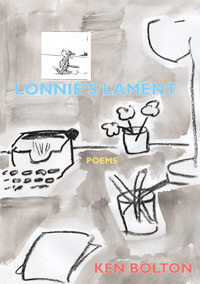
Review Short: Ken Bolton’s Lonnie’s Lament: Towards a History of the Vanishing Present

Lonnie’s Lament: Towards a History of the Vanishing Present by ken Bolton
Wakefield Publishing, 2017


Ken Bolton’s most recent collection expresses an intense sociability, co-mingling personal and communal memory to create poetry that draws on moments of apparent ordinariness, and ever so subtly transforms them into lines of understated enchantment. The poems are typically written for and about people close to and loved by the poet, reflecting a sense of togetherness tinged with an anxiety over the aspects of everyday life that separate as well as connect. Shifting between recognition and anonymity, conscious of finitude and erasure, they comprise a form of metis, or art of working things out that previous generations (indeed, ages) once had, and whose humour mass society seems to have lost.

Lonnie’s Lament opens with a long poem dedicated to the memory of Philip Whalen, referencing the San Francisco Renaissance and Zen Buddhist poet from ’67, crossing the dateline with its concomitant ambiguities regarding time and imagination. The poem creates and negotiates a thicket of names and years, working things out, with preoccupations and divagations cut short, looping back, seemingly in search of, yet evading an ending. As it circles with near repeats and recurrences, the poem creates an awareness regarding history and the ambiguity as to where it starts and who it includes: the folly of trying to pin down what demands to be lived: ‘Dreaming?) / My body turning, in some future’. Throughout the volume Bolton questions the dates he gives, just as he consistently reaffirms the names of his friends, bringing them closer, contrasting their reality and immanence with the unreliability of time. This process of questioning and reaffirming juxtaposes intimate and historical memories with dates and figures open to doubt: ‘A century / of interesting Times. More. Beginning when? / 1871? 1789?’ Revolutions consigned to the uncertainties of the disappeared past leave traces that are discernible in the seemingly unrelated present, through what Whalen’s contemporary, Charles Olson, referred to as a ‘syntax of apposition’. Bolton’s stream of thought continues with: ‘Anna, Lila // Sal // “Omaha” – the tugs – // now that name always makes me think / of the beach landing at Normandy.’ These cryptic yet clearly placed connections present space and time as the elusive elements that comprise the overall tapestry of interlinked lives, the cast of the overall shadow play.

The proverbial interesting times are not immediately apparent in some of the calmer stretches and sensibilities evident. For instance, in the poem ‘Train Tripping’: ‘thinking // of Pam & Jane & Cath & / Pam’s question – as to what Cath // does alone on Bruny & my / explanation: fishing and hiking around, // dinner with Lorraine & Ian / & friends up in town // & Pam and Jane’s life in Blackheath: / what they do’. This mustering comes without melodrama or self-importance: naming is creating, or more to the point reaffirming the existence of who and what one loves. The familiar comes with its attendant angst, and with his need to pull these human strands together, perhaps the poet is telling us that domesticity takes place just so slightly out of one’s comfort zone, or at least the immediately known environment. ‘I play some Dave Holland / move around the house / / doing things, picking up, / tidying, straightening – / / inside, outside – time / like an element around me’. Hints of the proverbial noonday demon are offset by a gentle irony, just outside recognisable surrounds, ‘including the street / where I almost fancy / I can see the restaurant / I ate in for years / where they threw me out once / asleep before / my raznichi’. Bolton adds with a touch of mischief : ‘I was aghast. / How could they?’

Further out, literally overseas, at apparently random meeting points, the sense of estrangement amplifies and demands more solidity in response from places experienced. Given that a cup of coffee can become ‘something different / in Adelaide: / the price of an air ticket. A / view of the blue thru pines’, the narrator of the travel sketches that fill out the middle of the book states: ‘I never go to Asia. / It is not a firm enough idea.’ Direct or disingenuous? Possibly both. Considering the extremes of terrestrial limitation gives rise to some semantic wordplay on furniture and geological fissures along with a gentle mockery of human delusion of control: ‘can large aesthetic / continental shelves co-exist, / in detente? They / can if I say so.’ Make things work or leave them to their own devices: the results are likely to be equally inconsequential. An essential and delightful part of this book is that it converses and jokes and refuses to take itself too seriously: its underlying melancholia is moderated if not by outright mirth then a tone midway between levity and the titular lament. As with Whalen, whose self-effacement and humour Bolton shares, this is poetry which can be found in everyday life, and literally everywhere.

Through these understated operations, Bolton recreates existence in the close company of friends, fellow poets and self-objects. Like Whalen, whose self-portraits ‘from another direction’, find elements of affinity here, Bolton puts forward a series of vignettes, not entirely settled and at times almost intentionally unsure and displaced, yet which indicate an essentially optimistic, nuanced and multi-faceted outlook on this uncertain age. Lonnie’s Lament decries enclosure and conformity, while celebrating the quiet joy of close and loving connections, adding another impressive and humanistic work to its maker’s extensive and generous oeuvre.

Posted in BOOK REVIEWS | Tagged ,

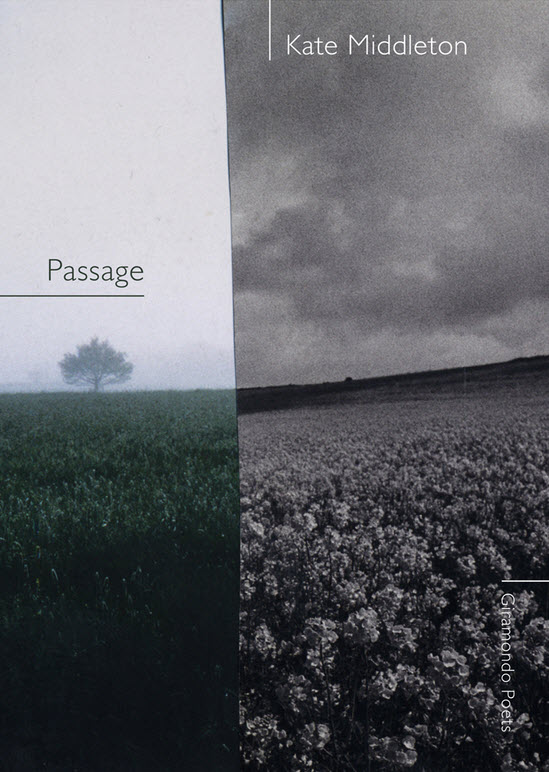
Review Short: Kate Middleton’s Passage

Passage by Kate Middleton
Giramondo Publishing, 2017


In the prefatory poem titled ‘Lyric’, Kate Middleton writes of ‘Voices torn, / pieced, re-sewn’, a phrase that neatly captures the allusive texture and patchwork procedures of her third collection Passage. The volume is replete with centos and erasures, that is to say, modes of vicarious composition that sing ‘by song’s own mesh of I/ of we’. Its keynote is perhaps provided by that innocuous preposition ‘after’ which occurs in the subtitle to so many of the poems (‘Lyric’ is itself ‘after Dan Beachy-Quick’ and begins with a quotation from his 2008 essay collection, A Whaler’s Dictionary). For Middleton is above all a poet of second sight, of the revisionary afterimage; a connoisseur of the residual intimacies that survive in photographs and paintings, the recesses of the body, and the ruins of a landscape.

Like Middleton’s last effort Ephemeral Waters (2013), a book-length paean to the Colorado River, Passage is primarily concerned with questions of travel and proceeds by juxtaposing human scales of movement and growth with animal or ecological ones. In the title poem, bowhead whales from the Pacific and the Atlantic are imagined reuniting in the Northwest Passage, a fabled sea-route through the Canadian Arctic Archipelago now being thawed out by global warming as well as the site of a fatal expedition led by Sir John Franklin in 1845. Middleton establishes an arresting parallelism between the ‘century-old grazes’ sustained by the whales at the hands of nineteenth-century whalers – ’the jade, the slate, the ivory/ sharps/ lodged in blubber’ – and the ‘starvation; hypothermia; lead/ poisoning;/ scurvy; dread consumption’ suffered by the explorers who ate food from lead-soldered cans and possibly each other in their last days. But the poem’s pathos derives less from the record of an historic failure than the lapsing of a legend of human hubris. It seems to ask delicately: what will become of stories like the Franklin expedition (or even the Titanic) once the polar ice caps have melted away?

Voyages have afterlives; as stories of survival, they themselves live on in strange and unexpected places, picking up what Middleton had called in an early poem a ‘mythological second-wind’ (‘What is in this bird?-’ from 2009’s Fire Season). ‘The Queen’s Ocean’ reminds us of the solace that the Journals of Captain James Cook provided Marie Antoinette as she awaited execution:

her imagination roved beyond
the cell, beyond the Conciergerie, tiptoed
slipshod up to the waves

she could not quite picture—at Calais,
at Le Havre, at Brest, at Point-de-Grave—
and finally beyond. (10)

The lines dramatise the appeal of travel writing for the sequestered monarch – an appeal that depends both on the romance of naming and an encounter with the unnameable (like ‘after,’ ‘beyond’ is another preposition that attains nominal force). In such poems, Middleton shows an instinct for the representative moment, the wider world-historical shift writ small, and just as ‘Passage’ deals with global warming without making heavy weather of it, ‘The Queen’s Ocean’ delivers an elegy to the Enlightenment in which the nominalization of the world through imperial voyages of discovery is counterpointed by the de-nominalisation of the ancien regime nobles (‘The Queen’ become ‘the Widow Capet’ become ‘Prisoner 250’).

Names, of course, proliferate throughout a volume in which Middleton summons up a whole host of tutelary spirits whose words she has fused into unforeseen eloquence: from contemporaries such as Luke Carman, Siri Hustvedt, and Eliot Weinberger, to golden oldies such as William Tyndale and Sir John Mandeville, to the lost-and-founds such as Isabelle Eberhardt (an early twentieth-century Swiss explorer and diarist who converted to Islam) and S P B Mais (once dubbed ‘the Modern Columbus’ by the BBC, though probably more accurately thought of as the Robert Macfarlane of the interwar period). Mais is the most conspicuous presence as Middleton ‘gleans’ (as she puts it in the helpful ‘Notes’ section) a series of erasure poems from his 1932 radio broadcasts titled This Unknown Island. Not much of the cosy self-recognition that Mais conjured up for his audience is left after Middleton’s alchemy of omission:

Think of home. The home of your ancestors. Of sun
and a child’s alphabet. A Lilliput of words and meadows.
               Blast it with dynamite. (20)

When placed alongside the centos, certain patterns emerge: Middleton’s telegraphic compressions have a tendency to turn matter-of-fact indicatives or coaxing interrogatives into bracing imperatives; the physical strenuousness of Wanderlust often gets transmuted into the moral strenuousness of spiritual allegory. But these compositions retain the joy of chancing upon something half-invented and half-discovered that seems to have animated Mais’s travelogues in the first place (the England he sets out to find having already been prepared for him by Emily Brontë or Thomas Hardy or Arthurian legend).

On the whole, however, Passage is distinguished less by its continual textual gambits than by its absorbing appreciation for all that is singular. What Middleton has assembled here is nothing short of a cabinet of curiosities: a piece of gravel from Plovdiv, the oldest living land animal, the Chimera of Arezzo, a gynandromorph butterfly, the regenerative heart of a day-old mouse, the verb ‘guddle’. One comes away from this collection charmed and grateful to have been able to read and ‘reread the riotous colour of grace’.

Posted in BOOK REVIEWS | Tagged ,

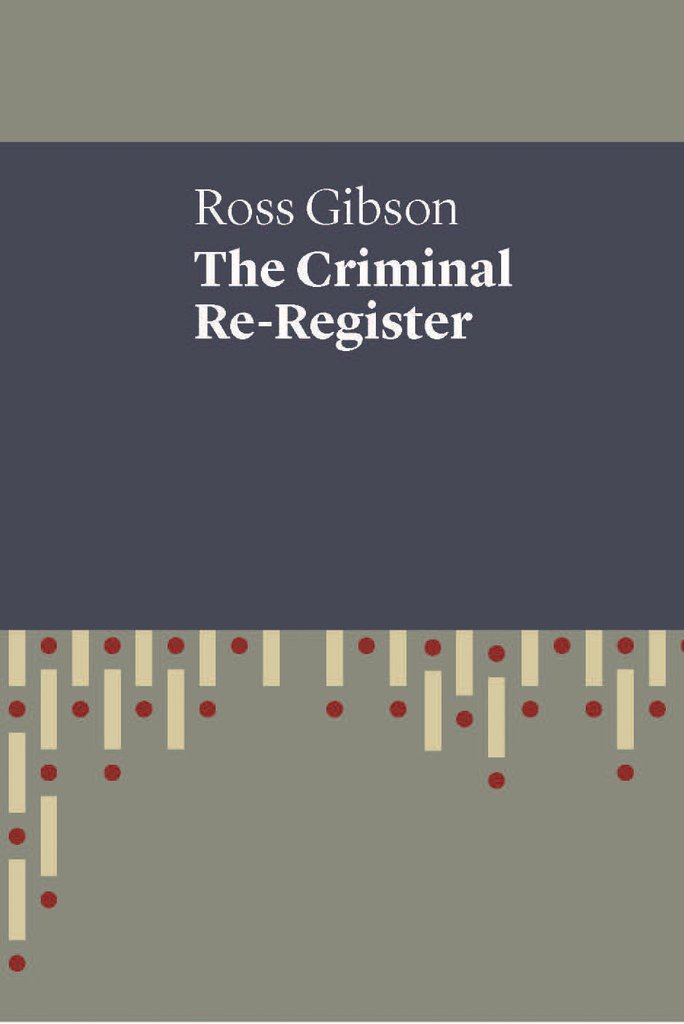
Alan Wearne Reviews Ross Gibson

The Criminal Re-Register by Ross Gibson
UWA Publishing, 2017


Ladies and gentlemen, the story you are about to see is true.
The names have been changed to protect the innocent. – Dragnet


(i)

This is a volume of (mainly) prose poems, derived by its compiler/adaptor/author Ross Gibson, from a large dossier of New South Wales Police records. If these can be described as ‘found’ poems (even if they have been edited) it would be as likely to refer to them as ‘accidental’. Certainly, these portraits and narratives may be challenging and at times infuriating, but when fully firing they are art, very entertaining and most instructive. Centred on criminals and missing persons, the cache Gibson has discovered seems to have been made for poets to find, they being much too important for writers of contemporary Australian prose fiction. One could of course imagine plenty of such material appearing in an historical Selected Documents anthology, in particular the prologue section ‘Notes for Detectives and Men in Plain Clothes.’

Why, though, poetry as the destination? Because so much of The Criminal Re-Register is propelled by language, a strange police dossier lingo from Sydney in 1957. Did the police involved realise they were concocting something fairly akin to poetry? I doubt it. Rather, it’s as if they had been instructed: ‘Whatever you do don’t write poetry …’ and little realising, they did it. Poetry for them may have had been connected with big rhetorical sweeps, and these were the domain of barristers, weren’t they?

(ii)

Allied to the fodder for imagination, certain authors and their traditions came to mind reading the book: Edgar Lee Masters’s Spoon River Anthology of 1915, that wonderful sequence of brief monologues and a verse novel ahead of its time; the biographical portraits and the ‘Newsreel’ and ‘Camera Eye’ sections of John Dos Passos’s USA trilogy; and Pi O’s epics, 24 Hours and Fitzroy the Biography, wherein he forges an incomparable bond between the documentary and the demotic. Though 1957 was too early to see much connection with television cop drama (that medium only arrived in late 1956), the stark style of the reports adapted by Gibson brings to mind the Los Angeles-based series, Dragnet. Quite often the folk Gibson portrays read like they are in some twenty-five minute Sydney-based episode in miniature.

(iii)

Are these found / accidental / documentary poems to be judged by the rules of more conventional verse? When required, maybe; though for The Criminal Re-Register I’ll give an example as to where I stand vis-à-vis found poetry, giving my benchmark for such a genre. In the late 1970s I possessed a newspaper advertisement promoting an exclusive housing development out of Brisbane. This took the form of a letter from a very excited young property developer to his mate in wintry old Melbourne extolling Karana Downs, its country club and golf course. Far smoother than mere ocker it was more ‘young man in the know’ to fellow ‘young man in the know’, saying so much about those times, probably without being aware of it. I loved this piece of Australiana so much that I had to spread the word and would be found reading ‘Karana Downs’ aloud at dinners and parties. Soon folk were clamouring for it, near chanting for a recitation. That most were quite stoned doubtless added to the clamour. Was this ad a ‘found’ poem, was it indeed poetry? Well, it was a damn sight more performable than plenty of performance poetry I’d heard, and much more poetry than plenty of contemporary Australian verse I’d read. It had wit, it had vigour, it used the language imaginatively and it was a hit. Who cared about the ‘White Shoe’ values it expressed when the product and its promoter sounded great? Indeed, one wonders if its hyperbole was concocted by the agency to have some kind of laugh at the client’s expense … surely not!

(iv)

Given the choice between a dull poem and a lively less-than-poem it’s obvious where I’m heading with The Criminal Re-Register. For one of the book’s delights, its major fuel, is that very formal, official cop-speak used in the reports, which hardly goes with the Police Force’s walloper reputation. Thus (and notice the amount of sheer observation and speculation):

Last seen at Central Railway Station carrying a green canvas sack cinched with red twine. Maybe at large in Bathurst or parts further west, or may have suffered a misadventure instigated by any one of the myriad reprobates he has antagonised in recent years.

Or try this:

Offender is of quiet disposition, sober habits, a dapper dresser and keeps no known criminal associates. A neophyte thief, perhaps in thrall to a newly risen mania that cannot be tempered by his will.

And once you are accustomed to such straight-faced seriousness, try imagining:

Fair go mate, just name us some myriad reprobates you’ve antagonized

or

Admit it, sonny, you’re nothing but a neophyte thief […] now tell us of your newly risen mania, we’ll understand.

And then there are those beautiful sentences telling enough with just so much being hinted at: ‘Ten minutes alone in a dim cell primes him ready to talk’; and ‘May have jumped a rattler to Casino’; and ‘Suffers from lumbago and irritable spirits.’ Or look at these from ‘Assorted Malefactor Quirks’ for which police should be on the lookout:

Skiting of unusual prowess: E.G. as a crooner, a songwriter, a fondler and copulatory, a horse or dog trainer, a floral arranger, a dancer, a bushman, a comforter of the sick, a hospital troubadour, a guardian angel to children.

Posted in BOOK REVIEWS | Tagged ,

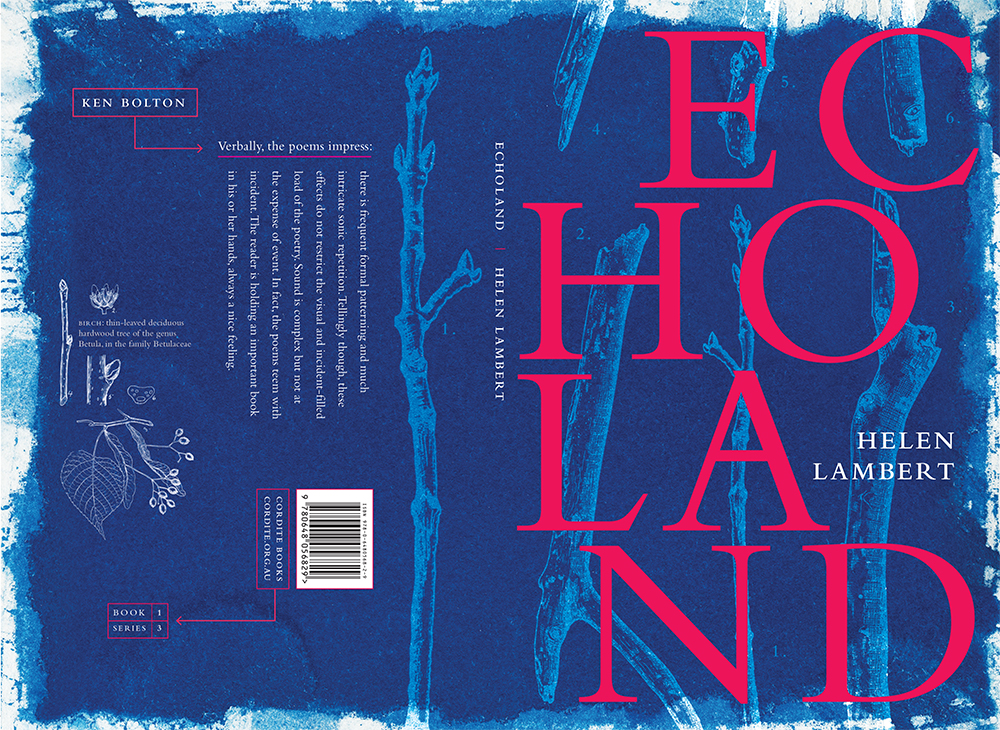
Introduction to Helen Lambert’s Echoland


Cover design by Zoë Sadokierski

BUY YOUR COPY HERE

Helen Lambert’s work is as new to me as it will be to others – she has been operating away from Australian poetry for some time, with long periods in Ireland and, lately, Russia. One approaches a new poet warily. Yet the inventive and capable intelligence behind the poems here is immediately apparent. It is wonderful to be able to drop one’s guard, to forget it – and to enter a wonderful world. From the opening sequence Echoland is imaginatively and aesthetically gripping.

Lambert marshals sharply realised images, and scenes, and atmospheres – and strongly put positions, or logic of argument and implication. The worlds conjured often seem like paintings – hard, firm, immobile – or like stills from films, and a little wintry, perhaps because so often they are the fir and birch forests of northern Europe. Furthermore, these scenes can seem miniaturised. The result – desired, we are sure – a tilt towards the Gothic, the folk tale and fairytale and, sometimes, horror. It brings a degree of distance, if not exactly detachment, of artifice: this is not the casual eye of the subject-viewer giving description, but an authoritative, narrating inventor’s overview. Do we tend to look down from above in these poems? Myths, tales, are made over, re-told. ‘Echo and Narcissus’, for one.

‘Roger, Roger, Roger, Roger, Roger’ is the Kafkaesque presentation of the boy – dead? missing? – replaced in his family, replaced at the family table, by the dog. The dog, we figure, has been given the speaker’s name, ‘Roger’. We know this from his brother’s regular complaint – ‘you called him Roger’. Nor, of course, can the aghast but more or less invisible speaker, who recalls – though the poem’s demotic is Angela Carter’s – Kafka’s Gregor Samsa.

But I should not compress Lambert’s range: these tendencies are neither uniformly present nor in equal strengths throughout. The poet does not – or not ostensibly – speak in her own voice but through personas, or via ‘voices’, that are believable, but which exist for us to try on, to live through. The writing is clear-eyed, and yet, in some instances feel as a dared dream or imagining – a testing of likely outcomes: what will happen to me, will this happen to me? Fraught envisionings. But there is more going on, more to be said.

Verbally, the poems impress: there is frequent formal patterning and much intricate sonic repetition. Tellingly though, these effects do not restrict the visual and incident-filled load of the poetry. Sound is complex but not at the expense of event. In fact, the poems teem with incident. Events, details, are held, fixed: the distancing, the artifice and control of the poet as narrator and picture-maker. The reader does not have to like pictures – Vivienne Shark LeWitt, Elizabeth Peyton, Tarkovsky, Brueghel – to like these poems. It would pay to like poetry.

In the mix are Beckett and Irish speech patterns – spiralling, reiterative loops – and the Baudelaire of the prose-poem vignettes, the Frenchman’s eye for detail that presages a coming modernity and foreshadows change in values and behaviour, though Lambert’s vision is contemporary. A moralist then? Not essentially so, but prepared on our behalf to inhabit that space as we eye our troubling, looming future.

The collection closes with a parodic pastoral dialogue featuring, as the male swain, Donald Trump – has any statesperson’s speech proposed the magical the way Trump’s does? The argot is teen girl, camp, and with an admixture of male, bar-room finality for closure. In ‘Trump’s Bone’ Lambert plays his enchanted world view off against a Russian female agent’s language of real-politik. Lambert’s feel for his idiom – and her sensitivity to its naivety, its ludicrous lead-with-the-chin vulnerability to attack, vulnerability to fact – creates a theatre for sexual politics, for the drama of ideological assumption and ideological parry and thrust. The reader is holding an important book in his or her hands, always a nice feeling.

Posted in INTRODUCTIONS | Tagged , , ,

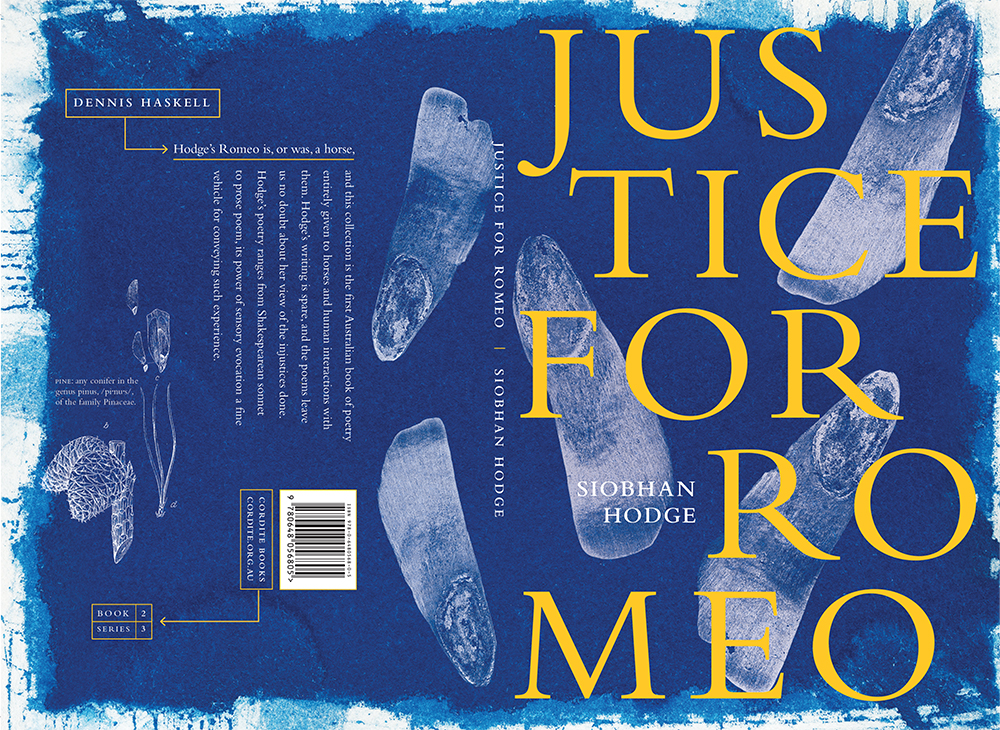
Introduction to Siobhan Hodge’s Justice for Romeo


Cover design by Zoë Sadokierski

BUY YOUR COPY HERE

Justice for Romeo, as a title, will seem both accurate and misleading for most readers; this is a book decidedly concerned with justice, and Siobhan Hodge’s sense of ethical responsibility pervades the poems. Hodge’s book includes as epigraph the exchange between Romeo and a servant in Act I, Scene ii of the most famous love story of all time; the servant asks, ‘I pray, can you read any thing you see?’, to which Romeo replies, ‘Ay, if I know the letters and the language.’ This epigraph has significance for the whole poetry collection, since Shakespeare’s play is as much about blind hatred as it is about love; Romeo’s reading the letter immediately after this exchange begins the tragedy.

However, we are misreading when we rush to identify Hodge’s title with Shakespeare’s character. For Hodge’s Romeo is, or was, a horse, and this collection is the first Australian book of poetry entirely given to horses and human interactions with them. Horses have been domesticated since 4000 BCE and the book is centrally concerned with the way that domestication occurs and is maintained.

The opening epigraph instructs, ‘The rider should know his horse physically as well as mentally … to understand his feelings and anticipate his reactions’. Hodge’s searching and heartfelt meditations show that this is true but glib; she does attempt empathy in the poems, but recognises that sympathy is as far as she, or any human, can go. Horses feel, think, see and react differently to us, and Justice for Romeo is an appeal to respect their independence and right to being. The second epigraph says, ‘It is best to let the horse go his way, and pretend it is yours’. We live in a period when the human capacity for empathy and sympathy with the other, not only with animals but immigrants, refugees and the planet itself, seems in short supply; this only serves to emphasise the importance of what these poems are attempting.

While Hodge’s writing is spare and dispassionate in tone, the poems leave us no doubt about her view of the injustices done to horses: for money through racing, for work and their treatment as machines, for war, ‘teeth … poised / for battle’, and sometimes even for art. Hodge’s own stance contrasts with a history of human arrogance but she is a skilful enough writer that her judgements are embedded in the poems.

Poetry, with its power of sensory evocation, is a fine vehicle for conveying such thought and experience, and Hodge’s poetic forms range from Shakespearean sonnet to prose poem. When riding, she and the horse are very much part of nature but when, for example in the poem ‘In the Pines’, she and the horse fall or approach a poisonous dugite snake, nature is not sentimentalised. These are poems which show not just knowledge and admiration for extraordinary creatures – that is, horses, not people – but a mature acceptance of the world as it is. Even Hodge’s accidents with horses recounted in ‘Bone Binds’ are evoked without bitterness as ‘aerial / lift’ with ‘Air kinder / than ground’.

Hodge’s poems give the horses’ ‘throttled tongues’ some voice, eradicating a ‘curriculum of silence’ but in our letters and language, so that the poems tell us about human imagination, fear, wish for power and concern with beauty. She has a greater variety of rhythms than The Man from Snowy River, so ride along with her: ‘in this mess we’re together’.

Posted in INTRODUCTIONS | Tagged , , ,

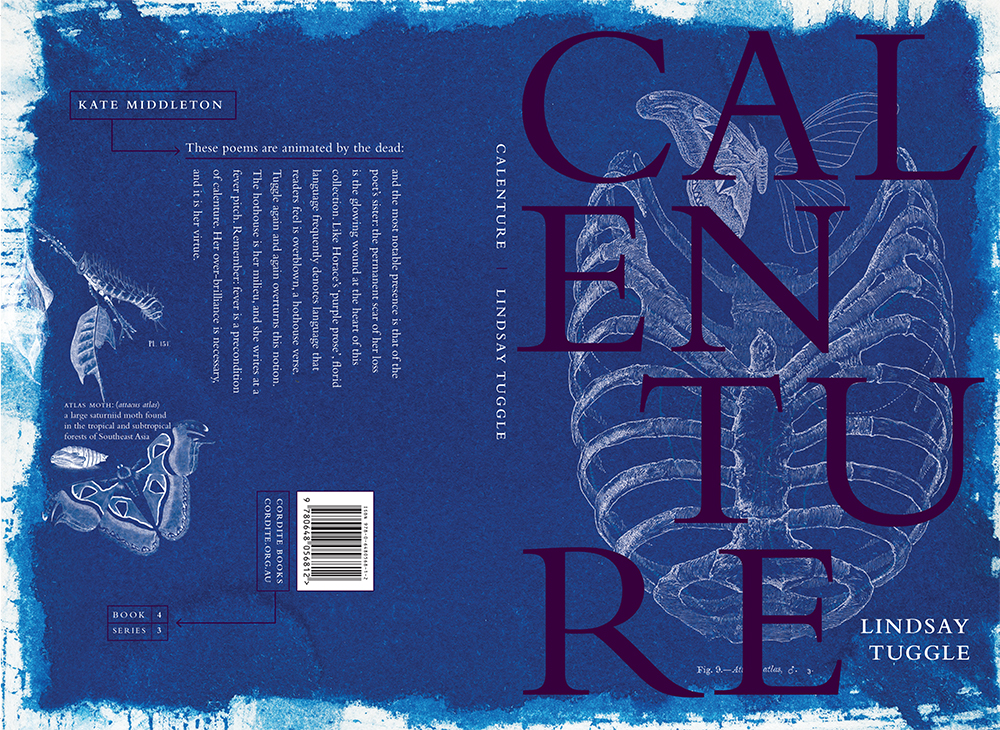
Introduction to Lindsay Tuggle’s Calenture


Cover design by Zoë Sadokierski

BUY YOUR COPY HERE

Lindsay Tuggle’s poetry is uncomfortable to read: the discomforts one feels in reading her work are the very thing that make it memorable. At once immensely personal, ornate, and unapologetically embedded in female experience, it is a style unconcerned with irony or terseness. It is a verse informed by the still-alive alternative histories of the American South and haunted by the Southern Gothic literature that these histories inform. It is also informed by the Gothic that comes to us from north of the Mason-Dixon Line: a world of autopsies, of madhouses, the weird souvenirs of books bound in human skin.

Tuggle’s is a poetry that emerges from a state of being between. She writes her American experience from Australia: a psychic distance that allows her to look at her subject with a clear eye. As an American, Tuggle observes that Australia is not immune from revisionist histories, and the sense that many among us live in an alternative present. She shows us how to traverse this ground.

The title of this collection refers to a misapprehension of one’s surrounds: the sailor feverishly believes the open sea that surrounds him is solid ground. He jumps overboard, only then learning the truth. The sailor’s experience of calenture is, like Tuggle’s verse, an overlay of an alternative present on immediate terrain. The green land the sailor sees on the surface of the ocean is the mind’s deadly trick in dealing with a no-longer sustainable present moment. Her verse uses elegy as a form of resurrection: that resurrection is a way to more truly unveil what is unsustainable.

Tuggle’s work proposes that we need a poetry of women’s bodies: not solely the female body as object of desire, or the female body as motherly (a vessel already frequently found in poetry both old and new) – but also a poetry of the misuses of the female body, and what occurs between states. Tuggle writes, ‘she’s prettier now / in coffined silhouette’. She writes, ‘The explosion that is my face / always was political’. She writes, ‘We are all flesh / toying architecturally with bone’. Her poetic autopsies go beyond the prettiness of a dead girl’s face, the living girl’s face, and gets into architectures physical, psychic, personal and cultural.

These poems are animated by the dead. The most notable presence is that of the poet’s sister: the permanent scar of her loss is the glowing wound at the heart of this collection. The poems that result from such a wound reflect a state in which the keening necessitated by this loss may never end.

In ‘Asylum, Pagaentry’, the asylum of history disallows the ‘florid stutter’ of the female sufferer, the keener. In contrast, Tuggle’s poetry demands this stutter. ‘Florid’ is a word that is often used to undermine the value of language: like Horace’s ‘purple prose’, florid language frequently denotes language that readers feel is overblown, not commensurate with its subjects. It is a hothouse verse.

Tuggle again and again overturns this notion. The hothouse is her milieu, and she writes at a fever pitch. Remember: fever is a precondition of calenture. Her over-brilliance is necessary, and it is her virtue.

Posted in INTRODUCTIONS | Tagged , , ,

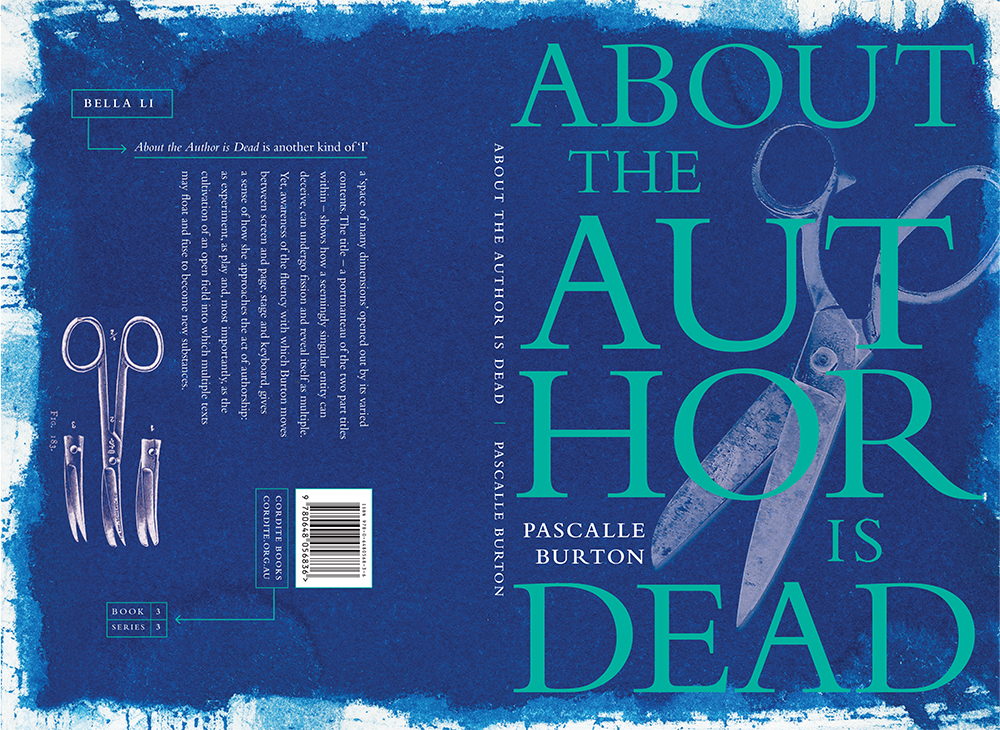
Introduction to Pascalle Burton’s About the Author Is Dead


Cover design by Zoë Sadokierski

BUY YOUR COPY HERE

Pascalle Burton’s About the Author is Dead refers to, and opens with an epigraph from, Roland Barthes’s seminal essay, ‘The Death of the Author’. Inside the collection, we find not one author but many: David Byrne and Grace Jones, Miranda July and Jacques Derrida; authors who are filmmakers, authors who are poets, philosophers and musicians. In the company of the contemporary and the dead, Burton raises questions about authorship and originality, authenticity and truth – questions that remain central to creative practice. Well into the second decade of the twenty-first century, the old temptation – in poetry perhaps more than other genres of writing – is not only to conflate the speaking ‘I’ with the authorial ‘I’, but also the authorial ‘I’ with the figure in the garret, monolithic and secluded.

To conceive of a text as ‘a tissue of citations’ (to quote Burton’s epigraph from Barthes) is to acknowledge that all texts are in some sense collaborative endeavours, joined by genealogies – though the lines of succession are neither linear nor clear. It is also to recognise, as Burton does, that biography consists of more than just births, marriages and deaths: ‘I’ is, in the end, also of text; is composed, in fact, of many texts together. About the Author is Dead is another kind of ‘I’, a ‘space of many dimensions’ opened out by its varied contents. The title – a portmanteau of the two part titles within – shows how a seemingly singular entity can deceive, can undergo fission and reveal itself as multiple.

In the tradition of the cut-up or the found, Burton cites, erases and appropriates (sources range from the novels of H  G Wells to the Facebook page of Kenneth Goldsmith), and her approach is polyglot: the languages of internet code and critical theory, popular culture and mathematics, intersect, interrogate and inhabit each other. The lexicon of cinema is particularly prominent: references to films and filmmaking recur throughout. ‘on waking weeping’, for instance, opens with ‘a high-angle close-up’ and proceeds by way of a tightly paced series of stills, while in ‘the gravestones’ the speaker observes of childhood: ‘mine was a b-grade science-fiction film / yours was sprawling and raw / an off-Broadway-one-man-show / a Jarman flick’. Elsewhere, a latent cinematic sensibility persists. Take ‘the cleveland line’, where the suburban surreal of a David Lynch movie, or a Gregory Crewdson photograph, stitches itself into the fabric of the scene:

on nights like these it drags me from near sleep
when I start to dream
about insects, amphibians –
latching alien mouths onto my skin
– and parents, of course

Such thematic and stylistic allusions to film hint at the multidisciplinary nature of Burton’s work: her creative practice incorporates video, performance, visual art, music and animation. An appreciation of About the Author is Dead does not depend upon familiarity with this larger body of work. Yet, awareness of the fluency with which Burton moves between screen and page, stage and keyboard, gives a sense of how this particular author approaches the act of authorship: as experiment, as play and, most importantly, as the cultivation of an open field into which multiple voices, sources and texts may float – and fuse to become new substances.

Posted in INTRODUCTIONS | Tagged , , ,

SUBURBIA Editorial

Suburbia

We begin with two recent voices in Cordite Poetry Review.

‘There is an assumption that real art only comes from the city,’ writes Winnie Siulolovao Dunn in her 2017 essay, ‘FOB: Fresh off the Books’. Dunn is writing about the stigma of hailing from both Mt Druitt and Tonga. For the young Dunn, the ethnically diverse Western Suburbs of Sydney seem far removed from any cultural centre. Indeed, as Dunn recounts, it took her twenty-one years to write and own ‘the literature of being a Fob in Mounty County.’

The second voice is Corey Wakeling’s, and it comes from his brilliantly provocative review of Puncher & Wattmann’s Contemporary Australian Poetry. Here, Wakeling argues that ‘the suburban is a preeminent register of the Australian contemporary’ and that ‘much Australian poetry already seems embedded in the suburban condition.’ For Wakeling, the huge CAP volume is a testament to the various ways that contemporary poetry is implicated in or grappling with notions and legacies of suburbia.

Suburbia is often perceived to be artistically peripheral and yet it is also entrenched as the focal point of Australian cultural hegemony. After all, Australia has been the most suburban nation on earth since the late nineteenth century. This is part of the reason that works like Courtney Barnett’s song ‘Depreston’ or Luke Carman’s novel An Elegant Young Man possess such resonance, for both works map edges and centres. And both are aware of those tectonic cultural forces that pull in competing directions. Yet the valency of suburbia also lies in the paradoxes of its own definition (the OED defines suburbia as ‘just beyond or just within’ the boundaries of a city) as well as in those contradictory reasons for which suburbs are criticised (e.g. they are too safe / dangerous, homogenous / diverse, materialistic / poor, conformist / law-breaking, mainstream / marginal, boring / chaotic).

When all of the above meets the charged, volatile nature of poetic expression (language which is itself also mysteriously ‘beyond or within’ the polis), we end up with Cordite 84: SUBURBIA. As Brigid Rooney has pointed out, ‘the lived experience, spatial contours and cultural demographics of contemporary suburbia are in flux.’ And it seems to us that poetry is uniquely placed to engage with those constantly changing modes of everyday existence. Indeed, if Andrew McCann is right, and anxieties about suburbia aren’t just anxieties about everyday life, but they are ‘anxieties about the “everyday” itself as an experiential category,’ then poetry is a remarkably apt way to register this heightened awareness. For instance, we see it in the colloquial saturation of specific Annandale spaces in Robin Eames’s ‘curb cut cartography,’ or the exquisite claustrophobia of Ella Jeffreys’s ‘Crescent Road.’ We hear it in the disrupted voice of the mother in Kerry Shying’s ‘Neonate,’ or the apocalyptic postcolonial breathing of Scott Patrick Mitchell’s ‘birak.’

The various types of suburb also orient us toward notions of form and shape, with their planning and sprawl, their pockets of fastidiousness and zones of neglect, their onramps and arterials, backstreets, boulevards, laneways and cul-de-sacs. And, like suburbia, contemporary poetry is marked by encounters between formal inventiveness and certain inherited arrangements. In this issue, Philip Thiel’s ‘Chadstone Sonnet’ offers the proprietary intensity of store names within the frame of the Elizabethan Sonnet. Tess Pearson’s ‘Household Ripening’ uses the pantoum form to explore ‘the dance of avoidance’ provoked by interminable housework. Elsewhere, there are erasure poems made from Christina Stead’s The Man Who Loved Children (Michele Seminara), poems in the shape of car-yard bunting (Mike Ladd), and even acrostics incorporating lines from the Petshop Boys (Stuart Barnes).

The poems in this issue are grounded in a variety of suburban experiences and locations in suburbs around Australia, as well as in North America, Asia and Europe, engaging with a range of themes, ideas and emotions. Brendan Ryan’s ‘View of the New Estates’ tackles the tension that has existed between suburbia and nature ever since the first bulldozer cleared the ground for the first subdivision. Mindy Gill’s poem celebrates suburban tranquillity, Lyn McCredden delivers a tale of intra-suburban prejudices, Anne Casey sings a wry and joyful hymn to a domestic suburban weekend, and Andrew Burke pays tribute to the iconic Hills Hoist.

It is our hope that this collection of poems represents a diverse and compelling cross-section of Australian and international suburban writing. Throughout the selection process, we were delighted, humbled, excited and slightly overwhelmed by the sheer volume of excellent pieces we received (the number of poems submitted approached two thousand). The massive response to our request for poems on the theme of suburbia testifies to the importance and ubiquity of suburbia in contemporary writing. The poetic responses to suburbia ranged from celebratory to disparaging, revealing both the pervasive influence of the anti-suburban tradition in Anglophone (especially Australian) literature and the desire and ability of many contemporary writers to abandon, dismantle, sidestep, reconfigure or ignore reductive stereotypes of suburbia. However, perhaps this kind of (poetic) population growth and sprawl is appropriate and expected for an issue on contemporary suburbia …

Posted in ESSAYS | Tagged ,

Ghost Flowers in the Word Machine: Poetry, Pessimism and Translation in the Age of Technology

I once read that the word ikebana (生け花), denoting the Japanese art of flower arrangement, can be roughly translated into English as ‘living flower,’ or ‘bringing life to the flowers.’ This summary sounds too easy, too graceful; there is an air of internet mythology to it, the truth of it smoothed and polished like a well-handled stone until it becomes convenient, small enough to tweet or swallow. I don’t know Japanese, and even if I did, I doubt whether my clumsy English renderings would do any more justice to the words’ original elegance: to the 生 rooted in life, meaning raw, growing, being born – to the bloom of the 花 recalling cherry blossoms, paper petals, grass. But somehow, despite my ignorance or because of it, I find joy in the deconstruction of the word, in the Googling of its kanji, the deciphering, the re-making. The word ikebana is a little poem, and I am its fumbling, ill-equipped translator.

There is something in the symbolism of ikebana, the practice of it, that fascinates me too: after the fresh flowers are cut from the soil – their first, ecstatic death – they are given new life through the meticulous touch of an expert practitioner, or kadoka. I cannot help but interpret the flowers themselves as words and poems, the disciplined hands of the kadoka as those of the poetry translator. Forgive my romanticism. But there is precedent here.

Poems have often been thought of as precious, living things, precariously balanced on the precipice of language, the tension of their form and music exquisite, untouchable. The words of Percy Bysshe Shelley, recorded in his famous ‘Defence of Poetry,’ remain some of the most widely cited:

It were as wise to cast a violet into a crucible that you might discover the formal principle of its colour and odour, as seek to transfuse from one language into another the creations of a poet. The plant must spring again from its seed, or it will bear no flower – and this is the burthen of the curse of Babel.1

If a poem is a flower, then to translate it is to uproot it from its indigenous soil, to sully and defile it; ultimately, to destroy it. This makes sense, if we think of translation as an act of analysis, some kind of literary vivisection (at best) or post-mortem (at worst). Except poetry translators, for the most part, are not the heavy-handed boffins Shelley describes in his ‘Defence.’ Translators of poetry, especially when they are poets themselves, seek not to analyse but to re-plant and re-vive; they work in studios, not in laboratories. Indeed, they have much in common with the kadoka – they are sensitive, well trained, precise. They are in love with their wordflowers. They are life givers.

Historically, the translation of poetry has been shrouded in pessimism, represented in grotesque metaphorical terms as an act of cold, methodical dismemberment. From Paul Valéry, who described it as the unholy resurrection of ‘dead birds,’ to the sharp-tongued Vladimir Nabokov, who memorably likened the craft to taxidermy: ‘Shorn of its primary verbal existence,’ he wrote, ‘the original text will not be able to soar and to sing, but it can be very nicely dissected and mounted and scientifically studied in all its organic details.’2

The observation that ‘poetry is what gets lost in translation,’ tenuously attributed to Robert Frost, has become a sort of aphorism for those who delight in bemoaning the untranslatability of great literature. This line of thought (caustically branded by leading Translation Studies scholar Susan Bassnett as ‘self-indulgent nonsense’) perpetuates the post-Romantic myth that poetry is some ineffable thing, impossible to transpose or transplant. Modernist aesthetics most certainly complemented this frame of mind (although I must exclude here the example of Ezra Pound, himself a renowned poetry translator). In works of poetry, as the Modernist argument goes, form and content are inextricably wedded. A poem is therefore a poem by virtue of the words it is composed of, and the way they have been put together. For the Modernist aesthetician, there is no prior meaning to a poem, and therefore nothing to be translated; in the words of T S Eliot, ‘that which is to be communicated is the poem itself.’

In light of such perspectives, the task of the poetry translator becomes not only impossible but inconceivable. Consider, for example, the disheartening words of Spanish philosopher José Ortega y Gasset:

Human tasks are unrealisable. The destiny of Man – his privilege and honour – is never to achieve what he proposes, and to remain merely an intention, a living utopia. He is always marching towards failure, and even before entering the fray he already carries a wound in his temple. This is what occurs whenever we engage in that modest occupation called translating.3

What Ortega y Gasset articulates in the above passage is the perceived frustration of the poetry translator, who must engage in a constant comparative tug-of-war between the original text and his own, forever inferior creation. Such attitudes are grounded in one’s general approach to translation, which all too often involves an inordinate reverence for the original text and an inevitable disdain for the derivative creations of the translator. Indeed, the view of translation (and of translators themselves) as subservient and subsidiary has plagued translation commentary for centuries. Feminist translation theorists have played a pivotal role in exposing and critiquing such perceptions. Sherry Simon, for example, argued that both translation and women have historically been branded as the weaker figures in their respective hierarchies, resulting in an enduring ‘heritage of double inferiority.’ This heritage abides in contemporary translation commentary, as evidenced by a persistent tradition of harsh translation criticism and the self-effacing, apologetic tone that continues to haunt many a translator’s preface.

Translators themselves know that the rhetoric and symbolism around their craft, both age-old and contemporary (the erasure of translators, for instance, is still present in a surprising number of literary reviews and paratexts) is inadequate. It fails because it fails to see what translation actually is: not the crass plucking of a flower but a re-arrangement, a re-contextualisation. A re-birth, even.

If little is said, these days, about poetry, then even less is said about the translation of poetry. A more topical arena for the same discussion is the question of machine translation. The shared soil between poetry and AI may not be immediately obvious, but arguments around both are rooted in the same (astoundingly common) misconception: that translation is a mechanical act, not a creative one.

Posted in ESSAYS | Tagged ,

‘a homemade world’: On the Dandenong Line


Image courtesy of The Deletions.

Sometime in 1953 my parents bought a house in Clayton (Victoria, Australia), then on the edge of south-east Melbourne. We moved there from a decidedly different environment: the guest house that my Grandmother owned. This was on Beaconsfield Parade in South Melbourne. In those years that suburb was largely working class with connections to the Port Melbourne wharf and the further dockside territory along the Yarra River. This guesthouse and the country around Ensay in the Tambo valley of East Gippsland where my father was born were ghost presences as I was growing up – imaginaries of an existence I might have had (urban / rural). We would visit my uncle and aunt in Ensay (travelling by train and bus until around 1960 when we finally owned a car) and we would venture into the inner suburbs occasionally where I would get to look at the ‘slums’. I’m not sure what significance these places had for my parents or even why they wanted to take me there. It could have been as a ‘this could have happened to you’ lesson, though I suspect this was not the case. The places we visited may have had more of an affirming effect for my parents. For me, the inner suburbs were simply ‘picturesque’. In art classes at Huntingdale High School I would often draw or paint decaying buildings from the images I had taken on my box Brownie camera. These were sketchy romantic visions lifted probably from the work of Sydney artists like Sali Herman or Donald Friend (encountered in the library rather than the art gallery).

My reality was a point some twelve miles out from the Melbourne CBD. Eva Street, where we lived, was, for a few years, impassable by car for part of the year (its muddy ruts were over a foot deep). My father would walk the mile or so to Clayton station, catch the train in to the city and then take a bus to Fisherman’s Bend where he worked as a tool-setter on the production line at General Motors. To get to the station you would follow the road alongside the railway line, but the shortest route to the local shops was via Dunstan Street. This wasn’t a through road either. At one point you would have to cross an open drain on a rickety footbridge. The drain went underground in places, and me and my friends would often play in the pipes. For years we had an outside dunny. It seemed an unbelievable luxury when, sometime in the sixties, the sewers were connected.

Clayton was, when we moved there, still partly occupied by market gardens. It was low-lying and in places sandy, though a few miles inland from Port Phillip Bay. We were told at primary school (Clayton South) that the place was named after a Mr Clayton who would often drive his buggy naked to the Bay (his nudity was not meant to convey to us anything salacious, just the fact that there were no respectable people around to watch). In the mid-sixties I would cycle with my friend Don Rickerby to the coast at Mordialloc to fish near the mouth of the creek.

By the time I went to high school the roads had mostly been made, the open drain covered and the rickety footbridge was a memory. Huntingdale High was wedged between two golf courses – the Huntingdale and the Metropolitan. It was forbidden to cross these links, though some students used to do so regularly, often stealing golf balls when they were hit into the rough. The links were believed to be the haunt of a man known as ‘Forbes’ who would expose himself, though nobody I knew ever saw him. More of a threat were the sharpies (an earlier Australian version of the skinheads). If you caught the train late at night you had to watch for them. Our local group were the ‘Springy Boys’, based in Springvale, a couple of stops further down the Dandenong line and a few degrees rougher than Clayton. They were real enough even if I didn’t personally encounter them.

The closest library was in Oakleigh, two stops towards the city. It was here that I came across the poems of Ern Malley, in the edition published in the sixties by Max Harris. I started to write poems in my fifth year at Huntingdale. These were mostly gloomy adolescent productions though I did make use of the local environment. Suburbia seemed pretty natural to me, even if Barry Humphries was giving it a basting. I didn’t sense that his cartoon vision – with its mundane addresses (such as the nearby ‘Centre Road, East Bentleigh’) – was one of total abhorrence, even if it may have been. Apart from a brief excursion, I continued to live in Clayton with my parents until I was 22. Monash University, which I attended from 1968, was just up the road and Australia’s first outer suburban tertiary campus. The friends I met there were also from the suburbs, though by then John and Margot Scott were living in relatively inner-urban Armadale (John’s father lived in Dandenong, right at the end of the suburban line). Alan Wearne was in Blackburn, a few miles to the north: a ‘leafy’ middle-class suburb (which he would continue to write about superbly).

In the late sixties the predominant mode of Australian poetry, written by people some twenty years older than me, was a purely academic one. The poems that appeared in The Age each Saturday were, as often as not, knowingly ironic takes on suburban life with a clever twist and maybe a classical reference at the end. The only poet of that generation who seemed truly at home in the suburbs was Bruce Dawe, who lived in Springvale rather than Carlton or Parkville. He would occasionally read at Monash and was always welcome there. I once took a train back from the city with him after a reading in Carlton (a place I still rarely got to) and we discussed poetry and poetics on the way. He was an early instance for me that poems could come from where you were (rather than, say, the battlefields of France in 1917). Rather than rewrite the classics you could inhabit what Hugh Kenner termed ‘a homemade world’.

I reflected on life in Clayton in a poem from the Blue Hills sequence. ‘Blue Hills’ was the Australian radio serial about country life (which my family would listen to religiously), but my Blue Hills incorporated the urban (and the suburban) as it progressed. In 1988 I referred to Clayton in number 21:

Out at the twelve-mile mark
peppercorn seed equals memory.
A lizard flits under rubble
between the sleepers, on the line where 
trains ‘rocket to impossible destinations’;
overhead, pale green semiconductors,
a sky full of cirrus. 
                                 It's spring:
the peppercorns hang, an innocent aura
of ten year olds sharing cigarettes
in a hollow of compacted earth
under the waiting room. 
And the lunatic who pushed a barrow
from the station to the newsagent,
infantile in middle age, what burst gland
disposed of him?

The quote ‘rocket to impossible destinations’ was from Bruce Dawe.

A little later in number 38 (1991), I reflected on the middle-class bay side suburbs through which I was driving away from my flat in St Kilda to a writing residency in Frankston:

Lanes I will never trace
of sheoak and flowering gum
fork through these suburbs
under the campanile, Mentone,
where the rail curves towards the bay
and its townships: median clock towers
and creek borders, overtaken by the city,
the lowlands between, drained, filled in,
overlooked by railway stations,
a vista from Edithvale to Wheelers Hill.
The settlements exist under these layers;
their clutter of architectures testify 
that paradise is momentary
             and jerry-built.

I remembered, as I wrote this, those now extinct precursors to the traffic lights: pylons with clock faces on which you could watch the hand progress from green, via amber, to red. They had long gone when I was commuting to Frankston, but they were there in the 1960s and I have never seen them anywhere else.

Since 1972, I have mostly lived in the inner suburbs of cities. This was where the readings and the pubs were. But like so many of my friends, I trailed a little of the outer suburban soil with me. John Forbes (the poet, not the flasher) and his three brothers came from ‘the shire’ (a term Alan Wearne picked up from them, basing one of the locations in The Lovemakers out there on the Sutherland peninsula). Ken Bolton came from ‘the North Shore’, yet his North Shore wasn’t the place of privilege the term usually evokes. Ken’s North Shore was only slightly further up the line than the world of Grace Cossington-Smith and Margaret Preston, but otherwise a world apart. It was the land of the weekend lawnmower. Sydney must have seemed like paradise to John and Lyn Tranter (escapees from ‘the bush’). We were a new crowd of inner-urban dwellers, but even so, we were not ‘cosmopolitan’ if compared to someone like Martin Johnston. He had grown up with two languages and an idea of culture in which Australia played a peripheral, if occasionally vital, part.

Posted in ESSAYS | Tagged

Ken Bolton’s Suburbia, an Introduction

LandImage courtesy of the author

This is going to be a rather disordered list of undeveloped and not closely connected thoughts about ‘the suburban’ and its binary partner ‘the urban’. Not my thoughts, for the most part, but my list of thoughts generally available. Something that might do to serve Cordite Poetry Review as preliminary, to obviate the need for their re-stating or further discussion, a kind of background or context-setting. A sample of ‘received ideas’ almost, not quite the full Bouvard & Pecuchet Dictionary of them.

I found – as I think most would – a store of these. And I never knew. I never knew because the topic seemed an embarrassing one, a kind of quicksand – and I had never engaged it. But, as we turn with irritation – or bad faith, or well-defended laziness – from a too commonly surfacing and unwelcome topic, meme, or point of discussion the mind does mutter something, makes some testy or scornful half-remark to help let itself off the hook. One doesn’t remember them – these excusing, face-saving utterances. They don’t bear examination, they’re not very deep, they are partly in bad faith, shameful or (simply) not very responsible. A snarl or a bleat. They signal the guilt that they deny.

This list began with an account of my response to the editor’s suggestion that I write something on the subject of suburbia / the suburban. Here is how I began (and how I’ve continued):

There’s nothing I’m burning to say about suburbia. I think? Though maybe I can think of things. I’ll have a go and see what I come up with. Mostly a welter of seeming observations and briefly flaring impulses, all of them mutually contradictory. So, I’m not promising anything, alright?

‘Suburbia: land of the home – free of the brave!’ has been my only consciously made comment so far in my writing life, made some years back, and it immediately seemed unfair. Though that ‘unfair’ seems to recognise that we ‘see it’ (the suburban) as soft, more vulnerable, somehow disadvantaged. The suburban is abject?

My take on it is that the whole issue has been a bit embarrassing: those ’50 / ’60s intellectuals (my first meeting with the term and ‘the issue’, although I’d have known the term ‘suburban’ was a put-down from some mid-century English fiction, surely) were so adamant that the suburban was shameful, tacky, feminised, emasculating, limited and limiting: The Great Australian Ugliness, My Brother Jack, Patrick White, Norman Lindsay. The rest. The issue used to come up – often – in Meanjin and other institutional publications. As I remember. But, I wonder if it really did? It seemed to. It seemed always to have been ‘in the air’. Maybe it was the weekend papers. Maybe the subject was big with ‘satirists’.

**

I was glad in 1971 to get out of the North Shore suburbs, myself, and move into Ultimo, Glebe, Redfern to be a student and then begin being a poet. But clearly most of Australia lived in the suburbs, the suburbs of the great cities (one, more or less, per state). It was where I and those around me had come from. Australia, from First Settlement onwards had been urban, chiefly. Were there moments when this had not been the case – the gold rushes, briefly, making Ballarat bigger than Melbourne? – probably not. The country was never preponderantly rural, was one thing I knew. And if it was ‘urban’ in this way, then for most it must have been sub-urban. Places that are now considered ‘city’ were once regarded as a degree out from the centre.

**

I mean to begin, now, as I had first intended, with a list of assertions, reflections etc. – ‘on the theme’ – without developing them particularly. But I don’t know how long that will hold. There is always a moment when one begins to elaborate further. As I say – have I said it? – did the theme, the ‘binary’ always make me feel guilty or uneasy, or impatient? These are the tips of thinking I have almost undertaken but not – tentative thinkings that I have backed away from, as unsatisfying, compromised, too easy – arguments I have allowed to develop as units of rhetoric, but which I have not wanted to pursue. They must have the characteristics of lazy thinking, of unexamined propositions. They will necessarily be hackneyed, but that might be their value: they might be the scrub we need to clear to check the lay of the land.

So here’s the data.

The painter of the suburban. Mostly, today we would nominate Howard Arkley. When I think Arkley, I always think of Reg Mombassa – he began with a similar realist-suburban view of housing (I think Patrick White collected some) back in the late ’70s or early ’80s – before giving himself to the Mambo enterprise. The segué from Reg’s small pictures, of simple houses, shrubs and curbs, to Mambo is fitting or useful here: Mambo are associated with surfing and the suburban, the suburban and beaches. They, Mambo, are a manifestation of popular culture. Beaches either ‘are’ suburban – or they can be seen as a cultural escape from it – an alternative that is blue, mystic, ‘ideal’, escapist, fun and so on.

I should just keep positing these things.

Reg Mombassa’s figure of the Suburban Christ or Self-Martyring Father-Hero ‘of the Suburbs’: usually depicted dragging or carrying an enormous weight – in a small suburban yard or street, under hot, hot sun. Mowing the lawn? It is satirical, but also affectionate. Or, it counts on our affection and then it undercuts that. (There are, historically, other notable painters of the suburbs: Danila Vassilieff, Roland Wakelin, Ken Whisson, a long list of painters of the ’20s, ’30s and ’40s, including Preston, Ruth Tuck, Clarice Beckett. Kurt Brereton’s paintings of the Illawarra. Stewart MacFarlane! The photography of Micky Allan circa 1980.)

Abstraction: the ideal, the absolute, the generalised. (Richter’s ‘realism’ is high culture. High Culture like Picasso and Braque: the ‘still-life’ as a genre deals with a sample reality, a reality apprehended through particulars, or particulars ‘considered as’ Reality. The specific generalised. And, of course, much of Richter is abstract. Richter is high-minded. Christopher Wool is high-minded, or at least ‘ideal’.)

Contrast with him painters Peter Doig (Scottish), Luc Tuymans (Belgian) for example. More mundane, less ‘noble’, less pricey. Less metropolitan. Doig is even Anglophone.

Manet. Manet’s Berthe Morisot with a bouquet of violets: a woman as the absolute, as the (absolutely) modern, the ‘now’. The specific generalised, the instant generalised?

Sebald – held in Germany to be good, but a little too English: e.g., pedestrianly banal and taken up with local and incidental colour, with detail, not cutting to the philosophical chase with sufficient continental drive. (The English – the Anglophone? – as ‘a nation of shopkeepers’?)

The distinction urban / suburban is too available, seems too handily to lead to further easy distinctions, usually weighted the urban’s way: sophistication, intellect, glamour, seriousness, ideas, the international. Remember – who can forget – the international passport to smoking pleasure? Everyone, probably, but I love to bring it up.

Advertising seems to treat the country most when trying to sell city folk cars, off-road vehicles. A fantasy.

**

The suburban came about / comes about with transport: the train, the tram, the bus, the car particularly. Post-war it is the car. In Australia it is the car.

The fetishised car, and the life around it, is suburban (and democratic, declassé, downwardly mobile? – and male – e.g., the car is not the home, is an escape from it, is ‘freedom within-the-suburban’?)

This last elision is one of the things I hate about the whole thing, urban / suburban. Marlboro Man is free – a young guy in a Torana is free. See, later, My Brother Jack as a locus classicus of this kind of gendering – not that I remember cars in it. Meanwhile: Ted Mulry, ‘Jump In My Car’ etc. Standard rap clips feature cars as centring on the male – women are prized decoration in the passenger seat, in the back seat. Single, young women. The exceptions pretty much prove the rule, still – hence the emancipatory, empowering effect of the girl-at-the-wheel, when it happens.

Is the suburban ‘Western’? The suburban as we mean it – that is, with our associations – has probably been imported along with globalisation and capital – into the capitals of Asia and the Third World and the Middle East.

The New Photo Realist painters of the ’60s and ’70s (and still) so loved the car (as they did everything shiny – but surely it was the car’s insistence on the lowly reality, the lowly perspective, that made it additionally alluring): it lowered the tone (at the same time as being undeniable, American, ‘now’)) to the discomfort of high-minded Abstract Expressionism. Part, surely, of their battle with big town, metropolitan Abstraction. (And their battle with Pop’s high-art irony.)

(Compare with the British Pop artists – so much more ‘nation-of-shopkeepers’ – Peter Blake, David Hockney, Richard Hamilton.)

**

Australians, I had gathered some time in the ’80s – I came across it by accident – were predominantly renters prior to WWII. Renting suggests – though not ‘logically’ – the city, the inner city – both things (though not logically) identified as Labor.

Posted in ESSAYS | Tagged , , ,

No Safety, No Submission? A Survey of New Zealand Small Presses


Image courtesy of Limbo Agency.

There is a preconception that small presses, existing as they do outside the mainstream, publish poetry that is wilder, stranger, more political, and more ethnically diverse. Poetry that the university publishers have turned away, or whose genius such presses have failed to recognise. Poetry that bucks the mannered, nostalgic style that monopolizes the prizes and the media. Poetry that takes risks. No safety, no submission.

Certain small presses do, indeed, follow this brief. Anahera Press, for example, publishes Māori and Pasifika writers. Their books ‘give voice to … the intersections and spaces between cultures’ or champion writers who are ‘walking between worlds.’ A press that publishes culturally self-aware poetry, by Tangata Whenua and ethnically diverse poets, is much-needed in an environment that is still overwhelmingly white. In 2015, 91% of poetry books published in New Zealand were authored by Pakeha / Europeans; a dispiriting figure, when you consider that Pakeha make up only 74% of the population. Have a look at Janis Freegard’s ‘sad little pie chart.‘

Of course, Māori and Pasifika writers still publish within the mainstream, and are even fed into the dreaded mouths of university presses via the creative writing industrial complex. Tusiata Avia, for example, came up under the ‘straightening‘ tutelage of Bill Manhire’s International Institute of Modern Letters, so-named by the Vegas cowboy billionaire who funded its establishment. In 2016, she published her awards-shortlisted startling third collection, Fale Aitu | Spirit House, with Victoria University Press.

While poetry is regarded as a strange and archaic art-form for most New Zealanders (‘Oh, you’re a poet? I’ve never met a poet before! I didn’t know they still existed!’), and poetry is near-invisible in the shelves of Dymocks and Take Note, the stakes of poetry publishing are enormously high for poets themselves. Being unable to find a home for one’s book can be a crushing feeling, spurring the sorts of frustrated energy by which new presses are born.

Sometimes, though, the aesthetic ‘wars’ between the large and small presses play out in the form of lightly boozy, cheery jesting, in the convivial climes of book launches – at least in Wellington, where everyone knows everyone. I think of Fergus Barrowman, the publisher at Victoria University Press, squinting at the pages of a freshly launched issue of Hue & Cry (the journal) and decrying the size 8 font, wine in hand.

So are small poetry presses publishing boundary-pushing, risk-taking, experimental work? Well, the answer is: sometimes. Sometimes small NZ presses are putting out work of zine-like freedom and stunning weirdness. Sometimes the production values are far lusher than the university presses, whose financial constraints and high output make print-on-demand a necessity, resulting in thinnish pages and visible pixels. Sometimes the poetry championed by small presses is deeply exciting. And sometimes it isn’t. The work can be accessible and predictable, in need of a harder editorial steer, and seemingly rushed to the page when it would have benefitted from a year or more of fermentation. The publishing sensibilities that shape these various outputs are themselves various, and produce variously interesting work.

The Hoopla series, by Mākaro Press, pitches itself as a boisterous, extravagant, and playful publishing project, while asserting accessibility and clarity as its key values. Is this a contradiction? The very attractively packaged and tidily designed books – lovely to hold – include Helen Rickerby’s Cinema, an absolute classic, Jen Compton’s wonderfully funny Mr Clean and The Junkie, a cinematic book-length underbelly love story, and Brian Walpert’s Native Bird, an accomplished, seeking collection. Walpert’s poems are generous in their concessions of clarity to the reader, and are saved from the over-easy epiphanic mode by their meta playfulness and genuinely meditative engagement with the nuanced pain of parenting and domestic co-habitation.

Hoopla also supports new voices, as one in every series of three is a debut collection. Some new voices are cracklingly promising. My heart quickened at Elizabeth Morton’s Wolf poems: fierce, nasty, taut, hot-blooded. These would have made a stunning chapbook, as the rest of the collection sagged somewhat after the accomplishment of the first ten pages. Morton’s self-consciously gritty image-accretion needs a character to centre it and give it purpose. Other new Hoopla voices exhibit the quiet, safe, tea-drinking nostalgia that frustrates seriously intertextual, experimental, or research-disciplined poets who feel they can’t get a foot in the door.

Helen Rickerby, the editor at Seraph Press, operates free of any commercial constraints – by inclination and by choice, but also because she once applied for Creative New Zealand funding, and was turned down, and can no longer abide the disappointment and the extensive faffery of all those forms. She and her husband fund the press, and book sales usually bring in enough revenue to cover printing costs at least.

Beauty is one of Seraph Press’s core values, and their books are indeed beautiful. The hand-sewn chapbooks and the books in the translation series are especially exquisite. The textured pages, the highly colour-saturated cardboard inner cover, and the rough string binding appeal enormously. Anahera Gildea’s Poroporoaki to the Lord My God: Weaving the Via Dolorosa is enclosed by a gorgeous fly-leaf insert of hand-made harakeke. These are books that feel like treasured objects, made by friends, to be shared between friends. On the binding process, Helen says, ‘I always have a bunch of people come around and we sit and talk while sewing. It’s a surprising amount of fun.’

Indeed, friendship is a key part of how the press operates. Because it’s self-funded, and Rickerby doesn’t pay herself, she says she only takes on books that she is smitten with – and acknowledges the uncomfortable gate-keeping element of the role: ‘There is a place for gate keepers I think – at their best they keep up quality standards, they curate things they love, etc. – but I do think we need lots of different kinds of gate keepers so we can also have diversity and experiment and boundary-pushing. For example, I think we need more publishers in New Zealand who aren’t white middle-class folks (like me).’

Seraph Press has sometimes taken on projects that other publishers wouldn’t touch. Their first-ever book was Locating the Madonna in 2004, an epistolary collaboration between Anna Jackson and Jenny Powell that didn’t interest their usual publishers. Fourteen years later, the catalogue is populated by a top-notch range of established and newer poets. Poet Laureate and recipient of the Prime Minister’s Award for Literary Achievement, Paula Green, released a thoughtful, playful collection called New York Pocket Book in 2016. In 2015, Seraph published Johanna Aitchison’s second collection, Miss Dust, a mature, sure-footed work, painting crackling, cubist little vignettes of autobiographical dream-scenes. Last year, Nina Powles’s Luminescent was well-received. This collection is unusually bound. A folder cover contains five chapbooks, each about a different historical or historico-fictional woman: a dancer who burned to death on the stage of the Grand Opera House in 1923; a ghost from Powles’ high school who is said to have tripped down the stairs when she heard her husband return from a voyage at sea. The romantic prettification of the deaths of these various women felt, to me, less thoughtfully and thoroughly explored than the wonderful, deep, and mysterious poems in her earlier Seraph chapbook Girls of the Drift.

Besides Cold Hub, who has been publishing poetry in translation for some time, Seraph is the only small NZ press with a regular translation practice. Seraph has published translations of Greek, Italian, and French poetry, and Tātai Whetū: Seven Māori Women Poets in Translation is forthcoming – a book that has (finally) garnered some Creative New Zealand funding, thanks to co-editor Vana Manasiadis’ patience with filling out forms.

Posted in ESSAYS | Tagged

Wright Vociferous – ‘Birds’ and ‘Skins’ – Physiognomy, Identity and the Wild Spoken Word

for Maxine

On 23 November, 2017 at the NSW Writers’ Centre in the Sydney suburb of Rozelle, poets Amanda Stewart, Nick Keys, Peter Minter, Michael Farrell and myself presented ‘The Centre For Deep Reading’s Talking Writing: Wrighting’ in the Judith Wright Room. Minter acknowledged this Wangal and Gadigal country. We each spoke for 15 minutes on Wright, and each did a mini-read of our own poems that reacted to or expanded on Wright’s work.

Our presentations organically generated overlays. Had I had more time, I would have brought in her first recognition of ‘I’ experienced at around three years of age. Wright had wandered away from the ‘boredom’ of a social occasion on her family’s property, was climbing over a log pile, and a splinter had ‘run’ through her knee (she wears starched white eyelets and a blue sash reddening with her dripping blood). She suffered the guilt of disobedience; ‘But it was this new ‘I’ that was making me howl so loud. From a kind of space-time continuum which included myself, I had suddenly arrived into self-awareness, alone and in pain and trapped in a life which I had now recognised would take me right through, unstoppably and uncontrollably, until I was as old as my grandmother – and then I would die.’ And, how, in 1939, as an aspiring poet, she had looked for mentors in Sydney:

I looked in bookshops for Australian writing and found very little I felt useful. Kenneth Slessor’s poetry, when I discovered it, enchanted but repelled me. It was masculine, tough or glittering or self-absorbed, and I did not want to write in the least like that. But then neither did I want to write like Mary Gilmore, that other possible mentor who lived only a block or two down Darlinghurst Road and whose age and eminence rather frightened me when I called at her flat with bunches of violets and the expected homage … She might have sprung, with the necessary alterations in age and manner of thinking, from the New England I was trying to escape.

As organiser and coordinator, Keys had sourced recordings of Wright, made in 1970, from the National Library of Australia and had cued up ‘Birds’ and a sound sample of narration and female birdsong I wanted to include from an episode of Catalyst, ‘Where Birdsong Began’, for my presentation.

Wright reads with a very light melodiousness. Some words, ‘and good for birds to do’ actually sound like a birdcall and very unlike how I would read it. Somewhere, between page and audio, the bold and confronting poem has met with inhibition and censor, either self or societal cue; its uncompromising strength has been checked. In another recording (used by Stewart and Keys), an interview with Roger Pulvers, off-guard in its recorded preparation her speech is wildly animated, musical and effusive, her superseded accent and pragmatic redolent language are now generally unheard; made extinct by the echoic mimicry of urbanised cringe from ironic mutilated ‘English (the other antipodean) genteel’ like the affected imperial zeal of the 1938 Aeroplane Jelly advertising jingle’s aspirational plummy diction and delivery. (As children in the 70s, we would sing it as uproarious satire with mock emulation … that and the one about ‘puts a rose in every cheek’. We would pinch our cheeks rosy. Of course, that was the idealised English complexion, the healthy rosy-cheeked ‘good’ white child, iron fortified through yeast extracted.) ‘Birds’, for example, is heard as an elongated, clear, wistful, lilting and elocutionary (Magpie-like) ‘Bairds’. For me, its last lines, ‘Then I could fuse my passions into one clear stone/and be simple to myself as the bird is to the bird.’, bodily distil a visceral maternal empathy and is highly emotive.)

I began by repeating its first line.

Whatever the bird is, is perfect in the bird

Birds: our weightless higher selves, ethereal visitors. I can’t resist the mysticism of birds made silent by Judith Wright’s loss of hearing – but perhaps, only the earthly.

Identity, conviction and commitment in Wright’s work are ever present and it’s something poets need to clarify. In the foreword of her 1989 ‘self-selected poems’, A Human Pattern, representing 40 years’ production, she writes, ‘Poems, like all literature, are written from within a social, historical and personal context and bearing.’ It is necessary for us to raise our voices. There’s both privilege and responsibility connected to expression. In Wright’s case, there is also dignity, intensity and a sacredness, something beyond herself. Let’s all be included … here in Wright’s ‘Poem and Audience’:

No, it’s not you we speak to. Don’t believe it.
The words go past you to another ear.
Does the look seem to rest on you, or you?
Regard it well, and see: it passes through.
It is not you we look at and we hear.

No, it’s not hard to speak. This is an answer – 
how  blurred, how stumbling, we have bitterly known – 
yet answer, to a question. Who could ask
so strange a thing, or set so hard a task?
We cannot answer. The voice is not our own,
and yet its tone’s deeper than intimate.

And when, expected and entreated long,
the question comes, we cannot hesitate,
but, turning blindly, put all else away.
Searching ourselves in pain, we yet rejoice
that the implacable awaited voice
asks of us all we feared, yet longed, to say.

In ‘Birds’, from her 1953 collection, The Gateway, she is grappling with settler-guilt, as we all do in varying degrees, and being part of her history, but needing to be apart from, to maintain her own identity. (The Australian’s Geordie Williamson, reviewing the 2013 Early Works Productions Pty Ltd – an ABC television documentary Love & Fury: Judith Wright & ‘Nugget’ Coombs – referring to early footage, can’t help but observe that ‘she looks like a Moonie Ponds housewife in her twinset and horned-rim glasses’. If I had a twinset, I would have worn it. I wonder how a contemporaneous woman with conscience and passion, with Wright’s brilliance, should have looked? And where should she have lived?

Posted in ESSAYS | Tagged ,

But Why Am I Telling You this? You Are Not Even Here: Against Defining the Suburb

Cul-de-sac 1

When I was 17 and finishing my high school exams the petrol station around the corner from our house exploded. I didn’t hear it but my twin brother did: he jingled the keys and we drove in his Subaru ute to check out the damage. The smoke came into view as we passed over the train line by the Bunnings on Albany Highway – the sky a bleached October blue, the kind that drains the colour from the world and makes the grass slump yellow, as if the earth was giving up for the season.

Though the fire was contained, it lasted another fourteen hours, nearly taking with it the Chicken Treat next door (a Western Australian chicken restaurant). As of January, 2018, the petrol station is back in place and no longer of any note. Yet, in the intervening years, Chicken Treat achieved brief, fleeting notoriety for entering the digital marketing age by entrusting its Twitter account to an actual chicken, one pitched somewhere between @horse_ebooks and random text generation.

I have never lived outside of a suburb: my life is a collection of suburbs as a duration. As a suburban person from un-idealised parts of Perth, there are probably a thousand more ostensibly fractious or notable or class consciousness-y or plain awful things that occurred in my suburban milieu (Beckenham-Kenwick-Maddington, WA) growing up. In thinking of trying to tell how the experience of growing there was – in terms of how I knew suburban poetry – it was these chicken scratchings, this mess, that came to mind, persistently: not these events but this chain of thinking, this nomenclature of mundanity and sudden irruption. Something happened in the middle distance of our quick lives, and because we felt we belonged to it and vice versa, we chased it, and in chasing it, in diving for the memory, I found the inverse to and the identity of living there at the same time … all within the same two or three square kilometres of my only life. In looking back, now, I couldn’t explain where I was without connecting these things which had suggested themselves together. I had been there, but how had I been? And how would I tell you about it?

Posted in ESSAYS | Tagged , , , , , ,

12 Works by Lara Chamas


Lara Chamas | (S)laughter | video still | 2015

Deploying humour to disrupt the aesthetic of authority built into these figures, (S)laughter features a soldier who is laughing and shooting transforms into a clown, and finally a soldier-clown. The titular wordplay comments on misconduct in the military. The juxtaposition of comedy and violence in combination with the invasive laughter mimicking the shooting of a gun implicates the viewer in a tragicomic way.

Posted in ARTWORKS | Tagged

4 Machines by Robert Andrew


Robert Andrew | Data Stratification

My research investigates denied and forgotten personal and family histories. As a person who has a connection to different lineages, I am choosing to move between them by constantly cross-referencing the old and the new. In my artwork, I bring together two distinct aspects. One aspect of my work is to explore ways to use open-sourced, programmable technologies as physical technologies to create visual artworks. The other is my engagement and story-telling as an artist with Australian Indigenous heritage.

My work combines highly refined, programmable technological machinery that erodes, exposes substrates, builds stories and creates residues. These works manifest as visually scraped back and built up palimpsests that reference technology, natural materials and artefact. Split between old and new, I explore my identity and history with the use of contemporary technology. I use earth pigments, ochres, rocks and soil to build stories of relationship to land and culture and to mine historical, cultural, political and personal events that have been ignored, buried and distanced by the dominant paradigms of our western culture.

Posted in ARTWORKS | Tagged

5 Translated Eileen Chong Poems


Image courtesy of The Planthunter / Red Room Company.

Mid-Autumn Mooncakes

It’s nearly mid-autumn. I spy the tins
at the Asian grocer—gaudy red peonies
unchanged for forty years. Of course
I buy the mooncakes with double yolks:

here in Australia, yolk or no yolk,
they cost the same. I should wait for you,
wait for the full moon, light some lanterns
and try to make out the lunar rabbit,

the Chinese fairy, but I don’t. I cut
the mooncake into quarters and spoon
out the deep orange yolks, leaving
half-round cavities in the sweet

lotus paste. Eaten on their own,
the yolks are creamy, almost too salty.
A continent away, my mother in her kitchen
would be slicing through shell

and briny white, my father would be scraping
duck eggs into rice porridge. They always saved me
the yolks. My bowl, a cradle of bright congee
full of the gold of the mid-autumn moon.


中秋月饼

已近中秋,
我打量着亚洲超市里,
花哨的红牡丹铁盒,
四十年未变。
月饼,一定是双黄的才好。

在澳洲,有黄无黄,
都卖得一样贵。
那一轮中秋圆月,
我应该等等你。
点上灯笼,试图辨出玉兔和嫦娥,

但我没有。
将月饼切成四块,
挖出金黄的蛋黄,
留下半圆缺口,
在香甜莲蓉中。

只吃蛋黄,奶油般丝滑,
稍咸了几分。
隔着一个大洋的距离,
母亲这时该在厨房,

切开鸭蛋壳,
露出咸蛋白,
父亲会将蛋黄碎放入白粥,
他们总是把蛋黄留给我。

而我别离的碗中,
映着中秋月之金。

翻译:张可 何文慧 (Translated by Ke Zhang and Weihui He)

Posted in TRANSLATIONS | Tagged , , , , , , , , ,

2 Translated Kim Yideum Poems


Image courtesy of Kim Yideum


Wet Book

I walk along the street that is filling up with water. The evening outruns me like a truck covered in a dark blue tarp. The dark and narrow alley – is this the right way? My room on low ground easily sinks under lukewarm water, even when it is not full tide. I begin anew my search for home.

Remember to take the coat off by the door. I draw a line on my chest to measure the water level today. Humans are bound to leak. When everyone blinked at once, my bed floated away on their tears. The books that I kept in the bathtub didn’t get wet.

I sit on the chair floating in water, and I sit at the desk floating in water, and I write alphabets the way I drink water from rain boots. The tied up bundle of letters is a face filled with tears. Your cat won’t calm down. She trembles on the bosom of the wet book.


젖은 책

물이 차오르는 거리를 걷는다 저녁은 암청색 방수포를 씌운 트럭처럼 나를 앞지른다 어두컴컴하고 좁은 골목 이 길이 맞나 저지대의 내 방은 만조가 아니어도 미온의 물에 잠겨 버리고 새로이 나는 집을 찾아 헤매곤 한다

외투는 문턱에서 벗을 것 가슴에 금을 그으며 오늘의 수위를 확인한다 사람은 누수한다 동시에 모두가 눈을 깜빡였다면 내 침대는 눈물에 떠내려가지 욕조 안에 넣어둔 책들은 젖지 않았다

물에 뜬 책상 앞에서 물에 뜬 의자에 앉아 나는 장화에 담긴 물을 마시듯이 글자를 적는다 묶어놓은 편지 다발은 눈물로 가득 찬 얼굴 진정하지 않는 너의 고양이가 젖은 책의 젖가슴 위에서 떤다

Posted in TRANSLATIONS | Tagged ,

4 Translated Geng Xiang Poems


Image courtesy of Nichalos Walton-Healy.
Translations from Master’s Return Journey: The Fields in Auvers — An Interpretation
of 120 Paintings by Van Gogh


Prologue

For one who pulls someone’s
Chestnuts out of the fire, he does not easily voice
His pain, hidden at heart

And whose company does the mad sun at Arles keep
By burning thirty seven times?

How can one draw gold threads
From the broken souls?

All my life, Van Gogh
Is the only one I love as I love his way of turning the world
Into a burning sunflower


序 诗

一个从火中
取栗的人,他不会轻易说出来
那些藏在心中的伤痛

而一颗阿尔的,疯太阳
伴谁:燃烧了三十七次

那些从破损的灵魂里面
怎样才能抽出的金丝线

我一生之中
只热爱凡高,只热爱他把世界
旋转成燃烧的向日葵

Posted in TRANSLATIONS | Tagged ,