‘Refusing to be published, refusing even to perish’: Amelia Dale Interviews Ouyang Yu


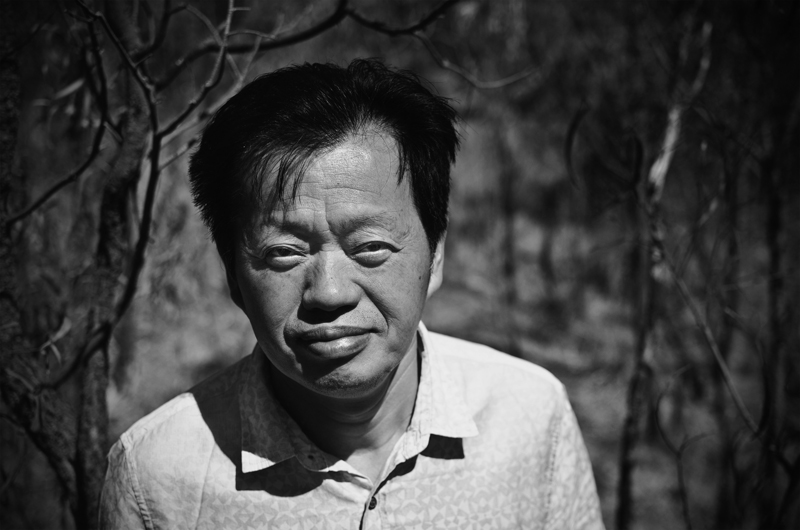
Image by Nicholas Walton-Healey.

Ouyang Yu, now based between Melbourne and Shanghai, came to Australia in mid-April 1991 and, by early 2018, has published 96 books of poetry, fiction, non-fiction, literary translation and literary criticism in English and Chinese. He also edits Australia’s only Chinese literary journal, Otherland. Ouyang’s poetry has been included in the Best Australian Poetry collections from 2004 to 2016, including his poetry translations from Chinese in 2012 and 2013, and has been included in such major Australian collections as The Penguin Anthology of Australian Poetry (2009), The Macquarie PEN Anthology of Australian Literature (2010), The turnrow Anthology of Contemporary Australian Poetry (2014) and Contemporary Australian Poetry (2016). Ouyang has to date published five English novels, The Eastern Slope Chronicle (2002), The English Class (2010), Loose: A Wild History (2011), Diary of a Naked Official (2014) and Billy Sing (2017), and four Chinese novels, The Angry Wu Zili (1999 and 2016), Land of Gold-diggers (2014), A Lonely Night Boat (2016 in Taiwan) and She (2017). Ouyang was nominated one of the Top 100 Most Influential Melbournians for 2011 as well as the Top 10 most influential writers of Chinese origin in the Chinese diaspora. He is now the ‘Siyuan Scholar’ and since 2012, Professor of English at Shanghai University of International Business and Economics (SUIBE). In 2016, Ouyang won an Australia Council grant for writing a book of bilingual poetry and a special award from the Australia-China Council for ‘his contributions to Australian Studies in China through major translations and original works of scholarship’ (for the 2000-2016 period).

This interview was conducted with an awareness of the many rich dialogues with Ouyang Yu that have come before it, such as the recent conversation with Melinda Smith at the National Library of Australia, and the four interviews conducted between 2003 and 2008 which close his essay collection Beyond the Yellow Pale: Essays and Criticism, the conversations with Prem Poddar and Steve Brock particular highlights here.1 Ouyang has also written poetry that describes disastrous interviews.2 The abundance of interviews means it makes sense to not begin (again) with the basics. By now it should be taken as a given – along with Ouyang’s importance as a literary figure in both Australia and China – his longstanding commitment to bilingual poetry, the importance of translation and self-translation to his practice, his complex drawing out of a poetics from, and between two different literary, linguistic and national cultures.3 I took this interview as an opportunity to talk about his most recent and most experimental poetic activities. Given the way Ouyang’s work persistently engages with temporality and the material text, it is fitting to note that this interview took place over Microsoft Word email attachments between Wednesday, 20 December, and Friday 22 December, with us both located in Shanghai. One of the many joys of moving to Shanghai has been getting to know Ouyang, and participating in the intensive online discussions around poetry and poetics that he facilitates through the WeChat poetry group ‘Otherland原乡砸诗群’.

Amelia Dale: Your ‘unpublishable’ poetry objects take the detritus of life as both an archive and the medium for the inscription of old, unpublished poetry. There is the voluminous ‘Living Book,’ a diary-like collage work, with fading receipts, tickets, used tissues and food scraps dated and sticky taped into multiple notebooks. Then, there are the ‘Poetry Coffins’, where empty tissue boxes and toilet rolls are stuffed full of inscribed cigarette butts. Then there are the fruit peels, which are similarly marked with old poetry and are kept even as they begin to stink and rot. When did you begin writing poetry on surfaces beyond paper? And what do you see as the end point to these projects, if any? Is ‘Living Book’ a life-long project? Will the inscribed fruit peels be stored until they turn to dust?

Ouyang Yu: It’s a secret business. It all started with my handmade books that go back to early 2003, around the time when my brother Ouyang Ming died, a Falungong practitioner, as a result of persecution meted out to him. In fact, the very first self-made / handmade book of poetry in Chinese is my《B系列》(Cunt Sequence),that I published 10 copies of under Otherland, which is a controversial book at the time and still is, the parts I’ve put on my Sina Weibo having been removed by the authorities. I have since moved onto other things, things that you’ve seen part of and described in your question.

The ‘Living Book’ is later, a few years after《我操》(I Fuck), another handmade book I self-published in 2003. I’ve made many of them, all based on my idea of ecology and time, and the perishability of flesh, and traces of living. And, of course, the unpublishability. Who would ever publish them? If so, how? And also the connection of poetry to art, to perishable objects, such as the fruit peels that turn to dust, along with the Chinese characters or English words written on them. The sadness of life. The sending up of all those aimed at success. It’s an ultimate expression of failure. The meaninglessness of life that is rubbish that is life.

AD: These preoccupations with time and perishability are also there in your recent poetry collection《乾貨:詩話》or Dry Stuff: Notes on Poetry (Otherland, No. 22, 2017). There’s the leaf litter cover art, which like many of your photographic poems posted on social media, magnifies a writerly detail in dirt. And yet if the phrase ‘Dry Stuff’ evokes these issues of poetic materiality and staling, there is also the other part of the title, ‘Notes on Poetry,’ 詩話 (shīhuà), a Chinese textual form with an old history. Why did you choose these textual ecologies for your book, and how did you modify the conventions of 詩話 for your purposes?

OY: Having got tired with academic writing, which to me is literally deadwood that helps the academics get on their social / academic / professorial ladders and that few bother reading after it’s published and kudos are won, I return to the old Chinese form of poetic critique, ‘shihua’, hua as in shuohua (say speech), almost oral notes on poetry, in a very spoken manner, all fragments, long and short, to the point and with references made to all sorts of things. The two volumes of 《乾貨:詩話》or Dry Stuff: Notes on Poetry are exactly that, that also incorporate different genres of writing, academic, fictional, poetic, nonfictional, diary, pen-notes, and bilingual from place to place, written on a daily basis, that has been going on for more than six years since mid-2011. The only thing I did is I remove all the dates and places where I wrote the entries, so to speak, spanning continents and countries.

Why ‘dry stuff’ (ganhuo)? It’s a Chinese expression that means stuff that is not wet, timber, if you like, or firewood, which is why it was rejected by the head of a journal after it had taken it and why it’s not accepted for publication anywhere on the mainland China except bits and pieces here and there.

AD: On a larger scale, dexterous shifts between different writerly forms are present throughout your body of work. As a novelist, essayist, academic as well as a poet, how do your different practices inform each other, especially if you’re working on multiple projects at once? If you are in the middle of writing a specific novel, say, does the novel lead to related poetry? Does the poetry help write the novel?

OY: Fiction, nonfiction, poetry, biography, autobiography – the list goes on – are all but forms or genres, containing ideas, thoughts, traces of life, of people, of things experienced. They might as well not have existed for me. But they do and cross each other all the time. I write poetry in the middle of writing a novel, for example. Indeed, I write poetry everywhere and any time. Recently, I wrote on a leaf of a tree near the lake where I live. I can still find it, growing with the leaf. And poetry sometimes forms the basis of fiction, becoming its core. A novel is too wordy. Why do we live a life and read another life while wasting the life we are living? Much of the fiction we read today is just words, helping one waste one’s life faster. I write poetry when I translate a book of criticism or nonfiction, too, as the form of found poetry helps that happen more conveniently. If the words, translated by me into Chinese or English, make poetic sense, I turn them into poetry. And that’s already mixed flesh of two languages via translation.
Posted in INTERVIEWS | Tagged ,

‘Myth is not merely decorative’: Prithvi Varatharajan Interviews Michelle Cahill


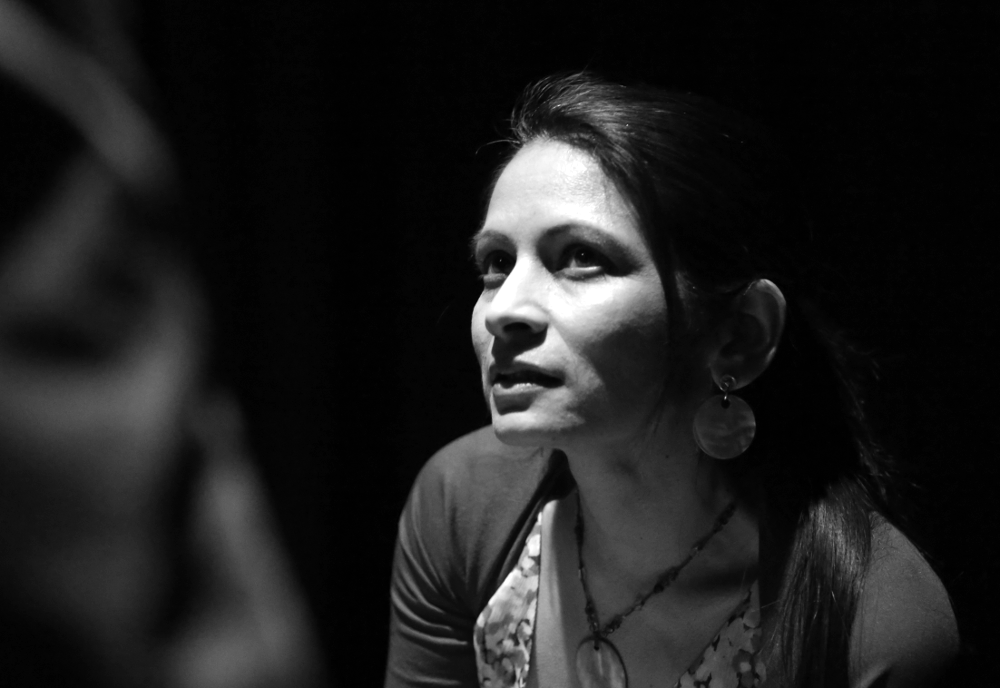
Image by Leila Schubert

Michelle Cahill is an award-winning poet and fiction writer and editor of Mascara Literary Review. Cahill has won the Val Vallis Award and the Hilary Mantel International Short Story Prize. Her debut short story collection, Letter to Pessoa, was published by Giramondo Publishing in 2016, and won the NSW Premier’s Literary Award for New Writing.

Her new book of poems, The Herring Lass, is published by Arc. She is a Doctoral Candidate in Creative Writing at the University of Wollongong; her research interests are in metafiction and the Anglo Indian diaspora.

The subject of my interview with Cahill is her second book of poems, Vishvarūpa, which is a highly unusual book by a contemporary Australian poet. In Vishvarūpa Cahill reanimates figures from ancient Hindu mythology. Cahill takes Hindu gods and goddesses and drops them into suburban Sydney, and into various Indian cities. The poet adopts the voices of Hindu gods in the first person, in poems such as ‘Pārvatī in Darlinghurst’ and ‘Laksmi Under Oath,’ and writes them into poems in the third (‘Hanuman,’ ‘Sita’). Vishvarūpa is an experimental rendering of myth that is well known, in its conventional form, to Hindus, but would be relatively unknown to the Australian or Western reader; it contains a comprehensive glossary for this reason. The book draws on the Mahābhārataand the Rāmāyaṇa – Hindu narrative epics – and philosophy and scriptures in the Vedas. Cahill’s own background is Christian, as she tells me, although her ancestors were Hindus before India was colonised. As such, Vishvarūpa is the poet’s attempt to reconnect to a Hindu tradition that is in fact part of her heritage. Cahill has Goan-Anglo-Indian – or Eurasian – ancestry, and cultural identity is a prominent theme in her work.

I wanted to speak to Cahill about Vishvarūpa in particular because it is rare for an Australian poet, not to mention an Anglo-Indian, to engage deeply with Hindu mythology and philosophy in their work. While the artistic practice of adapting Hindu mythology is common in India, particularly among Hindus, it is uncommon in other countries and among other peoples. The contemporary Australian poet Susan Hawthorne embarks on a slightly different mythological quest in her 2011 collection Cow – which focuses on mythology around the figure of the cow in India and in ancient Greece, and is told through the perspective of a cow named Queenie. In our interview Cahill also mentions a few contemporary diasporic Indians who have reworked the Hindu narrative epics. We spoke about a range of subjects in relation to Vishvarūpa, including cultural identity, feminism, and travel, but with a particular focus on Cahill’s poetic adaptations of Hindu mythology in the book.

Prithvi Varatharajan: Firstly, could you tell me more about the title of the collection, Vishvarūpa, about what it means in Hindu mythology, and why you chose it for the name of the book.

Michelle Cahill: Vishvarūpa means infinite forms , alluding to the manifestation of Krishna when he appears to Arjuna. Actually I’d been considering the title, (In)visible World because the poems engage with myth and with art, but there was something very appealing about not using an English word. It may be conceptual but it suggests an alternative to a theoretical or Western identity. Vishvarūpa embodies script, sign and otherness into possibilities which cannot easily be imported or incorporated as exotic. I think of it as non-binary. The word markedly varies from the Sanskrit to the Romanised contemporary translations: for example it might be written as ‘Wishwarūpa,’ or ‘Viśvarūpa.’ Also, because of typographical limitations I was not able to use all the diacritics according to the International Alphabet of Sanskrit Transliteration (IAST) standards. So I think this speaks to the way in which, when we name something, the signified is unstable and inevitably subject to change. In using this title as an Anglo-Indian, and as a Goan-Anglo-Indian, and in using a Sanskrit word, which is also a modified Hindu word, and making it my own … that was decolonising. The diacritics in Vishvarūpa are variant and experimental. It was playful and empowering for me to follow a trace of language, the shadows of identity. For me, it is a trace …

PV: What Hindu literatures do you engage with in Vishvarūpa?

MC: The main literary text that I engaged with is a translation of the Bhagavad Gita by Christopher Isherwood and Swami Prabhavananda. In length it is about 700 verses long and much of it concerns a dialogue between Lord Krishna and Arjuna. On the eve of the battle at Kurukshetra, Krishna speaks to Arjuna that there are two paths to spiritual realisation: the first being a contemplative path and second being an active path. He advises that if you follow either of these paths to the end they lead to the same place.

I was curious about this because I had written about perception and about Buddhist meditation in my first collection, The Accidental Cage (2006). In Vishvarūpa, I wanted to bring focus to a more active and a more rhetorical spiritual practice than Buddhism, and how the Hindu pantheon engages different energies. Krishna advises Arjuna to go into battle and commit a crime of domestic violence, to slay his cousin. So the notion that sometimes we have to be offensive as well as oracular, in poetry and in writing and in our real lives – that was compelling to me because it leads to the paradox of impurity, probably best described in the poem, ‘At West Head.’ Questioning cultural ‘purity’ becomes one of the deeper energies that runs through the book as it navigates through the relations and facets of post-identity. And there are some Portuguese words interjecting with English, such as ‘balaidera’ and ‘varandah,’ filtering linguistic fusions through the verse.

PV: Can you explain where the Bhavagad Gita sits within the Mahābhārata?

MC: I am not an expert on the Mahābhārata, or Sanskrit texts. Neither am I a third or fourth generation ‘almost’ Brahmin Hindu. I reject a fixed identity or a caste. This book is about retracing my own deracination or separation from a non-material episteme that would have been a way of life for my ancestors in an unrecorded history. Colonisation’s ruptures are temporal and cultural; a conversion to a Christian and Westernised spirituality and social practice most impacted those of mixed ancestry. Conversions were inevitably for political reasons in the seventeenth century when the British were competing with the Portuguese and the Dutch for stakes in India. Vishvarūpa is about traveling back through myth and memory to reconfigure a partially imagined and a partially real identity, from what is basically an identity crisis. As a poetic text it invites a documentary as well as an imaginative reading.

My research involved reading some books but mostly I read online. I did compare the Sanskrit transliterations, with some scrutiny. I thought about how I could use transliterations in the book; what they could signal in terms of a language being absent; how the linguistic element could be reconfigured as motif. There is a manipulation of these aspects, which shapeshifts and liberates the colonised speaker, stemming from the watershed between myth and history. That is the point I make in the poem ‘Reading the Mahābhārata’: that myth is not merely decorative. Like historical fiction, it has the potential to inhabit archival gaps. In the last stanza there are echoes of Keats’ ‘Ode on a Grecian Urn,’ a poem which inhabits the liminality of ancient, unearthed pottery.

PV: What I was getting at is that the Bhagavad Gita is a philosophical tract within the Mahābhārata – which is this epic story set on a battlefield – isn’t it?

MC: Yes, that’s right. So Arjuna has to go to war to kill his cousin, and that’s when he has this crisis. Lord Krishna appears to him, and reappears as a cosmic, with a myriad of different faces, with snake heads and halos. It’s described as ‘many mouths and eyes, and many visions of marvels, and ornaments and weapons’. And the incident is where I took the title of the book from. It sparked something for me about the tensions and ambivalences within identity, and also about inherent possibilities, the latent multiplicity in consciousness and in objects. That’s something I am interested in theoretically as well, in my writing.

PV: In my reading of the collection, I also saw the word as a metaphor for postcolonial identity. These many forms in one that you, Michelle Cahill, might have. I was thinking that you as a poet, and as a person, might have these masks that you adopt at different times: as an Indian, as an Anglo-Indian, living in Sydney and drawing on various cultures. Does that chime with what you were thinking?

MC: Not deliberately. I wasn’t thinking of myself. I am not a confessional poet. However, I have been interested in diversity and hybridity in my work, as an editor, as a writer. And I continue to think about the contradictions in contemporary Australia. What is my relational position as a migrant Indian to this culture? Going by last year’s census, our demographics are convincingly multicultural, but our literary identity has remained fairly homogenised. Furthermore our poetry until recent years has been almost exclusively white, a settler poetics. I would say Australian poetry is even more elitist and biopolitical than Australian fiction. So I was interested in the mythological tensions that provoke a working concept of belonging. Using a non-English word, which happens to mean ‘many forms’ was a small provocation as well as a unifying theme.

PV: Some of the poems in Vishvarūpa have a feminist voice that emerges through mythic figures like Pārvatī and Sīta. To what extent would you describe Vishvarūpa as a feminist retelling of ancient Hindu stories?

MC: When I started to write the book I decided to write through the lens of Hindu divas. I think my ‘Kālī from Abroad’ and my ‘Laksmī Under Oath’ are punchy. As I became more skilful and more comfortable with using the myths as a space for writing these personas, I could see that there were endless possibilities. And so poems like ‘Pārvatī in Darlinghurst’ and ‘Durgā: a Self Portrait’ did emerge out of philosophical ponderings on gender. And yes, I think it’s definitely a feminist version of the Vedas in that regard. Pārvatī is supposed to be the ideal composite to Shiva, the perfect wife – obedient and passive. This gets subverted, so Parvati takes authority of her self-image, rejecting the controlling element in romantic love as misogyny. The humour is also assured and scornful.

I wanted to return the idea of the Hindu goddesses being powerful, not merely because they could perform acts of great courage. I wanted to give them erotic agency, which is something that frequently gets missed in Western representations of women from the global south. In many textual and filmic representations, Indian women, and more generally speaking Asian women, may not be positioned to express their own desire. They may be the object of desire – they are often commodified or exploited – but not always able to express desire. This limits their subjectivity. And yet, despite horrific gender violence, I felt that India is a matriarchal society and women can embody independence, and I wanted to show how the erotic element is something they can own, and don’t have to be owned by. But I don’t discount gender violence, which is a daily experience for women in India. A poem like ‘Sīta’ laments a culture of caste and gender abuse: the goddess is a trans female ‘more outcast than dalit, bhangi or dhobi.’

Posted in INTERVIEWS | Tagged ,

Sandra D’Urso Interviews Fiona Hile


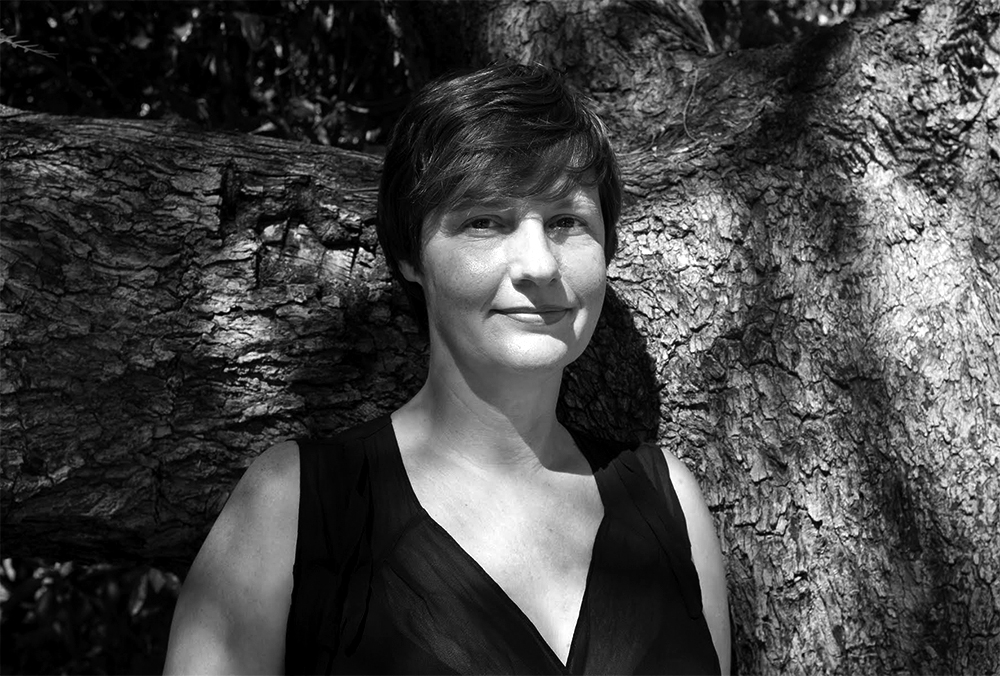
Image by Charles Bickford.

Fiona Hile is an award-winning contemporary, Australian, poet. Her first chapbook of poetry, The Family Idiot (2012), was published by Vagabond Press. Her full-length book of poetry, Novelties (2013), was published by Hunter Publishers and won the 2014 Kenneth Slessor Prize for poetry. More recently, her book Subtraction (2017), also by Hunter Publishers, won the 2017 Helen Bell Poetry Award. Hile was also runner-up for the Overland Judith Wright Poetry Prize for New and Emerging Poets.

To read Hile’s poetry is to encounter what it means to be a desiring subject in a contemporary world. Her use of vernacular recalls and transforms the details of everyday life, while gesturing toward the grand themes of a European philosophical tradition, including the problems of love, of being a woman – in the broadest sense – that of desire, the dialectic, the universal, and the particular. Her poetry is as disarming as it is humorous and inventive, reminding us of the movements and counter movements that define the twin-experiences of pleasure and loss. This interview was conducted in 2015, with these themes in mind. It is part of a larger project led by Justin Clemens, titled, Australian Poetry Today.

Sandra D’Urso: Do you think about objects in your poetry?

Fiona Hile: No, I kind of hate objects, in a way. I mean I love how people relate to objects rather than objects themselves. I don’t hate objects; that’s too harsh.

SD: Yeah, but there’s a discourse around objects that can be dissatisfying, or annoying?

FH: Yeah, it is a bit depressing, even though it’s so important and endemic. I feel like I’m lying now even as I’m saying this, but …

SD: Is it a bit like truths need to be told because there’s a recording device?

FH: Probably I feel more like lies need to be told. I’m reading Kant on phenomenology, about the apprehension of the object and I know how important that is but I find that it ruins something for me if I find out too much. But then finding out about it and not understanding it is good as well, so I guess they all go together. I’ve just been trying to fix up one of my thesis chapters; it’s about the dialectic, and I feel like all I’m doing is proving the dialectic by what I’m saying: Why am I trying to reincorporate what I don’t like about it?

SD: Yeah, so by trying to disengage from it you end up reproducing the very thing …

FH: Yeah, like my mistake is incorporated as a pathway rather than what could be reconfigured.

SD: What’s your thesis?

FH: Well, the other day I just said to someone, ‘Oh, it’s about feminism and philosophy,’ and they seemed quite happy with that. And I guess it is about that. I mean, I hate to make things about the one thing, but my supervisor said about three years ago, ‘Well, why don’t you just make it all about love?’ And I kept going for three years resisting that idea and thinking, ‘No, that would be too helpful’, but then recently I rewrote the introduction and made it all about that, and it just works a lot better because feminism and philosophy, that’s where they meet, I guess.

SD: Yeah, they intersect at the point of love?

FH: Yeah, well maybe that’s what they’re fighting over. I mean feminism is philosophy, I guess, so … it’s more like, because it’s a creative writing thesis and it’s about novels …

SD: Which novels?

FH: Houellebecq’s Atomised and Coetzee’s Elizabeth Costello. Anyway, I get a lot out of all of that stuff, all of my misunderstandings and frustrations get worked out through poems.

SD: So, the frustrations of working with the philosophy and the theory feed into your poetry …?

FH: Yeah, not being able to understand it and seeing myself in it too much. I put myself into my philosophy reading as a little case study, so that’s how I understand the ideas, is through my feelings, which is why it’s so laborious. You know, especially when everyone else focuses on the words and the ideas; but I end up getting a lot out of it for the poems for those reasons; that’s just how I think through things.

SD: Even when I’m reading theory and philosophy and then writing there’s a sort of embodied process to it, so there is a sense of filtering it through an internal or emotional landscape …

FH: You do that?

SD: Yeah, I feel like I do, and then I adapt it, or clean it up so that it reads like an academic piece.

FH: Do you feel like that takes a long time?

SD: Yeah, it does take a long time; I do lots of drafting. But I wonder, does poetry give you an opportunity to break with the particular demands of theory and philosophy, sort of like a radical act of departure? Do you feel less compelled to clean it up or make it verifiable in a sense?

FH: No, I feel like it’s more clean, I have to clean it up more and it’s got to be more rigorous than prose. The doctorate is a genre that you just have to slot into. So, there is, on the one hand, with poetry, that freedom of I can do whatever I want, but you can’t really.

SD: Yeah, it’s still a form.

FH: Yeah, and even if it’s not a form it’s still a form of not being a form, but because of that there has to be some other kind of intensity or rigour sustaining what it’s not.

SD: That makes perfect sense now that you’ve said that.

FH: But as to what that is, you find out on the day or something.

And also, I lament daily that I find that is also the case in the PhD genre as well because otherwise, if I knew what the hell it was I would have just done it. I have friends who say, ‘Yeah, I read so and so’s PhD, and I went, ‘Oh, is that all they want?’ And then I just did it.’ And I’ll be, like, ‘What?’ Did you ever feel like you’re always sitting down to a new impasse or something?

SD: Yeah, always.

FH: Yeah, same here. In fact, my thesis is about the impasse, in many ways. But it’s so hard, it just makes me think I’m not sure that everyone has to go through that. Maybe they do, but maybe everyone’s got a different relation to the impasse, of course.

SD: Are you finding out what your relationship to the impasse is?

FH: Yeah, and when I feel really bad about it I then think, ‘Okay, you really found that out, and that was a good thing to find out.’

SD: Do you have an example?

FH: Well, it was about the universal and the particular. I didn’t feel like I had a conception of it, and that made it really hard for me to write longer pieces of fiction because I didn’t have any control over those ideas. I remember once I was trying to write about this artist, Philip Hunter, whose paintings are very multiplicitous, and I wrote something just by following the movement of the paint, and I sent it to Ivor Indyk. He used to have this journal called Heat that he put out through Giramondo. And he wrote back saying, ‘This is great but there’s got to be more to it than just multiplicity.’ And I thought, ‘What is he talking about? What does that mean and why is he trying to deny me this luxurious proliferation?’ That set me off on a path of having to find out what he meant, and I remember actually being in Oxford because we went over there for my husband’s work. We were walking along and I think I wrote it down thinking, ‘Wow, that thing I don’t understand.’ I had a little one-year-old and a three-year-old at the time. I thought, ‘That thing that I don’t understand about what he meant is the problem of my whole relation to the world.’ And also, the problem of why I don’t know what to do with this novel. And then once you start getting more into philosophers like Hegel, you realise, ‘Oh, well that’s everyone’s problem.’ So I’m really glad, even though it’s been monumentally difficult and terrible, I’m glad that that became my path because if it was a different set of circumstances, a different supervisor, who would have let me just cruise through because I had a facility with words, I could have just gone on saying anything forever, and I could have maybe gotten away with that.

It’s like the realisation that you keep having to have, so that was just the first time that it occurred to me, and that was eight, nine years ago, and I’ve been struggling through that ever since, wishing it wasn’t so, maybe. But I never used to write poetry then; I’d written skerricks of poems in my life. And so, poetry is something that just happened four years ago.

SD: What was it that prompted you to start writing poetry?

FH: … I remember someone had an office over in the Cinema Studies Building, you know that really old gothic looking one? It was Josiane Behmoiras. She said, ‘Do you want to use my office on weekends?’ I remember sitting in this great big lofty room and despairing with my thesis and finding poetry more soothing. I discovered I needed to write poems; not poems, just one poem that I’d write and then scratch out every word so it was gone by the end of the day. And that would be my day. So, I was doing that and then one night I went to a party, and Justin Clemens was there, and Michael Farrell was there and I had seen his stuff in Heat, that journal I told you about, but in its short story form – you know how he writes those really long prose poems? He used to write them ages ago. I remember seeing one 10 years ago and thinking, ‘That’s like my writing. Why aren’t I allowed to publish things like that?’ And then I saw him at this party and I got talking to him, and we had that discourse in common, so we could talk about stuff that wasn’t just about poetry. But then this other friend of Michael’s called Sam Langer who lives in Berlin now, he came up and we got chatting and they were saying how they had a poetry group and then Sam said, ‘You should come to it.’ And I’m like, ‘Okay.’ But it was one of those moments where it might not have happened if the conversation had gone down a different track. It was really like a blip, a glitch. And so, I did end up going and there were a couple of other people there, one of them was Corey Wakeling, one was Melinda Bufton, and they were also new at the poetry group, so we all bonded. And a bit later Ann Vickery came along. She teaches Poetry over at Deakin. By that time there was quite a lot of frenetic energy around the people in the group, and we were all trying to impress each other and have fun and make each other laugh.

It was kind of spontaneous and un-programmatic, apart from the program of coming to the group, and no one really said anything about what you read; if they did it was kind of dorky to do that, you know what I mean? Like, ‘Come on, we’re not at school.’ So, all of us produced a book each by going to that.

Posted in INTERVIEWS | Tagged , , , , , ,

ten atmospheres


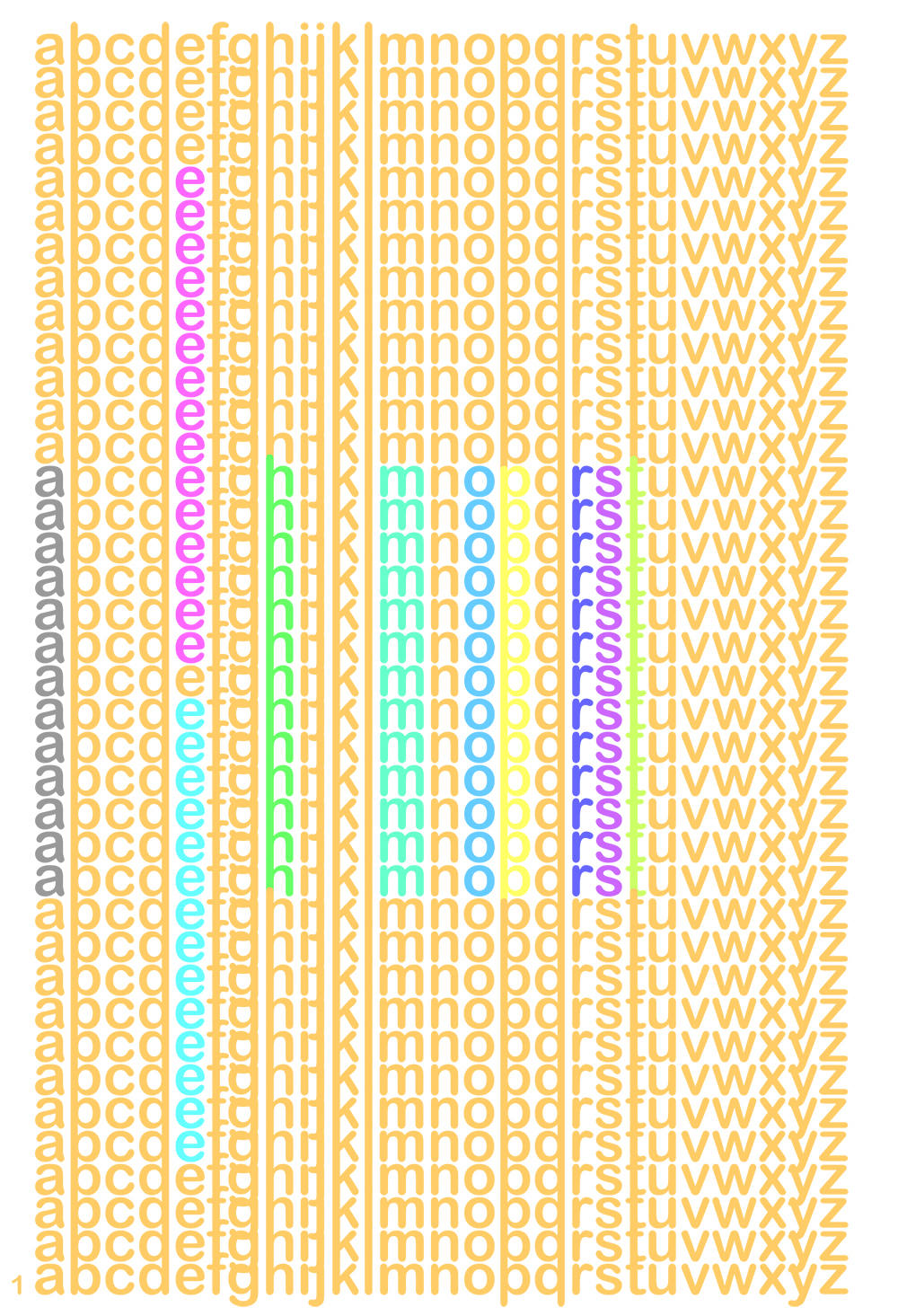
ten atmospheres | 2016 | A4 white paper, wall mount

Ten atmospheres is a graphic sequence that embeds the word atmosphere in a matrix of the alphabet. Ten letters in the word give ten pages; five have the word picked out vertically, five have it picked out horizontally. The colour sequence for the consecutive pages, and for consecutive letters in the word, is taken from the order of colours available in the modifiers of the word program. Although the patterns are visual, they are not pictorial. Instead of presenting a picture of atmosphere, the texts work on the usual convention of left to right flow, using memory and prediction as reading qualities. The reader is asked to experience what the word stands for through their reading, at the scale of the individual page and the scale of the set.

The poem has been produced using a standard word processor program, and accepting the A4 sheet size. Apart from its PDF version, it can exist as a folder of printed A4 sheets, or fixed to a wall in a long line.

Posted in CHAPBOOKS | Tagged

The Lowlands (West Melbourne Swamp)

Through boulders grey and honeycombed,
carving out a bed in time,
two rivers meet on the south west side.

The ebb and flow now
realigned.
Paved and railed.
Containerised.
Roadways hard against the tide.

To cross you, morning and at night.
Wetlands sleep beneath these lines.

I never wondered who you were – until
my sleep became disturbed – until
my feet were raw with nerves
unnamed yearning; – until
searching for a place to be.

I remembered:
water pooling in the yard,
algae blooming thick and green,
cracked soles and holes as my shoes sank
classroom cold,
June’s creeping damp.
The drain, once creek, now channelised,
rising through the night.

I wished I was the underlay:
the weave and weft of silt and clay
of saline marsh and sedge and
drift.

My carriage sways.
Trains glide along the causeway.

To cross you, morning and at night.
Wetlands sleep beneath these lines.
I cross you.

Posted in NEWER VOLCANICS | Tagged , ,

Stony Creek

When it rains
you flow by

eleven quarry holes
dub the town: Stoneopolis;
of ballast stocks,
interminable.

Blast
Chip
Barge
Ship

Your ancient bed served London well:
her pavement smooth and durable
heels low and high,
as distant feet, hooved, unshod
sink into softer clays and silt
(like mine like mine).

When it rains
you flow high
waste of wool and skin:
the scouring foam
of sulfur, lime and tan,
to hair combed half moon estuary.
Mangrove fringed
in green and white.
Backwash named
to push away
loss of tea tree
casuarina
and untold lives who passed
(this way this way).

When it rains
you flow high
long cemented sides,
reminder:
water finds a way
to this bay home.

(to this bay this bay home).

Posted in NEWER VOLCANICS | Tagged , ,

Moonee Moonee Chain of Ponds

With your reeds and your black swans
this is The Railway.

I’ve come to carve your circles straight
I’ve come to bring your edges parallel
and there: a ribbon of blue you’ll be
to carry the coal that feeds me

Will you give way?

You know the city cannot wait,
you know the swamp will soon be drained,
you know the sky will turn to road,

and yet you still resist.

(Do not give way)

Posted in NEWER VOLCANICS | Tagged , ,

Walking West

Out across The Lowlands,
drifting with the coal dust
to find
home footing.

Iron girder
railway bridge,
Footscray
high upon the lava ridge.

We reach a tidal canal:
remnant waters ephemeral,
born of floodplains
salt lagoons.
Blue rich.

Then two rivers
lined with tanks,
bluestone beaching
mouth to bank –
their confluence:
deep and wide.

We watch container ships
heavy
hypnotic
glide
(filled with sugar
built on bone mills)
beneath the western gate
that joins
silt to stone.
Brutal snake
in wake
of fertiliser sheds
gabled tight,
flaking pyrite,
furnace rooflines,
(arsenic cinders
hidden infill).
And there is the past flowing again –
saltwater
pushes and pulls
at a manmade bend.

Always there.
Past always there

signals are dark,
the river: a seam,
lights on the ridge are now hidden by
glass and steel.

But I can feel
silt and clay
meeting the bay,
depositing washing
layers.

This will soon be a layer.
I will soon be a layer.

A layer
A layer
A layer

Posted in NEWER VOLCANICS | Tagged , ,

Saltworks

Waiting on the saltpans,
watching from the high ground:
tide
tide
tide
through the traps.

Sun burns and burns
the crystals bright,
I narrow my eyes
to the glistening light.
A scatter of sodium chloride and silt,
desiccant diamonds
on silica beds.
Catalyst and cleaner
on colonial rails
to the canneries,
the abattoirs,
and later,
the oil refinery.

Sun burns and burns.
The birds return:
white faced herons in flight
black swans – I call to you.
We lie,
lied,
lie and turn.
Then walk to the edge for forgiveness
in the shallows and sea grass.

Sun burns and burns
on the western shore.
This inlet is hotter by two degrees – that’s what they tell me.

And there is the city like a cardboard cut out
linked by a bridge I crossed in my youth,
distant and grey (like I don’t even know you),
this was the entrance that changed everything.
This was the surface, now covered and carved:
the buffering edges of Skeleton Creek
the sentinel flame of the refinery

still burns
and burns.

Posted in NEWER VOLCANICS | Tagged , ,

The Orbweaver’s Newer Volcanics


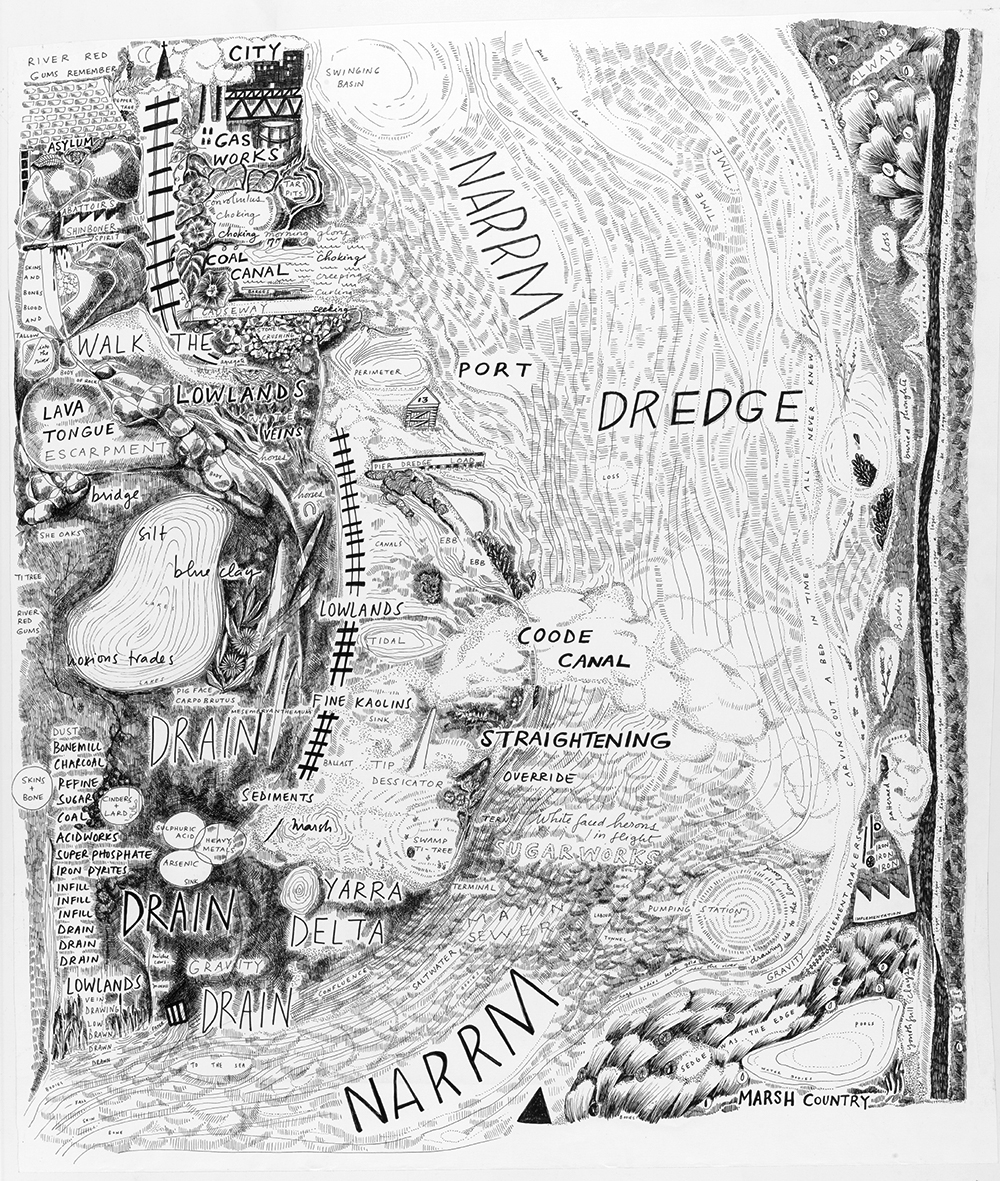
The Orbweavers | Confluence Song Map | ink and watercolour on paper | 2018

We would like to acknowledge the Traditional Owners and custodians of the land and waterways Newer Volcanics is written on, the Wathaurong, Wurundjeri and Boon Wurrung people of the Kulin Nation, and acknowledge their continued culture and connection to land and waters. We pay our respects to Kulin Nation Elders past, present, future and emerging. We acknowledge sovereignty has never been ceded.


We are researching western Melbourne waterways through the period of the late-nineteenth and twentieth centuries, to write and produce a suite of creative works which explore industrial history and environmental change over time, and the lives of people who lived and worked along their banks. This version of the project includes poems and accompanying visuals, with the aim to develop the project further to include songs and maps for later release. Newer Volcanics is the working title of our project and much of the research has been conducted under a State Library of Victoria Creative Fellowship. Our focus is on the Birrarung (Yarra River), Moonee Ponds Creek, former wetland of West Melbourne Swamp, Maribyrnong River, Stony and Kororoit Creeks, and Skeleton Waterholes Creek in Altona.


The Orbweavers: Moonee Moonee Chain of Ponds
The Orbweavers: Saltworks
The Orbweavers: Stony Creek
The Orbweavers: The Lowlands (West Melbourne Swamp)
The Orbweavers: Walking West

Note: the links above can be found on each page of this chapbook.


Newer Volcanics is a geological province in south-east Australia. It includes the country south west of Narrm (Melbourne), the unceded sovereign lands of the Wathaurong, Wurundjeri and Boon Wurrung people of the Kulin Nation. A landscape characterised by water courses carved through ancient volcanic plains, silty clays, estuarine sediments, and low lying tidal salt marshes of abundant birdlife, where creeks and rivers meet the sea. Much of the land in the inner-west has been has been paved and overlaid by post-settlement industry and transport infrastructure, but the waterways and sometimes their immediate surrounds persist, a living thread of the past and the present, a continuing flow and force through time.

I (Marita) grew up in the west, loitering by waterways and peripheral industrial sites as a teenager, taking in details but knowing nothing of the deeper histories. My family still live there, which brings Stuart and I regularly across the Maribyrnong River by Dynon Road, or over the West Gate Bridge, to my childhood home in Yarraville, or to Spotswood for work. Our fellowship project became an extension of the river crossings I have been making most of my life.

Psychogeography describes how we currently think about place in relation to our creative work: drifting through urban areas, letting our minds wander over layers of history visible as accretions and remnants; contemplating personal connections and reactions to the landscape. Walking and writing songs in this way has been part of our lives for long time, and inspired much of our second album Loom (2011), a collection of songs about the natural and industrial history of the Merri Creek in East Brunswick. We recently learned there is a term used to describe this activity, and an existing body of work citing psychogeography as a practice.

Dudley Flats: A psychogeography, David Sornig’s 2015 Creative Fellowship project at the State Library, first introduced us to the term (State Library of Victoria). David took us on a walk around the perimeter of what was the West Melbourne Swamp, and we talked about our shared interest in the area, its history, our personal connections to it. This led Stuart and I to searches on Guy Debord and the Situationists, drinking in abundant internet riches on the topic – blogs, critiques, reviews, photo essays. I had read W G Sebald’s Austerlitz (2001) a few years earlier, unaware of Sebald’s place in the psychogeographic canon, and was moved by his layers of place, history and memory described through walking, observation, archival searches, and the inclusion of mysterious – but not entirely unrelated – photographs in the text. Austerlitz provided a sombre and unnamable revelation in form and style, and in retrospect, probably exerted subliminal influence over where my creative instincts were heading.

My day job as a collection manager at a museum has yielded serendipitous waterways inspiration over the years: cataloguing a copy of Sir John Coode’s report on the Port of Melbourne engineering works, oral history interviews with employees of the Spotswood Sewerage Pumping Station, product samples from the Mt Lyell fertiliser works in Yarraville. I file these references away in my mind, making lyric notes on scraps of paper, for later refinement, investigation or contemplation with Stuart. Reference material is in constant accumulation.

Historical archives and maps are important reference points for our work – providing evidence and detail of a place at a moment in time, indicating how the landscape has changed and why. We then use this information to walk through in the present – looking out for remnants and markers. This action forges new sensory memories and emotional associations with a site, which we have found helps our songwriting process. Industrial Heartland (1990) and Worth Its Salt (1991) are reports by archeologist Gary Vines, published through Melbourne’s Living Museum of the West, which provide valuable detail on past industrial activities around western waterways. The State Library of Victoria’s digitised map collection has also been central to our work on Newer Volcanics. Copies of early Melbourne maps are stuck all over our house. We hope to slowly absorb their bird’s eye view topography in contemplative moments.

More recent publications such as Sophie Cunningham’s essay on walking the City of Melbourne boundary with accompanying photographs by Dianna Wells (Boundaries, 2016), and Nick Gadd’s Melbourne Circle: stories from the suburbs (2014-16) are works of local literary psychogeography which echo threads, sites and directions Stuart and I are exploring in our creative works.

Over the last year, Stuart and I have been walking the lava ridges and soft lowlands of western Melbourne any weekend we can. Where waterways have been forced through tunnels and industrial tracts, we jump fences, skirting tracts of colonising onion grass and Morning Glory along railway embankments, under freeways and along wire fencing, to arrive in fennel-covered edgelands of unknown jurisdiction. Psychogeography is like being a kid again, wandering the dangerous, beautiful, abandoned places without clear intention.

When we return home from these walks, we make notes and sketches. I often lay out large sheets of paper; words surface from the lake of memory, and sometimes I create new maps based on our walks.

Bone mill, charcoal, refine, sugar, coal, acid works.
Redefine, realign, carve, infill.
Samphire. Resist.

Drawing becomes a place to collapse time and space; an image to hold words. Absorbing and releasing topography and geology. Limbic poetry song maps.

The following is a meander through some of our excursions which eventually became the poems and drawings included here.

Walking through Melbourne watercourses has brought us to psychogeography, to histories and peoples, to environments and industries, and to creative spaces where we try to acknowledge the weave all these elements make. We want to acknowledge again that we are writing on land where sovereignty was never ceded, and pay attention to stories of pain as well as resistance, histories of peoples, cultures, lands and waters. In creating these works we hope to draw attention to different parts of Melbourne, and particularly to the layers that make all of us here.

Posted in CHAPBOOKS | Tagged , ,

Dressing for Paradise

I remember that time I held my mother’s hand
led her across the parkland temporarily blinded,
her infected conjunctiva spindly red;
burst open veins squirrelled about her white
opal hemisphere or sclera, her iris brown green
with a lint of gold, or hazel bewitchment.
Scared of leading her all the way to the doctor
only six years old, or thereabouts, past the play equipment
where the cross-dressed bearded man sat
drinking methylated spirits, rocking her pram
with a white poodle in it, across the busy road,
past the veterinary clinic. My mother’s
cyclopean tortoiseshells impressed me,
those oversized glasses she wore protected her
from the suns glare and gave me hope –
to go beyond the narrow confines of suburbia,
the peerless dull brick veneer houses, not as
Howard Arkley depicted, no neon splashes of colour,
or floral embellishments, only uniformity,
boxed gardens, concrete drives, fenceless plots.
My mother loved to dress up, to present herself
to the world everyday as if she were dressing for paradise.
Her expensive French silk scarves, gangster-like
gold ropes around her neck, diamond rings, fur coats.
Her mother dressed up too, sewed her own clothes,
put elegant outfits together. Perhaps,
in the spirit of Frida Kahlo who awoke everyday
to dress with such festivity, mythopoeic flair, so as
to face the divine with her chin up despite persistent pain.
My mother’s pain is like a temporary blindness,
it comes over her, she retreats into herself, goes
searching within herself for her-self-lost. This morning
I woke up with my lids stuck together, lashes-laced,
encrusted with gound from infection. From time to time
I go blind. But, I have one weapon against the dark,
a cutlass with which to sharpen myself, I wake every day
bare-skinned as a Phoebe and I dress for paradise.

Posted in 84: SUBURBIA | Tagged

The End of Men

The man on the train
the Maths 142 exam at the Showgrounds.
He had used
a Reject Shop catalogue
to form a little tent.

The man at night at the end of my street –
tall, pale, forties, blue shirt, I told the cops.
No, I did not want a patrol.

The man who made my friend at twelve
change schools.

The time late at night
on the tram 19 to Moreland, last stop before depot.
Hydraulics at the doors. A face, brilliant
smiling to the right. The elbow
going.
I got off. He was carried away
to the silence of the depot shed.
Always I wondered
what happened next.
Did he jizz all night
alone in the cavernous dark
among the sleeping trams, just jizz
and jizz?
In the morning when he tried to leave
the gates were locked.
Men began to fall
from a chute in the ceiling. First
they cried out, breaking bones, but the later
arrivals fell on the earlier, and were cushioned.
Women had had enough, had taken the world
at last. Only the tram depot
was for men now. We were building dildos
out in the world where we were free,
beautiful glistening pink dildos with no
men attached to them at all;
we had seen enough.

Posted in 84: SUBURBIA | Tagged

Breadwinner

I’m sorry, I can’t today. I have to focus on wearing my new pants. I’ll be busy wearing the pants all next week. The pants I have are a bit tight around my waistline, but I’m working on it.

Besides, I’ve got to go out and win some bread. Bread winning is a competitive industry. I hear you can win bread at the local pub trivia. Our household rent isn’t going to pay the bread by itself.

I don’t know if I’ll have time to go because I need to let out my new pants. My pants will be a great fit. I can’t wait for everyone to notice.

Although some say bread is not good. Poor form for waistline etiquette. It’s important to remember a muffin top is not a loaf of bread.

In the mornings, I roll over and turn off the alarm. Out of bed, I swiftly make my face. My hairstyle brewing, I like it dark and strong.

It’s an important day today. I’m at the business leadership awards. The collars here are all white. My white collar is stained pink from the wash. These days I only wear white shirts, stiff pants and red evening gowns. It’s annoying and wasteful to do separate loads. I hope my pink collar is taken as a fashion statement, not a failure.

‘The best thing since sliced bread’ was not an instant classic. Bread was first sliced on a mass scale in the late 20s. At the time most people didn’t like to buy their bread sliced. Aesthetically, it was considered unpleasant.

I want to get the bread out of here.

After I apply make up in the morning, I reapply at regular intervals throughout the day. Upkeep is important for topiary and rouged lips.

The roof of the Sistine Chapel used to be cleaned using wet bread. First the hand-kneaded variety, but later Wonder Bread was particularly effective. These days it is cleaned by a company, not the locals.

Bread is the latest political agent.

Posted in 84: SUBURBIA | Tagged

Deep

venetians are closing
on another small day
and you can see
i’m complicated like a conquered face
keep on keeping on and
round things roll off each other then sink
wishes come out like cockroaches
that’s midnight for you to dig
i’d climb out of this hole but i can’t feel the sides
no
that’s really something
animal
moaning like a crane
or my drizzle-soaked innards
om
all windows and no doors
no barge-arse though
i swear with my nerves
a resisted bubble
frightened by ventriloquists
and caught up in the beige apocalypse again
sigh
i keep forgetting i’m the universe too

Posted in 84: SUBURBIA | Tagged

Hills Hoist Poems

Lance Hill returned to Adelaide from the war in 1945 to find his fruit trees competing for space with the family clothes line. In his laundry workshop, Hill set about creating a rotary clothes hoist for his family that would later develop into that symbol of Australian suburbia, the Hills Hoist.

1

magpie walks in his jaunty manner
under washing and cocks his head
listening to Billie Holiday
stands still a moment as
a phrase catches his attention
and the breeze flaps
behind the beat

2

Give me a lever long enough and a fulcrum on which to place it, and I shall move the world.
– Archimedes.

3

when it comes to pegs, I admire
the craftsmanship of the wooden ones,
now weathered grey among
bright coloured plastics.

I asked an inventor
what great force held up
our sheets, underpants,
socks, shirts and bras …

he told me the great power
of the small torsion spring
was made of music wire!
piano wire! Amazing.

3

predawn birds’ chitter-chatter
dew on my bare feet as
I hug the Hills Hoist and weep
for the state of the world.

4

A Darwin family reported
that the only thing left
standing after Cyclone Tracy
was their Hills Hoist

(Wikepedia)


5

little white tufts
like old Chinese philosopher’s hair
wave above the Hills Hoist.

a small honey eater has
pecked at the fabric bound wires
to gain nest linings.

I wish him well
and smooth down
the backyard wisdom.

Posted in 84: SUBURBIA | Tagged

Traffic Calming

He pulls out to the wrong
side that morning, doubleparked
trucks tense him up
so dangerous, meat-hooked
carcasses, latched-open doors,
chilled pink in him more
than risk gritted in his teeth as
he overtakes, still he
drives heavily,
wrestles left, tyres abandon
pneumatics, grinds around
a corner too close, struggles
through the forty zone past
the high school – aren’t we all
exhausted
and over-heated
teenagers wishing
to do nothing while the world
misjudges?
We ruin our way
along the streets, how much space we take to which we are not entitled, with paper
and gum and all that language falling off us as we go
outside the bakery,
another van unfolds, trays of wheat
and yeast and bicarb and salt
cooked up around lower grades of fruit
asphalt and diesel, next hazard
for through-traffic which is him
with his down- turned mouth and flexed
lips and urge to cry, inexplicable.
If only something would explode or
tear itself to pieces or if he could,
he’s too meticulous to do other
than drive.
He recomposes,

intrusions built into little coddled streets
shaking the car this way, that, build character,
someone in council must’ve watched a lot
of stretched-metal cartoons. His car so fragile
as to scratch up
under
falling
leaves.
Trucks everywhere, nowhere
safe enough, carparks
too small for anyone.
How has it come to uncountable boxes back and forth along the highways,
this to there and that to here, so many lives taken with windscreens and squinting
and noise, he winds down the window where he
shouldn’t among the petrol stations where
fumes hurl and swirl like discount vouchers
If only he could glitch out of here for enough time
to inhale some other place before driving onwards.

Posted in 84: SUBURBIA | Tagged

Wembley Food Court

Intent on wonton destruction
we fought streets
combatted mortality
thieved grandness from auto-tuned oysters.

They sung out our numbers
saucy asked
and the sambal yams awaited deliverance.

We forgot the steam
shucked corn the color of lions
drank nettle tea
with wag-tongues red as the flags of false masters.

Posted in 84: SUBURBIA | Tagged

The Sound of Spitting

it rises in school yards

of smashed-fruit afternoons
sun peeling back day’s dazed
in Shakespeare
and Pythagoras’s theorem
when two kids use sticks
to cast spells on each other’s shins
smelling the scent of piss
from some suburban Harry Potter’s

mid-week binge, brain battering
beneath the train bridge
a trolley rattling
in the Kmart Christmas extravaganza
or a battler pulling his last cone
and melting into re-runs of The Simpsons
i’m talking layman’s terms
the sound of spitting
how it is to be out here all free

amidst the BP fluorescent green
considering the sun as a razorblade

cutting through thin crust

as we sit at the water’s edge
and watch as we roll
like lorikeets opening locks
with their beaks

and leaving us as digital brumbies
to be rode through a golden soil sunset

and isn’t that just the way it is

English riding train carriages into obscurity

only to get lost in that giant apricot
sitting on the lawn
or if that is just it, to wonder
as an Illawarra train sings
the Average Joe electric

breaking the windows
of the most religiously
worshipped Westfield

Posted in 84: SUBURBIA | Tagged

I Want to Look Like the Girls in the Mail Order Catalogue

Posted in 84: SUBURBIA | Tagged

Willesden Nocturne for a Retired Nurse

When you open your midnight door

fishing for sound you hear

the scrape of a snail

the frame fills with the head of a fox

your eyes meet

Do you then plant a stethoscope

on the throat

 of a wren

feel for the pulse of the glacier

 grinding its way to the future

 or track the thrum
of a lone motorbike rider under colliding stars

scanning lit streets

 in the hope of sighting injured mammals
deep in open-cut screens drowning in tea

blinded by the glare

of the jewellery channel?

Posted in 84: SUBURBIA | Tagged

Plath Close

There are Tennysons everywhere but only one street in Melbourne is named after Sylvia – Plath Close in Delahey, 13 F 6 – a cul-de-sac above Blake Close and Slessor Drive, below Raine Court, east of Yeats Drive (Tennyson Drive curves further south). A little north run a few Olympic gold medallist slash celebrity athlete streets – Hackett Court, Perkins Close, Currie Drive. West is a row of crops and southwest a pocket of stones. In Feb 2014 a Google Maps van camera drove by Plath Close capturing empty nature strips, cement footpaths, low or no fences, concrete driveways and browning lawns, closed gates, blinds drawn against heat or spies, and conifers, conifers – dwarf, pencil, cedar – pitched-roof white letterboxes perched on white poles, a freshly planted low-maintenance garden of rock mulch and astroturf and, from the close’s corner, the spire of a ‘215m high’ aerial. Delahey is off the Calder not far from the Bob Jane raceway where Gunners once played – the nearest stations are Watergardens or Keilor Plains. One day I will take my bicycle on a train to visit Plath Close.

Posted in 84: SUBURBIA | Tagged

His Murder in Four Movements

movement i

teen bodies on warm bitumen
legs in shorts in the sun drenched quad
she was my wild one, my brightly burning cloud

together driving fast through pine plantations
creeping into the burnt out observatory
gazing through the glassless dome at the stars
a universe that can’t look any closer
burning through our eyes

testing ourselves
against a shifting measure of
something I can’t even guess at

the summer we turned seventeen
heat bent our bike spokes
so we stripped down to swim in the lake weed
that bent around each limb

the summer we turned seventeen
we cut down feral pines
ran a Christmas tree racket out of the church car park
until they caught us out
chased us away running
lake weed streaming from our skin

Natalie Wilson and I
growing up rollies
on the edge of a stormwater drain
underage gigs
pop-punk clothing
black t-shirts, ripped jeans

and late one night
a needle, an ink pot
slight resistance and a stick-poke tattoo
three lines hinting the shape of a triangle

she never said what it meant
just that it reminded her of things


movement ii

news headline
Man found dead had multiple stab wounds

when I saw his photo
my pulse moved to my ears
I knew him without reading his name
they chose a shot from high school

light skin and freckles
thin red hairs

I remember him leaning
over the desk with blunt scissors
scraping back curls of wood
his fists in the mosh pit
black t-shirts, ripped jeans
he was everybody’s last man standing

it’s been a decade
I can’t remember if we said ‘hi’ in all that time

it was evening before I heard
how many times he was stabbed
there’s something visceral about that number, seventeen


movement iii

after the first reports there’s silence
no answers instead
months of waiting, wondering

then Natalie Wilson is arrested

the shock is hard and fast in my chest
my wild one, my brightly burning cloud
the burnt kitchen knife under her house
at first it’s no and then it’s yes

my head goes around and around with it
she’s accused
I think she did it
I have no evidence
she hasn’t been convicted

she’s accused
they found the knife
it couldn’t be her
they’re holding her
she’s going to trial

my memories of her body are
all teenage freshness
all strong tanned legs
lipsmackers
swimming carnivals
impulse deodorant
there’s something visceral about that number, seventeen

I wake into 2am confusion
night images visit me

her body, warm muscles
my memories curled up against her
sleepovers and movie marathons
whispered conversations

her body empathetic to mine
gasping pleasure
lips to cheekbone slip
hands to back bone pressed
hard like winter air

her body with that knife in her hand
four arms, limbs pushed together
the smacking of meat
seventeen times through the chest

and    I’m    fucking    appalled


epilogue: modern ritual

after she’s convicted I don’t visit her
time will not set her free

I run scenarios through my head
late at night like psalms

on Tuesdays I want her punished
embalmed and un-forgiven

by Wednesday all I know is her humanity
I perform sacrament in my mind at these times

I take her body
lay it down upon the kitchen table

wash her arms with warm water
a steaming wet towel

wash her legs, her feet
rub between her toes

brush out her hair
place a silk scarf over her eye sockets

I whisper to her that I trust her
I whisper that I will never forgive her

I lay her humanity down
stark against the kitchen tiles

Posted in 84: SUBURBIA | Tagged

Car Park Crows

Their eyes are steel sequins
fixed with a dark tack
gripping down on soft plastic handles
of deserted supermarket trolleys.

Sitting out of chrome cages
preying on what’s remained
as rubbish, the gun-metal gaze
waits for something to click.

They hold in their stare
a whole expanse of black asphalt
beneath which nothing pulses:
dead earth. They will not shift

for busy shoppers, and know what
ancient rules can now be ignored
or broken. A taming of opposites.
They give no ground. Still rule

the roost. Suddenly wings and flight
to scrappy gum tree branches.
Evening sharpens wind to cold:
all beaks and claws.

Posted in 84: SUBURBIA | Tagged

Icon and Iconoclasm

Lachlan Brown called, in an interview with Fiona Wright, a quote from
my essay The Suburban Problem of Evil his favourite one on
the Suburbs: saying I said, “nowhere else can the eternal
and the eternally
reversing dialectic between icon and iconoclasm be so sharply
observed,” or something like that’, and, without my referral
to source (me), that does sound accurate. I live where the lights
from the Mountains, the glittering or fog-lost Glenbrook Gap,
horizon the trees that hide the far Nepean, with a long
foreground of streets where cardboard houses orientally cling
low to the earth like children in between, like children
playing a game in a ring, aeroplaning close again,
shrilly, to the strange familiar earth. My vast veranda
creates ghosts and spirits, asks them until they answer,
but none answer the same, and in their courtly structure
function to contradict themselves and then each other,
providing fruitful conflict for the centre. Moonwild above me,
squealing with summer, the flying foxes in the rubber tree
squabble and fuck and seem to bounce their siblings
up and down the steel roof like gremlins. I am thinking
of Yeats’s ‘The centre will not hold’ and, God, mine hasn’t. I
hope I have more luck with the bowing roof, since my
chair swing is attached to it and shaking. I am at this time
uneasy anyway about the suburbs. The great religion
of overseas travel has descended on them like a filter
with picturesque colours, every concrete curb and corner
a Women’s Weekly World Discovery for Fine Writing. I do not
know how far this penetrates the core: long insurrection.What
I wrote tested innocence, violence, and they crucibled together
in perpetual furtive catalysts as rhythmic as this weather,
as unprepared. The suburbs are never plainly seen. Their reverence
– the icon –
only ornaments their experience. They change ornaments
like holy diction but to distance from their dead:
iconoclasm.
The sky is bled.
This grey roof holds alone.The moon becomes the sun.
Reversing magnets, to their caves, the river’s bed,
the flying fox spin home. __________________________

Posted in 84: SUBURBIA | Tagged