Tina Giannoukos Reviews Notes for the Translators from 142 New Zealand and Australian Poets

N4T

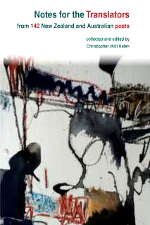
Notes for the Translators: From 142 New Zealand and Australian Poets
Christopher (Kit) Kelen and Jo You Chengcheng, eds
Association of Stories in Macao, 2012

Notes for the Translators from 142 New Zealand and Australian Poets steps into the fertile territory of literary exchange. It is a welcome invitation to poet-translators to immerse themselves in the work of contemporary Australian and New Zealand poets.

Continue reading

Posted in BOOK REVIEWS | Tagged ,

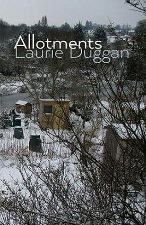
Review Short: Laurie Duggan’s Allotments

Allotments

Allotments by Laurie Duggan
Shearsman Books, 2013

In 2012 Puncher & Wattmann published Laurie Duggan’s serial ‘Blue Hills’ poems in one collection. The ‘Blue Hills’ – a sequence that first appeared in Duggan’s The Great Divide (1985) and then reappeared intermittently through a number of subsequent books until being brought together in The Collected Blue Hills – are notational works concerned with the idiosyncrasies of place, or perhaps space, depending on one’s theoretical allegiances [if any]. Continue reading

Posted in BOOK REVIEWS | Tagged ,

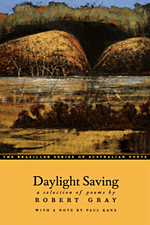
Review Short: Robert Gray’s Daylight Saving: a selection of poems by Robert Gray

Daylight Saving

Daylight Saving: a selection of poems by Robert Gray
by Robert Gray. Paul Kane, ed. George Braziller, 2013


In ‘Minima’, Robert Gray writes that ‘the senses can mislead us, / … when we rely on only one of them.’ Gray himself is in no danger of being misled. The dimension of synaesthesia in his perceptions has been widely noted, but it manifests itself in this collection as something both chronologically prior to, and conceptually broader than, the apprehension of one sense through another. In these poems, the synasthaesic crossover is on a continuum with other comparative and synthetic impulses: not only does he compare, for instance, ‘bird-song’ to ‘wandering lines of wet paint’, he also observes how the same shapes emerge in objects of different substance and scale, how the same ordering principles work in divergent contexts: ‘the wind paths, beyond the breakers, run out / across the water, / sinuous and spreading, like the arms / of the open eucalypts.’

In his forenote, Paul Kane explores the Buddhist inflections of Gray’s figural thinking, reflecting that the work of juxtaposition, apposition and comparison in his poetry is grounded in a Buddhist sense of underlying shared qualities. Rather than creating externally-imposed connections, his poems are ‘moments of revelation or unconcealment’. While the collection is aimed at American readers, this sense that the comparisons he draws existed prior to their poetic articulation is part of the book’s particular power for readers familiar with the places described.

When I saw the landscape around Guilin city
And realised it was still as the painter Xi Dao had known it,
In the T’ang period, I feel suddenly exulted,

The source of the exultation is the accord between the personal experience of a world and an artistic representation of it, and this same process, in reverse order, animates the reader’s encounter with Gray. It is not simply that Gray’s observations match our own: in the most interesting cases, we don’t have anything there to match. What Gray does is render explicit those impressions in us which might otherwise remain unconscious or inchoate. His description of the Australian landscape mounts a freeze-frame over our unedited reels of memory, bringing to our attention the moments we didn’t know to record.

This poetry of the ‘momentary mind’ is one of tremulously alive, circumscribed scenes: we usually know what time it was and what the light was like. What is particularly striking in Gray’s annotation of perception is that the poems often house dramatic juxtapositions in poised, grammatically intricate phrasing. In ‘Home Run’ the description of the view on the North Coast Line emerges in calm chronological order, its astonishing images scalpeled into diligent prepositional phrases: ‘The sea / is as blue as ink, or as a dye, newly pulped, / from out of which a great billow of fabric has been lifted, / the slightly lighter sky’; ‘there is a knoll / … / … / from the top of which the long grass streams’. These unblinking phrases have the effect of a full house gently displayed; the off-duty speech of a mime who forgot his painted face, as the poems matter-of-factly handle the torsions of ‘a downpour that is splashing up ferns’ or the Romantic expansiveness in ‘a sheen on the night and across the ranks / of water, / and close mountains that joined moonlit earth and sky’. The reality principle evident in both his empiricism and his unhysterical grammar means that when he writes of ‘the feeling that I wear great wings/ while stepping along the earth’, we believe him, and are recalled to our own.

Posted in BOOK REVIEWS | Tagged , ,

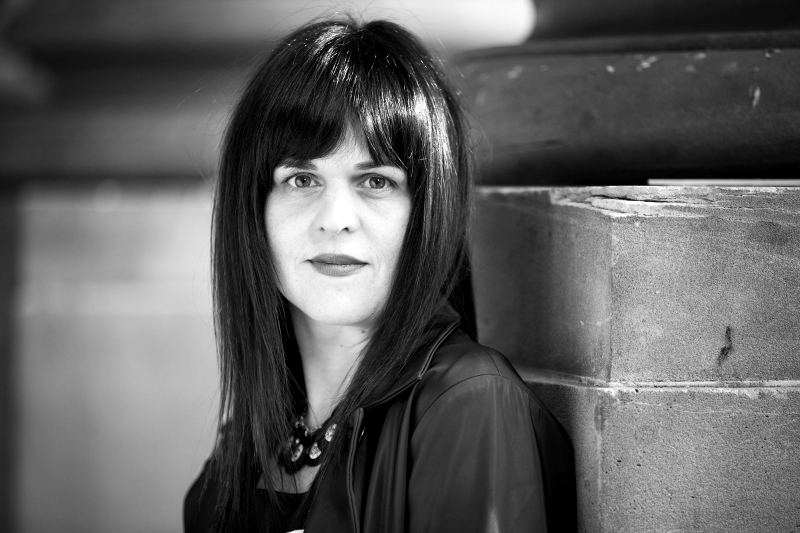
Jacinta Le Plastrier Interviews Nicholas Walton-Healey


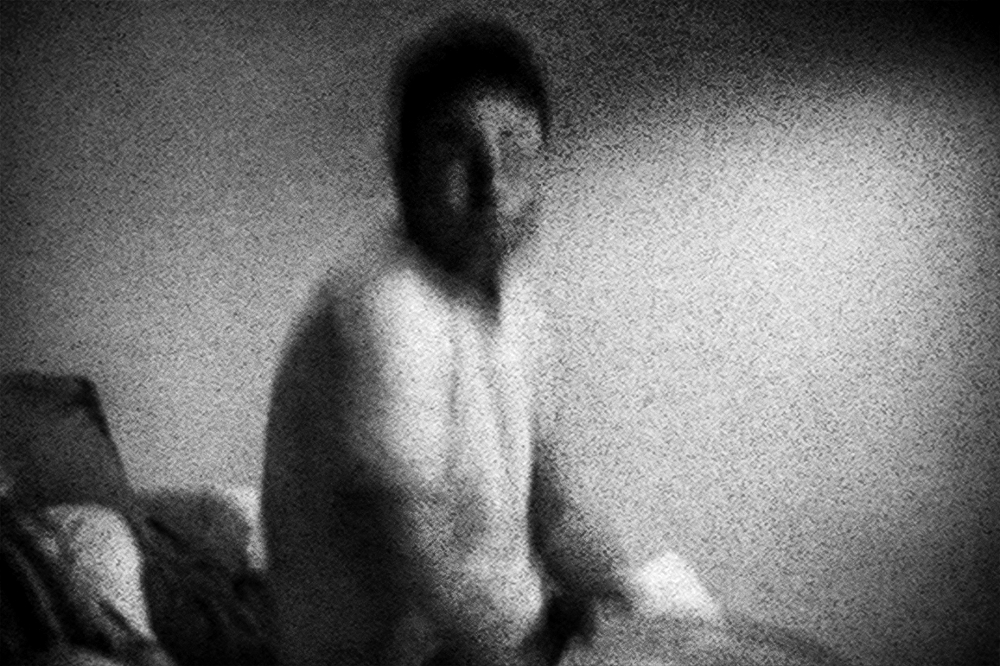
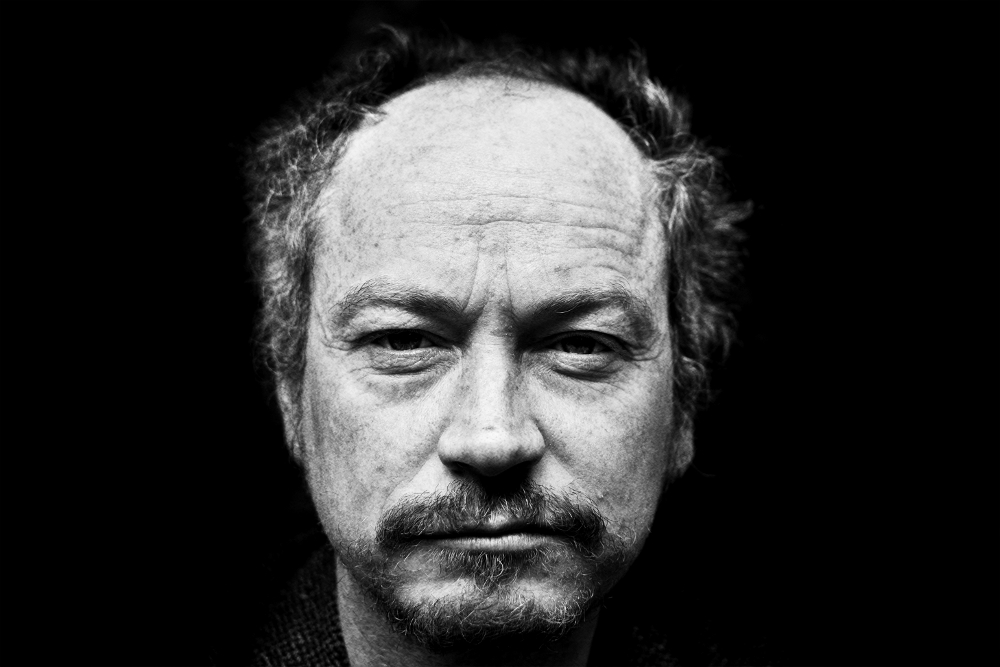
Image of and by Nicholas Walton-Healey

Land Before Lines is a book from Melbourne-based photographer and writer Nicholas Walton-Healey. The 144-page, full-colour volume (the images appear in black and white here for page recall considerations) features portraits of 68 Victorian poets and a single, previously unpublished poem written by each poet in response to their photograph.

Jacinta Le Plastrier: What led you to starting off on this project which, given the complex personalities of so many poets, must have felt like a daunting prospect?

Nicholas Walton-Healey: There wasn’t a single event. For a long time I resisted the idea. It seemed ‘too obvious.’ Before commencing the project, I was spending a lot of time with poets, mainly through my involvement with Rabbit Poetry Journal. I found it really very difficult to be around so many creative, intelligent people without participating in an aesthetic dialogue with them. I mean, although you might be able to go up to a certain poet and say, ‘your work is wonderful because of x, y and z,’ that sort of compliment always means so much more when it’s said in your work.

I studied poetry in the honours year of my first degree. I wrote a thesis on the relationship between the visual and literary arts. If you look at the work of the ‘greatest’ poets, you see a sustained engagement with the work of visual artists. I’ve always been fascinated by that intersection. I know that when I suffered writer’s block, or was in the process of conceptualising a suite of poems or a piece of writing, I often turned to the visual arts or the work of particular visual artists for inspiration. That’s actually how I began taking photographs. So I guess if you really want to trace it back, you could possibly say that the project started here.


Photo of Duncan Hose by Nicholas Walton-Healey

The complexity of the poets’ personalities fascinated me. It was actually the main reason I persisted with the project. But this sort of complexity isn’t specific to poets. What is specific to poets is that their chosen medium of expression is financially unrewarding. Poets can’t sell individual works for thousands of dollars. They can win prizes that are worth lots of money but there isn’t that system of patronage or gallery representation or even the opportunity to forge a living by selling private, independent works. I think this accounts for some of the ‘complexity’ of these people’s personalities. I mean, in the best instances, some of these people are producing work that’s every bit as important as that being produced by the country or state’s leading artists, but because poets don’t get the sort of recognition that artists working in other mediums sometimes receive, something gets twisted. I don’t mean to imply that these people write poetry for recognition or accolade so much as to emphasise how unusual it is to see some of the most accomplished and creative poetic minds living in situations or circumstances that would comparatively be described as poverty.

JLP: How long did the project take to complete, and briefly, tell us how it unfolded and developed? How many images all up do you think you might have taken?

NWH: The project took about eighteen months to complete. All together, I took over 200,000 photographs. That’s not something I’m particularly proud of – it suggests incompetence. But digital photography is all about excess. You get rewarded for keeping the shutter rolling. I think the excessiveness of it makes people relax. They get used to having you continually snap away and so become more likely to let you in on that fraction of a second where they display a side to themselves they wouldn’t normally present to the public. Sometimes people just get bored of having their photo taken and that’s really the best time to go to work.

The project started with Jess Wilkinson, who I happened to be in a relationship with at the time I photographed her. I think her book marionette is incredibly brave and this goes back to what I said before about verbally articulating something to an artist. The greatest compliment you can give them is to make a piece of work that implicitly articulates that compliment.

After that, I started taking photos of some of the other poets we were socialising with. Meanjin got on board around this time and suggested I get a poem from each poet I photographed. They published some of the portraits and poems in one of their issues (these appear in ‘Volume 72, Number 3’). The project really just kept growing from there.


Photo of Myron Lysenko by Nicholas Walton-Healey

JLP: Can you summarise the conceptual intention of the project which is contained in the book’s title, Land Before Lines?

NWH: This project is fundamentally about creative exchange. One of the ways I facilitated this exchange was by asking the poets to nominate a landscape or location where they would like to be photographed. This question compelled the poets to personally invest in the photographic process and made it more difficult for them to complain about the photographs (joke).

I’ve seen so many awful portraits of authors. This is because photographers typically work from the opposite premise; they ascribe to themselves a position of authority. I was very conscious of the fact that the poets I was photographing had far more established and concretised aesthetic convictions than my own, and rather than deny this fact, I elected to work with it.

So this is what the title means. Sure, the ‘land’ obviously refers to the fact that the poets in this book are united by the Victorian landscape and that this unity is privileged over any stylistic or aesthetic ‘lines’ that could be drawn between the poets or their particular use of the poetic line. But Land Before Lines is also a metaphor for a creative sharing that, in this project, is privileged over any division or fencing between photographer and poet. I mean who is actually the photographer and poet? Are the subjects of these photographs even poets? I’m certainly aware that this series of photographs constitutes a portrait of me as much as it does the ‘Victorian poetry community’ or the individual poets presented in the book.

JLP: What your thoughts on ‘auto-ekphrasis’?

NWH: Well, I know that an ekphrastic poem is a poem about a piece of visual artwork that also comments upon its own status as an art object. But I’m unsure of what an ‘auto-ekphrastic’ poem is and I’m not going to waste my time speculating – this is what academics get paid to do.

When I wrote my thesis on the relationship between the literary and visual arts, I used the relationship I perceived between Frank O’Hara’s poetry and Jackson Pollock’s drip paintings as a case study. Those two artists were personally and aesthetically very close (O’Hara even wrote a monograph on Pollock); critics seem to have allowed the distinction between their sexualities to cloud their ability to see the true nature and extent of this relationship. I mean, in order to see this relationship, you really need to get over the emphasis literary critics repeatedly place on the supposed frivolity of O’Hara’s poetry. Although this frivolity is important, especially in the later poems, I think it’s too easy and convenient to just attribute it to O’Hara’s belonging to the second group of artists associated with the New York School (which are supposedly more closely aligned with Pop Art than they are with Abstract Expressionism).

The thing I found most interesting about this relationship was that, when you really start to look into it, there exists numerous O’Hara poems that, although not conforming to the ‘proper’ definition of an ekphrastic poem, demonstrate a very clear relationship with Pollock’s drip paintings. And that’s where I think the power of ekphrastic poetry lies; as an intersection or choice to engage with ideas outside of one’s own medium. This gives the work a greater opportunity of contributing something different to the medium into which these ideas are introduced and I think artists need to engage with ideas that exist outside the formalist constraints of their own medium. Critics got that so wrong about Pollock; I mean Clement Greenberg defining Abstract Expressionism in terms of it being about the formalist qualities of painting. There’s a whole social and political context there that he’s just ignoring. Pollock’s work was very political but political in the only way political art can be – political art cannot be didactic. Similar criticisms were of course made of O’Hara’s work; that his refusal to follow poets associated with specific liberationist movements meant there was a lack of a political engagement. But this was precisely the reason O’Hara had an ambivalent relationship to the avant-garde.


Photo of Nathan Curnow by Nicholas Walton-Healey

Posted in INTERVIEWS | Tagged , , , , , , ,

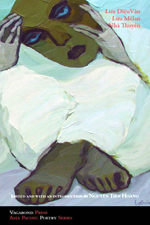
Jennifer Mackenzie Reviews Asia Pacific Writing Series Books 1-4

Vagabond AP SeriesVagabond AP SeriesVagabond AP SeriesVagabond AP Series

Poems of Masayo Koike, Shuntaro Tanikawa & Rin Ishigaki, Leith Morton, trans.
Poems of Rolando S. Tinio, Jose F. Lacaba & Rio Alma, Robert Nery, trans.
Poems of Yi Sha, Shu Cai & Yang Xie, Ouyang Yu, trans.
Poems of Lưu Diệu Vân, Lưu Mêlan & Nhã Thuyên, Nguyễn Tiên Hoàng, ed.
Vagabond Press, 2013

Vagabond Press has recently issued four attractively presented volumes of poetry from the Asia Pacific region. Each contains the work of three poets and represents China, Japan, Vietnam and the Philippines, respectively.

Continue reading

Posted in BOOK REVIEWS | Tagged , , , , , , , , , , , , , , , ,

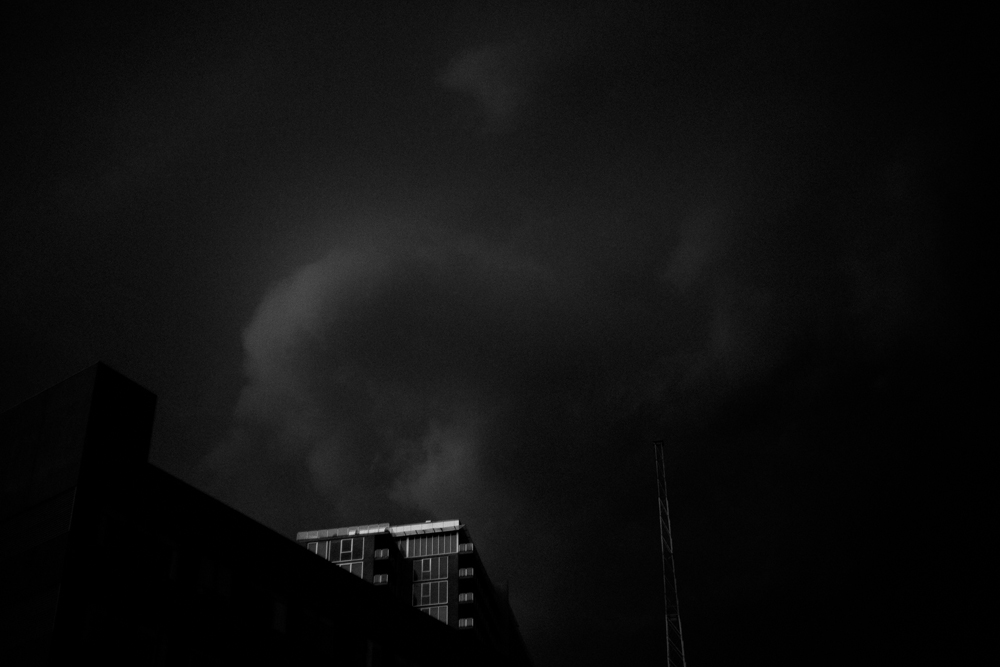
MELBOURNE Editorial


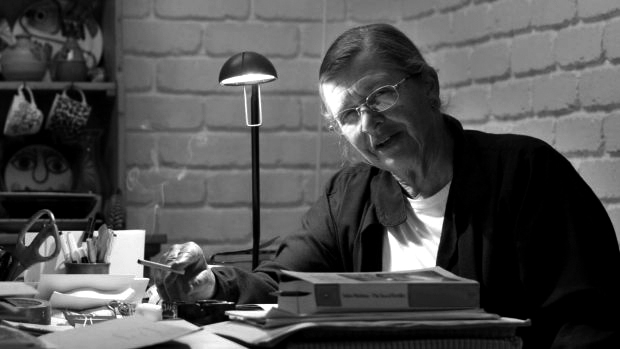
Photograph by Nicholas Walton-Healey


Reading MELBOURNE: a poetry feature could be analogised to living in Melbourne on a good day. Perhaps a good day doesn’t involve getting on a bus, but they are more interesting than trams or trains. It probably involves writing a poem, there’s plenty of it going on. It could be a work day if your work’s as interesting as that described in Brett Dionysius’s ‘Six Shifts at the VISY Recycling Plant, Heidelberg’ (or if your work is writing poetry). This is not a portrait of Melbourne but an enactment: poem as tram, café, accident. Poem as field of social/sporting relations (party/cricket match). Melbourne is not a discrete place either: Melbournians go to Yackandandah; Melbournians watch TV. It is not even a place as such, but a composite of experiences, like all cities. A good day in the city means needs met or needs unpressing. Days, however, stretch and change: a lot can happen. Perhaps a poem is more like an hour. A good hour so much more attainable, an after work hour might be good for anyone (for more on the hour and its relation to poetry see The Complete Perfectionist: The Poetics of Work by Spanish poet Juan Ramón Jiménez).

MELBOURNE is supported by the City of Melbourne through its Arts Grants Program. As guest editor to this unique issue, I solicited 50% of the poems (as opposed to the standard 10% or fewer guest editors wield for Cordite’s quarterly issues), and did so from poets who had rarely, or had never, appeared in Cordite Poetry Review before. These were mainly younger poets, though there were also a number of new and/or younger poets selected in the anonymous submission process.

One of these newer poets include Sian Vate, whose prose poem ‘melbs’, does what its title suggests: making the city (or more specifically, the suburb of Coburg) an intimate, yet social space, with a trace of one of the champions of such writing, ΠO, aiding its enunciation. The poem is structured through alternating negations and affirmations, yet is given lift through occasional questions and internal rhyme.

Another is Leah Muddle, her ‘flavour of’ evokes a bat’s view of Melbourne’s ubiquitous form of transport, public too in a sense, of bikes, bikes that ‘run cafes … sign t-shirts’ – and are perhaps influential in deciding the reigning cake-form: ‘flavour of’ optimistically declares the death of the cupcake (Bikes even distract us from the footy in Stu Hatton’s ‘lunch poem, university square’). It is an exemplary recycling of adjectives and images.

Claire Nashar’s ‘Melbourne sonnets’ Australianise the New York school poets’ play as well as Melbourne itself. The Yarra river, fruit bats and Corey Wakeling function as agents that move in and out of the urban, an image import-export industry, allowing and implying dingoes, bilbies, spirit animals. Nashar’s networking, ecological text delights in evading the convention of the city-bush divide.

The poems are the core of MELBOURNE, but the stakes of poetry manifest in some other features of this issue: ‘Crawling Across Tram Tracks: Extracts from Volumes 5 & 6 of Fay Zwicky’s Journal’ , introduced by Lucy Dougan; Corey Wakeling’s interview of Javant Biarujia; Alicia Sometimes’s essay, ‘Radio Laneways and the Melbourne Sound’; and ‘Some Art and Text: David Egan, Thea Jones, Nicola Bryant, Lauren Burrow, Nicholas Smith and Saskia Doherty’: a conceptual art feature from Monash Art Design and Architecture curated by Spiros Panigirakis. Tim Grey’s black and white photographic salon, ‘Plain’, emphasises the ground and sky: they are more than supports or canopies for Melbourne’s worldly endeavours.

Fay Zwicky has been a resident of Perth for many years, yet even her journals of the 1990s reflect on her formation in Melbourne. The extracts recall scenes as early as 1938: ‘the wireless, the gramophone, the Chinese market gardeners, the beer drays drawn by Clydesdales, the steaming heaps of orange manure on the roads on winter mornings, the milkman’s horse-drawn cart with it warm red light clopping in morning darkness…’ and a dream of St Kilda’s Luna Park from 1990. Lucy Dougan’s introduction to the extracts reflects on Zwicky’s position in Australian poetry, her musical upbringing, and the tensions for Zwicky ‘of a life lived between Melbourne and Perth’.

In his interview with the former Labassa resident (cf ‘Five Bells’), poet and small publisher, Javant Biarujia, Corey Wakeling elicits an allusive portrait of an international, reflective, feeling mind steering down a conceptual Yarra flow. Biarujia is both generous and critical: qualities which come further to the fore in his attendant poems ‘PLUS ÇA CHANGE … 1981–2011’, an Age cutup, and ‘The German Consulate in Melbourne’ which networks a further architectural reference into Biarujia’s productive melange (cf all its meanings, of Viennese coffee, diamonds, etc.) of the provincial and avant-garde.

Alicia Sometimes’s essay is largely homage to the spoken word scene of the 1990s. Her memories of ‘the Perse’ hotel on Brunswick Street in Fitzroy as a venue for performing poetry include not just names of poets but specific poems. Sometimes is an experienced local radio presenter as well as poet, performer and editor. Her engaging text dissolves the distinction between listening and reading, performing and reading aloud, between modes of writing and address. Her essay has correspondences with other themes in MELBOURNE: memories of growing up in Melbourne, of experimental writing (her excitement at being introduced to the work of berni m jannsen), of travel away from Melbourne and what that does to how you think and feel about the city, of the role of music and art and how they intersect with poetry. These memories all become aspects of a personal poetic history. But not just personal: ‘Radio Laneways and the Melbourne Sound’ is also social, connecting with the histories of many others, histories of earlier decades and of this one.

In ‘Some Art and Text’, Spiros Panigirakis presents the striking coincidence of six Honours students at Monash Art Design and Architecture in their use of poetry, narrative, reading and visual poetics. As Panigirakis indicates, in the work of these six artists there is no clear division between poetics as exegesis and poetry (or visual or other art forms) as creative practice. In this context we might see as ironic Nicola Bryant’s statement from ‘Ekphrasis’, which accompanies a large black dot: ‘This ekphrasis responds to the representation of a full stop’. Nicholas Smith’s interest in the night parrot recalls the poetic interests of both Dorothy Porter and John Kinsella: both dedicating books to this bird (The Night Parrot and Night Parrots respectively). For their work, and that of David Egan, Thea Jones, Lauren Burrow, and Saskia Doherty, and for the 55 poems in this MELBOURNE issue, read on.

Posted in ESSAYS | Tagged

Radio Laneways and the Melbourne Sound


Photograph by Catarina Fizzano

Don’t use the phone. People are never ready to answer it. Use poetry. – Jack Kerouac

It’s a beautiful thing to know what came before. Who walked the laneways ahead of you, smoothed any paths that might have otherwise been jarring, who stood up so you could sit down. Continue reading

Posted in ESSAYS | Tagged , , , , ,

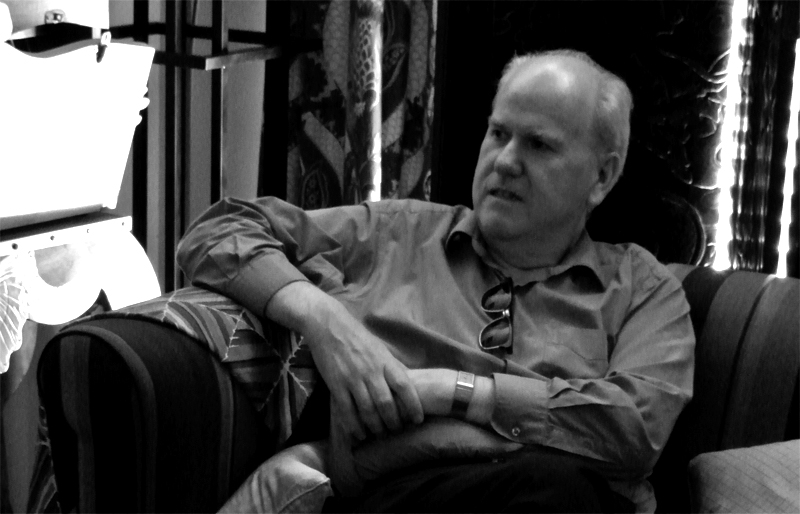
Corey Wakeling Interviews Javant Biarujia


Photo by Simon Mark

Javant Biarujia is an iconoclastic Australian poet, at once an unparalleled linguistic confabulator and an exponent of Melbourne avant-garde poetics since the 1970s. He is the author of seven collections, such as Calques (Monogene, 2002), Low/Life (Monogene, 2003) and pointcounterpoint: New & Selected Poems 1983 – 2008 (Salt, 2007), and numerous chapbooks. Biarujia’s work marks out its own historical forebears and familiars in a way that I believe – although absolutely in association with contemporary histories of poetry such as American Language poetry, Australian bricolage, and European surrealism – happens to hybridise baroque linguistic ingenuity with deconstructive collage and games of poetic reality that defy straightforward historical alignment.

Continue reading

Posted in INTERVIEWS | Tagged ,

15 Artworks by Tim Grey

Posted in ARTWORKS | Tagged

Crawling Across Tram Tracks: Extracts from Volumes 5 & 6 of Fay Zwicky’s Journal


Photograph by Neil Eliot


Fay Zwicky tells the story that in the early weeks of 2005, in the aftermath of the Indian Ocean tsunami, she was invited as one of WA’s ‘Living Treasures’ to write a public poem about the disaster, and to read it at the opening of the Perth International Arts Festival. She declined. It was too soon, she thought. This was ‘not a time for poems’ – was it? But already the politicians had weighed in with their ‘fine abstractions’ and preachers were parading their concern. Perhaps it was important, after all, to come out and speak with the words of the tribe about ‘true guilt’ that is ‘tongueless’. She changed her mind and wrote ‘Aceh,’ a poem that is poetically unadorned and rhetorically urgent, and intent on letting ‘silence speak.’ In keeping with these sentiments, Zwicky held to her resolve not to read it herself. It was only because an SBS sound recordist was in the audience by chance, and captured the reading, that it found its way back to her, and she heard it for the first time, as if it had truly come out of the silence.

The push and pull between silence and public utterance in this anecdote speaks to the complexities of change in the cultural field since Zwicky’s practice became established. Poets had once gained standing within a system that valued the long apprenticeships and long lead-times of print culture. New social technologies now allowed reputations to be made in ways that could easily circumvent or dispense with the past. And yet the same technology that made Zwicky feel alienated, and made her invisible to a new generation of readers, had salvaged that reading of her poem for her, reminding her that her work could speak meaningfully to her readership. This raises questions. Are our older writers at risk of invisibility because conditions within the field have changed so much? How can the dimensions of this new age make sense to lives lived inside such a vastly different paradigm?

And yet, Zwicky has not completely withdrawn from Australian letters – her last book of poems, Picnic, was published as recently as 2007 – but much of her attention has shifted from poetry-writing to a form that represents for her a way of letting silence speak. Since 1975 she has kept a detailed journal: a combination of writer’s commonplace book, poetry work-book, and reflective diary. Its thirteen volumes record her reading and reflect on what it means to her to engage in and sustain a creative life, and they are full of autobiographical details. Selections here are taken primarily from Volume 6 when Zwicky is turning 60. The first three entries are from Volume 5.

Zwicky’s journal keeping could be summed up as a witnessing. That same dynamic encapsulated in the Aceh story, to react or to withdraw, to speak up or stay silent, emerges again and again. Because she is ‘a poet in the old, vulnerable sense’ (Vol 5, 713) invariably she does bear witness:

The world I came from is getting more and more distant, it has practically vanished. That’s why I feel the need to bring it alive—not for nostalgic reasons, but to help remember what went to make the person I am. There’s a kind of loyalty, a rough affection, a sense of protective concern that hangs around memories… The changes in social geography, the slow slide into meaninglessness and motiveless existence—these are the frightening things. The youthful escape from provincial boredom has turned into a late cycle desire to repeat the performance…How can one make one’s memories conform to what amounts to an utterly transformed world? (Vol 7, 1000)

The vacillations on this central theme of reaction/withdrawal also connect to a life lived between Melbourne and Perth; and a creative life lived between playing music and making poetry. Just as Perth was an escape from Melbourne; Melbourne is later figured as a potential escape from Perth in what evolves as a fruitful tension. In the journals the two cities merge and are overlaid as in the dream sequence included in the selection.

At the same time in which these psychic dislocations are being mapped, the journals are also a material record of the ways in which the past looked and felt. Zwicky’s ‘vanished’ world is made accessible through objects and through practices, as in the picnic scene’s ‘metal cups with raffia-bound handles’ or amongst her grandmother’s possessions the ‘trap-like metal clips to make waves in the hair’. The presence and accuracy of such details function to remind the reader that a whole way of living has gone. And there is a strong sense in which these objects and events act in a filmic and mysterious way. They are both simply themselves but also conduits to the sensing of different and only partially recoverable ways of being.

The Melbourne of the journals emerges as a place of childhood memories: a site of comfort that is later engulfed by having to fit an independent temperament to the discipline of becoming a concert pianist. This wider family culture of musicianship and performance is tied explicitly to Zwicky’s Jewish heritage and her mother’s work in helping post-war refugees, some of whom were musicians, to begin new lives in Australia. Despite her ambivalent feelings towards this time in her life, there is a change of heart in revisiting the next crop of musicians in the Melbourne family who are ‘untaught, unpressured, just music in the house…natural as breathing’ (Vol 6, unpaginated). The sense of lightness and freedom here seems to match how Zwicky first felt on hearing Britten in the student union room in the extract below.

This revisiting of the next generation of family musicians is a good example of they ways in which Zwicky’s journals constantly rehearse interactions between the past and the present, between Melbourne and Perth, and between music and poetry, until they come to rest at a point of being able to pick up and go on. They are repeat performances that favour a cathartic action, and a working out of those contrasting poles: the young concert pianist in Melbourne and the older, reclusive poet in the city across the desert who, despite silences, has remained active and engaged in an almost entirely private way.

-Lucy Dougan

Posted in ESSAYS | Tagged ,

Some Art and Text: David Egan, Thea Jones, Nicola Bryant, Lauren Burrow, Nicholas Smith and Saskia Doherty

Some Art and Text
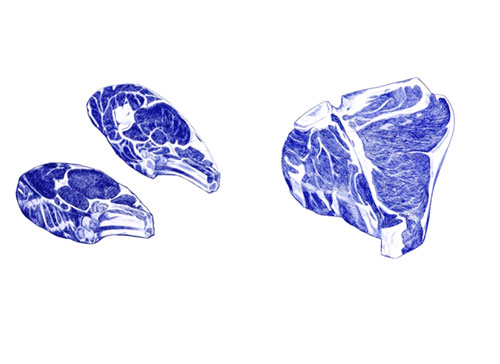
Nicola Bryant | Steaks, T-Bone (2013) | Biro on A4 paper

This folio presents six recent graduates of Monash Art Design & Architecture’ (MADA) Fine Arts Honours program. As an art school embedded within Monash University, it facilitates a program that encourages students to contextualise their art practice within a discursive and to an extent, ‘exegetic’ practice. In many cases, text becomes a tool to ground and substantiate – to stake a claim in the field – that the artists constructs or composes for the work.

What I found interesting (and exciting) as one of this group’s teachers was not only their explicit use of text, voice and poetics within their art projects but their experimental approach to the exegetic text itself. I want to avoid tying this group of artists together via a central premise or a collection of neat themes. They each, in accordance with the conceptual underpinnings of their research, used text to challenge any pedestrian understanding of the exegesis to illustrate and reduce art making and audience reception. Text and the textual becomes an autonomous entity within their art, another critical tool to engage the material and social world. Each text, in its own way, slips around, courts ambiguity, evades singular interpretative routes, and at times blocks our perhaps over-schooled assumption of what an artistic process might entail.

The Artists

David Egan presents an audience with a series of discrete moments. A seemingly identical set of landscape paintings sits atop of a continuous frieze painted with a spear of broccolini. Both of these tropes of painting play simultaneously with the gestural mark and systematic reduction. In 2014 Egan has exhibited at Slopes Project in February and will be exhibiting at the Substation Centre for Art and Culture in March and with Patrick Miller at Adult Contemporary in Perth.

Thea Jones investigates the material consequence of touch – this contact between ‘things’ is envisaged as a complex interaction of physical forces – that questions how we as subjects understand intimacy. In 2014 Jones is completing an Arts degree and exhibiting at Seventh Gallery in June.

The process of understanding and reading everything and to some degree nothing in the space of art might sum up Nicola Bryant’s concern. With a degree of wit, Bryant grapples with everyday musings within a textual space that is wary of grandiose narratives.

Lauren Burrow presents literal and methodological intersections between objects, narratives and the detritus of creative processes. With a concise formal vocabulary she frames materials that that are both partial and lustrous. In 2014 Burrow is exhibiting at Platform Contemporary Art and Trink Tank in April and Seventh Gallery in June.

Nicholas Smith explores the elusive qualities of attraction – between people – between people and animals – and between people and objects. Within this matrix of desire is the search for the night parrot. In 2014 Smith will show in a group exhibition at Seventh Gallery in June.

Saskia Doherty engages in process driven experiments that are staged in the space of the gallery. She exposes the potential for relentless continuation of the process but also allows for the halts and its performative potential. In 2014 Doherty is exhibiting at C3 Contemporary Art Space in March, Platform Artist Group and Craft Victoria in April, West Space and the Monash University Museum of Art in May.

Posted in ARTWORKS | Tagged , , , , , ,

Street View – Batman’s Hill, March 2014

1.
Intruders in the house.
We are walking up a river.

We walk quietly.
No more social esteem and prestige.
The river winds on.

With my eyes closed I would lose
consciousness pending further research.
The river. We were walking upstream.


2.
Enough of that has been said.
It feels like my wide mouth eyes again.
It feels like my wide mouth eyes.
But only if I could keep my innocent heart.


3.
In the insensible –
run out of money, run out of love.
In the distracted breath –
buttress, flakes, torsion.
Weirder than weirdland man.
Have braggart. Have stew.


4.
Carve that up and get me out
you is paranoid
just ahah,
down with the scalpel scissors and simple cleaver
just ahah,
operating a real machine.


5.
How carnivorous we get
in glad happy nature
we are all
we are all
bare? spare? forked?
Sensationally bodied, marketed and sheer?
More or less terrific?
How carnivorous we get
and you.


6.
Worth the hungry miles
worth the burning and
the crowding season. Worth
the virtuous galloping on
the ugliness and guts.
Worth how it gets.


7.
There are so many of us in the world.
And all of us so sick.
Me speaking personally I love the clean dementia
and perhaps the soul divided
walking around and yet still on fire
walking round then running up the street.

Posted in 62: MELBOURNE | Tagged

Trade

A man stands on the corner of Swanston and Bourke
plying his trade
which is not immediately clear to the observer.
Perhaps he’s
selling something nobody knows they need yet.
The observer
wishes to verify his or her own presentiments
about how the world
operates in all its flawed and reckless applications.
Nothing is
as it seems, nor as it actually wants to be,
for example
the illusory nature of bricks and mortar, transitory,
ephemeral as wind.
Air will last longer than this human achievement.
In the contest
between ill-will and charity ill-will will win,
the speeding car
will come off better than the hapless pedestrian.
Only stone,
as an ambition, can approach any sense of permanence
lying in wait
at the bottom of rivers, or the top of book shelves
disguised as souvenirs.
The sun will continue to rise long after the extinction
of our species.
That man on the corner with his basket of stones,
still not sure
who he’s waiting for, what his trade is.

Posted in 62: MELBOURNE | Tagged

Walking through Camberwell while the Bushfires

There is a something; orange orb;
a fluro zorb blood orange’n
blurry. corpuscles, violent yellow’n
red like smorg, eye of smorg, smorg ablaze
like a pink pink hot pink nike pink

run fast, 13-minute-lap, pink and a question:

What would yogi doona a knife’ight?
What if air’s two’n one is t’win?

skip (ya right?)

to the empty shops on the dry side, the east
of Burke Rd (yeah?)
[each has a local, and a septic liver, west, past Cremorne]

Sensing desperation on your writing & tetra-chroming down the hill
Stopping in the floodlamps (rabbit stopping, staring), bag laid:
vacant block’n shagging through the chain wire’s yr straw bed:

Yr an Ariel – hold on – written by a maker:
Yu quote and note t’change t’your – meaning their –
own words, on the cnr where bored kids drive beamers
far & fast.
An easy one three five degrees
And you just fill the gaps.

Bush fires; haze; death.
Cancel them and call it the
ceremonial scrubbing Lucifer avails
the wallaby mystics; Ophelia’s
apocalyptic howl for a Narcissus,

in all events.

Posted in 62: MELBOURNE | Tagged

Punk Wave (Baker Street, Richmond)

I fall asleep on my elbow,
pushing open the front gate
to place my foot into
a mudslide of grass and bottle tops,
edging along the fence to R.E.’s clubhouse.

Under the mulberry’s low canopy
a boy is playing the saw and
someone’s crowd surfing toward the grapevine,
yet I could be standing on the ski-slope kitchen floor
buttering scraps and talking about the sun on Fire Island,
or screaming hell down the hall at the po-po.

Pigs muscle in and atrophy us out
the broken front door,
over the brittle kerb and onto the street.
They hook a guy by his backpack, pulling him down,
until his head smashes on the ground
and knives clatter out.

Party’s over.
Squat’s gone.
The fitz are the only things which linger on.

Posted in 62: MELBOURNE | Tagged

Car Pool

Tyre pressures at 35psi & we’re screaming
Joe’s got that teargas cologne drenched on
like a bachelor, Michael’s rules for radio are
no drums, he gets mad, calling shotgun each
Stop. Michael never passes the air-con to us
he hates diverting the fan. The ideal temp.
for Michael is twenty-one degrees Celsius
& he’s happy, nobody likes Michael anymore.
Justin’s a rude social, doesn’t say much except
Shit every time it’s Red, he hates to be forced
into eye contact with other car passengers,
he thinks they judge him ― Michael does.
These streets are always the same, A dog
Another café, 40kph School Zone Police
Camera on the corner of Hale & York St.
Eye-in-the-Sky Bicycle down on Linfield Rd
going-South. Sam hates bike riders like cancer
he gets dirty every time they conquer lanes
& don’t wear fluorescent, he tends to fire up
wind down his window & go off like animals
(Michael hates the imbalance in temperature)
he can never finish, or cool down, he breathes
a lot after attacks.
Joe corrects his hair once the winds gone,
Michael asks where the child lock is? going sick
on Sam, while trying to reestablish the cabin.
There is a deep imbalance in beings. Joe tilts
his sunglasses at women like extraterrestrials,
Justin keeps fidgeting as the traffic packs up,
Sam’s breathing in & Michael can’t stand it.

Posted in 62: MELBOURNE | Tagged

To a Dead Poet

Charles Buckmaster 1951-1972


a variation of waiting nothing
coming

and the day
it is darker now

Woodstock. Gruyere. (Willochra)
abolished bastards of the trap
a presence appears like a snare
apparitions are hallucinogenic pulses

ABSTRACTIONS RISE

the seed of god planted in the earth
but a disturbance….

the true nature of this fear?
brooding in its decayed
momentary time:
an isolation (not limited to poets).

of the WOMB destructive births
have entered.

WHITE WHALE COMING

great voiceless creature
we fled the city, belly
of the white whale filled
crushed grasses, grey buildings

state-wide MELBOURNE–
I visited your house
… the school in Lilydale

couldnt find the broken poet
his aging disciple had stopped writing/
died alone-

… it is through leaving that our lives
begin to take form and enter full flight

writing poems across our skulls we
drink death, a kind of sweet wine.

Posted in 62: MELBOURNE | Tagged

Two Poems from Melbourne Central Station

Descent into Hades, stiletto edition

A sky-heeled woman
Dips her toe into the
Escalator Styx
A child seeking to enter
The snap of a staircase spun by
Schoolyard sadists
Once more:
And now the river is changed
And she is off, a-clop!
A mechanical chevalier
Stirruping metal grooves
Clasping black rubber rein.


Bathroom congregation

Co-conspirators hold closed
confession booth doors
as penance for guilty texting

Hands are cupped beneath
a vestment-white dryer –
to receive a breathy communion

A scarf is looped in the
sign of the cross, with
fingers rosarying its tasselled length

Voices are murmurs
eyes are low
and purses are held
air-port tight.

Posted in 62: MELBOURNE | Tagged

Feature Poem with Judith Beveridge: Sunflowers

What strikes me in Andrew Stuckgold’s poem ‘Sunflowers’ are the graceful curves of the syntax, and the way he has masterfully employed sound. Reading the first sentence, which runs over three and a half lines, we hear that the ‘o’ sounds are especially evocative: yellow, Picasso, suppose, rose. This is a poem which is very artfully composed, the pitches and cadences of the words, the line breaks and the attention given to the orchestration of the vowel and consonant sounds have produced a poem of compelling mood and reflection. But the visual, too, is striking. The bold heads of the sun flowers, ‘a camera flash of colour’ have centre stage in stanza one. It is hard not to think of Van Gough in relation to sunflowers, but in this poem it is Picasso who is evoked, and the poem as a whole has something to say about the way art manipulates time and space when representing objects, freezing them from the ravages of time.

The second stanza is more wistful and moves to a consideration of the sunflowers not as artefacts, but as physical entities undergoing degeneration and decay, as these lines express: ‘They slip quietly through the empty shadows/ of a distant Spanish autumn afternoon/to lie against the sun lit earth: the real/ without artifice and without history.’ I love the way time and space are so nostalgically evoked in the movement and rhythm of these lines, and the way the poet is moved, not so much by the brightness of the flowers, nor by their symbolic power, but by their fragility and transience, and thus the connection with the human is made. The mood of the poem is achieved largely through rhythm and syntactical variation, and through the linguistic sparks of association. The synesthesia in the poem is also an attraction, where the visual becomes a sound image at the end of stanza one. – JB

Sunflowers


Mute faces picked out in masks of yellow:
Picasso would have admired them I suppose, 
but undertaken a transmutation to represent 
the future rose. Green stems becoming 
some wild expression of cubic space, 
doubling and trebling in tension: the heads 
a camera flash of colour pinned 
against white canvas, stretched tighter 
than a screeching violin.

But for me, a few stray petals escape now;
dry and carried by the blue wind.
They are returning end over end, skittering 
past the painted door step of his studio.
They slip quietly through the empty shadows 
of a distant Spanish autumn afternoon 
to lie against the sunlit earth: the real
without artifice, and without history.
Posted in GUNCOTTON | Tagged ,

WATSONIA CC 1st XI 2063/64 premiership team

1. in watsonia perceptions in the aggregate of bodies
2. in watsonia numbers occur in ordinary sentences
3. in watsonia theres no setting up of a kind of logical inventory formerly imagined
4. in watsonia a dream acquires in the winter the colours of landscape
5. in watsonia the past reconquers by actualizing itself
6. in watsonia throw the lobster far out to sea swim after it
7. in watsonia this quiet spot it keeps branching out n blossoms ever forth
8. in watsonia there appear neither things nor functions nor relations nor any other
logical forms of object
9. in watsonia molongo shouted victorys ourss sures eggs
when pincher started throught the crowd and ran through johnsons legs
10. in watsonia in ecstasy in the forest w n ancient lawnmower
11. in watsonia the virtual sensation evolves toward real movement
12st in watsonia sacrificesre made in the struggle 4 freedom

in watsonia bolts a fast bowler w africa ins blood (coach)


key
1 katich = bergson
2 shane watson = witto
3 shane watson = witto
4 clara = dransfield
5 s smith = bergson
6 p hughes = carroll
7 b haddin = goethe
8 shane watson = witto
9 ryan harris = yeats
10 p siddle = blay
11 nathan lyon = bergson
12st faulkner = kurosawa
coach lehmann = sun


watsonia watsonia watsonia watsonia

ah also really like oats
whittocks from white oak
boards chris boardman
dorn boardman courtney barnetts barnetts = bressons la gaz
bruce reids a good bowler but bones too fine to withstand the rigours of the field
umps a 3rd eye 3rd ump out skiddy 4th umps cool seasoned traveller
umps cool seasoned traveller
global chris gayle lights up poles fasts a whippet ponting knows wentworth park inside
n out
last day of long service leave
technically out except no one appealed so technically not out
how much can these things be slowed down before they become some other event entirely
an unmanifest
rod hogg b michael holding

BRUNSWICK

this evening the drome smells of dogshit
there were dogs here this morning massive storms n paddle
steamerz
logic appeal whos the biggest gold chair “hello captain”
tree frogs also a terrain
warner “putting his hand up”
bob oconnor goon bag sticker
bob bolano saudade sticker
loosen up melbourne yr on next o from the rear end end
find a copy of dromes 4 will
joggerz
basketball
driving
bourbon from the boulangerie
steal a hen from ceres
though never having played golf feeling todays a good day 4 golf
how cold the hot waters n how quickly it gets hot
sit at the drome n watch wet concrete a lady playing frisbee w 2
dogs n a man the dogsre disinterested
the frisbees fluorescent gold welcome to chrome graf
someone passes on a bicycle n ah think of michael crane
old red hatchback; tiered forrester green above the stripe grey
below; worn lime kombi; modern hatch n a 2nd modern thick
black car
such hybrids of functionality their stripes bend 2 dogs n a man
walk around the base of the hill looking for a slope
cricket in allard park in julyre they still suffering agar fever?!
batter slashes 4 o the slips fielder cries “oh ho”
opportunity 4 ambush!
ah wait by a bush but olives doesnt complete the lap ns off down
mitchell st
attributes splinter n specialise
lattuca court
retrograde cars
northcotes a desert
post service customer service
clara becomes clarke
froome form
thornbury frontages
east brunswick frontages
normanby rds maggots a planet from another era
thornburys thornbury obsession
turning purple
matress
slats
hollow creaturist in pink chiffon warner saves worne
a line of spectators facing away from the track distracted by the
creek

COBURG

earholes rejecting earphones
orange monaro
correctly ciao amigo translates as ciao amigo
knowing the fruits rotten n peeling it anyway
ella estar
cow cow cow cow cow cow cow
freedom to abuse freedom
tiendo
the bath slopes
lookout cleveland m at sea reading bill beard 4 skype favs
with beggars banquets background
noise clicks beard


VALPARAISO (disused –

Posted in 62: MELBOURNE | Tagged

January

got sick and ached and forgot who i was
was lost with my usual lunch haunts closed
quit drinking
discovered sarsaparilla
fish n chips on the pier when the cool change hit
desired bikes, awesome old racers
guilt
an essay on apollinaire, needs a pretentiousness edit
read an old poem at royal park reading
wasted time
made tortillas fer real w/ masa nixtamalera
long summer evenings indoors
floored by the early pound, have to quit poetry
yearned for provençal, derivative yearn
hugged sam then lost him
got his bike back though, but its no awesome racer
kurt vile on a pretty day
point addis oh my god its beautiful, but i was sad, and we three were beautiful, but i was
still sad, senseless sad
felt far off, empty, artless, feint, beat
too much sport
indifferent to scholarship
started drinking again
approaching deadlines
too much tv
talked about drugs, took none
idled in the office
filled bins
no plans but instant plans
pants that don’t fit
wondered about michael
drunken disagreements over the marxist legacy
coveted my neighbour’s racer
modus operandi: obsession
fixed leaking toilets
plumbed old poems
went to the tennis, 44 degrees
floored by federer, have to quit tennis
resolved to read less books, read too many books
tired, inordinately tired
flummoxed by time’s knack for putting things out of reach
loved, distantly
hurt, distantly
valis
heine’s deutschland
still weirded out by christmas gifts
the stretching out forward, onward, time’s drawl
told myself to slow down, became irritable
snarled at flags
shunned life
succumbed to car fantasies
en l’an de mon trentiesme aage
was otherwise safe, emptiness safe

Posted in 62: MELBOURNE | Tagged

Traffic (Next Door’s Constant Flow of Visitors)

Your child looks from the pram
at this cat I adopted off the street,
the cat that had scabs on her back
when I first started feeding her,
first started coaxing her
in to the house
for warmth and food/
my health ideals/

Your child looks from the pram at this cat I adopted off the street,
the cat that had scabs on her back,
scabs she still gets every time my housemates kick her out for a night or two,
scabs like the ones on your face,
more obvious than those on the cat I adopted off the street,
the cat your baby looks at
and gurgles in joy over
from her pram,
looking up at you,
eyes wide and mouth almost making a word,
looking at the cat/
looking at you/
back and forth/

She can’t feel the scabs on the cat’s
back through the fur
the way she can feel the scabs on your face
through your 10 o’clock shadow.

Posted in 62: MELBOURNE | Tagged

Daylight Savings

At last, a day of spring light.
It turns gold around 5 or 6 o clock as it goes.
The squarish shadows as it goes
upwards in a chunk.
The buildings are so solid here.

I cross the lawn and through glass doors down spiralling fans of stairs into the library
basement seeking out his poems. Their warmth. I pause on the picture of Auckland.
The clocktower flanked by tips of trees. The sky blank blue behind.
His name in the contents. Open to page 243.

No sound. I used to have him reading aloud. ‘Starfish Streets’. I used to walk
along, matching the march of my untutored feet to the beat of his voice on my
mp3. He told of an old town full of ghosts. His voice froze at that moment.
Pause. Play. At a touch melting into Brunswick, soundwaves lap, soothe, pull
me back. A vivid private track on repeat. I followed word for word.
2am, hands clacking the tips from that dodgy pizza place.
Another just for now.

Sweet hurt heart shapes
spotted in thought clouds
leading back to Aotearoa.

Auckland. The clocktower
The scrumpy tree near.
Afternoon. Sun. Some girl.
Stop.
Hot librarian. Definitely flirts. This could be my chance
to fuck in the staff-only room.
and if we fast forward to the last scene.
Babies I guess. Dog. House. Lawn.
Dot dot dot. Debt debt debt.

Outside it is dark, but not as cold as I’d thought
walking back across the evening grass.

Posted in 62: MELBOURNE | Tagged

Melbourne Sonnets

Around Australia [destination: melbourne]

millions and millions of old ladies
go to the stock market, buy firecrackers

FIRECRACKERS: bang! bang! … bang!
OLD LADIES: we are the hotel
THE HOTEL: I am the eucalypts, am the sculpture garden
ROY LICHTENSTEIN: I would hate to see

a fire
start

but I cannot read the runes in this book of spells…
FIRE: <crackles>

HAYSTACK: Go on without me!
WOMAN: Okay

but I’ll never forget
the smell of your hair


Lost

and after dark
nothing ever came through,
only blew out

SPIRIT WALLABY: you can’t eat here
COCKROACH: I’ll dance until I crumple
FRUIT BAT: your toes make me wanna do the Macarena
YOUNG BOY: I will be your

nothing like
your

continual strategy, your
storage solution
SPIRIT COCKATOO: <preens>

KANGAROO IN DRAG: teach me
BILBY: I have hidden the treasure

who cares where
somewhere


In Theory

an Australian town is only as big
as its largest taxidermy koala

VENUS, GODDESS OF LOVE AND BEAUTY: then we came to the suburbs
SEASHELL: it’s my dream to be drunk out of
YARRA RIVER: I love driving my ute
COREY WAKLING: but you’ll never find me

not in a million years
not with a thousand dingos

no not ever ever
DINGOS: aaaooouuuuuuuuuuuuuuu!

POEM: stick ’em up if you value your watermelons!
TRACTOR: I would have thought

it didn’t matter
but now I see that it did

Posted in 62: MELBOURNE | Tagged