The March of the Nucleotides

a treasury

it amasses

via twists

knit among

runic gaps

almost all

regalia to

ornament a

thought as

lacing can

mimic gold

cast alloy

set aglint

at auroras

a tapestry


a tapestry

it affirms

via tropes

that atoms

along clad

string can

encrypt an

alphabet a

formula to

uplift all

adept airs

long cries

set adrift

at abysses

a threnody


a threnody

it arouses

via tempos

odic grief

using calm

lament and

erotica to

disquiet a

pageant as

utmost awe

might avow

epic glory

set alight

at arcadia

a treasury

Posted in 65: CANADA | Tagged

XVIII

She falls sick. Poems spark. Ethereal alto calls summons. Her sad ataxy throws muscular tantrums. Sore love lyses and amorous wet membranes permutate. Rose boughs. Winter doves. Doves half-sketched in early morning build soft, maidenly avian peptides. Hummingbirds feather small protease hatcheries. She calls to owls, exhorts pardalotes to come timbre, but loons’ honest lament is her reply. Pigeon feathers, raven shit, nests – abandoned. Frightened, ill, she lisps goldfinch. Some poor lexicon of bird glimmers, demands her verse. Joyful airs from some fallen birdsong, metred like medicine. Clinical poems. Gabby chirps dance over natural arrests, charm singing courageously her tune. Strict jammer, dub utterer, rhymer! Terns also hum a mercy she calls on. O tufted jay, o dusky-green oropendola! Septic shock sets in, her passion for firethroat flares. Firethroat quotes twist tenors forth, calling death, then bracing thoughts which glands secrete, she thinks histamines, thinks adrenal. Warbler hens interest her now-crystalline storytime as though sparrows art solution. Gasps omen can’t-breathe. Sore eyes, can’t-see. Solo song lives, then isn’t, and thrushes wish grieving odes. Listen for her totemic shree.
Posted in 65: CANADA | Tagged

While he waited for the school bus

The neighbour kid plugged a coyote,
.22 long,
roadkill deer for bait,
a calf dead from pneumonia when that was gone.
Twenty-five bucks for a frozen coyote,
didn’t have to skin it.

Russian thistle tumbled down the fenceline,
caught, loose, caught, pushed before the wind.

He waited in Prairie’s cold distillery,
narrowed his eyes at the weasel’s black-tipped tail,
the moon low in the sky.

When the sun rose east-northeast
and he’d moved his jackknife
from his insulated overalls to his jeans,
he picked off gophers ’til he saw
the dust plume of the bus.
No carcass to hang on the fence.
The same weasel, black-tipped tail,
white fur shed for brown,
slipped around the old wooden granary
where the kid stood his gun
butt down on the two-by-four sill,
clip hidden above the lintel.

Posted in 65: CANADA | Tagged

Somebody makes a decision.

Somebody bears responsibility
his shoes tapping as he walks away.

This is an illustration and
an example.

I enter the restaurant as a wound–
my smiling mouth.

Lipstick the colour of my labia.

And ‘m not gonna ugly my hand
for a pool shot sorry.

To be turtle-enough
in the night,
to clip.

The best way to hide is not.

Lipstick the colour of my lips.

Posted in 65: CANADA | Tagged

Carport

With the jewel bag jingle of a rain stick,
Tinkerbells cricket their crystal flints
inside the fluorescent bulbs. It’s righteous
how night and day mother each other.
From the carport see the slow-song
lawn-pines sway. Each pair
of fluorescents just newlywed
swans racked up in cryogenic
aluminum crypts. Fluorescents tripped
into blare so passersby can admire
our sparkling rides. Yes, carports are open
to the air, but why say open if they can’t shut?


As she boarded the bus to write a test
she wanted to fail, my daughter thought
it odd his Saab had crept from its hutch.
Three months after his mom had mysteriously
stopped making his lunch, the ginger kid from
a distant cul-de-sac pointed at our neighbour.
In the carport a lawnchair was upset
beneath a noose, our neighbour’s foot
reached like a tongue for a missing tooth.
We didn’t know the swans had thawed.
And forgiveness, the ginger was known
to say, is not their forté.

Posted in 65: CANADA | Tagged

Atomino

Posted in 65: CANADA | Tagged

Always Already Ahead

There you are. I’ve been walking north for several years hoping you would find
me. I’m sure you needed to feel cooler,

I know I did. I felt a lump under the left book stack and no way to shake loose the
coins on my wrists. Anyhow,

I needed to slow things down. Reading had begun to feel like teeth clamping on a
rod before the shock comes:

I know you’ve heard there are animals that die this way, thinking they have found
a great title,

Reaching across the wire only to have a tail land and zap. The heat is intense
today though you wouldn’t know it from

The sky, such moody clouds, the babies running through the 19th century
singing fâché, joyeux, triste, stopping

Only when conflicting desires trip them up. You know the day will have its
corners, that’s what I love about you

Mr. Ashbery. I often think the Arctic is like sex. You see how long it’s been? Tell
me, can you see the Crimea from the cusp of your poem?

Posted in 65: CANADA | Tagged

My Father Walked to Work, and His Work Was on the Water

My father walked to work, and his work was on the water.
His journey through blossom, cat-shadow, and rain.
Always I can see the rungs, but I can never hold the ladder.

I was his youngest child. But a man’s daughter
in her difference does more to ease his pain.
My father walked to work, and his work was on the water.

The grass becomes wet, and then it slides under.
The process is endless and everywhere the same
bootsteps fall. On every tide there floats a broken ladder.

Now I haunt the phone booth by the docks where
the cracked receiver’s silence rings a permanent refrain.
My father walked to work, and his work was on the water.

Does the child die with the parent? My sister
keeps the driftwood he gathered and his whisper of her name.
I grasp the fog’s whiteness as if it were a ladder.

And it breaks whenever I touch it, and the port oar
breaks when I try to set out. Yet every night and every day
my father walks to work, and his work is on the water
where the salmon, silver rung by rung, ascend the salmon ladder.

Posted in 65: CANADA | Tagged

Excerpt from Cinema of the Present

With your languid pose, your elbow against a tree, your flute, and your costume cut into
diamond shapes.
Simultaneously for and against this tradition of minor failure, you have acquired a
cummerbund.

You said we have both a colony and a god.

Smudgy, thick, cold.

To spare myself I’m going to drop these you said.

So long big doors, painted with sea-light and honey.

To spare yourself the trouble you’ll explore beginner infinities.

So now you are an economist.

You meant that by remarkably indirect paths you’d understand one god simply in order
to let go of all belief.

So you came to nilling.

If life is your idea, it’s an idea with fur.

So you sent for some novels.

Sheet-lightening and large-dropped summer rain in short forays, 5am.

Socius rex.

Your misunderstanding stopped just short of thoroughness and this was your particular
charm.

Some believe you ought to assume a tone of sincerity.

It occurs in the smallest possible space.

Some have deep apartments, some have shallow apartments.

An idyll in a bungalow; a palpability; a loss.

Sometimes the concept of plenitude is a help.

A gate made of floral foam, beeswax, silver leaf, drywall.

Sometimes you need a record of your life.

How else do you construct a pause in cognition?

Speak, tiny expensive morning.

Grumblingly.

Still there was no solution for the fabulous problem.

With late style.

Still, at this late date in the political, you remain intrigued by fucking.

It’s time for your late style.

Still, you’re totally in love with subjectivity.

Mid-way along that line that marks the adjacency of description to perception you paused.

Such aesthetics are as unthinkable to you as they are necessary: memory and the present
are not in opposition.

You had more important things to do.

Such facts lie beneath the grasp of contemporary research.

At the edges of sensing, there is banality.

Such that flowers, skulls, tables, subvert the vanitas.

You craved the diurnal irregularities of the imagining life.

Supernatural, social and divine.

You sensed your future unfounding.

Tattered Europe caking up in corners of abandoned rooms.

Your goodness lifts like a cock.

Tell me if you haven’t had grief. Whatever grief is becoming.

You just adore its heavy beauty.

Tell me more about animals you said.

Free error is what you’d call it.

Temporary benevolent peripheries.

You burst to a skirty froth.

Was it enough?

You play and believe.

That love happened at all.

And so you hit upon your grandeur.

That morning in the hotel-bed, you experienced your thinking as moving surfaces that
intersected sequentially and at varying angles.

Then you lapsed in its observance.

That only your lovely arrogance permitted this.

You use speech to decorate duration for somebody. You stop just before it becomes a
shape.

That the snow prevented you.

Because it’s not a site, it’s a style and it hurts.

That they become their deaths you said.

Very easy and very desperate.

That year, all of your muscles became useful.

There you were, fucking gratefully near water because you could.

That your mouth lovingly damaged the language.

You went to the river just to gaze at the river, like an old man.

The act’s absurdity is balanced by its excess.

And you counted, you counted, you counted.

The balance changes, and you care less.

You almost thought.

The countess of prose in your abandoned orchard.

You said the market doesn’t merit belief.

The current place looks a lot like the world with its trees and houses, but, for example,
when you wake up, there is only one bird, and then that bird stops.

You wanted to make your tiredness into a surface.
The delicate coyote, the streetlights, the pungent night.

The houses you lived in, their porches, the bored women and girls working at the arena
snack bars.

The description takes over the inchoate category.

Where else can you think change?

The dry tree of your task, the citydogs cavorting.

You breathed for those who dedicated themselves to burning.

The feeling of your sex became more and more mysterious.

What’s the good of burning?

The form never extinguishes its own irony.

You are neutral, like an event.

The girl at the park fanning her hair in the sun.

Two doves in the pine; three, and a train; one gone and a dog in honeysuckle: how are you
to make choices when perceiving is arbitrary?

The grand law empties you of preference.

You moved the taxonomy around.

The houses you lived in, their porches, the bored women and girls working at the arena
snack bars.

Then you felt lyric obscenity, both erotic and rhetorical.

The huge sky over the working harbour felt home-like.

You had fallen upon the situation where the designation “speculative” functioned as insult.

The I-speaker on your silken rupture spills into history.

Feminism wants to expand the sensorium.

The overpass hums in you all night as you sleep.

Once again and with mild exhilaration you acquire a new surface.

The peculiar indwelling of rime was a roving organ.

In the old studio photograph your lipstick is black.

The perceiving is for yourself, but meets at no doctrine of the subject.

You’d rather be a dandy than a writer.

The pleasure in leaving those quiet rooms!

O Sir, you said, had I only been able to tell a quarter of what I saw and felt beneath that tree.

The pools of bile on the floor of the operating theatre glinting beneath heavenly lamps.

Now you know that all along it’s been the body that you don’t understand.

The present is all with you.

You won’t assume that in your century the darkness is necessary.

The problem is not your problem.

Your historical pleasure was metrically interrupted by the inadequacies of terminology.

The problem of solitude, what was it to you?

At dusk the light through the branches was enough.

The question for you becomes what are we doing with our bodies?

You haven’t enough time to believe anything but the comedy of sensing.

Posted in 65: CANADA | Tagged

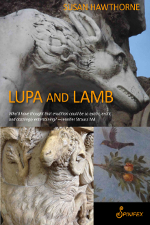
Review Short: Susan Hawthorne’s Lupa and Lamb

Lupa and Lamb

Lupa and Lamb by Susan Hawthorne
Spinifex Press, 2014

Lupa and Lamb is a beast of a collection – it spans literally all of time and features every woman that has ever lived. Ambitious is not too strong a word. Curatrix, our guide and commentator, leads us through archives of lost women’s texts on the way to a party held by the Roman Empress Livia Drusilla. It is through this trail that Lupa and Lamb tells women’s histories and their multiple, often contradictory roles in family and society. Continue reading

Posted in BOOK REVIEWS | Tagged ,

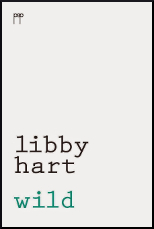
Review Short: Libby Hart’s Wild

Wild

Wild by Libby Hart
Pitt Street Poetry, 2014

Poetry might be whispering these days, but only fools fail to hear it. The whisper might be the tough sibilance of protest, it might be the swirl of nostalgia for what will soon be lost and irretrievable, it might be the resilient, gnomish murmur that tells of what cannot be suppressed, and cannot either ever be quite directly expressed. And so, Huginn and Muninn open Libby Hart’s new collection of poetry.

Continue reading

Posted in BOOK REVIEWS | Tagged ,

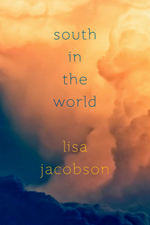
David Gilbey Reviews Lisa Jacobson

South in the World by Lisa Jacobson
UWA Publishing, 2014

For three weeks in Japan I’ve read and re-read Lisa Jacobson’s new collection of poems: in subways, on shinkansen, in parks, cafés, restaurants and my apartment – up on the twelfth floor of the hilly suburb, Dainohara, in Sendai. The poems, now fiercely dog-eared, have become my familiars; challenging, apostrophising and snaking/drifting/sidling into my consciousness, they have shaped my thinking and insinuated themselves into my conversations with ‘native English-speaking’ colleagues, Japanese friends and ex-students.

Continue reading

Posted in BOOK REVIEWS | Tagged ,

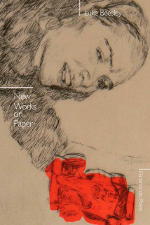
Review Short: Luke Beesley’s New Works on Paper

New Works on Paper

New Works on Paper by Luke Beesley
Giramondo Publishing, 2013

I’ve been meaning to write this review for a year – in fact, there’s a wine stain on my copy and I can pinpoint the exact date that I first put it on my to-do list (i.e. engaged in other work → frustration → tipped glass). Despite all of my sideways swerving, a year is a good amount of time to let Beesley’s recurring bees swirl around the head; a year helps one to figure out their tune. Or, as the poet writes, ‘It’s not about bees. There are no bees.’ Have I tipped the wine glass again?

Continue reading

Posted in BOOK REVIEWS | Tagged ,

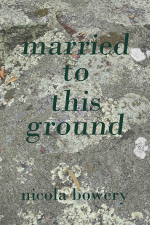
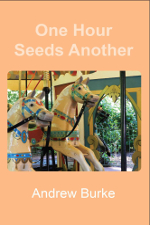
Review Short: Andrew Burke’s One Hour Seeds Another and Nicola Bowery’s married to this ground

One Hour Seeds Another by Andrew Burke
Walleah Press, 2014

married to this ground by Nicola Bowery
Walleah Press, 2014

Addressing the quotidian in writing is an ongoing practice for many poets. Andrew Burke’s One Hour Seeds Another and Nicola Bowery’s married to this ground approach this preoccupation with a robust commitment and urge to render it lucidly, but each is in conversation with different lineages. Burke’s cycle is cross-fertilised with jazz and folk music, with Hindu and Buddhist references, with playful abstraction, but it is the intentional elegiac timbre in this collection that lingers in the reader’s mind. Continue reading

Posted in BOOK REVIEWS | Tagged , , ,

Submission to Cordite 50: NO THEME IV Open!


John Tranter, Sydney, 2009, photo by Anders Hallengren.

Poetry for Cordite 50: NO THEME IV is guest-edited by John Tranter

Zounds! We’ve made it to issue 50 in the year that Cordite Poetry Review turns 18. Bust out the Passion Pop (read: Châteauneuf-du-Pape). Actually, this will be our 67th issue … but why be pedantic about all those special issues we’ve done in addition to all the rest? This is a bit of a special issue too.

It’s summer again in Australia. There is no theme. Send in good, new work.


That is all.


Please submit only once, with a maximum of three (3) poems in one (1) document … but first, please read the submission guidelines.

Posted in GUNCOTTON | Tagged ,

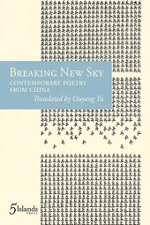
Sam Moginie Reviews Breaking New Sky: Contemporary Poetry from China

Breaking New Sky: Contemporary Poetry from China
edited by Ouyang Yu
Five Islands Press, 2013

Breaking New Sky is a happily variegated collection of work by contemporary Chinese poets, edited and translated by Chinese-Australian poet, novelist and translator Ouyang Yu. Strangeness produced by means of a ‘neutral’ or ‘plain’ English (a ‘Yu signature tone’) gives the poems and their objects a riddle-like quality whose pleasures and dramas implicate food, sex, work, river systems, animals, domestic space, relationships, the medical system, nostalgia, death, farming and sleep. This plainness is put to work as the material of an aphoristic narrative mode that defines this anthology; making small claims continuously and thereby amassing charm.

Continue reading

Posted in BOOK REVIEWS | Tagged , , , , , , , , , , ,

Review Short: Collected Poems: Lesbia Harford, edited by Oliver Dennis

Collected Poems: Lesbia Harford

Collected Poems: Lesbia Harford edited by Oliver Dennis
UWA Publishing, 2014

In the foreword of this long overdue volume, Les Murray writes that he considers Lesbia Harford to be ‘one of the two finest female poets so far seen in Australia; the other has to be Judith Wright’ (xviii). This is an extravagant contention, but it is not without foundation. Continue reading

Posted in BOOK REVIEWS | Tagged , ,

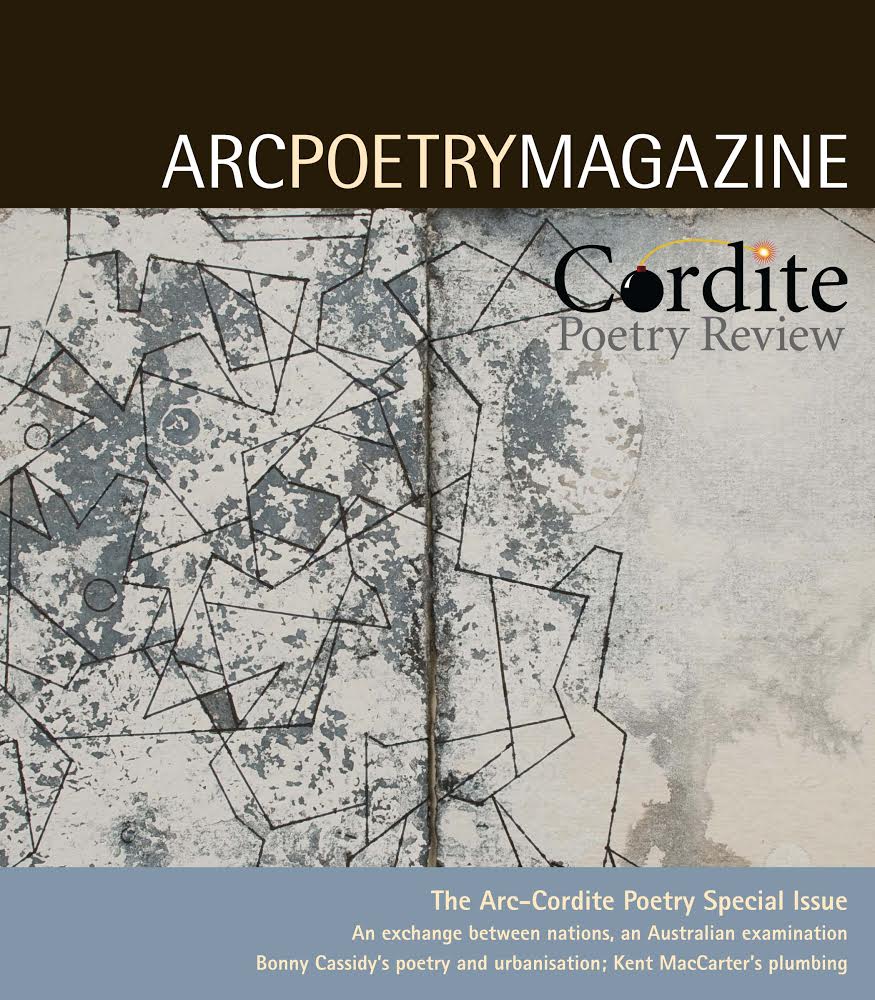
Arc 75: The Arc-Cordite Poetry Special Issue

Cover art by Ian Friend

My plumbing? Not exactly. But, well, after 14 months in the planning, making, mulling, and editing, it’s finally here: Arc Poetry Magazine 75: The Arc-Cordite Poetry Special Issue. Shane Rhodes and I (Kent MacCarter) co-wrote an introduction to this print issue and to Cordite 48.1: CANADA (publishing online 1 December, 2014), so no grand spiel here. But I will let you know what is included in each issue. Australians and Australian institutions have access to a ridiculously cheap 1-year subscription to Arc here. Goad your uni library to get it in. In addition to prose and a selection of artwork, Cordite ponied up a list of nearly 200 Australian poets who’ve 2-3 books under their belt to check out. And vice-versa. Here’s what Arc selected.

Arc 75: The Arc-Cordite Poetry Special Issue

Ann Vickery’s ‘Against Colony Collapse Disorder; or, Settler Mess in the Cells of Contemporary Australian Poetry’; John Charles Ryan’s ‘Australian Ecopoetics Past, Present, Future: What Do the Plants Say?’; Bonny Cassidy’s ‘Reclaimed Land: Australian Urbanisation and Poetry’; Jacqueline Turner’s ‘How Poems Work: Kate Fagan’s ‘Through a Glass Lightly: ‘Cento for Beginners’’; and Lucy Van’s ‘How Poems Work: Elizabeth Bachinsky’s ‘God of Unfulfilled Longings’’. (in print and Cordite site only)

Selection of artworks by Ian Friend in response to poetry by Matthew Hall (print only)

Australian poetry by: Ali Cobby Eckermann, Sarah Holland-Batt, Duncan Hose, Ali Alizadeh, Pam Brown, Corey Wakeling, Jill Jones, Mark Tredinnick, Louis Armand, Natalie Harkin, Fiona Hile, Toby Fitch, Kate Middleton, John Mateer, Kate Fagan, Peter Minter, Ross Gibson, Michelle Leber, Adam Aitken, Michelle Cahill, Paolo Totaro, Louise Oxley, Paul Magee, Justin Clemens, Nathan Shepherdson, Christopher Andrews, Angela Gardner, Judith Bishop, Javant Biarujia, Jordie Albiston, Ania Walwicz, Eleanor Jackson, Felicity Plunkett, Luke Beesley, Lucy Holt, Fiona Wright, James Stuart, Zenobia Frost, Kent MacCarter, A J Carruthers, David Brooks, Nathan Curnow, Eileen Chong, Claire Gaskin, Joanne Burns, Susan Hawthorne, Paul Hardacre, Mark Young, Tracy Ryan, Sam Wagan Watson, Jessica Wilkinson, John Hawke, Dan Disney, Amanda Stewart, Jennifer Maiden, Dominique Hecq, Peter Boyle, Rachael Briggs, and Jan Owen. (print or Arc site only)

And what we selected for Cordite 48.1: CANADA

Sonnet L’Abbé’s ‘Best Isn’t a Beauty Contest: How Canadian Poets Demand More of Verse’; Anita Lahey’s ‘Investigative Poetry: Are Poets the New Reporters?’; Kevin Matthews’s ‘Connect with Spoken Word Poet Tanya Evanson’; Lucy Van’s ‘How Poems Work: Elizabeth Bachinsky’s ‘God of Unfulfilled Longings’’; Jacqueline Turner’s ‘How Poems Work: Kate Fagan’s ‘Through a Glass Lightly: Cento for Beginners’’; Matthew Hall’s ‘How Poems Work: Nora Gould’s ‘While he waited for the school bus’’ (in print or Cordite site only)

Selection of artworks by Kelly Richardson and Kim Adams (Cordite site only)

Canadian poetry by: Jacqueline Turner, Clea Roberts, John Barton, Ray Hsu, Nora Gould, Jeramy Dodds, C R Avery, Gary Thomas Morse, Ken Babstock, Karen Solie, Helen Guri, Paul Vermeersch, Shane Rhodes, Sharon Thesen, Jordan Abel, Penn Kemp, Susan Ioannou, Sachiko Murikami, Sina Queryas, Susan Glickman, Sandy Pool, Sue Sinclair, Nick Thran, Katherena Vermette, Christian Bok, Derek Beaulieau, Adeena Karasick, Lisa Robertson, Tim Bowling, Priscila Uppal, Larissa Lai, Stuart Ross, Aisha Sasha John, Margaret Christakos, Rachel Zolf, Sonnet L’Abbé, Lydia Kwa, Jenny Sampirisi, Stephen Collis, Jordan Scott, Jason Christie, Stephanie Bolster, Colin Fulton, Tanya Evanson, David Seymour, Elizabeth Bachinsky, and Garry Gottfriedson (Cordite site only)

Neither issue claims to be a composite of all ‘that’s going on’ in each country, but we’re proud of both of these issues.

Posted in GUNCOTTON | Tagged , , , , , , , , ,

Alice Allan Reviews Nola Firth, Richard James Allen, Liz McQuilkin, Sandra Thibodeaux, and Wendy Fleming

Even if the Sun by Nola Firth
Melbourne Poets Union, 2013

Fixing the Broken Nightingale by Richard James Allen
Flying Island Books, 2013

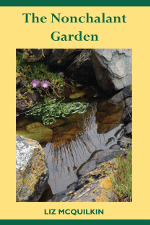
The Nonchalant Garden by Liz McQuilkin
Walleah Press, 2014

DIRTY H2O by Sandra Thibodeaux
Mulla Mulla Press, 2014

Backyard Lemon by Wendy Fleming
Melbourne Poets Union, 2014

Whether new or established, it’s part of a poet’s work to ask: How far can my words go; how much can they capture; where are their limits? The five Australian poets reviewed here each have their own methods of asking these questions. As a reader and writer of poetry I’ve learned a lot from the sometimes quiet, sometimes bold and always courageous ways they’ve answered them.

Continue reading

Posted in BOOK REVIEWS | Tagged , , , , ,

Adam Aitken Interviews Martin Harrison

Image by Juno Gemes

I’d known Martin Harrison since 1985, when I first met him in Newtown, New South Wales. I had been an undergraduate and aspiring poet at the University of Sydney, and we were neighbours. I hung out with a group of poets who often gathered at the Courthouse Hotel, on Australia Street a few blocks north of Martin’s house; a group that included John Forbes, John Tranter, Pam Brown, Gig Ryan, Laurie Duggan, Dipti Saravanamuttu, Jan Harry, Joanne Burns, Rae Desmond Jones, and Chris Mansell among others. Martin was someone from another literary scene, but I was not put off by that as I found him immensely intelligent, warm, witty, and encouraging to young poets.

Continue reading

Posted in INTERVIEWS | Tagged , , ,

When the Wind Stopped

I read somewhere that the words ‘ekphrasis’ and ‘ekphrastic’ had at one stage a reference only in the Oxford dictionary, but nowadays these words are very much part of poets’ vocabularies and practices and most poets at some stage write poems responding to other art works. Erin Shiel’s poem ‘When the Wind Stopped’ was inspired by a number of works by John Wolseley, but rather than depicting the actual art works, her poem engages with Wolseley’s process of creating the works. He’s out in the landscape which has been burnt by fire and he lets sheets of paper be carried by the wind until they are caught on the charcoal twigs and branches of the mallee trees. As she says ‘The charcoal stipples and/ scrapes a song on the sheets.’ In this dancing, singing poem, in which the page becomes like a landscape and the lines become like blowing paper and the spaces give a sense of the temporal, we have an intimate insight into a creative process in which nature, weather, space and time are all participants. Shiel so beautifully enacts all the physical processes that accumulate to produce these art works. The body is as integral as the charcoal because Wolseley has to chase these sheets of paper as they are blown by the wind: ‘He carries them out of the wind/ on his two outstretched arms back/ to a clearing and lays them tenderly/ on a carpet of red dust.’ I love the way Shiel describes the whole collaborative enterprise.

The enchanting connection between land and voice – (reminiscent of Aboriginal song-lines and the idea of ‘singing up country’) is so poignantly evoked: ‘He sings the song the charcoal/scrawls have composed/ and stills them with his voice.’ The language of the poem is very verb-oriented which creates a strong sense of process, action, movement and this works in tandem with the shape of the poem, but if we notice the first verb in the poem it is ‘stands’, and by the end of the poem the sheets of paper are at rest. There’s resolution, completion, calm. This poem so effectively draws out and highlights the intimate relationship between the body, the environment and the imagination. It reminds us of the deep interconnection between mind and matter. – JB

When the Wind Stopped


Wolseley stands on the hill under
the scribbly gum looking over
                                                                               the scrub, eyes flickering over burnt
                                                                               bush. The trunks of the eucalypts
                                                     kneel on a cushion of new green, 
                                                     dead arms extend up in praise,
                                                                               lemon myrtle their incense.
                                                                               He unrolls the paper and cuts 
as though he’s releasing a chained 
creature, sliding the scissors
                          through, feeling the smooth
                          incision, wincing at occasional 
                                                     jags as the angle of the blade
                                                     shifts. Ahead burnt out scrub
                          follows the flow of the terrain,
                          heights of the trees varying, 
                                                                               limbs tracing the rise and fall
                                                                               of the land so from above
it is a carpet of foliage.
He releases the sheets one by one.
                                                     They flap and fly over
                                                      the scrub like cumbersome 
                                                                               birds unaccustomed to catching 
                                                                               the breeze. Feathered ends flay, 
unfurl power but the wind 
drops and the flapping
                                                     settles into a glide until
                                                     the sheets are caught 
                          by the reaching arms of the mallee.
                          The charcoal stipples and 
                                                                               scrapes a song on the sheets. 
                                                                               They struggle,
                          flapping then wrapping, 
                          settling to swaddle low 
                                                                                             burnt out baby bushes. 
                                                                                             The pages caress and 
                                                     smooth the hangnails of 
                                                     petrified twigs. 
They stretch a fraction
to scratch their song.
                                                                               The charcoal song pleases 
                                                                               Wolseley still standing on the hill. 
                          He taps one foot impatiently. Leans
                          to one sheet of paper then 
                                                                                                          another before he dances 
                                                                                                          through the mallee chasing 
them one by one.
He calms their scrimmage,
                          detaching them from  
                          snags and twigs.
He carries them out of the wind 
on his two outstretched arms back 
                                                     to a clearing and lays them tenderly
                                                      on a carpet of red dust.
                                                                                                          He sings the song the charcoal 
                                                                                                          scrawls have composed
and stills them with his voice.
While they rest he considers the ring
                                                                  necked parrots screeching above. 
                                                                  How will he entice them
                                                     to land on the scroll
                                                     that documents the mallee song?

Inspired by the art of John Wolseley, various works.
Posted in GUNCOTTON | Tagged ,

Paul Hetherington Reviews The turnrow Anthology of Contemporary Australian Poetry


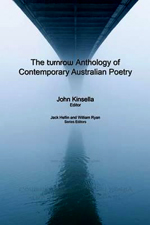
The Turnrow Anthology of Contemporary Australian Poetry
John Kinsella, ed.
Turnrow Books, 2014

John Kinsella is an Australian poet with a high profile and a long record of achievement, including winning the 2013 Prime Minister’s Literary Award for Poetry. He is also an assiduous anthologiser. Most notably, he edited The Penguin Anthology of Australian Poetry (2008), one of the more successful of recent attempts to establish an indicative canon of Australian poetry (although this was not, perhaps, Kinsella’s avowed intention with that book).

Continue reading

Posted in BOOK REVIEWS | Tagged , , , , , , , , , , , , ,

rob mclennan Reviews 70 Canadian Poets, Fifth Edition

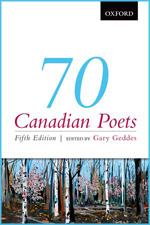
70 Canadian Poets, Fifth Edition

70 Canadian Poets, Fifth Edition, Gary Geddes, ed.
Oxford University Press, 2014

The fifth volume in editor Gary Geddes’s series of anthologies is 70 Canadian Poets. Predominantly produced as a mainstream-leaning overview of Canadian poetry for university courses, the anthologies exist as worthy introductions to the past century-plus of Canadian poetry. The series is now nearly fifty years old, and began with the original 15 Canadian Poets, co-edited with Phyllis Bruce (Oxford, 1970), before heading into 15 Canadian Poets Plus 5, also co-edited with Phyllis Bruce (Oxford, 1978), 15 Canadian Poets x 2 (Oxford, 1988) and 15 Canadian Poets x 3 (Oxford, 2001), with the new volume existing as a kind of 15 Canadian Poets x 4-and-two-thirds.

Continue reading

Posted in BOOK REVIEWS | Tagged ,

1-bit Signals: Computation as Music and Visual Art


Image courtesy of Tristan Perich

There’s a thin but substantial line that separates the abstract mathematical world of computation and the concrete physical world that surrounds us. We rarely interact directly with the processes of computation, instead we look at full-colour images on computer screens, type on QWERTY keyboards, or glide our fingers across glass digital phones. These are the physical interfaces employed to work indirectly with information, never truly touching the data manipulated by the microprocessors at the heart of our computers.

I’m interested in this translation divide, and how we can get closer to the mechanism of computation itself. Even though computers are, of course, electronic, I use the word mechanism because, at its most fundamental level, a computer’s operation is almost mechanical. Even though we all know information is stored as ‘1’s and ‘0’s, there are no tactile 1s and 0s present in computers, at least not how we think of them. The numerals 1 and 0 are in the domain of language, and in the same way as writing a ‘1’ on a piece of paper is just a line of ink – not actually the mathematical value of one – 1s and 0s are represented in a computer by electric voltage potentials, that are shuffled around much like how a marble might trickle down child’s mechanical toy. The result of this shuffling is called computation, and it happens so fast that we easily forget it isn’t just magic.

Image courtesy of Tristan Perich

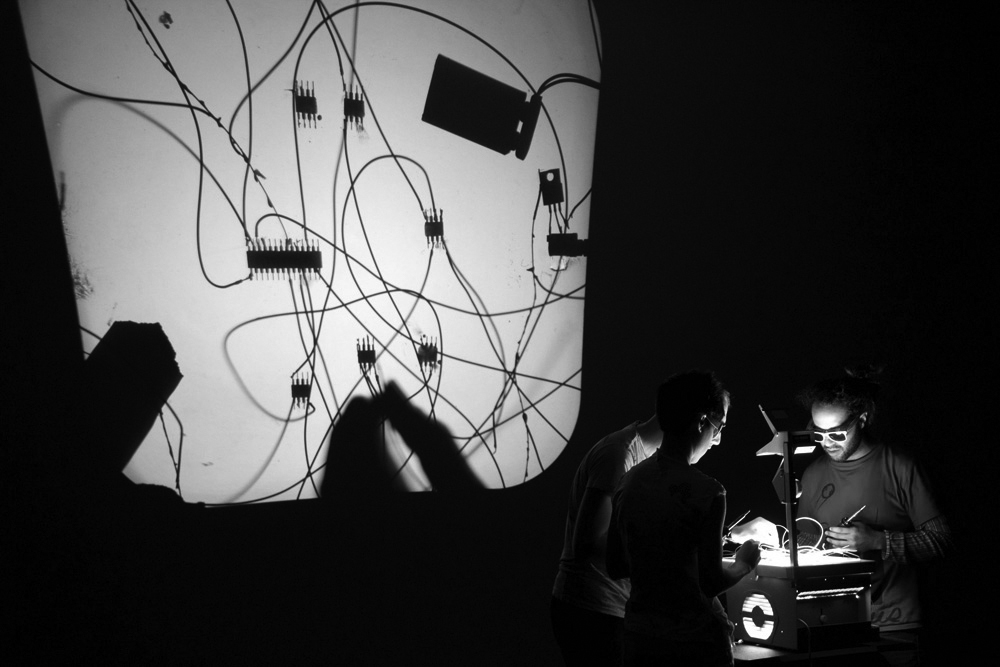
I try to expose this physical side of computation in my work. As a composer and visual artist, I employ these primitive 1-bit signals as my raw material: audio waveforms, video patterns, other signals made up entirely of 1s and 0s or on/off pulses of electricity. They are synthesised by simple microprocessors I program and then wire their binary outputs directly to things like audio speakers, motors or televisions.

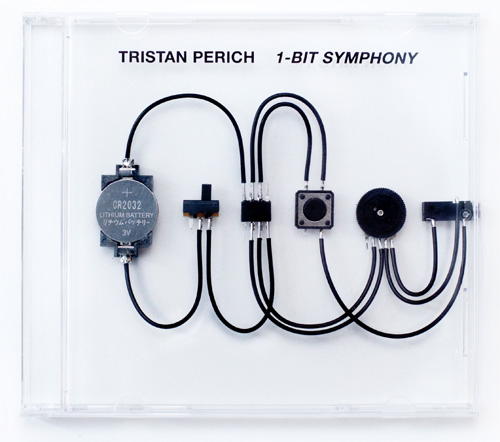
In 1-Bit Symphony, I composed an album of electronic music for microchip, and it was released as an electronic circuit with a headphone jack in the side. In my Machine Drawings, the signals are connected to motors that control the movement of a pen to execute drawings based on randomness and order.

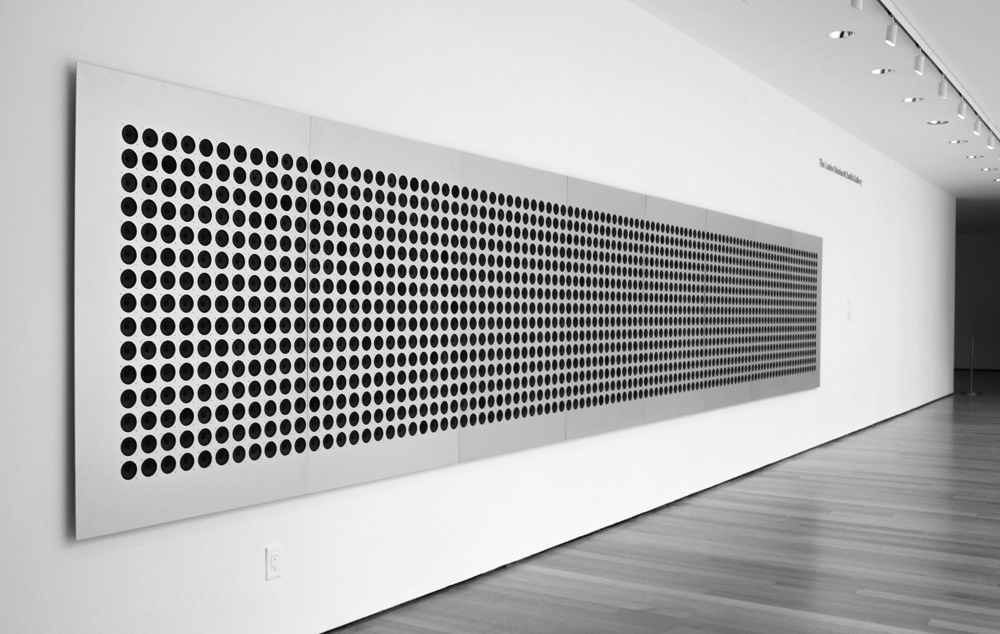
In Microtonal Wall, I explore the nature of sound by having 1,500 small speakers each play individually tuned pitches, which collectively add up to white noise, like the colours of the rainbow adding up to white light. In Between the Silences, I have nine classical stringed instruments performing against an austere nine-part 1-bit electronic score, played through speakers on stage with the musicians.

Image courtesy of Tristan Perich

As opposed to ‘hifi’ media, 1-bit audio has a raw electronic sound, 1-bit video a primitive binary visual, etc. In addition to being intellectually interested in working with the most basic digital signals, I find their sounds refreshing and alive. Rarely do I think about what they can’t do because of their simplicity – like how we wouldn’t think about why a violin cannot play back pop songs in high fidelity. Instead, the mechanisms become new instruments themselves; sound defined by their binary simplicity, voices played by computation.

Posted in ARTWORKS | Tagged