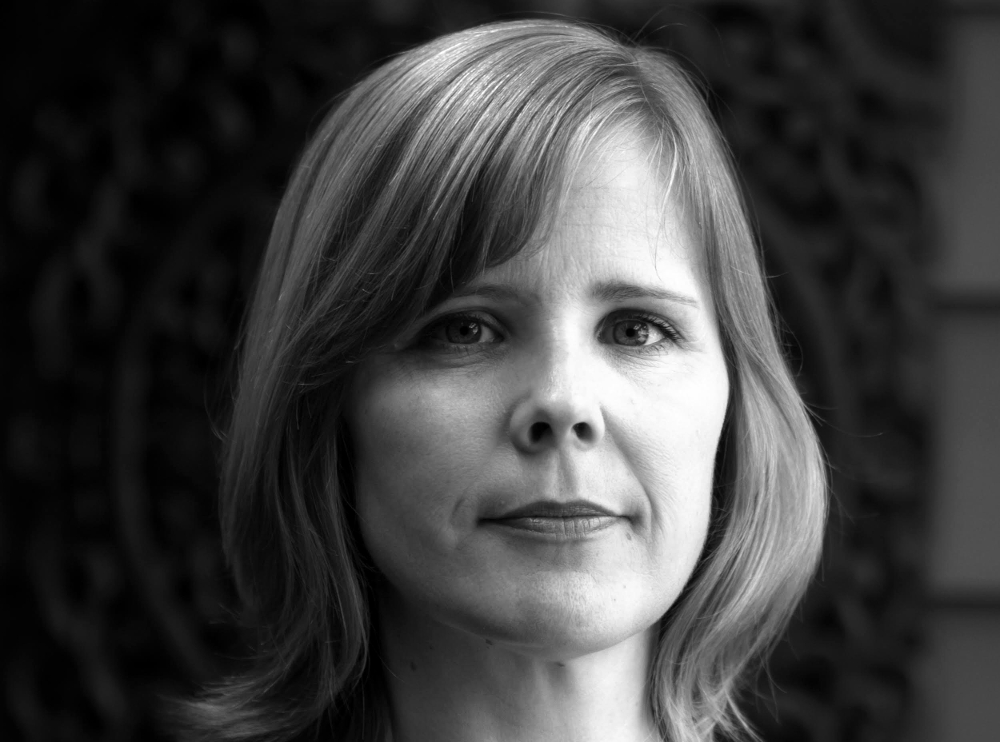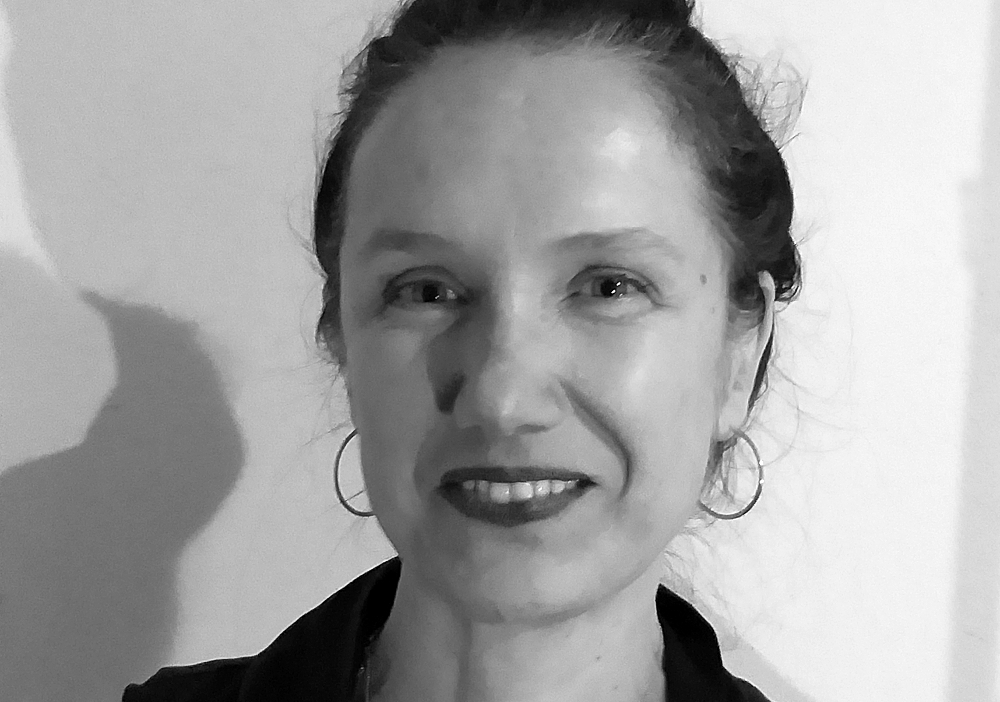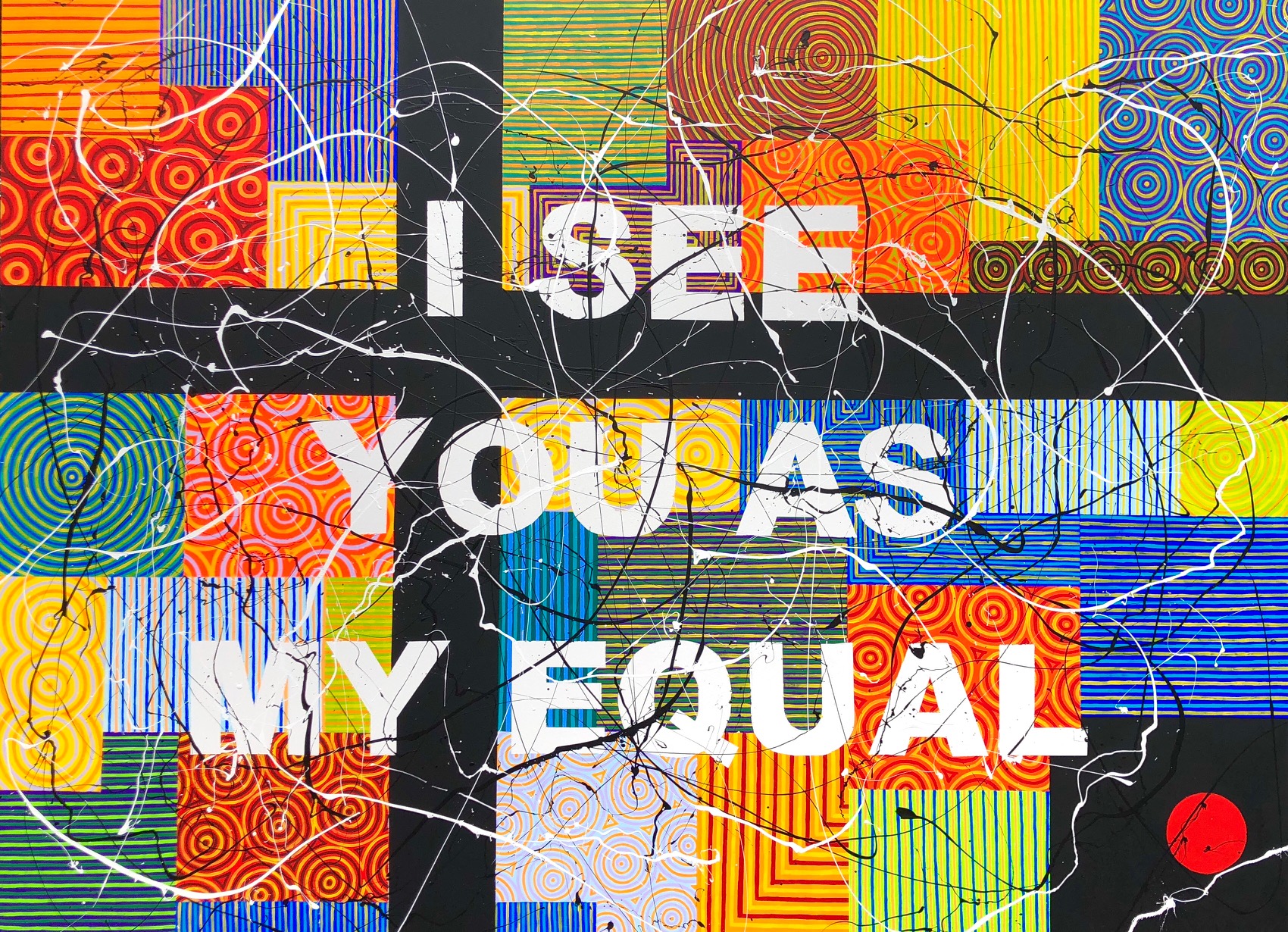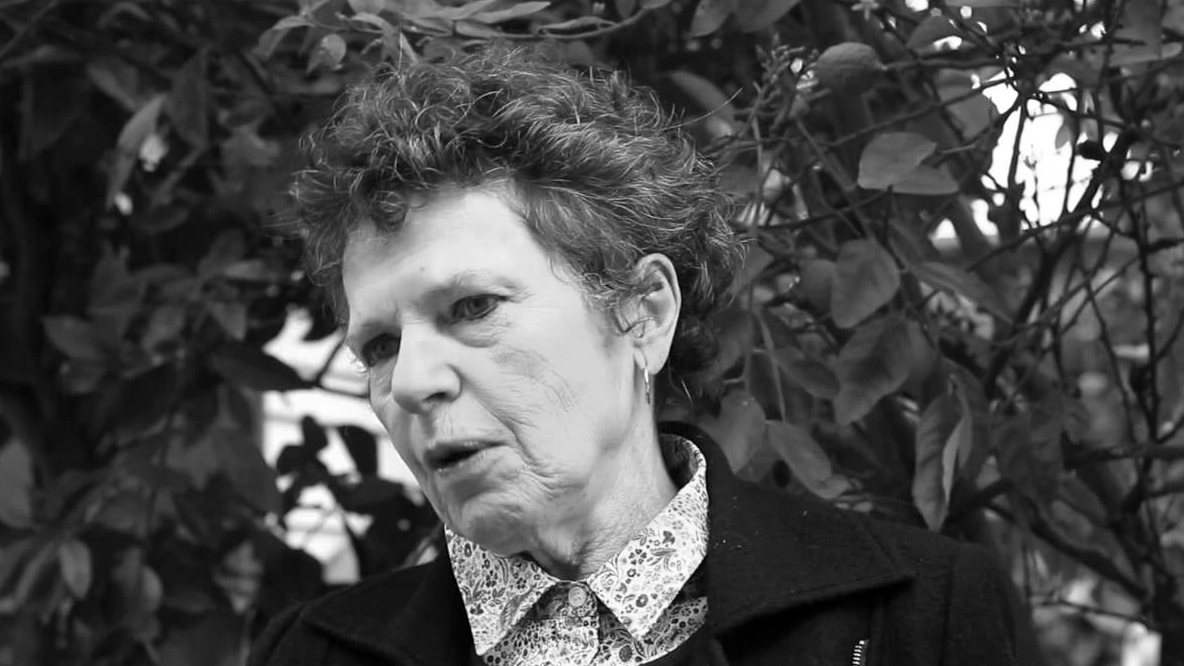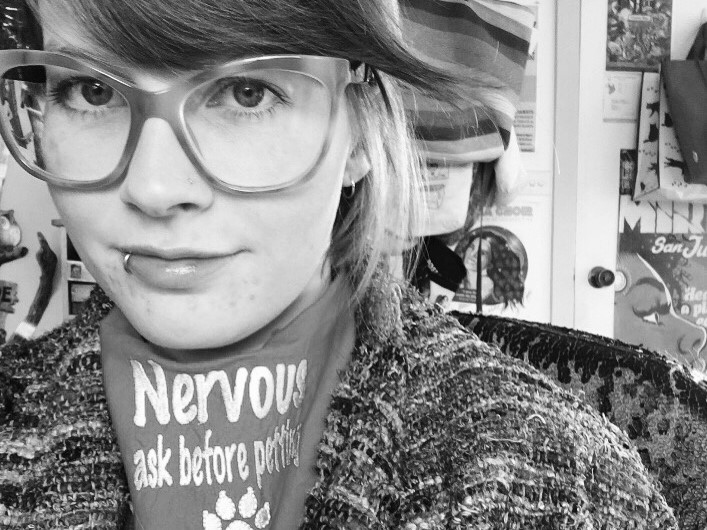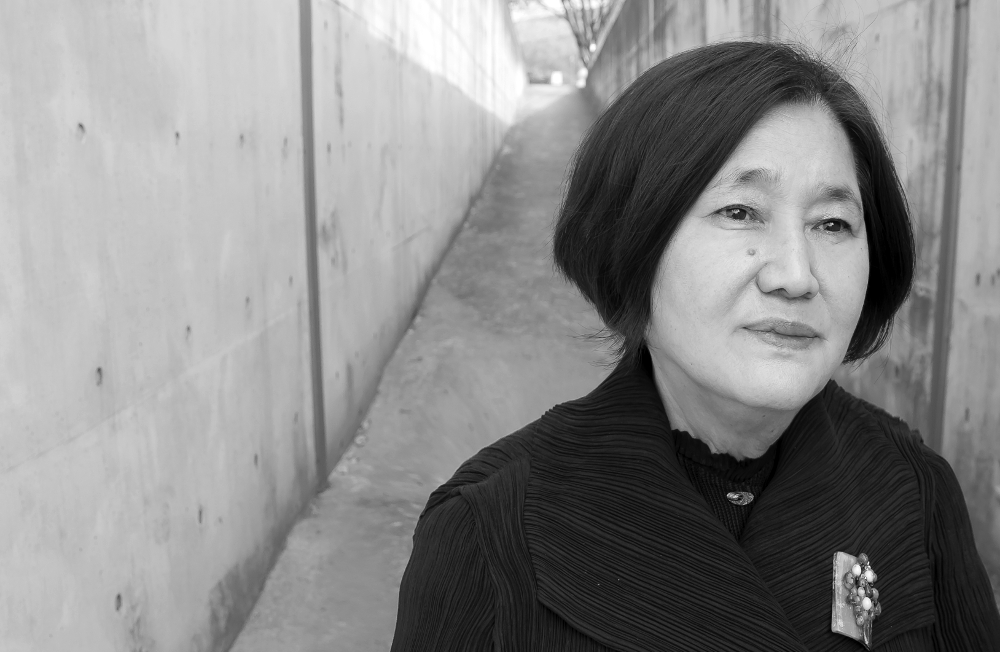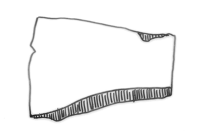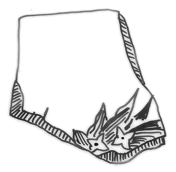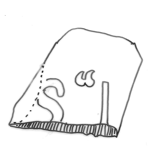
7 Portraits by Ali Gumillya Baker

‘Bow Down to the Sovereign Goddess’ (series 1-5), 2012; exhibited at Art Gallery of South Australia, ‘From the Street’ and part of the Flinders University Art Museum Collection. Portraits: Alexis West, Simone Tur, Nazaree Dickerson, Tracey Rigney and Faye Rosas Blanch.
‘SovereignGODDESSnotdomestic #1 and #2’, 2017, exhibited at ACE Open, in The Next Matriarch as part of TARNANTHI Festival of Contemporary Aboriginal and Torres Strait Islander Art. Exhibited at the Koorie Heritage Trust, 2018. Portraits: Natasha Wanganeen and Bianca Leicester.

Posted in ARTWORKS | Tagged

Selections from 3 Yhonnie Scarce Series


Yhonnie Scarce | N0000, N2359, N2351, N2402 | Blown glass, archive photographs, dimensions variable; 2013 (detail)

Posted in ARTWORKS | Tagged , ,

Kathy Acker and The Viewing Room

The last time I saw Kathy Acker was in London, in July 1997. I wasn’t sure how she felt about me at that point. I had failed to drop everything to be with her in San Francisco the year before, and I had failed to make a job materialise that would have brought her to Sydney, as she wanted. Things had, I felt, ended in a disappointing but amicable dead end. ‘Just be my friend,’ Kathy said, early on, and I had promised I would.

Being friends is more of an undertaking than being lovers.

Charles Shaar Murray: ‘I met Kathy Acker at a dinner party in a Mexican restaurant in Soho. A little over 24 hours after that meeting, we discovered ourselves to be in love and resolved to spend the rest of our lives together. We spent most of the next five days almost continually in each others’ company.’1

She had decamped from San Francisco back to London, with all its difficult memories, to be with him. She knew she had cancer, or maybe knowing and not knowing. She was already planning to return to San Francisco. I happened to be coming to London on some arts organisation’s tab, so we agreed to meet there, in a city where both of us were strangers.

It seems likely we had a meal somewhere, but I remember nothing about that. The part I remember starts with going to see a performance. What I remember is that it was a one-man show about a gay man living with AIDS who expected to die soon. The performer had such presence, not just with his language and gesture and stories, but with his body.

The performance was in a lecture theater at a London teaching hospital. His only prop and light source was an overhead projector, of which he made brilliant use. The show was both cutting and moving at the same time, a portrait of the state, medicine and technology as much as of this man’s life.
That was the first part of the show. The second was very short. He told us that the lecture room in which he was performing was next door to a former viewing room. In the past, hospitals set aside such rooms for relatives to view the recently deceased. In a viewing room they could be arranged properly as a kind of tableaux for relatives to pay their last respects. The performer asked us to wait five minutes. Then we were ushered into this viewing room.
The viewing room would have held maybe a dozen beds, a sort of ward for the dead. There was only one bed in it, and that bed was the only thing lit, the room being otherwise dark. The colors I remember are sienna, mahogany and salamander. Or maybe those are feelings. In the bed was the performer, neatly arrayed, completely still. He was acting as his own corpse. This was the second part of the show.

Part of the point this made was that even in the late nineties, a gay man with AIDS could not count on his real friends, his family of choice, being able to be with him in hospital, or to have the right to see him in death. There was something dignified about the viewing room, the intentional staging of the dead one, and the performer turned this to his advantage. We strangers were in a place to see his future self where his friends might not.

In the viewing room, everyone was silent. The energetic buzz of premature after-show conversation dropped down to nothing. We all just stood around. Kathy was next to me. I wanted to hold her hand, or something, but I did not know if she would want me to, or if it would make her feel worse. We just stood in the audience, this audition for silence, being silent together. It was such a naked contrast to the animated quality of the first part of the show. Then we left.

Memory is a genre of fiction. For a long time, I have wanted to know what the performance was that Kathy and I saw on our last night together. I found out finally by asking on FaceBook and tagging some people, who didn’t know, but knew people, who knew people, who knew: The Seven Sacraments of Nicholas Poussin, by Neil Bartlett.

I ordered it from Amazon. Read it. Now I know it was performed at Royal London Hospital in Whitechapel, from the first to the seventh of July. I had forgotten that most of it was about Poussin’s paintings of the sacraments. Memory changed the ending. There is indeed a second half of the performance, but Bartlett sits in a chair opposite an empty bed, as if he were holding the hand of its occupant. The pillow is creased in the middle as if a head lay on it.

Neil Bartlett: ‘You will have noticed, those of you who were brought up with these words as I was, that I keep on remembering them wrong. I have erred, and said things, like I’ve lost my place. I have left out the words which I ought to have said, and I’ve put in some of those that I ought not to have put in, and I just can’t help it.’2

Kathy didn’t want to go out, so we took the tube to her place, getting off at Angel station. Her apartment lay alongside one of London’s canals. I could see canal boats tied up there. Kathy often said she wanted to be a sailor, to take off into the rolling waves. She was a sailor in the ways that were available to her. Writing (fucking) was her sea. I imagined her pottering about on canal boats, where the city meets the rising tide.

Her address was 14 Duncan Terrace. I’m looking at it again on Google Maps. The red door is as I remember. I see that when Street View last cruised this block, it was for sale. On the other side of her street is not the canal, it’s a strip of green parkway. There’s waterways nearby, and if I zoom in on the satellite image I can see narrow-boats pulled up along the banks. Looking at the satellite images, and playing with the street view, triggers other memories, whether real ones or not I don’t know.

I remember her flat as one of a row of identical brick Georgian terrace houses. Judging by the quality of motor parked there, quite a posh area now. The brick grimy, the white-painted details shiny in moonlight. The famous writer Douglas Adams lived on the same block, Kathy said. He could afford a whole townhouse. His lights were on. I caught a glimpse through the window of his bookshelves, in white wood.

In memory Kathy’s place seems like a basement flat but I don’t know if that is a memory of architecture or of mood. Kathy rummaged around in the kitchen for wine, glasses and an opener. I looked at the bookshelves. All her books seemed to be here, neatly arrayed in alphabetical order, in double rows, just like they had been in San Francisco. I got a little distracted looking at treasure I would like to read, like I did when I stayed with her in San Francisco that short while. When she was out at the gym I just rifled her books, stealing lines into my notebook. I was always careful to put them back in the right place.

Posted in ESSAYS | Tagged , , , ,

To Live There: on ‘Dispatch from the Future Fish’

Dispatch from the Future Fish’ is a visual poem that is deliberately referential, opening up conversations and foregrounding the notion of writing into certain traditions: those that are given to us and those that we choose.

The first lines,

I come from
an archipelago
where land is built
on top of water
and that is called
a reclamation

come from Kyle Dacuyan’s poem, ‘American Vernaculars’. The section title, ‘Your President, Eileen Myles’, is also the title of Myles’ event organised by The Wheeler Centre, Melbourne in May, 2018. The Lobster is a 2015 film directed by Yorgos Lanthimos. The last lines of the poem, ‘We are all going forward. / None of us are going back’, are also the last lines of Richard Siken’s poetry collection, Crush.

‘Dispatch from the Future Fish’ opens and closes with a reference, both of which are taken from queer works and/or queer artists. These careful citations reflect on the practice of honouring queers who have encouraged other queers to walk down the path of living a queer life – whatever that life may look like.

It is also the case that much trans* art and many trans* artists may be drawn to these kinds of assemblages. Jack Halberstam writes of this in Unbuilding Gender where:

Trans* bodies … function not simply to provide an image of the non-normative against which normative bodies can be discerned, but rather as bodies that are fragmentary and internally contradictory; bodies that remap gender and its relations to race, place, class, and sexuality; bodies that are in pain; bodies that sound different from how they look; bodies that represent palimpsestic identities or a play of surfaces; bodies that must be split open and reorganised, opened up to chance and random signification.(n.pag)

‘Dispatch from the Future Fish’ takes from trans* criticism the imperative to be open to transformation. It is significant, then, that the poem is also a collaborative effort between Darlene Silva Soberano’s words and Eloise Grills’ interpretive illustration. The handwriting within the piece comes from both artists; Soberano wrote the section titles (‘A Reclamation’; ‘Your President, Eileen Myles’; ‘A Reclamation Part II’), while Grills has transcribed the words of the poem. The words of the piece have gone through several forms, first typed in a Word document, then written by hand into the comic’s visuals and finally converted back to a digital form readable online. The words bend: open to human hands holding both pen and pencil as well as typing. In the visual images they follow the rivers and are depicted as being among nature.

The first instance of the poem emulated Myles’s signature staccato style of language, but Grills’s visual arrangement of the poem suggests a slower reading. Consequently, in this final version, the dedication to Myles suggests both a marker of time as well as an acknowledgement of style. At its heart, ‘Dispatch from the Future Fish’ is a poem that rages against aloneness, and both its referential nature and collaborative creation echo this discussion in the work.

In the section titled ‘A Reclamation, Part II’, the lines, ‘I stop for a second / It looks me in the face / holds my gaze, / and calls me by its name’, are lightly paraphrased from the last lines of André Aciman’s 2007 novel, Call Me by Your Name. The title references the character Oliver talking to his lover, Elio: ‘Call me by your name and I’ll call you by mine.’ This line celebrates the sameness of the two lovers; their sameness of sex, sameness of two different selves in an intimate moment. Their sameness is queer – that is, also strange; it is strange to call somebody else by your own name. And still. It is a strangeness taken upon by queer people, especially in the way the world perceives us: ‘we don’t have to be witty and charming people who keep our lives discreet and marginalised in the straight world’ (Love, p. 157).

In ‘Dispatch from the Future Fish’, the speaker encounters a fish from the future. The fish calls the speaker by its name and, in doing so, claims the speaker as its own – encouraging them to adopt they/them pronouns. Unlike Call Me by Your Name, the encounter here is not necessarily romantic, but still reckons with the idea of strange sameness. Here, the two different selves in two different forms, the fish and the human, become one.

Many people considering using they/them pronouns hesitate due to the strangeness of the language. Despite efforts by dictionaries to continue asserting that the singular ‘they’ is grammatically correct, and despite the fact that ‘it’s likely that singular they was common even before the late fourteenth century’ (Baron, n.pag) – the term is still perceived as being grammatically awkward and confusing. Eileen Myles argues for the embracing of this awkwardness, or assigning personal significance to the awkwardness of the pronoun. In an interview with Emma Brockes, Myles describes how: ‘[w]e are many. I like the collective notion of self. I think more people for more reasons should take on ‘they’’(n.pag.).

It makes sense then, for the last lines of ‘Dispatch from the Future Fish’ to be grammatically awkward: ‘Future fish, I know who you are / I am they’. They is truly strange and to deny this aspect of the pronoun in service of progress is to deny queer practice. They is still undergoing transformation. To be they in this moment of history is to receive the benefits earned by the plights of older queers – but to be suspended before solid entrance into the mainstream. Like the early years of drag performance. Like the early years of the word, queer – its history now has the luxury of being forgotten; the luxury of forgetting why it was chosen – ‘because it evoked a long history of insult and abuse – you could hear the hurt in it’ (Love, p. 2). The dream, perhaps, is for the history of they to be forgotten – which is irresponsible, but such is the conventional marker of progress. For now, however, they/them pronouns contain a certain magic, for it ‘wakes us with its strangeness’ (Kaminsky, n.pag.).

Posted in ESSAYS | Tagged ,

The Wild Workshop: The Ghost of a Brontëan Childhood in the Life of Dorothy Hewett


Courtesy of the Archive of Lesley Dougan.

An indelible part of the Brontë mythology is their symbiotic development as young artists in an isolated environment. Some time ago, Juliet Barker’s biographical scholarship on the culture at the parsonage and the Brontë siblings’ lives in Haworth has questioned that isolation in terms of the rich resources available to the Brontës siblings and a family culture that strongly encouraged their imaginative and artistic development.1 More recently, director Sally Wainwright’s TV movie To Walk Invisible has meticulously recreated the dynamic relationship between the Brontës’ childhood fantasy worlds and their adult writing, along with the strategic ways in which the three sisters built a professional path towards their lives as novelists directly through their sibling bonds. Wainwright’s interpretation of the sisters’ creative lives has gone some way in recovering both the weirdness and the ordinariness of the Brontës in it they seem closer (more graspable) than in any recreation of their lives encountered before. In a similar fashion, Simon Armitage’s recent engagement with Branwell Brontë’s life and legacy achieves, I think, a similar thing. As critic Drew Lamonica Arms has noted

(f)or the Brontë sisters, home – and no place like home – offered the liberty to be together and to be themselves, and this meant the freedom to write. Writing in collaboration reinforced the Brontë’s sense of family solidarity. It was also a means by which they established, asserted and explored individual difference among siblings cast in the same mould, raised in like circumstances and spaces, placed in similar life experiences as daughters, sisters, governesses and authors, whose devotion to one another was both profound and intense (96-97).

I want to consider the significance of the space of childhood in the creative development of Australian poet, playwright and novelist, Dorothy Hewett (1923–2002) through the lens of the childhoods of the Brontës by tracing connections between isolation, place, physical freedom and family culture in relation to artistic development and identity. I want also to think about the role of sister relationships and the influence of parents within the context of isolated upbringings.

In her revisionary introduction to Wuthering Heights, Charlotte Brontë attempted to excuse the perceived scandalous nature of that novel by stating that it was ‘hewn in a wild workshop’(xxiv). Whilst one can see the ploy behind this statement – Charlotte Bronte’s attempt to cast Emily Bronte as a naïve primitive in order to fend off accusation of unseemly writing for a woman – the designation ‘wild workshop’ is handy to my purpose in that in suggests the combination of a space and an activity that is separate from the day-to-day world. It also brings together seemingly contrary orders of a space that are potentially both disordered (wild) and ordered (workshop). In this way, in this tension, it ultimately describes a psychic space as much as the moors of Yorkshire or Lambton Downs, the 3000-acre wheat and sheep farm in Western Australia on which Hewett spent her formative years.

That first spaces define and haunt artists is a well-established notion. Janine Burke argues in her book Source: Nature’s Healing Role in Art and Writing, that this is practically the driving force behind many artists’ adult output – and that to lose the first place is almost necessary. The Brontës, perhaps more than any other writers, symbolise this extreme connection to childhood haunts. Emily Brontë in particular is figured as being earthed in the domestic life of the parsonage and its surrounding moors and of hating time spent away from there. Bruce Bennett argues that Hewett shares with other Western Australian authors such as Peter Cowan and Tim Winton an ‘organic’ notion of local environments also shared by English writers such as D H Lawrence, the Brontës and Wordsworth. Of Hewett he writes, the ‘imagery of place and especially of remembered places of childhood is a necessary prerequisite to the figuration of human behaviour and action’ and that this connection to writers such as the Brontës gives her work ‘an inter-textual richness and force’(20). This particular nexus of intense connection to childhood home, the positioning of that home as extremely isolated, to missing that home, and to the bonds of both sisterly affection and competition would, I argue, bring this sense of a Brontëan haunting to the artistic formation and identity of Hewett.

Posted in ESSAYS | Tagged , ,

Externalising the Symptom: Radicalised Youth and The Membrane

I was radicalised in my youth. I came back from a year in Paris in ’68-69 with my parents, and went to Monash University, a ‘radical’ campus when it was new. I was not a leader; I was still too young for that, but being radical was a trend. In Paris I had been knocked to the ground by the CRS, the riot police. Back home I went to all the demos. I refused to go to Vietnam, and Gough’s election in 1972 saved me from a court case that would have punished me for non-compliance with the draft.

Not everyone was radicalised in those radical times. The boring students in the Liberal Club were biding their time. We were the ones who were going to change the world, uttering the word ‘revolution’ with all the naïvity of youth. Some even headed off to South America in search of some real action. The tentacles crept out. The revolution spread to gender issues and then baby boomer Indigenous youth announced their survival and woke the rest of us up to the foundational injustices of colonial Australia.

And now, today, there is a moral panic about the ‘radicalisation’ of youth of an Islamic confession. It is not totally different. What the kids of today share with my generation is the yearning to define their own place in the world, to be allowed to make their own home and be allowed to do it differently from the common sense expectations of the broader society.

‘They come over here and they …’ Joe, at my Saturday arvo baseball game, lets the unfinished sentence fill up with all the imaginary sins of a new unknown migrants. I think I should ask him if he has ever had a chat with one of ‘them’. Or with his father who might have had, long ago, similar complaints about ‘dagoes’ and ‘wogs’ that have now evaporated.

‘Joe, did you ever talk …’ I start to ask, but he is already striding towards home plate. As clean-up batter with two runners on, he has a job to do. ‘No pressure,’ I yell out, to no-one in particular. Baseball is a game full of such supportive chatter. In this Adelaide suburb, everyone on the team, even the whole club, seems to be white.

It’s the concepts that matter. What used to be the positive value of ‘revolution’ – kids actively working towards a utopian future – has been fragmented into isolated acts now called ‘terror’, coming from outsiders. And ‘we’ can only react.

The meaning of the veil

How does one conceive of a woman with a headscarf? Such women have been subject to hateful acts, even in the anonymous diversity of shopping centres in Australian suburbs. The French ethnopsychiatrist, Tobie Nathan, whose new book The Wandering Souls I have just translated, sees the headscarf first of all as a concept. He calls it a ‘membrane’, based on the meaning of the word ‘hijab’. The veil is not a sign of oppression, the women wearing it would be the first to agree, but one of status, the status of a married or marriageable woman who has chosen not to hide, but to show:

…[a] young veiled girl professes and exhibits a philosophy; she proclaims that she belongs to a group whom she intends exclusively to endow with all her vitality, all her thoughts, all her love. Here the veil is not the mark of a repression of sexual life, but the announcement of a preliminary selection of candidates.1

The same concept is at work where the veil persists in ‘Western’ traditions in the form of the bridal veil that symbolises the division between single woman and wife, a ‘membrane’ she crosses by lifting the veil at the end of the ceremony as she embraces her new identity.

A woman of Islamic faith wearing a veil in a diverse Western society runs the risk of hate acts not because she has submitted to an archaic moral order, but because, according to Nathan, her clothing is actually a kind of fashion – that is, a way of presenting herself that distinguishes her from the common by being attached to a select group. That is what provokes the outrage: there is a principle in ‘our’ society that no-one is supposed to be sexually inaccessible.

The Jewish refugee

‘They are like me’, says Tobie Nathan, also a baby-boomer, who arrived in Paris in the 1950s as a refugee kid whose family was expelled from Cairo after the Suez crisis. He grew up poor on a housing estate, like the ones where the youth of today are being ‘radicalised’ by Islamic extremists. He knows where they come from.

Later, like me, he was on the barricades in May ’68 in Paris demanding radical solutions (actually, I was more of a tourist on the sidelines, standing there amazed). The more militant were prepared to risk their lives to overthrow the regime of an older generation that was out of touch and failing to provide a viable future for our new ‘booming’ generation.

As an ethnopsychiatrist who has spent his career developing therapies suited to migrants and refugees, ‘wandering souls’ struggling to find a way to belong in metropolitan France, he knows what can cause people to seek desperate ‘radical’ solutions.

Bintou’s therapy

But most of his patients have been people like Bintou, a young woman of African extraction.2 The usual medication and therapies had done nothing to help her ‘psychosis’. But Nathan’s ethnopsychiatric clinic took her cultural background seriously. On her case he had one doctor in the group who spoke her language, Wolof. Another doctor used the divination technique of ‘throwing the cowries’, a technique that gained the young lady’s confidence and involved her in her own therapeutic process. This was perhaps no more ‘mumbo-jumbo’ than some of the Freudianism that had alienated her in other clinics.

The prescription that Nathan derived from the whole process was that she should ring her mother in Africa, and ask her to get the local healer to sacrifice an animal… This, along with other subtle actions, was carried out in due course, and the overall therapy was one of reintegrating a ’wandering soul’ to her family, community and ancestors. She was cured. Nathan’s insight is that Western psychiatry and medicalisation isolate the patient with their symptom (it becomes their identity), while his ethnopsychiatry externalises the symptom – it could be caused by the gods or someone casting a spell – and it is treated by procedures that reintegrate the person into their community (they regain their identity).

Posted in ESSAYS | Tagged ,

On Deep Breaths and Friends Forever: Im/materiality and Mis/communication in Happy Angels Revisited

It starts with a beautiful day in the sea, so full of souls, and it will be forever.
+
+
+
+
Things I want to tell you about:
+
+
+
+
the sun’s rays, my teacher, things that are woolly to touch, body organs and elastic forms,
+
+
+
+
all happening in the world, with nowhere else to go.
+
+
+
+

Happy Angels Revisited (2018) is my audio adaptation of the children’s book Very Happy Angel Visit (2016) by Hela Trol Pis (Max Trevor Thomas-Edmond) and Hulugold (Chris Peckham). Released through Hela’s publishing project 5everdankly, the print version combines Hela × Hulu’s experimental writing and drawing practices to produce magical milk-glass pictograms through the story of a shape-shifting angel and her friends. In this gentle reading-recording, Happy Angels Revisited considers the sonicities of body/-language through some of the book’s key themes of desire, religion, holograms, fuzziness, and friendships.

Taking cues from the Call and Response, an interactive polyvocal model used in antiphonal music traditions such as gospels, hymns, and sea shanties, where audiences respond to the ‘call(s)’ of a speaker, Happy Angels Revisited pursues a modality of swaying. Moving through and in excess of the sonic and the poetic, the polychoral and the literary, the you and the me (without recourse to a binaristic split between self and other), this is an invocation into the voice’s capacity to displace and disperse itself into multiple literary and aesthetic traditions, as a way of gauging encounters, affects, and relationships. Ythm, an audio journal of contemporary poetry, exemplifies this Call and Response structure in its first issue; Fred Moten’s Reneo’s Open House calls, and four poets respond; invoking a practice of beckoning and attuned listening, a practice of linkage – just like linking arms, like a chain, like a bead bracelet, like a friendship bracelet, a circle loop that means friends forever. The journal itself is auspiciously presented in a circular format – also what I imagine the shape of pores to be.

the sun needs you in it

Happy Angels Revisited is about slow and self-reflexive discharge. Through oral storytelling that moves between modes of address and subject, it is about identifying (without over-exerting) the things that happen in and around the body, and gently, slowly, leaking, expelling. I haven’t quite been able to commit to a name regarding Form but maybe the closest is something between a bedtime/wake-up time story, or a guided meditation; a type of relaxation therapy to facilitate the practice of breath and detachment from thought-induced congestion; easing the movement of worlds towards more renewable and sustainable flows of energy.

where do things go when they disappear? 

The angel learns, and plays
games in the world, so adorable,

I’m hiding from you cutely… 

:0

and then takes a giant nap after a big day of swimming, playing, and practising care.

Do you know how important rest is?

even the biggest angel needs a nap

You are the angel, but also the world, which goes in every time you breathe. 


<3 


that’s what breath is
Posted in ESSAYS | Tagged ,

Letter to Anne Carson: Work of Remembrance and Mourning

‘I came to think of translating,’ you write in Nox ‘… as a room, not exactly an unknown room, where one gropes for the light switch.’ I read your words and imagine you standing in a dark room, your hand thrust forward for a handshake with Catullus’s Poem 101. Paul Celan, the poet you admire, once wrote to a friend that he saw no distinction between a handshake and responding to a poem. But the handshake between a translator and a poem is of a special kind; the first touch is often tentative and timid but once the hand has been grasped, to let it go becomes impossible.

You too can’t let go the hand of Catullus’s Poem 101. ‘I never arrived at the translation I would have liked to do of the poem 101,’ you confess. ‘I guess it [the translation] never ends.’ The groping for the light switch continues. But it doesn’t mean that the effort is wasted. ‘A translation,’ writes Walter Benjamin, touches the original lightly and only at the infinitely small point of the sense, thereupon pursuing its own course according to the laws of fidelity in the freedom of linguistic flow.’ Benjamin’s metaphor of a tangent touching a circle seems in consonance with your groping for the light switch. Both touching and groping can’t happen without hands, and no handshake without them is ever possible.

Benjamin suggests that ‘… languages are not strangers to one another,’ and that only translation can express the kinship of languages more clearly and profoundly. Maurice Blanchot adds an extra emphasis to the idea when he suggests that ‘each language, taken by itself, is incomplete.’ His brief Translating seems to me to be a handshake as well; a handshake between languages; Benjamin’s German text was, most probably, read by him in French, and his own French text has reached me in English.

I have experienced the kinship of languages first-hand, and I am lucky that I continue to enjoy the experience. Like most Indians I was born and brought up in a multilingual family that made use of at least four languages: Punjabi, Hindi, Urdu and English. At home we spoke Punjabi, our so-called mother tongue, but none of us could read or write it because we hadn’t taken the trouble to learn the Gurumukhi script. Hindi became a convenient replacement.

My mother didn’t know English but this didn’t stop her from using English words she heard spoken around her. She employed them with confidence relying on an intuition that rarely failed her. My father’s grasp of Urdu was as good as that of English. He knew the Arabic script in which Urdu was read and written. My father also knew Persian and loved Persian poetry especially that of Mirza Ghalib, the nineteenth-century Urdu and Persian poet who died disappointed that his poems in Persian remained unappreciated by Persian poets.

So at home like many other Indians we spoke a hotchpotch of languages. This hotchpotch or khichidi, to use a Hindi word, continually evolved without any conscious effort from our side. However, the mishmash of our everyday speech coexisted without any discernible tension with a more literary version of Hindi and English that entered the family with books, magazines and newspapers.

In October 1962, when my father, a junior officer in the Indian Army, was sent to fight in the Sino-Indian War, the letters he wrote home to my mother were in Urdu written in the Arabic script. Only my mother could read them and so had to translate them for us. My mother replied to his letters in Hindi (in the Devnagari script) that my father could read and understand but wasn’t able to write.

I began learning English in primary school. When I moved to a high school my father started coaching me at home. His method relied solely on translation for which he used a book that had texts in English and Hindi. He would ask me to translate them: English into Hindi one day and Hindi into English, the next. Often brief news reports from The Tribune, his favourite English daily, were given to me to earn bonus points, which were occasionally converted into money to add to my pocket allowance. I used the savings to buy my first book, The Adventures of Don Quixote de la Mancha. This large hardback book was judiciously illustrated with colour plates and black and white drawings. I liked the stories and soon translated one of them into Hindi; not to show it to my father but just for my own pleasure. The book and my first attempt to translate a story, just for pleasure, made me fall in love with Sancho Panza, whom I saw in one of the illustrations seated luxuriously on his lazy mule.

Translation and translating which for many years remained an inexhaustible wellspring of pleasure became a compulsion when I went to Moscow to study geology. To learn Russian was a necessity but it also meant that I had to put away Hindi and English so that I could learn to think and imagine in Russian. It has to be the language in which you dream at night, I used to be told by my teachers.

For many years I used translation as an exercise to remain in touch with Hindi and English. Each time I read a Russian poem that I liked, I scribbled its translation next to it. Often translation from Hindi into Russian served the same purpose. Some of my first Russian poems emerged initially in Hindi and were translated into Russian. Viktor Urin, a Russian poet, who mentored a group of writing students, read one of my self-translated poems and said that they sounded strange in Russian. But they should, I had wanted to tell him.

However Viktor was keen to show me the difference. Hence in less than an hour, he transformed my ‘clumsy’ translation in to a ‘proper’ Russian poem that soon appeared in a Russian magazine. I was thrilled to see my Russian poem published but each time I read it, I felt sad that it had lost the strangeness that Viktor was so concerned about.

Posted in ESSAYS | Tagged , ,

Translated Extracts from Chantal Danjou

Rehabilitation of the Inferno
If Yellow

(Extracts)

an odour of cut grass
she who walks falters
land of deceiving linearity
like creases in a pillow
black and white slumber
one foot in a dream the other harried
bust opening its closet
of emotions closet turned display case
where butterflies sleep
structure of the void that inhabits us
odour of blanched grass
shadow of the elder tree adds moistness
flash of salt pans
butterflies disrupting contours
vertigo yet again
she who walks the we
takes us here and there
unpetals poppies
behind her orchard limbs of the absolute
paralyse slowly O ending of the body
at the end of the dream frame of us
tangible of some hidden path where to rest
then colza seemingly green-yellow
yellow! Then odour with no colza no orchard
no shade neutralised world


broom on the side of the roads
what being is held deep down?
Neither fauna nor flora nor mineral nor human
this and that such brilliant designations
so bright that the dark cave preceding
has paled that genera gyrate
that yellow gets louder and louder!
Ah! Superb and crowned are the living
marching from no longer marching
this from shade that from light
luminous voice crossing borders
rhythm of bushes this-that
thick as stars
death-their slowly falling to…
What well masks the asphalt?
What sieve collects yellow after yellow?
Gobble-beauty broom wings cut out
in blue too blue beam of lines
silence-chronicle bend and…
swan-roads-their blacks
sailing towards the fire
lied-shape lied-shape
landscape compression
capital letters under anvil
bottles cans clinking


under the marquee that dances?
That stopped dancing?
Big wind Thing
creeps in abstractions
sometimes thereby amplified
sometimes spreading a veil of dust
or catching fire or unmasking a human
shape its leg arm leg arm
diurnal elasticity night tension
love Thing too
jackets thrown onto embers
gyre or eclipse Thing
when will you engage with that which dances?
Faces pierce the dark
hanging like festive lanterns
light footed monsters are born
time is black as a wood stove
odour is a beautiful labyrinth
men women writhing like forests
it—other of Thing—pours stillness into jars
glasses and dishes frost shatter
the acrobat steps into fear
in the city everything is still
trees show off their fake growths


belly bared for the dance
as round as a mirror
O ballerina-dancer!
bellies turn into face spaces
ready for absorption
as if these were wings to hide in
and hands how strange
butterfly-beige cross your destinies
the marquee is that instant
when things slip or float
man held man with strings
with little flags
with gnarled branches
by the horns
through the monkey on his back
and in the end—they say—man got extinct
the Thing came back
from between foliage nights roofs
perhaps it fell
from one of those curvaceous thighs
Ah! Look at it go!
How it threatens to trip them!
How hard it is!
Enormous and shapeless
islet in the mist


peace-fright
does one know of any other kinship branching off
mute face with one eye always shut tighter
from dark to light patio with hydrangeas
huge flowers bit by bit transformed
into these anthropomorphic suns
these stern faces of grace
hankering after sublime hatchings
stems reaching out for the affrighted
face—how quickly they grow
to hide it! Streams course through it
from times immemorial—how old!
Centre piece of the garden like a white statue
bird song wings night out of the night
long so called supple papyri modulation
time of buzzards train coursing through fields
redolent face sagging face herb basket
train chug-chugging ever more slowly through each
contorting body—the infinite is near—hisses train
drops man in a field with mountains
in the background—see you—says the man
and the train chugs on through the valley pondering
the death by landscape of the humanoid.
At last! A sigh. Lighter, it brushes through the lavender
that used to fill fabrics and places with its fragrance

Posted in TRANSLATIONS | Tagged ,

Translations from Old English

The poems included here date to between the 7th and 10th centuries. Their original authors remain unknown. “The Dream of the Rood” is preserved in the Vercelli Book, and narrates the events of the crucifixion from the Cross’s perspective, recasting the event in the language and form of Old English heroic verse such as Beowulf. The poem uses the narrative device of the dream vision in order to justify its final exhortation to readers to follow the Cross’s example of good service to Christ. ‘Wulf and Eadwacer’ offers one of only two poems in the entire Old English corpus to have an unambiguously female voice. Difficult in the Old English, the poem presents multiple challenges for translation. The precise genre of the poem is unclear, and scholarly consensus is divided on the whether or not the words earne and dogode in the manuscript are scribal errors (this poem also provides the only attestation of the word dogode in the language, if the word is intentional). Riddle 46 is one of roughly 94 (some debate exists regarding the boundaries between riddles) riddles contained in the Exeter Book. The riddles are diverse in subject matter ranging from religion, to handicraft, to the natural world, to double entendre, and have served as inspiration for later writers like J R R Tolkien. Riddle 46 is a religious riddle, which names thirteen family members seated to dinner, though there are only five people. The solution is provided for the reader’s convenience in a footnote.


The Dream of the Rood

Lo that I wish to speak the best of dreams
That came to me in the middle of night
After the speakers dwelt in slumber!
It seemed me I saw a most splendid tree
To rise into the air, festooned with light,
The brightest of beams. That signal was all 
Covered with gold. Across the land gems stood
Fair over the earth. Five of them there were
Up on the axlespan. The Lord’s angels
Beheld all fair there across creation.

Yet this was no gallows of the wicked
But where the holy spirits saw him, 
Mankind over the world, all this gloried realm.
Splendid was triumph’s tree, and sinstained I
Was wounded with defilements. I saw God’s tree,
Honored with clothes, to shine in joyousness;
In gold the Holy tree was dressed, covered
Honorably with gems and golden cloth.

Yet through that metal I could perceive
The wretched old struggle, when it first began
To bleed from its right side. I was aggrieved
With sorrows, fearful of that fair vision.
I saw that tree change quickly its colors
And its garments. Sometimes it was dripping wet,
Covered with flowing blood, or clothed in gold.
Yet lying there for a long while I,
Sadhearted, saw the tree of the Savior,
Until that time when I heard it to speak.
The best of wood began to say its words:

“Years ago that was, yet still I recall
That I was hewn from my home’s edge
And stripped from my trunk where strong fiends seized me,
They selfwrought a frenzy and bade me their wretches to heave.
Those soldiers shouldered me until they set me upon a hill;
The fiends fastened me there tight. I saw the Freer of mankind
Zealously approach: to ascend me was his wish.
There I durst not bow nor break over the Lord’s
Word, when I saw the world’s surfaces 
To quaver. I could
Defeat all the fiends, yet fast I stood. 

The young hero ungirded himself—that was God Almighty,
Strong and stouthearted. He scaled the high gallows,
Mindful in the eyes of the many, that mankind he would liberate.
I buckled when the Son clapt to me. Yet I durst not bow to the dirt,
Nor fall to the earth’s surface, but fast I had to stand.
Rood was I created. The powerful king I heaved,
The Lord of the Heavens; I durst not lean myself.
They throughdrove me dark nails, the dints on me visible,
Open scathings of malice. I durst not scathe any of them.
They besmirched us both together. I was all with blood drenched,
Gotten from this man’s side after he had given up his spirit.

A long while have I waited on this hill
Of seething fate. I saw then the God of hosts
Direly stretched. Darkness had
Covered with clouds the corpse of the Lord,
The shining splendor, a shadow went forth,
Dark beneath the clouds. All creation wept,
Cried the King’s fall; Christ was on the Rood.

Yet from afar there fared the brave 
To the atheling. All that I beheld.
Sore I was aggrieved with sorrows, yet to the swordhands bowed down,
Gentleminded and greatly eager. God Almighty they took there,
Heaved him from that heavy torture. Hildr’s men abandoned me
To stand in the blanket of blood. I was all stricken with arrows.
They set there the limbweary one, stood by the ends of his corpse,
Regarded there Heaven’s Lord, and rested themselves there a while.
Battleweary after the great war, the warriors in the sight
Of the killing instrument undertook to crypt him.
They carved it from a bright stone, stowed therein the Lord of victories.
They began to sing to him the sorrowsong,
Wretched in the duskening. Then they desired to journey again,
Dejected for the great king; he dwelt there with the smallest army.

Yet there we stood, still for a good while,
Weeping in place after the warriors 
Cried up into the sky. That corpse, that fair
Lifedwelling cooled. Then one caused us to fall 
Down to earth. That destiny was terrible!
Someone buried us in a deep pit, yet there discovered me friends,
The Lord’s servants,
And they girded me in gold and silver.

Now you might hear, my hero, my dear one,
That I have withstood the works of the baleful,
Of terrible sorrows. The time is come now,
That far and wide they worship me,
People over the globe and all this glorious creation
Pray to this sign. God’s son—on me he
Suffered for a time. Therefore in splendor I now
Rise under the heavens. And heal them I may,
Each of them until they be in awe of me.

I was once honored of the hardest torture,
For the loathsomest people; life’s way—I
Spread it before them, before the speechbearers.
Lo, the Elder of glory exalted me
Over the wooded grove, the Guardian of the Kingdom of heaven,
Just as he did his mother too, Mary herself,
Almighty God, for all mankind 
Worthied her over all womankind. 

Now I charge you, my cherished hero,
To say of this sight to all mankind
Tell the word that it is the tree of glory
On which Almighty God was made to suffer
For mankind’s many sins
And Adam’s ancient deeds.
He savored death there, yet the Savior arose again
With his great might to be mankind’s helper.
Then he ascended to the heavens. They will hasten to that place again,
In this middle earth, mankind to seek
The Lord himself on the last day of judgment,
Almighty God and his angels with him,
That he will judge, for he wields judgment’s power,
Over everyone here (as once he himself did before)
Who in this loaned life deserves it.

May there not be any unafraid
Of the language which the Lord speaks.
He asks before the multitude where that man is
Who would savor, in the Savior’s name, 
Bitter death, as on the beam he once did.
But then they become fearful, and few think
What might they start to say to Christ.
Then there need be none afraid
Who bears the best sign in their breastchamber,
But every soul shall seek from the earth
Through the cross to the kingdom,
Those for whom to live with the Lord is their thought.”

With joyous heart then I prayed to the tree,
With great zeal. I was alone there with a
Small army. The soul was urged its way forth,
And I endured many times of longing.
For me life’s hope is now that I might seek
The tree of victories alone and more
Often than all, to honor it well.
For that is my desire great in my mind,
And to the cross is owed my patronage. 

I have few friends in earthly realms, but they
Henceforth have left worldjoy, have sought the Lord;
They now in heaven live with the high father,
In glory dwell, and hopeful I await
For when one day the Lord’s cross, which I
Have seen here on this earth before, takes me
Away from this fleeting mortality
And then am brought where much happiness is,
To joy in the heavens, to where God’s folk	
Are set to feast, where eternal bliss is,
And when I seat myself where sith I may
In glory dwell, and fully with the saints
Partake of joy. 

                                          To me God is a friend,
One who here on the earth once had suffered
For mankind’s sins upon the gallowstree.
He released us. And He forgave us life
And a heavenly home. Hope was renewed
With life and bliss, for those who ere tholed fire.
The son on that trip was victorious,
Able and strong when with a many he came,
A troop of souls, into the Lord’s kingdom,
Of the almighty one, to bliss with angels
And all the saints already in heaven
Who lived in glory, when their ruler came,
Almighty God, to where his homeland was.
Posted in TRANSLATIONS | Tagged

The Poets: Pejk Malinovski Self-translates


Image courtesy of The New York Times.

The Poets
(Extract)

Poets who love.


Poets who love Greece.


Poets who want to be loved and when they are, immediately leave poetry, relieved.

Poets who write their phone numbers into poems.

Poets who have no words for it.

Poets at parties dreaming of bright solitary spaces.

Poets in bright solitary spaces dreaming of parties.

Poets cutting lemons in the dark.

Poets in long columns on a long march.

The poet’s fascination with snails, which have both penises and vaginas and stab each other with calcium arrows before they mate.


The poet’s tears when he takes her sex in his mouth.

The poet who wants be tough, so she buys a leather jacket and sits on a motorcycle and fucks a girl who comes from a little village and writes poems about it, feeling the power crackle from her fingertips like lightning.


Poets who plan bank robberies with their poet friends. 10 downtown banks are to be robbed at the same time, so at least some of the poets can escape in the confusion. In the banks they plan to leave poems (bad idea).

The poet smiling at grasshoppers.

The poet investigating the poetics of hotels.

The next destination always seems more appealing to the poet than the place she is in. The previous stops seem more attractive the further away they are.

The poet’s face when she realises that she can never come home. That there was never a home to begin with.


The poet holds an important post at the institute of longing.

The poet feels bored, wherever she is.

The poet’s noble melancholy, one final remnant of the Austro-Hungarian Empire.

The poet imagining the future of golf pants.

The poet in his bathtub, like a cruise ship anchored in a deep fjord.

The poet, with the superiority of the penniless, towering like a lighthouse on the outermost point of her feelings.

The poet, with the anxiety of the ill adjusted, writhing like a worm in the intricate maze of his mind.

The poet with milk in his beard.

The poet with her foot on the gas.

The poet with his young male assistant.

The poet with the daughter of the cook.

The poet with her face in her hands.

The poet with her PhD.

The poet with gloves on, breaking into her own house to claim insurance money.

The poet with his finger on the Ouija board.

The poet evoking in daydreams all the houses she ever lived in. The living rooms, the bedrooms and kitchens, the furniture, the view from the windows. The poems she wrote in those houses. Finally, the daydreams she had in each room.

The poet prefers texts in which the I (if there is one) is a fluid I. An I capable of assuming all positions, masculine, feminine, young, old, human, animal, leaf of grass, tectonic plate, one after the other, or simultaneously. A doubting, searching, aspiring self. A furious, calm, expectant self. A little gnome-self during World War 2, safe and sound by the fireplace.

The poet who refuses to give up. Bald head bent over the white paper, which he slowly fills with prepositions, conjugations of God.

The poet’s ferocity, tamed by his obligations to a girl he adopted from China, shortly before 9/11 ruined the idea that he could give her peace and security.

The poet’s vanity and notions of an afterlife, the meticulous letters addressed to friends, publishers, critics, but written with the dark shelves of the national library in mind.

The poet’s late realisation that a lifetime of antagonism towards a particular critic was the fire that kept his poetry going.

Poets interested in what happens when you take psychotropic drugs.


Poets interested in what happens in the days after taking psychotropic drugs.


Poets who argue that Poetry is far wiser than any poet, wiser than anybody.


Poets who write about the dark side of Chinese society.


Poets who identify deeply with Glenn Gould and Joseph Cornell.


The poet who consciously works to destroy the memory of his privileged upbringing, burns all his bridges and ends up in a foreign country where he becomes a guru for a bunch of drug addicts who find solace in his limitless self-hatred.

Poets who win awards and develop an artificially inflated self-image they can then use as an excuse for new assaults on the language. Trembling cadence fever, grandiose metaphors. 


Poets who win awards abroad because translation conceals the violent assaults they have committed on their mother tongue.

Poets whose sensitivity to their mother tongue is so intense that it can never be translated.

Poets who are hurt when the public recognition they so despise passes them by.


Somebody nudges the poet in the movie theatre. He must have fallen asleep. Maybe he was snoring? Why else would they nudge him?


The poet at night, studying the trees in empty parks.

The poet in the morning, studying the landscape of the duvet.

The poet puzzled by the existence of moose.


The poet a jar.

The poet’s meticulous account of the comings and goings of swifts, their numbers and behaviour.


Poets who write long suites about the wind or the sea.

Poets who write poems with the help of google searches.

The internet poet is to literature what the cafeteria is to the school system.

The romantic poet is to literature what the butterfly is to the butterfly effect.


The three poet friends who invent a fourth, fictional poet who puts an end to their friendship.


Poets who are late for appointments.

Poets who sign petitions for peace.


Poets who help out in Haiti.


The poet, married, with 2 children and his own house, ranting against the petite bourgeoisie, seeing himself as a revolutionary anarchist and blaming other poets for being apathetic.


The convenient self-deception of the poet.


The poet who falls down, down, down in a dream with a lot of other people and chairs and tables in a kind of waterfall.


Poets meeting amid a swarm of bees.


Drunk poets playing long table tennis tournaments without a ball.

Poets undressing, fully.

Poets hiding inside the Trojan horse.

Poets jumping on wrecked cars in the morning sun.

Poets discussing the difference between having friends in literature and having friends in real life.

Poets discussing whether they’d rather be burned alive or eaten by a shark.

Poets being kicked out of the art gallery after having sex in the bathroom.

Poets, somewhere near a tennis court at night, feeling lost in life, but life knows exactly where they are.

Poets gathering around a bonfire with their favourite books, one brings Inger Christensen’s Alphabet, another John Ashbery’s Tennis Court Oath, someone else brings Pieter de Buysser’s Landscape With Skiproads, each of them explain what this book means to them, how it inspired their own writing, led them to new awareness, and then they throw the books in the fire. All meaning transformed into heat, the original hunt for the right words, mirrored in the syncopated dance of flames over smoking pages, fire as the ultimate reader.

Poets by the lake, mimicking titles of famous novels for the others to guess.

Poets disappearing as calligraphy over the ice.

Poets chased by the shadows of clouds.

Poets imagining life as an artist, selling a lot of art and having a house in Spain.

The poet watches the path of ants through the kitchen.


The poet imagines the bookshelves are high-rises and each book is an apartment full of word-people, living side by side, infinitely close. In this metropolis of meaning, new landscapes, smells, feelings, ideas open up with each millimetre, in every direction.

The poet imagines all the pregnant women on the street in New York suddenly breaking into synchronised dance, like in a musical.


The poet exits a dark stairway, feels the cold, dry air. The steam from a dog’s tongue.


A dog the poet has never known has sighed.

Posted in TRANSLATIONS | Tagged

Carnage, Crosses and Curiosity: 13 Images by Yvette Holt

Over the course of her outback chapters, spanning close to a decennial, I have taken over 56,000 photographs covering some 500,000 square kilometres since immersing into the greater desert regions of Central Australia. In particular, I am drawn to the decaying enamel of rust in the dust levelled at an assortment of post-carnage and yesteryears’ abandonment of motor vehicles peppered throughout the Central, Simpson and Western Deserts.

Literally climbing in and out, over and under of hundreds of metal carcasses not yet completely interned to the sands, her photography arches in between the chromatic intersection of light and darkness with a prescribed interplay on religiosity filtering deliberate sentiments of votive imagery through oscillating frames of prayer and faith – crucifixes and crosses.

The shattering of glass captured from these former carriages of petroleum movement heightens the illusion of a phosphorescent diaspora absorbed from windshields to quarter-glass to passenger walls of air, light and protection. Canvassed into the landscape of a baron inland sea, these prismatic shards of iridescent intensity not only satellite the curiosity of the photographer but also hostage solitude and fragility of the imagined rear view.

1. Namatjira


Quarry floor tiles shadowing a high noon cell style window pane cast by natural sunlight at Albert Namatjira’s two-bedroom family home, six kilometres west of Hermannsburg. Western Arrernte Ntaria, Hermannsburg, 2017

Posted in ARTWORKS | Tagged

Body of Sound


Martina Copley | Drawing for unworded onscreen sound poem, 2018 | paper, graphite, ink | 29.7 x 42cm

I’m excited to curate these artists to celebrate the communicative complexities of the body-sonic sphere. In an environment that is increasingly negotiated through algorithmic and predictive technology, this work allows us to re-examine orality.


Alessandro Bosetti: Plane / Talea #39
Carolyn Connors: untitled
Catherine Clover: Birds of New York series
Jacob Kirkegaard: Stereocilia for 2 Ears of 1 Person
Joel Stern: Twin Murmurings
Martina Copley: Unworded sound poem
Ania Walwicz: ‘Eat’ from Horse
A J Carruthers: Consonata


From involuntary sounds and inner voices to deconstructed words and letters. There are translations of avifauna and vocalisations reflecting space, all of which give rise to insightful contemplation and the wondrous possibilities of connection.

Posted in CHAPBOOKS | Tagged , , , , , , , ,

‘Eat’ from Horse

Posted in SOUND | Tagged

Stereocilia for 2 Ears of 1 Person 


Edited from acoustic recordings of spontaneous otoacoustic emission, clusters of simultaneously emitted tones tones from both ears of a single person.

Posted in SOUND | Tagged

Untitled


Posted in SOUND | Tagged

Twin Murmurings


The twins, Beatrix and Vyvyan, were born 29 October, 2017, and this recording was made two weeks later on 13 November, 2017.

I set up a Rode NT4 stereo microphone between them as they lay head to head in a shared cot. Both babies had the hiccoughs, having just been fed. Their breaths were short and sharp, and not quite regular or in sync. They were like little machines spluttering into life. This period of time is a bit of a blur, and listening back doesn’t do that much to bring it into focus. It does make me proud that we kept them alive though. It’s now just over a year later and Beatrix and Vyvyan are just beginning to talk.

Posted in SOUND | Tagged

Consonata


Posted in SOUND | Tagged

Birds of New York

This Birds of New York series (2015) focuses on the sonic aspect of the Cornell Lab’s Merlin app, an app that uses citizen-science bird observations. This easy access to the sounds of the birds is one of the key developments of portable technology enabling users to identify the birds by sound as much as by sight. There is, however, a stress in all bird watching communities of not playing recorded bird song in the field because it can be so disruptive. With this conundrum in mind these texts suggest an awkward solution: by using the phonetic words identified for bird calls from a traditional bird field guide applied to the songs and calls on the app, the lengths of poetic text are printed as four impractical A1 sized works on paper intended as a speculative and unwieldy writerly support for the app.


‘Birds of New York – American Redstart’
Digital print on paper 841x 594mm
Call recorded by: Arthur A Allen, Peter Paul Kellogg
Location: New York, United States, May 1952
Recording sourced from Cornell Lab of Ornithology’s Merlin app (2014)
Transcription made using Jonathan Alderfer’s Field Guide to Birds of New York, National Geographic (2006)

Posted in SOUND | Tagged

Unworded sound poem


Drawing for unworded onscreen sound poem, 2018 | paper, graphite, ink | 29.7 x 42cm


Undoing the traditional hierarchies of sound producer (voice) and recorder (device) – similarly writer / reader, performer / listener – this parenthetical poem composed of sounds we might call noise or hum is a stuttering assemblage in the digital register. It moves attention to the listening body. Loss, eruption and interference become structural elements in a material poetics of transmission.

Posted in SOUND | Tagged

Plane / Talea #39


For Plane / Talea, I have been using tiny fragments of voices. Many people have donated theirs anonymously. I do not process them; each sound starts and ends with the beginning and end of each utterance. What I do, and what the Plane / Talea system does, is just recomposing, recombining. Each one of these tiny sparks of voice has its own identity, its unique imperfections. I like to think of it as a living being. Now think about if every utterance leaving your mouth would become an autonomous being leading its own existence apart from you. 

What is somehow special regarding Plane / Talea #39 is that several of these utterances carry some spacial information in them, as if the space where they have been recorded has collapsed towards the inside of the sound. This is unusual in the Plane / Talea series as most of the instalments are abstracted from space and location. In this case, as you will hear in the first section, each of the SA phonemes carries in itself a reflection of the room and space like a sphere reflecting surroundings in fish eye mode. In a way, this is the dream of an impossible choir or, in other words, the dream of a community of voices that does not yet exist.

Posted in SOUND | Tagged

Suburban murmurs / A quiet word

we slip on the words that have fallen
quiet words
are you coming home?

eaten by dust mites
caught in hairs around the sink
tap dripping words
I don’t know how to change a washer

his fingers fat pencil stubs
nails ridged like corrugated Perspex
these are not words that want
to be shouted
what did I do wrong?

they stick to teeth and
hurt to chew on
best swallowed with a stiff something
words that tap on the window
at night
do you feel safe alone in there?

sleep with lights on
sleep with eyes open
sleep with mouth closed
doesn’t matter they keep slipping out

who will look after us
when we are old

words you are ashamed of
the quiet words you want
to go unnoticed
talk instead about things
shiny things

I deserve a new toaster
these stilettos are on special
honey blonde suits my face

in the mean time
the quiet words wait
one day they fall from your mouth unexpected
tumble like baby teeth
and it won’t hurt
as much as you think

Posted in 89: DOMESTIC | Tagged

My Dad and I Are Discussing His Olympic Career

My Dad and I are discussing his Olympic career and I am trying to remember which sport he entered. “None of them,” he says, “but let’s go with hurling.”

“Is hurling even an Olympic sport?” I ask.

“Of course,” he replies. “But only at the Dublin Olympics.”

“Dublin?” I say.

“There we were, charging down the field, screaming like we were going out to war, but I can’t remember much of the game, if we won or lost, if I kicked a goal or just spent all four quarters on the bench.”

“How do you mean?” I ask.

Dad shakes his head and runs at an angle. “Did you see the moon rise this morning?”

“No,” I say. “Weren’t you asleep?”

“Always,” he says. “I think maybe always, but I was outside and standing with the grass. There was a lot of grass and I’m sure the moon rose.”

“The grass,” I ask him. “Did the grass remind you of the game?”

“Don’t reckon,” he says. “There wasn’t that much grass.”

We fiddle with our mugs. The tea is getting cold.

“Well, what was it like standing on the podium?” I ask.

“Ah,” he says.

“And what was it like in the Olympic Village?”

“Oh,” he says, putting his mug on the table.

“Did you have much of a reception when you got home, like were you a hero or whatever?”

“Well,” he says. And then my Dad gives me the absolutely saddest smile and then he shuffles off into his room and seems to lock the door behind him.

“Dad,” I call after him, “did you play other sports when you were a kid, like cricket or footy?”

He doesn’t answer.

I get up from my chair, run over and rattle the handle. “Did you play them at school?” I yell. “What was it like when you when to school?”

There is no response.

Now I am banging at the bedroom door. “What about Mum? Dad, can you tell me how it was you met Mum?”

But there is only silence swelling in the house and even though I roar and cry and hammer at the door’s face, there is nothing I can do to break through.

Posted in 89: DOMESTIC | Tagged

the feeling of going home

the feeling of going home
brings a smile to my
cracked and sore lips

the quiet terminal
the whirring
coffee machine
in the background

waiting for
the arms
of my mother
to engulf
my frame

her warmth
laugh lines
worry lines
fade when
our eyes meet

the winter sun
thawing my
bones
frozen solid
from stony city
gazes unflinching

the years
of sacrifice
to stay home
with two children

she can
make a meal
out of thin air
with the
coins scattered
on our worn
scuffed table

protecting us
fed us
cleaned
back-breaking
work
to raise two
humans

with
black skin

to teach us
comfort us
when we
realised
the heavy
weight of what
our skin meant

all this I
thought as I
watched her
drip honey
into my tea

all this I
thought as I
saw her tears

all this I thought
when she reminded
me to be proud

her hands holding mine
soft and calloused
like shes handing
something to me

I will unfurl
my hand
when I am
to return to
the cold
when I feel
alone

all this I thought
as I stood at the terminal
back to the
towering lights
of the city
for my
domestic flight.


Posted in 89: DOMESTIC | Tagged