Review Short: Omar Musa’s Here Come the Dogs

Here Come the Dogs

Here Come the Dogs by Omar Musa
Hamish Hamilton, 2014

Primarily known as a performance poet and rapper, Omar Musa has embarked on another textual form with his latest publication, Here Come the Dogs. Written in a combination of verse and prose, Here Comes the Dogs offers an intimate portrait of three young men negotiating issues of identity and marginalisation in an unnamed Australian city. Musa, who is Malaysian-Australian, positions his poetry and prose in a manner that allows for his book to confront themes surrounding cultural and ethnic identities, intersectional discrimination and problematic expressions of masculinity and power.

Continue reading

Posted in BOOK REVIEWS | Tagged

Review Short: Rebecca Jessen’s Gap

Gap

Gap by Rebecca Jessen
UQP, 2014

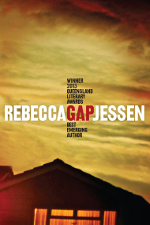
Winner of the 2013 Queensland Literary Awards for Best Emerging Author, Gap is Rebecca Jessen’s debut verse novel and a bold entrance into a strong line of Australian verse novels.

Continue reading

Posted in BOOK REVIEWS | Tagged ,

Review Short: Alan Loney and Max Gimblett’s eMailing Flowers to Mondrian

eMailing Flowers to Mondrian

eMailing Flowers to Mondrian by Alan Loney and Max Gimblett
Hawk Press, 2014

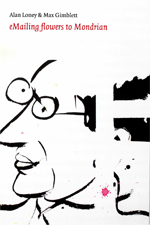
There are challenging layers to Alan Loney and Max Gimblett’s twenty-page poem, eMailing flowers to Mondrian. The first may appear self-indulgent, the second impenetrable, and the third overly personal; but, taken as a whole and meditated upon, this aesthetically pleasing saddle-stapled book turns out to be a cunning memoir.

Continue reading

Posted in BOOK REVIEWS | Tagged , ,

Review Short: Ania Walwicz’s The Palace of Culture

The Palace of Culture

The Palace of Culture by Ania Walwicz
Puncher & Wattmann, 2013

Ania Walwicz’s first book in more than twenty years, Palace of Culture, confirms her reputation as one of Australia’s leading conceptual poets. It consists of fifty (almost) prose poems, each between two and five pages length. The poems use the suggestion of narratives as a key organising principle. But suggestion is as far as any of the narratives get. Continue reading

Posted in BOOK REVIEWS | Tagged ,

Instructions As Art: Digital Writers as Modern-day Renaissance People

I am now almost thirty years old. While there were many different gaming consoles around when I was a kid, I wasn’t privy to many of them. I was a fairly active child and teenager who spent most of her spare time outdoors (usually wandering around parks aimlessly). My education did not involve classroom computers, however I did have access to one at home. From this I learnt the basics of computer symbols. Up, down, left, right, backspace, control, alt, delete, spacebar, and later in the PC’s development, the mouse-click. So, while I was not involved in a rich digital culture as much as children and teenagers are today, I would attest that not much needs to be known about a computer to make the basics work.

With this in mind, consider the term ‘digital literature’. This is a slippery term that takes on many forms, but generally I use it to think of digitally produced writing that also includes some form of interactivity for the reader. Writers were, for many years, trying to find ways to remove the book from the page – to give their words flight and freedom. The postmodernists, in particular, championed this by attempting to create written stories that were not held to the confines of the book. They were attempting to create stories that could be read differently depending on the reader. But they were still largely confined to text on a page, or clumsy convergence. The era of the digital, and namely, the Internet, brought with it the promise of an easy solution – text, images, sound, video, and choose-your-own-adventure style interactivity, easily contained within the one document, and easily publishable. This was seen in the hypertextual adventures of Net writing in the 1990s. But Internet literature quickly grew with the software, and now we see examples such as generative writing, and narrative games, that are perhaps digital culture’s best examples of multimodal literacy that considers visual art as a language. We’re also seeing more downloadable alternatives to the browser-based model, as the world of the application grows. A user can download your story or poetry piece to their phone, or touchscreen tablet computer, and interact with your words using new forms of feedback: touching, swiping, hands-free gestures. Further, their devices allow them to interact with your story not just through touching the screen, but through a range of sensors including accelerometer and vibration, where the world of physical computing, and the world of literature, overlap.

This newfound rush in Western societies towards touch devices and other haptic feedback devices (such as new forms of virtual reality) has played a bit of havoc with Internet literature, due to some fairly boring technicalities that I won’t go into. But it is forcing writers of digital works to further rethink their approach to ‘text’, by asking them to become even further aware of the interactivity between text and user, and asking them to develop a further awareness of multimodal literacy. As Barthes perhaps predicted, the story now has to consider the reader more than ever, and consider not just the reader’s imagination, but their entire body, their perception of space, and their location within it.

This opens up a myriad of possibilities for writers to not only collaborate with artists and technicians from other disciplines, but it allows for writers, themselves, to become more multi-disciplinary in their approach. The digital writer is not just creating words, they are creating visual art, sound, and moving imagery. They are intrinsically involved in the information technologies and software use, creation, and breaking. They become the modern day renaissance people. In this way, it may be so that the medium truly is the message, as the media used can drive the user’s experience, but meaningful and entertaining digital stories come from the author’s ability to embrace this as part of their process, rather than rejecting it.

We formulate our understanding of the world through our senses, and thus our ability to sense the world is generally an amalgamation of the visual, aural, haptic, vestibular, and the chemical senses. We also learn through exploration; through experimentation and adventure. This might suggest that multimodal literacy is something that humans can understand intrinsically. It also suggests that the process of exploring an interactive world, as a form of narrative play, is beneficial not just to our education, but our continuing growth and ability to create neurological connections.

So … if current forms of digital literature can wrap this up so easily via digital games and artistic narratives, why is it that a large percentage of paper book readers (which is still the majority of fiction readers in general) tend to find them difficult to interact with? The thing about most digital writing is that there’s no right or wrong answer as to how to read it – you’re invited to play and explore and attempt to break it as much as you wish. Press everything! Touch everything! Swipe everything! Type anything! You are in charge of the interaction.

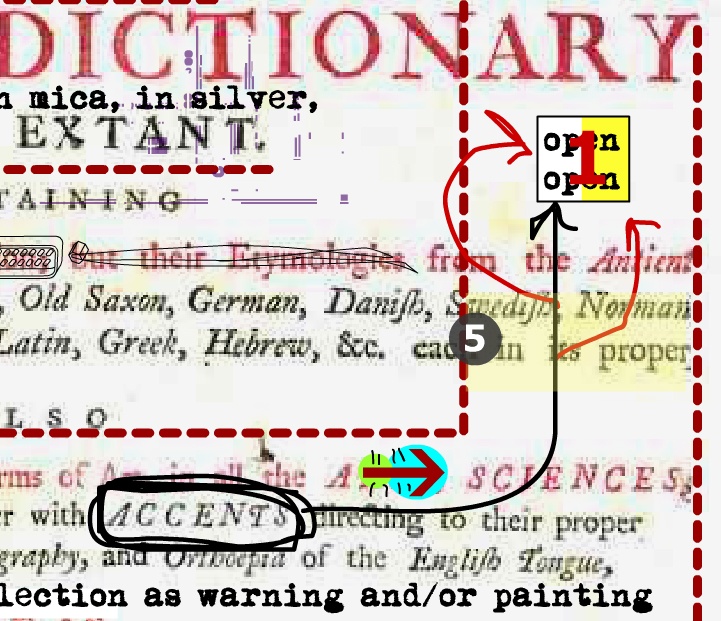
Yet I still see some users of my work approach it as if they were attempting their very first mouse dissection. They fear touching the wrong thing, or sending the main character in the wrong direction, despite the fact that I want them to do both of these things. Sometimes they ask me what they’re meant to do with the story, as if the most important part of the interaction was finding the end, as if the traditional bounds of linear writing are still too sacred to be challenged. Thus, I notice that many digital writers, including myself, tend to include a great deal of instructions with their work. The ‘how to’ guide becomes one of the very first pages. The narrative itself tends to end up intertwingled with reading directions as strange footnotes and epitexts. Large arrows are created to point to buttons that can be pressed, or to point the user in the direction in which they could potentially take the main character. The art and the interface become loaded with instructional symbolism, as the author attempts to create work for the beginner and advanced computer user, alike.

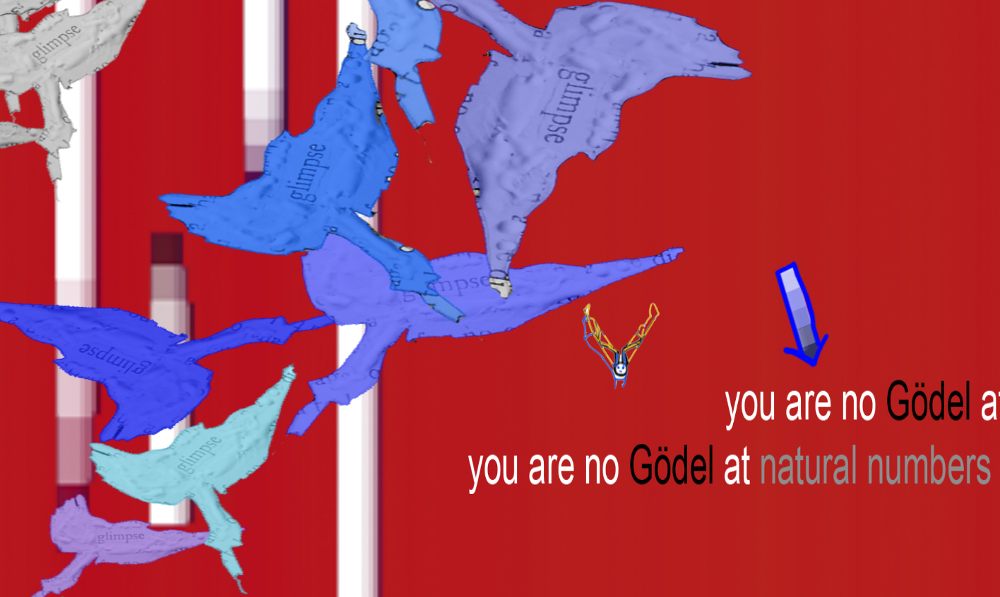
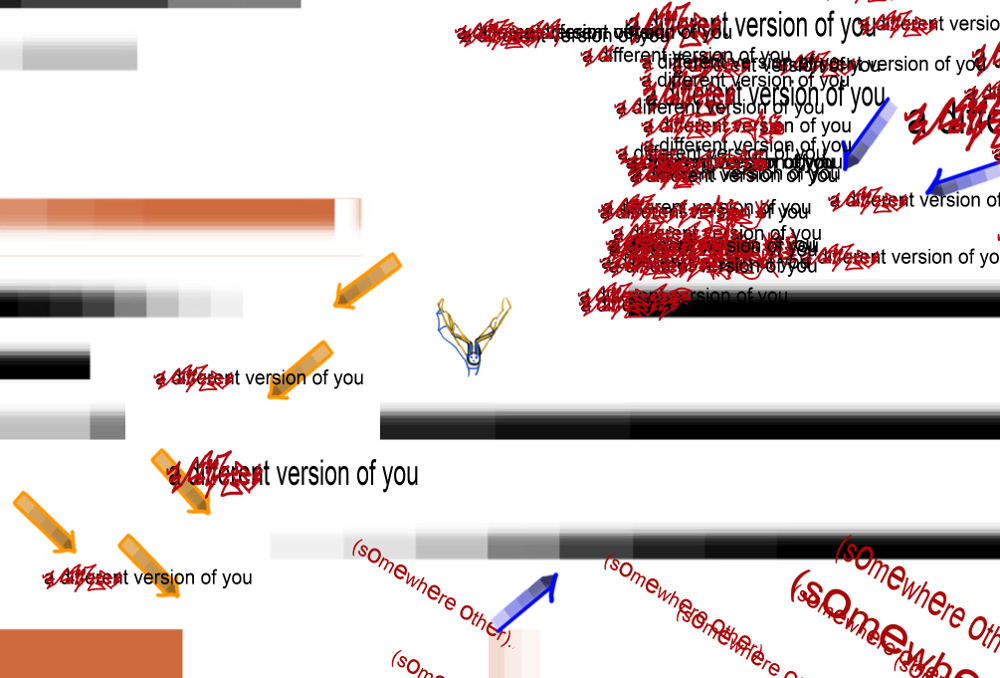
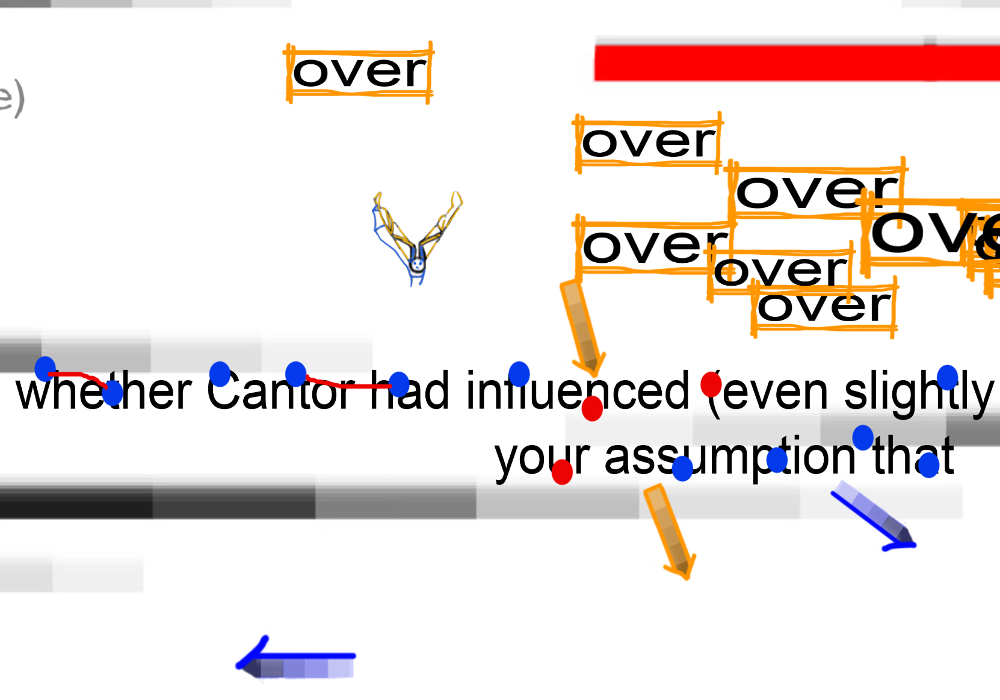
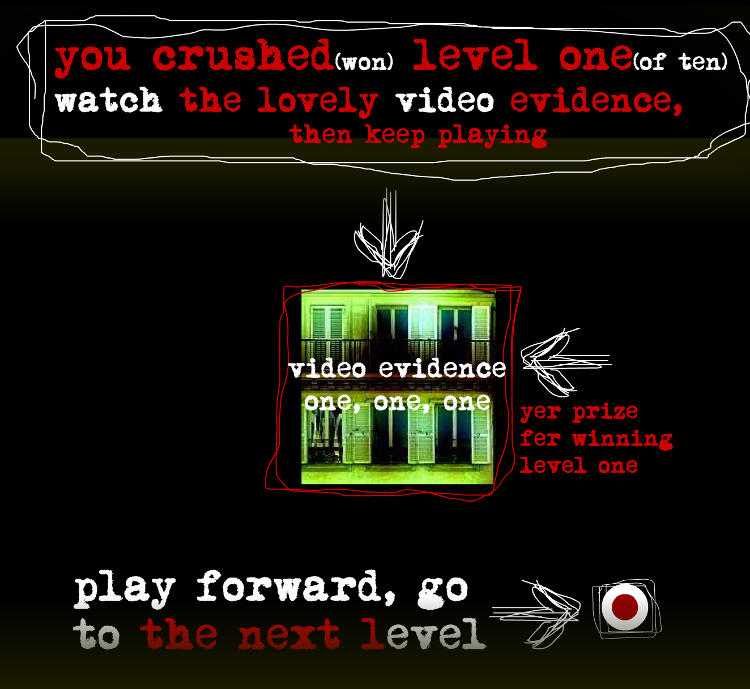
This weaving of art and instruction is beginning to form a major part of some digital literature works, as it can’t help but be a part of the multimodality. For example, in Figures 1-4, stills from my poetry game app ‘An Argument in Parallel Incompleteness’, you can see the interactive arrows forming part of the visuals from the first scene, all the way through to the end page.


figure 1


figure 2


figure 3


figure 4

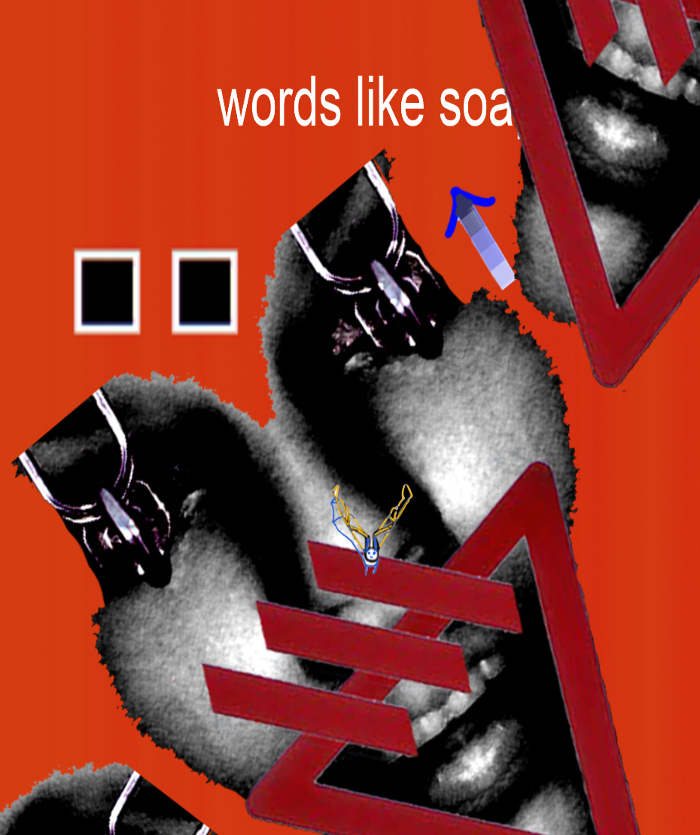
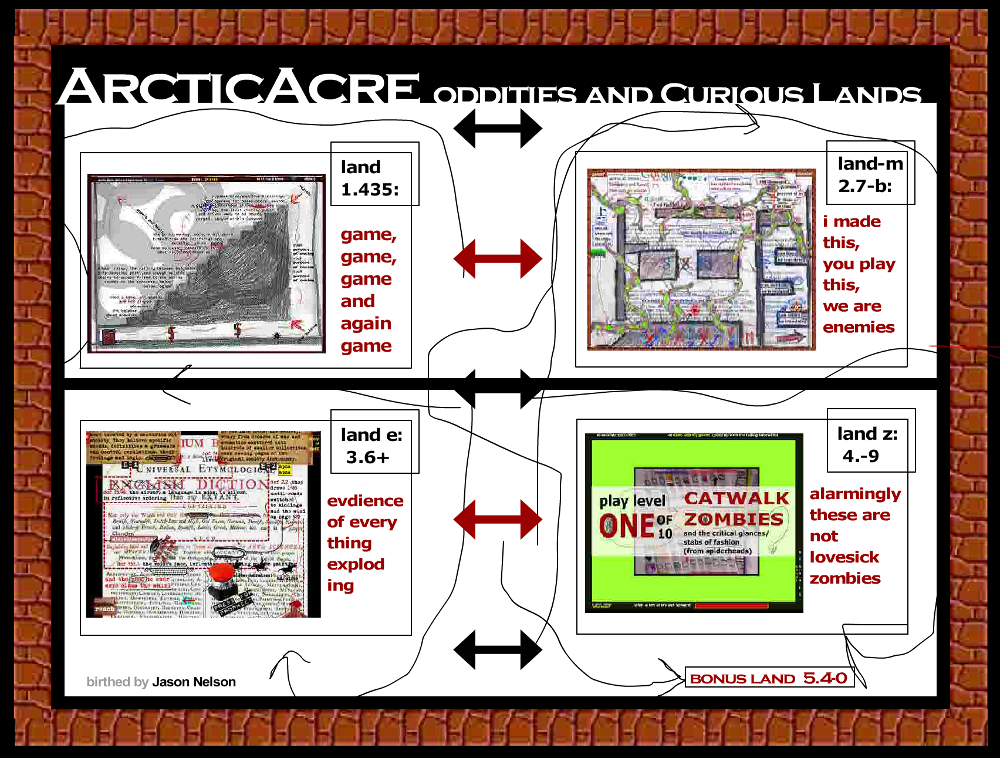
In Figures 5-7, stills from Jason Nelson’s ‘Arcticacre’, and ‘Evidence of Everything Exploding’, the messy arrows are an intrinsic part of the hand-drawn aesthetic, and form the bulk of the hand-drawn artwork. Perhaps it is inevitable, thus, that visual instruction becomes one of the main drivers of digital writing’s visual aesthetic (but I, for one, hope this won’t be the case forever).


figure 5


figure 6


figure 7

This is a sign of our times – our in between stage of half analogue half digital, where the world has computer users with a wide digital skill discrepancy. Of course there’s nothing wrong with narrative that becomes a kind of metatextual user-guide, but it is my hope that digital literature can move beyond this in order to place more emphasis on the narrative itself, beyond the directions. This direction-as-art has caused a symbiotic relationship between reader and writer, where the writer remains acutely aware of the widening gap in readership styles dependent on the reader’s understanding of the content delivery. If we want to see digital literature pushing boundaries further, and experimenting further with other ways of reading, then the readers themselves need to update their digital reading skills.

If you think your digital literature literacy might not be up to speed, there is one easy thing you can do to nourish your multimodal skills … Play more. Download some digital games – even simple ones, and be prepared to explore. What the world of digital literature really needs, are more explorers.

Posted in GUNCOTTON | Tagged ,

David McCooey Reviews Jennifer Maiden

Drones and Phantoms by Jennifer Maiden
Giramondo Publishing, 2014

Jennifer Maiden’s Drones and Phantoms opens with ‘Diary Poem: Uses of Live Odds’, a poem that juxtaposes – in a way characteristic of Maiden’s intensely synthesising work – politics, aesthetics, and gambling. Poetry, of course, is a kind of gamble, one in which the stakes are at once ridiculously low (financially speaking) and ridiculously high (personally speaking). Writing a poem – like any creative act – is a risky venture. One’s subjective experience of being creative never fully underwrites the created artefact. And as a communicative act, poetry runs the ever-present risk of obscurity and/or inconsequence.

Continue reading

Posted in BOOK REVIEWS | Tagged ,

CANADA / AUSTRALIA Editorial

An unlikely place to intersect, or even be at all – Brisbane, Australia – for Shane Rhodes (Canadian, poetry editor for Arc Magazine and the 2013 Arts Queensland Poet in Residence) and Kent MacCarter (native Montanan and Managing Editor of Cordite Poetry Review). Our peripatetic natures could have dictated that we’d be just as likely to meet in Winnipeg or Albuquerque or Brussels or Granada … or, most likely, never at all. Yet such a place was the 2013 Queensland Poetry Festival which brought poets from around the world (in addition to Shane, there were four other Canadians at the festival) and across Australia to converge on the Judith Wright Centre for Performing Arts (itself named after a notable Queensland poet) for three days of nothing but poetry. Sun and heat radiated on and through Brisbane’s stilted homes and Jacarandas, and the festival’s concentration of global poets created a tropical environment for ideas. We began discussing the possibility of a joint Arc/Cordite issue somewhere near the book table where both of us were calculating the maximum poetry purchase against national and international baggage allowances.

Why do this? Cultural relations via literature, that’s why. What similarities can be drawn or stylistic approaches extrapolated from reading the poetics of such vastly – 15,300 kilometres – separated places? Have similar histories of colonisation and immigration created similar poetics? Can what is being written in British Columbia or Nova Scotia, for example, find kindred forces in poetry from Tasmania or Western Australia? Our intent was, and remains, to showcase and cross-pollinate poetics between these antipodes and to share with a broader audience work that may be little known outside of home borders. To accomplish this, each magazine would, for one issue, hand the editorial responsibilities over to the other – so that the masthead at Cordite could fill one issue of Arc with nothing but Australian poetry, prose and artwork with Arc could do the same for Cordite. From that, the task became a seemingly simple one of amassing something that might be considered representative of what poetry looks like right now in Canada and Australia.

Of course, this was anything but simple as we all realised we wouldn’t be able to publish even half of everything we wanted nor would we be able to approach everyone we should. Rather than seeking work from well-established poets who may already have audiences in both countries, we decided to focus on emerging and getting-established poets – artists who may be early or mid-way in their ‘careers’ and are committed to and have found some success in being poets. What followed from this initial conversation were months of email correspondence as the collaboration grew from possibilities to long lists, then from short lists to making selections, honing budgets, sending out requests for work and publishing what you now see. We had expert help from our mastheads and volunteers – Chris Johnson, Zenobia Frost, Robyn Jeffrey, Monty Reid, Kevin Matthews, Matthew Hall, and Serge Duguay – in pulling the work together.

Although there are obvious gaps and chasms in our selections, what we were able to pull together is impressive for its range, quality, and verve. For both Canada and Australia, there have been very few occasions when such an amazing collection of poets has been brought together under one project. If there is one thread that unites these poets and their poetry, neither of us knows what that is or even might be. Rather, this project thrives on multiplicity, difference, and propinquity. It is with the indefatigable nature – in whatever drives us to write – of the authors and artists involved that will see this project both lasting and notable in both countries for some time to come.

Posted in ESSAYS | Tagged ,

Best Isn’t a Beauty Contest: How Canadian Poets Demand More of Verse


Image courtesy of Kootenay Arts E-Bulletin

No one in the class could say exactly. Writing that rhymes? A descriptive passage that seems to talk about one thing while actually meaning something completely different? A very very very short story that uses a lot of similes? The late Don Summerhayes, my first poetry workshop instructor at York University, had asked us to explain what poetry is. Continue reading

Posted in ESSAYS | Tagged , , , , , ,

Investigative Poetry: Are Poets the New Reporters?

It’s not unusual to come across, within a poem, a metaphor for the writing of poetry. For a reader, such a discovery is satisfying and delightful, and ever-so-slightly unnerving, a blurred window on the inner workings of a made thing. You see it, and then you don’t. And then, by focusing just so, you see it again. Poets do create such – metaphors deliberately, but not necessarily every time they occur. A metaphor may have an intended meaning beneath which some clue to Ars Poetica lurks. Continue reading

Posted in ESSAYS | Tagged , , ,

Reclaimed Land: Australian Urbanisation and Poetry

In memory of Martin Harrison

This cobbled expressway of signs and blackening holes. – Alex Skovron, ‘The Journey’1

Now I can go along high and dry, and preserve Warren’s blacking on my shoes in all its original lustre. Life is becoming quite calm and monstrous. I do not half like it. – Anonymous, ‘The Lament’2

1. The scanty vine

In the late 1850s, Charles Harpur composed the image of ‘a scanty vine,/ Trailing along some backyard wall’ (‘A Coast View’). It might be forgettable, save for its conspicuousness in Harpur’s bush-obsessed poetry. Whether purple ranges or groaning sea-cliffs, his poems cleave to a more-than-human continent. The scanty vine, however, clings to a different surface: human-made – the craft of a drystone wall, perhaps, or wire strung through posts like the twist of the poetic line – it signals domestic land division. Harpur’s vine of words trails along the vertical edifice of settlement. Continue reading

Posted in ESSAYS | Tagged , , , , , , ,

Australian Ecopoetics Past, Present, Future: What Do the Plants Say?

‘And I came to a bloke all alone like a kurrajong tree.
And I said to him: “Mate – I don’t need to know your name –
Let me camp in your shade, let me sleep, till the sun goes down.”’
– Randolph Stow, ‘The Land’s Meaning’ (1969)1

Like the country’s arid interior, contemporary Australian ecopoetics is vast and robust. The expressions of Australian ecopoetry are as varied as the antipodean landscape itself, underscoring the intricate connections between language and ecology in this part of the world. The Mediterranean climate of Western Australia’s southwest corner, the Red Centre of Uluru, the tropical rainforests of Queensland, the temperate Tasmanian old-growth forests and the alpine reaches of the Victorian High Country signify this: rather than a contiguous desert or a terra nullius (as some readers both inside and outside of Australia may still believe), the Australian environment is a mosaic of biota, climates, topographies and regions. Continue reading

Posted in ESSAYS | Tagged , , , , , , , , , ,

4 Artworks by Kelly Richardson


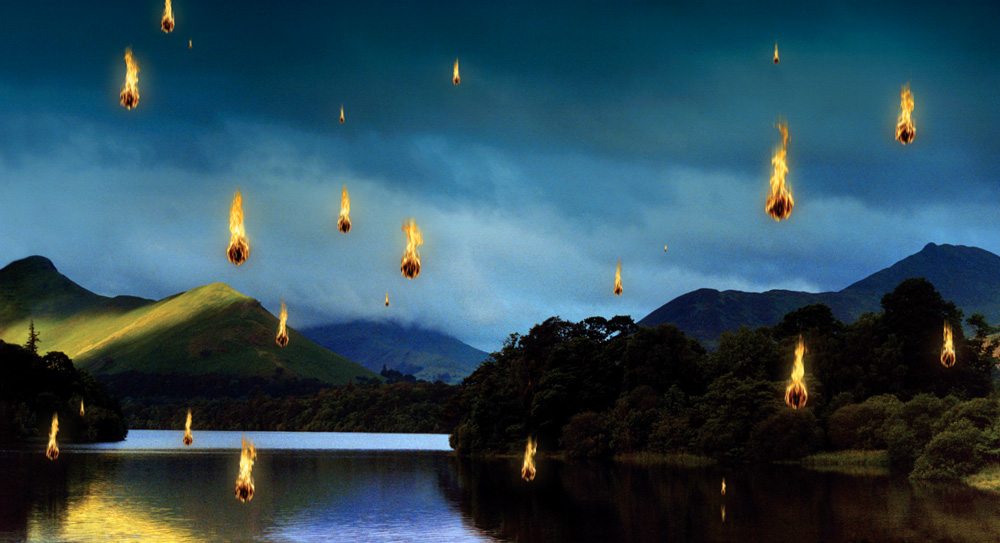
Kelly Richardson | ‘Exiles of the Shattered Star’, 2006 | Single screen HD video installation with audio and C-prints

In ‘Exiles of the Shattered Star,’ a beautifully colour-saturated lake is the backdrop for a slow, majestic rain of fireballs, perhaps fragments of the star of the title. This piece points to Richardson’s odd penchant for classic romanticism, pitting as it does the sublime beauty of the landscape against the terrifying, tragic certainty of mortality. – David Jager

Posted in ARTWORKS | Tagged

2 Artworks by Kim Adams: Autolamp and Breughel-Bosch-Bus Detail


Kim Adams | Autolamp

Posted in ARTWORKS | Tagged

How Poems Work: Kate Fagan’s ‘Through a Glass Lightly: Cento for Beginners

We move through language, swimming on influence, arranging words into patterns that make sense for our purposes. An essay with an argument, an email trying to get the day off work, or a poem that tries to make letters do something that they haven’t done before. A cento makes the act of being influenced manifest. It could be a tribute, taking another poet’s work and laying it out through one’s own prismatic vision. Saying yes, I admire what you do and now let’s make what you do with language continue, to spin and spiral outward into any of the myriad forms that are possible. Let’s make your words go on and on and let me reveal how language is always material by delicately or forcibly or deliberately reconstituting your work.

Obviously, I don’t know Kate Fagan’s intention in ‘Through a Glass Lightly: Cento for Beginners’ but I can plainly see the care with which she has set out the lines of Arkadii Dragomoschenko and Seamus Heaney to make her own meanings from their work. The Princeton Encyclopedia of Poetry and Poetics defines the cento as, ‘A verse composition made up of lines selected from the work or works from some great poet(s) from the past’ (220) dating back to Homer. So just the idea of ‘great’ poet implies the notion of tribute, of admiration, of wanting the work to be revealed in a different light, thus ‘lightly’ we see the words as through glass with the traces of their original form as well as the prismatic colours or depth now being revealed in their new iteration. This could send us back to those poets (as it did for me) and it could send us forward into thinking of language as having more possibilities than the mere fallacy of original individual self-expression. The collective work of the cento is actually the work that all poetry does: it doesn’t pretend individual talent, but acknowledges the ongoing debts to language.

In this poem, Fagan imbues musicality with images of the common nasturtium (taken from Dragomoschenko’s poem ‘Nasturtium as Reality’): ‘I see it plain/as a living fretwork/in the distortion of sound’ so that the plant is recognised with its inherent energy intact, the idea that bursting could be a sonic action as well as a biological process of ‘cells dividing’ while at the same time, the action of moving fingers along a fret board to produce music is also conceived as some kind of miracle. What comes is a simple ‘water drop/clean in its own shape’ like a baby developing, an originary miracle if ever there was one. It’s also interesting to note that these ‘great’ poets of the past are men, and their work is developed in the service of images of the pregnant female body in all its remarkable commonality: ‘Our love called and we lie/in the future of cells dividing … A nasturtium between itself/and us, showing the light.’ Again, the ‘great poets from the past’ are called forth to enact a series of bursting forth moments that culminate in the final action of this new poem: ‘Time to be born.’

Here the poem is again:

Through a Glass Lightly: Cento for Beginners


The nasturtium is to itself already
a memory. It opens its leaves
its fire
ribbed impression in the grass
that forms like shadow.
I see it plain
as a living fretwork
in the distortion of sound,
press a leaf to a winter dream
of your hand
translated, given.
Our love calls and we lie
in the future of cells dividing,
a water drop
clean in its own shape.
A nasturtium between itself
and us, showing the light.
Time to be born.


‘Through a Glass Lightly: Cento for Beginners’ from the collection First Light by Kate Fagan, published by Giramondo Publishing Company (Sydney). Used with the permission of the publisher.

Posted in GUNCOTTON | Tagged ,

Kevin Matthews Connects with Spoken Word Poet Tanya Evanson


Image from The Great Black North

Tanya Evanson is as generous of spirit as she is on stage in the hour we spent on Skype from a sunny, mosquito-netted room in Antigua, following an email correspondence. She has the knack for bridging gaps, and we have a shining moment or two when space collapses, her eyes go wide and her hand rests on her heart. What’s the Internet anyway if not an interstice that leaves us all ghosts, ready to be touched without being touched?

Clearly she’s finding some of the solitude in Antigua that complements the moments of intense connection she facilitates as an artist and teacher, and connecting is what her work is all about.

‘I am the Muse’s bitch. As such, I do not decide what should be written, but try to capture epiphany as it hits … if I get in the way of these things, I am lost.’

If that sounds esoteric, it’s appropriate – Evanson’s been a Sufi student for the nearly twenty years she’s been performing her work.

We connect easily over our shared passion for performance poetry and the challenges it poses: to practice this art is to be forever negotiating the tension between the ephemeral and the permanent. Oral literature – dub poet Lillian Allen prefers ‘Orature’ – is fundamentally transitory, or so we say, but each experience is (most often) the delivery of a persistent text.

So, is a performance more an act of writing or an act of reading? Probably more an act of balancing, and Evanson is known to find a harmonious posture on stage. Maybe this is not as contradictory as I make it sound, especially if you consider the way that Evanson applies her studies of Buddhism and Sufism to her work. She calls herself a ‘Bothist’ in rejecting either/or propositions, and remembering that each story or fact is incomplete without its shadow.

But what happens when things get off kilter? Evanson has thoughts on this with regard to current Canadian spoken word. She was one of the poets of honour at the 2013 Canadian Festival of Spoken Word (CFSW). The festival, with a national team poetry slam as its core and other spoken word events to complement it, has chosen this way to honour ‘elder’ performance poets – two per year – who have a core role in fostering the national community. Evanson’s nearly twenty years of performance have certainly touched most places in Canada.

From Montreal to Vancouver and now cycling back, Evanson had a bilingual childhood with biracial heritage and bicultural roots in Quebec and Antigua. She sojourned in South America and then studied Sufism for years in, naturally, the tri-continental country of Turkey.

No wonder she emphasises that poets must find unity through multiplicity. But our scene, she worries, is too dominated by a single path.

‘Canadian performance poetry is currently so overwhelmed by the SLAM tradition that anyone working under the vast umbrella of spoken word is often labeled a SLAM poet. We need to shift our focus away from art as sport.’

At the same time, Evanson acknowledges that what has been built with tremendous loving care, around both slam and national competitions, is a community. Some inspiring conversations about caring for one another and inclusivity have resulted from this nesting activity. She cherishes this, but wants more poets to fledge. In her view, intimacy (personal or cognitive) must give way to separation in order for the journey to be complete. Each artist is on a path, and Evanson seems to feel that we are gathering on that one stepping stone where competition and ego are potential downfalls.

‘Granted, SLAM is part of our education, but there are three levels of learning: reception, digestion, and separation. We are fixated on the first two. It is like receiving treatment from a doctor who is still in medical school. Poets are doctors of the soul! We must graduate! Leave the controlled environment so that the work may fly into global, radical, experimental, limitless, cosmic possibilities for change.’

The pedagogical analogy fits. Evanson is a key mentor, or a shepherd of mentors, however humble she may be. Currently, she is Director of the Spoken Word program at the Banff Centre in Alberta, which Sheri-D Wilson began after consultation with poets and organisers from across the country. That consultation, near a decade ago, was driven by seemingly contradictory impulses to preserve the vitality of the spoken word, while somewhat professionalising – or at least taking seriously – the establishment of a critical record.

Now, each spring in Banff, successful applicants gather for a guided residency in spoken word performance. Participants have generated fringe festival shows and recordings from the experience. Faculty has included the likes of Evanson, Emily Zoey Baker, Lillian Allen, and Bob Holman.

This program is vital. It could be described as a heart for the circulatory system of spoken word poetry in Canada. It’s remote, but no retreat, and participants have frequently described it as a rite of passage in their artistic development.

Does that mean its director has an agenda for where Canadian spoken word should go? Humility won’t allow her to express it as such, but she does feel there may be an imbalance to address. Once again, Evanson’s Bothism guides her thinking. She believes in the conjunction of the near and far, of community with solitude – something that Banff evokes for all of us who’ve spent time there with our writing.

In applying this Bothism, the arbitrary, anti-expertise ethic of choosing random audience members to judge slams is intended as a counterpoint to the stultifying (or at least exclusive) effect of a qualified critical class. But she sees a potential danger here in overcompensating for such expertise. She talks in deliberately non-judgmental terms about each artist being on their path, but does not ignore the possibility that those paths may lead us astray. She points out that we do not have much of a critical record, and little that could be described as an aesthetic credo. Instead, there’s a vivacious community of mutual supporters and enthusiastic audiences, where a five-year veteran can be valued as an ‘elder.’ There’s also a connection between the program at Banff and Litlive.ca: The Canadian Review of Literature in Performance, and we can trace ourselves back to Victoria Stanton and Vincent Tingueley’s history book Impure: Reinventing the Word. In essence, we do have some kind of tradition – one Evanson says we need to foster and help create more stepping stones and connections. Reaching beyond the Canadian experience, she admires players in the Australian spoken word scene like DJ Lapkat (Lisa Greenaway) and the journal Going Down Swinging, which both bring a critical record to current work.

She holds dear the spirit of exchange, and this issue of Cordite Poetry Review includes Evanson’s poem ‘Finishing Salt’ about seeking and letting go of a counterpart.

‘It is an honouring of time spent observing something as it ends, in this case, a long-term relationship (my 8-year marriage) ending in tandem with autumn on Galiano Island, British Columbia. Both are holding on to the crescendos of summer but death is inevitable.’

So there we are again in the present moment, and the present transmission.

In fact, it’s when I broach the topic of this occasion – this publication, and its reaching out from one hemisphere to another – that her hand goes to her heart. She mentions an urge to have a group of Canadian poets go through Australia, as have C R Avery and Shane Koyczan have recently done. She expresses gratitude to Australian spoken word poet Emily Zoey Baker, who was on the faculty at the 2014 Banff program. She talks especially about how much it means for her that ‘winter and summer exist at the same time on this planet, day and night exist at the same time on this planet, each is a fact.’

In Evanson’s Bothism there is clearly something – not quite a longing, but an alertness – that looks always to the completion of a cycle, or to the turning over of a coin to see its other face.

Being a spoken word performer means living not in paradox, but at an intersection where the ephemeral and the constant define one another. Here, the balancing act is a dynamic equilibrium to seek, yet maybe not achieve.

Evanson’s a student preoccupied with teaching, a vocalist studying silence, a traveller concentrating on the present – a good description of a refined practice of Sufism. Rumi too, we remember, had much to say about silence. To negate ego and to perfect a worshipful posture is more than an esoteric tradition, and it may be just the sort of guidance our spoken word community is looking for.

Tanya Evanson is proud of her work at Banff and the artists she works with, but she has a wish for us: not to have it both ways, but to turn and return, seeking the place where both paths are in fact one.


Posted in GUNCOTTON | Tagged ,

How Poems Work: Nora Gould’s ‘While he waited for the school bus’

While he waited for the school bus’ is just one example of the extraordinary work that defines Nora Gould’s new book. Steadfastly observant, carefully detailed and with the capacity to twin trauma and beauty, Gould’s debut collection represents some of the finest regionalist writing in recent memory. This is slow poetry, a poetry which invites quiet consideration, a poetry of the wind and rain, fieldnotes written in a pocketed notebook during calving season. As with the example poem above, you’ll find little reliance on the egotistical sublime, or lyrical escape, the poems here deal with the rural honestly, poetically, and without trying to importune any sense of transcendence to the experiential.

The division I am working towards defining here is the division between rurality and rusticism. Taking cues from John Kinsella and Rosanna Warren’s dialog ‘Southern Winter and Northern Summer of 2007,’ which appeared in Fulcrum: an annual of poetry and aesthetics 6 [(2007): 236-267, 242], I think that the honesty that we sense in Gould’s work stems from an adherence to the rural, to a practical conception of pastoral in which the codifications for living and consuming in close proximity to the land is played out. Whereas, if Gould had been working in reliance on inherited Romantic assumptions we would we would be more likely to ascertain in her work the construct of rusticity, the fetishisation of conditions of rural control and corruption; the fetishisation of power relations which dictate the transformation of nature into the pastoral.

This division, I believe, is intrinsic to an ethical and honest representation of the pastoral, the manner in which Gould has documented the travails of a family working the land. This is not a typified version of the past, well-worn through Canadian settler stories or inherited from European models, but an articulation of life lived, which details the attendant artifices of rural control and the often graceless details of the everyday. The poem above, ‘While he waited for the school bus’, is a complicated, tragic story. The poem sutures the loneliness and contempt for nature that some children are trained to accept, with the realities of hard times. The poem’s opening stanza details the commonalities of ‘the neighbor kid’ remorselessly killing an animal and taking it to a fur trader. An economic exchange of the simplest sort: bait, attraction, slaughter, reward. The ideological dictates of control and contempt for life extend an account of the pastoral’s originating dominance: colonisation. These are a set of hierarchical power-relations built into the place itself. Colonial relations are further reinforced with the second stanza’s ‘Russian Thistle’ blowing perilously in the wind, and brings to mind a scene from Ken Burn’s The Dust Bowl. This stanza, removed from the narrative of the poem, is a compelling reminder of our homesteading ancestors, and paints the landscape with a sense of unease and uncertainty.

The only sense of Romantic association in the poem is instilled in the third stanza’s capitalised phrase ‘Prairie’s cold distillery’, which speaks to the manner in which reality plays against reinforced expectations of pastoral life. Certainly Gould has issued this as a challenge to the reader’s common assumptions about pastoral life in an ironic cast. Acting as a fulcrum in the poem, the capitalised ‘Prairie’ precedes a changing season, in which the subjective ‘child’ commits the final act in the poem. The details given in the fourth stanza’s opening documents the time of year as well as provides a sense of colouration to the scene, the weasel has moulted its seasonal fur, a passage, a camouflage, with which to remain hidden. The weasel’s seasonal return and its ability to remain hidden provide a counterpoint to the child, the poem’s subject, who is suffering from overt exposure. A neighborhood child carrying a gun and a buck-knife to the road-side bus shed, waiting, as the wind smirrs dust down the horizon. The instruments of violence held close. It is with a deft gift that Gould relates to us the subject’s final act, unexpressive, factual, almost undisclosed. The child’s suicide is only ever foreshadowed, its weight remains the hanging, undisclosed secret that the poem foretells. The poem’s final act reveals the complexity and complications of pastoral life, the personal, adolescent trauma of living within rural expressions of power. The poem’s final act hangs over the reader, leaving them to consider the disjointed impact which divides Romantic conceptions of the rural with the realities of prairie life.

In the spirit of Robert Kroetsch, Gould has provided us with a glimmering example of honest, ethical writing. I consider it amongst the finest rural poetry I’ve encountered in years, and believe that in offering readers this viewpoint Gould has belied the expectations and assumptions of the capacities of regionalist writing.

Here the poem is again:

While he waited for the school bus


The neighbour kid plugged a coyote, 
.22 long,
roadkill deer for bait,
a calf dead from pneumonia when that was gone.
Twenty-five bucks for a frozen coyote,
didn’t have to skin it.

Russian thistle tumbled down the fenceline,
caught, loose, caught, pushed before the wind.

He waited in Prairie’s cold distillery,
narrowed his eyes at the weasel’s black-tipped tail,
the moon low in the sky.

When the sun rose east-northeast
and he’d moved his jackknife
from his insulated overalls to his jeans,
he picked off gophers ’til he saw
the dust plume of the bus.
No carcass to hang on the fence.
The same weasel, black-tipped tail,
white fur shed for brown,
slipped around the old wooden granary 
where the kid stood his gun
butt down on the two-by-four sill,
clip hidden above the lintel.


‘While he waited for the school bus’ from the collection I see my love more clearly from a distance by Nora Gould, published by Brick Books.

Posted in GUNCOTTON | Tagged ,

Introduction to Essays on The Best Canadian Poetry in English, 2014

Versions of two essays – ‘Best Isn’t a Beauty Contest: How Canadian Poets Demand More of Verse’ by Sonnet L’Abbé and ‘Investigative Poetry: Are Poets the New Reporters?’ by Anita Lahey – preface the newest volume of The Best Canadian Poetry in English, 2014 (Tightrope Books). Since the series was launched in 2008, it has annually taken the pulse of Canadian poetry. As series editor Molly Peacock wrote in her introduction to the inaugural edition, BCP aims to gather ‘the freshest, the brightest, the most exciting, compelling and vigorous poems published in Canada’s literary journals from the previous year.’

Each anthology is comprised of 50 poems, as well as a long list of 50 notable others, and features a different guest editor whose particular sensibilities inform the selection. The series – read by poets, scholars, students, critics and newcomers to the genre – has become a reliable touchstone, a window on and record of the shifting gaze of the Canadian poet. This latest volume was curated by Peacock, assistant series editor Lahey, and guest editor L’Abbé.

Posted in GUNCOTTON | Tagged , , ,

Feature Poem with Judith Beveridge: At Willabah

I forget who it was who said that the writer needs to be ‘holy in small things’, but I think there is a great deal of truth in that. That’s one reason why I’m attracted by Todd Turner’s poem ‘At Willabah’. Here, the poet guides us through the details of the landscape in a not dissimilar way to the deep engagement with particulars in such poems as Seamus Heaney’s ‘Death of a Naturalist’ or Elizabeth Bishop’s ‘At the Fishhouses’. Place in poetry is often a point of exchange, and in this poem it works to become a bearer of human feeling as the speaker looks and looks at what is before him. You sense that Turner has undergone that meticulous discernment of image and word, the deep seeing that enables the world to open out, and he balances that arduous attention to detail with a lovely sense of the line and with sonic acuity as in the ‘crooning of frogs’ and the ‘searing horde of cicadas’ that ‘smoulders with a resinous hum’.

For me this poem is not so much about observation, but rather revelation gained through ‘trained worshipful attention’, the ability to keep looking and listening until the world opens itself up, until each thing becomes an object of thought, an aspect of immersion. The affectionate accuracy with which Turner makes the water and the canoe known to us keeps us engaged. He delves deeper and deeper into possibility, ‘still there is enough light, enough shadowless/ dark out here to stay and buoyantly float, hammocked, on this iridescent bed of backwater’, strenuously orchestrating his language and imagery until by the end, we too, lie ‘dumbstruck under stars’ – not an easy line to get away with unless the poet has drawn us line by line through a swell of detail, though their rhythms of affinities and recognitions, and given us opportunities to witness how sensual panorama is changed by perspective, both spatial and inner, and made complex by affect. By the end, this watertight poem has bound together weed and frogs, lily-pads and mosquitoes, nests and cicadas, water and stars and set them all magically ringing. – JB

At Willabah


Walking the long trodden path
down towards the dam, I hear pebble
stones squelch underfoot, and the wooden 
jetty out over the brown spangled water 
pulses with the crooning of frogs. 
At the foot of the landing thick tangles
of tall grass, green on the blade,
flaxen like wheat at the tips, shoot up 
between the narrow gaps of slatted planks 
and through the middle of a weather worn
tyre tube, giving the appearance of ease.
Either rife or in decline, lily pads brim 
in bright and mottled stages of bloom and ruin.
They look like a drifting patchwork 
of miniature parasols, each stem softly landed.
But they have risen from murky depths,
launched pea-green sails and hoisted 
ceaseless bulbs into the warm flushes of air.
Late afternoon sunlight crosses the dam
and an undershot cloud of tadpoles
darts beneath the dirty gold shallows
under the dear little dead one, floating on its side.
At the first mellow hint of dusk
a hidden swarm of cicadas begins to rattle,
amplifying a static reverberant pitch
that fills the place with a thronging charge.
Upturned on stilted racks above the edges
of swampish ground, a large red canoe lies
heavily with its curved ends turned down.
It is mosquito-peppered and sun bleached 
from bow to stern, has lain here long enough 
for a community of insects and organisms to thrive.
Lifting it up and turning it over, I see a small 
black spider scurry across the length 
of the gunwale then shelter under the dry 
mud-caked taper of weed stuck there on its side.
I lower the canoe down gently off its perch
and drag it by the ring rope to the water's edge
before going back for the partially sunken oars 
that lie in a melded slurry of bog and grass.

Out over the dam, jutting there steadily, 
the canoe hangs in the balance on and off the jetty.
I lift it from its back end, tipping the scales.
It slides with a sudden splash, and in an instant,
undulant wavelets swish into tremolo
then recoil, whitewashed in dissolving pools.
I ease myself into the lumbering vessel
and wait until the rocking ceases...
Tideless, level and brilliantly still, the water
is a reflecting threshold of the bottomless blue,
a blank scroll glazed with a long shot
sequence of idle air and suspended inland sky.
I set off, levering the blade-end of the oar into a rung
and mutable clouds lap in diminishing ripples.
I row on across the silvery water mirror
before letting the canoe drift and curve then run 
aground into the twig-ends of a white, overhanging 
lichened tree, where an almost unseeable nest, 
not wedged but pierced, woven around a branch, 
is stitched and webbed there into place. 
As night sinks in, blue lit, draining the heat,
the searing horde of cicadas gradually dims
and smoulders with a resinous hum.
Though still there is enough light, enough shadowless
dark out here to stay and buoyantly float, 
hammocked, on this iridescent bed of backwater.
I let the oar slip, the canoe slide, and soaking
it all up, run my hands through the rain
and sun-struck litres. Feeling no solidity
as the water recedes and emptying flows, 
I notice a gentle braiding between skin and bone,
leaving only a distilled measure of silt to behold.
Now, drawing upon its intricate undergoings,
its fervent source, the dam, doused in nightfall, 
magnetically blackens and seeps like a fumarole.
I lean back, immersed in a brightening shroud,
watching the smoke-spun strands of vapour
freeze in a levitation of steaming shafts.
Cutting through the thick of it and crossing 
the haze, I gape, lying dumbstruck under stars.
Posted in GUNCOTTON | Tagged ,

My Education as a Poet

Where affliction conquers us with brute force, beauty sneaks in and topples the empire of the self from within.
—Simone Weil


(Dad, I dreamed about you last night. Mom showed me your stiff hand open at the
top of the bed and said “See?” I had to agree it was stiff and dead alright. And I was
freaking out because I’d missed a meeting at work so was relieved Dad had died so
I’d have an excuse. But then he returns, is walking around like nothing happened
though he looks pale and frail and soon to die again, possibly). He would sing,
Go to sleep my little pickaninnie
Underneath the silver sunny moon
Hushabye, lullaby, mama’s little baby

and before that my grandmother’s red coral brooch—
Grandma: pianist, good-time girl, Rosicrucian—
the brooch I lost one night at one of those parties
it took days to recover from, beating myself up

the good lickins with wooden spoon with branch from Sacred Grove
with belt with whatever was to hand & we were lucky
because when the kids down the street were bad
they had to go find and present to their mom
their own stick for the good lickins they got at the Shuswap

their dad would walk out
into the lake holding up a bottle
in one hand, a glass in the other, and hoist himself up
onto the raft, us on the beach
laughing & waving, he was an okay guy,
a great joke teller, I’d always listen hard from
the bedroom when I heard Bill’s ice cubes quieten down
& he’d say “So okay a Jew and a Catholic
walk into a bar” but even better were mysterious
filthy jokes that would emerge from—
stupefied silence at 3:30 in the morning
and the laughter was tired or maybe
there was some sort of decorum such as when
someone would leap across the living room
to light his wife’s cigarette, he was so in love with her
my mother said, she’d barely have the cigarette
out of the package before he’d be over there with the lighter

Poetry: a bright flame.
I always knew we were in for a long night
when Dad got out the banjo and ripped into Bye Bye Blues
& who knew how the evening would turn out,
in joy or in sorrow.

Sometimes the parties would take place at Bill’s or
somewhere else in which case there might be a phone call
at 4 a.m. to come and drive them home even though I couldn’t
drive yet so I’d walk over and get the keys,
just put it in Drive, Dad would say, & off we’d go
with the high beams on & the birds beginning to tweet.
Brett Enemark used to say this was Young Driver Training
in Prince George; he’d done it, too. At least they were being
responsible by not getting behind the wheel in a condition
Mom referred to as tight. This was poetry: terms like
getting tight.

Both Bill and Dad were good joke-tellers but Dad,
a big fan of Bob Hope, had a more technical approach.
He’d study Hope’s routine on the Ed Sullivan Show
“Listen to this” he’d say, as we scrutinized the timing.
Dad could even imitate Bob Hope’s little smile.
Poetry: timing, a little smile, the lyrics to Ragtime Cowboy Joe:
he’s a high falutin’, rootin’ tootin’, son of a gun
from Arizona!
Dad would finish
with a flourish of his pick hand, whirling it around
like a pitcher on the mound, and give his little grin and
shake his head as if to say, Boy, that was fun! And reach
for his topped-up Bacardi & Coke.

He transferred mandolin-type playing to the banjo & worshipped
the guitar moves of Les Paul. I can still hear the wall-of-sound
playing and singing from the radio, a drone poured off the surface
of the tight harmony with Mary Ford. The World is Waiting
for the Sunrise
was Dad’s most soulful cover—
you’d hear him practicing in the basement, tiki lights
parsing the dark little bar.

Before that, in Kamloops, when grandma’s piano arrived
after her death Dad drove me over the bridge for lessons.
My first piece was called Indian Dance, a steady
single-note repetition on the left hand and a simple
two-note slightly sad yet menacing-sounding melody on the right.
Poetry: something out of whack. Grandma had played that same piano
for friends and guests both whites and Haida thirty years before
in Massett, accompanied on violin by her husband Edward.
It was known that in the hands of certain women, red cedar bark could be pounded
to a softness greater than cashmere. But most of those women
if not all of them were dead by then. Most of the artists, carvers, and poets were
dead by then also, or crippled by disease.
Mom’s biodad, an O’Donnell, accountant and charmer,
Drinker, brawler, persona non grata, left early.
Her grandfather James Martin was then
her father until he died when she was seven, and then
tubercular Edward arrived from Germany with his violin and soon
he died too. Poetry: consumption and epitaph.

Mom would be homesick for the sound
of the canneries and salty crashing ocean,
kelp and sand dunes north of Massett
toward Rose Spit where Raven discovered Humans.
Every Christmas a dozen cans of Alaska King crabmeat
would arrive from what she called The Islands.
She’d tumbled down the white dunes & gone out after storms
with a can opener to see what had washed up from shipwrecks:
mostly pork and beans. Poetry: a can opener. Treasures
were the glass buoys—large, pocked, thick-glassed orbs
from the Japanese fishing fleets out somewhere in the
four thousand miles of open sea to the west of Rose Spit.
In the sanitarium Mom
and her friend from The Islands both at death’s door
in young womanhood with children at home later sent
Haida bracelets for Xmas—mine was of Dogfish Woman
crafted by someone whose signature was “XX” and
whose carving was a bit off on an angle. Poetry:
off on an angle, amidst the TB and the whalers and the moieties.

Posted in 65: CANADA | Tagged

Commerce

It’s time to go to work.

The retired woman as big as a house stands on her porch
scattering pigeons with mild invective and a broom,

no longer prone to fluctuations in the market.
Five doors further neglected leftovers of a yard sale

gather must and furious glances from the neighbours.
Countless enterprising sparrows mill behind

the bakery while fish persist in sidewalk barrels
full of their own gore. The homeless guy, here

every day wearing one glove, begs in a stutter
that depreciates the air around him, discovers

he finally has enough change and considers
this a version of grace. Without any

explanation for such impossible endurance,
I’m met with a lack of nerve. If not these

back to back twelve-hour shifts, then what?
The next store window teems with samples made

for display purposes only. I can’t fit a thought
edgewise as I approach an evening’s

uninspired events. One adventitious gift
when later, all business with our peers, you

turn to say it’s time to go.

Posted in 65: CANADA | Tagged

Map

u recognize

u recognize ur kin

u recognize kinds of letters

u have ur bottle of water

u identify th front of th bus


it’s a station

u know this


i heard ur voice on th internet

birdsong or a fist it

moved me


she wants me 2 buy a flashlight

wants 2 sell me a pack of kleenex

no i say over n over north american

no


natural forms will tell u where 2 walk

they are th commodities that sold u

bsides

in ur knapsack is th map

Posted in 65: CANADA | Tagged

Guns and Words

and so these are words
the shadows in mouths
marking blackness
between the spaces of teeth

bold and raw barnacles sticking to gums
that make the Canadian psyche shutter
since truth is to be hidden behind the lips
and across this mosaic land a crop of lies is what
Canada has given to the world

I am the mixed blood of contempt
but my mother’s people put me on mountains
so that my own salvation dripped
from the sweat and tears I offered as prayer
to build a future for my grandchildren

no vision was offered
but the words of my ancestors tore open
from my throat to fall onto paper to write poetry
to use the weapon of the white man
because all they believe in is the ink that splatters on wood

I am nothing
I have nothing
but the words and images of volcanic poetry
will you point a gun at me for this?

Posted in 65: CANADA | Tagged

37 Look at Heaven

Teenagers trying on
second-hand clothes-karma
discovering music from
the acid 70’s
books from the reefer 50’s
Busking in the streets
ragamuffin yodeling mountain music
after being raised on top 40 radio
Dharma karma bums
masturbating in the flower power shower
giving quarters to homeless hobos
teenagers in from the suburbs
trying bohemian east-side karma on for size
Most remember
to be a teenager
with big eyes
& a man who knows real rain
& sadness flushes
with the rest of the shit.
Never forget early lessons of rugged broke ass, bad breath beauty,
innocence looked good on you in Al Capone’s hat with Woodie Guthrie’s mistress
nipping at your heels as his 2nd wife, the dancer, listens to records in the dark.

Posted in 65: CANADA | Tagged

For the Ski Jump at Canada Olympic Park, Calgary

You grew into your destiny
in the city’s northwest, overlooking
a gas station, the KOA, a few acreages maybe
on the earliest suggestions of foothills,
we hardly remember what that was like.
It was before I was born into
what I think of as my life.

Development has flooded the scene,
Victory Christian Church Complex venting
emissions, a warehouse vaguely Bauhaus,
reservoir of modern open homeplans
risen nearly to your base.
Each time I return to the same place

it’s different. The adjacent new
community of Crestmont tries to act natural
leaning on the hill, rife with claims, wearing
last year’s colours in its awkward
final construction phase. In 1988
some people who’ve bought its houses
weren’t yet alive. For them

you might as well be a product
of erosion. A natural event, without promise,
defined according to what is most durable
about you. Does it matter to us
if we’re outlived by a minute
or a thousand years? I’m not saying it should.

You wandered away from insignia,
from the party of the symbolic imagination
and no one noticed. Hung with ads now,
the odd corporate zipline. Tourists
on the observation platform observe
the accelerating ritual of supply
and demand. A view makes us feel young.

Ideal conditions are a memory that pains
even a Finn. Competitors and their equipment
have evolved, the old ratios are untenable.
You’ve outlived your design.
Would need to be retrofitted for safety
and who has that kind of time.

Posted in 65: CANADA | Tagged