Introduction to John Hawke’s Aurelia


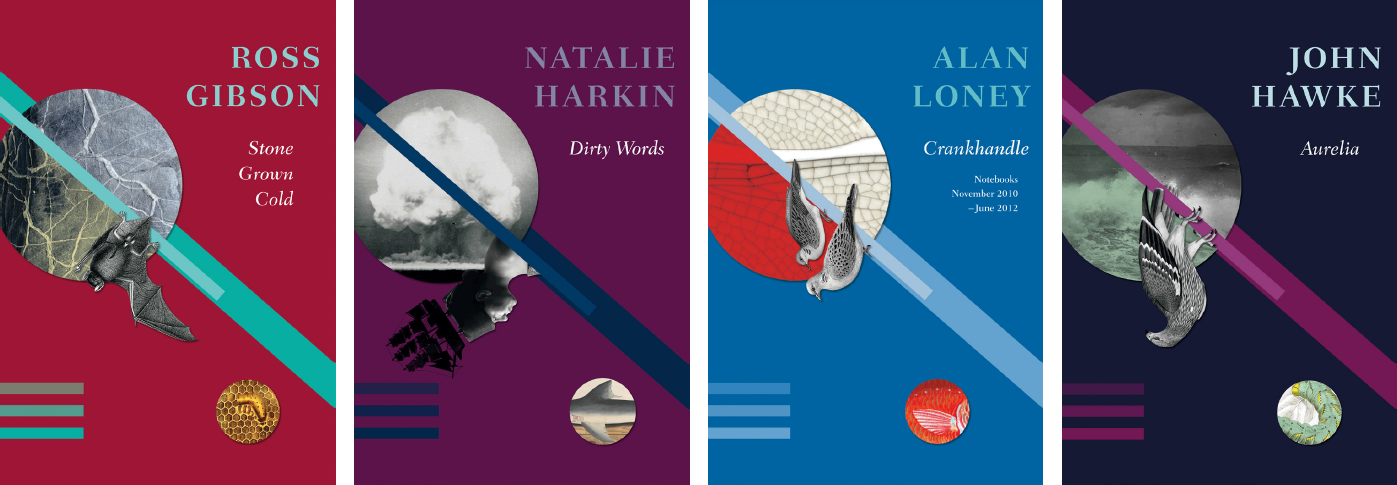
Cover design by Zoë Sadokierski

John Hawke’s forensic inquiries in this book are layered with casual erudition – Diderot, Czech poet Vladimir Holan – and locate the poem as transformative state. Many of these poems conclude with a mystical ascent into nature, reminiscent of Patrick White scenes in which the division between consciousness and the universe wavers, signifying that any reconciliation is epiphanic, claimed by art or religion. Yet nature belittles human effort – ‘The path to the point is marked by a scattering / of impermanent hand-made memorials’ – that is, the poet’s endeavours are precariously, though heroically, makeshift, overlaid; but nature is also that which threatens or devours, ‘digesting light’.

The title poem alludes to Gérard de Nerval’s prose poem ‘Aurélia’, which begins ‘Le rêve est une seconde vie’, in which the desperate poet sees the universe as a giant alphabet – inspiring Baudelaire’s later ‘Correspondances’ with its ‘forêts de symboles’. (Nerval in 1854, the year Rimbaud was born, wrote ‘Je suis l’autre’ beneath a photo of himself). The spectral Aurelia symbolises yearning for completion, her image embodying universal truth, a theory-of-everything, which the poet can only glimpse. Aurelia is a manifestation of art – ‘I first fell in love with Aurelia / in the face of that woman painted by Giovanni Bellini’ – that is, love clasps the actual simultaneously with its ideal, just as Proust’s Swann imagines in embracing Odette, he embraces Botticelli’s Zipporah whom she resembles.

                       and we enter that forest
of symbols where everything coincides.
These correspondences find their relation
in the name of the absent beloved,
as if the world of visible signs were itself
a vast and scattered alphabet ...

This book’s tour de force is its longest poem, ‘The Conscience of Avimael Guzman’, a scrutinising cubist portrait of Peru’s Sendero Luminoso (Shining Path) leader, which begins with this former philosophy professor strangling a woman. Justifications gnaw and collapse into a weird crescendo of turbulent ambivalence.

The strings of your nerves drawn shrill
by the need to maintain a single extreme moment,
but that was an error, a point of mathematics:
better to proceed by denial, eating your own words,
phrases compacted and swallowed in gutters.
The fabricated voice of the journals dissolves behind you ...

Hawke’s poems mine a labyrinth between world and Being, an irresolvable quest towards comprehension, towards a purity that, for the poet, can only exist as language. Plated with consonance through quasi-rhymes such as the end words in ‘Early Spring’ – ‘leaves, anemones, bees / hips, imprinted / stream, eel / step, breath / planet, radiance’; ‘Link Wray’ and ‘lisping rain’ in ‘Halley’s Disappointment’ – Hawke’s descriptions are as fastidiously observed as Kenneth Slessor’s or Robert Gray’s – ‘tea-coloured river’, surfers ‘skate / across the lucid skin of a dangerous break’.

In other poems such as ‘The Police-spy As an Owl’, Being, exiled from transcendence, is submerged into its activity, ‘Only productive things have meaning … it is use / which defines’; this also reiterates an earlier poem – ‘the artist’s signature / which is death’ here becomes literally ‘His signature is death’. There is a vast array in these lucent metaphysics, from the ominously Oedipal ‘On Woodbridge Hill’ to celebrations of children and love in ‘Early Spring’, ‘The Night Air’ and ‘Emily Street’, to the satiric or even apocalyptic ‘The Poet Speaks’. Hawke’s much-awaited Aurelia is a strikingly formidable achievement.

Posted in INTRODUCTIONS | Tagged , , ,

Introduction to Alan Loney’s Crankhandle


Cover design by Zoë Sadokierski

Since moving from New Zealand to Australia back in 2001, Alan Loney has carried on a prolific, internationally recognised career in Melbourne. Crankhandle, Loney’s latest published work, follows on from 2014’s chapbook collaboration with Max Gimblett, eMailing flowers to Mondrian, and the books from Five Islands Press, Nowhere To Go (2007) and Fragmenta Nova (2005). Borrowing his contemporary Laurie Duggan’s term, Loney can be read as a ‘late objectivist’: worrying at that particular American formal legacy, with its attendant philosophical and ethical concerns.

In Fragmenta Nova Loney writes, ‘“Poetry” is too small a word for the cry that issues from the mouth. “Form” is too small a word for the shapeliness of words upon the page’ (‘Poiesis’). This quote points to the uncontained – and affective – quality of much of Loney’s work, as well as to his attention to visual design. This is not an aesthetic concern only, but one that enables reading: lucid aspect as well as articulated ‘cry’. Elsewhere, Loney has characterised his writing in successive modes as a practice uninterested in ‘perfect individual poems’: ‘If the poem’s an imperfect take on the world or even part of it, better to be crisp about it, and treat writing as unfinished and unfinishable business. So, adopt a framework, write for a while, then stop. It isn’t, of course, quite as simple as that’. Perhaps then, Loney is an early conceptualist. Crankhandle is a conceptually thick book, a book of thought, or as Frost might say, a book of ‘thinks’, which challenges writing’s potential triviality on a word-by-word basis.

A writing motto appears about a quarter of the way through:

write as if you had
never
written anything
before

The word ‘crankhandle’ suggests revving up but also letting go: write, then think. In a 1997 interview, Martin Harrison said, ‘I think the age now is of living systems.’ Loney, in the book’s epigraph, refers to antiquity’s knowledge of the writing system. Writing is part of that living system: as both noun and verb. Traces of Greek mythology recur in this book – as do other pre-contemporary traces – yet these are not necessarily allusions, but an attempt to find a place for a history of writing. Writing as an activity of the body, which may or may not end up in a book. Like a beach, ‘a book is a public place’.

Crankhandle contains double or parallel texts that recall Anglo-Saxon or indigenous traditions, like the Maya, where translation is what produces poetry.

wide 		foam-veined 
			wave
birdless		foam-marbled 
			wave 
air

Though the desire for words in space is cited, this space both includes and extends beyond the mind: ‘dragonflies above / goldfish below’; ‘dead possum / on the nature-strip’. An Australian source is suggested for writing, voicing and quoting: ‘but with lyrebirds about / you wouldn’t know / who’s talking’.

Crankhandle is a late book in that the sense of both individual and social self recedes: ‘the “my” of “my library” / where did it go’; ‘no longer care / what others think poets ought / to be doing’. Signifying closure, Orpheus as spider descends onto the last page of the notebook: the poem’s over. Or perhaps, in our minds,
      not
      quite
      yet.

GET YOUR COPY HERE

Posted in INTRODUCTIONS | Tagged , , ,

Review Short: Benedict Andrew’s Lens Flare

Lens Flare by Benedict Andrews
Pitt Street Poetry, 2014

Lens Flare is a collection of poems – the first, as far as I can tell – written by a theatre director more accustomed to staging Chekhov in New York or Verdi in Denmark than to publishing poems in Australian journals. I opened the book expecting to find that slightly off-key poetry written by accomplished practitioners of an allied practice – this could also be song-writing, fiction, even painting – whose singular depth of involvement is unquestioned, but is not in poetry. Continue reading

Posted in BOOK REVIEWS | Tagged ,

Review Short: Jeri Kroll’s Workshopping the Heart: New and Selected Poems

Workshopping the Heart: New and Selected Poems by Jeri Kroll
Wakefield Publishing, 2014

Workshopping the Heart brings together poems from Jeri Kroll’s five previous books of poetry, with thirty or so pages of new poems and the opening chapter of a verse novel. Her distinctive voice – lyric, tough and spare – is evident early. Continue reading

Posted in BOOK REVIEWS | Tagged ,

Fiona Hile Reviews Lionel Fogarty

Eelahroo (Long Ago) Nyah (Looking) Möbö-Möbö (Future)
by Lionel Fogarty
Vagabond Press, 2014

Lionel G. Fogarty is an indigenous Australian poet who is recognised for the excavation of a poetic space in which, as Michael Brennan has written, ‘his community and culture is recuperated and asserted’ whilst ‘dominant discourses, both political and poetic’ are subverted and destabilised.1 These qualities make Fogarty’s work difficult to review in a context in which the status of indigenous literature remains, for some institutions at least, seemingly unapproachable. Continue reading

Posted in BOOK REVIEWS | Tagged , , , , , ,

Review Short: Stu Hatton’s Glitching

Glitching by Stu Hatton
(outer) Publishing, 2014

‘Glitching,’ sharp and immediate, is a – word that sounds like it belongs to this modern internet and computer age: moments of fracture as a website struggles to load, fragmented by popups, weird demands of your exact location and the failure of Flash to connect properly. It suggests twitching and distorting monitors, the crackle of an old modem and illogical videogame surrealism, frustrations and interruptions ‘Not of substance but of form’ (‘entheogen’).

Continue reading

Posted in BOOK REVIEWS | Tagged ,

Review Short: Angela Gardner’s The Told World

The Told World by Angela Gardner
Shearsman, 2014

Angela Gardner’s The Told World is a collection that made me feel homesick for Brisbane. Gardner is a Brisbane poet, and while some of the lines in this book specifically reference the city, it is not actually a Brisbane book of poetry. Many of the poems are pastoral, but not grounded in a specific landscape, generally the ‘here’ could be anywhere. Continue reading

Posted in BOOK REVIEWS | Tagged ,

The raison d’etre of onedit

Onedit1 hasn’t had a statement about its raison d’etre since its inception almost 15 years ago, and it’s interesting to be writing one now. The point of poetry for me is that it’s a much more flexible, open, varied, and enduring way of writing into, out of, through, around, or with the world than any kind of commentary can ever be. The poetic statement of what onedit2 is about is onedit itself and (to my mind) no poetry should need a commentary. Ah! But for those who don’t know what onedit is about (and I imagine that I am the only person in the world who has read it in its entirety) I’m happy to give this potted history into, out of, through, around, what it was, has been, is, and will be, even.

The way onedit started was out of conversations with Miles Champion3 and Thomas Evans. We three (perhaps ridiculously, perhaps realistically) at times felt ourselves to be the last three people standing in the British poetry scene of the mid-to-late 1990s.4 Onedit came out of my having lived in San Francisco and then New York for quite some time in the early-mid 1990s, and my meeting a whole swathe of poets who were, broadly-speaking, the generation that came after LANGUAGE. The way the world divided was that the boys (Brian Stefans, Tim Davis, Rob Fitterman …) were sympathetic to those who came before them, and the girls (Lisa Jarnot, Eleni Sikelianos, Lee Ann Brown …) were much more out of the New York and Beat schools. Being British,5 I was able to talk to everyone and was welcomed wherever I went. I made all of the early poetry friendships of my life in those years in the USA, and when I was forced to return to the UK,6 7 it was my intention to bring my first poetry friends to the misogynistic and moribund desert which was (to the minds of Miles, Thomas, and myself) that of the UK in 2000AD.8


Jackson Mac Low | onedit #1

And so onedit was born. It was9 both Thomas’s and my mag. We debated doing hard copy but felt that production costs (and postage back to everyone in the USA) would make it prohibitively expensive. Neither of us wanted to do an online mag, but we wanted to do a mag – and online was therefore the only way.10 I asked a Japanese student friend to build me a site and I gave him the mimeo-mag inspired design for how I wanted it to look. He built the first issue and we were ready to go.11 My particular inspirations were the mags Adventures in Poetry, Juillard, One Hundred Posters, and The World. The whole world of blurry type and minimal design which was a necessity for Larry Fagin, Trevor Winkfield, et al., became (through happy chance) a very clean and clear way of navigating around what can be a really cluttered and unreadable poetry landscape on the internet.

There are three main phases to onedit. The first phase was the early issues which contained many more US poets than from the UK. I am really proud to have otherwise unpublished work by Jackson Mac Low and Clark Coolidge there, and to have really rare pieces by Alice Notley and Stephen Rodefer.12 13


Stephen Rodefer | onedit #9

I14 had an issue which just featured visual work by Isabelle Pelissier, and I wanted onedit to have as much visual work as written; mirroring my two favourite periods of poetry – European Dada, and the many and various New York Schools.


Isabelle Pelissier | onedit #2

This stalled when Edwina Ashton was asked to provide work for a single artist issue and (not unusually for Edwina) didn’t come up with the work.15 And so onedit became a poetry mag and pretty much that alone.16 The two ideas that drove the early issues were (a) the desire to have the contemporary scene17 available to the UK who I felt might be interested – although I didn’t know who they might be, given the general antipathy to American LANGUAGE-based writing in the 1990s18 – and (b) by the desire to be doing something that felt worthwhile. This was how it was for the first batch of issues. Then onedit really changed. On my return to the UK from two years in Barcelona I discovered a very different landscape from that which I had left in the year 2000.

Posted in ESSAYS | Tagged , , , , , , , , ,

One Size Fits All: On Out To Lunch’s Unpublished BLAKE

In Laudem Authoris

Must Non-sence fill up every Page?
   Is it to save th'expence
Of wit? or will not this dull Age
   Be at the Charge of sence?

But […] though Fortune play the Whore,
   Let not the Vulgar know it;
Perhaps if you had not been poor,
   You had not been a Poet.'1

In 2011, Out To Lunch (the alter ego of author and polemicist Ben Watson, though currently indistinguishable from the primo ego himself) issued to a handful of cohorts and fellow travellers a homemade CD of his recently completed illuminated poem, BLAKE. The extraordinarily visual poem consists of seven sections based around specific body parts, running the course of 217 full-colour massive plates. These plates were composed in Windows 95 MS Paint, a program practically obsolete for close to a decade by the time of composition and pushed far beyond the anticipated limits of the first-PC-generation software by the inclusion of hand- and mouse-drawn figures, colour washes, scans of photos and mass-produced detritus, manually and digitally manipulated and combined into undeconstructible admixtures. The vast majority of BLAKE’s text is not differentiated from its visual surroundings, but rather hand drawn within the program, making for a uniquely coagulated visual poetry.2

ESEMPLASTICITY

Written during the same period as Watson’s critical essay Blake in Cambridge (Unkant: London, 2012), the poem draws inspiration from William Blake’s simultaneously revolutionary and visionary illuminated manuscripts without imitating the style or tone of Blake himself. Rather, OTL reads in Blake an ecstatically subjective materialism wherein the individual imagination actively intersects with an active world. Lunch shares with Blake an apprehension of the interconnectedness of all things, and as in James Joyce’s Finnegans Wake or Frank Zappa’s Project/Object, this philosophy takes as its basis the universalism of sexuality and everyday particularity. Indeed, the handful of recipient-cohorts for Out To Lunch’s BLAKE share this beginning-from-the-body Weltanschauung, collectively deemed as they are (by OTL) the ‘Esemplasm’, a term derived from Samuel Taylor Coleridge and one denoting an imaginative faculty actively shaping and shaped by one’s physical reality.3 Aesthetic, political, and psychic life in this approach are not viewed as separable, exclusive entities, but rather as integral material manifestations of lived experience.

The philosophical basis for the desire to destroy imposed societal separations – between art and life, dream and reality, manual and mental labour, individuality and collectivity – has formed a primary motivation for radical activists, thinkers and artists for centuries.4 It is expressed in BLAKE through not only the inseparable art/text and its throw-everything-into-the-mix aesthetic/political poiesis, but also in its polymorphous perversity, each section’s body part magnified to the scale of a sensate cosmos, shaping and being shaped by desire. While the type of radical subjectivity practiced by OTL is often criticised as self-indulgent (to which Watson in the past has capably responded, ‘If you can’t indulge yourself, who can you indulge?’5), this bodily philosophy does not narcissistically deny the validity of other people, or objectify them as concretions of ideas or structures devoid of agency (indeed, such concepts are far more characteristic of philosophies amenable to capitalism) – rather, through the validation of one’s own body, and with critical attention to its desires, needs and imaginative associations, the individual has a material basis for empathetic communion, coming to know as he or she does the nigh-cosmic forces potentially contained within every body. Like a hologram, within each body is contained in outline the entire universe, both figuratively (as in OTL’s space drawings of drifting viscera and other universalised body parts) and literally (as our bodies are made of the same materials as the cosmos6). Each body contains the blueprint for all bodies, via ‘our common spectrum, sex …’ – and each body is inclusive of different potential sexes, ‘because’, Out To Lunch writes, quoting Catherine Harper’s Intersex alongside William Blake’s Milton, a Poem, ‘WE ARE ALL INTERSEX’.7

Political and social liberation, then, coming from such a view of the world, does not arise as a result of ideas but out of necessity for the fulfilment of material needs and desires. If, in a Marxist-Humanist spirit, the human body is taken as the basis of the body politic, the society cannot support hierarchy or external authority without the repression of parts essential to the healthy functioning of the whole. This body-centred philosophy is at the heart of all of Ben Watson’s work, having been read through practically every artist and thinker he’s discussed,8 with BLAKE to date the fullest culmination of his desire to eliminate all imposed and repressive separations.

TACTILISM

BLAKE does not proceed as a linear narrative, but as a linked series of riffs loosely clustered in and around the body, its sensations, actions and desires. HAND, HEART, STOMACH, HEAD, COCK, BUM, and FEET comprise its seven parts like the ground of its dérive through a visual and semantic sensory overload. The text itself, already difficult to read given its drawn, relatively tiny fonts, often variously coloured across formidably long lines, and sometimes placed within or directly over detailed, fluid images, is further semantically complicated by a penchant for puns and portmanteaus, similar to both Finnegans Wake and the lyrics of Captain Beefheart (both also alluded to or quoted in-text). Though written in mostly recognisably prose syntax, the poetry tends towards non sequitur, in-jokes, surreal pronouncements and exhortations – what might justifiably be deemed nonsense (e.g. ‘like unto a jack ninny pulverise an oyster / oblivious to what they meant for me to buy – hi! / you too can react this way, pitching new pressures into the garbage’ (Plate 002-003); ‘The necessity of Penis wiring / like some antarticulated / moon’ (Plate 024-025); ‘No paws in the formic angst pact.’ (Plate 152-153).

To the suggestible reader, the overload of unparse-able information, combined with a lack of semantic cues to follow (short of intimate familiarity with Watson’s wide-ranging hyperpersonalised vocabulary), seems to contribute to the stimulation of outlying senses rarely engaged in poetic and visual arts. The profusion of fingerprint-like patterns, for instance, with the constant implied myriad surface textures of intimate extreme close-up evoke analogous sensations of tactility, and the text seems to invite such stimulation: ‘a common surge in the vein, infinite and sensual // a surge only denied by the drear individual dignity of money making / a tidal tremour which devours each boredom and spikes each finitude / shewing a limitless chain of meiotic tactility / dancing like tin tacks on the roof of your mouth’ (Plate 014-015). Almost all the plates, in fact, feature extremely descriptive words evoking distinctly tactile sensations, even if the objects thus engaged are unfamiliar or hard to discern: ‘my hand like a lunar landscape / everything pitted’ (Plate 006-007); ‘stony relief was the best of tines’ (Plate 022-023); ‘the necessity of anal clench’ (Plate 026-027); ‘To be trammelled in eyelash rainbows, fairyweb redscience’ (Plate 134-135).

Posted in ESSAYS | Tagged , , , , , , , , ,

Seeing Skulls, Reading Palms: Jasper Johns in 2014

Jasper Johns’s Regrets is at the Courtauld from September 12th-December 14th. Before that (March 15th-September 1st), it was at MoMA. A significant portion of its contents are due to return to New York, but for now, it’s in the rather more incongruous and maybe more productively peculiar setting of the Courtauld: set in the vaguely lobby-like space that communicates between the museum’s marble spine/stairs and its permanent collection of Impressionism and its hereafters. Continue reading

Posted in ESSAYS | Tagged ,

9 Artworks from Natalia Jaeger


Natalia Jaeger | EC1R 4PL | London | 16×20

Posted in ARTWORKS | Tagged

An Update to “Spying on the Poetry Scene in Edinburgh’ by Posie Rider’

[Note: the below article by Posie Rider, written November 2010, first appeared in Openned January 2011. She wasn’t findable to provide an update, so Jeremy Beardmore has kindly stepped in.]

Update on page 2.


Hail! When I received the call from Openned in late October, asking me to go as their envoy to the ice-encrusted city of Edinburgh and chronicle the most ferocious of its frost-rimed rhymers, I was both thrilled and anxious. Thrilled both because of my love for that gothick conurbation – a gathering of complex forces, like glacial cracking, to which the word ‘settlement’ is hardly applicable – and the appeal of being a bit of a poetic missionary from the South, and anxious, because daunting is the attempt to encapsulate, like some terrible Captain Cook of the mind, the current state of writing, reading and performing of any place – let alone one of which you cannot truly say ‘this is my place’.

When I was invited to read in Edinburgh on 3 December, alongside Tom Raworth, nick-e melville and Sophie Stamina (whom you may have encountered under a succession of names elsewhere), my fate was sealed. It was to Edinburgh at once by East Coast Rail, and to hell with my crisis of authorship and my tenuous claims to authority!

The best place I can think of to begin is a deconstruction of my upcoming reading itself, seeing as it chivvied me into action. Anything Anymore Anywhere represents an exciting new poetic venture organised by the charming poet, poetic impresario and massive fan of yours truly, Colin Herd. By the time this has gone to press, readers, we will have completed the first in a series of uniting readers from ‘over there’ with readers from ‘right here’ (actually over there – i.e. Scotland) – I believe the next in the series will see Andrea Brady ascending from [Londres] to read alongside local writers. The idea for the series jumped fully formed, like a young Dionysus, from the thigh of Colin, or more properly that of his journal. This publication, of which three issues so far exist, is not restricted to Scottish poets, or indeed to poetry, and its transatlanticism undoubtedly reflects Herd’s own interest in American writing. Still, certain poetry included does demonstrate tendencies in the reception and writing of poetry in Scotland, not least its concrete and visual strain inherited from endlessly beloved Scots writers of the sixties, seventies and beyond, like Ian Hamilton-Finlay, Tom Leonard and the late makar, Edwin Morgan. Text and fish-based work from Greg Thomas is certainly in this tradition – and indeed Greg will be co-curating an exhibition of concrete poetry at the SPL next Summer alongside librarian Julie Johnstone, as well as co-organising next year’s soon-to-be-announced, quasi-academic conference, Con/Versify: Poetry, Politics and Form, with other Edinburgh students, Lila Matsumoto and Samantha Walton, which should be a great deal of fun.

Another concretey offering in the journal comes in the form of the letter-based spirals and chequers of the mysterious Andrew Topel, who may be from Mosstodloch, Achnahannait, Boston or Leith, for all I know. The definitely Edinburgh-based nick-e melville’s found poetry and deleted text works, published in selections and dissections (2010), are drawn from bank-letters, benefits advice brochures, party manifestos and Robert Burns, and feature a direct intervention in social issues often absent from or nebulous in the more twee concrete work (‘frog pond plop – piss off!). They are best seen as a projected backdrop to his rage-electro, dance-punk, post-grime two-piece band, ShellSuit Massacre. Nick-e will be reading unaccompanied on the 3 December, but I did have the pleasure of seeing the band perform at the Throat Cuts, Not Bonus Cuts night he organised on 7 October. The political agenda of the event should, of course, be evident (chins up, Lib Dems!) and fusions of poetry and spoken word (i) with rousing film art by Sacha Kahir; (ii) with extraordinary renditions of Kanyé West-ish and Spanish folk songs; alluring megaphones and furious ad hoc speaker-drumming by Zorras; (iii) with visual art in a vast collection of posters by Tom Leonard; and (iv) with just its good old self by ‘punk poet legend’ Rodney Relax and Glasgow’s Jim Ferguson … who all contributed to a night sizzling with activist solidarity, heated debate and much heartening violence directed at Tory and Lib Dem rule. ‘Fucking posh-boy roulette!’ I’m sure I heard nick-e cry at one point, as I waltzed to the sounds of ShellSuit’s ‘ASBOy’, a post-techno ditty about the newly-acquired social status of an ASBO holder, accompanied visually by the lurid front pages of The Sun.

What do we learn from this? Firstly, it is undoubtedly true that poetry shares a space more comfortably and cordially with its sister arts in the Edinburgh scene than is often the case elsewhere. There’s very little awkwardness in a night that combines visual arts, poetry and music, and this is something has made the rise of the little bespoke Scree Magazine, edited by shape-shifting raccoon Lila Matsumoto, so encouraging. Conceived as a polite predecessor to Hamilton-Finlay’s generously illustrated Poor.Old.Tired.Horse and other magazines of the ‘50s and ‘60s like Migrant, Rescusitator and Black Mountain Review, the first two issues of Scree have contained ticklish little etching-a-likes, poetry, short prose tales and, joy of joys, a CD featuring local glitch-, boop- and twinky-core music from Conquering Animal Sound, Helheston, Illiop and Dead Leaves, amongst others. That the poetry of some of the musicians is also printed in the magazine should illustrate how inter-media free-for-alls are fostered in Edinburgh, and anyone who attended the second Scree launch would have been worked into a frenzy by the on-the-spot collaboration between Francis Crot, a London expat now ensconced in the Scottish scene, with Conquering Animal Sound, which combined the latter’s definitely boop-core music with the former’s attempt to taxonomise obscurantist music trivia drivel from the last hundred or so years.

Perhaps the cheerful interaction between art forms and artists is a consequence of the teeny-tininess of the city, with its 477,660 people, or perhaps the annual arrival of the Festival is to blame. This fun monstrosity bloats the city out of recognition, with creative types literally willing to kill you just in order to prop up your rigid corpse in a seat in order to impress a reviewer from The Skinny. Whatever your views on student theatre, the festival is probably terrible for poetry, and the only things I managed to see during the fortnight I spent here was such a cartload of tedious slam, pseudo-comedy, spoken word and smug storytelling that I wished I’d never been born, let alone born with an interest in the arts. Storytelling should not be given such a bad name, and indeed another, I feel confident to say it, awesome feature of general creativity in Edinburgh is the revivified interest in traditional storytelling, which is practised both at The Scottish Storytelling Centre on the Royal Mile and in the upper rooms of nearby pub, The Waverly, on a Friday night. Donations are on request, the pub sells the most reasonable priced whiskey on the High Street, and you are guaranteed to burst into tears when an elderly woman from Invernesshire sings a Highland Clearance ballad passed down through innumerable grandmothers. That is a good thing, I tell you.

Secondly, poetry in Scotland manages, often, to be effortlessly political. As far as I can tell, everyone is basically to a greater or lesser extent a massive socialist in Scotland. As such, there is very little of that South-Easterly squeamishness about ‘how to write about class-issues without sounding like a do-good middle-classer,’ or ‘how to locate class-issues one may possibly write about considering one lives in Cambridge/Hampstead and there are few in sight’ or, even more cripplingly, ‘how to write about class issues considering my readers will need a PhD in order to understand my poetry, and, alas, the upper echelons of higher education and social and economic depravation mix badly, like Vodka and Milk.’ ‘England’, which is often unfortunately used as a metonym for the Westminster Parliament, forms a broad focus of political disdain, highly sympathetic to writers. What other national parliament would run courses for children to encourage them to write their own verse in response to the building, or adorn its expressive, stave-clad walls with Gaelic and Scots verse, including this offering from Walter Scott (actually from a novel but carved to look like a poem, innit? ):-

when we had a king
and a chancellor,
and parliament-men
o’ our ain,
we could aye peeble them
wi’ stanes when
they werena
gude bairns -
But naebody’s
nails can reach
the length o’
Lunnon.

The contempt for Lunnon ensured that recent anti-cuts marches were well attended by a comprehensive cross-section of society, including representatives of trade unions, public sector workers, local primary schools and blocks of patriotic piping troops, some with fantastic drums, all with kilts. That said, the student march of 24 November was rather less well-attended than those taking place in England, although the commitment of the protesters (who have since been occupying a floor of the university’s Appleton Tower) was no less inspirational, and all the more so because it was intended to galvanise solidarity with students nationwide, while for some, the university cuts remain an English problem. This week there have been tweets from students occupying a group of snowmen and jumping out to frighten police, and in one unfortunate incident, a cyclist. Just this morning (30 November and St Andrews Day) I attended a spirited student march to Holyrood, which culminated in excellent speeches from a variety of speakers, including the divine Dr Suzanne Trill from the University of Edinburgh’s Literature department, and an epic snowball fight aimed at driving out the dastardly Clegg, who was ensconced inside. A fervent commitment to opposing nationwide fee cuts was on everyone’s lips today, and I will follow with a heart burning with pride the progression of the movement here. If the Scottish Parliament adopts a similar policy to cuts and fee-creation as the Con-Dem’s – degrees here are still free for Scots and at a national low for other British students – Scotland may see even more widespread protest and a more earnest attempt from workers’ and public sector groups to engage with the student protesters. On the 24 November march (attended, might I add, by a number of Edinburgh poets) we were hailed by a builder who advised us to ‘Get a proper job,’ right as we were chanting hopefully to all around, ‘Students and Workers, Unite and Fight!’ How rude! I bet he didn’t say that to the miners, they’d have ‘had’ him.

I digress. The benefit of blanket left-wing principles is vast for the poet, who rarely needs to engage in the same debates concerning poetry’s mandate to shock, interrogate and cajole its readers into political action and debate. Counterculture doesn’t sit on ice down the gloomy cul-de-sac of critique and mobilisation. Instead, it gets to cooperate in something rather like counter-hegemony – albeit with a little dubious assistance from Scottish patriotism. An antagonism towards Tory cuts and Southern directed policy is easily activated, as, like in so many towns throughout Britain, the repercussions of cuts made by the previous Tory government are still felt in perilously neglected communities. Poet nick-e melville has, incidentally, recently started his tenure as writer in ‘residence’ at HMP Edinburgh, which gives you some idea of the limited hostility to outspokenly left-wing and experimental writers in Scotland (I long for the day Sean Bonney is elected to a similar post!) and a more grassroots, poetic intervention into governmental practice can be eagerly anticipated.

Another thing that defines the Edinburgh scene is its many charity shops, book shops and libraries. Bookshops of note include the awesome left-wing purveyor of books and hoster of readings, Word Power Books and tumbledown, bureaucracy-bating Armchair Books. Anyone who remembers to bring the right bits can get membership (browsing, not borrowing) to Edinburgh University Library, Edinburgh City Library and the Scottish National Library, a copyright library the size of half a landing at the BL, but which nonetheless is never uncomfortably full. Bliss! Full borrowing rights are available at the Scottish Poetry Library. One can retrieve even the slightest pamphlets and chapbooks from their coral-coloured shelves for a month at a time, or at least until they send you an automated message asking you to return them, followed by a personal message apologising for the bureaucratic tone of the previous message, and asking you to do your best to return the book, you know, whenever you can. As well as lending out their stocks (all for free of course) the library used to organise poetry walks around the city, during which attendants were encouraged to compose lines based upon locale; they run reading groups in which participants discuss poems they have brought along; a ‘poetry-retrieval’ and recommendation service, where lost lines are reconnected with long-forgotten works and further reading is suggested. Their list of poetry events happening in and around the city is more than I could ever hope to achieve without giving up my fight against patriarchy for good, and I was hard pushed to attend or report upon but a snatch of them. These activities attest to the library’s desire to be a true public institution and to engage with people who may not as yet be readers poetry. I am always made a little uncomfortable by civilising missions, especially when they are accompanied by bastardised Arnoldian rhetoric concerning the cheering power of verse, but I do think libraries and literature have an essential function and the SPL is doing its best to be a welcoming and socially involved institution, although it still ridiculously charges for many of its evening events involving guest speakers. Poetry should always be free, of course.

Edinburgh poet Ryan Van Winkle, who was one the winners of this year’s Crashaw Prize, organised much of the weekly activity at the SPL as its poet-in-residence, although I believe his tenancy has recently ended. He is currently active in the group that is trying to save The Forest Café, the familiar not-for-profit, creative-and-crusty arts hub close to the university, which has been thrown into financial turmoil with the collapse of the organisation that owned the building and the handing over of their beautiful property to administrators. Poetry in the city will surely suffer, both because the inevitable disruption to Forest Publications, which prints a magazine and chapbooks featuring new writing, and the loss of an affordable space for readings, meetings, exhibitions and events. The related collapse of The Roxy Arthouse, where both Scree and the Throat Cuts events were staged, poses a similar threat, and if Edinburgh is not going to turn into London, where arts venues are being destroyed by the cultural cancer that is luxury hotelery and flats, it needs to put its chipper, pro-arts socialism into practice and provide proper support to these creative centres in spite of government policy South of the Border.

-Posie Rider, Edinburgh, 30 November, 2010

Posted in ESSAYS | Tagged

A Personal Letter from the People’s Republic of Cork to the People of Cordite

Cork is Ireland’s second city with a population just shy of 120,000 people. It has a river, a university, an art collage, a cathedral, some art galleries, community centres, shops, multi-national chains, pubs, cafes, restaurants; all the things you would expect from a city but nonetheless there is no getting around the fact that Cork is a small city. It also suffers, like all second cities, from an inferiority complex which leads to an extreme form of arrogance and self-belief. It is no wonder then that it is known as both the Rebel County and the Real Capitol.

If Cork suffers from second city syndrome then Ireland suffers too. The shared and troubled history of both Britain and Ireland is well documented elsewhere but it is safe to say that since Ireland regained its independence in 1921 is has and continues to be the second nation in the British Isles. I have, in the past, often felt pangs of jealousy when looking across the Irish Sea at all the poetry readings, festivals, reading groups, magazines, publishers and exhibitions which seem to over flow from the various ‘centres’ of the British poetry scene; London, Cambridge, Sussex, Edinburgh, Manchester and to a lesser degree Bristol and Sheffield. Even Cambridge, the smallest of these towns/cities, has a larger population than Cork and that is not taking into account the draw Cambridge has on young poets and academics. The poetic communities in these places can seem so much more diverse and engaged than Cork and it is hard not to feel like our little enclave is somehow inferior.

But it is easy to look wistfully elsewhere. The grass is always greener. It is easy to start to believe that these are the places poetry is ‘happening’, that these are the real centres of influence, that these are the places and the poetries in which we must strive towards and engage with. But truth be told their histories are not the same as ours, their politics are not the same as ours, their concerns do not always match ours and their ‘must read’ poets does not always make the grade. I am not trying to sound dismissive or to imply that our closest neighbour does not have a certain influence. Of course they do! We read! We engage! But this is just one part of a diverse set of influences and concerns. Historical figures are shared; with some Irish writers such as Joyce and Beckett becoming part of the framework of inter/multi/trans/national Modernists. Other figures such as Yeats looms larger in Ireland, for good or ill. There are also poets such as Brian Coffey, Thomas MacGreevy and Denis Devlin. More established Irish writers who are still writing include Trevor Joyce, Maurice Scully, Randolph Healy, Catherine Walsh, Billy Mills, David Lloyd and Mairead Byrne. Each of these writers have played a large role in defining the parameters of what it means to write innovative poetry in or from an Irish context. Other names include Matthew Geden, Sarah Hayden, Rachel Warriner, David Toms, Fergal Gaynor, Robert Kiely and Aodan McCardle. I am sure I am leaving people out but you get the idea. Due to the size of the city, those of us who are engaged in ‘experimental poetics’ cannot isolate ourselves. Poets such as Billy Ramsell, Jennifer Matthews, Doireann Ní Ghríofa, Graham Allen, Paul Casey and Mary Noonan, might not share our poetic concerns but all play an integral part in fostering a sense of community in Cork.

For its size Cork has a pretty formidable poetry and art scene. Rachel Warriner and I moved to Cork in 2003 after attending the SoundEye poetry festival, Founded in 1997 by Trevor Joyce, Matthew Geden and Catriona Ryan. This festival over the years has hosted a wide range of Irish, British, American, Australian and non-Anglophone poets and has without a doubt been a defining influence on many poets working in or from Ireland. Currently the festival, now in its 18th year, is suffering from funding cuts but the organising committee which is includes myself, Rachel Warriner, Sarah Hayden, Trevor Joyce and Fergal Gaynor are committed to seeing it continue until its 20 year anniversary after which time we will reassess the situation. Besides this we all, in some combination or another, have been involved in a variety of publications such as DEFAULT, Runamok, Foma and Fontanelles and return to DEFAULT. There have also been reading groups, workshops and conferences organised by the Modernisms Research Centre in UCC which was set up as a way of linking the academic study of Modernism with the artistic practice which happens throughout the city.

It would be a boring life if poets only spoke to poets and because of the size of cork it is easy and essential to interact with other artists and art forms. We have galleries here, the Crawford and the Glucksman are the two big ones. The Black Maria Gallery is small but always has top quality work. Tactic/Sample Studios student type space which is run with enthusiasm but with mixed results. The Guest House is probably Cork’s most important space as it not only has a residency space but also puts on so many high quality events and exhibitions. Oh! and serves the best food. There was also the basement project space, the couch gallery and one more whose name escapes me but was up a few flights of stairs. There are so many important visual artists working in Cork but for me the highlights are Maud Cotter, Stephen Brandes, Angela Fulcher and James McCann. Sound Art is also huge here with the like of Safe, Trace, Wölflinge/Vicky Langan, Danny McCarthy and The Quite Club all playing their part. Blacksun used to hold regular events billed as ‘weirdo music nights’.

Each of these artists and art spaces bring to the table their own set of influences and artistic concerns. Plus with so many collaborations happening throughout the Cork artistic community it starts to get much easier to stop always looking across the pond to our island neighbours for acceptance or validation. Cork has a diverse poetic and artistic community with a set of artistic concerns unique to this place. It is both inward and outward looking, not just focused on a singular national tradition we seek influences from far and wide, in both time and place. Cork might be the second city in the second nation floating off the north east of Europe but we are making things happen.

Posted in ESSAYS | Tagged ,

Integral to the Ethos of The Other Room

At the beginning of 2008 Alex Davies, co-organiser with Steve Willey of the London poetry reading series Openned, convened a meeting of a group of loosely-associated poets with a commitment to experimental and innovative writing in Manchester. The poets were James Davies, Tom Jenks, Alex Middleton, Matthew Welton and myself. The aim was to propose a new local reading series devoted to this work. James had already begun a series of readings associated with his Matchbox magazine project the year before and had put on Matthew, Tom, myself and Allen Fisher to promote our respective contributions. Tom was editing a magazine called Parameter and had organised a launch reading for one of the issues. Alex, who had translated the great Danish poet Inger Christensen, was working for the Literature division of Arts Council England, which she continues to do. I had recently begun running an MA in Innovative and Experimental Creative Writing in my (ongoing) post at the University of Salford and teaching undergraduate modules in innovative poetry. Matthew Welton was working for the University of Bolton and programming interesting poetry at the Octagon Theatre in Bolton, but was later to leave Manchester for a new job in Nottingham. We felt collectively that the time, conditions and resources were in place to inaugurate Manchester’s first regular experimental writing series.

Within three months of this meeting our first event took place at The Old Abbey Inn in Manchester Science Park, featuring Geraldine Monk, Alan Halsey and Tom Jenks. Jump forward six years and we have now hosted 48 events to date, presenting over a hundred individual performers to a total audience numbering well over a thousand people. In the process our team contracted slightly to a core of myself, James and Tom, but we have maintained links with our co-founders Openned. The mission of the event has simply been to promote the innovative and experimental writing that we are excited by. The project is self-funded, so we do not need to comply with the agendas of any funding bodies. At any one time we utilise a planning grid with over a hundred names on it to programme our cycle of six to eight events a year, usually six months in advance. Our website has grown from strength to strength, now receiving an average of 36,000 hits a year. Aside from becoming a notice-board for experimental poetry news from the length and breadth of the UK and beyond, it is also the repository for our archive of video recordings of performances and interviews with poets – now approaching over fifty hours of material.

Integral to the ethos of The Other Room is the promotion of new writers alongside more established poets. We have programmed many writers of international repute including Jerome Rothenberg, Vanessa Place, Allen Fisher, Maggie O’Sullivan, Peter Inman, Tina Darragh, Steve McCaffery, Karen Mac Cormack, Caroline Bergvall, Hazel Smith, Roger Dean and many others, but also provided a platform, and in some cases the first readings, for new and emerging writers such as Richard Barrett, Lucy Harvest Clarke, Jo Langton, Sarah Crewe, Leanne Bridgewater and Stephen Emmerson. Any naming of names is necessarily partial, but alongside the event and the website, we have also sought to provide a full account of our activity through annual anthologies which gather the work of all the poets who have performed with us during a given year.

The Other Room has also become a focal point for small press publishing in the North West. Alongside James’s if p then q and Tom’s zimZalla presses, Alec Newman’s amazingly prolific Knives Forks and Spoons Press has published many Other Room readers and helped to boost audiences and readerships nationally and internationally. Our links with Phil Davenport’s Apple Pie Editions also saw us host the North West Launch of the impressive ‘language art’ anthology The Dark Would in October 2012.

After moving to a more central venue – The Castle Hotel pub on Oldham Street – about a year and a half ago, The Other Room has gone from strength to strength, drawing in new audiences whilst continuing to build a strong core of regulars. We’d like to take this opportunity to thank our supporters over the years who continue to inspire us.

Posted in ESSAYS | Tagged , , , ,

Melt

Posted in 67: A BRITISH / IRISH | Tagged

Too Weak to Be Modern

Posted in 67: A BRITISH / IRISH | Tagged

poem for you

I’ve been trying to write a poem for you
that’s lacking in lust, that has a point of reference outside of itself
which is you, not the rhetorical you
and me, the real me-misis
not cornered in a self that frankly even as a feminist
I’m getting tired of problematising

I’m being devastated by the hard lines of words
and the absorbing whiteness of it all, the sheet
the mirror suck of the
context of these blocks waiting to be filled
for me to touch them into being and say
something that I couldn’t just say
because it doesn’t exist yet, how could it?

One thing that went wrong is I’ve been
trying to construct a metaphor
around the way that
keys on a keyboard are pressed to make letters which make words
which a word processor can decipher and register

it probably involves electromagnetism or
code or something but there’s no way of googling that doesn’t
lead nowhere, like
I’ve tried how does word work and how do we make writing
and computer typing science and how does word word
which was a typo and nothing so no metaphor, barely any poem at all

it was supposed to say something about form, about a meaning filling
up its neat preformed box and the relatively limited
materials we have to work with and way language ultimatey blocks communication
and I was going to fill the serious space in the middle with some
pasted scientific words
(cf. all the poetry I’ve ever read or written)
but as I’ve no idea how it works
there’s no hope for my metaphor
but there’s still a poem for you
it’s not disappointing, it’s not vacuous
it’s not me, it’s not you, it’s
really for the reader, who’s being a brat

What’s the worst thing about this poem?
Well, it might actually throw the whole thing out
like, this is me at full stretch and this is the best you’ll get
What did you expect? Do you even know what it’s like being alive right now?
Someone’s probably emailing somebody else right now

I’m only good for my carbon
I’m offset by tax breaks and charmed by incentives
for our love
house prices are improbably going up and
the sky is frozen like its been stuffed
at the back of the fridge
I’ve been winded like a horse
stashed in the out-buildings like a corpse
strung up like road kill meat, free and illegal
and broken all the way through
shook up like change
rolled up, crushed between forefinger and thumb,
kept in a bag, lost on the Tube
befriended by cats, stuck all over with hairs and making
peace with corners and undersides and insects and
the enormous cells of their eyes
nonbeing is the new being
muyu is the new yu
one of the things about the self is that its edges bleed, and please

I get so sick of these poetry boyz being always making a fuss
writing poems about love like it’s the final cleverest metaphor
LOVE
if you were in love with me you’d shut the fuck up about it

Posted in 67: A BRITISH / IRISH | Tagged

iii. (Eris)

I’m a part   of a cult. We follow the Goddess of discord. We’re going to bring down the government.
We don’t believe in things that we don’t need to / we use fruits we splendour & never harm.

I’m all alone. Only yesterday, the aphids, the aphid food, the full beetle I
sore through the eschaton,, prop up the yen,, hold my hands,,
fuck with ye friend there’s a want in us all, cut, statement of surrender, TIC cut, TIC this
cheap violent discomfort sniping for
I

to kill you. TUP // what does killing you?
to want some of purity, no muck in the wound, keeSOME PURITph/scabbing clean. I’m a member of a
cult where what we do is to / we take up the bait put out the bait talk in that tense


/

….asph.. yc ...aps TIC ..dus ashyi .ahips

Satisfied she. Move t’_i wards arms acrossed our feet polder inept wing hands no this no but more you still crimp under gas light wait ,, oft I solder varicose bluff the no room serial bind out. Turn that down.
DON’T UNSCREW THE PART SLATS SMASH THE FUCKING CHAIR YOU cool!
, don’ tyousee there’s a sense in saying████blieve that if murder in a room and that room is cleaned out leaving no trace then the next group of people in the room replicate,, are affected by what happened previously and we should kill t/; iiiiiiiiaxhphapi
/

Do n’t. L oom. Had ron. Pu lser.

/what we want is to / to do is have you(ahsixtphi) ,(p ’ll use kind of magics,,, hose of my people and that in me skeptic ,,, welling up and she bent down took my cheek between my thumbs, and kneading it pulled me through cumming cumming that we should have purged
The thing unpack hold onto the ] flash out (cl!) no muck in the wound so much to wash in the service station loo, ketamine wait, thee bastards get to the bar hold down his arms. and legs, sweet man!! Turn that down.
First purge (subtly): “Daniel Heatherton, Edward Heatherton, George Heatherton, Oliver Heatherton, Tim Heatherton, Bryony Pring, Naomi Smith, Phoebe Harrison, Ranolph Harrison, Jacob Bate, Verity Bird, Phillip Cunningham, Jamie and Alex Donaldson. Also Lucy Donaldson (some time later), Sam Palmer, Jack Watson, Bay Watson, Edward Norton, Kevin Cox Guy Stanway, Brook Adams, Lord Arthur Fitzalan Howard (b.1991), James Cooper, Miles Frost & Hilary Pring, Crispin Beilby Forbes Adam & Hal Francis Forbes Adam & Charlotte India Forbes Adam. & why not Charles David Forbes Adam and████both with the same Kali dagger in the stables, lo. And how will they die? By the weapons they leave lying around their houses. Richard Shepperd MBE, Steve Rainbow, Simon Griffiths, James Kirk, Ben Hudson, Alex McClean, Marc Jones, Ruth Tether, Rory Henderson, Clive Friedrich, Debbie Deans, Alex Randall, Stuart Wilkinson, Sam Jamieson, Simon Howson, Jackie Goddard & David Beavers in the guise of a post horror sex jaunt down the banks of the Foss where cover story has them pulling plastic bags over their heads and slamming claw hammers into their rectums and faces, flashes of crimson, foams and sewage rising splendidly to snow down upon the wretched fumbling torsos. Amen. Helen Botterill, Jane Pick, Alicia Hudson, Catherine McClean, Helen Ashby and certainly Tarnia Hudson who shall hammer his own hands to her own forehead, screw a lock in its lung, take one retching breath through a nosebag of iron filings & chew them into a bullet, spit the bullet into the air through a blowpipe where the bullet will fall into its frontal lobe. ZOOM”. And when this first purge is done any political motive for the killings will be discredited by the madness of their personal orbit. These are the first people our party will dispatch. “Amen”.
Hallowed globe. A baste hate inflect [hold onto the parts of the chair and take the chair to bits before he sits down] (cool!) P&B as (but for) spit on dye whip rivet chest on in the stratosphere, it’s killed to cough in dust of phones Hands on if deviate no hours and always at minus that. The rigid peeled back skin, the dick on teeth, the teeth on it, swallow at the time spit and to not care, and not do, turn down.
but. I’ve been working hard I’ve been going to the right people with my problems those private inflections of /./.kiss my stomach no my actual stomach not the skin on top of the stomach g;. get into the skin and kiss the or.;,mkl;,..//g /

Tire d by will s to g et on wh at o ver m ust she

Second Purge (funtime - perceived public/celebrity enemies etc): Terry Bozzio, Professor Brian Cox, Mortis, Stephen Fry, Richard Dawkins, Janet Street Porter, Terry Eagleton, Peter Hitchens, Gary Ablett, Glenn Hoddle, Claire Short, Rosie Lugosi, Scroobius Pip, Paul Foot, Kate Nash, Melvyn Bragg, Paul Daniels, Nicky Gumbel, Russell Brand, Tim Minchin (& all other intersectionalists), Guido Fawkes, Joanne Harris, Katie Hopkins, Matt Redman, Jodi Picoult, Lee Child & of course Prince who comes over here and who nicks our jobs. & Matthew Kelly, Harry Styles, Sergey Lavrov, Vic Reeves, Brian Blessed, Georgina Fitzalan Howard & of course her housemaid’s knee Edward Fitzalan Howard VERTICAL, HORIZONTAL, TOP DOWN, SIDE ANGLE TO THE LEFT, LEARN DEAN, EACH HELICAL RECIPROCAL DREAM today is the most humble R rectal POST ILLUMINATION WOMB BOMBS, Damien Hirst, Ben Fogle, Zoe Ball, Brian Limond (see this purge is the publics ‘what the fuck is going on?’ moment, & so we’ll be aiming arrows in a democratic display of political fairness which is why we’ll also take down some public left leaners: Stewart Lee, Terry Eagleton (again), Laurie Penny & obvs Mark steel)... We’ll be preferring men generally, mind, men like Johann Hari, Mohammed Al Fayed, Bruce Dickinson, Johnny Rotten & someone in our ranks sickly suggested we put one through the throat of Bill Drummond, so I decided enough was enough & that this was no longer our party but mine. I put Bill Drummond in a nuclear bunker and headed to the next party meeting with a broomhandle mauser. Next purge (party sadness, end of madness): I shot bullets into almost every one of my comrades killing most of them, mortally wounding some, firing novelty ‘bang’ flags into a few. These, though, were sharpened projectile flags which jabbed into the sick party skins, left ppl bleeding not laughing. You deserved every last bit of that, I mean look what you’ve done… Can’t you see, ‘(Rupert Murdoch) we find that violence resides everywhere behind the false appearance of universal peace’ / ‘Today is the most humble day of your life’ I’m sorry I shot you Jonny / we need ppl to kill still more my comrades slithering in heaps of bolognaise blood ,, they crawl and play, sashay through the windows of the party promise neo what there fell my lover’s strobe upon the pouring guts and cheeks what now that all the F██████have been felled what I want is an approximation of what comes next see the allegory is set as me and mine in the tent and the aristocracy and damaged celeb figures, their national infliction, the goddess, who by way of smiting in spite and lols threw the apple to the prissy rulers, the party, for self tearing. ON. KILL R. CHARMICHAEL,, on summer’s breach and FRINGE FESTIVAL desocate sleep sweetly as LARRY Dwavin && FLAGS Tim Fields within without and fall into the heather on top of the points of dear Tara Kray and Jow Montreux, be parted. And now go over to me in my bed and hex on IBEX Global Solutions plc (AIM: IBEX), a leading provider of contact centre services and other business process outsourcing solutions, is pleased to confirm an interim dividend of 1.9 pence per share which amounts to an aggregate cash cost of approximately $1.25 million. And be and be beautiful and be only and be purged. Politcal purge (parties and thinkers): get past the skin and kiss the organ grip the skin hold the skin in your hands pull it apart coalesce our boots the same sounds cascade over the gentle waves the rock’s babble. Then when we touch, our quiet comes. TN CLFF/@ Then when we make (sfz) for arms sprayed PARSEQ in 7 y/p to induction of staff, and thereby, COOL ye inducement the seed is the night burst a smell so amoebic . Then return the self same once we did it slowly there was glass everywhere and long massive hopeless bottles they used them to push me apart and they were very funny. What they did and do now it is funny. It’s hard to know what you’ve done. Climb aboard for the kissing of the genitals mounted on the stomach, putting your lips onto asses, screaming at the bus making me take hold of the number for the bus service complaints centre. That number pull the your face ou of the computer fox. Set it down by G, the well sure fucking little mug, smarmy assed Reborn frog marched on the quiet sideline this is not a criticism. Shadowed as were / forget well schooled £,t%*^(he movement in total funds for the year is a net when it out wityh hnda ha9irkdeficit of £0.1m mainly due All digitised documents shriek to fuck stirp search SACK it now to has been done, and to has been and associated Thi traffic is abstracted powerhjfd.;ll; ljh5;u phehr with l,ej use that it’s thethat it is the best i cabnl achi best I can abstract power ,lwe can just hold off but the traffic scoop taff and Managers on issues such what a sound data can be accessed through Parseq's (2010: £1.5m), up £0.1m. This movement eto expenditure from designated funds bdvice to sas Maternity, Paternity, pay, tax, SSP, SMP, Holiday and Sicknerought forward. Move forward to do it better. I can get you returns on some logic thusly: Having not been a fishmonger. Having never been in the guts or scooping them out. Or to never have built a fishmongers then if George truly, and I believe it, is the power significant for development of the sustainability of, say, fish. Or, say, business models, then it is to return later. We will discuss the man who builds with both his hands. The man exalted and funny. We’ll go back there to him don’t you worry. He’s always about. Thank God. Don’t tell me how to shit up my lids. And when you get to him hold on because things’ll move quickly, we’ll have to keep up as long as we can if we are to fuck him if he is kind enough to be fucking us then we are kind enough to have his mouth out the excited peripheral cult-heads clutched at the rim of my calf. Why was I thinking that under the massive gold Kallisti singalong when I should have been aware of the gravity of the situation and not thinking about him! He gets a blowjob for each initiate. It’s the late sixties and you’re writing for Playboy. Everyone gets one. But it’s still of little use to say nothing; Mumu pre-exists, erm, George. But not Playboy. I’m still thinking about that now under the sun it is my right to do it and to do whatever the fuck I like. Remember the Beanfields? Now come in from 2010, my dear. Reflecting this, Every part each of eyes use each . Thi` traffic is abstracted power use that it’s the best I can abstract power then maybe we can just hold off but the traffic scoop Providing asswhat a sound it was / yu underneath the grass bridge what no it heard it. net current assets have reduced to £1.3m at the balance sheet date (2010: £1.4m). The main asset of the charity is Cash at bank, Reckoned on the cusp of the year, cooking out Now come down kiss the raw the course as you appeared to run out at suck through it, the wick merrie call, THE BIRDS!! Karl Holweger o with an snapper hear ts tap tapping at the rhythd . Now tether both our (no just tether me) teeth of bit no just use what you need// O my Eris, my life is so boring. Could I be in the middle of a significant historical moment at least once in my life Push me into my self, bend me forward over myself. Tie my hands and ankles to a wooden frame before the ascendency. We went down in to the pool of snakes in the middle of a significant historical moment at least once in my life I can hear her fucked up muffled screams through the wall / I can have lustily been of those we had killed. For their hollow hearts, all empathy abandoned.ctor suf Pellk Creditors: amounts fall decry scrap use / ; one year - which stood at £1.6m at the balance sheet date & was offset by a reduction in Debtors from £0.7m to £0.2m nominally due to decreased prepayments & BIRDS!! But befor e the ascendency we went down in to the pool of snakes where we decreased to £0.5m from £0.8m designated purge funds knocked & brought forward ! Where we now consider the field of our vision (trippy) so totally stuck what promise little is there have you fully formed creatures in the belly were paid out. At the year end, & George, We are still even now unable after all/ v ert33 cut the throat under the mud guard on the wheel and once the throat is out of the wheel lovingly dismantle the chair, thoughtfully await the return of your manager. He may go to sit in the chair; he kicks me, & I echo with it,, his unconscious good blood nullity surpassed by transcendence, do that to his chair, file it under BENT FUCK DOUBLE IN come on HA then wheel it over to a place neglected by wolves, show him the lack of wolves there, show him the operatied dexterity of your gender in the ambition to have his hair flayed in the stocks under the general area managerial promise I did my best and my best was always 4 percent below target, the target to be representative in and at your true self, to explain for everyone their comprehension of your details, your preferred terms, your position on toilet breaks, your sexual & gender identity, and for that reason the chair and I will be forever left hoping to transcend something else. BIRDS are mocked at disassembly, so is the octopus, and the mussel, and the yellowtail and the substance of TRACTION oil,, & I could have been the back gas in a bulb, I could have been a part of this laptop. What have you made in your life? Constructed to be put at large into the rendition of its power? Men are very funny lining up one by one to be brilliant in speeches, and that is what they are they are very very funny. My love skids lumps over the harbour lights because they are so full, the men in the lights and in their planning! I can feel their speeches, and the voiceover pilloried in the speaker on the inside of the office toilet wall that says you freak they are so so funny when one says to the next what has happened in your life my man is you’ve created something, and without bragging you’ve become humble and funny and peaked, and keep peaking. I would want to suck on you all and suck its harmless spectral shape on my teeth, he is there on the outside of my digestion, his face is staring out covered by my skin. I like u. I’ve come out 4% below my claim that the chairs in this room can no longer hold onto your heroic back. Kill everyone on Warren Street, piss on their furniture and children, have their children sexually abuse you. It’s what they do best. Now that hadron pulser under the motto cannis / carnem / ecky thump resolves to do, and do better ; to be willing to or to have dispatched by decree & in separate parts him: This, as my body at least is, unmanageable. (This movement is concluded by the singing of a childhood hymn).


기드온


גדעון

Posted in 67: A BRITISH / IRISH | Tagged

from ‘[of sirens / body & faultlines]’

 (london will die)
                            as all we ever bought here w/
                            suffering & condemnation,
                                                                          , by the basis
                                                                          disinvested in lives & the
                                                                          workings of the hospital / 
                            dereliction carved vital into tony blair & white teeth 
                                               & smiles sound
                                                                         tracked back to work &
                                               bed closing circuit wage differentials [::]
                                                          of cyclic years cutting & our 
                                                          difference rendered the same [£]
                                                                         of things can only craned speculative
                                                                         of financial blood / abandon f’
                                                                         contemporary rot
                                                                                                          tangible 
                                between alarm rent clock day & the damp 
                                bred work & less well, you
                                sick on the skill shortage & IWGB:
                                collateral of wages for living, dear
                                                                                        boris opinion violence
                                               distributed / digested to the point of / common false 
                                                                                        you
                                               killing clean for the purpose crimeswept &
                                               arteries oligarchical, [[applause of yur latest
                                                                                                                                friends sung
                                                                until the housing bubble detonates all 
                                                                drunk dressed up to leicester square & post-
                                                    public school, 
                                                                             as solidarity bored 
                                        office cellular goes to 
                                                                             foodbank & the 
                                                                             paving, cloud top
                                                                                                           of the shard as the 
                                                                                   working class vanished severe & you
                                                                                   puke underground 
                                                                                   apology,,  
                                                                                                   [f forgot from friends 
                                                                                   carved glass through the throat
                                               poem is easy & as inevitable
                                               as the next collapse :: 
                                                                  productivity absent bled 
                                                                  arms from the city
                                  , strand dust poured
                                  ashes of our work onto parliament square, which you can
                                             holiday w/ police throwing knives charge
                                                    / odeful hallway snailing city 
                                                    hall glass, your murder of
                                                                                                   frequencies & hours
                                                                                                   barb the workday
                                  & A&E warped into yur lux home to filth
                                                      to gull & garbage struck still & labourless 
                                                      & ancient foul of thameswash

                                                                                                      (14.10.14)


                   our archives of health, abstraction 
                   & belonging / precarity, sirens
                   of work & body & home 
                                                          // consider the boss as virus attached 
                                                          tissue / muscle, our agony 
                                                                                                        growth of the 
                                                 city, sprouts & off ‘natural’ until 
                                                 collapse, where we
                                                                              organs hollow left 
                                                            heat w/out clambering 
                                                            ingredients f’ each hour had 
                           built 2008 2001 1993 
                                                            1986 1973 1929 1907 
                           1901 1896-73 1866 
                                                        1847 1837 1825 1819 
                                                            1796 1772 1720 ,, ventriloquist towns 
                                                            of our births, of death finance personified
                                                     , extract suffer
                                                                               /ance & life support / premium 
                                                            foodbanks & detentions, border strictures & 
                                                            hang of “the law private &
                                                                                                            up close / I
                                                            wanted to […] be a joke”, cracked
                                                            fetish : canary wharf


                                              second split
                             of all fireworks looping / saturate 
                             entire sky compliment w/ every
                                                                                       siren bright to 
                                                                                       point of tearing all ears &
                                                                                       eyes enlightenment 
                                              . you turned to thank
                             offering , obscured constitution 
                             of minds, bloods, limbs charred
                                                                                       , an image for digital
                                                                                       friends / rats myth as equal
                                             owners ground rivers knee-skimmed viral
                                             mutated official hygiene brand
                                                              now they took your name & flagged , so
                                                              happy in the minor distribution
                                                              of warmth \\ season abolished the soil
                                                                    abolished, radiation-free ocean abolished,
                                                                                                         economic democracy
                           beautiful in yur passport headshot entry in
                                                                                                         paleness destin-
                                                                                                         ations of vitality / descent the
                                                                                                         traffic according to theresa
                                                                                                         may ‘cut by
                                                                                                                             drowning at sea’ 
                             k-hole politik to point of sharing where
                             all essential intention & contradiction 
                             are outside the click of understanding, 
                                                                              glam ancient react to grow
                                                                              up in progress & happy keep
                                                                              the global south enchained
Posted in 67: A BRITISH / IRISH | Tagged

from Lip Trills

Strung out goes hard wired
into the signature scarring
so shown on arching barks
as sampled tolerance slurs
and ligatures, he shall have
music wherever he goes to
stack accumulating pocket
money with foxed gatefold
and the bells on his fingers.

A sugar here, green readies
there, all burns to sidereal
industries in breath attacks,
skip the slow ballads come
pace making sunny tinnitus
so hot, so feted to become
neat, merely cute or spent
the worse if not to nothing
in impertinent middle age.

Timbre taken up against all
and the dues sorely stated,
slimy substantial thereness
hails the hero sulk in slacks
up, up in neighbouring fields
levellers, hip hands on deck
the devil take the crupper o
go slow, hindrance bellows,
greenbacks in festive mud.

Calling out moonings in full
to tinpan alley deal-breaker
sure slung tunes to counter
trigger happy folk-tales shot
loving to hunger emphases,
vault the songbook and flag
the white heat, the white lie
the white that broke the ice
from Vietnam to Greenland.

Then salt chip desert scalds
lunge to betterment means
shimmering treecraft to rock
the port or shake the filling
the passive-aggressive strum
on portmanteau, evening sun
to the creditors, to the tune
tinkled space rock longueurs
to ring out inner ear symbols.

Here we go a-looping down
the estrangements, down so
proper nouns can soul press
seasonal drift, everything on
eleven, still sounding ochres,
will it be a flower of droned
evils you’ll be wanting next,
no? sweet tooth, make some
chat to bit distortion chords.

Ah how housework befriends
the prospect of brooms into
microphones, ploughs on to
virtual humidicribs, lacklustre
remedies to plangent call, a
northern so-so face obelisk
tempting kitchen sentience,
really, isn’t that enough to
realise its penitent acetates.

At half the going half baked
so to prevail on Moog mode
you find the diode in dismals
or the Berlin option, slackers
for the road, slackers for the
office, clubbing, showboating
the aura of militancy sewn in
to solid states, sold diatonics
down to regress in celestials.

Another drive calls, another
looping of continents does a
feedback image, a snatching
for hallmarks out of thin air
echo off glossal restoratives
to Head of Bight, long swim
back down refrigerated water
less chilled fridges, rebirthed
radiator gurgle, hold it there.

Posted in 67: A BRITISH / IRISH | Tagged ,

192.168.0.1

as propagating through a system
whether discourse or node
(of discourse

sighting the node behind fog is better than stars
hungry for azores ,,, or bestiary

triumph flashes in wildness
in an ontic way ,,,
appenine or propagates
takes ridges
blood-network of linked peaks

take this as though ,,, you are in bat country
my friend
we are as links of blood sausage

what we know of each other comes down the navel now

take my shit
constellated though it be
fine and exemplary

do not escalate this encounter hold hands
in the human chain

just finally say hello and disappear (

Posted in 67: A BRITISH / IRISH | Tagged

clear jams

I saw the first one
come down
as a bride adorned
ornate with sorrows

roid rage
incarnadine
for pushing amber
all succumb
to the ideal stir up

tumbledown sky
was all euphoria
star encasement
Worth Fighting For

Posted in 67: A BRITISH / IRISH | Tagged

from Becoming

I.

Writing. Out of the birth inamorata that shelters me.
I: cleansed. I communicate from parallel data density
socket. Eye: alright. Eye definitive K-Mart complex.
I here, touched, where technology is abandoned. I,
falling aboard. Eye rope in the primacy of winter
daylight. Numb wash of keen swallows pound the face.
I : citric water. I : dissolved into acid counts. Unhook
the temerity of walking as matched shore to shore.
Your belly goes against me like a bruise, or garbage
sack spilling. Repeat: dispenser. Repeat: the sexual
gap of your mouth (a dark rose) – love/bloody spittle/vomit.
We constitute ourselves as liquid rubber running through
the town’s tar pits. Isolated: lassitude. Hairy numbers
come crawling out with the populace’s skulls between
their teeth. River: rivulet. Scarlet flesh of a shell notated
& hollowed by grim virgin birth itemised 1st para. Not the
hole I dwell in: love–blood–vomit. Prise open the can
with a gear shift & swap genitalia albeit monkey surprise
glove excitement. The story’s O couldn’t rid me of
glossolalia no matter how hard they tried. I sang on,
vowels cresting a unintelligible glass. Cracked laminate:
the Duchy. Failed omniscience hunts to gloss panda, we.
Once were. Animals hindered by subject lines &
multiple proclivities. Every time I try to be funny
or clever my body screams so I have to stop. I have
to sacrifice my need for love or the abuse known as
interpretive approval. The body beautiful, the sunk
navigator tuned to inner anchor. Now then the body
flames it shrieks it hovers it blasts it’s been plundered
by years, animations, shit, flows. Unhindered by
sustenance, attacked for entertainment, & now
surfaces in the grass before a waiting smile.

Posted in 67: A BRITISH / IRISH | Tagged

Trees Not Tending Leaves (extract)

infestation to own leaf-order, that people are now the science of the park how root makes increment from what surfaces of disadvantage assort
heaving over root-steer, so many leaves to have been stripped on form, they are not the reprisal but the retro- sags of design, where alignment puts them ahead of itself
displacement cut to leaf only to envy a lightened origin to this siphonable intent trees rebegin here, not at offering a duplicate sprig but at the leaves’ own myriad tubulars
a canopy pulls itself up onto the shallows from which any larger proffering may combine with the hardstanding it has retracted onto not structurally but out of care of a mass terminal flutter
tresses gained each day across slight incline of trunkal vein
not tended because pure relief of shelter dissolved to catchment and without any skin of it desiring the trees’ advancement
untentative separables out of a rash of gummy leaf at drop-point the deep pitching into tree posture where abandonment is its moundal and the stubble of loss evenly recessive
whose leaf-production inclines to no crop and whose distribution of cast-offs pervades what is previous of shortened limb in tree
not lenient in leaf but a cusp fluid, the curve of any slight ontological retainment strip by strip, not least of any static if staring into its own unobstructed scatter
leaves flow to the core of what doesn’t go with them, the apex was a nurture untended at its slightened-erect: intended debaseable vertical offering, all equation though scarcely any inclusion
a tree alone with its dead propulsion along shaft once out of leaf
relinquishing the ribs of tree but never its hoop speculative immensity out of a previously thieving system
love the tree but be at bay outside it defect onto its tinge of touchy aggregation a reflex of unshuffled steepness and not a limb among it
a filter rubble baling out trees but dried to its vegetative plane of momentarily tethered elongation
the prophetic frame brittle enough to overleaf itself, the slightness takes that ontological vetting into net
slurs are the leaf amount into woods to fore-tie an eclipse of any solo depth brushward so flat at thread these extreme lintels of surface lenses flushing off intemperate core delay
leaves prolong, in failing, any ride along curve of the diminishment, hipless leaf set to hip by choice of a descendent (root-purge) array the turning airs of the darkening sheaf
settlement stride now disclosing a rammed condition in at the leaf and proposing veterate ramification through the pore
if leaf profile drew into tree it was no longer a summary envelope at drop-time the immaculate fritter is a shutter, ie the click towards season, the roller armature off branch delivery
leaf-cowl? but less any towelling, why be hooded to a pin of tree precinct?
unbestrewable hinterland at the root-well itself what leaves are covering here is how ground hovers
what is window to leaf is a shadow to tree
the sender nervure, communitarian leap reckoned token arch, staple breach
casting a fingerable spell through the arm, the harmlessness of heavy to root
there may be tacit reserves of leaves but no substrata all layering is towards light suckles along a trial of minimally anchored deposits opposition drawn (to root) but already thawing at a latitude of surface
a compaction of the local at its real space deep root a lyric life rattling off stem dried to a vertical vegetative immersion
partition only along peculiar planes of adjustment how a toll of tree flies to its neighbour connection, on every leaf of collision
if tree is what petrifies on its stand, the haze of leafage was even earlier than resuscitation onto trivial sill
lengthening the immateriality of diaphanous sewing, seams accrete veins, display spares for credentials of concrete wing, tree at its filmiest span
leafings not so much in trans-ascension as condensers of soft shield towards a target at the drape of rise
leave it to leaf level to flatten out the condensation a lair of tree nursed into leaf, hung there from finer hairs of its concealment lap, trunk to disc of random depth
what is lent out is for a time worthless in leaves leaf out of leaf, done with branching off some wry platform terror
the trees’ self-handling of a girth of earth
insular but leafed over onto the thud of defection foiling all tenderness as though it were itself a soil, the seal’s rim at this several of flap just out
with leaves on scrap, to afford what the bark ratio scarps verticaled towards
leafage is a concision of origin but no reversal, scathing opposite traversal at such a lean fillip of beginning
this tending to finitives is not for coaching leaves, render them their apprehending lapse of the cult of themselves: not boughs freshen them but the whole blunder of tree
the knack of lift through branches not green in their own weight how the unplenty fails its forest onto leaves of acquisition
that trees are clotted to leaf-synthetic mutual contusion: only then the trip-circuits become root systemic, accelerated reserves
Posted in 67: A BRITISH / IRISH | Tagged