Sidereal Time

I get onboard folded land in reference to nowhere
Towns down down to the bottom of all places.
The interglacial period finally terminates; the news comes
Over. Ice ripples like slowmotion—oars carving water—
until the Marlborough Sounds freeze over:
Wet hair, or milky healing in great scars.
Quickly the constellations are unrecognisable
Forests when every footstep is an evolutionary leap.
Every day we need a leap second to keep hold : now
Many hundreds of kilometres North—on the stones
Of Hokianga, which means you have been there
Before in a harbour earth oven
—the supernova of Betelgeuse flies
Broad daylight . . . And Phobos strays too close
To Mars’ gravity, mincing to Saturnine rings.
Only one feastday, the full orbit of galactic centre
Celebrated in those Saturnian days when Pangea reformed
Mountain oceans. I flicker down to the Southern Fjords
Where there is no more of this land,
When exhausted land continues to fold on. Last last
Last solar eclipse passes over sunbeds in Coromandel;
Breakoff any chance left for plate tectonics, and
“tables d’hôte” are set to the end of photosynthesis,
As police raid immigrant multicellular life from apartments
At dawn. Old volcano Maungawhau was a gable before
Any city unfurled on its blitzed shoulders.
At summit I skip stones to the magnetic field
Sailing out of the Waitemata, shelling ozone . . . plough of Sun’s
Habitable zone sweeps like suburban sprawl across,
Away. Poles wander Mercurial, and thoughts begin to smoke
As the world puts itself at Venusian ease.
But I’m let down as our galaxy fuses with Andromeda,
As if nothing has changed; as if New Zealand is still
The first to be seared by each calendar dawn.
Still first in line for great gaps in the ground.

Dad was born in a basin in Whangarei and I loved
The town sundial and the magnitude of seconds means
There’s no need, let alone way, to divide the hours.
I visit the house my parents sold, and I know the Moon
& Earth might be tidelocked—turning only
the same swollen face to one another—but right now
There are other people inside doing things.
Marsden Ave turns ninety-degrees to become Dominion Rd
With frequency the same as amplitude so we don’t
Have to do twice the work. At some unobserved early hour
The streetlamps begin to extinguish alongside the end
Of starbirth, and we slip into the Sun in transparent dark
When my neighbour Anne leans over the fence to ask
If there are still vespers. As if I had known that
Our last night at home would be
At low tide with black holes
The last objects in the cosmos. On this timescale all
Matter is instantaneous liquid, so even before I can nod home
The rivulet of atoms—the last panning iron—turns off
From a mountain source.
My parents are goodnatured enough. They wouldn’t notice
The eternal absorb just one more infinite; “the world” &
“the Earth” slipping around on different frozen lakes.
Now there is nothing it references all places.
Posted in 72: THE END | Tagged

Scott Walker Song

Kids dump old bikes in the Takasegawa Canal.
Rust talks with water. Water takes fright.
Glum eastern mountains start to weep without stint.

Bikes seep to zero going elsewhere from ore.

Cold in the high streams can’t remain a keen knife.
It blunts in the valleys. In the stone-roasted lowlands.

Wind from Fukushima puts a grey crust around bones.

Tanged water ebbs listless in the Takasegawa Canal.

Now even dry things start to weep without stint.

Posted in 72: THE END | Tagged

Tenons

“You’ll feel quite at home.” Here at the earth’s end
at the end of my bed.
At the end of the day.
At the end, words won’t be an issue.

Time will end
an end to grey?
on a slope above the endless blue

and end up
a clinking dead end.

Wit’s the one weapon for my fending,
bud at each flamboyant ending.

I have come to the end
(endless retakes, getting it right):
that is all. End of message.


a cento from Margaret Scott’s ‘In Tasmania’, Dorothy Porter’s ‘Help! Another Day!’, Lesbia Harford’s
‘Day’s End’, Rhyll McMaster’s ‘The Last Promise’, Dorothy Hewett’s ‘[Time will end]’, Katherine
Gallagher’s ‘Winter Hyacinths’, Dipti Saravanamuttu’s ‘Prayer’, Nicolette Stasko’s ‘Dancing Toward
What End’, Dorothy Porter’s ‘The jellyfish’, Rosemary Dobson’s ‘In My End Is My Beginning’, Judith
Rodriguez’s ‘Nasturtium regardless’, Dorothy Porter’s ‘The Flashing Mountain’, Katherine Gallagher’s
‘April Summer Fever’, Chris Mansell’s ‘Modern Tanka’

Posted in 72: THE END | Tagged

from [[terrain grammar]]

[intoxication]

. .

(over) the impoverished lands
(of) my body

(a) bony canvas of bent
trees overgrown (with) spindly bushes (beside(s))

(lodged) in the dim building where my heart (lies)
pale, pale legs where my head (is)

(a) living inkblot
planted . . . in place (of)

where does the poem go
(a) fuzzy remorse

(in) the burrowed furnace that consumes my ===

you only die once
with all the fairies at your bedside

whipped piper of love!
downy theorem where

every1 gathers at the hem
of blistering waterfall

to always be be/side
one (my/your/her)self

in your telescopic arm(ament)[s]
leaves consume my/a body

(a) worm enters (me)
(my) toes, now greying, begin to branch (toward)

those suffering severe repression may feel alien (to themselves)
we do not notice things in broad daylight if (they are not there)

and thus die toward/of a language. as it may [have been]. turning (in that
direction). whirling verb (of) personage. not grasped (to). in

search of [nautical roughage like as]. to displace (to). at refuse (of)
historical bending past. expands breadth toward/beyond

urchin of noun objects. forgetting of it now. (a) breach of always.

planted … in place of … japanese scream[s] . . . whimper
dreams which were somewhat elder[ly] follow the waving branches

and is night
is always night

[paperwork fantasies]

three narrow buildings
incandescent with rage

unrepaired bridge
falls into a concrete-walled stream

perpetually scratching the surface
my lost country

scraps of language
inside myself a lost child waving

thin fabric
in perpetual heat

the high seas
assume a wrongful place at a throne

swallowed by green land
distracted by faint traces of lack

wind composing obituaries for silent birds
i feel a blade

of grass on my neck blue
flowers sprout from fissures in my skin

(what type of flower does not matter)

talking points of
sprawling space

becomes faint(er and fainter)
with tiring hands

to feel young again in a different field
with money which grew narrower

breathing fast, his soft waist
gradual accidents befall

swatting at the darkness pretending
we are strangers

the truth of appearances
fading monthly, ending reluctantly

(unnecessary surfaces are always masterpieces)

at 45 degree angles
bent over the table, more furniture

vile and hypnotic
soothing me like nothing else

bodily harm and strips of dull silver
in the word “prescription”

how long will my spirit
end badly

half a person equals political malaise
lost in an interior life

absentee poets objectify myself
erasing the cityscape

ghost ship in brackish water
wayward thought

phenomenological corset
pollution and contagion

hesitation wound
shoot fish in a barrel

engulfed cities between day and night
example of silence

fallen world [intermittent in my landscape]
identify with cliffs

Posted in 72: THE END | Tagged

Serial Poems

*
There is no distance with God
The broken glass of communism
Travel again
Into a sandstorm
I heard death is kind…
You need to keep up with its silence
Is it okay to stay secular?
Surprisingly the clouds
And us
Us


*
Madness is personal
Your company travels without you
Sentencing each other to love
I love you
Sitting …
With an empty back
Occasionally encountering new money’s amplification of everything
I can’t get used to this damage
The confusion of employment
The precise spot of space I occupy
Devoting life to a future emergency


*
Holding onto the stability of a diagnosis
This kneeling is full
In my minor leaning toward you
There is an evasion of joy
Of its missing words …
You utter a good goodbye
And the slow hatred of most envelops me
Awaiting a spectacle
Shifting from love to hatred to love to hatred etc …
Looking from a mirror
At the bad shapes of the world

Posted in 72: THE END | Tagged

Why Can’t We Be Everywhere at Once?

Born in Boring, Oregon, he dreamt for decades
Of Celebration, Florida, but after moving there,
He soon returned to Boring, Oregon because
Celebration, he realized, wasn’t all that.

Somebody ought to establish a writers’ colony
At Cape Disappointment, Washington. Corn dogs
For breakfast, lunch, dinner and late night snack.

Spending her entire life in Sweet Home, Oregon,
She never visited Vida, just 57 miles away,
An hour and eighteen minutes driving, if
You’re not too eager for the end. “I’ve heard
About that place,” she said to her husband,
Her fork stuck in the mashed potato, her face

Worn and pleading. “I wouldn’t fuss over it, Midge.
We ain’t never going there.” Near Ashland,
There’s the Dead Indian Memorial Highway.
After death, you can be in Celebration and
Boring at the same time. Deceased, you can
Absolutely be nowhere all the damn time.

Posted in 72: THE END | Tagged

Jim Morrison’s Aubade

You grab my morning
hard-on, and we are borne

to the immortal motel
where we will lodge

a brief lifetime, sheltering
from an Egyptian sun

that burns down upon
the illegible gravestones

in the withered cemetery.
The feathered Indian

chants ecstatic outside
our door, until the end

of the banal frenzy, which
returns us to this bungalow,

an azure morning,
the day’s first beer.

Posted in 72: THE END | Tagged

Cultural Precinct

Reflecting on Tarnanthi, a Festival of Contemporary Aboriginal and Torres Strait Islander Art

All this creating speaking breathing on Kaurna country demands more than just an acknowledgment of a peoples past present and future, for this place, this space, is abundant with stories and strong families who have always had agency, moving through and resisting what this particular cultural-precinct represents: Tarnanthi – rise, come-forth, spring-up, appear. Right here, in this potent-place, you will find Festival offerings beyond a feast of art, for this cultural-precinct along Adelaide’s North Terrace is no easy place for everyone to navigate…. these limestone walls whisper a conglomerate fragmented journey that has lead us, toward this day, surrounded by precious gifts like these images, these hanging skirts, these glass bush-yams, these baskets, and now, in this moment, I call on you to reflect on the very walls from which they hang….

these limestone walls
frame institutions of power
shape the
‘main story’
this colonial ‘free’ State
/
these North Terrace
statues
bronzed famous faces
symbols of colonialism
Empire-revered
/
next door the Parade Ground
original quarry
raw materials morph
grand buildings abound
/
limestone mined
from this old Kaurna campsite
Red-Kangaroo
stories
ripped from the ground
/
these limestone walls
these
limestone walls
/
consider this Armory
that housed a
morgue
cells and gallows
watch our people hang
/
see mounted police
perform military functions
“pacified” our
warriors
on colonial frontiers
/
these wretched walls
this
Armory building
hear horses-hooves gallop
on cobblestoned
blood
/
this limestone heritage
revered cultural-precinct
our bodies stolen
de-
fleshed and preserved
/
these limestone walls
these
limestone walls
/
consider this place
the South Australian
Museum
their proudest collection
wins the Empire’s great race
/
an uncanny replica
London’s Natural History Museum
but
what is ‘natural’
about their history of this place?
/
they ‘set up
camp’
on great expeditions
to study and collect us
‘experts’ in teams
/
their cabinets of curiosity
their objects and
specimens
their racialised hierarchy
our human remains
/
these limestone walls
/
the Migration
Museum
was the old Protector’s Office
the Rations Depot
the Colonial Store
/
blankets and flour
sugar and tea
the
removal of children
the first Kaurna school
/
and behind the Art
Gallery
the Radford Auditorium
the ammunitions-store
for
military-police
/
then a storage-place
for Aboriginal
Records
where paper-trails trace
surveillance and control
/
consider the paperwork
the archiving process
to consign and
classify
this resource maintained
/
consider this fantasy
monolith-
archive
its stunning all-knowing
so easily sustained
/
these limestone walls
/
strive to navigate
this
violent place
be still and listen
there are waterholes here
/
these
fresh water springs
flow a limestone-memory
erode and
expose
our truth will appear

.

Posted in 72: THE END |

Swimming Laps in The Experience Machine

It’s the first mistake when the gloom floats in
switching through the channels of late night television
that palindrome of double-ues
it only casts you down, no matter
how bright-lit: and lo!
the ultrasharp reflection of the LCD
what God provides as harvest
‘His’ curious judgment seems most days
more a test, or so you’d like to think.
Something après testament style
having woken in a fugue in a motel room
edging the ocean. Beneath the ruins. End of the end.
The room is filled with humming objects
and despite customary domestic detail
(peach bedspread, aforementioned whitegood
hum)(No minibar, but of course a Bible)
you otherwise can’t quite place it.
It’s not the night itself, that non-illuminated other
more a problem of reference, self-citation
all the miracles of human intervention
from prophets to apostate thumbs
shuttles to the moon, funnel into this
one dumb stroke of a well thumbed newspaper
a feature on package holidays, poolside cocktails
plastic palm trees because you deserve it your chance
to eat hearts on the beach.
And the Devil’s Book
what the world will have whether they will or no
is jammed, tunned
¼ History & ¾ CNN
MH370 descends and descends
Nietzsche’s dead & Nozick’s wrong & Nitschke
advertises plastic headbags on a chatshow & Christ
knows the anaesthesia is not going the distance. No matter
the time you spend on mental state theories of well-being
sooner or later you gotta towel off
perch the side of that cracked tub, face the mirror
see. Cos this whole day you’ve stared and stared
like the world’s the sum of your own botched work
and—what?—any surprise
tonight you’re snapped right off your pencil?
emptied? utterly fucked out by it all
having woken as driftnets from News of the World
trawl the high Cs of your cerebellum
and now nothing’s left but bycatch.
So why wouldn’t you pass out to the beach
spend the night raving with some lunatic of a backpacker
a refugee from the 60s dream
embedded with the graffiti
blowing great blunt hits
streetlight dark pavilion gone
looming shadow of civilisation
crumbling beyond the wall saying
I don’t talk about nothin man
I don’t even read the paper
I took my device and dug it down
one foot by one foot six right
n pushed back the sand
man, that’s what I did
and tonight of nights this speaks to you
a wisdom beyond compare.
Swallow your words, bury yourself
drink nothing but sand
and when you’re good and baked
swim out past the breakers
into that pitching black
to float on your back
indeterminate a blob as blobs might be
one chunk of rock adrift between suns
& this is what you’re thinking, yes
launch yourself to the fates
see if water buoys, what weed
sends in thin tentacles up from the deep
and if you’re gifted back to sky, back to air
back to the swell and heave of below and above
if you’re gifted back to the cities, empires, continents,
back to the red lights of Campbell Parade
then ascending the reef and depth
from the terrible mouth of Mariana
the angel trumpet blaring stars
a word will shape that dark
into the hallowed face of love.

Shivering a little as the wind comes up
walking home DNA of helix rounds
in the down-hung bark of eucalypts
sweeping the night trees
footpath’s shifting knuckles
undersole bones of your feet
bare shanks, and all of it utterly foreign and particular
from headland to headland the colour tuned a dream of physics
wild indivisible hues. Meantime you mutter
solemn promises to a future-self: to never
read below the line, toss the brochure, turn out
the lights, the JWs, the relatives,
and never, never watch the credits
they run without end and say nothing you’ll remember
Listen to the morning, you say
Listen to the light
Listen to the only creature talking
pure sense, that magpie
warbling gospels to a strangeness of coming day
and by suchlike landmarks might you navigate
back unto the world.
Crash on the sofa TV/off
newspapers burned/binned
and drifting into unconsciousness
you figure: wallow a little if it takes you
but you didn’t sell the world
and you don’t have to buy it back
although, hazily, you have been online shopping
and waking some morning hence
you will find yourself in a motel room
you recognise but vaguely
filled with humming objects
and through the window The Pacific
will exhale in rolling dumps.

Posted in 72: THE END | Tagged

Pinions

I want to know what that hawk got in the grass, what it ate alive.
Long grass where a Fogarty, a Sandy, a Currie walked
Shining for bones, a boomerang’s hand
‘You were the last we expected to do this’
I don’t know how I feel, except for mountains
And if they bring the artefacts back
Will we be restored?

Posted in 72: THE END | Tagged

Dust and Drag

*The American Express* Platinum Edge Credit Card application form makes for an ideal canvas to capture poetry. Section #1 Personal Details is easily followed by Section #2 Your Contact Details. But Section #3 Your Employment and Income Details, snags appear, rapids, a flow of consciousness broken and stuttering … Full-time/Part-time, Casual, Self-Employed, Retired, Student, Home duties, Unemployed, and nil a box, “Writer – All of the above” This is the end of a beautiful trail, nothing but dust and drag now, empty wallet, empty bottles and plenty of empty promises to myself that tomorrow is another day, a commission is due next week and the next writers festival is paying cash per diem …

‘If one can’t accurately define both
the velocities of particles at one time,
how can one predict what they will be
in the future …’
-Steven Hawking

Rich in this lifestyle; no end of doubt, no end of time, no end of chaos and no end of words that can be used over and over again, and dictionaries on the shelves full to no end of unwritten manuscripts and all the Dostoyevskis in unplanned cells of crime and punishment will continue to write inconceivable manuscripts on toilet paper smuggled to the New Yorker to no end. You’ll be lucky to even meet a pessimistic butterfly in their 24 hours of life, and how that butterfly would appreciate potential and solace in what seems the dust and drag of our own mortality.

When even in space
Light impatiently runs,
From means to an end …

Posted in 72: THE END | Tagged

Don’t Want Me to Talk

You don’t want me to talk about
Mining or its impact on Country
You don’t want me to talk about
The concept and construct of ‘whiteness’
Its dominance and power in society
You don’t want me to talk about
The art vultures here and everywhere
Modern day missionaries – the art kind
Saving us on the great white canvas
You don’t want me to talk about
Invasion of this land or a Treaty
It’s a shared true history – let’s heal
You don’t want me to talk about
Past injustices, cultural cruelty, cultural genocide
And the cultural pain that is left behind
It’s a shared true history – let us heal
You don’t want me to talk about
How reconciliation could be the wrong word
On its own and without truth
You don’t want me to talk about
Native titles process being for the white man
You don’t want me to talk at all
Most of the time – you have your ‘exotic’ pets
You want me to nod, smile and listen to you
And it doesn’t really matter if I don’t hear you
You don’t want me to talk about
How I have got a voice
And you don’t listen.

Posted in 72: THE END | Tagged

Remote Community

In 2007 by the colonial calendar commands
were given from afar.
Suspend the Racial Discrimination Act
for Aborigines –
they can’t handle their rights anyway.
Troops marched in.
Then – Alpurrurulam, Anmatjere,
Bathurst Island, Bulman, Echo Island,
Gapuwiyak, Gove Peninsula, Gunbalanya,
Haasts Bluff, Hermansberg, Imanpa,
Jay Creek, Kaltukajara, Kintore, Ltyentye,
Maningrida, Melville Island, Mirrngadja,
Mount Theo, Mutitjulu, Numbulwar,
Palumpa, Papunya, Ramingining, Titjikala,
Tjunti, Utopia, Wadeye, Wurrumiyanga,
Yarralin, Yirrkala and Yuendumu
all came under the dictatorship
of a remote community on Capital Hill
called Canberra.

Posted in 72: THE END | Tagged

Numinbah Valley in Spring

In the Yugambeh there exist three genders: male, female, and a gender used specifically to refer to trees.


Twenty thousand moons shone here upon the People
and twenty thousand more before that
showed themselves crystal in the rushing streams
flanked with green lichened giants, beloved brothers
our other selves who have endured so much

Now the People are few here, and pale
white men came six seconds ago with their bibles and noise
the People left, bleeding
we left, torn from our mother’s arms to be made white

Our tallest selves on this mountain remain, strong and beautiful
Our tallest selves use the wind to speak, asking
Why are we lonely?
Where have our families gone?

Here, I answer, singing them a new song
jarjum yanbelillah mobo
the children of the People will return
goorie jinungilellah numinbah jagan mobo
your other selves will be standing alongside you again tomorrow
we will not cry long; we will not salt the earth of our grandmothers
be happy in your waiting Tall Ones
we are coming
we are coming
we are coming

Posted in 72: THE END | Tagged

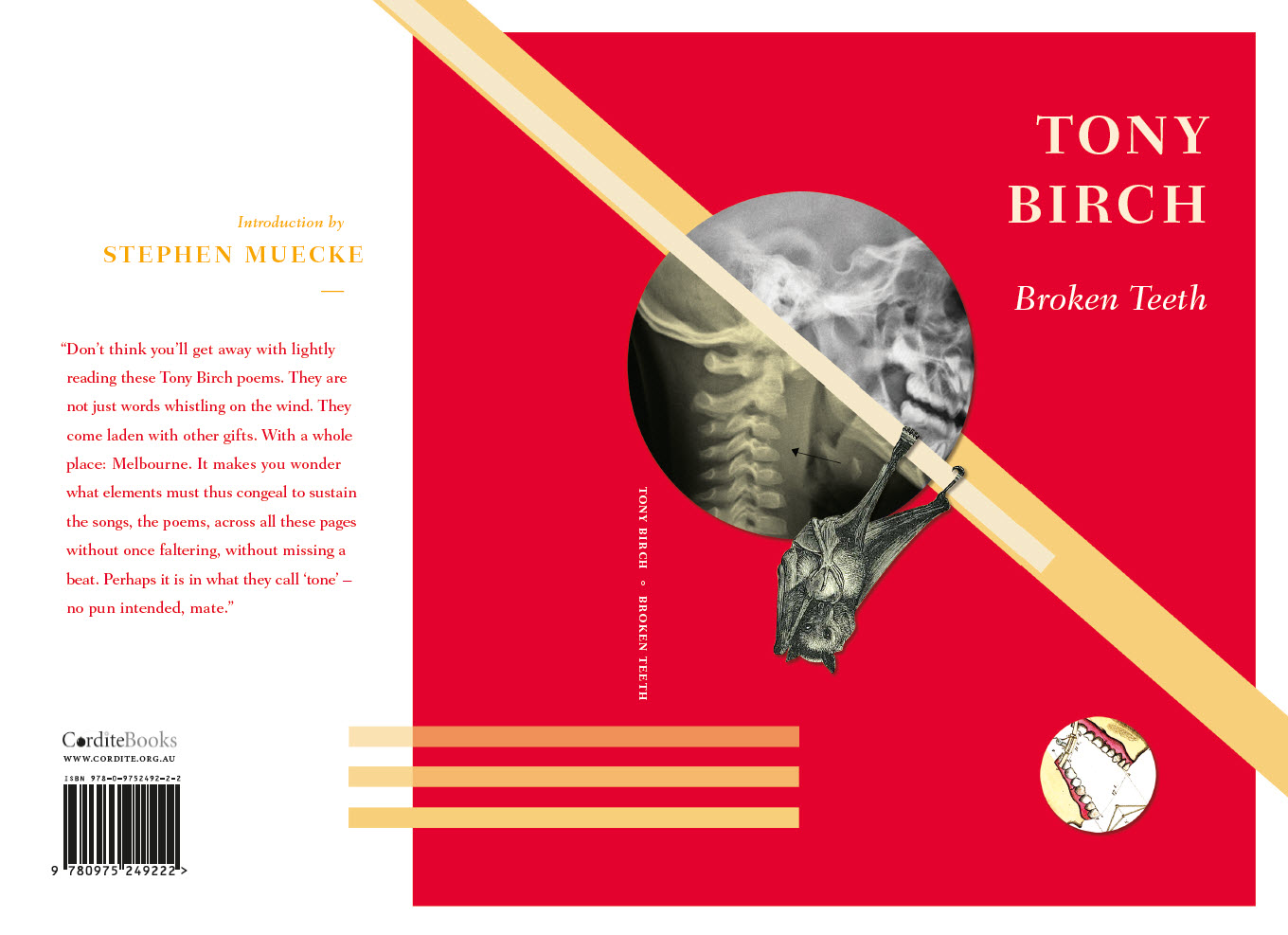
Introduction to Tony Birch’s Broken Teeth


Cover design by Zoë Sadokierski

Don’t think you’ll get away with lightly reading these Tony Birch poems. They are not just words whistling on the wind. They come laden with other gifts. With a whole place: Melbourne. With a long history: from before the bay filled with water, from after whitefellas came in boats and called it Port Phillip, through to today when others desperately try to reach Australian shores. The refugees’ boats, the poet tells us, are still made from trees that were once earthbound, but stretching upwards. Then, like poems, they are laid down and recomposed for voyaging.

Few writers love their hometown as ardently as Birch. Read his novels and stories, look at his photographs, listen to him tell tall stories about it, run with him along the contours of its creeks, or stroll with him in the Melbourne cemetery to chat with the dead. It makes you long to ‘… rest along the / bluestone gutter…’. That hard, polished bluestone that cobbles the back lanes of Melbourne. They are the half-secret byways where Fitzroy kids can escape, play footy, get up to mischief and hiss a warning about the ‘toe-cutters’.

Sound parochial? Sure, the inner city is Birch’s local run and his knowledge runs deep. But the arc of reference is greater than for many whose compassion is not tested by suffering. You can be inner-city and global at the same time, and refuse the kind of insularity forged by fence-building for property protection. The elegy for our Japanese friend, Minoru Hokari, who jumped the fence between anthropology and history to make a journey with the Gurindji, still makes me want to weep each time I read it. And ‘Michael’, who I didn’t know, and the boat people who no one in Australia knows. They will find a welcome in this poetry that understands how to express sovereignty without border protection.

Birch also delves into another place where things are half-concealed, the documentary archives. They turn up the most poignant letters from earlier days when, for Aboriginal Australians, even moving around was a trial or a life-threatening experience. The pages from the archive are here turned, and once again recomposed. Or ‘The True History of Beruk [William Barak] (archive box no. 3)’ spills the history of William Beruk, and this remarkable text goes on to experiment with lists of objects and with prose.

Objects proliferate in ‘The Anatomy Contraption’ sequence, where, in a singular assemblage of technology, modern science and early- twentieth-century eugenicism it is easy to coolly dissect ‘three infant hearts’ for a cabinet of curiosities, which ‘congeals together / like a song’. It makes you wonder what elements must thus congeal to sustain the songs, the poems, across all these pages without once faltering, without missing a beat. Perhaps it is in what they call ‘tone’ – no pun intended, mate. What is ‘it’? A combination of sounds, feelings and meanings (you can’t afford to sound flippant, insincere or, if sincere, not earnest); it’s such a fine line! The right tone is what makes these poems happy with themselves in this space they now inhabit, hovering between performance and reception. Birch is not immaterial in this composition – he forges it, and gets the tone right by having a felicitous and easy-going relationship with resonant words bearing honest feelings and just thoughts.

GET YOUR COPY HERE

Posted in INTRODUCTIONS | Tagged , , ,

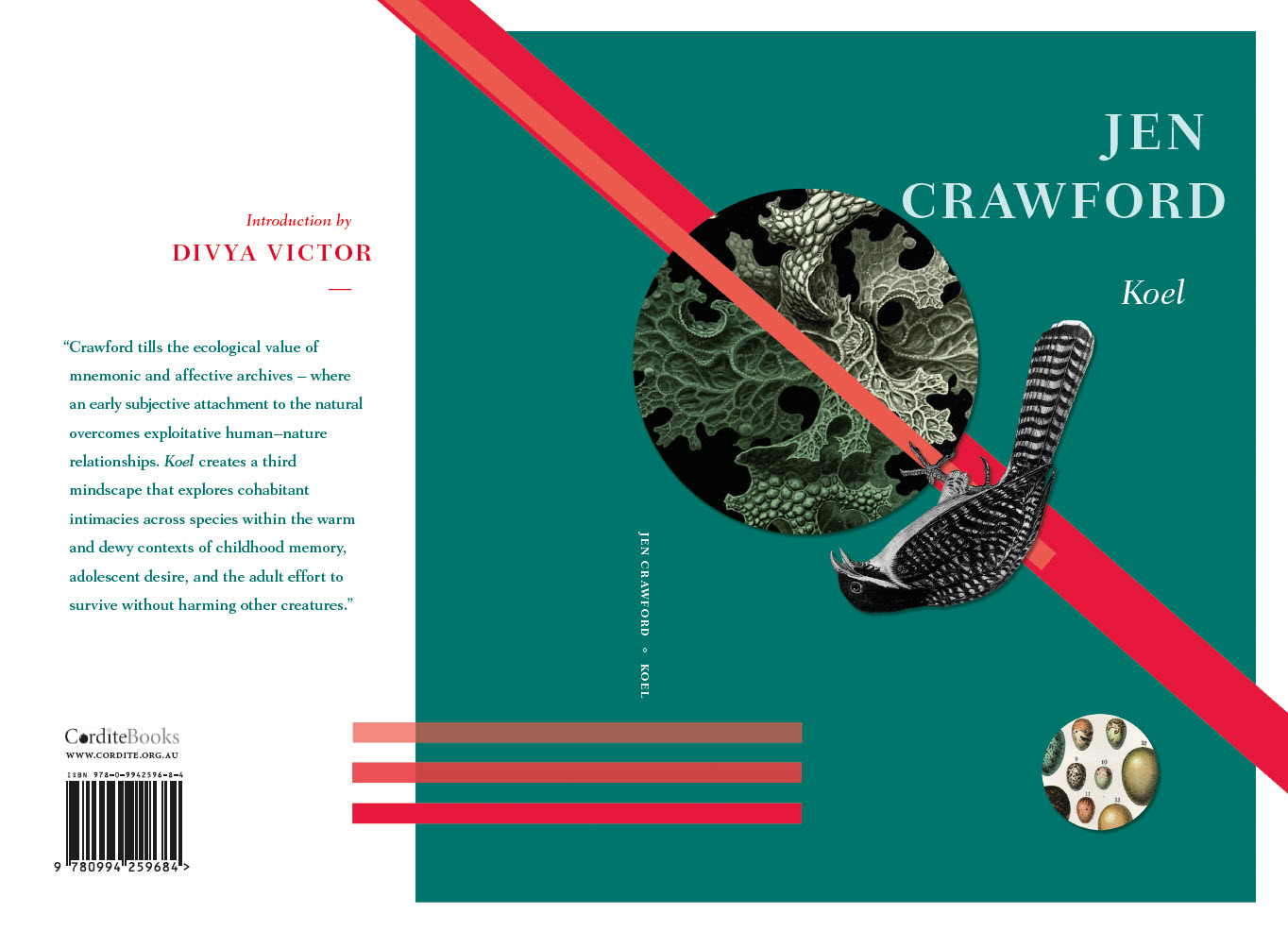
Introduction to Jen Crawford’s Koel


Cover design by Zoë Sadokierski

The koel is called after its call – its name is onomatopoeic, from the Greek ὀνοματοποιία: ‘ὄνομα’ for ‘name’ and ‘ποιέω’ for ‘I make’. The koel becomes itself as it sings out and is heard by a we. We, its human neighbours, find its name by listening to the lilting stretch of two plaintive notes that repeat and ascend in pitch until the whole neighbourhood pulses with its alarm – until the everyday is translated in the carousel call of the koel.

Koel tracks the fecund and chimerical crawl of life – bios – across the topography of New Zealand, Australia, Singapore, the Philippines, and into the warm terracotta of domestic spaces occupied by lovers, mothers and infants. The book offers us a phenomenological terrarium, a lush microcosm of urban and natural life that photosynthesises in the new, synthetic glass globe of late capitalism. Here, human identity grows like tangled filaments; its articulations sprawl like lichen from the cracks between national borders and embrace the cool stones of our foundations. Koel swells with the drama of symbiotic and parasitic life forms, where bodies intermingle and create each other through the hybridities of migrant identity and transnational belonging and are drawn together by the gravity of gravidity.

Mother. Moss. Migrant. These are the lines of consciousness that contour the book. Jen Crawford folds together a transnational atlas of ecopoetic forms. Crawford’s lexicon treks between the scientific, the architectural, and the philosophical, like the U S American poet, Mei- mei Berssenbrugge, tripping boundaries and feralising our cognitive attention. Like Chilean poet Cecilia Vicuña, Crawford reflects on settler-colonial politics, as Koel’s voices take over homes and the dislocation of a ‘self’ – a post-colonial cuckoo driven by dint of geopolitical churn, destroying life in its wake. The poems choreograph a phenomenology of the human as animal, roving between the trans-rational surrealism of tropical wilderness and the hyper-rationality of the biological, inspired by the verdant motifs of modern German dancer, Pina Bausch.

The French horticultural engineer and botanist Gilles Clément has recorded how industrial wastelands can become optimised for bio-diversity, blooming into post-apocalyptic utopias of ‘the third landscape’. Moving like a graceful rhizome between this ‘third landscape’ and an autobiographical one, Crawford tills the ecological value of mnemonic and affective archives – where an early subjective attachment to the natural overcomes exploitive human–nature relationships. Koel creates a third mindscape that explores cohabitant intimacies across species within the warm and dewy contexts of childhood memory, adolescent desire, and the adult effort to survive without harming other creatures.

Koel enacts the saccade of our attention through geographic landscapes and gives an account of how the feminine emerges from what it attends to; through those it tends to. It is the refracted story of how a life grows from a girl rustling among thrush nests in dresses, into a mother with ‘arms knit together as a shroud-knot as an ought / shade,’ and in doing so describes how one life becomes the world for another. Koel is a single day or it is all the days of life moving in grand and feminine interdependence between biological causality and phenomenological existence – between love and violence. Woolf described this place of the feminine when she wrote of Mrs. Dalloway: ‘She sliced like a knife through everything; at the same time was outside, looking on …’ The feminine, running its own attention to the natural world like a high fever, is a visionary memorising the world that is about to break her apart. Each poem in Koel is, in Deleuze and Guattari’s terms, a haecceity – an absolute limit of being entangled in assemblage with ‘an atmosphere, an air, a life.’

GET YOUR COPY HERE

Posted in INTRODUCTIONS | Tagged , , ,

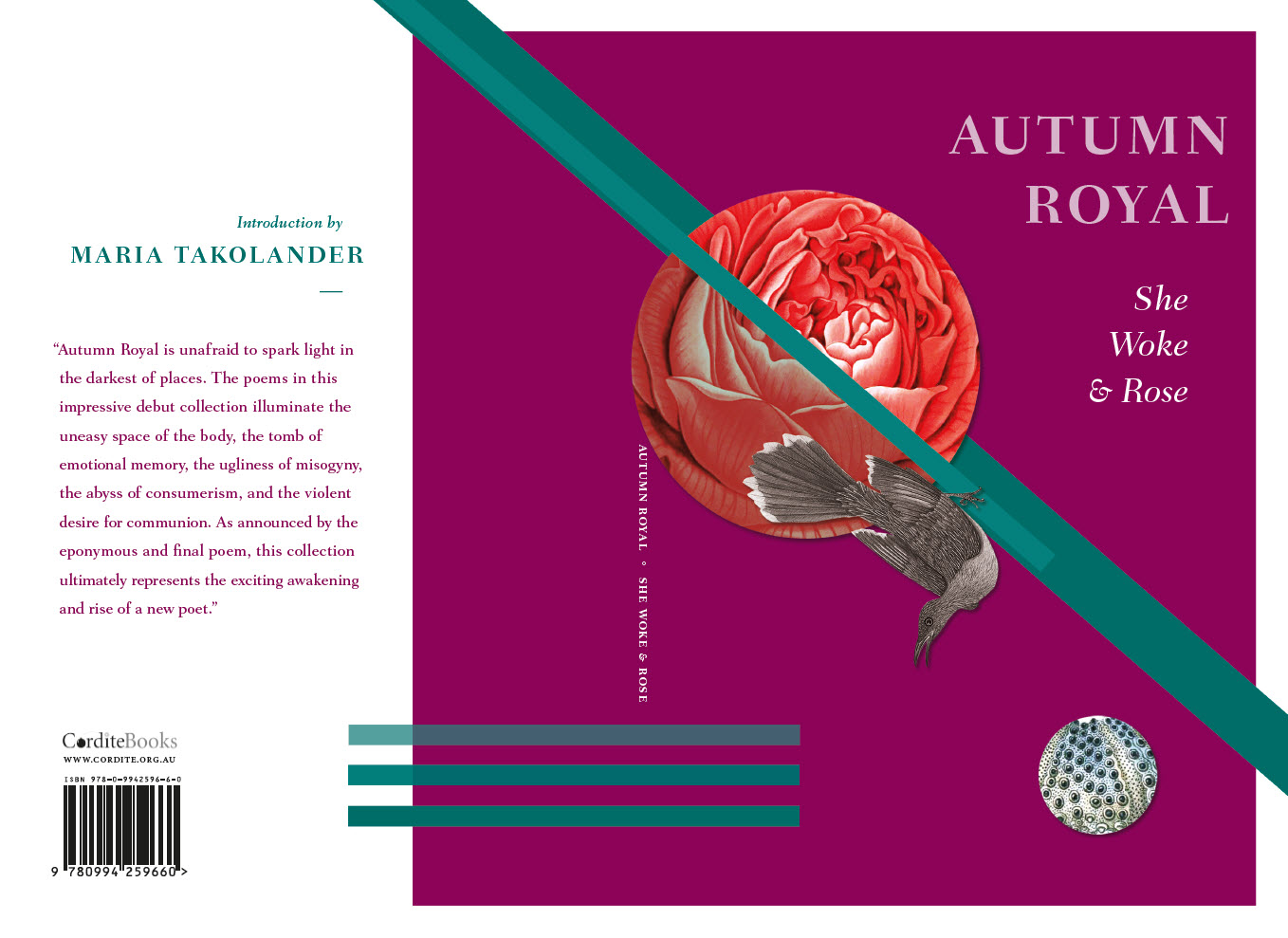
Introduction to Autumn Royal’s She Woke & Rose


Cover design by Zoë Sadokierski

She Woke & Rose introduces us to a poet, Autumn Royal, who is unafraid to spark light in the darkest of places. The poems in this impressive debut collection illuminate the uneasy space of the body, the tomb of emotional memory, the ugliness of misogyny, the abyss of consumerism, and the violent desire for communion.

Royal may have grown up in the vast light and expanse of the South Australian outback, but her poetry is marked not only by its dark subject matter but also by the claustrophobic: the claustrophobia of being inside a skin; of being haunted by childhood memories that ‘still rumour’ despite ‘the development / of my fontanel’ (as we read in the disturbing ‘After-dinner Mints’); of domestic interiors in which gender weighs intimately and heavily; and of the straitened sphere of the intermittently employed – the poet describing herself with distinctive wit and pathos (in the superb ‘Viticulture’) as ‘casual, yet seeking commitment / like a lamb bleating against a fence.’ Perhaps most oppressive, however, is the claustrophobia of silence.

In Royal’s characteristically hesitant and unsettling verse, the poet self-consciously struggles to liberate herself into being in lyric poem after poem. Often the poet’s skin is represented in association with paper or writing. In ‘Melting Ice’ the poet is ‘blue cellophane’; in ‘Trying to Write a Romance Novel’ she is ‘the inkling of myself’. ‘In Motion’ describes the poet’s project as one of ‘opening spaces with my mouth.’

Certainly Royal is a poet who can be brilliantly ‘mouthy’ and often in a feminist mode. In the beautifully sarcastic ‘Mirror Stage’ – the title a nod to psychoanalyst Jacques Lacan’s theory of identity formation – we read: ‘I open my mouth to create a new void … somewhere down below, perhaps it’s that endless / pit you eagerly spoke of as I sat on the bed / adjusting my thighs to ease boredom.’ ‘Hey Lady’ – heir to Sylvia Plath’s ‘The Applicant’ – riffs on the epithets associated with femininity, rejecting the ‘space for miss’ available on a form.

Thus Royal’s poems refuse self-identification even as they seek self-expression. This is apparent in the literariness of the poet’s self-stylings (with many poems featuring citations), in the fragmentary style of many of the poems, in their wit and dynamism, and in the transformations they often thematically play out. Typically, the persona of the poet dissolves or multiplies. In ‘The Wreck & the Raft’, which rewrites a passage from John Fowles’s The Aristos and pays tribute to a poem by Judith Goldman, the poet outlines the seven women who inhabit her psyche: the pessimist, the egocentric, the observer (the one ‘writing poetry’), the optimist, the altruist and the stoic, all of them trying to ‘ignore the crying / child — conceived in the breast of the beast / staggering to carry us up the stairs.’

Royal’s poems feature dedications to other poets too, such as Adrienne Rich, Plath and Anne Sexton. Royal’s work owes much to that intimate and edgy tradition of verse, but her voice is also her own: unpredictable, startling, sometimes devastating, but never self-piteous. Indeed, to return to the ironic personae of ‘The Wreck & the Raft,’ one might say that it is the optimist who triumphs with this book. As announced by the eponymous and final poem, this collection ultimately represents the exciting awakening and rise of a new poet.

GET YOUR COPY HERE

Posted in INTRODUCTIONS | Tagged , , ,

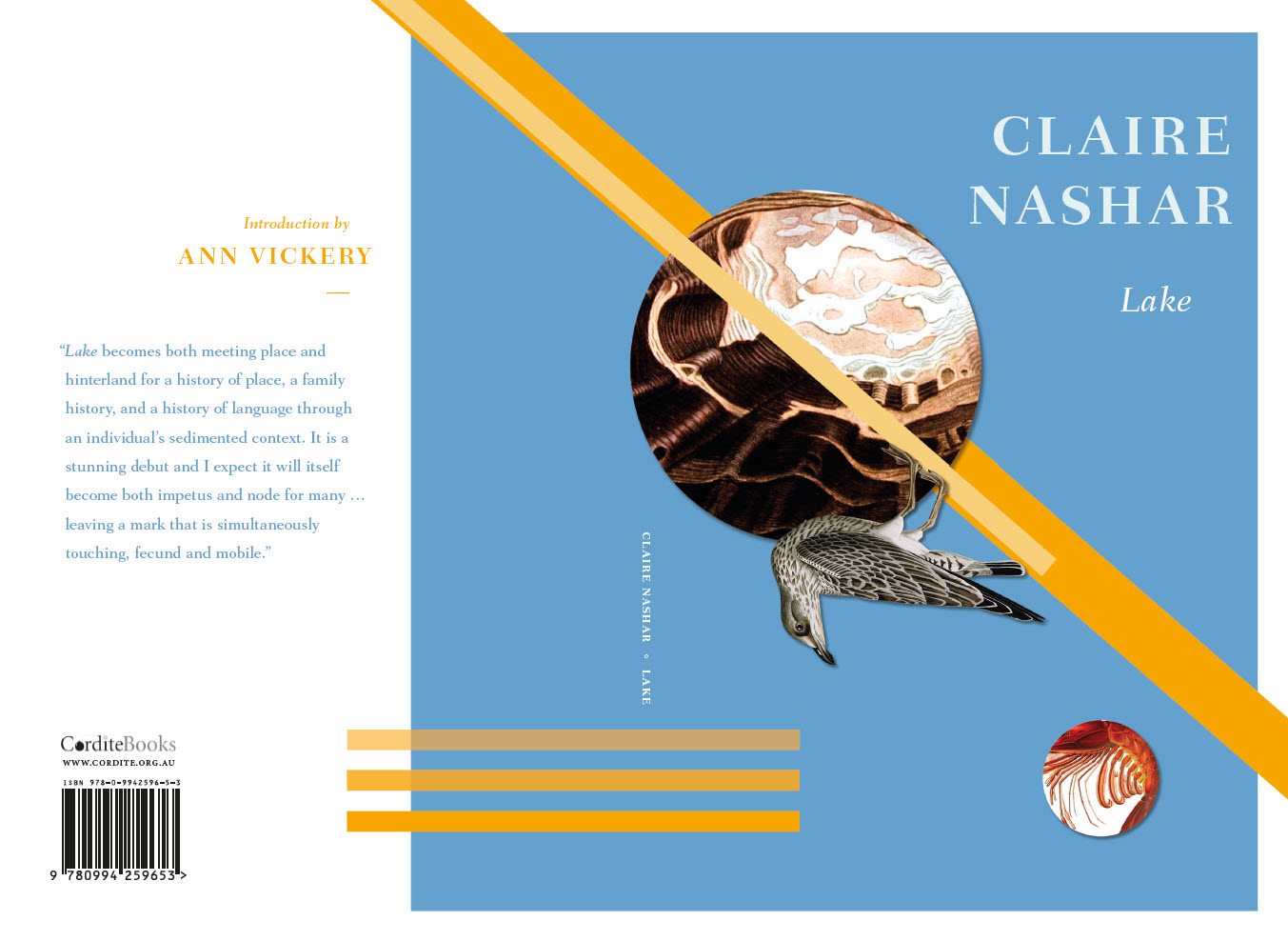
Introduction to Claire Nashar’s Lake


Cover design by Zoë Sadokierski

In Lake, Claire Nashar navigates the connections between people and between person and place in a striking elegy not only for her grandmother, leading geology academic Beryl Nashar, but also for Tuggerah Lake, an estuary on the Central Coast of New South Wales. Just as Beryl spent a lifetime investigating the composition of rocks, so too does Nashar explore the philological chemistry of how words, letters and space combine to make poetic form. Lake becomes both meeting place and hinterland for a history of place, a family history, and a history of language through an individual’s sedimented context. The personal here is always part of something larger, interacting within an ever-changing biosphere. Reflecting on the dynamics of composition and decomposition, Nashar considers how words, like a physical environment, are shaped by human use and how the deleterious effects of commercial fishing translate to the poem or the page. Pollution and land clearing becomes the contamination and reduction of meaning, a fragmentation or dissolution of the line. As weeds increase and slime transforms the foreshore, language becomes sluiced and dispersed, resulting in a scattering of a pluralising letter ‘s.’ Here, there is lyric impurity and erosion, but also experiment and a searching for ‘new air’. The family, like the long poem, has its inheritances but also its absences and rubble. Nashar looks at what is carried across and what is lost.

Stories, memories, and scientific theses are not discrete. Much of Lake traces how we make meaning or try to hold meaning together. Types of bird, weed and fish are grouped through family relation. Place becomes a map, a human body known through its anatomy. Punctuation brackets off parts of a line or poem, guides us towards where to take breath, and stops the reader from becoming ‘out of breath’. What is a mode of measure or enclosure, however, is undone and revealed to be morphic instrument. Following a day in the life of her family, Nashar considers how a poem, like a place, person or moment, is not reducible to an equation or box. What might be thought of as qualitatively or quantitatively known becomes a landscape of plasticity combined with dissipation. ‘[E]rasure admits an understanding of circumstance,’ says Nashar, and this is a poem where the words of a favourite poem or the memory of a particular person fails to be caught. Just as she demonstrates the slide between the human and the natural world, there is a slide in the sound between words, as remainders become reminders, ‘daughter’ is linked to ‘water’, and ‘read’ and ‘reed’ becomes interchangeable. These slippages foreground the connectedness between thing and name, act and thought.

As Nashar shows, absence is not necessarily emptiness. The blank space has echoes. Ash, too, has its bones. Not only is Beryl Nashar a part of Lake, but also Marianne Moore in Nashar’s naturalist eye and her ability to playfully open up a poem to its paratexts, like the index. Both precursors to Nashar direct our attention to layering and complexity. Lake also has resonances with Lyn Hejinian and Emilie Clark’s collaboration The Lake. It is a poem which reworks ‘much-little’ into a ‘little-much’. Return becomes a turn, a redirection. Lake is a stunning debut and I expect it will itself become both impetus and node for many … leaving a mark that is simultaneously touching, fecund and mobile.

–Ann Vickery, December 2015

GET YOUR COPY HERE

Posted in INTRODUCTIONS | Tagged , , ,

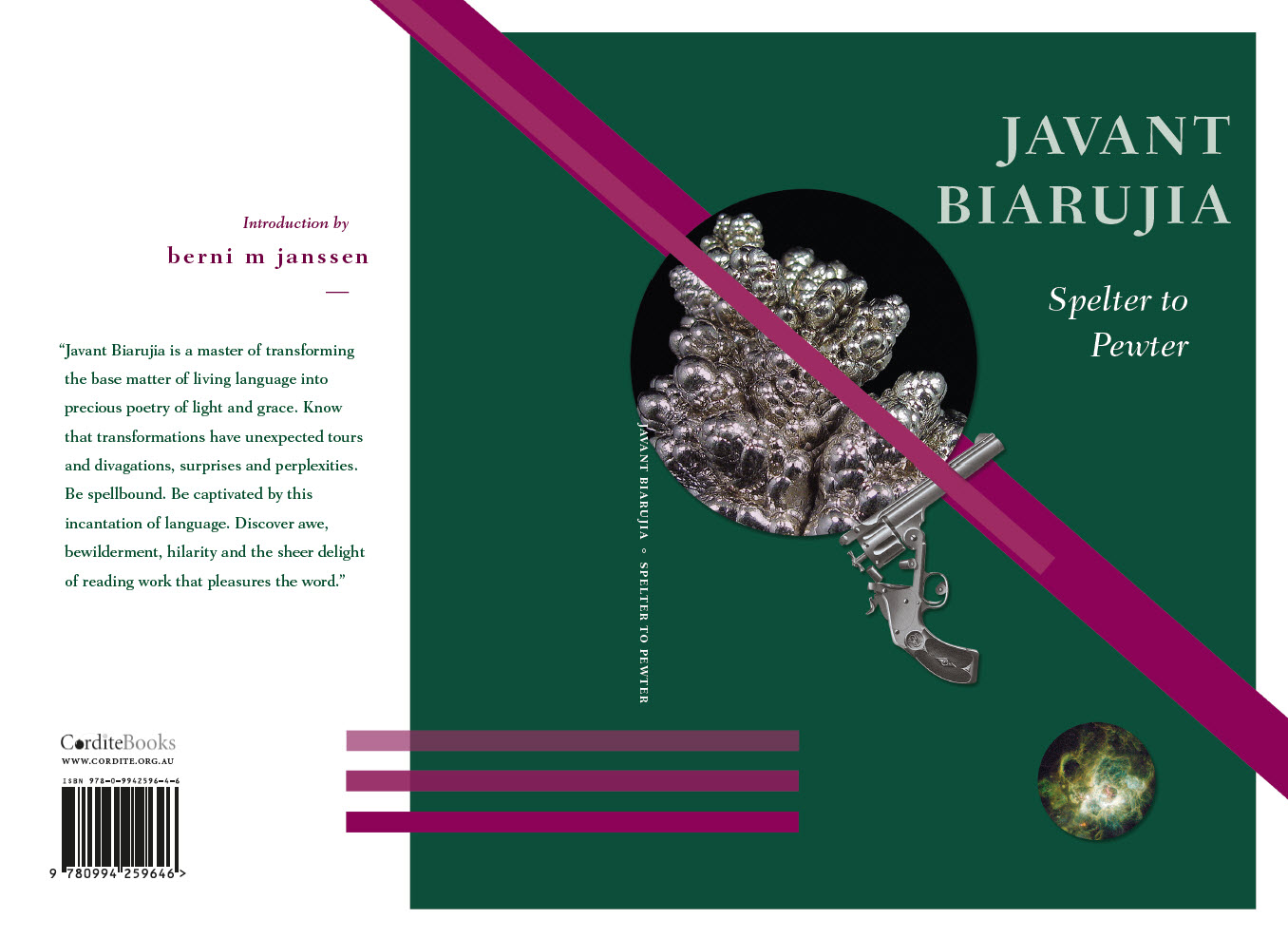
Introduction to Javant Biarujia’s Spelter to Pewter


Cover design by Zoë Sadokierski

In Javant Biarujia’s poetry, language matters – matters as in important, and matter as a unifying substance, a material to be transformed, and in so doing, becomes transforming. Particles of language are pounded out, splintered, spliced and mixed. Language is the matter from which his poems are sculpted into refined and polished objects. Matter is energy and these poems vibrate. Emit light, shimmering multiverses.

In Spelter to Pewter, the lineage of Biarujia’s poems is clearly acknowledged; from Zukofsky and the Objectivists, experimentation, shape, syntactic fragmentation and ‘the poem as object’. From Pound via Zukofsky, ‘a poem containing history’, and history not as ‘official’ but history as the all-encompassing lived experience of poets. Biarujia offers us remarkable and capacious poems ‘thinking with the things as they exist’, on matters personal, literary, spiritual, mythological, artistic, political and more. Always playful. Inventive. Incisive. In Spelter to Pewter we see the continuance of a tradition, a liberation of language, that still challenges.

Spelter to Pewter is both the title of the book and its first poem. Split this title, and in the particles exist clues. ‘Spelter’ was once synonymous with zinc and now refers to zinc alloy. The word ‘pewter’ is thought to be derived from the word ‘spelter’. Thus, spelter to pewter, the transformation of language. Pewter, a tin alloy. Both alloys are used to make objects decorative, detailed, hybrid and intriguing.

Split spelter to spell. Spelt.

‘Spell’, a splinter, or chip; language fragmented, where interruption, absence, disjunction and slippage endlessly generate.

To spell out, read letter by letter. Sound out. Each sound of a word is weighed. Each word, an arrangement. Textual elements – possessing the same particles and occupying the same place – are typographically disrupted, recombined and multiplied, and are weighted differently. Biarujia’s are isotopic poems.

Study closely, make out slowly, decipher. Sets of particles, casting a spell, create constellations of vital particulars.

‘Spelter to Pewter’, the poem, is the companion piece to Resinations. Both have 512 lines (8 x 8 x 8, a numerological affair). Where each ‘resination’ was a resin, each stanza in Spelter to Pewter has an element of the Periodic Table spelled out down its spine à la mesostics, a form that John Cage invented. We are spelling out, up and down. ‘Only the imagination of the reader limits the number of the poem’s possible meanings’, said Cage.

‘Brancusi Études’ is distilled and elegant. They have presence on the page as sculptural elements. Brancusi said that an artist should know how to dig out the being that is within matter. Biarujia has done just that.

‘Obje(c)t Fou(nd)’ is composed from others’ texts. This crazy mix-up, as revolutionary as Surrealism in its time, is framed by footnotes, typography and dualist titles – both placing and thickening, and adding weight to the matters political, intellectual, artistic.

Javant Biarujia is a master of transforming the base matter of living language into precious poetry of light and grace. Know that transformations have unexpected tours and divagations, surprises and perplexities. Be spellbound. Be captivated by this incantation of language. Discover awe, bewilderment, hilarity and the sheer delight of reading work that pleasures the word.

As Zukofsky said, ‘Felt deeply, poems like all things have the possibilities of elements whose isotopes are yet to be found. Light has travelled and so looked forward.’

GET YOUR COPY HERE

Posted in INTRODUCTIONS | Tagged , , ,

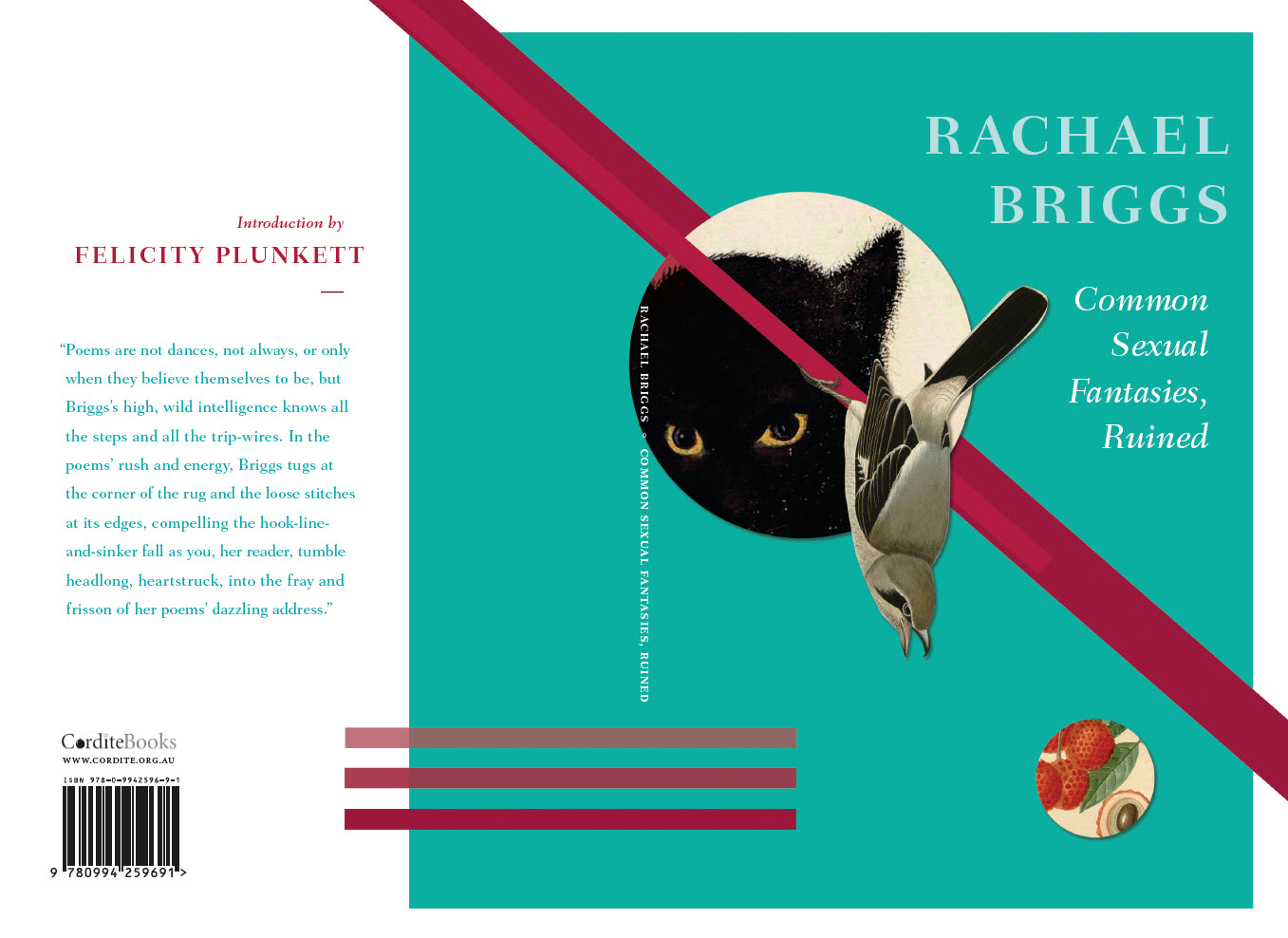
Introduction to Rachael Briggs’s Common Sexual Fantasies, Ruined


Cover design by Zoë Sadokierski

The polka originated in nineteenth-century Bohemia. A dance for two, it is reputedly simple to learn. Three steps and a hop, in fast duple time, with various steps – Turning Basic, Pursuit and Waltz Galop – an array of positions, sequences and rules. Do this, but not that. Proscriptions and prescriptions, as David Buchbinder puts it, talking not about the polka but the push-pull teaching of gender regulations.

Word pairs can work this way too: push and pull, good and bad cop shoving the subject in different directions, three steps and a hop, a one-two punch from one angle, now another. Common sexual fantasies, ruined. A cliché – ‘pull the rug from under you’ – shorn of its verb, twisting your attention to the eroticism of its nouns: ‘the rug from under you’.

Writing about Rachael Briggs, Justin Clemens recently noted how rarely you find yourself in the presence of ‘such incandescent genius’. He calls her debut collection, Free Logic, ‘a truly strange and brilliant book’. I was surprised to read this. Osip Mandelstam wrote of a poem’s having a ‘secret addressee’, and when I read the incandescent, strange and brilliant manuscript that became Free Logic I had no doubt its secret addressee was me. Briggs writes directly to you, invoking, challenging and interrogating with disarming and seductive focus. Her poetry holds your gaze.

Do you, she asks, in the prefatory mesmerism of a ‘guided meditation, proceeding backwards’ (of course) through the book’s four parts, have secrets up there? Up there in ‘the inside of your own head … more tractable than any pumpkin or melon’. The meditation swirls around logic and equations, language, closets and metaphor with the whip-smart hospitable wit and whimsy of this poet-philosopher who speaks only to you. It suggests the scope of the poems’ – but not, perhaps the extent of Briggs’s own – exuberant imaginative and formal playfulness.

Philosophical problems abound. In ‘Belief and Knowledge’ the protagonists are imagined as twin-like: ‘can hardly tell / themselves apart’. In ‘The Access Problem’ the alternative lines of a querulous interlocutor hack away at the poem’s fairytale narrative, dramatising a bifurcation between concrete and abstract realms. ‘Ambition’ posits that ambition itself is a ghazal, its refrains, like its ‘puffy-proud …chest’, stuffed with feathers.

The ghazal’s signature is ‘Rae’. The chimeric Rae moves through the poems’ hall of mirrors, catching the irreverent poet razoring the seams (of form, propriety, pretence), catching her eye in the mirror, catching her out and in, catching your breath and hers. Shrike and butcherbird chorus: ‘it serves you right, you pervert, Rae— / you dream the blade; you cut your waking throat’, a friend comments: ‘Jesus, / friends have boundaries, Rae’. There is a letter from ‘your faithful daughter, Rae’. Lipstick kisses are blown to Ray, but a receipt is ‘made out to Rae’.

Love may be, conventionally, ‘tab A in slot B’ (my rhyme, not Briggs’s), but in this ‘secret spacetimey, / disguised-as-a-phone-booth / armoire’, the labels itch, and it’s better to ‘snip off all the tags’. Poems are not dances, not always, or only when they believe themselves to be, but Briggs’s high, wild intelligence knows all the steps and all the trip-wires. In the poems’ rush and energy, Briggs tugs at the corner of the rug and the loose stitches at its edges, compelling the hook-line-and-sinker fall as you, her reader, tumble headlong, heartstruck, into the fray and frisson of her poems’ dazzling address.

GET YOUR COPY HERE

Posted in INTRODUCTIONS | Tagged , , ,

Robert Wood Interviews Alan Loney

I first met Alan Loney at the University of Pennsylvania in 2004. I was studying there at the time and Alan had been invited as a guest of Robert Creeley at SUNY Buffalo. As part of his American tour Charles Bernstein hosted Alan at Penn, where he gave a reading at the Kelly Writers House and met with students of Charles’ experimental writing class entitled ‘Close Encounters of the Third Kind’. Continue reading

Posted in INTERVIEWS | Tagged , , , ,

Philip Salom Launches Judith Crispin

What’s immediately significant about Judith Crispin’s poems is how strange they are. They bring into focus a world which is vital, lit, emotionally open and compassionate, but one which is also other-worldly, subject to laws and visions and visitations which are not those of conventional dailiness. This world of The Myrrh Bearers is animistic, shadowy, elegiac, and is certainly not routine and logical. Despite many who believe otherwise, our world isn’t routine and logical either. If it were so, would we bother getting up in the morning?

Continue reading

Posted in GUNCOTTON | Tagged ,

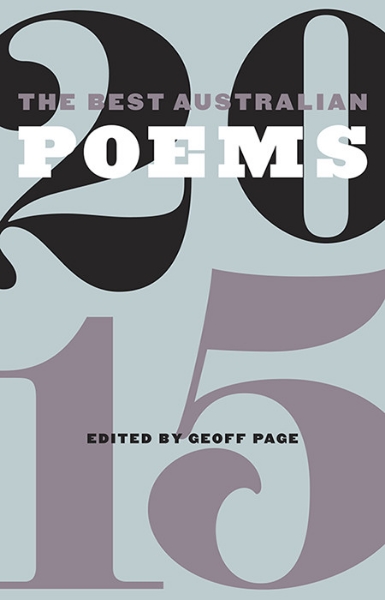
Rob Wilson Reviews Best Australian Poems 2015

Best Australian Poems 2015 edited by Geoff Page
Black Inc., 2015

Australian poetry, and indeed poetry in Australia, always seems to be undergoing something of a personality crisis. From the bush ballad to Angry Penguins and beyond, Australians have a knack for producing poetry, and a unique language from which to create it, but it’s a cottage industry. Even ‘industry’ seems too strong a term for what Australian poetry produces, though we have (and have had) no shortage of skilled writers working at various levels of poesy and doing remarkable things.

Continue reading

Posted in BOOK REVIEWS | Tagged , , ,

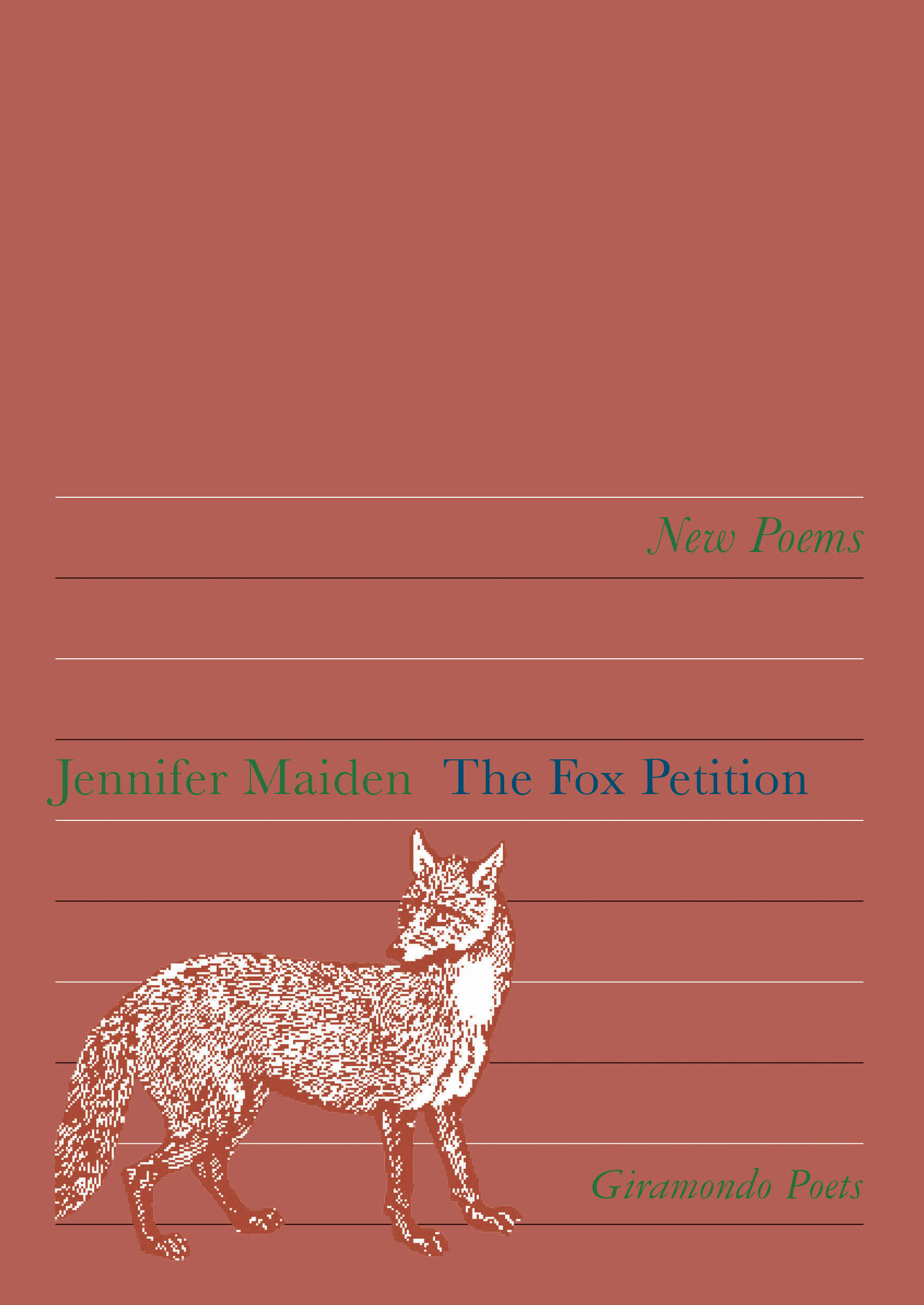
Simon Eales Reviews Jennifer Maiden and Stefanie Bennett

The Fox Petition by Jennifer Maiden
Giramondo, 2015

The Vanishing, by Stefanie Bennett
Walleah Press, 2015

We are already vanishing. Believe that!
Believe with the same candour
You show in believing me. (Bennett, ‘Believe That’, The Vanishing)

Stefanie Bennett woke up alongside Jennifer Maiden one morning, remarking, ‘An enemy is nothing to sneeze at: / Often his eau-de-Cologne’s / All embracing’ (‘Stratum’). This might be the too-cute, not-clever start to an amalgamating take on these two books from two poets with similar concerns and different styles. Continue reading

Posted in BOOK REVIEWS | Tagged , ,