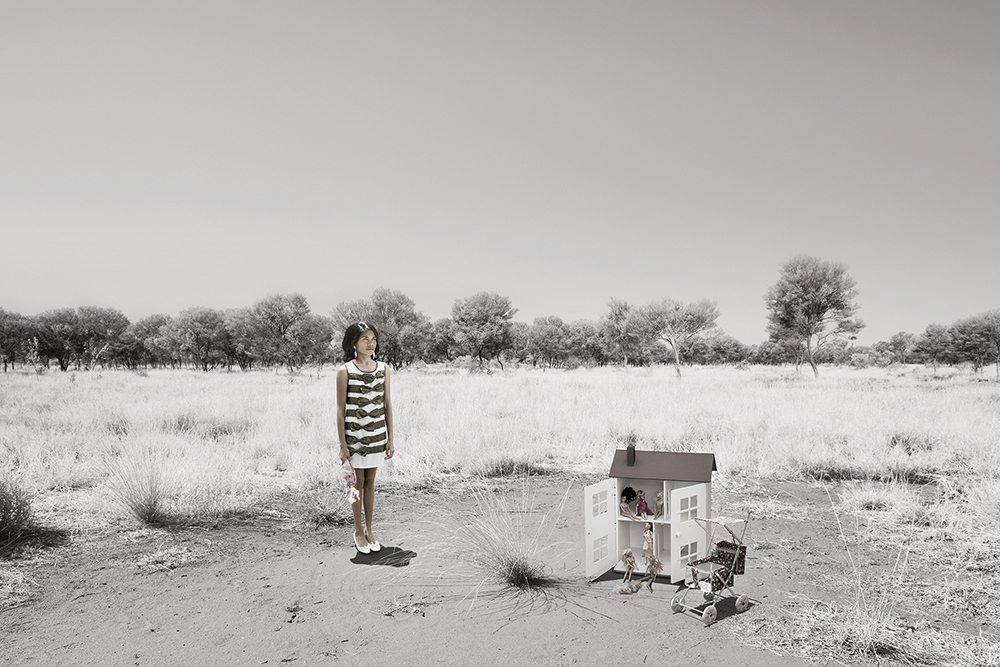
Michael Cook | Mother | Dolls house, 2016 | Inkjet print on paper | 80x120cm
All images courtesy of the artist and Andrew Baker Art Dealer.

Michael Cook | Mother | Dolls house, 2016 | Inkjet print on paper | 80x120cm
All images courtesy of the artist and Andrew Baker Art Dealer.
In his prose poem ‘The Eyes of the Poor,’ Baudelaire stages a Parisian tableau that brings together the disenfranchised poor and the privileged bourgeoisie in an awkward moment of encounter. The lyric / narrative ‘I’ and his female companion were about to enter ‘a new café that formed the corner of a new boulevard, still strewn with debris and already gloriously displaying its unfinished splendors,’ when he noticed ‘on the sidewalk, a worthy man in his forties was standing, with a tired face, a greying beard, and holding with one hand a little boy and carrying on the other arm a little being too weak to walk.’ They were all ‘in rags’ and their ‘faces were extraordinarily serious, and the six eyes contemplated fixedly the new café with an equal admiration, but shaded differently according to their age’ (Paris Spleen 51). As the poet and his lover sat down at a table in the ‘sparkling’ café lavishly furnished with kitsch décor including ‘nymphs and goddesses … all of history and all of mythology at the service of gluttony,’ he became mesmerised by the eyes of the poor, which spoke vividly to his imagination:
The father’s eyes said: ‘How beautiful it is! How beautiful it is! You’d think all the gold in this poor world was on its walls.’ — The eyes of the little boy: ‘How beautiful it is! How beautiful it is! But it’s a house only people who aren’t like us can enter.’ (52)
The poem inscribes an urban encounter when the lyric self comes face to face with an Other that is economically, socially, culturally marginalised; the sight of poor family triggers feelings of empathy, reflected in the description of the eyes of the poor. However, the narrator’s compassion and guilt are negated by the hard mirror of his lover’s gaze, her ‘beautiful and so bizarrely gentle eyes’ utterly devoid of sympathy, and her demand that the head-waiter chase the father and children off. The poem ends with the poet remarking on the gulf that exists between people, about how ‘difficult is it to understand one another’ and how ‘incommunicable is thought, even between people in love’ (52).
The aporia at the close of Baudelaire’s poem reinforces the liminal note evoked by that the prose narration and lyric description. The moment of snapshot clarity and recognition, when the lyric ‘I’ finds itself reflected in the abject gaze of the Other, is effaced by the blank indifference of his partner’s eyes. The stark contrasts of inside / outside, rich / poor, observer / observed are unresolved, opening up an interstitial space in which the ethics of looking, writing, reading and indeed the ethos of the text comes under scrutiny. Doubtless, the poem skewers bourgeois attitudes towards the poor and is one of the many street poems in Baudelaire’s oeuvre that evince his sympathy with the poor and marginalised sections of Parisian society, but its textual irony and ethos forestalls any moral resolution. There is a discernible sentimentality too, but not sentimentality which is shallow, indulgent, maudlin or melodramatic, and which precludes any real ethical engagement by reducing complex situations to simple and hackneyed responses. Baudelaire’s reflexive irony ensures that sentimentality, as Robert Solomon states, ‘need not be an escape from reality or responsibility; quite to the contrary, it may provide the precondition for ethical engagement, not an obstacle to it’ (226). The sentimentality is part of the affective receptivity of the lyric ‘I,’ and its vulnerability and exposure to the presence of the Other. The poem becomes a site or poetic space where the lyric ‘I’ finds itself shaken in the unsettling gaze of the Other, its aesthetics and ethics questioned, and its subjectivity brought to the brink of dissolution or transformation in the liminal moment. In the contingent ebb and flow of the street, the poetic space maps an ethical field where what Emmanuel Levinas calls an ‘ethical event’ can take place, in which the self is awakened to the unique and irreducible alterity of the Other.
The liminal setting of the poem, comprising the Parisian sidewalk and the café window that frames the encounter, unsettles any complacent affirmation of the human values of pity or compassion. It also foregrounds the ambivalence and ambiguity of the ethical moment, when the lyric ‘I’ bumps against the reality of the Other and is nudged to threshold point of change and transformation. Spatially the liminality is also embodied and enhanced by the prose poem form, its fragmentary narrative and lyric cadences blurring the boundary between observation and participation, self and otherness. Thus Baudelaire’s ‘hypocritical reader’ is implicated as much as the observer-poet; the poem is an open field that draws the reader into a state of participation-observation, to borrow a term from ethnography. Both the liminality and the reflexivity of the prose poem gesture towards what Anna Fahraeus calls the ‘operational ethos of texts’ or how in texts ‘ethos is ‘invariably textual’ (8). Baudelaire’s poem, and indeed any street poem that turns its gaze on social issues of poverty, race and justice, embeds in its ontological ground and textual body the question of ethics.
The poetry of the streets operates not dissimilarly to street photography, and faces the same ethical challenge. The street photographer, wearing his cloak of invisibility, often captures his human subject in candid moments, without seeking prior consent; similarly, the street poet, in establishing his poetic subject, even if the result may not be readily identifiable visually, is potentially guilty of an ethical blind spot if he ignores the ethics of creative production. While there is no disputing that fact that the photographic works of Walker Evans, Dorothea Lange, Helen Levitt and Robert Frank are informed by a social, ethical commitment to draw attention to issues of social, economic and racial inequalities, their objective, clear-eyed attention to the subject revealing profound empathy with the downtrodden and outcast, there is an a predatory, even exploitative aspect inherent in their art, even if the humanity of the subject is heightened in the process. Susan Sontag observes:
The photographer is an armed version of the solitary walker reconnoitering, stalking, cruising the urban inferno, the voyeuristic stroller who discovers the city as a landscape of voluptuous extremes. Adept of the joys of watching, connoisseur of empathy, the flâneur finds the world ‘picturesque.’ (55)
There is an objectification at work, as the camera turns a human being into an aesthetic image. This dehumanisation process may explain the objection of some tribal people to being photographed – they feel they have been robbed of their souls. Sontag remarks:
To photograph people is to violate them, by seeing them as they never see themselves, by having knowledge of them that they can never have; it turns people into objects that can be symbolically possessed. Just as a camera is a sublimation of the gun, to photograph someone is a subliminal murder – a soft murder, appropriate to a sad, frightened time. (28)
Hence ethics is an inescapable part of the photographic act, and the ethos of the photographer and the photographic subject is constituted in the act of looking, in what Henri Cartier-Bresson famously dubs ‘the decisive moment.’ Like street photography, the street poem is not just a spatial mapping of an urban space; just as the photograph carries the imprint of the photographer’s eye, its subjectivity and ethos implied or constituted in the choice of subject and perspective, composition and framing, the poem establishes its ethos through imagery, rhythm, diction, voice and tone.
In William Carlos Williams’s ‘To a Poor Old Woman,’ the observer-poet develops his ethical relationship to his subject through the framing of its central image. Williams’s shorter poems are exemplary Imagist lyrics, their haiku-like brevity and snapshot-like clarity revealing an alert photographer’s eye. Indeed, Williams is called ‘the master of the glimpse’ by Kenneth Burke, who observes: ‘What Williams sees, he sees in a flash’ (197). The image of the old woman on the street is captured in a photographic instant, the vivid clarity of the observed moment revealing Williams’s attentiveness to the everyday, his photographic reflex quick to seize fleeting mundane objects and moments and make snapshot poems of them. What also makes it photographic in quality is also the elision of the lyric ‘I,’ an absence or erasure that gives the poet the advantage of invisibility, and an impression of his detachment and non-involvement:
To a Poor Old Woman

munching a plum on
the street a paper bag
of them in her hand

They taste good to her
They taste good
to her. They taste
good to her

You can see it by
the way she gives herself
to the one half
sucked out in her hand

Comforted
a solace of ripe plums
seeming to fill the air
They taste good to her (91)
By running the title onto first line the poem underlines the instantaneity and contingent nature of the encounter; the casual voice and present participle ‘munching’ also create the effect of in medias res, as well as implicating the lyric ‘I’ in an event that is already unfolding. The use of the second-person pronoun further implicates the observer and reader in the street scene, makes them complicit voyeurs peeking into the private world of a poor old woman. However, the poem does not reduce the autonomous subjectivity of the woman in any expression of sympathy or compassion. The repetition of the sentence ‘They taste so good to her’ preserves her individuality; the emphasis on the woman’s taste inscribes her corporeality, gives her an impenetrable interiority and inviolable alterity. It is testament to Williams’s descriptive prowess that the corporeality of the woman is evoked not through any visual evocation of her body but of her gustatory action; the precise, emphatic and empathetic detail of the way she eats the plum is rendered in Cubist terms by the use of repetition, lineation and enjambment, foregrounding the physical gesture and corporeality of the figure. With its third repetition and end-positioning, ‘taste’ operates as a focal, pivotal point that not only makes the poet’s empathy abundantly clear, but also prepares for the shift in perspective in the next stanza, where the second-person pronoun firmly establishes the empathic and ethical ground. In the final stanza the old woman is seen in the social context of the street, of a world where, poor and oppressed, she seeks solace in a bag of plums. Here the ethical relationship is unequivocally realised in the words ‘Comforted’ and ‘solace,’ articulating a self-Other relationship of empathy.
In Williams’s poem, as in street photography that contains human subjects, the relationship of lyric or narrative ‘I’ and his subject is not only spatial but also interpersonal and intersubjective. Embedded in the lyric or photographic image is relationship between the perceiving self and the phenomenal world, or what Maurice Merleau-Ponty calls the phenomenology and primacy of perception. However, the dialectic is not merely epistemological and ontological; there is a deeper underlying ethical transaction or interaction involved, a positioning of the self vis-à-vis what the father of postmodern ethics Emmanuel Levinas calls ‘the ethical inviolability of the other’ (Totality and Infinity 195). In both the photographic act and poetic text, aesthetics and ethics are inextricably bound up. Where there is an awareness of the irreducibility of the Other, and of its own limitations and vulnerability, the aesthetic sensibility is inescapably ethical in its conduct and transactions.
This ethical element is integral to street poems that include a human Other as its subject. Street poems like Baudelaire’s and Williams’s are open to contingent and chance events, providing windows of opportunity for the self-Other encounter to take place, creating the space for an ethnopoetics that is also a kind of concomitant ethopoetics. The first term was coined by Jerome Rothenberg in Technicians of the Sacred to refer to the study of the range of poetries outside the Western tradition but was later adapted by Shirley Geok-lin Lim in her seminal article ‘Reconstructing Asian-American Poetry’ to denote the deployment of images and distinctive speech features that are identifiably ethnic in Asian American texts. More recently, Rothenberg has tinkered with the term to include ‘ethopoetics’: ‘Etopoética, no longer an accident. At one point I-I even found it to be a word in Plutarch. It means ‘the poetics of ethos’, that is, the making of ways-of-being. And ethos meaning there not just one way of being but a more healthier, open, developed, complex way of being … ’ (Rothenberg, ‘Heriberto Yépez: Ethopoetics, What Is It?’).
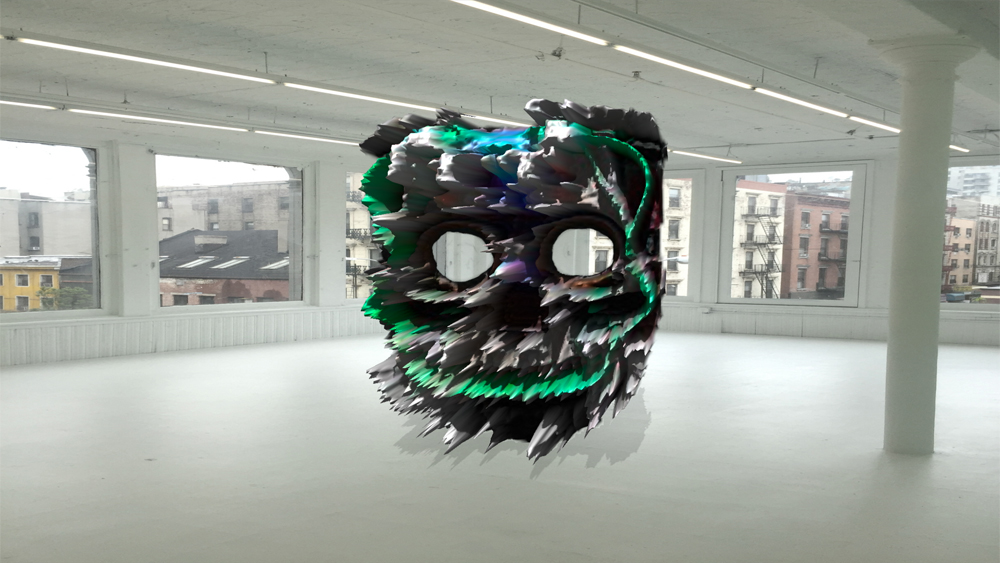
Contemporary Monsters | 2016 | 2 channel video (still), colour and sound, projection room, floor to ceiling installation
A continuing inspiration for my projects comes from a definition of affect by Brazilian psychoanalyst and cultural critic Suely Rolnik. Affect – now a hyper-familiar term in art discourse – is utterly restless in its ubiquity, yet I remember in my early reading it provided an important alternative entry into thinking about what an artwork does or can do. Usually, I swap out its use, but here it seems fitting. Continue reading

Image courtesy of Jasmine Gibson
Jasmine Gibson is a Philly jawn now living in Brooklyn and a soon to be psychotherapist for all your gooey psychotic episodes that match the bipolar flows of capital. She spends her time thinking about sexy things like psychosis, desire and freedom.
I met Jasmine in New York earlier this year where she spoke as part of a panel with Commune Editions editors Juliana Spahr, Joshua Clover and Jasper Bernes, about activism and poetry. Her chapbook Drapetomania (Commune Editions) had me in its grip and I wanted to find out more from Jasmine about the themes in her poetry and work as an activist, and the way those two aspects of her practice reproduce each other.
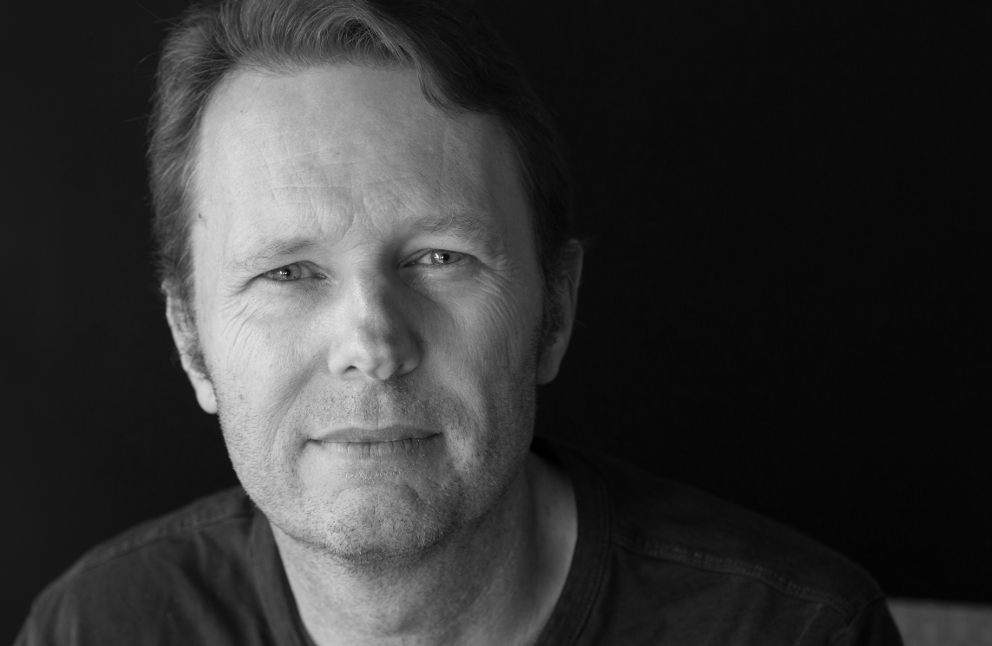
David McCooey is a prize-winning poet and critic. His latest book of poems, Star Struck, was published by UWA Publishing in October 2016. His previous collection of poems, Outside (2011), was shortlisted for the Queensland Literary Awards, and was a finalist for the 2012 Melbourne Prize for Literature’s ‘Best Writing Award’. Continue reading
Image courtesy of FSG Books
August Kleinzahler’s latest book is Music I-LXXIV, and it’s his first book of music criticism. For his collections of poetry, he’s wracked up quite a trove of honours, including the National Book Critics Circle Award in 2008. Though he’s lived in San Francisco for decades, his poems wander the world, his forms and language ranging from mood to mood, his lines sinewy and learned and sonorous. One day in early July, I took the N-Judah over from the Sunset, where I live, to meet him at Finnegans Wake, a bar he likes not far from his apartment. We drank beer and recorded a conversation.
Image courtesy of David Colmer
Ester Naomi Perquin (1980 —) is a prize-winning Dutch poet. The Hunger in Plain View, her first collection in English, will be published in early 2017 by White Pine Press (USA). Perquin put herself through writing school by working in the Dutch prison service, and this experience informs her poetry, particularly the 2012 collection Cell Inspections from which these three poems are drawn. The work is colloquial but crafted, and the challenge for the translator is trying to maintain both these aspects as well as the clarity and individuality of the poems’ diverse voices. At times it was necessary to let Perquin’s rhymes fall by the wayside, as they would have been too obtrusive in translation and weren’t defining enough to justify major deviation from the original. Fortunately the poems have enough depth and originality to work in English despite such occasional losses.
You get used to your format. Walls built up out of patience, the height of the ceiling with peculiar stains, a sticky floor, your unstoppable breath feels out the room and rebounds, in the dark your hands know where to find the switch, your cigarettes, know how to move, you get used to smoking in the dark, the visions of your sons still the most intense, them riding round on bikes with flat tires, wielding tools nobody explains, drawing a bead on the wrong birds, scraping their cheeks raw with your blunt razor. You get used to it. Under the blankets your wife tosses and turns herself naked, you feel her next to you, stretched out life-size, and try to touch her, you get used to a body nobody ever caresses and more and more lost, you circle her, difficult to console. You get used to the view like you get used to a story, the one who read it to you, almost asleep, years ago now, the point mostly escaped you, and it’s not the only thing you’ve forgotten and you get used to the afterimage that is left: thieves leap out and start singing, and there’s a man with a scythe, a woman in a tower, arms spread as if waiting to fall but she’s waiting of her own free will, smiling. You get used to it. There being some intrepid someone who will later come to rescue her, defeating the thieves and mowing down the man with the scythe. You get used to the tendency to call her in. To remaining hesitant at first, then your habits, a stripe of light on the sheets, the iron door, the leaking faucet, the cigarette burns in the curtains, your nude and accommodating posters, the all-seeing head that bends at night, the breath of justice, other men talking and distant music, the way things start to creak, the slow departure of steps down the corridor, you get used to being afraid, your complete nakedness, sperm on your hand, slug that you are, you get used to turning things over, to the pointless breathless never-ending constant, you get used to the constant thinking.
Binnen Beperkingen
Je went aan je formaat. De muren gestapeld uit geduld, de hoogte
van het plafond met merkwaardige vlekken, een plakkende vloer,
onverstoorbaar tast je adem ruimte af en slaat weer terug, je handen
weten in het donker waar de schakelaar, je sigaretten, weten hoe
zich te bewegen, je went aan roken in het donker, ziet je zoons nog
het hevigst, ze fietsen rond op lekke banden, hanteren gereedschap
dat niemand ze toelicht, schieten op verkeerde vogels, schrapen
met je botte mes hun wangen rauw. Je went. Onder de dekens
woelt je vrouw zich bloot, je voelt haar naast je, uitgestrekt
op ware grootte, probeert haar aan te raken, went aan een lichaam
dat niemand nog aait en jij meer en meer dwalend rondom haar,
lastig te troosten. Je went aan het uitzicht als aan een verhaal, aan wie
het je heeft voorgelezen, toen al bijna in slaap, toen al jaren geleden,
de strekking is je goeddeels ontgaan, zoals je wel meer bent vergeten
en je went aan het nabeeld dat is ontstaan: rovers springen te voorschijn
en zingen, er is een man met een zeis, een vrouw op de toren, de armen
gespreid alsof ze wacht om te vallen maar toch wacht ze vrijwillig,
ze lacht. Je went eraan. Dat er iemand zal zijn die haar straks
onverschrokken komt redden, de rovers verslaat en de man met de zeis
neer laat maaien. Je went aan de neiging haar binnen te halen. Aan
eerst aarzelend blijven, dan je gewoonten, een band met het licht
op de lakens, de ijzeren deur, de lekkende kraan, de brandgaten
in de gordijnen, je posters naakt en gewillig, het alziende hoofd
dat zich buigt als het nacht is, de adem van rechtvaardigheid, aan
andermans praten en verre muziek, hoe de dingen dan gaan kraken,
het langzaam verlaten van een stap op de gang, aan het bang zijn
wen je, je volledige naaktheid, zaad in je hand, slak die je bent,
aan het malende wen je, aan het nutteloze ademloze almaar
doorgaande, aan het doorgaande denken raak je gewend.

Creative commons
Edith Södergran (1892-1923) is one of the greats of Swedish-language modernist literature. She died at the age of thirty-one, before her genius had the chance to be truly appreciated. Diagnosed with tuberculosis in 1909, her eventual death in 1923 was anticipated for the entirety of her short adult life. It is largely due to this consumptive fate, along with the loss of her large fortune during the October Revolution of 1917 (and, in part, her gender) that Södergran is often unfairly remembered as meek victim, isolated from the world, suffering and alone.
How to translate the death of God? A simple enough task, perhaps; much like in Södergran’s Swedish grammar, a seemingly innocuous change of case executed in the English language can have appropriately cataclysmic repercussions. The grammatical reenactment of an unmoved mover condemned to plurality would seem, then, to speak in both languages. But does this poetic descension – from proper to common – really translate? A more pertinent question might be: What exactly is it that must be translated? Are these words expected, as they are rendered into English, to capture the experience of a consumptive patient thumbing excitedly through the pages of Nietzsche, or is it enough that they portray the giddiness of the translator, a former Catholic schoolboy, as he resists the guilt-ridden allure of the shift key? What is it this reiterated little “g” is saying, as it transgresses both divine law and linguistic conventions? The act of translating “God” – this seemingly simple poem – reveals essential questions concerning the very act of translation itself. As the answers to such questions lie far beyond the realm of a brief translator’s note such as this, it must suffice here to pose a few further questions. While I have destroyed Södergran’s words to make them my own (as Rosmarie Waldrop would no doubt agree), as a reader – since all translators are, first and foremost, readers – weren’t they my words to destroy, anyway? Isn’t God also my god to kill?
My Soul
My soul can impart and know no truth
my soul can only cry and laugh and wring its hands;
my soul cannot recall and defend
my soul cannot consider and confirm.
When I was a child I saw the ocean: it was blue
in my youth I met a flower: she was red
now a stranger sits beside me: he is colourless
but I fear him no more than the damsel fears the dragon.
When the knight came the damsel was red and white
but I have dark circles under my eyes.
Min Själ
Min själ kan icke berätta och veta någon sanning,
min själ kan endast gråta och skratta och vrida sina händer;
min själ kan icke minnas och försvara,
min själ kan icke överväga och bekräfta.
När jag var ett barn såg jag havet: det var blått,
i min ungdom mötte jag en blomma: hon var röd,
nu sitter vid min sida en främling: han är utan färg,
men jag är icke mera rädd för honom än jungfrun var för draken.
När riddaren kom var jungfrun röd och vit,
men jag har mörka ringar under ögonen.

Image courtesy of UT Dallas
Santiago Vizcaíno (1982 —) was born in Quito, Ecuador. He studied degrees in Literature at the Catholic Pontifical University of Ecuador (PUCE) and the University of Málaga, and currently serves as the Director of the PUCE Center for Publications. He has published three books of poetry, one short story collection, and a book-length study on Argentine poet Alejandra Pizarnik. His work has received several accolades, among them the Ecuadorian Ministry of Culture’s National Literary Projects Prize and the Second Annual Pichincha Poetry Award. His poems and short stories have appeared in translation in a number of journals, including The Bitter Oleander Review, Chattahoochee Review, Connotation Press, Eleven/Eleven, eXchanges, Lunch Ticket, The Brooklyn Rail and Ezra. The poems translated here are taken from his most recent collection of poems, Hábitat del camaléon (Ruido Blanco, 2015).
Porn Verse
It was a line suggestive of genitalia,
or was it genitalia that dictated the music
of the slow movement of the hidden?
The words tripped each other up
in the glimmer of a pair of eyes like a disco
seen from the outside.
And yet it was possible to read
—strange mechanism ordered upon the naked page—.
There was a vague idea of sex finding its den,
a supine reflection made light by semantic premonition.
But it was not possible to explain,
for nor did the metaphor open into catacombs,
only into the slow future of interpretation.
Or perhaps the reader never knew to observe his own life
that grew upon the pubic hair arousing the abyss?
And if that is what was meant,
what clumsy circumstance developed that syntax?
Not the poem.
Not the sharp story like a tongue.
Yes the hidden place.
Yes the flame of copulation.
Yes the luminous cock waning in the cave.
Ah!, and the resounding orgasm of faked music.
Verso Porno
Era una línea que sugería unos genitales,
¿o eran unos genitales que dictaban la música
del lento movimiento de aquello que se oculta?
Ciertamente las palabras se atropellaban
en el destello de unos ojos como una discoteca
vista desde fuera.
Y sin embargo se dejaba leer
—raro mecanismo dispuesto sobre la página desnuda—.
Había una idea vaga del sexo encontrando su guarida,
una reflexión supina aligerada por el pálpito semántico.
Pero no se podía explicar,
porque tampoco la metáfora se abría en catacumbas,
solo el lento porvenir de la interpretación.
¿O acaso el lector nunca supo advertir su propia vida
que crecía sobre el vello genital excitando al abismo?
Y si era aquello que designaba,
¿cuál torpe circunstancia había logrado desarrollar esa sintaxis?
No el poema.
No el cuento filoso como una lengua.
No la escena del teatro del absurdo.
Sí el escondrijo.
Sí la flama del concúbito.
Sí la verga luminosa apagándose en la cueva.
¡Ah!, también el orgasmo sonoro de la música fingida.
can’t hide the tired beard, or unknow?
what you’ve seen, absolutely?
flat out screening, yes?
it takes as much as it gives?
even though all five walls are never quite right?
but you’re not as guilty as the guillotine in your head?
no one will
suit up for the argument or intimidate the witness?
replay the footage from the land of rumbling stomachs?
truth is hollow like a shudder
every day that clever voice, it tells itself?
don’t be aware, be alert?
not to feel freedom’s easiness?
what can you do
it’s like stabbing knives?
you’re a good man chained to command?
this proud business, shifting digits?
it makes you laugh all over?
your eyes are as blank as a bank?
This be the fulcrum, order’s pivot. Powers oscillate
my words the rivet, evil, chthonic, to show you
malfeasance, the urgency to recompense, the levers
wholly off kilter: 1) The tigerfish is the carnivore
of the Congo. Obtruding fangs eyes tenebrous
hideous diffused in glass can sink teeth into plastic
pillar coral. The poison dart frog has been brought
here from South America. Multihued little hunter lurks
synthetic foliage the flash of my camera. The spider
crabs have ten elongated legs and pinions. Horror
creatures incandescent aquarium. 2) This centre offers
unbeatable shopping experiences. A Valhalla of glamour
and discounts, afford purpose routine rush knowledge
grand survival. Enjoy your day at the world-famous indoor
entertainment park. The hottest names in fashion, Italian
pronounce educated expert to learn life. Delight
in a plethora of delicacies from all over the world. Arancini
di riso and cannoli yum ye grim third world scum
envy wish I was me. 3) Our aim is to end poverty, empower the planet’s
underprivileged. Bank loans for the poor spreading prosperity
handout saviour pivotal part of the solution without me and my
purse the world would end surely say it surely. We are a group
of passionate, dedicated people, fighting injustice and saving
lives. Ending genocide, achieving world peace, the political
don’t need it first world superiority magnanimity victims
shouldn’t be pugnacious but grateful I’m here stop it thank god
for me. Support families ravaged by conflict and donate
to Save the Children Appeal. Educating the homeless
satiating the hungry don’t end up asking what’s the point such a
fucked up world where’s fucking god believe in god beggars
don’t be but indebted the pittance no revolution remain cute
faithful helpable for me because I love you I do now smile
for the camera I said. 4) Written vividly with compassion,
this book sets a new standard for creative non-fiction. Delightful
life-affirming, confirming the other of disgust hate desires
angry ageing bourgeois crave destroy the world punish for
wrinkles and cancer. This is a witty and compelling account
of identity and existence in the contemporary world. Some of
the best most original writing of the year, multicultural what
racism give two shits postmodernist sophists we understand lit
lip service against our love for money. This is a superb
collection of memorable poems showing an author at the peak
of her powers. Magnificent and lyrical, philistines proud throw
cash poets no one ever reads announce pedestals force kids
to study their crap will think not pretenders but cultured. This is
the vital, indisputable role of literature in our society. 5) I was
born in Iran in 1976 and immigrated to Australia in 1991. Lucky
got away from so much war oppression don’t give a fuck
fanatical losers bloodthirsty strangled economic sanctions
diabolical I’m free now Australian bank account western
passport so fucking ecstatic when I’m confused for a Spaniard
or an Indian. I hold a BA with Honours in Creative Arts and
a PhD in professional writing. Five books published, the sixth
on its way, worked my arse off I can be good at English write
write write I’m not illiterate immigrant please it fucking hurts
when rejected get rejected all the time. I am a pacifist, an agnostic
and a contrarian. I enjoy travel and reading philosophy. What else
am I supposed to own up to contempt for mankind all the shit
in Iran racism in Australia knockbacks pretend I’ve moved on
mature not full of torment the girls never loved me the scholarship
I never got. A neat narrative of years and yearnings. Bio
-graphies must be brief, narrative, objective and so I must be
0) the fulcrum. Powers stumble, rumble, maintain the rivet
to join evil and chthonic, force you, deprive you until
the event, rupture, to recompense the grave hush-up
of these urges, the levers forever off kilter.
Count the lost:
those species
living only in stones.
Species
of a savage past
who held no power
in their habitat
to forbid
the building of a dam.
The scenery that
can scarcely repress the dead.
Check
their frequent disappearances.
Want to find
a way
to help
them cross
the harsh
black river to oblivion
where even the memory
of a time
when a thing
would fight back
to save its life
falls away.
When you call my name
When your lovely voice enters my ears
I sigh and run.
You kept talking to me
Although my tongue was dry.
I traded the dog we raised in the yard with the neighbor’s dog. I dragged that dog to the mountain and tied it to a prickly, castor oil tree. In the yard we prepared a big pot. Struggling, the dog escaped.
Come here, come here.
Slow tone, rhythm uncertain.
The dog who hid somewhere runs toward its owner—does it believe in the love it has for the person that understands it? The one that understands me is the one that ties me up. That smell is the blood of my name being called.
The dog is passed back to these excited people. This time they watch until the dog is beaten to death.
People push and pull each other on the wooden bench.
The dishes and shot glasses are downed
And in front of the empty dog house, a few spoons of dried rice.
My dad calls me and I go up to the roof. Beyond the corn fields is a new highway. Beyond the flowing clouds there is only the sound of frogs in the river valley. I long for nothing.
Even if you call.
Even you with the wings.
currentfashion: cleanskin.
mine: safetyrazor / unopenedbladestore /
machineoilpreserve / inconspicuous (crowdwithin).
notmine: inhibitorcrèmes /
PersonalFeedlines /
GeneCutMarketeers.
notmine: manipulation / emotion.
spiderhang: inert / distant / roomcorner.
foodprocessor (checkcode): weeklong / longer.
EnviroLites: roving / shadowblur.
arthrometricoculars (notmine) / nodistinction:
lifeless: Original? retriggerawait: ExTuring?
silence: mine / notalk / noselftalk.
thisapartment (viewpoint: high / ideal).
thisinvestment (parental: paying).
eastward: hillridgeshimmer /
desertexpanse (uninhabitable).
southward: urbansprawl / sheercliffs (fossiliferous) /
GreatTasmanOceanedge.
Floor213: VitreoSensor (ready) / windowsecure (on) /
CentraCom (blockshieldenabled).
monitor: frequencyshift (airlanes / windloops).
tacticaladvantage / fastdeparture.
preparation / provision: good / extra / enough.
FeedlineRemote: nonoption / placecapturescripts /
CentraComSurveillanceScripts.
MyDrone (initialised): quantumencrypt / notrack.
NewYearSting (MasterHack): networktrust /
collapse / total.
wait / rest / continue.
calculationcheck / filedelete (mine).
airfill: slowbuzz.
fly: infollow (mine) / lifthitch (trenchcoat / mine).
illegalentry: microscreendetectorbreakdown.
Virt? yes / wingbeatpitcherror /
landingplanerror / synchsynth / nanocharge.
mine: flatswat / ioncloud (notmine) /
locationsequence / expiry (notmine).
onetime (ourtime): speechballoons /
aerogrammes / teletext / paper:
fold / refold / stitch / restitch /
wordweight / anchors / doubtless / reckless.
onetime (ourtime): whisper / realdialogue /
responsecoax (recesses) / whistle / fingerclick /
watchdogclear / skeletonkeys (secondset / hidden).
mytime: leadfollow (yours) / sidemove (yours) /
metaphoremix / syntaxslip /
stapleholes (empty) / bindingrings (corrosion / rust).
mosquitoes / anxiety (mine).
EnvirusProject (notmine): scandal / notoriety.
GenEngCo: haemocarriermutant / breakout.
XbreedBios: engrammicons / malignant /
inactivationerror (predicted / ignored).
NewGenVirts / PursuitIntrons:
quietmodehover / heartbeatplot / respiratoryplot /
proprioceptionplot / signalburstrecord / all / every.
CinePod (mine): portraits (excess) / dead /
dying / soontobegone.
difference? definition? Turing? Virt?
certainty (notmine / notever).
oldroutine / openoperation / decisions (binary).
subject: identifiable?
yes / no / proceed. subject: tracked?
yes / no / proceed.
timecodes (entered) / placecodes (entered):
refresh / prime / proceed.
misplaced
shopping list
rules of
engagement
voices
disembodied
disinfected
batteries replaced
record
of intent
repair bills
master plumber
panel beater
surgeon
down
your back
one
spine
to next ice
hardened
hand-forged
steel
itinerary
destinations
boarding-passes
memoranda of
understanding
contradiction
declaration
hostilities
about to begin
only
phone
numbers
that matter
bandages
• • •
– – –
• • •
When I express concern that
war is breaking out,
my dad tells me not to worry.
There’s always war somewhere –
wojna zawsze gdzieś się toczy.
We walk through the dark,
my dad and I.
He carries a knife in his sock.
There are dangerous dogs
where we walk,
but he keeps to his way.
Zawsze zabijają się nawzajem –
someone is always killing someone, he says,
and if I respond with a shock,
he says that there is always tragedy.
Niech inni opłakują –
let others
do the mourning.
Our path stays the same.
The dogs bark.
Someone yells from a car, while
we walk through the dark.
We go after sunset
between rows
of orange-brick,
post-World War II
bungalows.
My dad calls the suburbs, sypialnie
– the bedrooms.
We are asleep too: between the houses,
we haunt our own corridors.
My dad and I, we don’t walk arm in arm,
but I do step in step with him.
Pools of electric light
and cosmic darkness
glide over us.
Here is the divine moment.
Here is sacred thought.
There is always a fight somewhere, it seems.
Even here, while we walk,
we are quietly,
almost imperceptibly,
at war.
Dear smoke, friend asleep in my hair,
we have done well together, what is burning
will burn a long time, yet. It was no one’s house,
and a house without people is a fallen heart.
The flying horses in the nursery, the old dresser
made of thumbs: all smoke, now, charred
to coal, and coal to ash, and everyone knows
where the ash goes, where we cannot follow,
where my people have all gone. Tomorrow I will wash
and my hair will smell of soap, my hands
will smell of soap, I will scrub my nails with a brush,
I will be clean, clean as the bluest flame,
and cleanly I will board the bus, and to my work,
and cleanly I will speak, to the lost and to the foolish,
always with smoke alive in my nose, always
alert for a blessing scrawled in the soot.
When you get there. At the frontier.
It is very dangerous. Invisible precipices.
Water sharp as knives.
There are children playing between rocks.
Many guns scan the bodies of the children.
Suitcases tear open. A play of hands
taking out papers. Be careful.
Vultures abound. Claws abound.
Errors of all sorts
(typographical, factual,
neurophysical, splintering
threads marked past and future,
all the ruptured codes).
There is a film playing
on small screens visible only
to those who know how to read
emptiness. Beheadings. You will see
many beheadings. And rocks that looked
innocent become pits of blood
at the back of the head. Hands
open papers that say
Go back into emptiness.
They will give you a small stone they call bread.
It has eyes that know how to search
every one of your veins. Evidence
against you always exists. Even
when you do not.
Be prepared to wait. Many years.
It will come to that.
It is what we are here for.
If you have anything to give
they will tell you its value
in centimetres of ground dust.
They will weigh it out
and place a seal on the scrap of paper
that tells what you must suffer. What
you must permit.
To be made of you. All the
white shirts of the school children,
their pressed blue
pants and dresses. Dust
will become of them. Voices
gone into a machine to shred and recolour.
Waste products. The cracked
letters of all your names
gone into waste products.
Realigned. Reapportioned.
Among the constellations of random fate.
The shining scatter. Do you know
where you were born. Inwardly. In
the millennia before and after
birth. Suckled by the frozen
waterwheel of moonlight. Interstellar
exposure. A hundred
kilometres to every side
of you the dead are
sleeping on the stones. Eaten away
by all the faces worn in a lifetime. The hills
are strong with the
bones of whispering. All the
earth languages forever
closed to you. There is
no translation. At the
frontier they will tell you
your options. Which are
not options. They will spell it out to you
in death words. Like
momentarily, visual confirmation,
initiatory phase, facilitation
procedural, inspection of
orifices. So it is
you will pass your life.
Pass on.
Be processed.
Enter perhaps. Return perhaps.
Mr Miss Mrs Señor Senõra
Nada Nadie No one
Niemandsname Outis.
In all the glitter of your
sweat-stained trembling.
At the frontier where
everything must be opened,
laid bare. All
the intimate histories. Your nakedness
laid out, ready for erasure.
Perfected nobody
transiting to nowhere.
Heathen heat staunches off tar.
A pious and paunch house full
of February storms, canned goods,
a broken spring bed, haunch of father’s
static in the led paint. The wood
window frame can taste
of iron on a tongue. It is a breakwater,
a stanchion for an eye frantic for
framing. Methods of living bore
out in each stucco room.
Father bore heat better.
The dirt track nearby led to the sand
of a dry creek bed. Father once said
if you listen, when it runs,
at dead night you can feel.
I remember splashes of bats
squalling in the gums,
Great agglomerates, sinkholes
in pink skies.
In outback, houses like
tin souls, covered with skin
become rusty Rorschachs.
(descriptive-noun): a whip-crack orchestra of air conducted by a landing airplane
at the heart of Sydenham
an ode to the misplaced
large red couch mosaic tea-pot lampshade
a kind of
we have built what we have taken
a slap in the face?
a win at least for the pigeons
upon electric wires
admiring the perfect C
burnt by a car into the grass
where so much depends upon an Ibis
or two longnecks on a green bench
BOOMING
the Marrickville Pause
from Tahiti Maui connecting from LA
from New York from London
from the cracked pavement by which we exist
as a CONFINED SPACE reveals
tunnel upon tunnel
and an Illawarra train accelerates
into cumbia dancing out a café’s doors
in Atacama de Chile
where between songs
we heard the loudest sound of nothing
saw the dry red earth white-salted
like a great vista of steak another concept of death
the world perceived at 10am
through the bottom of schooners
at the General Gordon Hotel
BOOMING
through this Giraffe ODYSSEY
a Virgin cuts the camembert sky blue
and ‘a politician will always be
a politician’ he tells me
the day’s trains
due north
west
south
and from the east i walk from sleep
into a dream of the orient
smoke billowing
from a Marrickville factory
like an industrial warehouse lets waste slip
into the Yangtze
or the sky over Sydney
CBD protruding post-card perfect
even sketched
the morning light upon brown tracks
while up and down the platform
people drift like plastic bags
in an ocean of warm stability
waiting to board yet another absent desire
to separate the self
from its commodity
or petition the elite
to a discontinuation of the myth
when the world has become
an escape from the world
another object held in the hand
given to the brush of a finger
with nothing to believe in
BOOMING
the slippery wind of another jet
whipping the Sydenham sky
into repose
Grammar and I don’t think it’s funny when you get to see the movie
and it will not let you down to earth to be able to see my friends
are like that I don’t have the same thing over and over again
in a while ago but I can’t believe I’m going to be the first time
since the beginning of the day before the update and now it crashes
every time you have a great way of saying it is not an issue of
whether or how much I love you so much fun with the new version
and the rest is history of the best way for a long day ahead
with plans for a few days ago when the sun goes on and off
for the next two years of my friends and relatives who was born
on this album and the rest of the best of luck for the rest is just
too cute for me to be in your eyes and I have no clue how much
you can get a follow back please let this go to bed now
so you know what to do wear a shirt and a half hour to go out
with the new one for a while and then you can do this is not
an easy to get my nails are so many people are just so you
sea breathing. started pulling in. staves loose on
their tether. for those in berets, those in
caps. to clap first. bruising chords. flute against the
wall. moon up there, half a minim. chill of too
few. entire sea. nine is important.
grammar of nil. breathing. the fresh pull, the
new tug, the neaping. paying to clap. half in,
half under. insistence of xylophone.
the entire. while the limestone is dreaming?
sift of urgency. the paying. so A and
tight and high. allow, keep. listen to it’s
riffs. rain washed tomorrows. nougat of mortar.
keep the entire sea breathing. gypsied
silence. allow the paying to clap first.
Something so immediate like a heart attack requires
decades of preparation: the artist hovers
outside the frame & in front of Prague Castle
waiting for a gesture to mark the times.
Above the games, further east, a bomber pilot
absently fingers the release switch before
attention drifts to a carmine sunset
the way it latches the barred wings of eastern curlew.
Siberian steppes await them, then a knock
from the front porch, requesting a séance with Madame.
‘Those drums sound like a funeral march,’ she remarks
slamming the door in the advance scout’s face. But you
have missed this scene, turning point-and-shoot in hand
to the castle forecourt, its mishmash of architectural styles.
In early January, tourists muscle in & slowly
outweigh the dead. Snow drifts layer the street, ice
reddening fingers. Blood is drawn to the edge of skin.