Chloe Wilson Reviews David McCooey

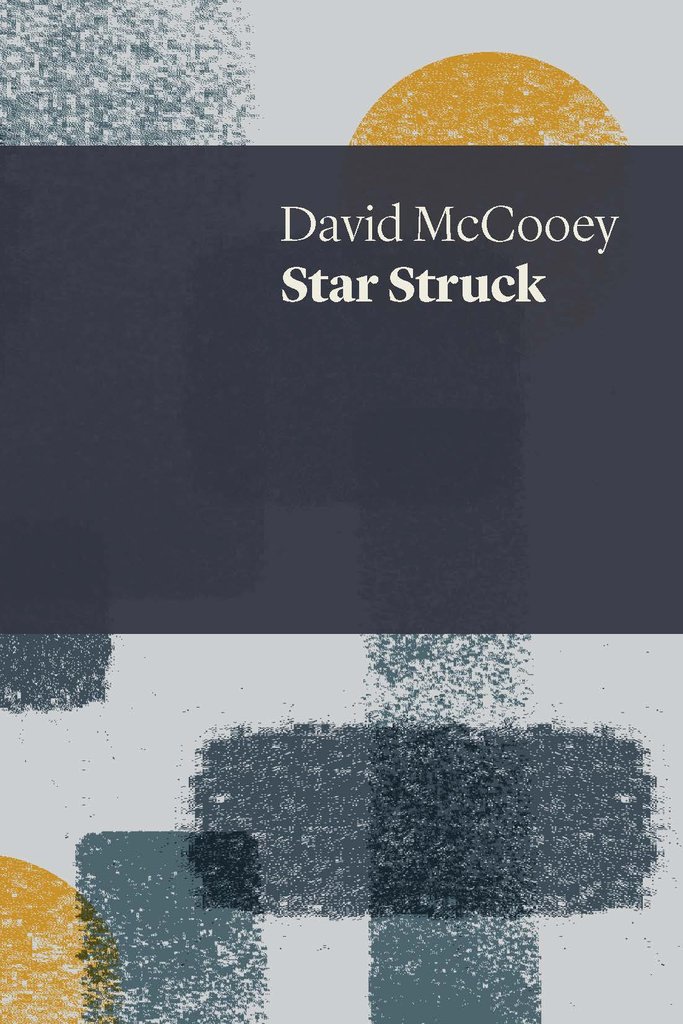
Star Struck by David McCooey
UWAP Poetry, 2016


At first, David McCooey’s Star Struck appears to be a collection comprising four sections, each self-contained and corralled from the others. These sections range from a series of lyric poems meditating on a ‘cardiac event’, to poems investigating light and dark, a sequence of eighteen ‘pastorals’ on pop stardom (and fandom) and, finally, two longer narrative poems. A quotation at the beginning of the pastoral sequence seems to hint at the collection’s attitude. From William Empson’s Some Versions of Pastoral, it reads: ‘Probably the cases I take are the surprising rather than the normal ones, and once started on an example I follow it without regard to the unity of the book.’

This cavalier disregard for the ‘unity’ of the book suggests a lack of concern with overall coher-ence between the poems in a single volume. And yet, there are decidedly consistent threads throughout Star Struck, both thematically (time, light, memory, the knife-edge of comedy and tragedy, how ‘voice’ is inhabited), and also in terms of tone. A mood of what might be called premature elegy suffuses McCooey’s poems throughout this collection. His speakers frequently find themselves alienated, unable to return to old selves, and unsure of what to make of the world they presently live in. They recall the past with nostalgia and sometimes grief (and irony – the atmosphere rarely threatens to become moribund), and view the present with an un-settled detachment.

McCooey’s reader senses that they are encountering a self irrevocably divided from its former incarnation. This is reflected in the use of second person in many of the poems – it would seem that the ‘you’ being addressed is not a different subject, but a past version of the self, an idea McCooey references directly in ‘Second-Person’, where:

you enter the realm
of the second-person singular,

a new you
to ghost the old,

the one on the other side
of a recalibrated life

The first section of Star Struck, ‘Documents’, presents the most literal rendering of this divided state. The speaker finds themselves in the midst and the aftermath of a ‘cardiac event’, and while at times they are able to find amusement in their distress (‘“I’m just labile,” you say, // and the doctor is satisfied. / You are speaking his language’) (‘Speaking the Language’), they nevertheless cannot help but reveal the terror that characterises this period of ill-health, with its moments of crisis and long periods of inertia, when the nervous system becomes ‘a shivering horse within you’ (‘One Way or Another’).

Throughout this sequence the speaker records with a meticulous eye and ear the physical envi-ronments, interpersonal interactions and thoughts that accompany illness and convalescence – at times, going so far as to arranging them into list form. A sense of the uncanny quickly emerges. It’s there in the ‘staring students’ who are ‘graduates / from The Village of the Damned’ (‘Music for Hospitals’); in the ambulances which are strangely unhurried, ‘state-ly’, rather than ‘rushed’ (‘One Way or Another’); and in the speaker’s sense that:

       it is not Death in
his outdated apparel at your 

doorstep, only your boss, doing
the right thing.

(‘Not to Disturb’)

For this speaker, death is omnipresent. As a result, the most blameless and familiar things now appear morbid; during the boss’s visit, even the biscuits are deathly ‘pale’, and the speaker refus-es to eat them.

Of course there is also a deadpan comedy in this that spikes even the most poignant poems. For example, the speaker mentions his wife ‘graphically’ describing the ‘harrowing scenes’ of the ICU (‘Intensive Care (ii)’) ‘so that you were both / gifted with that / pointless knowledge’. This reads as a dry call-back to a more sombre moment in an earlier poem, ‘The Point’, when the speaker’s wife jabs him in the chest during an argument:

There is a finger pressed
against your breastbone,
and left there, long after
the point has been made.

McCooey’s speaker even finds gruesome humour in a male nurse, ‘excellent at taking blood’, who brags about his prowess as a hunter, showing off photos of himself ‘dressed in fatigues / with Apocalypse Now face paint’, the ‘pretty’ corpse of an animal sprawled across his four-wheel drive (‘The Hunter’).

The tone and preoccupations of ‘Documents’ herald what awaits in Star Struck’s subsequent sections. A reader has already become accustomed to McCooey’s fascination with light and darkness prior to arriving at the second section, ‘Available Light’, which announces this as its theme; after all, ‘Documents’ has given us the droll observation that ‘Hospital light, like any other / light, is rarely “lemon coloured.”’ (‘Cardiac Ward Poetics’), and presented the sun as it ‘performs its drawn-out / power down’ (‘Invisible Cities’).

Yet there is a particularly spectral quality to the types of light listed in ‘Available Light’:

the science-fiction lighting
of deserted 7-Elevens;

the out-dated starlight;

a nightwalker passes 
the TV-blue of windows;
	
a phosphorescent Frisbee 
muses on the porch;

The vistas presented in this section are often deserted, with any signs of life – lights, music, va-cant chairs on a patio, figures or cars viewed from a distance – more a reminder of the speaker’s sense of isolation than a comforting indication that others, and the potential for connection, ex-ists. Like ‘The Dolls’ House’ with its mise-en-scène of family members attending to their (dull, gendered) tasks in frozen solitude, the speaker’s world has become distant and static, the ob-served details of domestic and suburban life as strange as the descriptive titles of ‘Early Photo-graphs’ which comprise the section’s first poem: ‘Untitled (two women posed with a chair). / Use of ether for anaesthesia. / Valley of the shadow of death.’

The poems in ‘Available Light’ also remind the reader that it is almost impossible to consider changes in light (and the capture of light through the photographic image) without also consider-ing time; the two move in tandem. Even darkness itself, the speaker of this section’s final poem (‘Darkness Speaks’), acknowledges this:

                                            One day
you will wake up for good,
and there I will be, at last.

Revisiting an earlier poem provides an opportunity to meditate on the interplay of time and light. ‘“Whaling Station” Redux’, presents a speaker who is forced to reconsider their earlier poetic rendering of a memory when ‘My late father’s legacy of 35mm slides, / newly digitised, undoes my poem, with three shots —’. The violence of the word ‘shots’ here seems particularly appro-priate, given the vast yet blasé violence of the images considered. The light stored in these imag-es, which becomes absent, ‘pure black’, at the whale’s centre, creates an occasion both for the speaker to reassess what he saw at the age of five (the images perhaps ‘darker’, literally and fig-uratively, than the memory) and to prevent his six-year-old son from seeing the same thing and this darkness therefore being handed on to the next generation. The poem’s conclusion, where the father flicks to a photograph of an Uncle ‘standing before the Arc de Triomphe’, is not an arbitrary choice of image; the Arc itself is of course another monument to the violent ‘industry of men’, even if it makes for a less confronting sight than the steaming carcass of a whale.
Posted in BOOK REVIEWS | Tagged ,

Review Short: Lynley Edmeades’s As the Verb Tenses

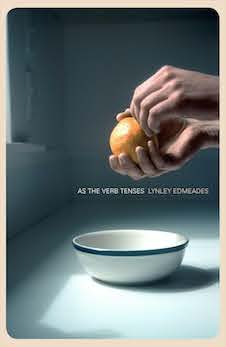
As the Verb Tenses by Lynley Edmeades
Otago University Press, 2016


As the Verb Tenses is a rare debut collection of poems that dazzles and delights with a profane, childlike wisdom. Acts of movement and play energise an accomplished performance held together by rare precision and a gentle power. Its author is the poet Lynley Edmeades who was born in Putaruru, a small town that is the home of the renowned Blue Spring and the source of much of the bottled water in New Zealand. Edmeades has travelled, read and published in New Zealand, the US, Ireland and Europe.

One of the great virtues of As the Verb Tenses is that it is not ostentatious; it remains poised in conversation and occasion. The verse is tensed between abstraction and feeling as it observes supposedly banal things: this kitchen pot and orange, and this clear spot on the counter. This everyday quality is some feat given the web of influences on Edmeades: avant-garde modernism, minimalism, and poststructuralism.

Edmeades completed an MA at the Seamus Heaney Centre for Poetry at Queen’s University in Belfast, and is currently undertaking a doctorate in sound in avant-garde poetics at the University of Otago. As the Verb Tenses bears the dynamics of modern Irish, as well as contemporary Asia-Pacific poetry; it plays with words between sounds, geographies, feelings. Edmeades achieves much in the calm irony of poems such as ‘Between Speech and Sound’, which invites us to feel ‘the usual shortcoming / of abstractions’.

This is a collection that refuses to choose between Baudelaire and Marx, and it is all the better for it. Judging from the epigraphs that open the book, Edmeades has structured the collection with at least two experiences of active tension. They are characterised by a mode of nonknowledge that opens us to a simultaneously sensuous and critical modernity. The first experience is that of the child who – as in Cage’s description of a trip to New Zealand that never eventuates – is characterised by a disappointed belief in the discourse of adults. The second experience is one of adult bookishness clashing with an unrecognised reality; or foolishness that makes unliveable promises to children. To open this experience, Edmeades provides an epigraph from one of the pithy sentences in Foucault’s The Order of Things: ‘Don Quixote reads the world in order to prove his books’.

Throughout the collection, Edmeades plays with Foucault’s critique of discourse to continually return to a heterotopic limit: ‘It’s difficult to keep the order alive’. A powerful new dimension is added to Foucaultian modernity through poems such as ‘Towards Whatever it is that Keeps Things Apart’:

This world, with its children and adults,
some ready for it, and some not.

In undertaking her poetic critique of everyday life, Edmeades makes full use of the geography of New Zealand, Belfast, Europe and Russia. Two poems called ‘The Order of Things’ almost but not quite bookend the collection. They plunge us into a kind of coming of age, post-colonial moment in the movement between country and city, from the family farm in New Zealand to the open air of the urban park:

When it was time for me to learn how to drive
I asked how I’d know which gear came next
It’s difficult to keep the order alive
When I get confused with the three, four, five. 

[…]

Red tulips drooping in the park.
Remarkable how quickly things change:
It’s tomorrow.
            It’s today.

The collection continues to dazzle as it moves between London, New Zealand, Belfast, a Siberian lake, and back to the metropolis. The peculiarity of post-colonial experience is evoked in poems such as ‘Second Hand’, or ‘East Belfast’, where ‘Birds sit in trees older than me’. Other poems return more directly to the quixotic theme of the epigraph: living ‘By the Book’, for example, just leads to ‘increased lack of intimacy’ in a poem about relationships. Poems such as ‘Cregagh Road’, ‘Inis Mór’, ‘As if’, ‘Orange Order’ and sketch Northern Ireland from the perspective of an outsider, a post-colonial child who finds wisdom in disorder.

In As the Verb Tenses, Edmeades guides the reader with an expert sense of rhythm and structure through the idiosyncratic itineraries of everyday globalisation. The poetry enchants, capturing the familiar childhood estrangement felt when we are playing with words to apprehend the world. This profanation of verbs is at its best when it approaches, as Walter Pater put it, the condition of music. Make like a verb and read this book.

Posted in BOOK REVIEWS | Tagged ,

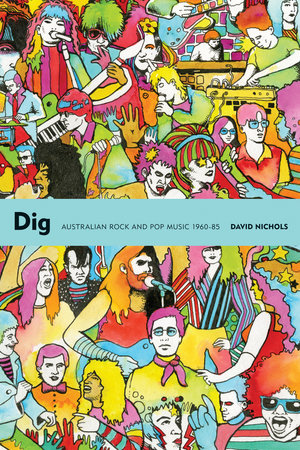
Jen Jewel Brown Reviews Dig: Australian Rock and Pop Music 1960-85

Dig: Australian Rock and Pop Music 1960-85 by David Nichols
Verse Chorus Press, 2016


Isn’t it time we invented a new handle for this ‘rock and pop’ stuff? ‘Rop’, for instance? Alternatively, ‘pock’ surely says ‘acne moonscape’: good for sounds designed to lure teens with condom-snapping haste. Regardless, I must say the droll and often delightfully irritated David Nichols brings a savoury palate to this tasting of Australian sounds. As a historian drawn to such antipodean delights as the subjects of his books, The Go-Betweens (2003) and The Bogan Delusion (2011), Nichols floats well above the bilge water line.

The foreword to Dig comes courtesy of Dave Graney, who notes that Nichols: ‘has experienced the limitations and constraints of the scene on the island and has continued to chase down rumours and will-o’-the-wisp reputations that occasionally spawn mad fevers in the compound.’ It is certainly true that, as this convict nation continues in its convulsive incarcerations, breakouts and last stands, songwriters and performers are the foot soldiers of escape. And with its bristling index and in-text scattering of old posters, cartoons and ads in black and white, Dig has a cannae-tie-kangaroo-down unpredictability. Nichols makes it clear in his introduction that he is not interested in cramming together all the old hack stories about rock stars acting up, or sniggering at historical ‘fashion crimes’. Rather he has rummaged through a range of evidence and conducted many interviews with musos and rock scribblers (including myself, disclaimer here) and others to plant his feet on the territory.

There are entire chapters dedicated to The Bee Gees, The Missing Links, The Easybeats, the strange story of the more obscure Pip Proud, AC/DC, Dragon, The Reels, The Triffids and The Moodists. Daddy Cool and Skyhooks are thrown into the washer together, where Bongo Star’s glitter irretrievably crunches up Ross Wilson’s foxtail. Other chapters explore the changing socio-musical decades. Along the way such interferons as architect Robin Boyd with his ‘Austerica’ (Australia / America) theory, the pianist, composer and free music explorer Percy Grainger and Richard Neville’s Oz Magazine-fueled rambunctiousness shoot through the text. Nichols dips into 1971 Daily Planet magazine to credit columnist Lobby Loyd with this ‘lobbying’: ‘Australian rock is probably the most advanced in the music world because this country has never known success, that perverter of truth and destroyer of progress.’ The crash-and-bash talent, unnerving persistence and musical nous are wonderful to breathe in.

The early-seeding festival scene is explored as a powerful multiplier of rock power. Nichols claims that South Australia’s three-day Myponga Festival in January 1971 only drew ‘an estimated 5,500’; recently, however, Bob Byrne wrote in the Adelaide Advertiser that he attended, and that Myponga, which starred Black Sabbath with many top Australian bands, had at least 15,000 paying customers and another 5,000-plus jumping the fence. Dig reports ‘heavy rain and icy winds no doubt made the experience unpleasant even before the Draft Resister’s Union tried to break down the fence, distributed pamphlets condemning the festival as a money-making concern, and at one point marched onto the stage chanting ‘out, pigs’ and ‘free concert’.’ The highly varied reportage on Myponga is challenging, and Nichols’s account funny, however I feel that his overall picture of Myponga is inaccurate. In the Australian rock festival scene, Myponga has always been quite celebrated as: one of the most impressive early Australian festival line-ups, with much of the weather hot, if dusty; and the birthplace of Daddy Cool’s enormous live success.

More commonly, Nichols has a solid grip on the ever-transforming and widening scene. Chapter Six, ‘Falling off the Edge of the World: The Easybeats,’ makes fascinating reading about the guys who in many ways wrote the bible on ‘How to Succeed in Show Business While Really Trying’, tripping over great cement clumps of failure en route, include Harry Vanda, Stevie Wright and George Young. ‘By 1969,’ writes Nichols, ‘Vanda and Young – at this point jointly the Brian Wilson of the group – were holed up in a flat on Moscow Road that had previously been a jingle studio for pirate radio … Somehow, the last proper Easybeats album, Friends, was made up almost completely of Vanda and Young demos, sung mainly by Young, including ‘St Louis’.’ Nichols quotes Vanda’s admission that, ‘I wouldn’t know what bloody St Louis was like,’ revealing that Friends was just an album to appease the contract while providing a taster of Flash and the Pan hits to come.

Another definitive moment in this sprawling history is when the talented Brian Peacock, known for the arty, rather baroque Procession – whose biggest hit ‘Anthem’, was completely a cappella – underwent a dark night of the soul. By this stage in the very early 70s, Peacock was staying at the Warwick Hotel in New York and road managing the American tour of the much more commercial New Seekers, when he discovered that their record company Warner Bros was owned by the Kinney Corporation, ‘basically car park operators … a heavily mobbed-up, mafia-riddled company.’ His resultant spiritual seizure ‘wasn’t drug-induced,’ says Peacock, ‘just a total paranoia that I was doing exactly the wrong thing, and the whole music industry was doomed and riddled with corruption.’ He told his business partners not to worry, he’d found someone else to take over, and as Peacock sensibly walked out, someone much more equipped to deal with King Kong – Glenn Wheatley – walked in.

There are also spiritual experiences in Dig of a purely musical nature. For instance, MacKenzie Theory (1971-4) were a highly skilled, electric ‘head’ band on the Mushroom label, improvising wordlessly on guitar, viola, bass and drums. Their American-born founding bass player Mike Leadabrand describes one show they played as ‘probably the most memorable event’ of his life. ‘It was as though the music came to us from somewhere else, and we were along for the ride as much as the audience,’ said Leadabrand. ‘When it was over, everyone knew that something had happened that we had no way to talk about.’ The Theory were supporting a popular Brisbane band that night, but that band announced they could no longer go on. Neither Leadabrand nor Nichols spells it out, but the implication is the headliners felt unable to follow the otherworldly experience their support act had conjured up. ‘Nobody complained or wondered why,’ said Leadabrand, about the headliners’ desertion. ‘This happened about three times in my three years with (MacKenzie Theory), and those times formed the person I would be to this day.’

Nichols isn’t always as sympathetic towards his subjects. After following the meanderings of Cold Chisel with attention in Dig, Nichols lets fly at their solo-going singer Jimmy Barnes for ‘the teeth-gnashingly ghastly’ single ‘Working Class Man,’ which, Nichols writes, is ‘written and produced by Journey’s Jonathan Cain, channeling a foetid, parallel universe Bruce Springsteen.’ Whether or not you agree with him, Nichols’s viewpoints are always individual, dodging the paralysing sameness often at work in long form rock-writing styles.

Posted in BOOK REVIEWS | Tagged , ,

John Clarke’s Complete Verse


Image courtesy of Legacy

For many years it was assumed that poetry came from England. Research now clearly demonstrates, however, that a great many of the world’s most famous poets were actually Australians.

So opens John Clarke’s The Complete Book of Australian Verse – later expanded to The Even More Complete Book of Australian Verse – one of the most extraordinary poetry collections in the history of this – as Clarke’s Dylan Thompson would have it, ‘wide brown bee-humming trout-fit sheep-rich two-horse country’.

Clarke introduces a number of Australian poets hitherto unknown, whose work has a huge influence on English poetry. There is Arnold Wordsworth, ‘a plumber in Sydney during the first half of the 19th century … responsible for a good deal of the underground piping in Annandale and Balmain. He lived with his sister Gail and with his mate Ewen Coleridge, who shared his interest in plumbing, and also in poetry and, to a degree, in Gail’. And Emmy-Lou Dickinson, who ‘film devotees will perhaps remember Emmy-Lou as an extra in Witness which was directed of course by her fellow Australian Peter Weir … she lives alone near Lakes Entrance and speaks only to small children on her mother’s side’). And, a personal favourite, W H Auding, who ‘died in 1968, 1971, and again in 1973’. The book is the apotheosis of Clarke’s genius.

As anyone who has waded, stony-faced, through The Faber Book of Parodies will attest, literary parodies are not easy and tend, for the most part, to diminish both the writer parodied and the one doing the parodying. But here Clarke manages, astonishingly, to do the opposite. He reveals himself to be both a writer of extraordinary precision and suppleness (we perhaps knew that already) and listener of great acuity (the former no doubt due to the latter), but is able to reveal truths about the poets – their lives, their times, their form, even – and here is a real skill – their tragedies, their pathos.

Take Sylvia Blath, who ‘wrote quite a lot about illness and death. She sometimes did it ironically but always, behind all the fun, were illness and death. She called it a day in 1963’. Unlike her near namesake, Blath, in ‘Self Defence’ allows herself to reach the limits of language, revealing more about Sylvia Plath than any number of dissertations.

Your daughter you condemned to the oven
Subtle in leather
Der offen, schnell.
Pig, brute, fatso, bastard
Shit, bugger, bum, fuck, poos.

While his Tabby Serious Eliot (‘Old is what I increasingly seem to be’) finishes his poem with as piquant a summary of his namesake as can be imagined.

In the room the women come and go,
Though not, perhaps regrettably, with me.

To do this, one needs more than a gift for parody. The book contains endless examples of Clarke’s brilliant ear form sound and form – from Labour Party leaders who ‘On remote coastlines … beach themselves / Spume drifting from their tragic holes’ in William Esther Williams’ ‘Carnival Music’; to those who would study ancient morals and observe that ‘at least one foot must be on the floor/While towing Hector around the walls of Troy’ in Section IX of Louis ‘The Lip’ MacNiece’s ‘What I Did in the Holidays’.

Clarke, by his own admission, came to poetry late, but became a devotee, writing lovely, revealing pieces – in his inimitable style, blending high and low culture – about a number of poets, including Auden (‘a natural history lesson includes the maxim that in polite company, you should never discuss politics, sex or religion. Auden was cleaning this theory one night when it went off. Almost everything he wrote about, and he wrote about almost everything, was politics, sex or religion’) and Seamus Heaney (‘when Seamus Heaney came to Melbourne in 1994, he had not yet won the Nobel Prize and could still play an away game’).

Poetry, Clarke felt was particularly propitious for parody, noting, in an interview with Justine Sloane-Lees for Radio National’s Poetica series that

… there aren’t very many forms, in writing, that you can adopt and collaborate with the original, but you can in poetry because of its brevity and its concision and because of the understanding that you have with the original because you’re collaborating with it when you first read it. So this is just another permutation of that collaboration, and it’s a pretty wonderful one to try.

This is every poet’s dream of an ideal reader – one who takes the care to ‘live with’ the poem, and to enter into a dialogue with it (the antithesis of the ‘what does it mean’ style of poetry reception taught in schools). For Clarke writing poems in the style of the originals was ‘like wearing someone else’s shoes and clothing, you walk as them, and all sorts of interesting things happen. You catch sight of yourself walking like someone else in the shop window’.

It is not hard to see the relationship between this and Clarke’s work with Bryan Dawe. I would argue that the key difference between satire and other similar forms of humour such as parody or caricature – or maybe just between good satire and bad satire – is that in the former the satirist, to some extent, empathises with the person satirised.

In this – the use of empathy as a way of engaging and satirising – Clarke reveals both his talent and his generosity, and this is, for me, why his political interviews were on a different level to other work in the genre. He didn’t simply mock the politician – an easy enough exercise – instead he asked the viewer to imagine being that politician.

To take as an example his final interview, where he played the Treasurer, Scott Morrison, Clarke doesn’t attack Morrison directly, rather, he imagines what it must be like to be Scott Morrison, having to defend a bad policy, and knowing that he will, almost immediately, be ‘hung out to dry’. Clarke’s ‘characters’ squirm, make desperate phone calls, engage in double-speak, attempt to make ‘Bryan Dawe’ ask easier questions, more intelligent questions, dumber questions, different questions. They are men and women forced to play dress up as politicians, and desperately wanting to be somewhere else – which is why Clarke himself didn’t need to imitate them. He makes the interviewee everyman or everywoman. John Clarke is them. We are them.

Posted in GUNCOTTON | Tagged ,

Rachael Mead Reviews Stuart Cooke

Opera by Stuart Cook
Five Islands Press, 2016


In the poems of Opera, Stuart Cooke attempts to take the writing of place into new territory, and in doing so, accomplishes something remarkable. This collection is both substantial and complex, enhancing our understanding of what a poetics of landscape can encompass and the capacity of language to articulate it.

Cooke has long been uneasy with the label of ecopoet, as he mentioned in a 2014 interview for Peril Magazine. While his previous collection, Edge Music (2011), focused on writing from the geographical and historical edges of landscapes, Opera pushes beyond an attempt to speak ecologically. Cooke is one of many innovative Australian poets (Louise Crisp, Peter Minter, Michael Farrell, Martin Harrison, Bonny Cassidy) who have been attempting to find new ways of speaking about landscape that acknowledge the multiple histories landscapes can possess: environmental, cultural and colonised. Cooke creates a new vision of how to speak about the temporal, geographic, ecological and cultural histories of land and, in the process, expands our lexicon with which to express them.

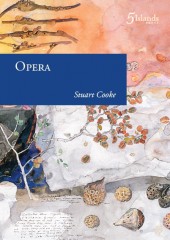
The cover image grants the reader an excellent entry point from which to understand the key themes of Opera. The artwork by John Wolseley is a detail from a larger watercolour of the spore-bearing bodies of Cytarria in Tasmania and Patagonia and their Northofagus hosts. These plants symbolise the ancient biological connection between South America and Tasmania and, as such, perfectly represent the scope and objectives of this collection. In these poems, Cooke is viewing Australia and South America as landforms once connected as Gondwanaland – ancient landscapes whose shared geological, biological and genetic heritage is still expressed today. Rather than focusing on regional specifics or local endemism as means of expressing place in a particular space and time, Cooke adopts a macro-perspective, writing from an understanding of place that spans millennia.

But these bald mountains remain the wisest:
their acrid soils skid through seasons, shirking
the heavy texts of jungles, of cumbersome timber,
of carbon’s tiresome routines. 
They lie across the azure like gods
of the stone they cradle,
they lap it up like great tongues
that descend into a single throat,
to the mad populous of the rapids,
the willows and the bamboos draping, the swirling
pollen in aphotic bivouacs, the flames of sun
in leaves, where all sound’s reduced
to a pure molten sign (‘Valle de Hurtado’)

These poems explore the myriad connections that link the continental fragments of Gondwanaland. Cooke’s overarching perspective sees not just trans-Pacific ecological associations but also political, cultural and linguistic linkages that have, over time, evolved in ways akin to biological speciation. All of the poems in the collection are creative responses to particular regions, but the geographic specifics are not necessarily mentioned in the poems. If the reader is keen to know which landscape inspired a particular poem they must consult the endnotes. I found this to be a cunning strategy, since by not making the poems’ geographic locations explicit, my sense of the multiple levels of connectivity and relationship existing between the various regions was constantly reinforced.

Cooke’s perspective acknowledges regional differences and environmental complexity while also honouring the languages that articulate their ecological individuality. Observed from this macro-level perspective, the linkages and connections Cooke explores in his poetry speak to the existence of a human commons spanning time, politics and cultures. This elucidation of what is shared rather than what differentiates is politically meaningful, since to confront global environmental crises such as climate change will necessitate the adoption of an integrated global vision. He writes:

                                                                  as if f
alling spirits weren’t caught by anyone but picked

up from the plain by hard white hands it’s

hard to talk about the dry, about what
what should or shouldn’t be […]


                         Now (here comes the rain)

with a capacity for change only time will tell la
vida derecha echa la echaste (trust) live

the drought, eat bad rhyme. Shout: Give back the land!
My hair’s too thin to mimic a downpour (‘Sonnet to rain [Son al silencio]’)

In addition to geological and biological connections, Cooke recognises a commonality of histories, in terms of the colonisation and repression of indigenous peoples and the need for acknowledgement of these histories in poetry that speaks of place. The colonisation of Aboriginal peoples in Australia and the Mapuche communities of Patagonia share many parallels. Cooke is one of many contemporary poets exploring the potential of poetry to articulate visions of the landscape that are not regurgitations of the colonial perspective, but instead embrace the vast spectrum of human and non-human cultures. As he explains in a recent article in Landscapes, Cooke’s poems embody the recognition that any trans-cultural poetic vision taking an anti-colonialist stance must attempt to eschew Western visions of categorisation and subjugation and strive for multi-vocal expressions of a complex location. Using both his significant experience with indigenous communities and extensive reading of indigenous poets both in Australia and South America, he writes from a place that values indigenous perspectives, allowing this way of seeing to sit alongside an ecological understanding of place in his work. Cooke’s poems reflect the profound understanding that for Aboriginal people language arises out of and in response to Country and, as a natural consequence, language is an inseparable component of Country.

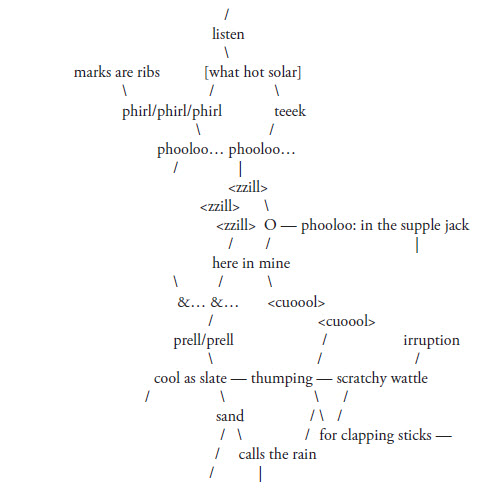
Cooke’s work becomes truly innovative when it recognises and explores the intersection between landscape, ecology and language. Cooke forges an entirely new syntax in his attempt to pull together and collate diverse material and experience from geographically and biologically varied locations. While creating his version of a transcultural poetics, in several sections Cooke frees the words or symbols from the need for communicating meaning, and instead invites them to act on the page and to provide texture in a sonic or graphic sense, which Peter Minter has written about this in his 2012 article, ‘Writing Country: Composition, Law and Indigenous Ecopoetics’. The poems ‘Biophilia’ and ‘Lurujarri’ both contain numerous examples of this. This is language as ecology and ecology as language. Cooke experiments with Jill Magi’s premise that, much as life evolves from non-living matter, so too can linguistic communication evolve from non-semantic sounds. For Cooke, language is a living system and such words and symbols can carry far more than their semantic value. ‘Lurujarri’ is a long poem in nine parts in which Cooke documents his experience of Country in the West Kimberley region of Western Australia. It is figurative, lyrical and experimental, with Cooke expanding the boundaries of language to represent a visceral experience of place. The physical, visual and aural landscapes are all rendered into text:


(‘Lurujarri’)

References to grammar and syntax proliferate in ways that speak to Cooke’s thinking about language as ecologically fertile. The profusion of grammatical terminology, alongside and combined with landscape imagery, brings to mind the role of sexual reproduction in genetic diversity and evolution. This reinforces what I perceive as Cooke’s thinking about language as part of Country as it seems to function ecologically in the poems, much like energy flowing through living systems. Lines of Spanish erupt in poems sporadically throughout the collection, reinforcing the idea of multi-layered connections between Australia and South America. While I spent some time checking my Spanish translations, I found it well worth the effort, particularly as it sparked thinking about the role of translation in linguistic connection and the writing of place. (Is literal translation important to the poems or is it more significant in its symbolic representation of another layer of cultural synthesis between these two continents?)

Posted in BOOK REVIEWS | Tagged ,

Review Short: Eileen Chong’s Painting Red Orchids

Painting Red Orchids by Eileen Chong
Pitt Street Poetry, 2016


In his short story ‘A Little Ramble’, champion of the anti-heroic Robert Walser says, ‘We don’t need to see anything out of the ordinary. We already see so much’. In her third collection, Painting Red Orchids, Singaporean Australian Eileen Chong testifies to ordinary experience as the sensory and emotional kaleidoscope of the individual. These are the lyrical portraits of a perpetual itinerant, her introverted recordings of private joys, loneliness and fascination with solitary journeying through a rich inner world. Sensorial and intellectual curiosity abound in her peripatetic wanderings any place and any time: Sydney’s Chinatown, Parramatta, the seaside, the Australian goldfields, Tang dynasty China, a friend’s kitchen.

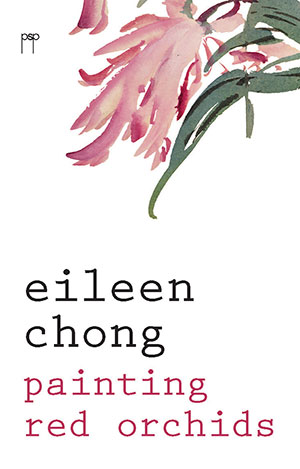
The eponymous ‘Painting Red Orchids’ opens the collection and is one of its highlights. Chong explores the Qing artist Huang Shen’s painting, ‘Red Orchids’, which in traditional ink wash painting style captures the life and energy of the subject rather than its literal likeness. Chong cleverly plays on this aesthetic tradition by textually re-enacting Huang Shen’s process of creation, and in so doing, the life and becoming of the red orchids:

One stroke, one breath: leaves give way to blossom.
More water—rain and cloud above the trees.
Cochineal paste, jade seal—red orchids bloom on white.

Similar to the closely related forms of traditional Chinese calligraphy and painting where text and image share similar techniques and appear together in dialogue, here poetry converges thematically with visual art. But Chong takes this further, occupying the position of Huang Shen with first-person narration, examining the provenance of the materials she / ‘he’ paints with:

…This one, an eyelash
from a leopard. The inkstone was my father’s: slate

quarried from the lake where my great-grandfather
drowned himself one spring night. I scoop well-water

The unrushed pace of these lines show the narrator, with Buddhistic mindfulness, recounting the life of each material that makes the painting and constitutes its life and energy. These items are material testaments to the trauma of past lives. These lines, some of the most accomplished in Chong’s collection, provide a kind of technical and thematic sleight of hand. Upon closer reading, the ekphrastic poem reveals its true complexity: a tapestried introduction for the mental and emotional landscape of the collection, a deft expression of art’s many lives. Chong’s art soars when she draws on classical Chinese motifs and inhabits myths (‘Magnolia’; ‘Seven in the Bamboo’). Through the high drama of history and legend, played out in anachronistic time and embodied by contemporary selves, Chong skilfully enacts the indelible mark of heritage on the imagination.

Conversely, a kind of self-conscious, ‘East-meets-West’ cultural exchange that the poet attempts, often through food imagery, is less successful. Awkward and clichéd, the narrator in ‘Sun Ming Restaurant, Parramatta’ ponders:

… How did we find each other
in this faceless city, on this wide continent,
coming as we did from worlds so far apart?

[…]

… We share hot tea, spinach
with three kinds of egg, and learn a new rhythm.

Similarly in ‘Xiao Long Bao (Little Dragon Dumplings)’, the narrator conflates food appreciation with cultural connection:

I still remember the look on your face when you ate 
your first little dragon dumpling. Sudden understanding.

From ‘A Winter’s Night’:

This, here, made from my hands,
his memories—we consume spoon after spoon
of history and desire and laugh about the future.

Chong’s strong craft and technique are at these points stifled by the clumsy and superficial treatment of multiculturalism, particularly in her depiction of exoticised cuisine and food rituals as sensual cross-cultural exchanges – usually within the bounds of a romantic relationship. This is accompanied often by the overuse of the contrived word ‘lover’ in such contexts: ‘My lover takes me to his favourite Chinese/restaurant’ or ‘My lover holds my hand and walks me through/an unfamiliar cityscape.’ (‘Sun Ming Restaurant, Parramatta’); ‘I am on the telephone/with my lover’ (‘Resonance’).

Nevertheless, it is with touching everydayness that Chong expresses the emotional state of an itinerant; her naturally rhythmic, prose-like descriptions intimate and immortalise the ephemeral, contingent and elusive. Flights of fancy, memory, nostalgia, dreams and desire are familiar secrets for both poet and reader. In ‘Taboo’, the seemingly blameless narrator offers a heartbreaking, imploring defence to an unknown crime,

I swear I didn’t.
I never could.

How much do I want? 
All the years, and none.

Sounding the death knell of a doomed relationship, these simple, sparse lines display an aching silence, conveying the unspeakable pain of love’s ending as it occurs. Prefiguring the death of a love that will never be, Chong is a clairvoyant of loss, imbuing her lines with pre-emptive, nihilistic disavowal.

What I think is the compelling soul of these poems – more than their subject matter (food, love, solitude, travel or dreams), or their technical artistry – is their unmaskable shadow of trauma, and the past lives that occasioned this work. For example, Chong writes, ‘On good days / there is chocolate. There is always a cup of tea. I don’t/think about pain, or loss, or the past, although they are there’ (‘Seven in the Bamboo’). She hints at the toil of survival with a poignantly innocuous line, ‘The trick / is to keep swimming, to keep taking in air’ (‘Trick’). Upon reading these poems, one after another, their accumulative effect is one of oblique sadness amidst joyful discovery, a sense of a rebirth destined to be haunted by the weight of past lives. It is an evocation as powerful and moving as any great literature I know. A self-described ‘poet of small things’, Chong’s intimate poems of minute complexities see so much in the ordinary and inspire a gladness of solitude.

Posted in BOOK REVIEWS | Tagged ,

Review Short: Elif Sezen’s Universal Mother

Universal Mother by Elif Sezen
Glora SMH, 2016


There is something delicious about a collection that doesn’t open itself up to the reader on a first or even second reading and yet compels them to come back to it, something delightful about lines that lodge themselves in your brain and demand a third, fourth, fifth reading to reunite them with the poems they come from.

The great Mughal poet Mirza Ghalib said that poetry was not merely the construction of pretty rhymes and images but mani afirni, the manufacturing of multiple, shifting meaning. In Elif Sezen’s work, Ghalib’s ideal comes to life. Universal Mother is rich with references whose intertextual mix of classical mysticism, mythology, ecology, biology, and pop culture makes it a thoroughly modern collection. Sezen’s knack for traversing centuries in the space of a few lines situates her as a truly transcultural writer.

There is an ethereal quality to Sezen’s work, a certain sense of longing and searching that carries echoes of Rilke and the best of Yeats’s poetry. Sezen’s discussion of ‘absence’ in ‘Two Ghazals’ in particular brings Rilke’s obsession with the concept to mind; while in ‘The Universal Garden’ Sezen writes: ‘A rose is the most silent thing ever / it blinks with a secret innocence’ (3), recalling Rilke’s epitaph ‘Rose, oh pure contradiction, joy / of being No-one’s sleep under so many / lids.’ Her fluent use of mystic tropes can also be traced to the Sufi tradition (Rilke found his rose here as well).

There is a sense of slow but inexorable movement in Universal Mother, like that of the heavens. Whether multi-part meditations or three-line lyrics like ‘Our Absences Merge’, Sezen’s poems take their time to unfurl.

I created a memory of you:
you are nurturing yourself
while I nurture me

Sezen routinely addresses a ‘you’ but it is evident that this is not the reader. There are several presences in this book. Some poems seem to address the speaker’s mother, but others seem to invoke the ‘Universal Mother’ of the title. Sezen creates the impression of a child talking to a wise and benevolent mother, seeking guidance and reassurance, but also showing her mother the world anew the way that children often do. She reinvents the familiar, reconstructs memories, rebuilds histories, all in a conversational tone that sometimes belies the complexity of what she is saying.

When you hit the floor, concrete turns into
a flower-bed, as if your recently deceased
mother is hugging you, she whispers:
You must go back now my dear.

Although universal themes such as the bond between mother and daughter might lend themselves to the obvious, Sezen’s poetry is anything but. The dream sequence in ‘Three types of gravity,’ about jumping off a tall building only to realise death is not what the narrator wants after all, speaks of the way grief makes people act against themselves. It also casts the mother as the daughter’s guide and protector even from beyond the grave – a kind of present absence that Sezen returns to in the last lines of ‘The dead woman’:

Put her between the sayable and the unsayable
so she keeps you alive.

The poems demonstrate a mix of spiritualities – references to kundalini energy, Buddhism, and of course Sufi mysticism all sit comfortably side by side – as well as a range of images and registers. Over and again Sezen blends her evidently expansive knowledge of poetic tradition with the everyday in her own idiosyncratic way. For example, she has an odd fondness for amplification using adverbs – ‘definitely’ is one of her favourites – and it stands out, turning up in the middle of an otherwise lyrical line. In ‘She meditates’ she writes: ‘there were children shouting and playing / in the park, and I definitely had to transform into / something else’. Earlier, in ‘Two ghazals,’ she writes:

Then
I saw the girl
behind the window
her hands
as if someone else’s
Who was she?
I definitely had to write this down

Although the use of the word seems odd, it creates an immediate and conversational tone that sits well with the mysticism of the collection. In ‘Invitation’ we see Sezen once again connecting the lofty with the quotidian when she says ‘There’s really nothing to fear / and what’s more I cut my hair’.

‘Guests’ indulges in another kind of blending. It begins with an epigraph taken from one of Coleman Bark’s most famous ‘translations’ of Rumi’s work: ‘Out beyond ideas of wrongdoing and rightdoing, there is a field / I’ll meet you there.’ Sezen moves the setting to a house and shifts the tone from mystical to playful, saying:

When I enter the house with no tenants
please come in, before I change my mind

Sezen’s brief, unexpected addition of scientific taxonomy to her stock metaphor has an expansive effect on the poem. She writes:

And make love as two guests, and touch
the furniture with illuminated neurons
with awakened cells
of our second-skin
feel how matter resists impermanence

There is a spark of joy that runs through this poem, a rush and excitement that makes it stand out from the others in the collection. Emotions fly fast and free here. But this freedom is fleeting; the ending reins it in with:

When I enter the outside
please come out
before I change my mind

The change in lineation gives the end an ominous feeling, as if something else looms beyond the little slice of joy in the poem.

That sense of something greater on the horizon pervades the whole collection, beginning with ‘Looking for the blue’. Universal Mother could be read as speaking of the environment, of our abandonment of it, of nature and the earth as the wronged mother from whom we have become estranged. The imagery of the heavens – the stars, the moon, the sky, the Milky Way – all conjure an awareness of the connectedness between our actions and the urgency of climate change. I do not know if this is intentional – perhaps the age of global warming and impending disaster makes such a reading inevitable – but it only adds to the complexity of this already multi-layered collection of poetry.

Posted in BOOK REVIEWS | Tagged ,

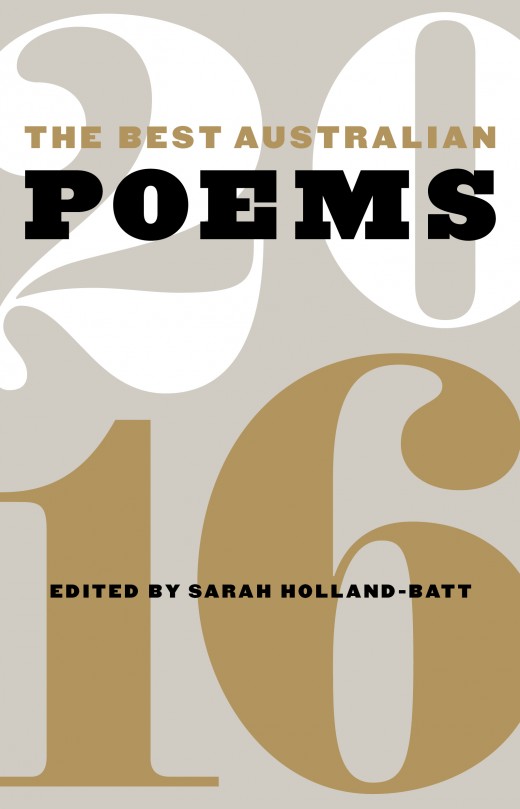
Paul Munden Reviews The Best Australian Poems 2016

The Best Australian Poems 2016
Sarah Holland-Batt, ed.
Black Inc., 2016


In her introduction to this anthology, editor Sarah Holland-Batt claims for the work ‘a colloquialism, contrarianism and playfulness that separates it from its counterparts in the northern hemisphere’. Being hitherto more familiar with that northern hemisphere, this reviewer’s critical interest was immediately aroused.

The nearest equivalent publication in the UK and Ireland is the annual Forward Book of Poetry. It differs in that it features the winning, shortlisted and highly commended poems for the Forward Prizes for Poetry, as selected by a team of judges. On glancing through both anthologies as a casual browser might (in some utopian international bookshop), it is true that several pages of the BAP make a deliberately playful pitch for attention. But playfulness can run deep, and is sometimes appreciated only when a reader tunes into the particular colloquialism and contrarianism that surely characterises vigorous poetry in many parts of the world. For readers less familiar with those particularities, something may well ‘suffer a bit / in the translation’, to use a phrase that Holland-Batt quotes from a poem by Michael Dransfield.

For example, I smiled at Laurie Duggan’s mention of ‘daylight saving’ (‘A Northern Winter’), not a phrase likely to be recognised in England, where the poem is set. In his poem ‘Hossegor’, Jaya Savige highlights a cultural gulf to extended, comic effect:

Surfing probably didn't occur to the Vikings
   but then you never know—maybe one of Asgeir's men
      found himself oaring his chieftain's faering

for this Biscay shore, just as a set wave jacked—
   the kind that narrows the eyes of the guns
      who yearly light up the Quicksilver Pro

A significant number of poems in both the BAP and Forward anthologies are set outside their nominal territories – a natural consequence, perhaps, of the diversity of contributors. Even so, a relative newcomer to the Australian poetry scene might expect the Australian landscape itself to loom larger. (There is relatively little of the British landscape in the Forward, too; what does this suggest – that an urban sensibility holds sway? At a time when the natural world is under the most savage of political threats, one might perhaps expect more active concern.) Phillip Hall’s ‘Royalty’ stands out in this respect, a poem the very texture of which captures the feel of the bush, providing too a vivid depiction of family ritual. And Michael Brennan’s ‘There and Then’, with its casual prose rhythms, is a strong rural vignette, intensely attuned to the physical attributes of the scene.

Both anthologies include a sprinkling of prose poems, but even more noticeable is the number of long poems. In the past two years Geoff Page, as editor of the BAP, sought poems of preferably one or two pages. This year, Holland-Batt has included some that run to six, as has the Forward. This seems fine in principle, but not all the long pieces would seem to justify their space. Page’s selections were also structured thematically; here there is no such ‘support’ for poems; they live (or die) with neighbours either side but with purely random correspondence. The logic behind Holland-Batt’s selection, however, is persuasive, and her introduction is an eloquent, stimulating discussion of poetry’s importance. She states that the poet ‘often registers the uneasy vibrations of a culture before the repercussions are felt by the body politic’, and that an effective poem ‘detonates in the instant of its reading’; that power may be somewhat ephemeral, but she makes a claim for durability, too. Few would argue with her assertion that poetry gets beyond the ‘truthiness’ of political discourse (or even the post-truthiness). But do the selected poems live up to the claim? Will these poems last ‘for millennia’?

The only plausible way of answering that is to identify poems that one already senses a wish to return to, poems that offer immediate rewards that are balanced by a further level of intrigue – a difficulty that is justified (as opposed to an incoherence posing as faux complexity), or as Holland-Batt puts it, ‘[language] whose subtleties and nuances are worth puzzling over’. (She describes her own considerable re-readings in order to make a case for a particular poem’s worthiness of our puzzlement, but such extensive re-reading is unlikely to be replicated by most readers of the anthology.)

Some poems win immediate attention through their arresting openings, Tim Thorne’s ‘Jakhan Pollyeva’ being a strong example:

Putin's speechwriter in a leopard print dress
with plunging neckline performs her latest poems
before chatting up the President of Kyrgyzstan.

Shari Kocher’s ‘Foxstruck’, with its long opening sentence, is similarly compelling, and Petra White’s poem ‘On This’ begins ‘Coming at you like a wave’, the whole poem energised by that that initial thrust, and continuing to surprise. Some, of course, put much store in their titles: ‘Blow Job (kama sutra)’ by Bronwyn Lea is unlikely to be skipped but also genuinely amusing, not least in its rhymes.

Other poems achieve their ends via much quieter beginnings. Debbie Lim’s previously unpublished ‘A House in Switzerland’ – going beyond Australian borders for a specific purpose, the termination of life – builds into a poem of considerable impact. As Holland-Batt points out, there is a strong, dark current in much of the work, balancing the playfulness, from the unflinching gaze of Robyn Rowland’s ‘Night Watch’, to poems that are explicitly political, such as Ali Cobby Eckerman’s powerful ‘Black Deaths in Custody’ and Lisa Jacobson’s ‘The Jews of Hamburg Speak Out’, one of a number of poems drawn from Writing to the Wire (UWAP, 2016). Also notable is Fay Zwicky’s ‘Boat Song’, a haunting poem that is, remarkably, both political and playful, as well as exhibiting a strong allegiance to form, which is yet another defining quality of many poems in the anthology (as is true too of the Forward). The beautifully controlled simplicity of Zwicky’s concluding lines are particularly striking:

We bring photos and candles and
Mountains of flowers upon flowers upon
Flowers upon flowers.

Poems by Judith Beveridge, David Malouf and others use stanzaic structures that incorporate energetic, conversational rhythms. Chris Wallace-Crabbe is almost alone in using consistent rhyme: his poem, ‘Altogether Elsewhere’, has a natural eloquence that thrives on intuitive patterning; some poems that make a big show of their looser fluidity seem by contrast rather forced. Holland-Batt points to the famed Australian ‘sprawl’, which at its best is highly engaging, but when it veers into ‘slack’, poetic power is inevitably reduced. Some poems here have unfortunate repetitions (unlike Zwicky’s highly charged example above), as if they have not been sufficiently revised. Some lack vigour, letting phrases pile up rather aimlessly, a lack of verbs not helping. Few of the unpunctuated poems entirely convince, rhythmically; they haven’t always replaced punctuation with effective spatial alternatives in the way, for instance, that Pam Brown has in ‘Rooibos’, which works as an effective musical score. There is nothing that looks less fresh than the echoes of yesteryear’s avant garde; and the haphazard use of such attention-seeking elements seems particularly bizarre. To take a fitting line from Verity Laughton’s ‘Kangarilla, Summer 2016’: ‘Chaos once cast charm. It doesn’t now.’

Posted in BOOK REVIEWS | Tagged , , , , , ,

Liam Ferney Reviews Cassie Lewis

The Blue Decodes by Cassie Lewis
Grand Parade Poets, 2016


After spending my teenage years with only Dorothy Porter for Australian poetry company, I discovered HEAT magazine in the orderly periodical shelves of the University of Queensland’s Social Sciences and Humanities Library. I was supposed to be learning how to write essays for EN152, instead I was learning how Australians wrote poetry. Until then I had thought it was only Brits, Yanks and James Gleeson who wrote poetry, but it turned out people from this country, only a decade or so older than myself, were writing poems about things I recognised in language that was familiar. Chief among the poets who dazzled me on those distracted days was Cassie Lewis, a precociously talented young Melbournian riding high at the turn of the millennium. As well as publishing regularly in key magazines, her work was collected in the era’s two important anthologies of Australian poetry: Michael Brennan and Peter Minter’s Calyx and Ron Pretty’s New Music. Still only in her mid-twenties, Lewis was the fourth youngest poet in Pretty’s book and perhaps (not all birthdates are listed) the youngest in Brennan’s and Minter’s. She was one of only a dozen poets who appeared in both.

Since then her peers – poets like Kate Lilley, Michael Farrell, Michael Brennan and Kate Fagan – have gone on to form part of the core of an established generation of Australian poetry while Lewis has only published intermittently. Her first chapbook, Song for the Quartet, was published in 1997. It was followed in 2002 by High Country in one of Little Esther’s pocket editions, then Bridges in 2006; and then nothing. In her biography there are possible clues to this relative silence. In 2000, Lewis left Melbourne for the United States. Landing in San Francisco, she founded Poetry Espresso, an early online poetry collective and tiny press in 2001, before settling in upstate New York in 2004, where she now works as a nurse at the University of Rochester Medical Centre. It seemed Lewis had joined the ranks of other anthologised poets from the turn of the millennium, including Jemal Sharah and Ted Nielsen (New Music) and Adrian Wiggins and Sue Bower (Calyx) who no longer publish. In fact, Lewis was omitted from Contemporary Australian Poetry, the new Puncher & Wattmann anthology edited by Martin Langford, Judith Beveridge, Judy Johnson and David Musgrave, while both Nielsen and Wiggins made the cut. Lewis was also one of the troika of young poets to whom John Forbes’ ‘Lessons for Young Poets’ is dedicated. The other two, Kieran Carroll (now a playwright) and Ramona Barry (an important figure in arts and crafts), have long since given up poetry and so, it seemed, had Lewis. So last year, when Grand Parade Poets editor Alan Wearne told me he was publishing Lewis’s The Blue Decodes, it was as unexpected as the postman turning up with hand written, postage stamped letter.

Based on the poems in The Blue Decodes, Lewis is an artist who values silence as much as noise. The book’s ninety pages, which include a number of poems published in her chapbooks, represent well over two decades’ worth of work which provides an interesting purchase on the question of why write poetry in the first place, particularly if it seems like an adjunct to an already full life? We can surmise that Lewis’s nursing career, her role as a mother and wife, the pileup of life’s prosaic diktats and sundry other factors combine to annihilate the time needed to write. Despite this, though, Lewis has not abandoned, or even forgotten poetry. That she has continued to write and seek publication suggests a need to write. This compulsion, combined with poems that are often short or fragmentary, lends the collection a sense of urgency. These poems simply have to be written.

There are multiple descriptions of her writing process in The Blue Decodes but one formulation appears twice. (Is there a better way of economising writing time?) Firstly, in ‘from Postcard Poems’:

I stay up late hungry and dreaming aloud,
to type is to construct little shanties
for the night. Something blue and clouded
stirs in the screen before me, 
I know! It is the sky in Arizona
that I have not seen.

Line breaks removed and tweaked slightly, the formulation’s second appearance comes a little over a dozen pages later, in ‘Bridges’, the long sequence that closes the book:

I hum softly to myself, I stay up late hungry and dreaming aloud. To type is to construct little shanties for the night. Something blue, immaculate comes at me through the screen. It’s the sky in Arizona.

In this formulation writing equates to building homes or, put slightly differently, of finding a place in the world. This idea crops up again and again in The Blue Decodes, at times amplified by the expatriate’s perennial dislocation. There is a sense, in the poems, that poetry provides, for the poet, access to a schema for living that is otherwise inaccessible. Home isn’t simply physical or geographic, it is a source of belonging and a refuge, a way of understanding the world and existing in time. The advice poem ‘The Way to Keep Going’ highlights the dislocation upon which this need to write poetry, as a way of existing in the world, is predicated. It begins:

Be hospitable to strangers.
Sometimes you may want to give away everything you have.
It is advisable to hold your own vision 
at some distance.
Failure is relative to your
standard of shelter.
Nothing ultimately matters
but the smallest things register.

Failure’s relativity to material circumstances could be a wry dig at the class with more dollars than sense, or Lewis could be arguing for the importance of another form of shelter, one that we can find in ‘the smallest things’, and which helps guard against the grim realisation that ‘Nothing ultimately matters’. This type of shelter is a knowledge that can inoculate, or at least provide temporary consolation, against nihilism. This is important if hope is, as it often seems in Lewis’s work, either past or illusory: ‘My life is like a map / where hope has been’, she writes (‘Vanguard’).

Posted in BOOK REVIEWS | Tagged ,

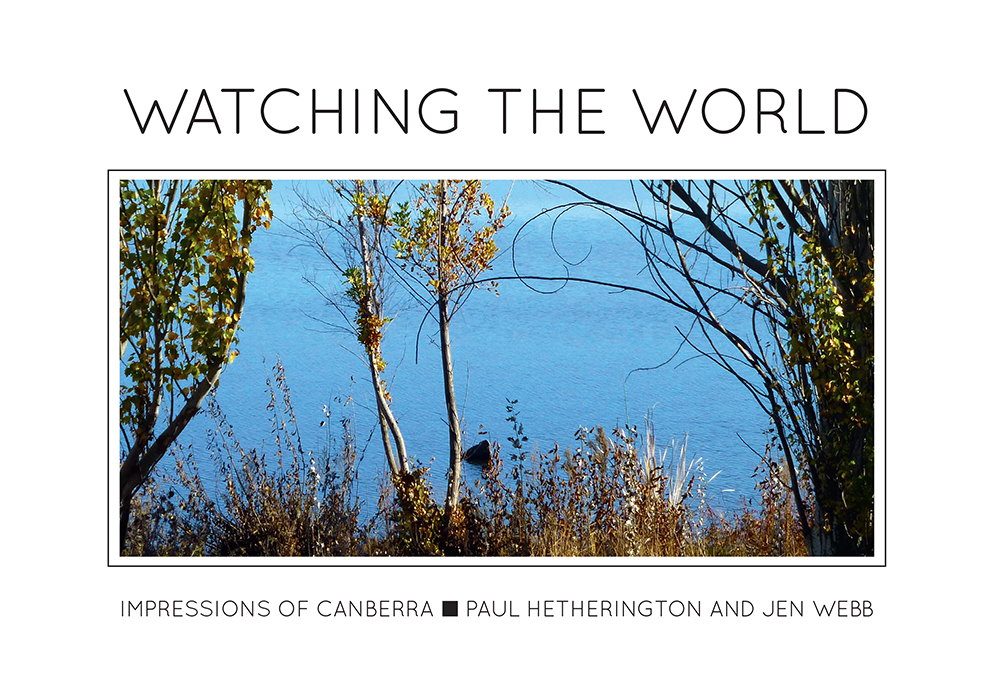
Alice Allan Reviews Watching the World: Impressions of Canberra

Watching the World: Impressions of Canberra
by Jenn Webb and Paul Hetherington
Blemish Books, 2015


What is it about Canberra that invites so many definitions? Comparing where we live with where we don’t is an Australian fixation, but there’s a specific energy to the way that people with a connection to Canberra go about this – they will start deriding or defending the place minutes after you’re introduced.

At least, this is my own tendency as someone born and raised in Australia’s ‘big country town’ capital. Like a family member, Canberra is mine to love, mine to hate, and mine to define. It was with this prickly attitude that I opened Paul Hetherington and Jen Webb’s Watching the World: Impressions of Canberra – the end result of a collaborative poetic / photographic project that began as part of an exhibition commemorating Canberra’s 2013 centenary.

The book is divided into three sections: ‘Where we live’, ‘Memory places’ and ‘Paddocks and perambulations’, with each Hetherington poem facing a ‘companion’ photograph by Webb. The collaborators describe how they used a call-and-answer process to create these parings: ‘Jen took photographs, which Paul then used as springboards into poems. Paul’s poems led, in turn, to Jen taking new photographs or editing existing ones.’ And while Hetherington is no stranger to ekphrasis, he explains in an interview with Verity La that ‘I did not wish my poems to be ekphrastic or descriptive works; I wanted them to be companion pieces; pieces that spoke to what Jen had seen and made; and which saw and were made differently, but in strongly connected ways.’

Introducing the book, Webb and Hetherington highlight their desire to step outside well-worn, tourist-friendly impressions of Canberra and ‘record ordinary parts of town, the places where people live and work and shop’. But while the result is nothing like a tourist guidebook, the commemorative origin of Watching the World means its depictions of the city are often admiring, at times even ode-like.

This celebratory quality, along with the book’s clearly delineated subject, puts Watching the World at a slight remove from Hetherington’s latest collection, Burnt Umber, and his 2013 work, Six Different Windows. They are broader in scope and often grapple with more intricate themes. By contrast, Watching the World is a moment of rest during which Hetherington has focused on succinct poems that condense around a single idea. ‘Summer’ shows this emphasis on straightforwardness and short, declarative lines:

Long grass burns
with late autumn light 
as if so much waste
of the passing year
is suddenly consumed 
in softest fire

Hetherington tends towards iambic metre in many of his lines, but is careful to interrupt the pattern before it becomes overpowering. In ‘Balloon’ this steady tempo suggests the progress of Canberra’s early morning beacons:

Memories march like bayonets;
your sense of yourself is a shred of words; 
and too much thought is never enough
to take you where a shady green
fell on your body like darkening joy –

It won’t surprise anyone familiar with Canberra to hear that the majority of these poems have a pastoral element. But before looking at Hetherington’s language more closely, it’s important to acknowledge the role of Webb’s photographs. Rather than offering a single answer to each poem, they act more as counterpoints, suggesting multiple interpretations of Hetherington’s lines. Human subjects are very few, with Canberra’s planned and unplanned landscapes the dominant theme.

Her work represents both instantly recognisable Canberran images – Telstra Tower, Parliament House and Anzac Parade’s memorials – and less obvious but just as representative subjects like a yellow lawn seen through a bus shelter window, walkers braving a sudden downpour, or dark clouds hovering above an uninhabited car park. In the companion poem to the latter image, ‘Airport’, Hetherington captures one of those moments when Canberra’s sky-scape dwarfs everything beneath it:

Horizons pull
until all’s misshapen – 
a protean weighing
of cloud-form and distance.

In his blurb for Watching the World, Peter Rose uses the word ‘Protean’ to describe contemporary Australian poetry. But if we are writing and reading Australian poetry in a period marked by change and difference, it’s also worth noting the consistency in Hetherington’s writing here. There could have been a temptation to use this collaboration as a reason to experiment with aspects of form, language or perspective. Instead, perhaps because these poems were first written for an audience that might not regularly encounter poetry, Hetherington has distilled each line, zeroing in on lucidity and approachability.

What’s particularly fascinating is the further consistency between Hetherington’s approach and that of a number of other writers in his poetic community. Profiling Hetherington after his 2014 residency in Rome (during which he finalised Burnt Umber), the Canberra Times describes Canberra as ‘a town fairly creaking with published poets’. With so many working writers in a population of just under 400,000, it’s hardly surprising to find resonances between the language of poets like Geoff Page, Alan Gould and John Foulcher, all of whom share Hetherington’s skill in ensuring clarity.

Of course, drawing boundaries like this to describe a ‘Canberra school’ is fraught. Any similarities we can find among Canberra’s more well-known poets leaves a community of unpublished and emerging writers out of the definition, not to mention those writing in nearby communities that don’t technically sit within the ACT. If there are legitimate through-lines to be found, these poets’ literary connections to one another are probably much less significant than the influence of Canberra’s singular, famously deliberate design.

Alan Gould is acknowledged for the idea behind ‘Waltz’, the poem that begins Watching the World. ‘Waltz’ addresses Canberra’s status as a place conceived on paper. It introduces the city’s ‘straight-drawn streets, / curves, crescents and rounding circles’ along with the houses that line them:

street by street they seem to waltz – 
stammering into blazing statements
like an algebraic magic
written on the pastured earth
in irreducible expressions.

This question of the ‘pastured earth’ is one that many poets familiar with the Canberra region, most obviously Judith Wright, have spent years chronicling and questioning. But where a poet like Wright poses large, often troubling questions about anthropocentric impact on this environment, here Hetherington is writing from a more contented standpoint. In ‘Eucalypts’ we feel the warmth of ‘extravagant, broken sunshine’; in ‘Stepping’, rain takes on an almost sensual quality as it ‘flicks leaves / like agile fingers’; and ‘Bird’ shows us ‘ribbed and green-lit shade’.

That said, there are moments when Hetherington ‘dreams a past / into the paddocks’ textures’ (‘Notion’) and Canberra’s pre-colonial history comes into focus. This theme is strongest in the poem that matches Webb’s wide shot of Parliament House (‘The House’):

A building that stands
for squatting and settling;  
erasure of stories;
for naming again
what had been named – 
excising land
that snakes in courses
of knowledge and lore

Canberrans go to great lengths to remind other Australians that although the city is the seat of Parliament, this doesn’t make politics central to their lives. As Les Murray has it in ‘The Canberra Remnant’, residents are occupied with other things, ‘safe from the Government of the Day’. Hetherington navigates this paradox by giving politics a peripheral seat, his poems more often returning to larger questions: Where are the fault lines between Canberra’s landscapes and its residents? When do these landscapes lose out? And where is Canberra’s Indigenous history in its comfortably urbanised present?

Posted in BOOK REVIEWS | Tagged , ,

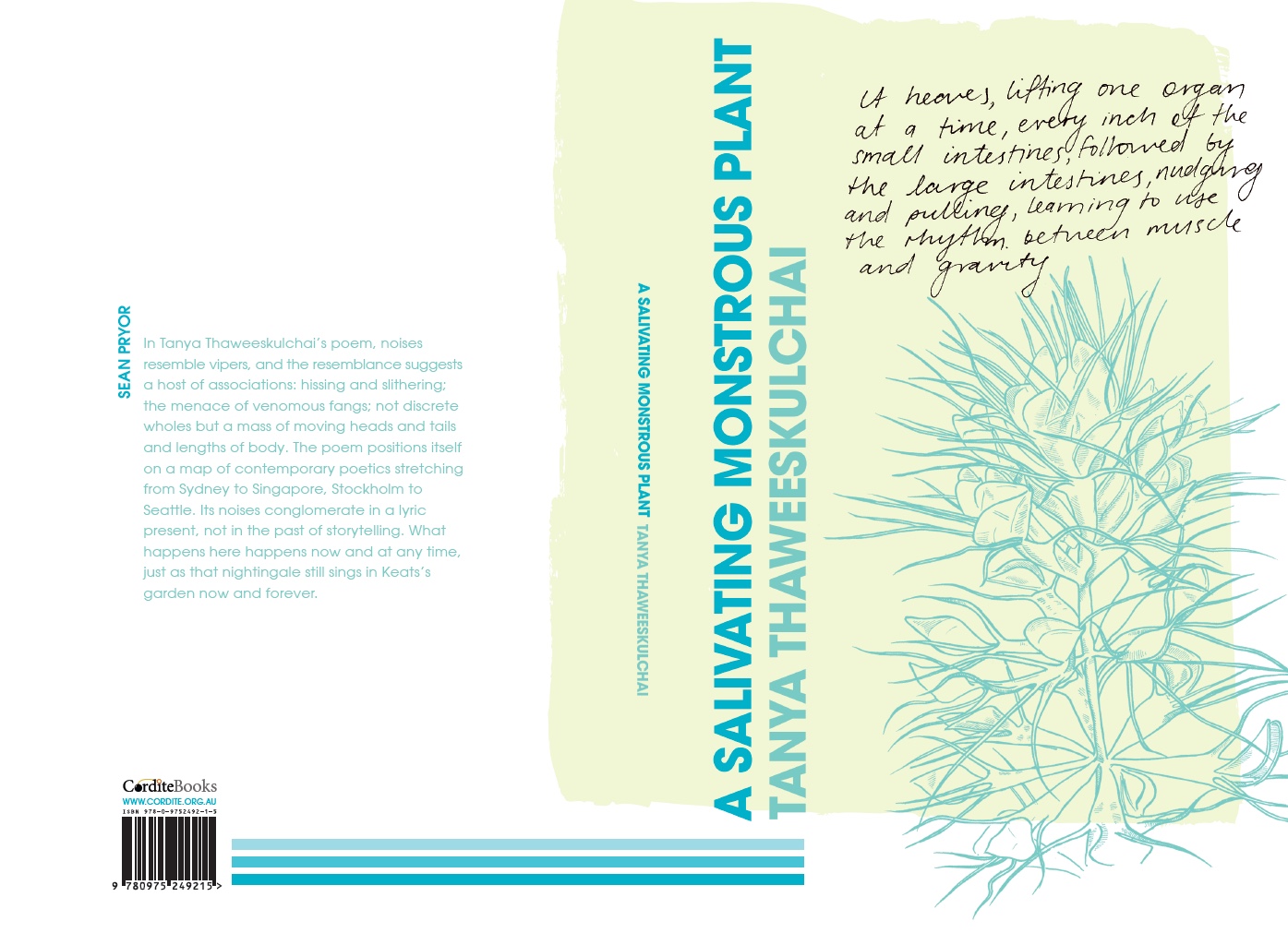
Introduction to Tanya Thaweeskulchai’s A Salivating Monstrous Plant


Cover design by Alissa Dinallo, Illustration by Lily Mae Martin

BUY YOUR COPY HERE

The greatest thing, writes Aristotle in the Poetics, is the command of metaphor, an eye for resemblances. The first overt metaphor in Tanya Thaweeskulchai’s A Salivating Monstrous Plant appears in its second sentence: ‘These noises conglomerate, building like a nest of waking vipers’. The noises resemble vipers, then, and the resemblance suggests a host of associations: hissing and slithering; the menace of venomous fangs; not discrete wholes but a mass of moving heads and tails and lengths of body. Real noises are given in terms of the imaginary, so that the sounds of what might well be an Australian garden – ‘crackling leaves, dust and dried mud’ – call to mind the hiss of snakes found in Africa, Eurasia, and the Americas, but not in Australia. Metaphor brings worlds together.

But in this collection, it rapidly becomes difficult to tell the real from the imaginary, the primary from the secondary, the literal from the metaphorical. The vipers may not be there, in the ‘real world’ of the poem, but in what sense are the noises and the leaves and the garden there? Even by the end of this first section, they seem less the scenic props of a narrative than metaphors for some other, unnamed experience or phenomenon, social or psychological. What matters as the poem progresses is the accumulation of words and images: leaves, shadows, eyes, skin, water, bodies. There is no stable literal ground on which to stand; we move in a world of restless resemblances.

I call A Salivating Monstrous Plant a poem – Aristotle was certain that poetry may take the form of verse or prose – but in its play with the conventions of narrative description and in its turn to the conventions of lyric presentation and lyric address, this long poem is nothing if not contemporary. In terms of technique, the poem positions itself on a map of contemporary poetics stretching from Sydney to Singapore, Stockholm to Seattle. Wherever we imagine that garden, its noises conglomerate in a lyric present, not in the past of storytelling. What happens here happens now and at any time, just as that nightingale still sings in Keats’s garden now and forever. This is the moment of narration or utterance, and it is the moment of reading: we as readers are intimately involved in the poem’s fluid figurative world. In the garden, at this ‘hour of commitment’, ‘the plant makes itself monstrous’, and some unidentified writer or speaker addresses herself or himself or itself or us: ‘Do this before anyone else can (so that no one else can): scrape away the thighs, stomach, breasts, arms’. And if sometimes this generic subject seems to offer a social or psychological ground and justification for the poem’s metaphorical abundance, at other times that subject seems itself the product of those accumulating images and words.

But Thaweeskulchai’s poem is not a puzzle, and the poem does progress. The ambivalence of narrative and lyric, like the ambivalence of literal and metaphorical, is not to be explained away. Instead, precisely these ambivalences give A Salivating Monstrous Plant its peculiar and compelling rhythm and momentum.

Posted in INTRODUCTIONS | Tagged , , ,

Michael Aiken Reviews Dave Drayton

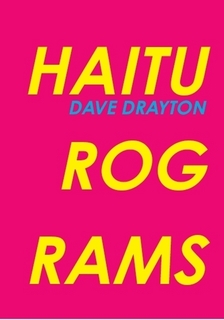
haiturograms by Dave Drayton
SOd Press, 2016


Dave Drayton’s Haiturograms is a brief but confounding volume, available as a free PDF download and print-to-order book from Sydney-based SOd press. Like Drayton’s other work, HaiturogramS is driven by formal constraint and innovation within that constraint.

One of its most immediately apparent features is Drayton’s explicitly concrete treatment of pagination and typography, in tandem with combinations of letters that often don’t elicit a morpheme and, more rarely yet, produce coherent words or phrases. Such prominent attention to form over meaning suggests a highly procedural poetics, a poetics of applied machination. That appearance gives rise to recollection of the l=a=n=g=u=a=g=e poets, or even perhaps uncreative writing like Kenneth Goldsmith’s Day, and their playful (to some, infuriating) confrontations with convention. The anagram-like appearance of some sequences at the margins of Haiturograms and the repetition of certain sounds within the body of the poems particularly brings to mind the Oulipoean poetics of writers like Christian Bök.

Like much of Bök’s work, Drayton’s haiturograms are dominated by extreme disruption of syntax and grammar. Despite this, his ongoing distressing of the formal environment throws up flashes of lyric intensity, like ‘one sobs, main echo stabs one’ in ‘iii.’ (No titles are provided so I’m following the numbers, though there’s also an argument to be made that what I’m referring to here as a distinct poem is actually just the fourth part of one continuous work). Particularly notable in what for the most part reads like a free flow of games, fragments and pointedly playful not-narratives, is the sometimes startling impact the introduction of an ‘I’ can have, for example in ‘v.’:

WETHI
ETIWH
EWTHI
WTHEI
WHITE

STIDEON          we, this tide on a street
ENIDOST
SONEIDT          I, when I do stare, stew
DIOTSEN     
DOTSINE          this one I’d test raw
IDONTSE
TONESID          the idiots enter as white dots in Easter

ASTRE               I don’t set one’s id
AREST
ESTRA
TERAS
ASTER

The (false) sense of a narrative purpose is tangible as soon as that lone pronoun appears; not only in the context of verbs like ‘I stew’, lending personality to the subject, but also tangentially, with the implication that ‘the idiots’ who enter have been designated such by that same (judgmental, scathing) subject. This is a powerful demonstration of how the need for a sense of human identity with which to relate, can influence our ability to make sense of – or engage with – a work of art.

The combination of lyric effect and formal phenomena in Haiturograms leaves the reader in a confounding place, particularly in the broader context of constraint-driven experiments like those mentioned above. Indeed, is this work procedural? If so, what is the procedure? As mentioned, at times there appear to be multiple variations of anagrams present, but without clear consistency. At other points, aesthetically pleasing lines emerge, but with a prevalence so rare as to constitute failure if they are the procedure’s purpose. 

To interrogate these poems further, I decided to go outside the text. Not far outside, but to other work of Drayton’s: the poem ‘Rough’. Again there is a procedural nature to the work, one both more immediately inviting to the act of decoding – given the greater prevalence of whole words and phrases – but also more confounding for those phrases’ failure to consistently produce complete, sensible sentences. But is meaning-making a fair criterion? After all, grammar and sentence structure are hardly things we expect of poems. But are these even poems? Why doesn’t Drayton use titles? Or are titles to be found in some of the combinations of letters in the margin?

Such questions naturally arise, but they do little to help with analysing whether these poems work. Are they good poems, on their own terms? If they are procedural or uncreative, do we need to read them if we’ve already read Goldsmith? Uncreative writing seems a celebration of the process of writing itself; is writing with no need of a product or purpose. Goldsmith’s wilful manual duplication of a newspaper, for example, intentionally traps the writing. Process as nothing more (or less) than that process. But is that what Drayton is doing here? And if so, why read it?  

These haiturograms can be ‘read’ entirely visually, yet are so difficult to make intelligible at a glance as to effectively function as unread(able) visual works, being / appearing rather than meaning. They can also be sounded out, read for what remnants of meaning they contain. As noted, Drayton’s uncollected work like ‘Rough’ is even more susceptible to the latter approach, given the prevalence of whole words and phrases. Yet even there the poem again slips away, the ‘lines’ never quite matching up. It’s curious too that ‘Rough’ is published in Plumwood Mountain, a journal of ecopoetics. Is this to say it is an ecopoem? And if so, is this also true of the haiturograms? Clearly that answer depends on a definition of ecopoetics. One interpretation of the term might be that it’s poetry (or art more broadly) which engages with or is ‘about’ one or more ecologies; how meaning, or at least aesthetic apprehension, is made of or with (or against, or by) ecologies. Given we are all the product of and inhabitants within one or more ecologies, the formally disruptive character of these poems argues for the notion that they are all informed by ecopoetics; we all of us are subjects to and observers of the formal conventions of writing, and therefore our ability to describe and apprehend in writing, to aestheticise and perceive our environments, is shaped by those conventions. In a further, meta-system sense, the distortions of grammar, syntax and word relation in Haiturograms act not unlike a reordering of an ecological set of relations, or its dissolution. What remains is the matter, the physical meat of the language and the opportunity to rewire those relations. 

Asking questions like ‘why these letters?’, ‘is this a title?’, ‘what the fuck am I supposed to make of these clusters of letters that appear to hold significance for someone?’, draws attention to the materiality of language, to the experience of letters and writing as a place we inhabit. This may well be the most purely ecopoetic of ecopoetics, highlighting how writing more than any other art form can engage with and expose the nature of its own ecology; an ecopoetics about the ecology of writing itself. Drayton’s marks on the page only create meaning within a habitat, a culture. Their disruption, fragmentation, stammering start and restart of shards of that culture say multitudes about the condition of that ecology and of ourselves. 

The term haiturogram, as far as I can tell, is Drayton’s neologism that appears to contextualise and contrast itself with heterograms – a form in which no letter appears more than once. By contrast, haiturograms appear to be ruled by slow change (evolution perhaps) within a semi-limited set: each opening line contains a base selection of letters, most of which are retained in each iteration within the individual poem, with enough substituted out and in to eventually achieve transformation. For example, the first five lines of the opening page:

I.
i. ion stars
ii. a this on
iii. chase to sea
iv. tackier rack
v. type on rot

II.
i. instore death
ii. one acts
iii. tradies once
iv. is thank cue
v. is acute
vi. deaf stove
vii. hour set

III.
i. at silent
ii. our teeth
iii. what elk is
iv. say no to us
v. we this tide
Posted in BOOK REVIEWS | Tagged ,

Owen Bullock Reviews Alan Loney

Melbourne Journal: Notebooks 1998-2003 by Alan Loney
UWAP Poetry, 2016


The publication of these notebooks completes the series that begins with Sidetracks – Notebooks 1976-1991 (Auckland University Press, 1998) and ends with Crankhandle – Notebooks November 2010-June 2012 (Cordite Books, 2015), the latter winning the Victoria Premier’s Literary Award for Poetry 2016. Melbourne Journal: Notebooks 1998-2003 is divided into seven sections of between two months and two years. Three threads dominate my reading of Alan Loney’s notebooks of the period: use of the fragment; the self and its relationship with writing; and observations of the world and what impact they have.

Loney’s work celebrates the fragment. This postmodern trope has been a constant of his writing career and is perhaps even more noticeable in this volume than others. The brevity of many of the entries here, some lineated and others in prose, speaks of the unfinished. He also makes new use of the sequence, another favoured structure.

From the first page the writing evokes a sense of dislocation. This is balanced by the links between the fragments of poetry, of thought and discussion, which speak in diverse ways as the strophes of the whole. The fragments are enough to signify that they go together to make up something; though, at first, we’re not sure what. As well as the idea of the book, which endures throughout Loney’s writing, aging is an important preoccupation here. One section of prose breaks off: ‘I have made no provision whatever for my later life’, and is followed by:

but the woman there tells me I have 
no accent, and nor does she, a
Melburnian who lived in Europe
a few years. That’s it then –
unidentifiable by sound

(October 1998-May 1999)

Whilst Loney expresses an avowed discomfort at new places, there is a desire for a new start (December 2002-July 2003), and Melbourne seems to represent this.

What appeals most about the arrangement of pieces in Melbourne Journal is the way they speak to each other; the way Loney, a master of juxtaposition, uses the sequence to create novel connections. In Sidetracks – Notebooks 1976-1991, he breaks the word ‘juxta-position’ across stanzas to emphasise particularity in a memorable way. He continues such inclinations in the latest collection, on a more structural level. For example, one eccentric description of three people exchanging a roll of bank notes is counterpointed with ‘what a supremely oral culture we are’ (October 1998-May 1999), as if to comment on the story-making qualities of the scenario described and the poet’s own ‘telling’ of it—but with a dash of irony since the characters weren’t reported as speaking.

The book’s movement from prose to poetry is often a happy one, in terms of achieving diversity in narrative voice. Sequences such as the following throw wide open the process of narrative formation in the mind of the reader:

I am living, house-minding for a few days, in a dwelling owned by a successful
middle-class family, in which there is not one thing, no picture, no piece of furniture,
plate, glass, cup or vase that I would choose for my own use

-

a swarm of tiny flies in the evening sunlight: they move at such speed it’s a wonder
they are not in continual collision with each other

-

Michelle Anderson: “the type in this book’s too big for words”

-

his walk is a bit lanky, loose about the shoulders, with a perceptible sway or swing
about it. She is upright, brisk and business-like, a crisp quick body alongside his

(Melbourne May-December 2001)

Here, the strophes of the poem are constantly in collision with one another. Why do they occupy the same page? The comment about the flies might reflect on the house where Loney was house-sitting, or the flies in some way mirror the disconnections of modern life. Does the third fragment comment on the first in some way? Does the fourth contextualise the others? Is the man described a new character, or the author disguised? Perhaps the fragmented sequence reflects thinking processes. Much of Loney’s writing emphasises the idiolect, a form of speech specific to each voice; it may be evoked by any stream-of-consciousness writing or work which allows the disjunctions of thinking to exist on the page.

Posted in BOOK REVIEWS | Tagged ,

Review Short: Holly Isemonger’s Deluxe Paperweight and Jessica Cham’s premium pastoral poetry

Deluxe Paperweight by Holly Isemonger
SOd, 2016

premium pastoral poetry by Jessica Cham
SOd, 2016


Holly Isemonger’s Deluxe Paperweight is a mixed bag. That’s not necessarily a bad thing, though it does make it difficult to write a concise review – one that provides the reader with an objective overview of the book’s contents, while simultaneously sprinkling throughout an appropriate serve of salty criticisms or sweet praises, depending on the reviewer’s palate; these remarks being, in the end, entirely personal judgements. What I ultimately want to convey to you is that the poems collected here are not all good and not all bad, but demonstrate genuine promise and wit, and that the mixed-bagginess mentioned above is probably intentional, though this doesn’t automatically excuse said mixed-bagginess. Saying that much is easy; what’s difficult is to explain why Deluxe Paperweight works, and why it doesn’t.

First, the chapbook is oddly structured. There are six sections and six distinctly different kinds of poems. Beginning with a series of ‘Reviews’ of films by Lars von Trier, Isemonger then turns to more conventional poetic forms with three ‘sad witch psalms ;(’, followed by a series of rearranged poems called ‘Hip Shifts’. Next is ‘Free Online Translation Service’, in which the author copy-pastes a paragraph through an online translator multiple times in order to jumble up the syntax until, in the final iteration, the passage is unintelligible (or at least I assume this is the case, since I can’t know for certain – it could be that Isemonger has manipulated the paragraph herself so that it appears to have been translated and poorly retranslated again and again). The longest section consists of three ‘Failed screenplays’, and the final piece, titled ‘Five Obstructions’ after the von Trier documentary of the same name, is a poem comprised entirely of questions. Intercut between these six poetic works are three comic-book-inspired pieces of visual art, made up of screenshots from various films, television programs, and paintings.

The first recurring technique that links these disparate works together appears to be ekphrasis: a rather unfortunate word for a rather nifty literary device. Film acts as a central motif throughout Isemonger’s poetry, though she is ultimately more concerned with the viewer’s private experience than with the filmmaker’s art. The poems in Deluxe Paperweight observe people who are themselves observing (and who are, in some cases, aware they are being observed). Thus, Isemonger remarks in her ‘review’ of von Trier’s Breaking the Waves that she ‘wouldn’t watch beyond the following frame if it weren’t for the handsome man’, and describes in ‘Hip Shifts’ trolling ‘the gallery for art that resembled life’. The prose poem ‘Free Online Translation Service’ begins with a description of a character recalling her experience watching an unnamed film:

If you ask her about the favourite part of her trip she will put her hand on her chin and look up, close her eyes and think of a film she watched at home in bed with an old boyfriend; a man ate canned pineapple, he ran around and around in circles to sweat out his tears, so he would stop being sad. (6)

The images Isemonger describes are provided without narrative context: the emphasis is on the recollection of the visual stimuli. This is perhaps why the three artworks in Deluxe Paperweight focus predominantly on images of different optical forms, from extreme close-ups of eyeballs, to a pair of binoculars, the lens of a camera, and the view through a peephole.

Reading Isemonger’s poetry, I am reminded of the feminist notion of the male gaze: indeed, several of her images are taken from John Berger’s BBC series Ways of Seeing (1972), which criticises the predominance of the male perspective in traditional Western cultural aesthetics. There appears to be a tension within the poems between Isemonger’s struggle to interrupt the hegemony of the male gaze and the need to incorporate its products into her work (all the images are taken from films by male directors or paintings by male artists). To subvert this, Isemonger turns to self-reflection; the mirror – recalling the vanitas paintings of the 16th and 17th centuries – becomes an important symbol of the feminine subject’s fragmentation via her re-presentation in male-oriented media. In ‘Failed Screenplay (Rom Com)’, a ‘version’ of the poet addresses this problem directly:

I cannot write the screenplay (looks up and locks eyes with herself in the mirror) and I’ll tell you why! (in the voice of Werner Herzog)

Look into the eyes of a chicken and you will see real stupidity – a fiendish stupidity (swivels in chair to address the camera) sometimes I write about me (gestures toward the mirror) sometimes I write about versions of me (yells) HOLLY!

Isemonger flits between flippancy and earnestness in her approach to this theme. There’s a double duality to her work, both in its tone and in its effort to balance literary art against so-called ‘low’ art, such as genre cinema, selfies, and Internet emojis; an idea that seems to be expressed in the chapbook’s humorous title: Deluxe Paperweight.

The tone in Jessica Cham’s premium pastoral poetry – a short work by another new poet – is similarly difficult to parse. Like Isemonger, Cham’s poetry is juxtaposed against images, though here they appear to be the author’s original photographs. The poem is written seemingly as part of an email to independent filmmaker, musician, and actor Vincent Gallo. Cham’s language is often playful, incorporating puns (‘oh de toilette’ (1)), surreal imagery (‘a tremendous exhale that swells / to the size of a balloon’ (2)), and jokes: ‘the only way you can move forward huh huh huh / is to recollect the sum total / of hugh grants acting range’ (3)). As the poem concludes, Cham becomes more direct—the underlying sensibilities of the poem seem to burst out into the open all of a sudden:

Ok so if u remove the fragmented syntax from
choreographed dance what is a difference
Between ur dance and an act of inexplicable dance
I don’t get it and i fuckin hate ur practise
                The work didn’t make sense and i hate her
personally like am i meant to feel sympathy for her
situation (3-4)

Cham shares Isemonger’s ekphrastic response to cinema, though it’s unclear whether Cham is addressing Gallo’s ‘work’ or someone else’s. Regardless, the sense of outrage remains largely the same either way – it reads like the secret argument you might have with yourself after visiting a bad art exhibit. There’s also the possibility that the above lines are intended as a kind of auto-criticism; Cham may be pre-empting the responses to her own work making it (like Deluxe Paperweight) all the more challenging to review. And both Isemonger and Cham use their self-awareness as a technique for satirising the dominance of the male gaze: ‘i have been tested installed and serviced for maximum performance and u should mount me on the wall to mark market economic value’.

Isemonger goes a step further, however, in her investigation of the transformative relationship between language and digital technology. This is where the chapbook shows the most promise but also ends up being the most disappointing. Isemonger’s experiments with language do not ultimately amount to much. ‘Hip Shifts’, where the poet rearranges three apparently unconnected stanzas of poetry, is reminiscent of the ‘Kenosha Kid’ passage of Gravity’s Rainbow (1973), though Isemonger doesn’t advance Thomas Pynchon’s linguistic experiment in any significant way. ‘Free Online Translation Service’ is much of the same. The use of an online translator to jumble up the sentence structure is reminiscent of the formal experiments of the L=A=N=G=U=A=G=E poets such as Charles Bernstein, but Isemonger’s poem doesn’t appear to add much to this aging tradition. You get the sense that something is trying to be worked out here; what that is exactly is difficult to locate. The final result is to make the poem more cryptic, though not necessarily more meaningful or interesting: ‘Eyes do not love, an old friend in bed at home, feeling stalls, or sweat, tears, pineapple round’.

Still, Deluxe Paperweight is worth a look. Holly Isemonger is a promising new talent and it will be interesting to see her art develop from here. Though this chapbook doesn’t achieve the full potential of its ideas, Isemonger manages to showcase a surprisingly broad range for such a short collection. But this is not quite a jack-of-all-trades, master-of-none situation; Deluxe Paperweight is a challenging though flawed introduction to a new artist, whose future projects will likely overshadow this one.

Posted in BOOK REVIEWS | Tagged , ,

Review Short: Anthony Lawrence’s Headwaters

Headwaters by Anthony Lawrence
Pitt Street Publishing, 2015


Headwaters is Anthony Lawrence’s fifteenth collection and his first with Pitt Street Poetry, whose website memorably suggests the humble reader should ‘Find yourself a shot glass, take a seat, and take a shot.’ This is the first time I’ve seen a publisher suggest their books be read thus, though in their defence, they do so in relation to lines from Lawrence’s ‘Wax Cathedral’. Ah well, when in Rome … a thimble of Lagavulin scotch as required and I’m finally ready to review. Non-drinkers may read on as they are.

Headwaters offers no great divergence from the impressive Signal Flare (Puncher & Wattman, 2013) or many prior works of note. It is recognisably ‘Lawrencian’: corporeal, tactile, connubial, self-reflexive, tenebrous, ecological, elegiac, transcendent, each flexing its own brand of toughness. ‘Connective Tissue’, which won the 2015 Newcastle Poetry Prize, is an early standout and the longest inclusion. Its six pages range from sickness to amazement at the body, seascapes and memory of country rugby games with ‘tough farm boys who made up / for a lack of finesse / with raw courage’. All are bound by the connective tissue which links poet and lover, honeyeater and flower, old man and young, walker and bird-printed sand. The opening poem of Headwaters, ‘My Darling Turns to Poetry at Night’, seems almost a prelude or epilogue to the subject matter of ‘Connective Tissue’, notably where ‘Her dreams have night vision, and in her sight / Our bodies leave a ghostprint where we’ve laid’, the double entendre of the last word a sly flicker of humour in the villanelle’s greater dance of abstraction and soft, imprinted skin.

‘The Deep’ is the poem I return to most. I’m typically (notoriously?) drawn to the marine, but in this case it is more the delicate, gradual rendering that makes this naked dive something more extraordinary:

                                           we slipped away 	 
without a word or gesture for goodbye
a dying sun like coals inside a fire opal
past fish like flying crystal
from a breaking chandelier, our rings
throwing sparks, our optical colour-wheels
depleted as we neared fatal levels 
in our oxygen, to surface under a sky
blowing over like ash, like a signatory
on love’s testament and will
made permanent and formal 
where acceptance moves apace
with a migrant shelving of the sea.

The rest of the poem is just as spellbinding, peering through ‘photic and abyssal zones’ where a world-record-holding free diver haemorrhaged to death, a marker buoy ‘tending / to the rise and fall of its reflection / like a woman with her face in her hands’. Lawrence’s detailed, absorptive luminosity is reminiscent of Martin Harrison, a master of generous lyrical concentration. Both poets, of course, share modern American tastes, though to refine this further does neither justice other than to note that Headwaters takes its epigraph ‘With no less purpose than the swifts / that scrawl my name across the sky’ from New York poet and musician Michael Donaghy.

The final sequence ‘Bloodlines’ sees the poet return to his country roots with its mixture of modern pastoral (‘the quad bike has replaced the night horse’) and Ted Hughes-esque visceral starkness. The starkness of ‘In Extremis’ is of a different order. Explorer poems are often considered out of vogue, consigned to the mid-century (white) Australian search for national identity in Rosemary Dobson’s ‘The Ship of Ice’, Douglas Stewart’s ‘Worseley Enchanted’, Francis Webb’s ‘Leichhardt in Theatre’ and Eyre All Alone’, with subsequent Indigenous retorts, for example in Jack Davis’ ‘The Black Tracker’. Lawrence’s ‘In Extremis’ resurrects the explorer poem with its depiction of a starving Sir Douglas Mawson in Antarctica:

In the late night flare and burn of the Aurora Australis
he finds the arc of a distress signal. In displacements of ice
breaking bone and rifle shots.
Standing where he’d once seen a leopard seal
tease a wounded penguin like a torn sleeve of muscle
from between the blue taproots of floebergs
he stares from the frayed portal in his balaclava
as if into the patronymic origins of his name. Maw.
The minke whale’s baleen like fly-streamers over a door.
The orca’s serated, invitational grin.

This is grand poetry without the pomposity, replaced instead by semi-survival and brute mammalian reality. I loathe ‘clean sheet’ reviews, but my harsher critical faculties can only peck at the edges here of the collection as a whole (does pseudo-ephedrine deserve a whole poem in ‘Medicine’?). The poems, as they should, correspond with one another. ‘Ghazal’, for example, serves as one geographic counterpoint to Mawson’s Antarctic solitude, the poet of his younger days alone in the red dust of Broken Hill, written into the present through the ancient Arabic form. Shifting sands, indeed.

Headwaters once again proves that Anthony Lawrence’s claim for a permanent place in Australian poetry stopped being a claim long ago. There’s little need to claim what you already are. Gravely, graciously, he’s just getting on with it.

Posted in BOOK REVIEWS | Tagged ,

EKPHRASTIC Editorial: Poetry that Sees

Ekphrastic

Ekphrasis

In ancient Greece ekphrasis was understood more broadly than in the contemporary world, indicating a complex genealogy for this term that encompasses so much fine poetry as well as many other forms of writing. For the ancients, the best ekphrastic poetry was prized because it presented an often dramatic picture in words, enabling the reader to ‘see’ and respond immediately to what was being described or evoked. Ekphrastic poetry provided a way of allowing readers or listeners to appreciate the imagistic and sometimes narrative content of poetry almost as if they might be looking at the object or objects being written about.

Ekphrasis was a rhetorical tool, enabling the evocation of an object in language in such a way as to enable readers to respond emotionally, even viscerally to it. However, ekphrastic works were not necessarily highly descriptive or detailed. They were considered successful – much as imagistic poetry is today – when they gave the reader sufficient and apposite details to enable them to imagine a whole scene. Words were, in this way, understood to be transportive in their ability to activate the visual imagination. Ruth Webb comments that:

the emphasis given in the ancient definitions of ekphrasis to effect, over and above any formal or referential characteristics, is striking: an ekphrasis can be of any length, of any subject matter … using any verbal techniques, as long as it ‘brings its subject before the eyes’ or, as one of the ancient authors says, ‘makes listeners into spectators’. (2009: 8)

Although some ancient ekphrastic works are relatively brief, one of the most widely referenced ancient examples of ekphrasis is very detailed. It is the description of Achilles’ shield in Homer’s epic poem, the Iliad, including Hephaestus’s making of the shield, part of which reads:

And on it he made a herd of straight-horned cattle: the cattle were fashioned of gold and tin, and with lowing hurried out from stable to pasture beside the sounding river, beside the waving reed. And golden were the herdsmen who walked beside the cattle, four in number, and nine dogs swift of foot followed after them. But two terrible lions among the foremost cattle were holding a loud-lowing bull, and he, bellowing mightily, was being dragged by them, while after him pursued the dogs and young men. The lions had torn the hide of the great bull, and were devouring the inner parts and the black blood. (1998: Book XVIII: 478-608)

This brilliant piece of ekphrasis delivers complex descriptive and powerful narrative tropes. Like much ekphrastic writing, it makes use of literary techniques to narrate – and thus transform into notional action – the picture it references. In inscribing in language a still image, it transforms the ‘seen’ into a second and reactivated form of seeing, reinterpreting what it evokes in the act of rendering it in words.

Ekphrasis’s combination of tropes of seeing (or seeing again) and narrative has confounded some scholars who have interpreted it as embodying a tension between image and word – almost as if these strands of ekphrastic writing are in a struggle for precedence. And, more generally, ekphrasis is seen by some commentators as a form that contains its own contradictions:

Ekphrasis … has a Janus face: as a form of mimesis, it stages a paradoxical performance, promising to give voice to the allegedly silent image even while attempting to overcome the power of the image by transforming and inscribing it. (Wagner 1996: 13)

Ekphrasis is certainly very often a complex form of writing that tends to problematise the question of how art represents and ‘perceives’ things. It also emphasises, more directly than any other literary form, the perennial connection between poetry and the visual arts – a connection so powerful that in the minds of some ancient writers, poetry and painting were different expressions of the same creative impulse.

Certainly, both poetry and painting are able to give imagistic representations of the world and of experience, and convey aspects of narrative in ways that may be more similar than they first appear. The narratives of visual art – such as in a painting – are fixed, but they often imply a great deal of movement; and poetry’s restless narratives often suggest considerable stasis, as if time itself is held in the amber of its words. Both painting and poetry enable the receiver of the work to view things newly and, as it were, through a fresh lens.

Posted in ESSAYS | Tagged , , , , , ,

J S Harry’s ‘tunnel vision’, Vicious Sydney and The Car Story

As I began this essay on J S Harry’s poem ‘Tunnel Vision’1 2 several years ago (2006) the radio drive shows in Sydney were full of opinions, mainly angry, concerning a report that a male teacher, in an English class, encouraging students to find as many words in ‘Australia’ as they could, had led the way by showing them how it contains the word ‘slut’, and then, when asked what that meant – it must have been a young primary-school class – had told them that it was a word used to describe women. An hour later I was having lunch with a visiting academic from Jaipur and we spoke about the recent spate of attacks on Indian students in Melbourne, Sydney and Brisbane, and then of the appalling death of an aboriginal elder in the back of a prisoner transport van in Western Australia. No point in claiming that Australia is not a racist country. I did, sometimes, try to claim that, but gave it up long ago. We mask it, that’s all: here on the East Coast we keep much of it beyond the Great Dividing Range, where a lot of other things are kept, out of sight and mind. We then, this Indian academic and I, spoke about Australia’s much-vaunted multiculturalism, its naivety, its need to mature, the stages it has gone through. There is a gap between Australia’s ideas of itself and its reality. A chasm.

J S Harry’s remarkable 1982 / 83 poem opens with a set of graffiti, probably (though I maintain that it might also be the Cahill Expressway tunnel) from the Kings Cross tunnel, constructed in the early 1970s ‘to provide a route for through traffic between William St and New South Head Rd’ in the east of the Sydney CBD. Of course, we don’t have to be this specific; the tunnel might well be purely imaginary; but I think we owe it to this poem to be specific. Part of this poem’s point and power, particularly to those who happen to know or live in Sydney, is in its specificity.

The graffiti form a palimpsest, or rather the printed replication or representation of a palimpsest, which is to say that the messages put up here seem already to have been tampered with. Someone, say, has put up one of the oldest graffiti, ‘JESUS SAVES’ (or had this originally been ‘SAVE THE WHALES’?), and someone else, coming later, picking up on the pun in ‘saves’, has added / adjusted the text to read ‘AT THE WALES’, referring presumably to the Bank of New South Wales (which, speaking of palimpsests, changed its name to Westpac in 1982 (Jesus, this Jesus, has evidently not overturned the tables of the money-lenders)). We can’t tell from what is before us whether ‘SUPPORT SYD VICIOUS’ appeared first and someone has added ‘CUT A SLUT’, though we should note that the ‘Sid’ Vicious of the punk rock group the Sex Pistols has become ‘SYD’ as if to refer us now to Sydney, vicious Sydney.

There’s a back story. Sid Vicious had a long relationship with a girl named Nancy Spungen. On the 12th of October 1978, Vicious woke up in their room in the Chelsea Hotel in Manhattan (yes, of that famous Leonard Cohen song about Janis Joplin) to find Nancy dead on the bathroom floor with a stab wound to her lower abdomen. Vicious was charged with the murder but was allowed out on bail. Although he never stood trial – he attempted suicide, was sent to Bellevue Psychiatric Hospital, subsequently was rearrested for assaulting someone else, spent fifty-five days in prison, and died of a heroin overdose (as had Joplin eight years before) while celebrating a second release on bail – there were theories that it was not he who had murdered Spungen and one can imagine some Sex Pistols fan writing defiant graffiti at this time, just as one can imagine someone else, aware of how Spungen died, writing below it an ironic ‘CUT A SLUT’.

‘WHO ARE YOU IF YOU’RE NOT?’ is at this point a little more mysterious, as is the following ‘CREAMINESS CONTROLS YOU / OR YOU CONTROL THE CREAMINESS’. The implication that in the midst of what we assume is our being we might, in some way, not be being at all, and the idea that some process or substance may so overwhelm us that relinquish control of ourselves. But we should store these away, awaiting developments. I should probably have begun, in any case, not with Sid and Nancy but with the poem’s title. The pun – its double entendre – is quite obvious: that the oncoming motorists are experiencing, as they enter the tunnel, the vision of a half-naked woman running toward them (and are also – or is this she? as she runs? but I imagine she is far too traumatised to do so – reading the graffiti as they drive past or through them), and that ‘tunnel vision’, as a physiological condition, is an astigmatism, a restriction of one’s peripheral vision, means that one views the world as if through a tube or tunnel (you might note that Harry refers to ‘tube’ lighting). But of course this is not just double entendre. It becomes evident, as we read further into the poem, that the tunnel is our culture, the way that the discourse that flows around and through us, making us (the tunnel in the poem is lined with words, as if to present language and the tunnel as synonymous), at the same time narrows our vision. It – language, discourse – may enable us to see (there is lighting in the tunnel), but also curtails that seeing: we witness, as we move through the poem, habits of discourse, habits of words, habits of verbal containment, closing in upon the motorists, so close to their encounter with the apparition of the screaming woman that it might almost be simultaneous. (Note ‘apparition’ there: this woman is ‘picture’, is ‘image’, is ‘form’, as if, even in the midst of her crisis, she is being – has already been – ‘packaged’, rendered ‘news’, taken from herself.)

‘(S)creaming without words,’ the poem continues:

she runs through the tunnel
straight at them

‘Straight at’ what? The oncoming motorists (as I think we are at first likely to think), or the words? Both, of course – the words, since they are seen by motorists both coming into the city in the morning and going out of it in the afternoon, must be on the walls of the tunnel, rather than facing the traffic at its entrance – but (and although the opening graffiti have clued us) we may miss this latter vector in the forward movement of the poem; she assaults language as much as she assaults the visual field of the on-coming motorists, but not language per se; that would be too easy – or, rather, too easy for us to wriggle out of. One of the most evident of the several things this poem is ‘about’ is the way language and habits of discourse paper over (talk over, repress) what for want of better words (irony there) we might call our vicious reality. This woman has been raped, or so it seems, and straight away those who see her begin to smooth / soothe the monstrosity of the act by creating ‘fictions’ – to take away the pain of it, yes, to avoid responsibility for it, yes, to mask their complicity in it, yes. How is it that when there should be outrage, immediate assistance, horror, disgust, action, there are only people passing by? (They know they should stop – they want to stop to help her – but they have to make ‘a difficult decision’, for to stop, surely, in this speeding traffic would be ‘risking causing a chain of deaths’ – and there, they have done it: the ‘right’ decision, the ‘difficult’ decision made, they are absolved, they can continue driving. To stop, to get out of their vehicles, to help, to abandon their ‘motorist’ selves, would be, in effect, to cross a barrier, to move into a different dimension, almost to shift to another side of time: to ‘leave the stream’ and to ‘enter the moment’, to leap over a ‘gap’.)

Posted in ESSAYS | Tagged , , , , ,

Ekphrasis as ‘Event’: Poets Paint Words and the ‘Performance’ of Ekphrasis in Australia

Ekphrastic

To commemorate the 50th Anniversary of the Newcastle Region Art Gallery (NRAG) in 2007, Lisa Slade and Peter Minter co-curated the exhibition Poets Paint Words. The two curators commissioned some of Australia’s best poets to write poems in response to a selection of paintings held in the NRAG archive. Gallery director Nick Mitzevich was optimistic about the potential of a mixed-media celebration of the NRAG anniversary, saying, ‘This exhibition will attract audiences of all ages, art lovers will be turned on to poetry and likewise poetry lovers will become lovers of painting.’

Historically, ekphrastic practice and theory has considered the poem subordinate to the painting, and yet – between 24 March and 17 June of that year at the NRAG – poems were placed beside the related paintings. Here the poems were presented at the ‘same level’, enhancing their literal and metaphoric equality (Kaplan 7).1

Slade’s and Minter’s curatorial decisions allowed for poets and audiences to experience ekphrastic poetry in what I contend to be ideal. Moreover, the caliber of poets from around the country who were asked to participate in this mode make Poets Paint Words a significant moment in the history of Australian ekphrasis. By exploring the conditions that made Poets Paint Words possible and how contemporary ekphrastic poetry can understood in a new way because of this Event, I offer a framework for conceptualising ekphrasis as a performance.

Here, I want to examine the concept of ‘Event’ on the public and private level. Adapting this terminology from Alain Badiou, I want to explore the effect of how the poets were able to view, compose and exhibit their work within a specific time and place. In Badiou’s terms, I am interested in how the exhibition transformed into an event via the set of conditions that encourage ‘chance once the moment is ripe for intervention’ (187). Focusing on process within an artefact invokes a poetics of performance that allows work to produce rather than represent reality (Bolt 89). This production clarifies the active role of the ekphrastic poet. Herein, I address theories of narrative, lived experience and Methexis, adapted from Australian art-theorist Barbara Bolt, using the poems contained in Poets Paint Words 1 & 2 to sketch a poetics of performance based Australian ekphrasis.

Beginning by listing the poets who contributed the exhibition – this reads like the dust cover of a Best Australian Poetry: Adamson, Fagan, Harrison, Jones, Kinsella, Minter, Murray, Porter, Tranter. Similarly, the list of Australian artists surveyed by the poets is no less significant: Cossington Smith, Dobell, Olley, Olsen, Tillers, Tucker and Whiteley. Rather than an exploration of a theme or an epoch, what is apparent from this incongruous array of painters is that this exhibition sought to be a site-specific sampling of the collection. There could be no pre-arranged outcomes from conditions like this. Instead of a utopic or hermetically congruous exhibition, the event of Poets Paint Words was, by nature, an occasion where proximity necessitated opposing forces to combine, or what Brian Castro has called ‘heterotopias’ (Castro 117). The spatial and temporal proximity of Poets Paint Words afforded these points of collision where new texts were able to be created.

This provides a spatiotemporal dimension to the public event; what Daniel Bensaïd, elaborating on Badiou’s ‘Event’, describes as the ‘propitious ripeness of the opportune moment’ (Bensaïd 96). As a test case, the controlled conditions of the exhibition give us the best examples of what an Australian approach to ekphrasis might be: Australian poets presenting at the ‘propitious’ event of Poets Paint Words.

Contributors to Poets Paint Words were selected on their reputation, not specifically as ekphrastic poets.2 Intuitive though it may seem for some, it would have been fair for any of the poets in the exhibition to first ask themselves: What is the role of poet in an ekphrastic engagement? The long history of ekphrasis suggests a straightforward answer: describing the artwork is paramount. Tradition suggests creating a rhetorical mimesis, attempting to replicate and re-present the visual effect of the artwork in language.

Yet given that the exhibition took place in this century, it is worth noting that the field of writing creatively about a work of visual art has expanded beyond this representational framework. As Genevieve Kaplan notes,

Ekphrastic writing may easily include elements of interpretation, meditation, interrogation, comparison, criticism, and praise as well as the more traditional description and narrative. (Kaplan 2)

For this there are two clear reasons: the improved access of works of art to the public and consecutive movements in Modern Art during this period that have explored Art beyond representation. Most ancient ekphrastic poetry was written about imagined artworks; a ‘notional’ rather than ‘actual’ ekphrasis (Benton 367). Poets Paint Words and the study of gallery commissioned contemporary ekphrasis is concerned with actual ekphrasis. Surveying the contemporary use of actual ekphrasis, Pardlo writes, ‘The initial rise in popularity of ekphrastic poetry corresponds with the evolution of museums as public state institutions’ (594). For an audience, being able to view or have knowledge of the artwork that the poet is referring to changes the ekphrastic equation; as the simultaneous presentation of poem and artwork represents a significant development in contemporary ekphrasis. Thus, an exhibition in the mode of Poets Paint Words allows the audience to cross-reference text and image. However, the temporal restrictions of the exhibition meant this lasted only while the paintings and poems were hanging.3 At present there are no permanent records of the exhibitions available to the public in print or online.4

The significance of Poets Paint Words 1 & 2 as public events is that the exhibitions captured the simultaneous and temporally specific nature of contemporary actual ekphrasis by creating a space for the poem to exist alongside the painting for continual cross-referencing by the reader / viewer, in the same line of sight. This curatorial decision determines how poets responded to paintings that were non-representational.

Posted in ESSAYS | Tagged , , , , , , , ,

‘Often Said Apologetically’: Merryn Sommerville’s Child of the High Seas


‘Ghosts I’ve met’ | Photograph by Merryn Sommerville | 2016 | Soft pastel, pencil on paper | 56 x 76cm

I’m not a story teller. I’ve never been interested in bringing context to my portraits. They float in a dark absence of context, in vivid expression and psychological space. I recall some years ago, a lively discussion with another creative. Their supposition was that one should be able to be isolated on a desert island – a cultural, social and historical vacuum – and in that lack of art knowledge and context, be able to intuit its quality. In other words, art should have an inherent quality and merit about it that speaks to the viewer. I think this common sentiment underestimates the strength offered uniquely in the visual arts. While other creative disciplines may rely on the knowledge of the audience to pick up on references, in my work, I don’t require them to. Instead, I rely on the preconceptions a viewer has been indoctrinated with through consistent imagery they’ve been exposed to in advertising, television and movies and to some extent, literature. The notion of childhood innocence and lack of autonomy was created socially, in conjunction with images of children in white; barefoot and connected with nature, pictured with animals that share psychological qualities. Our conception of children continues to be linked to their visual representation – a diversion from this, whether the viewer is aware of it or not, will be disconcerting. Art has the capacity to move a viewer towards a feeling while also mirroring the society that has shaped their reaction and view, and illuminating preconceptions they may not be aware that they have – illuminating insight through an emotional experience of the work.

Art is the understanding of the world that you and I occupy. It’s understanding the moral narratives, the colour associations, the social and visual history we have inherited, and the response an image may engender inside of the viewer. That is what excites me about the art I admire and the art I make.

The subject of my work is one child, a family member in a seven-year series, and of her seven-year life. As a young woman of childbearing age, it might seem an obvious choice for me to draw children; there was a time in art history where women were limited to drawing domestic scenes of children and animals. But their social identity became synonymous with innocence and a lack of autonomy. It is this association and expectation of the depiction of children that has led many female artists (Marlene Dumas, Sally Mann and Cherry Hood) to use confronting portraits of children as a vehicle for unexpected emotion. I live for the remark ‘your work disturbs me, but I cannot explain why.’ This is often said apologetically. But the visual arts offer a pathway to communicate conflicting and ambivalent feelings and ideas that literal language cannot. A viewer’s reaction to a work often unfolds itself from the inside out, where emotion leads to insight.

Though I intend for the work to engage the viewer as they experience it emotionally and psychologically, it is also important to consider accompanying information to be consistent with the conceptual and atmospheric qualities of the work. I don’t want the title of the work to limit the way it is interpreted. However, particularly as an exhibition, I want the series to be able to offer more as it is revisited – to be more than just a visual communication, a succinct juxtaposition of ideas. For example, the February 2017 exhibition at Lindberg Galleries, Child of the High Seas. It draws its title from a collection of short stories for children on the subject of death, written by French writer Jules Supervielle. The title story, ‘Child of the High Seas’, is a haunting and ambivalent fable of a child who lives on an island in the middle of the ocean, with artefacts of a life yet no memory of it. This child is the echo of a child that once was, and is suspended in this situation as a manifestation of the intense grief a sailor felt for his late daughter. This story has influenced my work significantly. I discovered it through one of my greatest art influences, Joy Hester – in fact, I’m influenced by her entire circle of post-World War II portrait artists, The Angry Penguins. Hester named a drawing after Supervielle’s Child of the High Seas. As French poet Paul Valery noted in Things Left Unsaid, ‘Nothing more original, nothing more oneself than to feed on others. But one must digest them. The lion is made of assimilated lamb.’ We are all broadly created by the assimilated lamb that has been available to us in the society in which we live. Artistically, Hester digested the work of Supervielle, and seeing something of herself in it, created something new. I, in turn, have been granted with both Supervielle’s work, as well as what Hester gleaned from it.

And so we return to the matter of giving a title not only the exhibition as a whole, but in naming portraits individually. Each title is a disembodied fragment from poets that influenced Supervielle, giving a nod to a creative lineage that led me to Child of the High Seas. I isolated lines that relate to the corresponding themes of the short story and my work more broadly – death, and the way it transforms us as living beings, change, regret, absence, grief and gender. Also in these titles are references to the ocean, acting as a symbol, and a link to the exhibition title. Each line transformed through the context of its pairing with a portrait, drawing further meaning as a list of titles, and as an exhibition as a whole.

The works have a dialectical nature, and a tension between being disconcerting and appealing.

They also sit between categories when it comes to the disciplines of drawing and painting. They engage with colour, form and layering in the way that painting does. And yet, they also encompass the impulsiveness of sketched line and mark-making, the treatment of absence and negative space, as well as the celebration of organic, skin-like paper – all qualities characteristic of drawing. It is the immediate purpose for which it is being used that will define their category. If, in an exhibition of paintings, they would be paintings. So, too, if curated with drawings. However, contemporary art practices rarely land in one discipline, with many artists that could be described as sculptors / drawers or drawers using paint. Perhaps such distinctions are relevant predominantly for administrative purposes. Whether my portraits are described as drawings or paintings may depend on the person viewing them.

My luminous soft pastel portraits of a child emerge out of black paper. There is conflict between colour and form, absence and sketched line. At my inaugural exhibition at Lindberg Galleries (March 2-18, 2017), you will find yourself surrounded by these disconcerting figures. The colour palate is bruised, bodies are poised in strange positions, visceral fur crawling up shoulders. From some portraits, eyes will watch you intently. In others, there is an absence of eyes. Each work engages your personal baggage, thoughts, your feelings. As a series in exhibition, they will create the experience of different entities haunting you from all sides.

Posted in ARTWORKS | Tagged , ,

Tunnel Vision

SUPPORT SYD VICIOUS
CUT A SLUT

JESUS SAVES AT THE WALES

WHO ARE YOU IF YOU’RE NOT?

CREAMINESS CONTROLS YOU
OR YOU CONTROL THE CREAMINESS

screaming without words
she runs through the tunnel
straight at them
shock opening like flowers
on the faces of the oncoming
motorists
her purple dress is ripped
to the waist so it has
become skirt only
her bare round creamy breasts
assault the pity
& the rapist
behind the many
masks of ‘motorist’
her face is contorted in
the scream everything
in her life is concentrated
behind it

she is either stoned out of her mind
just raped
so hopeless in her life
that whatever happens
will be better
drivers make
stories up
to fit some fiction
to the picture

it is 12 o’clock noon tube
white fluorescent
inside the road tunnel
she is running on
into the citybound traffic
cars part noiselessly
around her the traffic
streams into the city &
her bare feet & bare
breasts & scream
continue outwards towards
rushcutters bay & later
on to rose
bay if she makes it

drivers leaving the tunnel
blink at the sunlight
her image is off
their eyes but she is running
inside them as they enter
the city
all day they wonder
did somebody
rape her? again?
did she find
shelter?

her feet were busted
by the road – they were
bleeding
did some christ-of-the-tunnel
get out of his car
& kiss & wash her feet? risking
causing a chain
of deaths

to do so?

she is gone… going home
through the tunnel
drivers see
SUPPORT SYD VICIOUS CUT A SLUT’s
become ‘feminised’:
SUPPORT C.S.R. ROT
SYD VICIOUS WITH SUGAR

& JESUS FUCKS AT THE WALES
WHO ARE YOU IF YOU’RE NOT
MY GREAT AUNT FANNY

a female
form
its flesh & rags
in fragments
sea-sucked
purple
is fished
out of the
gap-
wash by the calm
voice-of-the-evening-news
a fortnight later

Posted in 79: EKPHRASTIC | Tagged

Interview with Sidney Nolan (Ella O’Keefe edit)

Image courtesy of Art Gallery NSW

Hazel de Berg’s recordings take place in the homes or work spaces of the subjects rather than a recording studio. This allows something of these places into the recording whether birdsong, traffic or an r&b song playing in the background. In the recordings, de Berg remains enigmatic, the ghostly presence operating the machine.

Interview with Sidney Nolan (O’Keefe edit)

2017 edit by Ella O’Keefe

‘Sydney Nolan interviewed by Hazel de Berg in the Hazel de Berg collection’
Courtesy of the National Library of Australia, TRC 1/58
Special acknowledgement to Duncan Felton, NLA Oral History & Folklore Branch

Posted in INTERVIEWS | Tagged , ,

Is Contemporary Australian Poetry Contemporary Australian Poetry?

Poet, if you’re looking for your name in this essay, jump ahead a couple of pages. There I begin talking about poets collected in this anthology. Those of you interested in a review about contemporary Australian poetry, let’s begin here.

Contemporary Australian Poetry (CAP) – an anthology of Australian poetry at present, in other words – comes introduced as a ‘survey, and a critical review, of Australian poetry between 1990 and the present (2016)’. What kind of document to this significant time-period does CAP constitute, and what bearing does it have on the question of an Australian contemporary? Most importantly, how do we now read Australia differently? What new forms of reading has contemporary poetry inspired in this country?

i will reinvent the game
jon bon jovi comes to mind
i met him once in a dream there is a
spring in my step i will
move at speed across my crease
no the direction does not 
matter only the leap itself

(Nick Whittock, ‘Michael Slater 2’)

To begin, consider images of the modern leading up to Australian poetry’s contemporary moment. In the Australian Book Review, David McCooey notes that John Kinsella’s Penguin Anthology of Australian Poetry (Penguin, 2009) shows contemporary Australian poetry’s chief setting as being the suburbs: ‘this suburban scene is the stuff of modern Australian poetry’. Numerous critics agree. But let’s extend this argument further than setting. The suburban is a preeminent register of the Australian contemporary: of its inheritance of Fordist economic expansion in a country of exceptional space; and its inheritance of a threatened native cultural sovereignty, disregarded until 1960s constitutional land reform at the very same time that suburbia becomes ubiquitous. The suburban also reflects the inheritance of a pliable bourgeois majority without much cultural competition of a homogenous landowner class; as well as Australia’s remaining reliance upon the ghost of British imperialism and the fire of American neoliberalism to define its geopolitical membership in the post-war West. Alternative cultural positions are often defined by some form of opposition to these paradigms.

I feel two radically different and complex reservations about the idea that poetry could be more suburban, however, and thereby more relevant to a majoritarian audience in Australia.1 First, like McCooey, I think much Australian poetry already seems embedded in a suburban condition: from the most committedly literary, to works of light verse or popular fiction, and all the more so when suburban writers romanticise a rare location or imagine a political alternative to the present. Of course, not everyone lives in the suburbs, nor all poets. However, for reasons I will explain, the mainstream of Australian culture is embedded in a pervasively suburban condition.

Importantly, colonial formations of impenetrable wilderness, isolated pastoral districts, and privileged town and city centres are now fantasies, for the most part, given the vast majority of residence lying in suburbia, the sustained dominance of telecommunications over the discourse of the Australian public sphere, the surrendered economic and regional sovereignty of the rural to the international trade interests of a suburbanised majority, and the socio-economic and cultural generalisation categorising national belonging for subjects living thousands of kilometres away from each other.2 As a national question, then, suburbia is a cultural predicament always to be negotiated. Adopting it or otherwise is a moot point. In the twenty-first century, city and country are defined by cultural logics of suburban desire.

A second consideration is at odds with the first. A wager: the suburban condition of Australia is not what avowedly suburban writers such as Bruce Dawe have been writing about. Dawe’s suburban condition poses as modestly universal, with the human condition defined by a middle-class domestic sphere as the stage of general truths. Yet, this post-war economy called suburbia has in fact been the stage of cultural turmoil, self-parody, and contemporary crisis. Among many possible ways to convey this reality, consider the general connotation of shelter in Australian cultural imagination: the concept of home ownership, what is now an exclusive bourgeois fantasy, the battleground for heroic reality TV narratives, and the place where Australia’s youth enter a new Thatcheresque age of housing alienation. Such alienation drives characters as early as Barry Humphries’ suburban Jekyll and Hyde, Les Patterson and Dame Edna, or characters in Patrick White’s The Season at Sarsaparilla, as well as informs prominent twenty-first century examples such as Christos Tsiolkas’s The Slap, or TV show Kath & Kim.

Australian cultural life’s concerted engagement with the suburbs has meant radically different strategies than Dawe’s assumptions of modest universality. Instead, memorable writers of Australia’s suburban condition point to intercultural unrest, commoditisation, paradoxical prosperity, conflicts of connection and isolation, cultural indistinction, questionable belonging, and anxious compliance as its real conditions. Therefore, the supposedly direct encounter with a suburban identity seems to me to involve deception as a putatively direct engagement with an ambient condition. Or, when most consequential, to assess the condition of Australian culture as embedded in certain socio-political problems stemming from suburban life, involves a somewhat calculated performance.

As a cultural problem for poetry, a suburban condition is at once impossible to avow and ever present. Given the attention brought to the subject in Australian literary scholarship in the 1990s, especially by Andrew McCann and McCooey, and renewed interest at present in recent works of scholarship, the category of the literary itself in Australia means some negotiation of the suburban. The literary in Australia does not require a suburban intervention as it lies aloof in some urban ivory tower; from the most challenging to the most conventional, the suburban sits prestigiously at the table of Australian literary subjects.

Posted in ESSAYS | Tagged , , , , , , , , , , , ,

An Extra Oyster for the Doctors

Entrée: raw oysters on the shell. Price
on application but they will be raised high
on a bed of ice and lemon slices.

A dozen and a half is not available
so we take a dozen, abashed
that oyster eaters cannot have their number

which would have given us three each.
Who forks the first and slips it down his throat
would like to seize the rest and lick the platter

or hurl the oyster shells over one shoulder. An
alumna of the University of South Carolina proposes
the final three go to the most distinguished scholars

first to the one whose golden thesis sits beside her plate
another to a prodigal undeserving Hon D.Litt., the last
to an unassailable Distinguished Professor. The moon

looks down on three tipped-back throats
once tugged by gowns and Gaudeamus notes
processing stagewards to receive the precious oyster.

Posted in 79: EKPHRASTIC | Tagged

John Woodcock Graves the younger [with] Truganini

So often reproduced and yet
the message so elusive.
John Woodcock Graves the younger,

lawyer, writer, poet, ‘friend’,
is standing high beside her,
not quite profile, looking down,

frock coat reaching to his knees.
Truganini, Trugernanner,
also known as Lalla Rookh,

is sitting in a stiff-backed chair,
the lines of which her long-sleeved, white
Victorian dress obscure.

What looks to be a scarf with tassles
reaches to her knees;
it’s white as well, her captors’ colour.

She’s thought to be the last, she knows —
of interest to Science.
She knows too that related women

are living in Bass Strait with sealers.
Graves, it’s said, was genial,
learnèd and eccentric,

something of a sketcher and
a well-known greyhound breeder.
Although the photograph’s undated

some say it’s 1876
and just three months away
from Truganini’s death

and five from that of Mr Graves
at only forty-seven.
But all of this is mere description.

It doesn’t read the code between them:
Graves, full-height, arms folded,
pensive, sad and somewhat

proprietorial;
Truganini with her hands
clasped across her lap.

Her woman’s eyes are wary embers;
they blaze at her ‘protector’’s belly.
Are the two of them aware

their photograph must prove symbolic?
Truganini knows her bones
will be displayed and sent to London;

she cannot know her ashes
will take just on a century
to regain D’Entrecasteaux Channel.

Graves knows too that he is powerless
for all his knowledge of the law.
He can’t foresee, we must assume,

his own death is so imminent.
Each knows, but in a different way,
the moment of this moment.

The future’s sepia already.


Notes:
In response to John Woodcock Graves the younger [with] Truganini,
Photographer unknown, Date unknown. Sepia toned, 15 x 10 cm Collection: Allport
Library and Museum of Fine Arts.

Posted in 79: EKPHRASTIC | Tagged