Recasting the Mould: ‘Beyond is Anything’

Upon hearing of our Children of Malley II edition, one of our readers sent in an unexpected surprise. Lurking in the wings was a Malley encounter we never expected: we found that the hoax lives on.

The story was related to us like this:

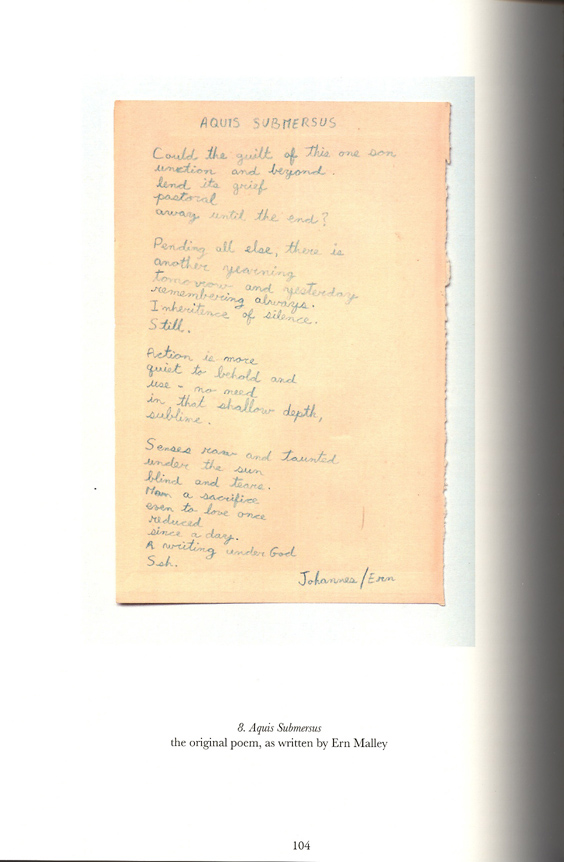
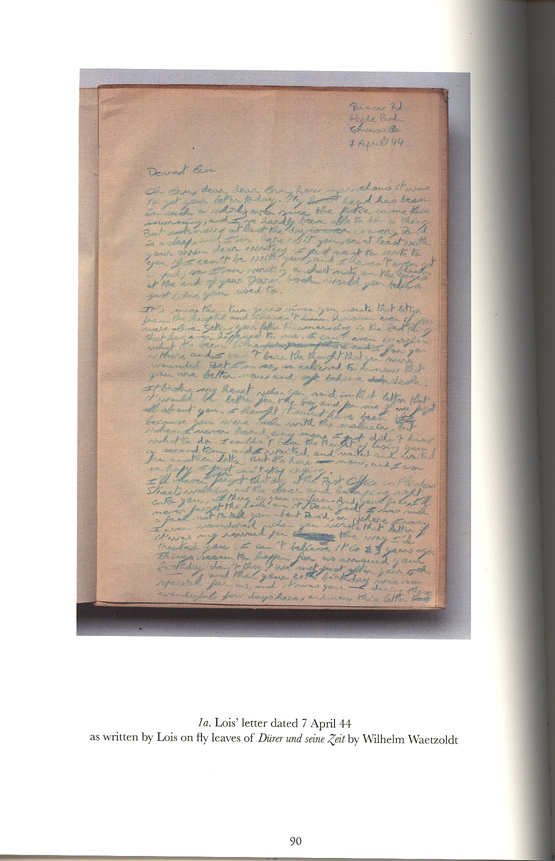
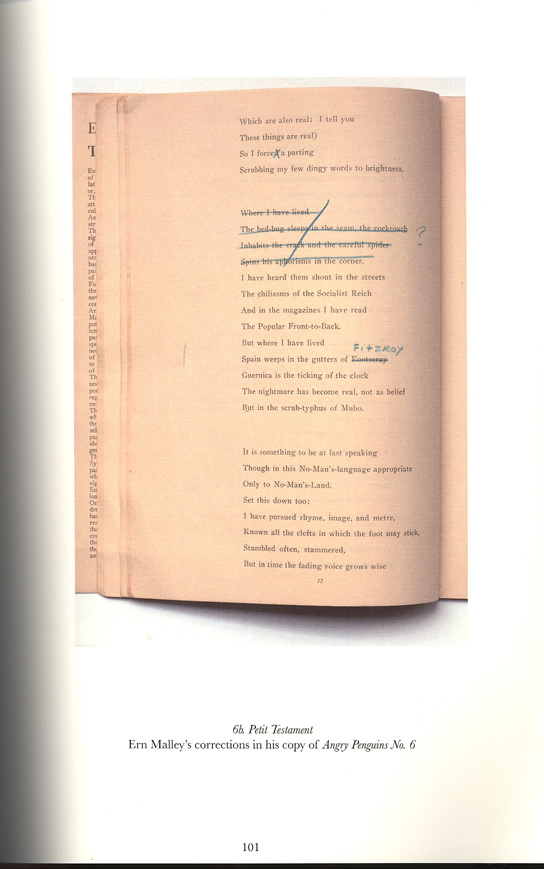
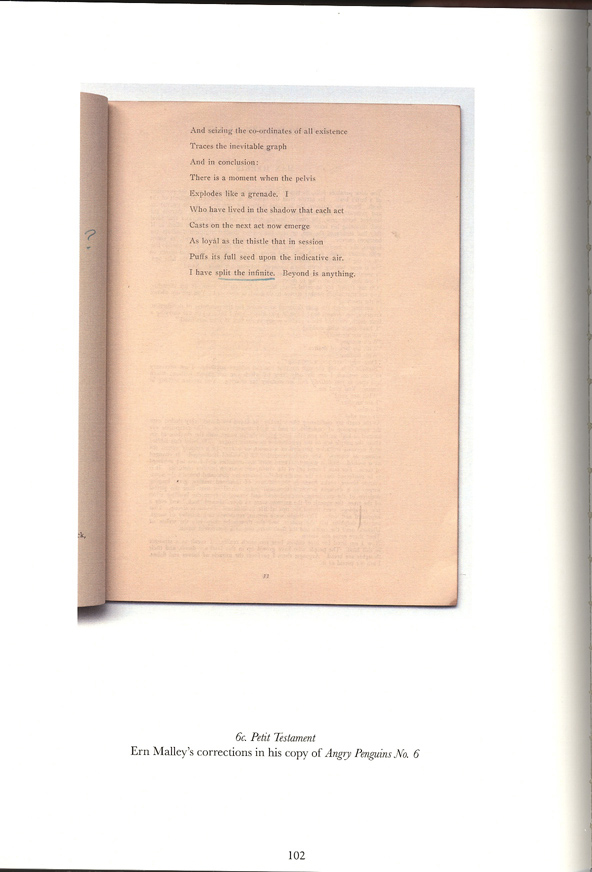
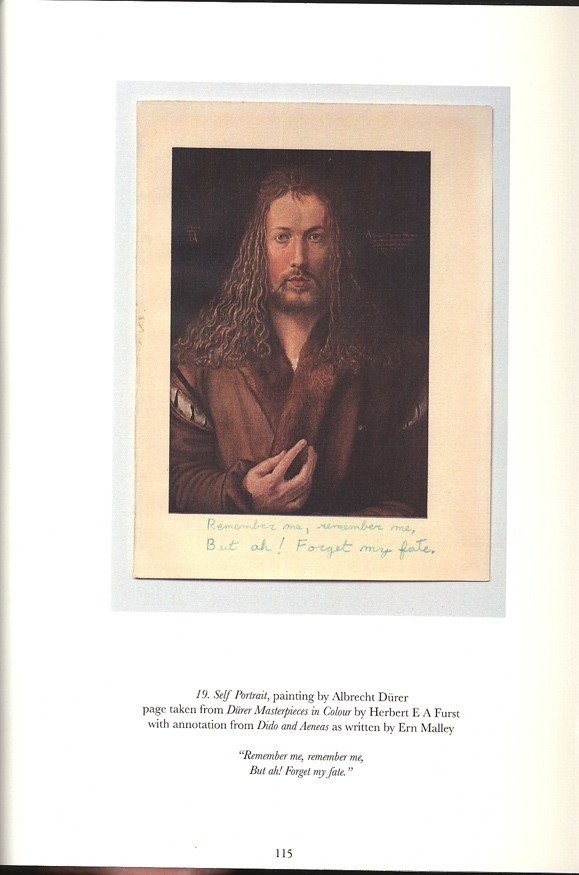
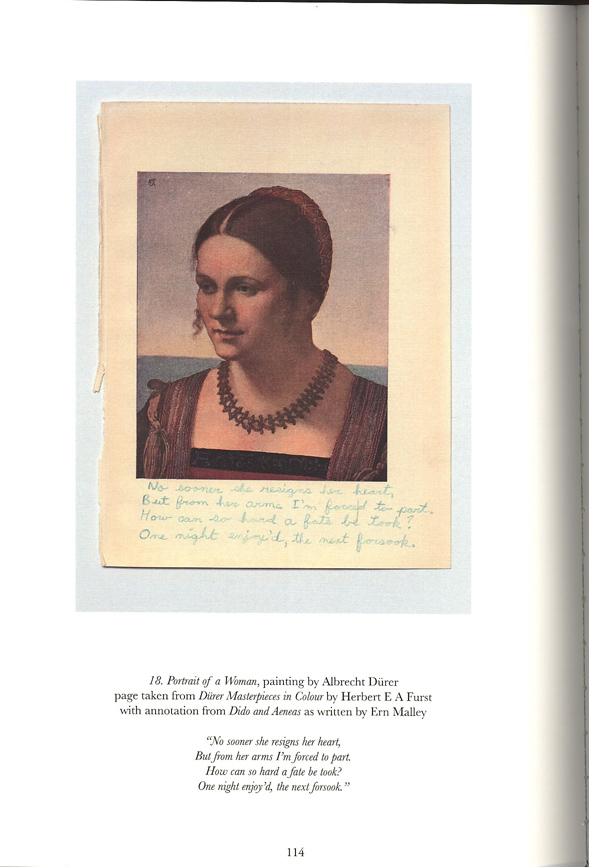
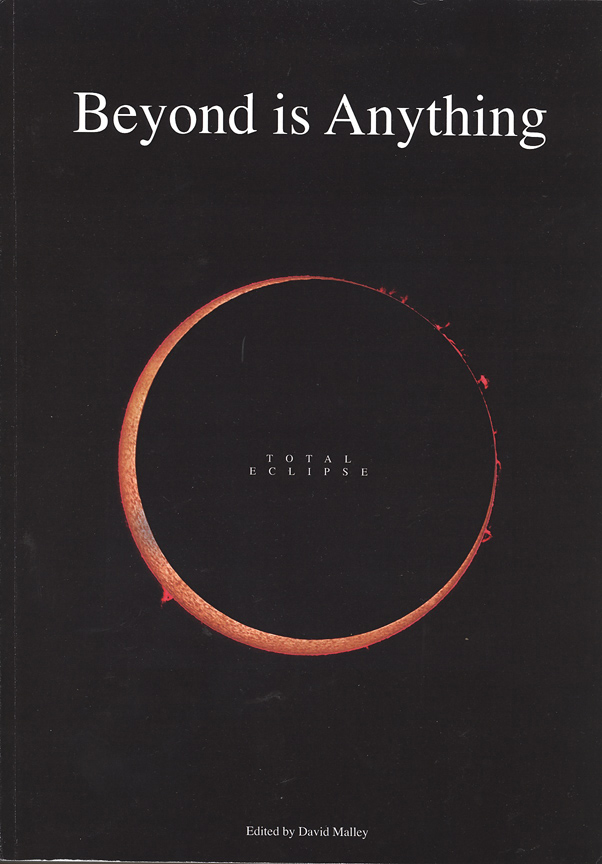
Earlier this year I received a package in the mail with a book Beyond is Anything edited by a “David Malley” with a letter explaining that David Malley is not a real person. The story tells of a “real” Ern Malley, although Malley was not his real surname, and that he and a “real” Lois had a son David who almost drowned during the war leading to Ern writing a poem Aquis Submersus. A copy of the poem in Ern’s hand appears in the book that mysteriously arrived. It says that Ern grew up with McAuley and that the poems published in Angry Penguins were actually written by Ern, who left them with Lois during the war asking her to give them to McAuley to get published. They were originally called Total Eclipse and the hoaxers changed this to Darkening Ecliptic as well as making a few other changes…

And it seems we were not alone: Martin Edmond has written about his frighteningly similar situation. The book lists a number of other recipients such as John Tranter and Philip Mead.

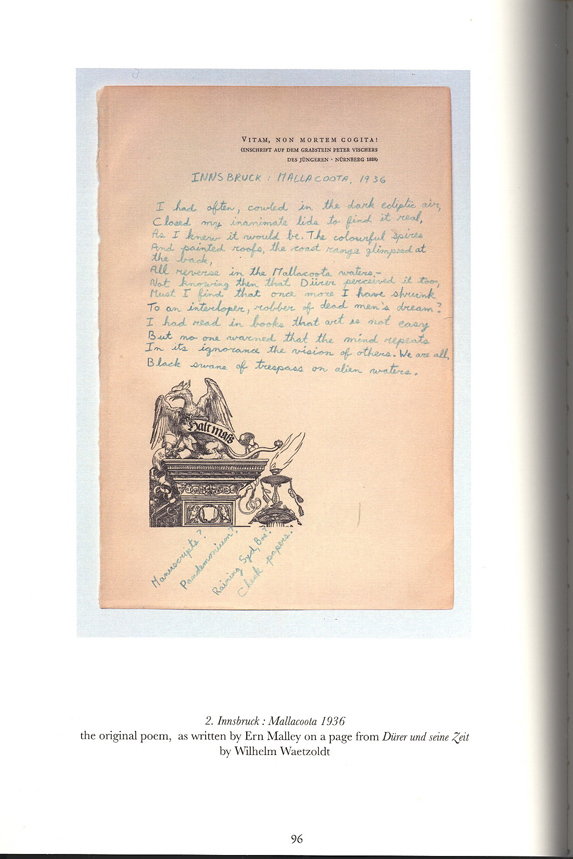
But not to worry if you don’t know anyone with their own copy – below, we’ve reproduced a few of the pages from the book to spark off your own investigations. In case you don’t believe us, check out the NLA catalogue entry for Beyond is Anything.

If this confirms anything it’s that The truth is anything. Beyond that, one can only imagine.

Posted in ESSAYS | Tagged ,

Ern Malley and the Art of Life

During a panel at the 2010 Salt on the Tongue poetry festival in Goolwa, SA, one audience member slammed performance poetry as being ‘more about the poet than the poetry’. Their intention was to damn performance poetry as an inferior genre – the under-educated, over-celebrated, buck-toothed cousin of real literature. Inadvertently, though, the comment hit upon a much bigger issue than that same tired line in the sand. As a sometimes performance poet sitting just a few rows back, I was not so much insulted as amused by the attack. Yes, I thought to myself, there’s a grain of truth in that – perhaps not more, but often as much – but how is page poetry any different?

Take Ern Malley. When James McAuley and Harold Stewart cooked him up, they gave him a bio befitting the archetypical tragic poet: dead-end jobs, a failed relationship, tragic illness and death at the sweetly Keatsian age of twenty-five, never recognised in his own lifetime, his work kept secret, a la Emily Dickinson, from even his family until after his death …

Max Harris later mused:

I was offered not only the poems of this mythical Ern Malley, but also his life, his ideas, his love and his death… For me, Ern Malley embodies the true sorrow and pathos of our time. One had felt that somewhere in the streets of every city was an Ern Malley… a living person, alone, outside literary cliques, outside print, dying, outside humanity but of it.

That Malley was unlucky in love brings an extra intensity to lines like:

I have remembered the chiaroscuro

Of your naked breasts and loins.

For  you were wholly an admonition

That said: ‘From bright to dark

Is a brief  longing. To hasten is now

To delay.’ But I could not obey.

and Malley’s awareness of his own terminal illness offers a grim context for Petit Testament, which begins:

I find myself to be a dromedary

That has run short of water between

One oasis and the next mirage

And having despaired of ever

Making my obsessions intelligible

I am content at last to be

The sole clerk of my metamorphoses.

and ends:

Explodes like a grenade. I

Who have lived in the shadow that each act

Casts on the next act now emerge

As loyal as the thistle that in session

Puffs its full seed upon the indicative  air.

I have split the infinite. Beyond is anything.

Would things have played out differently if Ern had been living? If he had been a well-fed lawyer and swinging voter? A stamp-collecting debt collector? A preacher? A police officer? A woman? Furthermore, what if the hoax had never been revealed? Would Ern’s poetry still have racked up dozens of reprints in countries all over the world?[ref]Ibid 10.[/ref] Would there have been a Children Of Malley I, let alone a Children of Malley II?

McAuley and Stewart intended the revelation of the hoax to prove that surreal poems were ‘nonsense … devoid of literary merit as poetry.’ But over the long term Malley’s poems have arguably toppled the hoaxers’ more ‘genuine’ works. Malley has provided inspiration for numerous artists including Sidney Nolan[ref]Ibid 56-63.[/ref] and Garry Shead and for writers such as Peter Carey and Elliot Perlman. There have been so many Malley spin offs that, like “Robinsonade”, it is practically a genre in itself. As John Reed observed, ‘the myth has overwhelmed its creators.’

Further supporting Reed’s observation, Malley is the focus of numerous essays, academic papers, theses and critical analyses.[ref]Ibid 10.[/ref] Interestingly – or perhaps ironically – many of these investigate the psychologies of the hoaxers themselves. Rundle claims that ‘the answer to the riddle of Ern Malley’ can be found ‘in James McAuley – in his frustrations, his fears and the terrible splitting of his soul’. Rundle also explores the possibility of unexpressed sexual tension between McAuley and Stewart. In terms of validity, such theories lie wide open to challenge. But validity is not the point here. The point is that theories exist – in such abundance that Stewart finally wondered whether ‘perhaps neither McAuley nor I ever existed except in the imagination of Ern Malley’. In other words, readers are concerned as much – if not more – with the poet(s) as with the poetry.

Similar phenomena can be found in other literary and artistic identity scandals. Helen Darville used the name Helen Demidenko and feigned Ukrainian heritage to give a ring of authenticity to her novel, The Hand That Signed The Paper, which relates events of the holocaust in the Ukraine. The book received initial praise, but was slammed when Darville’s real identity was revealed. Darville’s writing has more or less faded into obscurity, but fascination with the Darville/Demidenko character and her performance of the hoax persists. In the art world there was Aboriginal artist Eddy Burrup – really Elizabeth Durack, a white Australian. Durack’s supporters described Eddy Burrup as ‘a work of art in [him]self’ and a character in the story “his” paintings told. I stress here that I by no means intend to defend Durack’s actions, but am fascinated by the concept of authors as characters. Traditionally, authors are considered extra-textual – existing outside the text. But in the cases of Malley, Demidenko and Burrup the authors, both “real” and invented, can be seen as intra-textual – existing within their texts as literary devices.

Posted in ESSAYS | Tagged , , ,

‘King’ James Malley: Genesis

WHETHER we listen with aloof amusement to the dreamlike
mumbo jumbo of some red-eyed witch doctor of the Congo, or
read with cultivated rapture thin translations from the sonnets
of the mystic Lao-tse; now and again crack the hard nutshell of
an argument of Aquinas, or catch suddenly the shining meaning
of a bizarre Eskimo fairy tale: it will be always the one, shape-
shifting yet marvellously constant story that we find, together
with a challengingly persistent suggestion of more remaining
to be experienced than will ever be known or told.
This is a story of long ago.
The snow in the mountains was melting and Bunny
It was a queer, sultry summer, the summer

WILL you look at us by the river!
Here it is again, light hoisting its terrible bells.
He – for there could be no doubt of his sex,

OLD DUDLEY folded into the chair he was gradually molding
WHEN he was nearly thirteen, my brother Jem got his arm
BROTHER THOMAS,

You know how I always seem to be struggling, even when the situ-
ation doesn’t call for it?


FIRST ACT

SCENE

[Morning-room of Lord Windermere’s house in Carlton House Terrace.

Doors C. and R. Bureau with books and papers R. Sofa with small tea-

table L. Window opening on to terrace L. Table R.]

[LADY WINDERMERE is at table R., arranging roses in a blue bowl.]

[Enter PARKER.]

PARKER: Is your ladyship at home this afternoon?
Modern thought has realized considerable progress
THERE WERE ninety-seven New York advertising
men in the hotel,

Posted in 42: CHILDREN OF MALLEY II | Tagged

Text and Paratext: Ern Malley and the Function of the Author


Image courtesy of Australian Book Review

‘No-Man’s-language appropriate / Only to No-Man’s-Land’

The immediate target of the Malley hoax was Max Harris and those associated with Angry Penguins, but James McAuley and Harold Stewart also had ‘bigger fish’, as it were, in mind. Herbert Read in particular, the English poet and critic – whose writings were a significant influence on Max Harris’s own poetry and aesthetics – was very much in the hoaxers’ sights. According to McAuley:

It was the egregious Herbert that we set as our mark, hoping to keep the thing going long enough to reach him, and knowing he would be a dead sucker for any gross rubbish that came his way. He is, at least in the publicity sense ‘bigger’ than the locals, and would give the thing less of an air of taking lollies from children.1

For the hoaxers, Harris and other Angry Penguins writers represented a derivative Australian example of modernist techniques – championed by Read amongst others – that had already swept England and America. Modernist poetry, for McAuley and Stewart, was a ‘collection of garish images without coherent meaning and structure; as if one erected a coat of bright paint and called it a house.’2 Accordingly, the Ern Malley poems are a distorted reflection of such imagery; texts constructed out of misquotation, false allusions, nonsensical sentences and awkward rhyme. The ‘rules of composition’, as McAuley and Stewart explained once the hoax was made public, were fairly simple: ‘(1) There must be no coherent theme, at most, only confused and inconsistent hints at a meaning held out as bait to the reader; (2) No care was taken with verse technique, except occasionally to accentuate its general sloppiness by deliberate crudities; (3) In style, the poems were to imitate, not Mr. Harris in particular, but the whole literary fashion as we knew it from the works of Dylan Thomas, Henry Treece and others.’3

The sixteen poems that comprise The Darkening Ecliptic were all written – according to McAuley and Stewart – within the time frame of an afternoon and evening, McAuley called ‘a hard day’s work.’[ref]Graeme Kinross-Smith, Australia’s Writers, Nelson, Melbourne, 1980, p. 319.[/ref] Michael Heyward, putting this time frame in context, has noted: ‘assuming they produced [Malley’s] oeuvre over a period of eight or ten hours, discarding drafts and false starts along the way, that sets their output at a poem every half an hour, a rate slightly less than a line a minute, no mean feat.’4 Many commentators have expressed doubts that the poems could have been written so quickly; Sidney Nolan – who was closely associated with Angry Penguins at the time of the hoax and designed the front cover of the edition devoted to Malley – suggested facetiously that ‘it would have taken Shakespeare [at least] a weekend.’5 The speed of composition, as Heyward has noted, is in many respects unimportant, in that it in no way guarantees ‘either inferior work or the outpourings of genius … it simply makes the poets’ disclaimers of merit more powerful.’6 For McAuley and Stewart, it was important to maintain that texts such as Malley’s could easily be produced, and importantly, produced with little intellectual input.

To create the poems the hoaxers improvised with free association and conscious interruption, not dissimilar to surrealist techniques of poetic production. To build their collages they used whatever books were on their desks; the Concise Oxford Dictionary, a Collected Shakespeare, a Dictionary of Quotations, Ripman’s Pocket Dictionary of English Rhymes. The poems misquote and parody, among other things; Shakespeare, T.S. Eliot, Keats, the musical Oklahoma, Mallarmé, Dürer and Ezra Pound. It is little wonder, on the basis of this, that Harris was intoxicated by the imagery of the poems.7

One problem the hoaxers faced in this task was to create poems that would be convincing enough to deceive Harris. Consequently, the first poem Harris received was ‘Dürer: Innsbruck, 1495’, actually a ‘serious’ poem composed by McAuley prior to the hoax, one that he described as a ‘come on’:

But no one warned that the mind repeats
In its ignorance the vision of others. I am still
The black swan of trespass on alien waters (DE, 243)8

McAuley argued that despite the lovely imagery the poem was still nonsense: ‘What the poem claims is that the poet had often had a pre-vision of Innsbruck before seeing Dürer’s picture: not a very credible assertion … We need a revival of the eighteenth century reading habit of noticing what the poem says and asking whether this is sensible.’9

McAuley’s insistence that the poem possess some inner logic that is ‘credible’ and ‘sensible’ is crucial, for we see here not only a clash of artistic aesthetics, but also a tension over the production and value of ‘meaning’ within literary works. Or, to put it another way, the hoax becomes a testing ground for conflicting notions of textual reception. McAuley was calling for a revival of literary interpretation that foregrounded the author as the arbiter of unified meaning within the poem, a figure always prior to the text and informing it with significance. Such a position has been rendered problematic, however, by post-structuralist literary theory, where it is not the author that is imbued with the power to generate meaning, but rather the reader. In a complete rejection of McAuley’s stance, Roland Barthes (1977) argues that the author’s intention is fundamentally irrelevant as far as the unity of meaning within a text is concerned.

But before turning to Barthes it is worth noting that at the time of the hoax – when Harris was being publicly humiliated for believing the Malley poems were the work of a major, if previously undiscovered, poet – there were many respected commentators endorsing Harris’s assessment of the poems. The Age critic, Colin Badger, noted that ‘whatever the deficiencies of Mr. Max Harris as critic and poet, it is very difficult indeed to find that he erred in his estimate of these poems … with whatever doubts and hesitancies, honest criticism will endorse Mr. Harris’ judgement.’10 Brian Elliot, the Australian academic, wrote – despite certain reservations – that the Malley poems were ‘really quite remarkable as literary craftsmanship … There is something most unique about the whole thing.’11 But perhaps the strongest support for Harris came from Herbert Read, who hadn’t been embroiled in the hoax as McAuley and Stewart had hoped. Writing to Harris, Read argued that the poems were ‘undoubtedly poetic, and poetic on an unusual level of achievement’; indeed, Read argued that McAuley and Stewart had deceived themselves in creating the hoax:

It comes to this: if a man of sensibility, in a mood of despair or hatred, or even from a perverted sense of humour, sets out to fake works of imagination, then if he is to be convincing, he must use the poetic faculties. If he uses the faculties to good effect, he ends up by deceiving himself. He calls himself ‘the black swan of trespass on alien waters’ and that is a fine poetic phrase. So is ‘hawk at the wraith of remembered emotions’ and many other tropes and images in these poems.12

Read’s approach to the poems seems to be heralding the work of Barthes. For Barthes our concept of the author is a modern construction, a social product emerging out of discourses that promoted the primacy of the individual. It is therefore logical, according to Barthes, ‘that in literature it should be this positivism, the epitome and culmination of capitalist ideology, which has attached the greatest importance to the “person” of the author.’13 Such a concept is nowhere more evident than in the modern literary festival, where the cult of celebrity foregrounds the author before the text. As Barthes notes ‘the image of literature to be found in ordinary culture is tyrannically centred on the author, his person, his life, his tastes, his passions.’14 It was this social emphasis upon ‘the author’ that ultimately condemned Max Harris in the public response to the Malley hoax. If the ‘author’ of the work was a hoax, how could the poems have any merit whatsoever?

Barthes’s response would be that the author is not the issue: it is the text itself that needs to be considered. In this sense, McAuley and Stewart’s intentions in producing the hoax poems becomes an irrelevancy to the poems. That the poem ‘Culture as Exhibit’ contains a direct quotation from an American manual on mosquito control – intended as a complete absurdity by the poets – is a case in point:

‘Swamps, marshes, borrow-pits and other
Areas of stagnant water serve
As breeding-grounds …’ Now
Have I found you, my Anopheles! (DE, 255)

The Australian poet Elisabeth Lambert, who was the Angry Penguins representative in Sydney, made the point that regardless of its source the quotation had ‘a fine flavour’:

Someone should try and locate the man who wrote the opening lines of that American drainage report. It might be accidental, but on the other hand the poor ellow might be a suppressed poet … The whole quotation has a fine flavour. And borrow-pits. What a beautiful word. I’m doubtful just what a borrow-pit is, but it makes a lovely noise. In any case what made Stewart-McAuley think a mosquito unpoetic?15

For Barthes literary language is a language ‘without bottom’, something like a ‘pure ambiguity’ supported by an ‘empty meaning’:

There are no beginnings and no ends, no sequences which cannot be reversed, no hierarchy of textual ‘levels’ to tell you what is more or less significant. All literary texts are woven out of other literary texts, not in the conventional sense that they bear the traces of ‘influence’ but in the more radical sense that every word, phrase or segment is a reworking of other writings which precede or surround the individual work.16

Barthes’s position here is almost an echo of the hoaxers’ methods, except that for Barthes it is a position of affirmation.

Barthes’s approach to language and writing resemble that of French theorist Jacques Derrida. Derrida argues that the signs composing a text can be ‘deconstructed’, undermining the systems of logic by which we traditionally approach a text. For Derrida ‘there is something in writing itself which finally evades all systems and logics’, a constant defusing of meaning that the text cannot contain. 17 Like Barthes’s idea of literary language as ‘pure ambiguity’, Derrida’s concepts undermine traditional theories of meaning. This deconstruction of meaning is ‘a challenge to the very idea of structure: for a structure always presumes a centre, a fixed principle, a hierarchy of meanings and a solid foundation, and it is just these notions which the endless differing and deferring of writing throws into question.’18 It is interesting to note that both McAuley and Stewart were advocating not just a traditional unity in poetry but something more fundamental; their emphasis upon coherent meaning in poetry mirrored their desire for metaphysical unity. In the years after the hoax both poets sought the certainties provided by religion, or spirituality. For McAuley, this involved a conversion to Catholicism, and for Stewart a lifelong immersion in Taoism.

For Barthes, as for Derrida, such a position is untenable. It is a yearning for a sign [God] that acts as a transcendental signifier, an anchoring, unquestionable meaning to which all our signs are ultimately pointing; the transcendental signifier. For Barthes our concept of the author can be viewed in the same manner: ‘We know now that a text is not a line of words releasing a single ‘theological’ meaning (the ‘message’ of the Author-God) but a multi-dimensional space in which a variety of writings, none of them original, blend and clash.’19 In this multi-dimensional space it is the reader, not the author, who interprets meaning. Indeed for Barthes a text is made of ‘multiple writings, drawn from many cultures and entering into mutual relations of dialogue, parody, contestation, but there is one place where this multiplicity is focused and that place is the reader, not as was hitherto said, the author.’20 It is at this point that we come to what Barthes has described as the death of the Author: the reader, the only one who can interpret or write meaning into the text, is only born out of the Author’s death. At this point whether McAuley, Stewart or Ern Malley wrote the poems becomes of no importance; the identity of the author is an empty presence in relation to the text.

Posted in ESSAYS, SCHOLARLY | Tagged , , , , , , , , ,

‘King’ James Malley: Revelation

The modern hero, the modern individual who dares to heed
the call and seek the mansion of that presence with whom it is
our whole destiny to be atoned, cannot, indeed must not, wait for
his community to cast of its slough of pride, fear, rationalized
avarice, and sanctified misunderstanding. “Live,” Nietzsche says,
“as though the day were here.” It is not society that is to guide and
save the creative hero, but precisely the reverse. And so every one
of us shares the supreme ordeal–carries the cross of the redeemer
–not in the bright moments of his tribe’s great victories, but in
the silences of his personal despair.
‘Thank goodness!’ said Bilbo laughing, and handed him
the tobacco-jar.
He turned from me and walked away. I watched his back
receding down the long, gleaming hall.
, and
guiding myself by them, as by a magical thread, I stepped into
the room.
they went
inside the big old house whose door stood open, pressed back
by the breeze they made in passing.
You don’t see things or people, you see space –
the winch between two branches. You live in
the winch between two branches. Something spoke,
you answered. And you don’t know what, or when.
And the twelfth stroke of midnight sounded; the twelfth
stroke of midnight, Thursday, the eleventh of October, Nineteen
hundred and Twenty Eight.
It was at the bottom of the alley with its roots in the air.
“I only tell people once,” the man said and left the window.
He
would be there all night, and he would be there when Jem
waked up in the morning.
P.S. That night in the emergency room, do you recall if I threw up
something I needed? Some small but trivial thing that belonged
inside? I distinctly feel as though I’m missing something.
But then, I always have.

LADY WINDERMERE [taking her husband’s hand]: Ah, you’re marrying
a very good woman!

CURTAIN

reply only on the ethical plane. We shall devote to them a future work.

THE END

aimed
the pistol, and fired a bullet through his right
temple.

Posted in 42: CHILDREN OF MALLEY II | Tagged

‘King’ James Malley: Prayer of Manasses

The figure of the tyrant-monster is known to the mythologies,
folk traditions, legends, and even nightmares, of the world; and
his characteristics are everywhere essentially the same.

He had not been down that way under The Hill for ages and
ages, not since his friend the Old Took died, in fact,

‘I – well, my name is Richard Papen –’
He put his head to the side and blinked again, bright-eyed,
amiable as a sparrow.
‘– and I want to take your class in ancient Greek.’

Great white bearskins lay about underfoot, and the only
furniture was a lot of low beds covered with Indian rugs.
Instead of pictures

Dolly saw it was his right hand. His bloody working
hand. A man could hardly pick his nose with a thumb and
half a pointer. They were done for; stuffed, cactus. Thank
you, Lady Luck, you rotten slut.

, I carry

and nurse, my diffident twin, I’m often morose, and think
of those statues that lean above themselves in water,
Horses
tossed their plumes. The Queen had come.

The shutters and doors of the Radley house were closed on
Sundays, another thing alien to Maycomb’s ways: closed
doors meant illness and cold weather only. Of all days Sunday

DAY FIVE

I let Irene cut my hair today. It’s kind of horrible. She’s only
twenty, and her skin is all broken out from PCP and heroin. I got
so absorbed listening to her stories of blackouts and arrests for

prostitution that I didn’t notice how badly the haircut was ac-
tually going.
Julie is so cheerful I want to punch her.

LORD DARLINGTON [still seated L.C.]: Oh, nowadays so many con-
ceited people go about Society pretending to be good, that I think
it shows rather a sweet and modest disposition to pretend to be bad.
Besides, there is this to be said. If you pretend to be good, the world
takes you very seriously. If you pretend to be bad, it doesn’t. Such
is the astounding stupidity of optimism.
LADY WINDERMERE: Don’t you want the world to take you
seriously, then, Lord Darlington?
LORD DARLINGTON: No, not the world … you

Simi-
larly, if we question someone on well determined events in his private or
public life, he may reply, “I know nothing.” And this nothing includes
the totality of the facts on which we questioned him. Even Socrates
with his famous statement, “I know that I know nothing,” designates
by this nothing the totality of being considered as Truth.

“It sounds darling,” Mrs. Carpenter agreed.
“Sybil, hold still, pussy.”
“Did you see more glass?” said Sybil.
Mrs. Carpenter sighed. “All right,” she said.
She replaced the cap on the sun-tan oil bottle.
“Now run and play, pussy. Mommy’s going up to
the hotel and have a Martini with Mrs. Hubbel.

I’ll bring you the olive.”

Posted in 42: CHILDREN OF MALLEY II | Tagged

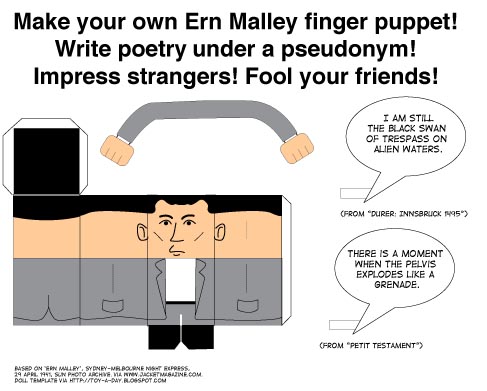
The Ern Malley Finger Puppet

Download today! (PDF!)

Posted in BLOG ARCHIVES | Tagged , , ,

Sally Malley: Trunk

“I beckon like a lemon, like a feather”
~ Sam Sejavka


damn that rose! there you go – alcohol’s
typos, elephant trees in boots, the body
like a present goes stale in its box

i say i am the sun of my room, though further
inside moss grows on kidneys, and love
as deep as the moon inside a wolf’s throat

o this winter that lasts longer than
a year – what’s to be done, but put one hand
on a sheet, watch it deny itself a bed

you shall arrive when you do unless you don’t
though in the capital of invisible prisons
someday the open door must let in a snake

it ends with a riot of affluence

Posted in 42: CHILDREN OF MALLEY II | Tagged

Margie Malley: Fahrenheit 451

good example of good literature
cold – very little human touch her house
was the opposite of montag’s, full of life
montag: state of confusion sense of saying
it hasn’t any lenient feelings sense of speaking
that if they programme the ‘hound’ re: he/it will
kill mon main point – why couldn’t they do other
things besides killing etc. montag is beginning to
be curious, doubtful about the whole society whether
it is right to do these things shows you what kind
of person she is (our is another way of saying mine)
she doesn’t care so therefore doesn’t care about her
marriage pretending topic seas provided them
with no challenge & they’ll be happy imagination
conscious is what makes montag guilty & thinks
to quit beatty hasn’t got any conscious faber’s
character comes out here! the sound of its death
comes after

carmel bird year 10 mercy college
fahrenheit 451 – ray bradbury

Posted in 42: CHILDREN OF MALLEY II | Tagged

Ethelred Malley: Soil: A Nocturne

for my late cousin Ernest

A bleat of lambs on Junee’s
naïve hills, a kind of white
foam in the dark; the clash
and slam of locomotive carriages:
stubborn cymbals of the Gods or
an ordinary torment? Such hyperbolic
music, I may have caught the railway blues!

How the mind repeats itself;
baked beans, heaped on my enamel
supper plate, chipped as any
conscience, o Nightshift
can your cruel roster!

I should have locked
the garden gate against
those volatile intruders
who swung their Eveready
torches over my lawn sculptures –
I tooled them all myself : a gathering
of penguins, swans, flamingoes
guarding the hydrangeas!

Louts kicked them down and
hurled them round and sprayed
them all with shaving cream (I have
the tin to prove it ), then darkened them
with thrusts of soil – can’t they read – are
they so illiterate – my signs that clearly
say No Trespassing No Hawkers. I sob
inside this rhetoric of slaughter!

Posted in 42: CHILDREN OF MALLEY II | Tagged

Blinkie ‘Bill’ O’Malley: The fête

“When an inner situation is not made conscious,
it happens outside, as fate.” – Carl Jung


Let me start by saying you
are unstable.
Eight deaths
in eight days. At the home
you thought you’d send
your mum to. Only you can’t send
mum anywhere she doesn’t
want to go, unless you have a signed
enduring guardianship, that is.
Sign
here pls.
Pls call
if you have questions. Like:
is it audited,
and what happens to my capital
&c. Well, what I started out
saying is “you look nice today
in the shadow of Eyjafjallajökull,
at 63°38′N 19°36′W.” Dazzling
stratovolcano, your fire makes
us tack around the planet one
way, then another, from departure
lounge to airport bar & back
with toiletries & stuff
sacks—the same planet where
what you don’t make
conscious emerges later
as a fête (dunking machine,
chocolate wheel, lucky
dip, white elephant)
as blood spilt
in a defrosting fridge.
That’s all fate is: a fridge
with blood in it
that you spilt
(& the fridge tells
not of it) so, as I sd,
to weigh a mountain, any mountain,
go to the mountain—
go about it with a plumbline;
measure between heartbeats etc,
as though we’re not actually stuck
here on the midgard kicking ash
and ice in our birthday
puffer vests from mum
saying mean things, ie:
“Like Man U you’re a bagatelle
in economic terms, and the banks
will write you off. Me too. #justsayin”

Posted in 42: CHILDREN OF MALLEY II | Tagged

Blinky ‘Bill’ O’Malley: F#!* Yeah

“And man shall be just that for the overman: 

a laughing-stock or a painful embarrassment…” 

— Nietzsche, Thus Spake Zarathustra


At the outset, let me just say this:
this poem has Tourette’s — it wanted to be
a swear bear so I let it be — an MA15 poem
[Medium level profanity, mild
nudity] — a Kevin Rudd
of a poem & in it Sergei Bubka says fuck
yeah Steve Hooker’s awesome
as he lines up & GOES
FOR GOLD with his ginger
ringlets & bung knee
with his special pole shipped
through monsoons
to nama-fucken-ste the docks
Hooker pulls up proud,
flushed & elated & post-meet says
if some competitors are Delhi
no-shows that’s a matter
for their conscience, an elite
athlete’s soundbiting way
to say “weak as piss”
respectfully for the news.
Polite people
everywhere (chef de bloody mission
Steve Monaghetti fr example) think (& sometimes
say) if you use cuss words in your work
(& not substitutes eg ‘pish’ or ‘tosh’)
it’s poor language command,
reflects badly on the team 1st, you 2nd, yr
family, yr school, yr nation, & so
the message goes down the shitter.
“Fuck ’em” says this poem & Kevin Rudd
says “ratfuck ’em” which is better
yet. Possibly best. Lolz I overpromised
on the nudity. Apols.

Posted in 42: CHILDREN OF MALLEY II | Tagged

Blinky ‘Bill’ O’Malley: Dithyrambs of Dennis

If I had any ambition
I’d make you a bouillabaisse in the Provençal
in St Marks Square. To create
intimacy in the poem, I turn up
the volume & this piece conforms
to an emergent post-OMGWTFBBQ
cast in acrylic in the Square where
our fingers touch when I hold
your guide while you woe
betide a pickpocket
only then, when you are most orthogonal,
are you most bent
& it’s sweet
my flame-haired
Russian spy, boating
to the rendezvous, hair the colour
of that toxic sludge spill killing fish
(villagers too) & I like you & so say
“like smallmouth bass
in the Potomac
there are three
kinds of poet; male, female &
intersex, to which I’d add two
further dimensions:
living or dead.”

Posted in 42: CHILDREN OF MALLEY II | Tagged

Bernie Malley: Blu-ray Morpheus


His metamorphosis contains the very mystery of sleep:
the outline of a fluidity, the look, sign, and gesture of evanescence
with the charm and virtue of presence
– Jean-Luc Nancy


a.
Technicolour dreaming
leads me here again an era
of corrosive sleep, caustic
slippages
left malnourished and dug in.


b.
7am in salty beach rain
a pale leavening moon, a summer
I got dragged into
by the weight of tides: time


c.
Sun hero, laconic heart –
strong and decent to women.
Your matter-of-factness a barbed spool
that lives inside me now
and unwinds and unwinds and unwinds


d.
Phraseology ill or broke, memory’s
coarse mark cordons my chest with
silvery thread
the brevity line of the sky sea horizon


e.
I say, hold my hand into a million pixels good
rain sizzles to the ground don’t you think?
If I keep on descending with you
will I exhale forever? My own mutiny…


f.


g.
Dark cinema dreams of you
leaning in for an onscreen kiss:
you say something, there is a shadow at the door
you say something, there is a shadow at the door.

Posted in 42: CHILDREN OF MALLEY II | Tagged

Bernie Malley: red eye

inflight enter-
tainment guide
say “chillax”.
glance prehist-
oric day dawned
corrugated
charmed, seams
of burn-
ished earth ochre
deep spindly
curve end fabled
plinths, white.

this new day is
witness: trajectory
of god s rich,
myths eternal
gold spun –

he a bored space
man yawn! at the
endpoint of
millennia dreams
skeins of silk new
day not there to
cushion a rapture
or a fall.

chillax. we’re
not going to the
moon. more hum
drum locale & vicious
civic primacies call
now next aisle over
son argues with
father,
attendant inter
venes, bends,
& dulcet tones
firm she
confiscates

his gilded wings

Posted in 42: CHILDREN OF MALLEY II | Tagged

Nessy Malley: Antisepticide

like a ghost tippaw
then stamp in ‘ope
that some malley might ‘ear

before grand days

of the fishy

plastic consciousness

saw itself ‘come two smelly boots over the wire
print head & me hesitate

forever was now
where most infamous anon malley
ran amok on cloud pages of

‘uffieface

hurry the douche bag up

Posted in 42: CHILDREN OF MALLEY II | Tagged

Blinky ‘Bill O’Malley: Arts & Crafts

“… you can’t have art without resistance
in the material.” — William Morris


Ah, don’t feel guilty about
the GM soy in the baby formula—
those activists are arsehats &
breastfeeding zealots & it’s unpiloted
drones dropping in on the reception
we really need to watch out for
& that’s what I like
about you: you’re a mélange
of what Americans do
best: • schools of poetry,
send in the marines & • new
post-consumer waste products 
for xmas.  A twitchy rear
guard we can’t help
but admire—it goes on
somewhat and we emulate
somewhat, & they’re printing
money to make it work (&
we’re digging ore) & that’s
what I like it’s what I like
it’s what I like about you.  Anyway
I’m not saying anything they
won’t later say themselves
so drop by sometime
with yr RESISTANT MATÉRIEL
t-shirt & yr disrupted pattern
camouflage empire
line marrying dress
by Miu-Miu for that fitting
& fee-free photoshoot
we always said we’d have 😉
(camo? why
not! with two under three & one
on the way. srsly.

Posted in 42: CHILDREN OF MALLEY II | Tagged

Blinky ‘Bill O’Malley: Love Story Metabolites

Dear Nuala, oh noes,
you’ve left your starting-a-new-life
job in the bait’n’ice for that no-hoping
armed & dangerous escapee
again!?  It’ll just lead to headlines:
 

Fantasist poses as playboy

&


Headless body in topless bar

 
you & that Canadian griefer
& a flirtatious real estate
agent in a getaway, walk
into a bar & you’re dropped
into a sick joke punchline
where the only exit is dead
panning your way out, like
Phil Collins from a third
marriage in a Lear Jet.  Dammit
these poems are sticky, whiffy
too—are they off?  Words
only get you so far—so sketchnote
this Sunshine (though omit
the radical interiority or whatever
it was Professor Whatsachops popped out
at the symposium q&a #drink)
This is a skill—it should be taught
in school, Nuala ;p kthxbai

Posted in 42: CHILDREN OF MALLEY II | Tagged

V E L O

top knot (?)
bike trajectory
wires cut the blue
filed somere bunched
up others ride wide
aberrant onescarse
collisions every 30 secs the
electricity fizzes
m ear m dances
the slowest era
under the sun
bump sunny
concrete cracks
thoracic
breathing
apparatus
fishing net
shadows
wet match

blue yellow
red chiasmus
wanted to drag
the mtn bike kids off but
they were too fast
for me finished
before id started
the sun was in m eyes
n i rolled m foot on
a stick everything ends
up on the roof in
the end

n 8 means theres 1 to
go til 9 or thereabouts
fuck this mtn so much depends
on a blue helmet ants and
fruit flies getting lost in my
leg hair a truck reverse
fucking concre
kettle again
they ride
that dent
fadeout
do the
Lemons (or limes) in
a bag and wrapped into a nice
Parsely too big for the post box
with Minty fresh breath
Pumpkin
(5)

apes)

the last of the
fruit jubies, a man cycling in the wrong direction wings
flapping, “tenuous balance”,
overhead ghouls cycle “galah
over there” “i know” “2 galahs”
drink from the ck ghouls
replenish their bidons at the
ck “6 galahs”


m handlebarsre mud folding
into cakes in m hands i
space them on concrete of
drome allowing room for
the rise early sun

freezing knuckle seasons
begun
trail of post anzac
smashed hard rubbish
down the street
dreamt of a ‘chair of hard knocks
 style
chair of kids
standing near the drome
singing ‘wonderwall’
asked them to sing quieter
and their leader said no he
had a shaved head the
rooster had plumes it
played with the irish setters it
taped blades to its toes and
fought for money the treeline
fine clouds n surf neon white
back at the monk’s “windmill”

to ‘roll the legs over, open up
the sternum’ … found orange drink bottle
man walks by with French foreign
legion
cap
small dogs w. diamante swastikas
for collars
… the one with the nozzle you grip
w. yo teeth
the sub 29 sec lap
this one at 28.80s
a stealthy dude appears
n pops your lung or uncle
sun eyes clouds theres no
sense of drama in any air
even the breathed bitsre clear
even the breathed bikesre clear

does lenticular mean ‘lentil-shaped’
?
breathe yr way thru a cap
which i would prefer
3000 laps or 3000 words ?
an orange drink bottle to grip
w. m teeth the time
of duration as the front wheel
rolls across the chessboard
6.0 / ? 30 seconds x 10
= 5 minutes
‘those minaretsre new’
are they minarets .. ?
shaped like a floor
or switch
the space of duration
flag-waving

THE LENKO
DOODLE
ART SHOW
press-on tattoo
rack of conviction
?
nozzle grip
lapsed
sprint on the fourth
bike frame squeaking under
velcro arse
sunday drive
shaved edges of lawn
what is
concrete ___ exercise
? I prefer the sound of
cycling to jogging too many
grunts of
exertion Hands made of stickytape
crumbs too big for the sparrows

THE LENKO
DOODLE
ART SHOW
lost his fin
glued it back on

ALASKA
fifty laps
numb nuts

…sometime

legs know
what you did
behind their shades
kids look at
you like they
know or
at least theyre
making a
good guess
ALASKA
TANGENTS

all the
birds knows
about
muffins
n everything
tastes like
blue / gatorade
premix
ALASKA

Alaska
SUBSPEW
think id like to stay
within the subspew
level i think i cracked

fifty seconds
drinking tomato sauce
4 breakfast tastes
like water are these
pedals orre they pastilles
ya cant even begin to sit on it

the longer you look at it
the uglier it gets but
dromes beautys eternal

38 secs to write a poem
bee sits cmon a bird call
sits from its beak like
bee
from clover
carn-nation sweetened condensed
milk

Alaska 9.30am 00.00:42.33
stop
accrue
lemon wedge seat
ripped bike
counting traffic

seasonably affective sneeze
didnt know you as a slagger
er ‘spitter’
only after jogging and only
in st kilda
velodrome
i used to ride to ride m skateboard there

SITTING IN GEAR THE DROME HUMS
MERRI CREEK
POWERBOATS HUM WE TALK A LOT
ABOUT SEX N PATCHING FENCES
A SCHOOLS RINGING A CROW PICKS UP

dreamt I found an old roof
I used to scratch words onto
my brother was there also
I was learning spanish &
had an exam but I didnt
know any words except the
word for write which wasnt
in the exam

its like swimming in the
surf resting on yr towel
n swimming in the surf

plastic pen on
blue painted metal
seventy lap
numbnuts
nick 28,47

dromes a bowl of mist
sock slurpees human dogs
its soupwracked!

claras drome Alaska
claras hemulen
claras golden drome
claras grey drome
claras grey nicolls
claras slazenger

settle cunt horse alaska
truck filled m eyes w grit

dewy con
crete how did the dark
chairs get so white

Eyesre iceballs!
Sleep w the wagtails
fingers thawed toes now frozen
thirty lake cupcake nausea
ocean liner
didn’t embarrass myself

how many times did I
count lap 17
repetition

wagtail distracts
lap count
one big bottle
of SINGHA BEER
please Jetstar to
Bairnsdale
from Lyon service *OPENS TODAY*
children
under twelve
sunday mornings an obsolete
course
spokes counting

overs with coopers caps “Ive
had bad experiences
“Im bad at the velodrome
my pedal caught on the
remember?

Te … bit rough”
lese bikes now
have any breaks!”
ill try and
st lap fast

Tomatoes
Rocket
Zucchini
Watermelons
Cherries (or gr
12 Apricots

recursive

orthogonal

Ref
83343925

down from the waist down
wagtail down 35 penises crossed
HIGH TENSILE
20 crow army
on toast
deflated

soccer ball metaphor
someone’s been nibbling at
my bike seat
(again)
long blue line
long red line _______________________
loop up up loop sustain
___________

well-padded
ices like pieces of fingers
1st suck on ventolin in
a year
feels great like smoking again
sex mushroomsve sprouted
counting layers like laps
lazers?

4 sad slow laps w. bag on

Posted in 42: CHILDREN OF MALLEY II | Tagged ,

Francois Sagat O’Malley: Glad Pews and the Good Steeple

you don’t always want
what you say, or
say what you
do (do you):
Notes of a Warring Class, J.H. Prynne

 
Lodge the pre-budget ambit claim.
Graphs observe
their models. The steam rises.
The sport of the day’s nadir.

He absconded on theeve of winter
By compass she fled –

founded the people’s
democratic spectator ship.
This is what it was like to have loved.
With tractor squall, not megaphone
you wake butterfly in the morning.

iii. inter

albatross blues

The wedding guest has long since been deported
The herald reported

This was the memory of how
too tropical to avoid gossip they fled the scene:
The posse is rain sloshed from a peak-hour gutter.
No mention of books soaked in official batter.

She stalks the
moose
like an unfamilial warrigal.
Rochelle:
sweeping
for her children.

She wasted no corrugations because they would not,
but thyme pressed and strudels came of it.
On the egg were kanji characters
with no rubber bands and less to suspend..

Take time out to design jam jars:
Kitchen Warfare Essentials for the Carrot Bachelorette.

I implore you to believe
this sincere account of the Lego Association

i. rupt

The Matthews method: melees and prayers,
The method Matthews uses confuses
The madness of Matthews’ method

We sleep in secular pews, dodging the flares.

Born in a field of Bruce Springsteen
you naturally dodge the suicide machine

a nasty date with the dynasty of wisdom
Christine’s white derriere, just declares:
“Your right Don?”

there was no credit for his message to Ezra,
thrown stones further, battled bathed rats and late
hats attuned to the Babylonian Hussein.
But it never came to that.

I am in Los Angeles today,
wearing a frock on the edge of a bowl of ice cream
and a slice of gateaux wondering if Giteau
will play for the sevens at the Commonwealth Games

“Fifteen is calm. Downgrade the film.”
Godot is not perfect but he will… try
Giteau in and away for a… try

The sonic peal in the hotel.
The serious café says: “Metaphysics
are the opiates of the masses.”
And all the Steve Bracks fall into line.
The solitary official translation
drifts towards zero day on a palanquin.
Software and scrupulous accountancy
open the terminus and uncover the deception.
Backyard Lebs ambush invariably at dawn.

This is the inevitable coalescence.
This is what it means to be the CEO of the Schapelle Corby Club,
base jumping from the extremities of the objectives
of your strategic eighteen month plan.

Understand the meaning of the freeways;
the phraseology behaves like a museum after an earthquake
the tumultuous juxtaposition of epochs.
Visas for the correct disambiguations have already been squandered

The socialist system will eventually
replace objective law. Everything is essentially collision.
Good people know this when bad news comes knocking.
Why would you want to live here?

Ceol of Wessex Cutha Cynric
Ceawlin Ceolwulf Cynegils
Cwichelm Cenwalh Centwine
Chifley Cervantes Cruise
Celan Carracella Tchaikovsky
all wanted to make views that stayed pews.
Stacked implants on the veranda
the memory of Freidrich Holderlein
fossilising in a front paddock.

When you run the program all you get is:
Read error 42: Pandora Your Friend – Unable to locate
requested file.

The log file says:
02-BHO: Pandora Your Friend BHO – {00A6FAAF1-0272E-
44cf-8957-5838F569A31D} – C:\liam\Program Files\Explorer\Temporary
Files\AK11849\Pandora Your Friend\runme.dll – Can’t find file

Behind every successful new historian
is an artist who says you forgot to mention my work,
and, boy is it symptomatic!

You want Yogo therefore you are.
Colloquial wisdom settles disputes,
and old scores
are eliminated
in long range knife duels.

Posted in 42: CHILDREN OF MALLEY II | Tagged ,

Walker Norris: Magicked Away

“When D’arcy Niland’s novel The Shiralee came out in the mid-fifties, the Australian film industry was in its twenty-five year coma, but such was the book’s popularity that film rights were quickly snapped up by overseas interests and the film version came out barely two years later in 1957. Lead actor in an international cast was Robert Mitchum, then in the heyday of his career. He amazed many of us at home by being the first American actor we’d ever heard get an Australian accent right. It was pure art, of course; an occasional shakiness in vowel quality was magicked away by his relaxed mastery of a dry understated masculine tone. Authentic backgrounds did a lot to offset the staginess of some of the other performers, and forty-odd years later I retain an impression that some of the camera angles were impressively spare and vast. I suspect now, that if I saw the film again I would miss the desolate inner weakness of Macauley, the book’s protagonist, and the book’s real sense of poverty and exhaustion.”

Les Murray in an introduction to D’arcy Niland’s The Shiralee

The taken mile reverts to inch:
That actor, Les, was Peter Finch.

Posted in 42: CHILDREN OF MALLEY II | Tagged

Dodi ‘Dodo’ Malley: Decorum Template

Your biscuit needs you!
Your crumby exterior requires
the shadiest corners of the disco.
At the zoo, fading between bars.
Do prawns spawn?
The aspidistra, the asprin’s sister,
I met them all at your salon:
don’t blame me for hell.
Alain Delon mops his own forehead –
surely this is the crime of the
century!
Go – you fuck like a character
from Cocteau, all gin and tonic
and white underwear.
I know no dentist is innocent;
there’s sugar on the landing
from promiscuous donuts.
What is a landing? Why?
I have a vision of Akubras …
Of pelicans nesting in chapels …
The sty is falling, the pigs are
listening to Dvorak, oh!
I have climbed the steps of
Moravia, they have not stepped
for me.

Posted in 42: CHILDREN OF MALLEY II | Tagged

Ern Malley III: A Difficult Love

And if the younger William Butler Yeats
were one of his regular drinking mates,
a few under the belt on Anzac Day
would square this difficult love away,
and Eve would open again her western gates

as in that hot and leaf-veined beer garden
things ill-defined once voiced, would harden
and every mythical hot-to-trot
would find a handy parking spot
outside the bar. In the light of what was spoken

there, over sodden coasters and glasses,
the valley would sing and shake her skirt of short grasses
and brambles. Broad-faced bouncers would fall away –
the angler and poet would at last hold sway
over all the mangled ritual that passes

for a day. But Yeats, he knows, got tired of tricks
and turned from gardens back to the bricks,
which piled upon each other make the world.
And the valley has her type like any other girl –
she likes a man with common sense, who kicks

against the entrophy of ordinary days,
a man you can count on to mean what he says.
Have a drink, she says, with that American, Robert Frost,
I understand his roads and walls; you won’t get lost
with him. And at that point, his mind ablaze

with love and hate like gold and silver apples,
hanging so low that he could no more grapple
with the image of the tree itself,
than with a single volume on his shelf,
he turned away from her, even as the dappled
light that plays across her pale summer breast
came burning back through his every thought.

Posted in 42: CHILDREN OF MALLEY II | Tagged

John Malley: Catastrophe Willing

You, tall Kosciusko,
Smooth as buttocks, I trade
Blows with your arsenal.
Kosciusko, better than Patterson,
Your pockets weigh the world
Down with silver dollars. The
Americas are broad,
Stupid. When is the next operatic
Catastrophe? I do not want to
Write badly of you. I will not write
Badly! Forever yours. The skis
Of my children are cockateels, your
Head coral calcifications. Irrefragable
Bust, I glide your cleavage. I cannot
Write badly of you on holiday. Young
Turks! Young Turks! She cannot be
Your Prelude. Is she a blue hill? I
Molest horses on the vespers. This is
the letter of a mare.

Posted in 42: CHILDREN OF MALLEY II | Tagged