-
- 118: PRECARIOUSwith A Jackson 117: NO THEME 14with A Creece 116: REMEMBERwith M Sahhar and A Te Whiu 115: SPACEwith A Sometimes 114: NO THEME 13with J Toledo & C Tse 113: INVISIBLE WALLSwith A Walker & D Disney 112: TREATwith T Dearborn 111: BABYwith S Deo & L Ferney 110: POP!with Z Frost & B Jessen 109: NO THEME 12with C Maling & N Rhook 108: DEDICATIONwith L Patterson & L Garcia-Dolnik 107: LIMINALwith B Li 106: OPENwith C Lowe & J Langdon 105: NO THEME 11with E Grills & E Stewart 104: KINwith E Shiosaki 103: AMBLEwith E Gomez and S Gory 102: GAMEwith R Green and J Maxwell 101: NO THEME 10with J Kinsella and J Leanne 100: BROWNFACE with W S Dunn 99: SINGAPOREwith J Ip and A Pang 97 & 98: PROPAGANDAwith M Breeze and S Groth 96: NO THEME IXwith M Gill and J Thayil 95: EARTHwith M Takolander 94: BAYTwith Z Hashem Beck 93: PEACHwith L Van, G Mouratidis, L Toong 92: NO THEME VIIIwith C Gaskin 91: MONSTERwith N Curnow 90: AFRICAN DIASPORAwith S Umar 89: DOMESTICwith N Harkin 88: TRANSQUEERwith S Barnes and Q Eades 87: DIFFICULTwith O Schwartz & H Isemonger 86: NO THEME VIIwith L Gorton 85: PHILIPPINESwith Mookie L and S Lua 84: SUBURBIAwith L Brown and N O'Reilly 83: MATHEMATICSwith F Hile 82: LANDwith J Stuart and J Gibian 81: NEW CARIBBEANwith V Lucien 80: NO THEME VIwith J Beveridge 57.1: EKPHRASTICwith C Atherton and P Hetherington 57: CONFESSIONwith K Glastonbury 56: EXPLODE with D Disney 55.1: DALIT / INDIGENOUSwith M Chakraborty and K MacCarter 55: FUTURE MACHINES with Bella Li 54: NO THEME V with F Wright and O Sakr 53.0: THE END with P Brown 52.0: TOIL with C Jenkins 51.1: UMAMI with L Davies and Lifted Brow 51.0: TRANSTASMAN with B Cassidy 50.0: NO THEME IV with J Tranter 49.1: A BRITISH / IRISH with M Hall and S Seita 49.0: OBSOLETE with T Ryan 48.1: CANADA with K MacCarter and S Rhodes 48.0: CONSTRAINT with C Wakeling 47.0: COLLABORATION with L Armand and H Lambert 46.1: MELBOURNE with M Farrell 46.0: NO THEME III with F Plunkett 45.0: SILENCE with J Owen 44.0: GONDWANALAND with D Motion 43.1: PUMPKIN with K MacCarter 43.0: MASQUE with A Vickery 42.0: NO THEME II with G Ryan 41.1: RATBAGGERY with D Hose 41.0: TRANSPACIFIC with J Rowe and M Nardone 40.1: INDONESIA with K MacCarter 40.0: INTERLOCUTOR with L Hart 39.1: GIBBERBIRD with S Gory 39.0: JACKPOT! with S Wagan Watson 38.0: SYDNEY with A Lorange 37.1: NEBRASKA with S Whalen 37.0: NO THEME! with A Wearne 36.0: ELECTRONICA with J Jones
Adam Aitken: Lines from The Lover
It was never a question of beauty but something else. Mind for example. For a long time you had no dress of your own, except those your mother had her servant make. D– could sew with hair-fine needles, pleats and Peter Pan collars. She could make anything look timeless. Writing was sewing. Writing was taking an image – a ferry crossing the Mekong say, and empty it of all significance until it became idea, an image caught between memory and forgetting. That place-marker for time that never existed. The Mekong – that blood in the body, that slow flow between banks that had faded away. The river carries everything along, straw huts, forests, burnt-out fires, dead birds, dead dogs, drowned tigers and buffaloes, drowned men, bait, islands of water hyacinths all stuck together. Everything flows towards the Pacific, no time for anything to sink, all is swept along by the deep and headlong storm of the inner current, suspended on the surface of the river's strength. History again, locked in the depths of your flesh. And like a new-born child, it was blind, or so it seemed to the ungainly, the women from elsewhere, the mothers and the sons, mute and cowed in the presence of the father. And it was blind.
Posted in 32: MULLOWAY
Tagged Adam Aitken
Adam Aitken: Notes on the River
Prologue
a river's there
for cutting grass
for police to
drop their pants
have their fill
al fresco
for girls to sober up
on a life
whittled away
by extortion
icons of shame
drifting in the garden shadows
who complains?
no-one writes or can
this my accident
of passing by
~
It is not a river at all
but a question.
An infant's mellifluous endurance.
One can ask of it direction,
or turn it to some western trope
for progress, decline and fall.
Or pay it homage,
find Hell at the end of it,
and Heaven also.
I scream at it, it whispers.
A big harbour man I'll never buy it.
It is either stagnant, or engorged.
A mini Mississippi
hugged by a shanty town Cambodians claim
is Vietnamese.
We walk its lazy curve, hold hands and harmonise
to a soprano line
of whistling bats in the Grand Hotel Gardens.
A discarded brassiere
or a dead black snake in a rubbish bin.
Gardeners play drafts with bottle tops
and frangipani petals,
rank and file drawn on the earth.
A sandalled army toting wipper-snippers
slashing grass.
Keep off it say the signs
in the ancient lettering of priests.
~
The river stopped yesterday.
So ochreous, I had feared a complete emptying.
It was the same water today
as yesterday. The same slime.
It will ebb backwards and forwards
Between the left side and the right of my brain.
Yesterday I missed you, now I don't.
~
The Mekong turns the corner
where it meets the Tonle Sap.
The moon is full tomorrow, glowing
on the inland sea.
Miraculous hydrology!
The annual catfish migration begins.
I will miss you once again.
~
This morning a man in green overalls
scoops out the river's scurf of plastic, then
a bottle, returning to the greater flow
its precious contents
with slow and infinite patience.
Magenta flowers on the wisteria.
One might fall pregnant here
or win the dragon boat race.
Youths cuddle and spawn,
police count their bribes, adjusting ever upwards
with inflation, and they know
road rules are for them.
The river, in whatever epic you choose,
will take a sepia tone,
and content itself to reflect
our vast melancholy,
our ennui,
like the Seine in autumn.
~
A modernity, a solution is required!
Voilà! Slums levelled, wharves, boat ramps.
It's called central planning.
Whites, Koreans, Chinese
in cravats and big sombreros
sipping caiperoskas
in the Foreign Correspondents Club.
In the new arcade of palms
the slavegirl folds her fan
and turns on the air-conditioner.
~
Old-timers remember fish so thick,
a living slurry smacking the oars.
To these images I rig a theory of fluid dynamics
and digital composition,
a poetic somewhere between
Baudelaire and Photoshop:
'fields tinged with red, the rivers yellow
and the trees painted blue.
Nature has no imagination.'
19th Century mezzotint
in the Victoriana Lounge.
Benjamin's “upholstered tropics”.
~
What unites the above?
My sympathy for semi-literate kids
relaying a shuttlecock
with slabs of plywood.
We dislike stagnant ponds
and sheet metal sweatshops –
but that was another river.
This is the river “which only to look upon
all men are cured”.
The net yields fish so tiny now
but their eyes are big enough and wide
this far – so far – up country.
Posted in 32: MULLOWAY
Tagged Adam Aitken
John Tranter: For Robert Adamson
Rock and roll chained to the typewriter is
one way of putting it, Southern Comfort is another,
but without the comfort, and with the
ending a surprise, as the ending
repeats itself as the beginning back to front and
then refuses to come to an end.
Antipodean ornithokleptomane, at the same time a
drunken boat pilot who lost the boat, but
always busy with a pharmacopoeia of poetry:
metrical acrostics, aspirin, western and country,
sapphics, fish cakes, codeine phosphate,
odes to the Hawkesbury sun and moon and still
no end in sight, so keep rowing.
Posted in 32: MULLOWAY
Tagged john tranter
Mulloway (Envoi)
Welcome to the dreamy village of Mulloway, population 28.1, set in the backblocks of the Hawkesbury, somewhere in the vicinity of Sandy Bay, Peat Island and the Angler's Rest. The place is awash with ribbon-fish shaped streamers and the sound of a parade of Customlines passing down the main street toward the water, all to a sound track of late-period Bob Dylan and Emmylou Harris …
Go, little homage, take us for a ride!
Posted in ESSAYS
Tagged Greg McLaren, robert adamson
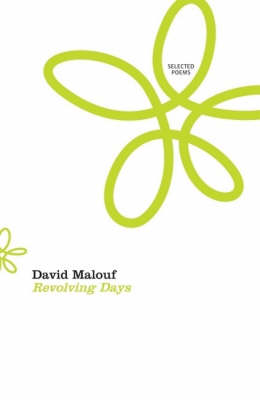
Bev Braune Reviews David Malouf
Revolving Days: Selected Poems by David Malouf
University of Queensland Press, 2008
In the very appropriately titled Revolving Days, David Malouf has put together a selection of poems that addresses the past, place and its importance to self-definition, the memory of houses emptied of family and objects yet full of what's left behind and filling up the present. The poems exhibit a quality which, with political comments more subtle than Les Murray's and longings less romanticised than Robert Adamson's, declares that the places where the emotions taken from another world rendezvous are always present and clear in comprehending the discrepancy between place-and-mind and feeling-and-emotion. Continue reading
Posted in BOOK REVIEWS
Tagged Bev Braune, David Malouf
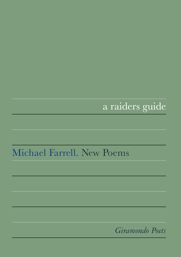
Stuart Cooke Reviews Michael Farrell
a raiders guide by Michael Farrell
Giramondo Publishing, 2008
Apart from a solitary '1,' the first page of a raiders guide is blank. Note the presence of the comma. What it suggests of the pages that follow is a transience between the concrete ('.') and the absent (' '). The book's entry functions as much as a point of departure as one of beginning; we all delve into different interstices. So we come to the first poem: unanchored by a table of contents (which, along with page numbers, a raiders guide does not have) yet, unlike the rest of the poems, it is ordered into dense blocks of text. It's called 'sprinter'; it begins by 'Walking through, in/out: my son a shadow? His mind marks the boundaries…' We are in the mercurial, the gaseous, where pressures force feelings into significations which, almost as quickly, escape through ever-present fissures of syntax. Welcome to Michael Farrell's new book of poems!
Posted in BOOK REVIEWS
Tagged michael farrell, Stuart Cooke
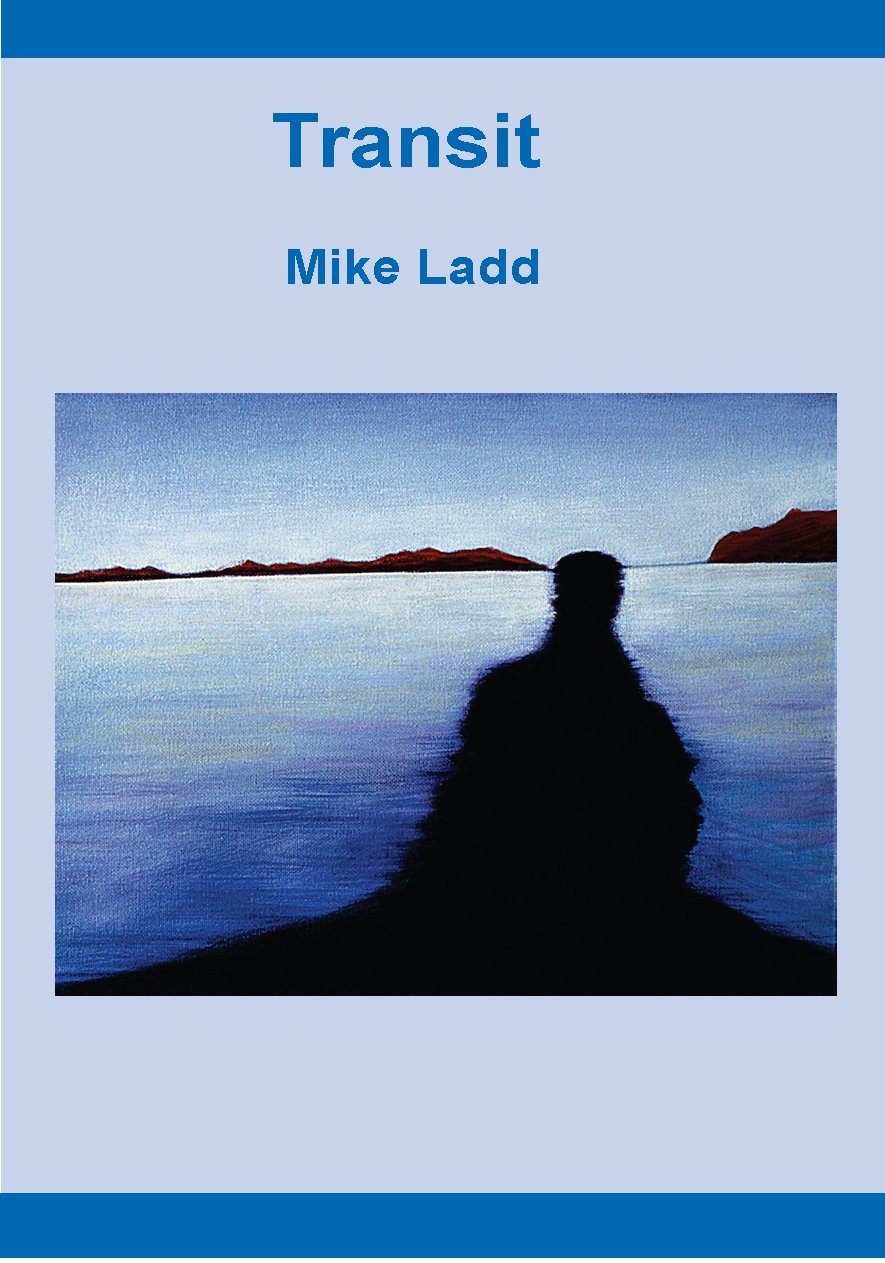
Heather Taylor-Johnson Reviews Mike Ladd
Transit by Mike Ladd
Five Islands Press, 2007
I find it a rare and lovely treat when a poet can become androgynous, or cross over discretely from a masculine voice to one that is feminine. While some of my favourite poets are steeped entirely in one gender or the other and that, indeed, can be their strength, I do want to draw attention to Mike Ladd. Perhaps his ability to move from soft themes of family and imagistic sensations to critical and satirical comments on the modern world is the reasoning for the title of Ladd's latest collection, Transit, because that would explain the great mystery to me. Without that possibility, I have one true criticism of this striking collection and that is the soundness of the title.
Posted in BOOK REVIEWS
Tagged Heather Taylor Johnson, Mike Ladd
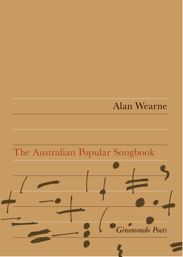
Adam Ford Reviews Alan Wearne
The Australian Popular Songbook by Alan Wearne
Giramondo Publishing, 2008
It seems to me that a poem should – in general – be a self-contained unit, either easily understood or a puzzle that contains the key to its solution. I'm happy to make exceptions for poems written in different eras or countries – such poems might need annotations to compensate for unfamiliar historical or cultural contexts. It's surprising, then, how hard it is to understand the poems in Alan Wearne's latest collection, The Australian Popular Songbook, which bases itself largely in 20th-century Australian popular culture.
Posted in BOOK REVIEWS
Tagged Adam Ford, Alan Wearne
Seven Secret Cities

On place and the page.
1.
A city had never the dimensions of a page; or, if it did, there was no need for the writing of it. Writing is a way in which a city of instances becomes an event. Instances disclose themselves patiently; the intention to account for these translates them into events. The inhabitant, who may or who may not be transitory, writes, and the page opens onto a secret space where instances arrange themselves into constellations: something here can at last and literally take place.
Posted in ESSAYS
Tagged secret cities
Hidden Signs of a City
How does one read a city? More specifically, how does a poet decode, and in turn re/present, the language of a man-made space? In Australia (and other 'New World' constructs) much poetry has been devoted to the natural world; but what can be said of the 'Old World' sense of text, where emblematic architecture, historical sites and other symptoms of civilisation signify as much as gum trees, fauna and billabongs do in Australia?
Posted in ESSAYS
Tagged Ali Alizadeh, secret cities
Paper Object Town
dear jones: i should never have come this place it is beyond desolation there are no sunsets and honey no hat-tipping neighbours friendly milk vendors nylon magdalenes mothers and ballpark heroes only a slow and lecherous infestation your organs a darkness so complete you do not inhabit this place it inhabits you. on fire escape stairs i smoke from a makeshift pipe each night something new a length of discarded pvc tubing copper pipe from a nearby construction site even a rearview mirror you attach to the side of your car when you tow a caravan on those long family holidays where all you see and hear and taste is curled and yellowed with time and turns the veins in your forearm to spaghetti hardened at the thought of sepia-toned wallet photographs. one night i even fashioned a pipe from a plastic pump-action water pistol reservoir great smoke a black milk lung toxin. tongue jaundice. the fruit of starfield road. japanese sirens burn all night colour does not exist it is not permitted. people hang from chains rust in metal vaults the bottle and the drinker who can tell? automobile crash subway fire fatal headshot knifewounds to genitals punctured breast tissue bound wrists incinerated plane crash victim suicidal strangulation by ligature foreign body in airway. drag marks. the footprints of the deceased. a recently vacated room. no signs of struggle. only morning taken as crimson pills. and skin, burning a distant star.
Posted in 31: SECRET CITIES
Tagged paul hardacre
Proportions
Stone bowls,
inflated to the size of small ponds, their brims shimmering with flowers. I see them waiting at intersections, walking the streets, at the square, high in the air, everywhere-
Crows
Each one holds an invisible magnifying glass, and won't be seen without it.
Jurassic Park
Under the sensible deciduous tree, prehistory shrinks to a point of view. Dew trembles upon the intricacies of a jungle: teeming tree-ferns, over-sized flowers, clearings, pungent mud. It goes for miles and miles. I gaze down through a chaos in the canopy, searching for Brachiosaurus, the biggest of them all.
Street lamps
Suspended over rivers and creeks of swirling cobblestone, they are like miniature cable-cars stopped mid-flight, letting light admire the view.
Winter trees,
enormous burrs, catching at the clouds.
Spring shrub
Like fish in a coral from The Giant Reef, yellow flowers collect in its branches, sway in gentle currents, catch the sunlight.
Posted in 31: SECRET CITIES
Tagged Cath Vidler
Chains (Poems, Nagoya)
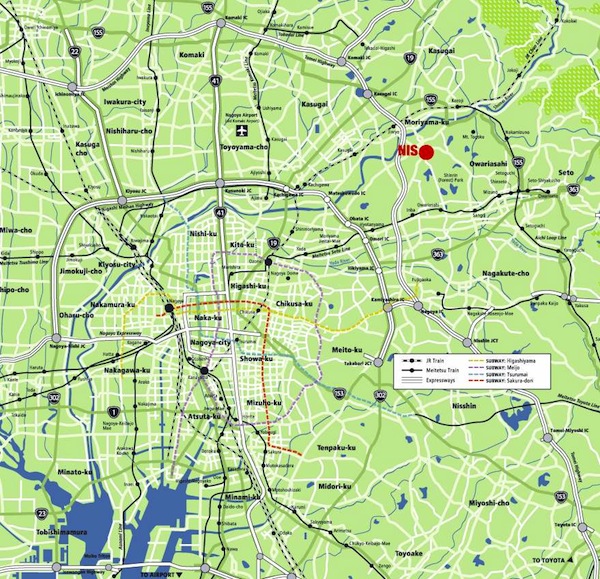
Dating and other unlikely incidents fed the poems I wrote in Nagoya, Japan, in December 2007 till February 2008 (where I had an Asialink residency).
#1 touch & go:
I was bored with my iPod, and lacked the technology to load it with the Japanese CDs I was buying or trading books for. So I replaced the songs with ones from fellow resident Sarah Holland-Batt's laptop (Feds please note this is fiction): including 'touch & go' by The Cars. Nice ambivalent title, and it reminded me of Mary O'Hara's My Friend Flicka: Flicka has a filly called that.
The opening lines of the poem:
Your plastic foallike form
Warms the single flat
& goes waving.
I don't think I was approached the whole time I was in Japan, apart from this one day in Nagoya when two women did so. The first was quite young; she saw me 'reading' a manga (I read the pictures) and asked me about my interest in manga. She was writing something for her studies about the differences between Japanese and Western culture. I showed her my own comic book BREAK ME OUCH and we sat down at the caf?© for something like an interview. Later in the poem I wrote:
yesterday approached on the train,
they noticed my comic. Views of international
Photographer, photographing
how do you read –
Sitting, kneeling
hot books in new york –
This was in Sakae, the central shopping district of Nagoya, and the location of Maruzen, a bookshop that has an English language floor. It was there that I was approached by a newspaper photographer who quizzed me on Haruki Murakami. His latest book was a bestseller in New York, and she had been commissioned by her editor to get a photo of a white person looking at Murakami as if they were in New York. So I posed, but don't know if the photo appeared. Weeks later in Kyoto I met a writer who told of seeing Murakami put down Soseki Natsume as 'not a novelist'.
#2 outside kfc:
Almost a catchphrase, it was a recognisable place to meet people. As a title for a poem it meant being able to write about my interaction with several different people. I'm still a bit self-conscious about the recognisable content in the poem; Frank O'Hara's solution of writing about people by name doesn't suit my style.
Don't think about his mouth, his Goodbye noises, his,
Emails missing or present in your inbox.
[…]
Nothing you Can think Of or to betray.
rupert isn't japanese, black, cravat but not your hair or eyes.
[…]
this time you know him
but hate getting lost
#3 word seen from a bus:
Maybe a word i know. But the mountains are covered-in,
different examples-of forest different water reflects. A bittern rises
from the page like a stick &s gone, it was a vision, white
word of childhood myth. Read unread.
Going by bus to Kyoto on Christmas Day, past forests and very occasional birds, I wrote this poem punning on word and bird. Man, woman and sugar were the only kanji I recognised: man and woman for toilets and baths; sugar, in a largely vain attempt to find less sweet cereal. (Later I learned to recognise open and close doors from lift buttons.)
a word in the river.
Or the sky: hawk
perhaps. Man woman or sugar

Map of the city of Nagoya, Japan.
#4 fried things society:
When I ate out with someone Japanese, in this case the poet and translator Keiji Minato, I asked them to translate the menu rather than the usual point-at-the-picture option. Rather than have them translate every dish I'd find out what categories there were first. 'fried things' was one. I'm not sure now how it occurred to me to add 'society' to the poem's title but something about the lack of custom outside the lunch rush.
A kombu smile on a burger head.
Enough rice to sink life,
They crowd back suddenly, they imitate crows dodos,
one picks up Something like a bestseller. American classic fried sinatra & grace kelly
#5 tendency:
I had no plan to write poems about Japan, just let the references come in as (un)naturally as possible. Motoyama was the suburb I stayed in; I often stay in Surry Hills in Sydney. 'russian prison' refers to two different dates who told me, when I asked about WWII, that their grandfathers had been in prison in Moscow, and both survived. My own grandfather was in New Guinea and souvenired a Japanese flying jacket that I used to wear when we went spotlighting.
a motoyama summer or surry hills winter make breakfast.
Sexy & your friends celebrities its better than russian
prison or hunting a gun & jacket through new guinea.
congrats they punch while the second son gets
bumped down a navy singlet betrays a perfect structure
(a fish & soup diet prevent you
from becoming stocky or even forty)
In Cafe Jaaja in Kakuozan, Nagoya, a man told me about the birth of his first grandchild who was now his 'second happiness', his eldest son (the child's father) being his 'first happiness'. Like an heir to a throne, the second son got bumped.
#6 muzak to view the city with
I heard a lot of muzak in Japan and, as I was there at Christmas time, a lot of Christmas muzak. It got a bit hard to take. Not just in shops but at the gym, and in the poem, in the Higashiyama tower in the grounds of Higashiyama zoo, in Nagoya. That the songs that had been muzaked were often quite easy listening originals made them even more irksome. Like Wings' 'My Love' or Starland Vocal Band's 'Afternoon Delight'. There's something a bit too much about being in a non-English speaking country on a date with someone from a non-English speaking culture and hearing a muzaked version of a song about sex in the afternoon that is from your childhood, but before the birth of your date.
Muzak makes its originals grungy makes
everything real tough.
If i hold my pseudo baby tight i participate
in muzak & remember when
My love, has so much in him he tastes
Like a cloud, im sorry,
For going too far,
Being reckless in making friends
i hope night calms the polar bear
The cloud reference is not about how high the tower was (very) but to Junichiro Tanizaki's writings on Japanese aesthetics, especially in In Praise of Shadows, but also in his novel The Key. Tanizaki writes of Japanese skin as white, but a cloudy white that distinguishes it from the white of Europeans. The bear did seem quite agitated. The zoo resurfaced in another poem,
#7 voluptuary:
An elephants dancing leg, lion statue chained to a wall,
some notes i take with my camera
feathers glued on a sign. Watching old videos
is a mistake, similarly avoid the familiar cafes the zoo denies,
the affinity i claimed i had with snow leopards,
raccoon tongues more fastidious than gibbons.
Scarlet george, hyacinth nick
Those macaws couldnt have met each other elsewhere
The elephant had a chain on its leg: its 'dance' consisted of repeated pulling away from the wall, keeping its unchained feet on the ground.
Posted in POETRY
Tagged asialink, japan, michael farrell, Nagoya, secret cities
Constant Haze (Notes From Chengdu)
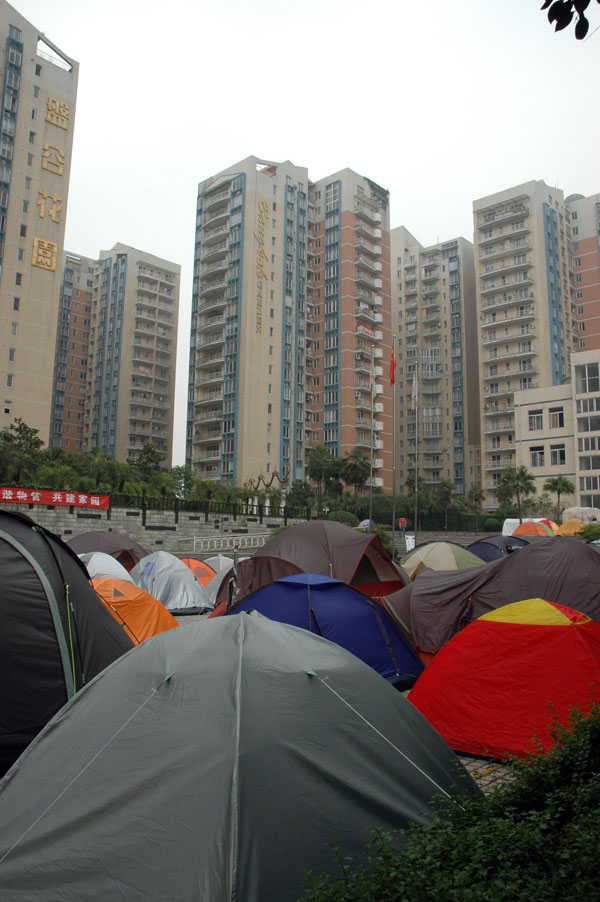
Five weeks and I have still not visited Mao's statue, which stands at the heart of Chengdu's First Ring Road. On the map in one of the city's English language magazines his presence has been reduced to a vector-based outline, a warm-grey fill.
Posted in ESSAYS
Tagged asialink, chengdu, china, James Stuart, secret cities
Dispatches
First: remember it's a foreign country,
Your words spun to remind me
it's a foreign English
fulfilling the promise of years watching white
picket fences on TV.
Posted in POETRY
Tagged Kate Middleton, secret cities
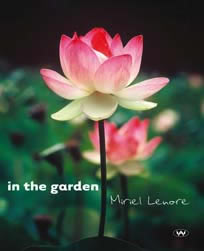
Pam Brown Reviews Miriel Lenore
In the Garden by Miriel Lenore
Wakefield Press, 2007
In response to the effects of global climate change, and probably informed by earlier exponents like natural historian Henry David Thoreau, Rachel Carson, Aldo Leopold, Eric Rolls and so on, the literary genre 'nature writing' has been re-invigorated and a new genre, 'ecopoetry', has emerged in the first decade of the twenty-first century. Miriel Lenore's sixth collection of poetry, In the Garden, reminds me of this, yet, whilst obviously aware of those strands in contemporary writing, it doesn't entirely fit the categories.
Posted in BOOK REVIEWS
Tagged Miriel Lenore, Pam Brown
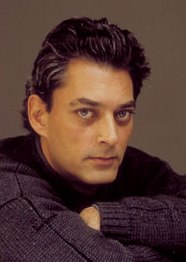
George Dunford Interviews Paul Auster
Paul Auster's career has meandered from poetry to prose to filmmaking, and gives no indication of slowing down just yet. The Brooklyner spoke to George Dunford about collaboration, word-houses, chasing the perfect page, and his twelfth novel Man in the Dark, set to hit shelves this September.
Your next book Man In The Dark has been talked about as a 'political novel'. What can we expect from that?
It is a political novel in some senses and then in another sense it's a family novel and it's also a novel about memory. It's many things all at once. The essential thing to know is that it's an aging man in his early 70s, his wife has died within the past year. He's been in a bad car accident and ruined one of his legs and is pretty much incapacitated, and he's living in the country with his daughter and granddaughter. The daughter is in her forties and the granddaughter in her twenties. It's just the three of them in the country – each one suffering for different reasons. And the whole book takes place in one night as he's lying in bed unable to sleep. He makes up stories to pass the time and to ward off memories he doesn't want to revisit. The larger story that he tells himself during the course of the night is a rather fantastical tale of a civil war in the United States. So yes, there is politics, and the Iraq war is certainly an element in the book, but it's more than just that.
You once said of your writing process that 'every day you learn how stupid you are.' Is that still true?
Absolutely. It's daunting. You make so many mistakes in the course of writing a novel. So many bad sentences come out of your pen that it's really humiliating. I mean it. I do feel quite stupid most of the time, but you keep pushing then eventually if the project is worth doing, something is gonna happen. You'll get there.
The difference between being young and old is that when I was younger if I got blocks I would panic and think that the entire project is about to fall to pieces and I wouldn't be able to push forward. Now I know that if it's worth doing I'm going to find a way, because it's already there somehow, inside me, and I just have to keep digging deeper and deeper and eventually I'm going to find it and pull it out of myself.
How do you keep digging?
I think you just keep thinking. You keep thinking about how you're telling the story and what you're telling and why you're telling- The mind works – particularly my mind – by association, so it's very easy to go spinning off track and make one or two leaps and suddenly you're taking the wrong road. So what we do then is go back to the sentence where you started to go off track and re-think your itinerary.
In the film Smoke you write about a blocked writer called Paul Benjamin. Do you ever experience block?
I've had moments when it's very difficult to write. I think it's true of every writer – most writers anyway – and you just have to live through it and get through it. It's uncanny- I'm writing a new book now. I started a few months ago and it's going very, very slowly. I barely know what I'm doing. I feel there's something to it. It's not that it's not worth doing, but I don't fully understand it yet. And I'm inching along as if I'm crawling on my hands and knees everyday. I'm all bloody from all the gravel that's been ripping my skin apart. Where as Man In The Dark just came pouring out of me. It was as if the book was already sitting inside me and I was taking dictation. It all depends. Every book comes out differently.
What about the good days when you feel like you're really hitting it?
I get scared because I think 'Oy, maybe tomorrow it's going to be pretty bad' so I try not to get too excited. I think 'Alright, so I put in a good days work. Let's hope I can do it again tomorrow.''
Do you still use an old Olympia typewriter?
[Laughs] I still have the same old typewriter. I like it; I'm attached to it. It's a very good machine and I don't see why I should change.
But you're not a complete Luddite: you have a MySpace page-
I have a MySpace page? Well, I never did it. I don't know who did it. I never look. I know there's a website about me, but I don't have anything to do with it. Someone in England started it about ten years ago. People tell me it's rather thorough.
I actually write everything by hand, either with a pencil or a fountain pen. I do have an assistant who helps me answer correspondence and she helps me with practical things. She comes in once a week and we go through the pile of things that I've received and she uses email to answer people. So in a sense I'm taking advantage of it but I'm not doing it myself.
In your work, the notebook is a real trope whether it's The Red Notebook or a found notebook. What makes you keep returning to notebooks?
I always write in notebooks, so notebooks are almost a synonym for writing itself. A notebook is a house for words, so I'm quite preoccupied by them.
Is it true that you believe in writing one perfect page per day?
Some days I only manage to write half a page, some days I write three pages. I work in the notebook and I start changing sentences, crossing things out and writing in the margins. It becomes so hard to decipher. Once I have a reasonable approach to a paragraph I type it up, then I start attacking the typed page with my pen or pencil, then I type it up again. I probably revise everything about a dozen times, twenty times. It goes through lots and lots of changes as I go through the book.
Everyone says that my style is so clear and lucid and easily digestible, well it's because of all the work [laughs]. You work really hard to make it look easy. But it's not easy, at least not for me.
You started relatively late in life as a novelist. Your book Hand to Mouth details your work before you became a writer including work as a seaman, a translator and a puzzle maker. And you can see how these jobs have informed your work – should writers work outside their fields?
Yeah, well it's true, but that was a long time ago now, since I was in those jobs in my twenties and early thirties, but those are indelible experiences and I'm glad of the different kinds of things I did when I was young and the different people I ran across in my travels. I always found that blue-collar jobs were more interesting than white-collar jobs: you tended to meet more fascinating people and to learn more. The work itself might have been drudgery but the environment you're living in is more stimulating. I learnt a lot from those experiences.
There was a long period where I was trying to make my living as a translator, but it meant that I was sitting on my ass all the time. I was translating to make money and then trying to write my poems and essays also at the same desk, in the same chair all day, and I don't know if that's the best way to live.
You yourself had a car accident that left you temporarily immobile and I'm wondering if Man In The Dark isn't a dark imagining of your own life?
I don't really know. I made this big break when I wrote Travels in the Scriptorium, that short book about an old man in a room. That book started with an image I couldn't get out of my head. It was just there. Day after day. Week after week. It was just haunting me. It was very simple: an old man dressed in pyjamas sitting on the edge of the bed, hands on his knees, leather slippers on his feet and he's looking down at the floor. That's what I kept seeing. And after a while I said I have to start exploring this image. What does it mean? Why am I seeing it all the time? I came to the conclusion -whether I'm right or wrong I don't know – that maybe that was a projection of myself twenty or thirty years in the future. Myself as an old man. The book came out of that. This new book is definitely a response to Travels in the Scriptorium – they go together. Travels takes place in one day and Man In The Dark takes place in one night. And this third thing that I'm writing is part of some sort of triptych of novels, all of them having something to do with war in one form or another.
Do you feel like Man In The Dark, as a response to Travels, is in some way unfinished? Is that why you're writing a third book?
I think there's a kind of inner dialectic that goes on in the mind of a writer. You start something and then you think of the antithesis, a response. That's definitely the way my mind works. One work answers another or contradicts it or subverts it or takes in a completely different direction.
For example, early on back in the 80s I wrote a novel called Moon Palace and one of the last things that happens is that the narrator/hero is driving across the American West in a red car and this car is stolen and he continues the trip to California on foot. Now, after I was finished with the book I said to myself, 'I want to get back in that red car.' So I started my next book The Music of Chance with a man driving around in red car. The two books have nothing to do with each other, but there is that link which is the red car.
You've done a lot of collaboration, from the film Smoke to recording music with Brooklyn band One Ring Zero. And the graphic novel City of Glass with Art Spiegelman – what was that like? Is it difficult surrendering your words?
The only thing I asked of them [Art Spiegelman and other graphic novel collaborators] was that they confined themselves to words in the novel: you can cut out as many as you want but don't add any of your own. And so they stuck to that and that was my main concern. I think the visual material is very compelling.
As far as filmmaking goes, I've been involved in making the films. It's not as though I've handed over my books or my scripts to somebody else and let them do it. It only happened once: it was a film version of The Music of Chance back in the early 90s and there I had nothing to do with it. The director wrote the script and was the editor and it was their film entirely.
How was that?
It went okay. I think the film was not bad, it's not great. It's a decent film. It kind of robbed me of the desire to have my books turned into movies so I've pretty much said no to everybody since. I don't think- My novels are too crazy to be turned into films. I can't think how they could work.
I believe there's talk about a film version of one of my favourite books, In the Country of Last Things?
It's the one project I've endorsed. It's a young Argentinean filmmaker and I think he's very talented and passionate about the book, and I think this particular novel is so interesting visually that I think something could be done as a film, but they don't have all the money yet and it's been dragging on for years and I don't know if it will ever happen.
I helped him write the script; we actually did it together. He did a first version then I re-wrote it and then we did a third version together, so I'm implicated and we'll see what happens but I haven't had any news for a long time. I have a feeling things aren't going so well. But that's the movie business. It's absolutely unstable and ridiculous.
He wants to shoot it in Buenos Aires and he's found locations that are very interesting and would work. It's not going to be a film with a high budget, so he's going to have to be very clever in how he figures it out if he gets to make it.
What do you think people would say about collaborating with Paul Auster?
So far I haven't had any complaints.

Posted in GUNCOTTON
Tagged George Dunford, paul auster
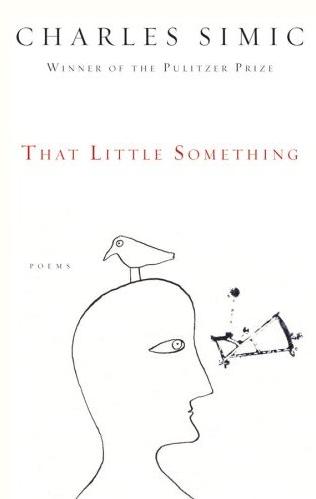
Ali Alizadeh Reviews Charles Simic
That Little Something by Charles Simic
Harcourt, 2008
An interesting aspect of Serbian-born Charles Simic's being chosen as the United States' 15th Poet Laureate is that Simic, partly due to his experience of a European childhood during the Second World War, has often been something of an 'anti-war' poet. What makes this dimension of Simic's work somewhat odd is that the United States is, of course, currently engaged in an interminable 'war on terror'. As such, Simic's poems and his becoming the country's current Poet Laureate testify to the complexity of contemporary American culture, a culture that is both militaristic and pacifistic, selfish and compassionate.
Posted in BOOK REVIEWS
Tagged Ali Alizadeh, Charles Simic
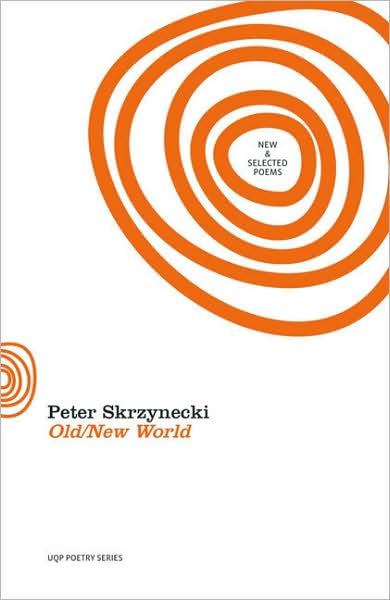
Deb Matthews-Zott Reviews Peter Skrzynecki
Old/New World: New & Selected Poems by Peter Skrzynecki
University of Queensland Press, 2007
Peter Skrzynecki is renowned for his poetic rendering of migrant experience, over three decades, and was awarded a Medal of the Order of Australia 'for his contribution to multicultural literature' in 2002. His Immigrant Chronicle (1975) is a prescribed text for the New South Wales HSC, which has ensured continued exposure for Skrzynecki's poetry, as well as sales of over 20,000 for Immigrant Chronicle. This is commendable, but, of course, it has to be said that Skrzynecki cannot speak for all migrants and the range of their experiences. Nor does he probably intend to.
Posted in BOOK REVIEWS
Tagged Deb Matthews-Zott, multiculturalism, Peter Skrzynecki
Liam Ferney Reviews Billy Jones
Wren Lines: Selected Poems and Drawings Volume 1 by Billy Jones
papertiger media, 2006
Billy Jones is, by his own admission, 'a recluse in the forest/ with a hardon blissfully alone/ and alive to the fire of cosmic joy' (from 'Riverbank… Extracts'). This is perhaps why, despite seven collections stretched across four decades, Jones has often been ignored by anthologists. The publication of Wren Lines: Selected Poems and Drawings provides an appropriate time for the reconsideration of the work of this atypical, hermetic bard.
Posted in BOOK REVIEWS
Tagged Billy Jones, liam ferney
Concentrate on the Utensils’ Constructions
It is not uncommon to accept dinner invitations here.
An evening with a Chinese ambassador, a Chef and a Snake Charmer is unexpected.
The dates are closely timed. Each man wants me for himself.
A tour bus arrives to cheer the Snake Charmer. It's his best show. The great serpent speaks with the man's face. There is a disturbance of waterpools, a trapdoor flapping on its hinge.
Briefly-dressed, the ambassador's wife, layered in an oversized suit of bright red shirt with pink sequinned glittering pillowy blouse, compliments the Chef.
As made-up dolls speaking like the living is expected to and seems and does, we eat purple-goldish blooms from chairs made of hanging stones strung together.
It helps to choose a large restaurant where I can concentrate on the utensils' constructions, the many slant corridors, the low-lit wide rooms.
Posted in 31: SECRET CITIES
Tagged Bev Braune
Wikipedia
What is this on Wikipedia's web?
The delicate feelers of a roach
caught behind the screen?
What exactly is it? A piece
of a nun's habit, a headdress
she forgot to put on?
What? The wing of an insect
torn off by an impatient child
trying to understand flight?
Maybe, the finely curved spine,
and wispy bones of a small
rodent, flesh rotted away.
A white linen cloth, and
a broken napkin ring? I see
it is a book with open pages.
Like the British Sunrise on doors,
knowledge reigns over all
and is never completely set.
Posted in 31: SECRET CITIES
Tagged Nancy Miller
A City
Children's laughter and their mothers'
gossip was returning to the market place
after years of random kidnappings,
suicide bombings and sniper attacks
but caveman needs evolved into beliefs
too powerful to remain at peace:
an invisible guide born in a dream vision,
delivered a set of laws by voices
and tribal hallucination so loving death
was the rock and a compendium of dogma
and cruel solutions interpreted from sacred
texts bubble in the acolyte mind, and anger
makes 'terror the human form divine'. Amen.
You send your neighbours a holiday bomb.
Posted in 31: SECRET CITIES
Tagged S.K. Kelen
at the experimental art foundation
first rain in months what little hair i have plastered on my scalp as i
cross the wet city to leave some copies of micromacro at the dark
horsey growing from the grating framed in red brick and
aluminium is a 3D cloud blancmange sculpture it could be an
installation in detergent for the experimental art foundation growing
bursting now tumescent now diminishing some
pieces breaking off whipped up into sky
ken bolton says it happens all the time dishwashing water roadgrime
& surfactants agitated by stormwater regurgitated back up the grille.
no point leaving more than three books. no-one's buying poetry.
perhaps one or two might go (to disappear into shelves or drawers
without a trace?)
on the way out a clot of suds sucked skywards in a thermal
insignificant as poetry to be dispersed into a wider universe like so
much puffery.
Posted in 31: SECRET CITIES
Tagged rob walker