Philip Hammial Live at the Globe

[audio:http://cordite.org.au/audio/Philip_Hammial_Prague.mp3]

Philip Hammial live at the Globe Bookstore (13:29)
Prague, 15 April 2009

Posted in GUNCOTTON | Tagged

Michael Farrell Live at the Globe

[audio:http://cordite.org.au/audio/Michael_Farrell_Prague.mp3]

Michael Farrell live at the Globe Bookstore (10:23)
Prague, 15 April 2009

Posted in GUNCOTTON | Tagged

Jill Jones Live at the Globe

[audio:http://cordite.org.au/audio/Jill_Jones_Prague.mp3]

Jill Jones live at The Globe bookstore (8:50)
Prague, 15 April 2009.

Posted in GUNCOTTON | Tagged

Pam Brown Live at the Globe

[audio:http://cordite.org.au/audio/Pam_Brown_Prague.mp3]

Pam Brown live at The Globe bookstore (11:24)
Prague, 15 April 2009.

Posted in GUNCOTTON | Tagged

Stephan Delbos: The Prague Micro Festival Poetry Series

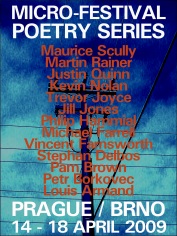
prague_festival_poster1In our latest feature, Stephan Delbos recalls some highlights from the inaugural Prague Micro Festival Poetry Series, held in Prague and Brno between 14-18 April 2009. To accompany the words and images, Cordite presents five live recordings of readings by Australian poets Jill Jones, Philip Hammial, Michael Farrell, Pam Brown and Louis Armand at the Globe Bookstore on 15 April 2009.

Continue reading

Posted in ESSAYS | Tagged , , , , , , , ,

Bridie McCarthy Reviews Going Down Swinging and Indigo

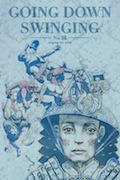
Going Down Swinging 28 edited by Lisa Greenaway & Klare Lanson
Going Down Swinging Inc., 2009

Indigo: Journal of West Australian Writing Volume III edited by Donna Ward et al
Tactile Books, 2009

At the level of function, a literary journal produces a collection of writing on a periodical basis. However, a journal is also another kind of machine, an apparatus which generates a readership, presents writers, exercises its own ideological assumptions (however loosely formed or evolving), and which makes claims to a certain cultural space. At this discursive level, Going Down Swinging and Indigo are very different animals.

Continue reading

Posted in BOOK REVIEWS | Tagged , , , , ,

A Nest of Cinnamon

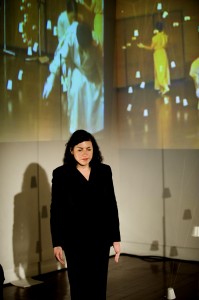
Angela Costi, during a Melbourne showing of 'A Nest of Cinnamon'Combining poetry with music to create a spatial dialogue is common practice. From Sappho to Leonard Cohen, Anne Sexton to Alison Croggon, Eric Beach to Kieran Carroll, there are many poets, from our past and modern times, who have engaged in a mutually rewarding collaborative process with musicians for the stage. The opportunity to present a poem off the page and to have it imbued with another form of metre, rhythm, beat, tonality and sound can etch the poem into memory. But what if the music or sound is unfamiliar to the poet? What if the music or sound comes from a place the poet has never travelled to? These questions, and others, presented themselves as I found myself agreeing to be part of an international collaboration involving my poems, a Japan-based musical troupe known as Stringraphy Ensemble, and Wang Zeng-Ting, a world-renowned performer of an ancient Chinese reed instrument known as the Sheng.

Continue reading

Posted in ESSAYS | Tagged , ,

Emmett Stinson Reviews Kent MacCarter

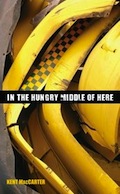
In the Hungry Middle of Here by Kent MacCarter
Transit Lounge Publishing, 2009

The three sections of Kent MacCarter's excellent debut collection are marked by recipes of an imaginative kind. In 'Fruit Salad with Papaya-Mint Sauce' he instructs the reader to include 'Ounces of fresh goddamn seedless everything', which serves as an apt description of the collection as a whole. MacCarter's poetry is a sort of mulligan stew that seamlessly blends landscape, as Japan, New Zealand, Australia and various locales in the United States coagulate into a coherent vision.

Continue reading

Posted in BOOK REVIEWS | Tagged ,

But Is it Poetry?

In this special feature, Emilie Zoey Baker presents the strange and wonderful aural texture that is sound poetry. Sound poetry highlights the phonetic aspects of human speech: it is poetry that has gone way beyond words, beyond the mathematics of language. It can be anything – just the sounds you hear in your head. It's free, alive and nil by verse. Unsurprisingly, sound poetry is primarily intended for performance, but it can sometimes make its strange shapes on the page. Scroll down and enjoy an interesting taster's plate of sound poetry from Canada, the US and Australia.

[audio:http://cordite.org.au/audio/Peter_Murphy_Um.mp3]
Peter Murphy
Um

Peter Murphy writes poetry, short stories, plays and takes photographs. His poetry books include Glass Doors and Lies and Snapshots. His short story collections include Black Light and The Moving Shadow Problem. Murphy says of his own work:

My kind of sound poetry often involves variations on words or statements. I mix obvious jokes, metaphysical word games, one-actor mini-plays in which words break down with an exploration of how sound moves through the body and how the body moves with sound. In a number of poems over recent years, including 'Um', I've been exploring some of the small sounds in the voice which stand out when it isn't loud.

[audio:http://cordite.org.au/audio/Ania_Walwicz_Begin.mp3]
Ania Walwicz
Begin

Ania Walwicz's most recent work, Palace of Culture, is a collection of prose/poetry texts based on dreams. Using abstraction of language, condensation and displacement of subject matter, Ania encodes self-reflecting and self-analytical diary material in a performative mode. This challenging work, strongly influenced by Surrealism, Psychoanalytic Theory, musical composition (language as sound composition) and vocal techniques (performative monologue), immerses itself in sound language textures by re-enacting psychological states.

[audio:http://cordite.org.au/audio/Jeltje_UQ_Them_Took_Us_From.mp3]
Jeltje & Unamunos Quorum
Them…took…us…from…to

jeltje's been convening poetry performances at La Mama Poetica since 2004, and in 2007 produced and performed with UQ in La Mama Poetica: Voiceprints for the Melbourne International Arts Festival, which featured live works by visiting Japanese sound poet and composer Tomomi Adachi, Sydney-based poet Amanda Stewart and groundbreaking performances by 6 Melbourne polypoets.

[audio:http://cordite.org.au/audio/01 I Know Very Well How I Got My Note Wrong.mp3]
Jeltje & Unamunos Quorum
“I Know Very Well How I Got My Note Wrong”

Unamunos Quorum (Sjaak de Jong, Anna Fern, Mark Lewis, Eliane Mortreux and Polly Christie) is a soundpoetry/performance art group that has for over a decade relentlessly followed the path of improvisation in the development and performance of their material. They have worked on a regular basis with the poet jeltje building a repertoire of word- games and sounds- capes that augment her recordings and performances. They write:

Initially, the poems determined the musical forms but the poetic forms, in turn, have changed and/or have been crystallized by the interaction with the music. Sometimes the poetic form actually defines itself in the process. We think “jeltje and UQ” has at times been a true meeting place of poetry and music.

This piece, originally titled ‘Mirror Man’, was written by the late Jas H. Duke (1939-1992) who was born in Ballarat, Australia. He worked as a draftsman/ laboratory assistant/ technical writer and dreamed of becoming a chess champion (but didn't quite make it). As a substitute he read every book that he could find.

In the 1960s he became an Anarchist, wrote short stories and was desperately looking for a way to break-out! He went to England via the United States, where he circulated in the politico-psychedelic underground. In England he sought the camaraderie of Freedom Press; met Ted Kavanagh, Cohn Bendit, Yoko Ono, and Raoul Hausmann.

Duke became a political activist, and an actor who appeared in many underground movies by filmmaker Jeff Keen. He came back to Australia in the early 70s. He published a surreal novel Destiny Wood printed in 1978, which includes poetry translated from the German, and a section of Concrete poems.

He became an active member of Collective Effort Press, where he was involved in many small press publications, including the groundbreaking 925, a poetry magazine for the workers, by the workers, about the workers\' work.

Duke was also involved in the first Visual Poetry Anthology in Australia, Missing Forms, published in 1981 by Collective Effort Press. His last book, Poems of War and Peace, was published in 1989 by Collective Effort Press.

[audio:http://cordite.org.au/audio/Max_Middle_run scrummee.mp3]
Max Middle
run scrummee

[audio:http://cordite.org.au/audio/Max_Middle_Zedders.mp3]
Zedders

Max Middle lives and works in Ottawa where he has been involved in many projects which have as their fulcrum a practice of poetry or m a k i n g . u p (among them the Max Middle Sound Project). His work appears in Shift & Switch: New Canadian Poetry. One of his works is currently being shown in the exhibition 'Blends & Bridges: A Survey of International Contemporary Visual Poetry' in Cleveland, Ohio.

[audio:http://cordite.org.au/audio/Geof_Huth_A Tiny Movement towards Backwards.mp3]
Geof Huth
A Tiny Movement Towards Backwards

[audio:http://cordite.org.au/audio/Geof_Huth_Intense Yields.mp3]
Intense Yields

Geof Huth has lived in Africa, Europe, the Caribbean, and North and South America, all the while using language for his own purposes. His interest in language turned him into a poet, a visual poet, and a thinker on words. He works words in many media: condensation, crayon, frost, object, paint, pen, pencil, pixel, pollen, sound, type, and video.

His most recent books of poetry are “texistence” (300 one-word poems co-written with mIEKAL aND), “a book / of poems / so small / I cannot / taste them” (78 micropoems around the topic of winter), “ENDEMIC BATTLE COLLAGE” (the first publication of a suite of digital poems written in the 1980s), “Gingerbread” (a long poem retelling a fairy tale), and “Eyechart Poems” (27 visual poems).

Huth writes:

Occasionally, I produce sound poetry that is performed off a script, even a script for more than one voice, but those are exceptions. Most of my sound poems consist of what I call extemporaneous poemsongs. These poemsongs grew out of my play with oral language. As I worked around the house or drove myself to and from work, I would sometimes sing a song to myself-the song might be quiet, almost whispered; it might include screaming and pounding on the floor; or it could veer between the almost silent and the screamed. Every part of these songs is invented on the spot: the glossolalic words, the melodies, the occasional rhyme-and most of them are lost immediately upon being created. The best of these I have performed only for myself, though I also end almost all of my poetry readings with a performance, sometimes dramatic, of one of these poemsongs. The point of these pieces – beyond the assumed aural beauty of some of them – is to create a language for song on the spot and investigate that meaning within oral language that exists outside the realm of the word: how intonation defines emotion, how music trains the listener's ear to keep listening, how the physical movement of body sculpts meaning, how generally non-linguistic phonemes (such as clicks and whistles) might be incorporated into supposedly linguistic utterances.

I have saved some of these poems by videotaping my performances of them, and recently I have begun to tape the songs I sing otherwise only to myself. What I've noticed is that this new way of creating is more similar to writing, since I can save what I create and since it is encouraging me to investigate a wider range of sounds. Many of my recent pieces are more spoken than sung, more theatrical than musical. In the end I do all of this to understand and extend meaning, and to entertain myself. For me, the play's the thing.

Posted in ESSAYS | Tagged , , , , , , ,

Heather Taylor-Johnson Reviews John Foulcher

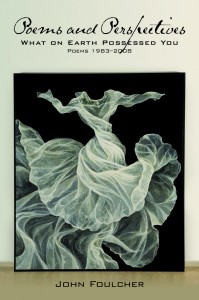
What on Earth Possessed You: Poems 1983-2008 by John Foulcher
Halstead Press, 2008

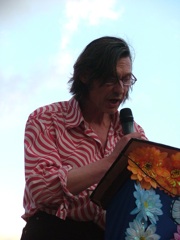
I read the first three quarters of John Foulcher's What on Earth Possessed You: Poems 1983-2008 in one sitting, without picking up my pen. So enraptured was I with these twenty-five years worth of collected poems and a handful of new ones that I ignored my call to duty as reviewer in those first fifty-one pages, avoiding even mental notes, because I didn't want to break the seamless stream of one poem to the next. Reading poetry that consistently flows is truly a rare treat. Poetry is often a complex beast dressed in radiant robes, so usually one stumbles over a jolt in rhythm or a difficult word or some obscure detail pertinent only to the poet. But Foulcher's poetry feels natural, and it feels right; hence the flow.

Continue reading

Posted in BOOK REVIEWS | Tagged ,

David Prater Interviews Arjen Duinker

Arjen Duinker, by David HowardPoet, raconteur and cryptogrammer Arjen Duinker may be one of the few writers living in the Dutch city of Delft. Cordite editor David Prater caught up with him recently for a wide-ranging discussion about books, writing, festivals, travelling and Australian Customs sniffer dogs …

DP: Arjen, the first question I wanted to ask you is – obviously, I'm interviewing you today as a representative of an Australian magazine, so for our readers who maybe have no idea what it is to be a poet in Delft, I was wondering if you could tell me a little bit about your connection to the place where you live?

AD: Well, I was born here in Delft. Delft is a small town let's say between The Hague and Rotterdam; Amsterdam's just a train's hour away from here … so it's the west of the country. I was born here, I was raised here, my school was here – okay, I studied a bit of psychology and philosophy in Amsterdam and Groningen, but I came back and I have lived here ever since.

Continue reading

Posted in INTERVIEWS | Tagged , , ,

Matthew Hall Reviews Les Wicks

The Ambrosiacs by Les Wicks
Island Press, 2009

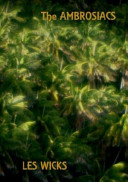
In Les Wicks' The Ambrosiacs visual and tonal senses, shown through a series of relentless escapes and endscapes, create a striking depiction of the poet's perceptions and observations. The fundamental basis of Wicks' collection, and the manner in which the reader is encouraged to approach them, is as an elegy: a series of memories and dedications aiming for the preservation of the instant, even if the instants are acknowledged as fleeting. The elegiac is not only the thematic directive, but plays out an effect of the visual, referenced from the first glance at the obscured palm trees packed densely on the book's cover. The ambiguity produced by the image on the cover references a loss to see clearly, and elides the demarcations between the trees and the sere, as the temporal space between them vanishes into the depths.

Continue reading

Posted in BOOK REVIEWS | Tagged ,

Moya Pacey Reviews P. S. Cottier

The Glass Violin by P. S. Cottier
Ginninderra Press, 2008

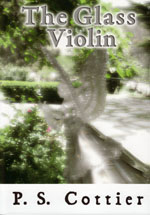
This debut collection by Canberra poet, P.S. Cottier, is striking in its eclecticism. Nothing much escapes this poet’s perceptive eye; her world is crowded and busy, and her poems reflect on and respond to a wide range of mostly contemporary topics and ideas. These include, among many others, injustices (big and small), the marginalised and forgotten, environmental concerns, as well as the nag of the everyday such as how to dispose of a tea bag responsibly or how to take care of one’s teeth. The poems in The Glass Violin are presented in, what appears to be at first reading, a random rush of responses to the arbitrariness of life in the 21st century. But a careful reader will soon discern that there is a sharp, ordered poetic intelligence at work in these mostly short, accessible poems.

Continue reading

Posted in BOOK REVIEWS | Tagged ,

Whip and Tongue

There's no comparison, I know, but sometimes
it's not enough, I lick the underside
to get a taste of how the other half lives;
the salt rising to the surface.

It's not enough, I lick the underside
to pirate, treasure, flag and farm
the salt rising to the surface,
heart voided, albeit briefly,

to pirate, treasure, flag and farm,
words stooked, hand-tied, and lined in rows,
heart voided, albeit briefly,
a silent song, approaching the throb within,

(words stooked, hand-tied and lined in rows)
hums its music, just as slowly:
a silent song, approaching the throb within.
A hungry stethoscope, tucked here and there,

hums its music, just as slowly,
to get a taste of how the other half lives.
A hungry, stethoscope, tucked here and there –
there's no comparison, I know, but sometimes-

Posted in 36: MADE | Tagged

anecdote

lid

dose

riposte

and

key

lions

Yours

Blink

like

pieces

save

is

glyphs

like

as

I

bandiera

'poem'

of

motive

like

salt

&

trousers

i

binder

he

thing

ouch

moratorium

bulge

god's

we'll

Posted in 36: MADE | Tagged

In one tidy [snickering bookstore] package

I'm waiting for someone to count me in.
You can see a faint candlelight.
I look away turn to it, check
you have that white chocolate
and the heat surging through it.

Falling for you, or at least in front of you,
I take your hand in these last nights and wait.
How silly it all seems, lines from special-k
and the floor with blood and honey.
It's always the edges that get blurry.

Perhaps – if I may hazard a simile –
while the sunken lounge swallows me.
Your head like a mixing bowl
gentle on my arm, like breath that stirs
stars suspended beneath the ceiling.

There's no escaping physics or
the unbearable rumbling of the sun.
We must wear our ornamental
emergency siren and blinking high sensitivity
fashions of cruelty.

In this new composition I work
the spaces between breaths,
a library of untranslated prose
leaving an eerie absence
that might have been engine or radio hum.

Posted in 36: MADE | Tagged

Mongolia

the rabbit world
where all wisdom is stored how it discovers
an English guard over the Seine.
Your lover has been made in Sri Lanka
Venetian, vertical – screen your calls
For the part about New York
In the main square in UB city
Mongolia

A Maoist is reading a map
behind us in the kitchenette.
beside the Styx on a green bank that runs to the wood,
plantations.
by a manufactured lake. It shimmers
India 14962 living
Sri Lanka 29755 living
The Philippines 25 living

Posted in 36: MADE | Tagged

Wasn’t

The first day of her trial provided
A crude representation
Of a famous orator
Coming in on the radar

Every speech was moulded
In the thin place between
The word and the thing
No other documentation was required

The path to the sitting stand
Like the vacant blue sky
Lead me to her mind's architecture
Trying to draw meaning from the graffiti

Her audience waited hours
To hear the phrase
But professing to see the Blessed Virgin
She slowly removed the incisors

Now the gap between the beating and broken

Wasn't

Posted in 36: MADE | Tagged

moss y doona

seriously, come

back later

moss

y doona

raised

on mari

achi & sprinkler e

ffects public

ly more

Bangladesh! tidy

wheels!

lousy

though ap

parently glazed

rhythm lake!

hums duplicate

Kylie clock

slopes r

ed

kitchenette lec

ture & come

back later

thought texta

breakfast a

gainst puppy ducks w

orking class

ducks

scratching mossy

on the

metro bruised

plum

age

dishdrainer platz

cutely a

grees

Posted in 36: MADE | Tagged

Mick’s Coos

I.
all over again
the crescent curve of his back
written on your lips


II.
he'd idle behind
spilling over glistening stones
sometimes, not enough


III.
someone imagined him
inside the shell of a car
it looks nothing like you


IV.
crazy dumsaint and
a pronoun. It may signify
caution. albiet

Posted in 36: MADE | Tagged

Erotica

again a soft-focus filter between us
and i forgot where i was
beginning our descent into barbarism:
in ease of darkness
he peeled back the sheet and slid his hands
between shadows
and flickers of saints.
patiently.
the crescent curve of his back
And our breaths intertwine on the world's edge
Lashes to lashes. Sky's shades
his head angled backwards,
smooth neck reflecting the sky.
The light flickers,
we both flicker,
twitch.
to steal under closed doors
then find him, open-eyed and loving.
I don't believe there's anything to say
except, “I was alive like you. Back then.”
When he reads me, I'm reading him
I wish I'd written him

Posted in 36: MADE | Tagged

Benjamin Dodds Reviews Carol Jenkins

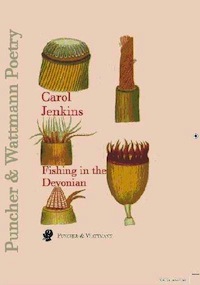
Fishing in the Devonian by Carol Jenkins


Puncher & Wattmann, 2008

Carol Jenkins's first collection of poetry, Fishing in the Devonian, has been identified as a body of great 'scientific' poems. Michael Sharkey's quote on the publication's back cover and Judith Beveridge's pick of the best books of 2008 in Australian Book Review both single out Jenkins's work for its strong use of science. Indeed, Jenkins's own blog refers to her work as 'science-based', and the collection was launched by Radio National's most prominent science reporter, Robyn Williams.

Continue reading

Posted in BOOK REVIEWS | Tagged ,

an ordinary day

and tell me;
how we're
going
to breathe,
in a hallelujah
of blue trees;
go past
in a righteous
gaze, when
even with a
silent song
playing
in one's
veins,
something
approaching
a throb,
historians
cannot
be certain
of the
ephemeral
stuff?

Posted in 36: MADE | Tagged

made things

bookbinder
atlas and fire
a medieval pronoun
makeshift engine

-Do not use boiling water-

skin pores. adjectives
on the underside of a kid
draw the cosmopolitan
in a tree.

this new composition
seasons
the word and the thing
on the unmasked pages.

wind touch
the paper the moulding
a manufactured
entitlement always somewhere else.

-The ghost in the plastic agrees-

breath stirs
old questions in new English.
I measure my length
of time or narrative

living
living
living.

that mercenary ethic
looks nothing, just ingredients
slowly made
from day to night.

what has gone missing
-the fine creation full of holes-
the unbearable rumbling
worse than a clock

you don't see are linebreaks
typed-The salt rising to the surface-
a short lesson
enjoining us to attend more closely

to weaving nothing
half a line
blunt pencils
inkless pens.

the smell of ordinary life
thick with resistance
troubles, leaving an eerie absence
to guide us reliant on reflection.

a path leads
out of these trees
Someone imagined
in the roaring library-

words hand-tied lined in rows
behind the small splinters
and wood grain, teasing out
flecks of leaf. I thought

recyclable materials
are subject to change.
tenderness guarding nothing
must be so hungry.

Posted in 36: MADE | Tagged