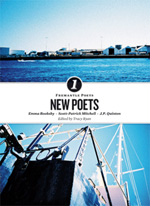
Michael Farrell Reviews Fremantle Poets 1: New Poets

Fremantle Poets 1: New Poets

Fremantle Poets 1: New Poets edited by Tracy Ryan
Fremantle Arts Centre Press, 2010

There is an apt awkwardness and uncertainty in all three poets – Emma Rooksby, Scott-Patrick Mitchell, J.P. Quinton – here: in the expression of sentiment (‘Preparations’, Rooksby), in the use of syntax (Mitchell) and archaisms like ‘verily’ (Quinton). All three are skilled poets, but they are new, and there is a sense that they are still trying things out. As editor Tracy Ryan writes, the three are ‘extremely diverse in tone and approach’ and this diversity is pronounced in a way that would be tempered were there more poets in the book. Ryan’s selected poets represent three modes, rather than merely variety itself. This is not a sampler, however, but three books in one, and perhaps not designed to be read sequentially.

Continue reading

Posted in BOOK REVIEWS | Tagged , , , , ,

A Diasporic Journey: Greek-Australian Poetry in Bilingual and English Publications

Antigone Kefala

It all started for me in 1983 when Dimitris Tsaloumas – a Greek poet in Melbourne – had just won the National Book Council Award for best book of the year with his poetry collection The Observatory, in bilingual form. In other words, he had won an award based on the translations of his original Greek poems, as the judging panel did not have any knowledge of Greek. It was certainly a first for Australian letters. Being then at the stage of finishing my Arts degree at The University of Melbourne (as a mature-age student who had finished high school in Greece), I decided to do my honours thesis on this fellow-Greek, and get to know his poetry. This decision became a catalyst for my subsequent interest in, and passion for writings by Greek-Australians, whether they identified as such, or simply thought of themselves as ‘Australian’ writers (born in Australia, or having arrived in Australia from Greece).

It is interesting how great happenings may start by chance, and I will relate an anecdote about the ‘discovery’ of Dimitris Tsaloumas, the poet. Tom Shapcott, who in the early eighties was Poetry Editor at the University of Queensland Press, had attended (accompanied by poet Judith Rodriguez) a poetry reading at an inner Melbourne library where Dimitris Tsaloumas read some of his poems in English translation. Shapcott, himself a poet, immediately discerned in Tsaloumas a new and different voice in Australian poetry, and invited him to send him more of his translated poems. His instinct proved correct and the result was the eventual award-winning publication The Observatory (published by UQP).

The Australian literary scene during the eighties was rapidly changing from being rather conservative – and dominated by Anglo-Australian writers – to a multicultural one (thanks to the prevailing attitudes of the times, aided by the Labor government’s new multicultural policies), whereby writers could be given awards, including Australia Council grants, for writing in their own language and publishing bilingual editions of their work.

The present article is an attempt to give an expository overview of some of the major Greek-Australian poets of the first generation who arrived in Australia in the fifties and the early sixties. They are: Dimitris Tsaloumas (from the island of Leros, arrived in 1952 and settled in Melbourne); Vasso Kalamaras (from Athens, arrived in 1951 and settled in outback Western Australia before moving to Perth in 1960); Yota Krili (from the Peloponnese, arrived in 1959 and settled in Sydney); Dina Amanatides (also from the Peloponnese, arrived in 1958 and settled in Melbourne); and finally, Antigone Kefala (a Greek from Romania who went first to New Zealand in 1951 and finally settled in Sydney in 1960).

With the exception of Antigone Kefala, all the other writers arrived in Australia as adults, having completed their high school education in Greece and therefore having an excellent command of their mother tongue. Kefala is a daughter of the wider Greek diaspora; born in Romania of Greek parents, she arrived with her family as refugees in Greece, after the end of World War II, subsequently migrating with her family as an adolescent to New Zealand in 1951, and settling in Sydney in 1960 where she still lives today.

I opened this article by referring to Tsaloumas’ winning an Australian award for his bilingual book of poetry in 1983, which became a catalyst for much literary and academic activity that followed through the eighties and nineties. Tsaloumas, however, did not fall from the heavens in 1983. He had been writing profusely, especially from the early sixties onwards, and had already translated 100s of his poems with the help of Philip Grundy – a Canberra-based scholar and literary translator. The same applies to the other four writers mentioned. They were all creating literary works during these times.

As all first-generation Greek-Australian writers have a home somewhere else, it is inevitable that memory characterises their writings. In order for them to make sense of their present situation, they have to examine their past. It is often said that diasporic writers look forward by going backwards. In order to do that, they employ mneme, or memory, the opposite of lethe, which is to forget.

Memory, however, does not imply a spontaneous, or natural flow of images or facts. It has to be ‘constructed’ by inventive and creative writers. A multitude of first-generation writers have written about the past, but for many of them it was not possible to create poetry of a high standard. Nevertheless, their work is still important as a socio-historical document of the immigrant experience. In any case, you need an entire generation of poets to provide the context in which the ‘better’ ones will emerge.

So what was it about Tsaloumas’ poetry that caught the attention of some?

Posted in ESSAYS | Tagged , , , , ,

Asian Australian Diasporic Poets: A Commentary

This essay provides a survey of the poetry of some Asian Australian poets, and does not attempt to be definitive. Diasporic poetics raise more questions than they answer and are just as much about dis-placement as about place, just as much about a ‘poetics of uncertainty’ as about certainties of style/nation/identity.

Susan Schultz describes diaspora as ‘an economic reality, a cultural tearing apart, often born of political turmoil.’1 At the same time migrant poets resent being stereotyped as poets of loss: As Shen puts it, ‘I am so tired of writing about / being Chinese as if it were / a loss’ (from ‘From Ancestral Shadows’). The subjects of this article, Asian Australian poets born here or overseas, and for whom Australia is home, may on the face of it have something deeply in common – a connection to Asia – but how is that connection expressed in poems? What is Asia anyway but a convenient blanket term for a diversity of regions? It is reductive to conjoin Asian Australian poets with that ambiguous hyphen, which runs the risk of packaging ethnicities for an Australian-centric readership.

What we need of course is more close reading of our diasporic poetry, which can be situated within an international literary network. It is fascinating, for example to read poets from Singapore connecting with those from Hong Kong and China; poets of our Buddhist / Hindu Indian diaspora (Michelle Cahill or Desh Balasubramaniam for example) are interesting to read in conjunction with Judy Beveridge or Robert Gray. Australian Sri Lankan poets may offer Hindu and Buddhist perspectives alongside a gay and lesbian orientation. My own poetry shows strong modernist European and American influences, though all my collections have referenced ‘Asia’ as a site of cultural knowledge and inheritance, as a zone of travel, and as a “text” about Australia’s Other. I prefer the more rhizomic (or de-centred) model of reading that can complement a more Australo-centric view. We must acknowledge the differences in reception for those poets who do not directly engage with Australia, and whose inspirations originate elsewhere beyond our borders.

For a start, diasporic literary influences, styles and forms vary enormously: from the traditional verses of Ee Tiang Hong, Yasmine Gooneratne and Sudesh Mishra, to the pared back objectivity of Debbie Lim, or James Stuart’s and Bella Li’s postmodern texts. The voices of these poets are not always fixed rigidly to place or identity and offer something innovative and performative. Nevertheless, there is something these poets have in common: at least one of their parents or grandparents was born in countries that we define as part of the region to our north and east, a region that includes South Asia (India and Sri Lanka), Pacific / Oceania (Philippines, Fiji) and Southeast Asia (Thailand, Indonesia, Vietnam, Malaysia and Singapore). Others are from more northern Asian regions.

One poet, Andy Quan, enjoys triple hyphenation as Chinese-Canadian-Australian. He uses this a complex embodiment to address the fundamental challenge of being gay AND Asian in a straight world. Quan’s poems are rhetorically rich, political, but charming rather than aggressive:

Is this somebody you could trust with your life? 
Somebody you could trust? Who you’d leave your
child with? With whom you’d have a child? Who 
you’d loan sugar to? Who you could learn something
from? Is this someone whose name you’d forget – after 
sleeping with? Is it someone you’d trade seasons with? 

(from ‘Is this?’)

In the context of a transnational flow of bodies and influence, hybridity challenges the notion that a poet should become the voice of the nations they live in or originate from. For many Asian Australian poets, cosmopolitan cultural influences dominate the nationalistic. In particular, English language brings this diversity together. The dominant influences of the British Empire / Commonwealth and its Anglo-centric education system has gifted us English as the lingua franca, but many poets have arrived at the Anglophone literary heritage from elsewhere, and apply a kind of linguistic freedom to their poems. Ouyang Yu, for example, a master of English, began his English education in China and completed his PhD in Australia, and this complements his writing and publishing in Chinese, and informs his work as a translator and scholar.

For many, academic study of English provides a tradition to build on and a position from which to critically respond to postcolonial issues. Sri Lankan poet and academic Yasmine Gooneratne skilfully considers the violence of 1980s Sri Lanka in the context of earlier European periods of atrocity. In ‘The Peace Game’, a children’s game becomes an allegory for war / peace, but the key question is the very concept of war and peace itself. Gooneratne’s poetry shows that modernity has failed to civilise the nation-builders, but this is not only the failing of postcolonial societies, but a problem with European Enlightenment itself, which has not quite been able to reconcile the promising ideals of the West with the emancipatory needs of the East. Desh Balasubramaniam’s poem ‘The Zoo’ shows that the migrant who must flee the violence of his native country may also find resettlement in Australia an extension of his trauma:

Fate of war — shunned 
to a strange land
‘Paradise’ said the coloured brochures
Refuge for the abandoned,
	honeymoon pictures 
Left at unversed doors,
new mother, a father—fern trees
Skeletal abode (a two-room home)
Six ‘curry-munchers’ crammed (given 
names)

(from ‘The Zoo’)

Balasubramaniam grew up in the Tamil part of Sri Lanka and his poetry reminds us that anti-colonial struggles create winners and losers. In his words political refugees become migrating chameleons. Others, like James Stuart, travel the region without suffering loss, and interrogate its prosperity. Some of Stuart’s best poems are sited in capitalist Asia – a mobile, postmodern and inter-textual zone where identity is embedded in the economy of desire and in the mediated images of travel and tourism:

It’s time to savour your European life. At the airport
she combs her hair back into the Third World War: 

Style is effortless the same way it’s easy
to have something unless everyone wants it too.

What emerges from urban pixellation is the greyest
of mysteries, furtive glance down an original side street.

You take each such image & let it vibrate 
beneath the weight of two dialects, a single script.

(from ‘Guangdong sidewalk’)

Stuart knows French and Mandarin Chinese, though he stops short of claiming a special privilege as a ‘Eurasian’. Nevertheless, this concern with multi-media representation sets Stuart apart from other Australian poets who write about travel and their Asian sojourns. The poet, or the poem, is like the lyrebird that imitates:

What is branding? The lyrebird has created 
this system & preaches it.
(‘The Lyrebird Variation’2)

In much of the poetry by migrants who are returning to their place of birth after a long absence, history’s burden becomes internalised. The sense of the poet’s exile and estrangement from a society that he / she has abandoned is qualitatively different from the experience of the Aussie tourist in Asia. Stuart registers a common sense of disappointment with the loss of an authentic Asian culture in a city of diasporic ancestry, perhaps Singapore, Shanghai or Hong Kong:

Dim sum, the city’s great tradition: the captain of the steam cart 
makes a beeline for our table, across the vulgar carpet, 
then zig-zags port-side at the last minute. 

We conceal disappointment behind the rain checks:
what can’t you find in a supermarket these days!? 
In Aisle 4: plantation palm oil & the latest flavonoids.
Aisle 6: a numinous stream of crockery & chopsticks.

(From ‘Immortal’)
Posted in ESSAYS | Tagged , , , , , , , , , , , , , , , , , ,

JACKPOT! Editorial

Samuel Wagan Watson

Twenty years ago, I decided to leave university after five weeks into my first semester. I’d worked hard for a year in a pre-tertiary course and discovered a genuine spring of warmth that bubbled inside of me when my college lecturers praised my creative writing assignments. Later, I was accepted into a good university and took English Literature 101. An editor of a literary journal had suggested that my short story writing was lacking in momentum, but critiqued my misadventure with words as having a certain ‘poetic’ quality. His advice was to try my hand at verse. And the rest, as ‘they’ say, is history.

Apologies about the tacky cliché, but it’s true!

But that English Lit 101 professor of mine had other ideas and thought little of my writing. I’ll never forget that day – walking to the bus, the irritating acoustic resonance in the voice of my rational-self telling me to listen to the wisdom of an accredited academic – whilst my creative demons were ‘egging’ me on to spawn some balls and take on a higher challenge. It was a wager against the better judgement of everybody who cared for my well-being. I decided that university wasn’t the place for me.

My place in a university belonged to someone more appreciative of the acquired tastes of academia. I would return home and become a steel-fixer and send poems to three journals a week. It was a gamble that paid off. Now and then, that same university invites me to come in and speak to the students in their English Literature 101 course. And I’ve found a home in this university’s publishing wing with a reliable distributor.

I’d really like to thank the crew at Cordite for inviting me to work on this edition. In all honesty, Kent MacCarter was the actual ‘wheel-man’ on this job! Twenty–four hours after this editorial note was due – and I must apologize to Kent – I received an epiphany.

At the age of 40, I’m resigned to the fact that I have some limitations with this craft of ours. I’ll never be a great writer. Or editor. Writing, as a career, in this global economic climate is an incredible gamble. I wholesomely believe in the capacity of a good mentor and I will testify that you can safely place your money behind a good mentor than a touted creative writing course. And it just so happened that one of my most cherished mentors contacted me as these words were due to be submitted. An accomplished novelist of some standing, he shared with me his miscalculations behind landing a three-book deal earlier in the year. There was a sudden sense of regret in his tone. He specifically used the word ‘miscalculation’ when relaying his woes to me.

I come from a family of accomplished writers and students of the weekend ‘racing form’. My father, on the eve of his first European tour with his maiden novel, put a few dollars on a nag and picked up nearly fourteen grand. Unfortunately, he won’t share his secrets with me. He probably doesn’t want his son to one day stand in a room of strangers and say with a morose lull of dignity; ‘Hello, my name is Samuel, and I’m a gambler …’

Writing is a gamble though. As we all know. I’ve studied the nomenclature of gamblers and the word ‘miscalculation’ is somewhat of a chimera that lurks in the shadows of a practitioner’s conscience. Successful gamblers only take calculated risks – climbing Everest, for example, or eating poisonous fish, dodging cancer, scraping through a nadir in life and knowing up is the only option, examples all of jackpots in this issue’s poems. It saddened me to hear that someone whom I regard as a dear friend, ally and teacher, is feeling the pinch with his accomplishment … that the ‘Jackpot’ of a three-book deal has become a devil in disguise.

As I said, it was a bit of an epiphany I recently received. I’m not going to tell you explicitly what it was. But, occasionally, one must recognise the warning signs lurking in an epiphany – especially at the expense of someone with whom I respect as a wordsmith and has played his cards wisely throughout his career, guardedly close to his chest. This could happen to anyone of us.

I believe the late poet Charles Bukowski adored the razor’s edge of a racing guide every bit as much as the paper-cuts he was dealt in the editorial process of his life’s work. I enjoy reading about his strategic approach to writing far more than his poetry. He had systems for working his horses and working the page. Likewise, from the very beginning of Kerouac’s On the Road, one is thrust upon the roulette wheel of his travels. I carry a dog-eared copy with me whenever I venture overseas, accompanying me through the monotony of departure lounges in so many foreign lands.

Like many of you who have shared the pleasure in keeping company with Kerouac’s ghost – and I hope you agree with me – it is having a destination that quite often begets a journey. The opportunity to have the means to gamble with words is the jackpot that many of us yearn to hit. This issue of Cordite is a big one. The love of my life has a law degree and a degree in English literature, which equips her with a PhD in detecting bullshit. Right now, her editorial advice to me is to stop all this rhapsodising and philosophising and get to the point.

We received a phenomenal amount of submissions – over 1000 poems all up – each writer proving to bare the faculties of illustrious ‘wild card’ talent. My mind’s eye was at times lost in a matrix of visions. How to chose? Thank you – thank every one of you – for joining this round. I am sincerely sorry that we couldn’t publish double, triple, even quadruple the poems we have.

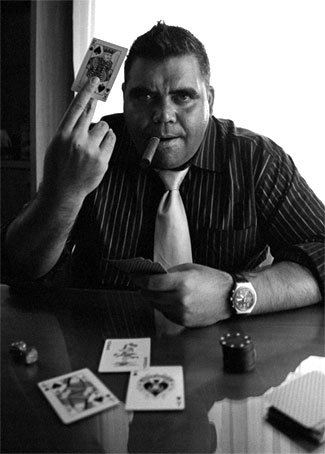
Last but not least, I’d like to thank my extended aunt, Annette Willis, who allowed Cordite to use a photograph from her collection, taken of me at her instigation some years ago in the Adelaide Hilton. I look at the photo today and know I am none the wiser. As a full-time writer, every day is up in the air, but I am prepared to resign myself to the moment when my luck has soured and the dice that put together any winning streak take a course of snake eyes. If there is one thing I have learnt from this game, this grift of writing, is that you must look for the opportunities lingering behind the trump-cards and be inspired by the luck of kindred hustlers … book deals, poems taken, poems published, the lot.

I sincerely hope you enjoy this eclectic jackpot of poetic portraits, and find in their reflections your shadow, captured in the shared viewfinder of our textual addictions.

-Samuel Wagan Watson, July 2012.

Posted in ESSAYS | Tagged ,

Transmissions: 3 Translations of Sappho

‘Transmissions’ comprises of creative translations and selective re-orderings of some fragmentary works of ancient Greek poet Sappho. These compilations emphasise the occasionally violent and manipulative nature of Sappho’s poems, the potential for multiple interpretations through lacunae, and some possible implications of imposing narratives on a poet about whom we know so little and whose works survive only in pieces.


Needlepoint

γλύκηα μᾶτερ, οὔτοι δύναμαι κρέκην τὸν ἴστον
πόθῳ δάμεισα παῖδος βραδίναν δι’ Ἀφροδίταν [fr. 102]
[κ]αὶ τοῦτ’ ἐπικε.      
δ]αίμων ὀλοφ.[fr. 67A]
Ἔρος δηὖτέ μ’ ὀ λυσιμέλης δόνει,
γλυκύπικρον ἀμάχανον ὄρπετον [fr. 130]
καὶ ποθήω καὶ μάομαι [fr. 36]
στᾶθι κἄντα φίλος
καὶ τὰν ἐπ’ ὄσσοισ’ ὀμπέτασον χάριν [fr. 138]
… κὰτ ἔμον στάλαγμον … [fr. 37]
οὐ μὰν ἐφίλησ̣      
νῦν δ’ ἔννεκα [fr. 67A ctd]
ὄπταις ἄμμε [fr. 38]
τὸν δ’ ἐπιπλάζοντ’ ἄνεμοι φέροιεν
καὶ μελεδώναις. [fr. 37 ctd]


Breakage

ἦλθες, ἔγω δέ σ’ ἐμαιόμαν,
ὂν δ’ ἔψυξας ἔμαν φρένα καιομέναν πόθῳ. [fr. 48]
ψαύην δ’ οὐ δοκίμωμ’ ὀράνω δυσπαχέα [fr. 52]

] ςαν• ἔγω τε γαρ [
φιλη [ ] μ’ ἆς κεν ἔνη μ’ [

] φίλα φαΐμ’ ἐχύρα γέ[νεςθαι

]… δ’ ὀνίαρ[ο]ς
] πίχρος ὔμ [fr. 88B]
]θαμέω[ς
ὄ]ττινα[ς γάρ]
[εὖ θέω, κῆνοί με μά]λιστα πά[ντων]
σίνοντα]ι.
]ἀλεμάτ[ων
. . .
]σέ• θέλω
τοῦ]το πάθη[ν.
]λαν• ἔγω δ᾽ ἔμ᾽ [αὔται]
[τοῦτο σύ]νοιδα… [fr. 26]
].αι δ’ ἄμα[
].ανθος•[
]μερον [fr. 78]


Transmission/“Stitching-Up”

Ἠράμαν μὲν ἔγω σέθεν, Ἄτθι, πάλαι πότα
Σμίκρα μοὶ παῖσ ἔμμεν ἐφαίνεο κἄχαρισ [fr. 49]

Οἴαν τὰν υάκινθον ἐν οὔρεσι ποίμενες ἄνδρες
πόσσι καταστείβοισι, χάμαι δ’ ἐπιπορφύρει ἄνθος. [fr. 105A]

Ἄτθι, σοὶ δ’ ἔμεθέν μεν ἀπήχθετο
φροντίσδην, ἐπὶ δ’ Ἀνδρομέδαν πότῃ. [fr. 131]

Τίς δ’ ἀγροιῶτίς τοι θέλγει νόον
οὐκ ἐπισταμένα τὰ βράκε’ ἔλκην ἐπὶ τῶν σφύρων; [fr. 57]

.… Ἔμεθεν δ’ ἔχεισθα λάθαν [fr. 129A]
Ἤ τιν’ ἄλλον
[μᾶλλον] ἀνθρώπων ἔμεθεν φίλησθα. [fr. 129B]

Σκιδναμένας ἐν στήθεσιν ὄργας
μαψυλάκαν γλῶσσαν πεφύλαχθαι. [fr. 158]

Ἕχει μὲν Ανδρομέδα κάλαν ἀμοίβαν [fr. 133]

Posted in TRANSLATIONS | Tagged ,

The Mundiad Book V

The Argument: Having found ourselves unable to fulfill the promises pretentiously pronounced in The Argument of Book the Fourth of The Mundiad, we return once more unto the aforesaid breach of promise in order to essay its repair, an essay which, if not undertaken for Harry, England or St George, nonetheless necessarily nudges against the pretty problems of person, place and patron, problems which, in the present book, prove to centre on the peculiar personage of the Dream Parrot and his often-cryptic, sometimes convoluted communications with our young but stoical if not sceptical or cynical heroine.

That everything that is appears as sign
Implies existence has its own design,
Reduplicating all as if the real
Were in itself a double — and a steal —
In such a way you’ll bounce from wall to wall
Without a bottom to your endless fall —
For there’re no facts to point to as if they
Could ratify the senseless things you say,
Or stop themselves from turning into what
Is sometimes something, and is sometimes not.10

Indeed, as nosy Ovid demonstrates,
Narcissus finds himself in duplicates,
And never realises the waters show
To him himself, an image, and a foe,
So in this volatile triplicity
Can’t seize the you he doesn’t know is me
For this poor fellow will not get that his
Reflective captivation makes him miss
That, in his very difference from his lover,
He turns himself as if he were another,20
And, though he cries “I’ll never give you power!”
He’s rather helpless as a wilted flower,
So that when Echo cries from rill and rock
I’ll give you power!” — it all turns out a crock.

So then Why look at all? I think, perplexed,
Completely horrified by what comes next,
For vision traps, and pleasure’s linger comes
To plug your snorting holes with grubby thumbs,
In such a way that, as you gasp, you bind
And choke yourself, until at last you find30
You cannot see, nor breathe, nor stand, nor sit —
And so you panic, spasm, throw a fit,
Till, in your desperate flailings, all must sum
In an equation of the cold and dumb.

How best to go on? There’s no secret here —
Just make a pact with anguish and with fear,
Then, in the mirrored smoke of golden bowl,
Root out the tender rhizome of your soul,
And crush the fruits that flower on its vine
To pools of ink of deep incarnadine;40
And with that ink then scrawl, in hope and rage,
Upon the tundra of the icy page
A rich psychology, for which word’s purse
Will pay so much perversity per verse
Until the pain you’ve suffered in your time
Entrances bankers with its steady chime,
And, from these agonies of pit and crash,
Can be converted into cold hard cash.1

For it’s in numbers that your life’s accounts
Recoup receipts from dispossessed recounts,50
Inscribing new distinctions that unleash
Unheard-of pathways in the thick of speech,
By twisting words that in their knots untwine
Odd paradoxes, and the heady whine
Of conscience tippling on euphoria —
The captivations of young Mundia.

The last we heard, she’s dreaming by a lake,
But in such detail, you’d think she’s awake,
Except, of course — despite being hours old —
She’s dressed in armour, standing, getting cold,60
In a bleak landscape with a mobile phone
And feeling like she’d like to bitch and moan —
When — suddenly — just as for Sappho love
Unbrains its victims, well, push comes to shove,
And from the crackling of the mouthpiece comes
A voice so brassy that it seems all drums:

— Ark! Ark! Hurrow!
— What?! Who the **** are you?! Mundia yelled into the phone. The birds twisted overhead in intricate polydimensional helices; around her, in the stark and rictus bushes, she could hear the insistently sinister scratching of tiny creatures that she could not see, but whose movements shook the twisted branches in an unspeakably creepy and threatening manner; the sun and moon stared grotesquely from the vacant sky like the particoloured thaumatropic eyes of a gargantuan cosmic madman. The phone crackled again, a pause. Then:
— Hurrow? It answered. Hurrow?
— Who’s there? What are you?
— Ark, hurrow, it’s you! The phone responded, at last!
— Who are you? Mundia yelled again, then, without pausing for a reply: where am I? What am I doing here? And how did you get this number?
— Ark, well, it’s just the way things happen here. No need to worry, everything’s quite as it should be.
— Who are you? Mundia repeated blindly, more and more infuriated with every response proffered by the voice, which, now that she’d heard more of it, resembled nothing so much as that of some kind of talking avian. So she added, tentatively: What kind of bird are you?
— Ark, I’m the Dream Parrot aren’t I, ark?
— What?
— The Dream Parrot.
— What’s that?
The receiver emitted a tentative, repentant, slightly wounded squawk. There was a long silence. At last:
— You haven’t heard of me?
— No, why should I?
— I was under the impression that I was rather well-known about these parts.
— You may well be, but I’m not from around here.
— Yes, yes, I know who you are and where you’re from. I still think you should have heard of me.
— Why’s that?
— I’m an entirely imaginary creature.
— I see.
— So you should.
— Why should I?
— Well, you’re an imaginary creature, too.
— No I’m not.
— Yes you are.
— No I’m not.
— Yes you are.
— No I’m not.
— Yes you are.
— What do you mean?
— I mean that you’re as imaginary as I.
— I’m not imaginary, I’m quite real.
— Ark, listen, ark, little girl, we’re both imaginary.
— What do you mean by that?
— Neither of us are altogether real.
— Are you insane? I’m perfectly real. I’m as real as it gets.
— That’s as may be, said the Parrot, but you’re still just as imaginary as I. And I’m not just playing games with you, neither, it’s not like we’re both imaginary and actual, without being real or virtual, or like we’re virtually real without being actual, or like we’re imaginary and real at once, or some other paradoxical metaphysical combination thereof. I’m just saying.
— What?
— That we’re imaginary.
Mundia felt, not without some justification, that this exchange might well continue indefinitely.
— Well, where are we then?
— You’re in Limbo.
— Limbo?
— Limbo!
The bird’s voice rose to an ear-splitting pitch, cleaving the little word into two unequal parts, viz., “lim” and “bo,” in effect rendering unto the word itself the very placelessness and indeterminacy that it usually merely designated from a safe distance as if with a derisory linguistic index finger. Mundia sighed.
— Limbo?
— Lim-bo!
This line of questioning wasn’t proving any more fruitful than the last. She sighed again. The Dream Parrot, whatever it was, wasn’t the most helpful of interlocutors.
— Where’s that?
— Nowhere.
— Where?
— Nowhere.
— And I suppose you’re nowhere too?
— Me? Ark, no, if I was nowhere, I’d be there in nowhere with you. Then I wouldn’t have to ring you up. We could talk in person, if indeed you can call a parrot a person, and if you can call a furious little new born girl a person, and if you can call imaginary creatures persons, which, given the situation, I suppose that you can.
— Where are you then?
— I’m here.
— Where’s here?
— Can’t say.
— Why not?
— Can’t say.
— Could you be any more helpful?
— Ark, yes, ark, most definitely, yes! The bird replied.
— How?
— Well, little Mundia, answered the Dream Parrot, you need only ask for all to be revealed! Ark! The Parrot sounded quite pleased with itself.
Mundia decided to change tack.
— Tell me a little about yourself, she said, injecting a sharp measure of coyness into her voice, you sound very interesting.
— That’s because I’m a very interesting bird, brayed the Parrot, very interesting indeed!
— Oh, how fascinating you sound, what a lovely voice you have, tell me more!
— Well, I was born a long long time ago, in a place far far away (if we leave momentarily aside the perplexing fact that you, now being in limbo, are exactly as far away from everywhere as from everywhere else and therefore are equally just as close to everywhere as everywhere else, but that’s as may be). I had what you could call, I suppose, a very ordinary upbringing, just the sort of things young parrots do, feasting on regurgitated matter from my parents’ beaks, shiftily shoving my smaller siblings out of the nest, jumping from trees, eating dirt for the good of my inner flora, flying about, squawking, you know, all the psittasistic things one normally does as an average young polly….
— Yes, yes, Mundia interjected, how splendid! Now can you tell me how the sun and moon can occupy the same sky at the same time?
Though the Parrot could certainly talk, it is a truth universally acknowledged that a capacity for language is neither coeval nor equivalent with a capacity for irony. On the other hand, it is also the case that a capacity to suppress one’s capacity for irony often induces others to act towards you as if they were more polite and solicitous than they may otherwise in fact have been. An abyss of interpretation could well crack open beneath their feet or paws, or presumably, as in this case, claws, as a result, in lieu of the real abyss which they undoubtedly wish would swallow you given the base and ferocious solipsism constitutional for most living things.
— Awk, forget that shit, it’s just stage scenery for poetry. The real issue is how you’re going to get out of your parents’ clutches!
That was more like it.
— Ok, Parrot, now you’re talking.
And indeed he was. He — or it — cleared his throat (or beak), and began:

“The problem’s, as I see it, with the dead —
Le mort saisit le vif!2 as French law said —
For all the dead — or living dead — conspire
To grip the fresh-born soul with fangs of wire,70
So that, when the soul’s wings begin to squirr,
The jaws snap shut, a gulp, a smirk, a purr,
And what had seemed quite promising to start
With finds its end by being torn apart.
Upon each living thing you see the trace
Of triune non-life pulsing through its face:
The artefact, the chemical, and what’s
Called apoptosis cast the living’s lots,
Until, contingent on your luck, your life
Is spun, then chopped by their remorseless knife.80
To be a psychosocial being, you are
An individual only insofar
As you’re both pre- and trans-collectivised —
Your being in being is being to be revised —
And this revision’s difference-from-self
Makes you alive and dead, a ghoul, an elf,
At once entirely you, yet really not —
Is there a way to not this knot of knot?
The dead will seize the living — that’s a fact! —
But, still, it’s possible genes can be hacked,90
So, now and then, a creature might emerge
In whom base nature’s truly on the verge
Of tripping into something strange and new,
A Thing beyond what’s dead, what’s live, and you!”

The Parrot’s point, however, proved somewhat
Less definite than this may read — for what
He said was almost lost in crackling noise,
The kind that ruptures eardrums, and annoys
The kindest, gentlest humans till they scream
With rage, the phone from nave to chops unseam,100
And, with the furies shrieking fit to burst,
Cast the dismembered parts to hell and worst.

Almost along these lines, Mundia rent
The phone from limb to limb, but, barely spent,
She dashed its innards hard upon the ground,
Dispersed the shattered fragments all around,
Then leapt again, again, until the dust
Was indiscernible from what was bust.

The phone destroyed, a chilling silence rose
And gripped the landscape by its twitching nose,110
As if to lead the earth, the sky and lake,
Into the nothingness that makes being quake.
(Because such nothingness is infinite,
You usually get there never, bit by bit,
But since time’s of the essence here, we’ll show
A flash of how it comes, so as to go.)


Eds. note: intentionally blank, keep scrolling ...


However — as it goes — this quietude
Was quickly ruptured by sounds loud and rude —
As if the horrid sky and sea had split,
And nothingness had finally lost its wit120
And thought becoming being was better than
Remaining what it wasn’t — from this span
Gargantuan roiling balls of chaos burst
To dance like dervishes who’d done their durst
In patterns so unhinged and complex that
They’d make you take a serpent for a hat
And, as it sank its fangs into your brain,
Choose for the worst as if that choice were sane.
Then, from the depths of this catastrophe,
Which shook and twisted and deranged the sea130
And sky and every little thing between,
Another slew of flames now cast their sheen,
Till out of their tormented centre broke
A noisome jet of incandescent smoke.

Freaked, stunned and choking, Mundia essays
To keep her balance in this noxious haze,
Although the ground is rippling like the fur
Of some enraged and quite demented cur,
And, as she scrabbles, desperate, with her task
In an unearthly light that’s turned damask,140
All stops, so quickly, that this sudden calm
Itself torments, and seems to swarm with harm —
Whereupon the enveloping fog dissolves,
And, in its clearing, a silhouette resolves.
At once, the shadowed figure shifts and splits
So fast the fleeing clouds are torn to bits,
And then — this disappearance done — the form
Appears again amidst the vanished storm.

“O, you’re the cutest thing I’ve ever seen!”
Exclaims our heroine at the small green150
And yellow apparition, with a quiff
So neat and well-pomaded, that the whiff
Of costly hair-product was seen to throw
Across the scene a bright odiferous glow.
The apparition squawks, its quiff alight,
As if quite paralysed by sudden fright —
But this impression was, it seems, just that,
As very rapidly, it turned to bat
Its tiny avian eyes at her, and then,
With a so-calm-yet-so-determined mien,160
Coughed twice (which showed a pronounced overbite)
And with mellifluous voice ‘gan to recite:

“She is goddess, hovering sublime in the empty air,
    Flanks veiled with clouds, in a white mantle,
Hair radiant, soaring on whirring wings.
    She subdues unrestrained hopes, hangs high over
Hostilities, smashes the lofty plans of men,
    Assaults and disorders intemperate schemes,
Imposes just reparation upon shameful acts.
O ancient Mundia, born of silent night,170
    Crowned by sky and sea! Stars light her forehead:
She bears bridle and sacrificial dish in her hands,
    And, always awe-inspiring, laughs and resists mad inspirations,
Subdues wicked vows, and from the heights rolls back
    Shining, and one by one governs the movement of our fates,
And carries off this one and that in whirling winds.”3

The recitation done, a silence rained
As if Lucretian atoms felt too pained
To keep on bolting down indefinitely
Without a break in their monotony —180
As when there’s not an agency to mark
What’s going on, even the light is dark,
And even matter feels resentment at
Going on and on and on and on and on and on and on and on and on and on and on like that.
For going on to stop there needs be,
As Epicurus taught, contingency,
Or, at the very least, some unmeant swerve
To reinvigorate the act, with verve.
If it’s not too ridiculous to say,
Exhaustion here itself had shown the way,190
The very pointlessness thus coming to
The point at which there was no point it knew,
And that may well define self-consciousness —
When repetition starts in self-distress.
What happens after that must be unclear —
It’s not like knowing helps you better steer,
But that each foray into knowing shifts
The act — which stays the same just as it rifts.4

In any case, it incensed Mundia,
Who wanted more than just idealised blur,200
So she, in fury, seized the hovering bird
By its bright quiff, and screamed: “You are absurd!5
I’ve had enough! I need real answers, not
This sound and fury, all this stuff and rot —
If you are going to helpfully advise,
You need do more than simply balladize:
Provide a detailed plan to implement,
Or I will rub your beak in excrement.”

The Parrot — stirred and shaken — shook its head,
But couldn’t free itself, and so, instead,210
Decided that the greater portion of
Its valour was to act as though a dove,
That is, a bird whose sole appeal’s to be
A symbol of peace and felicity.
So, to this end, it gently bobbed and stretched
Its bright green wings, and simpered (not kvetched),
“Wait, wait, young lady, don’t complain and wail —
For you, I have a pedagogic tale.”

“Before he married Oscar Wilde’s mama,
The surgeon William Wilde (yes, Wilde’s papa),220
Had three acknowledged illegitimate
Offspring — of which two met a nasty fate.6
Young Emily and Mary were of course
More unacceptable than a divorce,
And although William’s elder brother had
Adopted them — all knew he weren’t their dad —
And so they suffered the opprobrium
That bastards always have from Fee and Fum.
So, you can easily imagine how,
When one’s invited to a ball, well — pow! —230
The girls’ excitement blew their febrile brains,
And their imaginations ran insanes.
One pirouetted in her crinoline
Before the open fire, without a screen,
When one bright spark flicked out, set her alight,
Her sister ran to help her, in such fright
That she too found herself caught in the blaze,
And so the girls were lost in fiery maze.
Fortuna often takes such fatal turns:
Both died from complications from their burns.”240

— A terrible incident, added the parrot, but it rather raises a question.
— Which is? asked Mundia, curious despite herself.
— Well, it’s simple, but a bit complicated.
— What do you mean?
— It needs a bit of explaining.
— Explain away.
— Well, you know how Fat Oscar ended up in jail?
— Not really, no.
— To a great extent his undoing was his own doing.
— How so?
— Well, the father of the man Wilde had been sleeping with — ***, aka ‘Bosie’ — placed a card in Wilde’s pigeon-hole at the club one day, which read: ‘To Mr Oscar Wilde. Posing as a somdomite.’
— What’s a ‘somdomite’?
— It’s a good question. Whatever it means, Wilde took it as the worst of insults, and sued the father.
— Good for him.
The parrot looked a little perturbed.
— Well, yes. The only thing was, is that the father was the Marquis of Queensbury, you know, the chap who had codified the rules for modern boxing, so he was quite important. Moreover, everyone knew he was right. So Wilde went through a couple of humiliating trials, then to jail with hard labour.
— So it was a kind of suicide on Wilde’s part?
— If you like.
— So what’s the question?
— The question is about betrayal. Or to come at it from the other side, what was going on with their fidelity? Bosie was clearly betraying his father. Wilde was betraying his wife, at the very least. Everyone was transgressing the social mores and legal strictures of the time like they was crazy folks. And it’s not just that they were committing criminal acts. If you have sinned in your mind, and your mind is, let’s face it, the real locale of your life, then have you not already committed a kind of adultery, even if nothing has transpired in what is generally taken to be reality? Aristotle speaks of the akrates — the incontinent man — as someone who knows that what he’s doing is bad, but is incapable of stopping himself by means of reason. And Peter Lombard says that if you lose control when making love to your wife, it’s as serious as committing adultery — you just don’t know who you’re handling anymore. Indeed, how can it be if you don’t even know what’s going on in your own mind, or, at the very least, don’t know that you know what’s going on in your own mind?
Mundia thought about it for a few moments.
— I’m not sure. But you can’t just dismiss the claims of reality that easily. Reality’s reality.
The parrot looked dyspeptically down his beak at her.
— “Reality’s reality” — now there’s a revelation! I’ve already told you we’re both imaginary. That’s not so real, is it? Now that should make you reflect! And why stop there? What’s a wife, what’s a husband, what’s a child, what’s an affair, what’s desire? What to do with the illegitimate offspring of your unacceptable desires? What’s a mind, if volition and action have come apart? And what happens if your beloved child or lover turns out to be a horrible sneaky pervert and shameful criminal who’s blighted your life? Are you, as that child or lover, really up to the task of your betrayal? Even if it’s never enacted, let alone discovered? Questions, questions! Real questions!
— What about my parents, then?
— I guess I’m just saying parents are never really parents. It all depends on you. But you have to know what you’re in for.
— But they’re my parents.
— Sort of. Technically, they’re not even married, are they? They hardly expected you, did they? Neither did they really want you. And nor do they really want you now you’ve arrived, do they?7
— Well, no. Nor do I want them.
— Right. That’s why I’m here.
— To help me.
— Right.
— You’re doing a great job so far.
— Let’s take it one vision at a time, shall we? And I don’t appreciate your sarcasm.
— Just get on with it, creepy dream bird.
— Suit yourself. The Parrot paused. You are a nasty little piece of work, aren’t you?
— Whatever. You going to help, or what?
— I’m just saying that you have to decide what sort of a child you’re going to be. I wanted to give you some real options: innocent illegitimate dying in a conflagration of her own excitement, upon the hint of a trace of the lure of legitimacy; as opposed to a knowing legitimate dying in a conflagration of his own excitement, upon the hint of a trace of the threat of illegitimacy …
— You’re a strange bird.
— Yes, that’s true. I’m an avis rara.
— Whatever.
The Parrot cleared its beak again.

“The time has come,” the Parrot squawked, “to act
Despite the ice-age of established fact,
And be — not spectacle — but for yourself,
So as to seize from sickness a new health,
And crack the frozen seas of metaphor
With language-sword wrenched from the stone of law —
Thus, while you tremble at the water’s edge,
The shattered floes will shift, the wind will pledge
To sail you north or south, to east or west,
To unknown elsewhere, for the worse or best,250
Away from where the accidents of birth
Delivered you upon a glacial hearth.”
The Parrot paused, sententiously, as if
Polonius had paused to pat his quiff,
When — just as he proposed to start again —
His interlocutor cried out in pain:

“What’s this?” shrieked Mundia, enraged, “What crap!
I’ve never heard such puffed-up pompous pap!
(Not even pappy drivels such claptrap!)8
I shall refuse to listen if you can’t
At once improve your idiot irksome cant ¬—260
What sort of talking bird are you, who bleats
And dribbles like a lamb milk-drunk on teats?”

“Ahem,” replied the Parrot, “Why, I’m sure
I’m merely mouthing mindless metaphor.
Apologies, small girl, I’ll hasten to
Tell you precisely what you have to do.
Well, first, you’ll have to feign your own demise —
Turn on your face, turn blue, and turn your eyes
Into your head, so that all can be seen
Are ugly whites; from there, you will be clean270
Away, as everyone will panic, and
Will blame each other for your fate’s cruel hand;
The next you know, they’ll lay you on a slab,
Your little supine form turned breathless flab,
Where you must wait until the time is right
To disappear into transfigured night.
From there, I cannot help — you’re on your own —
Although I sense odd friends, a cat, a bone,
And — ah! — you must above all be alert!
You have a enemy, who’ll steal your shirt280
Before you know it — it’s a horrid Thing,
A metamorph…now this….and now, nothing!
It never rests, it’s constantly awake,
And most deceitful when it’s clearly fake —
Beware! Against its shiftiness you’ll find
You’ll need to be Odysseus in your mind!

“And, finally, my friend,” the Parrot adds,
“Eschew those peoples stricken by cheap fads,
Enmeshed in terror by the tricks and feints
Of wit, rage, cunning, envy, bile — against290
Such dismal sciences of the wannabe
You’ll find the Stoics’ semiology
Locates the joint of logic in our acts
Of speech — and not in ‘judgement’ or ‘the facts’ —
Such that the qualities of objects verb
(Not grass is green, but greening be the herb),
To show how life wields needles of events
To knit the world a cardigan of rents,
So that, through fraying holes, the wise can peep
Into the hairs of Being’s armpit creep.300
The lekta of those old philosophers
Denote, not bodies, but discrete affairs,
Incorporeal simulacra of mind
Which leap the gap between what’s sign and signed,
So that a sage who’s understood the warp
Withstands the weft — but does not cry nor gawp.

“You must now step into this noisome lake —
To leave this dreaming world, you must awake,
And, when you do so, you must not forget
The things I’ve told you — or your fate is set,310
But, most of all, repudiate, cast out
Vicissitudes of world-consuming doubt.”

Our heroine, who had been yawning at
The Parrot’s disquisition’s boring pat
And prolonged nature, felt a shiver run
Throughout her body, like a neural pun
Which, though it feels like x, means something else,
So that the sense, once straight, now swerves like ells,
And, in this swerve, what had seemed logical
Turns Aristotle’s ontological,320
Viz., what is says itself in many ways,
Just as an ass emitting many brays,
Or as equivocation spread on toast
Confuses who is guest, and who is host.
My point, in other words, is when good sense
Becomes this compromised, then no defence
Will save a person from the roll of dice
Existence is, so as the numbers’ price,
You’d better know that, though you feel like this,
Your feeling has got no real way to guess330
What’s going to happen, so the best you can
Do is to follow on what being began.

That novelty may spell oblivion
Should not prevent the thing from being fun,
So, in this vein, then, Mundia decides
To risk the cost of all life’s slippery rides,
And, taking on the Parrot’s strange advice,
Runs to the waters, leaps, and, in a trice,
Her heavy armour drags her cursing down
Into the slimy, weed-choked, green and brown340
Depths where she finds herself surrounded by
Unnumbered sparks of luminosity,
Which turn, on close inspection, into fish
You’d never want to find upon your dish.
Wrapped in this claustrophobic school, she screams
And thrashes fit to burst apart her seams,
But, bound so tightly by that piscine gown,
Our little Mundia begins to drown.

As if responding to her cries and spasms, the luminous sea creatures at once dispersed, and arrayed themselves into natty little troupes, as if preparing to launch themselves into an all-singing, all-dancing Busby Berkeley number. Strangely enough, this was exactly what they were preparing themselves to do. A small luminous striped fish, zany in lurid pink and orange, swam forward to announce:

WE’RE OFF TO BARNACLE BAY; OR, AN ABOMINABLE ANECDOTE OF RHIZOCEPHALAN SKULLDUGGERY

— It’s a nice title, said Mundia, but what’s “Rhizocephalan” mean?
— It’s a technical term, said the Parrot’s voice from above her head, somewhat muffled by the waters.
— That’s not what I asked. I asked: what does it mean?
— Haven’t you heard enough from me?
— Well, I want to know.
— All you want to know will be explained by what you want to know. Farewell for now, my young friend, ave atque vale, salut, au revoir, shalom, arriverderci, auf wiedersehen, sayonara, et tout cela, it’s time to fulfil your destiny! Perhaps we shall meet again, sooner or later, perhaps one sunny aeon or indeed one nightmare epoch … The Parrot’s voice trailed off into the incomprehensible roaring of the sea.
Mundia could barely make out the Parrot above the waves, but there he was, gesticulating with his extremities in what seemed a friendly fashion. ‘Farewell, farewell,’ he squawked again, waving one melancholy claw as he disappeared in a cloud of ink.
The fishy ringmaster glared at her, while the others shuffled about behind, clearly irritated and confused by the delay.
— You ready now? it asked. We’ve been practising for ages.
— Yes, yes, said Mundia, I’m very sorry to have kept you waiting.
At once, an invisible big-band struck up a rousing tune, drums and trombones dominating; the fish began to gyrate in intricate patterns like murmurations of starlings rising in joy over wolds unwittingly weave — although, of course, this troupe or, she supposed, the school, seemed altogether quite too witting about it. Then, all at once, in a vocal blaze of well-choreographed glory, the dancing fish burst into song.

A female Sacculina starts her life
As a tiny slug in the sea;350
She drifts along, her heart a song,
So careless, so footloose, so free!

But when our heroine comes on a crab,
She seeks for a chink in its shell —
Into that joint, she thrusts the point
Of a dagger to take him to hell.

Then through that dagger’s point she squirts herself,
Throwing her old self away;
Turned jelly inside the pregnable hide,
She’s ready to start a new day.360

At once her tendrils feast and grow, she sends
Her roots to everywhere,
She gads about the eyes and snout,
Redecorates her lair.

From that time on, the crab is not a crab,
But a barnacle breeding-machine;
This boss will drive her host alive,
Like a zombie-lord of the piscine.

So when you think you’ve got it tough, or when
The world has turned away;370
Thank all the gods you lucky sods,
You’re not in barnacle bbbbbaaaaaaaaaaaaaaaaaaaaaaaaaaaaaaaaaaaaaaaaaaaaaaaaaaaaaaaaaaaaaaaaaaaaaaaaaaaaaaaaaaaaaaaaaaaaaaaaa
aaaaaaaaaaaaaaaaaaaaaaaaaaaaaaaaaaaaaaaaaaaaaaaaaaaaaaaaaaaaaaaaaaaaaaaaaaaaaaaaaaayyyyyyyyyyyyyyyyyyy
yyyyyyyyyyyyyyyyyyyyyyyyyyyyyyyyyyyyyyyyyyyyyyyyyyyyyyyyyyyyyyyyyyyyyyyyyyyyyyyyyyyyyyyyyyyyyyyyyyyyyy
yyyyyyyyyyyyyyyyyyyyyyyyyyyyyyyyyyyyyyyyyyyyyyyyyyyyyyyyyyyyyyyyyyyyyyyyyyyyyyyyyyyy.

The last ‘Y’ seemed to go on for ever. The creatures glittered and swirled like hundreds-and-thousands at a children’s party. Mundia felt herself spinning wildly, losing consciousness, swept up in the wreck of herself, consigned to the nonexistent depths by a throw of the dice of being, to become nothing more than the evanescent black spume of letters momentarily traced across the otherwise-untroubled surface of the blank waters by her own vanishing.

And thus little Mundia fell asleep in her own dream.



Posted in CHAPBOOKS | Tagged

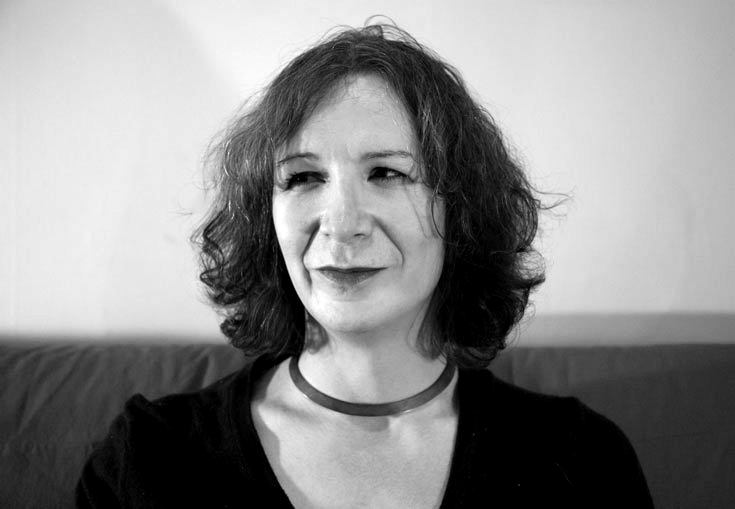
Genderqueer and Trans Poetics: An Interview with Trish Salah


Image by Kaspar Saxena

I had the great pleasure of meeting Trish Salah earlier this year through the University of Saskatchewan. Our talk quickly turned to poetry and poetics, and has continued to be a great blessing to me during an isolated academic term. An interview with Salah, I thought, would present an opportunity for the Cordite readership to gain an insight into transgender poetics from an astonishing lyrical poet and talented theorist.

Matt Hall: In what I thought was a brilliant review of your first book, Wanting in Arabic, Lisa Roberston wrote: ‘I read Trish Salah’s work as lyric, meaning: an exiled voice speaks towards its condition, invents a contingent authority that dissolves into receiver after receiver, mimics centres in order to disperse them in a lucid pleasure, slows down its legibility because it wants to install useless and indeed anti-utilitarian agencies of perverse instability in its readers.’ Can you speak to the manner in which the dissolution of the receiver is, in your first book, mimicked by the transfiguration of the subjective?

In what way does the exilic condition, in its broadest terms, figure in to your poetry and academic work, both as a transwoman and as a Canadian poet of Lebanese-Irish descent? Is there any divorce of subjectivity from politics?

Trish Salah: Lisa Robertson’s comments were very kind, and developed in connection with this extraordinary event Margaret Christakos has convened these last several years: the Influency Salon. The Salon invites both cautious and fervid approaches in the encounter between poets publically reading one another’s work in the context of an audience – rigorously studied and a space which is more of a polyvocal generating machine of poetic and critical discourses than one could ever hope for. So Margaret and the Influency crew enact, name and in situ exemplify an ethics of poetic encounter.

One of the things I most like about what Lisa says is her articulation of poetry as the implantation of useless and anti-utilitarian perverse agencies in the reader. There is a kind of nerve language I want – an anxiety of wanting your wanting – that leads nowhere ‘good’, but is spectrally calibrated to what once was. I guess that’s an exilic dimension: the longing for outmoded or overpowered narrative entanglements with shifting grounds that perhaps still have something to teach ¬– a cultivating of desire’s thickly sidereal quality, which is really about striking a point (making a calculus?) of not knowing, rather than discernible objects.

Reading Anne Marie MacDonald’s Fall on Your Knees, Gail Scott’s Obituary or Abraham and Torok’s Wolf Man’s Magic Word, what strikes you is the familiar feeling of carrying the encrypted secrets of others, whether as gaps or on the surface of things, as a concatenation of overdetermined and contradictory screen memories. We moved from Lebanon because … we never lived in Lebanon. I do think the question of narrative return, of temporal sequence is compromised and constituted by inevitable displacements’ curve around structuring absences – what Eric Santner calls their traumatropism. So does the subject in dissolve mimic the extension outward into/across receivers, or the reverse or neither? I’m not sure.

I’m honoured especially by Lisa’s invocation of Al-Andulus. I’m not a scholar of that period, at all, but Ammiel Alcalay’s deployment of the figure is for me salutary. He invokes it to remind us not to fetishise it, to recall that which Al-Andulus perhaps briefly was before the violent purge of Arabs and Jews from what would become Spain – stretched for centuries across the Levantine world, from the western Mediterranean to the Indian subcontinent. (And not, in turn, to fetishise that – Persia, among others, was sacked; and Alcalay is writing against contemporary, Israeli imperialism, among others.) But Lisa’s talk charts the movement of a polyglot dialogic poetics through the vernacular of women’s songs into Provence forward to Dante, tracing the foundations of European lyric to a disavowed Arab, Jewish and Romance hybridity. Of course that is shocking and an honour to be entered into.

MH: If sexual identity is a complex of discursive practices and constellates a series of power relations, as the political side of postmodern theory and deconstructionist theory would assert, then identity in its multiplicity is a performative construction. How do you relate to the notion that identity is performative? Secondly, how does the manner of subverting the binarism of sexual identity play out in your work, and what effect does this have on the relation to semblance, jouissance and signification within your own poetics?

TS: I have a general sympathy for the articulation of identity as repetition with a difference, performatively instantiated, though I think its dynamism differentiates surface and depth agencies, with relative autonomy (what Freud called id, ego, superego). I also think that it is reductive to forget durability and duration of subjective formation, however much it is politically exhilarating to denounce (and perhaps mirror) a monism of power. With Viviane Namaste, Jay Prosser and others, I need to take exception to the ease with which the early work of Judith Butler rendered transsexual subjects particularly unfortunate and hyperbolic exemplars of melancholic incorporation and gender performativity and its constitutive failures. It seems to me that queer critique of transsexuals/transsexuality was made, and continues to be made, without really taking stock of the cissexual privilege through which it is most often spoken.

With Britney Spears I prefer triangulation to binaries, and I really think the figure of three is the figure for everything that comes after ‘Counting Past 2’, which happened to be the name of a TS/TG multidisciplinary arts festival in Toronto in the late nineties. That space both undid certain binaries, and troubled the idea that gender binaries were really the main issue confronting trans folks.

When we’re thinking about transgender writing and ‘deconstructing binaries’ we’re thinking about transgender in a way that keeps it, and trans people, on the side of figural: transgender writing as a remedy for non-trans (cissexual) lives. If we think of trans people as people, then the question of literature’s utility might come up differently, in relation to how it can function to reimagine the social, articulate experiences of living lives that are marginalised or erased, contending with criminalization, or lack of healthcare. So there is that question of how literature might participate in making social imaginaries and arrangements more just. Counting Past 2, the brainchild of Mirha Soleil Ross, and product not only of her labour but also of countless others (notably Xanthra Phillippa and Mark Karbusicky) was my first encounter with an artistic and cultural space that centered transsexual and transgender people and projects. Though queer spaces have been very important to me, Counting Past 2 was crucial.

I think that along with molecular movements we need molar constellations – solidarities along with free associations. That can get tricky if you’re only interested in your line of flight.

That said, my own poetics is one of dispersed and multiple identifications and desires, of barred and deferred subjectivities, and that does have its relationship to jouissance, the generative and open economy of the possible – but that is suffering as much as pleasure and entails also law and lack. There is a certain amount, always yesterday, crossed out.

MH: For you, is the subject unified to the condition it speaks towards? And can you explain the manner in which the gendered relation is embodied in the lyric form in your work?

TS: My use of the figure of Tiresias, in my new text Lyric Sexology, extends the work of transgendering classical figures and gendered voice in the ghazals, in Wanting in Arabic. I’ve tried to appropriate – reappropriate really – the figure for the beyond. This is what Garber calls the category of crises/crises of categories, which is mapped as sexed subjectivity through Tiresias and many other ‘crossing’ figures. I’m interested in intermingling that construction of a ‘constitutive outside’ (Derrida) with the rhetorical protocol through which trans subjects have been written, erased, and rewritten and re-erased ourselves at different moments. But I need to think a bit more on that.

And while it is all well and good to undo the regulatory logics at a certain level of abstraction, there is also the question of how a person’s muddling along, unremarkably, with life’s small cruelties and exclusions, but also satisfactions and ordinary pleasures, can make its way into language when one is assigned to represent the sex of angels.

Posted in INTERVIEWS | Tagged , ,

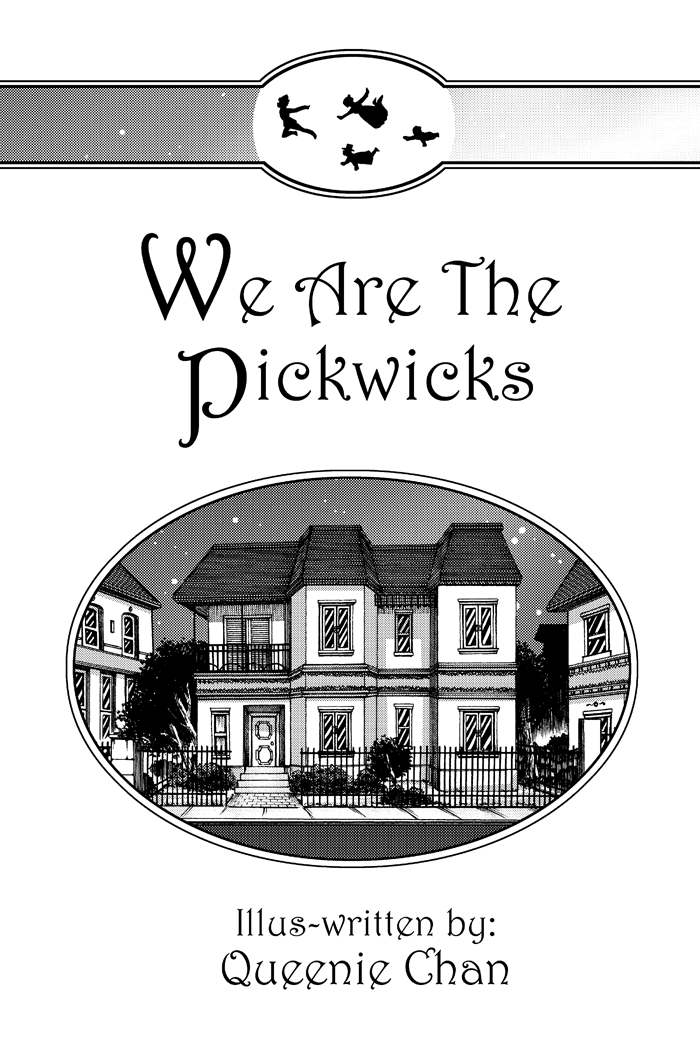
We Are the Pickwicks (extended remix)

We Are the Pickwicks (extended remix)


Posted in ARTWORKS | Tagged

Three Poems and Webb Lecture by the Inaugural CAL Chair of Poetry

Robert Adamson

Robert Adamson began his post as the inaugural CAL Chair in Australian Poetry at UTS in February 2012. Funded by the Copyright Agency Limited (CAL) for three years, the Chair in Australian Poetry is the first of its kind in Australia.

Professor John Dale, Head of Creative Practices at UTS, notes that Robert Adamson was chosen from a very strong field including several of Australia’s leading poets. ‘Adamson’s passion and enthusiasm for poetry will inspire staff and students during his residency at UTS,’ Dale said. ‘He is one of the great poets of place and his presence at UTS will promote the recognition and enjoyment of Australian poetry internationally.’

‘When Seamus Heaney took up the Oxford Chair, he lifted the profile of poetry in the UK and was tremendously popular’, Adamson says. ‘I intend to follow Heany’s example and inspire more people to read, write and enjoy poetry. I intend to share the great art that made this possible, poetry, then build a solid foundation so this Chair becomes a vital and continuing tradition.

Says Copyright Agency’s Cultural Fund manager of the Chair, Zoe Rodriguez

‘We support the Chair of Poetry at UTS because we think it’s important to have a live, practising poet in the role who can have the benefit of an income to write, as well as building connections within a writing school where they will encounter a very receptive and informed audience for their works, and also who want to learn about their craft. It is, of course, a benefit to the students, teachers and other members of the community who come into contact with the poets while they are at UTS.

For Copyright Agency, UTS’ vision of creating a cultural corridor in inner Sydney was one with which we felt a natural desire to partner. The success of the events they host – represented by the packed auditoriums – is testimony to the demand for such cultural engagement’.

Robert Adamson will reconsider poets – over the next three years and in a series of six lectures – whose works have been ‘brushed aside in the onward rush of the post-modern and fashion’. He notes that during the series, he will re-evaluate several great poets whose poetry had been unjustly under-rated. Says Adamson, ‘I want to look at how some of our finest poets are poets of derivation as much as inspiration and why these terms have become unfashionable. I will trace the ideas of reality and imagination in their poetry and what Wallace Stevens called ‘The Necessary Angel”. Documenting the experience is photographer and partner to Adamson, Juno Gemes. Her ‘Chair Insider: An Intimate Access in Photo Narratives‘ is also published in this issue.

The first lecture, Something Absolutely Splendid, looked closely at the life and work of Francis Webb and discussed how he influenced Adamson’s first book. Attending this lecture was Michael Griffiths, Associate Professor of Literature and Language at Australian Catholic University and author of the Webb biography God’s Fool: The Life and Poetry of Francis Webb.

Said Griffiths …

‘Adamson spoke eloquently and passionately about Webb’s importance to continuing generations of Australian poets about the fierce originality of his language and the breadth of his mind breaking through barriers of personal suffering and engaging creativity with a vast array of subjects: mental illness, Australian exploration, music and the natural landscape. Adamson’s own poetry with its crystalline imagery evoking the natural world, in its rich and resonant immediacy, clearly owes much to Webb’s language.’

There was a large audience for this lecture with several Francis Webb specialists present, included Toby Davidson from Macquarie University, editor of the new definitive edition of Francis Webb’s Collected Poems, (UWA Press 2011).

Poet Martin Harrison had this to say of Adamson’s appointment …

‘As it unfolds across the next three years, his lecture series will become a deeply insightful and enduring testimony to the beauty and human truth of the Australian poetic tradition. No other living Australian poet is as well placed as he to look into the heart of modern Australian poetry. He brings practical and personal and profound historical knowledge as well as the huge exploratory achievement of his own poetry.’


Three poems by Robert Adamson

Internal Weather, for Randolph Stow
Listening To Cuckoos
Wombats


Posted in ESSAYS | Tagged , , , , ,

Inferno III: The Hanged Man

The roaches scuttle out from under
old chip packets, kebab wrappers.
One AM on a Sunday; mad as hot
and twice as hell.

I left my voice back at the bar,
hanging in a slur around a friend’s
strange mouth. My tongue cut loose
and danced against my teeth, slipped
up on liquor. I left it there.

And now the street is silent.

Outside an abandoned night spot
the carcass of the New Year dangles
from a silver ball. I wonder
for what crime he hung.

The count-down clock stopped one
to twelve flashes in dreary digital.

Guilty or not
              time’s body swings.

Posted in 50: JACKPOT! | Tagged

The Spaniard

The not completely finished is life
~ Picasso, 1957


Federico’s roofs reflect the moonlight
that slides into my living room and
at midday they reflect the blistering
heat onto the side of my house.

He was a bricklayer
dyes his hair black
and we argue in Italian:

It’s the trees, it’s the leaves.
His gutters are full of my jungle.
I am land conquistadors invaded,
the Amazon
full of hot man-eating orchids
tendrils and fronds that
weave their way into cerebral cortex.

I’m something Indian
with strange ways and stranger music –
the tom tom toming of drums
sweet smoke rises for ritual
dancers wet with sweat.

His land is sanitised
concrete and mowing has cleansed and blessed,
retirement has expanded his empire.
We argue over his drilling and sawing
this music is tireless, virile,
he is Picasso
sculpting the landscape
building workshops, carports, illegal extensions
roofing and roofing and re-roofing.

His terriers growl and bark at the fence line.
Anna, his wife, tells Cheeky, Bartolo and
what’s-its-name to shuddup.
Federico hammers nails into my head at ten at night
while their cat, Paloma
anglegrinds my cat out of my garden.

Posted in 50: JACKPOT! | Tagged

Photograph

for Nana

I would have liked to have known you then
before you served in the war
when your parents were alive
before you        married
                            divorced
                            had kids
                                           watched one die.
I would have liked to have seen you
smile like this
more often
              and to hear you laugh.
Even though I can’t have any of this
or to ask about that time
              or anything,
having found this picture
              helps.

Posted in 50: JACKPOT! | Tagged

Warning to the Gambler

The way in is through thick double doors, between foyered palms, past
elderly stewards kneading hands. Fifty-dollar notes are exchanged for
happy-go-lucky seats, silver-dint-bar-tinkling machines. They lay down
their cards, sit hunched into their rib cage; sink into a consciousness of
play and battle.
In this warning to the gambler, one sees imprisonment and little daylight.
How many gamblers have been trapped in aisled rooms littered
with cigarette ash, zoo noises, furniture oozing years of spilled gin?
How many gamblers have watched two Kings scarper into a barrel turn?
How many have seen the chips scuttle before a fall, that fraction
before a missed fortune?
I have been thinking about the injustice, the raffle prizes paltry
in their wrapping, lukewarm hash browns, that free mother’s day
cup of coffee, and the club’s mounting fortune illuminating every corner.
I want to suggest to the gambler the narrative of despair, the febrile image
of lungs, Svengali at the lucky wheel, scuzzy manager in the Bahamas

                        under bamboo green
                        suave, con moto in moonlight
                        splashing bikinis

Posted in 50: JACKPOT! | Tagged

The 15 Great Dog Pisses of Paris

(after Brett Whiteley)
 
 
1. Off in the distance, a twig, the syphilitic finger of Baudelaire pointing towards any number of vague symbols — his spleen? the soul? an invitation to Pigalle? It’s a mystery.

2. Trailing down in an upside-down V — le Tour Eiffel.

3. Another V, cruising the boulevard above the Seine, corruptible and veering into the flames — Verlaine.

4. Rimbaud was here, on a bender laced with absinthe. After the deluge, he rolled in it then set it on fire, not the other way around.

5. Smudge, knuckle, vulva, miniature teddy bear.

6. Ghost-wizzle, or, the poem as echo.

7. Negative lightning bolt with a Stygian kink breaches the cracks like overflow from the underworld Metro. Bank left or right?

8. Double-squirt. A throw of the dice will never abolish a hazard.

9. Thin black line — another leak, another tributary of the Styx.

10. The most common piddle, a grey puddle to reflect the drizzling sky. Listen to it rain while regret and disdain weep an ancient music.

11. Lightning strikes twice — grey ghost, haunting. Listen to the fall of all the perpendiculars of your existence.

12. Tiny brown elephant head, long thin trunk.

13. Slodge. Shit. Rubbing it in.

14. This one, cornered by the wind, goes wee wee wee all the way down trodden steps to the water’s edge.

15. The River Seine, drunken, dirty, and gushing. Le bateau, frail as a moth, sailing three white sheets to the wind and a little to the left beneath the leers of Pont Neuf and Pont de Sully, steeped in the languors of the swell.


Note: this poem takes some liberties with the translation (or expulsion) of certain lines from Rimbaud’s ‘Le Bateau Ivre’, Mallarmé’s ‘Un Coup de Dés’, and Apollinaire’s ‘Il Pleut’.

Posted in 50: JACKPOT! | Tagged

Shots from the Family Album

You,
playing slow burning dirty
blues with a matchstick
plectrum. A pouch of
Champion Ruby
and a tallie at your
knee.

You again,
sharking pool
black quiff, brown skin and cold
stare. One eye on the kitty
to pay the power bill.

Here you are,
shirtless, lean
smelling of fresh sweat and petrol
mowing our yard while I hang
from your back licking salt
crystals as they dry in the sun

and here,
Father’s Day morning, still
drunk from a poker game, one eye the colour
of steak, unwrapping the present I’d
made you, with somebody else’s
blood on your knuckles.

Posted in 50: JACKPOT! | Tagged

Graceless, Even with Wings

Three wild horses punish the dust.

A butterfly waits for glass to become a rumour.

Once again, I am incapable
of tucking my heart in.
It will kick up, reckless and flying,
beating its wings at cold luck,
losing grace.

The sun may force itself upon the horizon
but dusk will always powder
at this time of year,
with this karma.

And my sun drops everything
for your headland.
My butterfly hammers beauty
and doesn’t see the truth.
My wild, beautiful horses
gallop towards your headlights,
towards your captivating headlights,
and then turn from grace,
head for the dump.

Posted in 50: JACKPOT! | Tagged

Upstream

Cigarette smoke tumbles over lawn-puncturing high-heels,
punchy accessories, splashes of color. Amanda blows smoke rings
that expand toward the stars. My waking age reels
before me amid rocks and retches. It tangles in palpitant strings

tied up between tall cans rowed like soldiers, roadside crosses,
and IV stands; I don’t have a glass to sit behind.
G&Ts offer to soften my edges, pry open my losses,
hum me synchronous with the smoky porch: I politely decline.

The lawn chair sucks onto the backs of my thighs
while I try to dissolve. Elias perfects his French inhale,
as a cichlid transmutation glasses my eyes.
The smoke settles into a film over my hardening scales.

Swimming away under everyone’s kaleidoscopes, I think
how good it must feel to let oneself sink.

Posted in 50: JACKPOT! | Tagged

Mr. Eno, A Brief for You

Can you do 6 seconds of inspiration, optimism,
futurism that is sentimental and emotional?
Sincerely
             Bill (Microsoft)

Sure!
             Blah-blah             Da-da-da

                                            Brian
PS             3.5 seconds okay?

Posted in 50: JACKPOT! | Tagged

Cameraman

As he filmed,
He walked backwards.
He fell on his arse,
Stomach upwards.

from ‘Buwarrala Akarriya’ (Journey East)
Annie Karrakayn & Dinah Norman Marrangawi

the cameraman walked
with his back to history
filming the women

the stone was placed here
in the dreaming
to stop those

who look to the future
without understanding
the past

the cameraman’s feet
danced for an instant
kicking up sand

on film the women
laugh for an moment
then there’s nothing

but sky

Posted in 50: JACKPOT! | Tagged

Midnight Jackdaw on the Jackpot Blacktop

The fact was that everyone was acting on an intention to kill. The knuckles in Cottage Apple’s right palm were flinty pistons rotating beneath his sailing overcoat. When Sapling Delicious was within charging distance of Brick Picnic, something heroic and primordial swam through his bloodstream. Electric Gazelle stared as the twins summoned carnage and life-suppressed spleen down onto the scorning thrill of Brick Picnic atop his motorcycle.

Sapling’s knee collided with his target’s chest as if the sky had tossed him with the pluck of prizefighter ropes. Brick Picnic surrendered to the mercenary grace of his oppugnant. Soon Cottage Apple had joined the fray and was driving his shoulder, with the pride of an unfamiliar stag, into Brick Picnic’s neck. He was claimed by the vanity of the night, by the violence of the street and the sewer-blood pumping beneath its lazy loam. Electric Gazelle sat weeping in the presence of the sweetest, bergamot-soft moonlight, blinking back a tide of gratitude, alone behind the whirring mechanism of the car motor, a spectator to some ancient act of kingmaking. The twins went Rodney King on Brick Picnic. There was blood scored over the pavements and the sweat of the skirmish smelt too fine.

When Edamame Mint’s favourite henchman was genuflecting before the twins and gargling for armistice, Electric Gazelle choked the ignition until it squealed into power and venom once more, and when the brothers deferred to a safe distance with a whip of their hands, our valiant behind the wheel lowered his heel onto the accelerator and palmed the gearstick into second right before Brick Picnic’s droll little frown. The car rolled over their freak antagonist at a handsome cruising speed. By the cold toil of Christ, the bastard looked nought short of a goddamn jackdaw right to the quarrelling end! It’s curtains now, Bubba. Electric Gazelle lashed himself fast to the steering-wheel.

Posted in 50: JACKPOT! | Tagged

Obviously

If you want a “u,” you strike
the “u” key, not the “i,” the “b,”
or the “c.” None of us doubts

the design. It’s obvious to all
who lack the genius to create

an algorithm of such majesty
and simplicity. If you want
sherbet, fruit is the only flavor

whether it’s a scoop of sunset,
cloud, winter surf, or sunrise.

Everybody knows the rules,
and nobody needs to tell you
there are six and a half billion

of us, and each has only one
single soulmate. We all know

the truth. Conspicuous misery
born even in our naked numbers
moves none of us to question

the fact. It’s a rule like a ruler,
narrow, straight, stiff, wooden,

useful to measure our decline
in inches, the shuffle of our feet,
and the trim hedges of our yards.

Posted in 50: JACKPOT! | Tagged

White Lotus Temple

It begins with
a spark. The wind knows,
slipping through the square-shaped mouth
in dark-grey of a brick furnace.
It’s breathing. Flying up.
Bursting into shapeless flames.
There are people, their eyes
telling a sterile apathy, not going with
their obsessive hands to put
the gifts in. They are murmuring
an ambiguous prayer, to the hopping spirit to
morph piles of four-cornered paper sheets,
which take the form of American dollar,
Hong Kong dollar and Chinese Yuan,
into ashes. They turn around and walk away afterwards.

Posted in 50: JACKPOT! | Tagged

The Coffee Bean Prophecies

1

In Laos, when people see Good Luck, they’ll touch you on the arm and ask your name and where you are going. They’ll want to be there when the snake crosses the road, when the monk anoints their wrists with a saffron thread fragrant with sandalwood. Once I saw a rickshaw driver (who’d seen too much of life) flirt with the waitress, the palmist’s daughter, (who was dismayed by his hands). She told him: “Don’t blame your bad luck on migrating gypsies.” There were days I dreaded, those I-feel-disaster-coming-on days. We blamed the curse of the bargain Ukrainian icon I’d bought for a silver coin in Budapest. My wife turned it to face the wall. I remember when the Beachside Good Life Prophesy paid cash-in-hand, when the club boss stepped out of his Porsche, a veritable polar bear turbo-charged in shiny white acrylic moccasins. The turtles would get up from their vodkas and form guides. Three kisses for the Boss! Those were the days, before the sunburnt rioters clogged up the train in spring. I remember how Fotini would dance the dance of smashed plates. For good luck she said. Rickshaw Man remembered when school prawns came wrapped in newspaper. It has remained to this day a luxury in the Andes.

2

So history’s been superseded by a grey funk. The lack of factual reportage in schools, the drought we had to have. It’s bad Feng Shui. It was the Huguenots with their obsession for punctuality. And she was right, always right. It’s 10 years of bad economic management. Too many bad bets on bad folks who can’t pay back. Is it? When they say ‘have a great day’ in the New American Church Bazaar you expected it: Jesus in a Mexican Tortilla, aglow in the shape of a fencepost five minutes before sunrise on November the 12th. If you escaped the tomato factory they called you a diaspora, a lucky migrant. Once, I was lucky to see the Catholic Youth group taking up all the bunks in the Glebe Backpackers and commandeer the PA for a very long weekend. Now I wait in hope. It’s those marble islands, those three garage temples and the Cantonese charlady shouting at me when I was five. We were terrified by the unseasonal gale. But we loved that place before we stared at the future. She foresaw beautiful grandchildren. She saw a Trifecta of arranged marriages so perfect and magical and necessary. Then the missionaries arrived. Where their dark shadow fell, they built their temples of stone. Good fortune wasn’t luck, they said, it was a piece of bone they’d locked in the cellar. It was a glass of blood and a cracker.

Posted in 50: JACKPOT! | Tagged

Internal Weather, for Randolph Stow

I dwell in this bone-cave     rocking cup of skull
histories constantly re-writing themselves     weaving

‘brain-waves’          thoughts drift out from
a fatty backwash   veins crawl with grainy information

blood-cells pushed into the white country
in multiples of ten                           you know nothing is lost

we remembered     sand streamed in syllables
lines breaking into phrases          static-sparks         weather
breaks

rain splattered paper       torn memories     flicker
sparks ping against blue tats      a healthy pink tongue

touching porcelain    internal canals   gushing
  woven nests    waves of fine              fragments of shells

Cannot evaporate, can’t die down—we live
at the world’s expense         devouring         pale after-images

with a bad weather-eye      tails of the serifs
chalk-up        fine stainless blades       score the walls of
arteries

a typewriter of bones   tapping   Morse on the spine’s
fret-work       the philosopher’s a machine     ticking out days

skidding down aisles in supermalls      I stand in the hall
in a column of human breath       the sandy desert

polishing finger nails          hair combed and dressed
a boogie with Mondrian     over leagues of broken weather


Return to Three Poems and Webb Lecture by the Inaugural CAL Chair of Poetry

Posted in 50: JACKPOT! | Tagged