In a book I recently read with my students in an undergraduate translation class, the writer sets forth twenty provocative theses on translation in this era of globalisation for a new comparative literature, ranging from ‘Nothing is translatable’ to ‘Everything is translatable.’1 As for me, translating Korean poetry into English, and vice versa, has always been a very daunting, sometimes impossible, task, beginning in the very point of ‘Nothing is translatable.’ However much time and energy are consumed for translation, I feel my languages, both Korean and English, would never touch the point of ‘Everything is translatable’ but at the same time, I know translation would be the first and final door that I keep going through for comparative literature, for crossing different cultures and worlds. As a translator and critic frequently facing the questions of impossibility of translation such as ‘How can it be possible to translate poetry?,’ I try not to get tempted to give into the fate of translation as transgression, translation as a treacherous activity, keenly aware of the unforgettable moment of fumbling two different languages. To translate poetry, as for me therefore, is to proceed from impossible possibility to possible impossibility and the very force that draws me from the dominant-negative-inevitable potency of translation as transgression or treachery is my humble belief in poetry and literature as living impulse and the yearning for communication in difference. Especially in this era when poetry ‘is beleaguered everywhere,’2 translation would be the very practical space that social and cultural domain of words can flourish again in the experiment and experience, in the absence of real politics of different languages.
Compared to the Western countries where poetry has been marginalized for a very long time, poetry in Korea has constructed a rather happy domain of discourse, taking its existential root in the real history of people, in the politics of everyday life. The overall division between poetry and politics – the one, passive, swoony, not in the business of doing things, and the other, active, gritty, and concerned with reality – does not seem to be applied to the history of Korean poetry. In terms of poetry, Korea has been the real republic of words and the representatives of poets drawn here would prove the wild, wide landscape of contemporary Korean poetry and its vitality. Getting its surviving energy from its unpractical usefulness or useless practice, poetry in Korea has also undergone changes. As noted by various writers, in the Republic of Korea, poetry has long occupied a very active social domain where aesthetic and political aspects of words have been expanded, modulated, experimented altogether. Especially since the 1990s, at once being liberated from the burden of politics or political representation, it has evolved into a more experimental republic of words. The onset of the new poets usually born around in and after 1970s, with their self-reflexive exploration of language and its relation to reality, marks a shift in Korean poetics from what a poem says to how a poem says.
The twenty poets invited here could be examples proving the shift of Korean poetics, almost every one acutely aware of the sociality of poetic language and focusing more on the very moment of poetic utterance in terms of newness. To claim the new, however, is always risky as the new always entails the comparison with the past within the overall ambience of improvement. Avoiding establishing the linear line of improvement, I, in this selection of twenty poets, try to explore a range of modes and directions countering the universal lament that poetry is in crisis. The aesthetic vitality and complexity of Korean poetics is reflected in the poem itself, rather than in the profiles of individual poets. So what I believe in here in this meaningful project as a translator and critic would be the force of language itself, rather than the personal ability of a translator. Passing through the different layers of language, the work is reborn in its new language, as Brother Anthony of Taizé, the most renowned translator of Korean poetry, says in a recent interview:
A poem translated so that it becomes a poem in another language is a different poem, of course. Translation is not anti-poetic as such but the translator of a poem faces multiple challenges. I have often written about the way translated poetry is subject to the same process of “reception” in its new language as any poem originally written in that language. The reputation a poem enjoys in its original language has no significance once it is transplanted into another cultural space; it has to start its career all over again.
When only twenty poets have been chosen from many hundreds, each reader will inevitably find a conspicuous presence of current Korean society, culture, and thinking. At the same time, readers might face conspicuous absences of some other unheard voices, but the absences would in turn form another project to be dreamed or published in the future. Among twenty poets, the names such as Ko Un, Hwang Tong gyu, Lee Si-young, Lee Seong-bok, Ra Hee-duk, and Kim Hyesoon are rather well-known to the English readers as their poetry books or parts of poems are already translated, published, and introduced in English. These poets in the earlier generation, never old in their poetic spirit, show how language brings into play in time and draws the various shadings of beings in this world. The interesting, witty conversation between Buddha, Wonhyo (a Korean monk) and Jesus in Hwang Tong gyu’s poems resonates with a very philosophical thinking blurring the border between life and death. Other philosophical lines in Lee Seong-bok’s poem, ‘Without the Body, Wouldn’t Have Existed’, serenely present the relationship between the body and the sprit, the inevitability of pain in our life, locating the existential questions of being in a most vivid portrayal of landscape.
Kim Myung-in‘s ‘Dating a Jujube Tree’ intensifies the physical proximity of beings in terms of memory. Kim Ki-taek‘s words, focusing on human physicality, articulate the painful and casual relationship of all beings. Park Hyung Jun‘s poems are famous for their beauty of subdued tone, finely grained language and Kim Sa-in‘s meticulous eyes for the lower beings invite readers to touch the heart of every wandering person. Ra Hee-duk and Park Ra Youn‘s poems would be another example of weaving the tradition of Korean lyric voice. In ‘Of Sympathy’, Park seeks to connect the house, a very material territory of a human being, with the soul. In a vivid sounding of everyday activities, these poets succeed in constructing the communal space of living, of leaving, of presence and absence. Kim Hyesoon’s unique voice takes a special site of contemporary Korean poetics. Her language full of bodily experiences explores the inevitable impossibility of I and you, or the field where the possibility of the impossible is tried again and again. Her repeated calling forth of ‘the first’ makes every poetic tongue an origin of poetic utterance and experience. The barking, calling, trailing of mountains in ‘Seoul, Kora’ delineates itself a very public discourse coupled to an acute sense of history or historical consciousness.
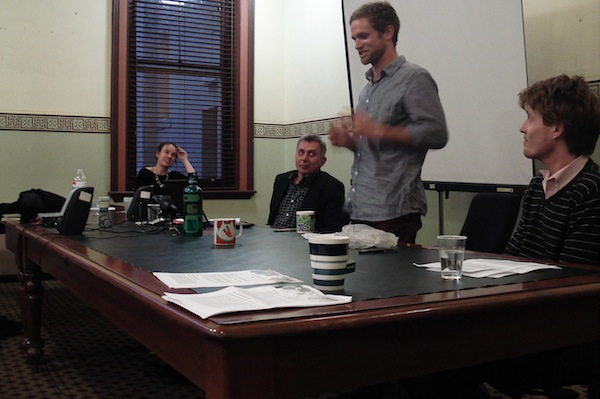
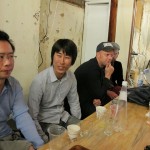
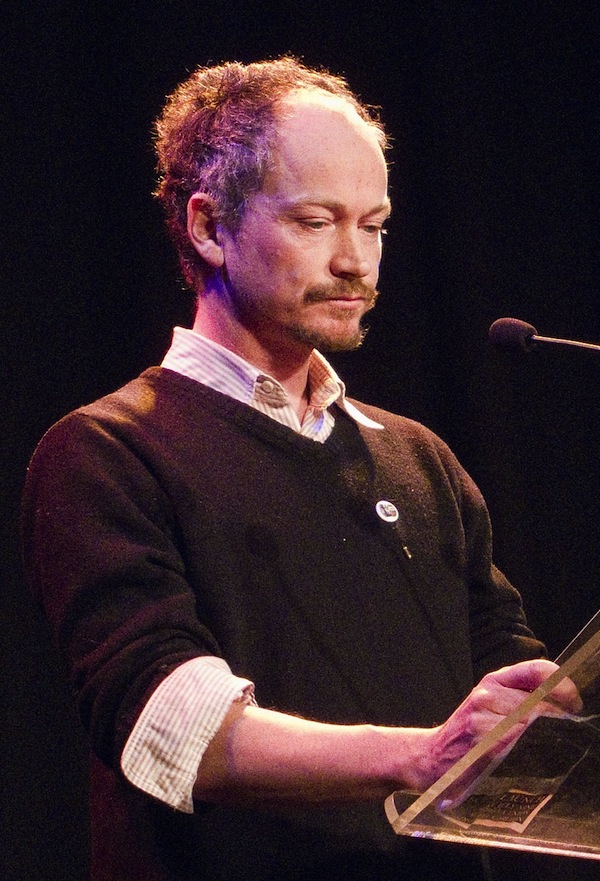 The profusion of book and journal launches in the interstices and evenings at the Bella Union Bar upstairs at the Trades Hall upheld the pertinacity of this symposium’s subject, the contemporary, not only in the present, but the instant. Lisa Samuels’ Gender City was a polyvocal spree, Michelle Cahill’s Vishvarūpa was delicately erotic, Astrid Lorange’s hallway reading of Eating and Speaking was goat-filled and glorious, Duncan Hose’s One Under Bacchus (pictured) was a monstrous truffle hound, Liam Ferney’s Career was searching and reminiscent, Benjamin Frater on DVD from the new 6am in the universe was diabolical, and the glossolalia of new cult journal-churchesRabbit and Steamer struck hieratic palms to initiate foreheads.
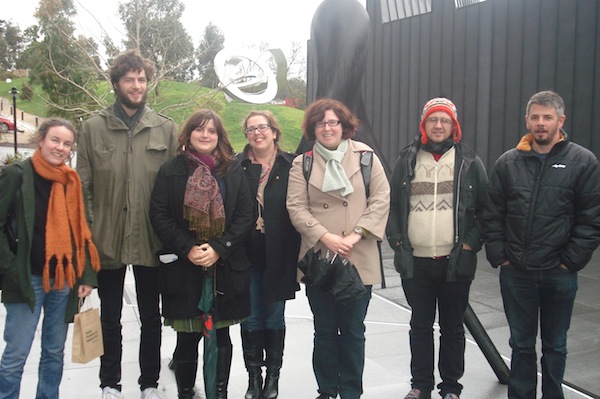
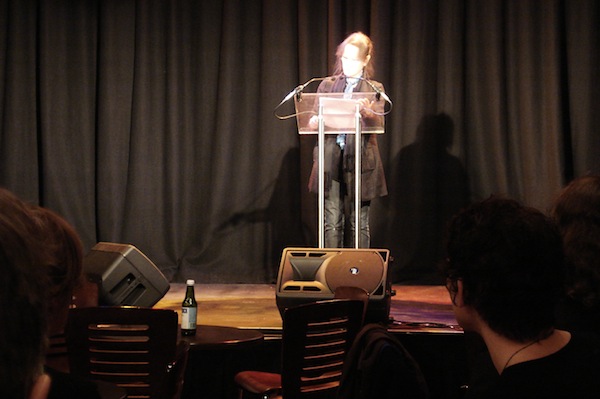 John Tranter continued the Australian Poetry Library conversation with an impromptu speech on stage and may I assure you, reader, as chair for Pam Brown’s paper, not an iota of this was premeditated! John Hawke and Alan Wearne launched the Grand Parade. Gig Ryan (pictured) launched esquires Hose and Ferney and had us in absinthe cackles. Rabbit steamed.
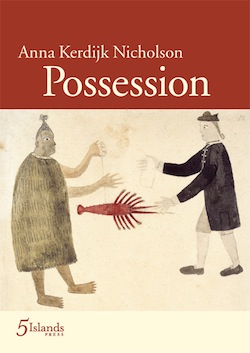 Possession: poems about the voyage of Lt James Cook in the Endeavour 1768-1771 by Anna Kerdijk Nicholson
 :etchings 9 – Love & Something edited by Sabina Hopfer et al
 HEAT 24: That’s it, for now… edited by Ivor Indyk
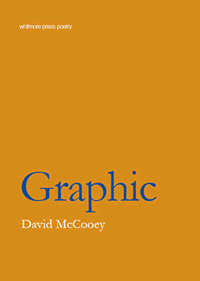 Graphic by David McCooey







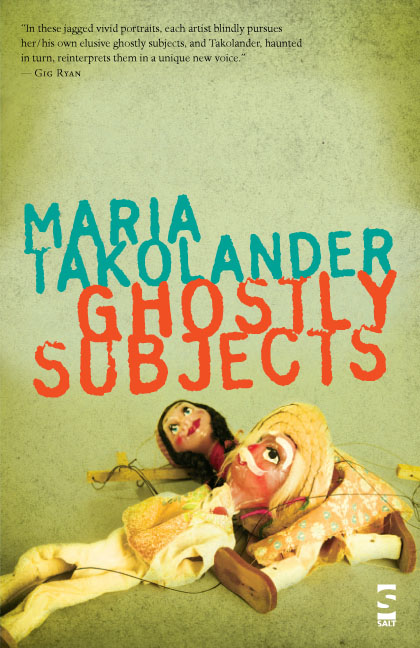 Ghostly Subjects by Maria Takolander