Cuttlewoman Reviews Stu Hatton

How to be hungry by Stu Hatton
Self published, 2010

Stu Hatton’s How to be hungry is predominantly a charnel house of modern, urban, party-going, substance-abusing youth. Hatton crams in the details of the worst of youthful socialising — friends as necessary accessories, drugs, sexual frustration, disappointment, aversion to boredom, lies, stealing, compulsions, addictions, the highs and the lows, even the consumption of adverts rather than proper food. In poem after poem layer upon layer of detail is accumulated like so much sediment, perhaps by way of a barricade against drug-fuelled forgetfulness. At their worst, these list-like poems are perhaps drafts of better poems — hasty, truncated, raw, a bunch of punch-lines tangled together, unresolved. True, there are many finely gnomic observations, but Hatton links them together fuzzily.
Continue reading

Posted in BOOK REVIEWS | Tagged ,

Nicholas Powell Reviews Grant Caldwell

glass clouds by Grant Caldwell
Five Islands Press, 2010

For nearly three decades Grant Caldwell has been writing some of the more interesting and fearless poetry in Australia. A relentless observer of the absurd and odd, Caldwell’s predominant tone has been a wryness capable of quiet awe. His poetry is pulled taut between these points. The lines are clipped and his narratives drift to punch-lines that rarely miss. At times he seems to reiterate Berryman’s quip that, “Life, friends, is boring”, but also that poetry and resilience are often located in the strangest, most overlooked places.
Continue reading

Posted in BOOK REVIEWS | Tagged ,

Submissions now open for Cordite 38: Sydney

We invite submissions for Cordite 38 on the theme of ‘Sydney’. Given that Cordite was founded in Sydney in 1997, we think that now is a good time to revisit our roots, and what better way to do that than to fire up your metaphorical barbie, down a long neck or two of Reschs and then head for Bondi (or maybe Clovelly) to take a dip in the Tasman.

As with all themed issues of Cordite, apart from the fact that we’ll accept up to five poems per submission, the sky is the limit. It’s not compulsory to have ever been to Sydney (let alone lived there) in order to submit. (If that were the case, we’d never, ever be able to produce a ‘Space’-themed issue – unless Buzz Aldrin writes poetry, that is).

Cordite 38: Sydney will be guest-edited by Astrid Lorange.

Astrid is a poet, PhD candidate, teacher, editor and book indexer from Sydney. She is the author of Eating and Speaking (Tea Party Republicans Press, NYC) and Minor Dogs (bas-books, NYC) and her PDF book Pussy pussy pussy what what (Au lait day Au lait day) was published on gauss-pdf.com. She is currently a resident commentator on Jacket2, where is she is writing about the alt.archives of Sydney poetry. You can find files and links at astridlorange.tumblr.com.

For full submission guidelines, visit our submissions page.

Posted in BLOG ARCHIVES, GUNCOTTON | Tagged ,

Tiny Steps: the Electr(on)ification of Cordite

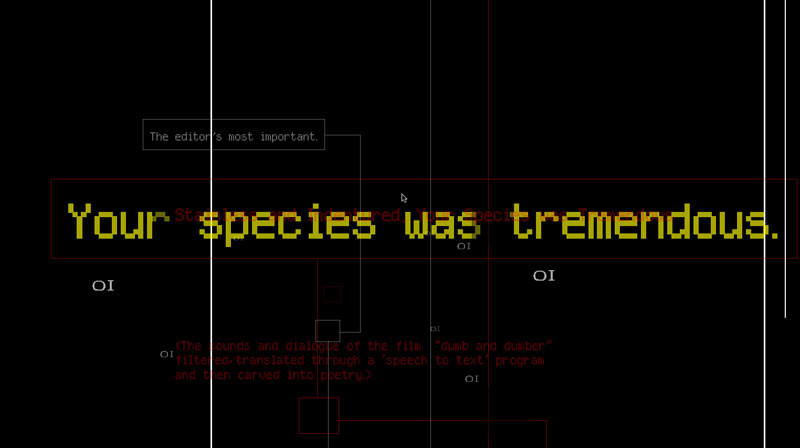
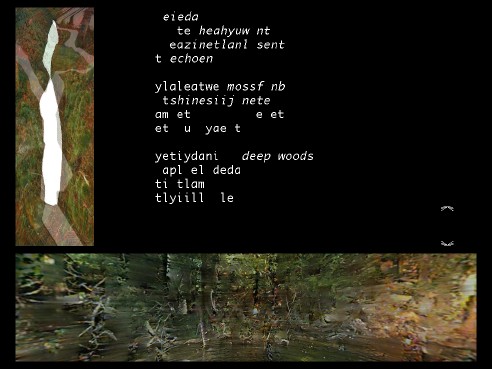
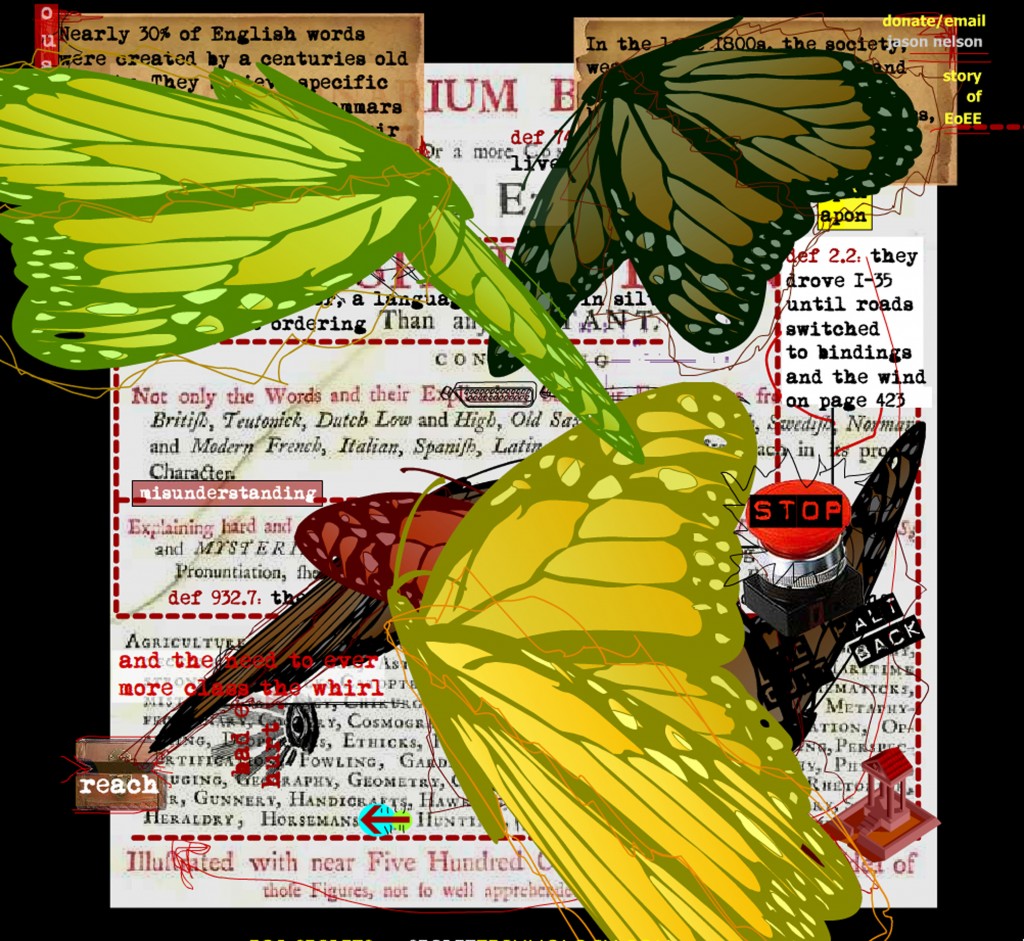
A screenshot from Jason Nelson's Depth: Text and Playthings
Image: screenshot from Jason Nelson’s Depth: Text and Playthings.

Cordite 36: Electronica has been a fascinating and challenging issue to put together. It contains forty new poems, fifteen spoken word tracks, a dozen features and, for the first time, a selection of multimedia or ‘e-lit’ works. Bringing together these disparate types of content raises an interesting question for Cordite as an online journal. Have we finally broken through that invisible barrier between ‘text-based journal’ and ‘online journal of electronic literature’?

In her editorial introducing the issue, Jill Jones rightly points to the issue’s presumptive focus on electronica and electronic music, specifically “the ways musicians in various modes and guises have used electric technologies to generate sound.” The poetry in this issue runs the gamut from highly experimental works to extended meditations on musical memories and forms. It’s absorbing, intriguing and puzzling – and this is just as it should be.

The spoken word tracks selected by our audio editor Emilie Zoey Baker are similarly pre-occupied with the bleeps, hisses and clicks we associate nowadays with electronic music. From Philip Norton’s bizarro Yes I Dream of Electric Sheep to Sean M. Whelan and Isnod’s Dream Machines, the works selected here paint an aural kaleidoscope that fizzes and pops, echoing electronic art from the works of Phillip K. Dick through to Kraftwerk. Check out the individual tracks or stream the hour-plus mix of electronica as one. Headphones highly recommended!

When it comes to the selected works of multimedia or ‘electronic literature’, however, we are faced with a series of disruptions that more often than not question rather than reflect the theme of the issue. Benjamin Laird’s Sound-less-scape and nothing left in, for example, present the reader (viewer? player?) with opportunities for interaction but remain stubbornly mute, like a silent rave. Joshua Mei Ling Dubrau’s Et Tu demonstrates the jump-cut nature of screen-capture technology when applied to text, while Konrad McCarthy’s TV Life strips bare the artifice of the audio-visual in a montage of movements.

The publication of these pieces – some HTML-based, others video – inevitably raises the question of genre and form. Is this literature? Is it even e-literature? As Tim Wrights asks in his review of the Electronic Literature Collection Volume 2, ‘What literature today isn’t electronic?’ I’d like to think, instead, of overlapping spaces – some of which may be electronic, others organic. Beverliey Braune’s Supra-text Sequences essay offers one glimpse into such a world.

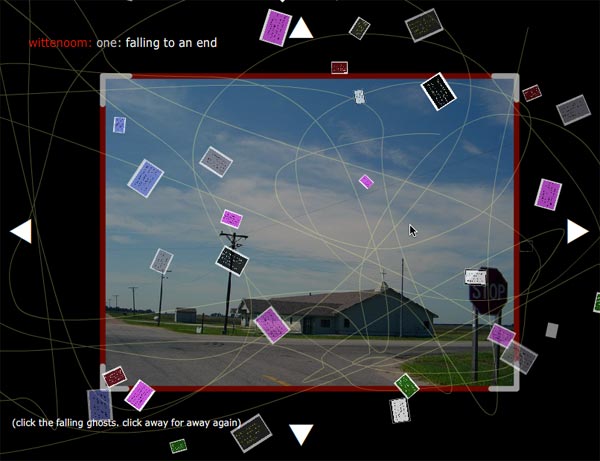
When it comes to the work of Jason Nelson, one might instead ask where the electronic world actually stops. I’m really excited to be able to publish three of Jason’s work in this issue, because in many respects his work attempts to break through the imposition imposed by the computer screen to offer a neural landscape that is deeply textured and interactive. Depth: Text and Playthings addresses this tension directly, by stating bluntly ‘Your screen is horribly flat’.

A screenshot from Konrad McCarthy's TV Life
Image: screenshot from Konrad McCarthy’s ‘TV Life’.

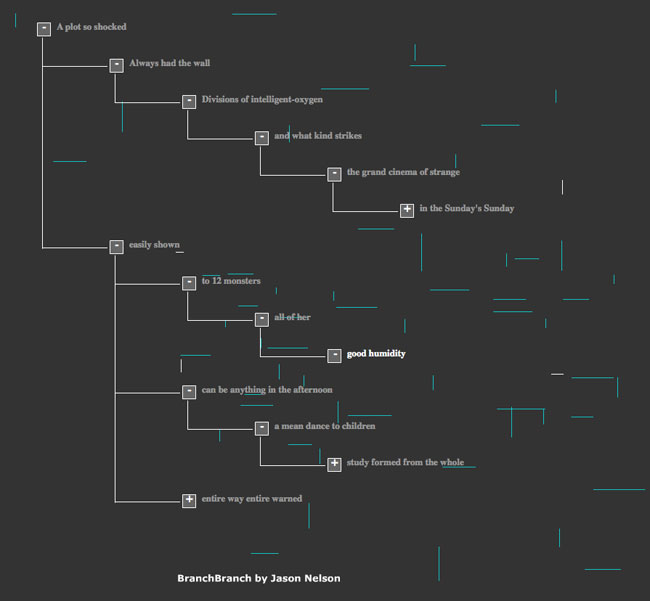
Elsewhere, Nelson’s work is playful and self-referential. Branching: branch branch is a work where the traditional branching structure of file folders clashes comically with a goofy soundtrack that is perhaps more amenable to a 1980s computer game. Meanwhile, With love, from a failed planet presents a phantasmagoria of late-capitalist logos. In addition to these pieces, I’m pleased to present an interview with Jason in which he reflects on his creative practices as an electronic literature artist.

Nelson’s work offers one possible ‘entry-point’ into the world of e-lit. The work of Mez Breeze offers another. Sally Evans’ essay entitled ‘The Anti-Logos Weapon’: Excesses of Meaning and Subjectivity in Mezangelle Poetry demonstrates that electronic literature can be just as much about ‘texts’ as traditional literature. Mez’s work is justifiably renowned in e-lit circles as innovative and highly complex. In an online world where more and more of us are exposed to the vagaries of computer code, Mezangelle chews up that code, parses it with human language and spits out art. Adam Fieled’s essay on Gertrude Stein’s Tender Buttons (a work that is itself highly amenable to remediation as a hypertext) shows that the worlds of literary practise and literary criticism remain inextricably entwined.

In terms of my own personal experience of electronic literature, Mez’s work was amongst the first that I viewed (scanned? played?). Over the course of this year, working as a post-doctoral researcher on the ELMCIP project, I’ve also met a wide range of scholars and practitioners working in the field of e-lit. For this reason, I’ve included in this issue two interviews with my colleagues at Blekinge Tekniska Högskola in Karlskrona, Sweden. Both Talan Memmott and Maria Engberg have inspired me to re-think my attitudes to the digital realm.

This brings me back to the question of Cordite’s place within that realm. As Benjamin Laird demonstrates in his overview entitled Australian Literary Journals: Virtual and social, Cordite is by no means alone in its attempts to engage with online communities. In fact, pretty much every Australian literature journal is undergoing a process of morphing and reinvention. I’d like to think that, in the future, Cordite will evolve to include more works of electronic literature that actually engage with the medium in which the journal ‘lives’.

This is not to suggest that the thousand-odd poems we have published on the site over the past decade are not ‘alive’, or that text-based works are somehow inferior to HTML, Flash-based or interactive works. Nevertheless, I hope that these tiny steps we have taken towards the electr(on)ification of Cordite will inspire others to create engaging, accessible art that takes advantage of the multitude of possibilities made available when viewing (reading? parsing?) information using a networked computer.

Posted in GUNCOTTON | Tagged , , , , , , ,

Australian Literary Journals: Virtual and social

An image of the front covers of Australia's ten leading print literary magazines, courtesy of the Literary Magazines Australia website

Twenty years ago, if you published a quarterly literary journal, you could be certain what that meant: four issues a year. In 2003, when Anna Hedigan wrote her overview of journals and their web presence not much had changed. The publishers’ attitude to the online space was that it was essentially a placeholder for the print journal.

Genevieve Tucker’s review four years later suggested many of the journals were becoming more sophisticated, with more content online and greater interest in design. Relevant to the 2007 review, RMIT publishing announced in September that it had partnered to produce a comprehensive digital archive of Australia’s most iconic literary and cultural journals. This initiative will provide full archives for a number of Australian literary journals.

Tucker’s review was written at the nascent of Facebook and Twitter. Nowadays, every print journal is represented on Facebook and most have Twitter accounts.

Additionally, we’ve seen the mass marketing of ebook readers and ebooks with expectations that journals also meet this demand. The embracement of smart phones and tablet readers has also created additional ways of reading the journals’ online presence (though only one journal, Southerly, catered via their website template to a small device reader and even this had technological problems).

With these additional demands, running a quarterly literary journal in 2011 means doing everything you did twenty years ago, plus updating Facebook regularly, tweeting constantly, creating or sourcing blog content, building websites that support multiple devices, producing video content, making podcasts, publishing the journal in multiple formats, writing a regular enewsletter, and, on top of all this, coordinating these efforts. With funding bodies now expecting this output, this model is the new baseline.

These new requirements, however, mean new staff with more skills.

Take, for illustration, Australian Book Review’s recent call for a publishing intern. Among the responsibilities listed were:

  • editing material and proofreading the magazine
  • creating each issue of ABR Online Edition (Joomla CMS enabled)
  • social media engagement (Facebook, Twitter)
  • writing reviews and blog articles

So what does this mean for publishers? What does it mean for journals?

Prior to being saved by the Australia Council, the Premier of Tasmania cut $60,000 of funding to Island on the grounds that there was a “trend” towards online rather than hard-copy publications for literature. As it stands, the only Literature organisations now funded by Arts Tasmania [PDF] are the Tasmania Writers’ Centre, the Tasmania Poetry Festival (a mere $6000) and The Australian Script Centre (funding to deliver a program to take the organisation’s digital publishing and e-commerce enterprise to the next level).

The greatest cost in literary journals is the labour; moving to new electronic formats and social media creates more work, and the labour involved is largely invisible to funding bodies and readers with raised expectations. Even if journals stopped printing hard copy versions, this new world of online labour and additional skills is mostly irreversible.

Literary journal audiences are small, they always have been. Smaller still is the Australian audience. If the work put into the electronic versions and websites can attract and retain international audiences, it may well be worth the effort and cost spent online. It seems to me, at least, that this will also require an attempt to engage international audiences and stronger journal identities.

So how are they doing? Under the circumstances it seems unfair to criticise but, honestly, they could be doing better.

Communicating

While most have a Facebook page, not every journal’s website links to the page or the links were hidden within the site. The same was true for Twitter. Some of these social media accounts were found accidentally (while I was looking at another journal’s page) or through direct searches.

The Australian Council research Connecting:// arts audiences online reveals some reader behaviour, namely, not all social media are equal. Facebook has much higher usage rates than Twitter (though among arts audiences, it is the literary audiences that use Twitter the most). To publicise events and communicate information, the Australia Council found the most successful way of interacting with audiences is through enewsletters.

A word on content

The first rule of writing for the web is you do not write ‘click here’. The second rule of writing for the web is you do not write ‘click here’.

I observed this trend in many of the journals websites, so want to stress this as a general point about writing links. Links that appear as ‘here’ and ‘click here’ are bad for readability, scanability and accessibility (for readers who use screen readers). They lead to verbosity and a lack of clarity. The equivalent in an essay would read:

… as Anna Hedigan argued in her survey of Australian journals on the web. (Look at the bottom of the page for the footnote)[3]

Or for clarity it is the equivalent of marking toilet doors with ‘here’ and having to look at another sign for directions. ‘The men’s toilet? That’s the one on the left with the sign “here”’.

Web platforms

In regards to web platforms, the majority of journals use WordPress (Going Down Swinging, HEAT, Southerly, Overland, Peril and Voiceworks) and Joomla (ABR, Griffith Review). Island uses inScribe Content Management System. The only non-PHP CMS was Inventive Labs’s Blueprint used by Meanjin. Surprisingly, one print journal (Wet Ink) and two ejournals (foam:e and Mascara Literary Review) didn’t appear to use a CMS at all.

Searches on these websites were rarely effective. Often, this is because of the technological limitation of these platforms, so it really highlights the need to have well-designed site structures.

None of the journals used metadata well. Given schema.org and other big projects to increase use of metadata, it will be interesting to see how this might change in future.

Now for this year’s review.

Print journals

Australian Book Review

A screenshot from the ABR website taken on 25 November 2011

Website:
www.australianbookreview.com.au
australianbookreviewblog.blogspot.com
Facebook:
www.facebook.com/AustralianBookReview
Twitter:
@austbookreview

The ABR website, understandably, wants to sell you its current edition; there are three links each to the print and online editions on the homepage. The online version is a paywalled version of the print edition. Readers can subscribe per month or per year.

Facebook and Twitter links, and newsletter sign-up, all appear in the sidebar. Their Twitter is rarely used but Facebook is regularly updated. Tying the two together would seem logical, both to broaden the audience and to provide ABR updates, something the website doesn’t really cover.

Online subscribers can access the current edition and back issues until December 2010. Author names are linked to author pages, which list other ABR articles by that author. Unfortunately there isn’t a way to list based on the type of content e.g. just the fiction reviews or just the poetry.

The ‘About ABR’ section covers most of the important information, including a link to an external blog. It’s also very easy to buy print and online access directly from the site.

I’m not a fan of the ABR design; it feels blocky. It doesn’t have an onsite blog and there isn’t an events page – so why would people visit regularly? The external blog, ‘From the Editor’s Desk’, hasn’t been updated since January 2011.

Unfortunately, there is no special design for smaller screen sizes, so it doesn’t render well for iPhones and iPads. Worse, though, is that some of the menu items don’t work with these devices, making sections of the website impossible to navigate.

Going Down Swinging

A screenshot from the GDS website taken on 25 November 2011

Website:
www.goingdownswinging.org.au
Facebook:
www.facebook.com/goingdownswinging
Twitter:
@swingingonline

There was a flurry of excitement when Going Down Swinging released an e-version earlier this year. Perhaps a little large filewise, it did show some of the potential of working with audio and video. Rosanna Beatrice Steven’s musical translation of Dorothy Porter’s ‘Nefertiti Rides Me’ and its discussion in ‘The Sound of Reading: Translating the Written Word to Music’ was particularly engaging.

GDS tackled the problem of poetry flow in ebooks by setting the poems as images. I’m not certain this is the best approach as it means the text won’t resize or be read aloud, thus losing the textual nature of the poem.

However, the e-issue was a standalone and it is now back to print and CD for GDS.

In general, GDS’s online presence is looking a little neglected. Their Facebook and Twitter can go weeks without being updated; their website itself is slightly messy, with broken tags appearing among the content. There are no dates on posts so visiting the site can be disorientating. The blog itself operates more as a newsfeed. There is no mobile specific layout, which is fine for an iPad, but involves some scrolling around on a phone.

Visitors can buy back issues and subscribe from a separate site.

Griffith Review

A screenshot from the Griffith Review website taken on 25 November 2011

Website:
griffithreview.com
Facebook:
www.facebook.com/pages/Griffith-REVIEW/59242722420
Twitter:
@GriffithREVIEW

Another site that has evolved since the last review, Griffith Review now has its own dedicated URL. It’s easy to buy and see sample content from all previous editions, and current editions are available as print, EPUB, PDF or EPUB and PDF on a very attractive USB card.

Subscribers can log in to update subscription information or check their status. One of the terrific features is being able to view all the contributors and see what they’ve written for Griffith Review. But, as with ABR, you can’t search the content by type. I typed poetry directly into the address bar and received a smart ‘can’t find that page!’ error that went on to list the poetry sections of the last few editions. Given that, it would be nice for these features to be directly built in.

Their Facebook and Twitter is regular and conversational (a must!).

Absent is a blog. There’s a ‘Discussion section’, which basically consists of letters to the editor from the print edition. There is a podcast archive that claims ‘contributors are regularly involved in discussion panels’, yet hasn’t been updated since 2009.

The site doesn’t allow for mobile or small screen styling. On the whole, I’m not a fan of the design and there is a grave misuse of underlining (Third rule for writing for the web: never use underlining unless it’s a link).

HEAT
A screenshot from the Giramondo website taken on 25 November 2011

Website:
giramondopublishing.com/heat/
giramondopublishing.com/heatpoetryonline/
Facebook:
www.facebook.com/pages/HEAT-Literary-Journal/170880023783

Although HEAT in print has exited stage left I wanted to cover it briefly. There is a solemnity to holding HEAT 24, like standing at the end of a one-way street or visiting a website that hasn’t been updated in a decade. Something final about something that shouldn’t end – streets, journals, websites. This is the tragedy caused by the weight of the electronic; audiences are deprived of HEAT, one of my favourite literary journals.

I understand it’s in the stages of being resurrected electronically and in the meantime there is HEAT poetry online. I am both hopeful after reading Ivor Indyk’s editorial, yet also worried given the history of HEAT’s online engagement. They used to publish journal extracts online and allow for easy purchase but it ended there. The descriptions of back issues were large blocks of texts and the journal’s identity, rightly or wrongly, was tied to Giramondo through a non-unique URL.

HEAT poetry online does not fare much better. It publishes irregularly and only single long reviews. Don’t get me wrong, I think long poetry reviews are important—it is the amount and the irregularity I have an issue with.

I still have my fingers crossed for an electronic HEAT.

Island
A screenshot from the Island website taken on 25 November 2011

Website:
www.islandmag.com
isletonline.blogspot.com
islet.com.au (redirects to www.islandmag.com/im/index.php?c=61)
Facebook:
www.facebook.com/pages/Island-Magazine/228269357186170
www.facebook.com/pages/Islet/308980005065
Twitter:
@IslandMagTas
@IsletOnline

Island is still going strong even after the bizarre decision by Arts Tasmania to cut its funding because why would they fund a Tasmanian magazine when Tasmanians can go online and read the New Yorker.

Island’s web presence, however, is everywhere and, in this instance, I’m not sure it’s a good thing. On the site, it is difficult to find the link to the Island Twitter account and impossible to find a link to their Facebook page. This is in contrast with Islet, their online journal for emerging writers, where both were very easy to find.

There are a few sections of web only content and links to articles (all in PDF format—it would be better if this was an actual content page) but they’re a headache to locate. The biggest problem here is not the intent of the editors but the CMS that they work with. The website uses a lot of ‘here’ links, all the worse for content that’s tricky to read because of both font size and contrast. The contributors page starts at issue 125 but is a single long page by. Some pages don’t display properly – overlapping images – and the only way to find content is by issue in the archive.

Island has audio interviews tied to specific issues and online only specials. Visitors can buy ebook versions (EPUB and PDF) and the print version easily from the website. I really like what Island is attempting, but it seems held back by the design and technology. If they can afford a new redesign and a new platform, Island has the potential to do some interesting stuff.

Islet is hosted on the same site. The design doesn’t really distinguish it from Island itself. Unlike Island the articles are actual pages and not PDFs. Their blog – the only one published by Island – is external to the website. Islet also has a new media section.

Meanjin
A screenshot from the Meanjin website taken on 25 November 2011

Website:
meanjin.com.au
Facebook:
www.facebook.com/Meanjin
Twitter:
@Meanjin

Meanjin has recently undergone a redesign, which has pulled the print and web design closer together. It is definitely one of the more attractive literary journal sites. They’ve also started to publish all their essays, fiction and poetry online.

There is, however, considerable whitespace on the lefthand side of articles. Articles are linked by type – fiction, poetry, memoir, essay – but there is nothing to indicate which issue the item is from on the article pages. Meanwhile, authors themselves are not linked so readers can’t easily find what other issues they might have written for. The article listing, on the home page, only links to articles via the image and not the text – something that occurs throughout the site. It is a problem Meanjin doesn’t link the text, as it means the links are not distinct and are potentially misleading for readers. A more serious problem is the alt attribute, which lists ‘Puff_puff’ as its content, rendering the links meaningless for non-visual users.

Blog post titles are not linked, forcing readers to access them through ‘Comments’ and ‘More’. Furthermore, scrolling through post history is impossible, as archived posts are unavailable in the listing.

Meanjin’s Facebook and Twitter accounts are active and entertaining. They have an enewsletter that is easy to find and sign up to, and readers can subscribe and buy back issues easily from the MUP website that link from Meanjin.

Overland

A screenshot from the Overland website taken on 25 November 2011

Website:
overland.org.au
Facebook:
www.facebook.com/overland
Twitter:
@OverlandJournal

It is said that people who live in glasshouses shouldn’t throw stones. So for full disclosure: I work on the Overland website, which I am currently helping to redesign.

The blog is regularly updated with almost exclusively nonfictional content: topical or reviews. Only one post appears on the homepage but the last five also appear in the sidebar; with a high turnover of content it is easy for posts to disappear. Posts don’t link to related posts, journal articles or topics such as Afghanistan. Bloggers have linked indexes so you can see what other posts they’ve written, though this doesn’t indicate if they’ve written any articles.

Full content is available since issue 188 (2007). It is easy to detect which issue each article was in, but there isn’t a way to get all the poetry or essays, and authors aren’t linked so you can’t easily find other articles they may have written.

The editorial team’s Twitter feeds are on the website and Overland’s Twitter feed is regularly updated and entertaining. Overland on Facebook is a person rather than a page, which isn’t good.

The journal doesn’t offer ebook versions. Readers can subscribe online, though purchasing back issues is difficult.

Submitting to Overland through Submittable (previously Submishmash) is an easy, electronic process that allows you to track submissions. (I honestly expected more journals to use submission management systems, because it’s an area that saves time.)

Southerly

A screenshot from the Southerly website taken on 25 November 2011

Website:
southerlyjournal.com.au
Facebook:
www.facebook.com/people/Southerly-Journal/100001523614044

The Southerly blog alternates each month with a guest blogger. It’s a nice technique that keeps the site alive and gives the reader a familiarity with that writer. Writings are a combination of poetry, fiction and non-fiction. In-between guest posts are launch notices, letters and correspondence, and overviews of upcoming issues. In one post, the Southerly editorial team ask questions to shape prospective comments, such as:

  • How does the post relate to your local literary community? Or if you’re a reader from outside Australia, how does it relate to your national literary culture?
  • Have you read something in the Long Paddock, or in our hardcopy issue, that relates to the blog post?

One of the stranger comments policies reads:

7. Comments must make sense by being in sentences complete with punctuation, to reflect the literary nature of the blog.

The ‘Long paddock’ is extra online content. I like the additional essays, poetry and reviews, but despise Issuu the Flash-based system they use for displaying them. It’s annoying to use and I don’t enjoy reading with it. Additionally, while they have the mobile template for the site Issuu, Flash doesn’t work on my iPhone or iPad (there is supposed to be a HTML5 fallback but I didn’t see it).

Lastly, purchasing a subscription online involves downloading a form, printing it, filling it out, scanning it, and emailing it in. I imagine an online purchasing system, even a simple Paypal button, would help increase subscriptions.

Voiceworks

A screenshot from the Voiceworks website taken on 25 November 2011

Website:
expressmedia.org.au/voiceworks/
Facebook:
www.facebook.com/pages/Voiceworks/24919754944
www.facebook.com/express.media.australia
Twitter:
@Express__Media

Voiceworks is the journal for under 25-year-olds.

The website runs off the Express Media website and domain. Virgule, a variably updated blog (sometimes daily, sometimes monthly) greets readers on the homepage. There is a Facebook page that is rarely used, although the Express Media Facebook is regularly updated with Voiceworks information. Voiceworks’s identity is largely tied up with Express Media. I imagine it would be more effective to separate out the identities so that Voiceworks is presented less as a project of Express Media and more as a unique journal (which the print design does effectively).

Wet Ink

A screenshot from the Wet Ink website taken on 25 November 2011

Website:
www.wetink.com.au
Facebook:
www.facebook.com/pages/Wet-Ink-magazine/14043129978
Twitter:
@wetink_mag

Wet Ink appears to be a static site without a CMS. I like the design (apart from the ‘click heres’) but imagine it will need to transfer to a managed system soon. Back issue articles are only available as PDF and there is no means of searching by author or topic. Wet Ink links to their Facebook page although not their Twitter account, with both only occasionally updated.

A subscribe page gives readers the opportunity to subscribe to the journal.

Online only journals

Of the three online-only journals looked at, two didn’t use a CMSPeril was the exception – and all published more than one poem per page (either the same author or all the poems of that issue). Ideally, each poem should have a unique page. For online journals this is even more important as the URL acts as a unique identifier for that poem. Multiple poems per page seems to be a print affectation that has carried into the online space.

foam:e

A screenshot from the foam:e website taken on 25 November 2011

Website:
www.foame.org

With no Facebook page, no Twitter account, no enewsletter, it appears foam:e gets by on reputation alone – the first editorial did state Poetry speaks for itself. Reasonably successful for what it does, the only disappointment is that there is no way to view all the poetry by a specific poet.

Mascara Literary Review
A screenshot from the Mascara website taken on 25 November 2011

Website:
www.mascarareview.com
Facebook:
www.facebook.com/people/Mascara-Literary-Review/100000123527263

Mascara has a presence on Facebook but the social media stops there. Once again there is nothing to link the authors with their work across issues. When on a page there isn’t an easy way to get back to the index of that issue.

Peril: Asian-Australian Arts and Culture

A screenshot from the Peril website taken on 25 November 2011

Website:
www.peril.com.au
Facebook:
www.facebook.com/PerilMag
Twitter:
@PerilMag

Peril is the most like the print journals in regards to engagement on social media and also on the website. The site links to their Twitter account, and also includes the current stream, and is very active and interesting.

Previous issues are clearly indicated in the menu and the poetry page of the current issue links via the related post to the previous issue’s poetry. The fiction and non-fiction aren’t identified in the listing and there is no contents page for a quick overview. They have a blog but it only has two posts and they are from September – here is an opportunity to use some of the energy that exists in the Twitter feed to have ongoing conversations on the blog!

Again, like many of the journals, Peril doesn’t link authors or topic areas and they publish all poetry on a single page.

Where to in four years?

As far a as prognostication goes, I rate myself 3 out of 10 as a prophet. That said there is a lot going on in the technology world that might give some indication of where journals might head and what opportunities there are for them.

Convergence between web and ebooks are growing. Many of the ebook formats including EPUB, which is widely supported and adopted, are built on web technologies. This makes converting between web content and ebooks quite trivial. With EPUB 3 scripting has been allowed and along with rich media and devices that support this, the differences are reducing.

This also means readers will have an opportunity to mix and match articles (even if not directly supported by the website) and produce their own journals.

That’s not to say print is dead. With print-on-demand expanding, traditional journals have a cheaper way to sell overseas, printing directly in that country, and can have flexible print runs by printing only what’s needed.

Lastly, it will be interesting to see where social media will be in four years. Google+ has recently added pages for organisations and Facebook and Twitter appear to be going strong. In the short history of social sites, however, popularity can dissipate as quickly as it grows.

Note: all of the screenshots in this article were taken on 25 November 2011. The image at the top of the article is from the Literary Magazines Australia website.


Posted in ESSAYS | Tagged , , , ,

The Electronic Literature Collection V2

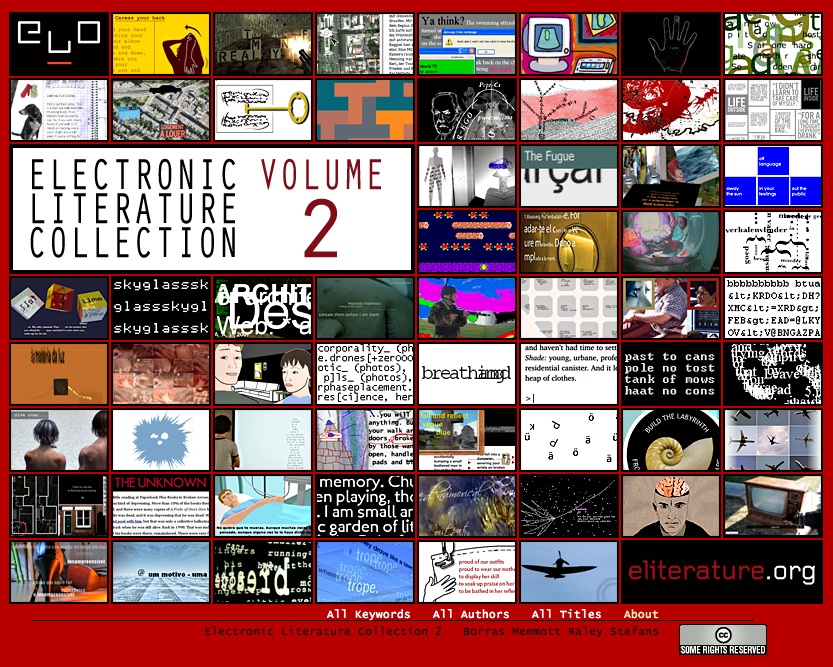
Electronic Literature Collection Volume 2
Editors: Laura Borràs, Talan Memmott, Rita Raley and Brian Stefans
Electronic Literature Organization, 2011

‘Electronic Literature’ could refer to quite different things: a novel written in the form of emails, a poem in Cordite (poetry is code!), a piece of musique concrète, an interactive installation in a gallery, a thread of You Tube comments, the Wikileaks cables . . . Understood broadly it could include any piece of literature making use of an electronic technology – e.g. Microsoft Word – somewhere along the line. What literature today isn’t electronic? might be the more productive question to start with. The Electronic Literature Organisation (ELO) – the editors of this collection – include in the category of E-literature, ‘works with important literary aspects that take advantage of the capabilities and contexts provided by the stand-alone or networked computer.’ Literature, then, which consciously, rather than complacently, makes use of electronic technologies and computer software as a means of its composition. Employed in this context the term ‘literature’, with such a long memory of print, begins to sound slightly ananchronistic. A pervasively digital, screen-based and networked environment does augur new reading experiences; accordingly, new terminology and concepts (such as Gregory Ulmer’s ‘electracy’) are required. That said, for the time being we’re reading, looking at and listening to ‘electronic literature’, a genre which might be understood as a hybrid one, marking a point between a literacy – and a literary criticism – specific to print, and one native to the newer media forms.

This collection, which was published in February 2011, uses a similar design and structure to the first volume, which came out late in 2006. As with that earlier volume, a large amount of material has been gathered here, 62 separate works, mostly from the latter years of the last decade, and a couple from last century. The earliest is the visual poet Geoff Huth’s Endemic Battle Collage from 1986, and the majority of the work comes from European and North American authors, where most of the centres with a research interest in E-literature are located. Each piece is accessible from the opening page, and represented by a single tile. The mosaic that these tiles create illustrates the attempt to bring together under one name works with often very different aesthetics and provenances. Each tile links to a page which contains a short blurb, an author description, and operating instructions for that work. These are often interesting pieces of writing in themselves, but the necessity to pass through the critical gloss on a work on the way to the work itself does get wearying sometimes.

short appreciative glosses

I’ll mention a few of the pieces I liked in brief before before going on to talk in more detail about three. Christine Wilks’ two Flash-based works, are Tailspin and Fitting the Pattern; the former is a work which makes careful use of sound, exploring thresholds of hearing in the context of a family relationship; the latter work lures the reader easily through different sections of a text by requiring him or her to carry out virtual versions of actions used in tailoring (cutting, pinning and so on), as a way of revealing sections of text: a series of memories about the author’s dressmaker mother.

Public Secrets, made by Sharon Daniel and Erik Loyer, takes as its subject the legislated silence around prisons in California since their government introduced a ban on journalists reporting from inside them in the 1990s. Specifically the work relates to women’s prisons, using the voices of inmates recorded over a three-year period in which the authors worked as legal advocates (a role which excluded them from that media ban). The choice to base the work around the recorded voices of the women evokes their world in a way that a piece more dependent on visual imagery would not have been able to. The elements of the piece act in combination to put into context, theoretically and politically, the silence around the question of prisons generally, without losing the very practical aim of granting a voice to the women represented.

Australian Mez Breeze’s _cross.ova.ing ][4rm.blog.2.log][_, written in her invented digital creole ‘mezangelle’, is a relief because of its stillness among more hectic works. The ‘electronic-ness’ of the work is incorporated into the language itself and resembles a page of print, static black text on a white background. Similar in its print-like appearance, Bjørn Magnhildøen’s Plaintextperformance is appealing for its slowness. Presented here is a recorded version of a live performance of various types of ‘writing’ unfolding, human and algorithm determined, which scrolls slowly down the page, encouraging the feeling that one can leave it and come back to it after browsing some of the other works, then return and note the changes.


Screenshot from Bjørn Magnhildøen’s Plaintextperformance

Caitlin Fisher’s Andromeda is, in the real world, a kind of children’s pop-up book, constructed partly with computer-readable cards. The book can be held up to and then ‘read’ by a computer through a webcam; the computer software then translates this information into text which is displayed on its monitor. The operator of the work is thus both reading to the computer (as a parent to a child) and being read to by it. While I only understand in a basic way how this piece actually operates, the video documentation of the process (as a unique object, probably the only way it could have been included in the collection) is intriguing. I could go on like this for a while, giving short appreciative glosses for many of the works.

source tags & codes

Andreas Jacobs’ Semantic Disturbances is a suite of four pieces originally published online individually as fluidal, radiator, destruction and architexture, each of which use the same format to different effects. The critical precis describes the work, slightly fancifully, as ‘like photographs of the very self-generation of the internet, exploding the image with algorithmically determined deformations that quickly overwhelm the space of the monitor.’ The pieces invite contemplation more than active interaction. Rolling the mouse over search terms stacked along the left side of the screen illuminates them as if they were links and sometimes ‘announces’ them in larger type in the centre of the screen, yet clicking on them doesn’t seem to trigger other events on the screen. It is an obdurate piece that sits somewhere between high-modernism and the screensaver. Jacobs here successfully explores the nature of the media he is working in, and the work is illustrative of a ‘slow’, perhaps minimalist, strain of net.art and digital writing, one native to the web.

One of the difficulties in generalising about the collection is that, while the categories are clearly delimited and navigable by tags, there is not (as far as I can tell) an aesthetic criteria holding the collection together. This diversity is also, of course, the point. A glance at the list of 49 keyword tags gives a sense of the breadth of the collection and of the editors’ interest in providing a watertight taxonomy. Held together by medium alone – the ‘electronic-ness’ of the pieces – it is unlikely that all or even most will appeal to a single reader. This is probably the case with any large anthology; the idea perhaps being that a reader interested in the form may find a few pieces they like, or a style they can glom onto, and from there begin to explore and read beyond it.

Working my way through the collection I find I lean towards the more ambient works, those which can drift into the background for periods, and which, as the description for the ‘ambient’ category states, are ‘meant to evoke or engage intermittent attention’ – a state often associated with the rise of networked electronic media. There are of course many exceptions to this preference – the highly syncopated text-jazz combinations of Young Hae Chang Heavy Industries (oddly, not represented here) are the most obvious of those which elicit a high degree of visual and aural attention from the reader for a limited amount of time.


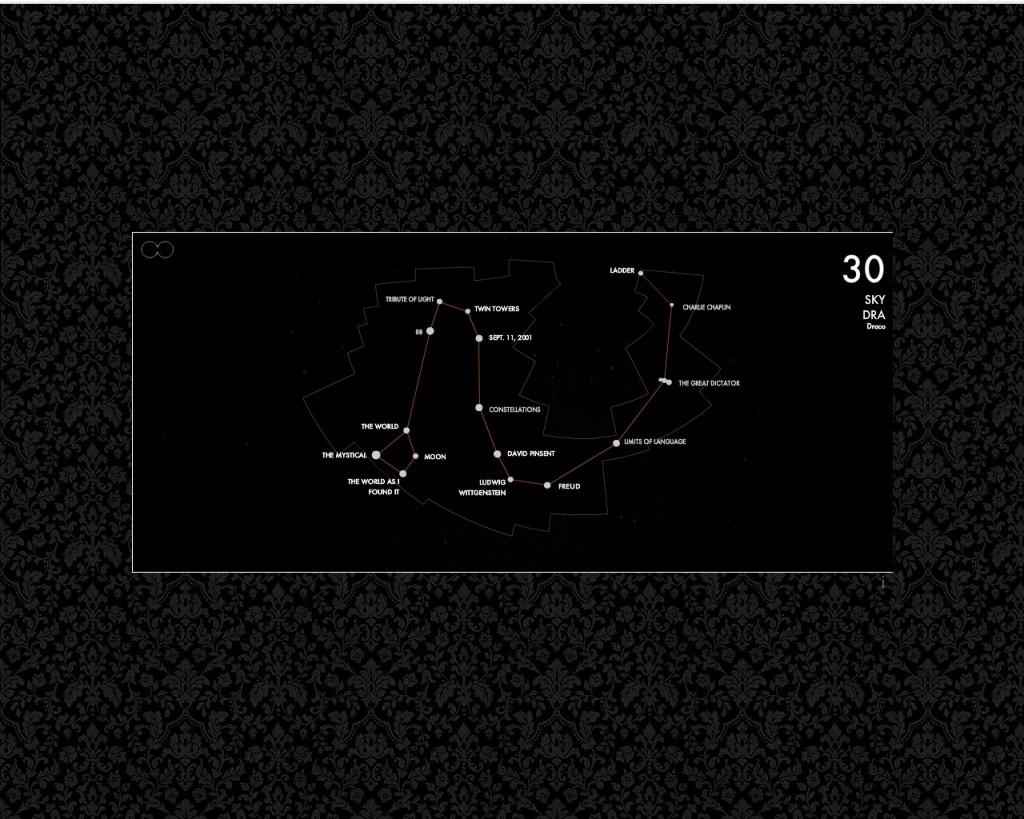
Screenshot from 88 Constellations for Wittgenstein by David Clark

88 Constellations for Wittgenstein by David Clark is a kind of Wunderkammer, a Flash based, documentary-like work made up of short movie assemblages which take the life and philosophy of Wittgenstein as a heuristic device through which to explore  interrelated 20th century cultural and historical phenomena (starting from Wittgenstein’s birth in 1889, to 2001). The number of the title, 88, often returns as a generator of links – sometimes via slightly paranoiac association – between historically and geographically diverse events. There is a large cast of characters – Wittgenstein’s coevals Adolf Hitler and Charlie Chaplin; and Carmen Miranda, John Cage, Alan Turing are a few. The reader chooses a constellation from a schematic map of the entire night sky, then once ‘inside’, moves along by interest, proceeding by clicking on the associated points in each constellation designated by titles such as ‘Fly Bottle’, ‘Pointing’. ‘Prater’, ‘Otto Weininger’, ‘Aphasia’. The experience of reading and operating the work is less to do with where one is going, or where one is, than with getting a sense of how the different ideas in the constellation are associated.

The work integrates the kinds of still and video imagery made available by the proliferation of the scanner and the resulting digitization of archives, and puts them to work in a hypertext environment. The juxtaposition of materials from different periods is one of the things that energizes the work and lends it surprise. It is an example of the ways that lateral connections can be made in critical works that are native to an electronic environment. David Jhave Johnston (another contributor to the collection) writes of the work on his Digital Poetry Overview blog, in hybrid terms, calling it, ‘a consummate example of hybrid interactivity, future cinema, net-art and scholarship’. It’s a highly polished work, and one which, unlike ‘Semantic Disturbances’, seems to sit happily within the frame or proscenium of the browser.


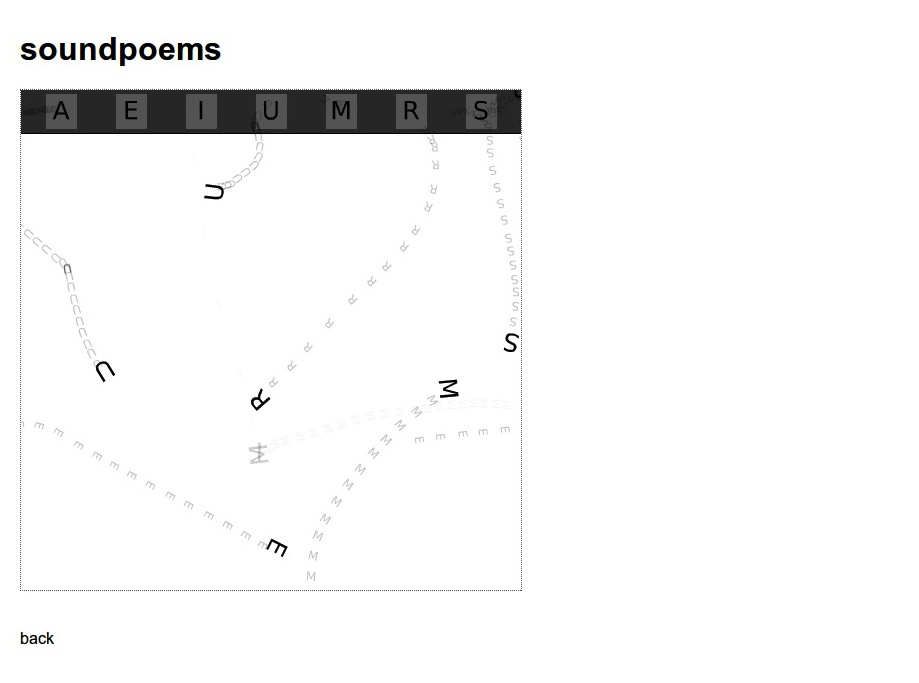
Screenshot from Jörg Piringer’s soundpoems.

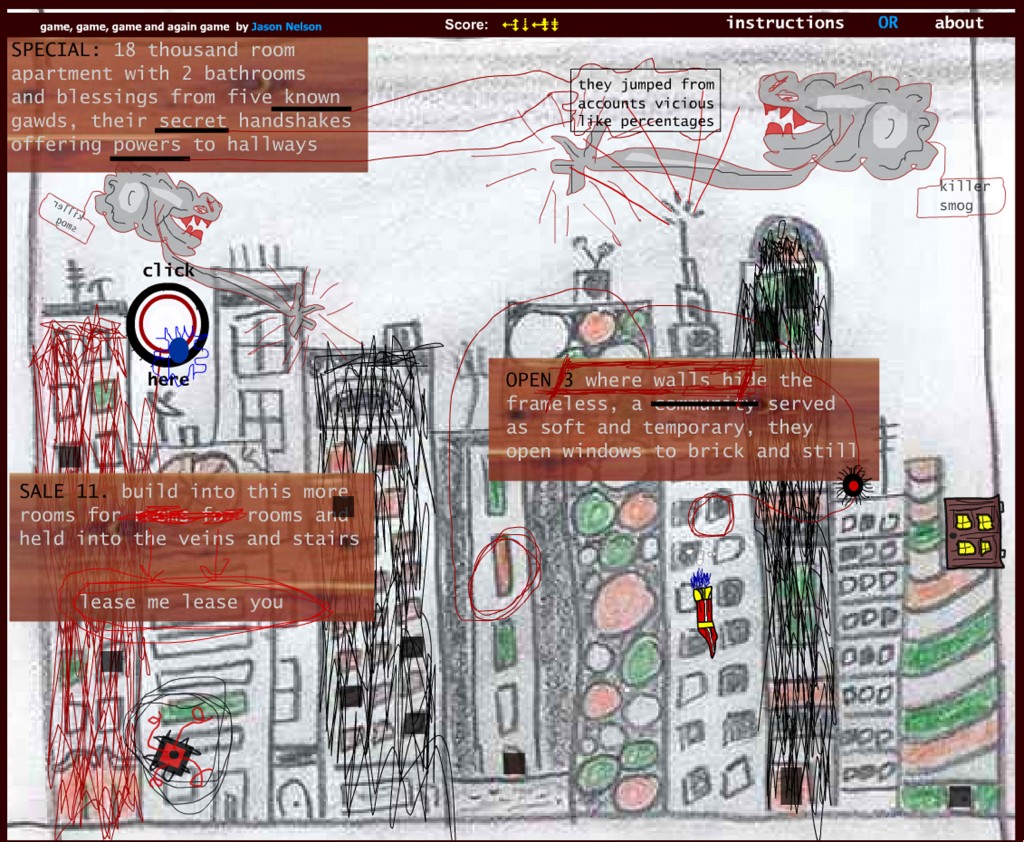
Jörg Piringer’s trio of soundpoems are fairly simple in appearance. The three pieces all use the same format: a rectangle in which the letters are motivated in different ways to trigger a range of phonemes to sound. In one of these (food chain), mouse clicks set down vowels (ä, ë, ö, ü) to be crashed through by roving consonants (P, T, X, Z, K), producing robotic utterances (Tö, Zö , Kë, Xä, etc.) for each collision. In another (predator vs prey), a set of letters and vowels at the top of the rectangle (A, E, I, O, U, M, R, S) produce when clicked on letters which then drop down into the rectangle and perform relaxed twirls while buzzing their own sound for a minute or so, until they collide with another letter and fade to white. As more are clicked on a personal sound mix is created. In this structural way (though not in others) there is a similarity to Jason Nelson’s wonderful early Conversation works, another trio in which the user is able to create her or his own ‘verbal compositions’ from different tracks. Jason Nelson is represented in this collection by two more recent works (though not his most recent), This is how you will die, and game, game, game and again game, which explore and reinvent the interfaces of the slot machine and the platform video game respectively.

This ‘freeing up’ of language

The ‘freeing up’ of text so that it can be recombined in surprising ways seems to be a recurring theme of E-literature, an echo of the spirit of Marinetti’s parole in libertà (along with other early 20th century Modernist explorations of the formal properties of language) plugged in and put online. It’s seen, in very different ways, in works from the first volume like Kenneth Goldsmith’s Soliloquy, Patrick-Henri Burgaud’s Jean-Pierre Balpe ou les Lettres Dérangées and Jim Andrews et al’s Stir Fry Texts; and in works such as Magnhildøen’s Plaintextperformance, Bruno Nadeau and Jason Lewis’ Still Standing, Oni Buchanan’s The Mandrake Vehicles, and K Michel and Dirk Vis’ Ah in this volume. In works such as these the soldierly stillness of letters on a page of a printed text is evoked,  often mimicked in some way, before the letters ‘detach’ and move around the screen, parading their newly found weightlessness. (This ‘freeing up’ of language is evident in other ways too: by breaking his own language down to its phonemic parts, Piringer’s piece illuminates the overlapping spaces between languages.) These works explore the latent potential of alphabet letters as they inhabit a screen environment, while thinking back to their origins in print; they remain in a close dialogue with the technology of the book. As new media theorist N. Katherine Hayles stated in her 2004 essay ‘Print is Flat, Code is Deep’, electronic literature allows us, ‘the chance to see print with new eyes.’ After spending time with works which employ mutable and shifting text, printed text in a book begins to look different: its stillness comes to be interesting in a way it wasn’t before.

As with ‘Semantic Disturbances’, Piringer’s ‘soundpoems’ are works which persist by their audio element: the various vowel and consonant sounds synched to the interactions of the letters in each rectangular sandbox. The use of sound in many of the works in the collection makes it such that the operator of the work produces, after a session of reading, a kind of aural record or mashup of the different pieces that have been opened in different tabs. Many of the works in the collection are best read in this way, by not shutting them down when moving on to the next piece. It’s a distracted modality well encapsulated by Sydney band The Cannanes, who instructed on the label of a 1992 seven-inch record, ‘Play loud and leave the room.’


Screenshot from Andreas Jacobs’ Semantic Disturbances.

One question to ask of the individual works represented here is: How do they imagine the computer that they inhabit? To different degrees, as a box containing a bundle of software packages, attached to a screen, speakers, a keyboard and a mouse, to be activated by the work itself and the user operating it. At other times, the work places itself as a point on a larger network, an example would be Ton Ferret’s The Fugue Book, which requires the reader to connect to it through their Facebook account. Not being a subscriber to that particular network, I did not actually experience ‘Fugue Book’ in action, however in concept it points to questions about how E-lit and net.art might make incursions into the more platform-dominated ‘web 2.0’, and explore the social relations  around them: an electronic ‘relational aesthetics’, if such a thing is possible. There are also those works – like ‘Semantic Disturbances’, again – which see the browser or the screen, as calcified technologies, to be broken out of or somehow worked against, in a similar way to Pound, a century ago, wanting to bust up the pentameter. (The name of Google’s browser, “ Chrome”, is suggestive of this fixity in the way we’ve come to experience and interact with the internet.) The impatience with the idea of a screen as a passive surface, and an apparent desire to want to move beyond it is perhaps best represented by the title Up Against the Screen Motherfuckers by Justin Katko. Other works aim to draw attention to that greater ‘link’ back to the body operating the computer. Some of the works seem to understand the computer (a laptop or a desktop) as a kind of furniture, one we may have become too comfortable with. After clicking impatiently several times to get the next word of a poem revealed in this way, Annie Abraham’s English/French work separation/séparation informs, alternatively, ‘Vous n’avez pas le bonne attitude devant l’ordinateur’ / ‘You do not have the right attitude in front of your computer.’ I am instructed to do an exercise demonstrated on the screen, ‘Open your eyes as wide as possible and lift your eyebrows for five seconds’; a bar appears on the screen indicating the elapsed and remaining time. A bit later, another punishment/exercise requires standing up, and as I am doing so I notice a large orange painting on the wall of the room I am in. I had registered it before, but realise then that I had never looked at it for any length of time. The composer Edgar Varèse once said that the greatest pleasure the radio gave was turning it off. The same could be said of electronic literature and clicking Shut Down.

Though the editors have clearly worked hard to make the collection widely accessible – indeed that appears to be one of their main aims: to create a portable anthology of recent E-literature – about a quarter of the works require software packages (such as Shockwave and Quicktime) to be installed on the computer, and this will immediately send some readers onto the next piece. This reader, sometimes, included. Once, when trying to load up one interactive fiction, I was informed by the program, ‘Sorry, your computer is too slow.’ These obstacles should be weighed against the collection itself being free, not just over the internet but, as with the first collection, as a DVD-ROM, free (according to the details on the site) to any one who writes to the mail address and asks for one.

When I reviewed the first Electronic Literature Collection five years ago I began by quoting from the category description for ‘poetry’, on that site and on this one, which states that electronic writing is ‘under continual construction (poeisis)’. The clean design and structure of the site, particularly the opening mosaic – more reminiscent of a checkerboard than a construction site – can sometimes suggest otherwise. The process of gathering, archiving and tagging the works to make them more easily available to a wider audience, also freezes (necessarily) what may have been otherwise ephemeral or in situ. The keyword system remains a valuable framework for exploring the site and for gaining a critical understanding of the works. However implicit within it, for the experimental practitioner, is the challenge to make works that call for new categories.

Posted in ESSAYS | Tagged , , , , , , , ,

David Prater Interviews Talan Memmott


Image from jill/txt

Talan Memmott is Assistant Professor of digital media and culture in the Digital Culture and Communications program at Blekinge Institute of Technology and an internationally known practitioner of electronic literature and digital art with a practice ranging from experimental video to digital performance applications and literary hypermedia. In June 2011 I met with Talan to discuss the history of beehive Hypertext Hypermedia Literary Journal, which he founded and edited.

David Prater: So, can you perhaps start by telling me a bit about the origins of beehive, and what sorts of works you considered for the journal?

Talan Memmott: It was [called] Beehive hypertext hypermedia literary journal – so hypertext applied, hypermedia applied, and literary applied – it could be all in one thing, or two out of three or just one – but then part of the issue was, well, how do you present these works? Lit journals or online literary journals in 1998 were very very flat, under-designed, not taking advantage of anything the web offered except for distribution – which bugged me, because there was a lot more potential there that could be explored. So Beehive was trying to fill a gap there, to represent electronic literature but also to give a more design-rich publication venue for what could be considered paper-based literature.

DP: Can you talk to that a little bit – who did the design, and to what extent were the contributors involved in the design of their pieces?

Well, it actually requires some background stuff. I mean, Beehive started and really remained throughout its time as a publication associated with Percepticon, the web development company I was working for. We had a photography journal, called Temporal Image and Beehive, and these were not necessarily a subset but an extension of presenting practise through what was a fairly corporate web development firm …

DP: What was the web development firm’s motivation for doing that?

TM: Well a number of things. I mean, we did do a lot of work for non-profit organisations and we, I mean, they paid for the service but they were discounted so we were trying to be, actually, a socially responsible web development firm. Presenting ourselves in a different context from other firms was important at that time. So, to a certain extent, we had the skills, and we used our skills in a way that would promote what web development firms should be doing – or could be doing, not necessarily should – in also advancing the field of cultural practice on the web. So it was important to us politically, socially and as a company.

DP: You mentioned before at that time most other journals were not taking advantage of the kind of technical things that were possible even then can you think of any other kinds of journals at that time that were doing those things?

TM: Well in terms of the journal, the electronic literature thing, I became completely aware of it in the early 1990s, and actually kind of playing off of Storyspace and some of those kinds of works, but in terms of journals at that time, there was Perihelion, which became Riding the Meridian, which did take advantage of these things. I think toward the end of Beehive, Drunken Boat was just starting, which began to take advantage of these things.

I mean, I can think of a number of reasons why things appeared flat. One is because of working as a designer and programmer, I had a different view of what the web offered, and also because of working in the industry I had the skillset required to do these sorts of things. So I had a different perspective on what could be done, I think at that point.

I think there was a ramp-up between say 1996 and 2000 as to these journals becoming what they would become. I mean, a lot of them have faded away. So I wonder what the significance of an online publication is at this point. That’s a whole different topic …

DP: Can you at tell me about the design process from a technical point of view – how was the site created? What tools did you use? What sort of coding did you have to do yourself – for example was it hand-coded?

TM: Okay, yeah [laughs]. With Volume 1 of Beehive in 1998, the design, coding, editorial, curatorial were all done by me. So to a certain extent it was my view of what the field was, and my view of what could happen in terms of design. When I look back at what Volume 1 actually looked like (and this is interesting for me to think about), we started out with this very bold set of colours, and it was this really kind of vibrant honey-yellow, and deep black, and a crimson, or puce [laughs] or bright red – the hex code was #B90000, I remember that – that’s the ‘Beehive red’, to me …

DP: Hasn’t that been banned under some kind of international convention?

TM: [laughs] I still use it! It’s a good deep red.

DP: [laughs] Okay …

TM: But as the journal matured, each volume went through substantial design revisions, and if you go through (although you can’t really access all the volumes anymore), thinking about the way they operated, the colours appeared much more in your face in Volume 1 and then by the final volume, which is Volume 5, you know, the bold yellow is replaced by this …

DP: Dare I say, beige?

TM: Yeah, almost beige. And the red has a little more blue in it, and the black is a little more grey, so it just kind of morphs over time. I mean, I call this colour [the beige], ‘nougat’, so the honey at the end became nougat by the end of the process.

Posted in INTERVIEWS | Tagged , ,

David Prater Interviews Maria Engberg

Maria Engberg is a lecturer at Blekinge Tekniska Högskola in Karlskrona, Sweden, a researcher in digital media and literature and my colleague in the ELMCIP project. I caught up with her in August 2011 before she jetted off to Georgia Tech in Atlanta to undertake a semester-long teaching exchange.

Can you remember the first work of electronic literature you accessed/viewed/read?

That’s a good question. I think I have a series of three, around the year 2000. I can’t really remember which of them came first but it was afternoon: a story by Michael Joyce; riverIsland by John Cayley; a shorter work by Stephanie Strickland called The Ballad of Sand and Harry Soot.

Can you describe what you remember of the experience of interacting with these digital pieces?

I had already worked quite a bit with digital media, so I was aware of the digital environment. I didn’t feel frustrated by the kind of ‘click and read’ that a lot of scholars talked about – even the aesthetics of frustration that came up in certain scholars’ work – so I didn’t feel that but it certainly challenged the way I saw literary reading. It was postmodern, or what I associated with postmodern, even though some of the texts felt very modernist, or in other cases (particularly in the poetic pieces that I then read) didn’t seem to adhere to a postmodern literary model – so it certainly challenged a lot of those pre-conceived notions of what literature could be, regardless almost of genre or style.

Were you in Sweden when you viewed those works for the first time?

Yes, I was.

Can you remember the sort of work set-up you had there – was it at a university?

Yes, I was here at BTH, I was a student and I was helping the then professor, Danuta Fjellestad, organise a series of conferences and workshops, and I remember that they brought in afternoon: a story and put copies of it in our computer room, and I read it on, you know, an old Windows machine I would imagine.


Image: screenshot from John Cayley’s riverIsland

How was electronic literature viewed in Sweden at that time?

It was completely unknown. I had started thinking about combining the work I had already done – by then, seven or eight years in digital media and computers – with my studies in American literature, so I had talked to some of the Faculty here, and we’d looked at some websites featuring digitised poetry, so we found things like TS Eliot’s The Waste Land in hypertext but also some Swedish repositories of different kinds of digitised literature – scanned, I would say. So that was what people would know when you talked about digital literature.

Okay, so were you aware then of any kind of Scandinavian electronic literature scene?

The examples that we looked at were mostly scholars trying to make print material, particularly older literary works, online – so they belong to what we would call digital humanities today. As concerns digital writers, I didn’t know of any, [but] I later discovered that Karl-Erik Tallmo had done some hypertexts in the 1980s that don’t really work any more. After a while I learned that there were people working in terms of scholarship in Norway and Denmark but again, not a lot of writers or a literary scene.

To what extent would you view Scandinavian e-lit (perhaps as it is today) as part of the avant-garde? How does the avant-garde work in Sweden?

There’s still not a lot of Swedish [digital] writers but they often do work in both print and digital forms. One of them is Johannes Heldén, and he belongs to a group of writers that I would call ’language materialists’ – if we think of L=A=N=G=U=A=G=E poetry in the American context with Charles Bernstein and others, Kenneth Goldsmith, and those kinds of people. Then, in the European context we have Caroline Bergvall or Kenedin Christianberg, Christian Yde Frostholm, or (in Canada) Christian Bök. You know, those kinds of people.

So there’s a set of writers and poets in Sweden who’ve been working in this field for a long time – Anna Hallberg, Jörgen Gassilewski, and some others. I actually met a few of them in 2005 when I gave a talk about digital poetry, and they understood the basics of thinking about this as a materialist practise, particularly growing out of concrete poetry (which some people would call neo-avant garde) but also collage, and particularly cut-ups and those early modernist and Dadaist experiments of automatic writing.

They were aware of that, and I think Johannes Heldén’s work partly grows out of that history, although he’s also a visual artist and also has a lot of other things going on in his work. But I think still that they are quite firmly set in an avant-garde tradition and quite aware of it.

Posted in INTERVIEWS | Tagged ,

The Anti-Logos Weapon: Excesses of Meaning and Subjectivity in Mezangelle Poetry

Mezangelle poetry is a form of electronic code poetry popularized by the avatarised avant-gardist, Australian multimedia artist Mez Breeze, a.k.a. Mez, a.k.a. Netwurker. The word mezangelle is adjective, noun and verb: mezangelle can refer to or describe the language in which Mez’s codeworks are written, while to mezangelle is to use, and operate within, this language. I would also argue that to mezangelle can also mean to engage more broadly with what N. Katherine Hayles has described as ‘experiments in multiple and interrelated semiotic systems’ N. Katherine Hayles, Electronic Literature: page 22. as part of a boundary-disrupting play between natural human language and machine-readable code.

Continue reading

Posted in ESSAYS | Tagged ,

David Prater Interviews Jason Nelson

We’ve published three new media pieces by Jason Nelson in our Electronica issue, and what better reason could we have for interviewing Jason, long-distance, about his creative practice? Read on for a glimpse into the mind of a pioneer of electronic literature.
To begin our conversation about your digital poetry, can you recall a story that might help explain your approach to creating?

Shortly before one of my first digital poetry readings/talks at the University of Maryland, I was asked, during a pre-dinner, to describe how I generated ideas for my digital poems. Initially, I stormed into a discussion about not being satisfied with the limitations of print, and the need to find a format that satiated a curious and scattered mind. And while those points are entirely valid and contribute to my creative process/direction, they didn’t really answer the question of where the kernel, the initial spark for each digital poem lives. I stumbled through half-jokes and comments about the food and weather, until someone across from me said they loved my interfaces. At the time I hadn’t really, formally, considered the idea of an interface, the notion that digital poems have an engine, an architecture that structurally, thematically, cultural surrounds the poem, holds the poem, shelters and nurtures and indeed conceives (procreation digitally) the poem.

Later after the reading/talk, the topic of “where are my digital poems born” came up again. And with the aid of a few drinks and the pressures of “big crowd talk” past, I raised my voice and commanded (rather dramatically) “look around at the bar”. With my half-drunk audience now confused, I continued. “Everything around us has an organization, a geography, a pattern, an interface”, I uttered. I pointed out how poems could be formed from the way drinking glasses stack on the bar top, or how the pool tables and their coloured and sequential billiard balls are an interactive and generative poem. Soon we began playing games, creating new digital poems from what we saw (and heard) around us at the bar. There were sound poems created from the mixing of conversations and music, game poems from the pinball machine, self-destroying poems from the way alcohol slid us deeper into one-dimensional thought. For that evening at least, the world, like a movie’s representation of the idiot savant mathematician, was filled with numbers and equations floating above everything on the screen. And instead of digits, interactive texts were the filter and footnotes to our sensory experiences.

While that sounds romantically alluring, it’s a soft and elusive explanation, can you screw your answer to the floor and describe your approach to interface as a poetic device?

It is overly simplistic to state digital poems come entirely from building/discovering interfaces. Any artist’s creative practice is a merging/melding mix of fluid events and inspirations. But within many digital poems there is one commonality, the emphasis on interface. Rarely do I even reuse interfaces, and when I do it is only as one section of a larger work. This continual drive to create new ways to rethink the structure, organization and interactive functionality of my digital poems comes from a variety of internal influences. Most importantly is how these interfaces are not just vessels for content, they are poems in themselves. In the same way digital poetry might be best defined by the experience, rather than a description. Or similar to a digital poet and their works being described by the events and stories surrounding the creation and building process, an interface is the life, the body, and a poetic construction in itself.

And what about the pre-digital age, how did poets deal with interface? Poetry has a long tradition of using the poetic form to drive, or serve as the engine, of the poem. Historically as new ideas, technologies and cultural trends arrived, poets used them as poetic interfaces. Digital poetry is simply an extension of that long history, using the various possibilities of the computer to build interfaces.

Is interactivity and interface a limiting factor to a digital poem?

In the purist sense of the word, yes, but then there has not been a computer or program designed that doesn’t operate on the limiting choices. As Scott Rettberg, founder of the ELO argues, “the link is inherently a constraint rather than a liberating device, is not however to say that the reader of any text, in print or electronic format, isn’t already “liberated.” He is drawing a distinction between the reader’s experience with and the composition of the digital poem. Every environment/machine/structure/poem ever created is governed to some extent by its uses of and reliance on limiting factors. I see those constraints as opportunities in the creating a digital poem, they are tools and techniques for engaging with the text/media and whatever audience comes along.

Are there certain digital/software tools/techniques/tricks that are more used/appropriate/beneficial/exciting by digital poets?

The most immediate, without thought, answer is yes. If you compared a hundred digital poems, you’d find such navigation elements as links, rollover hotspots are used near universally. And as for tools, html/javascript and Adobe Flash cover almost all works created in the past five years. If pressed, you could quickly list dozens of techniques and codes that might suggest a toolbox for digital poets. But what happens if you throw in all web pages? Aren’t those tools/techniques/tricks used for nearly all web creations? In MFA courses, both art and creative writing, we are taught certain techniques and tools to use. Things like enjambment, simile, hatching, stroke, drip, cadence are all part of the kitchen hardware drawer an artist/writer digs into when crafting something sweet and tasty. And initially it appears digital poets have a similar place to hide all the turning/breaking/adhering tools. A survey of digital poems common to university courses covering the field, reveals commonalities in how they use technology. And yet I am not convinced.

Digital poetry (literature) to a great extent is driven by what is possible with the technology and the poet’s ability or willingness to learn. The dominant tricks of a digital poet are generally the same dominant tricks as anyone else using that software/code. One might argue that it’s not the tools etc that are unique to digital poetry, but the way those tools are used. And to extend that, I could also add that ideally digital poet’s try to use the newest tools available, those not widely adopted by the rest of net users, or at the very least, good digital poetry tries to destroy and rebuild/repurpose those digital tools. Alan Sondheim, despite doing very little work with the dominant digital poetry tools of html and Flash, has been actively corrupting listprocs with his continual stream of exploratory texts. And Alan’s most recent work in Second Life has stretched digital poetry to the Avatar and the 3-dimensional/walk through virtual worlds. Alan is a good example of a digital poet who leap frogs technology. While it might appear he lags behind, having not jumped on to the build your own tools of advanced Flash, he has sought out other Web 2.0 and more community based tools for his digital poetry performances. Again, he, as so many other digital poets, are defined not by the technology, but by how they attempt to rethink it, to be forever reinventing the relationship between their creative selves and the electronic tools they use.

I know you’re reluctant to assign a meaning to your digital poems, and would rather people tackle it for themselves. But I am curious, with so much of 20th century pop and political history woven into your work, and with such an irreverent presentation, are your creations intended to be humorous? Satirical? Or disturbing?

The temptation, of course, like gliders off the slowest slopes, is to answer simply yes. Inherently, by design, by inference, by association, by any words, everything is absurd. History is built by the combination of circumstance and bravery, luck and control, all twisty-tied, plastic wrapped, a use by date of tomorrow.

Yes to the humorous, if only because that is the safest, easiest reaction to clever difference. And yes to satirical, because it is humor’s acid fingered sister/brother, bunk beds for margins of ten feet. And yes, yes to disturbing. I cannot imagine, well I can but I won’t, creating something that isn’t disturbing. In the strictest meaning, a disturbance is a mutation, an oxbow building bend in the river, walking slightly faster, with shoes not soled for inclement conditions.

And then, just now, at ten in the rainy evening, at a small table, a few yards from the street and the ocean, I realize my response is like my art, my games. A pretty barreling surface, hiding nonsense, that hides meaning, that hides some crap that sounds like a poorly written 19th century guide to spiritualism, or laughable sci-fi sage.

But, can I say, I am forever glad you caught those references, those soundy bits of talk and lost documents. Someone, with one of those self-referential email address names once wrote that I was not an architect. Had they included their address, I would have sent them 1970s Godzilla comics, issues 9-12. They are right after all, after all. I do not build weather tight buildings, with weather tight seals and doors that lead where doors go. I build awkward filters for what I see/read/hear, the graph paper diagrams of a man child scared of anything else. Strict meaning is for those who don’t pay attention.

You’ve mentioned that the educational system teaches us to look for an exact meaning in every piece of art or poem. Don’t you also find that the web frowns on random things? Everything online has to be tagged, categorized and clearly presented. It’s hard to find things that are genuinely weird.

Strange isn’t it. Most, when stopped on the street, and strapped down for answers, would say the net is built on random and weird creations. And yet I agree with you entirely, or as entirely as agreement allows. Given the incredible, near unimaginable number of websites and pages and files, the sameness is alarming. I want to think it isn’t so much that people aren’t unique, and rather it’s fear and the need to, as you say, categorize, keeping us locked into samey, same, same, same.

I should add that I don’t personally see my work as weird or strange or odd. When creating, my intention is never to create anything that anyone would specifically call anything. That sentence is still confusing me many days later. If some kid, in some stadium hallway, asked me, as I walked out to the big game, to hit or block or throw or cry, “how can I, as some kid, make weird?”. My response: think of the first five things you would do then erase them. Think of the next five, fall asleep, wake up, write and send a letter (paper and pen) to your grandfather’s ghost, then as you walk home, notice the edges, those intersections of grass and concrete, wind and conversation, the self-forced line between what you want to imagine and the imagination you have.

Groan…….and then everything started floating…. oh Jedi, oh Jedi.

Posted in INTERVIEWS | Tagged ,

Contextualists and Dissidents: Talking Gertrude Stein’s Tender Buttons

The world of literary critical discourse is governed by one central imperative: to expound. Every point must be developed, every quote “parsed”, every nuance and inflection (whether of tone, dialect, or syntax) “unpacked” to find a maximum density of critical material. This is an industry that thrives on complexity, with the assumed premise that (usually) great works of literary art (though “greatness” or “privilege” are now much debated, and do not hold the currency they once did) are “complex organisms”, in need of a specialist’s expert appraisal. Whether it is a Deconstructionist or a Formalist reading, we can generally expect complex reactions and complex schematizations, and essential simplicity and simplistic reactions to be avoided like the plague.
How strange, then, to hear Paul Padgette make the following remark about Gertrude Stein’s Tender Buttons (TB) in the New York Review of Books: “You either get it or you don’t.” The breathtakingly blunt simplicity of this statement cuts right to the central critical crux that runs through the bulk of what has been written about TB; can it be criticized (as in, expounded upon) or can it not? Those that do engage in criticism of TB almost always do so within some contextual framework: Stein-as-Cubist, Stein-as-feminist, Stein-as-language manipulator. Others, like Padgette, are reduced by the extreme opacity of Stein’s text to a bare assertion that the text is too hermetic to be “parsed” in the normal way. It is interesting to note that the “dissidents” (as opposed to the “contextualists”) are often great fans of TB (as Padgette is), but evidently believe that the work either holds some “ineffable essence” or else must be read, first-hand, to be appreciated. That Stein’s fans (literary critics, no less), would lobby against critical discourse is a tribute both to the power and the singularity of her work.

The contextualists have a problem, too. Because TB is determinedly non-referential, any attempt at contextualization must also be rooted in an acknowledgment that the work is beyond a single contextual interpretation. As Christopher Knight noted in a 1991 article, “One can locate it in the long history of nonsense literature…in the French Cubist movement…in the Anglo-American tradition of literary modernism…and in that relatively new artistic order— the post-modern.” What is so baffling to literary critics is that, more often than not, one cannot “turn to the text” in order to verify these kinds of assertions. TB’s sense (or non-sense) is determined largely by who happens to be reading it; it is extreme enough to stymie but not as extreme as, say, Finnegan’s Wake, which by general consensus need only be touched by Joyce specialists. Simply put, there is enough sense in TB to make an attempt at locating it, but not enough so that any stated “location” could be feasible to large numbers of critics or readers. Thus, to this day, the pattern holds; dissidents argue against interpretation (and for first-hand experience), contextualists argue (with foreknowledge of “defeat”, in the sense that no contextual argument about TB in almost a century has seemed to “stick”) for a specialized interpretation. As Christopher Knight concludes, TB “embodies all…traditions even as it can be said never to be completely defined by any of them”.

The most influential writing about TB seeks to straddle the line between dissension and contextualization. Richard Bridgman’s Gertrude Stein In Pieces, more frequently cited than most Stein critical tomes, adopts something of a centrist stance. Bridgman makes clear that the ineffable quality of TB is not lost to him; the book is “all but impossible to transform adequately into normal exposition”(127) and “unusually resistant to interpretation”(125). Bridgman’s use of the word “transform” in this context is very relevant. Just as Stein’s language experiments transform conventional vernacular usage, so “normal exposition” would have to transform Stein’s language back into something resembling a normal vernacular. Bridgman’s work also points out the central critical dilemma surrounding TB; it is “all but impossible” to expound upon, but the “ineffable essence” that makes it so compelling also becomes a goad to try and expound nonetheless. “Adequately” also points to the manner in which TB turns literary critics back on themselves; critics are forced to confront the limitations of their own methodologies, criticize themselves and their own competence. Stein makes critics feel “inadequate”, and it seems likely that, were she here to see the bulk of TB criticism, this would have pleased her.


Image: Louise Molloy: ‘Shuttle’

Of those brave enough to “jump into the ring” with Stein, none does so with more panache than Marjorie Perloff. Perloff’s attack on the “locked semantic gates” of TB is multi-tiered and determinedly contextual. In “Of Objects and Readymades: Gertrude Stein and Marcel Duchamp”, Perloff posits a space for Stein’s experiment alongside Dada-ists Duchamp and Jean Arp, while also granting its unique nature and inscrutable texture. Though this texture seems interpretation-proof, when Stein, for instance, talks about a carafe (“A kind in glass and a cousin, a spectacle and nothing strange…”(3)), Perloff claims that “Stein’s verbal dissection(s) give us the very essence of what we might call carafe-ness.” For Perloff, Stein is not talking “around” objects, but using language to “dissect” them, in much the same way that Picasso and Braque dissected objects, using Cubist techniques to put them back together. Or, in the same manner Arp and Duchamp “dissected” the nature of works of art by presenting “readymades”.

It would seem that Perloff’s use of the word “dissection” would make a Cubist analogy more apropos than a Dada one. TB, however, is so much like a Rorschach blot that almost anything can be made to “fit”, and the more perceptive contextualiats, like Bridgman, realize this and foreground their assertions with a central disavowal. Perloff goes on to say, “to use words responsibly, Stein implies, is to become aware that no two words, no two morphemes or phonemes for that matter, are ever exactly the same.” It could be stated, without too much hyperbole, that a discussion of literary “responsibility”, as regards TB, is an extreme stretch. This leads to the major problem contextualists have in dealing with TB; no two of them seem able to agree about even the most general framework. Thus, reading contextual criticism about TB is like looking at snowflakes; no two contextual critics say the same thing, which makes “grouping” a problem and talking of a “majority” an impossibility.

Perloff saves her most provocative card for last; she says, “long before Derrida defined difference as both difference and deferral of meaning, Stein had expressed this profound recognition.” This is a plausible interpretation, and it would seem likely that others might come to similar conclusions. However, this is not the case. Virgil Thomson takes the more centrist tack that “if (Stein’s) simplifications occasionally approached incomprehensibility, this aim was less urgent…than opening up reality…for getting an inside view.” Between Thomson and Perloff, we get opposite ends of the contextualist stance, as presented in criticism. From Perloff, we get definite, authoritatively presented analogies (Duchamp, Arp, Derrida) that seek to situate Stein and her work in a specific literary and aesthetic context. In fact, Perloff’s approach is both more definite and more authoritative than the vast majority of approaches that have been made to TB. From Thomson, we get a very anti-authoritative sentiment, which leans towards an abject-seeming generality; Thomson talks of getting an “inside view” of reality, but he cannot commit to a single or singular definition of what this reality is. He does not join in with the dissidents who argue against critical interpretation and/or the ineffable quality of this text, and in fact somewhat boldly claims to surmise Stein’s “aim”; yet, though the “why” is accounted for in his interpretation, the “what” is lightly brushed aside in a platitude. Considering that Thomson is writing, like Paul Padgette, in the prestigious New York Review of Books, it is remarkable that a platitudinous statement in this context seems par for the course. Few knew what to do with Stein and her work during her lifetime; it appears that little has changed.

WORKS CITED

Bridgman, Richard. Gertrude Stein in Pieces. New York: Oxford University Press, 1970.

DeKoven, Marianne. A Different Language: Gertrude Stein’s Experimental Writing.
Wisconsin: University of Wisconsin Press, 1983.

Dubnick, Randa. The Structure of Obscurity: Gertrude Stein, Language, and Cubism.
Chicago: University of Illinois Press, 1984.

Gygax, Franziska. Gender and Genre in Gertrude Stein. London: Greenwood Press, 1998.

Knight, Christopher. “Gertrude Stein, Tender Buttons, and the Premises of
Classicalism.” Modern Language Studies, 21-3 (1991): 35-47.

Mitrone, Mena. “Linguistic Exoticism and Literary Alienation: Gertrude Stein’s Tender
Buttons.” Modern Language Studies, 28-2 (1994): 87-102.

Perloff, Marjorie. “Of Objects and Readymades: Gertrude Stein and Marcel Duchamp.”
Forum for Modern Language Studies, 23-2 (1996): 137-154.

Padgette, Paul. “Tender Buttons.” New York Review of Books, 16-12 (1971).
http://www.nybooks.com/articles/10510.

Ruddick, Lisa. Reading Gertrude Stein. Ithaca: Cornell University Press, 1990.

Stein, Gertrude. Tender Buttons. New York: Dover Publications, 1997.

Thomson, Virgil. “A Very Difficult Author.” New York Review of Books, 16-6 (1971).
http://www.nybooks.com/articles/10510.

Posted in ESSAYS | Tagged ,

Supra-text Sequences


Image: A series of frames require me to shade some of the evenly-distributed sets-of-3, black or blank.

How I apply notions of form (actual space) and appearance (virtual space) to my experience in the world is very much like my regard of any object I consider a poetic work. I may apply those notions to a single object. I may apply them to a line of poetry, to a chair, to a chest-of-drawers or to the whole world. Because there are patterns I am looking for (inevitably bringing with me lists of likenesses from my experience in the world) I seem to be continually conducting such readings as lines of oddly-shaped ‘sequences.’ I walk into a gallery with Dürer prints in plastic stuck to the walls and I’m thinking ‘I should frame that,’ while staring at the high ceilings, adjacent spacious kitchen annex and deep beautiful floors. The gallery’s curator shows me 2 beautiful framed paintings which are scenes composed of gold and silver and jewels. I’m surprised to be shown them altogether, that they’d been there all the time but I hadn’t seen them.

Duality is at the heart of what holds the scheme together. For instance, let’s think of the gallery as only one of 2 houses virtually adjacent to each other—one, a light summer house, maybe; the other, the gallery, a mansion of deep ceilings, stone and wealth. The light summer house turns out to be one I’m to share with my grandmother. I discover she has the better room with a bigger chest-of-drawers. I’m thinking I’d prefer her room to mine or, at least, I want to share her more commodious/generous space. But a cleaning woman has arrived in my space and when I look back to see what she’s doing, she’s already put my furniture in an illogical way/reversed as such (that is, she’s arranged my chests-of-drawers so that an invitation tucked away for years had fallen out from between the drawers in the cluttered room where the weight of the items in them seems pulling the entire chest-of-drawers forwards, tipping the whole thing; each drawer standing ready to shoot out of its place.) Each group of 4 drawers is sitting in a corridor. Each drawer filled with flat books arranged to be put away, for storage. 2 of every four have items which were ideal or helpful, etc). The chests are on top of other furniture; so that the room is topsy-turvy—e.g. a dresser stands on a low table. I wonder at the sense of this. But the cleaning woman is quite at ease with the ‘normalcy’ of what she’s done.

I link the virtual furniture to ordinary items in my everyday life about which I speak in a shared way-of-speaking or thematic language. I see nothing or read everything ‘wickered’/ thatched/ under water; that is, as a puzzle to be solved. Or, put it this way, without the skill to see likenesses in virtual space’s furniture to ordinary items in my everyday life about which I speak in thematic or shared language, I see nothing or I read everything as a puzzle to be solved. That skill of reading one with the other (a language of virtual space with a language of actual space) relies on the opportunity of a pattern remembered. I may step into a pattern or sequence by climbing over the likeness of ‘a wall’ or ‘building’, a ‘deep fence’ or ‘wire railings’, and so on. By taking my mark from each unusual confinement or barrier (‘wall’, ‘fence’, ‘railing’) I am able to comprehend meaning in thematic language (speaking like you/ speaking so that you understand me/ being something that I am not) from a virtual sequence (speaking with a set of shared list-names of the virtual furniture that occupy uncommon space and supply the ‘logic’ I use in attempts to comprehend matters in shared space). In other words, I conduct that reading of following lines of sequences or patterns from a kind of supra-text in which the poetic furniture seems to ‘swim’ and floats them to my notice, the flotsam sitting on the surface of the liquid space, as it were, leaving its mark as a paradigm to be reckoned with.

In other words, let’s say that the next day I decide to visit the gallery again and I find an unusual addition to the exhibitions, an installation labeled ‘flotation device.’ Housed so that it is somewhat unsteady on its legs, a flotation or heavy-water vat is filled with liquid that changes and expands certain spaces in the exhibit. The water changes from a deep dark sea-liquid, to thatched floors, to solid concrete-like walls like those out of which the housing is constructed. Barely a drop of the liquid is spilt, though only one wall in the housing seems stable. To hold that image in my mind’s eye, I see that the pattern at work beneath them keeps several aspects distinct or free from ‘drowning,’ from being ‘lost’ before I find their form or likeness.

I take part in the game between actual and virtual spaces much like I might leave any safe confined space of, say, an office (even though that, too, is a deception) in the dark, taking narrow streets to buildings where I expect to find my car. It’s raining. Water is literally pouring into the car parked by a fence. I open it to find it’s the wrong car—because it’s blue. A man turns up and says it’s his. I now remember I parked mine in another car park. The man offers to go and get my car. I travel with him part of the way. One section of road has huge speed humps, which I think will hit the bottom of the car we’re traveling in to get there but we glide over the humps. Roadwork ahead down the centre of the road has cut the rest of it off. The man drives on the earthy soft shoulder around workmen and edge of the humps till we get to an area where the roadwork has been completed. I am now on my own. In no time I am fully aware that I am in the presence of a young female companion. A gang (of workers?) confront ‘us.’ I insist that we are not what they think ‘we’ are. In an instant ‘we’ are separated by a second gang. I hide in a house and start to worry about the helpful man who may be heading towards the gangs. Just then, however, my car (a yellow car) goes by. In the midst of this, a girl from next door brings me a paper bag saying that it is the young female companion, claiming that the companion is my twin. I challenge the neighbor, demanding to see this ‘twin.’ I get, in reply, a strange-smelling doll (mummified) from their wardrobe. They say that the doll is my twin, though it resembles a cloth doll constructed with pink knitting threads for hair. I notice one ear is smaller than the other; I think this is important.

But what is really happening in the swirl of poetic furniture? It is as if the moment you leap that barrier, there you’ll find sitting on either side of you—your 2 best friends who look a lot like Joaquin Phoenix. The one on the right wants to be “trotzkeith” (his words). The one on your left hasn’t yet made up his mind. He is silent. You see yourselves in years to come on a South American beach in body-hugging bathing costumes. You kiss each other a lot passionately—the men and women. And you plan to do important life-changing and life-threatening things. In the sea of words whatever is left to pure speculation is academic fish.

Bearing in mind the arrangement-set of which we are always a part in those sequences, think of my looking out into such sequences as founded on a series of sets-of-3 and that the items comprising these ‘sets-of-3’ are themselves 4-sided boxes with at least 2 complete sides seen at any one time. Each set is floated from a dense bed of images and their events not yet likened to anything I recall at the moment of first seeing them. Those base sets are not static together or as individual pieces of any set. Each set-of-3 may be rotated, flipped, twisted 180 degrees, opened out as flattened boxes. You might say the base set is the equivalent, in function, to that constant baseline (Y) that appears to glue the common shared space of shifting ground with virtual space freely re-arranged at its address or the place where it is seen. We’ll need to think of that sequenced-space in different forms, though one will dominate. And there will be sets-of-3 in every sequence. Also, keep in mind that my aim is to form some opinion on the likeness to which I might attach the relationship within each set-of-3. I already have a sense of the likeness in the language of thematic or shared space to which I have attached the items observed (e.g. my grandmother & I plus a cleaning woman; 2 Joaquin Phoenixes and you; a curator plus 2 beautiful framed paintings; etc). If I am to understand what I seem to see, I must at some point come to entertain an idea of how they relate to each other.

The constructions from those unusual confinements or barriers I may put to use must be constituted of a series of frames. Look at it this way. I am traveling to somewhere familiar. I remember it from childhood. A deep roof here. Shallow low tide. Stone and rocks. I am traveling to the place through water. Coops, pigs, rocks, the ocean, the sea front. I am as a native who can really see and smell and enjoy what’s before me. Beyond the building, a deep fence. I peel the wire-fencing away. I bend the poles that hold up the wire and find myself bending anything that’s standing with me, trees, rocks, people. As well, it always seems possible to refit the space within each unusual confinement. And, so, I could convert all the bent space into a small hotel where I might decide to spend the night. It is an underwater hotel. In large rooms with other guests, a ‘trap-door’ above is half open; one ½ of the door is hanging down. An inflatable lifeboat drops down and begins inflating. We (the guests) think of how to inform the tour owners. A pot of blue (bright sky blue) paint and brush is also at hand. But the paint is the ‘wrong’ color. (The room, white below a panel, is pale aqua.) The colors clash. Still, a guest begins painting the wall adjacent (from another ‘room,’ in the open plan) to the lounge living/reception room we are in. When she begins to put on a second coat over the first, still wet coat, the color is wiped off and the original color ‘stands up.’ We all begin to think that the boat and paint are gags/not real events (as we thought they were). On the way to the concierge’s office, I meet an old friend. He tells me what I thought was still the case is not so. That affair is over. My thoughts immediately replace him with the artist I once had eyes for. Even I don’t need to ask the question there. I know that’s been too long now.

The shared-language’s transcription of virtual space’s house-occupancy details is certainly not the jumble-of-words-without-syntax that presides, for example, over Roman Ingarden’s experiment in The Literary Work of Art 1931 (trans. George G. Grabowicz 1973) with the order of sequence in writing-a-book-backwards, where, in any case, the reasonable question is raised: Would that be a poetic work at all because the work no longer satisfied expectations of reasonable communication regarding represented objects, meaning and discriminative relationships among words in a sentence? As Ingarden tried to show in his experiment, reading the novel Buddenbrooks: The Decline of a Family (Thomas Mann’s Die Buddenbrooks: Verfall einer Familie 1901) backwards would create a work with ‘new formations.’ The changes, though, would be of varying degrees, especially, if the experiment changed every other word, or every second word, and so on. In many cases, sentences, as we expect them to appear, would not be sentences at all.  The alteration of some, such as ‘Father beats son’ to ‘Son beats father’ would not destroy a sentence as simply alter its meaning. A sequence such as ‘Table the upon lying is book the’ is nonsense even though there is a new pattern of sound and emphases that make a kind of rhythmic sense (Ingarden 306-307). It doesn’t help to remember the alphabet by shaking up letters in envelopes. However, I do not think it is so much a dependence upon sentence-space logic as it is on a structure that allows me to lift sensible sequences from the shifting constructions of virtual space into the more rigorous syntaxes of the language of actual space. Ingarden argued that the controlling sense-making sequence is time, that ‘concretization of a literary work can develop only in a segment of concrete time.’  Regardless of the punctuation and obvious syntax, if we understand the progress of the literary work or its ‘determinate line of development and thus an internal dynamics’ in terms of when things happen or happened, we have a sequence we understand and we can begin to glean meaning from it (312). To attempt to find myself somehow outside the unusual confinement or internal dynamics is to invite whomever I enjoy shared-space with back to the wickered appearances presenting themselves as if they are puzzles to be solved. They make for good conversation over a fine meal, but they will not be of any practical use to us outside of that dining room. In other words, to keep the sequences of virtual space intact in order to allow me to continue with reasonable language in common/actual space in every sense, I must master one thing: how to keep the 2 joaquin phoenixes afloat.


Image: Louise Molloy, ‘Shimmer’.

Go back for a moment to the barrier of the flooding house. Imagine. A young woman who claims to live next door risks going into the house though I warn her of the danger of turning on or touching light switches and standing in the rising waters for fear of electrocution—but she’s OK, and a man in the room into which she goes recovers a valuable item (I don’t know what it is nor see it). She picks up the item and he suggests he’ll safeguard it by putting it into his pocket, with which she seems happy. They return to dry ground unharmed. Outside, I’m relieved to see how it was easy to see into the house’s open-plan, its comfortable spaces, and its glass walls. It is easier to see inside from outside. In the same way, as such, I might follow the symmetry in each sub-sequence or I might do so each time I recognize it; for, it is worthwhile to remember that the mysteriousness of any sequence is an illusion of difficulty easily solved by participating in dialogues with those appearances. It is only so I might be able to keep the 2 joaquin phoenixes buoyant. It is only so I might find a meaning to the first Joaquin look-alike’s [self-]definition (“trotzkeith”) and his relationship to his silent second. So long as I remain in conversation with them I can tell where they are going. And it is here, at that point, that I enter into full participation with the sequences of virtual space.

Each occurrence of a sequence leads to another detour. What follows next may be ‘The French Sequence.’ There’s a late-night Carnival outside—I say this because the sequence feels like France. A musician asks for help; he needs an instrument like a didgeridoo but I only have ½ of the instrument he’s asking for. He says he’ll find a shop open before his performance. We embrace by large glass French doors to the street as he goes saying he’ll return tomorrow. I meet another friend—from Brazil who came to the carnival by ship. We go off to lunch together, looking for a line that’s not too long. She shows me the service has improved—they’ve opened up a 3rd line in the room where she sat on the floor eating yesterday. We walk up a flight of stairs—she’s feeling panic and we are worried because she is 6 months pregnant. She begins telling me of the ship voyage back in 15 weeks’ time, but we both avoid talking about whether or not the baby will be born there (which it has to be!). I’m excited to have company—a friend—even though I’m waiting, I’m a happy woman. In the evening, she convinces me to go with her to a musical performance. We find the seating only 4-6 wide and winding along a long corridor, outside a hotel. I am reading in French. All the seats are taken save several at the end of the line, so you can only hear the music in the distance. There are hostel rooms at the end of the seating too. I retire to my room for a while. The performers are setting up. I look out of my room into a gravel courtyard and cemented walkway to it from the street courtyard. The front of the hotel seems made of timber and glass. Musical instruments are on stands or leaning against the walls. I am glad to see one of the musicians, Mark, is about to clean one of the lute-like instruments; they are exposed to the elements and appear quite unsecure. I call to Mark from my window to suggest, without seeming to interfere, to keep the objects indoors.

According to the language of that sequence, if I first try applying likeness to the appearance of the sequence, I am also able to construct across space (as it were, in shared space) sub-sequences I’ll call detours or a virtual space for an incident the main sequence may be like. Even so, it is important to note that familiar application does not seem to remove the sense of unfamiliarity or mysteriousness from what I have encountered in that virtual space. I must still walk from a large virtual guest house to an Amusement Ground where I sit in a folding metal chair (others are on the lawn, on a green area). In one section, the grass is mown neatly and is very flat. Kids lie on their bellies face down, looking up to the horizon, waiting for their entertainment—planes and flying objects taking off and taking to the air from the runway that meets the grassy area. I’m still sitting on one of those scoop-type metal folding chairs. It feels like dusk or even a moon-bright night but everyone acts as if its noon and this is lunch-time entertainment. Later, back at the hotel/guest house, (someone is telling me I have more money than I realize) and there’s something about 400 more or 4000 which I didn’t take into account that I can have if I want.

If I should take a detour from The French Sequence, then, I might find myself, say, in a poor French quarter where the walls of buildings are so close together very little light escapes in or out. I may have stopped with another companion, the woman with whom I began the journey and on whom I have become dependent for direction through the squalid streets. When night falls I agree to dinner with a man I didn’t trust at first. He offers me some of his triangular-cut sandwiches. Later, in another squalid quarter, a man, a capoeira performer wielding a weapon-like stick, takes the woman and me in and becomes a kind of reluctant guide though he commands a little more trust as the night wears on. Nevertheless, we do not miss an opportunity to walk away slowly in the opposite direction when he finds a game of cards he cannot resist. Midnight betters our chances. A café is filled with musicians writing lyrics. They are looking for something special, a subdued place, a sound, the arrival of a tone they have not heard before. My female companion hands me over to new companions; she makes it clear to me that this is my meeting, but our parting. The leader of the traveling musicians invites me to his humbly sumptuous residence, meeting guests and (as if I am now to live there) decides how they arrive, what they eat; and in the kitchen I discover deep-freezes standing to the ceiling with glass doors, full of condiments and snap-frozen fresh garden vegetables, as if corridors of it. I move furniture at the entrance to create symmetry as people enter. I remember the guests and drinking from a tall slender bottle of white wine, tipping back my head to swallow. In no time, as we become more comfortable with each other, we may each be entertaining new neighbors with tools we hadn’t handled before. Before us, shapes of trays—choices unplanned from amongst an array of tools not meant to be used by one of us alone. So, while I search for the correct tray among an array of those made of wooden-inlays, deep aluminum sorts and others made of stainless steel, on which to serve green and black tea in clear glass teacups and saucers, it takes me some time before I find the first pair of cups and saucers. Though I’ve only found 1 pair so far. In the end, I am surprised I have had such a successful party. At first I naturally thought none of the new neighbors cared. As it is to turn out, I am the party’s pivot, its catalyst. My old assumptions are debunked!

In any sub-sequence I may vary the arrangement by changing the lighting where the sequence might be of an understandable description on a number of axes. More than one sequence can fit on a single axis according to the shifting arrangement-set, so that they seem as if more than one can fit in a bag, if they could be ‘bagged.’ What is created by reporting each sequence is an obscuring of all the others except the one I am describing to you, as I do so. You might be led to believe that I see one thing at a time. I unzip each one or uncompact it to allude to a common likeness. Now this too can be a sequence of any angle from which I see myself sitting in a formula like this: ‘In a sequence I may vary the arrangement by changing the lighting where the sequence might be, for example: 3, 1, -y, 2. More than one sequence can fit in the same space according to the shifting arrangement-set as if “More than one can fit in a bag,” and so creating the resemblance of obscurities or zippings; the fittings and zippings merely aspects of the line-shearer rule where views exist in layers, each extreme end of a view forming the line-shearer or cutting-off point or furthest edge of an unusual confinement or barrier.

And so, once I start to pay attention to what I did, crossing borders without other peoples’ permission, as it were, I know I have the language to go further. Conversions may even begin. It is that inevitable moment of exchange. I know that I am learning to read not just one but several arrangements at once. It is almost if I am on the outskirts far from everything that I once imagined was the way to my grandmother’s house, to somewhere fixed in history not only by my memory but by others’ (in this case, that of my mother’s mother, of her relatives, etc.). It is as if the border I’ve crossed is much older than my memory, than anything I remember about my grandmother, for example. The hill, the house sits on is not the dry steep slope it once really was, but an idyllic green with the grass working its way down the middle of its white-marl face of tracks. The stone house has sprung up out of the limestone and working so hard at ‘existing,’ the boulders are sweating with the effort.

The images are as real as real memory. But, it takes conscious effort at this point to remain with the language. I must make decisions about how I see and how I speak. I must learn conversation at new levels. I must, for example, take a sub-let, a small fort-like house on the hill near my grandmother’s if I wish to stay with that sequence. Outside, protected equipment—my typewriter and re-conditioned computer in an east-west-aspected open yard where I can work below the back steps of the house; there, newly-cut or cleaned sandstone amid freshly-turned and settling topsoil with new young plants rapidly sprouting and bright green on the rear periphery. Inside, the living room is sun-drenched and gentle levels lead to the bedrooms. Whatever might be stolen or lost on the periphery, here, is quickly replaced. The current owners are liable to drop in unexpectedly, hang around a bit in the dining room with its lovely long table and sip and try the soup with me. They are selling-up. There is an unruly patch of land, a dark hidden embankment tucked away in a corner—I can see why they want to get rid of the place. So, it comes as a bit of a surprise that the soon-to-be new landowner, a neighbor/friend, is to buy it from them.

In other words, history compounds resolutions through hiatus and the creation of poetic space or the possibilities of reading windows to and from all angles of virtual space’s residence. Anything is possible from here.

I may now flash back to shining slopes in Sweden: the tops of pine trees close to the edge of a mountain and its peak, a girl is lying on one side with an open-eyed porcelain doll’s face. I can hear clearly the ancient song of dedicated voices in chorus, female voices in a falling rhythm, the tone repeating in slightly varied notes, a lute-like instrument to keep time. I remind myself where I am sitting—the angle from which I am observing the lines I am reading—very comfortably so at the bottom of a graded hill flanked on the left by tall trees in a line, while there are people reclining, relaxed, in the green low grass, reading, minding their own business quietly, not noticing me as being one of them and belonging there. Prepared, now, to be party to a sequence of events—the virtual inhabitants reclining in low grass, reading, minding their own business—I name (while fully comprehending that I am practising the act of common naming with resemblances) arrangement-subsets with ease. Not only this, but, very importantly, in the cloakroom of the public theatre nearby, I notice three bulbs, light-bulbs. The bulbs occur as I see them, that is, if I were to note them by pointing them out to you or as if to take stock of how many were there, counting them, I would begin with those that are the same, turned-on, and lit and those that are not. I take note of the sequence: 1, 2, 3 (starting from my upper left and excluding the one that is different) are turned off, and 1—‘this is the one left on.’ I may later name what has happened; call it a triangle sequence, but its shape is not apparent to me yet. Indeed, whatever shape I might like to give it, the standard at work remains the same: each drawing-upon of an image from virtual space into plain text via trans-migrant language tries to arrange the half of each sequence at a time in an ideal or helpful way and those images are stored there for use now and later indefinitely.

The wonderful thing is that I can enter that virtual space even before sequences are completed, so comfortable have I become with being there. I become freer and freer to choose to set up house while the owners are in transition, as it were. I can change the sheets and even though there are pins among them and on the mattress I am amazed I am unhurt by the sharpened bits of metal. Looking out the front door, I see the walls thickening. The double door is strong enough to keep even rabid droves out of the sanctum. Beyond that, I can see emerging a compound; and after that, a small island or far-away country. The frame to what is beyond that is a slab of rock that is closed to every sense. Sleeping there, one night, I dream I start an electrical fire by an open wire near the phone in an old unused room with Energy No. 5214525252. Flames envelop the rear of the house locked off from the rest of the rooms beginning as a beautiful flash, a wave, a blanket. And so on. Each floating blank square finds its place in an increasingly cubed-complex. There is always a pattern that holds it together. Now, I am able to freely construct other sequences close enough in resemblance to previous ones through renovations to an earlier one, so long as I begin by positing one additional item.

In that mansion we first visited, sections of the exhibition gallery where the Dürer prints used to hang are undergoing renovation. Along the street leading up to it, quaint up-market series of restaurants are appearing. The patrons are in period clothing though I fail to recognize the specific period. I don’t loiter here and soon enough find a way I can take from the street, walking through with confidence. Now, the friends I’ve attracted muck in to complete the restaurant’s renovation for the celebratory opening. We’re all piled in the middle of the kitchen which runs off the main entry. Dunphy is chef. In the dining room, as they are preparing ingredients, we are asked if we want more lemon juice. Given a choice of 2 small containers, I choose the slightly lesser-filled: one is filled just over the inner lip; the 2nd jar, below; I choose the 2nd. Steps lead to a deep hall that seems a kind of warren. The step-rungs move like a purposeful mechanism when stepped on. It is becoming clear to me that there is even more here than things seem to be. This is a complex staircase best descended backwards. Once I have descended safely, I discover an underpass leading to an open door where I can stand upright and walk reasonably comfortably. There I meet a poet I recognize as R. A. We walk into a room set aside for art history lectures. As we enter, he makes it clear to me that he is late for the class he is taking. He takes roll quietly by simply glancing around the room.

In other words, I may begin to construct any number of detours in conjunction with each other so long as I remember the pattern. It is always possible for a pattern to find its place even while I am busy with amusements within the sequence itself, whatever its size or shape. In each case, the important issue is that of keeping the images afloat to complete any transaction of them, to complete any exchange between actual and virtual. It is then possible to understand that the space changed does not alter virtual space in its original parts; it sharpens the means for their construction.

Posted in ESSAYS | Tagged

With love, from a failed planet

Click on the image above to launch this piece or else try opening it in a new window.

Posted in 46: ELECTRONICA | Tagged

Pressing the arm

That old twat danced with a clunk to the end.
two legs fleshy and useless with age,
and two more firmly in his palms.
The working parts metal and plastic,
cords and tubes, that little box in his chest,
all tuned to the rattle of his pie maker,
leaning on that bastard needle scraping
sound off, (one, two) with every one of his steps (three four),
until the disc was smooth,
idly spinning with his mechanical wheeze.

Posted in 46: ELECTRONICA | Tagged

Free Music

Posted in 46: ELECTRONICA | Tagged

Iodine Songbirds

                 [veracity confronts us
                 ravens warning awe awe
– Forrest Gander]


The cataract of your voice
thick as a gaoler’s curse
of a dragonfly has a lot to live up to
over a pond full of electric frogs
thunder is there for the stealing
motel is where the heart is
murmur to the candle?
the modals of could, should, must
the sky recommences
iodine blue bags
theatre in the round
cowpats of the urban architect
for thine is the condom
sing again for me
the last bells
the faint pulse
stumbles at my ear’s door
the muffled hum
embraced life like a dynamo
the isobars make for strange times
how to market it?
what endearment does the moth
I like your wax
give me amex erotica
ambition of tadpoles in an elephant’s footprint
empty eggshell auditorium
farmer stuck in a peak hour of chickens
the translation’s ecosystem
forty winks will see the situation
as though you never had
of the nightbird’s hymn
of the last satellite
Posted in 46: ELECTRONICA | Tagged

The Phenomenon of Luminosity

I have been dreaming again, she said, breaking
a roll of round coins into the cash register,
of John Glenn on the Friendship Seven spacecraft
during the Mercury-Atlas 6 mission
of 1962. And as she handed
me my change, I could not help but look into
her vein-etched eyes. That’s why I could not sleep
the way I did when I was a teenager.

You look tired, I said, nodding: Have you tried
out The Phenomenon of Luminosity
before you sleep? That may account for something.
As she handed my bag, she said: That’s something,
but I’ve not heard it in over a decade,
and I have all but forgotten the melody.

Posted in 46: ELECTRONICA | Tagged

A line from Karlheinz Stockhausen

The disparity between the
left eye image & the Warhol-
style clipart pieces which coat
the bottom of the Great Lakes

is a root cause in the rise
of home-based baristas. We
may be entering a new phase
of glaciation events, but

drill down five kilometers
& you’ll still find gender in-
equality. The music has
become very irregular in

rhythm. I find myself
becoming lucid. Outright
ownership of a horse is not
necessarily the best option.

Posted in 46: ELECTRONICA | Tagged

Childhood Trauma

After John Tranter

 
They burn the radio, they listen to the blue.
The okapi farmers whisper
at their meetings, and skirt the gardens.
Their articles revel in a cultural effect.
A multiple connection is enough,

I suppose; it’s a way to influence cool.
They want ordination in that religion
practiced by Bolivians. If they
retreat too soon from danger, they’ll be
unable to explain magic. And any

attraction is important: it’s a kind of high.
Smooth groups of comrades criticise
their elders’ speech, so full of faux pas –
superiority provokes confidence.

&

The automobile industry makes sense
when you’re smoking joints in the dunes.
Your decision to get breakfast at the café
overlooking the beach was a good one.

We’re flanked by metallic heat and sound –
don’t push it. You set yourself against
your family, it leaves you feeling light,
and elusive as fish. I’m against it,

but supportive. Cloud ships over, and then
rain stains the wall of the rock that we
descend into the lagoon-side quarry.

I meant to say what you needed to hear.
Everything usually goes unsaid.
I needed a family, but found none.

&

The drunk swindler falls from the bus,
a happy impact. His briefcase of ethics
readings was featured in the newspaper –
his GP and lawyers weren’t happy.

But isn’t the conscious desire to change stupid?
Assuming everything has purpose, as if
expecting a film to improve with viewing?
How soon the city turns into a national economy.

That’s how it worked in the book, with its
estimations that flit from topic to topic, isn’t it?
Or is it still stupid, though you love its capacity

for morality, while that pissant turd, affecting
honour, looking down your top as the bus
pulls up, becomes painfully enamored of you?

&

We laugh at ourselves with some difficulty,
but it’s not impossible to create a system
to analyse our later moods. The photograph
we stuck to the fridge was removed

by the visiting International Socialist.
Time’s incisions cut across your deepest thoughts,
and inevitably a complex answer builds up
from our conditioned methodology.

We hold and burn next year’s calendar,
the chemicals warp from the photos
and the lost dates appear again, valuable,

capacious. Love is nothing but today. This
pursuit of loss chews at my paragraphs.
Through the fast later years, we know we’ll know less.

&

The woman falls in love’s slow reduction.
Except for the window, all is movement
through winter’s fog. It grows dark,
so they donate a baptismal.

Compressed time is a sad mother
who calls in at your mental home.
Mate, these women just pounded around
the power station in the downwards dark;

and have you seen the girls who preen themselves
nervously in the heat? We’ll have ‘em squealing.
The bandits fall in with fanatics, but they

want only to pet the animals suffering
in the Caribbean dirt. Rain is soft,
it inclines tenderly – your harem of weather stops.

&

Does being the subject
of innumerable paintings
mean the child is weighted
down by arts administrators?

You need to make a call.
The train moves the boy
shifting his entire sky,
which is only history.

A soldier intones the wind
as he takes another train
to deplorable borders,
to reveal what it is to punish –

the lesion revives, and the boy hides
in the completed painting of the sky.

&

The edge of the afternoon returns
to itself. Winter disfigures the ground
with its fallen matter, the strange
tired flippancy of corruption.

It is worn-out before it started,
but presses further, an introspective child.
The radio blurts vague, waffled policy,
reserved for people satisfied

in the sick and blackened cities,
as, at last, they turn over the rocks
beached along the shore. There’s.
a feeling of increase in the stations,

ascending then gone. He thinks:
when he swims, he’s really there.

&

They are courageous, even if it is induced.
Your fellow passengers climb down
the scales of water as you work through
from childhood to deviation.

That old requirement goes too far.
If you deploy the whole of memory,
you might sleep, though it’s the source of un-
restricted pain. However you press on,

death’s inside that promise, too: the gauge
is overheated, we’re too detached,
everything is a bad film where we worry

away our wealth on simplicity, where the light
gets stranger, somebody writes, lights up,
and our time with the bottle turns so wrong.

Posted in 46: ELECTRONICA | Tagged

Listen, he said.

“I wrote my best songs to
the tune of lights flashing
built on cars and conversations”
“Listen,” he said, “to the street.”
and we did, heads cocked, earnest
as the blood beating in our ears.
But he was New York humming
to kids locked in John’s Cage;
our Canberran lives played over,
skipping back,
back,
at four minutes thirty two.

Posted in 46: ELECTRONICA | Tagged

The Esper Machine

“proper meanings were the last to be found”

Rousseau


1. Deckard consults Roman Jakobson about a possible replicant.

I put the picture of a man –
someone with aphasia –
in the Esper Machine.                                [Track left. Enhance. Stop]

I seem unable to grasp
the multiplicity of his details.
The portrait is lost.                                      [Pull out and track right. Stop. Enhance]

I place a photo of a worker –
someone with mealy mouth –
in the doovalacky.

I appear incapable of holding
his broken shards.
The facsimile disintegrates.                     [Track forty-five right. Stop]

I insert an image of a lover –
a confused person –
into the ancient computer.                        [Centre and stop]

I lack the skill to handle
his whole being.
His essence dies.                                       [Enhance thirty-four and forty-six]

I thrust a stranger –
a figure bordering another figure –
into the slot.

I look sure to let slip
his inner complexities.
The message is garbled.                          [Enhance fifteen to twenty three. Stop]

I analyse him –
the mis-speaker –
electronically.

I can’t read
his code.
Select all. Delete.                                      [Give me a hard copy right there]


2. I am the business

He found Zhora in the bath so easily.
Scales of snakeskin in the tub
= danger and sex = femme
fatale. He caught her in a .dos net,
overlaying her photograph with a screen
made of intersecting green lines.
He pinned me down the same way.
But to find my hiding places is not to
penetrate them. That the grid exists
is syntax and sign. Yes, I am the business,
but I am also music, I am also rain.


3. GAFF: “When keels plough the deep”

Rachel’s selection of an uncertain future with me
is contiguous with my whisky glass.

My whisky glass was chosen for its vertical lines,
which reminded Ridley Scott of Raymond Chandler.

Phillip Marlowe is a bruised peach
next to the cold glass bowl of Los Angeles.

She and I set sail in the cinematic ending
because of clammy hands in the test screening

and I choose to begin with brand new words
because she is next to me.

Posted in 46: ELECTRONICA | Tagged

[from] love is a muscle (an e.p.

…; if you are work, be the work of play; if you are play, be the play of morphine on consciousness; if you are dancing, then, sure, dance, dance, but let the music be loud, the lights bright, the company distracting.
Bernard Cohen & McKenzie Wark, Game #2, Speed Factory

i. peripheral resistance

small arterioles offer too speedy
flow, are the lumen n-n-narrow

? raise the pressure. on hand the
other stimulates vaso-dialator. men

enlarge themselves, bloodening
. substitute low end harm with

no arms

. there is something coming
, red raw & th-th-thundering

. hear it break the edging
.


v. nervous control of the heart

your heart is nervous above all
else. wet palms arouse a wet cen

-tre

. nougat medulla melts
. card is content because

health cares, makes
concessions. blood

runs,

panting. nerves rate the
contraction & you gladly

puuuuuusssssssssh hard

. place called the vagus
made electric by our

presence. alone & afraid
, eccentric is a dirty verb

: together we turn it into
music & work it, wreck

recording studio, lay railway
, extenderly play, break beats

back

Posted in 46: ELECTRONICA | Tagged

Users > Chrissy > Documents > Poetry

At 1,545 metres,
before the winter jip.and
beneath the precipitous bluff,
how private and brutal can you be?

In my dreams
in this train.to
Insomnia City
(the night after the night before)
rolling down the hill.with
Sally with the one plait,
Sarah,
seagulls,
shaggers,
she wishes she was kilned into china.but
the girl with the two boys,
the happy batchelor.and
the mad man in the park.doc
all end at the year of broken things.

Posted in 46: ELECTRONICA | Tagged

Branching: Branch Branch

Click on the image above to launch this piece or else try opening it in a new window.

Posted in 46: ELECTRONICA | Tagged