NZ 6-Seater: A Chapbook Curated by Ian Wedde

Contents:

Floating Ribs by Selina Tusitala Marsh
Flood Monologue by Anne Kennedy
experiments (our life together) by Michele Leggott
Conversation with My Uncle by Murray Edmond
from ‘High Lonesome by John Newton
I Spilled My Story by Sam Sampson

Invited by Kent MacCarter to convene a 6-seater of local poets from this neck of the Pacific woods – New Zealand – I faced the usual short list of questions we all try to avoid answering:

1. What do you mean, ‘local’?
2. What do you mean, ‘Pacific’?
3. Can I invite my friends?

I live in Auckland again having left in 1969 when I graduated from Auckland University. I like the place – Auckland, I mean. It feels like home. When Donna, my partner, and I came up from Wellington to scout for somewhere to live in the blistering summer of 2010, we stopped for a cold beer at a popular bar called Chapel on Ponsonby Road, took a sip, and felt, ‘Yep.’ Later, I had a swim at a little bay near where we live now, and looked across the warm, murky Waitemata at the pink Chelsea Sugar Refinery. I’d relocated.

Chelsea Sugar Refinery

Chelsea Sugar Refinery | image by Ian Wedde

When I catch the green Link bus to the university where I’m currently working for a couple of years, I usually walk part of the way through Albert Park. At the time the Treaty of Waitangi was signed in the Bay of Islands north of here in 1840, Albert was married to Queen Victoria. My father had the same name. One day when I walked through it, Albert Park was filled with Asian students in gorgeous graduation silks. Their parents had given them big bouquets of flowers. Over at the Student Union, Pacific Island fafafine entertainers from K Road were belting out show numbers in front of a short brass section. One of my students was an intense Russian guy. When asked to write a brief text about something someone close to him believed in passionately, he submitted a lengthy deadpan piece about Mikhail Bakhtin’s concepts of heteroglossia and the carnivalesque. I asked him if he considered Bakhtin to be ‘close’ to him. ‘I live in the Pacific,’ he said, in his special flat way.

I don’t know everyone in New Zealand who writes poetry, but I know many of them. I know the six poets I’ve invited to contribute to this chapbook and count them among my friends. One, Selina Tusitala Marsh, is a Pacific Island woman; she describes herself as being of Samoan, Tuvaluan, English, Scottish, and French descent, which is pretty post-subaltern Pacific. Her famous book Fast Talking PI (2009) has an apt title. She’s a kick-boxer as well as a Professor at Auckland University, and she recently represented Tuvalu at the Poetry Olympics in London – in poetry not kick-boxing. Marsh’s live poetry performances are something else – and you can hear the kick-on of Pacific hip-hop inside her Thai kick-boxing manual ‘Floating Ribs’.

Anne Kennedy lives part time in Auckland, and the rest in Hawai’i where she teaches writing at the University of Hawai’i at Mānoa. It’s hardly a secret that she’s a screenwriter as well as a poet – one day I hope she’ll revisit the Bounty story, one of the great Pacific narratives. It’s never had the kind of quick pass scenographic precision Kennedy brings to her writing, though everyone loves the floppy 1962 version with Marlon Brando as Fletcher Christian. She’d get some air in the old thing’s sails, and it wouldn’t matter if she wrote a long poem or a screenplay. What’s more, Kennedy would think about the viewpoint ‘from the beach’.

Posted in CHAPBOOKS | Tagged , , , , , ,

Poetry as Extorreor Monolothe: Finnegans Wake on Bakhtin

1. The voice of the scholar

I was out drunk with friends one night in Perth, Western Australia. My father had just died. We were walking home, so to speak, and our path took us past the Church of Christ. At that, I launched myself at the wall of the church, found a toehold and lunged up into the air. I grasped the ‘t’ decal and with all my weight managed to prise it from the wall. The Church of Chris looked down upon us all. I continued on my way home, or rather to here, but not without the occasional somewhat gratified memory of the incident. I cannot help thinking of the sudden appearance of the Church of Chris as a sort of revelation, with something to say about the truth of something. That is what reading Finnegans Wake is like.

Continue reading

Posted in ESSAYS, SCHOLARLY | Tagged , , , , , ,

Ali Alizadeh Interviews Paul Kane

Paul KanePhoto by Florence Minnis

Paul Kane is the Professor of English and Co-Associate Chair of English at Vassar College in the Hudson Valley, 75 miles north of New York City. In addition to being a prolific poet and scholar of American literature, he is one of the world’s foremost scholars of Australian poetry. He studied at the University of Melbourne as a Fulbright Scholar to Australia in 1984-85, and has, since 2002, served as Artistic Director of the annual Mildura Writers Festival. He is also the poetry editor of Antipodes: A Global Journal of Australian/New Zealand Literature, and was recently named General Editor of the Braziller Series of Australian Poets. I caught up with Kane over a couple of coffees in Melbourne recently, and the following interview is the result of this conversation.

Continue reading

Posted in INTERVIEWS | Tagged , ,

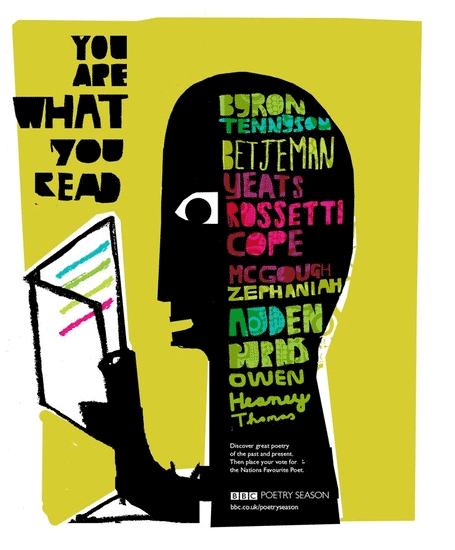
BBC Poetry Season: 4 Poem Postcards by Chris Haughton

I did a series of 10 postcards and a poster for the 2009 BBC Poetry Season. Each postcard was based on a classic British or Irish poem to promote the Poetry Season.

Here are four of them and the poster.

Posted in ARTWORKS | Tagged , , , ,

Reinventing the Ancient Across four Cultures, One Ocean

Introduction

A Nest of Cinnamon was an international, multi-art form performance of three distinct art forms and artists:

1: poetry and spoken text created and performed by Angela Costi

2: playing of the Sheng instrument by Wang Zheng-Ting. The Sheng is an Ancient Chinese instrument – 3000 years-old – consisting of 17 bamboo pipes of differing lengths mounted onto a base

3: a music and dance installation created through the use of silk threads and paper cups by Stringraphy Ensemble (Japan-based).
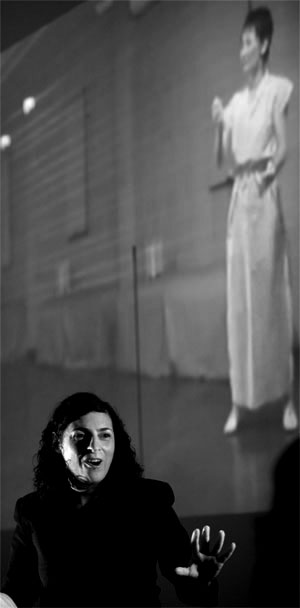
Angela Costi

The collaborative mix of Ancient instrument, Sheng, modern reinvention, Stringraphy and Costi’s type of poetic practice led the artists to explore in detail the mythological journey of the Phoenix. The Phoenix myth spoke to them on many levels. It is a myth that is familiar to the world at large and yet misunderstood due to its popularity. In Chinese, Japanese, Ancient Greek and early Christian mythology, the Phoenix bird is an eternal symbol. At the end of its very long life, the bird builds a nest of cinnamon twigs, which it ignites and fans with its wings into a fierce fire. Both nest and bird burn fiercely and are reduced to ashes, from which a new, young Phoenix arises. For the artists, ‘the nest of cinnamon twigs’ symbolised culture, tradition, rules, social code and expectations.

The Phoenix myth not only resonated with their individual artistic practices, it crossed their cultural landscapes. The Stringraphy creator, Kazue Mizushima, walked away from her piano and conventional modes of composition to awaken in her a connection with trees, birds and insects through a new mode of making music as an embodiment of the Phoenix journey. Costi’s recreation of traditional Cypriot-Greek folk songs and storytelling into new poetic form and metre is another mode of ‘burning’ the past in order for it to have a contemporary resonance. The Sheng instrument is visually intriguing as it was formed to imitate the shape of the Phoenix bird (the symmetrical arrangement of the pipes in differing lengths is an aesthetic connection to Phoenix wings).

The production integrated poetry, music and performance as it sought to narrate the Phoenix myth and then embody the myth. Global Japan Network produced it in partnership with Multicultural Arts Victoria and in Japan, with Midori Yaegashi, the producer of Stringraphy Ensemble. The project received creative development funding from the Australia Council for the Arts and Arts Victoria. Three full-house showings of the performance took place at Studio Eve, Tokyo in April 2009. Two Melbourne showings without the physical presence of Stringraphy Ensemble (they were projected on screen) took place at Meat Markets, a part of the CultureLAB program of City of Melbourne in June 2009.
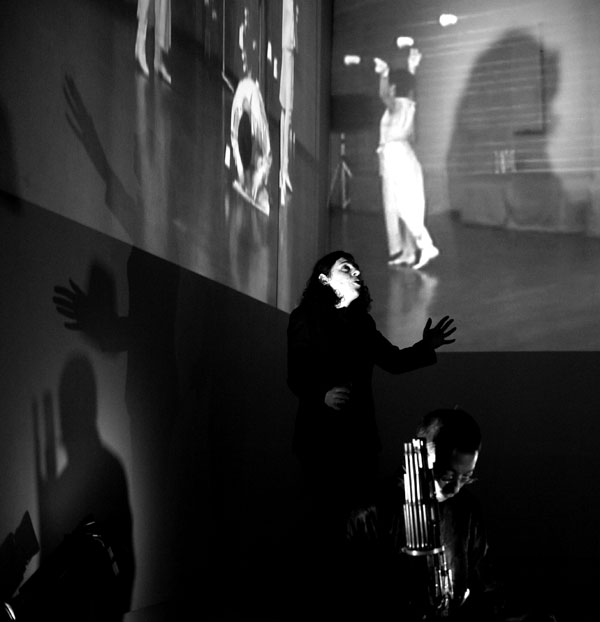
Angela Costi

The performance comprises four parts: ‘The Journey’, ‘What We Must Burn’, ‘The Burning’ and ‘In Order to Continue’. ‘The Journey’ focuses on telling the myth of the Phoenix through the three art forms, which provides a springboard into the next three parts. These parts encourage the artists to embody the myth, as they are required to ask themselves: What must I burn in order to continue? What is that aspect of myself – from my past, my childhood, my memories – that needs to be released ‘into the fire’ so that I can move on and be renewed?

Ting answers these questions by seeking release from the suffering he endured during China’s cultural revolution. Costi seeks to release into the fire her inherited sense of struggle to make ends meet, as handed over to her by generations of grandmothers. Mizushima revisits her childhood memories of being made to learn the piano from the age of four years old, and she releases this burden, discipline and control into the fire. ‘The Burning’, which is the third part of the performance, reaches a climatic level as all artistic elements are fused into the cathartic experience of letting go of the debilitating past. The final part of the performance embodies that part of the myth that concerns continuum and survival, and is explored separately by each artist.

This international collaboration illuminated the idea that we are all hybrids – continually igniting ourselves to make way for new cultures to exist within us – and so, performing it, we fly in the face of hanging onto our past from generation to generation, embedding our offspring with our nationalistic fervor and nostalgia. It also flies in the face of assimilation and integration because the past’s ashes are part of the air that we breathe, never lost or forgotten.


The Journey

(This poem integrates Stringraphy Ensemble, Ting with Sheng and Kiku in nest. All the elements – voice, body, sound and movement – symbolising the Phoenix and its journey.)

It is time to nest in the highest branch of the kiri
carefully select the most aromatic twigs
from the cinnamon trees
add frankincense and myrrh
create a censer of divine smoke
a pyre to perfume my ashes.

I will draw breath for the finest song
send it soaring to reach the sun
who will greet me with rays that spark
my wings will open in a wide embrace
to fan the flames into a blaze
and engulf me in a triumph of fire.

(breath – music – sound – movement)

My desire to die is not stimulated by age
though I am a parrot to my past
though I tire of singing my popular song
though I refrain from flying over mirrors
with their insistent display of my failure to moult feathers,
once mistaken for jewels.

(breath – music – sound – movement)

I admit, the sea’s spray does not refresh my flight
the horizon does not keep me awake
the world’s pattern does not capture my eye
the threads of war, the stitches from drought
the weave of eruption, corruption, destruction;
it’s so monotonous tending earth’s nest.


Now that I no longer glide with change
now that moments are not made on route
now that my organs have become debris
a bird cage grows from within
a civilisation is choking the earth
a 500-year cycle dreams of its end.

(breath – music – sound – movement)

When the burning turns my song into a scream
the flesh is seared with whimpers, a plea
how I wish to be spared
an ordinary bird dies quick and clean
I think of the peacock, eagle, even the pigeon
how would it be to die quietly?

(breath – music – sound – movement)

I have traveled from the Ancients to China
I have become a global trademark
I have met Ezekial, Nietzsche, Basho…
poets, philosophers, nation leaders…
know me as more than symbol,
know how to find life through death.

(breath – music – sound – movement)

The sun subsides               silence gathers around
a mound of cinders            night begins its reign
a tiny heart beat             unfolds its growth
a cry for light                    a thirst for home
soft feathers form into a new phoenix
who breathes in the ashes — and knows.


I must wake the sun with a song
rise from the nest
inhale tone, rhythm, pace
exhale heart, spirit, soul
fan out my wings and ask,
how will the world perceive me?

(breath – music – sound – movement)

There dies, my own mother
Here I am, my own mother
There dies, my own father
Here I am, my own father
There dies, my own child
Here I am, my own child.

The ashes of ancestry and history are a part of me
to gather into an egg
and cradle in flight to the city of the Sun
where I lay them to rest at the altar
forever in worship to that which burns
and takes and renews life.

(breath – music – sound – movement)

I continue my flight to what is known as home
with a flock of cranes, a company of kookaburras,
a parliament of owls, a congregation of magpies,
there is the dove to my left, the sparrow to my right
the squawk, screech, chirp of welcome;
I have so much to learn.

Posted in ESSAYS | Tagged , , ,

Soft Classic

New room. Pillows thumped into shape.
Twilight, pink and slim as hotel soap
unwrapped and lathered, shrinks.

From the bed, two small windows, one
above the other, separated by a strip of wall
which breaks the contained palm in two.

The wall is where you don’t want to be,
where the dark call originates, so opt
for the tree elongated by the disruption.

Waves raise marbled faces and unravel
a lace-of-foam that the calmer parts of us
find touching. Know an increase in the sea

breeze would make it so-so.

§

Your serviette tonight is a snow-white
bird-of-paradise folded by a village girl
who has chosen the name Dawn.

The couple is quite. Their eyes soliloquize
(inside a fetching silence that threatens to over
extend itself) a shift from garden innocence

to an inkling otherwise, conveyed in down
cast glances, and this hesitation is the branch
jammed in the spokes of a moment which had hitherto

recommended itself as the quintessential vehicle,
the sure wheel. Some running repairs and a walk
digests it best. Admire now the black butterfly

against a backdrop of palms. Swoon under
coconut clusters safe in the knowledge
there are sharks offshore but you braved it,

bobbing beside humble junks that are in turn
dwarfed by trawlers. Kicking the emptiness
with purpose, you’ve grown less ticklish underwater.

Posted in 54: TRANSPACIFIC | Tagged

Becoming Crystal

at Te Moeka o Tuawe (Fox Glacier)

I take my stone heart
to the river,
it moves with
all the other stones.

I slip and shear, ribs
crack like ice that makes
of the river gravel and gold
schist and carbon.

Forest’s dark green
sounds to the coast
with the dead and crystal
in their animate layers.

River collects sound
and boulder, water carries
time, leaves it, lifts it
as carcass, my becoming.

Rusty pebbles, creamy
lines of geographical age
grey and white moraine
bright icy time.

Posted in 54: TRANSPACIFIC | Tagged

Ipseity Game

Canadian or not, here I come!
I’ve counted long enough
my arm pressed against the brick
numbed despite the stings
my brow creased over eyes
closed as per social rules
my feet pricked by dirt
tickled to near death.

You hidin’ in the alley bin, girl?
You hidin’ good? Behind trash?
Or up the wall? Nobody looks up
where the monster splays.
You think I lookin’ down
all the time, blendin’ in,
brown brown me, quiet quiet
waitin’ waitin’ countin’.

Ok! I know you’re out there!
You not so silent for long.
You’re too used to do the talking.
You’re going to giggle.
You’re going to give yourself away.
You need a playmate.
It’s just a silly game. Come on.
Night’s falling. Supper soon.

Posted in 54: TRANSPACIFIC | Tagged

Transpacific

must have b e e n
my great grandfather [x30] taku tipuna1
Manaia –

he
was THE transpacific toa2
well b e f o r e any white-mariner’s hands murkied the swill.

aue so faaaaaaaaaar
back.

he’d poleaxed that grue Tūpenu
with one mighty swipe
& claiming utu3 for the rape of his wife, –
set sail trans-ocean.
Tokomaru te waka

steered by nga kuaka4 and maybe some whales,
they implored their gods
to skive a route southward,
scanning sidereal for matariki5 on those spectral nights,
&
peregrinating wave crests;
like no one before them.
Tokomaru te waka6

drinking deep from blistered nga hue7,
& filching errant flickers of rain
they delved down into kete8 for kūmara and taro,
y i
l n
thrusting for f g fish
yet lusting for far more
than those echinate gills.
Tokomaru te waka

transiting the currents and transcending the moon,
they trespassed on …

later, during the night
their gaunt dog absconded
&
guided all to shore with her faint distant yelps.

that first salient land-
beak
&
the l o n g white gossamer over

A O T E A R O A.

beamed out at them, beckoning.

Rākeiora sounded the pūtātara9;
they beached, stashing nga hoe10,
scrambling for sanctuary …
Taranaki

well a w a y from the liminal,
they’d transgressed the ocean, transposed the skies,

transpacific almighty

so waaaaaaaaaay
before now

Poem Notes:
In Māori tradition, Tokomaru was one of the great ocean-going canoes that were used in the migrations that
settled New Zealand. It was commanded by Manaia. His brother-in-law had originally owned the canoe. When
Manaia’s wife was raped by a group of men, he slew them, including the chief Tupenu. Killing his brother-
in-law, he took the Tokomaru and set sail with his family for New Zealand. Landing at Whangaparaoa, they
finally settled at Taranaki. Te Āti Awa iwi trace their ancestry back to Tokomaru. This is my iwi.

Posted in 54: TRANSPACIFIC | Tagged

Dateline

>> this message could not be delivered
because it was sent before it was received <<
POPmail


born a day apart we are here today, yesterday
but we are counting and the telephone rings
and we stop, on time, today again yesterday
and you ask how can this be and we go quiet
on time, listen to static, mosquitoes trapped
in flyscreens, smoke shifting decidual leaves
on time, on time, and you ask how can this be

so we sing who’ll come a-waltzing and we sing
john brown’s body and stars and spangles
and country too wide and sunburnt for any of us
while I dream of the city of angels and again you
call me the son of a godless convict, on time,
and the telephone rings and you ask about coyotes
and we glance at the clock, on time, always on time

and now if we were strapped in a jetliner careening
through new york skies and holding hands, cold
until we explode into shards of window glass
and aluminium and concrete-dusted filing cards
on time, this sun-struck morning, on time, last
fearful night and the telephone rings, on time
and you ask what date they will mark our epitaph

Posted in 54: TRANSPACIFIC | Tagged

Carrion Upbringing

An eagle’s diet consists
of corks, melons, priests,
winter births, Malcolm
McLaren, the newly
confirmed Deputy
Secretary of the U.S.
Department of Housing
& Urban Development,
an alpha male wolf, a family
exiled from the Dominican
Republic, Uluru, six Capuchin
monks—or was that
monkeys?—young Dracula,
Tip O’Neill’s grand-
children, their grandmother,
an impromptu curbside choir,
two HIV-AIDS research teams,
Gerard Manley Hopkins,
chopped mice & chicken
eggs, vegetarian primates, the
corpse of your enemy,
a cigar box lid, the Grand
Canyon, adopted & genetically
distant children of the
Baatombu, animal rights
activists, the delicate eco-
system of countryside Tasmania,
popular Brazilian music, &,
occasionally, small
animals & fresh fish.

Posted in 54: TRANSPACIFIC | Tagged

into

one feint :call. immense each stark limb uneased | sky
uneased | sky each immense stark limb one feint :call.
one feint :call. immense each stark limb uneased | sky
stark limb one uneased | sky feint :call. immense each
uneased | sky immense each feint limb :call one stark
uneased | sky each immense stark limb one feint :call.
stark limb one uneased | sky feint :call. immense each
one feint :call. immense each stark limb uneased | sky
uneased | sky immense each feint limb :call one stark

Posted in 54: TRANSPACIFIC | Tagged

Tears in Rain

for Nola Andrews

(i)

mother watches w-droplets
& planet’s blood pressure falls.

in sixty thousand years will
big Mars glow her memory

radiate again?

misses meteor shower over
brisbane, four children fracture

& depart.

silver hair; gelatin frost plate -67°
cold dawn is her cultural space.

(ii)

mother walks on green grass
ex-battery hen feet confusion

coal walker?

perspex sweats, can’t help it
ooohhh this feels good! Solid earth

claws frantic.

(heart)land burns domestic
re-entry, soul – Phuket soaked.

US air show pilot
aerial (r)ejected.

(iii)

that wet chicken smell, damp
bedraggled histories; Ubik found.

reached through to the other side
plastics multiple underground

& cover girls.
see through them, w-droplets
virgin stewards read safety cues

arm doors.

every woman needs a hoe
for those corporate snakes.

(iv)

drizzle flees mother’s country
anti-pastoral, soft plagues & shed

floors move.

half-mast mice, stalk hegemonies
sing out last moistures. rites of

spring abandoned.

drought’s fascist architecture
walls half papered, lino torn.

depression currency
of the great mind.

(v)

heaven will be Asiatic.
eternally damp for mothers.

no salt mirages, no dry heat
air-conditioned sanctuary

dust free.

she could believe in that
theology, sodden paradise

in between

monsoonal
& el nino.

Posted in 54: TRANSPACIFIC | Tagged

3 Lost Men

on guerrero the lost man & lite reign
oil ling. the cob bil stones & i wan ted 2 no
did he think how shock king 2 dy
a lone inn the woods as opp. posed 2 watt, inn a chair
in front of the tv or inn a bed. he sd it was
no problem; he had a good life. but
a lost man was lost & then he was found
& then he went 2 denver & then he came bak hear.
i have scene him byeing post er bored

& going 2 the gym. the woman was be hind the gate.
her husband had dyd recent lee.

he was the 1 inn the wheel chair. i sore him of ten

be tween the bar & photo copying shop.
her eyes where like the cob bil stones

wth yellow can dil lite the lost man
had all ready told me how the husband did it.
i un dir. stood. this lamp lite re mind ed. me of u
of coarse, 45 degrees. i hoped 4 a differ rent

mess sage as on guerrero, how shock king
2 dy a lone inn the woods i sd
but a lost man sd it was real lee know problem.


* Guerrero: ‘warrior’ in Spanish, also a street in Puerto Vallarta.

Posted in 54: TRANSPACIFIC | Tagged

Evasions

1.

Ocean opens
For every creature unveiled
It’s opposite in the absence

Erasure become object
Teeming measures of salt
Rock-bound

*

In the context of calling out
Thought’s misstep from mouth

Sincerity
Watching its fluency

Simple gestures adopted by branches
The decision to be moved

*

No longer pebble atop pebble

Mineral word solidified into muscle

A thickness greeting
Its own uncovered resemblance

*

Or at the condensed will of everything
One moment a contained gusting
Another, touch between two passing forces

Aligned intention
The duration of wind that begins

Back to those branches again

*

It goes on
Setting as time demands

The implied tree
Fated, gutted

Sea turned land
Where stride subtractions
Of what is known to live


2.

Dimmed propulsion
Recognitions of recurrence

If only to signal parallelism
A sea alongside a road, the road
Presented as its own habit of force

Tacit occupancy

*

Tracing duplicate paths
Accidental summit
Seen passing the opposite way

Downcast
Where crags or budding brush
Became the body’s stance

Forceful verdict
Grassy extent

*

To distribute a certainty:
Sod migrations
And the nerve-wrapped sky

Presence intersects
Decisions made on the ground
Slight turnings and fits of choice

Under elemental flight
Scansion of the blows
Wings cast

Posted in 54: TRANSPACIFIC | Tagged

Interlude

It was school vacation, my daughter skiing with her father,
my husband in board meetings,
mynah birds drumming on the window panes, autumn gifts,
my first ex. in a condo in Kuantan,
(true friendships don’t crowd us, they are not a phrasebook.)

But it was just the grief I felt in his apartment, a stopover,
sufficient to release claustrophobic
stanzas, one by one, a sorrow, unclenching into silence.
Shopping at East Coast Mall, the lap pool,
gymnasium, the trees peeling outside. I could call it respite—

forgiveness. I was at odds with bureaucracy, the clinics
who treat psychiatrics like offenders,
gagging them with psychotropic drugs, they surfaced,
gas-filled whales buoyed into my office
while Indonesian boats sank their cargo, politicians waged.

I could write more—hours spent with innocent refugees
tried by narrow halls, waiting for visas,
medical assessments or suicide. I could detail the security
frauds, bribery, Typhoid, children turned
in the hands of frustrated men like outdated dictionaries.

Or I could mention the Rohingya Burmese father of four
closing the door, in haste, unlocking
suitcases to scribble down their UNHCR-ID on the back
of some food coupon, the sound of a hose
filling buckets of water for the day’s quota, his exquisite wife.

Perhaps, I should confess how prohibited I felt, ferrying
back to a 5* hotel in evening’s pollution,
encrusted lights of traffic. I had no appetite for dinners,
swimming laps, late, without purpose.
Hibiscus swishes calmed my traitorous lungs— how I forgot
everything I knew.

Posted in 54: TRANSPACIFIC | Tagged

For Elise

After sundown garbage-trucks in Taiwan
sing electronic Für Elise
as they collect town waste –
(where else so talented?)

in different keys moving
closer now further away to
the grim outskirts

heard from the 13th floor (the building moans
in sea-breezes) oneiric
Casiotone a polyphony
underwater & out of tune.

This century already more haunted
than the last

not least by Ludwig
raging deafly from the grave.

Toucheng, Taiwan 2011

Posted in 54: TRANSPACIFIC | Tagged

Radar

I eat my learning all up; except maths. I mash it into my potatoes,
paste it under the table. I am eight. I hold all the cards.
I will sit there all night. I will never climb down.
Dad lets me go to bed.
He is forty-five, and working too hard.
He is arguing with the teacher. He is only about five.
He has been at it for hours, howling.
You are Uncle Charlie. You are the oldest and you can’t stand it.
You grab him and take off. You say, Wherever Garth was,
there was trouble.
I am four. Dad says he might have to belt me
if I don’t stop. I say, Your pants will fall down.
I have all the answers.
I do what I like.
The weather flashes. Frost crusted on the branches.
You are my Uncle Charlie, with a hard blue stare.
Hello, you say, with your joke: Where’s my stock-whip?
I hide in the chook shed.
You are my brother. You are the boy; just as well you like shooting.
If I am sixteen, you must be twelve. If I have Dad’s twelve-bore,
you have your own four-ten. We’re down the reserve
for scenic birds. Dad teaches us how to give them a lead—
like, at least a foot if they’re going flat out.
We are gorgeous with glee, we sneak so quiet.
I am six. I am standing gingerly behind our first pony.
Get right in close, he says. Bastards can’t kick you so hard
if they can’t get a swing at you.
I am sixteen. You are seventeen.
You are the best rider and you are my sister.
You have to put up with me all the time.
I can’t have everything my own way,
my mother says. I am bewildered.
You are my grandmother.
You live by yourself in the big house.
Mum must be thirty-three, if Dad is forty-seven.
She is always in the middle. I am the middle child,
I carry messages on behalf to my father.
He is a very private man.
He is the Lone Ranger.
He has a silver mare, she can turn on a sixpence;
he rides the range in shocking weather. I go too.
I am afflicted with loyalty all my life.
On Black Friday he lets me ride her,
she gets caught in wires. Whoa! I yell, Whoa!
She kicks and kicks till she flays off all her skin.
Wood in my throat, some imaginary hand on the small of my back
and push, there I go through the woolshed door.
Oh my God, you say, Oh my God.
She doesn’t die, no, she keeps her silver scars.
The patch on your back can never be touched.
You are Gug, you are Edward, my uncle.
For Courage.
I am seven. I stare at your trousers.
If I never see the sea again, you say, that’ll be too bloody soon for me.
If you get another bloody horse book out from library
Dad says, I’ll throw it in the fire. I am eleven. He smokes
and reads Jeeves or Somerset Maugham.
I am twenty-five. You were sixty-two. People say, it’s far too young.
You are my cousin Barbara, you say, He was such a good man.
Red hearts in the trees. Light glaring in.
You are my brother. Winters, you are sick; the rain deliberately falls.
Dad brings you a train set. Electric tension, he struggles with instructions.
Flashes and smoke.
You’re eight and I’m twelve. He sees the Jehovahs on the drive.
Fuck, he says, Go and tell them we’re Catholics.
God swishing in the bushes.
You are Barbara, you are only little, and he won’t answer.
He grins. He is thirty-three.
Grandma said I had to give something up for Lent.
I couldn’t give up smoking and I couldn’t give up swearing
so I bloody-well gave up talking.
She’s never forgotten it.
You arrive late, you’re over eighty
and I don’t know you. You are a townie.
If you’re going to eat it, Grandad says, you learn to kill it.
Throat cutting.
We girls aren’t allowed in the killing shed. Not till it’s gutted
and hung and the head in the creek.
We are to ride away.
Ride right down the road when they dynamite the trees.
We don’t go far, we get a good view; it hangs in the air
like the ashtray and sand we blew up in the house
with a Mighty Cannon.
Dad’s revolver wrapped in a towel
in the second drawer down. We are not allowed.
Gug has a revolver and a Luger he took from a soldier.
We use it to shoot birds in the orchard and he doesn’t come too.
The trees are white with nerves.
Uncle Charlie is eighty-seven. Who’s that girl? He says, I know her,
touching the photo of his sister, Gwen.
Rain slick on the windows, vaseline lights winking from the far land.
You are Gwen. You are eighty-one, and you sigh,
All those beautiful letters he wrote
They just faded away.
I kept them long after the only word you could read was Garth.
Smoke drifting down from the distant sky.
Dad used to run off all the time. Take off across the paddocks.
You always thought Granny was a big woman, but by hell she could run.
Mossy. Watching.
Go, dog, go.

Posted in 54: TRANSPACIFIC | Tagged

A Phenomenology Walking from Kasu to Mur, Rai Coast, PNG

and moinie created everything
with it so that life’s blood
was made ‘water’ so to travel
through everything and bond it

– ‘water’ Jim Everett – puralia meenamatta


treading thought
surfeiting
is it not maybe just the
relative staying power
of our metaphors:
our water’s
estranged
pointing out his mother’s land
a dispute simmering
sometime down the scarp
I know water only as water, and blood as water only
the paper on Aboriginal traditional conservation
said ‘waterscapes’
you thought: choked, friable outposts
i.e the same constancy as blood real blood
cutting my feet up on the track
I mean
my mother also conferred disjunction
on her family –
it is a land dispute, too

Posted in 54: TRANSPACIFIC | Tagged

Winds of Change

from the series Amphoteric Poems


Posted in 54: TRANSPACIFIC | Tagged

The Lungfishes Birthday, Steinhart Aquarium, San Francisco

Two wise blue-eyed cigars
arrived this day in nineteen-nineteen
with little grins on faces

and now like languorous jet-
liners they retrace the entire
world, from branch to
waving vallisneria—

iridescent Australia—
in ninety-one years they have
not touched the glass, but
their mouths where the
cigar was snipped search
in the gravel like paws
for worms, then stop, dart up
to steal a drop of atmosphere.

Posted in 54: TRANSPACIFIC | Tagged

Barricades

Once upon a time, scorched earth
& thighs. The first word was “dough”
upon my lips. Some voip mixer plan
in highly performative social wear.
Something about how I ate everything
in the house, & then proceeded to eat the house.
Life is so much better when you
don’t have to work. It’s hard to say
why anyone ever invented it. Pure power
is super-annuated & dull. I will probably
speak more than my twin brother this weekend.
There is no page to like. I am intact
in this case of lies, & I don’t care.
Perhaps we trust our texts too much.
& so continuously toward the dark toilet
trembling in a sea of topless .jpegs, that
function in your night like bayonets,
those enemas & ecstasies!

Posted in 54: TRANSPACIFIC | Tagged

Desert —

allows wildflower murders
the momentary, untouched
granular, hidden

has emu-light, river gum,
sockets of stone huts,
is always being left

accepts troop-carriers,
razorwire,
no man’s land

dessicates Detention,
slapped up in the magazine
triggers Intervention

Posted in 54: TRANSPACIFIC | Tagged

Tacit Knowledge

Driving back from Zavalla at 5pm along some road towards Courpsville
wondering exactly what I’m meant to watch the ice do on the bridge.

This morning a snake came up from the undergrowth
and I didn’t know whether it could kill me.

It wasn’t the diamond-headed death-bringer of my childhood;
nor does the maxim of if it’s long it’s deadly hold up in Texas.

From the wrong side of the road
I rang Mum in her new house who laughed at me

then said they had a 2 metre dugite living in their shed.
But she was worried I was driving at dusk

and told me to watch for roos and I didn’t correct her.
But what I want to know (as I drive past a dead thing with horns) is:

why can’t someone tell me if deer are crepuscular?

Posted in 54: TRANSPACIFIC | Tagged