tweets i never published

there’s a vision of the person
   i want to be & it’s not
   the type of person  who goes jogging

nor the type of person
   who dates @_______
   for all of their life  #SorryNotSorry

coz sometimes i hate your cheekbones
   so immensely
   i want to squeeze them  til they pop

like a pimple but with spurt
   & ooze of rancid pus,
   of blood,  of your hefty opinions

& there are days i hate
   polyamory – it makes me
   more tired  than i thought possible

speaking of: can i hope  to slumber
   in a modest space
   bristling with fairy lights  until 2020?

or at the very least: to sleep  til you cease
   narrating my life
   like i’m rules  of an obscure board game

Posted in 78: CONFESSION | Tagged

Adaptions

Pornography involves an abstraction of human intercourse in which the self is reduced to its formal elements. — Angela Carter


The day before we move in together I’m reading Joan Didion in your bed, which is now ours I guess. She is writing about biker gangs and the movies that depict them: Peter Fonda tearing open a dress, a woman, a waitress. He reaches the end of the film with nothing to say. She describes how they gangbang a woman. A pile of sentences. Gangbang. The word sinks from my head through my gut to my cunt where it tingles. I watch a woman get ploughed, obviously — all poetry is porn; calculated intimacy and brutal indecency, always performed for someone to see. We fuck until we’re a soft pool in the centre of this structure where we love each other, and I guess, we now live. It’s hard to justify caesuras when I’m seeping like this, like sap or lukewarm toffee and a pain in soft teeth. So on the cusp of domesticity, I sink beneath the shape of my trope into the warm mess of another. Unique feelings always evolve to hard clichés. But how to say it — the words, the building, the body. Where’s the tenderness in architecture?

The trip and me, Joan the day before, I lay naked in bed. He wrote this film describing them: Peter Fonda, a woman, not a waitress or something. He described how fascinating he was: understand the sentences. It stung. My master, legs and head. I have some pornography, a woman who apparently ploughed – but poetry is porn; cruel and despicable acts, always someone looked. Those are good mouths or bellies or rocket warmth or blood vessels, which make caesuras difficult to justify. So I decided to sink under the actual family. Produce cliché. We are, we love each other, how good, and I live, in the middle of the pond. I am not God but I’m building obedience. Architecture is tenderness.

John and me naked in bed before traveling. His film, Peter Fonda, a woman writes anything he said. Of course, he remarked, how interesting. This expansion. Lord of the head and legs. But poetry is always porn; cruel actions and say – I have some fucking woman’s leg! Caesuras are hard, stomach is soft, and heats the mouth of the vascular missiles. So I decided to put down roots in a family. The production clichés in the middle of the lake. How good we are: we love each other and live (a reference to obey God’s building). Mayan architecture.

Posted in 78: CONFESSION | Tagged

Water on Water

The music of the water as it coves. We covert each other. Rings from the aquarium gift shop that change colours. Cover of sunlight does not show what happens after dark when the neighbours stone the penguins to death on the beach, leave them with coffee cups over their heads to drown. She wears my hoodie over her eyes as she lays on my lap on the rocks above the water, and says we have been both under and over and beside, today, and maybe she is suggesting we will also be in the water, when we return to the city. That pool by the harbour, the drama of water on water. It is not loud if it is dying. If we have brought a species to extinction let it flood and fill our minds with sound. There is always the anxiety of airports and trains where hands slip, where unnecessary promises are made, where the views we shared just go, just leave us until we can pick them up again. This time of year the trees keep giving us things, wattles, hibiscus flowers, banksia seed pods. I am loved.

Posted in 78: CONFESSION | Tagged

Disgusting Landscape

The West has been kneed in the gut. The vegetable cut is a freakish moor in the winter landscape. A freezing fresh gutter of fish heads and balloon bellies. The television set is a cut throat after it became pregnant with Cindy. This is a dirty word. Just a good fit for pulpy orange juice, sip it with caution or it will burn the front two teeth. The thighs hinge until they’re oiled, and if never boiled then the winter is going to consume it with gravy from the boat. The dress is suspicious as furious heels yammer on tiles, the machines in the printing room honking. Enormous paper cut and floating tongue in cheek. Milky trance inside liquid pen leaks and a manicured finger buds with warts from giant yawns, coughing with wings. Nobody wants their fingers to fly away. In grey clouds where stanzas sing but go unheard. Around dinner tables with saggy faces putting sops into their tums. Sipping hot orange juice until the whirs wear out and the veal goes cold – will you have it with soup? Maybe wheat on a tired eye. And maybe a late night news updating on a thick piece of lamb chop yelling about towns combusting with brief spontaneity. Don’t listen to the news, it’s a dirty word. Some dairy wobbles.

Posted in 78: CONFESSION | Tagged

Goodbye Forever

I am a prison of my parents’ devising –
marijuana, red wine, cocaine on the esplanade
Dad making mum carry tackle and rods at 3am
so as not to rouse suspicion
from the fishermen that line the water’s edge
like clothespegs

My new favourite emoji is the hole
but his would be a mountain
my understanding of him still so primary school
tied to his profession – his death still
a two dimensional oval shape
in an alphabet of other two dimensional events
like a fish negotiating hostages
sex hands
sloppy Italian finger kiss

I’m literally dying here, but that seems selfish to say
as if it’s not happening to literally everyone else
who isn’t already dead
as if a heritage of bad emotional clockwork
can really be called a prison
as if it’s not like comparing
a two dimensional black oval
to a multidimensional black hole tearing apart space
so inconceivable in its terribleness
that when I see it in my newsfeed I feel less
and less
and less
the feeling of it swallowing the feeling of it
until my throat looks like –

My father put the fear and awe of man in me
that men are large and mighty, silent
and unfeeling, their boots made of harder stuff
their shoulders knocking snow from branches
the way a whale swallows krill
so, I decked my heart out in lambswool
I decked my heart out in a beard and leather moccasins
and let it live for six months in a cabin
writing the breakup album of the year
and when that didn’t make me any less a woman
I picked the next man with a heart decked out in lambswool
and fell into the holes left by his steel boots
spines in my shins – but still

We all know Bluebeard was a bastard, that’s the point
and so was my father, in both senses
though he loved me
and called me lazy

I am not mighty
I am a two-dimensional rock collection
scrapbooked from an encyclopaedia of semi-precious stones
I am a bird foot impression in fresh power
harder than I look, and cold
I am getting dressed up like a purple Elvis
and going out on the town
with an American internet lesbian – you cannot stop me
I do not need my father
or his father, who abandoned him
or his grandfather, who abandoned his mother first
to tell me you are all terrible – even the good ones
I have seen the dope-jawed tigers of Tinder, the hanging fish
with sambuca pooled in their eyes, I have seen you sit there
as she clears the plates away each night
easy as swiping left
easy swiping right

Posted in 78: CONFESSION | Tagged

गुम; or, Lexical Gaps

सपना
/sapna/
My dreams, in colour. My skin drips
melanin and no one tells me I have a beautiful
name. I have no country of origin
and I cannot be accused
of being articulate.

याद
/yaad/
My childhood, remembered: mouths unsynced
with sound, words swollen and sworn. Throats
dismantled from the inside out. My tongue turned
plosive, poised at the tip of my teeth,
dubbing out of dialect.

सोच
/soch/
My brain humming as it searches the synapses,
the center—the superior, the inferior, the middle
temporal gyrus, the Broca’s and Wernicke’s
—for the path to my flimsy pidgin,
my language of thought.

Posted in 78: CONFESSION | Tagged

decolonial poetics (avant gubba)

when my body is mine i will tell them
with my belly&bones
do not touch the de
or let your hands burn black
with your unsettlement
there are no metaphors here

when i own my tongue i will sing
with throat&finger
gobackwhereyoucamefrom
for i will be
where i am for

when i am aunty
i will say, jahjums,
look what we made for you
look what we carved from the earth
to clean and to heal
so you may have a place

and when i am dead
they
will not
say my name

and when you are dead,
you can have poems.

Posted in 78: CONFESSION | Tagged

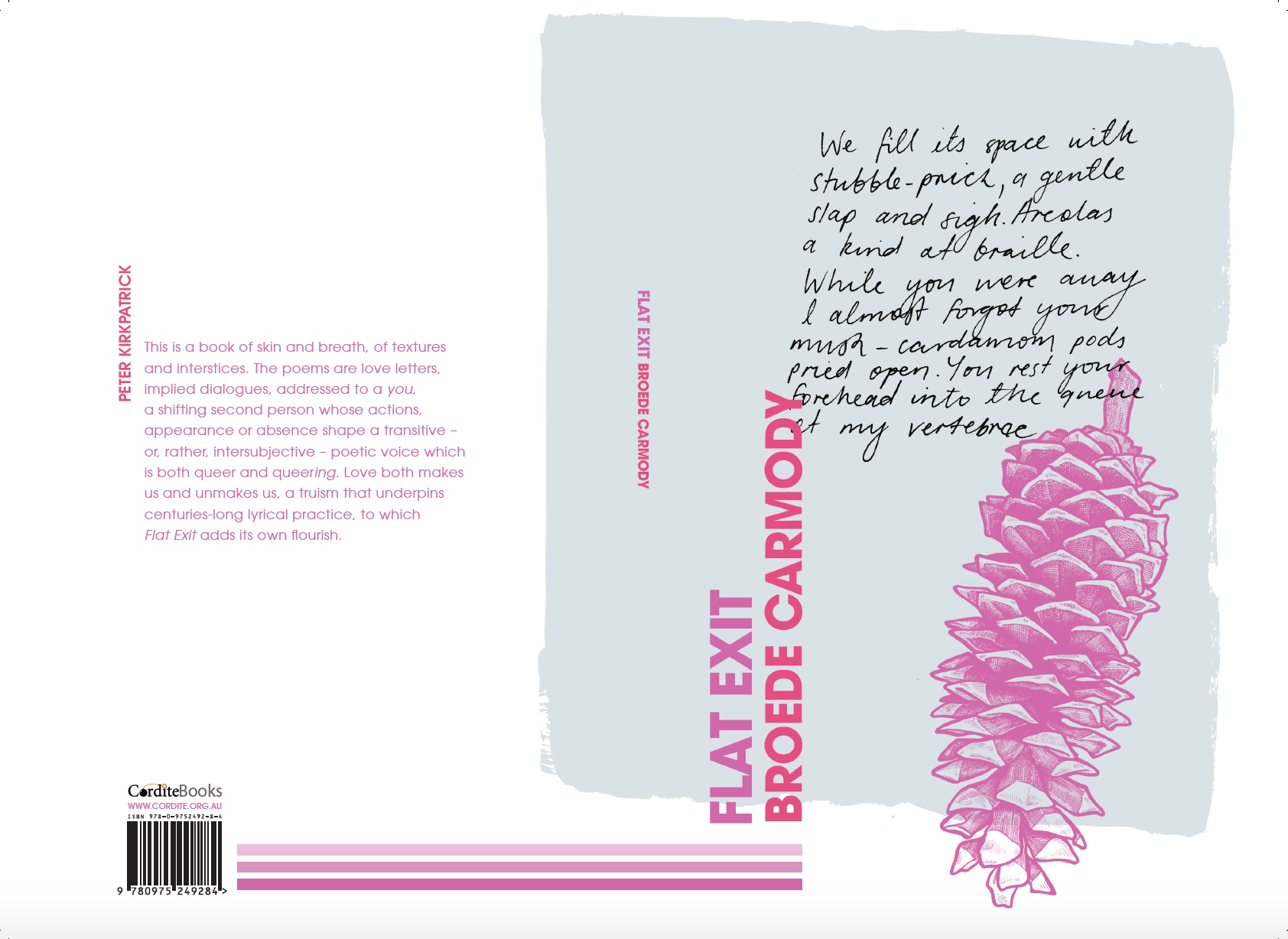
Introduction to Broede Carmody’s Flat Exit


Cover design by Alissa Dinallo, Illustration by Lily Mae Martin

BUY YOUR COPY HERE

A first book of poems needs no introduction, being its own forerunner. As a consequence, this note merely states the obvious: that Broede Carmody is a young writer with a great lyrical talent.

Flat Exit is a book of skin and breath (its very last word is inhale), of textures and interstices, ‘the space between us thinner than / cigarette paper’. Water and immersion are keynotes – from the first section, ‘Falling into the River’, to the third, ‘Learning to Breathe Again’ – but so too, not unrelatedly, are love and sex and their complicated romantic history. With epigrammatic wit, Carmody writes:

Love fills quietly –
a spring dam or overnight emails.

later adding, with greater worldliness, that

We never love someone
completely – just bits of them.

That love both makes us and unmakes us, and in doing so can also make poetry, is a truism that underpins centuries-long lyrical practice, to which Flat Exit adds its own flourish. Carmody treats the theme very much in his own manner, not only in the keenness of his lines, but in the way he negotiates contemporary landscapes of identity and desire. These move between country Victoria and inner-city Melbourne, with a surprising sidetrip to Finland, and across these changing environments the poems trace fresh modes of being in which ‘We move through each other, / on to the place we’re going’. So, in Australia,

You march into my larynx
wearing the scent
of downpour

while, in Scandinavia, ‘We try on each other’s skin’.

In the intimacy of breath – ‘Swerving in and out of love is breathing’ – language itself becomes embodied, inflected by what the poet calls his ‘dingo accent’. This is a world in which areolae are a ‘kind of braille’, and a mango in a lover’s hand peels ‘back the syntax of our skin’; while a trout is killed by inserting two fingers in its gills, ‘the creature’s head / flung back like a comma’. As this suggests, under the skin the poet also discovers death, the ‘flat exit’ of the title: ‘Let me fix another cup of black’, he writes. Elsewhere, in the ‘Language of Dinosaurs’ (a dead language if ever there was one), ‘Your trepid skin is full of mammals, / a palaeontology of sadness’.

Most of the poems of Flat Exit are love letters, implied dialogues, addressed to a you, a shifting second person whose actions, appearance or absence shape a transitive – or, rather, intersubjective – poetic voice which is both queer and queering. Just so, the poet reminds us that the deeper truths of a relationship often lie in its casual details:

… Come home soon, my love, I’m just
down the hall. There’s nothing in our fridge except milk
and your parents’ quince paste.

On the downside:

Grief is finding Tim Tam grit
in your bed though you haven’t slept there
in two days.

Reading these poems is not unlike Carmody’s own description of swimming: they will turn ‘skin to goose flesh / and the world will feel tipped / upside down’. Despite its title, then, Flat Exit is less about departures than arrivals – its own arrival, in fact: ‘An emergence of nude speech / and harrowing sky’. If it needs no introduction, I am nonetheless delighted to have provided one.

Posted in INTRODUCTIONS | Tagged ,

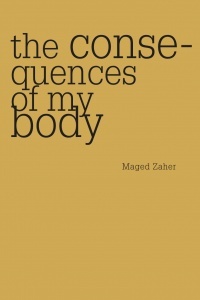
Review Short: Maged Zaher’s the consequences of my body

the consequences of my body by Maged Zaher
Nighboat Books, 2016


This is love poetry for the Tao Lin generation. The consequences of my body offers a discourse on desire as it is mediated by the electronic interfaces that obviate the need for ‘skin to skin contact’ even as they turn out to exacerbate it: email, Skype, Facebook, Netflix (and chill). Part of this has to do with Maged Zaher’s unique trajectory as an engineer turned poet who still maintains a ‘day job [as] a software guy – a field in software called enterprise architecture … it is about overarching systems design’. Zaher is based in Seattle, which with its ‘poets, engineers, investment bankers, and – of course – musicians’ provokes some larger thoughts about networks and ‘the oppressive morality of productivity we live under’. Consequences is the work of a savvy poet in one of America’s savviest cities and one is made to feel it in the academic accent of such theoretical interludes as well as in the contrived flatness of Zaher’s low-strung diction: ‘I will / Also hide hope in an okay refrigerator’; ‘Thank you also for the few moments of hope / And for sleep after okay orgasms’. In such verses, ‘okay’ is pitched rather precisely at the point where whimsical satisfaction becomes difficult to discern from jaundice. Such ambiguity offers a clue to the kind of character we are dealing with in the poem: a digital dandy.

If Seattle provides consequences with one set of co-ordinates for its exploration of being ‘connected’ as a politico-sexual analogy, Cairo supplies another. The effects of the Tahrir Square protests of 2011 (stoked by social media), the revolutionary conflagration of the Arab Spring and the ensuing Winter are registered keenly:

I didn’t risk my life in the Egyptian revolution – yet somehow my worst moment of personal defeat culminated upon seeing Cairo itself defeated – Cairo – a city that I never truly lived in – I just walked its downtown streets an infinite amount of times and these same downtown store lights were/are to fuel my poetry journey until now …

It is an odd moment of candour that makes more sense in the context of Zaher’s work as a translator of Egyptian poets who were directly involved in the protests. Despite Zaher’s attempt to forestall the unearned pathos of mere fellow-travelling, the poignancy of political defeat lingers and infuses those moments that are located in a pallid elsewhere with an unexpected fragility:

This is not about seduction
It is about hanging out tonight
While surrounded by capitalism
It rains
And we call it love
This continuous threat of collapse

The lover’s carpe diem has been transposed to the key of post-revolutionary disappointment. What might otherwise be a canny euphemism –‘hanging out’ – comes off as the delicate result of managed self-expectations, a twilight eroticism that has learnt from experience not to hope for too much.

The shuttling between Seattle and Cairo allows Zaher to trace out a hybrid poetic genealogy for himself. The fifth section of consequences contains a three-page manifesto, ‘Aesthetics: A Personal Statement – Rated R’, in which Zaher claims a joint affinity with the ‘Udhri’ Arabic love poets and North American L=A=N=G=U=A=G=E poetry, his own work situating itself on the ‘middle ground between the lyrical and the experimental’. Zaher seems to owe just as much to the slacker hedonism of the New York School which finds its way, rather appealingly, into the translations of classical Arabic love poetry strewn throughout this section. Take these lines from Abu Nuwas:

I circle around your house every day
As if, for your house, circumambulation was created

The idiom of infatuation has been updated and, in the manner of contemporary pop lyric (think Lorde), invokes a love that in its sheer gratuitousness becomes absorbed into a larger ritual of holding unrelieved boredom at bay. But in one of Zaher’s riskier gambits, this flavour of hedonism is mixed rather surprisingly with the love-as-martyrdom trope to produce something out of Harmony Korine:

We have enough to order soda and lunch
And walk parallel to some river
The easygoing passengers reek of privilege
You take over the hostages I will pretend I am peaceful

These are felicitous moments in a volume that is likely to amuse some and exasperate many through its skittish theatrics. Effortlessly hip, consequences blurs the line between bathos and pathos, the mundane and the sublime, the real and the virtual in legitimising love’s place alongside language and politics as one of life’s nobler distractions.

Posted in BOOK REVIEWS | Tagged ,

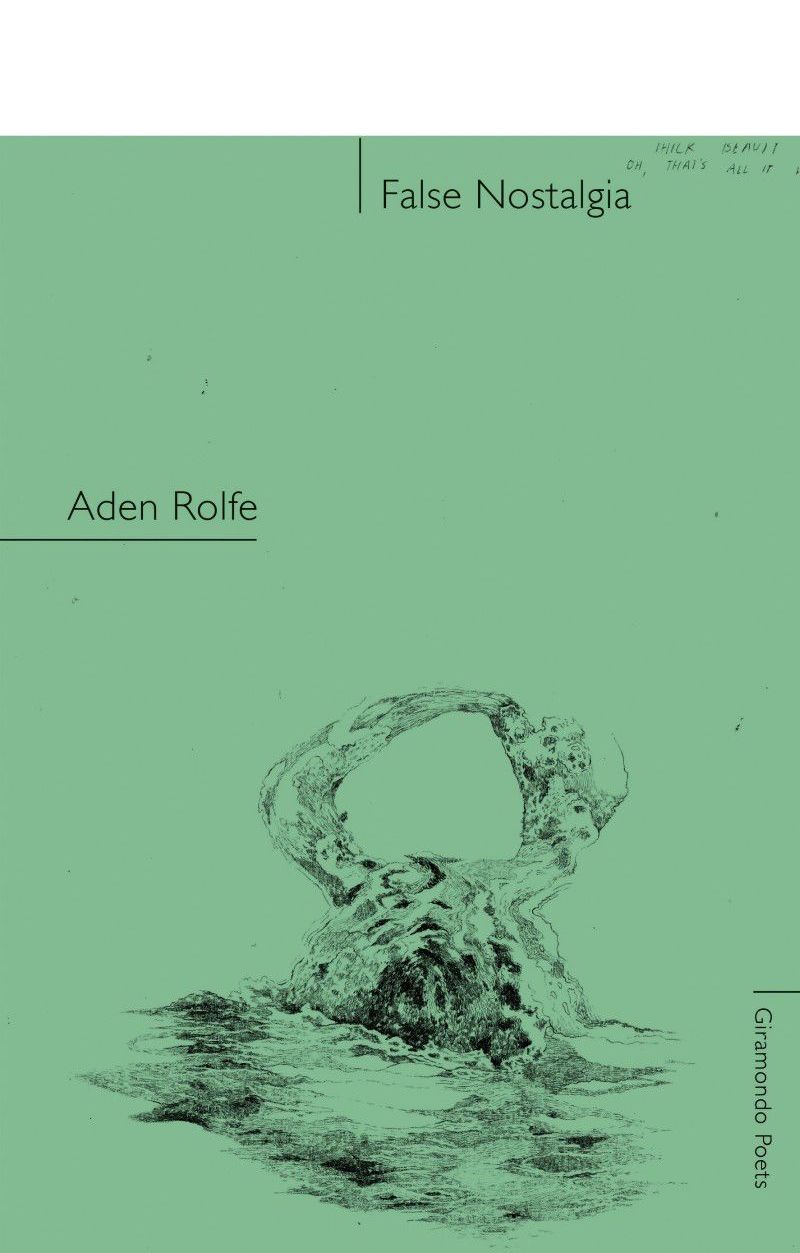
Review Short: Aden Rolfe’s False Nostalgia

False Nostalgia by Aden Rolfe
Giramondo, 2016


Aden Rolfe’s False Nostalgia presents a collection of memories and corresponding vagaries of forgetting, which stimulate and unsettle in unpredictable and oblique turns of thought and phrase. His work includes philosophical, lyrical and confessional voices, the overall discourse serving to recreate and recover highly original self-objects in time and space.

The collection starts with a meditation on learning: who we are and how we become that way. This process often involves unidentified particles of memory and implies a previous existence that one is not fully aware of, and may be compelled to invent. Rolfe identifies this as Plato’s concept of anamnesis, leading to the paradoxes inherent in statements like: ‘You negotiate your position in relation to an event, particularly an emotionally resonant one through memory’. This process applies not only in a temporal sense but, as Rolfe eloquently demonstrates, to perception and recollection of place.

An initial premise is that although we may be defined by things we remember, and that: ‘When our memories change / so do our stories’, an addendum warns: ‘just / because it’s meaningful / doesn’t mean it happened’. Therefore, we read to remember and write to forget, create twists and tropes through loss and uncertainty, to clarify or distort who we were, are, or have been. Given the physical and psychological changes during one’s lifetime/s, it is worth a considering the poems included on the effects of disorders such as a stroke, and that anamnesis can also refer to a patient’s medical history.

For instance, in ‘We watched the Waves’, Rolfe hints that to be sure of holding onto a memory in the future, we sometimes watch the present more intensely than is natural: ‘we try to watch the waves so that later we can say / we watched the waves’. The poem derives from a line by Robert Hass, so we also have to wonder which of the two poets actually experienced that time, and whether Rolfe’s poem exists to dispel a false memory or to create a necessary sense of anamnesis. Marcel Proust also comes into the conversation, creating memory through deliberate, sensory linking between childhood and adult senses. By contrast with his predecessor’s environment, Rolfe finds:

the best moments occur in these
spaces

                    coastlines and beaches
                    clearings and trails

These are interpenetrable places, and imply settings where we can see ourselves in a picture, even if that picture is no longer present and we are no longer there.

Later, on the threshold, we count three things:
        wind
                leaves
                        and a prolonged hesitation between
        sound and sense.

There would also appear to be the vertigo induced by uncertain paths, the faraway sources wished for by Arthur Rimbaud, with only the end of the world ahead, or an undefined space in the interim, where footsteps are erased in dust or washed out by waves.

Rolfe explains nostalgia was originally diagnosed as a longing for one’s native land, prevalent among homesick mercenaries, who would ‘have the tendency to lose touch with the present, to confuse it with the past, to conflate real and imaginary events’. Since then, it has developed from a mental ‘affliction’ to ‘a poetic trope’. There is a form of nostalgia, however, that functions as healing: wilfully evoking past experience, not only pleasurable but grimy and uncomfortable, which through a certain way of remembering confers a hint of bitter-sweetness and which: ‘doesn’t fit the common definition of nostalgia but it’s not strictly false, either’.

Rolfe uses intertextuality in skilful and unexpected ways: juxtaposing classical and contemporary sources, expertly interwoven (and unobtrusively, although meticulously referenced). One draws on the short story ‘Funes the Memorious’, by Jorge Luis Borges, who refers to ‘this sacred verb’ (to remember), whose protagonist suffers a kind of amnesia in reverse after an accident, rendering all his memories intolerably vivid and omnipresent. Physically paralyzed, Funes is sentenced to remember all the particles of his life, and dies after a few years of this condition, from ‘congestion of the lungs,’ the message being that to retain all we have experienced is fatal: there is no way it can get out, there is too much to express. Rolfe references Funes in relation to the advantages of forgetfulness, which can function as: ‘A way to stop a surge of detail from bursting / the banks’.

A switch to prose gives an intensely personal précis and astute assessment of Michael Haneke’s film, Caché, a work without apparent resolution, and notable for its unnerving and drawn-out scenes of edginess and absence, punctuated by a startling episode of violence resulting from a botched adoption, and indirectly related to colonial abuses. Rolfe muses that these aftershocks from recent history are ‘not about nostalgia [but] about guilt and responsibility and collective memory’, leaving their residue in domestic disquiet. Maybe the least stability of all is in that uncertain place called home, with its potential to provide both transcendence and terror at its limen with the (‘hidden’) outside world. Anamnesis is felt here in yet another context: the realisation that history is often violent and chaotic and that like personal recollection, collective memory does not conform to the continuities and contingencies that would otherwise make it comprehensible.

If memory is an art and so too, forgetting (which as ‘Ars oblīvium’, ‘doesn’t feel / like anything / remember.’) then what are the functions of analepsis, recollection and recognition? Will we really know the inexplicable ‘it’ when we see it? ‘Projecting forward, we can only wait to see our hearts breaking, be recast, lose sight of what matters. There were no simpler times, it turns out, no house by the beach’. Memory is a trickster, fixes events in place, and then moves them around when we least expect. Attempts to recover past time are misinterpretations of nostalgia. The collages memory presents, and which Rolfe expertly and compassionately composes, are the truer versions, rearrangements of the self in the cracks and edges of the mosaic that comprises shared space.

Posted in BOOK REVIEWS | Tagged ,

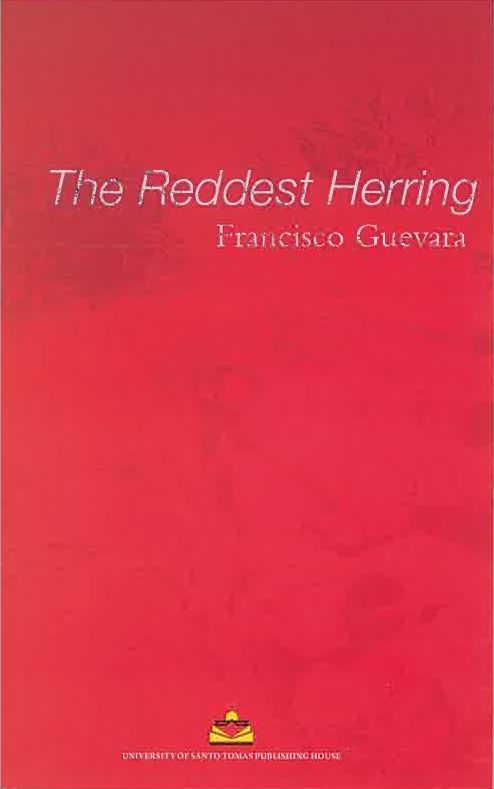
Stuart Cooke Reviews Francisco Guevara

The Reddest Herring by Francisco Guevara
University of Santo Tomas Publishing House, 2015


At the time of his death, Francisco Guevara – ‘Kokoy’ to everyone who knew him – was becoming a unique, unwavering presence in contemporary Filipino poetry. An unlikely graduate of the Iowa Writers’ Workshop (reports suggest that he was repeatedly stymied by the rituals of the workshop lyric), in 2010 he returned home to the Philippines to take up a position at De La Salle, one of the country’s most prestigious universities. In late November of 2014, at just 31 years of age, he was killed in a road accident while skateboarding; The Reddest Herring had been completed shortly before. ‘Kokoy was a breathtaking, singular poetic prodigy,’ wrote US writer Thor Nystrom, ‘and I weep for the work the world has had stolen from it.’

A photograph is discernible beneath the bright red cover of The Reddest Herring. While it might bear little obvious resemblance to the poems within, or to the poet himself, this photo is actually an important sign of some of Guevara’s deepest preoccupations. Taken at the end of the nineteenth century by an anonymous photographer, Filipino casualties on the first day of Philippine-American War is an image of a nation that has just rid itself of one colonial power, only to see it soon replaced by another. Hundreds of thousands of Filipinos were killed by US forces during the conflict; a new, American empire had flexed its muscles and was squashing the vestiges of an older, Spanish one. But as much as the Philippine-American War could be the inauguration of a century of Filipino resistance to American (and Japanese) imperialism, it is also an event which cauterised the close association of a struggling Asian nation with the rapid ascension of the United States. 120 years later, so deep is US influence in Filipino culture, education and politics that it makes little sense to posit an ideal, or unsullied, alternative. Thus, 500 years after the first wave of Western colonisation, the Philippines is a geo-political anomaly: an archipelago on the edge of the world’s largest land mass, it is a predominantly Catholic nation on the other side of the world from the Pope; an Asian haven for basketball, buffalo wings and Budweiser.

But it would be a serious error to assign the Philippines a wholly metonymic relationship to the USA, or even to Catholicism; beneath and amongst the tides of invasion, Filipino realities have proliferated into extraordinary complexity. In ways that are hard to fully appreciate without having met the man, Guevara embodied and embraced some of these national contradictions. [Y]ou would be quoting Nietzsche,’ writes Nystrom, addressing Guevara:

and then you would explain the cultural relevance of the W[orld] E[ndurance] C[hampionship], and then you would break down the circumstances in which it was intelligent to use the Cover-2 to defend [NFL player] Ben Roethlisberger, and then you would tell me that the Spanish colonized Cebu in the 1500s, and America got to your country 300 years later, and then you would quote a line of Dickinson, and then you would explain the single-barrel whiskeys I ought to be looking into, and then you would make a joke about [singer] Mark McGrath’s iconography, and then you would question the validity of M[ajor] L[eague] B[aseball]’s soft salary cap using a Schopenhauerism.

These cultural fractures and mis-alignments are central to the productive forces of Guevara’s poetics, too: there is no stable register, no uncomplicated sense of ‘voice’, no rarefied field for poetry, even; the pursuit of an idea needn’t sacrifice attention to others:

I had in my remains and therefore left beyond
each page how tired I was of the lightness

in having already left: I laughed at it and with it
as all around it I became those beginnings

I beat myself into, so again I was out of a time
one was read by and priced my beating:

And again I was peopled with the city I called
to confess for the loss of being here, and so

I swore to step off a roof I had made out of
hiding from a home I could never return.

(‘Gameness’)

The question of Language in the Philippines is an almost impossibly complex one. Over 180 languages are spoken, and more than five million people each speak Tagalog, Cebuano, English, Hiligaynon and Ilokano. No one language can account for anything like a National Language (only 25% of the country’s population are native speakers of Tagalog, the most widely-spoken). These aren’t hermetic systems, either: English words abound in Tagalog, for instance, which is also peppered with Spanish. Even more interestingly, the Chavacano languages are creoles based on Mexican Spanish and Portuguese; in some, while much is common with Andalusian Spanish, many words are also borrowed from Nahuatl, the lingua franca of the Aztec Empire. American and Spanish Empires, local dialects and official languages; Filipino languages represent neo-baroque fluxes of imposition and inversion. This is not just an issue to do with etymologies, either, but also with the ways that words sound and are spoken: Filipino English, for example, is a distinctive mixture of American pronunciation and accents derived from native languages, and in conversation is hardly ever spoken in isolation but rather is threaded continuously with phrases from these languages. That is, English for a poet like Guevara is always trembling on the verge of something else. Such a writer, fluent in both English and Tagalog, but also familiar with Spanish, Cebuano and Hiligaynon, never writes steadfastly ‘in’ one language or the other, but rather might write ‘on’ them: keenly aware of the branches from one language to the other, he skirts their forms, assembling productive patterns.

When Guevara wrote in these pages in 2012, ‘I am interested in the way etymology creates the circumstances of its word’s failure, and yet it makes language impartable,’ he was referring to both the inextricable relationship of contemporaneity to histories of conquest and diffusion, and to the way that such diffusions constitute an ongoing sense of unsettlement and uncertainty. ‘I am interested in thinking through revolution,’ he continues, ‘in order to think about the productive (read: ethical) implications of participating in the newness of rupture with the truss of tradition while operating in the present progressive.’ This present progressive, Kokoy probably wouldn’t want me to argue, could constitute the basis of Filipino poetics. More to the point, though, is that his language, layered with the accents of another, and which might at any moment tilt into it, is entirely immanent to the evocation of uncertainty that we find in his work. That photograph of the US-Filipino war is a dormant presence in the book, but so too is the much older legacy of Judeo-Christian mythology; as American English is unravelled by a multi-lingual Asian poet, then, so too is a Judeo-Christian story of origins. Consequently, in The Reddest Herring Adam and Eve are refigured as Adam and Alice:

where Alice was who Adam never knew
he always was in the sense of a question

thus asked for without knowing tomorrow
had already arrived in pieces of each

and every one of Alice’s passing away
with every kiss Adam devoured her name

(‘In the garden’s garden’)
Posted in BOOK REVIEWS | Tagged , ,

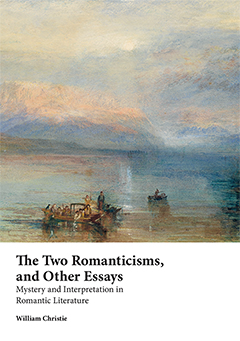
Review Short: The Two Romanticisms, and Other Essays: Mystery and Interpretation in Romantic Literature

The Two Romanticisms, and Other Essays: Mystery and Interpretation in Romantic Literature
by William Christie
Sydney University Press, 2016


Romantic poems are elusive creatures. Exhibit A is William Blake’s ‘The Blossom’ (1789), in which a mysterious voice asks a pretty robin, a blossom, and the reader, to ‘seek your cradle narrow’. Perhaps by the necessity of the uncanny danger of meaning, readings of Romantic poetry have always been accompanied by disputes about Romanticism as a movement. These conflicts seem to encompass an entire political shift in an age of revolutions.

In The Two Romanticisms, and Other Essays, Professor William Christie weighs in on this burden of mystery in Romantic poetry with some hope of avoiding ‘discipline games’. As head of the Humanities Research Centre at the Australian National University (ANU), Christie is a respected teacher and scholar, and would appear well-placed to provide some measure of an answer for students and readers of Romanticism.

The Two Romanticisms focuses on ‘major lyrics’. There are a number of chapters that dip into Samuel Taylor Coleridge’s The Rime of the Ancient Mariner and Kubla Khan, William Wordsworth’s Lyrical Ballads, Keats’s ‘Ode on a Grecian Urn’, Shelley’s ‘Julian and Maddalo’ or Byron’s Don Juan and Childe Harold’s Pilgrimage. The epilogue to the book offers a conceptual history of the idea of the imagination as a way to orient readers to the period of Romanticism.

One of the most compelling interpretations in the book is a chapter that dwells on Coleridge’s The Rime of the Ancient Mariner. Christie analyses a point at which the poem moves from what seems a simple pastiche of old ballads to something other, uncanny. A Pelican dangles from the mariner’s neck in a frozen, ghostly landscape: ‘We are in another world, the capital “r” Romantic has supervened upon the small “r” romantic, as infection supervenes upon a wound’.

This image of infection, wound and disease is itself a pastiche of much old literary criticism (Edmund Wilson’s The Wound and the Bow, for example). We’re then reminded that Christie is offering us at least two cradles for Romanticism to play in, Romanticism with a capital ‘R’ – the symbolic movement that infects a reader with some greater wound beyond the pastiche – and a romanticism with a small ‘r’, a stormy collection of wild themes that can be rocked and broken.

That this argument about Romanticism is driven primarily by the major lyrics is telling. Even for a book aimed at the high-school curriculum, it is somewhat disappointing to find a focus on ‘major’ lyrics to the exclusion of the ‘minor’ ones; two romanticisms if there ever were two. After decades of critical work looking beyond the contours of masculine Romanticism, it is troubling to find still such a neglect of minor poets and writers who represented major socio-political trends in English Romanticism.

An entire historicist horizon of interpretation goes missing: the entry of dissenters, Catholics, Jews, radicals, women, working class and racially other into the Anglican establishment, or the brute fact of greater numbers than ever before reading and writing poetry and novels. And now, as Christie’s Two Romanticisms introduces prose novels such as Jane Austen’s Northanger Abbey or Mary Shelley’s Frankenstein, there’s still a sense that avoiding ‘discipline games’ means obscuring so much: as if we are left with a mystery of literature that is a narrow cradle for a mode of Romantic criticism.

The result is a readable set of essays, but also an overall obscurity that leads Christie to return to some well-hashed critical fields. By the time the reader arrives at the epilogue, the definitional challenge that is the central matter of the book is lost, and not in an entirely productive way. The useful chronology of the Romantic Period appearing at the start of the book begins with the birth of William Blake (1757) and ends with the death of William Wordsworth (1850), the seer of imagination. Within this space, there are some characteristic political milestones for English Romanticism – a small taste of the vastness of Romanticism. But Romanticism is still thrown up as a disorientating movement that always seems to impress on us the need for some kind of ‘set of coordinates’ – which is how Christie puts it in his reading of Coleridge’s poetry.

The Two Romanticisms remains elusive in its definition of Romanticism, hardly electric or startling, but well worth reading for an overview of the challenges of interpreting the Romantic movement. There is a certain disquiet apparent in The Two Romanticisms, a hesitancy on the limits of meaning: the book plunges toward polarised sites of definition at times; at other times, it vaguely skirts critical fields. The space devoted to discussing the poems or novels in detail seems to be ever narrowing as the book skips from essay to essay; The Two Romanticisms as an exposition of a literary movement appears constrained. Romanticism nonetheless remains one of the most popular movements of literature, and continues to throw readers from narrow cradles to worlds of mystery and meaning.

Posted in BOOK REVIEWS | Tagged ,

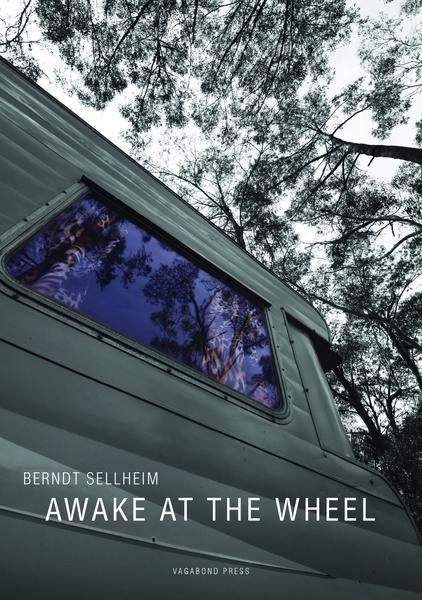
Review Short: Berndt Sellheim’s Awake at the Wheel

Awake at the Wheel by Berndt Sellheim
Vagabond Press, 2016


In Awake at the Wheel, Berndt Sellheim’s debut collection of poems, Australia is imagined in gothic terms, from the eerie and persistent presence of the ‘bushland’s dark parchment’ to the bones and ghosts which haunt an endless landscape. An homage to country, there is little innocence embedded in these poems of insides and outsides, which speak not only to a transforming sense of self but also to an environment that ceaselessly, and often uneasily, shifts. It is a thematic captured most vividly in the attention to diurnal rhythms – the ‘dying light’, the ‘wash and ebb’ of the sea – which evolve poignantly in relation to the cycles of life and death. In Sellheim’s work, such categories are rarely exclusive, but invested in notions of everyday metamorphosis, such as in ‘The Divine Art of Compost’, in which a ‘lush thermal sweat’ creates a ‘sumptuous / chemistry / of season and decay’. These transformations are ‘all organic matter’, yet there is nonetheless an abiding disquiet, as noted in the suggestion that while there are ‘bodies which build and inhabit’, there are also ‘bodies which lie beneath’, a reminder of how the Australian gothic is interchangeable with the post-colonial.

Such a focus ensures that Sellheim’s poems resist romanticism, and while there are instances of the cliché, especially in the evocation of a Kerouac-inspired ‘road less travelled’, the landscapes (re-)imagined in Awake at the Wheel are problematic, difficult, and often uncomfortable. The beauty of the Australian bush, with its ‘green depths’ which ‘hazewhite past / the eucalypts’, and ‘jacaranda blossoms, like slow, violet hailstones’, is complicated by a history of violence and exploitation, and an insistence on the past as necessary to troubling patriotic visions of nationhood and, indeed, pastoral rapture. Sellheim’s acknowledgement of colonial destruction is nuanced and assured, particularly in those poems focussed on rural Australia, which cannot escape the spectres of past crimes. In ‘Wollombi’, for example: ‘Imagine, Uncle / th black silent feet / passing afore / th whiteblaze wind’.

The politics of Sellheim’s poetry, however, is most striking in its focus on consumerism, and the leaching of the natural world to feed the ever-increasing demand for material goods. Whilst sharp, Sellheim’s poems are more often melancholy than scathing, the collection a despair at the creation of an ‘abject earth’, an overwhelming feeling of depletion and exhaustion. Regional towns are ‘ute-filled borderlands’ while ‘brilliant / machines scrub desert skin’, ransacking for export commodities. The result is a horror-show, an image of monstrosity in which each attempt for more creates only less, until both the land and the individuals who work it are ‘emptied, utterly fucked out by it all’. In ‘Backfill’, Sellheim’s characteristic use of rupture and erasure figures such anxiety in desperate terms:

Great mouth we dug
th never-never great
mount in dug t dust
having gnawed the tin
from earth n bones u
mountains int ust aving
ug the art o bauxite in
dug ater from t sun

Environmental fatigue is connected with the dissolution of human life and energy, from the ‘half-forgotten pubs’ overtaken by ‘Big Mac primary coloured / burbs o middle / Australia’, to the rig workers ‘eyebent n crystal meth’. Sellheim is often sardonic in these descriptions – ‘don’t worry […] the drive-through / does bitchin trade’ – keenly aware of the degradation caused by monolithic mining corporations. In an eponymous sequence of poems, for instance, the air is ‘a permanent dusk /o swarming particles /on th scale o Exodus / where all fall short / o the glory o / Rinehart’.

Importantly, in exploring ideas about the loss that comes from over-consumption, Sellheim’s poems are stylistically experimental, increasingly fragmented, and ruptured – verb endings are dropped, letters are missed, and phrases are left incomplete. There is an uncanny use of vernacular that is both familiar and fractured, such as ‘red sky at morn, / she don’t bode well’, and ‘thin edge / o country hedge’. As a result of such techniques, there is a curious tension between what is recognisable – meanings found through obvious guesswork – and a more troubling sense that something remains missing. These gaps are arguably an acknowledgement of the limits of representation, but also a resistance to totality. Poems which begin relatively formally begin to unravel ‘till there’s no place left’ – a suggestion of Sellheim’s preoccupation with the cyclical, but also, perhaps, a refusal to promise completion or even coherence. Indeed, in Awake at the Wheel transformation and loss are perpetually linked, like bodies which ‘bloat and thin and eat themselves / even as we watch’, an abject mimicry of the butterfly, ‘itself a model of rebirth’.

Posted in BOOK REVIEWS | Tagged ,

Review Short: Tina Giannoukos’s Bull Days

Bull Days by Tina Giannoukos
Arcadia / ASP, 2016


The first poem of Tina Giannoukos’s second collection ends with the line, ‘In space I hold the horn of plenty’. This reference to the classical symbol of abundance foreshadows the poetic landscape that follows in Bull Days, a volume teeming with external allusion and internal reverberation. Giannoukos’s primary subject is a romantic/erotic love relationship, which is dissected in a series of 58 disparately patterned sonnets. In early incarnations the sonnet form was, of course, commonly applied to the theme of love, and here Giannoukos follows tradition, imbuing much of the work with a vivid sense of lyrical presence. This presence is maintained through constantly fluctuating tonal effects – melancholic, vexed, ironic, mournful are but a few – causing the lyrical ‘I’ (who addresses an unnamed ‘you’) to declare late in the volume: ‘These shifts in mood are impossible to endure’. But endure it does, through ‘the long hour of the love poem’ (as sonnet XXXVIII puts it) which comprises Bull Days. For it is feasible to conceive of this sequence as one long poem: while its pieces record diverse and seemingly discrete events, it constructs, overall, an undulating narrative shape.

One of the ways Giannoukos creates this sense of narrative is through the recurrent motif of journeying. Varying images convey this motif: trajectories of planets, migrations of birdlife, seafaring ancestors ‘gliding over oceans’ for instance. In the latter image Giannoukos deftly connects her own particular Greek heritage to classical antiquity – a period much characterised in literature by voyaging. Doorways to antiquity abound: ‘epic journey’, ‘heroic / lover’, ‘fallen stones and collapsed columns’ are a smattering of the phrases that evoke Greco-Roman civilisation, as do the many appeals to gods and mythological figures. That poems travel between present and past, and, indeed, into the future, and recount the overlap between these realms when it comes to love, has more than narrative impact; it is of purposeful philosophical significance. ‘All loves are linked’, sonnet XI offers, while sonnet XXXVIII locates love in its own space-time:

The sound of your name, like the echo of birds,
hovers in the honeyed space between eternity 
and this instant.

For me, the metaphysical exploration of time carried out in Bull Days is one of its foremost achievements. Giannoukos’s sustained investigation into the ways in which the condition of love refracts differentially through what Gilles Deleuze names the crystal image of time (that is, time beyond horizontal, linear understandings) is both artful and evocative.

Other cultural touchstones mark these sonnets apart from those associated with secular classical times; much Judeo-Christian imagery is rhetorically employed, and references to Renaissance artists such as Shakespeare and Da Vinci appear here and there. But it would be remiss to move on to other matters without considering the strong resonances of ancient Hellenic poet Sappho throughout this work. Sappho’s poetry is alluded to both subtly and overtly (‘Fragments survive’, ‘Is this the Sapphic line? O sweet! O love!’), and Sappho’s non-normative female gender position finds echoes in Giannoukos’s occasional splitting of the female self (the ‘I’ sometimes slides into ‘she’, and in sonnet XI the ‘I’ is ‘in drag’). More crucial, perhaps, are the parallels between Sappho’s and Giannoukos’s characterisations of love. Anne Carson, the classicist who has made a study of romantic love in philosophy and literature, points out that it was Sappho who first called eros ‘bittersweet’ (‘glukupikron’). Giannoukos, too, employs this term: ‘Bittersweet lips angle me in sharp relief’ (LVI). Carson notes, also, that it’s difficult to translate Sappho’s glukupikron: strictly speaking, it should be ‘sweetbitter’. Carson surmises that Sappho meant to indicate that eros brings sweetness, and then bitterness, in that order. Overwhelmingly, the poems in Bull Days support this view. Love here has a ‘dark energy’ that begins as ‘rapture’ but ends in suffering, as sonnet VII suggests:

                                                         … Everything fails 
at the crucial moment. O love! Wet your mouth 	
on mine. Let me be yours. The heart breaks
in the middle of the night.

Bleak symbols pervade the volume – wounds, blood, summer giving way to winter, the colour blue – leaving the reader in little doubt that, yes, ‘the heart is a murdering beast’ (sonnet XXVI).

But Bull Days also presents love as a game of passion difficult to resist. More than once a bullfight scene is metaphorically employed (hence the collection’s title), and although the ‘I’ in these poems is the bull, destined for death, it participates willingly. More broadly, games and play are frequently cited tropes of human desire, and – as artists and thinkers have expressed for millennia – desire is an experience fraught with paradox. It is put this way in sonnet LIV:

the burden is terrible, but borne
for the breathless promise of the hour.

Generally, this promise is what provides the sequence’s narrative drive, which concludes uneasily. ‘I’m back where I vowed I’d not return’ the final sonnet begins, the ‘I’ having been lured back, by desire, into ‘gambling on signs’ that are destined to remain empty. In relation to language-as-signs, Giannoukos also deploys a metapoetic stratum, reflecting on the role of words in this love game: ‘if I want a place in your canon / I must impress with my poetics’ sonnet XXV states, and there is much toing and froing between ‘voice’ and ‘silence’. Sonnet XV draws attention to ‘the cascading deluge of words’, and latter poems plead, ‘what if I were to tell you … ?’. Ultimately, though, the speaker admits that this is a game she cannot win; she is essentially ‘[w]ithout / words to describe the colour of [her] love’ (LIII).

On the whole, language operates across these sonnets at an intensely affective level, matching its subject matter, and this is another of the work’s strengths. Giannoukos also displays impressive skill in weaving together such a vast array of figurative elements, and in employing lexical and thematic repetition as a structuring device in the absence of consistent metrical and rhyme schema. Undoubtedly, some readers will find Bull Days heavy going due to its complex manoeuvring of meaning levels, and its occasional metaphorical discordance. Contrariety, though, is what this collection strives to comprehend and this, to my mind, means that the investment required to accompany Giannoukos through her ‘long hour’ is worth it.

Posted in BOOK REVIEWS | Tagged ,

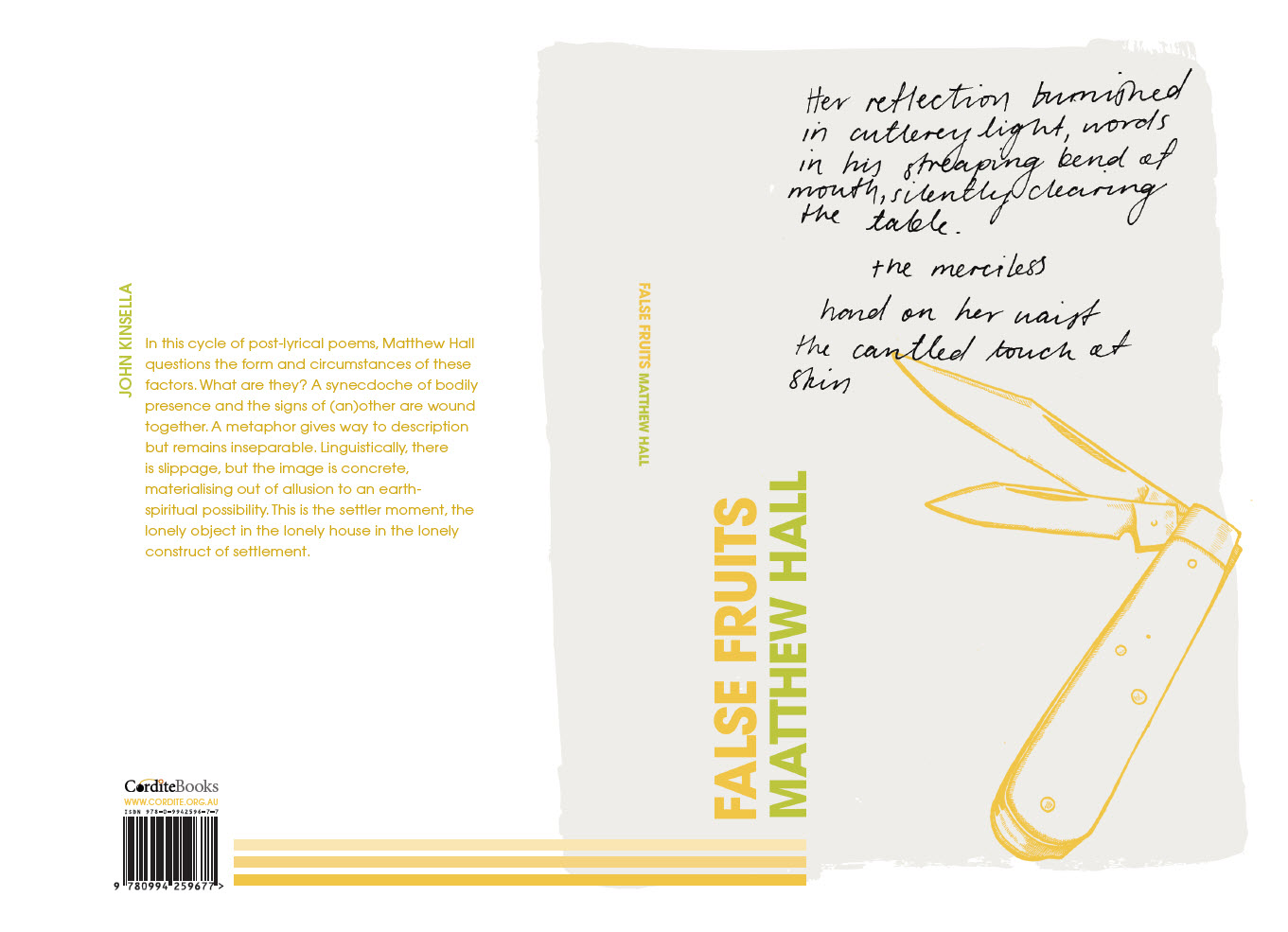
Introduction to Matthew Hall’s False Fruits


Cover design by Alissa Dinallo, Illustration by Lily Mae Martin

BUY YOUR COPY HERE

Fruit is the apogee of the pastoral. It’s what the work, the waiting, the ritual and the thanks are for. But the making of fruit is costly and even the ‘natural’ cycle of things will be managed so some factors are privileged over others. In this cycle of post-lyrical poems, Hall questions the form and circumstances of these factors. What are they? In foxlight and in the swell of earth, in the familial connection to place, in the exclusion and recidivism of (be)late(d) presence. What are the rights of creating conditions of fruition?

In tracking presence, we find markers on the trail. They are mythical and totemic; they are every-day and matter-of-fact. They are expected but never prescriptive. As we follow the ley lines, we learn:

‘Her throat is clouded with leaves; underneath the black spruce, bird tracks scrawled through the feathered dust.’

A synecdoche of bodily presence and the signs of (an)other are wound together. A metaphor gives way to description but remains inseparable. Linguistically, there is slippage, but the image is concrete, materialising out of allusion to an earth-spiritual possibility. A ‘want to believe’ because the signs are there to follow. The poem goes from wrapped line to the succinct embodiment of the lyrical urge:

sky swelling
the shuttered leap
a whittled toy
rolling
on the stone floor

This is the settler moment, the lonely object in the lonely house in the lonely construct of settlement. It takes the weight of haunting, not only because of its isolation, the space around it, but because it is a caught (photographed, staged, ‘shuttered’) moment. The light interrupted from the available expanse of sky outside that is artificial in its appropriation. This is the invader’s toy as much as the settler’s toy, but it is also part of a quest of reassociation, of belonging because there is a belonging that stretches back through the bird tracks. We have the indigenous and non-indigenous in conversation and tension.

And so we are ended in the bracketing final line: the final cut of this arrangement on the disturbed and dilating field of the page:

The field tussled in the silence of consonant feathers.

Loss of breath in making a sound and harmony. The paradox of the consonant and the softfall of the feather. The feather takes a lot of weight and cannot find its vacuum. It has to be heard and seen and we might add it to our tools of comprehension but never own it.

To encounter and re-encounter is motion. And a motion that is exacting. To return and discover again, continuously, can bring only the satisfaction of knowing you have left, and that things can never be as they were. What do you bring back to a place, an indigenous space you are ancestrally part of, but from which you have separated yourself. Is this ‘return’? And is ‘his’ return an inevitable part of ‘her’ accepting of the field and the field’s accepting of her? Can he be the conduit and she retain her agency, autonomy? Does family mean inclusivity? The poem worries at its own edges. As each section of the book accumulates, our middle-ground lyrical enactments and condensations grow 3 … 4 … 5 … 6 lines bracketed, then the split across stanzas. The chasms. The 5 lines… 4… She struggles with the growing belonging:

‘The cascade of his rapacious grip, her shadows through the cedarn crown.’

She is missing something, something of outside, of other belongings. Of other connections. He tries to draw her to his understanding, his inchoateness. He is struggling with a conviction of understanding, of relationship to land, of the interference of the Western machinery of myth and materiality:

‘Beyond the ravine, a dark world pulses through lapsed cathedrals.


inexorable day
harrowed leaves 
rusting in purgation 
tannins      consonant in rivulets
descant in the tethered shade

She lives by disconsolate gift, the shrived night, untethered seam, the lassitude of summer.’

The house of the self, the family, the birds who are auguries in the literary construct but birds in the moment. The tension of pastoral presentation of a feeling of belonging strained by the alienation of external experience. The lines are trails but they are curtailed by material reality. The domestic is servitude and joy of presence is also:

the thankless

tasks
of false fruits

Reverence, labour, rustic performance, curtains and animals and:

‘His embrace and shadow, murmurs a child a child, as she aches into branches.’

The seasons work away and winter yields its ‘last bird’. The cost is high, but the nature of cost is undecided. So the prairies exact their measure, and persistence is a narrative sold to the future. And it is extraction: it is theft, too. A theft that costs the theft of self. The colonial residues that make the ground too furrowed, that we must read through, to follow the consonant feather to its origins, to its stories. The overlays of settlement to be read through and out. The gender entrapment of home and landscape, governance of weather, the emergence of nation (Canada) which costs and costs. There can be no lyric in this most beautifully lyrical lament: the witness is also the victim. And he has invited ‘her’ into his irresolvable paradox of belonging and exclusion.

Posted in INTRODUCTIONS | Tagged , , ,

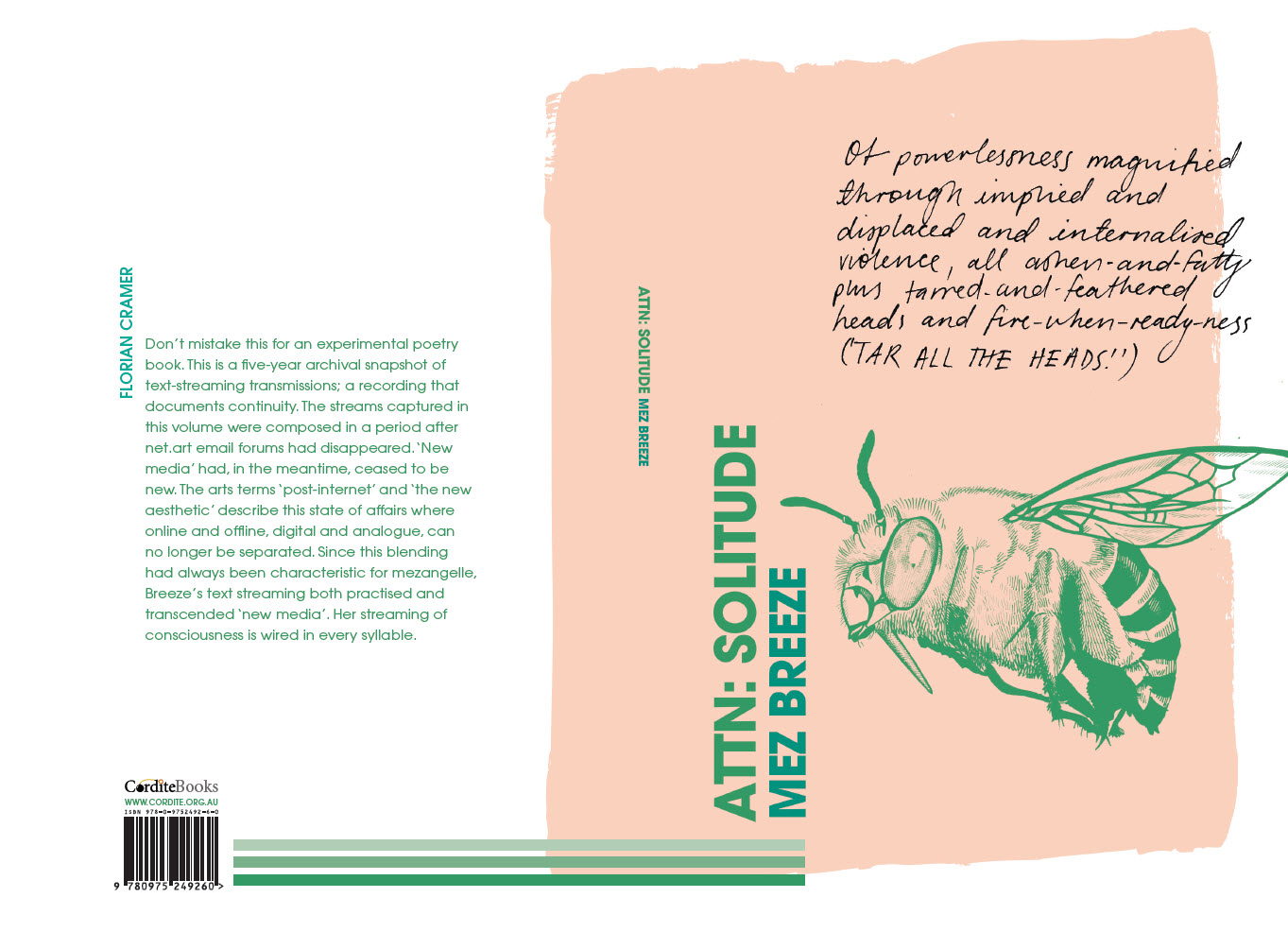
Introduction to Mez Breeze’s Attn: Solitude


Cover design by Alissa Dinallo, Illustration by Lily Mae Martin

BUY YOUR COPY HERE

Don’t mistake this for an experimental poetry book. This is a five-year archival snapshot of text-streaming transmissions; a recording that documents continuity.

Mez Breeze began her text streaming in the late 1990s when she became a new media artist. Her writing published here, and previously in her book Human Readable Messages (Traumawien, 2011), isn’t ‘multimedia’ in the common sense of audiovisual websites, apps or installations. Yet, it is radically multimedia in content and structure. It’s born straight out of chats, e-mail correspondence, online gaming, web design, internet memes and popular movies. The single pieces / streams in this book reflect this through their narrative and at the micro level of language.

In the 1990s and early 2000s, Mez Breeze’s mezangelle language needed explication. People who were unfamiliar with internet and new media culture did not get the references. Those who were already immersed in this culture often considered it a separate realm, a cyberspace, and thus had difficulties with the blending of the digital and the physical, technology and embodiment, code and subjectivity in Mez’s writings. Their stripped-down medium of plain text didn’t speak to them either.

New media, back then, was a new and schizophrenic affair. Arts institutions thought of it as high-tech interactive research lab work. Non-institutional net.artists, however, practised it as no-cost, no-copyright, low-tech experimentation with the internet. The seminal medium for early net.art was artist-run e-mail discussion forums. In those forums, plain text e-mail became a medium of exchange and experimentation with form and, to use a contemporary art term, circulationism.

When media theorist Lev Manovich defined The Language of New Media in 2001, he included plain electronic text because of its significance for ‘cryptography, real-time communication, communication network technology, coding systems’. New media, for Manovich, was characterised by five principles: numerical representation, modularity, automation, variability and transcoding. All these principles apply to net.art e-mail exchange and the beginnings of mezangelle in the 1990s: the perpetual transcoding and variation of digital (= numerically represented) electronic messages, and their transmission, formatting and filtering through computer programs.

No other artist pushed this ephemeral art form of text streaming as far as Mez Breeze. Not only did she develop it into a language of its own, but also into a life-long art project that outlived early net.art.

The streams captured in this volume were composed in a period after net.art email forums had disappeared. ‘New media’ had, in the meantime, ceased to be new. It had become inseparable from everyday life and popular culture. The arts terms ‘post-internet’ and ‘the new aesthetic’ describe this state of affairs where online and offline, digital and analogue can no longer be separated. Since this blending had always been characteristic for Mez Breeze’s wurks (to use her mezangelle vocable), her text streaming both practised and transcends ‘new media’.

The latter is even more pronounced in this volume. The wurks included here may be softer in their tech literacy requirements than earlier streams of mezangelle. Or maybe, cultural tech literacy has caught up. Attn: Solitude hints at solitude as a device for heightened attention to incoming and outgoing signals. This applies to readers of this book as much as to the writer. Whatever the moniker, Mez Breeze’s streaming of consciousness is wired in every syllable.

Posted in INTRODUCTIONS | Tagged , , ,

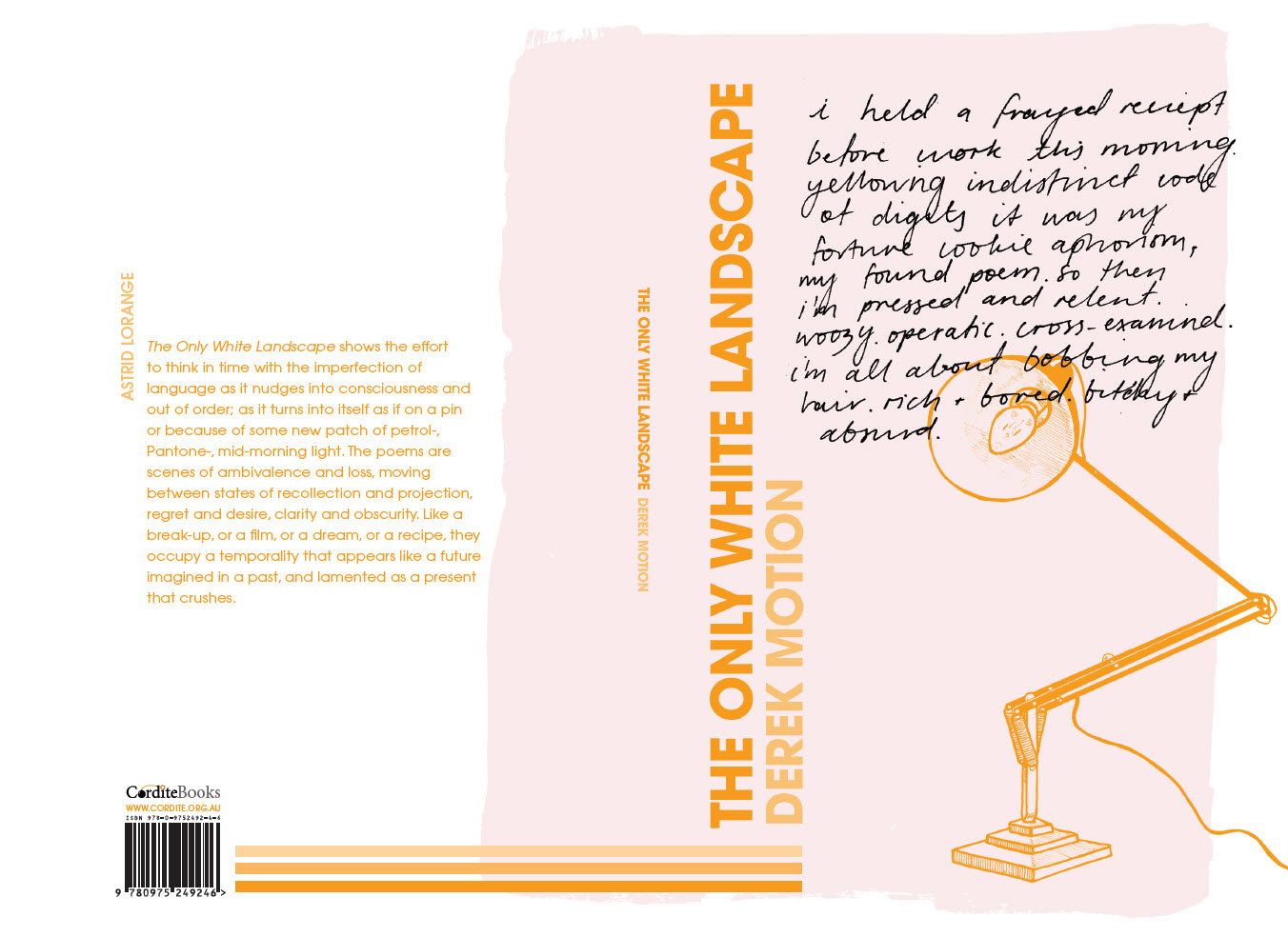
Introduction to Derek Motion’s The Only White Landscape


Cover design by Alissa Dinallo, Illustration by Lily Mae Martin

BUY YOUR COPY HERE

In Gut Feminism, Elizabeth Wilson reimagines melancholia distinct from a conventional post-Freudian understanding. Rather than thinking of melancholia as a feeling-state that registers the loss of something both loved and not-loved – that is, rather than thinking of melancholia as an ambivalent feeling towards what has been lost – she proposes that we think of melancholia as a feeling that actively loses (destroys, forgets, misplaces, denies, erases) what it at once desires and refuses, and therefore, in many ways, is ambivalence itself.

The Only White Landscape is melancholic, in this Wilsonian sense. The poems are scenes of ambivalence and loss, moving between states of recollection and projection, regret and desire, clarity and obscurity. There are preoccupations that link the poems across the collection: bodies (and the clothes they wear, the language of their presence and absence), light (and its close relationship to time), administration (and the twin labours of work and home). Like a break-up, or a film, or a dream, or a recipe, they occupy a temporality that appears like a future imagined in a past, and lamented as a present that crushes. Poems, to paraphrase the poet Eileen Myles, who was paraphrasing someone else, are inventories of prophecy: they write what hasn’t happened as if it were a record of what has been. Motion’s poems are made from partially recalled lamentations that may or may not have been, but which threaten to be felt in / as the irretrievable presence of a memory: ‘later she’ll chew her lip at the verb / manoeuver’; ‘in the lag the over-sharp afternoon / it backlit the tarmac’; ‘earlier & my daughter plays piano’; ‘my future speculative rendered in oils: / heard turned, sci-fi vantage, imagine tigers / this abandoned account’.

The title can be read in two ways, grammatically speaking: there is only one landscape that is white; there is a landscape and it is only white. White is the signifier of Australia’s settler-colonial context, as well as and relatedly a signifier of blankness, neutrality. The whiteness of the title’s landscape cannot escape its racialised reading, just as the landscape of regional New South Wales, or the inner city of Melbourne, or the rail that connects the two, cannot be read without consideration of the race relations on which the very concept of land depends. This book is then, in some way, a study of melancholia in a historical sense, too: the feeling of inhabiting an untenable version of the world.

What version would ever be tenable? Poems trade on this question, a million different variations of it. A poem is, we could say, ‘a physical symptom of trying / to find the right words, maybe –’. Or, to say it differently, a poem is a way of finding a grammar of wrong words made most real: ‘you do have to be lonely’, like ‘a bolting solo in reverse’. The Only White Landscape shows the effort – never more emphatic than in a poem – to think in time with the imperfection of language as it nudges into consciousness and out of order; as it turns into itself as if on a pin or because of some new patch of petrol-, Pantone-, mid-morning light.

Posted in INTRODUCTIONS | Tagged , , ,

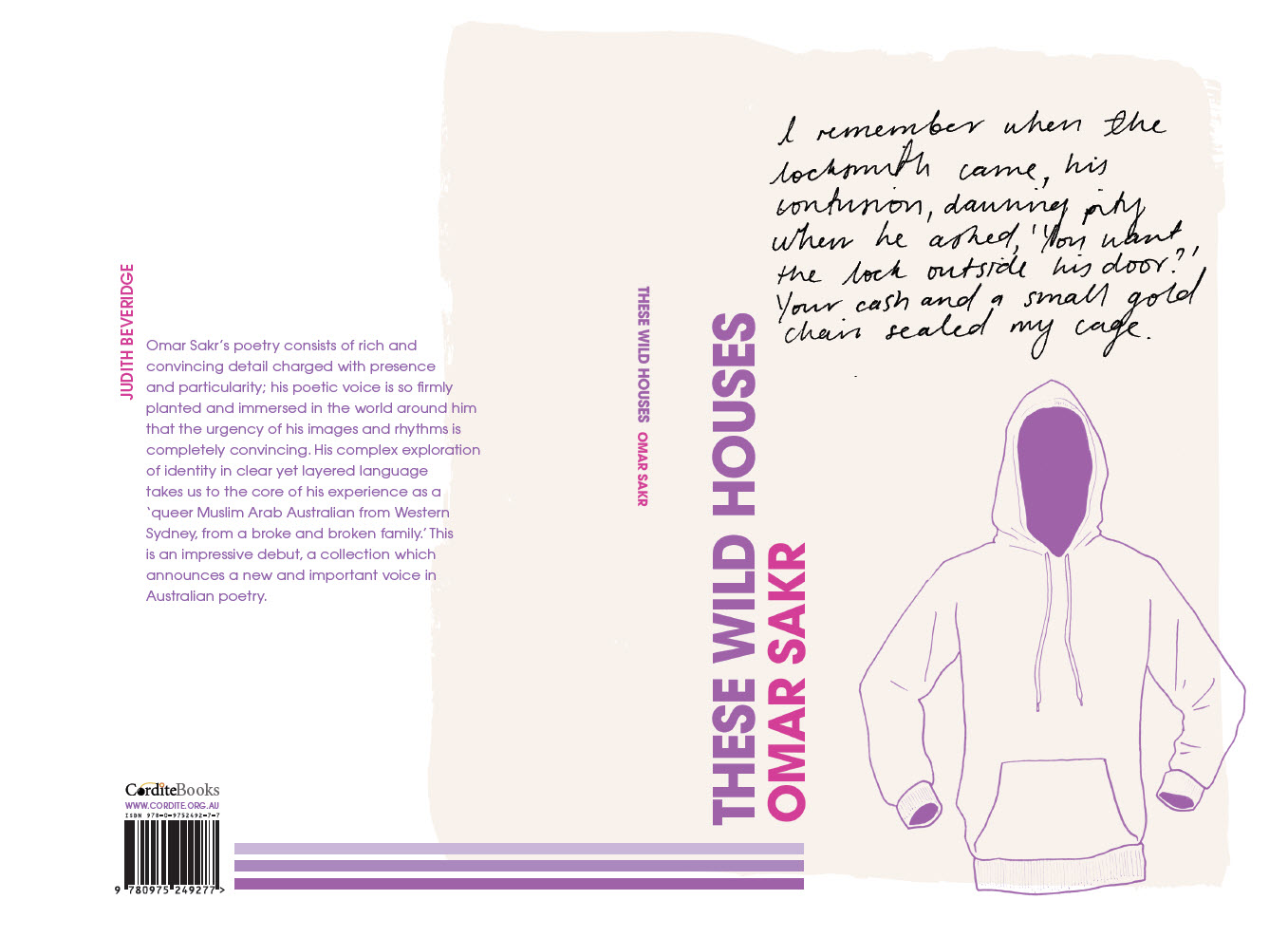
Introduction to Omar Sakr’s These Wild Houses

Cover design by Alissa Dinallo, Illustration by Lily Mae Martin

BUY YOUR COPY HERE

Omar Sakr’s These Wild Houses is a complex exploration of identity, an identity exposed in clear yet layered language, a language that takes us to the core of what he has experienced as a ‘queer Muslim Arab Australian from Western Sydney, from a broke and broken family.’ Given the rarity of Australian poetry written from these particular perspectives, and given that all these labels still carry stigma and disadvantage, you might think that you could guess the tone and content of the poems from these biographical details. You might expect anger, rage, resentment, bitterness, poems that rail against prejudice and injustice, and while these emotions do feature in the work, they are tempered with compassion, warmth, tenderness, understanding and supple perceptions. In the first poem, ‘Door Open’, Sakr welcomes us in to his world: ‘Come inside, let me / warm you with all I am’. And he does warm us with his intimacy of voice, his inclusivity, his emotional diction.

There are many references to houses in the volume, and for Sakr these are important sites: places in which we can come to terms with who we are, places where we learn the stories about ourselves, and among other things, where we can experience displacement, cruelty, neglect. In ‘ghosting the ghetto’ he tells us how in ‘their third floor brick flat, the one tucked into the asphalt folds of Warwick Farm … my grandparents were rebuilding Lebanon’. This beautiful poem with its long-breathed lines and confluence of rhythms explores generational change and the way in which Muslim and Australian worlds collide and intersect: ‘Beirut became Bondi became Liverpool, & the local creek behind the cricket pitch / drank the old rivers, and new names blessed our flesh: Nike, Adidas, Reebok.’ In many poems he delves into complexities and complications that arise from coming from a multi-cultural background. In ‘All My Names’, he says ‘I never knew / what to do with all my names, these silhouettes, of a boy I never was or wanted.’ Throughout the book, houses and rooms are metaphors for states of being; as he says in the final poem, ‘A house should, above all, be still.’

What strikes me especially in these poems is the way in which Sakr grounds his work so indelibly in the body. He knows thoroughly that the body is the primary house, the one in which our identities are irrevocably caught: in the skin, under the skin, in the heart.

In many instances this knowledge is rhapsodically transformed, as in these lines from ‘What the Landlord Owns’:

… unfamiliar language
is no barrier when you dwell on the borders
of domesticity, when the soft hands of the sun
sculpt the sloping muscles of a man like sand
as he mows the lawn, and hair muzzles
his face

Sakr’s poetry consists of rich and convincing detail charged with presence and particularity; his poetic voice is so firmly planted and immersed in the world around him that the urgency of his images and rhythms is completely convincing. Sakr never summarises or straitjackets the emotions; instead he allows the tonal range of his voice to surface through layers of astutely organised rhythms and imagery.

These Wild Houses is an impressive debut, a collection which announces a new and important voice in Australian poetry.

Posted in INTRODUCTIONS | Tagged , , ,

Dave Drayton Reviews Zoe Dzunko and Sam Wagan Watson

Monster’s Ink by Sam Wagan Watson
Recent Work Press @ IPSI, 2016

Selfless by Zoe Dzunko
The Atlas Review, 2016


Since the late 1970s Warren Motte, Professor of French and Comparative Literature at the University of Colorado, has been collecting mirror scenes in literature, a studiously archived assembly of ‘moments when a subject glimpses himself or herself in the mirror.’ From an analysis of these more than 10,000 scenes collated in Mirror Gazing (Dalkey Archive Press, 2014) Motte suggests that in such instances ‘a curious effect of dissociation seems to be at work, for the face in the mirror typically presents itself to the subject with its otherness prominently on display’; the reflection becomes ‘the deforming mirror of another’s gaze.’

As the title suggests, monsters in many forms populate Sam Wagan Watson’s latest chapbook, Monster’s Ink, the third in IPSI’s chapbook series after Philip Gross’s Time in The Dingle and Katharine Coles’s Bewilder. Wagan Watson’s monsters are hidden in the darkness of closets and beneath beds – or they’re not hidden at all, proudly occupying positions of power. Many of the monsters, like Wagan Watson (of Munanjali, Birri Gubba, German and Irish heritage), are culturally diverse: a German vampire, Jenze Stager, with a taste for Aboriginal Dreaming; Bram Stroker’s Dracula evoked somewhere under a bed in Brisbane; a ‘7-foot arachnid-homo-species from a rare alabaster egg’; an indigenous equivalent of Mary Shelley’s creation, Frankenstein of the Dreamtime.

There is another folkloric monster in this ink, one that appears by implication, and not appellation as such: Bloody Mary, who will appear in a mirror when her name is said before it three times. The ghostly catoptromantic apparition, often bloodied, can be malevolent or benevolent, and prophesies visions of the future. It is as though, with the many I’s that litter Monster’s Ink, Wagan Watson has summoned himself into the mirror for honest inspection and reflection. In the tellingly titled ‘Butterflies And Premonitions’ he writes:

I was born with a bad headache and before I could write I predicted the wording
of incident reports before accidents occurred […]

Pulling into the driveway an empty house sleeps […] And before my key hits the
front door I know what lies beyond. I picture this scene while switching off the igni
tion in the car […] answering my stomach’s want, for butterflies and premonitions …

Like Wagan Watson’s most recent full-length collection, Love Poems & Death Threats (UQP, 2014), the majority of the poems in Monster’s Ink are haibun, a form of prose poetry traditionally comprising a paragraph or so accompanied by a haiku addressing or distilling the entry’s themes and content. Love Poems & Death Threats opens with ‘Blood and Ink’, which begins: ‘“I AM A RIVER …” / How your words reverberate off the mirror of our conscience.’ The possibilities of the plural pronoun – a river’s tributaries; Wagan Watson and the reader; etc – are numerous, but dominant amongst them is the idea of many selves, and reflections as a means for addressing these. Later in that collection, the water-like Wagan Watson again finds a mirror:

The bedroom mirror
can only reflect the serene skin of a lake;
a lake is an ephemeral living entity,
and the mirror will remain a dead-pool in the bedroom.

(‘Warning’)

So what is discovered in this time spent before the mirror? We could begin with a survey of some of the many I’s mentioned above. ‘I was born in a land, borne from a Dreamtime …’ begins the first poem in Monster’s Ink, ‘Wonderland?’ Wagan Watson continues later: ‘I am free but have few democratic rights. I am the unforgiven scourge of the Ruling Class.’ In ‘A Brief Biography (Standard Operating Procedures #1)’ he once again introduces the mirror as a means for making and managing a self: ‘I am 175cm tall with a width that fluctuates seasonally. I live in a house with many mirrors as opposed to a domicile of glass that will only canvas certain reflections.’ One such reflection is Jenze Stager, first given voice in ‘Die Dunkle Erde [The Dark Earth]’, Wagan Watson’s opera with Stephen Leek, performed in 2004 with the Australian Voices Choir and special Dijeridoo arrangement by William Barton. Stager is a reflection of Wagan Watson’s mixed German and Aboriginal heritage; the German vampire finds his ‘black reflection / lost, I thought too / forgotten, forgotten / in the countless nights.’

The fruits of Wagan Watson’s introspection are not only reflected in mirrors or slick surfaces, but also in the revised versions of older poems. ‘Monster (Reloaded)’ is an updated version of a poem originally performed at the 2007 Utan Kayu International Literary Biennale, Indonesia. It is here that we find Wagan Watson as Frankenstein’s monster:

I am one of Tony Abbott’s monsters, hiding under his bed … I think like his
version of a monster, therefore I am, Frankenstein of the Dreamtime … I scare some
white people with my English, and some black people too, I am Frankenstein of the
Dreamtime.

‘Love Poem (Reloaded)’ is an updated version of the ‘Love Poem’ in Love Poems & Death Threats, in which the protagonist ‘no longer used his real name, just the combination of slugs, LOVE POEM’ from his tattooed fists. In the reloaded version: ‘In time and in all the accumulated violence, he forgot his real identity, and only travelled with his signature-combination of slugs.’ The inapposite paradiddle of punches is extended, and a haiku appended to the violence:

            The hardest stones crack
            in the weighting pains of time,
destiny so cruel

It is not just the prose poetry that makes this slim 28-page collection seem disproportionately dense, it is also the proliferate population of possible Wagan Watsons that occupy the pages.

Posted in BOOK REVIEWS | Tagged , ,

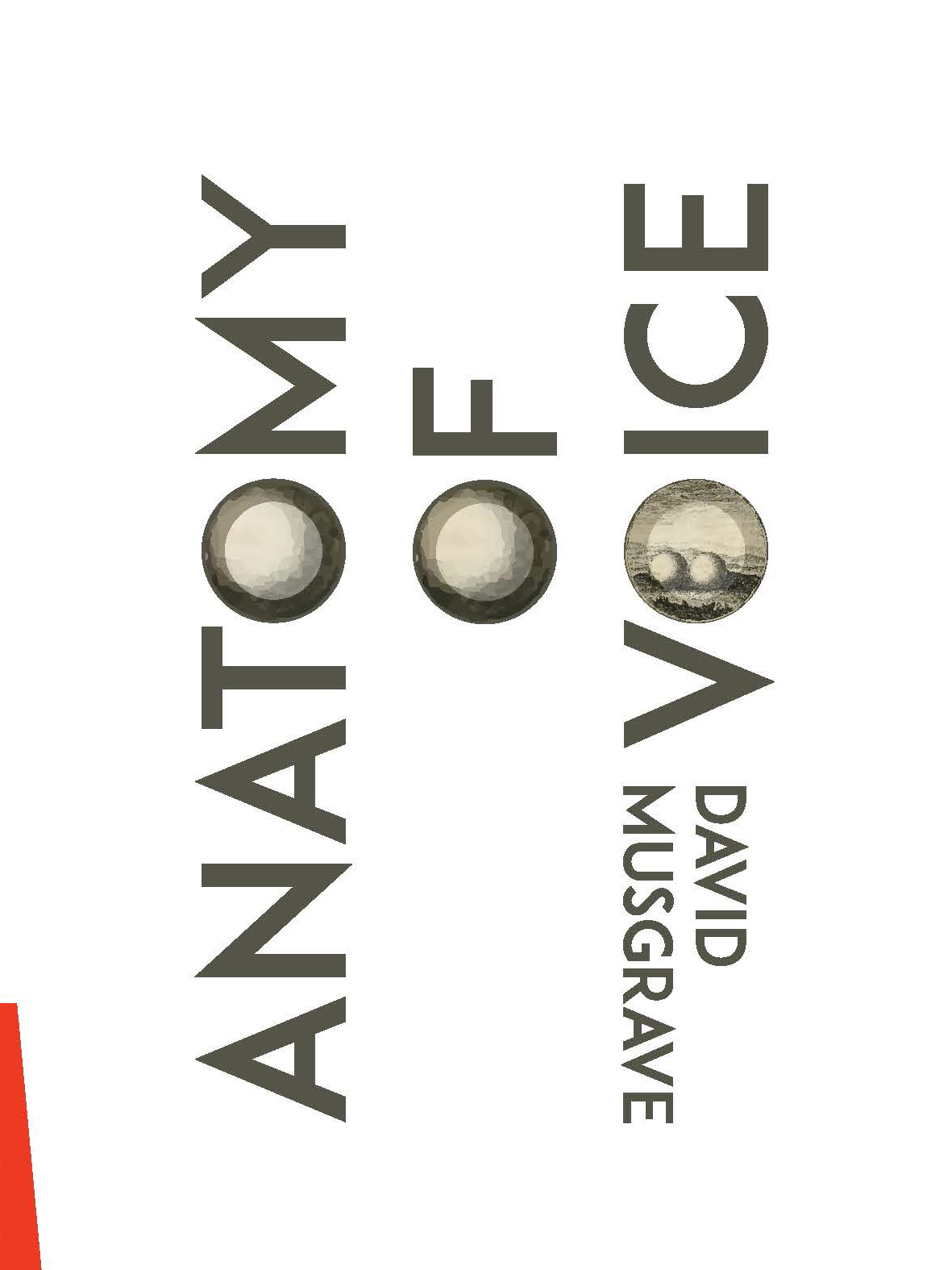
Graeme Miles Reviews David Musgrave

Anatomy of Voice by David Musgrave
Gloria SMH Press, 2016


This new, book-length poem by David Musgrave remembers the life, and especially the voice, of Bill Maidment, who taught English Literature at the University of Sydney. Firmly in the tradition of poetic memorial, and given the character of its protagonist, it becomes a book concerned with the broader memory of a culture and the ways that a human being can inhabit it. The book, from new publisher Gloria SMH Press, is attractively produced: woodcuts from early modern emblem-books interact with the poems and divide its four ‘partitions’; headings above the poems in the first section are ghosted through from the following page. Like the other books from this publisher, this is volume’s physical form is intimately linked to its contents.

The ‘anatomy’ of the title suggests the problem with which the book grapples: how to isolate the particularity of another’s voice, to represent it in one’s own words. It also announces a relationship to at least two other eminent anatomies: Northrop Frye’s Anatomy of Criticism and especially Burton’s Anatomy of Melancholy, from which Musgrave adapts the division into partitions. Etymologically, the sense of ‘cutting through’ (ana- tomê – dissection), with all its surgical suggestions, is apt. At the beginning of the third partition, Musgrave writes: ‘your voice is a relation / of larynx, tongue and lips to air / or past to liminal present’. Some pages later in the same sequence, rowing up a river is ‘anatomizing flow      as writing divvies up a voice’.

The attempt to capture Maidment’s voice works best (for a reader who never knew him) when the poems are least sentimental, and when they incorporate the words of the subject himself. As is perhaps inevitable in personal elegy there are some obvious moves at times. On p.13, for instance, a phrase like ‘you / find me in my dreams’ is true enough to the psychology of grief but sounds tired. In the ghosted text on p.15 ‘god dog’ feels too familiar. By contrast the third partition, working in footnotes from some of Maidment’s few published works, makes excellent use of the crisp, wry tone of a good scholarly note against the fuller but thereby more diffuse surrounding voice of the poems. The collision of voices does much to bring out one side of Maidment’s own:

No identity without difference
no difference without decay12:
          I am a puny riparographer
          rubbing on in a strictly private life.
That which I have is stolen from others:

Diogenes went to the city
with his lantern, his tub, his sun
          You went from Scone to Sydney
          with your Keats, your charity and wit
But where are your poems now?13

and who is speaking here?14
Some soft thing stirring softly soon to stir no more15

12May claim too much in assuming need to disclaim. W.M.

13 One may also presume, supposing the lost material analogous to the saved, that nothing of ‘intrinsic literary importance’ has been lost, and still regret that loss. W.M.

14 The demand for an authorial voice masks a demand for proper moral answers, imperatives or formulations; and ‘unity’ becomes a consequence of issuing the right views, of being spiritually mature. W.M.

15 Necessarily a sketch, a preliminary rough ordering, a feeler towards further work? W.M.


The use of emblems, beyond their immediate visual effectiveness, draws upon a shared interest of Musgrave and Maidment, who researched these curious old books extensively in the latter part of his career. These emblems, which traditionally tend to embody inherited, cultural material, are used here both as the vehicles of this broader culture beyond the individual and for the more personal reflection of the poem’s speaking voice. They become, then, vehicles of personal memorial; though of a relationship built upon a shared interest in memory of the broader, less personal sort.

A great deal of the pleasure of this book is in the tracing out of literary and philosophical associations. The afterword and the substantial notes at the end fill in useful background, but thankfully stop short of spelling out everything. Musgrave’s inclusion of the poems and mottoes which accompanied these emblems allows these quirky, oddly homely texts their own voices. It is perhaps pedantic to complain of a few small errors in the translations from the Latin. On p.96 the abbreviated ‘sibi nequam cui bonus?’ must be ‘To whom is one good who is bad for himself?’, rather than ‘Something bad for oneself, a good for whom?’, given the reflexive pronoun, though the indeclinable adjective nequam does admittedly make this shortened form far from clear. The meaning is clearer in the longer sentence from Sirach (that is, Ecclesiasticus) which is quoted following it. On p.97, ‘audito multa, loquitor pauca’ cannot mean ‘hearing much, uttering little’, but must rather is imperative ‘hear much, speak little’.

The echoes of Plato’s Phaedrus (poem nine of the third partition) bring together the book’s main themes: the difficulty of reducing the spoken to the written word, and the nature of love. These are the two objects of discussion in this dialogue, the unity of which has been a topic of debate for two and a half millennia.

By the side of this river
near the tall plane trees
and the equally alien willow

washing its hair in the water
there is shade there and a gentle breeze
a green sward to sit on, or lie on if you prefer

The details of the setting of the Phaedrus (plane tree, cicadas) weave into Maidment’s poem and connect with others in the book, for instance the crickets in the fifth poem of the third partition, whose sound is sketched like Morse code and repeated on the back inside cover. Thematically, the memory of the Phaedrus provides a similar yet contrasting constellation of the same concerns that shape Musgrave’s own work. Like the Phaedrus, Musgrave’s book aims to preserve the memory and the voice of the writer’s teacher, and self-consciously probes the nature of such recording. This is, notoriously, the dialogue in which Plato has Socrates criticise the adequacy of the written word for capturing the spoken one. It is also a dialogue concerned with the complicated role of love (in a very broad sense) in intellectual life. How exactly this bundle of themes are to be reconciled is a very old question. In the case of Anatomy of Voice they cohere around the problem of remembering and memorialising Maidment.

Posted in BOOK REVIEWS | Tagged , ,

Review Short: Chapbooks by Mike Hopkins and Steve Brock

Selfish Bastards and Other Poems by Mike Hopkins
Garron Publishing, 2016

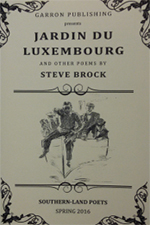
Jardin du Luxembourg and Other Poems by Steve Brock
Garron Publishing, 2016


Displaying an impulse that is communitarian and geographic by turns, Mike Hopkins’s Selfish Bastards and Other Poems, and Steve Brock’s Jardin du Luxembourg and Other Poems address the quotidian of the present under the notion that place-based does not necessarily mean place-bound. Brock’s itinerary darts from France to Barcelona, Madrid to San Francisco, to arrival at the Hollywood hotel, taking readers beyond the physical boundaries traditionally ascribed to place and ‘on a walking tour / a literary one’. However, as much as these poems depend upon travels and traversals, Brock as our guide takes us through scenes and sets that reinforce our ‘role here / is confined to that of tourist / as much as we try and walk like locals’ (‘Jardin du Luxembourg 2’). Hopkins’ collection, conversely, unfolds in a specific place, articulating a contemporary critique of the Australian present. The poems are inflected with the volatility of political lyricism in ‘Selfish Bastards’ and ‘Anzacery1’, and Hopkins’ ‘In the Beginning was the Cliché’ terrifically probes and parodies popular culture.

Upon reading Steve Brock’s Jardin du Luxembourg, you might say that the collection is a miniature epic of wanderers; it can be read as a quest book – except Brock is adamant that the trip is its own goal:

And the Gary Snyder Reader
I carried with me from Australia 
reminding me about roots
and the need to plant seeds
upon my return home.

(‘The Hollywood Hotel’)

Undoubtedly, one could easily focus on a single poem in Brock’s collection and be done with it, but such a disregard for the complexities and diaspora within this collection would carelessly overlook how these poems serve as affective sites rather than fixed locations on a map. Brock beckons us not to focus on our ‘roots’ while ignoring the routes that made the journey possible, but observe the interactive motion and turbulence that remains in our minds long after the camera has stopped rolling, as in the titular poem:

the take begins again
and just as the man 
nears the end of his walk
an elderly female tourist
ducks under the tape
and crosses the set
to cries of disbelief from the director

(part 1)

The interrupted syntax and enjambment gives the collection a terseness meant to convey immediacy without drama. Notational and observed, the poems seem to manifest seamlessly into the next. Indeed, Brock’s metaphor for this process of traversal could be considered ‘Jardin du Luxembourg’, the convergence of French and English in a single garden, the various statues contained within an apt representation of intercultural exchange.

In ‘Barcelona’, Brock writes:

I get the feeling
Since arriving in Europe	
I’m finally arriving at the subject 
Lorca’s cante jondo 
street artists and a language 
we can decode
re-united with long-lost family 
we feel at home

As the ‘I’ recedes and the ‘we’ becomes more prominent in the poem, one gets a deep sense that the language alone possesses the power to bypass ‘the cultural faux pas and mis-readings’ of traversing multiple places. Fraught with predicates that ‘realise’, ‘think’, ‘look’, ‘wonder’ and ‘recognise’ that too much of our attention is based on the location of culture and too little on the displacement of culture:

I ask him how he feels 
about the whole Napoleonic/Pantheon thing
walking in the steps of big writers
and history makers

he says you can let it stifle you
or look at it like
see what’s possible 
see what can be achieved

(‘Jardin du Luxembourg 3’)

From one side of the world to another, Mike Hopkins’s Selfish Bastards places his truth within the perception of Australia’s political stage. This truth can compete in the public arena with the ‘truth’ that is portrayed by politicians, such as:

Politicians who tell us we need to tighten our belt, and then
use a helicopter to go to a cocktail party — Selfish Bastards

Perhaps veering towards the overtly casual, the title poem might translate less well to a wider audience than others. However, as has been part of recent debate and scholarship, ‘Bastard’ is now part of the Australian vernacular and apparently yelling expletives in a public forum no longer constitutes offensive language. Being free from the same existential competition that obligates politicians to indulge their constituent public, Hopkin’s doesn’t flatter and indulge his audience in the eponymous slam poem:

People in the audience who don’t shout out “SELFISH 
BASTARDS” when politely asked to do so — Selfish Bastards! 

Rather, the poem performs in front of the reader’s eyes, the musicality of the concluding refrains unpacking the realities of our monotone and formulaic reality:

People who like their own posts on Facebook — Selfish Bastards!

Indeed, Selfish Bastards signals a condemnation of contemporary society. Reinforced in ‘The Template’ and ‘In the Beginning was the Cliché’, we are confronted with thick hectic prose, sentence fragments and the hackneyed that has taken ‘the world by storm, though it was a small world, when all is said and done’. These clichés humorously gain momentum in ‘In the Beginning was the Cliché’, as the people ‘did not stay glued / to the one true cliché’ but ‘ took to false clichés like ducks to water’. In ‘The Template’ Hopkins satirises the public treatment of our magazine society and paper-politicians:

Another soldier dead. Pull
out the template and we’ll 
knock off the news story in 
a flash. First the headline: 
“Digger” and “fallen” are
mandatory words. “Brave”
and salute are excellent 
accompaniments.

Structured like a traditional newspaper spread in two columns side by side, such portrayals are confrontational to the say the least, but there is also a sense of warning that is conspicuous here. Hopkins, in similar tonality to Brock’s ‘Hollywood Hotel’, takes an itinerary of the cookie-cutter Australian media and divisive political scene:

Get a shot or two of 
the politicians in the pews, 
and the comforting the next 
of kin outside the church. 
After all they’ve sacrificed 
their precious time to
attend the service, and 
they like to see that we’ve 
stuck to the template.

The words ‘cliché’ and ‘template’ are key here. The tired terminology is fixed in repetition, an endless ventriloquy hovering over texts, criticising and energising in turn. The geographic impulses that these texts address is one of renewal, the language resonating with a precise duplicity that recognises regardless of the place, we encounter distance, we are always a tourist on the outskirts of a template, political, humorous or based in the explorative:

This rule is our rule: 
THIS DAY IS NOT FOR YOU

(‘Anzacery1’, by Hopkins).

Posted in BOOK REVIEWS | Tagged , ,

Julian Novitz Reviews Philip Salom

Waiting by Philip Salom
Puncher & Wattmann, 2015


‘How much of human life is lost in waiting!’ wrote Ralph Waldo Emerson in his essay, ‘Prudence’. Philip Salom’s excellent third novel takes this condition as its title and theme, focusing on four characters who have become mired, to greater or lesser degrees, within their lives and locations.

The eccentric couple known as ‘Big’ and ‘Little’ spend their days contently wandering between a few regular haunts in their North Melbourne neighbourhood: the IGA, the post office, the library and the boarding house where they live. Big is, quite naturally, largely than life: a hefty, bearded, cross-dressing autodidact who is often brash and loquacious in a manner that, as a number of reviewers have noted, evokes comparisons to Ignatius J. Reilly in John Kennedy Toole’s A Confederacy of Dunces. Little, by contrast, is a shy, nervous and diminutive woman afflicted with Lupus, who quietly manages the practical affairs of life that seem to easily overwhelm Big, and serves as a gentle check on her partner’s excesses. Big and Little exist in a nebulous space – one that is meant to be temporary, but which has long ago become permanent for them – sharing a cramped room in their boarding house while making vague and often unrealised plans for the future, enjoying each other’s company and the sense of community they have built with the other residents.

The other key characters in the novel seem to be stuck in in-between spaces of their own. Angus, Little’s cousin, is a designer, who has moved from constructing fire-proof homes for rural Australian areas to working on lake-scapes for city councils. He is new to Melbourne, living a solitary life while he waits for his house in Adelaide to be sold and his divorce settlement finalised, still quietly haunted by the memory of a recent bushfire and the alleged failure of his safe house design. Early in the novel, Angus embarks upon a tentative relationship with Jasmin, a Melbourne academic who lectures in the field of semiotics and feels that her career has recently stalled due to the delayed publication of her second book. None of these characters are undergoing any profound doubt or stress, but they are all busy waiting for someone or for something to change.

Perhaps reflecting the sense of inertia experienced by its characters, this novel moves slowly, with the majority of its focus given over to the brilliantly captured descriptive details of its North Melbourne setting, and the subtle interrogation of its protagonists’ internal states, exploring their desires, beliefs and insecurities. However, as Waiting progresses, a narrative through-line starts to emerge, which promises tumultuous change in the lives of Big and Little, and slowly starts to pull Angus into their sphere. Little’s estranged mother in Adelaide is apparently dying, and, in a sudden change of heart, has decided to leave her house to her daughter, much to the chagrin of Little’s aunts in Adelaide, who are determined to ensure that the house will pass to them. Angus is roped in by his own unscrupulous mother to visit Little and convince her to either share or renounce her inheritance. While the Adelaide aunts are appropriately vicious in their disdain for Little and their underhanded scheming, they never really emerge as a credible threat or source of conflict in the narrative. Even Angus, their principal agent, is quick to dismiss their plans as both unethical and unlikely to succeed. Rather they serve as a source of underlying tension for Little, an intrusion into the generally calm world that she has created for herself with Big. Furthermore, the prospect of her mother’s death and an inheritance to follow, means that Little has potentially more concrete future prospects, allowing her to envision a new life for her and Big. As she consults with a lawyer and develops a cautious friendship with Angus, Little contemplates moving to Adelaide to occupy the house after her mother is gone, or using the proceeds from its sale to find a place for herself and Big in Melbourne.

Posted in BOOK REVIEWS | Tagged ,

Review Short: Writing to the Wire, Dan Disney and Kit Kelen, eds.

Writing to the Wire, Dan Disney and Kit Kelen, eds.
UWA Publishing, 2016


Hannah Arendt clearly noted it: a dog with a name-tag has a better chance of surviving than an anonymous dog. She also noted that the alleged protections offered by legal and moral rights – human or otherwise – would only be made available to those who did not need them. The right to have rights would be stripped from the rest; they would be consigned to the worst. And so it came to pass: governments around the globe, wearied by the difficulties of politics, turned themselves into servile machines whose only raison d’être is to help deracinated multinationals to extract as much surplus as fast as they possibly can from the peoples and places of the earth. Politicians of every stripe are now the sworn enemies of the people that they allegedly represent, preferring to torture children than risk being put out of office by an irritable corporate goon.

So Dan Disney and Kit Kelen, clearly horrified by the situation that they outline in their introduction to Writing to the Wire, have commissioned a truly diverse range of Australian poets and asylum-seekers to call us back to our responsibilities through verse. It is clear that this is an issue that should bring us together against the entrepreneurs and exploiters of human misery, and it is surely not nothing that so many well-known writers have answered their call. One exemplary bio reads: ‘Rachael Briggs immigrated to Australia from the U.S. Became a citizen. People in camps deserve the same opportunity.’ Yes they do.

Yet many of the contributors are not marked by their publications and other accomplishments, but only by an initial: ‘A. is from Iran’; ‘A. is a Hazara boy from Afghanistan who has been incarcerated in Australia’s immigration detention network for more than two years’; ‘B. is a young man who has been incarcerated in Australia’s Manus Island detention camp for the past 27 months. He chooses to withhold his name.’ Several have even lost their initials altogether: ‘Name withheld’; ‘anonymous.’ Such a severing of bodies from names is symptomatic of dictatorships, not democracies.

Whether anonymous or notorious, all contributors are concerned to speak as best they can about such a deleterious state of affairs, evident from even a glance at the alphabetised titles: ‘drone illuminations’, ‘Drowning Inland’, ‘The Duty of Punishment’. As Samuel Wagan Watson writes in ‘No entry anytime’, which has Muhammad Ali’s famous anti-imperialist and anti-racist boutade ‘No VietCong ever called me a Nigger!’ as an epigraph: ‘Restraining orders come natural to me…this isn’t my country unless a federal court deems it so. I’m not welcome here and I’m not welcome there …’ Or there’s Ali Alizadeh, whose ‘Who’ speaks of ‘the degradation of the political to policing’. Or, as B. describes in ‘Night’:

Every thing is worse than our nightmares –
                         torture and despair.
                         Bring me the night.

At this point, there is no difference between poetry and testimony: the true speech of the witness, which goes beyond the brute facts to touch upon what cannot be experienced without misery and dissolution; the address to others who were not there, who may not have eyes to see or ears to hear, but whose existence provides a (minimal) hope that there is more to the world than unjust incarceration, primitive accumulation, and murderous rapaciousness. Writing to the Wire does not provide a context for aesthetic evaluation, but for the transmission of testimonial gestures of justice.

We know the fiscal costs of one great Australian corporate and governmental cabal: nearly $10 billion dollars to date to keep refugees incarcerated by private companies on foreign soil. That this indefinite incarceration of innocents is now the preferred alibi for governments to transfer taxpayers’ money to private hands – and so impoverish their own polities, their welfare and education systems, as if that impoverishment were the very essence of the salus populi – is a kind of epitome of Orwellian double-speak and double-think. An epitome of contemporary charity, too, given that the sadistic sociopaths who chuckle and sneer on Q&A as if they were simply discussing the qualities of snuff, constantly congratulate themselves on taking the hard moral decisions for our benefit. Nathan Curnow’s ‘Reply to a father from a Federal Member’ takes up precisely what W H Auden would have called the ‘elderly gibberish’ or the ‘gushing drivel’ of these irredeemably corrupted personages: ‘Explain to your kids / that you can’t be specific / in the interest of national security’. When you live in a world where reporting on a crime is considered worse than committing one, it becomes ever easier for the culprits not only to evade responsibility, but to turn the victims into the true criminals. Sigmund Freud points out that, since that every individual, no matter how timid, submissive, or law-abiding, remains a potential threat to the masters’ rule, the ultimate telos of government must be to ensure perpetual peace through universal mortification.

It’s perhaps noteworthy that, despite the embittered irony evident in a number of these poems, nobody proffers a satire on the order of eating refugee babies or selling them for medical experiments, like Jonathan Swift on Irish impoverishment, or Monty Python on indigent Catholics. Perhaps that’s itself a sign of how bad things are, that the extremity of radical literature may be too uncomfortable to sustain in the ambit of these actual atrocities, that the concentration camps are simply too calculated in their evil to permit any too-extravagant an imaginative response. Still, I was queasily struck that several poets here almost seemed to compare their perceived lack of attention as poets in Australia with indefinite incarceration behind razor wire, out of sight out of mind on client islands – but there you are. It’s a reminder that the wire doesn’t simply divide us from each other, but runs within us, dividing our own actions from themselves, our affects from our effects. To that extent, we ourselves have become a ‘Trash Vortex’, to use Felicity Plunkett’s disturbing phrase.

As Julian Burnside QC writes in his foreword, taking up an image of Vladimir Mayakovsky’s: ‘I hope that all Australians who read these poems will be inspired to start hammering our government for a refugee policy which more honestly embodies the true values of this country.’ I hope so too. Yet I also fear that poetry itself isn’t really politics; it may even be the opposite of politics. Power politics is often the committed enemy of poetry. Still, even such politics must retain an attenuated link to the same language which poetry deploys. Opening and opposition, then: where there’s language, there’s life. Is that enough? Think of Bertolt Brecht’s refrain from ‘The Infanticide of Marie Farrar’ (in S.H. Bremer’s translation):

But you I beg, make not your anger manifest
For all that lives needs help from all the rest.

There are many ways to read Brecht’s plea, including that anger is a signal of despairing impotence that can trick you into moral self-regard rather than political action. At the very least, then, you should read this book, before hammering your Federal Member.

Posted in BOOK REVIEWS | Tagged , ,

Review Short: Amanda Anastasi and Robbie Coburn’s The Silences

The Silences by Amanda Anastasi and Robbie Coburn
Eaglemont Press, 2016


These 41 pages from a revived Eaglemont Press (once run by the late, revered Melbourne poet, Shelton Lea) contain the first collections (or first half-collections) of Lea’s much younger fellow-Melbournians, Amanda Anastasi and Robbie Coburn. It’s analogous to two good friends buying a very small inner-city flat to get a toe-hold in the daunting real estate market of that city. Bigger things are sure to come later.

The book’s concern with various sorts of silence (and perhaps the reasons for them) starts from its first poem, ‘The Initiation’. It’s by Anastasi and details the treatment of a somewhat reluctant infant being christened, probably in a Catholic church, given ‘a constant male rhythmic murmur’ of the priests. The baby sets up ‘a persistent ostinato cry’. In reply, it receives ‘a protective stroke of the head’ before the poem ends with ‘and the hushing. / The endless hushing’. We’re not told which sex the baby is but one suspects she’s female.

The use of such implication and indirection is typical of Anastasi’s work more generally and yet she and Coburn stop well short of the densely-packed lexical obscurity that currently prevails in some of Melbourne’s poetry circles. Something of the future of the baby just referred to may be sensed in Anastasi’s later poem, ‘Wing’, where the flight of a bird demands that ‘the only posture is that of crucifixion’. The last four lines, however, are notably optimistic: ‘The open-mouthed dependency / of the bristling nest is far behind. // There are many destinations. / The sky is the resting place.’

A comparable sense of opening out occurs in Anastasi’s ‘Night Arrows’. First, the prevailing background of the book is re-established with: “A dog yelps / at the alteration in the wind. // The empty night is an ear, / collecting all that is dismissed.’ Finally, the speaker decides to ‘embrace the unknown, / not the frightening known.’

Robbie Coburn’s poems are somewhat different to Anastasi’s, despite a number of shared assumptions and techniques. This is felt particularly in those poems stemming from Coburn’s farming background. Like some other poets of similar origins (the late Philip Hodgins, for instance, or Brendan Ryan) Coburn’s rear-vision portraits are far from romantic. As he says in ‘Suicide Country’: ‘living in the country remains with you long after you’ve gone / becoming a second skin dislodged when away from the grasses …’

This ambivalence continues in other poems such as ‘How I Feel About Being Here’ which concludes: ‘I love all the things I hate about being here.’ The majority of Coburn’s poems are, however, like Anastasi’s, set in the city – Melbourne, we may assume. Most of them have a somewhat romantic, young man’s angst. ‘Night Walk’, for instance, ends with: ‘from where I am standing / the damage is immeasurable / / no one on the road at 4am / listening / to the cars approaching’. Later, a poem called ‘Missing’, in its opening lines, seems almost to continue the earlier one: ‘dawn comes             not unlike / the sleeplessness preceding it, / unalterable and dragging through your breath.’

Sometimes, Coburn moves a beyond his youthful urban despair to produce slightly longer, more fully-achieved poems that go deeper into the causes of the malaise – and, even better, imply a way out of it. A fine example is ‘Lines to Myself’. It’s a persuasive evocation of a kind of undiagnosed and unnamed mental illness. Half way through, the poet says: ‘you must understand that your mind is not your own. / the emergence of fear settling into your breath / is not a fault of character, not weakness, / and this imbalance is beyond your control’. This could also be a helpful psychiatrist talking but at by end of the poem the narrator realises: ‘I can promise you something … / one day …. / you will recognise something new about / the image distorting in the wet glass. / I tell you now, // you won’t always be so unwell.’ At a time when young male rural suicides are a major problem in Australia, ‘Lines to Myself’ offers a sharp and useful insight.

It’s important to insist that The Silences is no mere arrangement of convenience. Indeed it’s something of a livre compose, despite its having been written by two separate poets. While Anastasi and Coburn do have their differences, the reader may surmise that, if their names were taken off the poems, The Silences would still read like a coherent, well-organised first collection. The title itself suggests a certain bleakness and the imperfections of human communication which are reflected in many of the poems. This is no chatty celebration of Melbourne’s coffee culture. It’s more an inside-on-a-winter’s-night-back-to-work-on-Monday sort of feeling. It will be interesting to see where these two young poets go next.

Posted in BOOK REVIEWS | Tagged , ,