Apropos

At the wedding he says
I took my wife off the pill, it wasn’t
easy. I say, Oh

that’s terrible. (Imagine being a wife,
being taken, taking
off somehow, what

kind of weight
I don’t know— The men at work
said: We’re talking

about you, not to you.
They were talking
of how best

to tame a reckless body
(their daughters’ irregular,
bloodied, not abiding—)

They spoke over my lunch.
I know swinging dicks—
I know to skip the sugar

pills, how to hoax myself.
The man at work said, Think
logically, like I’d lost

my head & not my books.
The skip bin opened
to the length

of half my living
room. It was oddly full
with warmth & admiration—

Sometimes it’s hard to break
habits of hoarding
& spite.

At the wedding
the music swings up
in angles, lit.

A tiny bride & groom
on the dancefloor, the cake;
a small song turning its way out.

Posted in 86: NO THEME VII | Tagged

Youth

You’re walking Lovers Lane, paperbarks
warp and woof overhead. The poodle
is at your heal, a cloud of impossible white.
Seeding clouds in the outback,
gramps and gran were gluttons for punishment.
The poodle’s coat is dreadlocked with long-grass,
between her hind legs blood fresh and wielding.
The bush is in heat, the smell of broken leaves
burning your sneakers. You didn’t want to return a murderer.

She’ll need a mate, gran said. So she’d sit on a stool.
Sit there for hours, wait for a royal mounting.
And you remember you’ve seen the red
between your mother’s legs, dark rivulets
mapping her inner thighs, her blonde pudenda so unlike
your brown, hairless skin when you washed with her
in the shower. The same heat. The same red.
The white cloud would be for the silver cloud.
The white cloud would yowl, it made you curious, this pain.
Gran became goddess of conceptions,
patience and silence, orchestrating litters
from here to eternity. The border collie would lurk
on the sideline, waiting for gramps to call her up to the ute
so they could round up the sheep
he’d shave and take to Goulburn, ending in scarves
noosing necks from here to London.
He hollers at you, you and his dog to hop in the back of the ute.

Speeding past and ducking into the yaw of lightning rod
eucalypt down to Dead Sheep Gulley, the back-burned underbrush
bares skulls of sheep that lost their way,
the collie expectant, its face stretched
as far forward as the fast ute. You’re a flying banshee,
this is what it is to be a banshee —
Flying on the back of the red ute.
Gramps knocks on the rear window,
so you pretend to oblige momentarily
holding on, your hair tied back by the wind. Banshee.

The dam’s drying up, the yabbies are still biting,
breathing holes punctuate life’s insistence
at the cracked edge. This country is carved by hoof
and bone, cliffs of dust… The whole erosion.
You got drunk at the wake, crawled
into the scrub beside the pub where you slept
most soundly. You disappeared on Hal’s Hill,
sitting there wet-faced searching the cold light
that disturbed you with its infinite.
This is where the demented flock roam,
this desert country in your deserted head.
This parched youth. This outgrown youth
that tracts then inside now, there inside here.
You burn in a plot of glowing silence,
your mother calls for you, you cannot tell her
when she embraces you she is embracing a stranger.

Posted in 86: NO THEME VII | Tagged

Backscatter

The day brings minor violences
made in the image
of money : dirty martini sunlight,
sluggish, airplanes
taking off and touching down
inside my ears, a collapse
of reflective weather

on radar, its red blotches
moving out, a panic
amassing in paranormal fog.
Sheathed in UV
duratrans with an earthquake
under the skin, I skew
in relation to market

flux, a Doliprane – ibuprofen
regimen. At night
it’s a samurai war
in the air, a burning
behind the film.
By six in the morning the
mortar shelling is real.

Posted in 86: NO THEME VII | Tagged

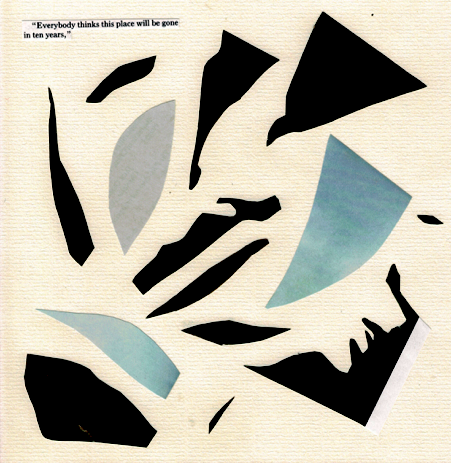
Everybody thinks this place will be gone in ten years

Posted in 86: NO THEME VII | Tagged

Inclined

The word love is merely a sign that means something like the way to the mountain.
Mark Doty, Dog Years

What the mountain thinks, you can’t
know. When it leans the weight of its shadow
on you, tall, how much might it say in fall
or thrall, like a lover, telling all? You don’t
know, but something’s in step, like (black and blue)
and (avenue), and you, all backpack and crampon, ice-
axe your way through, poster girl for grit: you can’t
wait, think of love as losing wait, court
waitlessness, ascend, impatient as snow, don’t know
how, don’t know where melt becomes avalanche, figure
stunts, jut and chutzpah are the go, don’t
know what you can’t know, find yourself
lost, but (stars appear), so step by step, go
up, (dry your tears), keep in mind the rhyme

(rain on face) (warm embrace) the rhyme
of it, the pulse, climbing in iambics, and you can
know, you stumble, skirt the glacier, syncopate, or trip
and have to use your little kit, your grit, you do
know, though it’s nothing you’ve known, find
you’ve left behind flat foothills, the boot in the ice-
face, powder and slide. And you climb, patient: find you can
wait, watch the mountain waking to remember (rolling sea)
speechful, whistling lovewhispers (wild and free)
and the summit isn’t some mystery since you do
know its song, its height and gaze, its quietude
and seep of calm, how much this climb takes heart
and breath from you, and gives them back, lighter,
might never be known, but walking here, you do know.


(after Bob Dylan’s ‘Make You Feel My Love’)

Posted in 86: NO THEME VII | Tagged

The House, Cracking

Enough to wake
the deepest sleeper
though still out there

by day I’m more
attentive lying down
by dark the strain

of stillness in
between each strike
a load to bear

as if some bone inside
were close to fracture
could snap in kinship

hearing that slap
in the face for a house
made of give and take

trying to settle but
it’s always been there
in every place whether

brick or timber
fibre cement
with feet of clay

heave or subsidence
thermal movement
each master stroke

a shock irregular
as clockwork
sound of one hand

it’s going nowhere
this cosmic joker
child with cap-gun

clueless what for
vast Christmas cracker
that lacks a token

somebody’s pulling apart

Posted in 86: NO THEME VII | Tagged

After Chopin

Out from elms, floating and rising, shrouds of dust play across the sand. There’s something alarming in how quickly the shapes move against my will as if they might carry you away with them. Celestial. Pious. Cowled like monks. They almost turn to laugh at me

It is true that I fell in love with you once and by fall in love I mean succumbed to your music. It was in Italy when the summer grass was cold and the jasmine fused a nimbus bluer than the moon. How it was that I saw you then, your candlestick eyes turned towards the night like a wolf’s scanning for movement in the snow

Let me tell you that I am made of neither the material of a wife nor the livery of a mother. In truth, I move invisibly across the snow. It strikes me very well that the circumference of your hunt is so narrow and the margin of your appetite falls so steep that the only way to find you is to step out of hiding

Step within a nocturne of piano where a hammer lengthens out my name

There I shall move not unlike a braid of waterfall. Let you step through me into a chthonic light where the sleep of stones and the fugues of totems have been boiled, gathered, enchanted away.

Posted in 86: NO THEME VII | Tagged

Tact

Last night, after we saw you both,
a thrush came to our sill.

Wild for light – her eye
striking at the glass –

for a sea was at her side.
She crouched as if to rest –

then dived. And I

may never rest again
in what is real to me, the known,

having touched small distances
impassable as worlds’.

Brick by brick, I have stroked
the rough wall

of your mind at its remove –
warm, unthinkable

and near.

Posted in 86: NO THEME VII | Tagged

Re-visiting Chernobyl

1. Liquidation1

The earth has always been so accommodating,
enfolding all kinds of calamities: the meteoric end
of dinosaurs, the Neanderthals and other botched experiments,
the debris of bronze and iron ages, modern battlegrounds . . .

And there is still so much space! For us to tuck away
these bull-dozed villages, lorries loaded with fallout,
electrically-charged farm animals (appropriately neutralised),
even a pine forest (gamma-rayed). Pat it all down.

Permit yourself to rest without a bothersome pop or tick.
(We have reinforced concrete for those more insistent sounds—
the kind that leach the pigment from eyes,
blister hearts as they are beating … )


2. Bio-Robots

What a piece of work is Man! A wise industrial sentiment—
and too often overlooked in newfangled forecasts of automation.
Lest we forget: that remote-controlled backhoe committed harakiri
from the clifftop of reactor 3, after reaching its emissions capacity
and look who saved the day! Triumphant as a plague,
crawling out the rabbit hole of history
in wave after wave, armoured in medieval scraps of lead
and muzzled for respiration. (Pig-faced, as the jesters said!)
They had 40 seconds to shovel contaminants (flung from reactor 4)
off the tower’s precipice. (We had plans for mass burial down below … )
Have faith, we said, there is nothing terrifying up there—2
but best to run like the dog, flee like the hare.
Scoop a spadeful or two of that hot stuff away and scram!
Before your bones and teeth are meaningless …
How they moved: like roof cats! It was only afterwards they stopped,
slumping together in the sheltered halls like litters of stillborn …
Mind you: some of them are still ticking!
(We had to ban embalming and open caskets … )
100 roubles is all it took—so many bought it.
Of course, we honoured their corps in cement, right at ground zero,
where the birds have returned, against all those glum forecasts.
Listen to them: chirruping away with the Geiger counters.


3. Dark Tourism3

Today we celebrate the half-life of caesium 137
with this sceptical offer: one-day tours only for US$!
Exchange phones for dosimeters and be mesmerised
as battery-powered crickets stridulate in a peace that is
truly ionising. Visitors are most welcome to observe
swans silvering in the cooling pond of radionuclides.
Drip-feed the gargantuan catfish (not recommend for eating.)
The retro excavator parked outside the sarcophagus
is a favourite haunt of the barn swallow, its pale throat
a world-first in partial albinism! Marvel at our mushrooms,
21.88 micro Sieverts’ worth and prized by bank voles
with cataracts—so rare! No need to fear our wolves;
they thrive on dogs left over from the original liquidators.
But best to update your shots: even rabies blossoms here!
How fortunate to have liberated the Earth of some people.
And thanks to the rich and varied lives of plutonium,
we are guaranteed to be more-or-less free of human habitation—
and open for business—for another 24,000 years.


4. The Red Forest4

Dress the wicker basket with cloth and sash.

Set it on the path still running through the woods.

Perhaps a bear, a boar, a raven, a bee . . .

The children have been sent from the village.

All the horses have been shot.

Wind fills the grass with its emptiness.

Once there was a hunter, a dwarf, a witch, a seamstress . . .

Who will sew up the tear in the fabric of our world?


5. What Was Invisible Now Becomes Visible5

Dew reconstructs
the spider’s pure and abstract
longing for itself.

The jaw of a waking fox
unlocks the silence
of teeth.

Lichen brushes the lips
of the stag burdened
by dreams of lightning.

Potatoes push up from
the earth like nubs
of bones.

The moon is the ghost
of a rock in
the broken sky of dawn.

The sun has
already discovered everything
including what we have done.

Posted in 86: NO THEME VII | Tagged

Insects

The diagnosis is hard to hear. Dark
flames lap the future’s pretty
cottage. Knees and elbows
smoulder anger. Three streets
away a fire engine’s
high-pitched gape
sounds amongst the traffic.

The grasshopper in the bathroom that I trod on in socks, not squashing it
but breaking off a leg and not even noticing till I sat on the milky bath edge
in the half-light and a small movement came to me. I peered closer—
what is that?—and saw the little thing crawling round its broken leg
nudging it with its head as if trying to coax it into life, circling and circling touching it. I felt what I thought must be its confusion, its grief
and my throat was thick with what I had done. Its poor big eyes.
I didn’t know how to make amends.

On the other side of the apartment
wall our neighbour is
crying. No-one can hear her. This is
not true; we can hear her
but we don’t know her so we don’t
know how to go to her. We wonder why
no-one goes to her.

My boy when he was little, some days after I’d told him that wild things
prefer to stay in the wild. He came running in from the garden, his breath crosshatched with sobs and threw his arms around me
pressing his head into my belly. Whatever is it? I asked
my fingers stroking the small bones of his back.
I let all my caterpillars go, he said. I put them back in the wild.

Even the birds have their emergencies.
Their loud alarms in backyards and bushland.
And that half-dead galah, flattened on tarmac
attended by ten or so others, who rushed
out from the pavement to flutter and squawk
around it whenever there was a
break in the traffic.

The story my parents often told about a time when I was a child
still young enough to run to their Sunday morning bedroom and crawl into
the soft place where their warmth pooled. On one such occasion a butterfly
had flown in through the open window and I leapt up laughing, grabbing
at the colours until my fingers closed around it and it fell on their covers.
I picked up the broken thing and crawled, sobbing, into the bed, smoothing
the crumpled wings, hoping they might mend. I can still hear the low murmur
of my parents’ comfort, feel their hands on my shaking back, a memory
that may have come from the actual event or the way I pictured the event whenever the story was told, or is maybe just the way I’m picturing it now
as I write this, stopping sometimes to rub at my burning joints while my parents
lie asleep in a bed so far away I can no longer run to it, can no longer find
its soft place.

Posted in 86: NO THEME VII | Tagged

In the Former French Concession

I see them from my bedroom,
pegged beside the neighbour’s
smog-coloured slips,
and on street corners
in the black thatch of power lines:
fish dried crisp, leaf-print bodies
honed to bone,
mined for eyes and eggs,
scales and fins mixed
in the gutter with other rubbish,
fish winched between drying ducks
round as spuds, rich with flesh,
bronze fish jangling above tourists,
causing arguments between neighbours,
taut in the wind, fish
big as tables, headless fish,
fish curved and smooth as boat hulls,
split and spread flat like sails
turning white in the white weather,
wearing a crest of frost.

Above me in the Former French Concession:
several small fish on the wire ravel
of a coathanger, cured
of saltiness, unscented as soap,
beside themselves in the wet market
rows and rows of brineless silence,
last night’s meal needled
with bones, on Jiashan Road
those that have dried their time are for sale,
the new twisting over footpaths
still tiled with scales,
eyes cataracted by cloud,
pious and quiet,
kids in a fish-trance
staring up into silver dizziness,
fish bones scattered like scratch marks
where cats get fed,
in the entrance to my apartment
two little fish
hang
in the window
like neighbours’ faces.

Posted in 86: NO THEME VII | Tagged

Royal Park

this the night dead gum leaves with wet glass sheen
ghosts of brand new green
headlamps diamente eyes starstruck by the big dark
energy drink kids sitting on the hill pointing
high-vis jogger with his iPhone torch on
ripped black crystal ashfelt
finger-stained metallic box
foggy window of unit 3 hot with the smell of the roti maker
sound of “hello young couple”
baby frowsy head small in the curve of his father’s arm

Posted in 86: NO THEME VII | Tagged

Coming Home | Ngaityo Wodlianna Parni Budna-ndi

Georgina Williams, 1985 | Yambo Ngangkiburka Kartanya-Ityanungku, 1985rlu, Piltabilu, 1999rlu.
Translated by Rob Amery, Georgina Williams and Paul Dixon on 13 July, 1999 (revised spelling by Rob Amery on 3 February, 2016.


dedicated to Kudnarto


I am an Old Spirit
 
Born to this new world
 
Taken from this place to die
 
Stripped and beaten
 
My land you claimed
 
and call your own


Old Spiriy
 
Red Earth


Narrung’-kaurna is my name
 
Yes I am an Old Spirit
 
Sporned today in this new form
 
Before I was here I slept in peace
 
Buried deep a seed
 
Inside my mother’s girth


Old Spirit
 
Red Earth


Ravaged and torn … weary and worn
 
She laboured in my birth
 
Then to her bosom I was drawn
 
Tenderly she suckled me


Old Spirit
 
Red Earth


Now I feel the pain
 
Fear, anxious upon the face appear
 
What was I born for; what must I die for?
 
I labour on where time stands still
 
Yet always I am born anew


Old Spirit
 
Red Earth


Silent in the night
 
My father gave his seed
 
To lie in wait
 
To germinate


Old Spirit
 
Red Earth


Out of the dust of these old bones I rise
 
My silence shattered, by the glaring neon light
 
In full circle I bear this child anew
 
Narrung’-kaurna her name.


My        home-to        towards come-PRES

Ngai bukkiana towilla
I        old / ancient spirit
Kurlanna parto yerta-ngga worni
New        big        land-in        was born
Ngaityo wodli-unangko manki madli-titya
My        home-from        took        die-in order to
             Turnki mari-appi, kunda-nanna
Clothes undress-CAUS beat-having
             Ngaityo yerta nindo manki
My        land        you+ERG took
Tarka-nanna ninko-andi
Call-having (it) yours-EXCL


Bukkiana towilla
Old / Ancient Spirit
Karko yerta
Red Ochre Earth


Narrung’-kaurna ngai narri
Narrung’-kaurna I name
Ne, ngai bukkiana towilla
Yes I        Old / Ancient Spirit
Natta yurlo-rendi kurlana-ni
Now        appear-REFL_PRES new-became
Bitti ngai budni ngai medotungki
Before I        arrived I        sound asleep
Wongatti yakki yitpi
Buried        deep        a seed
Trukkungga ngaityaii munto-ngga
Inside        my.mother-stomach-in


Bukkiana towilla
Old / Ancient Spirit
Karko yerta
Red Ochre Earth


Paltapaltari yarruri wirrani burtunna
Beaten / knocked around torn        weary worn out
Pa kathi budnatti ngaityo worni-ngga
She exhaustion arrived        my birth-in
Ngammi-anna ngai kuratti
Breast-to        I drew near / approached / touched
Naingu padlu ngai ngami nuinpi-pi-thi
Tenderly she+ERG me breast        suckle-CAUS-PAST.IMP


Bukkiana towilla
Old / Ancient Spirit
Karko yerta
Red Ochre Earth


Nata ngarntarrinth’ai
Now I am in pain
Wai yurlurrinthi, wiltirrkayinthi
Fear appear-REFL-PRES feeling frightened / anxious
             Nganaitya ngai warni? Nganaitya ngai padlu-ingku?
What for        I        born        What for        I        die-must
Ngai warpulayinthi tirntu-intyarlu yuwanthi
I        work / labour in time        standing still
Tudnu, ngai kurlana warniwarnithi
Always        I        new        born again and again


Bukkiana towilla
Old / Ancient Spirit
Karko yerta
Red Ochre Earth


Ngulthi-ngka warratina
Night-in        silent(=voice noise without)
Ngaityarli-rlu yitpi yungkithi
My.father-ERG seed would give
Wanti katpirri-titya
Lie        wait-to (i.e. to lie in wait)
Yitpi tarn-titya
Seed germinate-to


Bukkiana towilla
Old / Ancient Spirit
Karko yerta
Red Ochre Earth


             Murdu-nangku itu purtuna warpu ngai tarninthi
Dust-from these old / worn out bones I        rise
Kudlayurlu yartarrinthi kardlayirdi-rlu
Quiet / peace shattered        light-by
Kurruru munthu-ngka ngathu yaintya kurlana ngartu kangkanthi
Circle        stomach(i.e. full)-in I +ERG this        new child bring.forth
Narrung’-kaurna pa nari.
Narrung’-kaurna        she name.

Posted in 86: NO THEME VII | Tagged

Reading a list of celebrities who own islands as self-care

Johnny Depp owns an island
A-Ha, the band that sang Take on Me collectively
Own an island while The Lonely Island
Do not own one, Marlon Brando,
Who is dead, is on the list of island owners
Leonardo DiCaprio, Ricky Martin,
Robin Williams—also dead
Maybe this list is outdated
It features washed-out google images
Of the celebrities next to aerial views of their islands
Which look like supergreen salads or planets
Or salad-planets or cross sections of
Planet Hollywood billboards
So far away or so close-up
There’s an implied sense we as observers are
Exiled from these 200×200-pixel images
High-contrast oversaturated unattainable
Properties shining like beacons from a
2003 we can never access
In circles where buying an island is an acceptable form of self-care
A lifestyle choice we can rage against but never zoom in on
Maybe I should look at another list maybe I should—

Picking your nose really thoroughly as self-care
Watching an entire season of Queer Eye without moving as self-care
Making yourself a really healthy dinner and
Eating it too quickly to get indigestion
As self-care, at what point does your
Self-care grow a thirst that cannot be quenched
By coconut oil or yoga, at what point does a man
Become an island dressed inappropriately in a Hawaiian shirt
Unbuttoned, bare belly viewed from above like Mao
Drifting down the Yangtze to prove it’s not toxic
The Galapagos rising out of the sea like fat
Tortoise asses revealing themselves to Charles Darwin
Revealing himself to Richard Dawkins
Exposing himself to every old white man who
Thought his ideas more important than
Having values, at what point am I just giving in to the
Decadence of my sadness like eating a really
Nice ass-cake sprinkled with islands inhabited by my own
Feelings drowning them in stomach acid torching
The villages burning the villagers
How many times
Will I swallow before I sink

Posted in 86: NO THEME VII | Tagged

The Left-handed Self

See, when I hand the pen
to the left-handed self
it holds it like the stump of a finger,
truncated and clumsy.

It would write backwards if it could,
unwriting the right hand’s
good intentions,
not this crabbed sideways stumble
that slows thought and finds,
unsought,
some other, awkward truth.

Posted in 86: NO THEME VII | Tagged

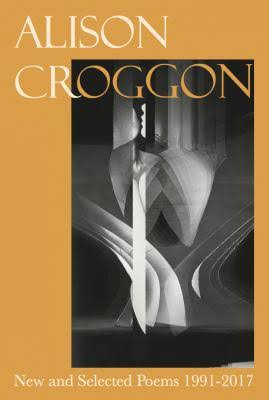
Catherine Noske Reviews Alison Croggon

New and Selected Poems 1991-2017 by Alison Croggon
Newport Street Books, 2017


Alison Croggon has worked across many forms in her career, and connections to several are represented in these pages – the nine-part poem ‘Specula’, for example, comes from a larger work of the same title which also involves an essay and a radio play. Her previously published poetry collections are likewise represented. But there is no distinction in this new collection between these various sources from which Croggon has drawn – a deliberate choice she carefully underlines in her author’s note to this selection. In the acknowledgements, her own titles are grouped with that of the numerous journals she has published in, and given no special attention. There is no distinction in the table of contents or in the book’s design which demonstrates each poem’s source – the only overt indication is the inclusion of titular poems from previous collections. Recognition of these moreover confirms that the new collection is not arranged chronologically, or by any other immediately comprehensible logic. Something larger is at play in the construction of the collection than the ‘historicisation’ of a writing career.

The previously unpublished works included with the selection are not all new – as her note describes, Croggon has included ‘all the poems I care to remember. I wrote the earliest poem in this book when I was eleven, the most recent this year. Some, including older works, haven’t been previously published; some have been published many times.’ At 314 pages, it is a vast collection. Accentuating this is the scope of the poetry, which shifts across forms, themes and foci with dexterity. There is for example a thread of violence, regularly connected to patriarchal structures of sex and gender, which builds gradually and comes to lie alongside the experience of motherhood in a beautiful but disconcerting and often confronting way. The poem ‘For Ben’, roughly halfway through the collection, offers an example:

Child, the world is swelling, light wavers
over your unblinking eyes, the ocean lifts you
on dark mouths towards the sudden dawn
when you’ll howl the sea out of your lungs
and harden the air.

To welcome you I have these eyes and fingers
to open their delight on your sundered skin. 
They’ll fail, as all desire fails, breaking on the reef 
of human weariness and gathering past 
its violation to simplicity

Perhaps. Here is a cushion of my blood

This concern with structures of the feminine spans the collection, and shifts subtly from the gentle embodiment of poems like ‘Owl Songs’ or ‘Communion’ (‘My flesh is sad with itself, it walks in the garden / heavy and opaque, an insoluble riddle’), to the open feminist politics of ‘Songs of a Dictator’, especially ‘1. He woos his mistress’. Powerful female figures abound – Persephone, Medea, Yseult, Euterpe and Cassandra all feature.

But this is not the only, nor always the dominant theme. As Euterpe’s presence suggests, a sense of joy in art of all forms emerges regularly through a rich and challenging intertext—poems cite sources from Rilke to popular television. Nature is also an important force, and unflinching. In ‘Bird’:

The bird is
a deep and troublesome fidelity.
Even as maggots crawl through its braincase, it is still bird.
In the skirl of storm
it is bird, torn feathers, tiny bones,
breasting the weight of air.

It is possible to read the collection in terms of the thematic, stylistic and emotional connections which Croggon cites as having structured her ordering of the works. But in another way, I also found myself resisting anything so active in the reading. The impression of narrative logic which emerged at points felt like a false temptation. Instead, again and again, I found myself wanting to play passive witness to the text, to take it as an offering on its own terms – in Croggon’s words, as ‘a new body of work that, like memory itself, exists spatially rather than sequentially’. This is a collection which finds structure in speaking to the experience of a life in words.

In an interview for Cordite Poetry Review with Kate Middleton in 2001, when asked about the diversity of her artistic outputs, and whether she considered poetry as her primary form, Croggon agreed that: ‘Poetry’s the first thing I did, and I think psychically it’s just in the middle, and everything else is related to it, branches out from it.’ The scope of this collection, representing the majority of Croggon’s life and testifying to the significance of her poetic output, can be read to stand then as this ‘physic middle’ in textual form. Like memory, it is fluid, richly imagistic, and has an intense and at times unsettling capacity for contradiction – in ‘Notes’:

little delicate animal 
your thin shoulders press against my belly
the bones of your face stand out like an adult’s
and your neck that white naked stem
is laid across my thigh
as if I could protect you

Moments when the poetry approaches the melodramatic seem to push towards the subconscious, playing on the notion of the hysterical to suggest the capacity within the psyche for panic or pain. In the poem ‘Mnemosyne’, for example:

she writhes into the mystery of her body

herself dissolves and remakes itself

will not be still won’t stop it’s eating her it’s closed her up she’s lost inside alone
she hurts there are no words there is no hand no tongue no god no hate no
love nothing to save her

a crush a must a burn afraid a breath a

The lyric voice varies in its rhythms and pace but is more consistent in its timbre: the ‘grain’ of the voice is recognisable, and the work carries always a power for moments of both strength and sympathy. Form, too, shifts in subtle ways: the minimalism of ‘Attempts at being’ sits beside the more expansive ‘Beginning again’, a work taken from the same collection, but shifted into new relation in the re-ordering. Similarly, the tense energy of ‘Aubade’, tightly constrained in two couplets, is followed by the slowly building, twelve-part release of ‘Divinations’. Even when visible and connected, the themes and images move in and out of focus. In all these ways, the collection reads as an intense exploration of self. But its cohesion, paradoxically, is a product of its fluidity – it works in recognition of a life’s inconsistencies, of the manner in which the self can change, as much as it offers an image of a complete and contained poetic ‘I’.

Posted in BOOK REVIEWS | Tagged ,

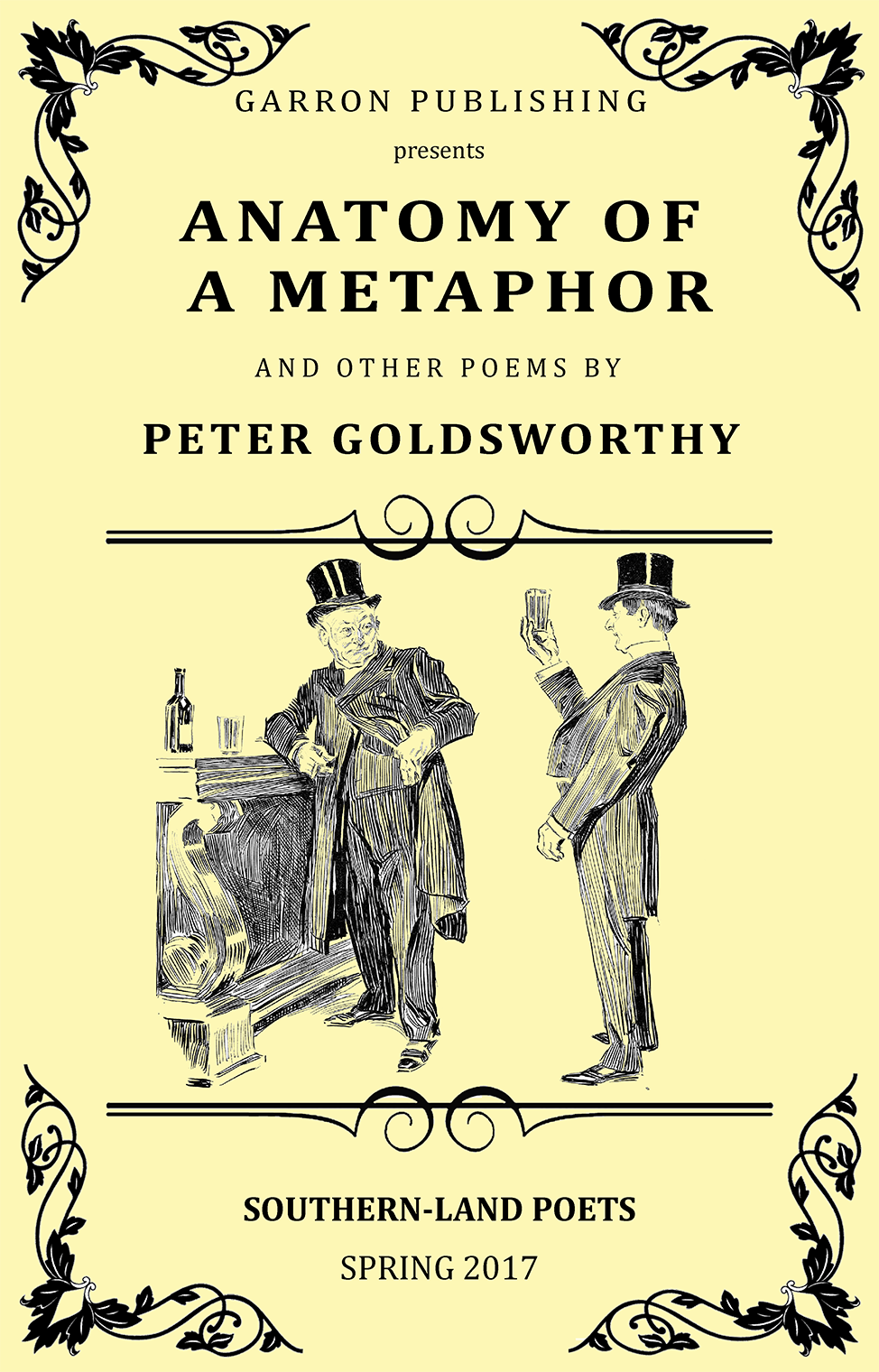
Alex Kostas Reviews Peter Goldsworthy, Jill Jones and Heather Taylor Johnson

Anatomy of a Metaphor by Peter Goldsworthy
Garron Press, 2017
The Quality of Light by Jill Jones
Garron Press, 2017
Thump by Heather Taylor Johnson
Garron Press, 2017


Garron Publishing was started in 2010 by Gary MacRae and Sharon Kernott as a means of self-publishing work, but has since expanded into a successful run of poetry chapbooks by established and emerging South Australian poets. This Southern-Land Poets series is a return to the original pamphlets traditionally sold in fifteenth century England by ‘chapmen’, and as such, their unassuming bindings do not necessarily connote the quality of their contents.

Anatomy of a Metaphor (and other poems) by Peter Goldsworthy is split into in three sections. The first, the ‘Anatomy of a Metaphor’ sequence, is a searing, seven-part poem focused on the human heart. It not only stretches the limits of a poet’s metaphorical ability, but also creates an intra-poetic dialogue between the ‘diastole’ and ‘systole’ beats. There is a hypnotic rhythm on a macro level, alternating between the relentless images of the systole and the distanced observations of the diastole. ‘2. Systole’ is a good example of Goldsworthy’s seemingly bottomless well of metaphors:

Red centre of a growing iron-red continent,
epicentre of small-magnitude non-stop body-quakes,
plum-coloured boab bulb with thick upspreading roots,
multi-tentacled squid-head squirting jets of red ink

Goldsworthy’s relentless litany is evocative but also thought provoking. Under Aristotelian thought, the Ancient Greeks gave the heart the prime place in human biology; it was the source of life but also the centre of all thoughts and feelings. Goldsworthy’s sequence provokes a realisation of the beauty of the heart and all that it does, and also how often we do not think about it. It beats along without us needing to.

But Goldsworthy is not only writing about the heart, he is also writing about metaphors themselves, so that the human anatomy that forms the subject matter of his metaphors is also, when viewed from the ‘diastole’, a commentary on the nature of metaphors themselves. ‘3. Diastole’ is a particularly arresting example:

The metaphor
keeps order
in a society
that is only an arrest

or two
away from anarchy

Goldsworthy employs the same general style of writing in the second section of the chapbook, but applied to other body parts. His eight-part poem titled ‘Hand’ is another example of his astounding ability to provoke self-reflection through imagery:

Hand  is our far-flung frontier   reaching across
the limits of words   the border of our matter
[…]
our mariner   our voyager   our miniaturized self
crossing the outer silence   the empty space
between the worlds
Posted in BOOK REVIEWS | Tagged , , ,

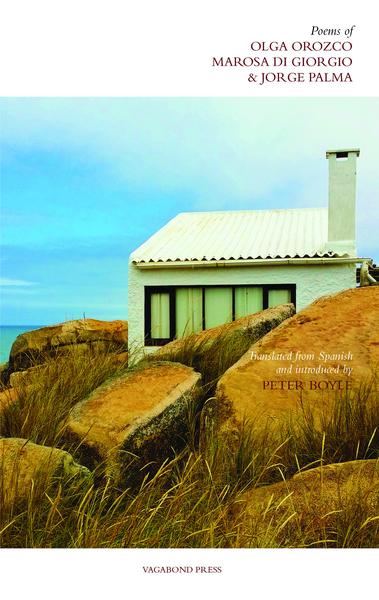
Israel Holas Allimant Reviews Poems of Olga Orozco, Marosa Di Giorgio & Jorge Palma

Poems of Olga Orozco, Marosa Di Giorgio & Jorge Palma
Edited and translated by Peter Boyle
Vagabond Publishing, 2017


In 2017, Vagabond Press launched its Americas Poetry Series. This is a brave and much needed venture, one that borders on the quixotic: an Australian editor offering publications from poets from the Americas to the Australian reading public, for the love of poetry and the art of translation. So far, the series has three excellent entries focused on the translation of Spanish language Latin American poets into English. Notably, all three books in the series consist of translations by translators who are themselves poets. They seize the creative potential of the translating act, producing poems that walk the fine-line between the languages and cultures of the original and the translated texts, while seeking to conserve the imagery, expression and rhythm of the poems. Given that many of the translations published so far stem from the baroque to the vanguardist schools of poetry, it is no small feat that the books present readable, engaging translations that retain the playfulness, the shock, the allure and ambience of the originals. Though this review concerns the first publication in the series, it must be noted that it has continued successfully, with the two latest publications being Poems of Mijail Lamas, Mario Bojórquez & Alí Calderón, focusing on a selection of Mexican poetry (reviewed in these pages by Gabriel García Ochoa), and the haunting Jasmine for Clementina Médici by the Uruguayan Marosa di Giorgio, with a foreword by notable poet, translator and academic, Roberto Echevarren.

Poems of Olga Orozco, Marosa Di Giorgio & Jorge Palma is selected and translated by Peter Boyle and consists of a selection from these three poets from Argentina and Uruguay. Boyle is himself a distinguished Australian poet and translator, with a long-running relationship with Latin American poetry, having previously translated poems by the Cuban José Kozer and the Venezuelan Eugenio Montejo, amongst others. Adorned with a beautiful photograph of a Uruguayan cottage taken by fellow Australian poet Stuart Cooke, that, with its ochre and blue tones, accentuates the connections between these distant souths (Australia-South America) and offers a glimpse of idyll that connects with the romantic tendencies of some of the contents. Yet, acting as the proverbial calm before the storm, this idyll also presages the turbulence of the pages to come. That is because Boyle’s book provides an eccentric, alchemical, if not iconoclastic selection that chooses the path of discovery, adventure and mysticism. To aid the reader, Boyle provides an excellent introduction that serves to not only to introduce the poets, but also contextualises the work of the three poets by placing them in their respective poetic traditions. Boyle’s introduction also addresses the task of translation itself, presenting different difficulties in each of the three cases. However concerned Boyle may be about those things that are lost in translation (rhyme, sound play), his anthology presents a delightful set of translations that read well, and most importantly, represent three different twentieth century conceptions of the poetic in Latin America: those who took up the call of surrealism, represented by Olga Orozco; the neo-baroque and experimental, in Marosa di Giorgio; and the conversational, socially engaged poetry in the poems of Jorge Palma. These are three forking paths that lead into different traditions that are well worth exploring.

The book begins with a selection of poetry by Orozco (1920-1999), and whose poems are carefully chosen from a lifetime of poetic practice, including a poem dedicated to her dead brother Emilio, dating from 1946, to the poet’s last verses, published posthumously in 2009. Orozco’s ‘Cartomancy’ sets the tone for what is to come, with its dense and dreamlike images and allusions to the world of the magical. In Orozco’s poems, this is a world where both poet and the reader are subjected to the twists and turns of fate and are surrounded by its symbols, often as jarringly juxtaposed as the twists of fate itself. Orozco was involved in Argentina’s Tercera Vanguardia, a vanguardist movement that drank heavily from the well of surrealism, embracing its formal experimentation and tendency to the violent juxtaposition of incongruent imagery. Perhaps, however, the most marked influence from the surrealists in Latin America was its play with the unconscious and its trust in dream imagery. Orozco takes from these traditions and filters them through images, experiences and places from her own past. As a result, there is in Orozco’s poems a marked tendency towards the magical and the fantastic. According to Boyle, Orozco’s faith in the magical stems from her own childhood through the figure of her grandmother who inculcated her with a belief in the magical and in the talismanic, in symbols, herbs and indecipherable turns of phrase. Orozco’s poems embrace these elements and render them on the page in the service of exploring her own recurring themes. There is in all of her poetry a fascination with both the fantastic and the fatalistic that is coupled with an exploration of the poet’s interior worlds. These are worlds marked by nostalgia for long-gone people and places of the poet’s past: the Argentine Pampa where the childhood home once stood; death; the animal-world, and the spaces once inhabited. Notably, many of Orozco’s poems are dedicated to the dead, ‘For Emilio in his Heaven’, ‘Pavane for a Dead Princess’ and ‘Cantos a Berenice’ are dedicated to her dead younger brother, to Alejandra Pizarnik and to Orozco’s cat. Orozco’s recurrent themes lead the poet to her own images and symbols of the plains, the elements of nature, the seasons, dogs, talismans, stones and snouts that “steal your breath”. Orozco puts these images to use to create a multifaceted image of reality, characterised as a space ruled by fate; a space in which one must attempt to decipher the runes of chance. Orozco explores this dynamic in ‘Mutations of Reality’:

Like me a captive, with constellations and ants, 
perhaps inside a glass ball where souls wander,
I’ve seen reality shrink and take the form of puny Jonah
            inside the whale
or endlessly expand into that skin which, in a stream of 
            vapour, breathes out all the sky:
indissoluble stowaway groping through the bilge water of the 
            unknown
or all-encompassing beast at the moment of exploding 
            against the wire fence around limbo […]
Like me, protector of one of destiny’s indecipherable masks,
Reality dresses up as a witch and with a sigh transforms 
            dazzling birds to legions of rats,
or puts all of yesterday’s and tomorrow’s wine in a pot to 
            evaporate
Posted in BOOK REVIEWS | Tagged , , , ,

Review Short: Rose Hunter’s Glass

Glass by Rose Hunter
Five Islands Press, 2017


Glass is a collection of elegiac poems, a memoir of free verse about the poet’s travels through Mexico and her own debilitating ailment. The ‘you’ in book is addressed with a certain fondness (‘where are you / i feel of course now we would have the most wonderful conversation’) and an intimacy that suggests the poet is speaking to someone she was once romantically involved with:

                                                           thinking of things i had to
tell you and what would you say and how you would laugh

The first poem ‘mixquic’ is addressed to ‘sean’, whom the book is also, in part, dedicated to: ‘for sean, again / for mum and dad’. The ‘you’ in the poems, it might be assumed, is Sean.

There are many allusions to Sean’s death. Whereas in ‘yellow’ Hunter makes reference – although not necessarily literal – to ‘cancers’, in ‘el edén’ Sean’s passing is the result of an accident:

magic wand bridge one-eyed fence canyon plunge                    buggy	
               tiny flimsy that killed you

There is also a passage that expresses guilt about the death of an intimate partner – presumably Sean – from alcoholism:

then i will bathe you clothe you feed you wash the dishes
                    hide the bottles take out the empties
call the doctor tie you down. now	         i will reel you back

from your brink.

Sean is the addressee of most of the poems and in this sense the book reads like a letter to the departed. Glass, however, is by no means epistolary in form or style:

(i would not interrupt say less backstory say
                    cut to the chase say what is the point
                    of this story	       or i would but that
would be okay too)

Often Hunter’s verse is conversational, but certain passages are also lyrical, somewhat oneiric, and almost surrealist:

                                   the dragon head on your chicken back
turkey feet and cowrie legs. wattle dewlap quill cuttle
               ventricular, come                    i will dab you bib you

we will be like the children we never were. 	      show me
your pony gait your ice cream cone fur and jester ears

Many of the poems, such as ‘bajío’, include uncredited epigraphs:

– the exhibition was about lost things 
you see. leashes slack on the ground.

Perhaps the epigraphs are fragments of overheard conversation, or words written by Hunter herself as ‘quotations’ of divergent voices or viewpoints. The epigraph in ‘bajío’ seems to suggest the existence of an escaped dog and, like most of the epigraphs in Glass, has an equivocal connection to the poem itself, which begins:

                    if we take a lobster for a walk well
how to put that harness and can they even go on land
and for how long?	   would they break their feet?

This passage, which could be observed as somewhat of a departure from personal narrative voice that continues more or less throughout the collection, brings to mind Gérard de Nerval, the nineteenth-century French poet who is said to have taken a lobster on a blue ribbon for a walk through Paris. Also, it is reminiscent in certain ways of Gabriel García Márquez. Hunter normalises the lobster on a leash with her conversational tone (‘can they even go on land … ?’) in much the same way as Márquez uses fairly ordinary language to describe fantastic occurrences. Hunter’s lobster on a leash is by no means physically implausible or as irrefutably surrealist as, say, García Márquez’s story ‘A Very Old Man with Enormous Wings’ in which an angel falls from the sky during a storm, but the two are comparable in their use of dry, pragmatic language that draws the reader into an imagined realm:

He argued that if wings were not the essential elements in determining the difference between a hawk and an airplane, they were even less so in the recognition of angels.

In Hunter’s poem, however, the fantasy lasts for less than a stanza before she flips into stream of consciousness:


                    […] i ate squid dashed against the rocks

with a specified promptness or precision 		or something
for it to taste a certain way or something.	
							                        […] look

i have eaten lobster only twice and still don’t know what it 
	     tastes like.

Elsewhere in the book, Hunter’s recollections of Sean and Mexico are often nostalgic, but ‘bajío’ is decidedly unsentimental:

                                        listen.	          if you are talking to a person
on the street one day and the next day they go out and die
like going for a hamburger or barbacoa [barbeque] like big deal they just go.

Hunter, particularly in the ‘brisbane’ chapter, also refers to her own encumbering illness: ‘we just don’t know why / i have dead legs’. At the same time, however, the speaker is incapable of forgetting Sean:

                    if i could go back to that day. i would do more
than take a picture of you

Hunter’s use of form – the indented lines, the large gaps within the lines, the relentless enjambment – is central to her stream of consciousness style. In ‘wickham terrace’, among other poems, the sentences are enjambed not only over lines and stanzas, but also over numbered sections:

i.


                             […] my father whistles through his teeth
lifts one foot, then the other	          touches his hand
to his mouth, his glance a thrown bus.	   time

ii.

                    is lost no matter how you lived it

The rarity of end-stopped lines and the way in which Hunter positions the sentences across the page accentuates the free associative design of her syntax. When end-stopped lines are included (‘did they not fight enough / did they not love enough’) they are all the more forceful. The fact that Hunter uses enjambment across numbered sections and their respective page breaks and the way she often begins poems with ‘and’ or ‘or’ contribute to the impression that even though there are 21 poems divided into three chapters (‘mexico city’, ‘jalisco’, and ‘brisbane’) Glass in many ways reads like one extended poem. The extent to which Glass is autobiographical is of course irrelevant, but the personal and somewhat regretful tone that pervades the collection make the poems nearly always compelling.

Posted in BOOK REVIEWS | Tagged ,

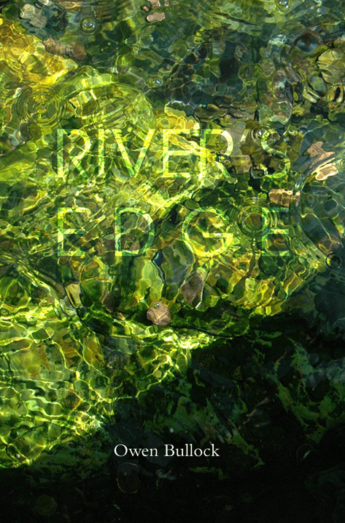
Review Short: Owen Bullock’s River’s Edge

River’s Edge by Owen Bullock
Recent Work Press, 2016


Owen Bullock stated in his ‘The Breath of Haiku’ article in Aoeteroa that ‘the modern haiku can be about anything, not just nature’. Readers of his previous collection, Urban Haiku (Recent Work Press, 2015), will be well aware of this position. Preferring to focus on the human and blur the distinctions between haiku and senyrū, haiku of human nature as opposed to the world, Bullock’s latest collection, River’s Edge lends itself well to investigations of textual forms.

old notebook
his daughter's
recipe

The individual lines featured on the back cover hint at what lurks beneath the surface of River’s Edge: a focussed recollection of the wisdom and experiences of a variety of people that brings together multiple viewpoints at once. Like a recipe followed by heart, unpretentious and yet demanding, each poem represents the attempt to preserve the moment – at a loss to see clearly beyond the titular river’s edge:

some of the waves
overtaking
the others (55)

Above all, the collection’s appearance is deceptive – while the haiku are characteristically brief and simple, they are intricately crafted and mindful as memories resurface and are subsequently overtaken, as expressed by the overtaking waves of the poem above. Sometimes as unobtrusive as a passing phrase about cleaning the mantel within someone’s home, the text demonstrates the advantage of a form that omits so much and yet hints at what is left unsaid, as revealed within the establishing haiku:

dusting
her little vases
this is my devotion (3)

By no means the last poem about seemingly irrelevant moments that at times evade understanding, words are rendered particulate within these fragments, the lines unstable and language suggestive of the personal. From the first page, Bullock appeals to the reader to not simply be satisfied with aphoristic haiku, inviting them to peer beyond what is printed on the page and read between and across the lines. For example, consider the following poems:

New Year’s Eve
to New Year’s Day
the unlit candle

old clocks
that don’t work
top his kitchen cupboards (38-39)

In these two instants, the reader gets the sense that each line could be interchanged, omitted or exchanged within the individual haiku and considered a stanza within a larger poem. The potential of the ‘unlit candle’ in the concluding line of the first haiku to also serve as the establishing line in the adjacent poem is refreshing and reveals the multiplicity at the centre of the text, the potential for a myriad of interpretations and perspectives. These meditations on memory celebrate dislocation and uncertainty. Despite the repetitions of ‘I’ and ‘my’, the collection seems to relinquish a sense of possession:

walking a road
I drive daily
nothing familiar (25)

In this instance, Bullock suggests an ever-evolving experience and perception, one that is simultaneously informed by the speaker and referential to the reader. The reader approaches the collection with their own experiences and memories, ‘walking a road / I drive daily’ and Bullock, considering these several perspectives, offers ambiguity, ‘nothing familiar’, leaving readers with the feeling that what they’ve just read might be their own recollection. Suggestions for co-creation are hinted at in the text’s lack of a context or titles, in what might be considered an attempt to disavow ownership of words or narrative. Consider the following, from the middle of the collection:

somewhere
in that mass of cloud
a few of your cells (51)

Above all, these meditations on individual and collective memory centre on the creation of a nebulous and subjective experience for the potential reader. This is not to say that Bullock doesn’t make space to return to tradition, such as in the vertical poems that appear in the collection:

avoiding the bumps mascara in progress (57)

These poems serve similar objectives to the poems described above, but Bullock’s decision to write certain haiku vertically may be considered a return to traditional Japanese haiku structure. The decision represents a further challenge to readerly expectations. With no syntax and cut to infer tone or emphasis, the reader determines the rhythm. The implications of these unfolding observations are determined by and revealed according to decisions known only to each individual reader.

It is the collection’s unpredictability and capacity to ‘reanimate old meanings and words to reflect radically new contexts’ (‘The Breath of the Haiku’, 48) that makes River’s Edge worth reading more than once. Held in an opaque, regenerative temporality, the instants sustained within this simple paperback are brief, captivating and ever evolving:

getting younger
each day that passes
river’s edge
          for Caron (33).
Posted in BOOK REVIEWS | Tagged ,

Varatharajan on as Commissioning Editor

Cordite is chuffed (once again) to announce that, joining Rosalind McFarlane, Amelia Dale and Joan Fleming as commissioning editors, Prithvi Varatharajan is joining the Cordite Poetry Review fold as commissioning editor for media poetry.

Prithvi Varatharajan holds a PhD from the University of Queensland, where he completed a thesis on the adaptation of contemporary Australian poetry by ABC RN’s Poetica, paying particular attention to its adaptations of John Forbes, Ouyang Yu, Vicki Viidikas and Ali Cobby Eckermann. He is a producer of cultural radio programs and audio books, and has produced for Red Room Company, RN’s Poetica, Earshot, Lingua Franca, Weekend Arts and First Person. His writing (poetry, reviews, interviews, scholarship) has appeared in journals including Adaptation, Cultural Studies Review, The Quarterly Conversation, Mascara Literary Review, Asymptote, Island and Cordite Poetry Review.

Posted in GUNCOTTON | Tagged

Review Short: Aidan Coleman’s Cartoon Snow

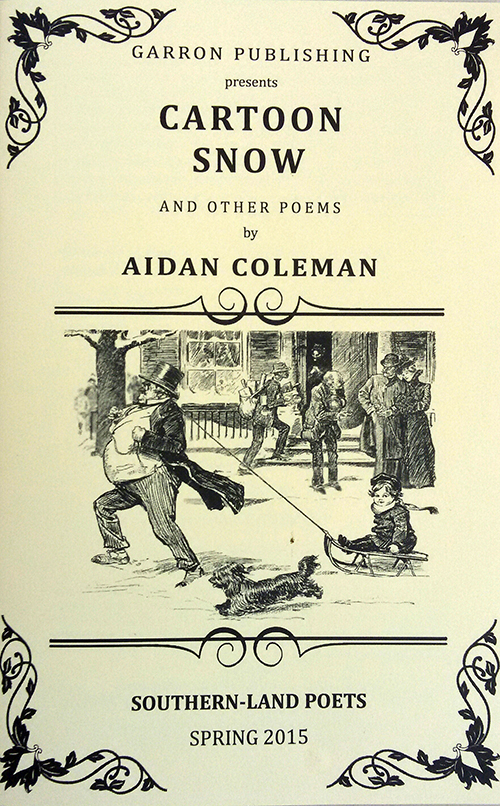
Cartoon Snow by Aidan Coleman
Garron Publishing, 2015


South Australian poet Aidan Coleman’s previous book of poetry, Asymmetry, was published in 2012. It charts Coleman’s traumatic experience of a stroke, and the resulting loss of symmetry in his body, life and writing. The book strings together revelations made startling through poetic bluntness, from the initial shock of incapacitation to the excruciation of gradual rehabilitation. However, physical damage was not Coleman’s main worry, but rather loss of language. He conveyed his anxiety in an interview: ‘a poem relies on metaphor … if you don’t get that real high … you’ll never write a poem’. Happily, these fears were alleviated with Asymmetry, which not only teems with astonishing and idiosyncratic figures of speech, but also operates as an entreaty for readers to think about illness anew.

Published three years later, Cartoon Snow demonstrates Coleman’s enduring acuity. The 17-poem chapbook is thematically lighter than Asymmetry, but it does not lack in an underlying philosophical enquiry. The cover features ‘The Spirit of The Time’, Charles Gibson’s 1910 whimsical illustration depicting a joyful child being pulled along on a sleigh by an equally joyful relative. Windows are coated with heavy snow but there is no indication of malcontent. Cartoon snow, evidently, appears different to factual snow. The sharper edges of reality are softened by the gentle pixellation of a romantic, pictorial focus rendering the subject innocuous. The cover is apt for a collection that asks questions about simulacra.

The book opens with the titular poem ‘Cartoon Snow’, where the speaker observes a freezer packed with ice that is difficult to dislodge. Coleman writes: ‘You realise the benefits of cartoon snow’, drawing the reader’s attention to the notion that literary illusion often softens the blow of existence, the freezer a signifier for life’s hardships. The poem instantiates this act of softening but also offers a reflexive vision on how these metaphors are produced. They are as ironic as they are romantic: ‘Sugar cubes of igloo bricks … / dazzling acres, you would dress for’. Such lines juxtapose a contradiction between what we know to be true, and what we wish to be true. It is unlikely you would actually have a desire to dress for the necessary realities of a very snowy day.

‘Cartoon Snow’ sets the tone for the upcoming pages, as we are pulled into a shared, tacit knowledge of how poetry works upon us. The paradox in romantic irony is at play as the poem drifts into the phantasmagoria of the ‘snowy night’ of Anglo-American poetic tradition. The drift brings to mind such antiques as Robert Frost’s ‘Stopping by Woods on a Snowy Evening’ and Emily Dickinson’s ‘Snow Flakes’, operating within a snow-globe of ethereal, exquisite phrases. The phrases engender marvel and lift us up above the mundane, yet they can also trap us in a frozen, false perception of safety. Coleman’s poem offers similar repose from the actualities beyond – such as a snowy night that is bitterly cold and painful to trudge through:

How gently it erases
fox-prints and sleigh-tracks,
the stamp of hoof

The speaker expresses dyadic desire: for poems to convey brilliant verisimilitude, but also for a heightened version of our world. We are in want of cartoon snow because such representations ease ‘the vexatious sharp edges of our pasts’. It offers a respite from relentless facts and rationalism. The speaker admits that it is tempting and pleasurable to ‘retire/once more to the puffing cottage, its windows a blazing/ marmalade’. The huskies inside are peaceful as they ‘settle for the uncluttered life’, an admission that brings the poem full circle in its contrast to the early image of the cluttered fridge. Poetic illusion is a kind of truth, Coleman seems to say, and it occupies the edges of the corporeal to ease our lives as we graze against them.

‘Sideshow’ is Coleman’s playful exploration of an Australian Christmas, in which he writes of a ‘Christmas down by the river’ where the carols are distinctly Australian, in a location that cannot achieve the illusion of a wintry and cosy European Christmas: ‘ice-cream van carols/pour into evening’. Such European notions are irrelevant in Australia’s heat and among its plethora of unique native animals. Coleman points out ‘kangaroos instead of reindeer’, and the unintended blasphemy of the nativity display where ‘an echidna, a wombat, and a platypus’ brings the baby Jesus his gifts. This deliberate hybridisation operates through comic images, but the evident delight in this feels radical. Coleman displays his uncanny wit in the last stanza, as a sudden vagary reveals his fondness for it all:

Is it the joy of their delirium
that makes it look so much like looting?
Anyway, we liked it .

Such examinations continue in ‘Barbarian Studies’, which takes the everyday scene of supervising a child and deploys it to break down the illusion of stereotypical masculinity. Here, masculinity is stripped from the male parent and comically endowed to his child. The parent imagines himself carrying out a more ‘manly’ activity elsewhere, which could be singing drunkenly like ‘a coachman circa 1840’, or in a Viking boat rowing hard. The poem surprises as it illuminates the title’s significance: when one thinks of barbarian, one usually thinks of someone who dominates through aggression. But is that not an apt description of many children loose in a playground? Certainly, they invade and conquer such areas. However, and this is the hinge on which the poem pivots, they still need their parents to propel them and assist their navigation. They may behave like Vikings, but as Coleman grudgingly remarks: ‘the Vikings … at least did their own rowing’.

The concluding poem ‘Diagram and Leaf’ is a fitting, meditative moment among the comical metaphors and metaphysical questions. It addresses more directly the longing for truth in the semblances of poetry. After the disruption of poetic liberties, Coleman reveals an admiration for the ‘willing suspension of disbelief’ – as Coleridge famously called it in 1817 – employed by readers to truly appreciate the poem’s interpretation of the world. Coleman admits to ‘tricks on paper’, but such tricks and illusions are celebrated in ‘Diagram and Leaf’. The water ‘sparkles’ – it is not grey and dull, and we arrive at who we are by asking why we value this. What lies beneath ‘obsidian and mirror’ is not how we are, but how we long to be – the world remade through our submersions in poetry. Coleman has not lost his touch for singular metaphors. As he deconstructs the role of such metaphors in this exceptional chapbook, these poems invite us to question our perceptions of reality, heightening our understanding of what we often need the world to be, even if only as ‘tricks on paper’.

Posted in BOOK REVIEWS | Tagged ,

Review Short: Melody Paloma’s In Some Ways Dingo

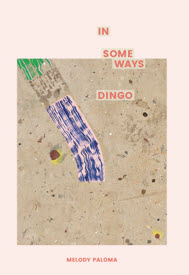
In Some Ways Dingo by Melody Paloma
Rabbit Poetry, 2017


The cover of Melody Paloma’s first poetry collection, In Some Ways Dingo, is a work by the artist Emma Finneran called ‘Into Stella.’ It’s formed from acrylic, ink and pastel on cotton drop cloth. Finneran’s work is interested in the material possibilities of drop-cloths: cloths typically instrumentalised into catching ‘the excess paint from Mum’s feature wall’ (in Finneran’s words) and to be eventually ‘rendered forgotten, formless, shapeless, degraded – to be dropped.’ Finneran’s practice reanimates and repurposes drop sheets into paintings, embellishing aleatory markings. The green and purple brush stripe near the centre of the cover art of Paloma’s book, for instance, elaborates on accidental strokes to create a marking that gestures towards a street strip, evoking the way In Some Ways Dingo drives its reader across the page. This is a poetry collection that Sian Vate suggests doubles as a ‘road movie’ (Melbourne launch speech, 2017). In any case, this cover displays discarded detritus as productive of making, meaning and abstraction. Finneran’s practice is both procedural and unruly freeform. Thick with the textures and the robust practicalities of art making, Finneran’s work mirrors as much as it frames In Some Ways Dingo.

Paloma’s poetry picks up and repurposes found phrases from youtube videos, a NSW government website ‘Wild About Whales’, pop culture refuse, and roadside waste. There’s a ‘catalogue / for the front yard of that one house on the street’. The ‘catalogue … in part includes:’

waffle maker
toilet seat
amplifier
tarpaulin
dog food
pink cot
tyre
bird of paradise
doona

(‘Small acts of self-preservation,’)

Loni Jeffs notes how, in Paloma’s book, ‘[i]nteractions with people are sparse, but the objects that they leave behind are present ‘in piles.’ Paloma’s poetry involves piling objects upon the page, usually compartmentalised with line breaks, but sometimes with commas as well, as in the case of ‘gum wrappers, receipts, packs of Panadol / and once, a stuffed crocodile,’ (‘On reality tv,’). The poems ‘Itemise lives spilled out’, an itemisation that involves naming, gathering and ordering things, even annotating specific features of interest, with a spacing that suggests a ‘notes’ column next to the items catalogued:

shell pond
shoe
baby wheelbarrow
bottle with a crook neck                          now toxic

(‘Gimme, Gimme, Gimme’)

Paloma’s use of poetic catalogue as a kind of documentation of detritus could be read through the non-fiction poetry framework of the Rabbit Poetry Journal’s Poets Series (this book is number 9). At the same time, though the poems incorporate lists within themselves, the poems are not themselves lists, or rather, in their reading, they rapidly move back and forth from being lists to being less list-like, suggesting by doing so the way narrative, description, lyric, road movie can be boiled down to an itemised catalogue for a ‘knick-knackatorium’ (‘A letter in three parts or more’).

Returning to Finneran’s drop-sheet: it is also a useful reference point for In Some Ways Dingo because of the way these poems persistently return to what falls downwards, what is buried, and what it might mean to fall into the ground, ‘swallowed by pavement’ (‘Sinkhole Poem’), ‘Edge sinks back into the / Ground’ (‘Periphery’). This book is animated by the injunction to: ‘remember all things come from the ground’ (‘Olympic Australis’).

The poem ‘Special Values and Characteristics’ reads, in part:

Significant geomorphical interest; with attributes not yet fully identified but
which may include important fossil or sub-surface features.

Specialised habitat for plants and animals.

A geological resource that may have mining potential.

These lines, along with the title of the poem ‘Special Values and Characteristics,’ are taken entire from the Lake Gairdner National Park Management Plan from the Adelaide Department for Environmental Language and Heritage (2004). The only alteration is the excision of bullet points. Repurposing the language of the state, forcing us to read a government document as poetry, Paloma’s poem displays, with the arresting force of an open -cut mine, the way culture, environment, country becomes reduced into points of profit potential. The poem does not end with the words of the state: rather, set apart from the rest of the poem in italics, the repurposed material potentially functions as a page-long epigraph to a poem that registers a space ‘where the ground closes in’.

Paloma’s powerful use of ‘Remaindered, devalued goods’ as fodder for ecological and political poetry could be situated within the avant-garde aesthetic category of the ‘stale’. In a review in Cordite Poetry Review of Emily Stewart’s recent book, Knocks. Paloma describes Stewart as part of a ‘new wave of avant-garde poetry in Australia’ but that Stewart’s poetic processes simultaneously resist being boxed into a singular movement or community. Just like Stewart’s work, Paloma’s work can also be cited as part of a ‘new wave’ of Australian poetry and resists easy categorisation. I’m also thinking here of Paloma’s gripping experimental performance at her Sydney launch of the long closing poem of the collection ‘Gimme Gimme Gimme,’ where she squatted, jumped, crunched and ran her way through the poem. I think here also of her durational performance piece hosted by SOd, ‘Some Days’ taking place over the course of this year, a long poem which is written or edited every day of 2018. At the time of this review’s writing it is divided into monthly segments, each radically different from the last. But this of course is entirely subject to change. In Some Ways Dingo embraces lexical shifts on the level of the line, through the poem, across the page, between poems. Language tugs in multiple directions, across different spaces/places, moving beyond, through, away and deep beneath.

Posted in BOOK REVIEWS | Tagged ,

Dashiell Moore Reviews Lionel Fogarty

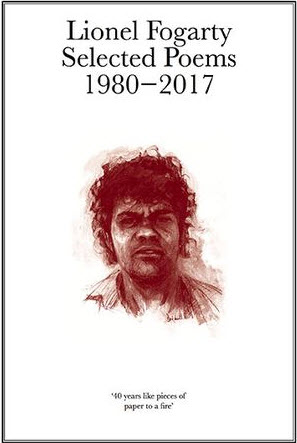
Lionel Fogarty Selected Poems 1980-2017
Philip Morrissey and Tyne Daile Sumner, eds
re.press Publishing, 2017


To begin this review, I would like to make the most important of declarations and acknowledge the Gadigal people of the Eora Nation as the traditional owners of the land on which this review was written; and would like to thank Narungga scholar, writer and poet Natalie Harkin for having assisted in the editorial process. I would also like to acknowledge and pay respects to Lionel Fogarty, the Yoogum language group from South Brisbane, and the Kidjela people of North Queensland, whose inestimable linguistic, cultural and spiritual legacy is clear in Lionel Fogarty Selected Poems 1980-2017.

The publication of this collection marks a retrospective moment for the Australian literary landscape. Lionel Fogarty, born in South Burnett in Southern Queensland, is a poet praised by John Kinsella as ‘the greatest living “Australian” poet’ (2013, 190). The controversial writer, Colin Johnston, also described Fogarty in 1990 as ‘Australia’s strongest poet of Aboriginality’ (26). (Colin Johnston is also known by the name of Mudrooroo, or Mudrooroo Narogin, an act that is seen by many as a misappropriation of the Nyoongar language.) I mention Johnston’s voice above many more fitting critics in this review to juxtapose Johnston’s and Fogarty’s fortunes in the last two decades as somewhat of a tragicomic mirror of the Australian literary landscape and our need to seek out an ‘authentic’ indigenous Australian voice. I write in heed of the deeply tenuous position Johnston occupies in Australian literature as explored by Anita Heiss in her book, Dhuuluu-Yala: To Talk Straight (2003). Heiss posits that from the time of Johnson publishing of Writing from the Fringe: A Study of Modern Aboriginal Literature in the early 1990s, ‘he was regarded as the authority on Aboriginal writing, and anything associated with it’ (4). When Johnston’s authority to speak on Indigenous Australian issues came under question in the years to come, the fallout regarding his lack of consultation and misappropriation caused an indelible impression upon our conception of indigeneity. Such debates over identity politics and cultural authenticity have changed how we read the work of Indigenous Australian writers – creating an obsessively objective distance that misleads us from the real conditions of writing, as well as obscuring the literary production of unabashedly indigenous voices. I would argue that this is certainly the case with regards to Lionel Fogarty, one of the most unrewarded and unrecognised figures in Australian and World Literature.

In Fogarty’s poem, ‘Finalist Unnamed’, a previously unpublished work included in this collection, he writes satirically of his omission from the ‘honour-roll’ of literary prizes: ‘My name is now the finalists unnamed? Ha’. The irony in these lines speaks to Fogarty’s imagined opposition to white Australian society, as well as his management of the distance between himself as an Indigenous Australian activist from the literary community. These seeming tensions reflect many of the frailties of the Australian literary landscape; the inability for indigeneity to be properly conceived of and read adequately in mainstream literary landscapes and markets, the literary-suicide of labelling oneself an ‘activist and poet’ to a wider Australian readership, and further, a lack of proper close engagement with Fogarty’s poems themselves. This review intends to grapple with these incongruities and signal, perhaps ambitiously, a trail that leads in to Fogarty’s nebulous, and yet, capacious collection.

The editors, Philip Morrissey and Tyne Daile Sumner, have collated both published and previously unpublished poems. The latter have been edited and published with close involvement from Fogarty himself. In this manner, Fogarty’s involvement as a co-editor and poet answers Peter Minter’s call for ‘a renewed ethical and aesthetic architecture’ (2013, 157). The poems are ordered in distinct periods where Fogarty was said to be particularly prolific: 1980-1995, 2004-2012 and 2013-2017. While this periodisation of Fogarty’s works may run the risk of emphasising perpetually relevant concepts (such as deaths of Indigenous Australians while in police custody or political representation) within discrete periods of production (many of the themes, phrasings and poetic rhythms are returned to, after decades), this structure offers a chance of seeing Fogarty’s images and turns-of-phrase evolve. This is particularly true of the 1980-1995 poems, a period described as a ‘high point’ for Fogarty while working alongside one-time partner, co-editor and publisher, Cheryl Buchanan, of the Kooma Nation in South Queensland. Buchanan’s work as an editor and publisher is significant for this section. A leader in her own right, Buchanan almost single-handedly published Fogarty’s first volume of poetry, Kargun, in 1980, stating in the official launch of the Yoogum Yoogum collection in 1982, that no publisher wanted to touch such ‘heavy political material’ (n.p.). It was her belief in Fogarty’s revolutionary style of writing as speaking rather than writing that moulded these poems, laying the foundation for his future work. In the foreword to the Nguti collection published two years later (1984), Buchanan would state: ‘Lionel regards himself as “a speaker, not a writer”, and does not like to be categorised as a “poet”’ (n.p). This sense of frustration against the identity of a ‘writer’ pervades Fogarty’s earlier poems. That is not to say that Fogarty’s poems can be read as discrete, singular entities. For instance, the demands of activism that pervade his earlier work transform into renewed decolonial thinking in the areas of education, Trans-indigenous solidarity and the historicising of Indigenous Australian activism. In this way, Fogarty performs a metaphorical encircling of his own position, what the Martinican theorist Edouard Glissant described as a reconstituted echo or a spiral retelling’ (1997, 16) regarding his own returns to earlier works. Morrissey himself notes that in revising each of the poems into English for publication, ‘the selection process has been complicated by Fogarty’s habit of revising and recycling sections of poems’ (Morrissey 19). As readers, then, we are privy to the forming up of Fogarty’s oeuvre in real-time. Such a re-processing, a spiral retelling of language-events, makes this collection of poems doubly worthwhile.

A reader might perceive, for instance, that the metaphorical implication of ‘death’ in the early poems – for instance in ‘Do Yourself a Favour, Educate Your Mind’ – differs greatly to the later poem, ‘Signing My Death Lionel and Hell’ (another example might be his variance in using the word ‘academic’ as the collection draws on.) In the former, ‘death’ acts as a metaphorical removal of Anglicised Australian identity imposed upon Fogarty in his being brought up in Cherbourg Mission: ‘(I) wrote my death in/George the Third’. In the latter, Fogarty imagines himself as a dying lion, Lionel literally translated to ‘Lion and Hell’ in order to convey his cyclical rebirth in the natural world, dying as a physically embodied writer, but eternalising himself through the potentially infinite re-readings of his works:

With my thousand words the dead woods are white dreams. 
Whistle the dead calls at morning night and depart away my spirit. 
Starless days are able to shine death, as rouse is use for me to die 
[…]
Listen it’s time for me as a writer to die.

Another way of perceiving the poems in the structure the editors have placed them is by transposing Fogarty’s poems alongside the political events that helped to shape them. For example, often the themes and motifs of his poems are direct references to news articles and current events, as a metaphorical (and at times literal) pastiche of contemporaneous jargon. This is evocatively evident in the composition of the unpublished poem, ‘Academic Great Boundaries’, which reflects on the water policy in the Murray Darling Basin and the dams that stop the water flow. In the poem itself, Fogarty metaphorically conjures up a dam wall through juxtaposing a self-authorising scientific vernacular divorced from feeling with his own intuitive writing:

Governments and nunnery highlands lie
49,000 bores lowering the table pastoral
Non-flowing rate of 3% per annum.

In contrast, Fogarty alludes to the lack of benefits locals receive from the dam itself, remembering the incongruity of earlier colonial excavation of the land that eliminated native Australian flora and fauna. He questions the reader:

Are departmental shrubs destroying the remade reports?
Is every central country plain without pains?
Eliminate all inappropriate species
The fallacy of the first dugouts
Sunk in marbled stone.

It is also worth recounting the poet’s formative experiences, as they are at times presented, disfigured, in Fogarty’s poetry. For example, it is impossible to read his works without knowing of his politics. After growing up in Cherbourg Mission and becoming involved with the Brisbane Chapter of the Australian Black Panther Party, Fogarty was charged and arrested for demanding money with menaces and was detained in an adult prison while still legally a juvenile. Despite being acquitted for a lack of evidence, the experience remained with Fogarty and was recorded in a provocative account of his arrest in the poem entitled, ‘Related: Charged’:

Welcome here, you son of a cunt, 
   This pig said to me. 
Sign your death warrant, you son of a fucken moll. 
Next
   released on bail

The crucially formative event of Fogarty’s adult activist life was the tragic death of his brother, Daniel Alfred Yock, a talented painter and dancer murdered under police custody in Redfern. This prompted some of Fogarty’s finest elegiac works, as well as some of his more charged political statements. Side by side, the 1995 poems ‘For Him I Died – Bupu Ngunda I love’ and ‘Murra Murra Gulandanilli- Waterhen’ can be read as a most profound expression of grief.

Posted in BOOK REVIEWS | Tagged , , , , , , ,