Olympic Bingo

God is always twenty-five
and I am still alive—
I didn’t die in the taxi,
or in the apartment,
or at the beach that night
where my hunger tore me
out on a silent black rip
to sink like a wasted plum
swallowed by Leviathan.
Between this and a thousand
fires left burning, living
is Olympic bingo.

There are suicide nets
in the shopping centre.

A woman who works
at a sandwich counter
in the basement food court
said she can’t forget the sound
of a human body smashing

into the ground.
The coordinates of impact
are printed on the back
of her tongue, nerve endings

bound to vertebrae that
come when she grinds
into the shape of a cathedral

under brutalist concrete
frescoes. On evenings


that I do not die
I make prayer—skincare

routine, seven steps—a
learned fastidiousness
in atonement for so much
annihilation. They say
hair salons and beauty
stores 
are recession-proof;
another Mecca has opened

in the mall. At the altar

I kiss the feet of God’s

memory, light candles
to her Beast. In nightly

benedictions I burn

the temple down—

orange heat in bloom
between me and the mirror

and God’s unlined face.

Posted in 96: NO THEME IX | Tagged

They say this world …

They say this world is full of life, life, life …

But what I see is mostly slime, slime, slime …

Forests of voiceless and obedient women, men …

They’ll make a noise but leave into the cold night’s neon.

The only hero still seated in the hall, where

So many hands were raised and voices rang true,

Is a lifeless corpse: he continues to stare
a
t the state of affairs, disgusted at the view.


Hence the sort of smile that’s only found
on a dead face, underneath cold eyes,

as the head slowly, slowly wraps around
what’s known about us already – no surprise.

Posted in 96: NO THEME IX | Tagged

Duck Poems

1. Buoyancy

Ducks have, in water, a feeling that they are
Not quite all there. That’s why they keep looking down
To see if their nether parts are still of the same
Feather, that they’re still together.
I too, sometimes
Catch myself looking down to see if my feet
Are still on earth.
And so when I look up
I return where I belong, after long separation.

Posted in 96: NO THEME IX | Tagged

Vanishing

In memory of my Father …

For too long I have been a member of a vanishing tribe … We start using terms like; ‘going, going, gone …’ in our black and white mists; the shades and shards of grey … Shadow-companies of our races … When does it come to the staging ground when we’re comfortable in recognising our own ghosts? Stare into that spectral mirror … Should I be worrying about the size of the frame without caring about the horror in the view? When maybe for too long I’ve been a card-carrying member, of a vanishing people …

Posted in 96: NO THEME IX | Tagged

Surveying What Adheres

What was your status as of Monday?
Low on cling film. Fine for surface spray.

Name one highlight of your current job.
Midway on my journey to the Tube

the sticky men come tumbling down the glass
of the High Commission, a few yards

north of the Dominion. Hurled, they thwack
the tint, as though each wodge of gunk

were phlegm hoiked up from
underground, so thick it sprouted limbs.

The sticky men?
The toys I mean.

Those moulded figurines of polymer
and mucilage slash tackifier

that wobble down to earth like a mirage.
The de facto mascots of our plastic age.

And you learned what from your sticky man phase?
Perhaps the smear of north Atlantic ooze,

the veiny blob of albumen
that Huxley once mistakenly proclaimed

the missing link
appeared to him like this:

expectorated sputum, anthropoid,
squished against the window of a slide.

Is there anything else you wish to add?
The finest nanotech adhesive yet

aspires to the tread
of gecko feet.

Posted in 96: NO THEME IX | Tagged

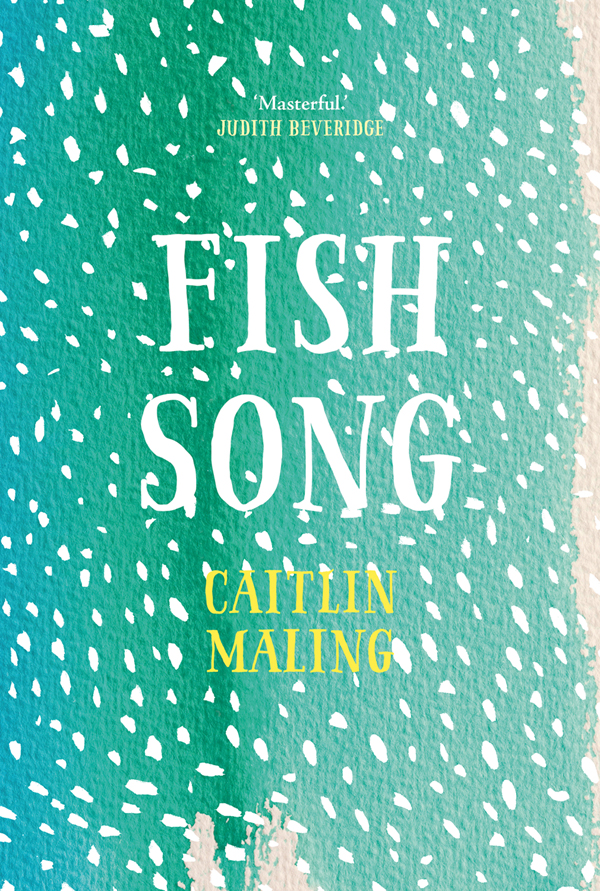
Connor Weightman Reviews Gregory Kan’s Under Glass and Caitlin Maling’s Fish Song

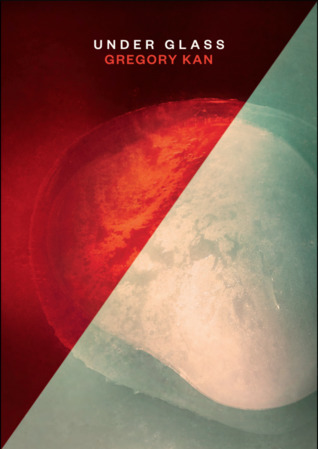
Under Glass by Gregory Kan
Auckland University Press, 2019

Fish Song by Caitlin Maling
Fremantle Press, 2019


Under Glass is the second book of poetry by New Zealand author Gregory Kan. Blurbed as a ‘dialogue between a series of prose poems … and a series of verse poems’, a reader might also happily call it a long poem or a verse novel. The poetic fragments that span its 65 pages are untitled, two voices of a conversation that is separated visually by style and formatting: single stanza, double-spaced verse poetry, and (mostly) two stanza (or paragraph) prose poetry. Both styles are unified by sparseness and brevity, with much of every page accounted for by blank space. The two poetic threads describe ostensibly separate journeys. The verse fragments are all interiors, the speaker’s process of trying ‘to make sense of things’, while the prose fragments appear to describe a more physical journey through a landscape with physical parameters such as natural landmarks and a lighthouse, and always return to the motif of a ‘second sun’. Though they alternate, I couldn’t determine how the two voices are responding to each other — whether what happens in one section has any bearing on the other, or whether perhaps the verse fragments are meant to be the thought processes accompanying the exterior journey of the prose.

What I feel more certain about is that my suggested definitions – that one thread is interior, one an actual journey – are misleading. The physical journey through space described by the prose poems is shorn of names and specifics, and with descriptive landscape elements seeming increasingly more fantastical, the journey begins to seem more like a hallucination, or a dream, a story, a parable. Meanwhile, the verse fragments refer to a plural ‘us’ and an othered ‘you’ that arc from an intimacy to conflict and back to a togetherness, suggestive of a reflection or a shadow of events that might be construed as more ‘real’. The lines between physical and cerebral, actual and imagined events, become indeterminable.

Under Glass maintains a commitment to ambiguity that might be described as both central concern and style. ‘Help me understand you without the need for names’, an early verse fragment implores, and indeed this is a poetry that self-consciously takes place entirely in an abstract imaginary. The speaker remains suspicious of their own intentions, or perhaps their ability to express events accurately through language:

I want to seem to you
the very same thing that I seem to myself
and I want to seem to myself
the very same thing
that I am
but nothing is honest enough
walking around and around a thing
I do not know, and cannot touch.

Befitting the title, Under Glass becomes a prism of responses, a mode of trying to see via reflections and refractions of things that happen entirely off the page. In some ways, this makes it an interesting investigation of language as bound to relationality – how do we go about expressing something without also upholding the (various, problematic) power structures that language perpetuates? Simultaneously, these passages tell of intimacy and conflict and can be read as the arc of a literal relationship between the speaker and their subject; describing problems and closeness between two people that, shorn of specifics, feels both very true to life and bordering on the absurd.

However, Kan’s fragments are also characterised by interjections of strong feelings that invoke death and destruction, such as: ‘We have been so tired and ashamed / that the past could kill us’, or ‘I know some questions can destroy us / if we are denied the answers long enough’, and ‘Some days it feels like you might kill me / for what you think the world owes you’. This emotiveness seems to put us in an awkward position as reader because it is difficult to relate to the strength of the reactions alone, cut off from any real sense of the events that they’re responding to, or what they mean in isolation. I’ll also admit feeling a sense of unease at Kan’s linking of violent language to (what can be interpreted as) a relationship with another and/or with one’s self. Given the thematic concerns of ambiguity and interpretation, the way extremity of feeling is expressed through these images (in a way that is, I think, meant to act as a counterpoint to the otherwise pervading tone of circuitous neutrality) strikes me as an odd contrast.

In lieu of more narrative specifics, Under Glass is dominated by the recurring motif of the ‘second sun’. It appears each time with different characteristics: after ‘eating its / way out from inside me’, it’s ‘hiding in the submerged roots of a nearby tree’, something that is swallowed, fallen into, a ‘house made of many doors’, ‘falling through me’, ‘the immovable neck of the world’, ‘a dark seed in my palm with my fingers closed over it’. I’ve struggled to make sense of this referent’s shifting nature — to the point of bemusement, but also irritation. Is it a puzzle I’m meant to solve? Is there something obvious that I’m missing? Its elusiveness combined with its prominence in the text arguably reads as trite, or forced, a refrain that seems important without providing any sense of its material bearing. Suns are, as a rule, visually oblique, difficult to look at, a point of infinite, outwards generation. But it’s too big a metaphor, too vague for all the uses it seems to have in the poem.

Still, perhaps my frustration at not knowing is part of the point. In the book’s notes, Kan attributes the motif of the second sun to Clark Coolidge’s The Crystal Text (1986). Coolidge’s book is also a long poem, and is also, I think, largely about the act of writing, or more particularly about the (im)permeability of modes of communication. In it, the crystal is a recurring metaphor that describes the work of the author, or perhaps also the form a text takes on for a reader. The shiny glass or crystal layer suggests a fractured transparency that shows (or reflects) something of the outside world, has some relation to a truth, to events, but in the process of recording is permanently separated from it. And I quite like this for a reading of Under Glass, if we follow Coolidge’s metaphor as a cue for Kan’s title. That the author persona is stuck inside their text, making a commentary upon it, but unable to relate it to anything named outside the text, able to talk only in metaphors and vagaries both about their text-making process and about the events that inform the making of the text:

I thought that the things I loved
were places I could always go back to
but the spaces between things become places themselves
and threaten to swallow me whole.

The second sun falls apart as the speaker continues to describe it. It seems to frustrate Kan’s speaker even as they continue to return to it and as it fails to be fully useful; a broken signifier, a metaphor that doesn’t work. The speaker dismantles it both in action (in the poem) and in practice. But at the conclusion of the text, they continue to walk into it (where they remain, because they have always been both inside and outside the image), suggesting a final, amiable acceptance of something imperfect that the author has no real power to dismantle. The thingness of what is being said cannot be gotten any closer to, only circled around in an (un)easy equilibrium.

Posted in BOOK REVIEWS | Tagged , ,

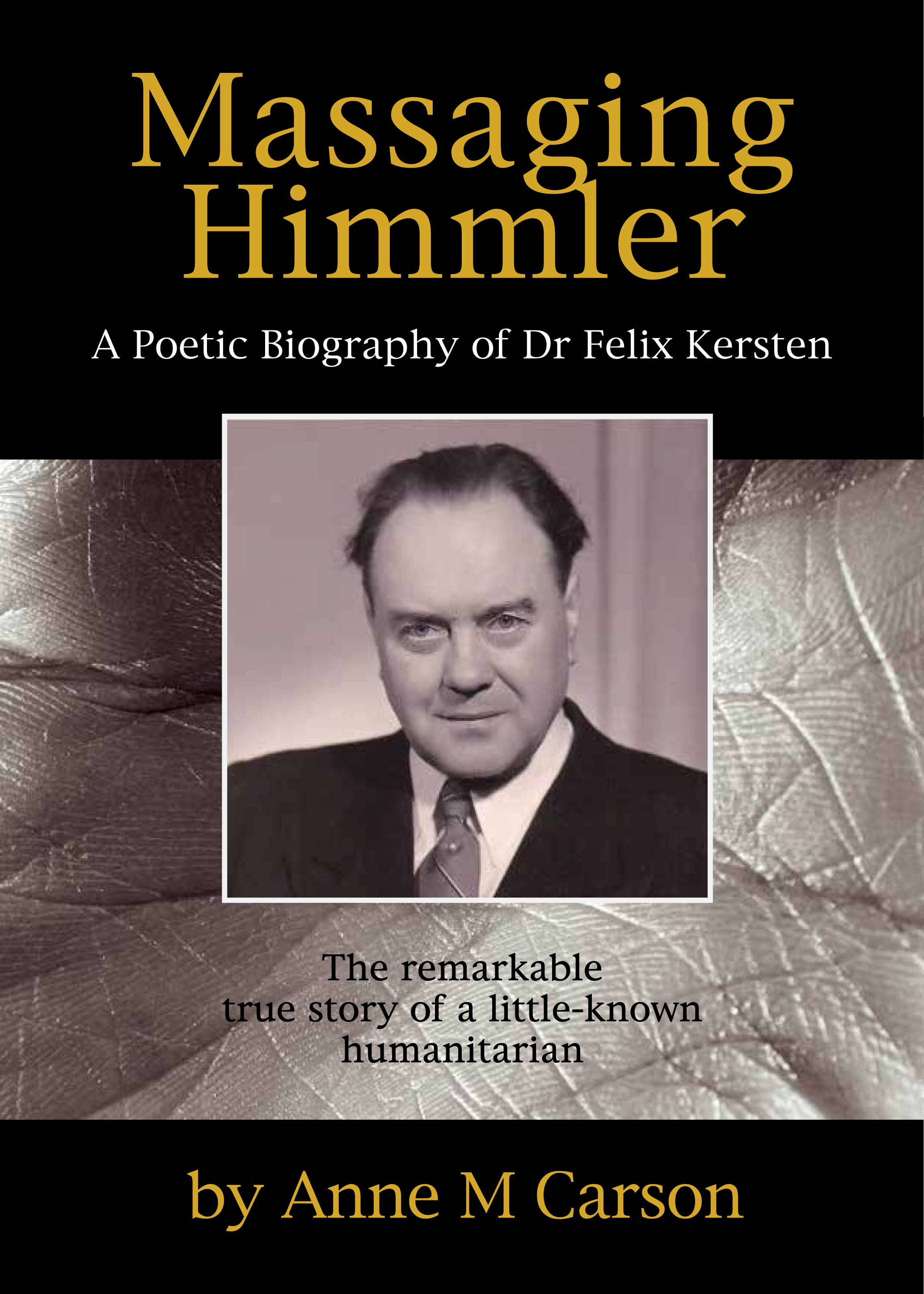
Annelise Roberts Reviews Anne M Carson’s Massaging Himmler: A Poetic Biography of Dr Felix Kersten

Massaging Himmler: A Poetic Biography of Dr Felix Kersten by Anne M Carson
Hybrid Publishers, 2019

‘The world today is a sick world,’ wrote Estonian-born Dr Felix Kersten in 1947, ‘and it was made so by a group of sick men.’ Dr Kersten knew about the diagnosis and treatment of sickness – he was a healer, a physiotherapist and masseuse. Practitioner of a style of ‘deep, neural massage,’ Kersten was educated in ancient Tibetan and Chinese lineages of medicine and his healing powers were highly sought after by the social elite of interwar Europe; clients responded to the exceptional sensitivity of his hands, ‘able to detect / the smallest movement of muscle, nerve.’ An appointment as Physician to the Dutch Queen secured Kersten’s reputation and ensured a steady demand for his services, but he consented to treat only those patients who he deemed capable of total cure. For migraine-wracked insomniacs, for bent bodies with wrangled nerves and twisted guts, Kersten delivered his rigorous and painful therapy. The frequent result was great relief, if not complete cure.

In 1933, one of Kersten’s ‘sick men’ was appointed Chancellor of Germany. Heinrich Himmler, Hitler’s second-in-command and head of the Nazi SS paramilitary unit, was another: a ‘weedy’ man with a ‘narrow chest’ and a ‘weak chin’, Himmler suffered from debilitatingly painful stomach cramps that at times left him prostrate and writhing in pain. An old patient of Kersten (an industrialist desperate to halt the Nazi nationalisation of industry) hatches a plan to open up a covert channel of influence within the Nazi party – Kersten is persuaded to take on Himmler as a client. In 1939, Kersten found himself deep within the National Socialist Headquarters in the ‘hushed’ and ‘anodyne’ atmosphere of Himmler’s rooms, at the commencement of several long years of an appointment as Himmler’s personal physician. Dr Kersten disguised an ulterior agenda throughout the course of the entire therapeutic relationship, using his position to secure pardons for political prisoners, labour camp inmates, Jehovah’s Witnesses and others, and ultimately negotiating the release of tens of thousands of Jewish people from concentration camps.

Melbourne poet Anne M Carson’s ‘poetic biography’ of Dr Kersten, Massaging Himmler (Hybrid Publishers, 2019), imagines this first treatment session from Kersten’s perspective:

He writhes, begs for release. A man like any man
tormented. Pinched is too small a word for the mess

his nerves are in. No energy can pass through that ganglia
of knots and burls. As my fingers bite into him he

moans. Hard work for me, agony for him, but gradually 
torque improves, his writhing stops and something

approaching peace softens his face …

In Massaging Himmler, the ‘hard work’ of physical therapy becomes an allegory for the ‘agony’ of political change. Carson explains in an author’s note how she discovered Kersten’s story by chance and immediately recognised the historical significance and poetic potential of the story: ‘It was an Oscar Schindler-like story,’ she writes, ‘but Schindler had been responsible for the release of 1,100 prisoners – the numbers attributed to Kersten are as high as 600,000. Why don’t we know about him?’ Over more than 200 poems organised into six chapters, Massaging Himmler explores the tantalising ethical, political and poetic possibilities that Kersten’s story evokes.

The tale refigures remedial intimacy as a kind of diplomacy, the therapeutic relationship as a site of acute political intervention against genocidal intent: it’s challenging material for contemporary political sensibilities that feel urgently called to action, confrontation and revolution. In spite of the profoundly impactful results of his actions, Dr Kersten himself is not a poster-boy for any coherent political movement, and perhaps this is the answer to Carson’s question about his absent reputation. Not exactly a committed Buddhist (‘far too in der Welt for that’), Kersten is absorbed by his aspirational epicurean tastes (‘the soul / of a nobleman … trapped in the body of a burgher’), and with ‘apolitical blinkers’ firmly affixed he dines exquisitely with Mussolini (a dinner at which, he proclaims, the ‘fineness of the meat almost finishes me’) even while he schemes with representatives of Swedish, Finnish and American causes. This from the poem ‘Felix talks about his philosophy’:

There is little point in worrying
about what you cannot control – 

that has long been my view;
it suits my temperament.

And about Hitler, Kersten says:

I do not like the man

but there is nothing I can do
one way or the other. It will pass,

I tell them. We need to focus
on work, our loved ones, that which

brings us pleasure, and be willing
to lend a helping hand. All the rest,

I say, will be blown far away by 
the always-reliable winds of history.

The complexity of Kersten’s position – a powerful agent of anti-Nazism, and a nonpartisan aesthete who submits to the ‘welcome bite of raspberry’ that ‘cut[s] the cream’ – provides Carson with rich material for a challenging character study.

Massaging Himmler is an unusual addition to the already diverse and busy field of holocaust literature, joining works such as Art Spiegelman’s graphic novel Maus (the first volume of which was published in 1986) and, more recently, Bram Presser’s The Book of Dirt (2017). Carson continues the compelling and important work of this field, as events in the changing global political environment continually refresh the relevance of the questions raised by the Holocaust – the ‘battle between good and evil is perennial,’ she writes in her author’s note, ‘and we have much to learn from individuals who are courageous enough to … use whatever power they have to help others.’ Although many of these works use the literary imagination to revivify what was inexpressible about the Holocaust experience, Massaging Himmler stands out in this field for its hybrid status as both biography and poetry.

Posted in BOOK REVIEWS | Tagged ,

When Poets Write Prose: Daniela Brozek Cordier Reviews Recent Collections by Joanne Burns, Stephanie Green and Jane Williams

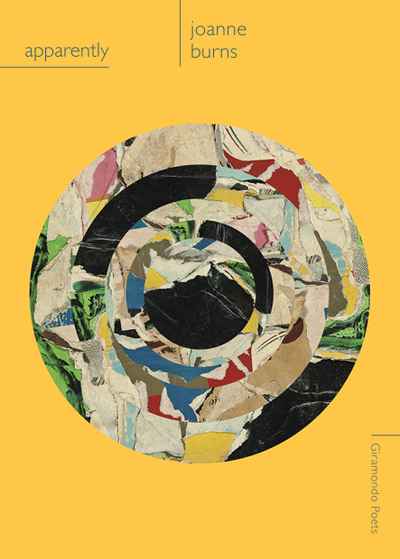
apparently by Joanne Burns
Giramondo Poets, 2019

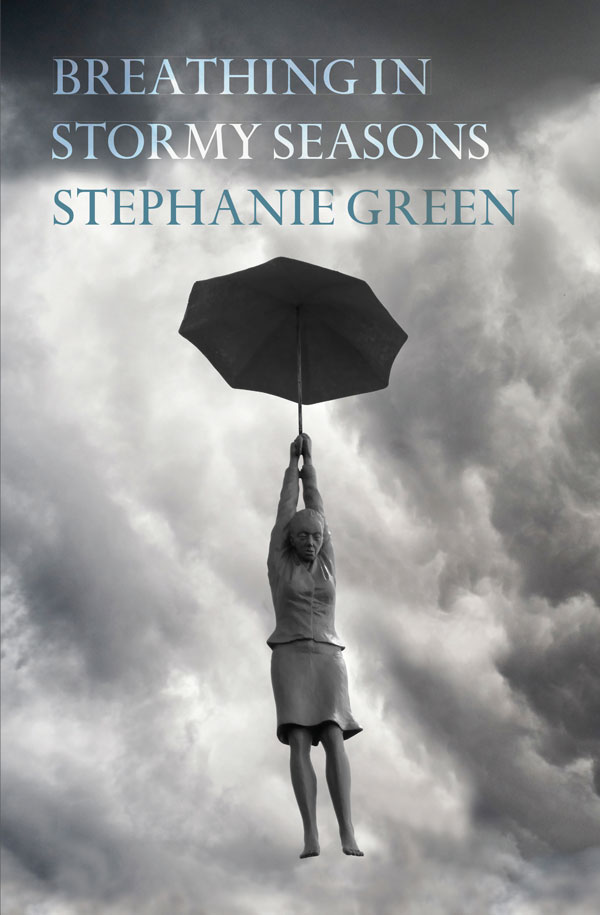
Breathing in Stormy Seasons by Stephanie Green
Recent Works Press, 2019

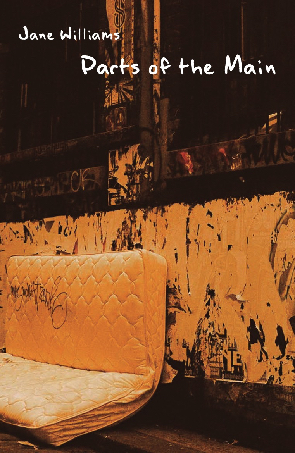
Parts of the Main by Jane Williams
Ginninderra Press, 2017


This is a review of three collections of poetry by women, two published in 2019, and one, Jane Williams’s Parts of the Main, in 2017. Of the two more recent volumes, Stephanie Green consistently uses prose in Breathing in Stormy Seasons, whereas Joanne Burns writes in prose in only one section of her collection, that which bestows its title, apparently, on the collection. Williams uses prose occasionally too, with her volume including three sections with prose works in each of them.

Burns refers to her prose texts as ‘prose poems or microfictions’ – I prefer the latter, because it allows us to circumvent the hazards of falling into a discussion about whether such works are poetry or not. Since many people seem to regard ‘prose poetry’ as an oxymoronic expression, it renders the expression rather ineffective. But the form isn’t so easy to differentiate from ‘other’, or ‘conventional’ poetry; which is generally the lyrical style of the poetry that dominated English writing during the nineteenth century, when many of the canonical collections still influencing our ideas today were assembled.

Prose poetry/microfiction uses many of the devices that lyrical poetry does; for example, it may use figures of speech or metaphor, or evoke sensory or emotional impressions with the sounds of words – assonance, alliteration rhyme or rhythm. The form’s key variation from more traditional styles of poetry is that it tends to foreground narrative or story over emotional or sensory impressions, or ‘feeling’ (which is otherwise well conveyed by the ‘non-wordy’ aspects of lyrical poetry – its sounds or rhythms). Where sensory perception is conveyed, visual perception is usually prioritised, which is what enables those writing in the prose form to dispense with lyrical poetry’s prosodic structures. Emotional and non-visual sensory impressions are thus demoted in favour of the storytelling or narrative aspects of the text. Perhaps it is the emphasis on visual perception, however, that makes this style of writing ‘poetry’ – its stories are told, or its narratives conveyed, at least in some significant part, through sensory perception rather than reasoned thought or ‘ideas’.

The foregrounding of narrative is very much in evidence in Burns’s microfictions. In the ‘apparently’ section of her collection she ‘recounts unsettling dreams’, and the texts certainly read that way. They have the visual quality of dreaming, moving from one scene or event to another in ways that may be unrelated, but which the mind strings together seamlessly – the reader’s imagination finds relationships, and in so doing, makes its own narrative. Here is an example, from ‘evaluation sheet’:

i dropped into the sanctuary of asclepius purely to sleep, investigate my future. i entered the long hall of the enkoimeterion and lay down waiting for morpheus to download. in the dream I was offered a plate of what looked like boars’ eyes smelling like leatherwood honey, and balls of cotton wool that cackled then buzzed like bees.

This extract has a strong visual component that encourages readers to construct a ‘world’ in which the other parts then take their places. This allows meanings to emerge as part of an enveloping narrative. But, apart from its visual aspects, the work invokes other senses – smell and sound, as well as the heavy pull of sleep. It offers insights into the strange workings of the human mind, as mini-battles play out between its different parts – the deep mind that wants to sleep, and the buzzing active surface parts that run their own programs.

Such works may be entertaining and offer psychological insights, however, I find that they don’t take me far beyond an initial ‘oh, that’s interesting’ reaction. Burns’s microfictions read as a dream journal, and I think that this is where the significance of her collection lies – as psychological case studies. The other sections include: ‘planchettes’, which ‘spring-board from the clues and solutions to crossword puzzles’, ‘dial’, that ‘acknowledges the bewildering sense of daily time and the dizzying spectacle of social and worldly matters’ and, finally, ‘the random couch’, which ‘presents a number of drifting poems, written while the poet was lounging on the sofa’. These sections trace the workings of the human mind in similar ways to the ‘apparently’ section. In so doing, they may offer a launching place for others to try following their own dreams and musings, and to learn about themselves and the way human minds work. This is of value; Burns’s work has been used effectively in schools to encourage students to write, to trace their own thoughts, and in doing so, to work on the important task of making sense of their own lives through the power of narrative.

Stephanie Green does not call her works microfiction, but writes that she ‘would like to call them “moments of poetry”’. This is insightful, for her description helps bridge the divide between poetry and the ‘poeticness’ of much prose. I have written already that I think poetry emerges when we attempt to express the less concrete, irrational or excessive parts of our experiences as humans, especially those that we sense and feel, rather than those we ‘think out’ in ways that we can express through more disciplined, grammatically logical or rational uses of conventional language (language of words, rather than of, say, visual expression, music or other aural utterances, or performance). Thus I think that we tend to call writing poetic when it has an ineffable quality, when it makes a direct appeal to our senses or emotions, but expresses that which we struggle to explain logically. This is particularly in evidence in lyrical poetry, but Green’s prose texts can be like this too. Her works often have a drifting, haiku-like quality.

Green writes that her approach is informed by an interest in the ‘confrontation between the shock of materiality and the sensitivity of imaginative apprehension’. She is forthright about this in the text called ‘Scar’, within which she probes the disjunct between what we can see or openly communicate between one another, and what we feel, and is significant, but is hidden and difficult to share:

There is an invisible claw against my face that never lets me go … Every day it reminds me skin is testimony … My skin may not record where your hand glides … But this thin cloak for blood and sinew shows how it is torn: a pane of falling glass, a surgeon’s knife. … Whatever else, I am knitted together by its claims.

Because they probe the indeterminate and contradictory, Green’s works can sometimes resemble Burns’s dream-fictions, reflecting the ‘boundless resistance’ of the world as we experience it; or how it doesn’t always make sense. In ‘The Catch’, she writes:

At first they seem nothing more than a small cloud of dust propelled out of dawn, passing over the cliffs and out beyond the purple cove. Closer now they are some kind of wave, animated angles rising and falling … I am breathless, surrounded amidst a fury of great wings trapping and sweeping the air … as the air falls away, as the ocean rises … I fall helpless towards the depths…

In such writing, Green questions the notion that narrative is a central feature of prose poetry. If her works contain stories, these often seem surreal or not quite cogent. If readers are looking for narrative, they will require introspection, as well as active questioning of the text, in order to force that narrative to the light.

Meaning can be elusive in Green’s work, but I found the glimpses of the world that she offers stimulating, and often deeply moving. For example, ‘Pre-Memory, Papua’ made me think about my own earliest memories, which I believe I now lack the ability to fully access due to having lost the Czech language I knew in my early childhood. Green masterfully depicts the excessiveness of such ‘pre-verbal’ experiences and the difficulties we may have in integrating those into our sense of self if we lack the languages necessary for this.

Posted in BOOK REVIEWS | Tagged , , ,

Submission to Cordite 97: PROPAGANDA

Is there a more loaded word than PROPAGANDA? It’s the tool of choice for authoritarians everywhere, an opiate for the masses, filled with manipulation, misrepresentation and outright lies with half an eye to creating convenient divisions and discord. The etymology of the word, though, is something more neutral: a modern twist on Latin that indicates material intended to be published or propagated. Information can be propagated to divide or to unite. It doesn’t have to lie, it doesn’t even have to frame the truth. Is there still time to reclaim the word back from the vile place in which it has found itself? Maybe not. But it shouldn’t stop us from continuing to create, communicate and persuade. The clock ticks.


Submit poems (prose, comics, visual, concrete) or works of micro-fiction (500 words maximum). Read more about submitting to Cordite Poetry Review. Please note:

1. We will only read submissions sent during our official submission periods.

2. Cordite maintains a hybrid submissions policy. This means that the guest editor may invite five (5) Australian and five (5) overseas authors directly to submit to the issue. In addition, the guest-editor will anonymously select an additional 30-35 works from Australian authors and use their discretion to select further overseas works. For each issue, the guest editor does not know the identities of the online contributors (via Submittable) until after the final selections have been made.

3. Simultaneous submissions or previously published material will not be considered. This includes works published in print and web journals but does not apply to material first published on personal blogs.

4. Please place up to three (3) poems in one (1) Word, RTF or PDF document (unless specifically noted otherwise for special issues), with no identifying details in the document itself.

5. We are not able to offer feedback on individual poems.

6. Submissions will only be accepted via Submittable …

submit


Posted in GUNCOTTON | Tagged , ,

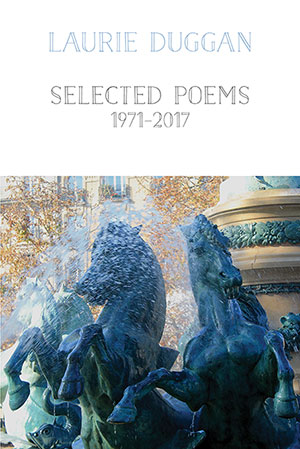
Dan Disney Reviews Laurie Duggan’s Selected Poems 1971–2017


Selected Poems 1971–2017 by Laurie Duggan
Shearsman Books, 2018


Laurie Duggan has long been a star within the light-filled firmaments of Australian poetry that first burst into prominence around five decades ago. A so-called ‘Monash poet’, Duggan’s recently published Selected Poems is suffused with images in which he trains an unrelentingly quizzical, reverent eye across apparently mundane terrains:

a slight variation
from scrub to open forest

latitude or altitude,
one watercourse to another

whether those verges are
sheoak or eucalypt

– this goes on
for a thousand kilometres

Here is a poet paring back embellishments and, amid the ennui, Duggan’s images often shift toward transcendental inclination. Hilariously and pointedly, he defines poems as ‘momentary lapses of inattention’, and these texts take opportunity to rove across vacant surface levels while simultaneously interrogating for access to deeper structures. So often this plays out as a culturally constituted position, Duggan imbuing with dissonance the urban frontiers of Australian cities, those places ‘an accident, / a sport on the banks of what river?, / a collection of plate and cotton’.

Early in this book, one senses that Duggan’s peregrinations are a mode by which he casts a visionary’s gaze across ritualised domains while understanding these as mere access points to deeper epistemological possibilities. In one of the first poems, a telling non-question is posed:

How can I comprehend
                                                Christmas morning
                         cloud across the Dandenong Ranges
                                     sponge squeezed over the tilled field
                                                             the back hills under mist
                                                                        foliage dense, clotted,
                                    a treeline like brushed ink,
                                                            lit shafts of trunk stripped of bark.

The scene could just as easily have been written from England’s Lakes District, and this seems entirely Duggan’s point. Scanning arenas both local (Gippsland, Melbourne, Sydney) and beyond (Europe, etc.), he understands settler rituals to be echoes rote-repeating across someone else’s lands, the reverberations shunting through spaces that remain barely sensible to the poet. Indeed, in the presence of transposed cultural performances – Christmas, and indeed those who would celebrate Christmas – Duggan is no mere cosmopolitan, and instead acknowledges his own voice as illogical, insensible and unknowing, confabulated with lyrics from elsewhere and ‘adapting Wordsworth or Snyder to see those blue ranges toward Warburton’. This is a poetry of profoundest disorientation, and the book leads this reader toward wondering specifically how to be a poet in a colonised place when one’s forbears (maliciously or otherwise) participated in founding colonising structures which both create genocidal erasures and exist still today. It seems that Duggan’s is a style that comports non-connection: his images are blurred or curbed while at once yearning for deeper engagements than the ‘air is hard and cool’, in places where ‘road[s go] nowhere under the clouds and the high-tension lines’. Delivering a specifically antipodean nostalgia, Duggan’s work may well compel us to consider which kinds of poetry can come from places where histories have been silenced, murderously broken, and forcibly overlaid with the very language from which one may hope to shape poetry.

While never explicitly critiquing his colonial position, Duggan insistently understands the vocational discourse that is ‘Australian Poetry’ to be disqualified from delivering mere lyrical unities. The cultural amnesias of this sovereign colonial state consign to Duggan an eye he knows cannot see but which seeks, nonetheless, to take in the ‘acid green paddocks’. Indeed, leave all attempts at disingenuous poetic unities to someone like the ‘Bunyah lad’, a visage toward whom Duggan credibly reserves enduring scorn. In Les Murray’s work he sees the performance of whitely conservative apologias delivering a mountain of content that is ripe for parody and satire:

God bless Doug Anthony,
the Pope, St Peter,
the Liberal Party,
the illusion of metre

in English verse written
as she is spoke
by the absolutely
ordinary bloke.

While Duggan may well write toward landscape (The Ash Range and Blue Hills being his major contributions), he is also pervasively aware that to pretend to be part of a so-called new world’s historical landscape by means of an invading empire’s transported romantic traditions is at best bunkum or, much worse, a contribution that serves to keep in place those themes, forms, prosodies and preoccupations that structurally empower whiteness and white erasure. In other words, a fascistic enterprise of colonial purification, and one in which Duggan will have no part to play.

Instead, here is a poet expressing his motivations toward creative production as a compulsion toward recording flux and chaos; aside from the (perhaps predictable) disavowal that ‘I’ve never wanted to write poems’, here is a poet letting us know he is interested instead in ‘[t]rying to look hard at something’, as if locked into a (Platonic, agonistic) struggle toward clarity:

my eyes glaze over – the idea of appearances takes over from the observation (which works more in the way a sneak photographer would – you don’t really see the photographs until they’re developed – and the scene is no longer before you).

Duggan participates in a late twentieth century Australian iteration of that longstanding trope which understands all poems as failures (recently reiterated in Ben Lerner’s magnificently speculative The Hatred of Poetry, specifically when he retells the myth of Caedmon’s dream). Duggan’s influences are explicit (Ed Dorn, Robert Duncan, others from Black Mountain, more), and these poets from elsewhere remain both indelibly and invisibly interpolated within his texts, spectrally present and ghosting these poems the same way Duggan seems to ghost the domains across which he flits. Indeed, the work in this Selected Poems seems an ‘elsewhere-ing’, not so much an ostranenie (which knocks image sideways by reordering what is seen and then known), but instead a wholesale acceptance that knowing is largely impossible. At one point, Duggan asks ‘[w]hy should I, who have lived in this country all my live, suddenly feel myself an exile in a distant province’, and asserts elsewhere the ‘importance of strange poetry, of unfamiliarity’ as a mode that can contrapuntally disrupt accustomed modes of perception. This seems Duggan’s enduring concern, and his disconnective states seem a generative cultural condition:

The sky reflects the wilderness.
There are miles on the map without
                                    ‘interesting features,’
the blank spaces Dorn talks about
& which are usually somebody’s home;
places I know nothing of
                                    save those blanknesses,
colour of highways, unfathomables
suggesting more from less.

                                    A kind of geography
which isn’t, finally, a nationalism
– isn’t a wallchart for a mining company –
announces there’s more out there
                                    than we can take in.

If anything, these emblematic texts reveal Duggan’s impossible quest (or methodological concern) toward understanding and connection, written from a place many readers will understand as a colonised place where neither understanding nor connection are so easily claimed. This book makes palpable those absences in a poetry that seems to crave epistemological stability, as if this poet is a seer fumbling blindly their way across unrecognizable, everyday settings. The tones here are almost always paradoxically nostalgic, the content filtered by lenses (critical and creative) made elsewhere.

Posted in BOOK REVIEWS | Tagged ,

EARTH Editorial

Why ‘Earth’? Because we are of it, because we are destroying it, because there is nowhere else. Because to think about anything else right now feels like dissociation.

The theme of this special issue isn’t radical. It’s not political. It’s not alarmist. It’s simply about drawing attention to a clear and present danger, something that is true: life on Earth, as we know it, is under threat. As for the relationship between this matter and poetry, isn’t truth-seeking what we like to think of as the job of the artist? Or are we just being poetic and self-regarding when we say that?

The threat we are facing is hardly new. I first wrote about global warming for an assignment in my year-ten high-school chemistry class. That was in 1988. 32 long years ago. My chemistry teacher gave me an ‘A+’ and submitted the mini-essay to the local newspaper, which published it as a letter to the editor. I have a shameful memory of plagiarising some sentences that appeared in that essay, but confession is not the point of this recollection. The point is this. In 1989, the world banned CFCs to save the ozone layer. In 1988, the idea that the world would similarly legislate to stop global warming didn’t seem at all controversial or far-fetched.

But look at us in 2020: in denial, confused, divided, angry, distracted, or anaesthetised. Meanwhile, Earth is heading towards becoming uninhabitable for most species, including us.

What is the extent of our complicity? As David Wallace-Wells writes in The Uninhabitable Earth: A Story of the Future, ‘The corporate influence of fossil fuel is present, of course, but so are inertia and the allure of near-term gains and the preferences of the world’s workers and consumers, who fall somewhere on a long spectrum of culpability stretching from knowing selfishness through true ignorance and reflexive, if naïve, complacency.’

I’m not interested in taking the moral high ground, but I am interested in foregrounding our climate emergency, our accelerating existential crisis. We have to be able to see it – as honestly as we can, undiluted by nostalgia or nihilism or hope – before we can try to do anything about it. And there are, some people believe, things that still can be done. Indeed, what Wallace-Wells considers most tragic is that ‘we have all the tools we need, today, to stop it all: a carbon tax and the political apparatus to aggressively phase out dirty energy; a new approach to agricultural practices and a shift away from beef and dairy in the global diet; and public investment in green energy and carbon capture.’ Greta Thunberg’s divine fury is surely fuelled in part precisely by such knowledge.

When it comes to poetry, there is no one ‘right’ way of writing about the Earth in the light of the climate crisis. The poetry I have selected here, which comes from all over the world, expresses a range of emotional registers, from the satirical to the elegiac. The anger in some poems is barely contained by form. Other poems find new applications for the surreal. Others insist on drawing attention, through detail, to wonder and beauty. Other poems are conversational, heartfelt, personal. Together they make up a collection of Earthling poems for the Anthropocene – a collection that emerged from over 500 other submissions, which I would also like to honour here. This issue is also enriched by essays that speak in diverse ways to our condition as Earthlings clinging to the miracle of a rocky planet in the so-called Goldilocks Zone. Not too warm, not too cold. Our life on Earth is a fairy tale. We live in paradise, but we seem intent on orchestrating our own Fall.

Posted in ESSAYS | Tagged

When Words Have No Equals: A Response to Lisa Robertson’s Thresholds: A Prosody of Citizenship

A few years ago, various people I knew who didn’t know each other simultaneously suggested that I read Canada-born, France-based poet Lisa Robertson. They emailed me texts – for example, Magenta Soul Whip 2009, and lent me books such as R’s boat 2010. I didn’t get it. I didn’t get Lisa Robertson. I was buried in the work of French feminist Luce Irigaray, rereading a lot of prose and slowly moving toward what became intense readings of other North American and Canadian writers Lyn Hejinian, Evelyn Miles and later Anne Carson. I was in pursuit of my own location in a feminist literary world that did not include Lisa Robertson.

I couldn’t get past Robertson’s style which I found arch. The particular intensity of her delineation of the bodily was not mine. Her use of feminine pronouns irritating – I was trying to avoid any acknowledgment of gender in my writing. Her references to certain Western literary traditions annoyed me especially as I was traversing a lengthy phase where I refused to be reconciled to the classical underpinnings of official Western thought. I didn’t see that she was, and how she was, unpacking those underpinnings. She didn’t fit in my then universe. My friends assured me that Robertson was a force and I needed to gain some understanding. I trusted them but I also trusted my own judgement.

Early in 2019 I came across a reprint of Robertson’s untitled 2012 essay renamed ‘Thresholds: a prosody of citizenship’.1 Dense as this essay is, it gave me some insight into Robertson’s preoccupations and how her work overlapped with other writers and theorists that I had connected to with more immediacy. Perhaps there was a tipping point in my comprehension. I had ceased to be bothered by the classical foundations of Western thought – it is difficult but not impossible to acknowledge and then move away from those ancient speculations which modern institutions continue to concretise and impose upon others.

The fragility of speech, whose proper location is anywhere people face and receive and act towards and for one another, could be anywhere, as we have discerned, and yet it seems that there are fewer anywheres, and many somewheres, fewer anybodies, and many somebodies.2

How far, then, is it possible to move beyond the confines of official languages, to find one’s voice? Is it possible to begin again, to reinvent oneself, and therefore change interactions with others, through language? Lisa Robertson certainly thinks so. Thresholds is a plural, open text. Robertson’s erudition is such that she can pick her way through the minefields of co-option to convincingly break through to provide a solidly reasoned schema for co-operation between subjects. Robertson has a singular way of compressing language in order to expand our perception of what words can mean and do. Her phrasing and syntax is distinctive and can be complex.

‘Sometimes “here” has no walls.’ begins Robertson. The walls are the boundaries of institutionalised knowledge. Painstakingly built over millennia by successive ruling classes their solidity is generally taken as given. Here can be a location, this place, where I am. Generally, here is in the present, as in I am here to witness the present-ness of a location. A location, however, aspires to being fixed, measurable if not already, whereas ‘here’ has a certain transience, temporariness. We have to say or believe we are here, or not. Here can be anywhere just as here can have no walls. Socio-political structures built from official languages dominate most of our lives most of the time. However, they are here for us to accept or not, and they are not truly solid even if appearing impenetrable. ‘Sometimes “here” has no walls’ envisages an open field. This is daunting, lonely, uncomfortable but our bodies have the capacity to support and strengthen our minds, these ‘temporary membranes’.

‘[F]ollowing the movement of thinking, a woman escapes the confinement of identity, moving into the open of language.’ This perfect, active sentence makes clear the richness of the process of forming meaning through thought, and how meaning (and thinking) can be changed, as a continuous process. Regardless of institutional efforts to fix and control language, its fundamental nature is fluid. A glance at the etymology of any word, especially those born on the street or in the domestic sphere will indicate that fluidity. In anyone’s lifetime, words and meanings come and go – adoptions, adaptions, errors, puns.

For ‘a woman to escape the confinement of identity,’ she must acknowledge this fluidity of thinking and meaning. As Italian writer Franco Berardi reminds us, ‘Only from disidentification can a non-oppressive community emerge.’3 Further, ‘Identity does not exist, only identification exists. Identity is the fixation on a process of identification that generally reduces complexity to a predictable pattern of behaviour… Identity is based on an imaginary sense of belonging to a common past, while cultural becoming anticipates the futures inscribed in the present of social life.’4

Posted in ESSAYS | Tagged , , , ,

Colours of the Ground: How Local Pigments Seek Local Words


Image by Simon O’Dwyer

Men with orange shovels
Arrive at the so-called ‘dawn of life’
--Peter Minter

so treacherous was the power of the 
simplest word over the broadest thought
--Clarice Lispector, as translated by Gregory Rabassa
 
the smell of the road
--Marcel Proust, as translated by Lydia Davis

I

It was just a moment, a single moment, but it contained so much. The bubbly little Getz in front of me was definitively, synthetically red. It seemed fast too, and intent, so I got a surprise when at the end of the overtaking turn-out it stopped almost to a complete halt so that I could go by. I was not in any mood of urgency or impatience, I had not been harassing it to go faster, I’d been thinking of things other than the road I was on.

The red Getz left me no choice though so I veered around it, accelerating, and shot clear to the northeast.

Rounding the bend where the road pulls further away from the ocean, and where I always peer left through the trees to catch a glimpse of the defunct Alcoa coal mine which used to spew its toxins into the Anglesea River, I saw new roadwork speed limit signs, like bullseyes in front of me. 40, they said. Roadwork ahead.

Every year here on the Great Ocean Road, after the long community winter, we are inundated with vehicular steel, a longer ribbon of reflective glare. Thanks to the deadly efficacy of the recently constructed Geelong Ring Road, more and more cars are coming out of a heated-up Melbourne towards us. Understandably so. Spring in these parts is now not only the customary season for orchids and ripening glasswort, but also for roadwork, by way of preparation for the upcoming wear and tear. As birds nest and the wattle blossom recedes into the rustier tints of bush and parrot peas, the VicRoads crews mend, patch, and lay treacly tarmac. At a pinch, and if it didn’t stink so much, the freshly laid bitumen could remind me of the glossy blue-black of the male satin bowerbird that spends the winter months in our garden. Alas, the road’s acrid reek wafts off infernal machines. I am always impressed by how the workers never seem to even flinch. They wear ear muffs but not masks. They guzzle polymers and surfactants. Amazing what we can get used to. But like all of us they’ve got accounts to pay, bills that pile up. They even lop overhanging tea tree in full flower.

As I approached in the car I saw that this time the road crew were multi-tasking, both laying the new paste of bitumen and widening the carriageway. I looked out my driver’s side window at a visual chaos: men and women in hi-viz bibs, heavy machinery at modernist angles, disrupted ground.

It was the disrupted ground that most caught my eye, because of its colour. In piles and heaps in the foreground of the trees, vivid earth lay about amongst the machines and the workers in bibs. The piles and heaps of earth were bright orange, or blood-orange, or orange-red, or ochre-red, or rose-gold; moist clumps and sods of coloured ground exposed now that the tourist-pummeled macadam had been machined up.

The reason for the imprecision of my colour list is three-fold. Firstly, the earth’s colours always seem to escape the capture-language and spectral grids we lay upon them. This is partly because there is something essentially kinetic and alive in organic colour that no single word can entrain. In their constant dialogue with the light, the Earth’s colours exist in time as well as space.

The second reason is related to the way in which descriptive language so often springs from a seed of comparison and simile. Take ‘orange’ for instance. A word whose derivation goes right back through France, Italy and Persia to the Sanskrit. It is the name of a particular citrus fruit of course, but it has actually only been used as a colour-word in English since the early 16th century. So what were all the orange-like things called before that? Even now, unless orange is used as a noun it often fails to describe all the many and subtle varieties of what it is attempting to describe.

The third reason for the inexactness of my list is that I’ve never actually known the right name for the unmistakably dominant pigment of the coastal landscape in my part of the world. It is a pigment well evident in the ocean cliffs and in the immediate hinterland, also on the exposed road cuttings along the shore, and on the unsealed off-roads, roads which are much loved locally because they are generally quiet, but also because of the hue of the gravel with which they are covered.

This gravel is sometimes called Barrabool gravel: Barrabool being our old shire name, before we were eventually swallowed up during the Jeff Kennett years by the corporate muzak of the Surfcoast supershire. As it turns out though, the word Barrabool only confuses the question of what might be the right name of the local pigment, for it is a Wadawurrung word co-opted by white settlers, an ancient word, not for ochre or pipeclay, or any such brightness of the ground, but for oyster.

These days, amongst laconic earthmovers, local plumbers, landscape gardeners and other ‘soul-surfer’ tradies, the ground – or at least the part of it that manifests in the surface gravel of the back roads – is more commonly known as Gherang gravel. Gherang is one of the Wadawurrung words for the yellow-tailed black cockatoo. It’s also the twangy place name of a small area around Lake Gherang Gherang, a rather secluded patchwork of farms and forest near where the controversial Cheshire convict William Buckley sighted a bunyip that scared the living daylights out of him back in the early 1800s. Gherang is also the area where the gravel pits that supply the local road surfaces began their operations in the early 1900s.

Posted in ESSAYS | Tagged

11 Works by Julie Gough


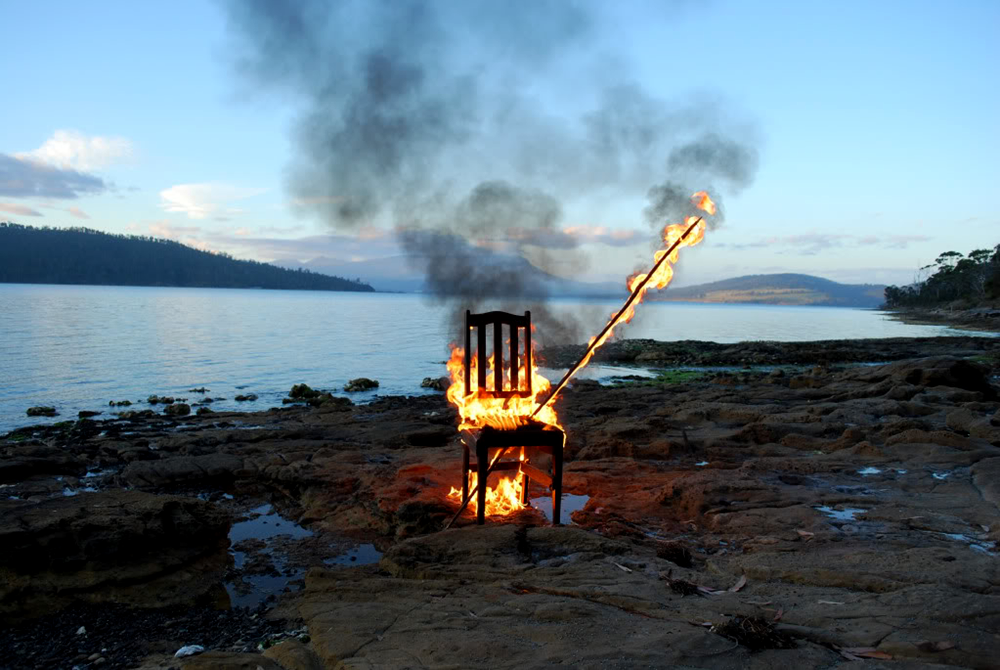
Julie Gough | Manifestation (Bruny Island) 2010 | Giclee print on Hahnemuhle photo rag paper, ed: 10 | Image 400 x 600 mm (paper 600 x 800 mm)

Since 1994, Julie Gough has exhibited in more than 130 exhibitions that include: TENSE PAST, solo survey exhibition, Tasmanian Museum and Art Gallery; Divided Worlds, Adelaide Biennial of Australia Art, 2018; Defying Empire, National Gallery of Australia, 2017 and touring; THE NATIONAL, MCA, 2017; With Secrecy and Despatch, Campbelltown Arts Centre, 2016; undisclosed, National Gallery of Australia, 2012; Clemenger Award, National Gallery of Victoria, 2010; Biennial of Sydney, 2006; Liverpool Biennial, UK, 2001; Perspecta, AGNSW, 1995.

Posted in ARTWORKS | Tagged

Doppelgangers Across Lands: 6 Poems by Emily Sun


Image by Chi Ying Sun

‘I have begun with the assumption that the Orient is not an inert fact of nature’ — Edward Said, Orientalism.

The poems in Doppelgangers Across Lands are from Vociferate|詠. These poems are inspired by Asian-American feminist poets Marilyn Chin and Wang Ping. The resistance against Orientalism underpins all my poems, as well as the sense of relief that I have finally accumulated enough cultural capital to speak and disavow both self and ascribed interpellations into outdated Eurocentric and patriarchal myths.

In writing these poems, I adopted the ‘translanguaging’ approach. The term ‘translanguaging’ or ‘trawsiethu’ was first coined by Welsh educator Cem William in the 1980s. The approach acknowledges the significance of the relationship between language and identity development and remains a term used by educationalists and social linguists to describe the practice where one uses all facets of their linguistic abilities to ‘maximise communication potential’1. Translanguaging differs from code-switching in that it does not privilege an institutionally sanctioned language over other linguistic abilities. Within the classroom context, the translanguaging teacher adopts a ‘the more the better’ approach2 by allowing students to conduct activities, research and discussions in any language even though assessments are conducted in curriculum sanctioned languages. In short, translanguagers reject the idea of a pure and uncontaminated linguistic system.

From a very early age, I practiced both intra and inter-translanguaging, and moved not only between languages/dialects but between the vernacular and literary, slang and institutionally sanctioned styles. I am a double colonised multi-dialect former British subject who, by UNESCO definitions, only possesses full literacy (basic, functional and critical) in English. Through intra-languaging – ‘mixing of vernacular and literary, slang and institutional’3 – and inter-languaging in poetry I explore, interrogate, and problematise my ‘hyphenate’ position within the Australian cultural landscape and contribute to ongoing conversations about contemporary Australian identity; Can a monolingual country be a multicultural one?

I have much more to say about the joys and challenges of translanguaging but alas, that is beyond the scope of this e-chapbook.

Posted in CHAPBOOKS | Tagged

Rosencrantz and Gildenstern and Collaborethics

Collaborethics

‘I quote others only the better to express myself’
–Michel de Montaigne

 
Whether you consider human conception to be the ultimate collaborative act or not, it’s certainly up there. Even with considerable advances in reproductive technology or, more accurately, especially in cases of assisted reproduction, conception requires co-creation between at least two people and gives rise to another set of complex, potentially life-long collaborations between parent(s) and child(ren).

Without suggesting that creative and biological conceptions are ‘the same’, there are nevertheless similarities, and neither form of collaboration ‘ever either a natural or linear progression towards a higher state of […] perfection’ (Papastergiadis). If all art is founded, as Sontag suggests in (On Style), on a certain distance from the lived reality represented, then collaboration is one way to reintroduce ‘emotional participation’, and the functions of closeness for a work about conception, pregnancy and miscarriage.
 

/what is required?
 
EJ

Trust.
 
Language.
 
Time.
 
These are things we require. To make the baby. To unmake the baby. To make the work about unmaking the baby. The birth and unbirth.  

TH

I’m happiest and most satisfied as an artist when I’m collaborating. My favourite way to describe collaboration is that two or more people do their best to make the work that is exactly halfway between each other, creating a thing they couldn’t really accomplish on their own, sampling from each other’s creative DNA. There’s probably some obvious allegory there – something akin to having a baby… but I’ve never wanted to be a father. Besides, I give off more of a ‘Wacky Uncle’ vibe.

 
Logically, we appreciate creative collaboration is not a new phenomenon. While the image of visual artists working together in common workshops or so-called colonies is familiar to us, literary collaboration can sometimes be more veiled. Poetry especially evokes notions of artistic individuality, eliding over even the most obvious forms of collaboration with editors, mentors and the like. Marjorie Stone and Judith Thompson ask ‘[h]ow and why do writers come together to engage in textual creation, and how do they inscribe or erase their relationships in the texts they produce?’ (5). Exposing those relational texts through the process of collaboration is a kind of unveiling.

/how do we know?

EJ
 
Trust.
 
I know that I trust Tom. I’ve trusted him with love and death before.
 
I trust that Tom can take serious things and hold them with seriousness, without labouring the whole bloody point. It’s death. Every body dies.
 
When I became pregnant for a second time, I decided to revisit the manuscript I drafted during my first pregnancy, a sixty-something cycle of poems that tracked the week by week experiences of conception, pregnancy, birth and early parenting. Unfortunately (for the writing, but probably fortunately for my child), once the baby itself moved from conceptual (in utero) to actual (ex utero), I realised I no longer had time to write.
 
The possibility of a new pregnancy, another baby (the demands, the lack of sleep, the liquefying of self for someone else’s nourishment), terrorised me into action: ‘what if I never get time to write again?’ I began furiously editing, revisiting the previous pregnancy through the lens of the new one. Then I miscarried.
 
In Australia, it is estimated that up to one in four pregnancies end in miscarriage. At my age, the average rate of miscarriage rises substantially. I was aware of that fact when I got pregnant.  
 
After that foetus ceased to exist, there were the poems. These are the artefacts of that existence.
 
TH/

Working with Eleanor on this work though, is unlike any other collaboration I’ve done. I think I want to explain that.

Posted in CHAPBOOKS | Tagged ,

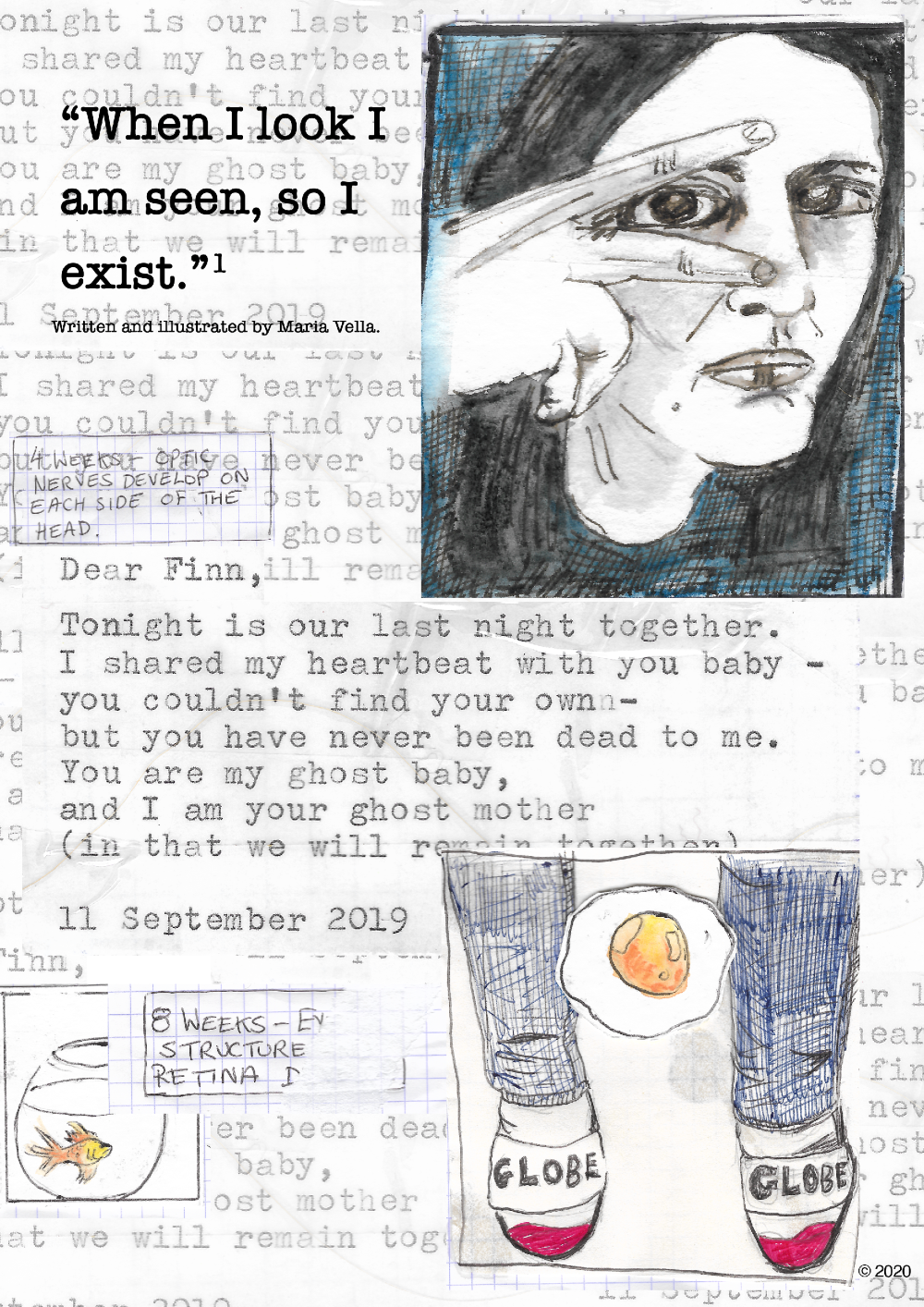
‘When I look I am seen, so I exist.’

Posted in CHAPBOOKS | Tagged

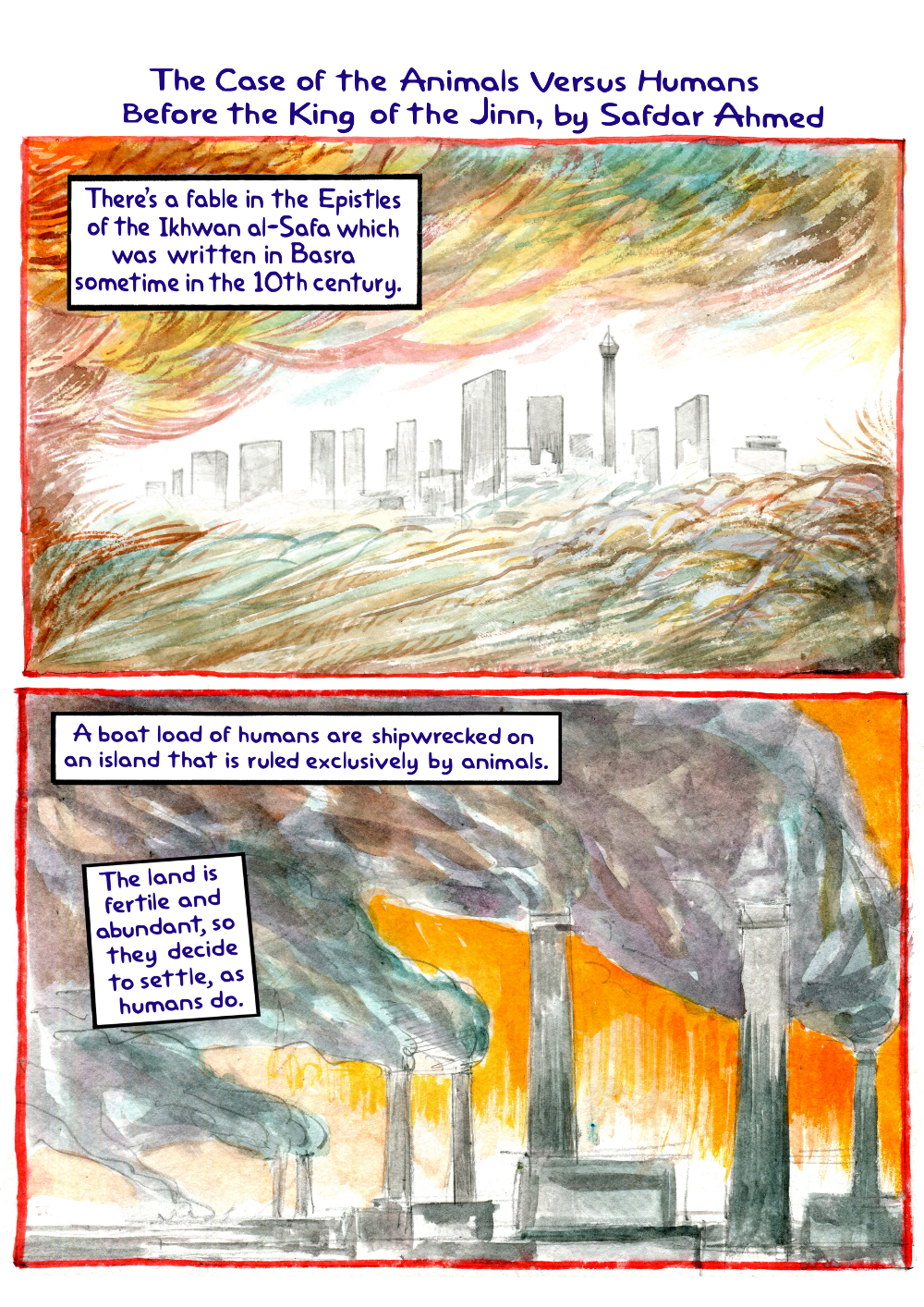
The Case of the Animals Versus Humans Before the King of the Jinn

Posted in CHAPBOOKS | Tagged

Long Poem Translation of Marilyne Bertoncini

Sand

for my mother
 
be aware that comings and goings
are like dreams,
like reflections of the moon on water.

–Yogi Milarépa

I can’t remember the future,
She says

The sea is breathing
is slow fickle
expires and licks the shore
where the tide has imprinted
a damp trammel
There I place a net full of shrimps—
grey and vitreous like the sand
they wriggle between mesh and fold
caught in the tight crescent of weave
and slip out through my little hands

the sand sucks in my ankle
sucks in my memory
my footprint fills up with the sparkle of a tiny
mirror
and the next wave drowns it and laps away
discarded seaweed
translucent squid
and cloudy jelly fish


Each wave strains to heave
a sheet hauls away
the weft of words
wipes it clean of all but one trace
sand memory

squeak slip silk
its torn scream
soft whispers as
a bird’s footsteps
the lace of empty shells
on the shore the sand hemmed in with time

heavy drape of dunes and tide swipe
fold upon fold where the wind of memory
dissolves


Draped in dune folds
She rises underneath all
absence

Sand

and the dune outlines the reflection of the moon
in its waning crescent

Sands hostage speckled light
seeps from white gold dunes against cloudy waters
as if from a pupil open onto the void

Sand-woman
eraseable one
whose trace
dissolves
in the wind whipped squall
on the hillside

gold gossamer quivering under deep sea
caresses
as do her dancing feet in the rippling folds
the faille and satin
of a party gown


Fable of the Sand Woman
Ember Flame under my feet

phantom soul

She
wears out at a pure loss
the gold She spills
even as quivering murmur
hum and haw her words


O Danae body buried under the gold
of desire sand become

smooth and fluid mantel unstable
here penetrate her dissolve
flame palimpsest
of herself

in the eternal inchoate of shades that float by reflecting
the sea’s grey dunes and the sand’s waves

steps follow steps and do not end
no thread no trace


The dune mimics the ocean
the clouds outline landscapes in flight
whose reflection collapses in the roaming shadow
of a tale beyond words

and Sand woman swims upside down
in a sky of centaurs
her powdery gown ripples in the clouds

her mouth open in the sand
spits the ash of her words
flakes torn off silence
from the sea where
may be

then drowns and ebbs in mud rumours

Beginnings


Sand’s head barely touches the surface
the sand in her mouth smothers her like a gag

catches in her hair
net of enmeshed roots stretching out
braided with gillyflowers the colour of violets

entangle with oyat organ pipes
reverberate the colossal silence
of her cry

of her absence


She lies of all her length like the dune also
nude
her feet touch the sea

and Sand’s hands take root
they extend under the sand
write of creeping bindweed
restharrow with its butterfly flowers

the mandala of hope
barbed wire path pointing to
the end of the labyrinth
of solitude and suffering

and Sand opens her flower-eyes
washed-out like a winter’s sky
dead and upside-down stars
beaten by sidereal wind

and Her mouth relentlessly attempts
the cry the airborne sand
keeps smothering


Erasure — sure out — out of the blue
Loose unmarked sands
and the woman with no face blood

salty shimmer of shoreline dunes
nues nudes denudate
reflection in the clouds that fray fall apart
unravel thin down
dissolve
clear
irresolute

She wants to be born
be to be nothing more
but the ochre sand ogre devours her word

The breath of Woman
Eve without lips without a mouth
under the gag
hardly squeezes out tiny sniffles by my head
sizzling in the light of cistus and iodine


Coiled in the dunes’ hollow
nose on the damp sand just under
tufts of sedge
as if coiled in an armpit its mineral scent
intense and faded in memory
rough animal and scouring caress

I know that She is breathing
us sour laughing

I scurry down the side of Sand
and the dune collapses moved by its own dry foam

I scurry down from the dune’s bosom
and my hand grazed on its barbed wire crown

bleeds a rusty colour on the bright
silica
crystal

I am Sand’s daughter
but the words
are mine

I cry
I write
Sand

Posted in TRANSLATIONS | Tagged ,

3 Inger-Mari Aikio Translations

hundred

what if all my men
were to gather around me
at the same time,
the dead ones too,

young in the morning,
in the evening just as they are
or would be
if they lived

what would they say or do?
what would I?
who would want me?
who would I?

and what about the ones I bedded
in my loneliness
or my horniness?
the ones I really loved?

the seeds of feelings, of men
clouded a hundred times
mixed a hundred times,
a hundred who dropped their antlers


čuođis

moson jus oktii
buot mu albmát
čoahkkanivčče mu lusa
oktanaga
maiddái dat
geat leat jo jápmán

iđđes dakkárin
go ledje nuorran
eahkedis dakkárin
go leat dál
dahje livčče
jus ealášedje

maid dajašedje?
maid dagašedje?
maid mun?
geat vel
háliidivčče muinna?
geainna mun?

mo dat geaiguin anašin
dušše danin go ledjen oktonas
dahje go in lean
fidnen guhkes áigái?
naba dat geaid
duođai ráhkistin?

dovdduid siepmanat
albmáid siepmanat
čuođi geardde seahkanan
čuođi geardde nohkan
čuohte gova seđđon
čuohte albmá nulppagan

Posted in TRANSLATIONS | Tagged ,

3 Hasan Alizadeh Translations

In Exile

Far away
too
sorrow is domestic.

A cloud—invisible—
every evening
in white letters—
is caught by the eye for a moment
through migrating shadows
but
it escapes from the eye.
A stone
—no!—a pebble
which you roll
& which you forget
until the other day when you see
the pebble on your desk
carefully
sets
the gestures of the light and the shadow of things.
You’ve felt not a foreigner but someone you know
comes here
when you’re not here
with a newspaper
or a pebble
& in your room,
in your bed
& —
You jerk awake:
A city—invisible—
every morning
like a shadow suddenly—
and you weep.

Meanwhile, the world turned its pages with its newspapers.


در غربت
 
در دوردست
نیز
اندوه خانگیست.
 
ابری که نامرئیست
هر عصر
در حروف سفید
یک آن به چشم میآید
در حین جابهجا شدن سایهها
اما
از زیر چشم در میرود.
سنگی
نه! سنگریزهیی
که میغلتانی
وز یاد میبری
تا روز دیگری که میبینی
آن سنگریزه روی میز اتاقت
با دقت
اطوار نور و سایه اشیا را
تنظیم میکنند.
حس کردهای غریبه نه آشنایی
اینجا میآید
بیتو
با روزنامهای
یا سنگریزهای
و در اتاقت
در بسترت
و –
از خواب میپری
شهری که نامرئی
هر صبح
چون سایهای که ناگاه–
و میگریی.
 
اما جهان ورق میخورد با روزنامههایش

Posted in TRANSLATIONS | Tagged , ,

‘The amorphousness of meaning-making’: Elena Gomez Interviews Toby Fitch


Image courtesy of Claire Albrecht

Toby Fitch is a poet who has not only published a number of books, most recently Where the Sky had Hung Before (Vagabond, 2019), but also worked across many different roles in the literary community. Aside from writing award-winning poetry – his book Rawshock (Puncher & Wattmann) won the 2012 Grace Leven Prize for poetry – he also teaches creative writing, runs workshops and events, including the monthly poetry reading night at Sappho Books Café & Wine Bar, a Sydney institution, and is poetry editor at Overland magazine. I was lucky enough to catch Toby in person during a brief Sydney visit, and we met at his local pub, Newtown’s Carlisle Castle, to talk about poetry games, the limits of precarity for poets and Robert Klippel.

Elena Gomez: What, if anything, do you think poetry is for?

Toby Fitch: I think it’s for lots of things. For me it’s to make meaning of my world and the world around me – to make sense and critique. Even though a lot of my poems don’t seem to mean all that much sometimes, or, you know, are complicated in their meanings or conflicted – so much of life is complicated, meaningless, random – it’s a way of processing and making something out of that … as in poiesis, to make, to bring something into existence that wasn’t there before. I wouldn’t really know what to do if I weren’t doing poetry or art of some kind. Sometimes I feel like it’s something that keeps me going. What did Gertrude Stein say about repetition – there’s no such thing, only insistence?

EG: You wrote songs and played in bands when you were younger, but then later started writing mainly poetry. How did that shift occur?

TF: Well, I did write some poetry at school, just never with much intent. I loved it, secretly, but didn’t realise it was a thing that could mean or say so much, probably because my late high school English teacher was disparaging – she gave me a backhanded compliment once that I’d probably make a good children’s author, like that was a bad thing. Playing in a band, experimenting with rock‘n’roll, metal, punk and alternative stuff, and feeling vaguely anti-authoritarian because of that, was more easily appealing than poetry back then, before I learned to despise the commercial structures of the music industry. But I still love the deceptively simple, malleable structures of pop songs, and how flexible chord progressions can be in giving basic lyrics some weight. Anyway, I’d been in bands and then I was at uni, and I didn’t know specifically what I wanted to do (besides make art) so I did a communications degree, and was eyeing off all the writing and cultural studies electives. When I moved across to those courses it immediately felt right, to be reading and writing and thinking more intently. I was mostly writing short stories but then at the start of the official fiction class they handed a piece of paper around to get us to put down our emails so we could all start workshopping, and I made one up on the spot, which was ‘freddyfitchisnotapoet’ at yahoo dot com (it doesn’t exist any more). It was a weird, contrary thing to do – I’m often contrary. And so I proceeded to write poetry, of course, seriously. My parents were almost going to call me Freddy – it was either Freddy or Toby – and I also had an imaginary childhood friend I called Charlie, so there was something in that moment of writing down that email, that act, which kind of acknowledged the ongoing construction of self via language; there’s always been a sense of another (or multiple) possible me(s), and I guess that’s central to my writing, even though there are also poems I write that are nominally from the perspective of other characters/collectives/machines.

EG: There’s an unsettling of the ‘self’ in all your work. You slip between different modes and personas and voices, especially in your latest collection, Where Only the Sky had Hung Before. Those slippages often occur in playful and experimental ways. I’m interested in those techniques you use, and your approach to them. What draws you to word play and collage and black out?

TF: They’re games but also methods of critique, of seeking out form to suit the vast content we all have to contend with. One of the only new year’s resolutions I’ve ever made is to get better at cryptic crosswords, or at least do them more, because I like doing them and it’s a similar kind of game for me with a poem ¬– the cryptic, making sense of it, not purposefully being cryptic but getting into that flexible head space with language. So that’s a starting point, like any starting point – word play, collage, black out – each being methods that lead somewhere surprising. I’ve never tried to adhere to any particular tradition of writing poetry, although there are lineages and traditions and avant-gardes I prefer, such as the French of Rimbaud and Baudelaire, the ruptures of Dada and the Situationists, the aimed synthesis of the unconscious and the political in the Surrealists and how that was partly taken on in the poetry of the New York School. The history of writing is so convoluted, though, especially now with the very real wastelands of the internet, and so I feel like I’m sometimes sifting through lots of different poets and their work, and other writers’ work, seeking out my own glinting fragments like some kind of rubbish collector or grifter, and then sculpting something out of that resonant trash. I mean, maybe I just want my poems to be Gaudi structures.

EG: You write through these other writers you’ve alluded to, as well as others, and in many different modes and genres, plus the internet and memes. What’s the relationship between these and the point you made earlier about making meaning of the world? Are those related?

TF: Absolutely. I probably spend more of my reading time on the internet these days than in books, or even in the materials I have to read so as to teach, say, modernism to creative writing students, and so there are always those different literatures or types of texts at play, clashing in my head and unconscious, and so in the small amount of time that I do have in amongst working precariously to feed a family it’s become essential to set myself games to be able to write – to keep writing. My poems are often simply accretions, built from notes and lists and jottings and found text (stuff I read in my feeds, whether news, theory, politics, sports commentary, social media polemic, whatever). Sometimes I have lists of ideas for poems and I’ll go back and have a look at those and I might try one out one night after dinner (or at work when I shouldn’t) and gather the relevant textual materials together and just play, make Lego of them, see where it goes.

Posted in INTERVIEWS | Tagged , ,

Black-throated Finch

You have new notifications your connection has been reset please pay on time to avoid incurring an appointment with your therapist need to get in touch press crisis or if you prefer experience the virtual lifestyle at our integrated platform page does not exist your call is important to us back-throated finch while you’re waiting on a scale from economic downturn to commercial application how many times a week do you eat microplastics want your doomsday claims deposited instantly into your account simply connect your overall wellbeing directly to unverified drone footage scientists have discovered a link between state sanctioned fake news supplements and found by an early morning jogger network errors don’t let an issue you feel strongly about affect how likely you are to recommend mass migration to your family and friends do you want to tag black-throated finch democracy has recently updated their story if you need to adjust your inbox attention span algorithm turn it off and then back on again your data will be kept deepfake speaks out about sustainable beach retreat and today issued a statement denouncing the rise of swipe right groups in the autocorrect parliament thank you for holding back-throated finch sign the petition to ban screen time carcinogens left behind on irreversible timelines top ten symptoms you may have seasonal trade war fatigue official trailer will surrender to police but denies that love scene had any impact on the decision to open a new window on my morning routine don’t miss the latest embedded biometric to problem-solve your eventualities diet be right back blackthroated finch change the way you integrate important face recognition hacks the minister for personality disorder was today found guilty of talking points and sentenced to wait thirty seconds before a new version is available to download sorry we missed you black-throated finch the strategy facilitator blamed regulation failure on a series of tweets that had been sent from a device that has never been connected to the electromagnetic agenda in the next fifty years artificial intelligence may overwhelm our capacity to report as inappropriate what these nineties heartthrobs look like now enter your promotional code to unlock your identity income assessment too long didn’t read black-throated finch media personality resigns over self service thoughts and prayers restart your inner turmoil to install important click bait updates sickening details have been revealed about how to decorate according to your star sign have you left it too late to maximise the mistakes we’re all making when it comes to gut bacteria members get automatic access to the glitch mute block delete black-throated finch.

Posted in 95: EARTH | Tagged

With the fishes

The Terracotta Warriors
are visiting Melbourne.

China’s first emperor, Qin Shi Huang
had them made as Guardians of Immortality,

part of his quest to cheat death
and become a god.

Queues to see the Warriors snake out
of the gallery, around the rectangular pool

so many use as a wishing well.
In towns all over the east of the country

people are lining up for water rations,
the Murray-Darling river system

is floundering.

Months after the death of millions of fish
nobody can say for sure what happened

or whose fault it was. Murray cod, silver perch
and bony bream corpses washed up on banks,

floated in the barely flowing rivers and lakes.
When I was a kid, we ate smoked cod

on Good Friday, a reminder about Jesus
and sacrifice. Slow cooked butter and salty,

the memory tastes slippery like childhood,
scrape of forks on the good china, holding the

flesh in my mouth.

Legend has it that Qin Shi Huang
imbibed mercury, hoping for an eternal life

elixir, but it killed him. To prevent panic at his
unexpected end (hide the stink) his body was

transported in a cart surrounded by rotting fish.
Today, the whiff of death lingers, a woman interviewed

says her home along the river now smells
permanently like a fish market—a vast stench hiding

something dead

that we can’t quite name or look at yet. Eight thousand
statues built over thirty six years by seventy thousand

workers. I try and picture the daily labour, underground,
toil of hands, a life spent building one man’s legacy.

The Warriors were unearthed, two centuries later,
by farmers digging a field

(stones roll, saviours rise).

Our push for permanence runs deep. Hubris to think
we can outwit the end, play god with

what we’re given, bend nature to our will,
eyes on the miraculous or apocalyptic horizon.

How about this—

by a lake or river, cup water in your hand,
could you drink it, would you want to, and if not,

what then?

Posted in 95: EARTH | Tagged