Shovel | 一把铁锹

Translated by a j carruthers and Cui Yuwei

noon after snow
Kirin Bay Park
there where there’s a far corner
in this patch of wood
a shovel I see
stuck up a tree
two print-foot-trails
snake along
here from the path where I stand

sunbeam
it streams down through those branches there
suddenly, the shovel quivers
it’s as if it’s having a soul
gleams
dazzled light
snow forsaken by its whiteness
the two crows and with them a flock of sparrows
the lot of them frightened
flee with clatt’ring wing

Posted in HOMINGS & DEPARTURES | Tagged , ,

Sighs | 叹息

Translated by Xuan Yuan and Tim Lilburn

—for all the slaughter victims

I hear, I hear the flock of rain, crowing, rushing out of stirred
crowds of chaos and fright, sweeping past, laughing, roars of
laughter crashing into the Wailing Wall. Triumphant karma
holds a sharp blade in its mouth and slices the sigh into
pieces; one piece, two pieces, feathers flutter, dancing.
You emerge, among the whirling sleet.
The thing, the mortals can’t imagine arises. It’s time,
drops of white blood splash, the brightest blossom of solid snowflakes.
I see, I see your heart of great suffering swells up, up
till an angel thunders out, and he flexes up the roots
of his not-yet-familiar large wings, pressing against the gust
blowing from the gap in the heart, then bows his head to peck
such an immense petrified world with his sharp beak.
An already rigid You, giant sigh, stands upright, burning inside.
A fire wall, a wall of fire burns darkly and damply, smoking
whitely and bitterly, collapses and buries, buries the eternal sighs.

Posted in HOMINGS & DEPARTURES | Tagged , ,

The Fog of Our Age | 我们年龄的雾

Translated by Heather Inwood

How it got here is a puzzle.
That’s not to say it’s unsolvable, but I’d rather
keep a little mystery for myself.

Snail-like, up the steps,
against the wall; wherever I look
I see its milky trail:

I intentionally ignore its weight,
but this is because I know
its strength. I’ve sensed it many times.

Similarly, I never worry about
questions of visibility and the like: I’ve noticed
a post office floating in its belly.

Just like that, three meals a day, take strolls at night,
read a few pages of Pascal before bed.
The window’s open. I’ve felt the change.

Because of this, I was for a time most engrossed
with where its edges lay,
this always left me full of secret wonder.

But now I have the confidence to stuff it
in a pocket like a box of matches, good for a light,
good for warmth, or for a fortune-telling game.

I also let it turn into an ant and
slip out, watch it cross my arm,
burrow into my chest where, I admit, it tickles—

You have opened the labyrinthine entrance to my soul
and, as curious as I’ve always been: when I see you
I am already within you.

Posted in HOMINGS & DEPARTURES | Tagged ,

The Reliquary | 宝塔

Translated by Ali McIness

—for Li Chun and His Contemporaries

The reliquary is a candle; the lake by the trees
And the bottle on its shore, drawing on its warmth.
And why isn’t it the bottle?
You raise it, perhaps to take another drink?

To whistle? Or cast it into the lake,
Rending your lungs in song to the night life.
I, myself, gallop swift as storm winds, the reliquary
Rising abruptly from weekend shopping receipts to
proclaim: Love!

Hate! That with which your right hand fumbles,
resembles
Not a computer mouse or western book, but a
window frame: Push it open,
Let in the fine vapours of translation. Mountain
forms rising from the babble,
A sandpaper dawn—So false! Against this backdrop

The reliquary stands a pinnacle; the darkness you
turn to grasp,
Forever its reflection. Eyes left in attention,
Its gaze follows you. Although it may be gossamer
soft, fruit flavoured, fluorescent,
Above all else it’s crimson.

Posted in HOMINGS & DEPARTURES | Tagged ,

Cardboard Boxes | 纸箱子

Translated by Canaan Morse

I know you remember those bound-up carboard boxes.
When the spring tide came, they floated in every hallway,
light and rigid, like the model ships boys carry.
This once brought me peace,
as I have only two hands, as do you,
we can’t take it all.

But may I tell you, how I can hear
the sound of them sinking?
though we had thought they would ride the current,
go before us, all the way to the deep eddies
of paradise, and prepare for us
countless tearful gifts.

May I tell you they are disappearing,
dropping through purple kelp
and schools of migratory fish, through whirlpools
and layer on layer of candy-delicate sand?

May I tell you
they now lie wordlessly beside me; and that
nothing ever was destroyed,
but simply gone from the water’s surface?

Posted in HOMINGS & DEPARTURES | Tagged ,

Rangoon Lover | 仰光情人

Translated by Liang Yujing

Your mind is to taste all nightmares.
Your body in charge of fond dreams.

Open your icebox, your white bra.
Open the two clean lungs
like you push open the shutters.
Knock the drumbeats into your guts.
Freeze the letters in a fridge.

I only have eleven lovers.
I only have poetry, this one lover.

My darling bathing in soft cheese:
for you, I can even join the Party.

When we are in love,
we don’t do anything legal.

As you breathe out chit pa de,
a bird pecks them away.

You write about me, I about you.

Posted in HOMINGS & DEPARTURES | Tagged ,

Childhood Playmate | 童年玩伴

Translated by Gu Yiwei and Cassandra Atherton

Death, is another child, with a thin face
Occasionally he comes to play with me, knocks three times,
moderate and regular, forming a habit
Like the scar on his forehead that is uncovered
when he takes off his hat—
It’s a strange mark burnt by Mars, he says
He doesn’t blame his father who smoked every day in clouds
and swam in alcohol, who was old, tied to the post
nor his mother who sat and sighed
at her dresser. His home was in the depths of the flax field across the lake
Unexpectedly, I have never really been there to have a look
(I have headed towards there several times, but returned
Before arriving) or to see the antique furnishings
he described, kept in their proper positions
Sometimes when I am not yet up, he lies prone in the sleeping bag
looking at me; sometimes when I happen to be
drinking milk in the kitchen
there are feathers floating in from the window, something to speak of
He always collects quaint baubles such as
a silent bird, a doddery horse which cannot be ridden,
Some canned fish that aren’t fresh, he probably loved these things
covered in moss in the shade, not heliophilous,
he did not expect them to grow into feral shapes
Before leaving, mum always warned, ‘You have to be home before the sun sets.’
Then we rushed across the front hall
Across some sporadic puddles, and arrived at
The reeds where discarded barges were moored, so
that was how one puddle joined another
You took off your hat to show me your scar
You even took a cat out of your arms, saying it was magic
Out of admiration, and of self-esteem, I said
This is nothing surprising, once I even held a
Colourful tiger in my arms, and let it go
with my hands. Just now a wild francolin flies over head
and you go chasing the luminous curve
As if you love falling, you run like
the rising tide, puddles gradually swallowing up the reed field
It disappears, like an innocent beach gobbled up by the waves
Coming back empty-handed, you spread out your hands, shadowed with sorrow,
‘People always talk about going somewhere far away to dance, but they
Never know where to go, or sometimes go too far,
Forgetting to come back home.’ At times like this, it means goodbye
I look at the puddles, the lake that has formed
The flaming clouds over it, and his home
He said it was only another mark, the same as the one
On his forehead. Then I stepped and splashed about here and there
Strolled back home alone, while my young solitary playmate
Always ran in the opposite direction.

Posted in HOMINGS & DEPARTURES | Tagged , ,

On Curing Depression | 关于抑郁症的治疗

Translated by Austin Woerner and Bao Huiyi

Now all I need to do is carefully differentiate
between each dull ache, name it, add a footnote,
lock it up
in the correct drawer: which tears I shed
for my suffering father, which for frostbitten love,
which came just from shivering in this vast,
indifferent
prison of stars in which we all live. If each small pain
could be precisely located, like troubles in Yogacara
buddhism,
they would, like sins in Dante’s funnel, become
bearable.

Every pain I refuse to, won’t stoop to, or simply
cannot pour out
will congeal into brown, olive, and silver spices
brewing miracles in the holy-water bottle of time.
Rhetoric evaporates before a suffering heart, speech
becomes frivolous,
and if not done in order to save oneself
narration is unforgivable. If I could take a piece of
sky-blue chalk
into this maze, and mark every forking
that leads to disasters: “I have been here, I will not
be tempted again” then they would become
bearable.

If all my tastes of mercury and arsenic
could exempt you from understanding this poem
—they would become bearable,
little patient.

Posted in HOMINGS & DEPARTURES | Tagged ,

Contemporary Chinese Poetry in Translation: The Homings and Departures Project


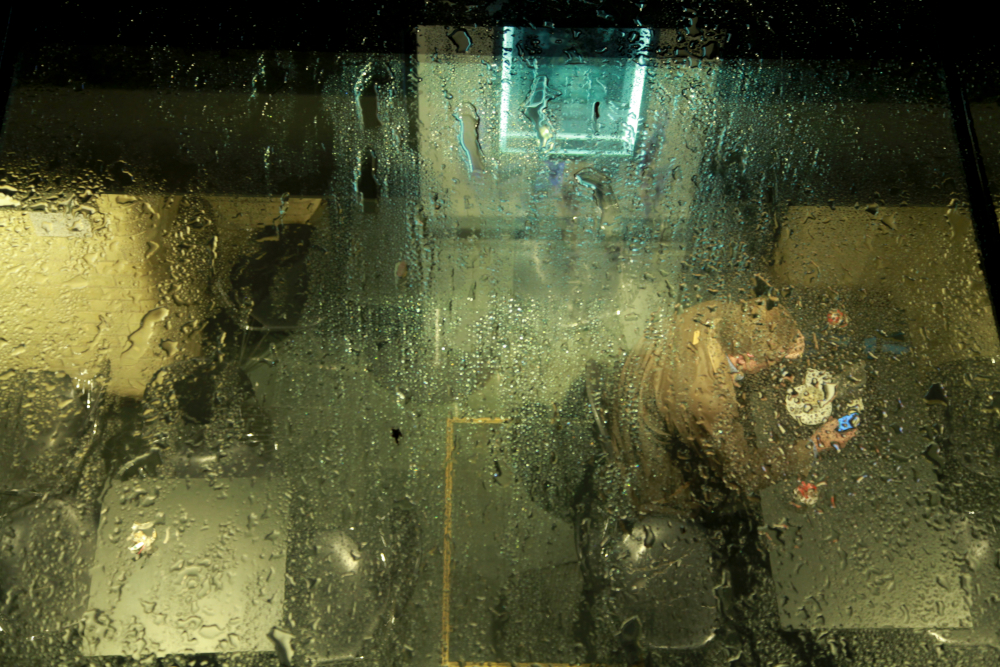
Image by Wang Yin

Homings & Departures is a poetry translation project of the China Australia Writing Centre (CAWC) at Curtin and Fudan Universities, and the International Poetry Studies Institute (IPSI) at the University of Canberra. As worldwide borders close and movements are restricted, the project’s title has gained a pressing new relevance. If bodies cannot travel then words, at least, can. In a spirit of nuanced exchange, CAWC at Curtin and Fudan, along with IPSI, continue their creative collaboration at a time when it is increasingly vital.

These poems were first published in Homings and Departures: Selected Poems from Contemporary China and Australia (Qinghai People’s Publishing House, 2018), edited by Bao Huiyi and Hai An. Later this year, an Australian companion volume of Homings and Departures will be published by Recent Work Press, edited by Lucy Dougan and Paul Hetherington, with Chinese translations by Iris Fan Xing.

Mai Fei: Shovel | 一把铁锹
Translated by a j carruthers and Cui Yuwei

Wang Ao: Standing at the Gas Station on a Winter’s Night, What am I Afraid of | 冬夜站在加油站我怕什么
Translated by Eleanor Goodman

Leng Shuang: The Fog of Our Age | 我们年龄的雾
Translated by Heather Inwood

Wang Pu: The Reliquary | 宝塔
Translated by Ali McIness

Zhao Si: Sighs | 叹息
Translated by Xuan Yuan and Tim Lilburn

Dai Weina: Rangoon Lover | 仰光情人
Translated by Liang Yujing

Zhang Dinghao: Cardboard Boxes | 纸箱子
Translated by Canaan Morse

Si Rongyun: Childhood Playmate | 童年玩伴
Translated by Gu Yiwei and Cassandra Atherton

Bao Huiyi: On Curing Depression | 关于抑郁症的治疗
Translated by Austin Woerner and Bao Huiyi

Zhang Er: Buji River Serenade | 布吉河小夜曲
Translated by Michelle Yeh

Feng Na: Birthplace | 出生地
Translated by Henry Zhang and Amelia Dale

Iris Fan Xing: Canton Holiday | 广州假期
Translated by Iris Fan Xing


Editors’ notes

With thanks to all the Chinese and Australian poets and translators involved; to Paul Hetherington for the overall conception of the project; to the Director of CAWC at Fudan University, Linjing Jiang; to editors Huiyi Bao and Li Dingjun (Hai An); to publisher Ma Fei, Editor-in-Chief of Qinghai People’s Publishing House; and to Wang Yin for his photograph, which provides such an atmospheric frame for the poems in translation here.

Posted in CHAPBOOKS, TRANSLATIONS | Tagged , , , , , , , , , , , , , , , , , , , , , , , , , , , , , ,

‘Mix it with grit’: Claire Albrecht Interviews Jill Jones


Photo by Annette Willis.

Adelaide poet Jill Jones sits down 1,525.5 km from me, Claire Albrecht in Newcastle, to discuss her sparkling twelfth book A History of What I’ll Become. That’s a lot of ground to cover – along the way we talk grit, sexuality, anxiety, and the way these might be captured by observations and processed by repetition, hesitations, and formal experimentation into a poem. We dig up the sublime and consider shared modes of composition between poetry and a symphony. We die symbolically on the beach. We write to control. Strap in.

Claire Albrecht: Jill Jones! What a pleasure to kick off this conversation. The last we had was in the back courtyard of a gritty Newcastle cafe, and I’m sorry we can’t be face-to-face again, but here we are. Strangely I feel like I’ve been in contact with you this whole time, as I’ve not only been close-reading your 2014 book The Beautiful Anxiety for my PhD exegesis but also following your Twitter observations, which for a while gorgeously catalogued your impressions of local walks during your isolation. I notice your Twitter account has been deactivated – are you still cataloguing your small observations since restrictions have eased? How does a fascination with the (non-viral) micro hold up when we’re all collectively freaking about the macro?

Jill Jones: Yes, here we are, only able to talk virtually, but it is a pleasure. I’m always up for another gritty café chat if this is ever over. Newcastle seems to be full of poets. But, sure, the micro, the local, sure interests me, always has, but I haven’t been as diligent in my iso-walk notations lately. A combination of the fact of leaving Twitter, so that sense of the constraint (280 characters) has gone, as well as the fact that, at least in Adelaide, my movement is freer around the suburbs and into the city. I have even been back into my workplace office a few times since they unlocked the building.

I’ve been re-reading Lorine Niedecker’s work, a process I recommend in these times, and in both the early and later Niedecker there’s that sense of both the associative and, especially in her mid-to-later works, a sense of that base in the local although her reading and thinking was always very broad. She did a lot of research as well. For instance, she collected together many pages of notes and research and did a road trip to write her poem, ‘Lake Superior’, which consists of only 393 words. Her work continually has that sense of the associative and the assemblage.

To me this all raises questions around improvisational practice. What can I fit onto an A7 notebook that I shove in my pocket as I walk out the door. Or simply a scrap of paper I find in the back of my wallet one day. How then to assemble poems out of such notes. The things you hear – ‘“I win again”, says little girl to daddy in the race up the garden path to the front door’ – or what you see through the streets – ‘Day 31: empty bins – empty croquet club – empty bowling club – empty trailer – empty footbridge – seven magpies at the corner of Ormonde Ave and Lloyd Ave’. I’d often find I could come up with a template for the walk on each day, so I’d only write about animals I saw, or plants, or signs. Or only use three-word phrases for each thing. Improvisation doesn’t necessarily imply lack of structure, in my mind, but seeing and feeling what comes to hand, to eye or ear, and find a way of making it into text.

On Twitter the 280-character constraint was also a useful container. And in a longer poem based on the notes, I tried a couple of approaches, like a certain number of phrases per line, or a certain regular mix of syntax. I even tried some kennings: ‘Day 23: shivergrass – mulchcrackle – yellchild – hissbike – dogpuff – crowsight’. Of course, as soon as you rewrite and rearrange you’re changing the thoughts you might have had out there in the street. The kennings, for instance, are both observational and conceptual, as well as sonic constructions.

I think about the observational as simply taking note of what’s before me. But how that becomes a poem depends, for me, on the associative, the juxtaposed, even the accidental. Observation is one part of that complex act of perception and organisation of making a poem, but it does get you, or me at least, to take notice of things outside myself, especially in this time. What are my neighbours doing? What birds are in this area? How to write that. And not just as notes or reportage.

To me, it’s observation as compositional practice, not as consumption or stage setting. It involves listening and seeing whilst passing through and with a place. It’s both passive and active, receiving and translating, as well as being in the place as one among many entities, sentient and non-sentient. The Objectivist ‘thing itself’ is more than that, it’s the thing or things, including me as a human thing, in a situation that also isn’t just singular.

It also has a ring, to me, of something Veronica Forrest-Thomson wrote about in Poetic Artifice, the ‘hesitation between empirical and discursive modes’. I recast that (not sure what she’d feel about it, though), to think about hesitations created through caesura, line endings, page position, punctuation, parataxis, assemblage as well as changes in poetic modes. Forrest-Thomson says that ‘that hesitation is not unproductive’.

And is hesitation a kind of anxiety? Maybe. I think it’s productive, for me. And there’s that first line of yours from ‘annexiety’ in your book pinky swear: ‘anxiety is the millennial condition, says a clickbait article’. So I wonder if you do?

Posted in INTERVIEWS | Tagged , , ,

‘It is a gift for you’: Danny Silva Soberano Interviews Manisha Anjali

In my mind, Manisha Anjali is most neatly described as a ‘poet’, though her body of work cannot be so neatly classified: she also works in visual and performance art, she produces Neptune: A Dream Archive which is currently collating and publishing pandemic dreams, and she has worked tirelessly as an editor.

This interview began as a conversation one day in early December 2019. I had come to visit Manisha during a period of grief in my life. She welcomed me with a beautiful meal of purple cauliflower baked with spices, chilli oil on the side. After our meal, we walked down Brunswick Street in Fitzroy, when I asked her what she was working on. Her chapbook, Electric Lotus hadn’t been released yet, but Manisha was finalising everything for a late-January launch in 2020. She talked me through her meticulous process of choosing the exact paper and colours she wanted for her collection; publishing with Incendium Radical Library had allowed her to have a say in such decisions. We talked about religious euphoria and music. We talked about our dreams. I’d been having nightmare after nightmare. Manisha’s dreams were much gentler.

Our interview has now transformed into a clean transcript. Our exchange took place over the course of many months across email and Google docs. Here it is now, a record of Manisha’s abiding calm as she speaks of slowness in poetry, being an artist with multidisciplinary interests, and the divine – and – it is a record, also, of my deep awe at her artistry.

Danny Silva Soberano: What is your relationship to editing your poems over time? Does a poem ever really feel finished to you?

Manisha Anjali: Poems can never be complete, because like us, they are alive. They are growing and aging. Poems outlive us by travelling through mouths and ears through time and space. For this moment, my throat and tongue are instruments for cultivation of expression and revision over time.

I am in love with the ephemerality of performance. The poem wants to move a different way each time. I move with it. I put myself in a trance by embodying the rhythm of the poem. Whatever I share in the public space is informed by an act of listening to the poem itself. I found impermanence so pure and thrilling that I avoided publishing anything for a long time.

I now recognise the importance of publishing, for a poem to travel and for it to communicate with future minds. The written word is the blueprint. It is a version of the work, not whole in itself, at least not for me. It can be translated and performed by anybody who reads it in any way they like. I am becoming more comfortable with permanence; it is akin to me becoming more comfortable with my own death.

DSS: Poetry can be a medium that encourages slowness. Your considered way of releasing work stands out in an art culture that can sometimes emphasise quick releases of art. There is so often a rhythm to your performances.

MA: For me poetry does not necessarily encourage slowness. Its lawlessness and freeform supports the speed at which I throw my ideas around. The way I have been writing and performing thus far has mirrored my non-committal and capricious way of being which I feel like is beginning to change. I have always loved being in a state of overstimulation, juggling a thousand concepts at once. Now, I want to embrace slowness and stillness. I want to do this by committing to a big long slow-cooked body of work, such as a novel or epic poem. I feel ready.

DSS: The first poem of Electric Lotus is a list of songs and a QR code that links to the Spotify playlist. I get the sense that this is the soundtrack to the chapbook. Does music tie into your critical interest in spirituality and the sublime?

Posted in INTERVIEWS | Tagged ,

‘Multiple things at once’: Hana Pera Aoake Interviews Jackson Nieuwland

Jackson Nieuwland is a writer born and based in Te Whanganui-a-Tara, New Zealand. They studied writing at the International Institute of Modern Letters (IIML) at Victoria University, graduating in 2015. Together with Carolyn DeCarlo they run Food Court, an ongoing zine and reading project. Jackson is one of the most special and important young writers in New Zealand, namely for their clever, experimental writings, but also for the enormous support they give many other writers and the community they uplift. Earlier this year they released their first collection of poetry, I am a human being with Compound Press. Over August we discussed their book, ways of (re)imaging our bodies, and the power and limitations of language.

Hana Pera Aoake: Ngaa mihi o te poo Jackson, I just wanted to begin by saying congratulations and that I think your book is really special. Mihi atu ki a koe me to pukapuka ataahua.

I guess what I love about I am a human being is how you frame the body as being expansive and able to be reimagined and reconstituted. It speaks to ways of imagining and understanding ourselves and our world that feels very pertinent to this current moment. To start our koorero, I wonder if you could comment on this and how it resists the very patriarchal and colonial mode of oppressing our bodies and relation to other living beings into categories?
Jackson Nieuwland: Kia ora Hana. Thank you so much for your generous reading of my book. It means the world for a person and writer who I admire so much to engage with my work with such depth.

I’ve spent much of my life feeling out of place and uncomfortable. I’ve never really felt as though I fit in anywhere. I’ve only recently begun to gain an understanding of why this is.

The patriarchal, colonial, capitalist society that we live in is obsessed with categorisation. People need to be categorised in order to be productive. People need to be categorised in order to be controlled. We are always being pushed to be just one thing. In order to be a valued member of society you need to work a full-time job in a socially accepted field. Outside of work you can have one hobby or interest that matches your gender/socio-economic status/education. Some people seem to thrive within this system, or at least make it work for them. These people are usually straight white cis males. This system of categorisation is harmful and dangerous for those of us who are not just one thing; those of us who are many things or straddle the lines between things.

Even before I had the language and concepts of non-binary gender, I have always pushed towards being multiple things at once. I remember when I was a serious basketball player: for the vast majority of people I played with basketball was their whole life, but it was never my whole life. I wanted to write and make music. That’s actually how I began using the name Jackson Nieuwland. My full name is Thomas Jackson Nieuwland du Chatenier. That was too long for everyday use, so I grew up using the name Tom du Chatenier. Everyone from basketball knew me as Tom. So I decided to write under the name Jackson Nieuwland. That was how I would trick the world into letting me do two things. I haven’t touched a basketball in years. Now almost everyone knows me as Jackson.

As a child I danced around in front of my family wearing nothing but a pink tutu. In primary school, I wanted to play netball, but I wasn’t allowed to because I was a boy. Girls made fun of me for wearing tights. For a while ‘Barbie Girl’ by Aqua was my favourite song. Friends questioned why my nails were painted and I came up with excuses. Only this year have I regained the confidence to wear skirts again. I’m still nowhere near to dancing in front of people.
I wrote the poems in I am a human being as an escape. They were a way of not being human anymore, not living in this world anymore, not being myself anymore. But I always knew that the characters in these poems were a part of me. Each one is a version of me. The speakers in these poems are simultaneously me and not me. Together they add up to some sort of self-portrait. It’s a portrait that couldn’t be created solely through concrete description of my body and actions. Language and imagination are such a key part of who I am that any depiction of me that doesn’t include metaphor, simile, wordplay, and puns is incomplete. The reason that I say I am all of these things is because I AM ALL OF THESE THINGS, no matter whether society accepts that or not. I am a dog. I am a river. I am a cone of blue light. I am a liar. I am a bottomless pit. I am a mermaid with a cock.

HPA: As I understand it, your tattooist also contributed illustrations to your book, could you talk a little about your decision to do that?

JN: It was a pretty simple decision for me. I’ve always enjoyed books having pictures in them, I’ve even gone as far to say that all books should have pictures in them. In my mind it’s just another tool that we can use when making a piece of writing, the same as font, colour, layout, etc. If we have these tools available, why not use them?

I had a few different ideas about possible illustrations for I am a human being over the years. At one point I thought it would be cool to make it a flipbook, with a little stick figure at the bottom of each page, interacting with the page numbers, but I never got organised enough to make that happen. Later I thought I might illustrate it myself with some of my terrible drawings of human beings, but I didn’t end up having enough faith in those pictures. I’ve always wanted to draw but I get too frustrated by my lack of skill and I don’t have the drive to make myself practice enough. Then for a while I just accepted that the book probably wouldn’t end up having pictures in it until my publisher Chris Holdaway brought up the possibility.

The idea of the tadpole morphing into a butterfly is just something that popped into my head one day. I also thought about having a caterpillar transforming into a frog. They both seemed like perfect metaphors for transness to me. Steph Maree was the first person I thought of when considering who to get to draw the images. She’s done several tattoos for me and her style matches what I imagined for these pictures. It was really cool to be able to offer her some paid work during lockdown when she wasn’t able to tattoo people. And then as soon as we got out of lockdown, I got her to tattoo them on my lower back.

Posted in INTERVIEWS | Tagged ,

Buji River Serenade | 布吉河小夜曲

Translated by Michelle Yeh

Sunset, grey rain and railroad tracks blockaded by the river
power lines gather concentrated daylight, clouds grow dim
till they are swallowed by boundless silence
as if they had sunk into a counterfeit continent

Someone meditates while jogging on the other side
maintaining the standard for an outsider’s sense of shame
afterwards, an even longer negotiation
like a golden retriever that has gone missing lifting his hind leg
under the night sky

A few rainbow Mobikes1drive out of the abandoned lumber
processing plant
drawing near from a distance, carrying on their backs a docile
economy on the wing
After the rain the torrent in the river gains speed
leaving behind a shared rhythm and chemistry in vain

A fisherman takes out a searchlight from his vest and aims resolutely
Under the arch bridge, a startled white heron draws in an
instant a parabolic arc of urgency in the sky
His pregnant wife leans on the railing and gazes down

at the feast in the fish basket; barefooted children
holding toxic, sick fish in their hands vie to take pictures
On the triangular island, lovers steal kisses in the dark
The hurried tangling of limbs looks like a graceless Tango

The night curtain is filthy and alarming
Raindrops wash the calcium-deficient city and its clustered buildings
A green-coated train touches the track exposed by earth
its rumbling ploughs open a tune of hidden rests

Posted in HOMINGS & DEPARTURES | Tagged ,

Get Ready with Me: 6 Poems by Jini Maxwell

Lazarus

I see it seemed obvious: four days, and some man cups
his hands around a god, eager
to prove his miracle. Sure, wake the dead,
there’s always more room in the din.

You can prophesy all you need; on the unmade bed
are all the stranger’s clothes laid out.
Some things get buried deeper than a body,
with no point of entry marked.

Heavy oiled cloth fell on my waking skin: the dark
pulsing of a world
as I geolocate my footprints, and retread.

I still miss the interim: that feeling like a
a morning between stations.
Soft lights and bells sounding
as if through water.

Posted in CHAPBOOKS | Tagged

Birthplace | 出生地

Translated by Henry Zhang and Amelia Dale

People always bring up my birthplace,
a cold Yunannese place with camellias and pines.
It taught me Tibetan, and I forgot.
It taught me a tenor; I haven’t sung
That register is a hard pine nut, hidden somewhere.
There are Muntjacs in the summer
and fire pits in winter.
The locals hunt, harvest honey, plant buckwheat
because it’s hardy. Pyres are familiar:
we don’t ask about the private life of death
or ask comets striking ruts in the earth.

They taught me certain arts
so that I might never use them.
I left them
so they wouldn’t leave me first.
They said that loving should be like fire
so that ashes needn’t need to burst into life.

Posted in HOMINGS & DEPARTURES | Tagged ,

Canton Holiday | 广州假期

Translated by Iris Fan Xing

1

thirty-nine thousand feet above
a thin blue line runs across
an unknown island on the map

on the other side of the equator
another pair of eyes
lead you through
peak hour crowds

old memories replaced by the new
some names match
their faces, others don’t

on a descending escalator
you see people ascending
for the New Year countdown

2

she said
when representing history
you need to defamiliarise

does she mean we should see
through the eyes of that stray cat?

sliding my hand into my pocket
touched two one yuan coins
except one slightly bigger

Posted in HOMINGS & DEPARTURES | Tagged

Gin, Poetry, and Slaying the Devil: Joel M Toledo Interviews Lourd De Veyra


Photo by Annette Willis.

I caught up with award-winning writer and frontman of the jazz outfit Radioactive Sago Project as he prepares for the launch of his new book of poetry, Marka Demonyo. It’s the poet-journalist first collection since 2011, and the title alone (which translates to ‘Mark of the Devil’ in English) begs a closer inspection of what lies in the abyss of the book’s contents, and the impetus behind the verses.

Marka Demonyo is Lourd’s fourth collection of poems; the previous ones were Subterranean Thought Parade (1998), Shadowboxing in Headphones (2001), and Insectissimo! (2011). He’s been quite busy generating journalistic pieces and broadcast TV political commentary of late, as well as hosting his weekly music show/podcast Chillax Radio in one of the country’s local radio networks.

I, myself, have been a co-fellow of Lourd for a week-long national writing workshop ran by the University of the Philippines back in the early 2000s, his poems of the time buoyed by a growing fascination with local politics and phenomena, amid a backdrop of jazz and rock that has been a staple in his work. The latter made sense, too, as he had worked as a music writer for various Manila newspapers and magazines in the ‘90s.

We had wanted this online back-and-forth to come across as a more formal exchange, but the ongoing pandemic and too-much time quarantined at home (might have) messed with our heads a wee bit (the cases of COVID-19 in the Philippines continue to multiply, no thanks to shoddy government work).

At any rate, Lourd talks about how current politics in the Philippines informs his work in this quasi-banter. And why naming his new collection after a slogan from a local drink seems most symbolically apropos.

Joel M Toledo: It’s been a while since your last book, 2014’s Espiritu. What have you been up to?

Lourd de Veyra: What the hell are you talking about, Toledo? In 2018, I published a book called History with Lourd based on my pop history television program on (local news channel) TV5. It’s Philippine history without the academic avoirdupois. You don’t watch TV do you, you filthy snob?

JMT: Sorry, not really. My TV’s stuck on sports cable.

LdV: The dang show is regularly uploaded on YouTube. What the hell do you watch, Joel, endless Billy Collins readings and Anne Carson lectures?

JMT: Well, those and videos of llamas and cats. But I do like the several YouTube videos of more contemporary poets like Dean Young reading their poems. Anyway, tell us more about History with Lourd?

LdV: It’s like learning about Philippine history over a bunch of drunken gossips who happen to have PhDs. And it turns out that while the presentation is light, humorous, and oftentimes sarcastic, we make sure to counterbalance the blithe narrative with insights from real academic experts on certain subjects. So we’ve managed to tackle everything from debunking or confirming urban legends about certain presidents and revolutionary heroes to serious historical questions. The facts are there – names, dates, places – but we often discuss the context and the relevance of, say, seemingly esoteric 19th century events to the presently lovely shithole we’re in.

JMT: Hey, no cursing.

LdV: Sorry, sorry. I know Cordite Poetry Review might censor that. Let’s now try to make this sound like a Paris Review interview. And, since we’re all mostly jobless because of the pandemic, let’s just call it Writers with No Work.

Posted in INTERVIEWS | Tagged ,

Conjuring Merlín with an ‘í’: Shannon Maguire Interviews Erín Moure


Image by Karis Shearer

Erín Moure is an internationally recognised, award-winning, poet and translator. Drawing upon multiple languages – including English, French, Galician, Spanish, Latin, ‘MacProse’, and Portuguese – her nineteen collections of poetry (including a collaborative collection with Oana Avasilichioaei) shift the margins of possibility in thought, language and feeling. Moure is the recipient of two honorary doctorates: one from the Universidade de Vigo, Spain, 2016, citing her ‘contribution to poetry and translation and Galician culture’ and another from Brandon University, 2008, citing her ‘contribution to Canadian poetry’. She won the Governor General’s Award for Poetry (Canada) for Furious (House of Anansi, 1988) and she is also multiple finalist for the prestigious Griffin Poetry Prize for Poetry (in 2002, 2006 and 2008) for Sheep’s Vigil By A Fervent Person (her translation of Alberto Caeiro/Fernando Pessoa’s classic long poem ‘O Guardador de Rebanhos’), for her collection Little Theatres, and for Notebook of Roses and Civilization by Nicole Brossard, translated with Robert Majzels. While her own poetry is mainly published by Canadian publishers (such as Anansi and Book*hug), her translations have found homes beyond the border at publishing houses in the United States and the United Kingdom among others. Moure has translated sixteen volumes of poetry and four of creative non-fiction by writers working in French, Galician, Spanish and Portunhol. She has also translated six further collections of poetry in collaboration with other translators. She is twice a finalist for the Best Translated Book Awards (University of Rochester), in 2018 and 2020. Three of her books have been translated – into French, Galician, and German, attesting to the significance of her work for readers abroad as well as at home. My Beloved Wager: Essays From a Writing Practice, edited by Dr. Smaro Kamboureli (Avie Bennett Chair in Canadian Literature, University of Toronto) in her Poets as Critics Series (NeWest Press, 2009), gathered Moure’s poetics essays written over several decades. Moure’s translation of Québécoise poet Louise Dupré’s Tous Comme Elle (Just Like Her) received a critically acclaimed production at the Luminato Festival in Toronto in June 2010 and featured an ensemble of fifty women on stage directed by Brigitte Haentjens. The versatility with which Moure moves between and among languages and genres sets her apart.

Erín and I first met and struck up a lasting poetics conversation a decade ago (in the summer of 2010) when she was my one-on-one summer mentor during my MFA in Creative Writing (Poetry) at the University of Guleph (Canada), where she helped bring my first collection of poetry to its final draft amidst the hardcore reading she assigned me in theory, feminist, and translation poetics. Since then, she has edited my second collection of poetry and I have edited a forty-year selected retrospective of her poetry, Planetary Noise: Selected Poetry of Erín Moure (Wesleyan University Press, USA, 2017), for which I also wrote a critical introduction. I was honoured and delighted to have been asked by Kent MacCarter and Autumn Royal (with many thanks to Matthew Hall) to interview Erín on her enchanting most recent collection of poetry, The Elem:ents (House of Anasi, 2019), which we conducted by email in July and August, 2020.

Shannon Maguire: In your essay ‘Staging Vernaculars,’ from your book My Beloved Wager, you tell us: ‘In my own work in poetry, I often try to first think out a shape or physical presence, spatial, to advise me for each book … or: the book comes to me as spatial entity. Or: language itself for me is already spatial. Your most recent book, The Elem:ents (Nam:loz) (Anansi 2019), traces structural and even linguistic lines of flight between a father with dementia and his lesbian daughter who is a poet. Listening to the title in just English and French, we can hear ‘The Elle laments’. On the surface, the name of the book to me also evokes the Alexandrian mathematician Euclid’s magnum opus, ‘The Elements’, a text that defined the field of geometry for a couple of millennia until hyperbolic and elliptic geometry brought a non-Euclidian approach to the field in the nineteenth century, and which on an all-time bestseller list (at least in the West) comes in at second only to the Bible. But when I cracked your book open and saw its division into eight parts, and noticed pages like p. 90 where the page is explicitly dimensional (I know you have said elsewhere that all pages are dimensional, but you very clearly show us that in giving us Saskatoon Mountain, for example), I wondered if you wrote this book with a particular shape or ‘spatial presence’ in mind?

Erín Moure: My idea was to create a kind of day-book of writings in which poetry and thinking could both exist without hierarchisation, as the poem ‘Purpose’ sets out (p. 24). And a book that would see my Dad’s way of thinking, through dementia, as also a valid way of thinking, one way of thinking. This was important. I was coming to Edmonton as writer-in-residence at the University of Alberta, and my father (who lived in Edmonton) had wanted to write the book with me (it was a ‘demented’ idea but I accepted it and told him he could write it too), but he died ten days before I arrived to take up the residency. The acknowledgements end with an envoi that describes my reason for writing the book: In the absence of poetic razón: / To make wording for my father, / and to retrace my own meridian. Of course, my mention of ‘meridian’ evokes Paul Celan’s 1960 speech on writing poetry, The Meridian, in which he says, in part, that poetry is ‘homage to the majesty of the absurd which bespeaks the presence of human beings’. Celan says that this actually has no name, but he thinks of it as poetry. Further on in the same speech, he says, and I shorten here: ‘the poem has always hoped to speak on behalf of an altogether other’.

A person with dementia is, in themselves, I think, experiencing world and self as an altogether other at almost every moment. People in general try to ‘correct’ them, or quiet their fears with pharmaceuticals (the disconnective reasoning of dementia is extremely anxious and fearful). In dementia, I observed, though ongoing thinking is based – as is all thinking – in one’s current condition, you can’t take that condition as in any way settled or stable; you can’t even take notions of time as grounded and settled! Basic notions that most people take for granted that keep us settled as beings is unsettled in dementia. This makes thinking very different, as even time is constantly in question.

I call the book The Elements as it is about one of the elements of life, the good, bondade: goodness, which in Galician also means kindness. I talk about this on the copyright page, and the cover image speaks this as well: on the cover, in a famous photo, the allegorical image of goodness on the Dresden City Hall is intact and staring over the bombed city as if the city, in turn, were the allegory of dementia and the physical state of the demented brain. In a sense, though my father was far from the perfect human, and was early on not a father you always wanted in the house (he didn’t like being a father and was too often an angry person), he ended his life as a good man. Goodness won him. Namloz enters into the title as a counterpoint to the element of goodness, of kindness: for despite these basic elements, we are all fundamentally nameless. Altogether other. Even if we have names, we can lose those names. We are always losing our names and regaining them.

Posted in INTERVIEWS | Tagged , , , ,

‘Chops and surrender’: Nam Le Interviews Jaya Savige

Jaya Savige was born in Sydney, raised on Bribie Island, and lives in London. Jaya has lived overseas since 2009, when he received a Gates Cambridge Scholarship to read for a PhD on James Joyce at the University of Cambridge (Christ’s College). Since 2013 he has lectured in English Literature and Creative Writing at the New College of the Humanities in Bloomsbury, a block from the British Museum, where he founded the Creative Writing degree. His first poetry collection, Latecomers (UQP, 2005), published when he was 26, won the New South Wales Premier’s Kenneth Slessor Prize for Poetry, the Thomas Shapcott Poetry Prize and was shortlisted for a number of other awards; his second, Surface to Air (UQP, 2011) was shortlisted for The Age Poetry Book of the Year and the Western Australian Premier’s Award for Poetry. He is the long-standing poetry editor for the Weekend Australian, the recipient of travelling fellowships from the Marten Bequest and Brisbane Lord Mayor, and Australia Council residencies at the B R Whiting Studio, Rome, at the Cité Internationale des Arts, Paris.

Jaya’s third collection, Change Machine (UQP, 2020) was released earlier this year. We’d planned to do at least part of this interview in person but the pandemic didn’t cooperate so we were forced, from our London and Melbourne lockdowns, into email excursus about uncanny automata, zombies and nanomorphic killer-bots.

Nam Le: I should put my cards on the table. When I read Change Machine in proof last year, I wrote this in an email to you: ‘You know that Justice Potter Stewart throwaway about porn – that he doesn’t know exactly how to define it but knows it when he sees it? – I felt that strongly reading Change Machine that it’s got it. “It” being, I guess, sensibility: which is, in this case, this compounding combo of candour and courage, intelligence and play, rhythm and humour and blues. This is a full-spectrumed collection, ranged through geography and history, self and other, claiming every register in a way that’s super rare nowadays. The poems of ‘daddydom’, especially, slayed me. Bravo to you – if this is the fruit of nine years, it’s to my mind more than well worth it.’

Nine years. It’s a long time, in which a lot’s happened. To, in, around you. A lot of this comes out, in various ways, in Change Machine. (I mean … the title!) So, a couple of easy warm-up questions: How has your poetry changed in that time? How your poetics? And (pushed to hazard) why?

Jaya Savige: Thanks for these kind words Nam. How has my poetry changed? I find that a tough question to answer. I’ve been thinking lately that a book of poems is a bit like a shed snakeskin, or a moulted spider-crab carapace; it’s true that nine years is quite a while to spend moulting. A snake expert apprehending a shed snakeskin, or a marine biologist a moulted shell, can probably make accurate inferences about the creature who shed it – its genus and species, age and habitat, and idiosyncrasies such as scars or markings – and the changes it has gone through. But if you were to ask the creature itself how it has changed, the answer would surely be different: my guess is that it would focus more on the protracted feeling of tightness, stretching and chafing in the skin or shell, the struggle and pain of birthing yet another iteration of itself, and the mixed feelings of radical possibility, vulnerability and precarity (in its broadest sense) that attend the process.

Alternatively, I sometimes think of an author’s books as the growth rings seen in the cross-section of a tree trunk. The reader of tree-rings, a dendrochronologist, might infer that at a certain time a tree lived through a drought, and would speak of changes in the tree’s biomass, nutrient uptake and morphology, as well as externalities like the levels of rainfall, acidity of the soil, and so on. But if you were to ask the tree for its account of the period marked by such a ring, I’d expect a description of enduring thirst – I’m thinking of parts of Patrick White’s Voss, or J M Coetzee’s The Life and Times of Michael K – where privation takes on metaphysical dimensions.

So, I can attempt to be the creature that speaks to its own shed skin or shell, or the tree that speaks to its own growth rings – with the caveat that a biologist or dendrochronologist (reader, critic) will do a better job of identifying and illuminating what changes might have occurred in this book, while I can speak to the experience of that change.

NL: Can I jump in here? You’ve called my chicken, to mix metaphors: you’re right – my question was flagrantly overbroad. And deserves your answer that beautifully forestalls answer. (What’s more poet-like than to offer up the pleasures of metaphor – surprise; shapely figuration; rightness of fit, with slack enough to invite adjustment – in order to free up one’s own authority? (Including – or especially – from itself?)) I love these metaphors (and want to come back to them) although I suspect we could talk to them all day –which was probably your dastardly intention! – so let me ask you more specifically: what’s gone on in your life these last nine years that might particularly have bent your pen?

JS: Ha! You’re right, I’ve succumbed to the poet’s age-old defence against self-accounting! Perhaps most obviously, the poems in Change Machine were written over the last decade, while I’ve been living abroad, mostly in London, with stints also in Cambridge (UK) and Paris. The sheer passage of time, together with my distance from home has undoubtedly had an impact on my writing. It’s fair to say the book is the product of someone with a decade’s more life experience, uprooted from subtropical South East Queensland and Moreton Bay, and replanted loosely in the UK and the European continent. With that comes a whole host of changes, from the minute to the overarching. Relocating to the UK does not involve anything like the culture shock of moving beyond the Anglosphere; the differences are subtler, but no less perplexing – there is an uncanniness to it, the unnerving similarity-with-difference. Anyone who moves abroad is constantly recalibrating their understanding of their source-culture and their present one, both at a relatively trivial level – e.g. the different set of constellations in the sky; jarring divergences in idiom – and at deeper levels too. In the latter, I’d include differences in historical, cultural and geopolitical perspectives and attitudes, not least of all those concerning the legacies of European imperialism and colonialism.

In terms of the book’s more personal themes, as you say, I’ve also become a father. On the flipside, serial pregnancy-loss endured with my partner was also a feature of these years. Both find their way into poems in the book. For the vast majority of this time, I was a signed-up member of the academic precariat, working as a sessional lecturer in London; I think of these as pretty dark years really, characterised by hard graft, exasperation and at times, frankly, despair. I’d say the existential effects of being cut from the familial, social and artistic ecologies of home were compounded by these things. All were part of the weather and soil of this book, but their impact is often felt in combination. To take one example, a poem like ‘Tips for Managing Subsidence’ would not exist without those losses with my partner, and also the tendency of very old houses in England to subside and crack (which I’d never encountered before). So, these changes have a way of being bound up together.

Posted in INTERVIEWS | Tagged ,

Poetry Against Neoliberal Capitalism in Ali Alizadeh and Melinda Bufton


Image courtesy of Literary Minded

Poetry has a long history of disruption, resistance, and revolution, overlapping the concerns of politics with literature and the boundaries of language. In globalised, late-stage capitalism, the place of language as a tool for propaganda, denial, and romanticisation is ever shifting to accommodate online engagement metrics and algorithms that alter and manipulate one’s lens onto the world. ‘Late’ as a qualifier for capitalism is used here to loosely encompass the end of the 20th and into the 21st century as a period over which the individualistic ideology of neoliberalism has grown and prospered. Rather than address systemic or structural inequality, neoliberal individualism instead charges the consumer with endless self-improvement tasks purported as a way to use systemic oppression to one’s advantage. For Australian poets Ali Alizadeh and Melinda Bufton, writing into and around capitalism means subverting the figure of the individual by positioning the lone poet against the systems of power that uphold inequity and oppression. Both Bufton and Alizadeh identify the hollowing out of language as a key component to capitalistic dominance whether through jargon as elitist gatekeeping or sexism in-built to corporate culture.

In their criticism of capitalism, each poet approaches the issue with a different focus. Towards the End settles amongst Alizadeh’s varied literary career of novels, non-fiction, poetry, and hybrid texts that reflect Alizadeh’s interest in traversing boundaries of content and form (‘Profiles: Ali Alizadeh’). This new collection continues his work of ‘documenting and exploring literary works … which oppose the discourses of the ruling class’ (‘Profiles: Ali Alizadeh’) with a specifically Marxist critique of capitalism rooted in class struggle and the distinction between the working class and the professional class in creative spaces. Some poems like ‘What We Want’ and ‘Thus Capital’ use a sardonic tone to explore commodity desire as a distorted sexual subjugation while ‘Alphabet City’, ‘The Academy’, and ‘The Point’ directly engage with the intersections of profit-driven capitalism and poetic practise.

Moxie, Bufton’s third poetry collection, builds on her previous publications’ interest in the side-lined and denigrated realms of girlhood and womanhood. In this collection, a centring of femininity in corporate environments leads the poetry through neoliberal postfeminism and the unique experience of navigating gendered labour. Bland corporate-speak is manipulated into a witty critique of structures of power that would usually hide behind the allusions and inexactitudes of project management and team meetings. ‘Always Collect You Earned Medallions’ and ‘In your Spare Time you Climb the Ladder (Competition Is the Prize)’ present disquieting scenes of sexism in workplaces and the expectations placed on women workers to adequately perform femininity. These poems use examples of physical comparison and self-policing by women to demonstrate the effects of neoliberal individualism as they manifest for women in consideration of their clothing, hair, makeup, and even their voices. Additionally, Bufton reclaims the language of the postfeminist ‘girl-boss’ to undermine an empty message of empowerment that further burdens women as solely responsible for escaping their oppression.

Both poets imagine poetry as the last bastion of meaning, the final opportunity for change, which is particularly poignant in the current national and international climate. In Towards the End and Moxie the figure of the poet arises against neoliberal capitalism and its degradation of language. Institutions and systems of power have been revealed as inadequate in the face of climate change, COVID-19, and anti-racism activists. The language of these very institutions and systems are unwound and reimagined with poetry and language as tools for change in the new work of Alizadeh and Bufton.

Alizadeh’s style of poetry reflects his personal investment in investigating philosophy and politics from a radical Marxist perspective. In interviews Alizadeh has spoken candidly about the intention of his poetry and his self-description as a ‘philosopher-poet’ (McLaren) with an interest in directly injecting writers like Jacques Derrida, Alain Badiou, and Michel Foucault into contemporary Melbourne scenes. When positioning himself amongst Australian poets, Alizadeh defines himself with two concerns: a disinterest in naturalistic imagery and ‘excessive grammatical playfulness and verbal sophistry’ and as writing in resistance of ‘Australian survivorism’ (Brennan). Alizadeh conceptualises this framework of ‘survivorism’ as

the hegemonic expression of the will to be seen as a survivor, this ‘survivor’ being some sort of Lacanian imago – a coherent image one wants to identify one’s messy ego with – produced by certain historical, political and economical factors, and maintained by cultural and, in this case, literary forces (Brennan).

Rather than operating like the myth of the Aussie battler, ‘Australian survivorism’ is ‘a systemic and inconspicuous mechanism of representation’ through which Australian literature has been engaging since the early twentieth century (Brennan). From this perspective Alizadeh can be described as cognisant and resistant to dominant discourses and power dynamics within Australian colonialism and its relationship with Australia’s literary identity. He is interested in the collective rather than the individual, speaking to movements and ways of thinking that strive to reject capitalistic self-interest. As a result, his poetry engages with grand concepts of war, revolution, and global social and economic forces.

Posted in ESSAYS, SCHOLARLY | Tagged , , , , , ,

Direct Action on Things: Harry Hooton and Artist Film in Australia

Let your soul stay cool and composed before a million universes.

A line from 1855, first published by Walt Whitman in the poem ‘Song of Myself’, appears again at the beginning of a film produced during a Creative Arts Fellowship at the Australian National University in 19691 Out of the 19th century transcendentalism of New England, the film’s subject emerges as ‘Anarcho-Technocracy’, specifically as it was theorised and transmitted by expatriate poet Harry Hooton (1908-1961). Hooton had died in middle age in Sydney, celebrated as the ‘poet of the 21st century’ by his friends and devotees. In this way, the trans-mediation of his poetry and philosophy onto film seemed strangely appropriate for his ambitious idealism: Leave man alone, man is perfect. Concentrate instead on matter.

In post-War Australia, Hooton’s vehicle to this future was titled 21st Century: The Magazine of a Creative Civilisation. It was first reviewed in December 1955 in the following way:

While there is much that may be pure 19th Century about most of Australia’s literary magazines (in, say, the ‘liberalism’ of ‘Meanjin’, the stuffiness of ‘Southerly’, the rough-neck-ism of the ‘Bulletin’, and the inverted Henry Lawson unionism of ‘Overland’), ‘21st Century’ in this, its first September issue, is at least 20th Century. (Fleming)


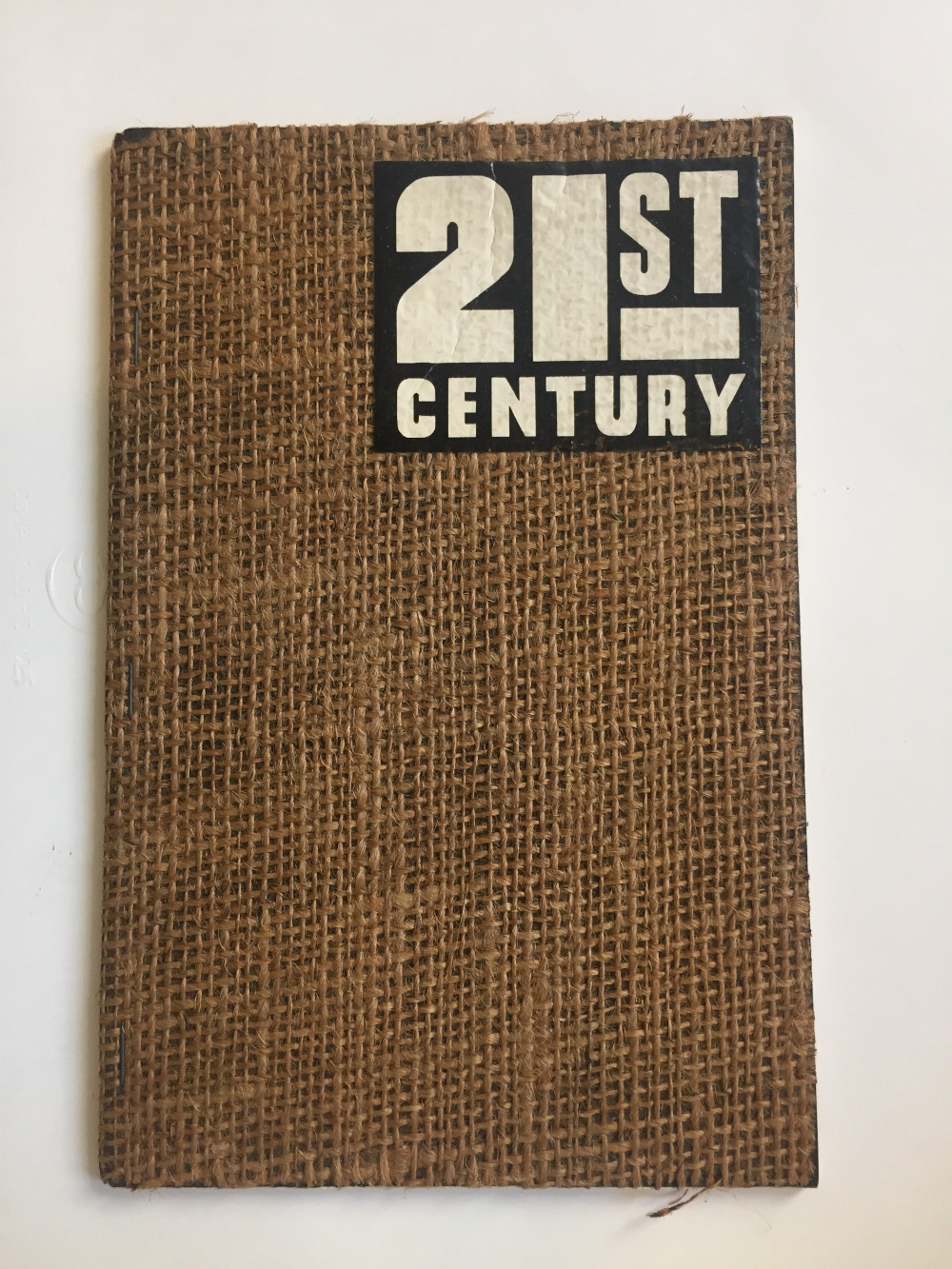
Figure 1: 21st Century: The Magazine of Creative Civilisation (September 1955). Edited by Harry Hooton. Design and Layout: Brian Ford and Margaret Elliott. Circulation: Corinne Joseph.

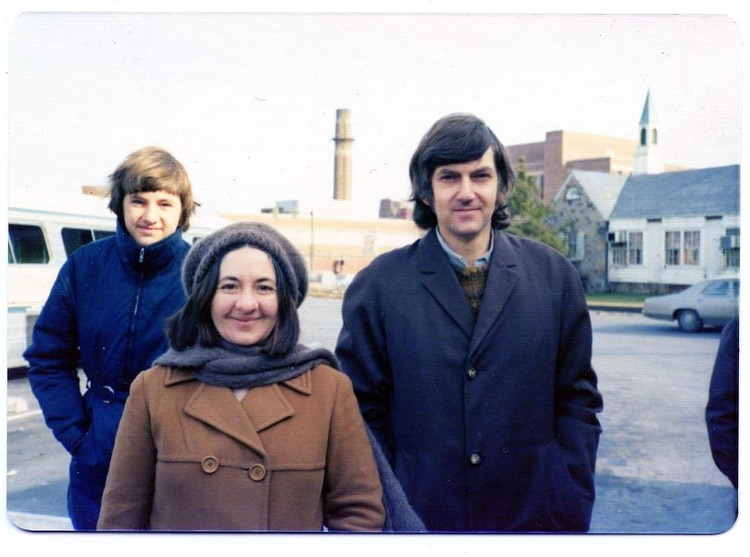
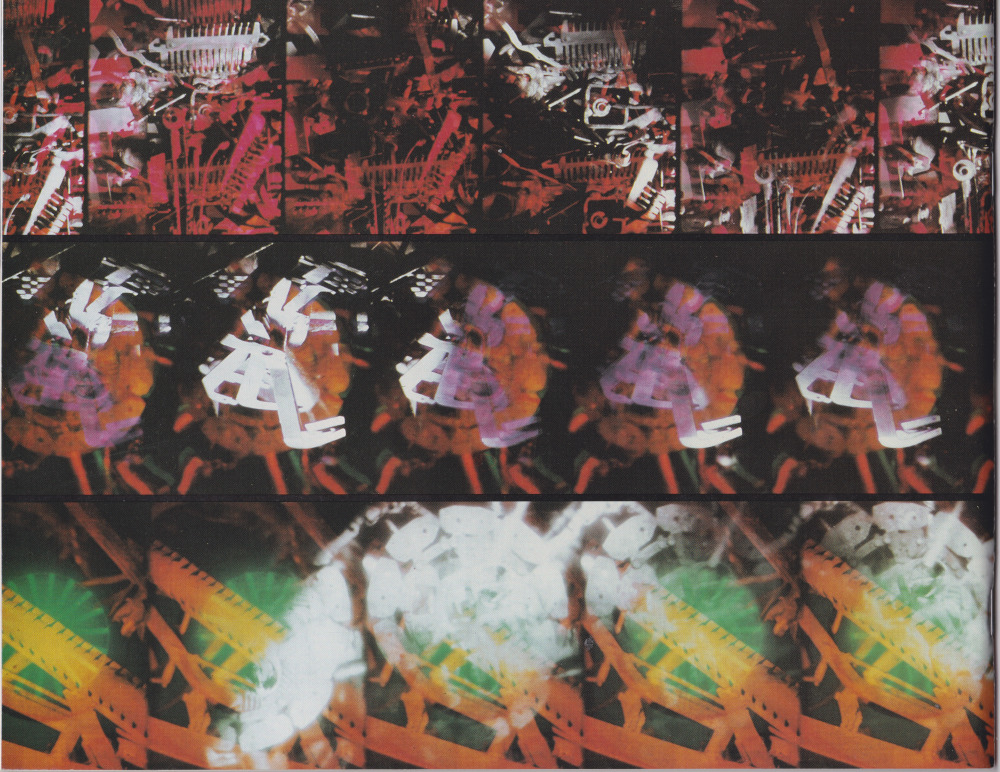
But only two issues of 21st Century would appear (the second in 1957, Figure 1). Following Hooton’s death, yet unbeknownst to them at the time, two of Hooton’s 21st Century collaborators would separately go on to have a significant impact on filmmaking in Australia: Corinne Joseph and Margaret Elliott. Joseph was in charge of the distribution of the inaugural September 1955 issue, Elliott the designer (along with Brian Ford). In 1969 it was Corinne Cantrill (née Joseph) who would make Harry Hooton with Arthur Cantrill, while living in Canberra, after having returned from a four-year stint in London. The Hooton film was intended to be a realisation of the poet’s materialist polemics: using direct film techniques, monochromatic light and hand processing, more than simply a biographical homage to the poet or a retelling of his life, it was an application of his thinking to the medium of film. In Harry Hooton, matter is the issue, the film-strip precedes the projection of light and the amplification of sound in the expanded field of the cinema as an audio-visual environment.2 Alongside the images, Arthur Cantrill composed a series of musique concrète using reel-to-reel tape processing – on a Revox A77 – whereby they understood the recording of sound as an instrument in itself. Their Nagra and Ferrograph machines allowed for feedback to mix into the synthesised sound. 3 Interspersed throughout the heavily abstracted and post-processed montage which organises the film, are audio clips of Hooton speaking as if from beyond the common grave in which he was interred; he had recorded 510 minutes of his poetry and philosophy to tape from his death bed, now available as digital audio through the National Library of Australia. The film, made 50 years ago, has since faded into historical obscurity. However, like the figure whose influence reached far beyond the poets and polemicists of Australia’s east coast (as Sasha Soldatow set out in the editorial introduction to Hooton’s Collected Poems in 1990), the Cantrills’s films have made a significant impact on a form of cinema variously known as ‘avant-garde’ or ‘experimental’ not only locally, but around the world, as recent retrospective screening programs of their work in Spain and Germany attest.

Artist-film and its relation to poetry is a principle concern of their early work, But the links existing between the practice and production of the two in Australia during the 20th century have not yet been established (see Laird). This may be because the Cantrills prefer ‘particular screenings’ of the hundreds of films they produced over five decades, and they have tightly control their distribution. Yet Harry Hooton remains important in that it represents a way into their fiercely independent work. It was screened in public as recently as June 2019 at the Arsenal in Berlin (see Stein). Furthermore, other than for the occasional presentations of the film, there is very little literature examining Hooton’s concerns for the 21st century, his poetry and philosophy of ‘Anarcho-technocracy’.


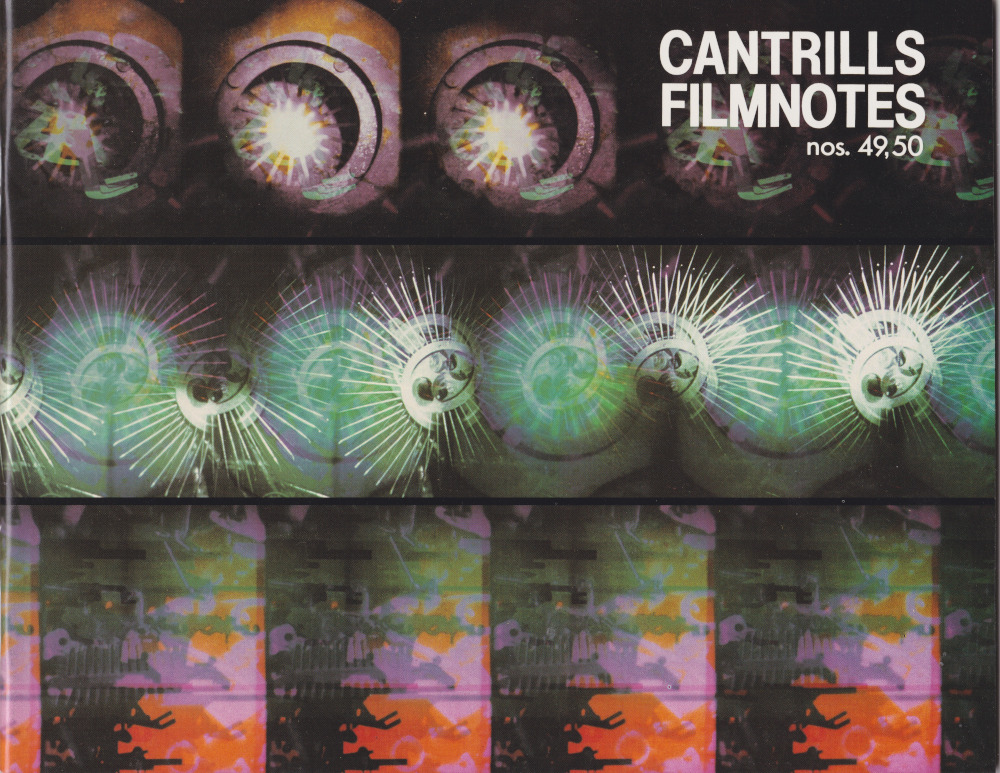
Figures: 2A & B. Front and back covers of Cantrills Filmnotes, Nos. 49,50 (April 1986) featuring images from Harry Hooton (1970) by Arthur & Corinne Cantrill.

Cinemapoetry

In 1986, on the occasion of the fiftieth issue of their journal, Cantrills Filmnotes, Arthur and Corinne Cantrill returned to Hooton, placing stills from their feature-length work on the front and back cover of the issue (Figures. 2a & b). The decision was self-referential: in the same year as they’d made Harry Hooton, they’d published a ‘Cinema Manifesto’ in the first issue of what would become a 30 year publishing project, by quoting Hooton there too: ‘LOVE MATTER TO DEATH, LET IT FEEL YOUR BREATH’ (Arthur Cantrill, ‘Cinema Manifesto’, 3). In 1970, the Hooton film had premiered at the Canberra Film Society, screening in the Copland Lecture Theatre at ANU on the 2nd of September. This was five years after their first ‘overview screening’ by the Brisbane Cinema Group, run by Stathe Black, which occurred before they had headed to London to work in film and television.4 The Cantrills’s first films appeared in 1963, cautiously navigating the conventional documentary and pedagogical forms (one early film, Mud, was shot in New Zealand at Rotorua’s thermal springs).5 In 1969 they had returned to Australia, resolved as to what they needed to do, the first issue of the Filmnotes appeared in March 1971, not long after the Hooton film’s premiere. In it they declared: ‘We want to make films which defy analysis, which present a surface so clean, so hard, that it defies the dissector’s blade’ (Arthur Cantrill, ‘Cinema Manifesto’, 3). Fifteen year later, inside Issue 50 of the Filmnotes, the Editors’ Comment reprinted the first lines of Hooton’s ‘Poetry’:

There are no rules for poetry
Necessity makes, and breaks all rules. (Hooton, ‘Poetry’, Poet of the 21st Century, 101).

Their aim for film was the reconciliation of form and content, and the enduring influence of Hooton’s unique mixing of poetry with philosophy presented itself as a significant and local model for how to do this. Furthermore, they’d both seemed to coalesce around and figure out how to articulate the energies emanating from the unique conditions that had produced the amorphous scene known as the Push in post-War Sydney.

During the Second World War, Hooton had come to believe artists were the truly anarchic figures who could thus be the ‘technicians’ required for the benevolent administration of things in the industrialised dictatorship to come. At the same time, a teenaged Corinne Joseph had taken the chance provided by the wartime economy to study botany as an unmatriculated student at Sydney University. Australian cinema during the war years was dominated by the films of Charles and Elsa Chauvel, and the adventure documentaries of Frank Hurley. Yet, as Danni Zuvela has shown, there are also a number of early films made in Australia that ‘illuminate the conditions leading into the development of organised systems of experimental production, distribution and exhibition’ of film here, leading to the moment in the 1960s when experimentalism would take flight (2).

Arriving in Sydney in 1948, the Czech artist Dusan Marek began to produce short films in the early 1950s, which were directly influenced by European Surrealism, in turn an aesthetic response to the totalitarianism from which Marek had fled (7). Corinne had travelled in Europe after the war – at one point working with the International Youth Brigade on the Dobuj-Banja Railway in Yugoslavia – before returning to Sydney and eventually working in childrens’ creative leisure centres (Pinguim). Meanwhile, Arthur Cantrill had met Hooton through his work in the same programs in Sydney in the late 1950s. By that stage Corinne had already been associated with Hooton through his publishing projects, and when, in 1959, she and Arthur were both moved to Brisbane to work with disadvantaged children during school holiday programs, they moved in together and turned to collaborating on filmmaking, which followed from the theatrical activities they had devised for children (Arthur had for some time worked in puppetry).


Figure 3: Front cover of Cantrills Filmnotes, Issue 1 (March 1971).

The other figures listed alongside Hooton in the first issue of the Cantrills Filmnotes (later it became simply Cantrills Filmnotes) are more recognisable as the artist-film luminaries that one would expect as reference points for such a journal. Fellow expatriate from the South Pacific, Len Lye, is there. The Cantrills had encountered Lye in Europe in the 1960s, and the link foreshadows their concern for the growing idea ‘pan-pacific’ artists in the global imaginary. Other canonical touch-points include Marcel Duchamp, whose Anémic Cinéma (1926) appeared on the cover of the first issue of Filmnotes, beside images from the even earlier artist-film Perfido Incanto (1917), directed by Anton Giulio Bragaglia. Bragaglia was associated with the Italian Futurists, and the manifesto of 1916, La Cinematografia Futurista, was translated at ANU and included by the Cantrills as the final text of the first issue of their journal (Figure 3)6 It therefore remains a quirk of this moment that the man they celebrate as one of their ‘mentors’ has since that time all but succumbed to the vicissitudes of a minor history. Hooton, as well as contemporary poets like Jas H Duke, Garrie Hutchinson, and Charles Buckmaster would come to provide the Cantrills with direct links to the performance of poetry in post-war Australia, even as they continued to explore new media, particularly on film and video. Most significant for this development, it seems, were the events held at The Maze, a countercultural venue for artists, for selling crafts, books, and even food in Flinders Street, Melbourne.

Posted in ESSAYS, SCHOLARLY | Tagged , , , , , , , ,

3 Amir Hamzah Translations

Amir Hamzah (1911-1946), the greatest Indonesian poet of his generation, was born into the ruling family of Langkat, a Malay sultanate within the Dutch colonial government’s East Sumatra Residency. Amir’s love of his native Malay language and its literary heritage, as well as his Islamic faith, developed in the cultured atmosphere of his immediate family circle, where recitations of the classics of Malay literature were a regular occurrence and where Islamic devotion was tinged with the mystical perspectives that had been fostered in the sultanate. This cultural background was enriched by a formal education, conducted principally through the medium of Dutch, which began in Sumatra and continued in Java, where he was sent to a Christian secondary school in the colonial capital Batavia (Jakarta). His secondary education was completed in Surakarta, a centre of Javanese culture, at a school specialising in Oriental Studies (including language studies in Javanese, Sanskrit and Arabic).

While at school in Surakarta, Amir was elected leader of the local branch of Indonesia Muda (‘Young Indonesia’), a youth organisation that supported the rapidly developing nationalist movement and the adaptation of Amir’s native Malay language (bahasa Melayu) as the national language of a unified and independent Indonesian archipelago (the Indonesian language, bahasa Indonesia). Despite his membership of an indigenous aristocracy maintained by the Dutch colonial government, he continued his active support of the nationalist movement and the development of the Indonesian language throughout the rest of his life.

Returning to Jakarta at the age of 21 to study for a law degree, he began publishing poems and prose pieces in literary journals and immersed himself in a literary environment dedicated to the development of a truly Indonesian literature. Quickly becoming a prominent representative of this generation of ‘new writers’ (pujangga baru), he was co-founder of the influential cultural and literary journal Pujangga Baru, launched in 1933.

Amir Hamzah’s vision for the new Indonesian poetry was for the revitalisation of a Malay poetry that had lost the spiritual and emotional potency of its traditional symbolism, as well as its inspirational connection with the heroic era of Malay history and legend. Impelled by that vision, and with a profound poetic sensibility shaped by the cultural, educational and linguistic influences outlined above, he produced a corpus of 68 poems, principally written in the decade between 1928 and 1937. Most of them were originally published in two special issues of Pujangga Baru: the collection titled Nyanyi Sunyi [Songs of Solitude] in November 1937 and the collection Buah Rindu [Fruits of Longing] in June 1941. Although first to be published, Nyanyi Sunyi is a collection of his later work, and is generally regarded as his greatest achievement.

While many writers of his generation found inspiration for the new poetry in Western (particularly Dutch) models, Amir looked to the East. In its October 1939 issue, Pujangga Baru published a collection of his versions of poems from Persian, Turkish, Indian, Chinese and Japanese literature under the title Setanggi Timur [Incense of the Orient], many of which are on the theme of the poet’s relationship with the Divine – a prominent theme in Nyanyi Sunyi. Pujangga Baru also published Amir’s translations (from Dutch versions) of the Bhagavad Gita and sections of the Biblical Song of Solomon.

Love and longing are at the centre of much of Amir’s poetry, in which the symbolic correspondence of romantic and spiritual love is raised from the level of poetic convention to that of visionary experience. The deep romantic relationship of Amir’s early maturity was with a Javanese girl whom he met when they were fellow students in Surakarta. That relationship – the inspiration for some of his most beautiful poems – came to an agonising conclusion when he was summoned back to Langkat in 1936 to enter an arranged marriage with a daughter of the Sultan and to fulfil his princely duties in the administration of the sultanate. Devoting himself to the faithful and compassionate performance of those duties, he abandoned the writing of poetry.

Amir Hamzah died in 1946 at the hands of militant revolutionaries. During the so-called ‘social revolution’ in East Sumatra, aimed at the dismantling of the sultanates, dozens of Malay aristocrats were indiscriminately and brutally killed in the sultanate of Langkat alone. Amir’s death, at the age of 35, has an aspect of tragic irony considering his active involvement in the nationalist movement, his prominent role in the promotion and development of the Indonesian language, and his outstanding contribution to Indonesian literature. In recognition of those achievements, he was proclaimed a National Hero by the President of Indonesia in 1977.

Posted in TRANSLATIONS | Tagged ,

PROPAGANDA Editorial

Loaded term: propaganda. Hardly the mild descriptive tag of its origin, the word now invokes visions of cynical manipulation, grand conspiracies to turn entire populations against their own interests and against each other.

Sure, plenty of coordination between bad actors is necessary to create and operate echo chambers algorithmically crafted to bum-steer misinformation directly through [to] individuals or the rampant incitement that disinformation spawns. But so much of the pervasive stench from today’s propaganda stems from the banality of dumb profit as greed and cowardice combined to form a most useful idiocy. At every turn in today’s social-media-directed [dictated] news cycles we get to observe and understand propaganda’s machinations in real time.

Lucky us.

Indeed, so pervasive is today’s machine that it may be useful to conceptualise poetry itself as a type of anti-propaganda because although it exists outside morality, poetry’s emotional hooks capture and funnel attention more towards cohesion than division. The urge to explore and craft language in this way is in itself progressive. Poetry can be seen as the rendering and promulgation of an interpreted shape of truth, where propaganda is a backwards-firing truth engine, one that smears us all with a rotten illusion of reality through a dreadful merging of information, manipulation and biases.

This distinction—of poetry manifesting as an antithesis to propaganda—can lead to the hopeful harnessing of poesis as a counteraction agent: a salve, if not a panacea. Works such as Sarah Temporal’s ‘[91 days]’ act as a clever neutralisation of logo-spin where the reworking of form is crucial. Meanwhile, Victor Billot’s ‘How good is this?’ helps to counteract the taste of abandonment during a recent national crisis where Australians were left bereft of leadership, truth, and info-transparency. Failure of leadership also informs Pascale Burton’s piece ‘There’s a Boom Up There (After Scott Morrison)’, which turns language manipulation into an absurdist toy, exposing the indifference of entrenched power. And then there’s the moment in Alisha Yi’s ‘Film #6: Eve in Vietnam, July 8, 1968’ where the haunting turn of phrase ‘No bodies mark our stay,’ stirs emotions well outside any propagandist’s range.

This issue is filled with such moments. The works here by their mere existence seek out propaganda, expose it, neutralise it, counter it. If you need reassurance that we are not beholden to our basest instincts, these poems are a good place to start.

Posted in ESSAYS | Tagged ,

3 Antoine Emaz Translations

The French versions of these poems were published in the anthology Caisse Claire. Thank you to Charles Rice-Davies for his help in proof-reading, and Anne-Sophie Petit-Emptaz for her kind words and encouragement.

A Poem, Without Moving

I

Within the limits of possibility, the sea. But already, with this desire for swells and air, like an improvement, a breath a bit wider.
Glued to the summer, a provincial town, whatever its name, far away in motionless lands. And the sea, up there, vast, due north, waiting.

A jar of grey sand: nothing else to find one’s way. Most often, it is enough: a jar of sand and a few rough grains stuck on the tip of fingers or on the table: one gathers these crumbs, making small heaps, and if the sea does not come on the table, it is not far, called out by the sand – maybe a movement in the sand again – one just needs not to see anymore.

//

A pinch of salt and the sea comes back in the body, the whole body, from the hand.

Not a memory, a swell made of waves; some seen, some gone from sight, an ebb of melted images, blended… From memory, a wave comes to the front of the head – past turning into desire – a head wave is going to break, one can feel it breaking, the limit of the image now, also dynamic, the hollow of a muscle, very quickly broken.

//

Another day here, a new patch of sky and it all starts again, bleak blue, dead quiet, summer. Lowering. Inertia. A limp head under the blue, and muggy air.

Wimereux, Ambleteuse, Slack… names of places, indeed, what else but mere names, without the water?

stark countryside packed town
heavy oak forests in a corner
truly
a lack of air

//

Here, without a movement. One keeps cool, inside, blinds shut.
The summer outside continues: stubble-fields.
In the north, tight rain, grey, the dyke and smell of seaweed. Drenched.
Or the flat sea and, sitting in a hollow of sand, a dune cheek, let the sea stir, brood over, far ahead.

Here, the heat on the town packs the already low and tidy houses a bit further down, their slate roof burning. The body flowing. One dreams of being close to deep water, to see its thick dark green, tightening the eye. To be on water, almost sleeping in a fresh muscle, curled up in tight and clear fibres.

//

Cliffs in the eye: dull colours, dominant brown, ochre, dirty beige. The story of a land broken here, clear-cut: at its foot, the sea beats slowly. Patience of a hand passing, and using. Like the limit of a body, the birth of a skin. Masses of green, masses of brown, some motionless, some moving, limiting each other, containing each other, this is roughly what comes to the eyes when, without seeing, one looks at the small garden, by the window.

the sea against
the summer

Very little grasp in fact of what happens in the eye. An image superimposing itself on the outside until it is deleted: it is almost mute except for a lapping sound, light, and far away in the silent house.

//

Sea: a mane of hair of course, undone plaits heavy locks unknotted slow train of a jellyfish, so easily, breathing water. Rippling, throbbing, moving hair, vast foliage… the image draws away, drifting out of reach.
A landscape out at sea: what cannot be grasped and embraced. Shapeless sea, neutral mass, moving. The image of a jellyfish comes back, with its long suite of thin hair.
Curls of murmuring sea foam.
Wrack, kelp, dead mane of hair.

Green seaweed, short loose hair, waving in thick water. Children’s words come back through these supple seaweeds in clear water. Currents, long invisible muscles grasped when the body meets them: a brisk cold, a warmth.

Here comes back more clearly and unquestionably what is experienced up there like a disturbing infatuation, a confusing pleasure.

//

The sea without a grip. Obstacle.
Somehow, no desire to cross through. A halt without any pain. Indifferent, and yet blocked off.
The wall, the sea.
Short-circuit-contact, there.
Was it the energy carrying? The sea has erased the summer: the sea is erasing itself now, losing itself within the forces. In mind, a neutral space remains, barely beaconed by stakes.

Strange journey, as if the image had come out of the eye but the town had not, nor the garden either, outside.

II

whatever the name of this town
far away in motionless lands
the summer holds it
fast
a street towards the sky
and the sun
tackling to the ground

down this street
empty
one waits

//

comes the wind first
and salt in the air
then water
words without a sound
in deep water
in mind a swell
lifting a large cradle
and memory weighs moves slow
swell of memory
a mute moving image

words the sea
fold
the street the sky

the summer bows

//

a wave another
erases

the heart calms down
and the body becomes air
in slow ripples

green water
here
nowhere

no further words like
the breeze
undone out at sea
in water and air
free

//

slow is the night coming
and resting the town

ebb

one gathers

the street is blue

Posted in TRANSLATIONS | Tagged ,