The Fish-Twins

Their numbers rose as the oceans reclaimed
lands that were closest to its wet borders.
The reports—initially laughed at in the cities—
first came from rural coastal towns.
Women giving birth
to twins: one human, one fish.
As the infant survived, its fish-twin vanished,
never to be seen again. Some said
they died, unable to breathe on land,
some whispered they were killed and
buried in shame—no story’s the same.
Midwives and physicians were baffled, then
became dismissive. Mass hysteria,
someone in authority opined.

It didn’t take long for someone to record and upload
something on social media. The grainy and shaky
video managed to show something tubular
and gray slip from the old hilot’s* hands
into a basin of water.
The mother’s screams rang like bells.
A man stormed into the room,
shouted at the person holding the camera
and grabbed it, ending the footage.
The internet went ablaze. No one was
laughing anymore. A public health crisis
declared, experts and epidemiologists
worked to make sense of the phenomena
but found no answers.

As more islands sank beneath the waves more
women delivered twins of human and fish.
People’s violent reactions simmered
into nonchalance—as always—except for
the few times when the fish survived
instead of the infant. Coastal villages
moved inland as the ocean swallowed
their homes. The elder folk declared
This was just nature trying to check
and restore balance.
“We all clambered from the sea,”
one said with confidence.
“And that’s where we’re all going back—
Sooner or later.”

Weeks later, a fisherman was arrested for
his daughter’s disappearance. The child
had been sick a few days. The mother
went to a relative to borrow money
for medicine, leaving the toddler in
her husband’s care.
He was crying on the beach when she returned.
Distraught, he said his daughter suddenly
stopped breathing and as he held her up
her neck opened up like fish-gills.
By instinct, he took her to the water, which
revived her instantly, and she quickly swam
away, as her rumored twin-fish sister did
barely two years ago.


*Hilot – traditional birth attendants in Philippine rural communities

Posted in 95: EARTH | Tagged

Giant Rainforest Snail

Hedleyella falconeri

What formuli are whorled inside
this home you sculpt out of your self:
secretions that belie the tensile
properties of bone, in favour of
a spiralling fluidity of form –
your nautiline and perfect exoskeleton.

Slower than aquatic counterparts
propelled by tides and brine,
you ponderously inch your way
across millennia, humbly yet
with dignity, terrestrial cartographer
of ancient forest at the crater’s rim;
slow-moving in a world obsessed
with speed, you forage after rain,
a fungivore whose home base
is the forest floor – time’s denizen.

Posted in 95: EARTH | Tagged

Early Evening at the Coal Plant

I was all alone at the coal plant. The final hour of the day had gone by quietly, like a horse wearing slippers. As my co-workers processed out I said: bye, Rolf—bye, Elaine—bye, Barry—bye, Ed—bye, Lakshmi. No one made me leave even though I was never the last one out. Where was the night shift?

I didn’t know if I should stay or go or what to do, so I watered some sick plants. I rolled a screw in slightly unpredictable circles on a table. This made me thoughtful. I thought about how I had got work at the coal plant by accident. My one real qualification was that I was very good at shovelling. If I had made different choices I would probably be shovelling manure or shovelling snow or shovelling soil into graves. I imagined that scientists who wind up making biological weapons must feel the way I do, that their powers have been misappropriated by shadowy forces. Scientists and me, both destroying the world against our wills, like rice water foaming out of the pot.

I decided to ring my parents, to confess or receive absolution, I guess. Answerphone. ‘Hi, Mum and Dad, this is Gordon. Sorry I didn’t phone last weekend; smartening up the house for the sale is taking longer than we thought. I was just wondering if you think I’m a horrible person and if you think Janie would like a cricket bat for her birthday. Love you. Bye.’

Posted in 95: EARTH | Tagged

The Waterside

You do not want to be a monkey,
you say.
but there are facts, I tell you
to be faced—of anthropoidea
how we got here
by way of water
that it was the sea that made us naked
not the hunt
how our descent was anti-terrestrial
—an ascent, from the silt upwards
and that our hunger was for salt
not blood.

But there are things we prefer
to deny
the lateness of our rectitude
how defenceless we were
in our eternal infancy,
slicken and blubbery as seal cubs
that we swum before we spoke
our minds born of algae
and how we waded, heavy-bellied, maternal
through swamp-weed
to prize open shells with
the same blunt-fingered hands
you now interlace with mine
and how, when I lay them on you
wanting to lick the residual traces
of its brine
from your hairless flesh
I am in more parts animal.

But there are things it is easier
to forget
like how deep it drew us
how far out we went—
our second nature
the ease with which one can rise
to two feet
and walk away
from the water.

Posted in 95: EARTH | Tagged

in the event of a lack of oxygen

HOLD the earth in your hands / be careful––she is hot / talk
to her tenderly the way you might your mother at the end of
her days / honour her / place her somewhere she might rest/
perhaps the mantle piece between your bone-china swallow
mid-flight & your fake brass barometer the shape of a ship’s

wheel that will not steer us out of the storm we are in /
despite her dishevelment, tell her how lovely she looks /
offer her tea / a scone / horlicks if it still exists / slip her
feet into soft slippers / massage her shoulders rounded
from the burden you have placed on them / cradle her in
your arms /

now go to the mountains / yes, go / facetime will not suffice /
tell them you are sorry / return with no selfies––this is not the
time / now go to the rivers / listen to them / let them tell you
their stories / do not interrupt with your lies about your
recycling / like you are not guilty of slipping glass jars

& clean cardboard into the wrong bin / now get down on
your knees & beg their forgiveness / do not worry their
banks are no longer muddy your levis will stay dry /
understand in the event of a lack of oxygen no yellow
masks will drop from the sky / remove your stilettos /
leave all your personal belongings behind / tip toe

past earth’s bed / leave a note under her pillow / apologise
profusely / tell her you’d drunk too much / that you weren’t
in your right mind / that you didn’t realise just how much
you’d loved her till she was gone /

speak when she speaks to you / if your shame will allow
it make eye contact / answer her questions with an honesty
that will feel alien to you:

yes we had ample opportunity / yes money
was more important than water & air / yes
we’re tired of our empty promises too / yes
coal yes carbon yes methane yes plastic /
yes dollars yes pounds yes euros yes yen /
yes vegan yes sweat shops yes you warned
us no we didn’t listen / yes we saw the signs
yes we ignored them / yes the bees are in
default / yes the banks are foreclosing their
hives / yes we should have planted more
lavender more rosemary more bottle brush /
yes flooding yes fire yes species extinction /
yes we should have been kinder / yes we
should have stopped to think before we
fucked her / yes we should have pulled out
sooner / yes oral contraceptives yes STDs /
yes we should have used a condom /
yes we are sorry / yes
look at this mess now.

Posted in 95: EARTH | Tagged

gilayn manday (high tide)

gilayn manday (high tide)
manifest as tears, he finally came
my spirit was drenched in him
like he come up to hug a brother
this bingay (older brother), him quenched a thirst vengeful
sated scorching anger
girambit (salt-water) salving sorrow, a bit;
this rising up inside over 232 wayibala (white fella) years
is a rage for which english fails –
      yii Gathang-guba bakaaba!

baal baling wuba giwi bali (don’t extinguish fire, not dead)
will never be extinguished
is everywhen
but wayibala no listen
nganda giripundu bulbarii yiiga barrin!
like a torpedo fish rising up out of the water, then goodbye net!
wayibala-guba anti-depressants, bari – (go –)
wayibala-guba counselling with strange uncles’ I don’t fucking know! yiiga! (goodbye!)
wayibala-guba ‘antipodean’ philosophical survival cum nihilism: weep,
wayibala, weep
it all away! and sob
over the guttural
dirge
that gilayn manday plays
as he come all ways –
nyuguwangay (with him)
I found strength
burray, ngarin, (boy, older sister)
all same
nyina bari nyina barra
they all sit, go, sit

bambi birriwal, (make fire strong)
ngarramba (make know)
burning, barragay (with me)
resilience; bumbi watha! (blow the fire)
blow the fire!
much older than
you think everywhen never strong?
grow up, wayibala
grow up knowing that
these tears come also for you
they cry for you and make us both come strong
ngarramba birriwal (knowing is strength)
the whole is in all parts
all parts tell me that
but you only recognise since last week, wayibala
learnt from an aunty you never meet
bilbal bakanda nyukang buwi (writing on stone, aunty dead)
bingay, he come, somewhen go,
through fire regains

it’s getting late
the tide retreats
spirit remains

bimaygal gagil
gilayn manday bari
nyara nyina

Italicised words and phrases are English-phonetic Gathang, a language shared between Worimi/Warrimay, Birpai/Birrbay and Gringai/Guringay mobs, NSW. In Gathang, gilayn manday is a noun-like term, and is referred to and recognised as an entity.

Posted in 95: EARTH | Tagged

rim

you cup your hands. hold and press them to your face. waiting for something to appear – a voice, an image suggesting what to do next – like a child hiding her face in the warmth of her own hands. a little cave or theatre of destiny.

~ ~

if you’re a black tea drinker you’ll know how hard it is to get those marks off the sides of your cup. you scrub and scrub. but you keep on using it, the stains become private history. with the evolution of the t-bag there is little loyalty to the practice of reading the leaves. you too have succumbed to the white silences of the bag.

~~

you remember those tiny clay cups used in india for train travellers at stations. a richly brewed tea handed through the window by the chai wallahs. you noticed discarded broken cups scattered along the tracks. you kept your cup for a while and then it vanished.

~~

the image of that styrofoam cup deserted on a bench at the gym. that cup with its rim coated with an imprint, a large smudge of red lipstick. week after week. regardless of a bin nearby. the female equivalent of the male leaving the toilet seat up. but can they be compared.

~~

that great mound of cups. paper, synthetic. that huge pile of rubbish, the rubble of our throats, looming over the city. choking the spaces in between cities. an ‘avalanche’ in waiting, as calvino called the discard society’s legacy. could anyone make trompe l’oeil dry stone walls from such cups. to line the edges of freeways and overpasses. look, aren’t we innovative. what magican would do it.

the listless thrill of the discard. no washing up no cleaning. a careless convenience soiling the earth.

Posted in 95: EARTH | Tagged

Lullaby

Before the divine inventions of dawn
& grief, before all bare beginnings, there
is the body’s intention to sing.
The river wants to hear it
& so does the shadow abandoned
by its owner under the chestnut tree, waiting
with its palm extended in supplication
like the vagrant in Brueghel’s painting.
Here in the garden, time waits
like the slowest fire while autumn dies
in eddies of gin-clear amber.
Having planted my voice here in the garden
by the end of last spring—where I’ve prayed
for harvest but the soil remains
stubbornly fruitless, I can no longer sing
yet the night air parts before me of its own accord
like water cleaved by vibration
& through its sheer blue curtains
drifting apart, I can make out the snow geese
lifting the cold songs of their bodies—
unimpeded by hunger, nor by their dresses
of damp feathers—toward a light
we on earth no longer believe in.

Posted in 95: EARTH | Tagged

That Summer in Montpellier, the Botanic Garden

1

patois tumbling Occitan, Latin, Arabic, Hebrew
Muslim, Jew, Cathar, Christian

left a wingbeat in the sky to return to later:


cicadas chirring in their dialect

a sign, Jupiter becoming Saturn perennial becoming bush

liquidambar

black ants foraging for red blood

noonday sleepers on benches of dust & stone

two gardeners, hands on hips under the only unlabelled tree after searching patiently
for an hour for seedlings

raked path edges which tell of markings of desert scriptures of distant sutras

some dozens of hundreds of the fruit of the mulberry Morvus alba which fall are
falling taken only by birds

those same mechanic cicadas whirring lower than shrilling jinking soaring coasting
wheeling swallows

the bell tolling sixty seven times at seven in the evening


wandering the length of the flaneur twilight


2

hills, the long purple evening hills

& into darklit Theatre of Anatomy

what we should not see they say

dark closed-room aborted secrets

cut apart, torn, ripped from life

palpitating, flayed, stripped from ourselves

to ease apart the skin

to pull apart skin

to ease over the muscle

to send the knife where it will

to count throbbing organs

& the chambers of the lungs

moon bitten eaten cancered by clouds

shrivelled pain held in alcohol

in aspic blinded in vitriol in glass


the light then the lights of a distant town

the pine in Gerhard Street which enjoys

singing its cicadas


3

there are many reckonings
I counted them
she is on a bicycle with eleven parrots
she is on a scooter with two dogs running
she is on a stone stair with a lizard
she is alone with how many hands
what does she hold

open the light


4

as Garden Directors become bitter
jealous, then stone:
Rondelet, blind
Pelissier, priest, blind
Belleval, debtor, blind
Sauvages, blind
Dunal from a distance appears to see
spiders in Granel’s sockets
Galavielle with webs & pine needles in his
Martins, empty sockets
Planchon, eyeless


5

it is forbidden

among other things
speech

we listen carefully
heed little among tongues

the grass
is forbidden

poetry
is a kind of music

you must hear it in
order to judge


6

in the nothing
in the unclear mind
in the going & coming
of water lit sun
shafts under trees


7

what can be
brought from here

a thousand seeds
a thousand words

a thousand arms
of compassion

peace, cicada
peace


8

rooted in perfection

lotus maple osage

& the Judas tree

unassailable perhaps


9

a twentieth century story
of noble birth
surviving revolution
fleeing war
though not wealth
resorts to painting
what’s abstract to you
Zao says
is real to me

an old tortoise
finally in mud
what he likes best
next to painting
is to smile


10

mouth full of stones
olives of the region
cherries of the region
fill my mouth with songs
with song leaves


11

the music
& here’s the diamond
the heart
drops of water
beads of water
pearls of water
stones of water
tears of water
blood of water here

the fountain’s turned off at six in the evening
there, it is kept turned off


12

shadows
traced in sand
& bells pealing

fading


13

yarrow
tansy
poppies
plantain
sow thistle
arnica
knotweed
all-heal


14

the trees, once human
Bacchus, Jupiter, once divine
become bitter, jealous
toes thrust into myth & story
become paper & word
written

Thracian women see
cracked wood spreading
along their soft thighs
root as Oak

a foul mouthed shepherd’s voice
-box grown rigid, gnarled
what’s left of his tongue
become Olive

the Sungod’s daughters
tearing hair for a dead brother
tear Poplar leaves
poplar bark closing over last amber words

to be remembered
when seeds & leaves fall
into my lap &
stick in my hair
where doves come to sip

where fingers
reach down into soil
hair become willow
Rabbi Dov Lior, bitter
jealous: a thousand non-Jewish
lives’re not worth
a Jew’s fingernails


15

under the swallows
beside the garden

is the tramcar
direct to Odyssey


16

not a new game, destruction
what’s in a name, Valéry?
a garden of epithets
a dictionary garden
what do they not see
no independent arising
our garden is whose desert?

what’s in a name,
Rondelet, Pelissier, Belleval?
between tongues
a dictionary falls from lips
a self-naming
a transhumance of people
refugee
after their own horti
culture
drawn on Tassili dune caves

Sauvages
what shall we say to Lior
to Saïd to Yousef
to Lbou to Hassan
Chani, Abdelhak & Tibou?

In another room
a man sings
softly oh oh
eh eh tomorrow
eh eh tomorrow

& falls asleep

a jet passes overhead.


17

something like history slips in
dogs bark & drop delicate turds in the street
virtuoso musicians & jazzmen
strike up in squares where
we dine on terraces

something like war elsewhere

in another room she sobs
she sobs, heart become pebbles
her sleep will turn mosquitoes
into droning planes


18

the whole of July

doing what
a taxonomy of reality
recognition before thought

yesterday’s flower is
no more
is to see the impermanent

as permanent
mind traces today in flower
unnoticed before

delicate white
starry jasmine
Trachelospermum jasminoides

white pink apricot red
oleander
Nerium oleander

recognised not described
lotus
Nelumbo

today the cicadas
are reborn as cicadas
their old skins abandoned

lives walked away from
on tree trunks
the cicadas

are climbing out
of what
they would not recognise


19

he sings of his hidden house
in the lemon orchard

I also have a little house in a garden
just for the present

I talk to cicadas
& the fish in bubbling water

also talk of love
among these flowers


20

in another street he sings
I’m chocolate, chocolate that’s me

our frailty as people walking
our oddity dreaming

those who sleep soundly
are the jailers of the street


21

our aim to wake
another going round
we’ll grow a revolution
we’ll grow our own tongues
a lilting an utterance
sage & rue
whole vocabularies
of grapes on the vine
each fig’s a proverb
each mulberry a lyric
red tomatoes small sweet nothings
a thesaurus of cherries whispering

names cannot be sold
only given & received

*

it is July 14th in this
Year of Grace

he sits in the street
singing still softly

his feet are carefully
folded

into old soiled rags

*

Raimon d’Avinhon
caustic trobador:
a servant
meat porter & hijacker
ruffian & trafficker
fisherman & horseman
friend of streetgirls
thief & rat catcher
stonemason drunkard
baker & writer
milliner & grocer
maker of weapons of war
swine herd
bin raker
fool to those who believe it
sage to them as find him so
a good physician
when it’s time

Did we walk the streets alone
ranting loudly each to himself
anger at our livers

Did we play Roma violins for cigarettes & coins
& abuse

we know oud was played
in the Theatre of Anatomy
& gargoyles of the old cloister gaped
& we briefly applauded the

divine in music under a new moon
shining on the west rondel of the Cathedral

& the stars the stars.

Why is peace forbidden?

Did one of us walk seventy feet up
along the acqueduct ledge
gesturing, muttering, throwing
down random wild flowers – weeds
upturned faces at pavement cafes
a pause in Midi Libre
not wanting to jump
but there anyway

Did another sit patient, begging
in that square
dedicated to the Martyrs of the Resistance
pennies in an ashtray
marked 3 centuries


22

wintersweet
sorrel
equisetum
daisy
dandelion, that piss-a-bed
sedums
ferns
simples for cures

what simple for cloudwalking
on acqueducts

sweet winter rains
now’s the time

*

migrating
coming & going

better
to listen than talk

what
is a state of mind

leaning
back in the chair

soles
& heels flat against a cool wall

shrilling
of cicadas striking hot stone

grove’s
interiors

shapeless
shapely the mind learns to walk

shadows
of bars on the insides of eyes


23

dust
& the very planes of light

what
is a state of mind

tight
right into the heart (it moves)

&
gone with the dappling leaves

green
chambers of sunlight


24

garden riddles

who stole the stars
& dropped them in the dust?
jasmine

who stole the sun
& gave us each a piece?
the orange

who stole the rain
& sent it straight up again?
bamboo

who stole water
& turned it to wine?
the grape

who stole time
& sent it spiralling?
snail

who stole our labour
& turned it to gold?
the king

who stole the gold
& gave it liquid flesh?
koi carp

who stole the fattest carp
from the king’s garden?
the hanged man


25

at night
back from sleep

I ask droning mosquitoes
to bite me

leave alone
flesh of the one I hold


26

I’ve counted the measure
of the plane leaf in fives

each not one but
not in its own tongue

it wasn’t rain but
pattering of zelkova

seed & green distressed
by wind & heat

size of raindrops
dusting the place of trees

*

to consider form
the whole long leaf

lit afternoon
considering seeds

*

to consider time
the cicadas chirred

three times a second
for endless minutes

on edge
magpies at counterpoint

*

clapping game of a mother
with her daughter

syncopation of water
striking bamboo

& reddening
pod by pod day by

day along the month
of Italian lilies

to send a blaze
through woodland floor


27

one noon in another
room in open air

with a handful of
hot radishes, some bread

cracking almonds, drinking
wine dregs,

in the mouth of
Arnaut Daniel

il miglior fabbro
Occitan:

it’s better made
in mother tongue

& the alouette
cackled at that


28

eyes dance with leaf
the other side of veins

petulant, the sun king points
to clouds once more

with moon
beyond his reach


29

one two three four
five six seven & eight times

shadow of moving water
shade of a singing voice

sleep is the bridge
to mother tongue


30

herder of hills
little runner of waters

what is emptiness

Roch, in the seventeenth

year of his age, not yet a saint
set out on pilgrimage

to a place older than God
older than that grove

at the source of the Verdus
where Diana bathed

(& for setting eyes on her
turned another to a stag

torn apart by his own hounds)
& simply helped

pustulent sufferers
of the black death.

Roch, no spring in his step
but autumn revealed

the way he took
the road which walks itself


31

here water leaps
toward frog kingdoms

ponds swallow
with a smack of lips

in a republic of water
all princes end

their days squatting
under the meniscus

jumping at
every common footfall


32

plant misery
harvest anger

heart of a heart
in the old city
a garden
in the old garden
an old tree
its old trunk grown in
& clasping itself
writhing with a hundred eyes
& gargoyling wooden mouths
arthritic mother’s skin
stretched luminous over bone

in old mouths
wishes are posted
paper scraps

I have need of money

I hope to be serene

for the health of my family

I want a job

that my sisters stay happy as I left them

love & prosperity to the end

Diderot, I hope our story continues

peace in Israel
peace in Palestine
peace in Iraq

who thanks the tree
with leaves of tongue

in the old garden
in the old city

that those I made suffer
may forgive

the practice of compassion
compassion


33

holly-leaved oak
mulberry with plane leaves
tansy-leaved phacelia
whole-leaved jaborose
lamb-leaf Tartary

maple with leaves of ash


34

to sit where
the salamander sage

creeps out for sun
sage of the Himalayas

sage of the Nile
sage of Iranian mountains

sage of Turkestan
sage of the woods

sage of the boreal
morning


35

remember that first night
you left before dawn

here in the shade of trees
day never breaks

Posted in 95: EARTH | Tagged

Brimstone Villanelle

All the sulphur of experiments and gardens of explosions and purifications,
the Golden Splash Tooth the subceracea light of the shades and the damp
and the sun’s show-through the mimicry of light and shadow-skin.

Sun’s action is beneath away from its eye as under and under the canopy the fallen
wood rotting trees offer conditions and protection, the fungus grows as the gleam of a lamp,
unto the sulphur of experiments and gardens of explosions and purifications.

For the extraction the greed for the element of star formation
for the contradictions of the elemental body’s desire for a soothing burn a universal stamp?
And the sun’s show-through the mimicry of light and shadow-skin.

Such inversions such cravings to make the chemistry of animation,
and to find these sulphury residues on wood piled in a dry place at a stable temp,
all the sulphur of experiments and gardens of explosions and purifications.

The hydrogen sulphide gas the sulphuric acid the fossil fuel by-product variations on brimstone:
and all around in every seam and crack across every surface the wattle pollen encamps;
and the sun’s show-through the mimicry of light and shadow-skin.

For the pollen is the yellow time is the sulphured light we sweep to horizons,
the golden splash tooth meteorite heatshield in darkness reminds us, too, and ignites a swamp,
All the sulphur of experiments and gardens of explosions and purifications,
and the sun’s show-through the mimicry of light and shadow-skin.

Posted in 95: EARTH | Tagged

Two Meditations on the Ecology

1. Siple Dome

After three years of drilling, we reached

bedrock, two-thirds of a mile under

the humpbacked bulge of winter.

Each season, six fresh inches of ice


put us closer to Jesus on one side,
machinery to whatever else on the other.
Sometimes the scientists gave us trash
chips to splash in our gin & tonics

—

you could hear bubbles of air & ash,
dust that’s fifty thousand years old crack

& pop. There’s so much pressure at bottom,

it squeezes a whole century into an inch-


thick wafer of time. Neanderthals roamed
Europe. Homo sapiens still hadn’t left
African plains when that sliver of core

was last exposed to the pale, thin light.


Now pieces break off the Antarctic cap

at rapid rates & float out to sea. Coastal

cities could be swamped in just a few

centuries. Sure I was drunk, but one


afternoon after work had stopped, wind

sliced through the rigging, & I’d swear

I heard singing. It was the last day

before the end of what passes for summer.


We’d soon leave for home. I spit a nickel

I’d kept warm in my mouth down the shaft

& wished. With every hole that’s opened,
we fill, or hope something will come out of it.


2. The Whale Gospel

Whales have run aground off Cape Cod again.
What if God created them for us as metaphor?

How like us they are, beached and prostrate,
sand shifting under them with every wave

from heaven. Bloated and murder to move,
they slowly rot in the blurry sunshine, victims

of distress we can’t fathom. All we can think
to say is beware the giant squid, the seaquake,

beware sickness in your leaders. Beware the dark-
eyed shark, sonar’s ping and Japan’s traditional hunger.

The rusty bows of ghost ships
                                                are singing through the water.

Posted in 95: EARTH | Tagged

Blue Whales

How they are comparable to
the biggest dinosaurs that once lived
on this turquoise globe; titanosaurs
and argentinosauruses, ranging
from tens to more than one hundred feet
in length. How they swim using
their tailing flukes and pectoral fins below
the surface of a jagged edge, only
making a grand entrance, twisting
their obese bodies and flashing their tails
feet-high in the air. How the blue whale,
the Sinatra of the ocean, whose
crooning songs, glide through air & salt,
marking an elaborate mating ritual;
how they roll and rocket up to air,
while spearing out gametes.

How the birth of a baby whale, is no fluke.
It is marked by a journey of thousands
of miles, to warmer equatorial waters,
and a return to the habitual hunting ground
of shoals of krill, flapped to the mouth
by the two prong fluke. How the story of
a blue whale mother giving birth
to her calf, captures our imagination
and attention; a tale of a birth canal
and the freedom of realizing,
that the sappy soap of child birth, has all the elements
of a Nicholas Sparks novel; twists, turns,
mush and a sentimentality that
makes grown women cry, seeing
a baby whale being born.

How a mother whale shelters
her calf, as she lets him be carried
on beneath her blubber belly, sometimes,
pushed to the front of by her snout,
knowing that the difference between
soppy and sloppy, is survival.
How they roam the seas together, singing
the songs that make sailors at sea,
think of their wives at home, tormented by
sightings of fluking, distracted in
mind, to entertain mermaids.

A juvenile whale calf, who by instinct,
leaps high, spins and turns the torso,
lifting his fluke, only to dive below,
like a spinning ballerina, after an airy jump,
which amasses the whale faithful, to
watch from the nearby hull of a lookout boat.
How the first breath is always special,
to a bantam weight milksop,
still sopping on his mother’s milk,
knowing that his calcified milky-white spears,
were lost to evolution, well before
the ontogeny of baleen; sheets of armor,
draped down from the upper jaw,
made of long tapering tassels,
frills harvesting krill.

How a blue beast is more of a beauty,
like a doming turquoise mosque high above
the Istanbul skyline, as we, the ones,
inspired or mad enough to chase whales,
are gifted with a truth, that befalls us,
like an earth-bound flared asteroid,
kindling something deep from within us.
The math of calculating the sheer numbers
of miniature shrimp that must perish
to build a monument of flesh,
padded with body fat. How the fasting diets,
deplete whale blubber, one chain at a time,
as they migrate from frigid polar waters,
to latitudes of the equator,
to beautify a blue heifer,
transforming her,
into a cow.

Posted in 95: EARTH | Tagged

Tipping

They say the world is teetering on a point

we’re tipping

as an aurora rinses the sky

penguins waddle across the Titanic’s downfall

i remember in the movie we watched on the plane

my heart beat fast

first to die were the boiler room shitkickers

shovelling coal fast into the teeth

of the giant engine room

but they’re only the seen ones …

not the arctic indigenous tribes

that the scientist talked about

(they fascinated us)

who tried to visit ancestors graves

instead got trapped by melting ice

still
light hanging onto the rim of the earth

like a saucer

a perpendicular egg caul

while on the other side

Rinehart and Morrison snorting coke in the same glitzy ballroom toilet

that last line was designed

to plunge a needle into the veined aquifer

and extract liquid power

Posted in 95: EARTH | Tagged

notes on a so-called sydney summer

                                                vaping
                                                                                                         while driving

*
before they opened the floodgates, expecting more rain, townsville’s dam was at 229% capacity— a crocodile spotted in a flooded suburban street “why can’t we just pipeline that water straight down to the murray-darling?”
*
In Absentia Absent DJ DJ in Absentia
*
it was a tactile, hazy day in so-called sydney: the street closing in on itself, creating a loop
*
saw an article in the new yorker about juuling— in high school bathrooms, kids vape a pack-a-day worth of nicotine one tells the journo, “dude, we all gonna die anyway”
*
bamboo toothbrush bar soap bar shampoo paper packaging, glass jars & whole foods carry keep cup, water bottle, fork
*
“‘professional activists’ blamed for high schoolers striking for climate change in ‘disgusting political manoeuvre’”
*
tuesday morning I hear someone rummage in our bins for bottles for the 10c refund I go back to sleep
*
I describe my bed as “palatial” you read from the dictionary (so sexy): “spacious, splendid”
*
a vegan kills cockroaches in her bathroom while her guests sleep— flushes their little bodies down the loo
*
“before you came, all our packaging was biodegradable, our food organic & pesticide free”
*
it is now may. come what may (?) a few blasted mozzies still out—never seen this late in the year
Posted in 95: EARTH | Tagged

Greta Thunberg Ode

children the size of adults
pester me with questions like

how big is your carbon footprint?

I mean yes
I’m a minor poet

not a major corporation

but I’d still prefer being
taken to task by someone
with a stake in the future

over being taken to court

watching the lawyers
stride in
& out of the stone building

from the shade of this
frankly arrogant tree
resplendent with carbon

there is a whiff of the
entitlement that comes off
a certain kind of person
who when asked

still or sparkling

answers

sparkling
or
something equally
as bougie

—is firing off tweets
as bad as burning down
forests?

I mean
I get it
some kids don’t want to have to
think about the anthropocene

they want gazelles
jordans

they want supreme

I
on the other hand

grew up
climbing trees

barefoot & in rags
swinging off
the fig trees
outside the zoo

a real Mowgli figure
of inner suburban Adelaide

imagining the tree
was my mother

or at least the female
tree-character from
Pocahontas

(…Grandmother Willow, but I had to IMDb it)

when
you stop to think
for a minute
that’s a strange film

I mean
from a contemporary perspective

there’s settlement
& the reek of entitlement
not to mention
the extensive
land clearing

plus it stars

Mel Gibson
before he got cancelled

for saying those
awful things about
Jewish people

—my point being

can the market
really be relied upon
to even all of this out?

to absorb our
stupidity
the way trees
absorb our carbon
from the
atmosphere?

can a pouch of tobacco
costing $36
really stop someone
from smoking?

can e-cigarettes?

can this 36 degree day
lived here
that could be anywhere
somewhere in
the golden age of capitalism?

golden
in the way that
a plant turns golden when the sun
had voided it
of its moisture?

golden
in the way
we tend
to convince ourselves
things are beautiful
even as they’re
dying
right in front
of our eyes?

I’ve been
having better conversations
since accepting this
perennial state of
emergency

reading about the school
protests & watching Greta
Thunberg videos on youtube

accepting the
solution will not be simple
or easy

as unpalatable
as it tastes

this soy latte
is not the solution

with the newspaper
in front of me
which I’m sure
almost no one my age
or younger
is reading

the editorial suggests

maybe plant a tree?

or get a sodastream?

failing that
their logic would
advocate

just go back to work
as normal?

& if you don’t have a job

buy one?

Posted in 95: EARTH | Tagged

Concerning Divination (2)

For most of my life I’ve been right
about omens. Salt, ravens. Red skies at morning.
Rocks thrown against the wind. A six
pack ring found in the vicinity of a sparrow’s nest
suggests three loves before marriage. A robin’s egg: split
ends. Stones skipped over an oil-slicked lake are lucky—luckier
still by an evening bonfire, flame
licking the corner of a clamshell
punnet of strawberries. To be born
on uranium-rich soil is to say something about granite, sunflowers,
polymer. The transfiguration of telluric into human
object. A prophecy is only as good as its seer, and no witness
is ever on time.

Today I was divining the melt point of a bulk bag:
the heat required to spur an entanglement of matter, amalgam
of polypropylene and Fukushima soil. The time it takes to write
radiance into rock. What remains
after passing is plastiglomerate, pressure, and the cascade
that rots caesium to barium. What departs is various.
It was many years ago, now, when a stone was just a stone.

Posted in 95: EARTH | Tagged

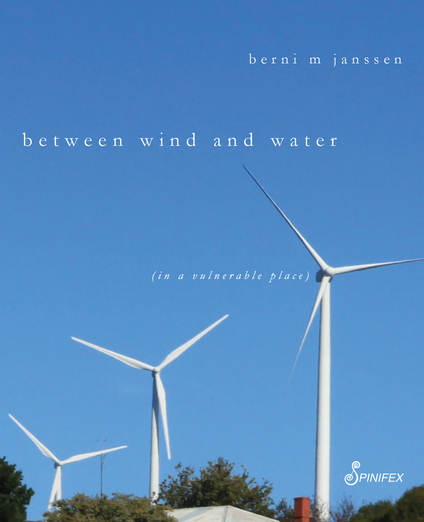
Alyson Miller Reviews berni m janssen’s between wind and water (in a vulnerable place)

between wind and water (in a vulnerable place) by berni m janssen
Spinifex Press, 2018


In ‘speaking out’, the final poem of berni m janssen’s fifth collection, between wind and water (in a vulnerable place), a choral cry for resistance is offered, a lyric that insists on the ability of individuals to provoke immense change: ‘one voice small forms fight in strength / one voice strong gains another / i’m with you, go boldly’. In a context of climate strikes and impassioned environmental activism, such lines might be attributed to Greta Thunberg, whose reminder that ‘you are never too small to make a difference’ has become the slogan of protestors worldwide demanding action against an impending ecological crisis.

Yet between wind and water speaks of a different kind of truth to power, one which explores the detrimental consequences of climate change solutions that have otherwise been framed as a panacea to the polluting ills of industry. Examining the complex repercussions of the installation of wind turbines in a small rural community, the collection has been described by Javant Biarujia as a ‘cautionary tale’, revealing the nuanced conflicts of corporate vs. community interests while the plundered earth is leached, and can no longer provide. In its analysis of the ways in which battlelines are drawn, between wind and water presents a vision of discord and loss, an image of a landscape and its tormented inhabitants that is rendered by greed, silence, and disillusionment.

Multi-vocal and multi-layered, this collection is comprised of a series of oppositions, not only between the corporate-speak and enviro-savvy gurus who insist on the safety of the turbines and the community which seeks to resist them, but also in relation to ideas about the natural and the material world. Such tension is neatly encapsulated by the figure of Dan—one of over twenty-one characters and voices in the narrative—who as a farmer and poet embodies a mythic, if not mysterious, Australian archetype reminiscent of Banjo Patterson or Henry Lawson—a man of the land who is also in tune with a profoundly Romantic sensibility. Characterised as a ‘steward’ who desires little more than to live ‘full prosperous happy […] without end forever and a day’, Dan presents as a battler aligned with spaces he inhabits, yet keenly aware of the increasing separation between the human and non-human. It is a distance marked by a progressive series of haiku in which Dan observes the physical and psychological impacts of the turbines on the community: ‘south west wind blows hard / another letter of complaint sent / as if hands crush skull’. The intrusion of technology creates an atmospheric shift that results in a sense of suffocation and disquiet, making the ‘body buzz ears hum’, an unseen, creeping force that unravels and confuses: ‘am all over the shop’. In a sequence by fellow anti-windmill activist Vera, whose ‘living is with the earth’, the disruption of the turbines is vividly imagined as an anxious threat that invades the bodies of its victims:

They know their bodies pulse, quiver and twitch, the pressure
and pain, in ears, head, chest, all tightening, they know this as 
what has happened and still happens, from day to day, night to
night, not every day every night, but never before the turbines

The industrialisation of the landscape is thus conceived in intimate terms, worming inside the minds and bodies of those who live within its vicinity. In the poem ‘Mattie’, the eponymous narrator describes a state of disquiet in which she ‘can’t settle today can’t settle / wind in my bonnet bees on breeze’, an image of jittery restlessness, but also of being imposed upon by a greater force. The effects on self are ‘jangle jarred’, an experience of agitation and loss in which ‘things don’t stick in my head neither pin nor word basic / structures articulated imprecise’.

Catherine Schieve notes in the afterword—an oddly explicatory addition—that such portrayals demarcate the careful balances maintained by the ‘fragile landscape’, an ecosystem which ‘includes our very own bodies, as the work of capitalism affects everything down to our dreams at night’. The invasion of the ‘industrial windmills’ throws the machinations of the natural world into chaos, creating a constant friction between object and subject, each fighting for space in the bionetwork. As Dan writes in ‘early autumn’: ‘fingers of pale light / turbine blades locked together / cannot concentrate’.

Importantly, each of the embattled residents is presented in relation to a singular, extraordinary connection with the natural world, enamoured by a quasi-spiritual understanding of land awarded to those in rural spaces and denied to those on the outside. It is a question of ownership, made clear in the animosity towards the governmental agents and advocates who are unable to explain the phenomena: ‘complaint no 315 draws mister grey suit / thirtysomething urban company tool slickster / this not his territory’. Such binaries are mimicked via the performative language of janssen, whose remarkable conjuring of movement and sound replicates not only the invisible peril that menaces the community, but also the positions from which each actor speaks. As Schieve observes, janssen constructs ‘a full theatre of voices arranged in space’, a cacophony of accents, jargon, and quirks that synthesise into an intricate expression of corporate-lingo, outrage, and grief. More formalised structures and rhyme schemes are reserved for representatives of The Company, for example, who revel in cropped clichés and weasel-words to parody bureaucratic emptiness and repetition without meaning: ‘I’m here to listen, to listen to you, to listen to your concerns. Yes, really listen. Listen really. A real listening’. Alternatively, the opening section, ‘Still’, narrated from the perspective of the landscape, is constructed of long fluid lines and lists, eschewing static choruses in favour of language that is alliterative and verb-heavy, echoing a sense of seasonality, transformation, and impermanence: ‘small feet tickle my dust print into decay a lace of living strung from tails swooping bounding switching surface to air fleet the colour the pattern the texture each to their own and of their passing they home in me guests’. Similarly, in evoking the horror of the windmills, the source of so much dis-ease, janssen attends to a sense of perpetual, fragmented motion, a nauseating refrain of clipped and frantic energy: ‘they spin do spin spun spin spin spin forward, do spin around round spin forward round whirred spinning turning spun spin sizzling speed fast’.

Posted in BOOK REVIEWS | Tagged ,

Introduction to Prithvi Varatharajan’s Entries


BUY YOUR COPY HERE

I’ve noticed that Prithvi Varatharajan thinks carefully about offering a true gesture, word or position in every social exchange. I sense that, for him, all communication is an art defined by authenticity rather than decadence. His reflective nature is continuous with the character of the poetics in Entries. The book is a performative documentary of ‘processing’. Its poems refine our social condition into a dramatised, lyricised, essayistic motion of thinking out loud.

There’s a metafictional aspect to this mode of Varatharajan’s work. Its speaker refers to being Prithvi but we should remember that the title of the collection is ironic; these are not simply ‘entries’ in a journal or a log. They have been edited over many years. They are, after all, framed as poems, which is a hint that we ought to be attuned to their craft, particularly their rhythmic and sonic qualities, particularly their line.
I can’t describe Varatharajan’s poetics without reference to his scholarship and work in audio production. It’s revealed by the way that his speaker often becomes detached from one or more of his senses.

‘I was moving my knees and my head to and fro,’ he writes, ‘so it seems I was enjoying the music’, as though listening could be experienced as a Cartesian deduction. The rhythm of his prose is not really metric, but more like a refined conversational variation of longer ruminations and staccato asides. He is particularly good with the silence that follows the final full stop, like that beat of dead air that finishes a recording, or a comfortable pause in dialogue.

It’s invigorating, the ease with which Varatharajan alternates between prose and enjambed verse. It reflects the way his poems toggle between moods. Some of his entries resemble Romantic epigrams and fragments, whereas others are mini-essays. The enjambed poems included here – often ‘small r’ romantic in attitude – create emotional and spatial punctures. Their voice is more immediate, more impulsive than their prosaic neighbours. They reveal the quixotic heart that makes the brain run.

If there’s a narrative tendency throughout the collection, it would be towards scenes of sign-reading. The speaker is often to be found deciphering not only literary or semiotic signs, but also the cues of body language and vocal tone, as well as cosmic signs like coincidence and premonition. In the opening poem, for example, the speaker mentions moving house, ‘which I think was last night’. There is an almost psychedelic sense of possibility in this aside. The question it raises is of greater philosophical consequence than flawed memory or unreliable reality. The speaker’s uncertainty might be ‘environmentalist or anti-modern’. It throws him into a dilemma of capitalist dependency. As he asks in another poem, ‘What are the risks of everyday living’? This quandary is filed away for future consideration.

These poems remind us, maybe, of our better selves. These poems do not drink and dial; they do not hit ‘send’ too soon. In this manner they are a balm to current hyperactive expectations of social responsiveness. Paradoxically, Varatharajan does this by emphasising the provisionality of our being social animals. Entries not only registers so many types of everyday (but by no means banal) oscillation, it seems to revel in them. He openly invites us to celebrate this slow suspension as the most honest position: ‘I am king of ambivalence, so I’m king of being human.’

Posted in INTRODUCTIONS | Tagged , ,

Introduction to John Mukky Burke’s Late Murrumbidgee Poems


BUY YOUR COPY HERE

John Mukky Burke – one of my favourite philosophers – is the most underrated poet in Australia. His usual lacerating intelligence and empathy are here in this sensational collection, but ‘exuberance’ is the word that keeps occurring to me as I read. Burke is a poet who, in maturity, has shed many masks and is the better for it. He revels here in the godawful, funny, earthy business of being alive on Country today. Sex and death dominate (‘when a cock approached a cunt’), with detours down any manner of kangaroo pads. And there’s bold new authority in his voice, too:

Who said something about someone somewhere somehow
caring for a sparrow? Didn’t you fucking know that?

‘My Sister and I Get Our Mess of Pottage with a Small Kid Dead on Mr Boynton’s Double Bed’ tells of a stark rural childhood. There is zero pathos and no dogma; rather, a blunt country voice, reporting:

No one ever said to me not to go there,
not to see, not with the house full hushed with crying, and the dead
child frozen, laying on the bigger bed and in the back room, congealing
porridge in the kitchen spoilt with tears and snot,
yours cold, mine not. I left you there, and could stare at only death
right in the arse.

Similarly in ‘Warts, an Extract’, an old man reflects on his life, then and now: ‘No toilet, no mattress, no primus, no kero … And now I can type on computer, Jesus!’

Burke has dialled the dryness up to eleven, and by Christ it can be funny. As a young teacher, stuck, Burke got his kids in the Northern Territory some Kiwi penpals:

One girl over the Tasman wrote something that ran almost exactly like this: There five people in my family: me, my mum and dad, my younger brother and my grandmother, but she’s dead at the moment.

There is always death, of course, and worse, for ‘we people who have walked at midnight have seen a great delight of pain’. But death and pain are no more than components of the great game. Proudly Wiradjuri after battling his white skin for years, openly gay after decades of closeted torment – Burke’s pen crackles with energy in Late Murrumbidgee Poems. I busted out laughing at the excoriating ‘Happy Wagga, an Overview’.

The collection covers vast territory, from the insufferability of colonial explorers (‘Cook Was Not an Anthropologist’) to experimental work in the voice of a religious petrol sniffer. I was delighted to find included here my favourite Aboriginal poem, ‘Poem for the APEC Ministers’. In ‘Zac’, Burke speaks lovingly as an elder to a younger Koori man (‘with the blackest eyes’) struggling with life and in denial of his aboriginality.

The natives of Turtle Island tell that, collected, poems and stories are medicine bundles. They feed us and give us courage. This collection is just such a medicine bundle, but it’s more than that. It’s a kangaroo skin scraper passed to us from the hand of a master wordsmith and intellectual giant.

Hold it close.

Posted in INTRODUCTIONS | Tagged , ,

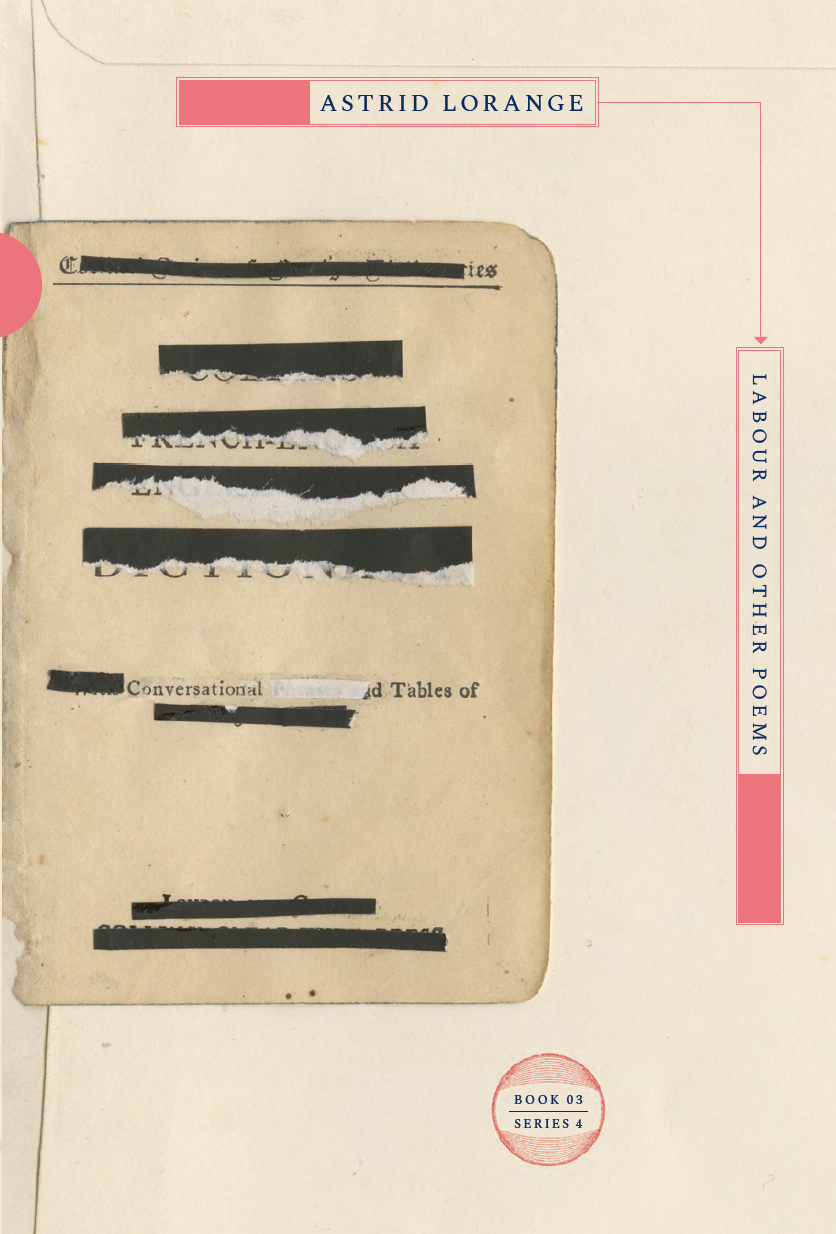
Introduction to Astrid Lorange’s Labour and Other Poems


BUY YOUR COPY HERE

This book is titled Labour and Other Poems. Just as Astrid Lorange speaks of building a poetics – intensive and intentional – as a way of perceiving the world of relations in their shadow, every poem here requests an attentiveness to the multiple relations of our lives, to the entwining of senses and references.

Labour is a word that enters English from Old French, where it not only means ‘task’ or ‘exertion’ but ‘hardship, pain, affliction, misfortune, suffering, distress.’ Labour is a word that cuts across all traditional divisions of, well, labour, insofar as it designates at once childbirth, ‘the sublime and violent history of reproduction,’ and hard yakka, the foundation of production. Almost always and everywhere, Lorange reminds us, this labour is extorted and expropriated: birth slavery and wage slavery and slavery tout court.

In The Human Condition, Hannah Arendt makes a distinction between labour, work and action. Each corresponds to a basic condition of being-human: labour corresponds to the biology of the body, to the condition of life itself (‘nature’); work to the unnaturalness of human activity (‘culture’); finally, action takes place specifically within and between the plurality of human beings, for being human is not to be human like any other human (‘politics’). Labour concerns life and the life of the species; work, the production of things that persist beyond mortal lives; action, the production and place of history itself. Arendt famously identifies natality – the entrance of the new life into the world – and not mortality – being-towards-death – as the motor of all values in their constant revaluation. Labour, as Lorange writes, both with and against Arendt, the labour, never finishes.

This too is part of the labour of poetry. ‘Toast for Friendship’ concerns secret organisations and their politics of friendship. Like the CIA, the Nazi jurist Carl Schmitt considered that the essence of the political was the power of deciding on an exception, and that such an exception entailed the formation of friends and enemies. What does toast mean here? Stéphane Mallarmé wrote a famous ‘toast’ or Salut, a poem of greeting and celebration to his poetic friends. But toast is not only a form of delicious fire-charred bread, nor a public salute to outstanding persons or deeds, but a demotic idiom meaning ‘destroyed, decimated’. In an Australian context, think how ‘Toast’s penumbra of significations – grains and alcohols and vast aggressions – are correlates of the invasion of the wheat eaters. And the remnants are everywhere: take ‘Ex’, which proposes a kind of molecular pheromonology, of abiding if often imperceptible micropolitical affects.

Oddly, labour is also a collective noun for a group of moles, e.g., ‘a labour of moles’. In Hamlet, Shakespeare’s eponymous hero acclaims his father’s ghost in such terms: ‘Well said, old mole, canst work i’ th’ earth so fast? A worthy pioner! Once more remove, good friends’. Labour, law, life and friendship are thus linked. This image of the old mole that burrows unseen and unknown, clandestine, beneath the soil of the symbolic, impressed the German philosopher G W F Hegel, who invoked it to characterise the labours of world spirit; in Hegel’s wake, Karl Marx picked it up to designate the labour of revolutionaries in The Eighteenth Brumaire; for her part, Rosa Luxemburg used it to propose the slogan ‘Imperialism or Socialism!’ These moments are also part of Lorange’s labours:

Patriots, says the CIA, should be wary of
poetry: it can be revolutionary but not even
feel like it.

It’s time we started really feeling like it.
Posted in INTRODUCTIONS | Tagged , ,

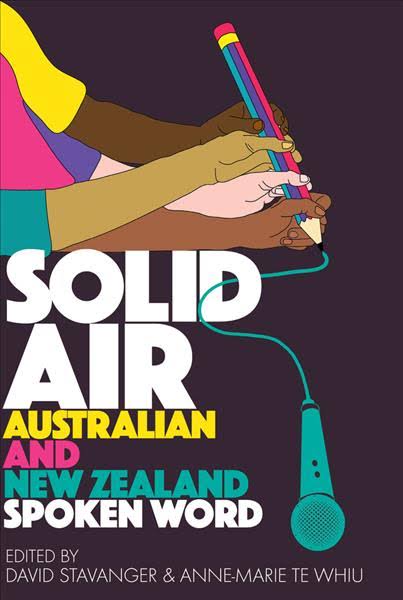
Andy Jackson Reviews Solid Air: Australian and New Zealand Spoken Word

Solid Air: Australian and New Zealand Spoken Word

Edited by David Stavanager and Anne-Marie Te Whiu
University of Queensland Press, 2019


Is an anthology greater than the sum of its parts? Does it effectively capture its milieu? Who’s been included, who left out? Is it genuinely of the moment? Will it endure? The case of Solid Air is even more complex. This is a collection of spoken word that’s been published as a book, rather than as a downloadable album, a film to be streamed, or a live show on tour (though there have been a string of impressive launches). Voice turned to ink, accent and emphasis turned into font, the unfolding of a poem in time turned into a presence on paper which is there in its entirety at one glance. Is this the stage surrendering to the supposed dominance of the page? Should I consider these poems purely in their physical form here, or as reminders of their performance elsewhere? Of course, editors David Stavanger and Anne-Marie Te Whiu know you’ll ask these questions, and it’s proof of their adept curation of voices that – while such questions persist after reading, transformed into something more productive – the poems themselves overwhelm any theoretical position or argument about what or who this anthology represents.

Firstly, a disclosure: I was chosen by the editors to perform at the Queensland Poetry Festival in 2017. I don’t appear in this anthology, though, so perhaps that balances any perceived bias. What Solid Air does so powerfully is remind us that poems involve positions, a precarious and essential bridging of sites, a profound resonance between bodies, such that the reader or audience is unavoidably implicated. The cover illustration by Des Skordilis is emblematic – four hands, of various skin tones, grasp a single pencil, whose lead becomes a microphone lead looming in the face of the reader. The opposite of siloing, this is a poetics of coming together, the potential for solidarity. Contrary to the image, however, rather than one microphone, the anthology contains 120 of them. And it’s partly in the juxtapositions of voice, not in any implied harmony, that this anthology makes its considerable mark.

There are the ‘big names’ expected by anyone acquainted with contemporary spoken word – Omar Musa, Maxine Beneba Clarke, Miles Merrill, Luka Lesson, Selina Tusitala Marsh – brushing up alongside emerging artists like Melanie Mununggurr-Williams, Jesse Oliver and Eleanor Malbon. Solid Air also takes a boldly expansive definition of ‘spoken word’, too, refusing the binary of ‘stage’ and ‘page’, including a great number of writers whose work confounds that outdated distinction – Nathan Curnow, Ali Cobby Eckermann, Quinn Eades, Omar Sakr and many more.

The selected authors are arranged alphabetically by surname, which means that Solid Air opens, entirely appropriately, with Hani Abdile’s ‘The beautiful ocean’, a breathtaking poem which somehow manages to hold the trauma of seeking asylum by sea within a refrain of love and survival. Immediately, Solid Air seems to be suggesting that the best ‘Australian’ poetry punctures holes – sometimes gentle, sometimes angry – in the idea of Australia itself. Behrouz Boochani, still imprisoned by the Australian government in offshore detention and denied citizenship, also appears in these pages, with a poem of longing and displacement in the midst of beauty.

Also appearing early in the anthology is one of the most exciting emerging voices around, Evelyn Araluen, whose ‘Fern your own gully’ lands with a thrillingly unsettling punch. The poem’s satire deconstructs ‘the smell of eucalypt’, ‘gumnut coins’ and ‘pastel bush dreams’ with fierce intelligence and a subjectivity that is both defiant and strategically elusive:

Just hop in that pouch, unusual girl
hop in the swag                this whole home waits
in handpainted frames of silk native frocks
            wear them to your reading
            wear wattles from your ears
it’s all metaphor for            the beautiful thin white woman
whose body slides linenly through bush

Resistance to colonialism – not only on the political and personal level, but in the idea of what literature is and should be – is a major theme in this book. Anahera Gildea, Te Kahu Rolleston, Grace Taylor and others from Aotearoa New Zealand fluidly integrate indigenous languages without translation. The casual disruption of English by these linguistic interventions is synecdochical – the words themselves standing for the ongoing embodied perseverance of all Indigenous peoples.

These juxtapositions feel more like mischievous channel surfing than any kind of straightforward argument. Araluen is followed by Ken Arkind, with his poem ‘Godbox’. With its long lines arranged vertically on the page, the poem is a jarring chorus of found prayers, numerous voices pleading in confusion, whispered despair and shouts of anger towards a deity who ‘will not answer’. The experience of reading it is shocking, visceral, tenderising.

Another poem driven by a prayerful refrain is ‘Tramlines’ by Arielle Cottingham, which riffs on the racialised implications of hair straightening and ‘straight-ness’ itself in the context of family and public ideas of beauty. To write such a thematic summary, of course, reduces the poem – it’s much more exhilarating and untamed than that, merciless in its honesty and how it implicates the reader. Here, the voice is capitalised, italicised, enjambed and run-on, so that its rhythms and pressures (both internal and external) are made acutely tangible.

These poems are not simply transcriptions of what is spoken. There are experiments with the space of the page that make a hesitant, stuttering or self-correcting voice concrete, but there are also elements here that can’t be understood purely in terms of the heard voice, but include a kind of unheard, internal voice. Emily Crocker’s ‘Spooks’ enfolds complexity into caesura and strikethroughs:

Glitching in the aisles,    mate              ah        ma’am
I knew I was a worryman when I began using my form
as a flotation device, 	            a skeleton key,               a dustpan –

On a similar note, while to my ears Amanda Stewart’s poetry really does need to be heard, her ‘postiche’ allows a reader to experience the scrapes, slippages and ambiguities of her voice in a rigorous and playful page translation. Reminiscent of experiments with typewriters, but also of sound-artist DJs, ‘postiche’ manages to evoke late capitalism, surveillance and anxiety, without explicitly naming any of them.

Posted in BOOK REVIEWS | Tagged , , , , , , , , , , , , , , , , , , , , , ,

Magan Magan Reviews S K Kelen’s Yonder Blue Wild and Kit Kelen’s Poor Man’s Coat

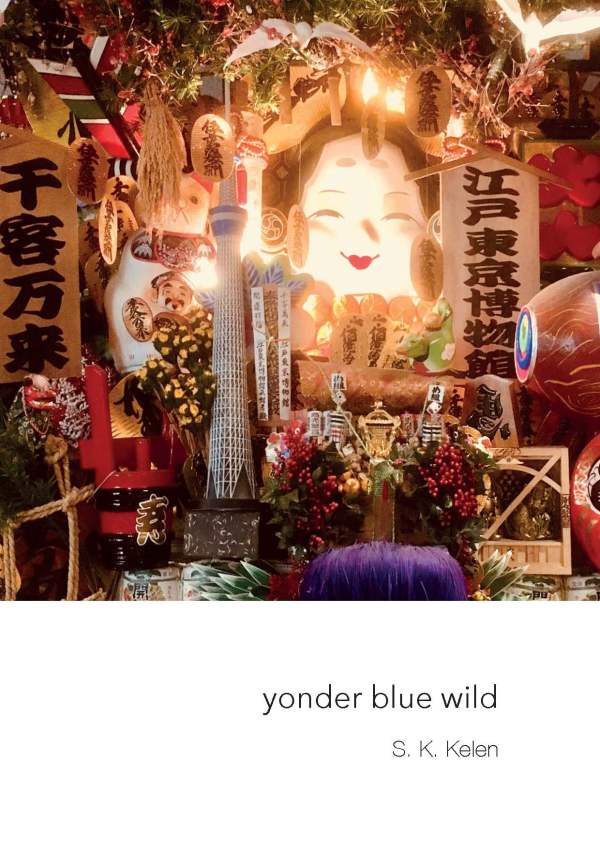
Yonder Blue Wild by S K Kelen
Flying Islands, 2017

Poor Man’s Coat by Kit Kelen
UWA Publishing, 2018


We came from the ice 
and out of the trees
and wanted the whole world warmer. (Kit Kelen, ‘Parable’)

Award-winning author S K Kelen beautifully explores the theme of travel in his collection Yonder Blue Wild. For some, travel is a benefit awarded to them by virtue of their class; for some it is a tool to attain an idealised version of the life they want to lead. For others, travel is something they have no choice in. The connecting thread is indeed a kind of escapism, and an attempt to express, through movement from place to place, one’s own humanity. In that expression hides stories untold.

Kit Kelen’s collection Poor Man’s Coat complements the theme of his brother’s collection, as he looks at conversation and argument as expressions of personhood. The interesting parallels between the collections are their ability to pronounce these themes through mirror poems and window poems. Mirror poems function as poems that connect people with themselves by way of revealing the self to oneself – the key feature being revelation. Window poems are observational poems that provide the self with insight through observation.

The effect of reading the title, Yonder Blue Wild, contradicts the theme of the collection. Each noun, ‘yonder’, ‘blue’, ‘wild’ stands alone, only moving with when animated by the reader. They are like the state of a stagnant person suddenly moving after unexpected change, triggered by their lack of control. Change is an invisible signpost required to adapt in the world. We have no choice but to be alone in this world even though fighting it seems natural – drugs or alcohol or sex or the chaos of people. The theme of the collection is that travel is part of the human experience, but for me, a person whose stomach begins to turn at the thought of travel, reading this work automatically calls into question the idea of a collective existence. I find it difficult to ignore the idea of travel as an opportunity to temporarily glaze over being born into this world without choice.

What do we have if not our context? It’s a position from which our humanity can be found. In his poem, ‘Love In The Tropics’ S.K. Kelen gives context to his characters. It is precisely due to the contextualisation of their scenario that Frank and Kathy are understood in a complex fashion:

and these
people on the trail, intent on experience...

Wait, Frank the American civil engineer
staying on the beach now six weeks tires
of his Australian girlfriend, Kathy, who 
speaks of literary life in Sydney
boring Frank in the chai shop making
eyes at Yvette vivacious French hippy
Kathy might be jealous, she might not be
& life goes on.

‘Love In The Tropics’ sheds light on a reality that is too often ignored and or is too painful to acknowledge. Kelen speaks to a kind of exhaustion that takes place when a person doesn’t confront the state of their relationship. Such exhaustion eventuates into dysfunction. This is indeed the beauty of poetry: its commitment to the reality of the lives of people and its strength to hold two otherwise opposing things in equality. What is the root of Frank’s exhaustion? Is it his relationship with Kathy? Is it his insistence at ‘making eyes’ at Yvette? Similarly, with Kathy: is she jealous? Should she be?

If poetry guides us to take life as it is, then what happens when change doesn’t occur by virtue of our stubbornness? Will poetry be lost? I must make mention of John Keats’ poem ‘On the Sonnet’: ‘If by dull rhymes our English must be chained’. He fears that if a change in form doesn’t occur, the beauty of poetry will be lost. He uses Andromeda, known for her beauty as well as getting chained up, as a simile for the ruins of poetry. Although Keats speaks about the consequence of adhering to the rules of a sonnet, he sticks to the rules. This draws a comparison to Kelen’s poem when he writes ‘& life goes on’, calling upon an objective truth about the world, a universal law, despite his contextualization of his characters’ conflict. Like Frank, many of us continue on our path:

Frank makes a joke ordering
banana cakes from the boy
Yvette smiles but Kathy 
Shrugs it off as part of travelling, 
Find a man on the beach.

Like Frank, we suffer through life in tiny ways as our pain nibbles at us. In S K Kelen’s poem ‘Tiger Show’, however, we see a different perspective on the notion of evolution. He stops his characters to ask: ‘What are you doing here, middle aged Australian / couple?’ A question as universal as love, a question that forces us to a stop: ‘Left the kids at home, let loose / seeing Bangkok’s dizzy lights / before it’s too late’. The difference here is evolution triggered by outside forces, of evolution starting to manifest outwardly.

Posted in BOOK REVIEWS | Tagged , ,

Elena Gomez on as Reviews Editor

I’m honoured to announce that Elena Gomez will be taking up the helm of Reviews Editor. Gomez is a poet and editor who worked in book publishing for ten years. She is the author of a number of chapbooks and the full-length collection Body of Work (Cordite Books), which was Highly Commended in the 2019 Victorian Premier’s Literary Awards. Her poetry, essays, interviews and reviews have been published widely, and she regularly appears at literary festivals. She recently completed her Master of Fine Arts at UNSW Art & Design.

This also means that Bonny Cassidy will be leaving the post after 5 years, though will remain on our advisory board. Her contribution to Cordite Poetry Review is incalculable, and there is not a deep enough thanks I can extend to her on making our long form poetry reviews peerless in Australia, and ushering in our Indigenous engagement policies. She will be back with an introduction to our forthcoming 40 Poets in late 2020.

Posted in GUNCOTTON | Tagged

BAYT Editorial

Dear reader,

In Arabic, ‘bayt’ means house and also a line of poetry. Welcome. I hope you enter and explore. The poems in this issue are universes, every one of them an ode of sorts: to food, to music, to home(s), to language(s), to (be)longing, to cars, to the body, to dogs, to neighbors, to family, to friends, to god, to cities, to the self, to grief, to love. There’s so much love in these poems; I felt held re-reading them this morning.

Dear reader, I was a little girl in Tripoli, Lebanon, and I wanted to become a poet. I wanted to become a poet because I wanted to inhabit the language of poetry – how it moved me, how there was something magical about it. Then I became a literature student in Beirut who still wanted to become a poet, though I had no idea how to write or publish, and more importantly, I had no idea how to find a community of poets in which I felt supported. I read Hugo and Baudelaire in French, I read Darwish and As-Sayyab in Arabic, I read Eliot and Szymborska in English and English translation. I read poetry at some open mic nights in Beirut, and I read on balconies or the floor of the university with friends. But when I looked for poets of Arab heritage who wrote in English now, I was only able to find Naomi Shihab Nye (she has a poem in here, and this is one of the beautiful ways the universe sometimes works). So much has changed since, and I’m happy to see the Anglophone community of Arab-heritage poets grow, this issue being but a sample of the varied voices that would have made a younger me feel seen, that makes the present me (and us, I hope) feel more held, that makes the ultimate home that poetry is vaster, stronger.

Dear reader, I have two confessions. The first is that when I was asked to guest edit this issue, I felt … exhausted. Perhaps because writers of Arab heritage are often put in the same category, are often expected to perform their Arab-ness, so I asked myself whether curating this issue meant feeding into this. I soon moved from this initial feeling of doubt to one of excitement: excitement about creating a space, a house, a bayt, made up of the work of poets I looked for decades ago, excitement about celebrating this multiplicity of voices and their infinite possibilities. The second confession is that I’ve been away from poetry lately. A beautiful revolution has been unfolding in Lebanon since 17 October 2019, and I’ve been incapable of doing anything but watch it and think about it. Revolutions in Iraq, Chile, Iran, also this month. And Gaza, bombed again. For more than 40 days now, as I looked at the news and social media, as I received constant WhatsApp messages and videos from friends and family in Lebanon and outside of it, as I kept looking at plane tickets to consider going to Beirut for the weekend, I asked myself, what use is poetry, really? Yet even as I asked myself this, even when I couldn’t get myself to read one line of verse, I knew that poetry was a home, I knew I would always return to it (even if only briefly for now), as I did this morning, re-reading these poems. For beauty, for laughter, for grief, for questioning, for prayer, for love. For the power of words. Poetry can’t change the world, and yet it does, doesn’t it?

Dear reader, welcome.

Dear fellow poets, thank you for your important work. Thank you for your companionship. Thank you for building this small bayt, this house, this line in an ever-growing poem.

29 November 2019

Posted in ESSAYS | Tagged