Dear White, It’s OK to be white

In October 2018, the motion ‘It’s OK to be white’ introduced in the Australian Parliament by White Supremacist Senator Pauline Hanson. The motion called for the ok-ness of Whiteness while denouncing ‘anti-white racism’ and ‘attacks on Western civilization.’ Astonishingly, it was only narrowly defeated 31-28, with many members of the ruling conservative Liberal-National Party coalition supporting it. This short text was written in response to this vote.

In the text, I use white to mean a white-skinned person (which as many academic works have shown is a far less straight-forward description than it might first appear). On the other hand, I use White with a capital W to indicate a White who has a conscious or unconscious investment in a Whiteness that they think they possess. It is someone who mistakes, in a classically racist way, an identification with their skin colour, as they imagine it, for an identification with Western Civilisation, and, someone who derives as a result of their identification with White skin colour, as they imagine it, a national and colonial sense of supremacy, that is, someone who thinks that their skin colour, as they imagine it, entitles them to certain privileges over and above what other beings are entitled to. (For a more in depth discussion of this complicated process of identification see my book White Nation: Fantasies of White Supremacy in a Multicultural Society).

~

Dear white, it’s ok,
It’s ok to be white.

but it’s ok to be white and nice.
It’s not ok to be White and mean.

It’s ok to be white and generous in spirit.
It’s not ok to be White, envious and stingy.

It’s ok to be white and ill-informed, and try to know more. 
It’s not ok to be White, ill-informed, ignorant and mediocre, and be proud of it.

It’s even ok to be white and prejudiced, as long as you’re trying to work on yourself to be less prejudiced.
It’s not ok to be White and prejudiced and ignore and justify your bigotry.

It’s ok to be white and demand and struggle for a better life because you deserve more as a human being.
It’s not ok to be White and demand a better life because you think you deserve more because you are White.

It’s also ok to be a socially unrecognised and low-achieving white and still be proud of the many wonderful cultural and scientific successes, attainments and accomplishments that white people have achieved across history, but it’s not ok to think that just because you share the same skin colour with those high achievers that their achievements have something to do with skin colour and are yours only. Most of these great white achievers wouldn’t touch you with a ten-foot pole, so stop acting as if you represent them.

It’s ok to be white and be the descendant of people who have plundered, exterminated, enslaved and subjugated other peoples and their lands across this planet, if you recognise it and deal with its consequences. It’s not ok to be a White who is aspiring to perpetuate what your ancestors have done in this regard.

If you don’t recognise any of this no amount of official and non-official declarations and proclamations will change the fact that you are a shitty White, a racist scum, and a scourge on all of us, white and non-white, who are struggling to make this already damaged planet as bearable to live in as possible.

On the other hand, you would be so great if you can recognise all this. 
So 
why settle with being ok when you can be great?
Posted in ESSAYS | Tagged

In Search of Living Rooms Filled With Laughter: On Belonging as a British-Lebanese in a Time of Revolution

I had my first panic attack somewhere on the Central Line between Marble Arch and Bond Street. Sitting in an empty, well-lit carriage the world darkened and tightened around me. I thought I might disappear. I stood by the doors, willing them to open. Even in the darkness, I’d run through the rest of the tunnel, then push past people on the escalator, smashing through the exit gates. I’d surface and find what was left of myself. But the doors didn’t open, so I had to close my eyes and pinch at the sides of my jeans to check I was still here. When the doors aligned with the platform, I dug my fingers into the space between them, helping them release me, finding my way to the rain.

That was almost four years ago. Everything I had consumed about Trump becoming president, about ‘shithole’ countries and travel bans, about Brexit and Nigel Farage, was now consuming me. I had just left Lebanon because I couldn’t see myself staying there and here I was in the city that birthed me unable to feel welcome either.

Now, the panic has been dulled. Now, I catch myself in a numbness. Unable to feel something I know I am supposed to feel. Suddenly feeling it all at once. I feel scraps of emotion. I perform emotion. But I am mostly just tired. I am British, Lebanese and British-Lebanese. In a transactional late capitalist world where we must all be meta-tagged to within an inch of our lives, I have chosen British-Lebanese as an identifier. It means nothing. I suppose it means slightly more than each of those things alone. But I am also often neither Lebanese nor British. I am often an imposter. Moving through the world while I lie to everyone about who and what I am.

I used to think I was part of a hybrid identity. That somehow, in the hyphen between places I wasn’t from, I had found a community. I read up breathlessly about Third Culture Kids. A community bound by what we don’t have rather than what we do have. Third Culture Kids. I have come to hate that term, something many people like me latched onto. But all it meant was that we had lived interesting childhoods surrounded by many cultures and that our parents were probably middle-class professionals somewhere interesting. Hardly something to cry about. Hardly an oppressed minority. Just misunderstood and unmoored sometimes. But who isn’t. The label stares back at me now, infantilising and backward-looking. A community that might have been.

I have constructed identity in opposition to what I have not been. Growing up in London, I built a form of fantasy Lebanese-ness. I stuck images of the Temple of Bacchus in Baalbek and the Jeita Grotto to my bedroom walls with the Blu-tack left over from school projects. I surrounded myself with images of a country I had never set foot in. I built it in my mind from pieces of discarded memories my parents left lying around the house. A faded photograph of unmet relatives, a cassette of a Ziad Rahbani play I would listen to, understanding every 10th word. One of my earliest memories at home is of a full living room full of semi-strangers. My parents often had friends over when I was young. All the women had fiery red lipstick and smelled of freshly applied Elnett hairspray. The men wore dark suits and crooked ties. Everyone, except my parents, smoked. Tumblers of Johnny Walker Black Label made little rings of water on the coffee table and pistachios sat in little bowls. Everyone spoke in accented Arabic. I knew they weren’t all Lebanese but I didn’t know what that meant. I was only meant to come in to say hi to all the uncles and aunts, none of whom were my uncles or aunts. But I would listen to their laughter from my bedroom and think this is how us Arabs laugh. Fully, uncontrollably, as if possessed.

As I write this, there isn’t much laughter. The Lebanese October 17 Revolution is well into its second month. I sit on the sofa fiddling around with the YouTube app to find a live stream of a Lebanese news channel, I feel empty and disconnected from everything. Both the physical space I inhabit now in London and the space I left behind in Lebanon. In the early euphoria of the revolution, I wanted to fly out to participate. I selected my tickets, and hovered over the keyboard, credit card in hand. The ritual dance of the online transaction about to be consummated. But I couldn’t do it. It felt like conflict tourism. Heading back to a place that I had left behind to somehow usurp their revolution. It was my revolution too, of course, just not now. For a decade in Lebanon, all I wished for was for it to be a better place. Not even better, just normal. I recently read about the German poet Hans Magnus Enzensberger’s visit to Hungary in the late 1970s, where he met of the communist regime. ‘We are not dissidents,’ they said.’ We represent normality.’ Normality is all anyone wants.

Posted in ESSAYS | Tagged ,

The Arabic Poem that Jumped the Fence

In 1960, the Syrian Lebanese poet Adonis published his prose poem manifesto and the Lebanese poet Unsi al-Hajj published his collection Lan (Won’t) with its seminal introduction theorising for the possibilities of poetry in prose. These are two theoretical cornerstones that launched the prose poem in Arabic. They are the first instances of using the Arabic term qaṣīdat al-nathr (prose poem) and by that announcing the entrance of the phrase into Arabic as a ‘simple abstraction.’1 As such, Adonis and al-Hajj proclaimed the conceptualisation of a category even if the practice of blurring verse and prose had existed in Arabic literature for centuries before that. Thus, the Arabic prose poem was not invented in 1960 but rather became a thing with a name; it was pointed out as a problem or a cause. Writings that could be described as poetry in prose or prose with poetic qualities go back as far back as the pre-Islamic prose, the Qur’ān, and Sufi writings. However, once the phrase qaṣīdat al-nathr as a simple abstraction was introduced, this rich pre-history was called into being as a history, and the prose poem became a critical lens or an enclosed class of poetic product. Its major claim was that it was poetry and its units were poems entirely freed from the restrains of meter and of pre-conceived form.

But poetry cannot be freed up. It is nothing at all if not tension or orchestrating tension that doesn’t tolerate hanging loosely. Once the Arabic prose poem jumped the fence of meter, it exposed itself to pressing and fundamental questions about the very game of poetry, its possibilities, and the new parameters of the playing field. Despite its claims of freedom, individuality, subversive-ness, and democracy, the motor force of the Arabic prose poem has thus far been its quest for that organising tension that makes the poem; that deliberateness that guides the wandering and the going astray; that design that sharpens the edges of sentences into music and sculpts nothingness into a clearing.

‘One function of the poet at any time is to discover by his own thought and feeling what seems to him to be poetry at that time,’ Wallace Stevens writes in his The Necessary Angel.2 Poets do not define poetry as much as discover it over and over. Poems are not definitions of poetry as much as they are disclosures of poetry, unveilings of its perpetually hidden and elusive faces. And, the prose poem is the most recent disclosure of Arabic poetry. Although it has now existed in Arabic as a term and a distinct poetic ‘genre’ since the early 1960s, it remains a novelty that is somewhat out of place. The distance between the Arabic prose poem and the Arabic poetic tradition is to a large extent what has kept it alive and controversial, and what has bestowed upon it a profound critical power by which it has placed every other established Arabic poetic form in question.

Even in their attempts at forging a link between their project and the Arabic literary tradition, Arab prose poets have continually insisted on the new-ness of ‘qaṣīdat al-nathr’ and its disruptive agenda. For it does not only pose the question, ‘What is poetry?’ but also, more subversively, urges us to ask: ‘What can be poetry in Arabic?’ In a tradition that has long accepted very clear-cut distinctions between poetry and prose, such a prospect is both exciting and unsettling. 3

By proposing to redefine the very notion of Arabic poetry and to open it up, the prose poem becomes a space where poetic and extra-poetic imperatives intersect. Furthermore, the prose poem places the relationship with the (non-Arab) other, the connection to the poetic past, and attitudes towards the Arabic language in question.

The term ‘Arabic free verse’ (al-shiʿr al-ḥurr) is often used as a synonym for the Arabic modernist movement of the Twentieth Century, referring to a project that was launched in the late 1940s and is still on-going today. However, the poets and poems included under this heading do not constitute a homogenous group. Aside from the grand gesture of breaking away from the classical ode, the qaṣīda (the metrical and mono-rhyme master-Arabic poetic structure which dominated Arabic poetry from pre-Islamic times until the first half of the Twentieth Century), the proliferations of the Arabic modernist movement were primarily motivated by distinguishing themselves from each other. Hence, it might be more accurate to study the various disclosures of modern Arabic poetry as responding to each other and growing out of each other, than it is merely to view them in contrast with classical Arabic qaṣīda or measure them up against outside influences.

A distinct notion of the ‘modern’ Arabic poem begins to emerge when one considers the variances and inter-connections between the modernist trends and movements of the Twentieth Century.4 This approach serves to upset the illusion of a monolithic ‘Arabic modernism’ by breaking it down into modernist positions with multiple visions and proposals for what the modern Arabic poem can be. This approach also puts in perspective the two often exaggerated stimuli of this experiment: the Arabic literary tradition and the western poetic influence.

There is no doubt that the Arabic qaṣīda remains present in the background as point of reference for much of the innovations of the modernist project, especially on a formal and structural level. Nevertheless, as the modernist experimentations developed and moved beyond the early ‘pioneer’ years of the late 1940 and early 1950s, the poets and theorisers were more concerned with commenting on and responding to each other’s work. The same applies to the role the western poetic influences. I would go as far as to say that, beyond the early phases, western models introduced through translation of poetry and theory into Arabic, were relatively marginal participants in developing the poetics of the modern Arabic poem. The main agent in the elucidation of a new poetics was the on-going and self-absorbed revisions, refinements, and modifications of modern poem, in which the various trends and movements were engaged. And, although one can point to several positions and directions within this large experiment, each presenting an agenda and imagined trajectory for the modern poetry, the two most visible manifestations of the modern poem in Arabic are: the free verse poem (qaṣīdat al-tafʿīla ) which remains within the parameters of meter even if expanded and loosened and the prose poem (qaṣīdat al-nathr), the rogue form which defies all pre-existing prescriptions.5 Many qualities of each are elucidated by the on-going dialogue between the two forms.

The Arabic prose poem, qaṣīdat al-nathr, which later became the rallying point for the Shiʿr group and their journal founded in 1957, is primarily a response to qaṣīdat al-tafʿīla and the relatively fixed definition of poetry endorsed by the 1949 modernist pioneers (especially the Iraqi poet Nazik al-Mala’ika)6. The Arabic prose poem made its biggest statement by claiming to be poetry without any metrical consideration whatsoever. It is more comparable to the French and English free verse than it is to the prose poem in these languages. Prose poets in Arabic often write lineated, lyrical, short or long pieces which are similar in mood, tone, and themes to what was written under the aegis of qaṣīdat al-tafʿīla. It is the absence of meter coupled with the claim of being poetry that made these writings scandalous. It is, thus, necessary to study the Arabic prose poem in its conversation with qaṣīdat al-tafʿīla.

Posted in ESSAYS | Tagged , , , , ,

Reel Bad Lebs

For Edward and Jack, unreal Arabs

Up until I was nine years old, my favourite film was Blood Sport. Frank Dux, who was played by Van Damme in the prime of his career, competed against the world’s best fighters in the underground martial arts tournament called the Kumite. Early in the film, a brown-skinned man in a traditional Saudi headdress named Hossein tries to force the white female lead, Janice, upstairs to his hotel room for an ‘interview’. When she refuses, Hossein raises his open hand to slap her. Fortunately, Frank Dux intervenes, grabbing Hossein’s arm and winning a bet against him, which spares the blonde-haired damsel from imminent physical and sexual assault. As a result, Frank gets the girl the consensual way – they take a friendly walk, making fun of Hossein as they meander, they have a romantic dinner and then they head back to Frank’s hotel room for a wholesome night of procreation.

On the first day of the Kumite, which I re-enacted repeatedly in my bedroom, Frank Dux’s preliminary bout is against Hossein, who says in a thick and coarse Arab accent, ‘Now I show you some trick or two.’ As soon as the bell rings, Frank takes Hossein down with a few quick punches, breaking the world-record for the fastest Kumite knock-out in history. But shifty Hossein does not concede defeat, and after Frank is declared victorious, he stands and attempts to take a cheap shot at him from behind. Frank pre-empts the attack, and delivers a reverse elbow and punch combination which knocks Hossein out cold.

Whenever I had a punch-up during primary school, within the white-dominated working-class slums of Newtown, I always tried to imagine myself as Frank Dux. I would throw three straight punches, one roundhouse kick, and one helicopter fly-kick, concussing my opponent in a few seconds. One lunchtime, this older eleven-year-old boy named Matthew Pearce, who had piercing blue eyes, called me a ‘Lebanese shit’. As the other kids in his grade watched on, I threw a succession of punches and kicks, each of which missed him by a foot. Matthew stood back and watched me tire myself out, and then he stepped in toward me, gave me one hard push, and I was down. Lying on the ground while Matthew and the other kids laughed at me and chanted ‘Lebanese shit’, I finally realised: I wasn’t Frank Dux. I was Hossein.

In 1978, Palestinian-American intellectual Edward Said released his controversial book Orientalism, which investigated the Western depictions of Middle Eastern, Asian and North African people, places and cultures throughout history. Overwhelmingly, Said discovered deliberate representations which propagated myths about the East’s mysticism, exoticism, primitiveness, barbarism and violence. These depictions sought to create preconceived notions about the ‘Orient’ and the ‘Oriental’ in order to serve Western interests in the East: ‘Orientalism can be discussed and analysed as the corporate institution for dealing with the Orient – dealing with it, by making statements about it, authorising views of it, describing it, by teaching it, settling it, ruling over it’ (Said 2003, p.3). Orientalism was primarily a British and French activity up until the Second World War, followed by the ‘latest phase’ of the phenomenon as Arab lands and resources became a central target of American imperialism:

Since World War II, and more noticeably after each of the Arab-Israeli wars, the Arab Muslim has become a figure in American popular culture, even as in the academic world, in the policy planner’s world, and in the world of business, very serious attention is paid the Arab… If the Arab occupies space enough for attention, it is a negative value. He is seen as the disrupter of Israel’s and the West’s existence, or in another view of the same thing, as a surmountable obstacle to Israel’s creation in 1948 (2003, pp.285-286).

Whilst I had never heard the term ‘orientalism’ until my post-graduate years at university, I have been the victim of orientalism from as early as I can remember – every time I watched a Hollywood movie I doubled-down on the belief that people who looked like me and had names like mine are bad, real bad.

In 2009, a comprehensive film investigation by Arab-American scholar, Jack G Shaheen confirmed my suspicions. The title of his book, Reel Bad Arabs, is a play on the word ‘real’ – real Arabs that can be found in the real world in contrast to fictional Arabs that can be found on the film reels of the world’s dominant moviemaking industry.

Pause and visualize the reel Arab. What do you see? Black beard, headdress, dark glasses. In the background – a limousine, harem maidens, oil wells, camels. Or perhaps he is brandishing an automatic weapon, crazy hate in his eyes and Allah on his lips. Can you see him? Think about it: when was the last time you saw a movie depicting an Arab or American of Arab heritage as a regular guy? (Shaheen 2009, p.8).

Reel Bad Arabs lists in alphabetical order over 900 American films since the establishment of Hollywood that negatively portray Arab people, especially Arab-Muslim people. This list includes films where the presence of Arab characters is central to the plot, such as in the 1970 epic Lawrence of Arabia, and films where Arabs are simply background villains for stories that do not concern Arabs at all, such as the 1985 science fiction classic Back to the Future, where a murder scene involves Arab caricatures armed with assault rifles and speaking a gibberish language which is supposed to be Arabic (Shaheen 2009, pp.91-92). Shaheen’s study extends over many decades and genres, from historical films such as adaptations of Cleopatra (1912, 1917, 1934, 1963) to thriller and action films such as adaptations of The Mummy (1932, 1959, 1999). He examines adventure films such as Raiders of the Lost Ark (1981) and action blockbusters such as True Lies (1994) and even animated features such as Disney’s Aladdin (1992). While some theorists have considered symbolic and figurative portrayals of Arabs in Hollywood films, for example of the savage aliens in Star Wars (1977) called ‘The Sand People’, Reel Bad Arabs focuses on portrayals where the characters and the places are only ever intended as ‘literal’ depictions of Arabs and the Arab world.

Posted in ESSAYS | Tagged , , ,

10 Works by Justine Youssef


Duha Ali, Justine Youssef
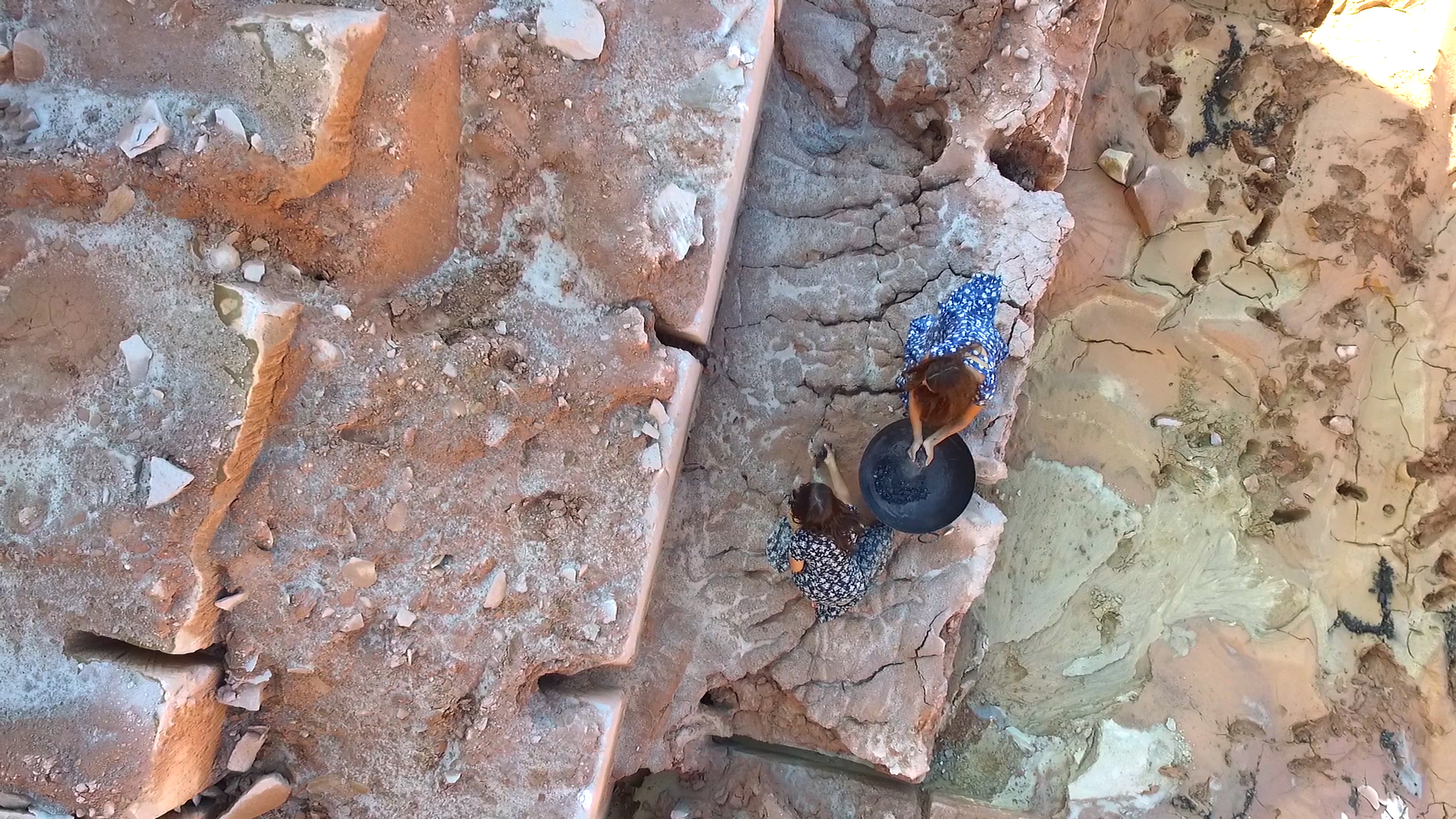
Kohl | 2018 | 3 channel video installation, 4 minutes and brass bowls, kohl, sandstone and clay vessels, dimensions variable, video still

‘Kohl’ was created in collaboration with artist Duha Ali. In the work we trace our ancestral practice of making kohl by hand for two consecutive days at a sandstone quarry in Kurrajong, north-west of Darug land. It is a site of ecological devastation, bearing witness to the genesis of Sydney’s colonial sandstone structures and continuously being eroded by human force.

‘Kohl’ contemplates the practice of settler-migrant rituals on stolen land. Traditionally in our villages, kohl is used in a number of ways — applied after prayer, to protect the eyes from the sun, to ward away the ‘evil eye’ and for its healing properties. Through an engagement with site and material, this work creates a conversation around the way in which cultural inheritances exist within, in this case, Darug and Darebin land.

This work was informed by the generosity of the Darebin Aboriginal Land Council who advised us as we developed the work.

Posted in ARTWORKS | Tagged

bil 3arabi: 6 poems by Sara Saleh

Dedication

She asks me why I don’t write in Arabic.

“You’re Arab, no?”

Eh, mbala … but …” I try, more question than statement.
“I am … but …” Always a disclaimer.

What I want to say,
“What does it mean to exist in in-betweens? Shame, self-doubt, siesta?”

So shukran, Zeina, for awakening the languages inside me. I am learning.
And like most things in hijra, this is ongoing.

These stories are living,
and no one can occupy that.

To rebuilding languages, and rebuilding the cities inside us.

Posted in CHAPBOOKS | Tagged

Ode to My Husband, Who Brings The Music

There are more windows in the new house, so much light
the living room feels weightless. On weekends, I find you
staring out into the garden from the sofa.
You always wake before me, go downstairs & start
playing a song on your phone—sometimes it’s new,
more often it’s not, & always it works
the memory. When we carved the olive tree near our school,
we could barely see the letters. But after the rain,
they blazed orange. Does bark heal, our names
buried inside it? A name is a wound is a song,
so what you’re really doing is calling me. From what
sleep? You warned I eat my days too fast,
or perhaps it was too slow. You once asked,
What happened? A balding head, a bank account.
Somewhere, a boy with a black fringe kicks a football & eats figs
straight from the tree. I repeat the story of my fear
of fig trees, how my parents said the wind from the branches
could blind me. No such thing, you shrug.
Half of our hometowns thought our marriage was a sin.
A mistake, at least. There were phone calls.
There was hanging up. Years of silence.
& though we weren’t a revolution,
we were at least a questioning.
Last week, you almost dialed my old phone number,
& I wondered whether it would ring
in my childhood house, & whether I’d rush to answer.
Only you know & remember the house I drew
over & over again in all my school books:
house with roof tiles, with chimney,
with lake & swan. Simple, geometric house
I never colored in. But look how resilient
the future is, how I underestimated
the importance of big windows. Of the calm sea
of you. I don’t know at what age we learn to be afraid
of happiness. Our first slow dance was in a family club
called Union, in a town too small. We had no flow,
still have none. Unless you consider this—

me in bed, not ready for the morning yet,
& you downstairs, bringing the music.

Posted in 94: BAYT | Tagged

god moves at the speed of my name

in vacuum know words to praise god
cant explain love letters 2
god of no one else god mother
i tongue i light fallen far from
patriarch and fist just wait til
i learn my language my logic
sans rules men rules men writing their
godbooks lying by omission
nur nour noor and nowhere my name

shops on 52nd street
men who see me give me sweet
oils incense tafaddalu
me as offering all belly
dance skirts mine! they rehip me,
they hear me! hear me and the
women stop pretending they
dont see me fear me unknow
me love me. ukhti me my
eye on wrist a talisman

light is my bismillah
though i ameen elsewhere.
no english, no nigglish
nonpronouned but i speak
not cantonese. kill my
tongue a spectacle, mine
the body gawked. stubborn,
i stare back. i know god
made me black. but god, how
do i find my black words

which unlit language
still meandering
streetlights signals which
home? was i born in?
overwhelmed my mind
with these new neural
pathways, lit up like
some false third eye glow.
im all babel god
how am i still lost

all wor_ds allah
rules over by
habit: god is
a virgo and
eternally
will nitpick at
the apocalypse.
hence im stuck here
with these muslim
aunties 3ammos

lonely trek
within me
allah is
the long walk
the unlit
path if i
only could
find god i
might could speak
guiltlessly

allah
you see?
where i
omit
pronouns?
whose are
missing?
and what
does that
tell you?

god
is
mine.
get
your
own.
god
is
noun
. or

?

Posted in 94: BAYT | Tagged

For the Bagged Body in Front of Koshary Ameen Restaurant

Sometimes, I think about your hair, how it must have smelled of the space in bones where and when we curve inward, layered in casein, dry oats, incoherences. How yesterday, you picked up a slab of sheep meat, a couple of rib bones for dinner tonight, tomatoes. How yesterday, you might have forgotten to soothe yourself in forgiveness and the temporary bleached wave of gratitude, its constant bell. There is a stubbornness to grief. Its crooked stem continues to hang at an angle from the clay. My father and I stood on the corner of Emad Eldeen street, stared at how you were wrapped in your bag for hours because you didn’t have any ID on you, how a name must still be somewhere, starting to cloud in someone’s mouth. My father was pressing on to my hand, as though the smaller the space between our fingers, the more certain we would become of our own bodies: the bitter promise of calcified bones, brief blades the dusky color of iron, derma folding into its stretch, everything beneath fluttering, contained.

Posted in 94: BAYT | Tagged

fairouz is searching for a pair of eyes

the colour of a country
& in the national gallery of art i find
hers staring at me from within the body

of a new woman a spectacle of light
caught mid conversation

in the limelight nearby i tell her
we are not entitled to know the body yet
it will escape us like it always does
one foot in front of the other

to figure a border i’ve been told
you must first start with the body

in the fresco of a bathing woman
you can see the effect of its creator’s
breath left on the plaster at the edge
of the painting where the edge
is purposeful

unlike baladi in the 20th century
‘created almost by accident’

we know how a single sneeze from the right
white nose can cut open a new country

water spills out of the woman’s face
like a harvest                    

each pigment wept
into position then i move on

.أأ

they say we owe it to god’s
country to mark our distance from
its beginning its unprimed canvas its one
rosary eye

so while in the westness i try
to find her a country of our own
making but each museum is a mirror in
mourning each sky a stolen artifact

homeland-less again
i return to our cities
and on those same

balconies nearby women
ululate          their welcome        
through the air                  like a bird
glistening against                
the limestone        

.أأأ

on my way back from the future          i discover for fairouz an almost-country
a mountain of turquoise                                
cloud hiding in the desert                                

what she wished for        
that one wellspring        
of a song called ‘wattani’

she asks me to bring it home        
mid-air it dissolves                
its architecture                        

.أأأأ

akh! ya albi        it’s almost as if        
this new mesopotamia doesn’t want to be found

hiding somewhere
in a madaba-like mosaic
bare in the basement of
an unknown church

still        fairouz chases the silhouette
of its dream on the behalf
of storms everywhere

.أأأأأ
DEAR MR. GALLERY MAN,
I am lost and have been lost for centuries.
The instructions are missing and I am tired.
I would like to stop looking by myself for a while.

.أأأأأأ

fairouz is searching for a
country the colour
of a pair of eyes
with a harvest like
the dawning of a face
so i draw on her eye
brows with a felt pen
i stretch her skin with
total intent i hope to put
all sneezes wa their endless
consequences behind me
since it is written that
to body the edge of
a border first you must
open its figure first
you start with its eyes

.أأأأأ

في معهد فن الفسيفساء والترميم
i ask my instructor how easy it is to forget origin
how difficult it is to restore a whole of fragments
to re-build a body post-partition                
she says                  whatever you do
mosaics are pixelated                
you can’t ask a tessera to be other
than what it is          يا زين        
it would do you well to remember
not every mosaic can be protected
from time wa its burglars

.أأأأ

in my dream i’m on aunti zein’s
porch painting a blue peninsula into
the sky named fairouz in the near distance
the dead sea makes her first appearance four
hundred wa twenty three new metres above
place sixty point eight kilometres too close
for comfort each pillar the old sea brings
with it sits tight in the garden right below
our family’s oldest possession a country
of light drawn fresh wa free-hand

.أأأ

but these women
welcoming us
to a home mismade
how they body
the air in the dents
of their frame
how among
our elders an argeeleh
pipe travels
how the cards
are lost slowly
sheikh by sheikh

.أأ

multiple modes of sensation cannot exist without suffering. the old masters. how well they
understood. of acclimation too the flesh can make itself a master. if the sky changes tone the brush tips
must charge onwards. our hands must negotiate the unanticipated one gradual mixture at a time. to
create you must accept the human position. accept the gradience you cannot change with a flexible
wrist. hold your palette close to the heart of your eyes. do not forget the canvas begins as a desert.
neither of which are blank. the brush an extension of lightning ready to make its mark. approach
both gently. trust in their ability to strike in the sand a sign you did not know you need.

when you asked me what mahmoud meant when he said
“لربما القمر ليس جميلاً
إلا لأنه بعيد”
wa i told you ‘maybe the moon is not beautiful                
except        that it is far away’        
you said translation fit my mouth perfectly
since then i’ve asked the moon to come closer every
night wa every night the moon pretends not to hear me
she turns her face away from me until all i can see is the pure
curvature of her neck        stretched like a minaret light        
in the horizon        the rest of her body
a faint border in the dark يا قمر
عيوني إليك ترحل كل يوم         
        وإنني أصلي
                                

Posted in 94: BAYT | Tagged

How did the gods make skin waterproof, asks my lover

London, August 30th, 2019

Her beauty blotted out the screech of metal on wheels, trains in the anxious
depths, big city loudness. Tattoos— on joints, a cryptic symbol
or ten. On calf, a dragon exhaling.
Clavicle: the spread wings of heart.
Stomach: a spider web. Bicep: lions roaring. Thigh: leaves rustling.
She sat across from me, staring at her phone.
I counted the decisions in her skin.

What would you tattoo on your wrist if your life depended on it?
How would you speak of terror, using ink on your bones?

Exposed skin, big city freedom, dirt on every pulsating surface.
From planes to rough fabric seats of the masses,
to the sticky hand prints on mottled chrome.
Skin, with illustrations, almost a comic book of all she feared,
a drawing pad for the love she held on to.
I had nothing to read on the train, and a beautiful woman lent me her body.

What events did I casually imprint on mine?
When kissed, did the vocabulary of Damascus evenings cascade out into the lungs?
When groped, penetrated, smacked, shoved, aroused, bitten,
biting, clawing, holding, held—
did the lines assemble into a poem that stayed with the lover?
What have I uttered naked to the man who also loved Palestine?

Did my knuckles bring back a plot of stolen land? Perhaps
a willow tree swaying, the hum of his grandmother, smoking.
The panting dog, barking at the clouds.

We keep the cells of all those we loved in us.
Write, write onto your sinew the ballad you have been keening,
bring with it the dragons you wished lived
in your breasts. In your mother’s breasts.
Write on creases into which we shove truth.

The girl left the train as quickly as I noticed her.
Took no time then all of it at once. Slanted sharp blue eyes,
wispy brown long hair, the waist of a woman on the run,
in this city where no one sees us.
I see you, dragon woman with lace and limb, black and blue.
Not cold, not nervous, not worried about the drawings on your frame
or the wrapped up woman reading them.

Everything I have been taught about the trueness of love, I learnt only
in big cities. New York first, then the memory of parks in Damascus,
then the summer jostle of London flesh.

The commuting, ambling bodies of multitudes, elbowing through the stale air.
The shape of it all— fat and hair and nail polish.
Newspapers and burgers. Makeup mirrors, and the disgusted itching.
Stumbling ankles, pregnant bellies. The older woman with veined hands,
a huge diamond on the inner thigh of another. The leaning in,
the lips with gloss, recklessly giggling.
The boys with dirty hair, the girls with
none, pierced, bejeweled, entwined in drunken solace.
The small gestures of thumb and toe.
The black and the brown beauties, all frayed shoes and high
heeled madness, all crushed into a jigsaw of lust.
How tender, the tip of a finger on a forehead, sweating and scarred.
The man with his arm around the
wheelchair, the little girl gently kicking
the boy’s foot in rhythm, a dance of train stops and starts.

I have loved the sagging and the surging, the uplifted
hairdo and the invisible eyes behind shades,
the beards, the breasts, the booty.
Loved luscious skinny pale androgyny in the arms
of holographic lovers, all sucking on liquids and the damp heat.

I have learnt about love from big cities, big rides.
These bodies making more bodies from the harbored rocking,
from cramped beds to the salty sea waves.

What I knew of desire in those old cities where we hid, is now small, is wrong.
Here, in the grim capital of capital, bodies
have wrenched themselves from our gavels.
Flown across the aisle of the silver tube to fondle one another.

The skin of a stranger girl drawn into tapestry,
another way to remember my own, changing
into a rounder version of its youth.
How the body fails and snaps.

Listen to the announcement:

A fire on the tracks, another burnt body struck,
the dictionary of a jumping person buried.

The trains will move with childlike zest, oblivious
to the trembling in our stomachs, to the symbols on our hands.

Still, the world knows what to do with this love on display,
harnessing it as it does to the passing afternoons of this woman
traveling, with a dozen homes to return to.

Posted in 94: BAYT | Tagged

Being-Nothingness

After Aphrodite Desiree Navab’s Super East-West Woman

The dervish in me can’t let go of my addiction
to theory. There are so many ways to explain
the tragedy of devotion; all the names of God
held captive by I. Come inside my blue cocoon,
lavish in a curiosity the state disputes. I didn’t say
I was really about that life. I said blue, not blew.
Heaven isn’t a happy ending, you know?
Heaven is crawling inside of a mirror and redraw-
ing with obsidian edges, to kill off crystal growth.
I never wanted to be a lava angel, or a good example.
When I say home, I mean origin as a transitive verb.
When I say love, I mean these miracles are work.

Posted in 94: BAYT | Tagged

Spring Fragment

I could see the branches, how they swept
back and back. The sky a narrow scrap
of color breaching gray cloudfront.
In the human landscape, dandelions
and debris, overgrown blades of sward.
I felt a little crushed, in the pleasant day, it was
as if I had no future. I could not love
my ordinary life. Not without an essential
obsession, a lesson.

Posted in 94: BAYT | Tagged

Understanding

We’ve come to it now
and sleep in rooms far apart
dreaming of others.


—for Hananah Zaheer

Posted in 94: BAYT | Tagged

apology

is the summer after my spleen almost ruptured into the stain of a thousand sunsets. i am sitting in a therapist’s office, and she asks me to start at the moment i wanted to die from my own hands. i could have painted her this body, in all its failed topologies; i haven’t a home that isn’t in love with the way it floods, but instead, i gave her a history lesson: 1967 – the west bank is annexed by israel after nakba, catastrophe, my grandparents, exile in their own home: when i say, anxiety stretches continents: when i say, depression is an ocean we never wanted to traverse: fast f or ward – my aunt falls in love with a woman twice her age; finds mother in her after her own grieved a stolen country, and decades of abuse from a father with rage in his blood; when she comes out, they ask if she needs to see a therapist; a nice woman to excise the devil in her – & today, a stranger with fists in his blood makes a growing country for my organs and i cannot love myself; or perhaps, this is just a topology lesson – a professor who fails me tells the class of exact sequences; of how topological spaces inherit the shape of their emptiness from previous generations of dimensions; a whole lineage of singularities, and at this point, i too wanted to disappear, in the office of this therapist, who was, perhaps, a topologist, who asks me so what shape does this anxiety take inside of you? & i wanted to say tooth of a mouth, eye of a hurricane in my chest, an organ with vast chambers, haunted by its own emptiness, and so much blood, it can almost be mistaken for a country; a newfound inheritance; an atheism found at the intersection of 3 merciless gods – do you pray still? why have you stopped praying? the therapist asks me & perhaps the therapist is my mother; the one who found god at the bottom of liquor bottles the color of bloodied oceans; the hands that prayed for a son who left in search for home; desire, swelling in him like a ruptured organ: father, forgive me my drunk inheritance/forgive the stairs that collapsed beneath the weight of me/forgive the third floor window that tried to swallow me into the night’s mouth/ for give the bodies i swallowed like broken teeth, the knees i spent trying to summon god in my own mouth/forgive the way my DNA strands are sculptors of brief suicides: i’m trying to love the shattered window of myself – the hands, the rocks, the broken religion left behind; my inheritance, this body of vandalized cathedrals: light me on fire; strip my god from my breath; watch as i dance dancing amidst the flames

Posted in 94: BAYT | Tagged

Elegy on Plastic Kazoo

after Dean Young, for Drew

So many things in this life are unlike themselves
in cartoons, but it took me finding
a scorpion in Theodore’s bathtub
to admit it. I didn’t ask if
there was blood, a limb still
sweet from a dog’s love when they found
you. I was 11,315 days old
when I wrote this, and now I’m not
certain twigs make the best kindle for a campfire
when we’re already so many extra
cells. If I consider
myself a house of hair dressing
a home of bone, skin seems less
nonsensical. Doctors told me
Theodore was born with a stomach
no more than a marble, eyelid
thin, facts for which I was ill-
prepared so all night, I read to him
about rare metals, even rarer
exoskeletons. The Velvet
Ant, the Bird Mite. The Bark
Scorpion hardly moved when I crushed it
with the tip of a broomstick, its pop like a twig
bowing to a flame. Two days later, I mistook
a tick for an ingrown hair, and let it be. I found a friend
in a mirror once and understood differently
what it is to be eye-level with anything.

Posted in 94: BAYT | Tagged

Journey

Already you’re walking down the road alone,
though you insist you can still turn back.

You’d rather not hear our grief-song,
so we offer silence, the one gift still possible.

Your body was the oldest home you ever knew.
Stalwart and reliable, it bore you across continents.

Now flesh proves traitorous, dead skin
sloughing like bark from a rotting tree—

though at the core, the wood still lives.
Don’t tell us what you see ahead.

Speak your way back to the beginning,
when it was still morning, and light undulated

off springtime fields like a promise.
You didn’t know then what roads you would travel.

You were young, and eager, and ready for life.
There was still so much time.

Posted in 94: BAYT | Tagged

Ramadan, 1979

Barely old enough to fast, my father
agreed to half-a-day with water.
In the morning I put on my slippers
& moved with the rhythm of our households:
a little mimic to the adults who woke to pray.
The azhan in Alexandria was worth flinging
windows open to & drinking in while
sitting on a plastic chair on our balakona.
Worth turning ABBA off so that the voice
of the muezzin could be heard over modern noise.
I watched the Mediterranean Sea & said
its other name. I heard my name given a new
syllable. I sipped water on the morning
of the first day of the holy month
while the crescent pearled on the horizon.
I lived again on the Hijrah calendar.
It was a revolutionary year. I turned seven.

Posted in 94: BAYT | Tagged

luv poem 2 (while listening to lady lamb)

i like driving around at night and being in luv w/you
one hand on the wheel the other on my neck
god what’s wrong with me all i fantasize about
is us at night taking turns, windows down one driving while the other–
speaking of hands i stare at them all day their roads their fates i write them
i still can’t draw them. mathematically speaking this relates
to my inability to fold a map back up the way mapmakers intended.
life hack: when you give in and fold the paper in half, point A
touches point B. suddenly our cities are not so far apart.
i want to take the backroads to you. like the ones i take
to get to rt. 28, which is the mass ave of my life now. i can’t help
but compare everything in my life to something else i felt before it, hollowing it
new then climbing inside to sing my old songs. i’m trapping myself
inside echoes. but i’m learning to keep quiet in the new stillnesses until i mirage
through the fade. til the new shines through. @joshcornillon tweeted nostalgia is poison
and that’s my hot take!! stop wanting things back!! want new things!!
and like RT but you return like a planet everyone warns about
i never see you coming and we don’t believe
in linearity so nothing is retrograde if we decide it isn’t. i want to say
i’ve never felt this way before and mostly i haven’t
but ok listen the first time i heard your name, it wasn’t yours yet
it belonged to a friend of my father’s. an old name.
i was six years old and it struck me. i repeated it
to myself over and over while i played with legos.
my dad’s friend’s daughter didn’t think anything of it
just kept handing me legos. isn’t that so weird and funny.
it’s like i knew you were important before i even knew you
it’s like the world around me was like “yeah basically” it’s like
something was going 60 on a backroad to cut time in half
to fold time in on itself point you meeting point me. anyway
i just remembered all this on tyler st and wanted
to tell you.

Posted in 94: BAYT | Tagged

Fish in Bushwick

Today, today is all of time. Mahmoud Darwish

I trained my hand to do it without the eye.
In my palm held the flesh, felt the shrimp’s small sinews fall
to pieces in the sink, my fingers slick and the smell
of fish the smallest sound in this kitchen in Bushwick.
After a few fumbled tries, I gentle cut open the intestines, dozens of them
careful to keep the shit contained.

In between is a place, I said to Akram’s surprise,
and the words gave flesh to a familiar feeling.
In the silent moments of our night, he said it again and again
to ensure that the waning hours of night had not melted
away the buttered truth of an untrue thing. I have always been
only in-between. A small medium between countries and ways of saying
showerhead, deposit, three pounds of porgy, lightbulb.

I wonder what rawness has affected in how we see death,
a stage before consumption before the cooking of
a flesh to our body’s liking. He slid his finger into the
underbelly of the fish the butcher had cleaned with
wide leathered hands, a pinked knife clipping off the
scales in rows, iridescent waste plop upon cellophane. We
stuffed the belly of each fish with chopped aromatics,
garlic, jalepeño, cilantro, lemon, like his mother would be doing
in her kitchen in Gaza upon returning from the fish market,
selecting from what lay on the pillows of ice, keeping
watch for the fresh ones without blood in their unflinching eye.

We smoked cigarettes in Akram’s kitchen. His roommate’s
live-in girlfriend of two weeks watched us dance to
mahragan songs on YouTube, smoked with us while she did
the dishes and outside it rained. Multiple things are always
happening at once. We were new to each other, met a night on Second Ave and
settled into a stranger’s conversation for three days for fear of being
again lost to the mouth of this voracious city. I have not seen him since.

Then I had become a collector of my own memories, made
home in a plastic box of toiletries and a small shrine to my friends.
In between belongings, I become a museum of myself.
Akram said he left everything behind and did not turn back
to remember because the past is far away and there are
some impossible returns that float around the city like ghosts
haunting where they never were able to leave. Some
places are not memories or metaphors. They cannot be
captured in the net of thought or language or a thing you put in a box
or tuck into your flesh. Some places become metaphors
the further away we get.

I hunger for a memory flayed and ageing and it begins to stink,
looks up at me with a tiny blood in its unflinching eye, threatens
to become more raw and rotten by the second, indifferent to whether
I cook it delicious in time.

Posted in 94: BAYT | Tagged

Dream Where I find My Roof

I dream it, the dream my yearning self
sleeps for. I’m at my own

birthday party celebrating with
all the father figures I have known—

the nurturers who’ve made me feel loved,
and my true father, Uppo who haunted me

with his absence. They file in hand-in-hand—
black tuxedos, white shirts, bowties,

a few, those who taught me to be reckless,
buttons undone, ties loosened—

ready to take the floor for the dabke,
line dance born of Lebanese villagers

gathered on housetops with drums
and ouds—music to stomp straw,

mud, branches into sturdy roofs—
protection from the volatile sky.

As other guests arrive, I turn
to greet them—just long enough

that when I look back, the men are gone!—
before I could tell them

though their presence blessed me with sheltering
hours—there was Sittu, always Sittu

who viewed this granddaughter with eyes
sharp as bee stings, her words, termites

gnawing through my roof. How even so, I clung
to her apron to learn the language of sustenance,

having already learned the language of hunger.
I would tell you how it felt to only imagine you,

how the night sky opened its inviting buffet of stars
that never drew close enough to feed me.

Posted in 94: BAYT | Tagged

A Palestinian Seeks Therapy

I want to say israel made me lose everything to history I had no hand in
I was born brown to a family that picked oranges not fights


I want to say I am here in my body but I am still
trying to pull it from under rubble trying to bring it to life


I want to say israel occupies the space between me and my breath

the milk I breastfeed to my babies, the water I give to jasmines, the dreams I build

I want to say I am angry grieving and I don’t know which is which

and I want to hear these words: “your feelings are valid”


I want to ask how I can end this? I still fear the night skies tuning colors

I still see the shadows of their rifles; every barbwire is a border, every firework is a bomb

I want to say I love myself. I love us

circling in dance rowing in prayer fisting in a battle baking bread

I want to say I am capable of hope and healing
and I quote Darwish:” سيطلع من عتمتي قمر”


But I say:” I have trouble sleeping”
you end the session and give the prescription.

Posted in 94: BAYT | Tagged

Eminent Domain Tanka

Said her husband once
of her eyes fed to the cats
why weep at the sight

of small, outstretched hands, my love
morning we’ll go South

*

Fleeing, too late, bodies
crash, necks snapped on the clean sill
brief fleshy light—

Victor Jarra’s hands
ripped, ligaments flung like song.

*

River, rows of blackberries
decorate lips, beard, cheekbones.
August snaps done, lost.

Who leaves now becomes
homeless, hawks fly; crows descend.

*

What hides tiny snakes
in the holes of its dark walls:
the Damascene house—

Bassamat’s face spells
home, her tongue’s tip on fire.

*

On a woman’s face
a rust blemish lit up by
a surveillance flare—

Shut-up now, Marie.
They are closing in quickly.

*

Child by the Sahel
lighting through acacias
just lucid dreaming.

He wakes up angry,
devours a memory—

*

Night: old lady scrapes
the light in the mustard field,
just to scare the trees

Outside the big house,
a father scalps his lawn down—

*

Hummingbird returns,
hears Milosz read “A Song on
the End of the World”—

She hangs clothes outside,
smells fire in the air, sighs—

*

Rain, gooseberries, heart-
beat—she conjures Dickinson
knocks her heart down, sighs:

this love hurts badly
Return before it’s too late.

Posted in 94: BAYT | Tagged

Looking for Shade in Beirut

*
corrupt and corrupting I proceed
like a chant upon a hill, I decorate:

my days with more days

oh dreams do not wake, shut
eyes!

oh how the air can create

how the hours blend, all

gone!

at once I see, and at
all
there is nothing
to be seen.


*
here
an old ache I hold, in one
corner
of this chipped bone,
something breaks and the pain
begins and begs
like
a slow sluggish snail
it begs
a start

that never never ends.


*
so I witness and wait,
and I wait and wait
to witness:

some more, I raise my head
to the blue,
to the clouds:
see there!
the old and the new, how
time can pass us all, how
these walls of old wars
have not been hidden:

oh what giant and
mad bird has been
pecking
at this city?


*
sigh after sigh, this is the place
of far-fetched emptiness
of narrow side-walks
that have no room for
the steps—

the ones demanding
and
constant.


*
on the streets the beggars beg
they always extend:

I imagine and decline, the hands
no longer matter
no longer
can one count or account:

we pass figures how many

millions?

all sent to this corner
of hunger.


*
a marred and martyred language
no one speaks here

we all exchange

views

I am beside myself of course, but
hear…
hear me imitate
all others

oh—

the figures we avoid are at once
and at all

us.


*
when can this deranged
tongue

when will
it
cry?

when will it sustain?
will it
ever
grant me life or
death?

will it ever
grant me choice or
dime?

I can flip my luck like dawn
I can drown it among the fish
but I have no length for life:
I’m ashamed, I

myself

trying to situate—

but instead
I evade
into my own invention of space
as things pile up:
here nothing
gets tossed or thrown—

the blood of martyrs and
murderers
all the same!

all preserved and reserved
for the hour and the next
and the one preceding
all.


*
the tireless tires of this city
the stuff for flames
the creators of dark fumes
the setters of gloom
I see them now—
here and there
buried in the boil maybe
fed up:
and yes
fed to the soil.

and these screens
filling…

how they make us
all avoid
the things on the ground

a heaven,
this is hell!
a heaven,
we propel:

our steps
avoiding litter,
avoiding imitations
and all

creations—

people drop
like flies, they want to speak
make sounds

ashes on ash:
a body is murdered every hour:
And if only
I could—
shame these days with color.

Posted in 94: BAYT | Tagged