Empathy

When you call islamophobia, I listen
When you call anti-asianness, I listen.
When you call anti-semitism, I listen.

When you call misogyny, I listen
When you call homophobia, I listen.
At that moment, my humanity connects to yours and I feel your pain.
I empathise with your sufferings and we become one.
Ubuntu.
I am because you are.
But when I call racism and you don’t listen.
A piece of me is taken.
At that moment, therefore, it is not my humanity that is in question.
It is yours.
For when you don’t see your reflection on me.
You are incomplete.
until you do see me as human.
A full human.
Your humanity will be the one in question.
Not mine.

Posted in 100: BROWNFACE | Tagged

Hakka Land

Hakka were Yellow River people but
never claimed the place, foolishness

is its own reward, we were dubbed Hak
Ka, 客家 Guest Family, forever without

place-name and fixed address, we were
unwelcome guests, butchered and un-

digested over centuries from the north
down through China’s innards, shat out

on to the tropic coast. After all the inter-
tribal prejudice we nicked off overseas

unwelcomed as yet another exotic
spicing up the locals’ slurs and slings,

Discrimi Nation is an ugly country
so big that we can never get out,

my late Bà, he just rode the curve of
rising standards and looked back only

to bunk history, he smoked and ate
until there was no tomorrow, my family

guested in the Malays’ Peninsula till
we read the riots, acting quick I was

sent south with my reduced heritage
and my secret disco shoes, but still

adding to the first peoples’ burden,
to join for good and ill the growing

guest families of Terra Lucky. Arnott’s
Family Assorted. New Hakka Land.

Posted in 100: BROWNFACE | Tagged

I am forever guilty of whiteface

he has to
pick a costume.
brown can be his costume.
he buys face paint from a migrant.
she knows what and why she is selling.
cash or card? she must always offer options
to others. how can a swift magnetic swipe taste
like chains? in his mirror: he slathers bought brown
and feels nothing; she scrapes away her brown and wishes.

my skin is carved from nobles, warriors etched into honour boards
you will never read. my family is forest, unshakable trees
in whose shade i knew growth. sapling, i did not know
the hue of my bark, nor that it could be wrong.
i only knew that my roots could drink
until torn and dumped in waterless
bricks and concrete. at school,
i learned thirst. i learned you:
we don’t play with niggers.
i learned that bark burns
and does not go out
without water
so i learned
to peel.

brownface is easy:
smear on, clean off, live on,
your face returned to you.

whiteface is endless:
i cannot apply it. i tear off
the brown, the black, the dirt
until i am bones.

Posted in 100: BROWNFACE | Tagged

Guadalupapi

1AM
roma, mexico city
i spend my last night

burying his body
into my chest.

by now, my ribcage
must be an altar-

an ofrenda to
the young man
who offered me salvation
for 500 pesos.
patron saint
of all the young men
who have dissolved
like incense
into the streets.
he likes to tell me
a quickened heartbeat
knows no difference
between fear
& desire.
that’s the only way to live here,
con el jesús en la boca
in that sumptuous edge
between being and longing
to be elsewhere.
his room
reminds me of the last ten years;
of absence and the silence
that has grown in its place.

a candle to
la guadalupana
gives its last light,
covering our bodies
with marigolds,

as if they were already
gone.

2AM
i’m obsessed with the sheer
physicality of him
the topography of his skin;
fields of bone. rivers of muscle.
how it
reminds me of our country.
his eyes
two full silences
like the faces in the placards
lining the corners
of the zócalo.

we consume each other urgently,
voices stretched into silent mouthfuls.

i pull his body so close
we feel the same hot blood
beating away from our chest,
scattering everywhere.
sweat
licking the nape of my neck and
his prayers at the back of my throat.

bodies heaving in rebellion
stubborn
with their presence,
refusing to
disappear.

3AM
and we finish
with our eyes closed,
mouths open to the sky we pray to,
but never see.
bodies limp & fragmented,
dripping with warmth.

he tells me he always wanted
to feed something
more than hunger.

i tell him,
you’re enough
to be remembered.

Posted in 100: BROWNFACE | Tagged

2 life

No, please don’t
Y do u want people 2 admire u
And keep admiring u
It’s boring that way
The business of this business
Is basically death
In love, no I mean in life
U make words come
2 life
But u r meanwhile dead

Who doesn’t know that?

Posted in 100: BROWNFACE | Tagged

Eyad

30 May 2020

& as i scan the tweet             Palestinian autistic man’s killing a ‘tragedy’             i am surprised             & i am surprised each time             how platitudes masquerade as mourning             how headlines condense our loss into abstract             & there is nothing abstract about Eyad              i read that Eyad sipped his morning tea & spritzed his cologne & walked to elwyn el quds school             his footsteps rhythming across the concrete             & i see that his caretaker Warda stood at the gates             waiting for him like she had the last 6 years             & in 6 seconds they turned Eyad into an occasional lapse             loose trigger fingers             a familiar sequence of these streets             a fatal sequence of these streets             & i wonder what about Eyad is threat?              & what about Warda is threat?              & what about ambulance is threat?              & i think about a better headline             two israeli police officers shot Eyad/kept shooting at Eyad/executed Eyad – because they can             i do not misunderstand, five bullets were not enough for his Palestinian body             they have stripped all the holy out of this city             & i know his identity card is a death warrant             & his whole face is a frontline             & i see he has a mother, Um Eyad             she is on the tv now             her falastini and weeping stretched thin over this dunya,              as if this dunya didn’t just end for her             as if it didn’t try to end her many times before             & i can’t understand how many of us to change a home an alley a community a country?              the israeli police refuse a Palestinian autopsy             some bodies get a different kind of burial             soon after i read that Abu Eyad and Um Eyad requested the lion’s gate security footage             & the justice ministry said it is not available             & i know though the dimensions of this narrative may vary, its devils and divines do not             & in this place dead does not always mean dead             & i know tyrants do not always end the way suras and psalms promise us             & i have felt this before             my insides corroding in the baptism of this occupier             we are Palestinians carrying Palestinians in our mouths             we know the importance of naming things             & i have run out of ways to ask for my own forgiveness             & i see official condolences coming in as if it were a natural disaster             words to ornament these casualties             words to ornament their collusion             & i’m not sure if it’s ever been as important             to sit here in testimony             at least for those who will come after             meanwhile, a tik tok video of israeli girls shimmying their hips to our hishek bishek music has gone viral             & i just need to get off twitter             & i’ll forget about it then.

after Clint Smith

Posted in 100: BROWNFACE | Tagged

Never Seen

I’m sitting in the bath of a small dot on the map somewhere in the Wimmera Mallee. It’s the home of small birds and the population has always been around 400. There’s a road that once held six churches; Sundays here were busier than Bourke street after closing time. My Nana’s hands soap, then rinse, my back. It’s a daily ritual and when she’s done, she towels it dry so I can sit in the bath and play without catching a chill. Today she rubs the rough face washer across my knees then scrubs harder till it hurts. ‘Look Nana’, I say, and bend my knees into two peaks with their bony childhood ridges, ‘they’re not dirty, it’s just my skin is darker when it’s not stretched over my knees.’


I lengthen in years and height, tower over my Nana and fall in love with Hollywood. I collect movie posters and dream of fame and fortune on the big screen, even though I never see myself reflected in those celluloid images. Even though every single person in my favourite television show, Neighbours, is white and so English there’s not even anyone who is Greek or Italian or German or French. Nope, all of them are good old Aussie battlers. Every. Single. One. Sure there was Different Strokes and the Cosby Show but those people were American and black – cool in a way I could never dream of being with my brown skin. Not black. Not white. Brown. This is years before I saw The Kumars at No 42 and found my father on film. Perhaps he had never really existed until that point. But still, I never saw me until I was in Year Nine. My group of friends and I were making a film for Media Studies. We wrote scripts, learnt our lines and figured out how to use the camera. I finally got my chance to act and I loved it. But when our video screened in front of the class, I squirmed in my seat and scrunched myself down as small as I could get. All I saw was how dark my skin was, how brown it was; how brown, so dark, all wrong. And that’s when I knew I was never meant to be on the screen, never meant to be seen.
Posted in 100: BROWNFACE | Tagged

they rise

(after Hannah Brontë, after Maya Angelou)

it used to be all
white men shit
when I turned on the news
when I was little it was the same
shitty white liberal prime minister shit
shitty pauline hanson shit
shitty gap that needed closin
shitty fear of blak black brown
of women
of people fleeing wars that we’d started
I never thought I’d put pauline in a poem
HEY AUNTY P
YOU SEE US NOW

we got a Blak Prime Minister
she’s deadly
she’s hot pink hot stuff she brings her tiddas
and they love us
they whip their hair
kiss the bubs
it’s all different now

they dreamt up this future
and invited us with em
turns out the future is technicolour blak black brown
turns out we’re all welcome here
queer brothers and sisters and non-binary siblings
if you been here since the first sunrise
or if you come here now just now
come here heart open
come here hurt from those wars
and those sea levels rising
my Prime Mister believes in us
she believes in me
wants our jarjums safe and educated good ways
wants the tiddas safe and the fellas too
she don’t care if we rich and her cabinet don’t either

I stand proud under our flag
lilac lime fuchsia
I stand proud
cos when Aunty Maya wrote
still I rise
I know she was thinking of us hey
all of us
blak black brown

Posted in 100: BROWNFACE | Tagged

Kupu rere kē

My friend was advised to italicise all the foreign words in her poems.
This advice came from a well-meaning woman
with NZ poetry on her business card
and an English accent in her mouth.

I have been thinking about this advice.

The publishing convention of italicising words from other languages
clarifies that some words are imported:
it ensures readers can tell the difference between a foreign language
and the language of home.

I have been thinking about this advice.

Marking the foreign words is also a kindness:
Every potential reader is reassured
that although obviously you’re expected to understand the rest of the text,
it’s fine to consult a dictionary or native speaker for help with the italics.

I have been thinking about this advice.

Because I am a contrary person, at first I was outraged –
but after a while I could see she had a point:
When the foreign words are camouflaged in plain type
you can forget how they came to be there, out of place, in the first place.

I have been thinking about this advice and I have decided to follow it.

Now all of my readers will be able to remember which words truly belong in Aotearoa and which do not.

Posted in 100: BROWNFACE | Tagged

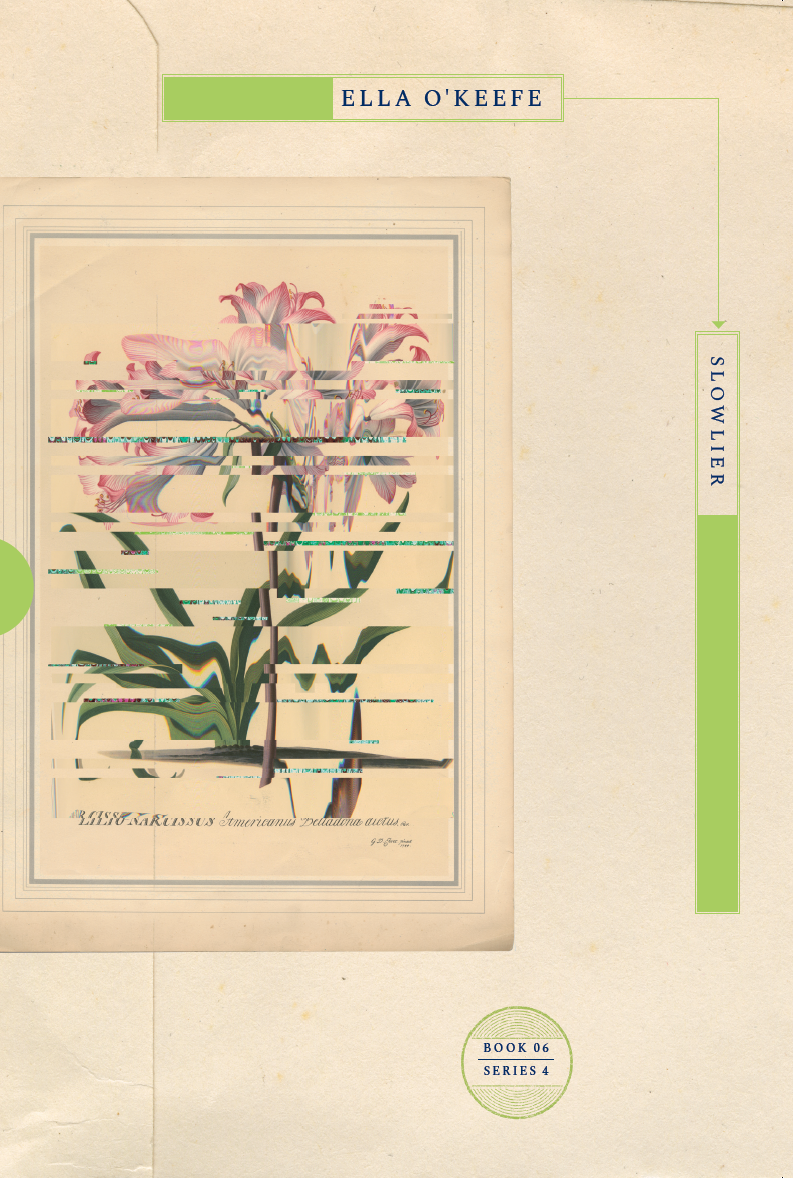
Introduction to Ella O’Keefe’s Slowlier

BUY YOUR COPY HERE

Since 1972, satellites have circled the earth, collecting images of it and sending them back to be catalogued and examined. Conventionally these satellites are called landsats, sometimes EarthHawks. Landsats tend to have a 16-day orbit. Most of them only last for three years. But Landsat 5, it lasted for 29 years, meaning it circled the earth over 150,000 times, sending back over 2.5 million images. Landsat 5 captured Chernobyl three days after the nuclear disaster. And the oil wells that were lit on fire in Kuwait as the Iraqi forces left. And the tsunami in South-East Asia. But it did not just capture large historical events. As Landsat 5 circled, forests burned down and then became deserts or parking lots. Flowers bloomed and died and bloomed again and died again. Rains came and went. As did floods and hurricanes and droughts. Ice caps melted and 11 new emperor penguin colonies were birthed.

When Ella O’Keefe writes about landsats in her poem ‘Landsat 5’ she points to ‘our unspeakable / patterns of use, inhabitation’.

O’Keefe writes with a landsat aesthetic. She uses juxtaposition so that fragments of the world float by, bumping up against each other. The poems travel, board planes, catch the bus, have a lot of walking to do. Unsurprisingly, things are often seen through a screen. In one poem, there are ‘whole corners for televisions / that burst from brackets’. In another, ‘flat screen jellyfish inhabiting conversions’. In another, workers ‘hold phones / up to the hidden moon’. Sometimes these same screens broadcast the riots of our time and are ‘a ledger / of brutality that stays near’.

In ‘Landsat 5’, O’Keefe speaks of ‘the uneconomic fraction’. The same year Landsat 5 was launched, the USA privatised satellites and their data was turned over to a commercial vendor. Image prices skyrocketed. And the vendor, as commercial vendors do, only collected data that it could sell. The rest became the uneconomic fraction. And these images disappeared. Our unspeakable patterns of use made even more unspeakable.

Poetry might best be understood as a corrective to this, and as itself an uneconomic fraction. In O’Keefe’s poems, these fractions are the waste products of capitalism. She, for instance, attends to the bottom of a Hackney canal, one filled with ‘150 years of Britain’s industrial history’. At other moments ‘pink smoke’ floats by, a reminder of ‘how much of our domestic scene / is held together with compounds / squeezed from tubes.’ Often O’Keefe is concerned with how products are created. She begins one poem with a moquette rug, notes its tenderness and give thanks to its ‘soft passage’, but then as it continues she notices the ‘livestock prices’ within it, next the rug being made, the yarn being ‘loaded into the matrix’ and the poem continues on, reminding us that mockado, a sort of fake velvet, was made to conceal. The poem ends with an allusion to courtly poetry. But it is not just a rug that experiences O’Keefe’s keen eye. So too a cartouche, an AlkAway, a scratchcard. And through these items, O’Keefe builds a complicated world, one that attends to the uneconomic fractions, the waste rock, and turns them into the poem, or ‘crystal form data-mining in the apricot light’.

Posted in INTRODUCTIONS | Tagged , ,

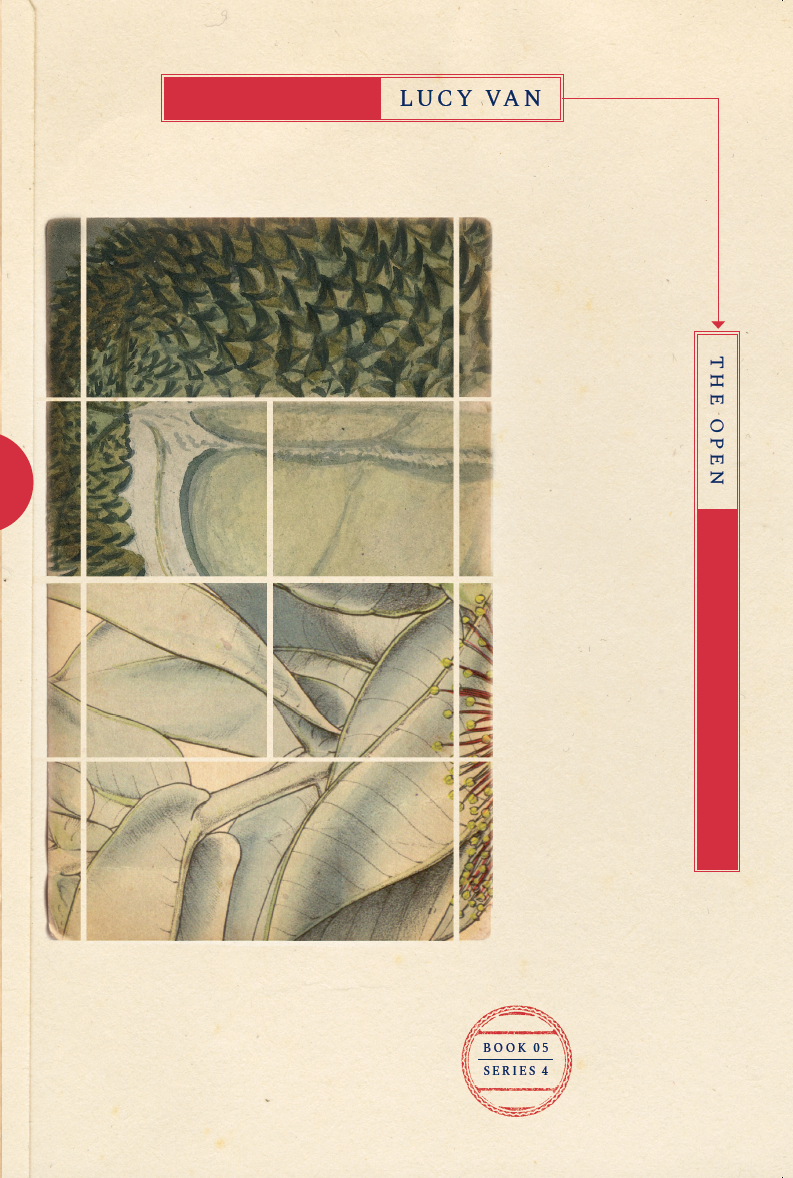
Introduction to Lucy Van’s The Open

BUY YOUR COPY HERE

This door, this though

All doors are open in Lucy Van’s poetry. Ingress and egress are multiple, even coincident. We’ve just touched what’s here, or are about to touch it, when apprehension is quickly unsettled, halted or reconfigured. Because we’re only passing through a door or another door is opening, as the poet offers: ‘Another thought though (and oh, I think about how thought and though are very similar words)’. Hers is a liminal though. Between what’s touched and what’s yet to be touched. Site of frisson. Contention. Then insight.

The book opens to Hotel Grand Saigon: ‘I have gone back and now I am here.’ ‘Back’ is her father’s family and roots in Vietnam, opening the door to his migration history, only a peek, though (‘Never write a poem about a boat’), then opening to Vietnam’s colonial history. And now we are here where the Vietnamese staff ‘are always ready to serve’ the French and other holidaying Europeans and white Australians, and herself, the Vietnamese Australian poet ‘coming home’, though also waited on or waiting in a gift shop and unable to ask, because she can’t speak her father’s language. Van’s poetry is an ongoing decolonial passage. Each opened space and time takes to task the one just left, then comes home to the poet, her self-reflexive though pointing to her own entanglement. She’s inside and outside these pasts and presents, or presences: touched and untouched.

But is one ever untouched? The ocean passes beneath these poems and one inevitably gets wet. It’s ‘a liquidation of territory’, whether in Vietnam or in Australia, where land has been liquidated, too, by the passage of colonial ships through water. Public or personal territory, even the most intimate, is persistently liquidated. Disappeared by coloniality, modernity, progress, by growing up and outgrowing, or by an aside, this though. Or simply made liquid, flowing through the next door, only to reappear as something else at the other side before moving on again. Van’s quicksilver to-ing and fro-ing creates an insight-coaxing discombobulation. But it’s the liquidation of the poem’s territory that is the hallmark of this collection, prose poems occasionally juxtaposed with the familiar shape: that block of a poem. To accentuate the liquidation? These prose poems start as a moment flowing in interior monologue into multiple spaces and times. Then sneakily, and bravely too, they open estranging doors, so poetry starts reading like short story becoming extemporaneous discourse, erudite and interrogative, hopscotching from Foucault to Kristeva to Homer to Bishop to Whitman to Catullus to Malouf to Plath.

Each is a new door opening: this though.

Is this from the sheer force of water that wants out, wants more?

The poet’s serve is vigorous: reader hurtles through another door and is suddenly in the middle of the Australian Open. Here, ‘[t]he court is [her] discursive space’. The ‘serve is the rhetorical question’ and the return, birdsong, ‘the aggressive claiming of territory’. Or merely a wish to restore what was liquidated? Tennis becomes philosophy. The line of thought is the line of though: one is again taken elsewhere. But always she returns to family, home, the intimate, the body touched and untouching: ‘most of your life you are coming home … all the while you are leaving’. It’s when Van is in this transit on ‘A Little Cloud’ that she’s most moving, and she transcends. Like when she watches her father drink a Fanta – poet drinking him up down to ‘the lump in his throat mechanical with thirst’ – and she’s ‘transposed … to the temple’, to ‘[p]laces like this … filled with doors’.

Posted in INTRODUCTIONS | Tagged , ,

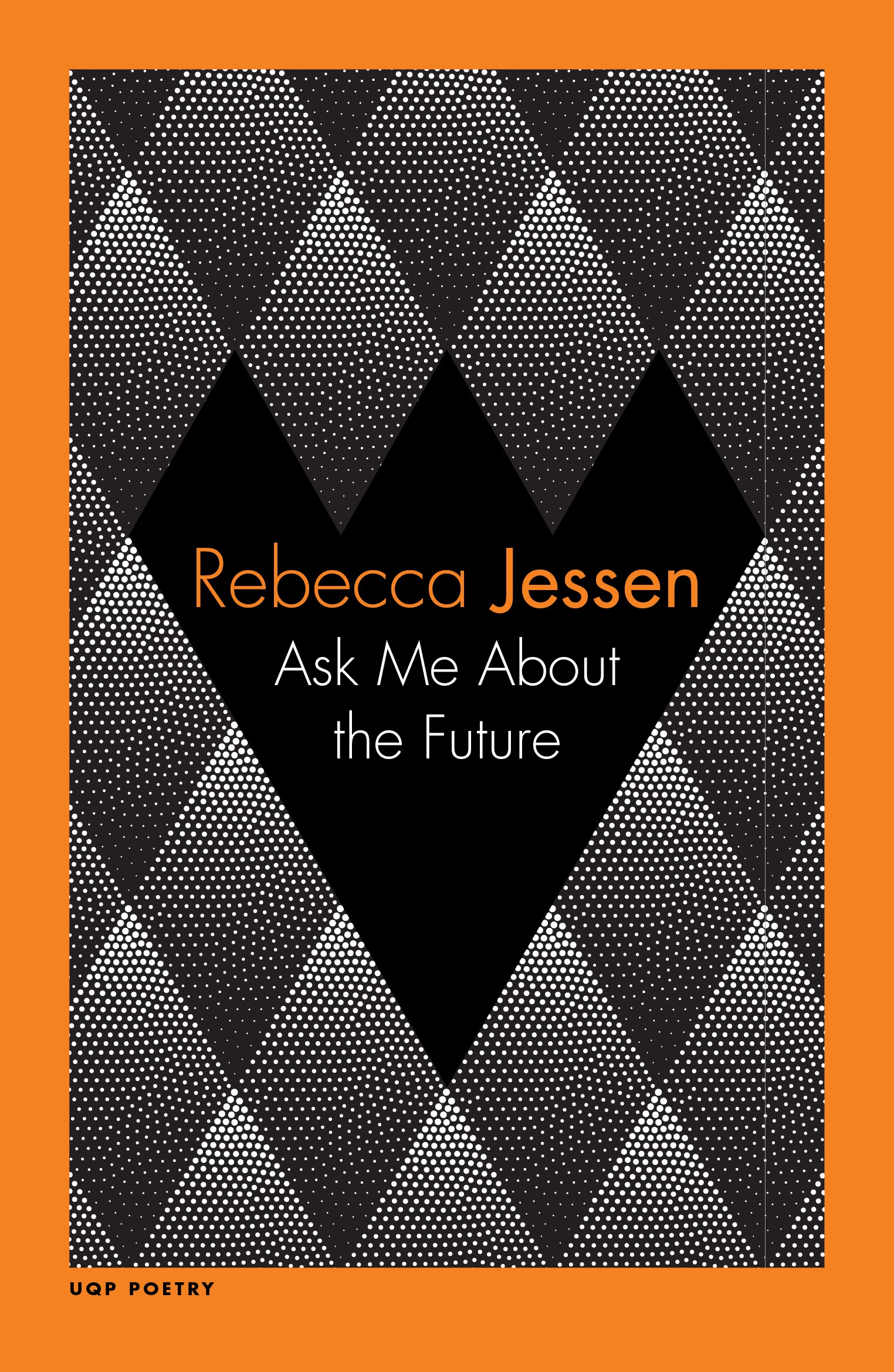
Caitlin Wilson Reviews Rebecca Jessen’s Ask Me About the Future

Ask Me About the Future by Rebecca Jessen
UQP Books, 2020


Is the future something to fear, or is it our saviour from the present? We have no idea what’s coming; we hope it’s something better, but suspect it’s only getting worse. In 2020, it is hard to be optimistic without caveats; you’re not alone in thinking of what lurks around the corner, or off in the distance, brings about a spike of anxiety. Is there still space for seeing what’s to come as a haven? Rebecca Jessen’s second literary publication but first poetry collection, Ask Me About the Future, though written in the Before Times (pre-pandemic), is a timely call to face our fears, to wade into the unknown with Jessen as our intrepid guide.

Ask Me About the Future is poetry as cartography, winging its reader through ports of bittersweet nostalgia and the rough sea of selfhood. The collection’s poems are waypoints; when followed, they reveal how quotidian occurrences and dramatic moments alike form a winding path through our lives. This churning journey whips up emotions like seafoam. The first poetry collection from Rebecca Jessen, author of 2014’s verse novel Gap, confidently, traverses the intimate, familiar spaces of beds and hometowns, suburbs and birthing suites. Gap, too, was shaped by a juicy preoccupation with connection, escape and love in all its forms, a fascination Ask Me About the Future takes up and extends. Here, Jessen’s potent sense of unbelonging, purposeful and melancholy, captures the feeling of waiting on a better world. Jessen describes these poems as ‘launch pads, not escape hatches’, a guide rail that is apparent in the collection’s concern with our propulsion into the future, as well as its refusal to sideline the past’s best efforts to tug us back down to earth. ‘11 Trippy AF Poems About the Total Eclipse’ recalls the 2017 total eclipse as ‘spying on the sun’, and suggests that ‘in the future we will look back fondly / at the pictures / and say things like / remember when / I Survived Totality 2017’.

The collection’s commitment to rocketing onwards doesn’t prevent Jessen from turning her gaze to matters of the present. A revelation of the imperfect present offsets a promise of goodness to come. In ‘triage’, the speaker says ‘there is no here. not for you.’ The future, on the contrary, appears in the collection as a place of progress and freedom. This is perhaps most explicitly explored in ‘Go Farther in Lightness’, a vision of a queer future viewed through a rocketship-shaped lens of retrofuturism. Jessen’s reflections on the past and present are the foundations from which her future imaginings sprout. Love is a major theme – familial, sexual, romantic. Jessen’s work deals with the ephemeral reality of emotions. As much as this collection looks forward, it is also a semi-nostalgic still life on past love and old family homes. Like in ‘some days’, where the speaker tells us ‘home is a big-screen TV and a three-tier cat scratcher’, and that ‘Mum’s place is like a time capsule. yet to be sealed’. Or in ‘prepare to merge’, where the central couple has become ‘the stock photo of ‘couple cooking’. ‘I keep my domestic past / folded squarely in my back pocket’, the speaker of ‘prepare to merge’ confides. ‘The Birthing Suite’ is a quiet epic, told from the perspective of an older sister as her younger sister gives birth, its sweetness and angst a perfect encapsulation of family drama. The ebbs and flows of intimacy are starkly painted, pinballing between contentment and anxiety. In ‘digging into eternity’, the speaker finds herself

at the rail underpass 
you photograph me next to the other me
but I am larger than myself here, 
where the stray cats skulk in the succulents 
and planes fly so low I can taste 
their metallic underbelly, where we kiss 
with tea-soaked tongues, and I am still learning 
the gentle ways to wake you.

Here, photography is a method of capture beyond the obvious – it splits the self into pieces, splits time into ‘now’ and ‘later’. The present is vivid and flavoured; the juxtaposition of metallic and tea-soaked a palate that distils the bittersweetness of losing yourself in love. These pieces feel crafted by a poet with skin in the game. Jessen’s authority on love and dating translates to humorous, cutting observations of contemporary text relationships and dating app woes. Jessen gives space for the unromantic romance of modern dating – in ‘(after) HER: dating app adventures’, the heart emoji is a repetitive, hollow marker between stanzas filled with txt spk, pick-up lines and winky faces, a distillation of the dating app game into the parts of its sum. (Jessen also asks the real questions here: ‘is it wrong to click ♥ because I think your Burmese is cute?’) The lived-in feeling her poetry arouses continues with her musings on twenty-or-thirty-something adulthood. In ‘The Late September Dogs’, blunt sentences are second person peerings into older-young-adulthood:

            driving cars worth more than your self-esteem.
And 
            feeling like an old soul and too young to know what life really is.

Encapsulated in these poems is the quiet drama of being young-ish, playing with phrases that bounce around social media as much as they bounce around our heads. Jessen softly satirises the language of millennials, her self-deprecation reflective of a generation (mis)-characterised by an odd combination of self-obsession and self-loathing – ‘Season 1: 12 Episodes’ begins with ‘1. My life becomes a series of consults with Dr Google.’, and ends with the pithy ‘12. My life becomes a series on Netflix no one binge-watches’. ‘Self Portrait as Index’ similarly investigates the self as a series, indexing terms with the ages to which they correlate. ‘Chronic emptiness, 18–31’ and ‘dole bludger 18, 25, 30–31 / see also underemployed’ dwell with ‘aunty 21-31’ and ‘queer 18–31/ see also lesbian; soft boi’ in this systematic, funny-sad attempt to define the self. Jessen’s poetry, romantic and otherwise, is formed and informed by queer existence, explicitly and implicitly. Poems like ‘sillage’ beautifully engage with queer eroticism, painting desire with olfactory notes of ‘black plum and aniseed / late summer / cherry’ and ‘top notes of acetone’. Queer love poems still feel radical in their own vital way, and ‘sillage’ is a gem.

Posted in BOOK REVIEWS | Tagged ,

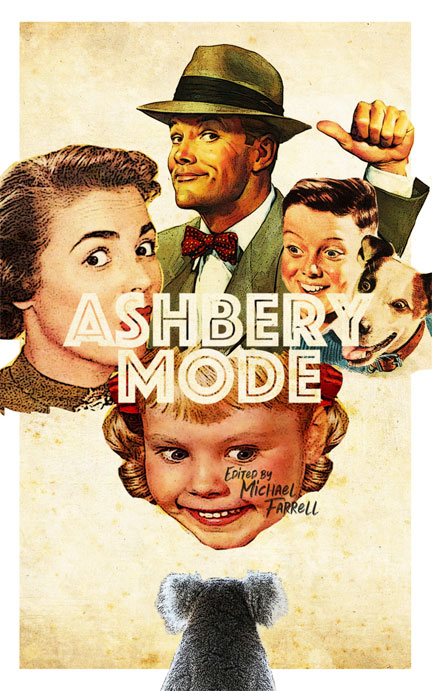
Joel Ephraims Reviews Ashbery Mode Edited by Michael Farrell

Ashbery Mode
Edited by Michael Farrell
Tinfish Press, 2019


The presence of John Ashbery shines over contemporary literature, for many as an enigma, indisputably as a catalyst. Part of the post-World War II wave of new American poetry, his name is grouped not just alongside his contemporary poets but among their literary schools and movements: the L-A-N-G-U-A-G-E school, the New York School, the San Francisco Renaissance, the Beats, the Black Mountain poets, our own ’68ers and J.A.

With its larrikinism and easy-going feel, even, not paradoxically, but inventively, at its most serious and radically experimental, it’s not hard to see how Ashbery’s poetry has almost always been popular with Australian poets, as much as the poetry of any other international poet. It is fitting then that Michael Farrell, undoubtedly one of Australia’s leading Ashberyians, has put together an anthology of Australian responses to John Ashbery’s poems, published just a few years after Ashbery’s death.

Ashbery Mode is a refreshing and innovative addition to Australian literature and a timely and illuminating opportunity to see how Ashbery’s mode has found expression in Australian poetry across two centuries.

I will first explore that expression by looking at how some of the most successful poems in the anthology adopt some of the most vital aspects of Ashbery’s mode in relation to poetic form, self, society and politics.

Let’s start with Ashbery’s use of the meta-poetic and a strategic metonymy. Ashbery can frequently be found commenting on his poetics within poems, whether cryptically, ironically or more directly. Ashbery’s poetry, like life itself, also presents a plurality of meanings. Often certain meanings are more dominantly implied and made buoyant by background strategies of metonymy. Even so, lines are simultaneously kept open to other interpretations, like music, acting as analogous channelings for any number of experiences or emotions.

Take these lines from the poem ‘Awkward Silence’ by Angela Gardner:

This is the moment to decide what to leave behind, instead
we get biblical, no longer recognisable. Familiar text
spews from what we say is our m. (marginalia) m m.. (marginalised)
m m m...(mouths).

The use of first-person plural invites the reader to position themselves as the poetic personae. In these lines, and the lines preceding, the specific situation has been kept vague. We are forced to lean into the language. Metonymically, with allusion to the creation of text and the ‘awkward silence’ of the title, we are leant into the interpretation that we are sharing the ‘awkward’ composition of the poem. In ‘our’ moment of deciding ‘what to leave behind’ we are taken over by an upsurge of ‘biblical’ but ‘familiar’ text. The narrative voice suddenly stalls and enters a comedic B-grade horror movie death throes, achieved with an A-grade literary acrobatics.

The conflict of composition is revealed as the conflict of self, a perpetual flux of inside and outside worlds.

Craig Hallsworth’s poem ‘Dolors’ begins with a meta-poetic moment which both parodies and hyper-realises the role of influence in poetry:

          My mound was effectively to meet a poet
with connections
High up in the food chain – that is awful of me
I must admit  In any case I imagine
He would have sat right where you are sitting now

Within the collocation of its line the use of ‘mound’ suggests lot and fate. Within the wider context of the stanza it meta-poetically suggests oeuvre. The authority or sanctimony of a poet’s status or voice is playfully diminished. The personae then bitingly presents poetry as a consumerist hierarchy before opening the fourth wall to bemoan the espousal.

Like in Ashbery’s poems ‘Rain’ or ‘Europe’ from The Tennis Court Oath, the scattered form of the poem presents the poem as process rather than product, as mental-activity concurrent with the page. All pronouns dissolve into the poem’s planar treacle ego and the space of the poem becomes an all-encompassing meeting place, integrative rather than imposing:

          But then ask yourself
          What am I not
A turgid member of   Am I not every bit
As embrangled in these fatal paraphernalia    Have I not
Myself on occasion found it rather cosy   All of us
Ghouls together

In a hyper-connected world where connection is often superficial and information is often torrential Hallsworth’s, following Ashbery’s, embodiment of a collective societal identity amounts to a radical democratic maneuver which constitutes ‘a commitment to democratic communication which is a challenge to, not a legitimization of, a society which makes it increasingly difficult’ (Herd 10).

In Ashbery’s poetry discursive tones and registers are blurred and mashed. The oversaturated and constellated nature of our discursive world is simultaneously illuminated and leveled out.

Take the following lines from a section of stanza two and eleven of Toby Fitch’s ‘All the Skies Above Girls on the Run,’ a collage poem assembled with parts of lines that reference the sky in Ashbery’s book-length poem Girls on the Run:

in the comet of the lighthouses
plastic star removal continues the real message
being written in big air bubbles

how serious we are as we dance in the lightning of your rhythm
like demented souls did we outwit you

The odd collocation of ‘the comet of the lighthouses’ echoes titles of American westerns and country songs such as Riders of the Purple Sage and ‘The Coward of the County’, the collocation of ‘plastic star removal’ echoes an advertised service such as ‘chipped paint removal’ and ‘written in big air bubbles’ sounds like the simplistic awe of a child. Shift to the next stanza and we have two lines that are more uniform in register and tone, presented with a verbose Elizabethan syntax.

In Girls on the Run this intricate tapestry of tone and register, aside from being delightful, presents the complex time-warp of the present in which the innocent girls must build and position their own identities, buffeted by a barrage of pre-existing positionalities and contexts. Fitch’s collage poem distills, rearranges and crystallises this effect.

The poem ‘Cloud Cover’ by Julie Chevalier exemplifies what John Koethe has called Ashbery’s ‘metaphysical subject,’ in which the subject or personae of the poem is refracted and dispersed, ‘yield[ing] only a personality or image that is ‘other’…timeless’ and knowable only as fragmented ‘surface’ (Koethe 92). Chevalier presents us with a series of floating images:

a cloudboat becalmed
          a ghost ship sipping iced tea    floating islands in a lemon sea
waves rolling in like mountains breaking   iceberg floes    ice blocks

a monolithic baldie    a dancer    a twister    i couldn’t resist’ er
chicago daily trib clouds    buck rogers clouds in the 25th century

The images and syntax appear like incomplete mental representations of an unmediated self, directly confronting the reader. The images crackle with personality. Associational sonic jumps like ‘iceberg floes’ to ‘ice blocks’ and the surrealistic, jumbled and retro subject matter give the impression of a daydreaming mind in scatter-thought. What is brought into relief here is the sheer magnitude of mind and identity.

Posted in BOOK REVIEWS | Tagged , , , , , , , , ,

SINGAPORE Editorial

When Cordite invited us to put together a folio of contemporary Singapore poetry, it seemed like a straightforward business. The usual suspects are called, a few new names sprinkled in for progress, a grant applied for, a spreadsheet assembled … but instead, we paused.

Contemporary Singapore is commonly represented either via national / official anthologies incorporating poetry in all the four official languages of Singapore – English, Chinese, Malay and Tamil – or in independent monolingual versions, most often in English. Over the short course of Singapore’s history, the government’s policy of promoting English as the main language of instruction, administration and business has rendered its purportedly polyglot denizens tongue-tied to a sesquilingual rather than truly bilingual or multilingual state.

We decided that our curation should thus attempt to diverge from the mainstream options – either of presenting only Singaporean verse in English, or token work from each of the four official languages. Neither is a truer representation of Singapore than the other, and both omit far more than they organise.

So for this issue, we consciously eschewed the substantial but well-represented body of Singaporean poetry originally written in English, and instead sought out voices from Tamil, Malay, Chinese and more which have not been as well circulated in the anglophone literary world. We wanted to foreground Singapore’s poetic polyphony and cacophony beyond the clipped strictures of Received Pronunciation.

To further twist the plot, we also conscripted over 30 younger poets, primarily versed in English, and gave them the challenge of transcreating these works into English: whether from a language in which they possessed native fluency; from a mother tongue they hypothetically should have been fluent in after 12 years of compulsory bilingual education but really weren’t; or from an argot they had no ability to even read, let alone understand. They navigated this process via the time-honoured combination of Google Translate and emailing the original poets for guidance and forgiveness.

Our hope is that this process has forced these talented poets to explore a language they may be more reluctant to call their own, and to pick apart their own comfortable assumptions about the line, the phrase, the word. Audiences new to Singapore poetry may get a dual sense of the linguistic contestation inherent in such a project. While most of the transcreators stayed largely faithful to their source texts, a few took liberties either of the formal or conceptual (some might call this extra-faith, or even inter-faith) nature. One rationale for doing this is to broaden notions of what poetic translations can or should do as creative works in their own right – as texts that challenge and are challenged by, grapple with, speculate on, negotiate, approximate and reimagine their sources in a variety of fruitful ways.

In curating this issue, we also sought to pry open the definitions of ‘Singaporean’ and a ‘Singaporean language’. A poem in the severely endangered Portuguese-Malayan creole Kristang, with only about 2,000 speakers worldwide, is featured, alongside works in Bahasa Indonesia, Bengali, Burmese, Gujarati and Tagalog. These poets may not all hold Singaporean passports, but they are based (or have been based for a meaningful time) in Singapore. Theirs are latter-day contributions to the literature of Singapore, which continues to evolve, alongside earlier traditions that have come to call this island home.

Special thanks must go to noted Singaporean artist Michael Lee, who kindly contributed eight artworks mapping the urban jungle that is a habitat for so many of these pieces. Sing Lit Station project managers Shalani Devi and Michelle Lee were tireless and diligent in the administration of this initiative, and the National Arts Council generously provided a grant to honour the contributors.

The 37 poems in this folio are presented with the original language poems following the English pieces. Although the reader is invited to dip in and out as they will, the poems have been arranged in a loose sequence meandering through a Singaporean day – from a city-dweller’s front door to their commutes and offices, through development and place-memories and migration, via family, via language and ending at the sea that encircles and delineates our island nation.

To conclude: we apologise for any crimes against language that may have been advertently or inadvertently committed in the course of these transcreations. In every case, we obtained the consent of both source poet and translator for the works to be published as you see them here.

We are but a ragtag Babel Alliance salvaging the tools of a post-crumbling Empire – prone to producing our fair share of Hoth-like debacles – in the faint hope of occasionally firing a proton torpedo through the odd thermal exhaust port between languages. We tried something new, stood back, and waited for the explosions … that had to be cleaned up afterwards.

Thank you, Cordite, for your patience and for letting us play in your galaxy.

Posted in ESSAYS | Tagged , , , , ,

8 Artworks by Michael Lee


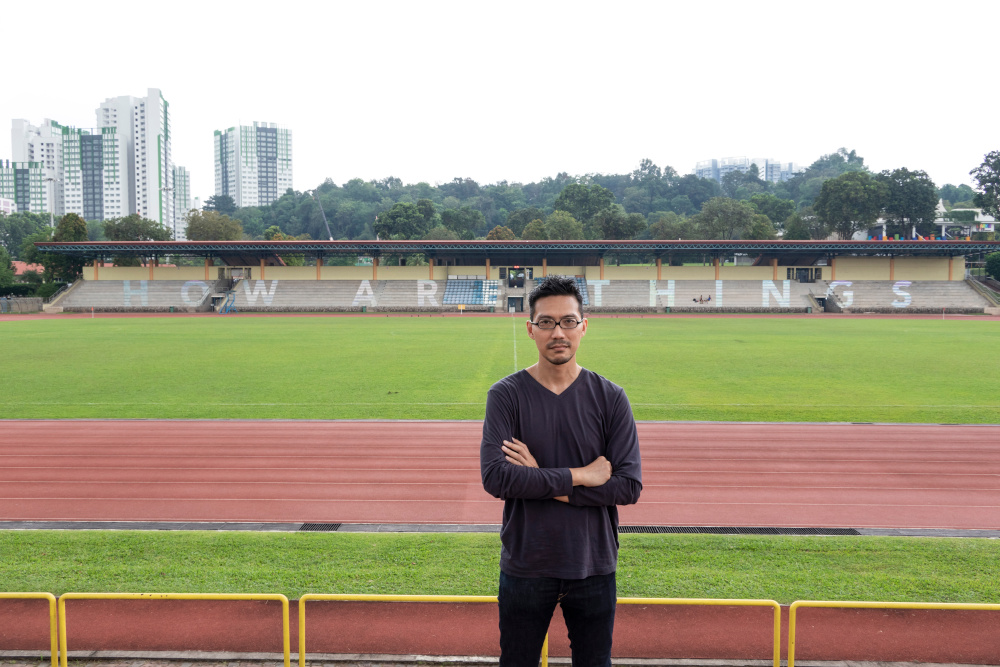
Michael Lee | How Are Things (installation view with artist), 2018

My artworks are personal reflections on city living, with a focus on how space structures human thought, feelings and actions. Researching architectural heritage addresses my own poor memory of places I’ve lived in and been to, which also benefits from and spurs my own speculations of spaces to come.

From 2010-11, I created ‘Second-Hand City’, a series of architectural posters featuring fictional buildings or cities. Among them is Shishitv Tower, which narrates the life cycle of a species of building that disperses its offspring via explosion. Architecture insiders may recognise the reference to contemporary architects here, and my intention is precisely to suggest that, try as Rem Koolhaas and Frank Gehry may to profess personal style and distinction from each other, there is continuity between them. I continued this fascination with how reality rubs against fiction, sometimes in wrong ways, in Notes Towards a Museum of Cooking Pot Bay (2010-11), a large-scale mind map of notes for a hypothetical museum that commemorates the past, present and future of Telok Blangah, a neighbourhood in the Southwest part of Singapore.

While on an artist residency programme at the Künstlerhaus Bethanien in Berlin during the city’s historically coldest of winters in 2012, I was struck by the paradox of solitude as both a state of precarity and a condition for production. I explored spaces of confinements and escapes by making diagrams, including the floor plan in Bahja Caves (2013) and the sculptural outline of a treehouse in Skeletal Retreat No. 1 (2013). Diagonals (2014), an interactive wall mural bearing the hazard symbol of black-and-yellow stripes, enacts the experience of having unknowingly entered a situation without access to the exit. “Planting Building” (2017), whilst revisiting lost buildings and topiary, also throws up dilemmas of growth, training and care.

My recent projects wonder about how to communicate with others for the sake of mutual flourishing. The large-scale text installation, How Are Things (2018), harnessed the subtle colour-and-tonal shifts of holographic stickers to address Woodlands Stadium users and MRT commuters with the titular greeting. In Friendly Strangers Party (2019), 100 pennant flags revisited the words or deeds of people whose identity I never ascertained but who have touched me in one way or another.

I hope my art captures in some ways the opportunities and challenges of urban existence, and suggests fiction not just as a form of entertainment but as a mode of survival.

Posted in ARTWORKS | Tagged

A Magical Aquarium Called the Ocean | கடலெனும் வசீகர மீன்தொட்டி

A fishmonger in the wet market
wakes the Sundays, sprinkling
a little palmful of water
across the agape, throbbing mouths

of stranded male fish
awaiting breath. Bristling
with lustful desperation
they gulp for gifts—
Filled with air, unsatiated.

In another dried-up country
a female fish swims in her marital tank.
The scent of her beloved arrives
through the mobile phones
as bait on a glimmering hook.

Droplets roll upon a banana leaf.
On it, a meal of sliced fish
served from her lingering palms.
After, these palms in which wetless kisses
begin in secret to gather and swim.

The meanders of unfulfilled thirst
take their course in the arc
of the thrilled body, springing streams
of sweat along scale edges.

Between the two countries
is an alluring fish tank.
Here, the unending ocean.

Posted in 99: SINGAPORE | Tagged ,

We Speak to the Fish in our National Language | 我们对着鱼缸说国语

Facing the fish bowl, I speak the national language1:
each vowel, a gust upon glass;
each accent, a mosquito’s unsteady dance.

From my watch’s face, each second, turbulent, rises like smoke.

The English of the 50’s was but a colonial tongue.
Thinking of our national language, we’d speak Malay.
But by 1965, what was it? English? Malay? Both?

Smoke clouds roll and swallow the map.
Where can we hope to live in peace?

The Federation. Straits Settlements. Malaya. Malaysia.
Taiwan. The Republic of China.
Temasek. Singapura. Singapore.
Please, repeat after me.
This is my home country – Home. Country.
You have your own national language, as do I.
Our tongues roam free – they are by no means bound.

We sit about a round table, practicing the national language.
The fish, in their round bowl, pout the way all goldfish do.

They are like the snakes in our mouths, these writhing tongues.

Occasionally, our lips, too, are round –
when they are
they are fishes they are languages they are Bahasa Melayu they are Ü;
when they are not
they are ikan2 they are English they are Inilah Singapura3.

Posted in 99: SINGAPORE | Tagged ,

Heart | হৃদয়

a heart rendered
like wax, to
insignificance,
to giving up–

a heart rendered
like time, an
amnesiac, spaced
in uniform–

a heart rendered
like love, saying
hello, a teaspoon
of honey–

a heart rendered
like current, in its
own course, feeding
to ocean.

Posted in 99: SINGAPORE | Tagged ,

Our home ocean | எங்கள் வீட்டுச் சமுத்திரம்

I had transmuted all my opinions
into smooth stones
in the fishtank
in the living room.

If the price is right,
Lalitha said, we can buy an ocean.

That Sunday, we both went
to the shop that sells oceans.

For the price of a month’s rent,
said the salesman, you can own
an ocean that comes with full moon waves.

My wife and Lalitha were delighted
to have bought the ocean.

Our cat kept
glowering
at the ocean.

Cha! Saturnine ingénue,
what does it know?
I said.

The Sanitation Officer
inspected the ocean and left.

It was not on his list.
We can buy a tortoise next,
I told Mother.
Mother objected;
like a statue of Krishna
playing his flute,
a tortoise destroys a home.
Everything would be swept away.

As sunlight disperses
on the surface of the water
like bread ripped to pieces
by fish, whales and tortoises,
our home ocean lies
balled up in hunger.

Posted in 99: SINGAPORE | Tagged ,

A Mother Is a Poet | Ibu Adalah Seorang Penyair

In a mother there are two creators:
one a devotion spoken to her children,
the other a conduit for them
as she raises her palms,
reaching to the heavens
in search of the divine wire
at the cost
of her beating heart.

How her children
fall deaf to her pleas.
They muffle it with
thunderous play
until the distance
between them and her
becomes an open circuit.

A mother remains a conduit
until the storm takes her away.

Posted in 99: SINGAPORE | Tagged ,

I’ll Come Back Later | ခဏနေ ကျွန်မ ပြန်ခဲ့မယ်…

Stop setting me alight with that look on your face.
Please just leave me alone.
I’ll come back later.

You have no idea
How I collapse into madness,
How my marrow melts and evaporates,
And how a tempest forms in my mind
When my breasts become stiff and ache.
You can’t read me through and through. You are just a man.
You don’t know all about mothers. You are just a father.
Don’t worry; I’ll come back later.

His scent wafted from my uterus to the end of the universe.
His music traveled from his first breath to my last.
All my dreams were about him.
And he was a beacon of hope.
Now the farmland of my future, like my uterus, is desolate.

What kind of sound did the life I strummed like a guitar make?
What kind of mineral crushed my fetus—my flesh and blood?
The destiny with my name on it is a wasteland.
I have gone mad. I need answers to all these questions.

When I want to scream until my soul shatters
Or when all the veins in my body burst and weep,
I will gently rock the cradle that I made for him.
Or I will push his teal blue pram alone.
I will hum some lullabies.
I also have a pair of pink socks I have to finish knitting.
I will recite Homer’s Greek myths.
And I will draw the picture of his newly sprouted incisors
That I never had a chance to soothe.

Son, I watched every centimeter of your growth.
I watched with delight.
I could build a whole new world with traces of your existence.
I…I…Oh, I…
Don’t worry; I’ll come back later.

Posted in 99: SINGAPORE | Tagged ,

My House | Rumahku

through spaces & slits

breath, spirit, longing shelter

seeks
no reward

I fashion this prayerful
footstool

to sweat on
so they’ll know a love

weathers
crash & swelter

my house a place
best fashioned
mine & my heart

mama

papa
bless—

what’s treasure got to do with anything?

Posted in 99: SINGAPORE | Tagged ,

Left | 左边

After Wislawa Szymborska

I like the morning-sound of ground coffee beans.
I like the symphony of leaves in light rain.
I like the delight of an unexpected friend around the corner.
I like watching expressions over opening lunchboxes.

I like looking back.
I like windows with views.
I like silhouettes, but not shadows.
I like speaking to people older than me, except when they are children.
I like humanity’s complexity, but not its cunning.
I like when the few are led by the many,
but not when many impose upon a few.

I like the in-betweens.
I like being left more than being right.
I like when someone admits they don’t know the answer,
but not when they say there is only one answer.

Posted in 99: SINGAPORE | Tagged ,

Amnesia | 失忆症

You don’t need to try again, doctor, really
I honestly can’t remember – What am I?
Address? Where do I live? Hold on –
Ah! I seem to recall, I live in
those clothes, my son’s clothes, other people’s
sons’ clothes. There are a lot, I always wash them
Hold on a minute please, my son’s crying, ah!
This boy, since he was four, his father
has been tracking his progress from a portrait on the wall
these clothes, I live in them, but
then the fire came and drove us out. Ah, no—
That’s not right. I live behind, right, yes,
and they live in front. I don’t dare to go there because
that woman will strangle me—with her eyes
she’ll choke me with a silk band. Her voice, building up
cold, a wall, keeping us apart, me and
my son. But those flames are coming
they’re so unreasonable. My neighbour walks
shouting for me to run. Doctor, please come quickly
help me get something, that suitcase, that
kettle, yes, that one. And here,
this pot, hurry up, Doctor, it’s too late.
The fire was set by the homeowner, I’m sure of it
I’ve owed him rent for so long, it must end, all of it
all the begging, my landlord believes so,
I want to hug my son, he’s crying, but
oh! I’m mistaken, that’s not
my son, he’s not tall enough, sh!
He wants to help me dry the clothes, Doctor
but, I wash the bucket of clothes, and I turn around
and he’s taller than me. He hangs his clothes
saying he can fly. Clamp, and that piece
it flies, and you have to compensate. But I don’t
see how he flies. He just walked in
that door, the one made of glass, and then
gave me a whole load of hope. Uncle
look again, what is he saying now, can I trouble you
I don’t know how to read, Uncle, ah, no, Doctor. Please
don’t ask me again, I can’t quite remember, it’s too vague
the door was so thick and the aircon so cold. He walked over,
he finally came home, I know. Because that woman
isn’t coming home, her skin is too sensitive
in my room, there’s bacteria
my granddaughters said so. They’re adorable, my son’s
daughters. They never once let me touch them,
their clean little hands. So I know, Doctor
he finally came back. My son, it’s him.
My relatives and neighbours said he’s here
their eager eyes pry him out. It’s really him.
Him, and he brought a gift too, a foreign brand
– my daughter-in-law and my granddaughters. It’s so cold
the aircon. Thank you, Doctor, that’s much better
if you were just my son. If I just
had a son, that would be good. But I don’t have
an address. Where do I live? Someone’s knocking
Doctor, why don’t you open the door? Someone’s there
I heard it, it must be him, he’s finally back
since he was small, he was always so sensible, my son
he came over and handed me the dry clothes
came over and gave me hope to hold in my arms
now, Doctor, look, he’s coming over
he said, he said she said, the house is too small, next weekend
they want to take me there, where it’s so warm, that
old folks’ home. But, Doctor, no
that’s not my home. They made a mistake. But
they’ll come and chase me, like that fire, so
I went to look for my son, he was gone
then, I forgot where I live.
What am I? Let me think, hey,
I remember my name. My name is
garbage, yes, garbage, useless. I heard
my name, floating, from those gentle, sweet
lips. I remember, I remember who I am, but
really, I can’t remember anything at all, Doctor.

Posted in 99: SINGAPORE | Tagged ,