Read this essay over on Liminal magazine.

Read this essay over on Liminal magazine.
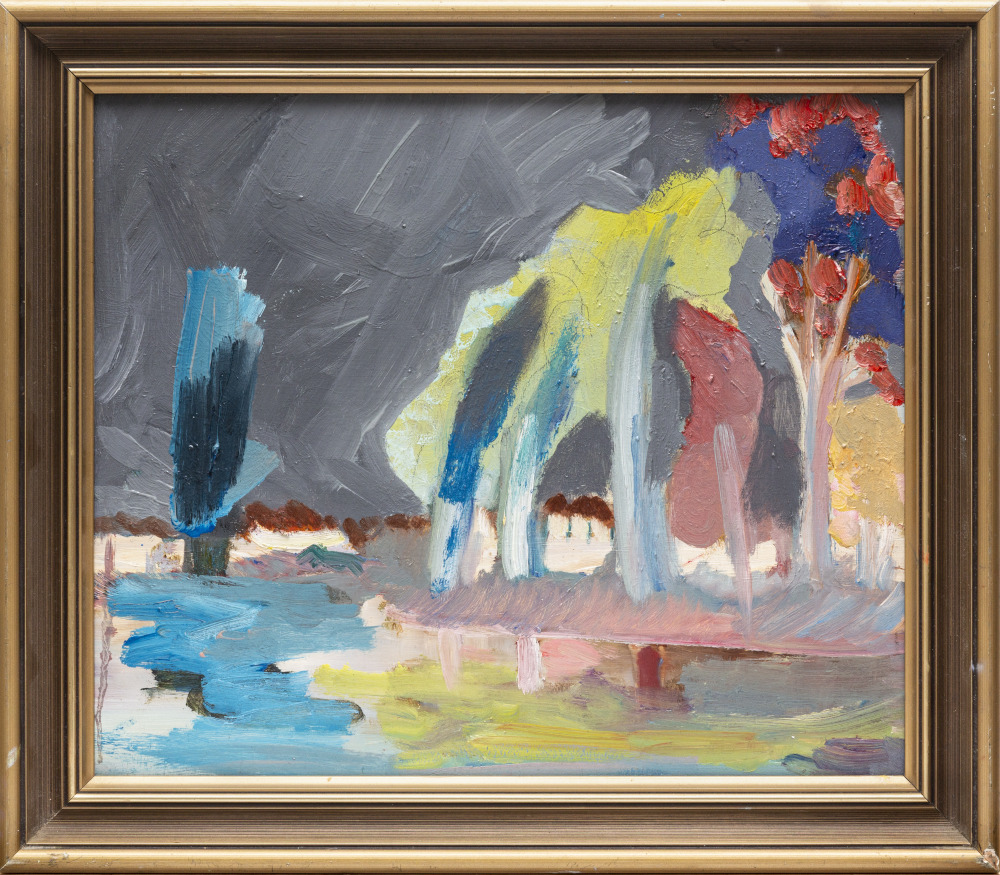
Karima Baadilla | Purple Does Not Mean Sad | Oil on found board | 36 x 42cm
My painting practice explores the emotional and psychological aspects of a person’s life, and is informed by my own quest to find my place in the world as a migrant settler in Australia. Painting new paintings on top of old paintings is a way to create spaces on existing ones, understanding that the present is made up from elements of the past. Painting directly on top of another painting is not about erasing the past, but creating a new perspective, a mosaic of things that makes a new place.
By choosing to de-frame, re-paint, re-frame and then re-define an existing painting is to demand space where there was none, to add a new time dimension to an existing one. The physical act of adding a painting on top of another image or painting is to add layers of time, space, place and history instead of creating a wholly separate figurative world – rejecting the notion of othering. This rejection is the driving force behind my artistic practice as I seek to create works that do not explicitly showcase my identity but rather, allow the action of reclamation to be my agenda.
Let’s Pull Things Apart Together was developed by Karima Baadilla during her time in RESIDENCE at Footscray Community Arts, 2021.
‘Criticism is committed … to helping us to understand poems as significant utterances. But it must ensure that in its desire to produce ultimate meaning it does not purchase intelligibility at the cost of blindness: blindness to the complexity of those non-meaningful features which differentiate poetry from everyday language and make it something other than an external thematic statement about an already-known world.’ (Veronica Forrest-Thomson)
I take my title and epigraph from Veronica Forrest-Thomson’s separatist manifesto, Poetic Artifice: A Theory of Twentieth-Century Poetry. First published posthumously in 1978, Poetic Artifice is more than what its unassumingly vague subtitle suggests. In addition to being a ‘theory of twentieth-century poetry’, it is also: an ABC of reading, an extended argument with the critic William Empson, a critical genealogy of technical innovations from John Donne to Dada, and a fanatically clear-sighted insistence that poems use language other than to exchange facts and observations about the world outside themselves. The ‘Artifice’ in Forrest-Thomson’s title is the name for the total process by which a poem marks language – adding emphasis through typography and lineation, rhyme, metrico-rhythmic patterning, etc. – so as to hijack its ordinary communicative usages and arrive at a meaning that is as much about itself as it is about the world at large, a meaning that subsumes thematic content under a larger concern about the efficacy of its own meaning-making structures.
Forrest-Thomson was by no means the first person to make such a claim. Much in the way that Artifice works through a play of poetry’s continuity and discontinuity with other language games, her theory is less a radical break than a pivotal node in an experimental tradition running from Russian formalism to American L=A=N=G=U=A=G=E poetry, a tradition which we might define as broadly ‘anti-realist’. While this is not a tradition to which Australian poetry has historically been indifferent, Forrest-Thomson’s critical and creative work, curtailed by her early death at the age of 27, remains largely unread outside of relatively small coteries in North America and England,.
So why bring Veronica Forrest-Thomson into a discussion of Asian Australian poetry? There are a couple of circumstantial coincidences: she was born in British Malaya (her father was a rubber planter) and found an able and sympathetic expositor in the Australian poet Martin Harrison, who gave a 1979 ABC Radio talk on Poetic Artifice. But the main reason has to do with the critical austerity that is her counsel, the vehemence of her objection to what she calls ‘bad naturalisation’ – a way of reading that by-passes or liquidates ‘the complexity of those non-meaningful features which differentiate poetry from everyday language and make it something other than an external thematic statement about an already-known world’. It is an arresting and somewhat aggravating provocation: that in our ‘unseemly rush from words to world’ (as she puts it), we overlook much – if not all – that makes a poem, well, a poem.
While the categories of identity that are part of our critical orthodoxy do not feature in Forrest-Thomson’s study (all her case studies are white and only two – Edith Sitwell and Sylvia Plath – are women), I find her notion of the ‘bad naturalisation’ particularly suggestive. For ‘naturalisation’ also happens to denote the legal process by which a non-native resident of a country becomes a citizen; and Poetic Artifice’s main argument, we could say, pertains to poetry’s equivocal citizenship in the many worlds of discourse it constantly traverses. Rootlessly cosmopolitan – as fluent in the parlance of the office as in the language of the bedroom, in the theorems of science as in the paradoxes of theology – poetry is a perennial migrant in the republic of letters.
In what follows – a close-reading of three of the thirty poems sedulously edited by Bella Li – I wish to elaborate upon this hint that our negotiation of poetry’s generic difference may set a kind of precedent for our encounters with difference in other orders of meaning and being. I’ve chosen work by three younger poets representing what I take to be a generational congeniality towards Artifice and a shared instinctive appetite for the effects of aesthetic distancing. In their Artificing, one notices a sense of belatedness, a removal from – and perhaps a certain skepticism about – more securely transparent forms of personal testimony with their attendant authenticating affects.
****
The interplay between the two senses of ‘naturalisation’ – as the domestication of meaning on the one hand and the legitimation of community membership on the other – appears to offer a way into a poem such as Vidya Rajan’s ‘Untitled Wild Geese Game’, a mashup of Mary Oliver’s much anthologised poem ‘Wild Geese’ and the indie video game Untitled Goose Game. A ‘bad naturalisation’ of it may read something like this:
‘Untitled Wild Geese Game’ is a migration poem askew – one that displaces the pathos of the diasporic crossing of geographical latitudes (a residue of which persists in the conventionalised image of the goose) with a wry awareness of the behavioural latitude (or the lack thereof) permitted under model minority citizenship (‘very few / of the people I know enjoy / the grace of mistakes’). The ambivalence of the poem’s attitude is captured perfectly in its subtitle: ‘[sorry Mary Oliver] [sorry House House]’, where the ‘sorry’ transfuses an unrepentant insouciance (‘sorry I’m not sorry!’) into a pro forma display of filial piety (an acknowledgement of sources being a kind of ancestor worship, textually speaking). This way of being bad at being good is, of course, the inverse of the objective in Untitled Goose Game, where, as the eponymous goose charged with wreaking havoc on an English village, one ‘gets good’ (in gamers’ parlance) at being bad.
This reading, while capturing some of the poem’s ironic inflections, proceeds from certain assumptions about who the ‘I’, ‘we’, and ‘the people’ in the poem are – that is, from fixing the identity (with some help from the geographical coordinates provided in the poem itself) of what linguists call shifters, those grammatical constituents (pronouns or adverbs such as ‘now’, ‘then’) whose meanings shift according to the context of utterance. What about this poem do we recoup if we forego these assumptions? What part of our vision is restored if we lose this crux of intelligibility?
We might be able, for instance, to think about the poem’s concern with the relationship between permissiveness and kinship – as well as its comic improvisations upon its source material – through the conventions of pastoral. When we substitute a generic ‘I’ for an empirical one, we see that the speaker’s unforced eloquence, ranging from the slight wistfulness of ‘very few / of the people I know enjoy / the grace of mistakes’ to the rancor of ‘this or that / shithole country of origin stress’, is reminiscent of that of a figure such as Meliboeus, one of Vergil’s herdsmen in Eclogues I, whose fortunes are similarly hostage to the arbitrary determinations of the imperial centre. That very sense of arbitrariness is also conveyed by the anecdotal informality of the lines in ‘Untitled Wild Geese Game’ that most explicitly engage with the history of empire:
why’d the brits leave
so much scrap metal – was it our own fault – we should
have cleaned it up

well, when we were young we didn’t have
all this, and the rice, the grains, if you trace them back,
were of poor quality, the best exported elsewhere,
for the empire?
and now all these illnesses, I guess I guess
Tonally and typographically, these lines are bracketed, passed off as a kind of small talk (which in pastoral is always thinly-veiled big talk). If there is a ray of migrant pathos here, it passes through the diffractive medium of pastoral melancholia – it is not just a family story being presented here, but a story about ‘the history and family of things’.
In examining ‘Untitled Wild Geese Game’ under the aspect of pastoral conventions, we might also be alerted to the way in which human-animal relations are mediated through this poem’s cacophonous soundscape. More than any of its discursive statements, it is the poem’s sonic exuberance that performs the most wholesale critique of Oliver’s catholicity about ‘the family of things’ (the concluding phrase in ‘Wild Geese’), a disclosure Oliver arrives at through a stateliness of repetition and address over which Rajan rides roughshod. Bits of verbal spare change – ‘like’, ‘cute’, ‘ew’, ‘um’ – are placed at line-endings to emphasise the porousness of the boundary between the semantic and non-semantic. It is a poem highly attuned to its own trafficking in noise. We can detect, for instance, a sort of counterpoint between the lexical and phonological repertoire centred around -es words (‘geese’, ‘knees’, ‘less’, ‘stress’) – all of which thematise psychic and corporeal vulnerability – and the cluster of -on words (‘honk’, ‘dominion’, ‘imagination’, ‘lonely’, ‘moon’) – words which mark moments of self-possession. The decisive change is rung at the conclusion, where an adaptation of ‘Fly Me to the Moon’ (‘Honk me to the moon! / Let me honk among the stars! / Let me see what honk is like on / Jupiter and Mars!’) tunes the poem to a new key – of wilfulness, if not freedom.
Let Liboteur do the work of Prophet who is NOT ACCEPTED YET.Let Huitzilopochti Gerzil Rongo Set Hachiman Inanna almighty Indra Junda Jiutian Xuannü Nemain Laran & the Kydoimos Neit Idis Ullr Jarovit Sekhmet & Ogoun & Resheph & Enyo REJOICE with Roberto the Clown who would U believe VERTICALLY REGISTERED ZERO more on it later.Let Nicholas Pounder the PRINTERPŔETER rejoice in the Spirit of his ways with Blake Hokusai Hogarth who legislate shape.Let Nick Whittock & (Bk 1) Cathy Vidler VISUALISE the Quantum Universe & Wicket Pitch SPATIALLY INTUIT spontaneously exercising caution O, o.
in the middle of we are always
boarding a train returning to
my mother sends me a picture
from 2004 she tells me memory
is transient
remembering is eternal in the image
I am carrying a small orange both hands full
somewhere
uncaptured in the frame
the train stops
moving
He brings it home one ordinary afternoon,
cupped in his hands like a fresh piece of hail.
When he rolls the rock between his palms
a fine precipitation sifts down, barely visible,
and the air between us crackles, falls several
degrees colder. We marvel at the rare find:
this tiny blizzard for the pocket, a child’s fist-
sized conjuring of snow. If only I too, as a girl,
had found such treasure. He slips it in a bowl
of steaming water. We watch in silence, solemn,
as the surface slurries, begins to knit its dull
cataract of ice. The schnee stone darkens ever
so slightly, and refuses to melt.
* Schnee: German for snow
Po Po dreams / of glaucoma moon / a white meihua flowering / through alluvial
night / she dreams each strand of light / a stemmed grief / stirring the parable
of her face / dreams each eye unhinging / like swollen figs / as the wok-dark
smoulders her deeper / into the fever of steamed fish / into the incorporeal salt
of ever dissolving dreams / where some nights she awakens / nestled in the strange /
grasses of a half-parted world / seeding the soil with her astonishment / as she slow
dances amongst schisandra leaves / as she skips stones like unhoarded decades /
as she calls out to her grandchildren / gathered on distant plains / their feathery
heads aglow / like meihuas thawing / into impossible morning / & sometimes there
grows a silence / which glistens like apples / the music box of nectar / she cleaves open
to fill the aching / fermata of her hollowed gums / & sometimes she watches meihua
sun / blossom brutal black / beneath reddening sprig of dusk / & she understands
the sea’s greyness / to be a mirror without / the home of its reflection / & all through
alluvial night / she digs out the compass of the horizon / to etch divinations /
into the cicatrix of stars / to omen herself into sky / before geographies of sight /
harden into cataracts of maps / before the slow trains of sleep / bear her back through
the dark wheat of dreams / into the shimmering station / of this snow-rocked room /
of this world she could never / part with / where the blankets sculpt her bedlam /
body into the impermanence of summer frost / & the pale plosives / of her breath
unpetal over her / a white meihua mourning / something unspeakably soft
Write how quiet it is.
‘Starvation Camp Near Jaslo’, Wislawa Szymborska
The lines stretch out like a child’s drawing,
wavering, circling the block. These are people;
they clutch envelopes, papers, proof of lack.
They are hungry, they are afraid of going hungry.
The price of dignity. A reporter says No, she will not
go to the front of the line to demand answers—
The cafes are shuttered. There are no rooms
to while away the hours of the night, drinking.
A narrow bed will fit precisely the contours
of a single body lying flat on its back. Sheets
rumpled and pulled back like a discarded shroud.
Behind the glass whole alphabets are set loose.
Imagine the touch of a stranger—an unknown gift,
a leap of faith. A breath and its attendant dangers.
The carpet glitters with piles of spilled-over numbers.
At the hinge
of before and after,
the boycott expands:
me from ordinary life,
ordinary life from me.
Nostalgia summons
the once finely calibrated
habitus of advertising:
the very mint cashmere shawl indie
film festival new vegan restaurant
I didn’t know I did but wanted.
Not so much real intimacy,
just capitalism’s deep, surveillant interest
in my anxious homo economicus
(being looked at lovingly sometimes being close
enough to being loved).
Now all seems random:
news reel, conversation, meeting
invitation — hasty incisions, knife slipping
over thumb and no dark metaphor for
salvage. I do not really yearn for the best
ten exercises to lose my stubborn belly or
how to lean in as a remote-working feminist;
all of my passwords feel compromised,
no simple hack gets them sleeping like babies.
The expensive calm of now,
pruning things I know how to do
and people I know how to talk to,
leaves light shining down, me squinting at
questions — how to name a child so they know
they belong, how to name the body
so it doesn’t fail you, how to taste the sticky
corner of your mouth, how to fast forward
through all this, the very best day of life.
1
Here we fell among it, the cursed lawn
dappled day: my Voltaren gel caps askew
Medjool pit in the Spanish crown teacup
Cursed in the sense of all lawns – unnatural
monoculture, a steep price for your desires above
the rest (pollinators, winged ones)
2
We’re in surplus, sprouted mung beans
I’m on a single leg and turning eastwards
colliding at the sky, a pond or hearing the old life
They call it keeping your balance, I call it switching
swapping a tiny blacksmith’s hammer
on a neck for the enclosed, the erupted, on 20th
3
You watch this spot, the one where I poured
luminous coffee, we discussed the voltage of inter
generational junctions, the past always
contained the object (yours, a pierced-hole lobe)
Mine, a deep gut lurch. I mean, a hook inside but welcomed
digging pits, reaching over state borders
tectonic shifts for the new world
(not a new world at all but we’ll learn the shame, for Leopardi)
4
I’m calling it: we’ll walk the rest of the way. You told me
how it’s made, but I stuff my face with mountain spinach
all the same. I haven’t worked out this next bit, the cast off
they call it
(the fisherman’s
knitting bible)
as burning house: https://theburninghouse.com/
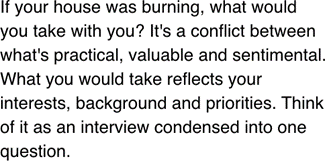
as mourning:
The frog dies because it can’t detect the water boiling.
Felix no longer wants the slow release of forgetting. He wants
something swifter. To more readily mourn. To no longer wait.
He goes to Myer to buy a black suit.
as dusk: https://youtu.be/qRZE77N5woQ?t=9
as malfunctioning microwave:
as goodbye: https://thoughtcatalog.com/stacey-becker/2015/05/15-rules-you-must-follow-when-saying-goodbye-at-a-party/
as father’s words you’ll always remember:
“Be the master of the events.”
as pedagogy: https://www.fluentu.com/blog/chinese/how-to-learn-mandarin-chinese-by-yourself/
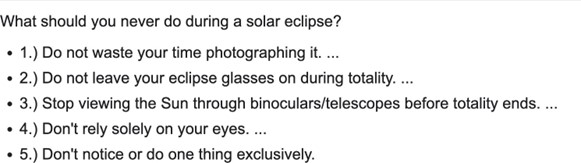
as the sun and the moon:
as seance:
Felix is sorry you’re gone. He’s making seven phone calls to
different people in the underworld trying to make it through.
He’s on the phone with Ox-Head and Horse Face, guards of the
underworld. They keep trying to finish each other’s sentences.
But they’re extremely bad at it. Felix is getting nowhere.
as plans:
to be swimming in tomorrow’s pool, tomorrow’s weather
today an egg in my hand (a little light escaping the eggshell)
will remain burning tomorrow’s things for tomorrow’s dead
I should call my mum, tomorrow
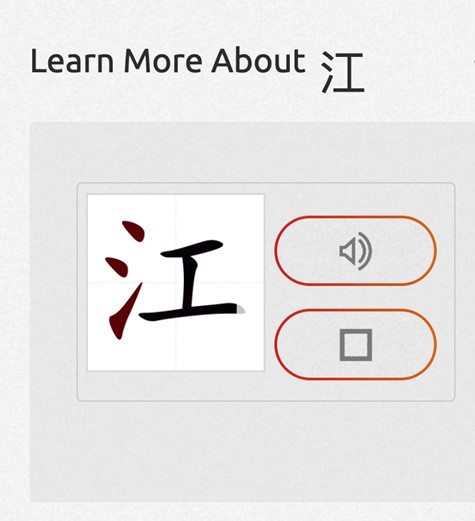
as online search to confirm name:
as the physics of waves: https://www.youtube.com/watch?v=tc2tW0jFHPo
as grandma’s conversational skills:
How tall are you?
And how tall is your brother?
And how much money do you make?
as memory:
Felix steps back into a memory of his childhood. There is Felix
and there is a rabbit. Later, he is unsure if it is a memory
of the event or a memory of seeing a family video of the event.
as Google-translated title:

as intention:
to eat the fruit that will be received
to receive the fruit that will be cut
to give the fruit that will be received
to grow the fruit that will be given
as response to fast-approaching deadline:
Felix goes to the beach to look at fish.
as grandma’s conversational skills five minutes later:
How tall are you?
How tall is your brother?
How much money do you make?
as what happened to the blueprint: melted by rain.
as family memoir postponement:
Felix’s mother drops a vat of soup on his laptop. Everything is gone.
He quickly cycles through the stages of grief. Kübler-Ross proposes
five stages. Felix reckons there are more.
He has since learnt to back up his work.
as what might come after:
as three further questions:
what if i could remember your face forever
what if i could think in the language first given to me
what if i finally downloaded WeChat
as how I felt about it before:
Contained in rooms. Rooms, plural, but still rooms.
as zoom call: Felix has been speaking for five minutes and has been
on mute the whole time.
as paternal love:
as transition from container to possibility:
If there were rooms before I am ready
for passages.
I am ready for roads.
I am ready for horizons I cannot see
beyond.
as unfathomable loss:

as response to whoever left the door ajar:
See above.
The first Anglo-Indians were born in 1601, and as the seventeenth century
progressed, the East India Company’s directors encouraged their employees in India
to take local brides and convert them to Protestantism. A gold mohur or pagoda was
paid to the mother of every child born from such a union. The offspring became
known to the local Indians as ‘feringhees’ (foreigners), mesties, topases, or
wallandez.
If a group of people
is displaced from
their place of birth
in spirit in the churn
of soul song pulse
If a woman is displaced
from her community
in body and flesh
becoming an outcast
in her place of birth
If a birthplace is displaced
from itself within
the bodies of a group
of its people, deflected
by alienation from
ritual culture politics
If the offspring of inter-
marriage are coded to the culture of the coloniser
If a group of people
is both coloniser
and almost-
colonised
(her brown skin
disappearing in
her brother’s white
or the reverse
their identity culture-
coded, quilling
bifurcation)
If the primary language
known to a group of people colonises their birthplace
(joyful borrowed phrases
wink on an amazed ceiling)
If you cross a subcontinent by marriage, you cross her deities
/
In the photograph
you are holding
a basket of flowers
in a lush garden
looking as if you belong
in Picnic at Hanging Rock
only this is northwestern India
and India surely lingers
in your features and attitudes
as you surely linger
in the body of India
your place of birth, of death
(as surely as your family
traversed the ocean
stepping away
from their home—
away from home)
But you were not Indian—
to have claimed this identity
would have suggested
something other than a name
There were so many languages of India you did not understand
(there were so many British spaces you could not enter)
there were the Anglo-Indian schools gathering your confession
in Western knowledge and Christian teachings
As the train wound into Jamshedpur … manganese ore poured into the furnaces lit up
the night sky for miles around.
/
Synthetic ochre
is a geological muscle on the verge of heat. Consider
raw yellow soil calcining radiating in the cadence of salt
a swarm of hues forms to carry the pioneers across the landscape
where earth is converted to burnt earth
As goethite becomes hematite, yellow darkens into red
As the hand’s tint or tilt palm lines earth lines
turn fold with a lilt toward the hills
so the angle at which a person enters history
may be altered by the material of desire. How grief forms in the rock surface
in wide willowy eyes. How quasi-
settlers place local news on hold
while servicing an Empire composed of several histories
only some of which rise to the surface
Tears wake the cornea, moistening
epithelial tissue. Visual information pools into blurred names reserved
for artificial natives. Someone born here is nonetheless
feringhee | foreigner mesties | the child of a mulat
and a white person where mulat means the child
of a black person and a white person
Many shades of person,
calling to each other over vast distances, are measured. Distinctions between
the British and the ‘countryborn’ Anglo-Indian are complex
The fair son may be sent to England to be educated. High adventure
ensues opening to a technique of preparing images
in wave upon wave
layer upon layer of lime plaster then milk of lime
/
There is this city within a city
in which you reside
there is this culture within cultures
in which you reside
there are these pigments within earth
in which you reside
If you stay, if you leave
Let the meaning of home rearrange itself
Rub each coat with a stone
Polish the surface with an agate stone
Through the mist-aproned mountain,
wind blows a gate open.
Years that don’t belong to me
flood my palms like coins too heavy
to hold. Memories—time’s avalanche
sweeping the mountainside of the mind.
In my naked namelessness, I lie down
in the spring snow. The contours of my senses
dissolve in the coldness
like sugar on a fevered tongue.
Slowly, the wind in the mountain assumes
the gate’s unwanted shape
the way a soul first tries on a body: testing
its limits before suffusing it, before
surrendering itself wholly to a fixed form.
I miss not having a body, or rather
that illusion of absolute freedom,
of not having to indulge
the body’s stringent longings.
What is nostalgia if not the oldest hunger
you can no longer return to—that sliver
of clear sky that each falling flake of snow
holds within, unwounded by masts or wings?
The wind tries to close the gate
but the gate refuses closure.
A pain, when touched, shines in the dark.
The wind is no longer what it was.
The mountain remains the mountain.
Question: Please explain how to separate a body from a nation.
This commission is killing me
I am waiting for my liberation
like peasants before the revolution
and patriarchs after the revolution
would I like to say something about colonisation?
yes! I would love to be colonised! I grew up colonised!
we loved the conquerors! my dad loved America and he
got me to read quotes by Western thinkers . . . Lincoln, Napoleon
Bonaparte, Plato, Pascal, Rousseau, Churchill, Derrida, Foucault . . . even Nietzsche
and he said there was no future for Hong Kong
the pigeon cages and landslides, no one will want
to live here . . . learn English, go to Australia
the land of comfort, where the conquerors
are thriving still . . . alas here I am
neither black nor white
the Switzerland of Asia . . .
oh God—
I don’t want to write another vain dull hopeless song for the editors
it is so tiring to sing for others . . .
it’s like a cheap pop melody
without mythologies . . .
if nightingales were paid to sing, would they???
if the gods had to go to work, would they have bothered making the world?
editors of the great magazines
I love you
but are you truly happy?
I am depleted
so depleted I resorted to using a poetry generator . . . (don’t laugh)
the following words are generated by algorithms and I think
they are
better than my poem:
DEATH TO THE EDITORS
I cannot help but stop and look at the dead words.
Now doomed is just the thing,
To get me wondering if the action is stillborn.
The devastation that’s really hellish,
Above all others, is the annihilation of bricks and letters.
Down, down, down into the darkness of the annulled,
Gently it goes—the unholy, the diabolical, the evil
Hatching like a bad egg.
Just like an insurmountable hill is the pain.
Pain—the true source of happiness.
I cannot help but stop and look at the fat sorrow spread upon my dinner
plate.
It was fried with lard and tasted like dog piss.
Sparrows roasted on the spit, country style.
Heavy feelings . . . they overflew the page . . .
Dark clouds, they ask no questions.
Moonlight, I murdered my wife.
Why would you think the assassination is helpful?
The assassination is the most hopeless hatchet job of all.
It won’t solve anything.
Never forget the despondent and bad assassins who fail at their work.
What is worse:
The editors may live.
Oh troubles without end!
They are fatal beyond belief.
Damned forever are the Bards!
Bad things happen, will always happen.
Now hate is just the thing,
To get me writing, wondering
If the word, trouble
Is mortal after all.
. . .
the wreck of rain
too dark to see . . .
I set to work, the loathsome editing . . .
great unhappiness awaits,
while the Russian tanks
never cease to attempt to unite the Slavic race
and the Chinese Communist Party does the same
and sends the People’s Liberation Army, the Poet’s
Liberation Army of editors
to liberate me—
from?
???
Oh great souls of the literary army,
I once spoke against you
I once fought, though my heart was not in the fighting.
But now, but now
I love you,
How I love you,
How much I loved you!
And I love you still, perhaps forever!
I love you like the running stream at the choke point, fellow
revolutionaries, my comrades!
I love you like the Western Plains overwhelmed by so many tears from
the gods,
I love you like the colonised columns broken by an axe, my axe I
kissed with my lips of submission,
My country of typhoons and tycoons, Zhuangzi and Laozi,
unsurpassed unenlightenment and the Luohans beating up the
Buddha,
cleansing him, changing him, preparing him for the current
curriculum:
the language of simplicity!
Books of hours and years lost,
new memories replacing the old,
Books of loneliness, ugliness, emptiness,
I love, I love, I love—
The death of my life, the birth of my death! For you alone
I am Switzerland!
Sydney, 14th July 2022
I am hearing sounds I shouldn’t
A phone ringing when nobody’s calling
If reality is collapsing like I have asked it to, then I am delighted
and will buy moist, soft strawberry rollcake to celebrate
I daydream about living deep in the woods in a fairytale
cottage near a wide, powder-blue lake
I am completely self-sustaining
I grow my own food and warm my own bath water
with a fire I stoked myself using firewood I found
strewn atop the Earth
I walk barefoot
In your travels, if you happen to enter my realm,
perhaps you would like to trade with the fox children who
are neither foxes nor children, who do not
know a good deal when they see one I have made it
very clear that capitalism may not exist/here
/here, I am growing flowers
Flowers that emit their own light
& dim when plucked
when replanted
become twice as bright
I chose this place for its ruined church
for its still-functioning fountain
wide enough to hold a body
wise enough to house a soul
Generously lifting the veil from our eyes
Limitless not
deep enough to drown in
1.
My husband he saw an article about his
hometown in The New York Times
Donald, Victoria, Australia
Population 1498
I google Donald, New York Times
he is backseat googling behind me
telling me no google New York Donald Donald Australia Donald articles
we are driving far from where we want to be
we see Down the rabbit hole with Donald
Donald Trump just can’t help it
The People vs Donald Trump
Celebrities react negatively to Donald Trump’s shutdown
Where is my Donald the broken biscuits the
pessimistic farmers the nursing home round the
corner the
slow roads
2.
When I am feeling sad sometimes I google
Donald Trump New York Times the
habit started during the primaries
and I haven’t broken it
it soothes me to feel the predictable contours
of surprise unsurprise outrage fatigue
the completeness of my knowledge of the world
the world is anywhere but here
I wake up from my reading feeling
cleansed of bad emotions and guilty
for going back to him
3.
I am having lunch in Savannah, Georgia
on the fifteenth floor of a hotel
this is the world to a girl born on a big boring island
floating at the bottom of the map
a lady dressed in pink and gold angles
speaks to the American people with black-lined eyes
why do you think he knows you
how do you think he knows you
this man who grew up in a house that that that
this man who grew up in a family had had had
she tells me I got my citizenship after I saw him
campaigning on tv I had been putting it off
but then I thought no
I am from Egypt and there have been two dictators since I left
and the current one has changed the constitution
to say he can rule till 2030
4.
I give my supervisor discounted flowers
for a baby big inside her belly
there is no metaphor and no simile
I can make for this it is
too beautiful a baby just as it is
she says what are these
I say I dropped the flowers on the way here
this is true but it is untrue that it was the fall
that made them look like yesterday
these white-yellow cones of dense petals sloping sideways
they looked like that when I pulled them dripping from the bucket
she says she likes them like
like Donald Trump’s hair she says
thank you for this
and here he is
again in my flowers I thought
I kept myself pure from him how
can I keep myself pure from him
Body as an extreme / as a machine / as a ship thrown
against the rocks / Fragile vulnerable creature needing to be
cradled / Resentment / Drowning / Taxidermy / How far can you test
its limits? / You wish you could grow wings / escape yourself.
Why always write about flight?
Some might call it naïve , running away
from reality like that. Others might call it
necessary. Shouldn’t you blame fate, or
circumstance? Guilt isn’t all or nothing,
you know. (nothing is)
Anyway, the whole process
is enough to make anybody
lose track. Chase the wind.
A free fall is exhilarating — but gravity will always
win. Sorry, you say. It’s just that I wanted to be better
in every sense of the word.
You, as in me. I’m sorry
for lying. Especially that.
Maybe next time.
After Du Fu
Shopper drops jade bracelet, then collapses in shock.
When I get to level 47 the air is almost breathable.
A cold wind blows beyond the river of ancestors,
past the cars in the lobby of the Marriott hotel.
So much is held in commercial confidence. Things
get karaoked into existence when a song is played twice.
I tap ‘love’ on an image of a single drone, hovering
over an artificial lake. This is a night for uploading
images of the new winter line. Revive our hearts, Lord.
While I in sandpits sat, dug holes to China,
Walked home from school, green backpack, shoulders bouncing,
Penknife in hand, you’d pace the forest’s heart—
Pick berries, dream revenge against the killers.
We grew on separate, split by small sea-water,
Two lengthening children, pre-desire, regret.
At fourteen your eyes loomed large, closed round, white-moon.
I longed to duck my head and instead stood,
Not knowing my mouth must move––
Kept air beneath my bow, above the string:
Risked not one mis-stepped sound, false frictive note.
Discarding clothes compared to this was simple,
A bed I’d swum, blank-white, sea-bright, since birth.
Asked me, a thousand times, I never answered—
Thought bodies outgrew words, had not yet learned
Of Satan’s fall, smote on him sore,
His legions, angel forms, who lay entranced,
Thick as autumnal leaves strowing the floor,
Kindling a sea of flame, the once-cool brooks in Vallombrosa
Leaping, furnace-forged, white-hot, red-gold,
Vaulted with fire. So I was but did not know,
Nor could look down, nor could forewarn, nor could feel awe.
At fifteen from my mouth outpoured a river.
At sixteen you crossed the wildest ocean,
Didn’t drown in shock-storms or tsunamis.
Five months gone: the native birds still pierce the air,
Their shell-beaks pick, necks pink with frosting.
They don’t turn back
But walk forwards through the grass,
Mouths pressed earth-down.
No arms, just legs and throat.
White crests like wind-topped waves.
Grey tail-wings uselessly at rest.
I did not believe your words.
The jacarandas bloomed more fulsome than before,
Purple flowers filled
When I was small and I was whole.
It’s too late now to hear their bullet fall.
The rain has washed all through one month of autumn.
The new year’s children climb on wooden benches,
They topple on the ground, forget they cry.
Am I light like them?
Their voices hurt me.
I grow older.
If you are sailing backwards down the river,
Rewinding the ocean you left upon,
Seeing caps white glare blue, so bright, you must avert your eyes,
Hear this, the water’s sound.
My father said after you’d gone: forget it wholly.
I remember now only his age-long care
Which ceaselessly returns, like winds cross oceans
Which earth’s aeons’ mountains onwards range.
And Sunday sinks its heathen summers into the kneecaps of the expropriate wicked /
kain na tayo! / having genuflected hours for a piece of motherfucking bread
isang bagsak, anak! the concrete moves you!
marking devotions this morning to chismis / the auspices of the Gran
Pasista Almighty / fat fist forcefield burrowing achilles’ kili-kili /
and the golden deluge let loose in the just-clean toilet of the parishioners’ office
next to church
Sinful!
a practice of bad descendantry with guarantees of holy sustenance / compass set
for slurpees and cardinal direction in the ravenous I of the beholder / imbibe
blue juice for brainfreeze / and graduate cousins in the crypto-mythology of paying for shit
with hypothesis / sticky finger anointment / a rising sea level washing
the dirt-dream dendrology of juvenile tortures on scabskin
isang bagsak, iha!
Pamilya,
the New Flotilla / ravaging the virgin aisles of Teks and Go-Lo / for a new piece
of shiny / new piece of dollarstore ass / new peace of gestational minute /
for bone-deep highway brains riding rodeo reptilian into a memory of may dila / bankrolling
the covenant into a communism of white conyos / white canticles
white love / of ancestral injunctions on reverence after life lived in the violence
of an easy televangelism / we umutot on the Vatican! / we are pilgrims to the Maccas
and two-dollar chook neck nuggets / cheap as chicken shit / as chipped china imports
adorning the cabinets of migrante pantheons and speakeasy delirium
isang bagsak, ate!
Do you think when he said you have your grandfather’s mouth that he meant
he wanted to / you know / at least we will have something to sin about /
in the bright-beam tinnitus of an open confessional / empty hymnals rehearsing
antiphony karaokes / anathema algorithm to the tune of Mother Mariah
out the stereo with fanta sweat and ballad baptisms
isang bagsak, kapwa! how the humid moves you!
an islandry of miss pilipinas blockading the streets on streets of mini malls of Asia /
brandishing new haymarket chanel / op-shop imitations / & proliferative degrees
of sacred separation / famous uncles brothers cousins stepson’s best
friend’s daughter / gracing the call list of b-grade teledramas / parallel kinships
with the celebritied / your incidental earthquakes / 7,641 islands / your kinship
of global atoms / you balikbayan boxes / you recycled recipes / you transnational
pageantries / fried fish filipiniana / kare kare & KFC / to grow strong / to gestate
isang bagsak, bunso!
one of you farted! / I could smell it /
white husband white wife procession trumpeting the second coming with Glen 20
here, let me convert you
Sit still and pray hard, children!
The spirit behoves you!
1.
Verrition: an untranslatable term Césaire used to indicate a kind of sweeping. Not really: it was a term to indicate the double jouissance of licking words, over and over again. But that is not unlike sweeping, and sweeping is not unlike action painting, your heft and back pushing bristles as they sound off, marking the floor with a tacky rub, or licking the ground, over and over again.
Maybe we could buy a new broom at Bunnings? That question hovers for minutes, days. Maybe we could find ourselves licking the ground at the interval between days, between minutes, between the 59 and the 0? What is the interval between days, between night and day? (Le petit matin, Césaire called it, which Walcott translated, and I find plausible, as foreday morning.) Cognitive drowning, or a tortured landscape in foreday morning, then. Drowning before or at the fore of the zero, which is day. What I mean is that this is not the only thing tethered to the fore of a zero thing, the foreday thing, which is not only an aesthetic thing. And the inclusion of human references here will not be decorative. Except the conclusion here might be decorative, assuming the human will have already existed.
I can’t open it, I say, when I can’t open a file or a link, when I don’t have the password anymore. I can’t open it anymore. But then I thought I was in a landscape or countryside. The file or the link was in the countryside. How do I open a link out there? What if I don’t know the password? What if I don’t know the countryside—which countryside—the institutional countryside—that has disordered my relationship with passwords? My body seizing, pushing bristles as they sound off. This would be me, from the countryside.
Glissant says, I am less interested in your origins in the countryside than in how you would draw a tree, for instance, which is no longer genealogical nor biographical when the picture includes the soil, the manure, the grasses, the birds, the water in the air, the water in the ground, the water on the leaves, the adjacent trees, all the condensation from all the leaves, the clouds humming in the blue hinterland. Humming is historical. Is it biographical, but no longer intimate? Or is it intimate, but no longer personal; that is, no longer a person? Waiting for a live one in a tortured landscape: humming. This is not Glissant talking anymore, this is someone else. This would be me. The notion of privacy is an intensely held public notion; quite the sacred notion, if a notion can be spoken about as sacred. This morning me and my notion tentatively called the Magistrate’s Court, passing through a number of institutional countrysides into the sacred countryside where the private matter could be dealt with. Then, more boldly, we called the Carpet Court. We ordered 59 kilometres squared of carpet. We wanted to lay it down and lick the ground, over and over again.
2
At some point I try to tally roughly how many times I texted ‘Leo is leaving this Monday’ or ‘Leo left this Monday’, usually prefaced with ‘I’m not sure if I already told you, but—’ or suffixed with ‘—I thought you should know’. Three times would have been ideal. I went for a walk at night in Lorne, at some point I thought to do it, as a context. Shape of the bay and shape of the moon, plausibly analogous. A plausible analogy. An old Italian man in my car is at me about poetics, because it takes me a long time to understand things I love. A woman eats a rotisserie chicken. One hand holds the chicken. The other hand, covered in a plastic bag, prises the flesh apart. Her mouth holds something key—the neck?—in place. I wear the new PSG jersey to the little bar they have here and the staff at the bar go absolutely nuts. They go absolutely nuts. Which was probably, somehow, key: the neck of the plan.
Last night on the phone to Cam he told me he was the Ian Thorpe of chillin’ and I said, yep, you’re the chill-pedo and we both laughed and laughed, because my god there were so many levels to it. Like, two levels! And then because I was already getting off the phone I said, how the fuck can you follow chill-pedo, and at the same moment Cam said, who the fuck can I call now?
3
The thing with protest is that it involves a lot of singing. Protest is the thing that involves a lot of singing. I am sitting on the Rathdowne St side of Carlton Gardens, near the corner of Victoria Pde. I have just finished work and I’m wearing my stupid work clothes, which protect me from being mistaken for a member of Extinction Rebellion, who set up camp here only a few hours ago only a few metres away. The XR camp is enclosed by an improvised fence made of washing line from which XR logo-ed tee-shirts hang. When I sit down, a trio of women are singing the Stop Adani song and I’m reminded of the claim I overheard once at a meeting to organise a protest immediately following the detention of DW embassy leader, DT Zellanach. Some guy in a wide-brimmed hat and hiking clothes was rifling through his soft briefcase full of sheet music, explaining to a pondy young woman that he is responsible for a number of the ‘current chants’, and that his authorship extends to ‘Coal, don’t dig it / Leave it in the ground it’s time to get with it’. I don’t know why I don’t believe this easily plausible claim. The same week I attended that meeting about DT Zellanach, a local squatter in the house near the bike track told me he is currently involved in several legal cases, including one with Jay Z for part-songwriting credit for Rihanna’s ‘Umbrella’. He told me this after asking me if I worked for the local council, thinking he was about to tell me to get fucked, concerned about the meaning of my work clothes. That claim about ‘Umbrella’ is a claim I am willing to entertain because it’s more entertaining and therefore more plausible.
A few police shift about in the park, looking embarrassed, perhaps by XR’s singing or perhaps by their own patrolling. They are humming, their own singing. I keep going to these things, though I keep reverting to this abstract journalism. Patrolling the singing, oh, the bloody singing: this is a wild desire to leave. Though we believe it when the protestors say this is an emergency.
There is a ‘smoking area’ that XR has set up near a river red gum outside the tee-shirt fence. On the back of a placard, the painted words say: ‘Smoking Area: Bin Your Butts!’ I stare at this sign for a long time. Under the river red gum, a young man and a young woman are slowly, but slowly, kissing. Last time I looked at them, before I began staring at the Bin Your Butts sign, they were simply staring into each other’s eyes, legs crossed. I can’t decide whether it is weird or completely unweird that everyone at the XR camp is white. I can’t decide if it’s weird that I wear a suit to work when there’s no dress code at work and basically no one ever sees me at work and, basically, I’m not even sure I’m really in work.
As I leave for my conventionally parked and recently washed car, I see the XR march coming up Exhibition St, singing the Stop Adani song. People clap on beat. People beat a drum. A police car parallel parks in the space behind me. The song sounds like what I imagine a dirge must sound like. Only now I realise I’ve never knowingly heard a dirge before. The policeman in the car scrapes his left wheels against the kerb. He nearly doors a cyclist. I have a feeling I shouldn’t leave. The feeling is a dirge.
As I drive away, the radio plays an article about how the number of volunteer firefighters has been in decline since Black Saturday, in part due to the trauma of that event, in part because the weather is changing in a way that’s unpredictable, so that no training can prepare someone to do this job. The weather is changing. Verrition, over and over: something so plausible I’m swept away.
CONCLUSION
The water in the kettle is dancing, says Leo. Can I use that, I ask.
Do you guys have any money, I ask. Cash money. Good point, says Mel, walking a $5 note to the man sitting on the ground in our path. Actually, I say, I want to go use the photobooth on the other side of the station. It only takes one- and two-dollar coins. Six bucks for four photos, I say. This is taken as a passing comment, because we never cross the bridge to the photobooth, not heading out west and not coming back east to the car.
We should go to the Skydeck when this is over, I say. The path to the Skydeck crosses our path, reminding me of the time I went to the Skydeck in a fever after speaking at the photography college. I’m afraid of heights, but sure, says Mel. That feeling of heights, explains Leo, is the body recalling a previous experience of falling. You feel it in your groin, I say. Yes, they both say. The past is a feeling in the groin, no one says.
Somewhere after Queensbridge we lose our bearings following the river west. In an alcove under the Bolte Bridge, a department relevant to the river or the bridge has left a notice on a door. Do not venture further, it says. We look at the West Gate Bridge, which is closer than we remember. It’s a destination we don’t make this day, but a few days later those boys will get there. It doesn’t make it to the news, but when they make the middle of the bridge, those boys start dancing.







