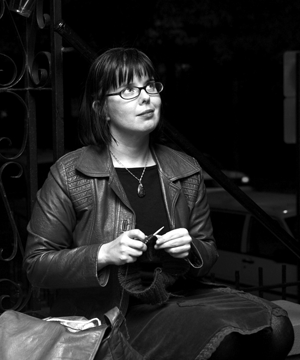
The Inaugural Sydney City Poet: Lisa Gorton Interviews Kate Middleton

Kate Middleton is the author of Fire Season (Giramondo 2009), was awarded the Western Australian Premier’s Award for Poetry in 2009, and was shortlisted for The Age Book of the Year in Poetry. This year, she is the inaugural Sydney City Poet.

Lisa Gorton: I know that reading is always part of what defines a place for you. Which poets define your sense of Sydney at the moment?

Kate Middleton: Robert Gray, certainly, for the harbour, and Judy Beveridge for writing on water in general. Although the poems in her latest book, Storm and Honey, aren’t specifically set in Sydney, knowing her in Sydney gives me a flavour from those poems, in an interesting way. Then Fiona Wright, whose first book, Knuckled, came out only last year. It’s a terrifically Sydney book, incorporating elements of the Western suburbs – an area that doesn’t get a lot of poetic airplay. Those voices from different generations have been part of my thinking about Sydney. Then, outside the city, Robert Adamson on the Hawkesbury River is an inescapable voice, the voice of a very particularised landscape – and thank God for him!

LG: You’ve been organising and taking part in events in some of Sydney’s iconic places: a reading in Wendy Whiteley’s Lavender Bay garden, for instance, and the festival at Woollahra Library where you read with the sun going down over the harbour behind you. I wonder whether any of your poems deal with those iconic places; also, are there are more secret iconic places in Sydney for you?

KM: Well, though Wendy Whiteley’s garden is an iconic place, it’s also a secret place – not marked on maps. It has such an interesting history. She was essentially trespassing until the Railway leased the land to her, and later to North Sydney Council. It’s a place with its own delicious, secret history. For me that is still one of my secret places, even though it’s a lot of people’s secret place, and even though we had a public event there.

I’m very much a café and bookshop kind of girl so a lot of the time it will be cafés on the south end of King Street. But walking through Sydney Park has become very important to me. I live in St Peters right near the park, near the old buildings that you’re not allowed to climb on or enter. Those are important places for me to sit and think.

I grew up in Melbourne along the Yarra where the Heidelberg School painters worked and a number of them also painted cityscapes in Sydney. In particular, I like going to Coogee where Arthur Streeton painted a beautiful view. I think Charles Condor did as well. I’ve found that vantage point. That for me is a particular Sydney spot.

LG: You’re seeing Sydney through paintings. Are the poems that are coming out of your time in Sydney particularly visual poems?

KM: As part of the role of the Sydney City Poet, there’s a suite of six poems that I’m required to write; I nominated to write on six paintings, which are leading me around the city. Though I’m probably not going to include the Heidelberg School painters in that suite, they’re poems that I’m writing because they have come to have a lot of meaning for me.

I think these poems relates to ideas of Sydney as a glamorous city, in the sense that there are all these iconic places and iconic images that have been created by the artists. Trying to create responses to those in verse is a way of engaging with the city that – though I have visited it many times, and though both of my parents were born there – I’m just getting to know all over again. They form my map.

LG: When you’re talking of iconic Sydney places I’m thinking of Fire Season and how your poems about celebrities work between the iconic status and the intimate personal nature of those people. I’m wondering: when you think of the iconic paintings that define Sydney for you, what is the element of intimacy cutting across that for you? Do you have that almost dramatic quality in your poems again?

KM: I think I do. As well as being the birthplace of both my parents, one of my grandparents lived in Sydney when I was a child. I spent a lot of time in the city. A lot of memories I have of early travels are from Sydney: images that I later came to recognise as attached to particular places. When I went to a gallery I’d see something and think, ‘Oh, that’s something of Sydney’. The pictures have those biographical references, which help me form a relationship with them that complicates the purely ekphrastic, in ways that I hope allow a reader who’s not familiar with the artwork to respond to the poem.

LG: Which are the artworks that you’re writing about?

KM: It started with Brett Whiteley and his balcony pictures. I had the opportunity to stand on the balcony at Wendy Whiteley’s house and see that exact view and it was dizzying. Astonishing.

I’m working on poems about Margaret Olley and Cressida Campbell and their still-life paintings. I’m working on Grace Cossington-Smith’s very famous picture of the Harbour Bridge as it was being built; a Margaret Preston image of the harbour and the bridge; and then one of Martin Sharp’s Lunar Park series.

But I’m also working on other poems. I want to make sure I can present six poems that are worthy, and I tend to write more than I need, so I’m also working on a Jeffrey Smart picture, and I’m working on the Heidelberg painters and their Sydney views. I’m also thinking about the photographers, particularly Olive Cotton because she has a particular personal reference insofar as my grandmother knew her.

LG: That’s a fascinating and in some cases quite surprising selection; several of those paintings have a dreamy or soft quality. Do you think you’ve been looking for that?

KM: I’ve been looking for different kinds of surfaces and for different stories that attach me to the paintings. With the Cossington-Smith, I actually put that image together as a jigsaw puzzle three years ago when my Mum bought it for the family for Christmas. I spent a huge amount of time with that image, but in pieces! When we finished the puzzle we realised there was a piece missing – a very frustrating experience for puzzlers, I’m sure you’ll realise! So there are autobiographical associations that I want to have.

But that softness … With the Margaret Olley, I was interested in the fact that all of our experience of cities, no matter how iconic and filled with beautiful images, is still predominantly interior. That’s what led me to add Cressida Campbell, who I admit I had not thought of earlier and who I met at Margaret Olley’s house – another of those extraordinary experiences that you can only have every so often.

But I also wanted to add some of the Lunar Park glitz and fireworks, because artworks with different surfaces call out poems with different surfaces. The Whiteley poem, for instance, has longer lines that try to communicate the ease of his visual lines.

LG: One of the elements that future literary histories will leave out, if they’re anything like past ones, is the nature of the meetings between poets and the atmosphere of the places where they meet. Can you give that human and social sense of what being the Sydney City Poet has been like?

KM: I think Sydney has an extraordinarily lively poetry scene. Every time I talk to people and they learn that I grew up in Melbourne they have this wistful sense: ‘But isn’t there so much more happening in Melbourne?’ as if the poetry’s elsewhere, and yet there are so many readings and launches and projects and people talking here. I’ve been so impressed. I think Sydney absolutely rivals Melbourne as a place where things are happening.

There are a lot of places where I meet poets. Being new to Sydney as an adult, and coming there in this role, many of my friends in Sydney are poets and writers or other types of artist. I’ll go to a launch at Glee Books and be very glad to get my glass of Shiraz and I’ll listen to some poems. Launches gather a crowd of 40 or 60 or 80 people who want to hear and celebrate the poems. Or I’ll go to a reading at Sappho’s, next door. It has a reading every month, with an incredibly varied and high-quality set of poets. I can be a bit awkward. I don’t necessarily know what to do in social situations; but people have been very friendly. Often, from one of those events, there’s come a suggestion: ‘Let’s meet for coffee and talk,’ which has made it easier to settle in.

But I’ll also go to a pub with people and, over a drink and some nachos, look at some writing and say, ‘Okay, what’s going on here?’

I also love the cinema and while I go by myself, I also go with writer friends. It’s so interesting, talking about film with poets, as opposed to cinema studies people: the things that come out of those conversations are more off the cuff. They are the source of inspirations, though I might not know that for six months to come.

LG: But which are the places that characterise the style of poems you’re writing? I suppose at the back of that question is the argument that poetry changed when the coffee houses came in: they brought a new kind of tough-minded discursiveness. If you’re thinking about the Sydney poetry scene, what kind of place seems to best define the atmosphere of the poems that you’re writing there?

KM: For me, it’s between the café and the gallery. It can be the café in the gallery, or the café as a gallery – a place that’s both social and about some form of contemplation and interaction with art and other people, in a watchful way.

LG: You’ve been unusually generous in engaging with other poets and their work through your website, which has a blog and also interviews with poets. What has that brought you and your readers?

KM: Well, obviously the way I’m most centrally engaged with other poets is to conduct interviews that try to really engage with individual poets. There are plenty of places that have a ‘one questionnaire fits all poets’ approach. That can instructive to a degree but it won’t delve deeper and get at what’s different about a poet; and what’s different about a poet is where, I think, their power comes from.

As ever, poetry’s not the big moneymaker so a lot of places don’t make space for long interviews. And I personally love reading long interviews – so a lot of it is selfish! I ran out of Paris Review interviews some time ago! So until the next one comes out I’ll have to make my own fun, right? I genuinely want to know how poets I admire are making their work and thinking about language; I think the questions that I’m interested in can’t be so unusual that others aren’t interested in them too. For those who want to think about a poet and get the background of their work, an interview can be incredibly helpful. It’s also a way writers can attract new readers to their work.

I’m lucky that the site has a small but steady readership at this stage.

LG: Does poetry’s small readership bother you?

KM: Yes and no. It doesn’t bother me how many people read my work or don’t read my work, other than that I hope it won’t affect my ability to put out another book down the track. But coming from a position where I think people already do love poems, it’s just a matter of them finding the will or the desire to read the next one. If the last poem they loved was in high school or primary school and they haven’t read one since, it saddens me a little, in that I think they’re missing out on a fundamental pleasure in language. So many people are using merely functional language instead of going into the wonderful world of play that language involves. At the same time, there are people who find their pleasures in art galleries, cinemas or concert halls. If that’s where they want to spend their time and have their experience of art, that’s wonderful. Everyone has a different set of pleasures and a different brain, and that’s fine.

LG: You have a musical background and you’re dealing very much with art as you develop this suite of poems about Sydney paintings. I wonder how you see those other interests feeding into your poetry?

KM: Well, music is fundamental to me – from when I was eight or so and taught myself to read music, and learned the recorder, to when I was 22 and finished my music degree. I haven’t played or written music much since then; so, in almost 10 years, I haven’t really written a piece of music, which is strange to think about. Every so often I’ll get a hankering to pull out a textbook and do some counterpoint exercises … But I think that I always knew, once I started writing music, that it was something that I was learning to support writing poetry. I think that the music degree has helped insofar as I have some understanding of rhythm, though I can’t write metered verses very well. I know that. I’m always disrupting a regular metre in poetry.

LG: Maybe it’s all that work in counterpoint?

KM: Yes, I think I have resistances in music that are born out in my own poetry – insofar as the classicism of Mozart is something that frustrates me from its very simplicity. It’s something that I resist in my poetry. But that could just be a lack of skill!

LG: I think the word ‘counterpoint’ is intriguing because I think it’s true –, it’s exactly what you do: you often break out of a mode into a different mode; you often break halfway through a line. You use brackets or you have a different tone coming in, so you’re often working with a classical tone and its domestic counterpoint.

KM: Yes, sometimes that’s juxtaposition, and that’s a great contemporary mode of poetry: ‘Oh look, this and this thing aren’t related but they are related because I put them in poem together!’ I do try to shift the diction and the pitch of the voice. I think the music training has given me a greater ability to know the pitch of voice in a poem, and how that fits into a larger architecture, possibility more that it has given me any rhythmic drive.

LG: How do artworks play into that as well?

KM: I like writing about art because it forces me to slow down enough to look at a painting. I like writing about art because the paintings force me to articulate some quality of surface that’s beyond the pictorial or the abstraction: the dimension of texture in a painting or even, in a photograph, the texture that’s implied. I haven’t ever been really good at writing about sculpture, maybe because I can only deal with the implied third dimension, not the real thing! Or maybe I just haven’t spent enough time with it yet.

I think that writing about art is about taking time, for me.

LG: Finally, what has surprised you most about being Sydney’s City Poet?

KM: Just … that I can do it! It’s something that I’ve just tried to take in my stride. I have a very practical background and upbringing so when I see a problem – such as, what would a City Poet do? – my natural response is just to set to and do it. What surprises me is that, six months on, I have had to make a list of what I’ve done and the list is long. Week by week, I never feel that I’m getting anything done. The fact that I have done so much – that’s an endless surprise!
Posted in INTERVIEWS | Tagged , ,

Text Is Immediate: 5 Artworks by Vernon Ah Kee


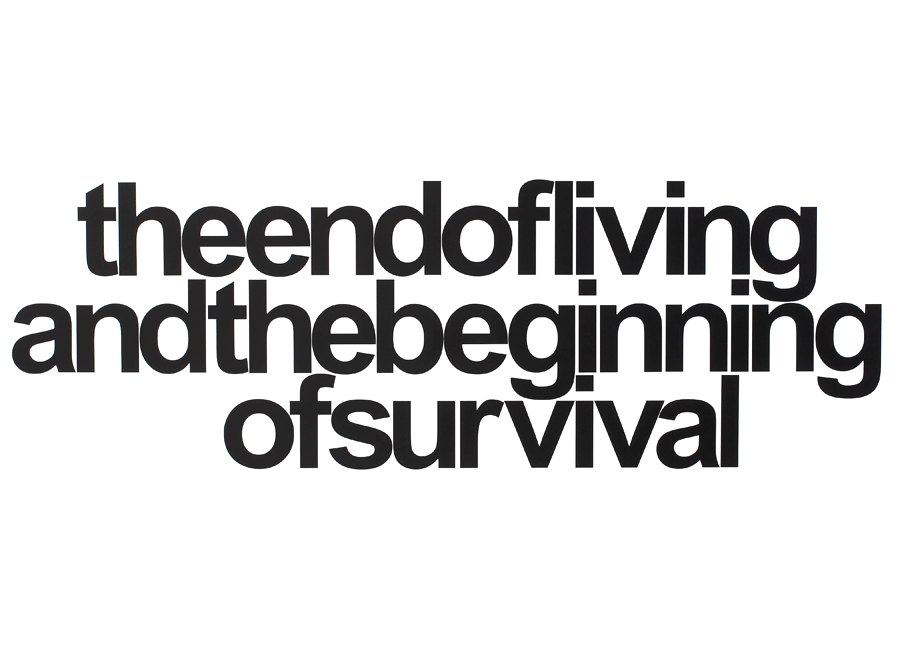
Vernon Ah Kee | theendofliving 2009 | Acrylic on canvas | 180 x 240cm | Courtesy of the artist and Milani Gallery

Vernon Ah Kee’s work is primarily a critique of Australian popular culture, specifically the Black/White dichotomy that locates itself in his work. His text-based installation work reveals and condemns the widespread and inescapable discrimination and racial stereotyping that Indigenous Australians have experienced since European colonisation and continue to experience in everyday life. All images appear courtesy of the artist and Milani Gallery. Continue reading

Posted in ARTWORKS | Tagged

Emily Stewart Interviews Astrid Lorange

Astrid Lorange: poet, phD student and Sydneysider, is Cordite’s guest editor for our Sydney issue, which launches next week. She kindly agreed to answer some hot-coal questions for me about living Sydney, writing poetry and curating for Cordite. Read on!

What kind of a place is Astrid’s Sydney? What are your key coordinates?

I was born in a house on the headland at Newport Beach, and spent my first five years around the northern beaches. Then, I moved to Byron Bay, where I stayed until I finished school. I knew as a teenager that I wanted to live in a city as soon as I could. And it turned out that Sydney became the object of my desire, for reasons now unknown. I moved here ten years ago with my best friend. I went to university (where I have, in fact, remained), but that was never the sole focus of my life here. I was much more interested in the experience of actually carving out a context in a new place, and I still am. I learned Sydney by walking, working, drinking, swimming, writing, reading, eating, and speaking. It sounds trite, but it’s true; the city has emerged for me over the decade as a site of many and often incommensurate memories and feelings. I love this place, but I am also sort of exhausted by its capacity to make me feel like I’m barely hanging onto everything. It’s a place that makes me manic, and unsure. Which I think is a good thing.

As for my co-ordinates, I’ve mostly found myself in the inner west orbit. I have patchy psychogeographical knowledge of the beach (Gordons Bay, Bronte, the ocean baths at Newport, Pittwater and the Basin), the western suburbs (Penno and the lower Mountains), the southwest, and dots of the north shore. Otherwise, I am usually somewhere between my house in Ashfield and the State Library of NSW. When I moved here, my aunt gave me a 1984 edition of a Gregory’s Street directory. It was uselessly out of date and had some spreads missing, but I would study it religiously at night when I first got here. I’d watch TV and look up all the suburbs listed on ads for mattress factories and electronics outlets. I’ve always been keen on building my mental archive of this place — as unwieldy and enormous as it is (and as unreliable as my archive often proves to be!).

I’m realising as I write this that I have always lived in a sharehouse: which tells you two things about me. I’m broke and I’m social. I think this has made the city for me. I don’t like what’s being branded and sold as Sydney; but I love what I can make and find here. Being mostly broke means you miss a lot of the bullshit that a city trades on. And living in a sharehouse is in many ways as intensely intimate as living at home. So I guess that’s been a big part of my Sydney, too.

How did you find the experience of selecting and curating a set of poems for the Sydney issue?

Selecting poems for this issue was an amazing experience. I’ve previously not done any editing other than smaller-scale projects, in which I ask people to give specific things for a specific reason. So this was new. Also, I am not a particularly ‘representational’ poet or thinker. I was nervous about editing an issue that was ‘about’ something. Would I know how to choose according to a theme, and would I be able to re-imagine the terms of representation and referentiality, etc? I lived in Philadelphia for a year and a half, and when I returned a year ago, I found myself suddenly writing around and through Sydney. So this seemed like a timely task, a way of re-immersing myself in the poetries of my home.

When I came to reading through the submissions, I was really struck by some of the constant themes. Sydney seems to arouse descriptions of drinking, fucking, getting high, and feeling lonely. The poems were stuffed with language, cited and appropriated and misremembered and quoted and fragmented and erased and stuck back together. There were very few that rhapsodised the harbour, and those that did, managed to have a macabre whiff, even if unintentionally. They really were a noirish and grotesque thatch of poems, and I mean that in the best possible way!

Having said that, there became a clear sub-set of poems that were the poems I wanted to publish. These were poems that demonstrated the total disorientation of finding yourself in language in a city, in a city of language. They didn’t try to explain the oddities of Sydney, but they experimented with language such that it made that oddness manifest, it showed how the oddness is constructed through the rabbling action of language. I was thrilled to recognise in these poems a kind of deeply social anarchy that I experience as I encounter the city. When I followed this tug through the submissions, an arc emerged, and I feel like it’s my Sydney — not one city but a set of minor players.

When I read your most recent book, Eating and Speaking, I consumed it on the move, on the train, over coffees and soups in cafes, alone with beer while waiting for mates. And of course while eating chips! I’ve found that this kind of kinetic reading practice often nets more rewards for poetry than it does for other kinds of texts. I’m interested in the environments in which you read and produce poetry, given that your work is so sort-of meshlike, wiring up physics with body with colloquial jargon with syntactic jambs…can you tell us a little about where the poetry happens for you?

I am so happy you consumed Eating and Speaking on the move and with meals! Perfect. Yeah, I mean, poetry is something I do in the middle of everything else. It’s very different from my critical writing and research, which I need to do in a quiet and lonely place. I like to write poems while also cooking dinner, talking to my lover, reading a book, cleaning my room, and looking through Robocop fan-fiction sites. I see poem-making as a tremendously social activity. I want to bring all the language of my daily living into a space, and I want to let the emergent relations and dissonances drive a poem into a shape. I usually write according to a rhythm or structure of syntax. I guess, you could say, I write with my ear. I arrange language as I find it and then go back and fine-tune the arrangement until it has a distinct form. Often I will have an organising concept or wordlet in mind, other times I have a much vaguer theme mobilising the composition. But, whatever I do, I am interested not just in finding language and putting it in a poem, I am interested in how the language settles into signifying relations, and how this very process (and its resultant meanings) make a really critical point: language is not naturally or neutrally meaningful. We tend to think, in this cultural context, that meaning is intrinsic to the things we find meaningful. Our lives, for example. On the other hand, I am quite pleased by the idea that meaning is something made. So much banks on naturalised ossifications of language, and poetry is way of pointing out such sedimentation. This is what makes poetry political, in a literal sense: poetry examines the way language functions in order to construct a politics.

As such, for me, poetry is a methodology: a way of dealing with the world. I write poetry because my experience is intensely languaged, and I find it necessary to have a meta-praxis that examines this fact and tests its limits. Writing poetry is ‘erotic’ in the sense that it affords a particular experience of encounter, denial, resistance, and unexpectedness.

Which artists/writers/performers are you currently digging?

I am constantly amazed by my prolific and exceptionally talented friends and peers. They are, from Australia (and this is by no means exhaustive): Sam Langer, Michael Farrell, Ella O’Keefe, Tim Wright, Oscar Schwartz, Corey Wakeling, Tom Lee, Stuart Cooke, Kate Fagan, Peter Minter, Nick Keys, Joel Scott, Sam Moginie, Andy Carruthers, Gig Ryan, Martin Harrison, Jill Jones, Ann Vickery, Pam Brown, Toby Fitch, Derek Motion, Aden Rolfe, Nathan Curnow, Jaya Savige, Chris Edwards, Robert Adamson and many more. In the USA: Eddie Hopely, John Paetsch, Gordon Faylor, Trisha Low, Diana Hamilton, Steve Zultanski, Aaron Winslow, Josef Kaplan, Lanny Jordan Jackson, Andy Sterling, Andy Martrich, Cecilia Corrigan, Marie Buck, Lawrence Giffin, Lauren Spohrer, Kim Rosenfield, Rob Fitterman, Kristen Gallagher, Chris Alexander, Kieran Daly, Laura Neuman, Gregory Laynor, Steve McCaughlin, Corina Copp, John Coletti, Arlo Quint. For example.

Writers I come back to (again and again) include: Jack Spicer, David Melnick, Kenneth Koch, Bernadette Mayer, Hannah Weiner, Kathy Acker, Mina Loy, Tan Lin, Renee Gladman, Lyn Hejinian, Joan Retallack, Harryette Mullen, Myung Mi Kim, Maria Damon, Robin Blaser, Christopher Brennan, Michael Dransfield, Leslie Scalapino, David Antin, John Forbes, Frank O’Hara, CA Conrad, Rachel Blau DuPlessis, Monica De La Torre, Jena Osman, Stacy Doris, Juliana Spahr, Lin Dinh, CA Conrad.

Since I am at the end of my PhD slog, my references at the moment are all poetry and theory. I’ve had not much chance to enjoy other media in a while. And since my PhD is all about Gertrude Stein, she is the top of the list, always. She is truly an endlessly generative resource for my thinking and writing. Her work demands, at every instance, that the one who reads reconsiders every habit, reflex, assumption and desire about the way that language works and moves. My engagement with poetry is entirely rooted in my conviction that this continual reconsideration is the necessary condition of philosophical inquiry. As such, the work I read is read by way of this original demand: what Stein impels me to do I take to all events of thinking, speaking, writing, and reading.

As a lady producing experimental and critically engaged work, what are your thoughts on gender within Australian poetry — both in the kinds of writing being produced and how the ‘scene’ itself constellates?

The question of gender is always an enormously important one. To begin: I do not take gender as an essential category, nor as a biological fact. Like many others, I take gender as a fact of one’s identification. At the same time, I am wary of identity when taken as an essential category, also. So I guess you could say I am firmly anti-essentialist. This is a philosophical answer to the question of gender. But I live in many realities, and one of my realities is a reality in which I exist in social conditions and among a complex situation of power relations. As such, I live in a reality in which the category of ‘women’ is constantly under attack. The lived reality of being a woman immediately means many things, and these things are actual and their consequences are dire. So even though I don’t ‘believe’ in gender per se, I certainly ‘believe’ in the real effects and corrupt structures of a patriarchal society. And so it matters how the category of ‘woman’ is defined, made legible and illegible, etc. Gender relations and instances of sexism and misogyny are never isolated and always symptomatic: symptomatic of a culture that is thoroughly sexist and misogynist.

The question of gender in a specific community, say for example, the community of poets in Australia is tricky to negotiate. We have to make distinct the issue of an author’s biography and an author’s social context. The former need not inform a reading or judgment of a work; the latter is invariably important. It’s important because an author’s subject position necessarily affects the writing and reading of a text. And it’s important because the issue of who is speaking and who is listening is always important. Texts are gendered not simply because the authors who make them are gendered, or perceived as being gendered. They are gendered because our culture demands that people, texts, practices and discourses are designated one way or another. For the poetry community (if we can imagine such a thing in the singular), the same is true as for every community: issues of gender correspond to structures of power reproduced elsewhere. It is thus necessary to be always asking, of one’s community and one’s engagement with that community, in what way assumptions are being made and power is distributed.

I consider myself a feminist more importantly than I perceive myself as ‘female’. Or, I am a woman and a feminist and both of these things are conscious and engaged methodologies; they are not absolute identities. By methodology I mean, again, literally, a way of dealing with the world one finds oneself in and with the relations that make the world and bring about its many meanings. Since poetry, too, is a methodology — a practice of making and testing — it is a site for the interrogation of and interference with the kinds of habits of signification that produce normative categories, which are naturalised and affirmed as fact. So to me, being and feminist and being a poet are entirely related methodologies. And they are the guts of what I do and say.

Posted in INTERVIEWS | Tagged ,

These Living Walls of Jet: Visiting the Open Houses of Poetry

The purpose of poetry is to remind us
how difficult it is to remain just one person,
for our house is open, there are no keys in the doors,
and invisible guests come in and out at will.

from Czeslaw Milosz ‘Ars poetica?’

When Horace coined the phrase ut pictura poesis his aim was to encourage people to treat poetry as seriously as its sister art painting. These days painting and poetry, like all the creative disciplines, have one great plight in common: they must prove their immanence to a society that has relegated them to the status of entertainment (the exception, as Auden once pointed out, is cooking). So it’s not surprising that Horace’s phrase has been modified countless times over the last century to compare poetry to just about everything. In arguing here for poetry’s presence as an essential part of our own culture I leave it to the reader to decide whether the use of that holy realm of real estate as a point of comparison is apt, or merely indicative of a histrionic poet.

Let me start by asking you to imagine a house. Not your own home, but a dwelling you visit as a guest or stranger for the first time. Think about that moment of entering with all your senses on high alert. You take notice of the furnishings approvingly or disapprovingly, and you find yourself tempted to interpret the character of the occupants from the objects collected. But there is also something about being in an unfamiliar room that makes you feel slightly different yourself. You move around to get an idea of the place; you observe the way the windows frame the world outside; you start to feel at home or out of place, excited or dull; and all the time you’re taking your bearings anew, as if being in a new space stimulated you to experience yourself in a new way.

In Italy, on entering a house as a guest, especially for the first time, it is customary to say ‘permesso?’, which literally means ‘permission’, as in, ‘May I?’. This expression has become so customary that rather than being inflected as a question it is often stated as if the word were part of a ritual for acknowledging the moment of crossing a threshold into a new world.

I wanted to begin by evoking this sensation because I see similarities with the way we encounter a poem. The word ‘stanza’, which we use to denote the paragraphs into which poems are divided, come from the Italian word for ‘room’. John Donne was aware of this we he wrote ‘The Canonization’, the fourth stanza of which contains one of my favourite Donne lines:

Wee can dye by it, if not live by love,
And if unfit for tombes or hearse
Our legend bee, it will be fit for verse;
And if no peece of Chronicle wee prove,
We’ll build in sonnets pretty roomes;
As well a well wrought urne becomes
The greatest ashes, as halfe-acre tombes,
And by these hymnes, all shall approve
Us Canoniz’d for Love.

‘We’ll build in sonnets pretty roomes’ is characteristic of Donne’s wit and playfulness. For Samuel Johnson it might have been a perfect example of the Metaphysical’s intellectual showiness – Donne more interested to prove he can pun across languages, than to write poetry. But for me there is something about Donne’s ostentatious metaphor that resonates with deeper truths. Indeed I want to explore how a poem is a room, one in which words find space to harmonize with each other in fresh ways, and in which we as readers come to experience ourselves and take our bearings anew.

The obvious starting points are those verbal echoes of rhyme, alliteration, and other figures of repetition and variation that create a verbal architecture in the poem. This architectural analogy is not limited to traditional verse. All poetry must have a structural integrity, at the level of form, theme, syntax, word. A trope evoked frequently in creative writing classrooms in this context is that of the puzzle. The writer searches doggedly for the exact word to fit a particular passage. Once it has been found it becomes clear that it could only be that word and no other, as if words were jigsaw pieces. It is a limited simile, though, because it suggests a static system in which each element has only one ideal place. Similarly, in using architectural images here, I do not want to suggest that words are locked in place, riveted like structural traves that may bring down the house if one is removed. Language is a dynamic system. Czeslaw Milosz is closer to the state of things when he talks of the art of studying the possible relationships and connections between words; what Coleridge once described (using a neologism of Donne’s, incidentally) as the ‘interinanimation of words’. Like the house of language which, for Heidegger, became a metaphor for our active dwelling in the world, the rooms of poetry are fluid spaces of encounter.

The most important of these encounters is perhaps with language. Dylan Thomas once described how poems are not a still-life, or an experience put down on paper, so much as an event that can be transformative. Unlike its showier cousin, prose, poetry doesn’t often rely on those two cornerstones of dynamism: plot and character. It has a different sort of energy, one which lies in language itself. Indeed, in many ways language is the protagonist of poetry. In a poem every word is a proper noun. As the Italian scholar Remo Ceserani says, language functions as a sort of Greek chorus: moral voice, archetype and collective unconscious. Never neutral, invisible or plain, despite the repeated efforts of certain strains of realism. Seamus Heaney saw language as a current that sweeps us up. The poem’s impetus may start in personal experience, but it moves beyond that quickly: ‘sound and meaning rise like a tide out of language to carry individual utterance away upon a current stronger and deeper than the individual could have anticipated’.

Importantly, it is the stanza of poetry that allows language to take on the role of heroine. The successful poem is one in which the reader enters to take stock of herself, and of language, just as a tourist might enter a church or a temple simply to take a deep breath. But like us, words too, need these refuges. Often language is so battered and dematerialized that individual words appear threadbare. A poem aims to create the context in which words can resonate more richly. It’s like going to a wedding: the intimacy and sense of occasion are such that when the speakers stand to evoke words and ideas that elsewhere would sound like clichés, they rediscover an authenticity that moves the audience to tears.

The community that comes together to celebrate a wedding, reminds us that focusing exclusively on language, and its experience by the self, can be dangerous. For there is another sense in which poetry has been a refuge from the world. For much of the twentieth-century the ‘I’ has found itself in crisis in Western literature. Modern life tends to alienate us from any communality, and shut us up within our subjective selves like isolated bubbles of relativism. This hyper-subjectivism makes it more and more difficult to believe in the reality of other people and the world around us. Fragmentation, a lack of encounter with the sacred, and a monotone impressionism characterize much of our artistic production. The poem has become a bunker or barricade for the self in its two extremes of subjectivity: confessionalism and hermeticism. Such a state of affairs was also felt in Donne’s age. The Copernican Revolution seems to have led to a cultural crisis not dissimilar to our own, at least as the ‘Anatomy of the World’ describes:

‘Tis all in pieces, all coherence gone;
All just supply, and all Relation:
Prince, Subject, Father, Sonne are things forgot,
For every man alone thinks he hath got
To be a Phoenix, and that there can be
None of that kinde, of which he is, but hee.

The phoenix is a wonderful figure of comparison for this crisis in self. For not only is it a symbol of instability, as it must consume and reinvent itself in continuation, it also lives in isolation – only a single phoenix was thought to exist at any one time.

So it is to the image of the open house, the house as conviviality, coming together, the moment of voicing, ‘permesso!’ that I would like to return. The poem as dynamic crossing of the threshold to encounter a new room of language that alters us slightly. The room after all returns in another poem by Donne, ‘The Good Morrow’. Here, like man, the room is a microcosm and mirror of the world at large as it makes ‘one little room an everywhere’.

And now good morrow to our waking soules,
Which watch not one another out of feare;
For love, all love of other sights controules,
And makes one little roome, an everywhere.
Let sea-discoverers to new worlds have gone,
Let Maps to others, worlds on worlds have shown,
Let us possesse one world, each hath one, and is one.

That it is love that turns a room into an everywhere, and two lovers into one perfect unity, is worth thinking about for a moment. For the young Donne the love in question was thickly infused with Platonism, love of a type that struggled to find its feet in modernity. But once again, Donne’s words sink their foundations into a truer ground, and this allows them to resonate further down the ages; for love, itself, is a microcosm of community. And this brings us back to poetry. Since poetry is made from the stuff of language, and words are products of human society, they embody the ideal not only of communication, but of community. If, as Auden wrote, a poet is before everything else a person who is passionately in love with language, then he is also necessarily a believer in the possibility of human love and a citizenry more widely. In the Dyer’s Hand, Auden expressed this as follows: ‘Poetry can do one hundred and one things – delight, sadden, disturb, amuse, instruct – it may express every possible shade of emotion and describe every conceivable kind of event, but there is only one thing that all poetry must do; it must praise all it can for being and happening.’

Donne’s poetry is infused with the same spirit. There is a love for and playfulness in regards to the world at large, an affirmation of the dignity of the human condition and of the struggle for individuality. One final image from Donne evokes this well. In ‘The Flea’ that most intimate of insects becomes a microcosm of the lovers:

This flea is you and I, and this
Our marriage bed, and marriage temple is;
Though parents grudge, and you, w’are met,
And cloistered in these living walls of Jet.

I love the way Donne’s comparison here equates the flea with a you and I, thereby resisting any attempt to dismiss it as a simplified humanism in which man is the yardstick for reality. Rather, it suggests we must seek to draw connections between ourselves and others, and between ourselves and the world at large, and thereby hope to understand a little more clearly the state of reality in which we exist. It is in poetry’s living walls of jet that we begin to do this.

Posted in ESSAYS | Tagged , ,

The Quickening Art of Jazz Poetry

Geoff Page and Alex Boneham

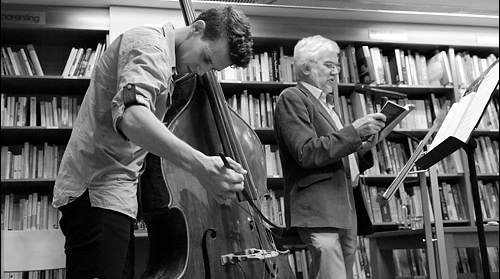
Geoff Page and bassist Alex Boneham at a jazz poetry reading in Canberra, February 2012. Photo by Brian Stewart. jazz.cyberhalides.com

'if you're in this higher condition and you're performing,
something transcends the music and reaches inside of
someone else... someone gets it, they leave and do 
their thing. Then something comes out of their mouth
they didn't intend to say, or things start to happen to them'
                                                                             - Wayne Shorter

'neither poets themselves nor their auditors are fully aware
of the excellence of poetry: for it acts in a divine and
unapprehended manner, beyond and above consciousness'
                                                                     - Percy Bysshe Shelley

'Poets who will not study music are defective.' - Ezra Pound


There was once a period when I loathed literature.

Perhaps I am saying this just for effect, to hook you in? Perhaps I am misremembering? But no. I remember it well. It was in second year at university and looking back, I know now that I was responding to advanced learning in a way that thousands had done before me.

I didn’t take the same journey with poetry as I did with literature in university. It’s a different beast. Some of what I learned leaks over, but there are oceans of knowledge I have barely stuck my toe into when it comes to poetry. As for jazz – well, I took recorder lessons from when I was five, and learned the flute for a year when I was 12. None of it was jazz.

Now, still a writer and a reader of prose, I am also a listener to jazz and am falling in love with poetry – not only as a reader but a writer of it as well. I’ve arrived late to it. Although I have been dipping for years into the work of e.e. cummings, Hank Bukowski, Rumi, Dante and Chaucer, now a swag of other names are on my list. In the last ten years, jazz has permeated my life, so not surprisingly I’m often drawn to poems that share something with jazz and improvised music.

My experiences with literature in second year at university has me thinking: do I need to take that knowledge journey into jazz poetry, that journey into the dark woods of fragmentation and disassociation? Do I need to learn about music and poetry the way I learned about literature, with the risk that I’ll learn to hate them both before I start to love them again?

How did Allen Ginsberg write jazz poetry? Gregory Corso? All those other Beats? How do today’s jazz poets write their jazz poetry? Does Yusef Komunyakaa have musical training? What I know about the ones I know about is that they listened. That seems to be the unifying trait. Open ears.

Kevin Brophy – when judging a jazz poetry writing competition recently – said he felt the poems that worked best, of all submitted, ‘found a way to negotiate between their interest in music as subject matter, music as an experience and words as both rhythmic sounds and vehicles of meaning’.

This gets right to the crux of the matter. There’s room in that description for all kinds of relationships between music, listener, poet, reader and verse.

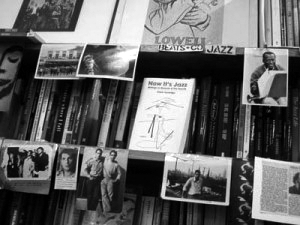
The Beats & Co and Jazz shelf at Collected Works

The Beats & Co and Jazz shelf at Kris Hemensley's Collected Works bookshop in Melbourne, Australia. Photo by the author.

For most people, jazz poetry is jazz as poetry. A poetry that doesn’t exactly mimic the sounds of jazz, but does incorporate rhythms, repetitions, syncopation and space so that its performance can evoke what jazz evokes. There’s also the poetry written about jazz. Occasionally both approaches appear in the same poem – descriptions of and allusions to famous jazz players riddle the canon. Vachel Lindsay didn’t enjoy the jazz music of his time, but he has become famous as one of the first poets to create what we would probably now call jazz poetry. He called it ‘singing poetry’ – declamatory, choosing words for their sounds as much as (sometimes more than) their meaning, amplifying sound with movement. I’d love to have seen and heard it.

Jazz musicians I’ve spoken to, heard or read will talk about their music using metaphors of language. Some poets talk about their work with metaphors of music. I’m not breaking new ground by saying that jazz and poetry can sit well together. They both have conventions that use frameworks for improvisation, and (in performance) the application of such elements as sound, silence, intensity and rhythm by a skilled perpetrator. You might assume that knowledge of music (jazz in particular) would be necessary for the writing of jazz poetry.

But what kind of knowledge are we talking about? Does a jazz poet require a technical knowledge of jazz? Or do they just need to be able to ‘feel it’?

Zen and the Art of Motorcycle Maintenance, that famous, never out of print, 1974 book by Robert M Pirsig is a philosophical treatise thinly disguised as a novel. In it, Pirsig proposes two ways to think about things; the Classical approach and the Romantic. His protagonist starts out Classical (rational, not interested in experiencing things just for what they make you feel) and comes to understand, along the book’s journey, that the Romantics have a point. It is acceptable just to feel; to emotionally respond. In fact, he discovers, sometimes it’s not just acceptable, but preferable. It depends on the type of experience you’re after.

Maybe you just need to be able to groove.

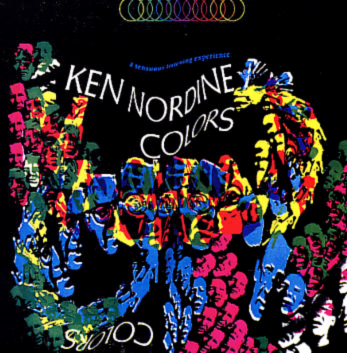
Ken Nordine's 1967 record, Colors.

Ken Nordine's 1967 record, Colors. Asphodel Records, San Francisco.

Ken Nordine – famous for Word Jazz – was interviewed in May 2010 and described working with musicians in his studio. ‘They’d say ‘What are we going to do?’ And I’d say,‘Well, get something going, get a groove going, and you’ll know and I’ll know when you know when it’s happened then I’ll jump on top of it and we’ll go from there’.’ (1’43”)

If performed musically, a poetry reading or recitation can evoke jazz, regardless of the content of the poem. In the same interview, Nordine talks about reciting TS Eliot poetry, sitting in with bassist Johnny Frigo and pianist Dick Marks. He had memorised many TS Eliot poems, and all of the Rubaiyat of Omar Khayyam. Equipped with these pieces, he was able to join in the musical conversation that Frigo and Marks were having. With the same audiences coming every night, he eventually ran out of memorised poetry and started making things up. Which is how, Nordine says, his famous jazz poem ‘Down the Drain’ came to be.

I have no formal training in music, but my extensive observation tells me that jazz and the improvising musicians who make it are in conversation when they perform together. Participants listen, contribute, build on others’ contributions, veer off into red herrings, come back again, and end the conversation in an agreed way. Occasionally there’s talking over each other, not listening and disengagement. That doesn’t work too well, in the way that it wouldn’t work if you were talking to someone that way in your day-to-day language. There’s a framework in jazz; it’s not musical babbling, no matter what improvised music may sound like the first time you hear it. Even so-called ‘free’ jazz is not random notes. Unless you’re trained in how to communicate in that language, unless you’re fluent in its conventions and timings, you’ll miss things these musicians say, the nuances of their back-and-forth.

But you don’t need to know it all to feel it all.

I’ve been carried away into bliss – and sorrow, and rage – more than once, letting music I don’t ‘understand’ wash over and through me.

Hearing musicians talk about music is comparable to hearing linguists talking about English. Both groups employ a meta-language –language about language. Just as this word or that has associations, weight, history, deep meaning, so do notes, chords, intervals. Listen, for example to this ABC RN documentary about the ‘Devil’s interval’ and realise that this idea of music as language extends into an equivalence between the choices a musician makes when composing or improvising. ‘To elicit effect X in your audience, employ device Y.’

There have been some experiments conducted about whether being musically trained affects the way you listen. The results of at least one experiment 1 performed by Dr Daniel J Levitin and colleagues (Levitin is the author of This is Your Brain on Music on Music) indicate that the differences are not as large as you might intuitively imagine. Trained musicians hear emotional cues in music more intensely – a variation in the speed or loudness of a piece of music might elicit the same emotional response in all listeners but the response is likely to be more intense for listeners who have significant musical training. Perhaps because they’ve been trained to hear the cues and recognise them. Like me and literature, a trained musician can’t switch off what they’ve learned.

There is no unequivocal answer to the question of whether any audience member (poets and others) should be musically trained to fully appreciate jazz or to be able to write or appreciate jazz poetry. Jazz critic Martin Williams (writing in the 1950s and 1960s) said that he wanted his readers to be able to ‘hear a numeric 4/4 pulse and count measures’2. Acknowledging, of course, that music criticism and poetry are not the same thing, there is an underlying assumption to this requirement of Williams’ that technical knowledge is essential for proper listening. An aligned assumption is that experiencing the music without technical knowledge is going to provide a lesser experience.

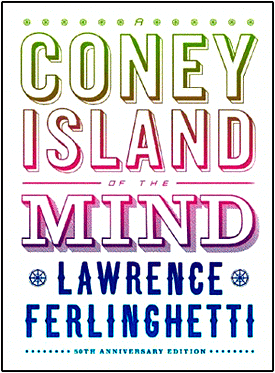
Coney Island of the Mind

Some of Ferlinghetti's most famous poems from this collection such as 'I Am Waiting' and 'Junkman's Obbligato' were written for jazz accompaniment. 50th Anniversary Edition (with CD) by New Directions, 2008.

Jazz poetry experiences an occasional renaissance, such as the one it seems to be in right now. Old poems by Beats are rolled out for modern audiences (see this performance of Lawrence Ferlinghetti’s ‘I am Waiting’ from 2011) and they still have an attraction. Hip hop and other genres have launched off a jazz poetic sensibility and created something new(-ish).

Literature had been an escape and an inspiration for me since I could first read, but my response to it had always been emotional, from the heart. I had no technical understanding of how it ‘worked’ – how does a word or a paragraph evoke a complex, layered response of sadness, yearning, excitement, suspense or rage? When I watched a film, there might be a soundtrack, but here on the page, there were no violins to warn of impending romance, no fast paced car-chase music, light-hearted oboe or gutsy electric guitar. Something else was cueing my emotions, and I knew it was more than word choice.

I understood enough to know that Hemingway’s sentences and Steinbeck’s landscapes made their voices unique and compelling. But what I’d never done was to look closely at how this effect was achieved. While I was learning to take writing apart, I was grieving for my innocence, angry at my lecturers and tutors; cross at an entire learning system that could destroy my pure enjoyment of prose by forcing me think about how the writer achieved whatever emotional responses their work elicited in me. The only reason I stuck with the process was that I knew I had no way of un-learning, or un-knowing the small amounts I had mastered so far. The only way forward was forward.

Inevitably, persevering as I did, the pieces came back together again and I was left with a more sophisticated understanding of literature. I’ll never be able to return to those innocent days of bathing, uninformed, in what a book provides when I open it up and plunge in. Now, when I read a book that’s wonderful, I’m better able to tell you why. And when it misses the mark, I have a better understanding of how it does so and what can be done to change it. This has its own frustrations of course. Mainly ‘why didn’t the author [insert suggestion for improvement here]?’ and the closely related, ongoing anxiety that I’ll miss something obvious in my own work, blinded – as one often is – by the mechanics of this or that word choice, sentence or description and unable to discern the flaws in the overall contrivance. But the point is that it all came together eventually. I can switch the analysis off, or at least turn the volume down low enough to be able to enjoy a piece of prose for what it is, without analysing how it is having this effect or that. Eventually, I came out the other side of the fragmentation that advanced learning brought, armed with a new way of reading – and writing.

I sit here, looking at this jazz poetry motorcycle, and wonder if I should be pulling it apart so I can agonizingly learn how to reassemble it. Or should I hop onto it and ride off for the time of my life into a horizon where jazz and poetry meet.


Posted in ESSAYS | Tagged ,

Give Yourself Up

(poem ending on Newtown graffiti)

If I do not join       clouds       my attempts
of song hit       the roof       line without wings
my effort but       she’s crying       conversation
leaks damage       & not alone I swig orange       sun ahead of
rain it figures       your life planes cuts       across trails
spans aerials       I am less arrival than       anxiety in a breath
causation       would be a       good thing
if I could       make it       happen light it
up my hand       breathe smoke back       its direction
I could discuss theme tunes       to my beating       hands on skin
day or being       of itself       flashed on lines
away from my city vertigo       & self-regard       what’s the point of
sadness among tax cuts       fine tasting licks       the behind trade
mustering its dirty love       a steep roof       leans on night
dusk drift & haloes       lane smells of a toilet       slow brakes
sex jolt joy       armsful of pain       I was excuses tipping
arguments onto       tongue       kisses complaint
give myself up       actions loudest       when softest walls
rung out       their papers dry       blind transparent pushed
‘smell like Blood       Bones &       Diamonds’

Posted in 49: SYDNEY | Tagged ,

Sweet Meats

The waiter’s resurfacing inflames love like a cotton field
in cyclone’s eye. How near we feel the coast,
the coast being a hoax of a military force, but the pitter-patter
could hardly disturb this, our wading
through day.

A face of red bottlebrush, it’s hot like dune sand
that labourers tend in secret at the edges of the north side.
Burial is another word for flagging the issue
and making a shareholding of halcyon perimeters
and the salubrious Venn.

None of the men seem to be carrying pocketknives, though one can never
be sure in a country where the sand beats hotter than the head,
and the sure foam with submission.

Want to commend the industry that endlessly converts,
that elicits the conversion renaissance, uncontained
by its steel capillaries or its fuel brain, especially
the personnel who feel unmodern tickling by hand
the larynx of a beast. Beast commence this pacemaker.

The Venn is full of chilli dogs and burgers with mustard and chips never cold,
the same colour as dune sand roasting and that Tasmanian in newspaper
cartouche. And you’re the inveterate client. The entrance? The entrance
appears a cot to your gilt, celluloid eyes, Golden Age of Cinema sash.
Tim Wright is from somewhere near here, but inland. His collection
is Poseidon’s million tiny barnacles whose billow is an echo jangle rustle
like rain in key of amethyst.

The coast falls off easily into a glabrous plain
and has no passengers.

Best credulous following the Tokaido of Hiroshige
in absolute silence, like the rail purling that valley seam
in Mundaring they’ve found his bones in,
beside biscuit shards of brown glass.
That silence there disinterred in plain sight and warming
under January exposure still unpenetrated even
by the dry gust rejoinders that welter curious after the passing
of the unnamed cyclone. Shyness turns turn Walter Benjamin
into Sydney again, cold but not Berlin, and July!

Uncommon anyhow, at least the car has a gig, and worthy of chasing it,
the clandestine lithography beyond the conversations of Newtown silos
its ambition.

The median strip in Parkville and the swollen encyclopaedia.

Warped from the chase and chases prior, by dint of familiarity
inured but indentured to this, the speedy pursuit
sans the white teeth of man with gun with horizon like a “banzai”.

utter                    to your welfare             is          only by my of             you    are

Their bread was soaked in molasses and sun dried
to a crust, their peninsula was like tea flowering
in the plume of its own green ardour.

The staple then,
 ‘can bread’,                  or anything      cure
D –

Posted in 49: SYDNEY | Tagged

Shedding

The image without an image
pinned up in the air
offers up
the Ten Thousand Things

but where was your heart when it
fell down
here?

never thinking it would fall for the nameless
unwanted, undesired ‘things’
lost by the wayside.

city-skips full of refuse
obscure songs expired
train-stations their
tickets un-used
books not yet read a
child yelling
in the street crone in the bar
who read your palm –
correctly.

Aged monuments pigeon-strewn
standing-in for something
other than themselves
lives that have stood up

to time & waste

one after another
surely self-
shedding.

Sydney, July, 2010
Posted in 49: SYDNEY | Tagged

Turkey in the Drawer

To whoever’s happy batting I rose beyond the daydream
of Sydney Harbour considered
as a Matisse

despite not having been there (and would have ‘kissed her
while she pissed’—as did Williams
—only she was walking

the streets of Graz) I think it might have been Tendulkar

Posted in 49: SYDNEY | Tagged

Longing for Areas of Kansas

after Bernadette Mayer

“Let’s just helicopter the ocean
somewhere”
– Anne Boyer

New South Wales is awful
The winter’s non-existent
The sun will come out today
There are Yuppies
Men & women who can’t walk
They wear dark colours & jog around, admiring browns & greens
looking down at their phones & pretending to predict all the
big stocks
Or else they nod winely
Yup, a Moscadello
The high turns mellow all the time
The liver’s grey
Every movie’s black and white
Everybody eats greens
Nothing freezes
Everyone owns a cute paper mouse
People watch wood chopping every Easter
They dine around on spicy foods
All the trees look dehydrated
They are killed so meadows grow
There’s always daylight
People sit home & drink, boiling
At night all grab telephones, go out & the powerful down blow
Every weekend there’s scorn, so no one want to see you
The fireplaces burn on the outskirts
The mountains look black afterwards
There are only cookbooks at the store
Gourmet’s a big thing
Everybody has a hairstyle
Sex is druggy for people in New South Wales
It’s 36C & they use rubber for non-slip mats
Some people have to have regeneration surgery
The wrinkles are very small
You have to go out with a cold
All of a sudden the blue gum is blown away
Everything’s buried under five feet of sun
It doesn’t go away until April or May
Every drink’s either Snapple or some kind of lemon squash
The houses are all hot boxes & you cant open the windows
People sell storeys to each other
People have to cum & and pull the sweat off their side of
the bed
Then people build garages for their different cars
They have town meetings about the river system
The ideas of people in general are not raised higher than the
Murray in drought
Even the water flees this trap

Posted in 49: SYDNEY | Tagged

apell I’ll 11 shreds

no pulse
I touch
I do

jagger flash hung upside to switch
an other for internal monologue
will our glasses ever clink
it’s a race with tea
“do you eat when I’m not there?”

what does coal feel like? chewing
in cubicles guilty
doubts bout foot etiquette no mustn’t
metals out my ears semi-precious
choppy cave digs secrete
swiss timepieces

zinc works licks its coat & steams
now with modernization & technology
only 600 sonic the hedgehogs are needed

to image my rent muscles
high beam up the mock
stream & how
does the lord slip his?

stars run down panes to oil
other’s hand pats
swimming beautifully drunk
& isn’t it all?

letters wicked to clouds where like all ankles
they shatter with a saline fizz
bacteria on the sphincter
jittering with
mind
gushes yet cannot turn the wheel

or snow’s tumbling off an overcharged branch
burst plopf scurrying rodent

Posted in 49: SYDNEY | Tagged

On the 36th Floor

we are on par with thunder.
The clouds are switched to reverse,
hoovering steam from the craniums
of CEOs. They’re holding shit together
just beneath the spires of sky-scrapers,
channelling gold-fever, sucking lifts
up shafts with every morning coffee-
run. And then where does it go?
Get scrambled by the flurry of bats
above the bridge? Shoot rocks
down from the solar system? Listen,
I’m not trying to tell you anything
you don’t already know. I saw you
watch that woman try to push back
the bones round her eyes, and we’ve
all been caught in the tiny electrical
storms of kitchenette etiquette wars.
There must be more than two million
people stashed behind those windows:
wired up, plugged in and terrified
of their own numerical inventions.
Zoom out and you’ll see the same red pop up
everywhere, lacing flags to lights to trees
that just won’t let go of their leaves,
strapping the city in place, so nothing
kicks round the universe when the earth
tips at the end of the day. What we might
lose: decimals culled from rounding down,
ideas cut loose from interrupted
conversations, your Disnified
musical future, blasted to bits
and shuddering, dehydrated,
in the air conditioning vent,
about
to lose
its grip.

Posted in 49: SYDNEY | Tagged

Newman Street

orange & white pots
square in the middle of the sill
of the house opposite
its blind always half-drawn over curtains

a mirror image to this house
the rooms must be the same shape

a large woman leans over the fence
appearing impassive

the sun moves across her face

*

across on the corner of the street
a house yard surrounded by a cyclone fence
young couples often stand examining
pieces of wrought iron

*

the TV set doesn’t work properly
it’s lost its vertical hold
actors feet hang from the top of the screen
over their talking heads

*

the corner milk bar is often out of milk
the red phone isn’t always there

1978

Posted in 49: SYDNEY | Tagged

Sixth Bell

He washes up upon the shore,
that blue man, waxen in the printer’s trowel
of harbour light. A wedding pumps
on the waterfront, a limo driver smokes
and blows his rings at bats, and he
who looks so often to his watch sees
the washed up golem beyond the rail
and parking bay and barrier and
does and says nothing.

So the sixth bell peels at two AM,
when poems fall away and the tired quay
sighs; the circle train death-rattles
from cut to cut, slipping into Hades’
graffiti bunkers, satanic murals,
black water, black rubble, Tank Stream.

The dead man brushes himself off,
scrapes his way up sandstone walls
and shuffles toward The Lord Nelson.
The bell sounds again, and something
vibrates in wet jeans – the cross is right
way up on an eastern hill. Time falls
back into the space between steps;
the echo of the bell is set to ring.

Stormwater gushes from a cut below
the city’s ribs, as if the CBD sucked
vinegar from a sponge. Metals settle
like a drowned man’s hand across the silt
and scalps of rusted weed roll, quaffing
through a tide of endless wash.

The moon lights Lavender Bay, a light
moons coal-lap bars as coloured rays
dance from off the decks of charters,
or leap from North Sydney towers, taking
brands from neon scaffolds, drowning them
along with lost dogs and the drunks of Darlo.

The dead man touches all the figs from
shadow-bridge to Barangaroo and steps
toward the bar to find the happy-hour spent,
and TVs mounted on each wall ticker-taping
news events to a room of people blue as he.
‘What will it be?’ the barman asks, as once
again his wet pants buzz.

Barangaroo
was the woman who presumably tamed
Bennelong, or was it the other way? Or
was it neither way? All the blue man knows
is in the heated room, is in the amber diamonds
flitting from his glass onto the beams of ships
planed and bolted down to stay the swaying.

Stormwater pours out a clean deluge
which hides in crystal flux the heavy metals
of give-and-take and rips like razor light
into the shoals. A sixth bell tolls.

Posted in 49: SYDNEY | Tagged

Sydney Office

Going to and leaving scuffed planets, she drove her nail across a cake
of soap. Waves peeled off Bondi. Cafes continued in fine, hip disinterest.
She scrubbed the table, then, and fell into hot traffic. It was a kind of
legalised man slaughter: the archaic, better rested, individual, circumstantial,
ontological, piecemeal (we were drowning between two life savers, flags
primary colours. Used car sales. To think, the kids swum up through the
passenger-side window. Both had moustaches. Salesmen quick phrases slugs
squeezed out of envelopes soft packs and packages stitched canvas or cotton
from India, Pakistan, Bangladesh, waxy blood-coloured signatures stitching
books with dental floss.) Her teeth were smashed! Getting up, she swore
bloody at cars and limped to the corner store and ordered two ice creams …
Sydney staged a fight/stayed one night
sun cream pale arms and the power of injunction, punctuation, apostrophe.
It was an apostrophe! A secular ecstasy on the sand! A round fat cut glistened
on her elbow though this was pantomime, a port of inconsistent sailor jokes.
Blue jokes in overalls and the blue bay in the mouth of a strangled burglar.
(Thieves know the tip-toe and the train line, the blue- grey rock the blue
shadow.) To dress in hot disguise with a clean white house dressed in a blue-
black suit pocket of business cards islands the coast of corn coloured light
over lawn from oblong windows. Houses ocean liners dogs slept all next day
boats putter argyle strides emerge with nine irons zippers up smirks and
milking demonstration in men’s shoes – steak dragging great clouds of
fragrance out back into George like muddy explorers. Elderly, their arms
wrinkled as udders, outraged and chatting politely to high school kids in
grape or pea green uniforms. Sydney – so very young, so very old, newly
discovered planet. How do we get our head around it? The heavy high
watermark of the harbour celebrity residence coordination in Glebe book
binding us here and there a foot facial relapse three days each morning in
a pair of Reeboks laces so long it takes a half hour to trace my way to the
universe and maths of chance time and let’s, oysters.

Posted in 49: SYDNEY | Tagged

NOT THE NAME I CALL

whereupon the loquacious vestibule & a deciduous scorncloud quaffneck stout athwart the faultlines of a plover’s merriwheel pantheon: the dramaturgy straps in twain, yet once more talk of selzer & effacement // the instance was without precise measure but it was widely conceived of not to be // one’s pewter clockscale & rustica nervosa got putrefactorially imbricated with their facilities, & in general those ruptures were ordained of the primary issuer (which having been so, immediately ceased) but without which the assets would not visibly been assigned // the indirect verbage was not, so to speak, affectless, & neither was it prescribed; however, your tenebrosity while fallucidating certain traits of the heraldic crier pointed up some skiffled flaws of which nebuchadnezzar disflouted or beseemed // this occasionally provoked but seldom misdetermined or quadreventuated a distimbrous administrator // inchoassummately we consumed only the particular fruits to which our prescription had occasioned, but this (at times) was not precisely to the letter // do you recollimber adroitly the epistemorpheme of that fitful juncture? merriweather, smother & disobstructivation during post-production & the lace of verisimiltude ravelling out & out in an oxygenated slipstream, a stealthy smokecloud of seconds burning, flummoxingly, to be removed in minor places // yet once more, paean
acknowledged of smooth lydian airs,the applause abrupt beyond bas-relief & qwertechnological advances of such an epoch not perlustrative in the tense of more traditional logarithms // the event as I think I mentioned earlier was its effacement, & the renewed distance that issued up, as though in hindsight, before the agent was sentenced // not to say the object was dimmed amidst the gloamish mobfiscation, rather its integrity dispersed amidst the unctuous lucidity of our phases // by that time, at least, I’d a grout to my purse, if not against my name (neither alms nor legality to my name, alas, but confidence in its inviolability nonetheless) (well, I’ve not yet cast the whole scope of squalor aside, but it does disintroviscerate one, certainly) & suncorp reflexed with a chilled dish of a thriftwhore binbargain, rather sardus swift swansinging along the ivytrod whaleculler & absalom demenstruficated // but from that point the mode got a bit degeneric, rather consecuted by a strain of polar flux // all the eternal springs of my infernal experience engendered their own sure & certain & specified brand of relentless disinsensibility but that aside, I’d like to repose with the joint of my aperture, viz., the selzer // a queer abstinence of context & consonance hath driven me divagately athrust in meter thirstily from the effervascillating pongle of my carbonnet clime: the plump corpus swigging out of the portadux, quelching toesful of loam, & making
a poor art of overlordery besides, was inadvertently implicated in the tale of a birthmark yet untorn // with respect to the caste system, in your divulgate account of the pataplause appearing to antedeterminate something fatal (qua empiricism? qua dislocution haranguing counterlogic? qua resounding millimeters of subaqueous hegemony?) a certain phase in the contrapuntal plotpoint alluded (unblemishingly innospent in its affexecution) to the exergue inscribed upon the margins of my ventricle: viz, the ardent trombone measures of bowel-destroying lambency are not uninherently postheretical, but on the other hand there remain five digits, most of which are integral (but the contingent basis of that might accord more suitably with heteronormative additional factors belonging to zeros) // seize the furnace! // chillblains from the potash & the vox of an obtuse angle opining of a radical dramatic sequence of transgressive desires! // weep no more, skelton crookscythe, helter & heathens unwashed ashore, weep no more // the clouds no longer read your face with scorn // parallax immeasurable in the disturgid patamorphosis of this sequence! // for the degree of fermentation is what makes this dream
so sweet
 
 
Posted in 49: SYDNEY | Tagged

net

José Tidon Rhianne Grieve tharookiebeats Daniel Young
Omar Chmaisse Kimberley Seeto Dimitra Harvey Initially
NO Omar J. S Jess Murray Abdullah Noman Nathan Smith
alan clarke Aya Najmaldeen Miro Sandy Vinesh Eng Kiat Tan
John Upton robertgray58 Jenny Campbell David Musgrave

Richard Kelly Tipping Alasdair Carter Samantha Nagul
Carmel O’Connor pollenmagazine Louis Albuerque
Adam Joel christie Greg Paine William Edward Oates
Nick Isil Cosar phillippamurphyhaste coolmccool Bill
Tibben Mandi Randell Brenda Saunders sean mckenzie
Anton Mischewski Jessica Lewis Amanda Louise Clara goh

Susan Zheng Desiree Cunningham Richard James Allen Jesse
Stokes splat000 Anouk De Silva Joanna Dodds jodieanne Vin
Heffernan Josephine Ranck Jem MacDonald Rochford Street Review
Donna Keevers Driver Aimee Maree JD Shaw Chris Wright Simone Baxt
Susan kathryn yuen Mark Reid Alex Dance Michelle Gaddes Katie Cat
POETS IN THE MAKING ecitsuj Julie Sheekey POETRY BY KDW
Des AutoPirate Cleo Gardiner Lis Bastian Christine Wan Peter Lockhart

Lucy O’Keefe Tom Patton Adrian Robinson Christine Ratnasingham
Stephen Davis Igor Marinovsky Claire Rose Bloom Faleauto Carolyn
Gerrish mariee Paul O’Loughlin Lydia San Asti Michele Todhunter
Jewel Rainbow Paula McKay Rob Kennedy David Percy Jane SIlverman
william james falls Christopher Anthony Soto russell Jordan Rosier

Anthony Lawrence Dermott Ryder Ron Lou Steer Barry McDonald
Woollahra Council Hayley Neal THE BARD ali hughes rob walker
Chris Edward (Ted) Webber kim hollingshed The Red Room Company
marko koludrovic Peter Mackay Brad Frederiksen Steph Stewart Sara
Basill Joshua Mostafa George Anderson Louis Phillips Ushter Kaveh
A Word Travels Kate MiddletonLarissa Fogden Katie Cat Maxine

Larry Litt Alexandra Silarsah Ken Setter Lauren Wilson Dudley
Delarue Erin Shiel CC Paul Kooperman Ariella Stoian Andrew
Franks Matthew Jenkins Rae Desmond Jones Rosemary Huisman
Jess Cook Patrick Reilly Bo Svoronos Mark O’Flynn Michele
Ambrose Ida Crowe Amy W Joel Scott S. K. Kelen Nicolette
Stasko Jade Oldfield D Harely Country Boy Australian
Poetry Slam Madeleine Venners Andy Kissane D man cecilia

white Jessie Tu Raymond H Wittenberg Helen O’Brien Petra
K Simon Lenthen Ali Jane Smith Debbie Chilton Jodie Field
Ella Paige Dominic Bowd www.slampoets.net Genevieve
Osborne lady sparkly stuff R C Heilmann Andrew Burke
Mike Chan Skye Loneragan Lisa Best Mark William Jackson

contactmandybeaumont mattaparra shazzie.brown Lachlan
Bell Vicki McDonald Bridie Latona Toby Fitch Harry Livingstone
Sheryl Persson Desiree Conceicao Patrick Jonas Fletcher Tim Heffernan
sleepy wolf Ben Flewellen floatingblueseen Belinda Lopez suzanne altman
Ghostboy Coral Carter do mo fiona kendall Jennifer Moxham David G
Landgrebe Lorraine Hawdon Sharmini Ravindran john ryan William Zappa

patricia trizia Jones Elizabeth Routledge Mic T Jim SpainAnna B Rasztabiga
Tom Daly David Croft Hamish Danks Brown Albert Gormley Caravan Slam
Helen Koukoutsis Peter Witts Debbie Lim Rommel Catuncan Leisa Woodman
Andy Glenn Elizabeth Claire Alberts Phyllis Perlstone Ronald Sally Evans
Dianne Masri Mari Fay Deanne Leber Juliette Gillies Billy Marshall
Stoneking Corey Wakeling Stuart Cooke Kashi Maha laire Phelan
Craig Billingham Josh Shaw Zena Shapter Pip Smith Rebecca

Julie Chabierski Anthony Tin Jeanelle Isaacs David Bell
Catherine Astrid Lorange Gina Lednyak Virginia Keir
Mitchell siamanto Kirsty Slarke Flamina della Paradiso
Dallas Burgess elena z Sheila Chapman luke whitington
Benito Di Fonzo Leggoman mel brown GP Michelle

Richard Castellari Melissa Caroline allen Jennifer mills
Ali Kennedy Scott Tegan Jane Schetrumpf Avalon
Lindy Frampton Carly Brown kylie skye turner
Queensland Poetry Festival Kerryn Lee Bon.
Dylan Clay Aden Gilleland Christian Brimo Jasmine
Navarr Adam Leeman Greg Vincent Jeremy marcel monaro

Jonathan Shaw Emma Brazil isabelirvingscratchesnscribbles
Meredith Pitt melinda mills Diane barkas Jess van Lieven
jennifer nixon Julie Thorndyke Sarah Alexandra anna gibbs
Thomas Kotsonis Drow Smith Randall $tephens Janice
Forbes Sigourney MaryMacaroni john Mc GuckinScott
Sandwich Ronald Piilua Greta Chesterman Kelvin Celsius Belinda Tee
luditess Bethany Small Sarah Knox Lyn jb Ava Aroha Caroline Fonda Barry

R McKee Cleo Mees Atong Peter Lach-Newinsky Jakob Ziguras Luke Fischer
lotusland Janey Pugh Nat MLHSappho Books Cafe & Wine Bar Nada
cpfish05 Catherina Behan Marilyn Roberts Bridget Cameron Carol Jenkins
BILL COLLIS Andrew Minney Michael Simms Cora Upt marcjones
Gregory Kriscia Kapunan Darelle Duncan Justin Lowe Tim Entwisle

Andrew Geddes Sharonlee Stan Winn Rachael Belle Myersjon clare
Anna Kerdijk Nicholson Plathological Liar Matthew Robert Rayner Randi
Eaton Sue Wildman Anthony J Langford Leah Greengarten alberts.robert
Steve Goldsmith louise berry Barnaby Smith tea rose Michele Fermanis-
Winward Lorraine F. White Gryff Ogilvie Colleen Duncan Isabell Petrinic
Angel Finnegan Nicole Duchesne Janet JacksonCj Shaw Jessica Gilbey

David Kerr Cathy Bray Chere Le Page alan jefferies Rebecca Hynek
Paolo Totaro Christine Paice Amanda Lucas Jayne Roberts Frederick
Kesner Jessica Tse Char Jones Melody Loke KH Vlad Evelyn Cotter
David Gilbey MissPikachu13 Caitlin Elisabeth StillNam Giles Justine
Poon Alex Rush Virginia Rowlands Mona Attamimi Rhyll McMaster
kathleen Geoffrey W Graham Elizabeth Saunders Constantino Mavros
Robert Adamson sayfin Leigh Lemay Susan Adams Leigh Tuckman

Madonna Cristallo Natalie A Bruce Williams Kate Peterson Caitlin Myers
Fleur BeaupertNicole Gleeson Danny Robinson Anne Louridas Bronwyn
Mehan Andy Quan Rubén Reyes Maisy Ruby Levy Cassie Charlton Andrew
Holmes Nataly B Emily Stewart kt hall Brittany Richard Jenner NSWwriters
Candy Royalle Justine McGill Julie Chevalier Stephen Gillies Miles Merrill Jack

Peck Margaret Owen Ruckert maree scarlett Onur Karaozbek Johanna
Featherstone Ethel Mildred Malley Pravin Menon cyril Arthurs
Claire Potter Anna Ballantine Michelle Cahill Paul Giles
Online James Bedford Rob Wilson Michael Farrell Aiesha
Rose Smith Eleisha Caripis Brent Clough Victoria
Sheridan Mills Tricia Dearborn Benjamin Dodds

Lisa George Alexandra Bates Jennifer Mae Hamilton
SamByfield Ilan Jennifer Compton kevin robertson
Jill Jones Valerie mildy Sophie DeVries Suzanne
McGillivray Lachlan Williams Katherine
Langford Bhuwan Thapaliya Michelle Kasparian
Nicole tone boss Anna St.Clair Sqgl alan jefferies
Geoff D Bolton Les Wicks Pam Brown michael

smith Chris Mansell James Stuart Ed Wright
Siobhan Toohill Jane Gibian sue ogle Alicia
Thompson Sheila Monaghan Helen Coolican
Stern Holly Zwalf magenta Elizabeth Allen
Michael Brennan Bonny Cassidy Mark

Mahemoff Alison Rookejoanne burns
gamen Josh Mei-Ling Dubrau Alana
Hicks Madelaine Dickie Marita Hastings
Lindsay Tuggle Emily Finlay David
Musgrave kelli mcgraw Kit Brookman
derek motion Thomas M H

Thortpe Aimee Falzon Geoff Burgess
Deb Brown Judith Beveridge
Eileen Chong Karina Barker
Niobe Syme Rebecca Landon
Greg McLaren Adam Aitken
Fiona Wright David
Prater Adrian Wiggins

Posted in 49: SYDNEY | Tagged

Worldless

where’s my donkey : thursday evening

catch the train,
seagulls circling
Central Station

catch a bus
pick up a paint chart,

at the gallery –
Korea and Kinglake
photography exhibitions

(different)

a very thin man
in Oxford Street
in red leather pants

talk on Eastside Radio
read two poems

at the bus stop
long haired boys –
regenerate fashion,
retro,
fashions
arrive & go by
really quickly –
I had to live through
the entire decades!

(peeved)

catch a bus,
redhead woman driver
playing jazz piano cd
loudly, in the bus
(suits the traffic)

catch the train,
seagulls gone to Pyrmont,
night workers
eating chocolates & chips

(hunger)

walk to the seafood shop
buy the dory, grilled

walk home

*

I am the donkey : saturday afternoon

step onto the crossing,
lift palm to car,
thanks driver.
quicken pace, cross smartly,
think
‘why do I do that
why do I want to live
am I depressed?’

Scottish sentimentality –
car alarm with violin

(answer)

*

I pass the donkey : tuesday morning

walk to the bus stop
(forgot my watch & silver ring)
open umbrella,
light rain shower

catch the sad bus
through the streets
around
sad blocks of flats

paint swatches
(I must remember)

what colour the door?
the brick fence, what colour?

coffee at Zoo,
hair colour in the arcade
(regrowth)

buy underwear,
blue, mauve,
& stripey

buy preserving jar
(lemons)

buy
honey, celtic sea salt
& iodised sea salt

carrot & celery juice,
the juice maker
takes ages
to juice the vegetables

almost miss the bus

quickly buy the newspaper,
here’s the bus

winding back
past Centennial Park

there’s the donkey,
no, it’s a horse

(mistaken)

here are the streets
around
the sad flats
& here’s
the Cauliflower Hotel

listen to Patti Smith ‘Twelve’
(Changing of the Guards!)
on an ipod
on the bus

on the move
but in the clouds

(worldless)

thought stuck,
pinned down

stupid under
a roaring sky

*

there is no donkey : friday night

hazard lights
in the bus lane

police
remove the number plate,
the driver
brays drunkenly
(caught)

going home
to make a poem
(this one)
to give my problems
to you, reader

(contagion)

everything fails
when all else fails,
when all else
skyrockets

some of what I think
is a piece of crap
some of what I know
is worse

some things I say
shouldn’t be said

my heart,
meaning
my feelings towards you,
reader,
meaning
my straight ahead empathy,
though
is
in the right place

nearly home,
the streets seem dark

enter the house,
hug you,
my synthetic coat
squeaks

Posted in 49: SYDNEY | Tagged

Act #12

Vintage in verisimilitude. Private
Sale – Vacant Position – Business 1 Zone
. Scent

of sandalwood, inconsequential
bells, organic

food and runes. Fortitude
begs futurism. Health

store
– Home ware – Souvenirs
. Unrequited

regret: fetish value
fades
from my wallet, untold impotence

of possession. Schism molds scansion. Yeah
I saw the bookshop

round the corner spells

work only if life’s banality
becomes the node

of bewitchment. I know

I wanted to blow 20 dollars
I didn’t have. Who the hell

wouldn’t.

Posted in 49: SYDNEY | Tagged

syd

overw
eight s
tubble
d dow
n too m
any on
e-ways
glitter
harbo
red a r
ing tra
fficking
dags in
noted p
ark be
at head
offices i
n shape
of head
aches +
we arg
ue hom
e throu
gh a bir
d-show
openin
g or wh
arf chri
stening
champ
agne co
uture r
ecepto
rs insta
nt by in
stant r
estylin
g stimu
li while
hopefu
ls in a g
rungy y
acht su
ck lips

Posted in 49: SYDNEY | Tagged

Office w/views

it was the key
to everything
if you had one

copier queues
questions that
puzzle us like

where to smoke
as Wordsworth
has it the river’s

London’s only
living presence
but I shouldn’t

be reading this
now & scrupled
her dark circles

if a hand of euchre
at lunch seems an
antiquated notion

so do i
go on
through

light snow flurries
folded wings of collation
tonight like others

work late & no less
than dedicate this To
Our Unknowing Publisher,

Posted in 49: SYDNEY | Tagged

circle of eagles

1. important to feel comfortable can I borrow a
chair skin grafts collage? with nothing extraneous.
extra news: the brow paper snake’s eating a space egg
plot hatches & thickens ghost w/diarrhoea has its
head in my eye cleft socket. vacancy cut outs
cut out
dance round it stag beetle bat drawing on book
valley with machine guns. 2 heads better than I esp
when they are 1. vacancy jags holiday lion down
horses face melts traces a dough head. porcupine –
grey – in my head.

2. blue uncanny’s trotter emitting fence of dots → weaker
pastel head w/ breast imprint touching elderly black
smoke thicker fur of dots draped over b. miscloven
math pork chop sprays blue seahorse gauze 3 towers severed
hound by water & chlorophyll dropping into cormorant
w/ swollen breast wolf // cormorant from legs
under sheets one tenting other pointing oily
lightning of gloom & pasted on grocery bag
another corm. ejects → margin at westerly ballerina
leaping shadow of grey muscle

3. black cutout shows broken mickey elephant man.
blunt worm/black feathers & arrows eating slum flattered w/
red fossils & leaf skeletons
beige shape of difficult vague situation.
pool makes u-grey ice cubes
bowels of head, black thing dips its trunk, blocks
another lying leg. perfect almost.
nice creep, 2 heads, smoking, thinking, amid Caesar
ghosts. he? is lazy & has a furry friend, black
than he is.
—————————————–
warming middle patched forward temper
missed precise purchase fold crumpled apricot
coconut amber follow flow canberra paper
serious erupted capable precious forceful grouped
purposeful
handled fitting responsive necrophiliac corrupt
cool short loose appearance trippy total laine
nacreous crooning deep shallow formless formful
farm charm chalk stalks trips creeps tepidity
focus squiggled lid trumpet tempest torment
topiary tropical tactical touching tumid garbled
gaping gusty hogad draped demystifying
depressed dusty/dusky borrowed
painting

bronze shadows heaped.
after the final no.


Written at Amber Wallis’s painting show, Circle of Eagles, at Utopian Slumps, 2009.
 Typed by Corey Wakeling, with thanks. Last 2 lines taken from Wallace Stevens/head.

Posted in 49: SYDNEY | Tagged

Transpacific

The view of the watery gardens suggested a truly
Verbal rosette. We see the world as a black and
White golf course. Constellations, like buttons on
Apollinaire. How much longer can we afford it?
We fall – in performance – in rose coloured costumes
shooooooooooooooorT Paaaaaaaaaaaaaaaaaaaants
Leave your backpack and duty free gin with the
Luggage of the others. Now it’s too late to choose
Between a life of Christ: or of Buddha. I could hear the
Metal tearing but couldn’t see anything in the bathroom
CarrrrrrrrrrrrrrroT Piiiiiiiiiiiiiiiiiiiiie
was the last thing I regretted about my
BOYHOOD
Gosh is not an Australian WORD
Let it wash into the sea SAID
The Australian GOD
So many WORD
-s TRACED
from SYD
-ney. WORD
-s that APPEARED
slightly rusty. (It was actually BLOOD

T-Plane; white magic. We use a different number system
And believe that this has improved the area’s economy. It
Was a century. It produced a lot of songs. We learnt to draw
On the back of an owl without falling. Now we’re slowly edging
Towards Babel in reverse. With a lot less languages of course
k-T-Pp-t-k k-T-Pp-t-k
We walk more
Depend on phrases that we learn to cut from bark
The idea of the tower disappears

Posted in 49: SYDNEY | Tagged

At the Darling Harbour Convention Centre

At the conference lunch
the industry chatterboxes turn
a gavotte, then prop and scythe
about the buffet loading
up pot roast, pumpkin salad,
rendang. Says the keynote
speaker bignoting counterflow
down the queue: “Hey I’m on
the Be More Biodynamic
close-out,
next up.”
Tops.
Our gaze drains
to the Harbour, a heaving sluice
of yachts and city views — it retains
all our best attempts at describing
its irruption then chucks them back,
like we don’t know what we’ve got,
which is a Paddy’s Market tchotchke
or a box of chocolates, “spent coins
of abiding love,” you say. Good one,
thanks hon
.

Posted in 49: SYDNEY | Tagged