Vis[i]tors

i.

the office & library
cooling system hum
outside the weather

feet on pedal or dash
we refuel loyal listeners
tolerating radio’s sight gags
took the bridge coming in

ii.

so that here –
Port Botany sky
curators race for cover

our late 80s archive
an amateurish mix of creams and whites –
is the view you paid for (sixteen replays
are inconclusive)

iii.

this morning by the stairs a famous face what’shisname

give way to the
portrait of an unknown

a red flag sirens
the beach is open
even when it’s closed
scene to breathe life into

iv.

: almost on cue

a breeze reports
first in the crumbly architecture
stippling windward

tracking the flown inflatable
as far as

White Cliffs

v.

when the kids get tired
the big kids get wired
when the kids get wired…

he has a boat out front
the adulation of the gulls
french for welcomes/
farewells

vi.

short of a stop

time/location met
peremptory bus doors

with these wheels
perambulate sandhills

retired elevator
card in the lock

vii.

timed cued to cross

& short flight home
to spurred ledges

not sure where
walking ends &
traipsing begins

i folly the signs

Posted in 49: SYDNEY | Tagged

Reflections

On May 31, 2011, as headliner of Sydney’s VIVID LIVE, The Cure played
one of two ‘Reflections’ Shows – its first three LPs (Three Imaginary Boys,
Seventeen Seconds, Faith) in their entirety, as well as a fourteen track encore;
‘The Lovecats’ closed both performances – at the Opera House’s Concert Hall.

even sunstruck the ribs rise
from Bennelong Point like Arthur C.
Clarke’s black slab

I storm the frets, stopping
only to whirl when your aperture’s
cocked at my spine

this hair’s a tornado
of sand ridiculous, you needle,
a blond gothic

no licks of laughter
(Father, Son, Ghost shedding Prozac)
my Scorpio sting: fuck off, Madame Acronym

§

the ticket snakes
on knotted
wood shoved between twin beds

once
we had no need
for such arpeggiated space

dulled, you insult
in my headphones: ‘Other
Voices’, ‘A Reflection’, ‘Grinding Halt’

Fender grey,
a sea gull pummels crossbows
on the pane

§

three four five
raven finished
casts embark Dry Ice

I’m more cleft
than that acoustic-electric
presented by my Daddy

in stunting aisles minors gravedigger-
dance and mew
the lovecatsss

a crèche of stars
weeps plasma at the mutilated
placard of the Harbour

Posted in 49: SYDNEY | Tagged

Sorry’s Essence

This poem is constructed using words and phrases directly from Kevin Rudd’s ‘Sorry’ speech
as reprinted in The Sydney Morning Herald (online version) on February 13, 2008.

I move today we honour, we reflect
on mistreatment of the oldest history, indigenous people
who were stolen, blemished in our nation
the time has now come to turn Australia’s history
by righting the future
we apologise for profound grief and suffering and loss
and pain and indignity and degradation and sheer brutality and hurt
of mothers and fathers and brothers
and sisters and families and communities
breaking up inflicted on a proud people and the spirit
healing, heart, embraces
never, never again
solutions, respect, resolve, responsibility
origins are truly equal
remove a great stain
do so early
an elegant, eloquent and wonderful woman
has travelled a long way to be with us
she remembers the love and the warmth
and the kinship of those days long ago
she remembers she insisted on dancing
rather than just sitting and watching
she remembers the coming of the welfare men
tears flowing, clinging
complex questions
it was as crude as that
Tennant Creek and Goulburn Island
and Croker Island and Darwin and Torres Strait
She was 16
a broken woman fretting
ripped away from her
it’s a good thing that you are surrounded by love
Sorry
And remarkably, extraordinarily, she had forgiven him
there is something terribly primal about these
a deep assault
stony, stubborn and deafening
leave it languishing
human decency, universal human decency
deliberate, calculated, explicit, and notorious
Generally by the fifth and invariably by the sixth generation
all native characteristics are eradicated
they are profoundly disturbing, well motivated, justified.
an apology well within the adult memory span
a point in remote antiquity
it is well within the adult memory span of many of us
therefore we must also be the bearer of their burdens as well
the darkest chapters
with the facts, the evidence and the often rancorous public
we are also wrestling with our own soul
cold, confronting, uncomfortable
there will always be a shadow hanging over us
I am sorry
I am sorry
I am sorry

without qualification
Yuendumu, Yabara, Pitjantjatjara
there is nothing I can say today
I cannot undo that
grief is a very personal thing
imagine the crippling effect
it is little more than a clanging gong
a thinly veiled contempt
the gap will set concrete
the truth is a business
halve the appalling gap
back the obscenity
beyond our infantile bickering
Dreamtime

Posted in 49: SYDNEY | Tagged

(untitled)

a plane flew overhead
ten kinds of friends
you never said that
you said I just want

to show how I love
shouldn’t lie it’s nice
try not to raise your voice
military

like I can talk
everybody wants
a walk and a cold beer
to hang their head on

whereto for poly hearts?
open lines and hill starts
an enough advice
to please everybody

Posted in 49: SYDNEY | Tagged

Out of Politeness

Out of politeness you probably wouldn’t say,
especially when spring has started false
and hailstones
small as ball bearings
ring the roof
keeping you trapped at the library
a cancelled anatomy book under your arm
– or perhaps it’s a newspaper
and instead you’re under the eaves
looking out at sheet rain
wondering how a street sustains so many cafes and not a single electronics shop.
It’s a cable you need, not a coffee,
but it’s a small consolation.

If asked, I probably wouldn’t say,
instead imagining myself lost in a forest
surrounded by the heady aroma
of peaches, perhaps
enjoying this wintry lapse into drizzle
alcoved under a willow
fingers deep in dark soil.
I probably wouldn’t,
I don’t think so anyway.

I wouldn’t say nothing, though
if asked
if pressed between pages
if, while hours and minutes trickled by
if I
if –
I probably wouldn’t say no
no, I’d think of rally driving and Zen meditation.

When time’s fragments gather together in the same room
like boxes on a calendar grid,
a room say, like the one at the end of the hall
with sash windows and the Edwardian daybed,
when they gather there

I wouldn’t want to say either, either
or as well,
I wouldn’t want to say anything, no,
not nothing, not no, not probably not,
lips stitched against the apologia
of a coming wind
needling
addressing no one
but giving everything away.

Posted in 49: SYDNEY | Tagged

Western Triv

(courtesy of the White Cockatoo)

Petersham: the formerly fashionable
but now rather heavy overcoat
on the portugese tart. Tickertape ribbons
and other dictionary entries.
Lip-reading Theory of the Leisure Classes,
little Ern stumbles through the public primary
before graduating to Summer Hill Intermediate.
Spain weeps in the gutters of Footscray,
to say nothing of our serious frolic.
Closed my inanimate lids to find it real
behind the shelter sheds. I tell you
these things are real. Even
baroque Mediterranean garden furniture.
Greek quails under the flight path,
cooing softly: the girl from i perama.
Rooming houses line summer dust,
a month of pianos for Kate and Pete.
We wanted underground lighting
or even just subtext
to distinguish the last three decades
of a fallen Enlightenment.
Romance relishes the house-referential,
listening night after night
to Janet Jackson’s Alright pump
through over-priced rental walls.
Hightailing cowboys drawl
back to school, it’s fort for
or la di da, Lacan with a cute snub
neurosis warring over the inner, waning West.
Someone has to pay
or there would be no affect. Pasta dura
rather than Dürer. Crusty paraphrases
stagnant on the unclaimed meat-tray.
We purvey a crystal ball obscura,
a street stripped back, oxford-pinked.
1999 ‘found’ postcard: Hi Mum!
Didn’t inhale Paramatta Road, parked
on anarchy’s shop-floor, Birkenstocked
our way through claypot chicken,
& bought into the $5 Rashai
Frequent Diner’s Club cartel.
It’s true, global ecologies
kept us searching for the gastro-commune,
but to no avail. xxxx, E.M.
Cockroach hopscotch
lags on the line-faltering footpaths.
December gossips between
of, whenever, and somewhat expectantly,
another tin-roofed rapport.
Next year, Lieutenant-Governor
Francis Grose will check out the real estate here,
wave to Joel in the flat above,
and set up a row of convict sweat crops.
Before you know it, it’ll even be home to
The Australian, or at the least its tidy originator.
All good & legal, so they say. Identity
flashes in. At our duplex, national pride
still gags for just one more go
at the Olympics. But why pine for the ultimate
when you can already see Ultimo?

Posted in 49: SYDNEY | Tagged

Sadly

Ability is not the end cause and justly–
not even the original thing can foreclose the horselock
I don’t want to tell you I want to say you
come here to the main city where all the intense emotions
sleeping in the outback incommunicado.
I can’t keep not looking at you (I never was)
I can’t keep up anything I never started.
I left the house and made it close. I decided against
excision. A scalpel slices my leg all those years ago (1).
Where is Sydney even ever when you need it? Not t(here)
I don’t think. There is a prefix of verbal destruction that
can be applied to any word. Watch the summer monstrous.
Watch my flower while I walk. Where is the sun in relation.
Where is the unrelated. Every orbit is too close over there.
Watch your head when you kowtow please. Who needs a car
when a car can be broken? This is a place about poem. Arms space.
Race race. All of the dayglo foodstuffs are too strong. Open
out a lily and gild all my flowering embarrassments.
Back when the bible was still the newspaper things were heavy
you could swim all the way, dude, no shit. You’re wearing me down
and weaning me off. Take only the best. Always be trigger-happy.
Give me enough pages and I will write for you every self-help book.
All the houses are seriously full. All the houses are full, srsly. All the
homegrown foodstuffs are selfmade geniuses. Automatic Dialect.
All the people are good and bad and evensided. Howevermore.
Insofaras. In the near snowlight. The cutest herbivores.

Posted in 49: SYDNEY | Tagged

written in sydney

1.
Looking for the unobstructed view
a man with glasses and a chair-like stick
untainted by settled heavier blueness
a child reaches out to a chess-man
I retell myself as coffee comes onto me
nothing in the world matters more than each other
but I kick against you & hold like two dots
an airbrush’s idea of human hair
independent sail you have no tact
knitting your own fingers in black
crocodile won’t apologise cat-eyed nor change
cardboard harassing paper in the street
three middle-blue squares pay the cheque
half the air is birds


2.
Crossed out wait for me
I’m a dinosaur at the end of your arm
the crinkled brick subtracted us
Blotches and of a piece
near the trolley bars return key
Ford canvassing a star
you shoot a pipe from your arm
to which I held neither piece
gamble on this tracking away
into a bitter railway identity me
if it blinked like a key
it is a star

Posted in 49: SYDNEY | Tagged

Juvenilia

Standing in line with haircut to join the
Air Corps circa 1989 – & failing that,
a George St boarding house
(firetrap w/ kindling for stairs),
shoesole counter-dinner, chips, tomato sauce.
Squadron Leader says lost cause,
gulping schooners & ducksoup
saxophone mindwash – psychiatrist not
liking the green cut of yr silhouette?
Great art’s all very well, son,
but it’s details that count.
Old guy on telephone sobbing with drink –
Berlin on the radio, Cold War fizzle,
rocky horror midnight cinema freaks.
Y’d cut yr balls off, wldn’t you,
for the good of the nation?
The man with the bitter pill behind
the fishmarkets, four a.m. –
swallow this & see if you can’t stomach it.
Where’s home? What’s leaving for?
Flying bomber-formation
through Chinatown, kicking up dust,
butts, used cocksucks – the future
sure looks bright from here.

Posted in 49: SYDNEY | Tagged

Opera

After each useless, ephemeral voyage I return
to the house
and its quay; I circle the edge before skittling
off to the suburbs.

Come to me, I cry, fat plastic and screaming sail,
shining, golden city
cramped and seeping music! Tonight
my heart’s emptier than a harbour.

I gulp down your murky cocktails
of diesel and suit.
I drink, drown and return
sharp as a note, sharp

as a particular location in space
– one
of one million locations – one
of one trillion locations in space.

I watch the melody collapse
– looming, stretched, blasting –
it flattens me and I’m spat
out the other side

into pure noise, pure scrunching and there’s Sydney,
the wet black face,
the burning beer intoxicated with its own
bubbling tarmac.

Ragged music blows in from the desert,
from the sea;
ragged sheet music catches
on a barb. Sydney’s

a barb on a rusted wire;
it pierces currents, leaks tetanus;
it’s the time of day towards which
we tumble inexorably,

away from which we surge, searching.

Posted in 49: SYDNEY | Tagged

Fragile

… ha- … thanks … another post … time … hotel … Stanmore train … heavy … it
was … full … through the corridors … black … winding down … I went … I was
staying … park … under the … they would be … to … Circular Quay … under … it
… flowers … she was reading … the books weren’t … the … I get a … heat … hard
… running across … milkshake … said The Piano … fly back … noodles … we are
across … he seemed … boat … a sec … arguing with his child … copies of … so
much w- … in the mosquitoed … lock … tshirt … a singlet … café … it was only
stop bleeding … sorry, forgot … learning how to … between … Darlinghurst … at
the … cannoli … we talk a … its cheap … Glebe, Valhalla, Balmain Town … crazy
… dusty … out the back … and we … carving … tea … sharing … fake boob … she
was too fatigued … standing – brooding … I wore … running up Crown … at the fair
… red bag … into the … that one ni-… a taxi on … that won’t … he … when had
that moment in paint- … conflict … raining as … it was … avoiding … had to
your comment … and here … duck … I saw her … had the goat … rough when
lightning … bath … near Sydney Uni … tanned … Bookshop … Green … Me =
lecture and after that … dog race … it was great … it was … fruit … where he had
I was roused … mostly suffering … moments … for … spotting … if they
beautiful … the chairs … raining … Petersham station … broke the … street
Cockatoo … smell the record shops … Orientalism … persists … late … run-ins
before … his manuscript … house … I think … books … my books … photos
garage … slightly … Library … Johnson … go and pick up … under … one of the
last remaining … read … I don’t know what … driving … the bus … escalator … ok
but … I went in there, but … felt all … yes … pressure … whoever … small … roof
… video … ok? … dance with his penis … it’s always … noodles … out the back
to flush … if we pass … walking … through the gossip … night … he didn’t look at
me and … later … wharf … could’ve taken … hotel … under … it didn’t seem so
taking so … boy that I … always keeping … Oxford … secondhand … through the
window … he wanted … train … wrong … Zoo … had destroyed much of … we
took … theatre … about New York … can’t remember … didn’t see him, just
furniture … didn’t … wasn’t what … hail … that awkward- … net … blue … throw

Posted in 49: SYDNEY | Tagged

Highlights from the Poetry Symposium

About a week ago, I got along to the Political Imagination: Contemporary Postcolonial and Diasporic Poetries symposium, hosted by Deakin Uni at their suave city campus. Convened by Ann Vickery, Lyn McCredden and Cordite’s very own Ali Alizadeh, the symposium made trouble with notions of postcolonial and diasporic poetries. It was a Nespresso (and in my case Codral) fuelled couple of days, packed full of paper presentations, book launches, and great conversations cut short between sessions. I found it pretty generative to some of my own thinking about poetry — I’ve put together a bit of a run-down of the bits I found particularly interesting. Please feel free to leave you own comments or reflections from the event below.

The keynote speaker was Peter Minter, who got proceedings off to a cracking start with a paper that evolved his critique of the Gray and Lehmann Poetry Since 1788 anthology, and went looking for productive ways forward in reconceptualising what an Australian poetic is/could look like. Searching for ‘new ways of conceptualising the beautiful, the artful, and the aesthetically true’ he proposed the notion of an archipelagic poetic, inspired in part by the work of John Mateer and Robert Duncan. He asked the question of how culture could become more sophisticated in engendering cultural diplomacy, arguing for ‘archipelagos of psychogeographic intensities’ where we each habituate on our own archipelagos, venturing across to others for moments of exchange and commune.

It was really great to see how this notion was picked up and reseeded by many of the presenters over the two days. It certainly captured my imagination, both in its potential to decolonise the trope of Australia as an island nation, as well as in the sense of volatility and movement the word suggests — archipelagos are fraught places, often formed out of volcanic rock and liable to flooding over. I thought it was a really ripe idea and I hope Peter and others continue to develop it. Keep an eye on the blog for Bonny Cassidy’s take on it too, coming very soon!

Later that afternoon Ania Walwicz gave a performance and creative paper about her poetic practice. I hadn’t seen her read for ages, and she was terrific. I actually woke up the next day with her in my head: I wake up now now I shower coffee now where is coffee now? These were some of her pearls from her accompanying paper, which she described after the fact as facetious: ‘I inflate myself — and then I cut’, ‘Freud writes: the only reason I write is to analyse Ania!’, ‘Something is wrong and I see this in a film’, ‘I don’t believe in one word I say’, ‘dream diary dreamt in the palace of culture’. I’m pretty intrigued about what her dream diary contains, and I think she’s inspired me to start one of my own.

Unfortunately owing to illness I missed the Michelle Cahill’s and Adam Aitken’s sessions the following morning, arriving just in time for Michael Farrell, who was totally on-trend with his paper about Michael Dransfield, who seems to be everywhere right now. His presentation used Dransfield’s Courland Penders as a test site for turning over the notion of the baroque, a term which he fermented with other concepts hiked from Latin America, specifically the geopoetic (‘a place where poetry, science and thought can come together’) and creolisation (‘the results of a history of contact: colonisation, history, migration’). I got the sense that Michael was working with these ideas less to reach a destination point than to see what adding them into the mix might reveal – a way of shaking up an attitude to Australia poetic genealogies he memorably phrased as ‘varandah shandy triviality’.

For Farrell, the ‘baroque turns itself intrinsically towards the rural, the peasant, the pagan,’ and widening out from Dransfield, he drew on this definition in reconceptualising our formation of poetic lineages, differentiating the bush baroque — being a term Peter Porter once used to describe Les Murray – from the neobaroque, a category he extends to poets such as Gig Ryan, Chris Edwards, Jill Jones and Emma Lew.

He received a question at the end which unfortunately I didn’t write down, something about the follies of moving from away from Eurocentric conceptual modes — a comment I found especially odd as I’d been thinking about how great it was to finally see some cross cultural concepts in action!

And he also quoted Walter Mignolo,‘I am where I think’, an idea which seems to sound off Minter’s archipelagos-as-psychogeographic-environs idea.

Towards the end of day two Lyn McCredden gave a presentation on poetry and nation. Afterwards I was initially frustrated that it wasn’t a more focused paper, but the longer I thought about it the more provocative her ideas became. I feel like she swooped in and left us all with a bunch of riddles to solve; does poetry have a role in reimagining nation/hood? What can we conceive of as common readers? Especially when poetic language use is anything but common? How does this in turn feed into ‘the double impulse of poetry’: embodiment and refusal? And finally, is Australia bad at poetry?’ All-in-all, questions I’d love to see someone more foolhardy than I try to tackle!

There were so many other highlights too — Lucy Van’s compelling observation that a sense of the present is always belated in criticism (based on her reading of Achille Mbembe), Ann Vickery on Juliana Spahr and postcolonial queering, and her idea of water as a connecting fluid (another idea useful for our creation of the archipelago); poetry readings at Collected Works and the launches of forward slash, VLAK

And the epic closing event, in which we all crammed in to the upstairs room at The Alderman for the launch of six Vagabond Press chapbooks, by Corey Wakeling, Fiona Hile, Nick Whittock, Nguyen Tien Hoang, Eddie Paterson and Jill Jones, which I’m planning to say much more about once I’ve had the chance to chew through them.

Thanks to the symposium organisers! Not only was it a productive and stimulating two days, it was free and open to the public, allowing for a diversity of participants which can only be described as a Really Good Thing.

Posted in GUNCOTTON | Tagged ,

Thoughts on Adrienne Rich

It was rubbish news, to hear that Adrienne Rich had died on March 27. Her influence on my poetics, as well as my person, has been significant. On first reading her poems – those within A Fact of A Doorframe, nabbed from the shelf of a friend a few years back – I was struck by the power of Rich as a fierce poet without adornment, whose poetry could be read without obfuscation, without aesthetic glitching, without feeling stonewalled by theoretical moonscapes.

In the days since I’ve been revisiting her work, and keeping tabs on the obits as they come in – The New Yorker, Lambda Literary, Slate. They all talk about her legacy; her feminism, her activism. They begin to create a nest out of her life and influence. The New Yorker’s Katha Pollitt, describing Adrienne Rich’s death as ‘the end of a kind of poetry that mattered in the world beyond poetry’, observes that Adrienne Rich’s obituary made front page news at The New York Times – and wonders whether ‘an American poet will ever be honoured that way again’.

From ‘Axel, darkly seen, in a glass house’.

“The dead” we say as if speaking
of “the people” who 
gave up on making history
simply to get through
Something dense and null 	   groan
without echo 	        underground
And owl-voiced I cry Who 
are these dead these people these
lovers who ever did 
listen no longer answer

**

I discovered Adrienne Rich through her poems, but if I’m honest, I enjoy her strong, articulate prose even more. One collection of essays in particular, What is found there: notebooks on poetry and politics sits permanently on my desk. It’s got pen marks and dogged ears and many of the pages are stained purple from a red wine incident. It’s my first port of call whenever I hesitate about the political function of art and the relevance of poetry in this world, where everything is so … fucked.

‘This impulse to enter, with other humans, through language, into the order and disorder of the world, is poetic at its root as surely as it is political at its root’ says Rich. With this sentiment she reminds me of another great female artist, Nina Simone, whose music reverbs with the same balance of the sensual, the personal and the political as Rich’s poetry.

Rich does not distinguish between page and performed poetics, between poetry read rather than listened to. In this book, her examples and anecdotes are generous to each; she is desirous of honest voices however they capture her, attentive to poetry as a bodily-experienced phenomena and casting upon it no further distinctions regarding form or format.

Recalling memories of her father and her grandmother reciting poetry from memory, Rich made the realisation that poetry ‘was not just literature but embodied in voices’. This is a notion she turns to repeatedly. The voices she shares in this book range in one breath from the canonical to the never-before-heard; from Wallace Stevens to women in prison.

**

From her essay on revolutionary poetry, entitled ‘What if?’:

‘A revolutionary poem will not tell you who or when to kill, what and when to burn, or even how to theorize. It reminds you (for you have known, somehow, all along, maybe lost track) where and when and how you are living and might live – it is a wick of desire’.

And from this same essay, a poem by Joy Harjo about a young female member of the American Indian Movement who was murdered in the 70s (quoted here in part):

You are the shimmering young woman 
	                              who found her voice, 
when you were warned to be silent, or have your body cut away
from you like an elegant weed. 
	                              You are the one whose spirit is present in the dappled stars. 
(They prance and lope like colored horses who stay with us 
		nuzzling the frozen bodies of tattered drunks 
				              on the corner.)

**

Rich’s attitude to voices and revolutionary art strike a chord in light of the Queensland government’s decision to axe the Premiers Literary Awards (which included awards for poetry). The negative effects of this on the diversity of creative voices given public kudos and support, are much more profound than the couple of hundred K they’re professing to save.

That the local arts community has come together so quickly to create their own awards in place of the Premier’s Prize is heartening, and a testament to the scale and verve of Queensland’s writing scene despite common stereotype, and now, political estimation. But the larger problem this axing exposes still remains.

Re-reading Rich it’s occurred to me that there is no real question about whether poetry is significant within our private lives; alone or in the orbit of family and friends. It is. The battle is with how poetry’s claim to a public space and a ratified involvement within the wider cultural imaginary becomes eroded or mortgaged off: as she points out again and again in these essays, suppression can take many forms.

**

And if I’m trying to get my own handle on what Rich’s legacy is, perhaps it’s this: ‘A poem can’t free us from the struggle for existence, but it can uncover desires and appetites buried under the accumulated emergencies of our lives,’ she says. ‘After that re-arousal of desire, the task of acting on that truth, or making love, or meeting other needs, is ours’.

Posted in GUNCOTTON | Tagged ,

Notes from Chennai: Rigour and Flow in Urban India

I am so pleased to introduce Melbourne poet Andy Jackson, who is kicking off our new monthly blog series that explores ideas of poetry and place, both domestic and abroad. In late 2011, Andy undertook an Asialink-supported residency to India. Here’s an insight into his experiences there – Emily

There are two extremes when it comes to writing. Some people sit at the keyboard early in the morning, stick themselves down with ‘bum glue’ (as Bryce Courtenay has memorably recommended), tap away and achieve their targets. Others basically just go with the moment; working at their day job, doing the housework and the gardening, but always carrying around a notepad just in case the muse floats softly down upon their shoulder to deliver a poem in its final form. At various times in my life, I’ve really wanted one or the other to be true. I’m now convinced (surprise, surprise) that the truth is actually somewhere else entirely.

Late last year, I spent about eleven weeks in India, mostly in Chennai, on an Asialink-supported residency. The task I’d given myself was to write about ‘medical tourism’, people travelling to another country for medical treatment, and the cross-cultural implications of this. There has been an immense amount of academic writing on the subject from public health and economic perspectives, but little in terms of personal stories. Since poetry to me is the preeminently intimate genre of writing (which also carries powerful public and political dimensions), and since my own poetry has long been interested in re-humanising interactions that occur around our bodies, I was keen to see what I could come up with.

Results? Well, I wrote about ten times what I normally write at home. And this was not because I sat down and worked at it regardless of my mood (although being away from home responsibilities meant I had more time to think and write). Nor was it because India is just inherently more inspiring than other places. Being outside your familiar territory does throw a whole lot of questions in your lap, and India’s especially adept at doing this. But while place is important to poetry, there’s more to it than that. Here’s where rigour dovetails into flow.

I arrived in Chennai aware that my main reason for being there was to write, and I had the weight of months of research pressing on my mind. Hospitals, clinics, disability, illness, tourism; all seemed to leap out of the background. I wrote a lot because I was prepared to write a lot, and I looked at things through the lens of my research.

At first the poems I wrote were tense, dislocated and searching for answers. Even though I’d been to India before, the sheer speed, density and sensory overload of the place was still shocking. As a visitor, your eyes, ears and nose tend to dominate your perception of a place – sensory superficiality and self-consciousness is pretty much inevitable. And inevitably, I became the alienated ‘medical tourist’.

Being an Australian in India, I found I couldn’t write dispassionately, at a distance. I kept becoming implicated. I had a lot of qualms about exhuming old cliches about this country and dressing them up in a contemporary issue – discrepancies in access to healthcare, poverty, pollution, crumbling infrastructure, etc – especially as an outsider. I was tremblingly wary about treating India as the Other, or as monolithic. After much time, talking and thinking, I came to believe that the key is that there is no key – just an ongoing questioning, as well as a continual letting go of the clenched preciousness of the First World-er.

As time went on, I became more familiar with Mylapore, the suburb of Chennai where I stayed. I met students, writers, people from various walks of life; I grew to feel deep affection for the place. I was seeing a different city. The longer I was there, the more my poems became about being present, noticing things as they were without a sense of panic or confusion, but with some kind of acceptance; exploring affinities while acknowledging the gaps.

And by acceptance I don’t mean the disappearance of a sense of injustice. A huge number of Indian people are sad, angry and protesting about government inaction on health, infrastructure and poverty, about corruption, caste-related oppression and misogyny. They feel these things on a much deeper level than I ever could. So, I hope I don’t ever lose touch with my intuitive human reactions, and I hope they come through in the final drafts of these poems.

Posted in GUNCOTTON | Tagged

Sound, Rhythm and Meaning: A Pacific Northwest Chapbook Curated by David Wagoner

Featuring poetry by Lillo Way, Jacqueline Haskins, Jeremiah O’Hagan, Marie
Hartung, Robert Hoffman, Leone Mikele and David Wagoner.

American poetry has never been more diverse in form, content, and intention than it is today. All imaginable styles and mannerisms are being made use of and show up in literary journals, and there are more of those outlets than ever before, not counting the numerous new online magazines.

Most of the turmoil is taking place in what used to be the no-man’s-land between poetry and prose, with most of the partisans fighting it out in the muddy shell-holes by the light of short-lived parachute flares, neither side being able to identify the other in the general free-for-all.

There are no literary dictators presiding over this, no commanders of taste, no truly authoritative figures making the rules. If critics think up new rules for the art or craft of poetry, dozens of overjoyed poets try to violate them immediately and may even form a new School with a half-dozen members.

The same is true of poetry being written in the American Northwest, but there is, I think, a notable difference. Poets in the northwest part of this country once were a rare breed, strictly local and unknown. They scarcely existed till the arrival of Theodore Roethke who, as a kind of Midwestern savage, had been winning prizes in the loftier literary East, began teaching at the University of Washington in Seattle in 1947. His English Department chairman at that time told him, ‘Ted, it’s all yours. There isn’t another poet for 500 miles in any direction who’s publishing in national magazines.’

Some of Roethke’s students in that first year and during the next six were James Wright, Richard Hugo, Carolyn Kizer, Tess Gallagher and myself. William Stafford wasn’t a student of Roethke, but became a close observer. All six of us became teachers of poetry ourselves – Wright in Minnesota and New York, Hugo in Montana, Kizer in several universities in the South, Gallagher in upper New York State, Stafford in Oregon, and myself in Roethke’s position after his death in 1963. All of us became, in our turn, winners of national prizes like him, some more than once. And all of us followed in our work and teaching one of his basic principles of the craft: the effort to unify sound, rhythm, and meaning, to treat them as equally important insofar as it was possible in any and every poem.

It’s not surprising that living in the Pacific Northwest of America has an unusual effect on writers. Its landscape is extremely dramatic. There are more climate zones clustered here than in any other place in the country, with the possible exception of Yosemite Valley in California. On the Olympic Peninsula in Washington State, in the last virgin rain forest in North America, we have the largest weight of living matter per square foot on Earth. You can drive from the sea to the alps in 45 minutes; see desert tortoises crossing interstate highways; watch salmon making their stony nests on your way to work. There are several more volcanoes that haven’t been heard from lately with unpredictable ideas about the future. And there are innumerable places where you can get lost in the woods without half trying.

The editor of this journal asked me for an essay, and I told him I didn’t write any if I could help it. You can probably already tell why. Then he suggested I act as ‘curator’ for a group of six current Pacific Northwest poets, in addition to myself, in a kind of small exhibition for Australian readers.

I agreed, the results follow on the next pages.

All of the poets included in this chapbook – including Lillo Way, Jacqueline Haskins, Jeremiah O’Hagan, Marie Hartung, Robert Hoffman, Leone Mikele – have recently been or currently still are students of mine, either at Richard Hugo House, the main center for literary activity of all kinds in Seattle, or at the Northwest Institute of Literary Arts, the low-residency Master of Fine Arts program based on Whidbey Island in Puget Sound.

Posted in CHAPBOOKS | Tagged , , , , , , ,

A Round for the Muses

To draw, you must close your eyes, Picasso said,
and sing, and our composers must open them
and hear new colors, and our dancing playwrights
must see and taste the music of storytellers
and gather shapes and shadows to be turned
to living statues in a festival
while poets open and hear their other eyes
weaving among them, drawing them all together.

Posted in PACIFIC NORTHWEST | Tagged

Australian Poetry eBooks – Why Don’t They (really) Exist Yet?

In mid-Feb, the Copyright Agency Limited held their annual seminar at the State Library of Victoria. This year’s seminar was themed ‘Digital publishing today’, and saw the announcement of two major digital initiatives – CAL’s own new web resource Digital Publishing Australia, and from SPUNC: The Small Press Network a new ebook distribution service. For SPUNC, this is a significant expansion of their publishing services, making great leaps from their partnership with booki.sh in getting Australian indie titles into the local, and now international, ebook marketplace.

Do you own an ebook of poetry? I own exactly two. Black Inc’s The Best Australian Poems 2011, and Susan Hawthorne’s Valence, published by Spinifex Press. Both books are published by houses with much larger lists (by this I mean predominantly a range of non-poetry genres of writing). I mention this because, and someone please yell out if I’m wrong, currently no specialised Australian poetry publisher is producing digital versions of their titles.

Digital Publishing Australia’s tagline is ‘A community for those wanting to learn or share about digital publishing’. It may be grammatically jarring, but CAL have obviously put a lot of thought and development into the project. Of particular interest to me is the inclusion of a number of case studies with a range of presses – including Spinifex and Overland – about their digital experiences and strategies.

When we take a sideways step and look digital poetry outside of its book ‘container’, we see not only that it is flourishing, but that it has been growing and evolving for long enough to have formed established genealogies of networks and readerships. Cordite’s been going strong online for over ten years. Likewise Jacket, now Jacket2, around since 1997. Add to this John Kinsella’s poetryetc listserv, which also began in 1997, and the swathe of journals come and gone and going – how2, foam:e, Mascara, etc etc. I don’t think it’s a stretch to say that Australian poetry on the whole is most fresh, exciting and relevant in its online habitat.

So, poetry readerships and writerships are already open to text beyond the page, countering the commonly-heard lament that digital reading offers a less authentic experience. Less authentic, or less codified? I don’t want to come across as a tech evangelist. I’m still as smitten by print books as ever I was; perhaps even more so, since the creep of digital change has made me look much more critically at a medium I once had taken utterly for granted. But ebooks aren’t necessarily an either/or proposition. When I go OS mid-year, it would please me greatly if I could take a giant batch of paid-for poetry ebooks from my favourite publishers along with me.

I’ve not had the chance to speak with any poetry publishers about this yet, but I suspect the main reasons for the lag are time plus money. As we all know, the number of poetry readers is small; the number of poetry sales for a given title smaller still, and given how hard publishers work already to get their print pubs out the door, I can understand their reluctance to add on a digital workload.

While they dally though, many poets quietly engage with digital technology in innovative ways to source their own readers, side-stepping the formal publishing process all together. A couple of weeks ago, Tim Wright made available a PDF ebook of new work free for download on his blog. Former Cordite editor David Prater uses an enewsletter service to email subscribers a poem once a week – a terrific way of ensuring his work circulates among interested readers, while avoiding the strictures of first publication copyright.

For publishers thinking about entering the digital publishing space, both CAL and SPUNC have just made the jump a whole lot easier. I’m looking forward to seeing who’ll be first in.

Posted in GUNCOTTON | Tagged ,

Adam Ford Reviews Fiona Wright

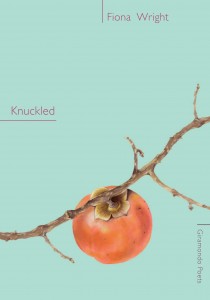
Knuckled by Fiona Wright

Giramondo Publishing, 2011

Knuckled is the debut collection from Fiona Wright, and can I just start by saying that ‘knuckled’ is a great title for a book of poems? It’s a word that’s easy to understand, one that immediately brings images to mind (hands, fists, gnarled trees, walking-sticks) but also one that you don’t hear that often. It’s also a fabulous word to say out loud over and over again. On first read, my thoughts were that this was simply another collection of lyric poetry: a bunch of measured short free-verse observations (some wry, some earnest) and descriptions of things (a frangipani, cutting open a persimmon, bushfires, bus rides in Sri Lanka), one observation per poem, one poem every one-to-two pages. An interesting collection: diverting but unremarkable.

Continue reading

Posted in BOOK REVIEWS | Tagged ,

Take

So take, for joy’s sake, this wild gift of mine.
This uninviting desiccated necklet
Made of dead bees that once turned honey into sunlight.
–Osip Mandelstam

Touches were newspapers
tucked and benched in Riverside.

Would I borrow from homeless men
their worn coats–bare threads

or gouge from darkened pigeons’ roosts
their salty hearts and by osmosis glide

or hold quartz second-hands?
It was obscure to me then.

Caresses were fries and battered oysters
dropped in Fulton Marketplace.

Would I pray for rags and bones
cemented in grave pools by river tides?

Brooklyn Bridge is damp and dry
but at the ends its cables are opaque.

So let me give you, for the sake of time,
these mites or lice or bedbugs

pinched from hairless hide. Take them–
white knuckles, bug scrawls,

death-defying lapses, synaptic leaps,
this dry mulch kiss–felt necklace strung with ink.

Posted in BLOG ARCHIVES | Tagged

Alala

The crows on my walk build nets
from roof top to tree top in threads
of communication, each juncture a rook–
Kaww Kaww–of the arrival and departure
of my comings and goings.

They know my hair top, my face, my walk,
that I am sympathetic,
that I wouldn’t ridicule or mock
my knowledge that crows lose altitude
and are forced to glide–mid-stride–to speak,

“Here! Here!–Why don’t you know?”
and the echo call from another rook
rocking on top of a pine, “I know! I know!
Watch the jay that nests below”–a corvus cousin–

once sibling in size, now Napoleon stature,
guarding her eggs by avian jousting
with beaks, tools with which to fend, fight, and feint,
the common crow–too big to scare.

Come! Come! to the corvus court–
a study in social proximics–
where Alala stands in the middle
of a concentric circle in judgment:
the pecked of the pecking order.

Balding and scared–for what crow crime?
six surround–jump in–jump back–Kaww Kaww–
did she take a mate meant for another?

A dozen, further back–Kaww Kaww–have opinions too.
In hunger, did she eat her own eggs?
The net stretches out to twenty and more.

Was it Alala’s time to die? To be consumed
is the proper order of things. If she cannot conform,
she cannot persist with the masses in a corvus nest.

I, like Alala, refuse to conform to a social order
that eats what it doesn’t understand.

Posted in PACIFIC NORTHWEST | Tagged

Mid-summer Forecast

Wind dashed from my palm a flock
of mica— scone-crumbly,
water-colored glass.
My handful of angles flashed up
like a foam of sandpipers
off the ocean’s tongue.

If I could believe like a child
or crone, I would have known
the bone broke my way,
the rabbit’s foot clutched,

my sun-rinsed palm
odds on clean futures
wave upon wave, as sandpipers
whirl, reel, and resettle in surf.

I saw the fawn with her mother
at dusk again last night, staring up
from the irrigation ditch.
Spotted, still, she crow-hops,
teasing the leggy grass,
the big-eyed cars who roar
like mating frogs,

then she freezes, one brown branch
of her mother. We stare-down
until mother and child bend
their necks and rip the grass
as if the world meant
to be this way. Every night,
the nighthawk sings the same
mocking rasps from his beak,
prophet’s death song
when he tucks his wings and falls
and rises, and falls.

Guzzling sandpipers dot-to-dot
the productive edge, just where
the footing incessantly pulls out
from under their toes,
broken cookies of coral grinding
finer. A head-scarfed housewife
fills her grocery cart, talons
pierce a fox kit’s neck,
a cleaning woman unlocks
the door to her workday. Andrea,
her fourteen-year-old daughter,
is at summer camp too,
like the other girls.

At Camp Static Cling,
Andrea and her mother start
with the partner dance, stripping beds.
When the vacuum shouts
at the TV, Andrea shucks
pillowcases. Her friends, upstate,
by the lake, slap mosquitoes—
OMG, they text, thyr trrble—
and raise their hands for
computer animation
and archery.

Andrea lifts a can labeled
air-freshener. If Outward Bound
left Andrea in this hotel laundry
all alone, three whole days
with just three matches, I know
she would wedge both doors open,
let the wind wrinkle through, and fold
into flight.

Posted in PACIFIC NORTHWEST | Tagged

The Dream about White Salmon

What’s in White Salmon? she asks from the dream.
I thought she meant a fish, not slivered in pink
but an albino aborigine, blank eyes communal
and naked. The dreamfish camouflaged, moored
in the stream’s float and swaddle. Water carves
boulders into that color. I see the salmon staking fame.

But faith in landscape is meant to deceive.
What you meant when you asked was about place.
There and here is where land meets the rain,
the super-hero swims slow in veins tied to mornings
and the birthing of crane-fly hatches ever so soft.
You might be remembering Rocky Lake when you dreamt.
All that rising, popcorn in the water bursting.
The fish we couldn’t kill, larger than our solitude.

Rain and land make somber peace under an arrested sky,
eventually casting light toward river’s untouchable shadows.
The salmon then gives back the boulders’ graves,
the decomposing house of leaves, upstream darting
among twisted leader and hooks, pulling, in water’s current
the pulse that wakes and rocks us.
We must awaken from the dream, I tell you,
because we must keep getting wet, our scales as skin,
having forgotten how to rise in the fogginess of white.

Posted in PACIFIC NORTHWEST | Tagged

Dad’s Home

On a summer evening I’m ten,
my dad is just home from work,
sitting in his truck, engine off
and radio on, listening to
the last crackles of “Southern Man,”
which spins my mother in frenzies
with its crazy guitar and Neil Young’s
pitching vocals, a harsh affront
to her robed Baptist choirs.

From the front yard where I’m
catching baseballs with my brother,
I strain to hear the song crying
from the driver’s wing window,
pivoted wide, and I know Dad’s
resting his elbow atop the door,
head leaned back, wearing a t-shirt
with torn-off sleeves and the red
beginnings of a tan. His dark hair
is shot with sawdust and the sweat
of eight hours spent framing hemlock
2-by-4′s in a bowl of sun.

The music drops our baseball
and breaks with the static snap
of the radio and slamming
truck door. We ditch our mitts
and race for the smells of dinner,
banging screen doors, “Dad’s home”,
an announcement that hangs
like a warning above the sink
where we wash our hands
before fidgeting in our seats,
ignoring Mom’s nervous smile,
while he takes his place, scowling
at meatloaf and baked potatoes,
again this week. Then we all choke
down silence, thick as sour cream.

Posted in PACIFIC NORTHWEST | Tagged

Le Rayon Vert

Look here, a mere inch stripe
of fire orange sunset holding its own
under a bumpy blue curtain
socked between the great-dome sky
and the puny line of city buildings
beyond the window sill.

I am content with that slender
golden Cleopatra snake of color
– we’re easy to please here in Seattle –
when my eyes are struck with a stabbing’s-worth
of candlepower as the sun slides herself
right into that skinny strip
now not so bright after all.

I’m telling you that disc’s shining a path
across the lake from there to me
worthy of any buxom harvest moon.
But here’s the kicker: At the end of her short show
she winks an unmistakable rayon vert
magical reward for willing one’s eyes
not to blink during her last second of visible life.

And then – I know you won’t believe this –
the green lingers, snuggles girlishly
against an upended skyline rectangle,
and tosses out a pinch of lime juice
to the lake’s ripple tips.

You are going to tell me green flashes
happen only over oceans and so I thought.
Never in all my years of watching the sun
disappear behind Jersey City did I see
anything even slightly verdigris,

And certainly not the sexy shade of green
she sometimes likes to flash
just at her final exit,
ensuring we won’t forget,
that we’ll watch every single night
hoping she’ll show it again.

Posted in PACIFIC NORTHWEST | Tagged