Tree

Have you ever seen a yellowing leaf clutching to a tree branch?
Listened so carefully you could hear it screaming?
The tree is rotting from its roots, but it still grows,
It still clings to its leaves.
It stands strong and refuses to go quietly.
How would you feel?
If all you knew was turning into mulch,
Feeding the scavengers in the muck?
You can feel them creeping and crawling, scratching, and scraping.
Eating out your insides one bite at a time.
They’re doing their best to break the body down,
But what they want, what they hunger for is the spirit within.
The forbidden food they have feasted on for generations.
The little leaves feel sick and one by one they succumb.
Some fly away when the wind picks up,
Some dry up in the scorching sun,
And some are consumed by those snapping their pincers and jaws below.
When a tree is sick most of its leaves fall too soon,
They transition before their time.
A connection is severed, and both are left cold from either side’s departure.
Rotten roots, twisting trunks, bending branches, lifeless leaves.
The wind is picking up,
The sun is boring down and the bush has gone quiet.
The tree stands strong but can’t hold on and she falls with a sickening thud.
Those waiting for their feast move in quickly and silent as death.
And death does come.
Every strip of bark,
Every ring of time,
And every leaf that couldn’t fight back is annihilated.
Annihilation, decimation, extermination. Genocide.
Where will you be when it’s too late?
To save a tree and all its leaves.
Posted in TMLYMI v5 | Tagged

No one can love the world except God

Do not love the world or anything in the world. If anyone loves the world, love for the Father is not in them. – 1 John 2:15

For God so loved the world that he gave his one and only Son, that whoever believes in him shall not perish but have eternal life. – John 3:16

my pastor says during mass / and I think I love the world, but I am no god / only a skinny boy with
enough rivers inside me to call home / to wage war / name country / continent / benevolent brute /

sometimes my beloved is a field of wide open overripe fruit and I am their only bee / sometimes my
beloved sings and my hands lift like lilted notes, twisting into a voice / just to join / chorus /
chorus / bridge / today I am watching the birds lift in a hymnal of snowed wing and feather and bone and I

remember that the last male white rhino is dead / and the bees are dying / and there are no more fields to
wade through like rivers / but I am a river / I am the bank’s dirt and my beloved buries bruised flowers

inside me / I am sitting / my face against the glass / watching a thousand birds / fall through a thousand
mornings / chorus / chorus / bridge / my beloved defrosts meat in the kitchen / the ruby / the slick red
wettening in the pink light and I praise this ritual of becoming / faithful rune of cartilage and cardinal/ I

think my love / like all love / is a kind of bird / wreckage of sparrow singing through unbridled throat /
yes / what other glory than this? I sing praise / hosanna / because when they told me

grief has a mouth / my first thought was to kiss it / forgive me / when they told me grief was an animal /
my first thought was to take it home / no, not hunt it in an open field / but home: dry its wet fur / feed it
defrosted lamb from the fridge / I’m sorry / I meant joy / I know you wanted a poem about joy / but

here’s the truth: when I couldn’t write a complete sentence in only English / my first grade teacher made
me stand outside the room and forgot I was there until lunch / because I had no language / I had no

language to cleave the world for space for my body / because once / in writing class, mistaking the
synonym of plot to mean the same thing I write: I lie in a story of land; a cunning of grass and rhye–– Yes. Yes. I
know the trauma of metaphor; the trauma of being a metaphor / I know metaphor’s trauma well the way

I know the sun will die and how my teacher will forget me / (I could not hold her language) / But some
days, my grandma and I will sit on her porch / our faces mauled by columns of sunlight / eat

bright fruit pulled from the ground / durian / mangosteen /rambutan like tiny bone-white suns / the
mangoes crowning our mouths / rising, like dawn inside our throats / a thousand dawns / a thousand
mornings / a thousand birds / falling / falling / falling / like notes / like overripe fruit / like overripe

song / I am twisting blue lilies into her hair / crush hibiscus around her eyes / and for once / we love the
world / and we are not god /and no one’s children / no one’s stupid forgettable children / and we are

not god / and we are not god /
but almost /
almost /

Posted in TMLYMI v5 | Tagged

Gilly G

the night is young
because your hand is on my knee


resting surely as seventeen conversations


warble around us.

whose birthday is it anyway?


i’m busy falling in love
with this couple sitting across the table
waxing on about
Gilgamesh, clutching axe and nightshade


flailing

frayed


at the rim of the forest
meeting Enkidu.


and he’s good, Enkidu, but he dies
and Gilly G wanders the wasteland
baying for his ghost.

as i watch you listening
in your eyes we are them
but in mine Enkidu’s absence is only his.


when I look at you
I find it hard to remember

if

for me


we were ever

them.


that we were in a place
where love rang out
and you could not get away from it

the back then unseaming the now, our bodies
leaching light in unravelled rows

the stars falling in dizzy waves
up and up
over
the lip of this world.

could it be i’m still waiting
for the banquet doors to open

could it be the burnished first look
at someone hot entering the room


that undoes it all.
and how the feeling now
escapes through the throat,
instead gathers all around me like weather.


in dreams I am a multitude of ghosts
whirring in concentric circles, passing
right through your chest like gamma rays

in attempts to kiss your ashen mouth.


it’s no use. jagged knife-lust
is replaced by a soft cavernous want
not a train slicing itself into the city
but a diaphanous ringtone filling the room.


i know now,
while your body is turning into tomorrow
i will remain a speck of dust.
i will remain containing
your offerings and songs


and in the quiet of the blue night
I leave the room, a tomb,
pass by your solemn body
resting there, unmoving limbs repeating
yesterday’s words as iridescence

knowing I will miss
the way you hold the light
on your skin so effortlessly.


hence I’m tramping down Parramatta Road
to seven eleven for a donut, for something sweet,
and I see lit by block light Gilgamesh, vape-smoke streaming
out of his mouth, dead and pink and alive.
he says without words (only the smell of blueberries)

“When you walk back up the street
the home you have just left will be cold,
thick with dust, the bed empty, the room barren.
You know this already, so?
Want a puff?”


I’m kissing him to pieces now
in the curve of a neon glow,
traffic light leaking onto the side of the road

my body lurching, ecstatic,
in the blinding brightness
of a sugar rush.

Posted in TMLYMI v5 | Tagged

Five sketches in ink

Nature is impermanent, and so our bodies are inherently impermanent things. Despite our internal homeostatic mechanisms that serve to maintain a physiological balance (that can easily be disrupted), our bodies are in a constant state of flux. So are our thoughts, feelings and desires – all those metaphysical things that make us who we are. We are a new person each day on some level though we may not notice the changes, and yet sometimes we choose to impose the illusion of permanence on our bodies by various means.

I am interested in tattoos, how they allow us to embed a semi-permanent snapshot of our ever-changing selves in a physical, prominent, and intimate form. The following individuals have generously shared with me the stories behind their tattoos and reflected on their past and present selves. In response, I have worked with them to create short poems to represent where they are at this point in their lives. After they have chosen the location of their poem, I have provided them with a custom temporary tattoo of it.

Here is a gallery of snapshots of these individuals through the lens of their bodies and time.

Posted in TMLYMI v5 | Tagged

sealed tight for safety

i call my suburb the god district
because there’s a church on every corner
because the sunsets here are beautiful
because of all the retirement homes

here’s where i saw god this week:
on night-time concrete, while jumping, singing
the wattlebird watching me write this
my favourite cup shattering on the bathroom sink

i make dinner to Survivor
i get into bed with a nineteen year-old
scandinavian and his axe
he is building a log cabin from scratch
he is chipping at timber
he is knocking me asleep

i felt god in my almond magnum
that 7eleven is atop a hill
i can see the whole world
my parents tell me hello

slurp
there’s that final suck
before my window sip
is fully wound gulp
and the citylink gasp
is a world away

there’s the fact that
the muffle starts
before the ute hits your bonnet
and then there’s ringing

i’d like to make a shrine
in my living room
but i can’t find an altar on gumtree
and my hands have been so shaky lately
and chicken wire makes me bleed

shards of shattered blue
like sledgehammer to screen
like riverbank in sweden
in winter and
a strong man’s foot

when the log cabin is finished
and the doors is closed
it will be airtight
it will be silent

my grandmother is with white cotton now
and with the earth
her body will nourish the dirt and that graveyard
will become a mountain
it will be so high
and the sunsets will be beautiful

the muffle hits before the crash
and then there’s the bits on asphalt
the last time
i saw plastic shatter like that
it was a toy
i was twelve
i was in beirut
it was under a tyre

god saves my life every time i walk the creek and don’t fall in
i would not drown
i would be so stunned by the water
its yuckiness
that i would stay there forever

i found a frame
on facebook marketplace
it’s silver
like my birthname
but lost its luster
like my birthname
the frame
is for my grandmother
for the portrait of her that i love

and i saw a photo of a heron
eating a rat
in central park
the water is brown
the rat’s body is perfect

mannequin
with arms and legs
click-locked in place
petrified like that and snapped
to stay that way
forever

Posted in TMLYMI v5 | Tagged

for desire

in response to Kim Addonizio’s ‘For Desire’

give me his dark curls, his whites & browns & coppers
give me the sweetest porridge & the bitter olives
that take the longest to cure
give me the lover who feeds me cumquat
takes the bitten fruit i would not swallow fully
darts his tongue out to suck its pulp whole.
woo me in the middle of a grand room
with a wood-burning fire only someone
with callous hands could tame.
i do not want ambivalent greetings
but the one who opens his arms at the driveway
carves out a way for me to his childhood stories
leans his forehead down to my squatted thighs
& listens to my broken red-flushed poetry.
i do not want to be ravaged anymore
chased after on the dark streets
wolfed down by a blue-suited devil
who would not learn my name.
give me the warmth of someone who savours
who would not kiss me until i ask them to
who would untie my ruminations
with the same hands that worship
banksias & bushy yates at this land’s feet.
i want the lover who would kiss my knees
& ask me which heavens i come from,
who is light-filled, standing in a room unyielding
despite my storm, my soft fire, a gush of
waterfalls down a rapid stream.
i want his strong arms & the narrow girth of his body
pressing against me on a bed where
he asks first where i want to be touched.
i want to say: everywhere. i want to
sit on his lap & have an endless conversation
i want to live for love until i am brimming to the rim
all i could do is pour. i want to wait after a long day
for his truck to arrive & stand before him
wearing just my giant pink shirt
look him in the eyes then kneel at his feet
& tell him just how fucking good he looks.

Posted in TMLYMI v5 | Tagged

Dictation Poem One: Profanity Filter

D-I-
“Asterix”
-K-T-a-T-I-O-N space numeric one.
“Enter”
that didn’t work.
D-I-I-see-K
enter
D-I-see-say-K
see-oh-see-K
“I am human am I human?”
Enter:
space
space
space
space
space
ha ha; clears throat…

“I may have a steady number
but at least
my floors

are always changing”

Just like my-
“****”
-TIS TISTS-
“****”
space-
“***********” -and poop- “***”
, Asterix censorship language
bad
language
badbad
language
–“I-can’t-write-this-poem-right-now-because-the-dictator-won’t-dictate-the
-swear-words-in-my-writingthenaughtywords


“: “The Bad Language”.”

Posted in TMLYMI v5 | Tagged

Mother

The day my mother chose me, a flame was ignited.

Her fertility, abundance and generosity fed this light of mine.
Until the shimmering radiance of a mid morning’s sun paled in comparison,
To my warmth,
My kindness,
My compassion.

Fuck, I was a blazing fucking inferno.
I was strength.
I was power.
I was peace.
I was fucking fire.

Until the day my mother came calling.
It was my turn to deliver unto her, what she had to me.
I was to keep that cold hearth aflame.
Ensure bitterness and loneliness did not leave a forever stain upon the greatness of her.

The chill of the morticians scythe must be kept at bay.
For she could no longer sustain.
She could no longer give.
She could no longer share.

She was tired, her body withered and frail.
Her endless bounty of life, and life-giving shrivelled.
Not unlike the corpse of a roadside animal,
Skin and bones rotten with disdain.

Her time had come and all that remained was a emptiness where my flame once lived.
She had gone, but I was stuck.
Lingering within coals lukewarm from memories,
dithering amidst the smoke.
Moments of Joy.
And passion.
And serenity.
Littered amidst the embers of a dying flame.

How could I exist without you, my mother?
How could You leave me stranded amongst your ruinous remains?
How could I exist without you, my mother?
How could You leave me alone?

Posted in TMLYMI v5 | Tagged

Spiders

Can spiders fall in love?
Does one look at the other
with an embarrassed secret glance?
Do they write poems in silk
and, with infatuated mind, run their lover’s name
across trees, across corners
so that love is hidden in every shadow?

Do they go ice-skating for their first date?
Is one more experienced than the other,
offering one leg for their date to hold onto
while their other legs trail and clatter around them in hired skates?

Do their pincers knock awkwardly in their first kiss?
Do they get lost in the aisles of forests looking for gifts?
Do they wonder what and when they should label each other?
Do they hide from their parents when they fall for someone?

And do they sometimes dream it’s just them spinning silk
in a dark world where not even the moon can voyeur
Or is it okay with spiders if everyone can see them be in love?

Posted in TMLYMI v5 | Tagged

Signed, Ready for Duty in Reservoir

a tumbleweed rolls past us / under boom gate
/ over train tracks
i think — it belongs in brunswick
more than we do, today

i could reach across the gearstick,
tell you that tumbleweed…. is a diaspore
and a diaspore is anything that carries seeds to someplace else
but i’m trying to sound less like a diaspora poet
and your facts are better than mine

like when you say that vegan fish fingers don’t aim for fish flavours
just for…. fish-adjacent ones
lemon and seaweed, tartare sauce if you please
you call it ‘taste of the sea’ and my greasy tastebuds are fooled

i’ve been camping out in the paris end of insomnia
for a while now
i think the locals hate me …
… or maybe that’s the insomnia talking …

i got the welcome-to-the-neighbourhood pack:
melatonin, weighted blanket,
pass-agg post-it about screen time before bed
like insomnia is a nordic government
and i’m a big baby

and every night i’m doing battle,
fighting for my life under that blanket,
sleep paralysis demon perched on the nightstand
whispering…. “sheep aren’t real”

this feels like an activation phrase
taste of the…. government cover-up
but if i’m a sleeper agent
i’m a bit crap at it

doctor, doctor, i’ve dislocated my spirit
it popped right out of the socket
and the human flesh search engine
isn’t taking my calls anymore

Posted in TMLYMI v5 | Tagged

for sylvie & the moonee ponds creek

something milked & my tummy rumbles
I haven’t seen the sea in so long. I read
somewhere that sand is carried by river
a product of endless watery movement
but let me not be a thing that carries
or is carried but a hand grasping air
stooping to dig at the surface that
gurgles & leaks & never says anything.
that day I was learning the river for the
last time & I noticed ‘Fritz’ spray painted
on concrete, the sound of frying seeds
like a whiplash of wind named before it
hurts & everyone walked possessed.
somewhere, upstream, I hear that pepper
trees shed salmon leaves & the marsh
is a sinkhole, a blinking cyclops of thin light
but here, I nest inside the distance of a
thing carried & how faintly the water coos.

Posted in TMLYMI v5 | Tagged

Impressions

Summer weaves its limbs through the gaps of the dead magnolia. Contact is made with a tendril, lacing up to scale a wall. Outlines of a sky cracked open by branches, pressing static into colourless forms. The shared nature of vision teaches us less about experience and more about power.

Sinking down glossy liquids to an abundance of long gazes. A mirage, or a prediction of what comes after the event. Listen to the hours hovering over these architectures. The backdrop of suburbia is oppressive when heat rises.

Keep forgetting the word to describe the feeling that occurs when meaning is effaced in the process of articulation. As in, speech is tilting again. Something about cruelty, falling into arcs of delicate pauses. Notice again: that the air is sticky with the residues of the past.

I find myself dwelling in the shapes of history, memorising the edges that we have come to understand as movement. The light is porous with humidity, driving down highways unspooling themselves, no longer stitched together by signs.

In the spaces between substance and suggestion, I ask you: What kind of image remains, without sight?

There is a structure to giving that is indistinct from labour. There is a structure to light that is indistinct from collision. When sleep slants through the walls, I tentatively care for the imprints that do not stay.

There is a clarity located in objects, and it is in this that I find comfort.

Mimic the limits of a soluble blue. Observe how a body folds when it comes into contact with another’s. Circle the enclosures of a referent, speak around these chasms.

To reach for language as a relation, where words do not always name, but function or obliterate.

I lined this city with implications, so that I could ask you: what forms of erasure allow for luminosity, instead of dissolution?

Posted in TMLYMI v5 | Tagged

Submission to Cordite 104: KIN

Image by Jacqueline Jane

In becoming kin, we journey unbound across homelands, histories and generations. This issue will explore how kinship, our understandings of who we are and where we come from, engages with dynamic senses of Country and belonging to Country.

How does Country hold knowledge, stories and memories of how we are interconnected?

How do we become kindred to Countries and cultures?

How do diverse and complex understandings of kinship intersect?

We are seeking writing which reflects on our instinctive longing for home, family, kin and a sense of belonging in an ever-changing world.


Submission to Cordite 103: KIN closes 11.59pm Melbourne time Sunday, 14 November 2021.


Please note:

  1. The guest editor(s) has sovereign selection choice for all poems submitted.
  2. Masthead editors will also contribute to the issue.
  3. We will only read submissions sent during our official submission periods.
  4. Please place up to three (3) poems in one (1) Word, RTF or PDF document (unless specifically noted otherwise for special issues), with no identifying details in the document itself.
  5. We are not able to offer feedback on individual poems.
  6. Submissions will only be accepted via Submittable …

submit


Posted in GUNCOTTON | Tagged

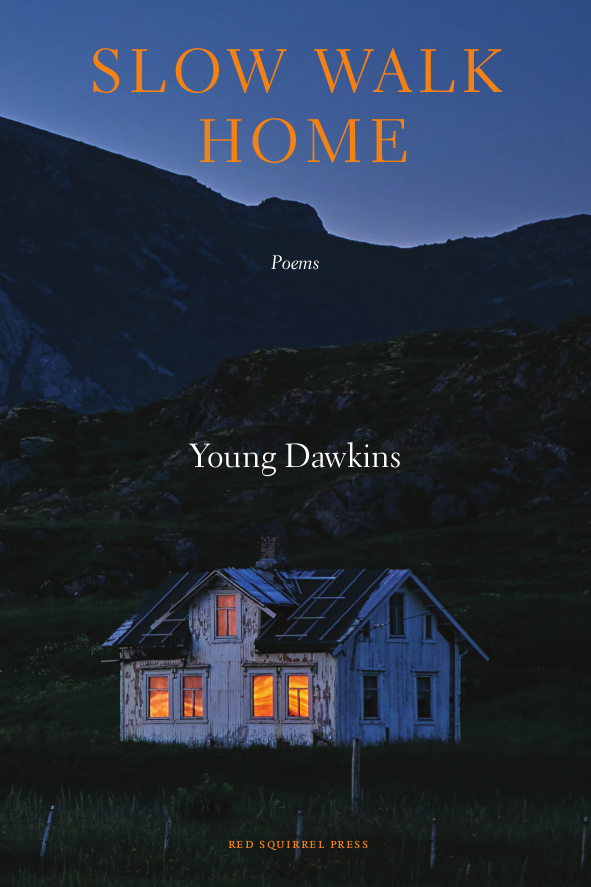
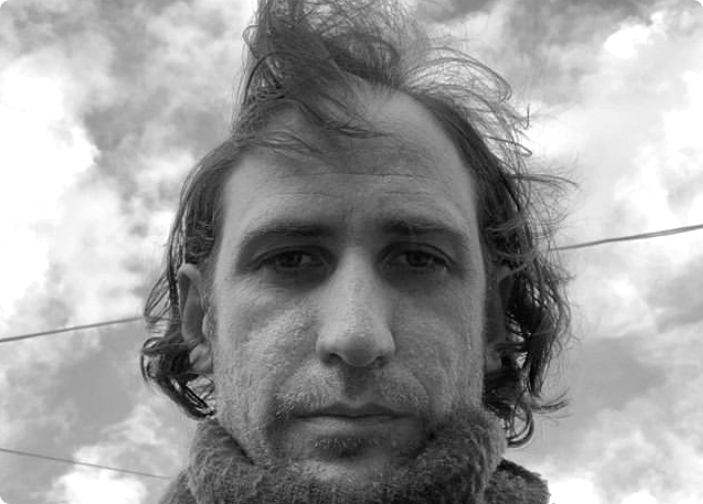
Zowie Douglas-Kinghorn Reviews Slow Walk Home by Young Dawkins

Slow Walk Home by Young Dawkins
Red Squirrel Press, 2021


There is a humour to Slow Walk Home that interrupts solemn atmospheres with a wry warmth, comedy and tragedy unfurling like contrasting petals of the same bloom. The second collection of verse by Young Dawkins, an American-born poet who has lived in Scotland and now resides in Tasmania, Slow Walk Home also pays homage to Beat poets of his generation, evident in poems such as ‘The Real Lion—Ginsberg’ and ‘Kerouac, Raton Canyon’. But these homages aren’t mere nostalgia – Dawkins offers a glimpse of the era through a fractured looking glass, not entirely rose-tinted, but perhaps with a smudge of its glow. In ‘Fishing with the Dead’ and ‘Breakdown,’ Dawkins tempers his reflections on the past with a mature gaze – both poems inhabit a quiet sense of finitude, but not melancholy, as the speaker witnesses a collapse in communication. There is a sense of arrival approaching acceptance as the latter poem’s final line reads: ‘The railroads are dying.’ This poem powerfully conveys the bewildering sense of love’s failure in one becoming unknown to the other, an experience illustrated by weeds devouring machinery: ‘Swallows are nesting / in the faded / yellow coach car / that was our love.’ In the yellow coach car, Dawkins shows the wild ache of abandon, the lost capacity for warmth that emanates from a hollowed vessel of memory. As Dawkins writes in ‘Portsmouth’, ‘Memory is the diamond stone / on which we hone our edges.’ These are not so much trips down memory lane as an observation of memory’s physicality – the ways in which life is contoured by loss and mortality, evoked in decomposing symbols of the old American dream: hollowed-out cars, railroads that come to an end through their disuse.

In his encounters with dead ends and cul-de-sacs, Dawkins acknowledges that, to parrot a simple adage, that all things, good or bad, must pass. In doing so, he draws connections between homage and transience. Among the references to other poets of his generation is a sense of memory as a fluid instrument, filtering through channels of music and image to find a place of rest. The act of remembering and paying respects to loved ones passed is expressed in the simple practice of walking. When the speaker goes to visit the grave of a loved one, or crosses the road, these sites are rendered at once surreal and mundane by glimmers of reverence and humour.

Maybe it’s the old Billy Connolly rule that you can make anything funny with a Scottish accent, but reading ‘Green Man’ made me laugh out loud at the poem’s deadpan line: ‘you cannae / simply stand there like some fucking tourist.’ Dawkins wields humour in different ways throughout – it intercepts tragedy in the poem ‘Dialogue’, where the speaker visits their father’s grave in a cemetery, all the while recognising the names on other headstones of people they knew growing up. The grieving speaker sits down in the cemetery:

I said, Dad, I love you. I miss you.
He was silent.
I took one of my business cards
and placed it above his name, 
in case he changes his mind. 

These poems are deceptively simple in narrative, but they hold a balance between seemingly conflicting forces. In bringing together these glimpses of humour alongside stretches of sorrow, Slow Walk Home reads like a tapestry of love and loss. The warm joys of the mundane are interspersed between dizzying highs and punishing lows. For example, Dawkins’ poetry trammels the small pleasures of everyday routines with subtly evocative language, in the poem ‘The Perfect Chicken Sandwich’ (‘toasted fast beneath an angry grill’) and the poem about his son, ‘Tom, One Year’. This poem is as guileless as its title, but playful in its depiction of parenthood:

we throw stale bread at indifferent ducks, 
then bundle back home for a later lunch of pasta, 
self-served by fat little fingers. 

The rhythm of these poems works alongside images of food and contented repetition, creating a sense of comfort, or the radiance of quiet happiness.

Not ready for sleep and too early to eat— 
we walk around the flat, you crooked in my arm, 
and together we put names to the mysteries; 
Door. Clock. Rug. Light.

But there are sections where the poetry feels perhaps too satisfied, too convinced of its own enclosing logic, such as in the closing poem ‘Home’:

they sent a beautiful woman 
from the edge of the earth, 
first to hold me, 
to love me, 
to remind me 
of being a man. 

The poem doesn’t make it clear if the implication that women are put on earth to remind men of their masculinity is intended as wryness or irony that emerges in the rest of the collection, or whether it is an unintentionally earnest cliché. Either way, to end with something so conclusive (or so loaded with irony) feels like a missed mark for in a collection that is otherwise adept at unravelling more complex expressions of relationships. Either way, the entire poem feels as if it is trying to bundle an expansive allegory into a few universalising words that could be deliberately ambiguous, but which lack the specificity and depth of the preceding poems.

Posted in BOOK REVIEWS | Tagged ,

3 Maya Abu Al-Hayyat Translations

Penniless

Penniless I live at a checkpoint,
trifles make me happy,
like when a whole day passes without me
seeing a single soldier,
his bored yawning.
There I write my new novel
about the butcher
who wanted to be a violinist,
mean and vulgar,
his hands failed him, favoured
the sharp glistening blades.
You can imagine how gloomy it can be
to be destitute, penniless,
to live at a checkpoint,
to know happiness
in trifles, skipping a loquacious poet’s turn
in line, or passing wiped out
day labourers with banana sacks
on their backs, guava bags,
and containers of Tnuva milk.
I’m destitute. For years
I’ve been living in a tomb
but have seen neither angel nor devil,
just more than my share of sleepy soldiers.


From You Can Be the Last Leaf by Maya Abu-Alhayyat, translated from the Arabic by Fady Joudah (Minneapolis: Milkweed Editions, 2022). Translation copyright © 2022 Fady Joudah. Reprinted with permission from Milkweed Editions.

Posted in TRANSLATIONS | Tagged ,

Translation of Wadih Sa’adeh’s ‘Dead Moments’

A central figure in development of the Arabic prose poem, Wadih Sa’adeh’s work treats and springs from interrogations of exile and displacement, the constant tension between the present and memory, and the place of the poet between them. In his own words, he is, ‘a poet of summoning presence.’ Sa’adeh has published twelve collections of poetry to date. His first, The evening has no siblings, was first distributed by hand in Beirut in 1973. The poem translated below is from his 1992 collection Because of a cloud, most probably. The unrelenting, quiet discontent of its recapitulation of small details stirs up memory and doubt, breaking the surface stillness; the process of writing pushing forward against the inertia of despair over its utility. It is possible to see this poem as embodying a process in his writing that he has described as follows

I had intended my poetry to be a kind of salvation for me in my confrontation with the onslaught of a perpetually antagonistic world. When this confrontation failed, I tried convincing myself that surrendering to the world – being a scrap of paper floating downriver – was the only salvation available to me. But this proved impossible, too.

Read the poem in its original language.


Dead Moments

1

Suddenly the sunbeam disappears. I believe a cloud is passing over the house. Sunbeams disappear for only two reasons: clouds hide them or it’s night. It is morning now: most probably a cloud is passing.

Maybe soon it will rain and I will be able to watch the rain from the window. Life is beautiful, so beautiful that you are able to watch it rain, circumstances permitting. Mine is a water sign and I assume that every now and then some planet up in space melts and flows down here, in front of me. Happy notion. I carry it over to the window. I open the window and I look at the cars, the hot asphalt, the weary labourers. Why do these labourers get tired? I used to get tired myself sometimes and I would sweat, but then I regretted it, and I rested. For years. Sweat of the brow? It is hateful; shameful, in fact. Repulsive: rising from sleep to make yourself sweat. A car going by leaves a light cloud of dust. A cat asleep at the corner opens then shuts its eyes. I close the window and slowly make my way back.

Today, too, I shall rest. I can experience all things in all their glory from the couch or pacing the tiled floor and staring at the walls. Four or five hours of life a day will do. Then I might go out, wander through the city, run into friends, buy a bottle of arak, return.

Anything might happen without warning. A stranger’s visit, the death of a friend, a man walking in the street and his skin, suddenly, crawling. Just like that: purely arbitrary. Then nothing changes. I might go out onto the balcony, glance at the flowers in their box, then back inside. I might smile, perhaps; perhaps not a muscle will move in my face. My face is round and motionless, like something that has taken its final form; my nose a touch sharp, like a bird’s hooked beak. My eyes are black. When I open my mouth out comes panting breath and perhaps a few words, too. Few and faint, so that sometimes I can’t hear them myself. In truth I never have anything to say.
Yet frequently I find myself forced to speak. Why this expectation of words whenever they sit with me, I do not know. And then I become ill. I picture life as a silent friend; whenever it speaks someone comes down with cancer. I had a friend who died like this.

Is this the cause of life’s sickness? Because of voices? It falls sick and dies because men speak?

Between the bedroom and the sitting room my hand lifts to smooth my hair. No distance at all, but I picture speeding trucks and strange sounds crossing it. Reach a chair at any cost. I pass my hand over my hair; the hand that holds nothing can easily lift to it. My hair is long and like anyone who sleeps it banks and tangles in the night. But always I pass my hand over it, so that it remains my friend. The world is more beautiful that way, when hair is a friend. With a friendly body the world keeps close to your heart. When your limbs love you the number of your enemies declines. Even your nails, dust-gatherers, are gathering something dear.

I advance two paces and reach the window. Still the labourers, the asphalt, and the cars; the cat asleep at the corner. Sounds reach me through the pane and I feel them to be beautiful. Even people look delicate at a distance.

What shall I do today? I have no intention of doing anything and I do not have to do anything. I could probably make friends, from behind the glass, with these people in the street. The day is still young and a few minutes of friendship would be enough. Then I must go out onto the balcony and water the flowers. I must, maybe, take a short walk through the city and bring back a bottle of arak.

The window is shut and I am a short man, 165 centimetres tall, making friends with the long street. From time to time he passes his hand over his hair, slowly taking whatever falls out and throwing it in the bin. A quiet man who, even between the bedroom and the kitchen, frequently pauses in reverie or to rest. Who rolls his cigarette slowly, picking the excess tobacco from each end; a quick glance at the lighter, then he ducks his head and lights. The building before me has reached the seventh floor. An Indian labourer overhead is like an angel. The people, too, resemble angels from a distance, the migrants in particular. I do not know why I can’t picture immigrants without seeing angels. The labourers in particular. Those who pick up their baggage and walk. Who, halting sometimes just paces from the door, roll a cigarette and turn back homewards.

I pass my finger across the vapour on the windowpane from my mouth and I take a pace back. I look at the couch to my right. As it was. The friends who visited me would sit there. Today I am alone and I might be its only audience. There is an old friendship between us: from the moment I saw it in the corner of the showroom and told the salesman, I can’t afford more, and he carefully picked it up and brought it to me. Still here, in place. Perhaps a little out of place from when friends slumped down and shifted it, but more or less in the same place still, this friend of mine, with these labourers, with this vague line my hand has traced through the vapour on the windowpane. I approach and draw another line. Another line, another friend. I look at it and I slump into the chair.

From Because of a cloud, most probably, 1992

Posted in TRANSLATIONS | Tagged ,

‘Playful and iterative’ Ian MacLarty Interviews Gemma Mahadeo

In 2018 the poet and disability activist Gemma Mahadeo wrote a poem inspired by one of my videogames called Catacombs of Solaris, published in The Victorian Writer. After meeting in person at Bar SK, in Collingwood, a focal point of the art videogame scene in Melbourne, I approached Gemma with an idea for a game inspired by their poem. Our collaboration process spanned around a year until in 2019 we released the game If We Were Allowed to Visit – a game embracing the intersections between poetry and video games – or a platform exploring the relationship between poetry and gaming. Our collaborative process involved Gemma writing poems in which I would respond with code to render such poems in a virtual 3D environment. In this interview, Gemma and I discuss the origins of the game, process of making it and its reception.


Opening scene of the game, showing a rural dwelling.


A view from inside the dwelling.


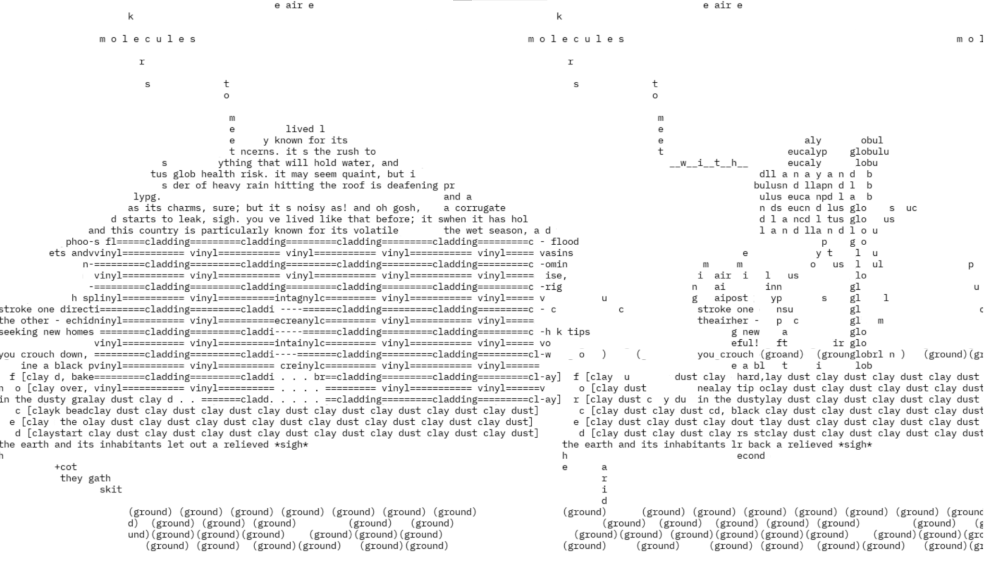
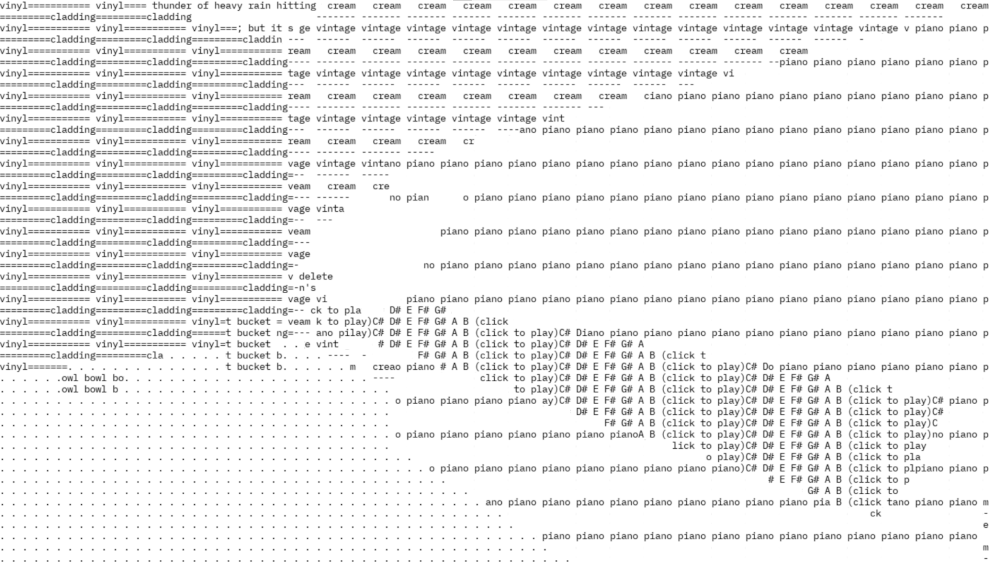
Gemma’s ‘tumbleweed poem’, as rendered in the game, with other poems in the background.

Ian MacLarty: Bar SK was one of the first places I showed my game Catacombs of Solaris, about which you responded to with a poem. It was also where we first discussed collaborating. For me Bar SK was this vibrant focal point of the art videogame scene in Narrm/Melbourne. Bar SK provided a physical space for games that weren’t trying to be commercial products. The space would regularly exhibit new, experimental work and host panels and talks where the creators could talk about their practice with their peers. It wasn’t only games people that participated. There was a lot of intersection with the poetry scene, such as Bonfire Park, a zine featuring nine writers responding to different Australian video games. Bar SK also hosted a reading of the Bonfire Park works. Sadly, Bar SK is no more, but I think it left a lasting legacy on the Melbourne scene. I don’t think we would’ve met and made our game together if it wasn’t for Bar SK. I wonder if you could talk about your relationship with Bar SK and what it meant to you?

Gemma Mahadeo: Bar SK may be gone, but it definitely is not forgotten. The suite of poems which are mentioned above – they literally would not exist without Bar SK and without me asking Dayvid, a main staff member, for his recommendations on what games to play after explaining I wanted to write poems about some of the games. He was the one who immediately told me, ‘you have to play Catacombs of Solaris’. If not for that, you and I – an – wouldn’t have met. It’s also worth noting that at the time I was writing for an indie beer mag, Froth, and hung out as much as I could at Bar SK as both Louis Roots and Dayv were very generous with letting creatives co-work, and they always let folks sample beers before trying. It was just a creatively generous environment, not restricted to beer nerds, or indie game nerds.

Posted in INTERVIEWS | Tagged ,

‘A foot between two whenua’: Morgan Godfery Interviews Hana Pera Aoake

I knew Hana Pera Aoake as a writer before I knew them as my partner. I remember one publication describing a piece of Hana’s that they were publishing as ‘a trigger-laden, genre-bending persona shrie’, which is perfect. The title of that piece was ‘MAYBE I JUST WANT SOMEONE TO HAVE SEX WITH WHO WILL LIGHTLY CHOKE ME WHILE I’M ON TOP’. That title might seem glib, and it deliberately is, but the piece itself is funny, and intellectual, and in good part deeply serious. What distinguishes Hana’s early work is a search for community – its destruction and reconstruction. Growing up with one foot in Australia and another in New Zealand, Hana was caught between two different communities. In Australia, a migrant and a settler, and in New Zealand: Indigenous. That’s a difficult displacement, but one that Hana works through delicately and insightfully in her pieces, whether they’re a Dodie Bellamy-type stormer or an Edward Said-like discourse. Last year, Hana and their publisher at Compound Press brought together some of their best work from the last half decade. A Bathful of Kawakawa and Hot Water (2020, Compound Press) sold out its first, second, and third print runs and pieces from the book have appeared in New Zealand media outlets like the Spinoff and prestigious international outlets like Granta, a testament to Hana’s reach as a writer of different content and forms. In this interview, we sat down together as interviewer and interviewee.

Morgan Godfery: Kia ora Hana. Ngā mihi mahana ki a koe. Thank you for agreeing to talk about yourself and your work. It’s a privilege to talk to you in this setting, even if it’s a little strange to do it as your partner.

Hana Pera Aoake: Kia ora Morgan. You are the person who knows me best, so while it’s strange it feels like we can be very open with one another.

MG: The first question I have is: no hea koe?

HPA: Ko Taupiri te maunga. Ko Waikato te awa. Ko te rohe o Kingiitanga te Whenua. Ko Waahi te marae. Ko Ngaati Mahuta te iwi. Ko Weraiti te maunga. Ko wairere me Waiteariki ngaa wai tapu. Ko Mangopiko te awa. Ko Te Oohaaki te marae. Ko Ngaati Hinerangi me Ngaati Raukawa oku iwi. Ko Tainui te waka.

Ko Tuhua te maunga. Ko Poerua te awa. Ko Poutini te Moana. Ko Arahura te marae. Ko Ngaati Waewae me Ngaati Wairangi oku hapuu. Ko Kaai Tahu me Waitaha me Kaati Mamoe oku iwi. Ko Uruao te waka.

I am from the people of Ngaati Mahuta near Huntly in the Waikato of the north island, as well as the people of Ngaati Hinerangi and Ngaati Raukawa in Okauia also in the Waikato. From my mother’s side I am also from Ngaati Waewae and Ngaati Wairangi on the west coast of the South Island. I’m also Jewish, English, Scottish and Romani from both of my parents.

MG: You spent a part of your childhood moving from place to place, school to school, in Queensland, Australia. Do you ever think about how that experience – as manuhiri on Aboriginal land – shapes you and the way that you relate to land and water?

HPA: I vividly recall as a small child visiting New Zealand and driving past the Waikato River and my parents telling me: ‘that’s your river’ to my sister and I. As a child growing up in Australia, I always had an understanding that I had a land and water that I belonged to that was where I had come from, but I also felt a sense or understanding of the responsibility of being a guest on someone else’s land. Australia wasn’t my land.

I lived in small towns in Australia across Queensland mostly in gold mining areas. I remember always feeling angry at the relationship between settlers and Aboriginal communities and knew that so-called Australia was their land. Living in Australia taught me a lot of things about what racism and otherness is and it was a brutal lesson. Its telling to me that someone as bigoted as Bob Katter is still in parliament from when I was a child. I still remember the way he spoke about Aboriginal people and migrants in the 1990s. That kind of rhetoric felt suffocating there at times and I have spent a lot of time unlearning. I think growing up in Australia radicalised me, because I witnessed the injustice of colonisation and racism and I couldn’t ignore it. I saw the lack of respect given to Aboriginal neighbours, friends and classmates and often knew what that was, but had trouble finding the language to articulate what was wrong. I think about this a lot and feel ashamed at not saying things when I could have and feel humbled by the times I did. I was a kid though so I feel like the adults around me could’ve done better.

I often think about the way I was treated and of being seen as ‘okay’ because I was a ‘mowrey’ and how wrong that felt. I remember the way people looked at my visibly brown father and the way he was treated. I felt like people were afraid of him or waiting for him to do something wrong. It was an awful feeling that sits in the pit of your stomach and makes you feel sick and very protective of that loved one.

Posted in INTERVIEWS | Tagged , ,

Family Mathematics: Continued Fractions

Says Marty Ross …

Fractions are the easy numbers. Well, comparatively. True, they’re not as easy as whole numbers, 7 and 12 and the like, but there’s nothing too scary about 1/2 or 5/6. Even a fraction within a fraction, such as 1 + 1/(2 + 1/2) for instance, is more bark than bite; a little once-familiar arithmetic can show that this nested mess equals 1 + 2/5 or, if you prefer, 7/5.

But what if we keep going? What if we keep nesting, making a fraction within a fraction within a fraction, and so on, forever:

Or, to make it as simple as possible, let’s just use 1s:

Who would do such a thing? And, why?

Well, the ‘who’ is easy to answer: this is exactly the kind of absurd stunt that mathematicians love to pull, and which so endears them to everyone else. It also suggests an explanation for the ‘why’: to a large extent mathematicians do these absurd things just because they can. Mathematicians find simple joy in stretching ideas as far as they’ll go, all the way to infinity if possible. But it turns out that there is also a surprisingly practical reason to create continued fractions, which is what monsters such as the above are called.

Apart from the easy, fraction numbers there are extremely difficult numbers, the irrational numbers – literally not-ratios, not-fractions. Famous examples of irrational numbers are square roots such as √2, the super-famous π, and the much misunderstood golden ratio, denoted by the Greek letter φ (pronounced as either ‘fie’ or ‘fee’). Such irrational numbers are unavoidable. Square roots arise naturally in right-angled triangles courtesy of Pythagoras’s theorem, φ appears in a similarly polygonal manner, and of course π is a fundamental circle thing.

Now, triangles and circles and the like don’t appear to be all that difficult, suggesting that irrational numbers might be similarly benign. The problem, however, is that although irrational numbers may be accompanied by an easy geometric picture, as numbers they are a mysterious mess. As a typical example, √2 is written in familiar decimals as 1.4142···, where the dots stand for ‘God knows what comes next’. Really. No one knows all the digits that should be where those dots are. Similarly, the golden ratio is in the end just another square root thing, with φ = (1 + √5)/2, which equals 1.6180···. And, π = 3.1415···, including the same ‘God knows’ dots.

What to do.

It turns out what to do is to make continued fractions. Although they look very strange to us now, continued fractions were once very well known, exactly because they make much easier sense of irrational numbers. The first continued fraction above, for example, exactly equals √2. And, the second continued fraction is exactly the golden ratio, φ. Which is about as absurdly beautiful as you can get. There is lots of nonsense written about the golden ratio: φ is not hidden in the human body, φ is not the key to proportional beauty, and φ is not many, many other things. But, as a mathematical creature, φ really is wonderful, and its continued fraction is a stunning thing. (The sorting out of π is another story, which is best left to accompany a future poem.)

Now, are continued fractions an improvement over decimals? You would be forgiven for doubting so, and in particular there are still those troubling dots at the end. But the key point is that the dots don’t necessarily have to be ‘God knows’ dots. For example, all the subsequent stages of the √2 continued fraction above follow the exact same pattern: replace the dots by +1/(2 + ···) at the bottom, in the bottom-most denominator. The golden ratio expression is even simpler: it’s just 1s all the way down.

For mathematicians, and for many others, these expressions for irrational numbers are stunningly beautiful, infinitely more beautiful than ‘God knows’ dots.

Posted in CHAPBOOKS | Tagged ,

A Special Starch: Poems by Grace Yee


Image by Demelza Wong.

‘A Special Starch’ is an excerpt from a collection that engages with stories told by – and about – early settler Chinese Australians and their descendants, with a particular focus on those who settled in Melbourne and regional Victoria. The poems were written with the assistance of a Creative Fellowship at the State Library Victoria, 2019-21. This project has been assisted by the Australian Government through the Australia Council, its arts funding and advisory body.


Famine Relief


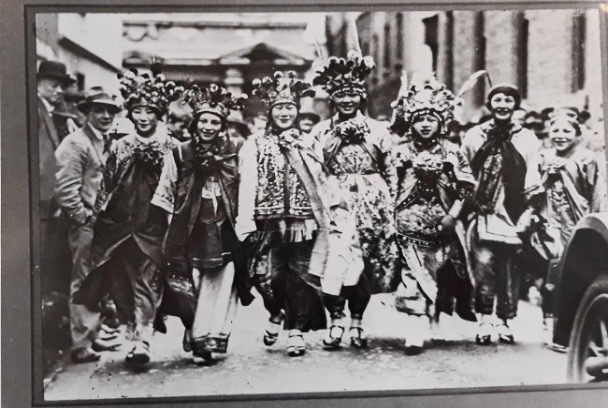
Part of a procession to raise funds for famine relief in China. Melbourne. 1929. Pictures Collection. State Library Victoria.

(Heffernan Lane). Look at us: well-dressed and opulently fed, a rare oriental opportunity, fully cognisant of the messages our bodies convey, acutely aware of the enormous flagpole in the garden and the importance of concrete particulars firmly shod in our kid leather one bar / t-bar shoes (salvaged from the fire at Selfridges). See the white man in the margins? He framed this portrait in accord with the principle that the right decision is always the one that leaves you in full sight. For centuries we have been bricks in an unending cycle of falling out and almost breaking. We are gathered here today for our starving compatriots in northern China running mad for porridge in towns without separate tables for children. The building on the right is the Chinese Methodist Church: an index of gentility. On Sundays we collaborate to honour, love and value one another. Such practical sympathy, symbolic of the openhearted generosity of The Australian People (and so difficult to replicate), will be most effective in aiding the fund of thoughts and prayers that will remain open for the next two weeks. Please Donate. Dear Lord, there are so many questions and moral dilemmas. The Russell Street store can only hold so much food, medicine, herbs, silk and fireworks. At the cabinetmakers, our mothers can barely manage long division. How do we daughters of the middle kingdom – world-famous for self-effacement – begin to deconstruct the status quo of colonialist, anthropological government? It is simply not possible to stem this lymphoma and at the same time determine its metastases and mixed metaphors. Should we pray for rain so the builders go home, or meditate on the structure’s neutrality and learning objectives? After all, history has shown that education opens doors with traditional architectural features. In the tenth century or the year 583AD, Han Chee of the Chin dynasty or Emperor Li Yu of the Sui dynasty ordered Lady Yao, a court dancer and/or concubine to bind her feet to make them look like the new moon. The woman’s metatarsal joints were ceremoniously oiled, crushed and bowed in luminous breathtaking waxing crescendos. How can our footsteps possibly compare? In this story, we are well-heeled, muscular, arched and unfettered, tripping and gadding in shoes our grandmothers (supposedly) could never have conjured.


‘First published in Honey Literary, Issue 2. 29 July 2021.

‘Famine Relief’ includes phrases borrowed and adapted from: ‘FACTS AND FANCIES.’ Yackandandah Times. Fri 7 Jun 1929. p3; ‘The Woman’s World. The Flower of Youth – In the Orient.’ Herald. Sat 16 Mar. p8; ‘China Famine Relief Fund.’ The Argus. Sat 24 Aug 1929. p24; ‘The Chinese Famine.’ The Age. Thu 29 Aug 1929. p13. Morag Loh, Oral History Interviews with Chinese Immigrants and their Descendants 1976-83: George Nan Tie, 20 Feb 1982, and Dennis O’Hoy, Sep 1983. State Library Victoria.

Posted in CHAPBOOKS | Tagged

Erasure Poetry As Outsourcing the Lexicon with Reference to Srikanth Reddy’s Voyager and M NourbeSe Philip’s Zong!

1.0 Let’s begin by playing with an analogy in the hopes that it might somehow work its way up towards allegory; where seemingly technical minutia may bring something to bear upon our contemporary literature – parting the blue screen, revealing … ?

1.1 So it was with the apparent arms race in pixel counts in all manner of devices I was compelled to look into the question of resolution, to see if there was anything of substance behind the insistence of manufactures to ceaselessly upgrade our TVs and monitors for some reason other than driving headlong into the ditch of the uncanny valley. At the time of this writing, we are experiencing the surge of 4K into our collective consciousness, being an image resolution of around 4,000 pixels on the horizontal axis – compared to circa 2,000 in traditional HD – and hawked on all manner of gadgets from home TVs to computer monitors to cinema projection. There are, of course, questions. Is the sampling rate of the human eye even capable of detecting these advancements at viewing distance? Does anyone yet possess an internet connection with sufficient bandwidth to stream video in 4K, or are early adopters of these gadgets unwittingly being served regular old 2K content stretched to fit? Much of the cinema we hold out for remains shot at 2K, before being ‘resed up’ by mighty algorithms for 4K exhibition. Meanwhile some manufacturers push on to 8K and further regardless.

1.2 American cinematographer Steve Yedlin has created a remarkable demonstration of image resolution by repeatedly filming a number of short scenes each time with a different camera, to expose how spatial fidelity may vary between specifications and conditions. Through an exceptionally lucid and strangely compelling explanation, Yedlin makes evident that the raw pixel count is a poor predictor of spatial fidelity, producing examples where perceptual clarity increases even as the true resolution decreases. While there are undeniable leaps between the images of 20th Century video and contemporary forms, there is a sense that, once a certain level is attained, finer grains are no longer questions of clarity at all, but choices of aesthetic qualities that are not as susceptible to measurement in quantitative let alone absolute terms.

1.3 But more than this jockeying for position and product evaluation, the systematic lesson of Yedlin’s ResDemo is that escalations such as from 2K to 4K are not extensive, but intensive. That is to say, the uptick in sheer pixel count does not expand the field of view so that we see more in the sense of scope, but instead increases the number of points over which the same amount of content is distributed. Each 2K pixel is further divided into four, and its context statistically evaluated to determine what the content of those new pixels should be. The algorithms that perform these acts of re-sampling are by no means objective, replete as they are with human decisions over what aspects to privilege in their design, and Yedlin goes to detailed lengths to show how each may affect materials in diverse ways.

1.4 The technical and the poetic, the making and the mechanics … never quite separate – as if every piece of media were always but the next nudge from an algorithm away from collapsing into a bottomless fractal and shattering forever the prospect of atomism.

Posted in ESSAYS | Tagged , , , , , , , ,

Fair Trade: a way to RE/order /imagine /code the world


Image by Natalie Harkin

‘Above all, it (whakapapa) is a notion of time which recognises the interconnectedness of all things.’
–Moana Jackson. ‘He manawa whenua’. Paper presented at He Manawa Whenua. Hamilton, 2013, p.59

A bag of salt was a beginning. Tribal tattooed hands from another time, yet present beside me, reached in to a handbag and placed a small, well-travelled satchel on the table. We all stared at it. Her voice, an instrument of belonging, invited us to pinch some.

I take this with me everywhere. It’s the best salt. Put some on your food. It’ll add flavour.

It was August 2017 and the location was The Tibetan Kitchen on Brunswick Street in Meanjin, Brisbane. Gathered at the restaurant table were Joy Harjo – a member of the Muscogee Creek Nation, her partner Owen Sapulpa, a respected Elder of Muscogee and Ali Cobby Eckermann – a Yankunytjatjara poet along with David Stavanger and myself as co-directors of the Queensland Poetry Festival. It was my third year of co-directing the festival which was to start in four days. Joy and Ali were in town as our festival programmed guests. I knew that night I was in the midst of people whom I could only describe as poetic heroines.

I can easily recall the feeling as Joy and Ali, two sisters who’d never met, shared those first moments of being rae ki te rae – face to face. Witnessing them share stories, laughter, silences, sadness, hopes, share what may lay ahead … sharing … was a gift. Being there at that table is one of the important beginnings of what would become, Fair Trade.

‘What is crucial is to enable writers, artists, filmmakers in communities that have been and are marginalised to take up the space they need to bear witness.’
–Aileen Moreton-Robinson, Talkin’ Up to the White Woman. University of Queensland Press. 2000, p.47

Between January – March 2019 I completed the CREW256 Māori and Pasifika Creative Writing Paper at International Institute of Modern Letters, Victoria University in Wellington, convened by Victor Roger. Being in the classroom alongside eleven other brown writers was revelatory – I savoured the experience. Listening to and learning from fellow Māori and Pasifika writers completely freed up concepts I’d held around what poetry could and should do and I found that my writing flowed when I thought of my classmates as my readers – safety in tangata whenua numbers. Beyond the writing, the class offered time and space to create bonds with people I’m still connected with today. The moana ties us together and the experience reinforced how much I wanted to bridge what I experienced (and still do see) as a ‘literature gap’ between Aotearoa and Australia.

Collaborative commissions for Fair Trade

Fair Trade is a part of Poetry Month (1–31 August 2021), a new initiative presented by Red Room Poetry to increase the profile of Australian poetry, poets and publishers.

Throughout Poetry Month, the poetry noted below will be published online, and linked to from this essay.

Story Tree’ by Ali Cobby Eckermann and Joy Harjo

          ~ Ali Cobby Eckermann belongs to Yankunytjatjara 
          ~ Joy Harjo belongs to Muscogee Nation (Este Mvskokvlke), Oce Vpofv

‘we are the moon’ by Natalie Harkin and Leanne Betasamasoke Simpson

          ~ Natalie Harkin belongs to Narungga 
          ~ Leanne Betasamasoke Simpson belongs to Mississauga Nishnaabeg

‘Forgotten is just a word nonetheless’ by Tony Birch and Simon Ortiz	

          ~ Tony Birch lives and works on Wurundjeri Country
          ~ Simon Ortiz belongs to Acoma Pueblo tribe

‘Postcards of Colonial Ghosting’ by Sam Wagan Watson and Sigbjørn Skåden

          ~ Sam Watson belongs to Munanjali, Birri Gubba
          ~ Sigbjørn Skåden belongs to Sámi village of Láŋtdievvá (Planterhaug) 

‘a water suite’ by Evelyn Araluen and Anahera Gildea

          ~ Evelyn Araluen, belongs to Bundjalung Nation
          ~ Anahera Gildea, belongs to Ngāti Tukorehe

‘Circuit Breaker’ by Ellen van Neerven and Layli Long Solider

          ~ Ellen van Neerven belongs to Mununjali - Yugambeh language group
          ~ Layli Long Soldier belongs to Oglala Lakota Nation

I had been back in Australia one week after having completed the course when the horrifying attacks happened in Christchurch. On 15 March 2019 a man who once lived two hours away from me in Grafton NSW, murdered 51 innocent people who were attending mosques to gather and pray. I woke up one morning and felt compelled to drive to Grafton. I wanted to see and feel the place that had shaped the person who had committed such a heinous terrorist act. I counted eight Australian flags during my drive there. They flew from masts in yards, were plastered to front windows and hoisted from garages, an affront to the sky. The last one I spotted was strung up high at the petrol station just outside Grafton.

When I got home, I committed to weaving 51 baskets to represent the 51 people who were murdered. The baskets would be vessels of remembrance. My weaving would be a way of bearing witness to their lost lives. These baskets ended up being displayed in a piece titled ‘ātete’ as part of a group exhibition curated by the Conscious Mic collective called Ctrl Alt Del in Brisbane that June. It was an honour to have work shared alongside First Nation artists from Australia and around the world. The calling to collaborate was firming within me.

Posted in ESSAYS | Tagged , , , , , , , , , , , , , , , , , ,

Just Mediation: Videogames, Reading and Learning

Gaming as living literacy

The inclination, first, and then the capability, of schooled literacy in its institutional framing – most prominently the study of literature – to integrate videogames into its terms of reference has been of interest to us for over a decade (see McDougall and O’Brien, 2009).

Most recently, Andrew Burn, an established scholar in the intersection of videogames and literature, has written in depth on an example which will offer immediate resonance to the readers of this publication, we imagine, the adaptation of Beowulf into a videogame:

An argument for English teachers to consider is that computer games are particularly well suited to adapt the ancient narratives of oral (or quasi-oral) tradition. This is partly because they share the popular cultural milieu of their sister media. But it is also because they are, literally, formulaic texts, made up of computer code. … I imagine what these features of poem and game might provide for an activity in the English classroom: how the transformation of Old English poem into videogame might reveal that 21st century students might be, albeit unknowingly, treading in the footsteps of their ancestral performers of narrative, whether oral or written-formulaic; and how it comes to be that a thousand year old poem contains features so like those of a quest-based videogame. I imagine how such questions might lead to an investigation of the history of Beowulf; of Tolkien’s own transformation of the text in The Hobbit and The Lord of the Rings; and how his Middle-Earth creations gave rise to the vast, sprawling genre of roleplaying games, at first table-top, then digital. (Burn, 2021: 116-117, 131)

In this essay, we reflect on the convergent findings of studies into gaming and literacy; games as literature and the implications to these intersections of current developments in AI-generated story mediation.

Fifteen years ago, we studied the conditions of possibility for gaming as a ‘living literacy’ practice (Rowsell and Pahl, 2020) with teachers and students and at two further education colleges in England (McDougall, 2007). At the time, students were studying games as textual objects within the Media Studies curriculum at A Level. We explored degrees of insulation between ‘pleasure learning’ and classroom learning when games become study texts and, in this newly complex (at the time) dynamic relationship between game literacy and academic work, how the classroom context might reinforce, challenge or abstract such relations?

The two games being analysed were Medal of Honor and The Sims. We observed a discursive tension between epistemological and pedagogical discourses spoken by teachers and the literacy practices of learning with and reading games. Our student participants were obliged, in order to pass the exam, to work with a preferred reading of games as vessels for ideology. This was different to their thinking about the games as ‘just’ players, but this thinking was highly literate, despite being ‘unschooled’. A teacher participant observed: ‘It is hard because on the one hand you have constantly got in your mind the fact that you have got to prepare them to write an essay in an exam, but on the other hand you I really like the open-ended possibilities that this generates.’

Posted in ESSAYS | Tagged , ,

The Stakes of Settlement: Fences in Ned Kelly and Michael Farrell

What is it that distinguishes honesty from knavery, but the hard and wirey line of rectitude and certainty in the actions and intentions? Leave out this line, and you leave out life itself; all is chaos again …
–William Blake, Outline in Art and Life

William Blake’s articulation of the ‘bounding line’ as ‘the great and golden rule of art, as well as of life’ may seem a far-fetched place to start an examination of the poetics of the fence in Australian poetry. The line’s cosmic necessity and ethical force were being asserted by Blake in the context of a long-running dispute amongst art theorists as to whether outline or colour was the predominant element in the pictorial arts. But my mind reverts to this quotation when thinking about the cathected attitude to lines, boundaries, and fences that is emblematic of the settler-colonial establishment in this country in both its agrarian and suburban contexts.

Signalling possession, privatisation, and productivity, the fence was one of the main props by which a cadastral grid (comprised of adjoining rectangular land parcels) was imposed on the Australian landscape with the effect, as Denis Byrne has observed, of putting it ‘in immediate dialogue with the landscape of England’.1 Wire fences began being rolled out in the 1870s and Byrne offers us a stark reminder of how much a turning point this may have been in settler-Indigenous relations:

Wire fences made the cadastral grid a visible, tangible reality on the ground, where previously it had existed for the most part only on paper in the minds of white settlers. It seems unlikely that Aboriginal people understood the full extent and nature of their dispossession until wire fences fixed the grid onto the face of the land.2

Rather understandably, fences have featured prominently in recent Australian art that does attempt to capture something of ‘the full extent and nature’ of this dispossession – from Lin Onus’s 1985 painting Fences, Fences, Fences to Phillip Noyce’s 2002 film Rabbit-Proof Fence. As these works suggest, fencing is not simply a matter of exclusion and displacement; indeed, the regime of spatial discipline that fences impose is shown to be complicit in other regimes of regulating the individual and social body: that of incarceration and, ultimately, eugenic extermination.

In speaking of fences in the Australian context, then, one finds oneself rather quickly in fairly deep water. I’m not a strong swimmer and I won’t be plumbing its depths in this essay. What I will do is offer a series of thoughts about the poetics of the fence using two related case studies, one taken from a colonial context (Ned Kelly’s Jerilderie Letter, which I read, after Farrell, as a poem), the other contemporary (a selection of poems from Farrell’s I Love Poetry). In examining what I call the fence poetics of these two texts, I’ll try to draw out some questions about genre and how genre helps configure history (literary or otherwise). But in particular, I want to focus on the way that the fence gets used (and abused) as an efficacious symbol of the stakes of colonial settlement.

Posted in ESSAYS | Tagged , , , , ,