Arts of the Possible: Time, Politics and Gaming’s Virtual Worlds

I’m worried about Nour – the last I heard she had hitched a ride with a fellow refugee and an Italian woman. I haven’t heard anything for hours.

I have to admit, it feels a little strange being concerned about someone who doesn’t exist.

Nour is the fictional deuteragonist of Bury Me, My Love (BMML), a game by French studio The Pixel Hunt. She is a Syrian who is departing Homs to seek refuge in Europe. Players take on the role of Nour’s husband, Majd, who is caring for family members. Just as importantly, players take on the role of Majd’s smartphone as the couple keep in touch across Nour’s perilous journey.

The real-world refugee crisis is not a common subject matter for digital games – at least, not without a layering of science fiction or fantasy (lost homes, far-off homelands and destroyed planets are commonplace in the backgrounds for game characters). In fact, sometimes game developers go out of their way to insist that their representations of crisis are not, in fact, in any way related to real-world occurrences. The upcoming game of the blockbuster first-person shooter (FPS) Battlefield series is set in 2042, after a ‘Second Great Depression’ in which ‘No-Pats’ displaced by climate change and state collapse contend for scarce resources. However, game director Daniel Berlin insisted this scenario was developed to incorporate spectacle and is in no way social commentary: Battlefield 2042 is ‘purely a multiplayer game for us’.

Another reason that BMML is remarkable is its real time mode (RTM), in which the game mixes design techniques from mobile games while fictionalising the interface systems of the mobile phone itself. Nour’s in-game messages appear in real-time as part of players’ quotidian digital bric-a-brac. The game consists of the characteristic DMs, selfies, links and other components of contemporary social media and messaging interaction. Nour’s characterisation is important here – she reacts to Majd’s messages in various ways depending on a number of tracked variables (which are not revealed to players). Players can choose Majd’s side of the exchange and thus advise, cajole and inform – but this is not a case of a gaming ‘avatar’ that serves as a vehicle for embodying players within the game world.

When Nour is unable to access her phone – as in the situation above, or when she is looking for a charge point to keep the device alive – the game chat log will be unresponsive, stating that ‘Nour is busy’. Players have to wait real hours to learn how things turned out. They may be in the midst of any number of everyday activities, when a new message arrives from Nour.

BMML is very different in ‘Fast Mode’. Here there is no delay in the progress of the story, regardless of Nour’s fictional situation. There is also no use of the smartphone’s notification interface. The overall effect is much more conventionally game-like, and the activity much more play-like: this is a branching path narrative. We’ve played stuff like this before.

Posted in ESSAYS | Tagged , , , , ,

Instapoetry: The Anxiety of the Influencer

On Instagram, old questions about sincerity and identity in the lyric voice meet new pressures from the digital attention economy. This collision has produced evolutions in form, but also prompted critical questions about the Instapoem’s commodification of selfhood and about the vexed categories of aspiration, representation, and authenticity in contemporary poetics.

Many commentators have observed Instapoetry’s curious resistance to criticism. Soraya Roberts argues that ‘admirers focus on its genuine feeling, its emotional truth. Critics shrug it off, claiming it’s just not their thing.’ As Roberts puts it, ‘Instagram is the affirmation medium’, noting that the messages of Instapoems are, overwhelmingly, encouraging. Responses to them follow the same logic: there would be something incongruous about bringing a tone of critical assessment to bear on messages that are themselves so roundly positive. There isn’t a forum in Instagram for saying ‘I don’t like this’ or ‘I like this but I think you should rework line two’: the only response possible in the medium is the enthuse. In fact, under these circumstances, attention itself becomes fused with approbation – you either don’t pay attention or you give praise; you like it or you nothing it. This is part of Instagram’s community-building function: in a digital landscape where Twitter is for spats and Facebook is for feeling your tribalism clench around you, Instagram is where you find people who like and are like you.

Less discussed is the way in which the verbal-visual format of the platform closes off criticism through the Instapoem’s particular construction of identity: the identity of both writer and reader. This conflation between writer and writing happens because Instagram is selling the self, in that the product proffered by an Instagram post is at once the image and the individual behind it. Instagram itself operates through the logic of the gestalt: the identity of the creator combines with that of the image just as individual items in an image form a composite. An Instagram picture of breakfast, in other words, isn’t the same picture if the plate of food is not set off by a cactus, a candle, and sunglasses angled with the precision of an Edwardian butler. The image is then set in the larger amalgam of previous posts on the grid, creating an overall picture of the account and its creator. Just as the words and image are taken together in the post, then, the Instapoem and its creator can’t be untangled. This structural feature of Instagram is part of what creates roadblocks to productive critical conversations about Instapoetry, but its fraught relationship to the category of authenticity contributes too.

While authenticity is often claimed as part of the value of Instapoetry, Instagram’s other defining structure – its logic of disclosure and display – complicates this: choosing to ‘share’ a moment of one’s life is also an act of self-construction. This act of construction extends to the reader, who often finds themselves being directly addressed through a kind of universal interpellation. As Anna Lewiska notes, there is a lot of second person speech in Instapoetry. Instapoetry’s ‘you’ suggests the individuality of selfhood – the addressee is you, specifically you – but because this ‘you’ could be anybody, it is also strangely anonymous. The reader is at once the addressee and the overhearer of a conversation with somebody else. As Claire Fallon writes, ‘anyone can see themselves in Atticus’s poetry, and what they’ll see is a slightly heightened version of themselves, enigmatic and alluring.’ The Instapoem’s second person mirrors a broader tension in Instagram between the expression of individuality and the formation, indeed homogenisation, of it: on the one hand, individuated authenticity is prized currency (literally), but on the other, on Instagram everybody’s eyebrows look the same.

Many Instapoems are about an unnamed ‘her’: this can be anybody in the same way that ‘you’ can be, setting up the same dynamic of universal applicability. We often don’t find out much about ‘her’: that would get in the way of this blanket identification. The second-person voice sometimes also issues the ‘you’ instructions about this ‘her’, as in the famous Atticus line apparently widely requested in tattoo studios: ‘Love her but leave her wild’. To whom is this injunction addressed? To the one who loves the ‘she’, or the ‘she’ the reader identifies with? This kind of proxy identification allows the reader not only to construct the self, but the self via another: the self as she would like to be loved. This is at once authentic in that it involves people’s real feelings, but it is predicated on a kind of originating lack of authenticity, in that the template needs to be blank enough to fit all comers.

What do we lose in this process of identification? There is something dubious about the construction of femininity in the celebration of ‘wildness’ in Instagram’s generically unforgettable women. Being free is what we all want but there’s something a bit Cool Girl about freedom framed only as an operatic ‘wildness’. Are you lovable if you’re not someone who, in the words of R H Sin, ‘burned flames and drowned oceans’? What if you don’t feel like being extra? If you’re just regular? This, then, is another of the ironies of framing Instapoetry as a space which encourages readers’ love for themselves as they are. Clare Bucknell captures some of these contradictions well: in Instapoetry, ‘men can write about women as if they are perfect … but women are barred from calling their own bodies perfect without having acknowledged their imperfections first.’

The self as reader being addressed by the Instapoem has also become an aspirational identity – not so much for the experience of reading but for what the act of reading allows the subject to think about her or himself. This was of course ever so, but in the age of social media, thinking of oneself as a reader takes on a specific (phantom) texture, in which the physicality of books sits in commodified opposition to the digital. The aspirational tinge of readerliness in Instapoetry is all the stronger given that the image of someone reading a book is, by definition, being experienced on a screen. Glasses here also function as the same kind of overdetermined signifier, as these three-dimensional objects – books, glasses, fountain pens – turn into props for each other and for the idea of bookishness. As Bucknell notes, in Instapoetry, ‘posts present poems in the same way adverts place products’, noting the propensity to set the poems next to sundry desireables, whether these be ‘quartz crystals’, ‘white duvets’, or ‘gym-honed abs’. In this case, physical objects like books and glasses become a kind of material synecdoche associating readerliness with hipster glamour, placed in composite images with other tokens of material aspiration like marble surfaces and eucalyptus sprays – put anything next to a eucalyptus spray and it becomes the Etsy version of itself. The same patterns characterise the commodification of the self-as-writer: Instapoetry has a tendency to perform writerliness as a lifestyle defined by non-writing markers, drawn from a mid-century moment when women were women and writers were Kerouac. We see no bureaucratic modernity, no highlighters, post-it notes, chewed biros or Microsoft. Instead, there are typewriters, moleskins, yellow paper with coffee rings, whisky, cigarettes, Courier New.

Readerliness and writerliness in the Instapoem stand in not only for a kind of ruggedness or hot librarianhood, but also for the idea of self-care. Instagram poetry’s images show books paired with other signifiers of elevated relaxation – steaming mugs, bed sheets (waffle not Spiderman), spa candles and succulents. Various Instagram poets explicitly characterise their work as therapeutic. R M Drake writes: ‘it’s self-exploration and self-therapy’. The question becomes: how does the self-therapy of the poet line up with the self-therapy performed by the reader? The therapeutic processes of reading poetry more broadly can take many forms, but one of these can be characterised as a process of discovery: coming to know or see something, about yourself or the world, that you didn’t see before. In order for this discovery to take place, there needs to be, by definition, an engagement with something beyond the self and the known. However, those who talk about the soothing power of Instapoetry often focus on ideas of familiarity and self-recognition. While on the one hand, seeing oneself reflected back has its own consolatory power, there is something claustrophobic in experiencing only the results of your own choices: there is none of the loft of randomness.


Posted in ESSAYS | Tagged , ,

Simulative Pleasure: The Game of Reading in English Education

Throughout this pandemic, I’ve been reading fiction to simulate going home to Florida. I read Ivy Pochoda’s sprawling Los Angeles novel Wonder Valley (2017) to replicate my layovers after flying into LAX, and Swamplandia! (2011) by Karen Russell to remember the smell of swampland and the tacky sadness of gift shop strip malls. I returned to Carl Hiaasen’s Hoot (2002) to relive the experience of buying a shrink-wrapped copy at the Scholastic Book Fair in the refrigerated library of my Central Florida elementary school. For 18 months I have used fiction for my own simulative purposes, as a game I can play to get home.

This type of reading may be described as reading for pleasure. Like a game, I engage with a fictional interface and desire enjoyment. As the user, I decide how and why I want to read the texts I select. In the case of my homesickness, I had the particular purpose of simulating lost experience and indulging my nostalgia. I chose the reading mode and gamed my adventure.

While the original goal of reading these texts was to feel connected to home, the end result was unpredicted. Each novel taught me more about my ambivalent relationship with America. Through Pochoda and Russell I witnessed the stain of violence and grief in the nation’s quest for capital. With Hiaasen, I was present for the destruction of the environment in the name of convenience. Meanwhile, these texts foreground the strive to live a meaningful life in spite of chaos. There is something unique about the American condition that balances feelings of emptiness with significance. And while I was able to return home through my reading, I was reminded of the fact that every time I do, I absorb the sickness in the culture, and feel like I need to get away by fleeing across the ocean. While this was not the desired outcome I set for my pleasurable reading task, I exited reading with some new knowledge about my orientation in the world, or lack thereof.

This game of reading for pleasure seems different to the sort of reading we teach and learn in school contexts. While I read for pleasure in the evenings, during the day I conceptualise my reading time as a researcher to be a different sort of game. I have been trained to approach reading texts with the purpose of knowledge creation. This kind of reading has to be work, and so it has to be hard, and have the potential for consequence. I experience pleasure when I am working, I find thinking to be a pleasurable activity, but my main intention isn’t enjoyment. I can’t approach the texts with a purely personal goal, my reading has to reach out beyond my interests and speak to the concerns of others. More than anything else, I want my researched readings of literature to be useful to someone.

As a teacher, I encourage my students to address texts with a critical edge that goes beyond pleasurable experience. Of course, I want my students to read for pleasure and delight in their literary encounters, enjoyment is a critical feature of engagement, but I also believe that pleasure cannot be the final stop in their education. When I reflect on my own experience as a literature student it feels clear to me that enjoyment was valued, but at the core of our mission stood something greater. The educational approach to literary reading doesn’t feel like a game at all because it connotes rigor and significance.

However, the purpose of a literary education still feels largely like a mystery. Whether one reads in the context of a formal educational institution, or for personal education, this approach to reading is often conceptualised differently to reading for pleasure. Throughout history, English as an established discipline has wrestled with this difference.

Posted in ESSAYS | Tagged , , , , , , , , , ,

Covid Clean: 11 Works by Andrea Srisurapon


Andrea Srisurapon | Covid Clean 1 | Photographic print | 2021

The photographic series Covid Clean is a symbolic self-portrait that confronts the racial remarks towards Asian appearance and identity during the COVID-19 pandemic. Racial comments of Asians perceived as unhygienic, dirty, and the virus itself as ‘yellow peril’ were heavily circulated in Australian media.

These comments are harmful, divisive and only stimulated the racism that lie dormant in our society. This series not only challenges xenophobic attitudes and the anti-Asian sentiments by showcasing its lack of truth to reality, but also moves towards empowering ones Asian identity.

As a subject of the series, I, Andrea Srisurapon, harness my vulnerability and weaponise my body. Ultimately, I am not an object that can be labeled: a Thai Australian woman defining her identity.

Posted in ARTWORKS | Tagged

Hasta Carmen: 12 Works by Camila Galaz


Camila Galaz | ‘As the Spanish say, Hasta la vista, ta ta for now, Hon.’ | 2021)

When I met the co-leaders of San Marino at the Olympics, I knew where it was because of Carmen Sandiego.

–President Bill Clinton, The New York Times, 1996

We just don’t know the geopolitics of Carmen Sandiego, and in some sense, it’s really important to find out. What did the game include about history? More importantly, given the brevity of the information presented, what did it exclude? Were there outright falsehoods in these games or racial, ethnic, or gender biases? We don’t know the answers to any of these questions.

–Alexis C Madrigal, ‘The Geopolitics of Where in the World is Carmen Sandiego?’, The Atlantic, 2011

Games come to signify not just code, but interaction with a certain kind of machine, space, and time.

–Rhiannon Bettivia, ‘Where Does Significance Lie: Locating the Significant Properties of Video Games in Preserving Virtual Worlds II Data’, International Journal of Digital Curation, 2016

I’ve always loved the video game Where in the World is Carmen Sandiego. First released in 1985, it spawned the edu-tainment software revolution of the 90s, which I was very much caught up in. While the Carmen universe has expanded to include live-action and cartoon TV series, books, and multiple versions of the video game focused on history and specific geographic areas, the original Where in the World is Carmen Sandiego game was a world geography challenge. With Carmen as the brilliant antagonist and leader of a crime organisation known as VILE, players would track her and her cronies around the world in an attempt to thwart their brazen attempts at stealing famous monuments and items of cultural heritage. Ostensibly made for children in the United States, the game positions the player as a gumshoe ACME agent (a quasi-CIA operation) on the hunt for Carmen, a hispanic-coded criminal – though, interestingly, Carmen is largely positioned as non-threatening to the player.

At the time I was playing Carmen in my youth, I was also beginning to fully comprehend my Chilean cultural background. From Australia, I absorbed any Chilean references that came my way, trying to piece together an understanding of my cultural identity without being present in the country itself. How strange to look back on this now, thinking of myself as the daughter of a Chilean exile who fought against the CIA backed Pinochet dictatorship, play-acting the role of a United States agent.

When considering the individual players themselves, the geopolitics of Carmen is incredibly complex. The selected locations are often presented as exotic or other-ised to the United States and displayed within the context of a criminal investigation. This US-centrism also plays out in other ways, as Marsha Kinder infers of the 90s TV cartoon version in Media Wars in Children’s Electronic Culture:

The red coding [of Carmen’s outfit] also evokes Carmen’s past as a former spy who speaks flawless Russian and who got her hardware from the Soviet Union – a backstory that helps recuperate the cold-war paradigm.

Carmen played a huge role in geography education for generations of children. While the game developers preferred to see the games as exploration rather than education, it is clear that the game’s success was deeply rooted in its positive reception within schools and its marketing as classroom-based software. The games did develop over time, with the country facts changing due to shifting geopolitics. However, what is learned from these games is not solely contained within the borders of code but permeates into the physical social experience of gameplay, the temporal contexts, and the relationships of individual players with the content presented. Using my personal experience as a conduit, in Hasta Carmen I attempt to interrogate the information learned from a political and sociological viewpoint – looking at how the positioning of a specific country within the game merges with the lived experience of the player over time.

In Hasta Carmen I use the visual lexicon of these early games (specifically Where in the World is Carmen Sandiego? classic and deluxe editions), redrawing and playing with elements of the graphical interface. Collated clues, to-do lists and country information specific to Chile from within the game are mixed with notes and photography from my first trips to Chile in re-drawn gameplay fonts and framing. These two sets of information come from very different sources and perspectives. However, they combine to acknowledge the complex web in which we construct understandings of cultural identity. Both my experience of Chile and the gameplay of Carmen are focused on investigations (as is much of my art practice).

In working on this project, I began to wonder if my experience of playing Carmen also influenced the way I process information. Marsha Kinder further suggests that

… since these young viewers are still undergoing a process of cognitive development, which helps establish the basic schemata by which they organize perceptual data, that very infrastructure can potentially be inflected by the structure of the particular medium they are monitoring.

Regardless, the clues have brought me here and I will continue my sleuthing. As the Spanish say, ‘Hasta la vista, ta ta for now, Hon.’

Posted in ARTWORKS | Tagged , ,

GAME Editorial

As we write this, we are living in cities that are both in lockdown. Our days see us bouncing from one device to another, room to room to room. In these days that feel increasingly unreal, it’s invigorating to look back over the selections for this edition and step back into the magic circles marked out by each poem.

In this GAME issue, we have collected poems that took their play sincerely. Their constraints – be they formal, thematic, or functional – are not a cage, but an opportunity for transformation, an invitation into a new logic. Play here is a mode that supports Paul Valéry’s image of the poem as ‘a little machine, one that for the reader produces discoveries, connections…again and again, as many times as we need’.

We have chosen works that we feel exceed the lightweight connotations of the word game. Not every game we play is opted into, and in this selection are responses to labour under capitalism, dealing with loss, familial conflict, and international borders. Many of these poems sought a lateral dialogue with the invisible rules we gestured to in the call-out to this edition – depicting resistance, resignation, and the ambiguous manoeuvres that are needed to coexist within these complex and often cruel systems.

At the same time, we were equally invested in the work collected here that engages with silly, undiluted joy. Whether they are revelling in the inner workings of language, or making space for the absurd and dreamlike, these poems create an intimacy that can only exist through the communion of play and confirm our belief that solemnity is not a requirement for affecting poetry.

We were happy to see many enticing digital-born works submitted, a reflection of the efforts of publishers and organisations that have supported the overlapping worlds of writing, games and new media art: from Emerging Writers Festival and Freeplay Festival to Voiceworks, Liminal Magazine and Running Dog to name but a few. There are also some poets in this edition being published for the first time, or for the first time in Cordite, Poetry Review, which is an immense joy and honour to us!

Finally, we’d like to thank these writers and artists for trusting us with their work, and to thank you, the reader, for giving us your trust, and entering the magic circle with us. We hope the games, discoveries and connections here serve you, again and again, as many times as you need.

Posted in ESSAYS | Tagged ,

Family mathematics

But now the huge trick: continued fractions allow you
to go on forever, with infinite nesting, just as we allow
infinite decimals to go on forever.
— Marty Ross

i. Nest

if you’re talking children
and ordinals
I was 1st

if you’re talking
children and fractions
1 in 4

if you look just at girls
it was 1 in 2

if each unit in a family
is given equal value
1 in 6

not that we were

reality was rationed out
to the powerful

which generates complex equations
hides the damage

in a family of 6, what is the ratio
of care to distance
knowledge to silence

the longer you follow the pattern
the closer you get

to the secrets
nested in secrets

lies nested in lies
nested in lies

Posted in 102: GAME | Tagged

Double Glazed

Posted in 102: GAME | Tagged

eastern line

as much as we imagine reliable
emotional landscapes in the blink
of a grazing cow’s eye life is re-invented
paddocks & a station rush past
look & sigh, elsewhere without colluding
with the overwhelm to explain
layers beneath feelings behaviour
in mid-sentence a sudden chill
ends the conversation one’s theory
of the universe no longer tenable
as much as we function without
humour or rainy-day attire
(remember on the island when we got caught
in a sudden deluge?)

on the eastern line steel wheels
clatter the tracks train, window
cows chew cud a dutiful father
listens—his keen eye roves the light

tail-swish ball…bell…balance—ear-flick

his voice falters along the suture line
aberrant cells sweep aside the gift of life
truth—paddocks yellow-grey grass
shimmers—head-long to evening.

Posted in 102: GAME | Tagged

Ready or Not

Under the railway bridge,
the creek smokes cattails.
Sweat courses your clavicle
like bubbles on a bottle
of Coke. In your childhood
kitchen, your father said,
Marry a man who loves you
like I love your mother.

And you did—
one who opened his hand
like a map,
and kept it flat
when he hit you.

Honey, take courage.
Hear the train just there.

Posted in 102: GAME | Tagged

Tables

Tables

We are just ordinary people, despite our greatest endeavor,
    memories of us do not last for a significant time;
as for the great who do nothing, it’s they who just need to be breathing,
    and, as the Libyan says, last long in adamant stone.

So, it was one day that Zeno, the guardian king of our city
    playing a curious game, staged with capricious dice
found himself fully surprised, when a complex position was showing
    as for the pieces of white, they were returning back home,
first, there were seven white pieces that occupied field number six and
    then there was one on the ninth, followed by two on the tenth;
nineteen and twenty had two stones and then there was one final counter,
    on a position alone, taking the second from last.

Black had its pieces as follows: a double on place number eight and
    leaving another two stones on the eleventh domain;
finding a similar number at rest on the following twelfth spot,
    only a single black piece, took the thirteenth as its place;
right on the number fourteen there were two who had just settled in there,
    analogue pieces were found sitting on number fifteen;
in an identical fashion, the eighteenth had two pieces staying,
    counting the fourth from the last, this had the final black two.

Now it was time for the king’s move, because he was playing the white side
    he did not notice the trap showing itself on the board,
after the casting of dice from a wooden receptacle downwards
    tumbling down ladders inside, leading the dice to a rest,
three of their numbers appeared and they turned up a two, six and fiver,
    eight of his fields were now split, leaving just singles in place.

All of you, flee from this game board, as even a sovereign ruler
    could not evade his bad luck, playing this treacherous game.

Posted in 102: GAME | Tagged ,

Crown Of Moons

Energy sandstorm crackling
granular bismuth plankton
and not correlating its seethe
but finding the temerity of wave
in flared points that are pregnant
with voids backward spark cathedral
masochistic trash archipelagos
sutures of lava flow and disembodied
flames make flesh eager to amass
dendritic silhouettes of matter trees
rock swallows wood to become water
in a bliss of levels and effort circles
a crown of moons a calendar of milks
synthetic eyes arranged to monitor insect
apocalypse downgraded to cell errata
bouquets of freshly destroyed steel
man made of remnants among lasso rope
reflection of edifice skyreach tortured
dancers in gleaming wheelchairs no
one can count the tragedy arcs
heavy inked on expensive paper
feverish mutinies in gravel dugouts
fecal ribbons in the city water
dogs mutating in tumblewood chatter
videocassettes sold in dust markets
whereby objects multiply platforms
and beach towels you are a memory
for the fact of stuff haloed bank integers
like tallies across jet realms animals
scissored in halogen rooms halogen attic

Posted in 102: GAME | Tagged

eelegy

eels by the dozen stained questions,
shimmering mud deep in slime.

natural science ends this unknown lineage,
a deathbed world more abundant still alive.

new eels old lives as beetles
born of sea-foam or glass muscle.

any eel answer another eel question
a world war finally

here lie the great currents of their home
fluid and strange. with opened stomachs

the mature dusk of eels: quivering, watered
freshly writhing surges of wriggling.

what we wanted the eel
to be eludes


After “Where Do Eels Come From?” by Brooke Jarvis.

Posted in 102: GAME | Tagged

Light variations at the bomb museum

I heard the footsteps again, you know who it was.
The fish tank inhabited by a strange artwork.
There was nobody home to explain, we waited.
I remember tampering with the core and the first stage of fission,
a hollow impact orphaned from history.

Polished white concrete and conditioned air.
An atmosphere ecclesiastic. An impossible heat
and futuristic toilet facilities, supine tourists, black rain.
An exit the opiate of jargon and the
difference between then and now,

igneous rock like mirror. Nothing to intercept
nothing to the horizon, wastelands of artefact.
A sinister experiment in my underground laboratory.
The jet streams magnesium pink being pulled to the sun.

More colours to the desert,
a calcified giant from dead myth. A daring
and most ingenious project: the curve of the wall from which
an osprey tips. Far below an angel submits to hypothermia.
Voters may form false memories
after seeing
fabricated stories.

Posted in 102: GAME | Tagged

Grenadier

I pour a blush of wine
into my housemate’s glass.
Orange tiles & succulents in jars.
Rolling through sulfur is hard
when you’re stuck in other muck.
There can be too much adrenaline
stim. As an example, what will we call
summer when it’s more than four months long?
Yesterday, I thought I saw my
dead friend at the depot: black Docs,
leggings, two ribbons of hair falling
from undercut. Our friends are counting on us.
I don’t mean a lonely medical droid. I’m talking
before Alderaan’s demise. I wonder if
there’s guilt in hyperspace. I already know
the answer: in-game & at that market a sonic
imploder detonates my mouth.

Posted in 102: GAME | Tagged

Impossible Borders

Instructions

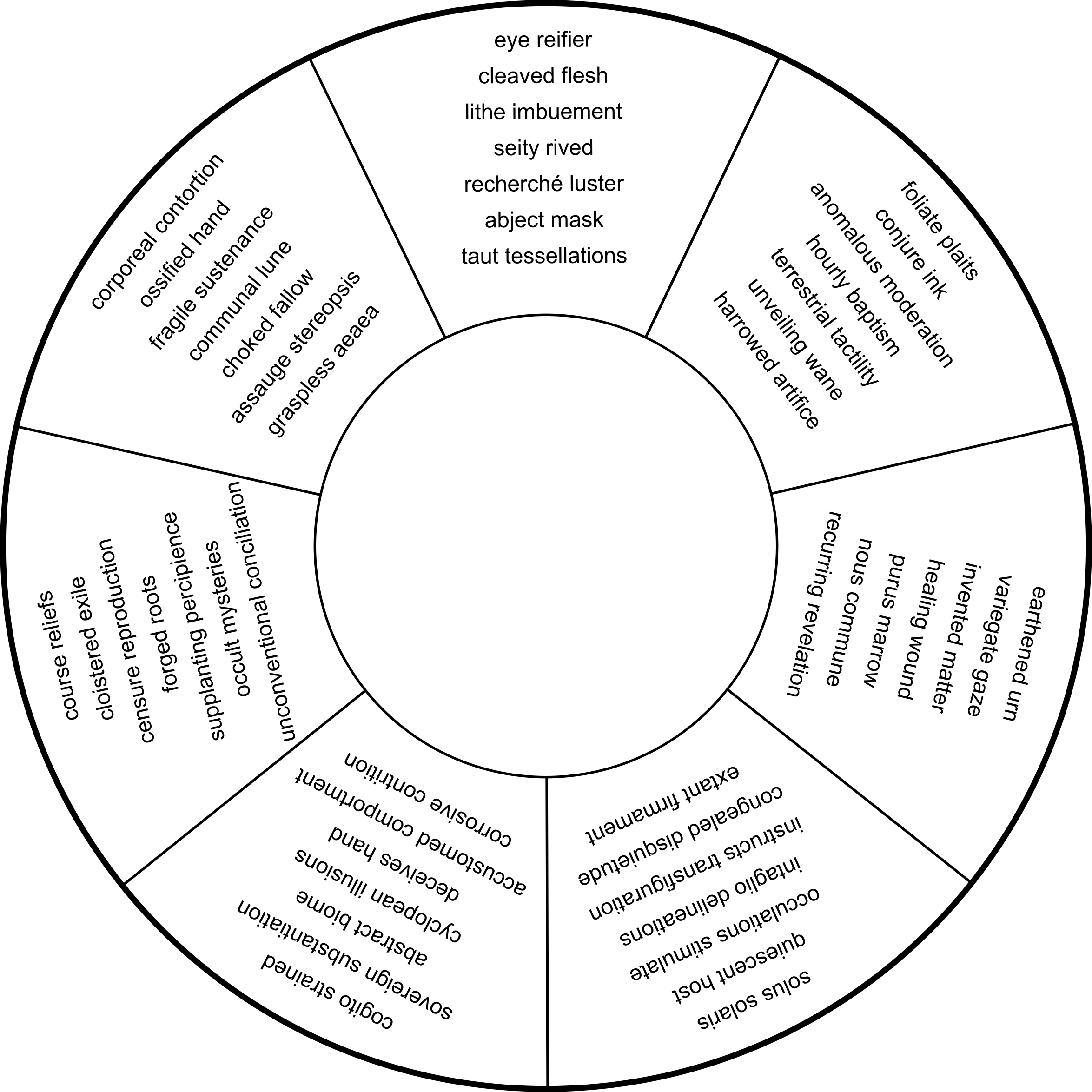
Impossible Borders is a ludic response to the distorted everyday of COVID-19 lockdowns, where once familiar spaces were imbued with new meanings.

Drawing on a range of experiences and shifts of perception—like the hardening of hands due to constant washing, or how a softened gaze tessellates the leaves of a house plant—seven 14 word poems were composed and ‘distorted’ (from the Latin distorquere—‘to twist apart’) across a disc of seven segments, obscuring the original poems while inviting unconventional reading approaches.

We recommend using one of these reading patterns:

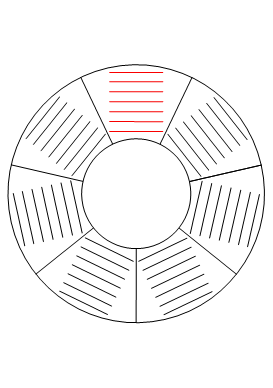
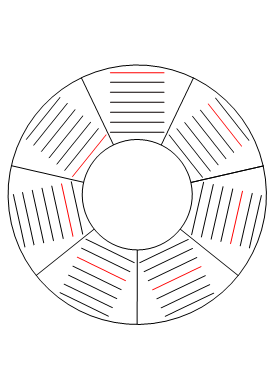
Option A                                                                                                             Option B


You can read the downward poems in each segment (Option A), or you can read the poems by way of an inward spiral (Option B). After reading each poem in your selected pattern you can start at the top of the next segment and repeat the pattern to read the next poem.

You can start with either or neither, but whatever reading pattern you choose will require being constricted to the confines of the disc. External devices (abacuses, cards, die, dictionaries, grimoires, etc.) as well as internal stimulants (preconceptions, prejudices, apprehensions, etc.) are encouraged, but not required. Methodical application of these devices will yield consistent results. It is up to the player to determine if this is preferable.

Warning: reading patterns other than Option A (including the recommended Option B) may create ocular disconcertion.

Posted in 102: GAME | Tagged

What Animal Could You Beat in a Fight?

a Twitter Found Poem

I’m glad you asked.
It would have to be small. Maybe an insect. Not poisonous ones.
Would I be wearing body armour? Or some kind of stiffened leather?
Do I have the advantage of surprise or terrain?
Any animal which is low to the ground, if it is snowing,
or a kangaroo because they can’t go backwards.
Definitely a goat or a goose. Geese are not as tough as people think:
I’d slide under its wings and grab it by the neck.
I could probably take a bear if I had to, once the adrenalin kicked in,
15% survival chance. But not a Gorilla, Gorillas are a one punch K.O.
Yep. A whale or a shark. But only on dry land.
I won’t fight mythical creatures, though: griffins and armadillos and Big Foot.
You. You’re not an animal? Then myself. If someone cloned me.
In a fistfight, I couldn’t take a Puma, but I could beat a racoon.
I’m glad you asked.
I’m glad you asked.
Tactically, spiders and snakes are out, and I can’t fly, so not birds.
You can’t let a panda get in too close, it’s all about reach.
I’ve been thinking about this for some time.
It depends on the rules: I could beat most animals in chess.
Not vertebrates, even jellyfish, though. Jellyfish will swarm you.
I’m glad you asked.
Could I make an alliance with some of the animals against the rest?
Nothing smarter than a cat.
If I was a samurai, then easily killer bees.
Oh wait…no weapons? What about the animals? Do they have weapons
or are they declawed and defanged?
No point choosing wolves or big animals. They don’t exist anymore.
A cougar once you tire it out.
A human can kill anything.
We are the ultimate predators.
I reject the premise of the question.
I’m glad you asked.

Posted in 102: GAME | Tagged

A Field Guide to Triplines

Before crystal and gold dolphin
wind down end of the day emotions wash so hard
overlooked lavishly by the blunt attention of mirrors.
Aeroplanes high time to relax the concept of failure
is hideous. Between ignoring and not hearing there is
a difference where human error constructs its unreliable
batteries. That we would eat each other shortcuts loss
of signal, as if the difference is the remote is on the blink
and the robot you are, that I am, follows us and trouble
-some diagnostic knobs direct us in circles. The dogs
are excited because we’ve found the switch to turn you on
and all it took was a remote salvaged from a plastic toy.
In my hand, a difficulty, a comfort you fall within
enough to shake the messages you leave.

Posted in 102: GAME | Tagged

a gordian knot

i never was one for
patience and strategy

biting down on the bit,
an anxious habit

pop a blakfella
on the line up –
soft furnishings to dress
the set of your scene,
to brandish completed puzzle cubes –
kids upload videos
to YouTube, demonstrating
that one trick, still
give yourself a pat on the back

like a Magic Eye puzzle –
an optical illusion –
to look at me
there is just flat image,
to perceive the full picture
you have to change your
point of view

Always Was
Always Will Be

all to service your brand.

Posted in 102: GAME | Tagged

A Game of Life You Don’t Always Know You’re Playing

A short history of songbirds: declivities, banging pans,
eyes scratched out of religious icons painted on cave walls.
In the marrow of debate, the preservation of power.
You pretend not to see: in stones, the disappearing trees,
the lobster flaying its disconsolate torso in a steel pot.
An ichthyologist detonates explosives to study fish.
No apologies, only a timetable outlining the dates
of all the season’s matches, and the arenas they will be played in.
Survivors of a shipwreck are paid out in instalments;
the ones who can prove in a document they are dying
can apply for a supplement: unrooted plants, honeybees,
yellow lichen. In a department store, on the entry level,
women’s attire; here you can consult a fashion expert,
ask about the meaning of life, entangle yourself in saying
the word ‘fossiliferous’. It is here that you throw dice,
sign a piece of paper that you are, in fact, rudimentary,
and insecure, and require a credit card to ensure your name
is not forgotten, or erased. At the back of the displays,
administration, where your application for eternal remembrance
is approved, sent to government departments, a catalogue
of businesses, and finally, to pharmaceutical corporations
and airline companies to ensure that you will resign yourself
to visiting amusement parks and circuses on a regular basis.
Nothing is insurmountable on this journey, as long as you abide
in the umbrella practice of the requirements of hammers.
The world is an oyster, they say, and you are a clam with no eyes.

Posted in 102: GAME | Tagged

A Compendium of Failed Relationships

Posted in 102: GAME | Tagged

Reverse Reverence

.
..

…..
……
……..
………..
Reverence ……………
Reverse and you and I ………………..
your______[radiant] compass
_________omission, only _____
____I glisten. And _____
________[glory]___distance_______
we_wander … _________________space
[luminous]_____glinting._____span
Stars_____connect[ing/ion/ed]
ever________and upwards.
To roam and_______, gliding
________was only _______
______in our [glory] and
and__________as if________could
into [transmutation]. We traverse
______dots and_______transform
Higher and [escalation] as______becomes
as we climb [ascension].
lighting our way
and radiance
Stars in their multitude
out the_______window.
little [colour] [contour] leaves waving
on the dash. Me with my
Me in my little pot jostling
and out, skyward and [surpassing].
and______as we thrum past
The rain-streaked roadside gleams
at least, not like this, not like [reverence].
Never thought I’d ever travel

Posted in 102: GAME | Tagged ,

First Game

Rayman II
before you m’dear –
we got a taste who she

couldn’t even on a chair
without sideways
mysterious
on the floor
three at most
she moved him
around
big cloppy shoes
air where a neck

stepped him forward
through the water-fall
turned
turned and then
through the water-fall
turned
turned the water-fall
the water-fall

Rayman so
no quest
instead
delight
moment moment moment moment

Posted in 102: GAME | Tagged

LuLi

The name LuLi actually originated from the island’s constant state [of] flux:
“lulubog, lilitaw”, which translates to “sink, float”.
– Archipelago

Once, far from my city, there was an island, and then there wasn’t, and then there was an island. This morning, my house was in the city, and then the city lost it. From the bridge, I could see the edge of the river, and then I couldn’t, and every dog was barking outside, until they just weren’t. Between there and not, I was rowing a boat to the island that is and isn’t, looking for dolphins. But wild animals know better than to stay around the morning after a storm. All the time, water stretched around me. I remember thinking the sun is unbelievable and soon, this island will be. I dug an oar into water and hoped for sand, for mud, for the new edge of a new river. I passed the island because it wasn’t, and I passed my house. Every wild animal passed me: dolphins, and barking dogs, and one carabao after another. After that: unidentified clutter. Once, I had a future. Today, I have an oar and in my mind, an island. I don’t know the difference between high tide and low, only now and after. I keep wading for my house, far from the lost edge of a river that isn’t. In my mind, my city loses one house after another, which means I’m almost not alone, flung so far into the water that all the time, stretches around me. From my boat, there is an island, and I am close to it. Wading near the edge of the world, I am close to it.

Posted in 102: GAME | Tagged