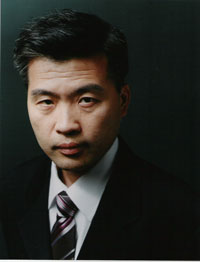
As I write this introduction, it occurs to me that the following interview constitutes my first unmediated communication with Kim Ki-taek (if we discount the technology through which we’ve communicated), that is to say a communication unmediated by a third, human, party. All of our interactions on our recent exchange to Seoul and the Korean poets’ subsequent visit to Australia utilised (to varying degrees) the services of professional interpreters and/or accommodating English speaking Koreans. We could not have done without them – not to minimise some of the Korean poets’ facility with the English language, but rather to highlight our lack of, and in my case non-existent Korean. How we were accommodated! and how I’m accommodated again in the instance of this interview, by Kim Ki-taek’s insistence that he respond in writing, in English, to my questions, allowing for our first unmediated communication. Though my formerly non-existent Korean now exists, it does so tenuously, and the only vocabulary at the ready in my arsenal (hello, thank you, I don’t know) hardly an interview makes. So with the threat of its extinction (from lack of use) on the horizon let me preface the interview in saying, and in no small way, kamsahamnida Kim Ki-taek.
As a starting point I’d like to ask you about your childhood. You are an orphan, can you tell me a little about your experience growing up an orphan in South Korea?
I had no information about my birth and my family except the fact that I had been sent to the orphanage in Anyang from the Seoul Municipal Children’s Hospital on 1961. At that time I was four years old. I heard that several poor mothers or widows put their babies at the front gate of that hospital at night. I spent my youth at that orphanage until 20 years ago. After the Korean War (1950 to 1953), orphanages were built to admit lots of war orphans. However so many orphans had also been sent there because of serious poverty.
You can find my experience of the life of an orphan in my 1960s poems ‘The Death of Cho’, ‘Sung-Hwan’ and ‘Children’s Story’ and so on. (These poems were not translated into English.)
I had to endure hunger and violence in my growth period. And I also had to bear the biased view from the people after being a grown up. Most Koreans have the Confucian thought which lay stress on the upbringing under the patriarchy. So generally the orphan was thought as the person of defective personality. So it is not easy for me to open the fact that I have been brought up at the orphanage.
And most orphan friends of mine lost the chance to go to middle school. I was very lucky to be an only boy to go middle school and high school exceptionally at that time. After that time I studied at college for myself.
In the biographical information available on you in the publication Korean Writers: The Poets (Korea Literature Translation Institute, Minumsa 2005), the ‘relationship between the body and the violence inflicted upon it’ is posited as a recurring theme in your poetry. It goes on to assert that ‘physical and psychological violence inflicted on [sic] human body leaves its mark behind, and this mark eventually manifests itself as various habits that continue to inform one’s sense of self.’ What violence, psychological or otherwise, has informed your sense of self as a person, as a poet?
I think ‘Physical and psychological violence’ is common for all the people and the living things. However I agree that my poems are very sensitive to find the ‘mark’ of physical and psychological violence of all the bodies of humans and animals. (I regret for foreign readers not to find it in my poems because of no English version of collected poems.)
In my poetry, I have observed how violence carves marks on the body, and I am interested in this process and in these wounds. The body appears in various forms including all human and living things with their words, actions, habits, and instincts. These powerfully provoke my curiosity. I have been pleased to watch and to describe them in my poems. I think that they are related to my question — what am I who lives in the body?
When my mouth waters at the sight of delicious food, when my skin contracts all over with gooseflesh at the sharp sound of a nail scratching glass, and when I feel sexual desire, my body seems to respond beyond my will. Someone inside my body seems to act instead of me. This someone gives orders to my body, and it passively obeys him.
I think there are many invisible ancestral bodies living inside my visible body. I often feel that my ancestors, who left my body behind through the long chain of life and death, are now moving inside me. I can feel the marks of their pain and delight. They seem to borrow my living body as their residence. So ‘I’ is singular as well as plural. There are ancestral life histories in my words, actions, thoughts, and habits. I continue to transform all of these possible ancestral bodies into my own, making the invisible ancestors visible through my body’s words and actions. My body automatically moves just as my ancestors did for over a thousand years.
My body is the result of my ancestors’ hard-fought survival against the threat of their surroundings. I think there are many wounds, visible and invisible, in my body. I often feel some of them – hidden in my personality, habit, and behaviour – suddenly appear. Sometimes they intensely move inside me. So I can say that I am a living relic older than any relic in a museum.
The physical or psychological violence I mentioned is general. It is not easy to clearly say what violence has formed of the sense of self. I can say that the course of my growth makes me have more concerns for this violence. I hope the good critic can make clear this matter from my works. However you can feel a little one side of this characteristic through my poem ‘Eating a Live Octopus’ or ‘Chewing Gum’.
Is poetry, the act of writing poetry itself, a ‘habit’ that informs your sense of self?
I think that my poetry writing can be the useful tool to get the sense of self. When I wrote the poems I often found that there was a magical device in the poetry to change the negative emotion or feeling such as pain, sorrow, anger or disgrace to great joy. I also found that a certain unknown emotion which troubled me inside was sometimes changed into the exciting play in the space of poetry. At that time, the identity of my invisible inner organism could be the clear image I can see. By the help of poetry I can control the negative inner power pressing my mind.
Another biographical note commends your ‘ability and determination’ to hold down a full time job whilst pursuing your passion for poetry, suggesting it is a product of your particular childhood and ultimately reflective of a ‘strong desire to belong to society’. It strikes me that these two pursuits (full time work and poetry) might be perceived to have a dichotomous relationship when it comes to the idea of ‘belonging’ to a society. Whilst the worker is fully integrated into society, the poet, perhaps by virtue of the pursuit of his/her passion remains an outsider. I guess it begs the question, is the poet and outsider in Korea?
My condition as an orphan made me go work for livelihood at the age of 20 years or so. Since that time I have worked for over 20 years at the plant or the office. Korea has small land and large population. So it is very competitive for workers to have or maintain the job. Most Korean workers are under the strong pressure to keep their job. I have worked under that condition. Of course it was the same for me. My poem ‘Office Worker’ shows most salary mens’ ‘strong desire to belong to society’ in Korea.
So poetry writing is the breath to me in the stifling atmosphere. Though my body was imprisoned by the hard work, I could have exciting experiences in the different time and the place and I could feel free. If I was an outsider as a poet in the company, it would be a happy outsider.
I couldn’t help but note the high regard in which Korean poets were held on our recent exchange to Seoul. Has this always been the case and what part does poetry play in Korean life?
I think that Korean poets comparatively have the high regards from the public. But some poetry events have lots of people, some events do not. If the events have variety of interesting contents or famous poets participate, lots of people will rush. In case of Yonhui events, it was successful. Generally Korean readers like to read the poetry books in the room rather than to hear the voice of poets or talk to each other in the reading events.
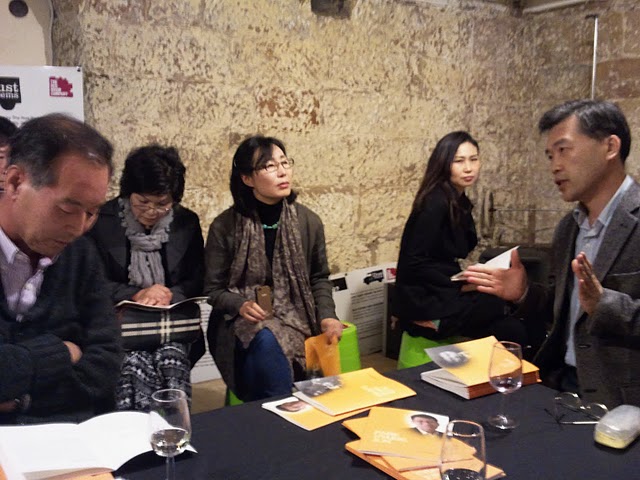
Image: Kim Ki-Taek in Sydney at the Poets Speaking Softly readings.
At the lunch we attended with the KLTI, your fellow poet Park Ra-Youn, through our interpreter, casually leant in to tell me that her first collection of poetry sold two million copies. I was gobsmacked. In Australia a standard print run for a volume of poetry is 500-1000 and if you manage to sell that many it’s considered nothing short of a miracle! Do you think this appetite for poetry, as reflected in book sales, legitimises it as a pursuit for Koreans? Or is it a generally held view that it is a legitimate activity, a respectable pursuit, no matter the number of books sold?
It seems that there was wrong communication at that time. I asked Park Ra-Youn to make sure it was true. But she told me that total copies sold were less than fifty thousand. Of course this volume was amazing too. I remember that there were three Korean poets to have the collected poems sold more than a million copies. But I do not think those poetry books had the good reputation to get the excellent literary value from the critics.
Also there was several poetry books which sold more than a hundred thousand copies and, at the same time, got the evaluation of outstanding literary achievement in Korea. Some modern important poetry books have still sold very well. So I think there are both the bubble and the respectable pursuit in this consumption of poetry books.
I’m very interested in the notion that a poet makes a ‘debut’ via first publication in Korea. In Australia we would take first publication in a journal as just one in a series of future publications a poet might pursue in his/her career. It is not, as such, an auspicious occasion. Can you talk a little about your ‘debut’ as a poet, how significant a moment it is in one’s career and what doors it opens for a Korean poet?
I have been debuted by winning the newspaper literary contest in New Year. This debut system has more than 60 years tradition in Korea. The winner’s work is introduced in the nationwide newspaper. So the new poets can get the concerns from lots of writers. By this halo effect, my works kept on introducing on several major literary magazines and to publish my collected poems.
However, lots of writers have been debuted from the literary contest of several literary magazines as well as the newspaper literary contest.
In the handful of your poems available to me in translation, I’ve noticed an inclination in your work to give great power, reach and scope to the most mundane, almost benign objects/subjects, ranging from a fried egg and chewing gum to a crevice, the “feeble void” that remains long after the solid thing around it has fallen away. I’ve also noticed an almost anaphoric repetition (to lesser and greater degrees) in some of the poems, specifically in “Chewing Gum,” with its repeats “gums which,” “gums with” that at once effect a kind of mastication in the mouth of the reader and in their repetition insist that the quotidian be given its due before we discard the thing altogether. Perhaps with some commentary as to the above, what would you say are the characteristics and concerns of your poetry?
I have partially answered this question above. So let me add a little more comment for the poem ‘Chewing Gum’.
껌
누군가 씹다 버린 껌.
이빨자국이 선명하게 남아있는 껌.
이미 찍힌 이빨자국 위에
다시 찍히고 찍히고 무수히 찍힌 이빨자국들을
하나도 버리거나 지우지 않고
작은 몸속에 겹겹이 구겨 넣어
작고 동그란 덩어리로 뭉쳐놓은 껌.
그 많은 이빨 자국 속에서
지금은 고요히 화석의 시간을 보내고 있는 껌.
고기를 찢고 열매를 부수던 힘이
아무리 짓이기고 짓이겨도
다 짓이겨지지 않고
조금도 찢어지거나 부서지지도 않은 껌.
살처럼 부드러운 촉감으로
고기처럼 쫄깃한 질감으로
이빨 밑에서 발버둥치는 팔다리 같은 물렁물렁한 탄력으로
이빨들이 잊고 있던 먼 살육의 기억을 깨워
그 피와 살과 비린내와 함께 놀던 껌.
우주의 일생동안 이빨에 각인된 살의와 적의를
제 한 몸에 고스란히 받고 있던 껌.
마음껏 뭉개고 갈고 짓누르다
이빨이 먼저 지쳐
마지못해 놓아준 껌.
Chewing Gum
Gum which someone chewed and threw away.
Gum with teeth marks clearly remaining.
Gum which did not discard or erase at all
the numerous teeth marks imprinted one over another
on the teeth marks already imprinted,
crumpled fold after fold into the small body
and made into a small and round lump.
Gum which quietly exists now as a living fossil
in those numerous teeth marks.
Gum which was not torn or broken
or mashed in the least
even though a power that tears meat and breaks nuts
mashed it again and again.
Gum which awakens a memory in the teeth of a long forgotten massacre
and plays with blood, flesh, and sickening smells
with a feeling soft as flesh
with a texture chewy as meat
with the yielding elasticity of arms and legs struggling under the teeth.
Gum which bears throughout its entire body
murderous intent and hostility for all life of the universe carved in the teeth.
Gum which teeth mashed, ground up, pressed down whole-heartedly
and released reluctantly
because they were exhausted first.
My poem, ‘Chewing Gum’, symbolically shows all living things’ desire to endure and to resist being eaten by stronger animals. Humans eventually survived nature dominated by the food chain or the law of the jungle. So our bodies have an original uneasiness and fear of being eaten or of dying. In my poem, the teeth marks imprinted in the gum may be a metaphor for such an emotion. The bodies of most living things – for example: horns, nails, whiskers, wings, hair and so on – show the marks that brute force carved on them.
We enjoy chewing gum. Gum is different from the food that our teeth mash and our throats swallow. I can say that chewing gum is a kind of game. It feels similar to chewing meat because its soft elasticity resists the teeths’ grinding. The elasticity’s power and resistance is so vivid that you can almost feel a live animal wriggling. This feeling stimulates the animal instinct, a kind of pleasure, carved in the teeth, and this stimulation wakes up and activates the ancestors’ ‘long long memory’. ‘Long long memory’ means the instinctive memory of primitive men, primates, or other things that ate living animals throughout evolution to the human stage. This is their instinct to chew other living organs to maintain their lives. Our teeth have wild instincts like those of lions or tigers that always ask to be satisfied. Chewing gum is a game that makes use of this very memory.
It seems that my poetry focused on two things. One is the real invisible power or being hidden in the visible things. I enjoy pulling the invisible being from the visible one and show it as the clear and vivid image. Second is the actual feeling or sense of realism. To do this, I would like not to let the reader ‘think’, but just to make their whole real body such as sense, emotion, feeling ‘move’ actively.
Can you list some of your influences?
There are so many Korean poets to give me influences.
* 1930s poets: Chung Ji-Yong, Baek-Suk, Seo Jung-Joo and Yi Sang.
* 1950s poets (Post Korean War poets): Kim Soo-Young, Kim Choon- Soo, Kim Jong-Sam and Ko Un.
* 1960s poets: Oh kyu-Won, Chung Hyun-Jong and Hwang Dong-Kyu.
* 1980s poets: Hwang Ji-Woo, Lee Sung-Bok, Choi Seung-Ho and Kim Hye-Soon.
* There are so many post-1990s poets I have read impressively …
I also was impressed the imagist poets of English and American poets: Ezra Pound, T. E. Hulme, H.D. and so on. And I was especially impressed by the poems of T. S. Eliot.
When we met at Yeonhui Writers Village in Seoul for our first reading, I was surprised to hear how different readings were for Korean Poets. Can you tell me a little as to your experience of poetry readings in Korea and how they differ from those you’ve experienced elsewhere?
There were three kinds of reading at Yeonhui reading events in May this year – one was a rap reading by hip hop singers, second is the poetry singing by the singer Sorri and the other is the reading by the poets. The first two readings are not common in Korea. This was the special trial. Nowadays Korean young generation have more concerns about the young singers rather than the poets. So the event sponsor would like to show the variety of exciting reading to meet the taste of young audiences. Some poets welcomed this change and other poets not.
Fusion is the key word in every field these days. You can see this example in the mobile phone. This trend is popular in the arts. Especially young generation have a lot of curiosity about this. We can relate the poetry reading events at Yeonhui to this trend.
At the initial reading we also heard the work of, amongst others, poets Shim Bo-Seon and Kim Un. Kim Un’s poetry (the youngest of the group present) was markedly different in style and tone. Would you say there is a generational shift happening in Korean poetry that is registered in not only style and tone, but also, larger thematic concerns?
Year 2000 Korean poets have remarkably changed. Their works are different to what we have seen. So they are the new issue of Korean poetry these days. Even though what are the characteristics of these poets are, their works looks very new and attractive. However there are lots of voices to blame their poems because of difficulty of reading and the lack of communication.
Where are you at currently with your own poetry? What are you working on, and are there any major shifts happening in your own work?
I think my poetry in Korea is located in the middle of traditional poetry and new wave of young poets. I do not know how my poetry will be changed and where they head for. But I can say that rapid change will not be happen in the future.

 If you’d told me in April this year that we’d still be posting content from our Oz-Ko issue in November, I would have called you barking mad.
  amphora by joanne burns
 Vishvarūpa by Michelle Cahill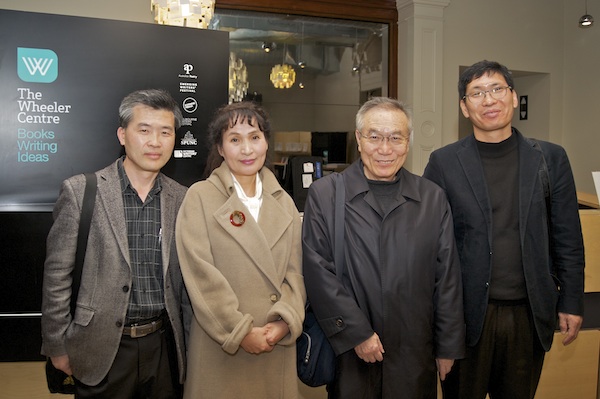
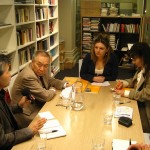
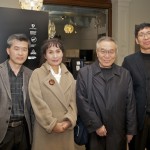
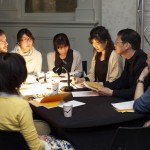
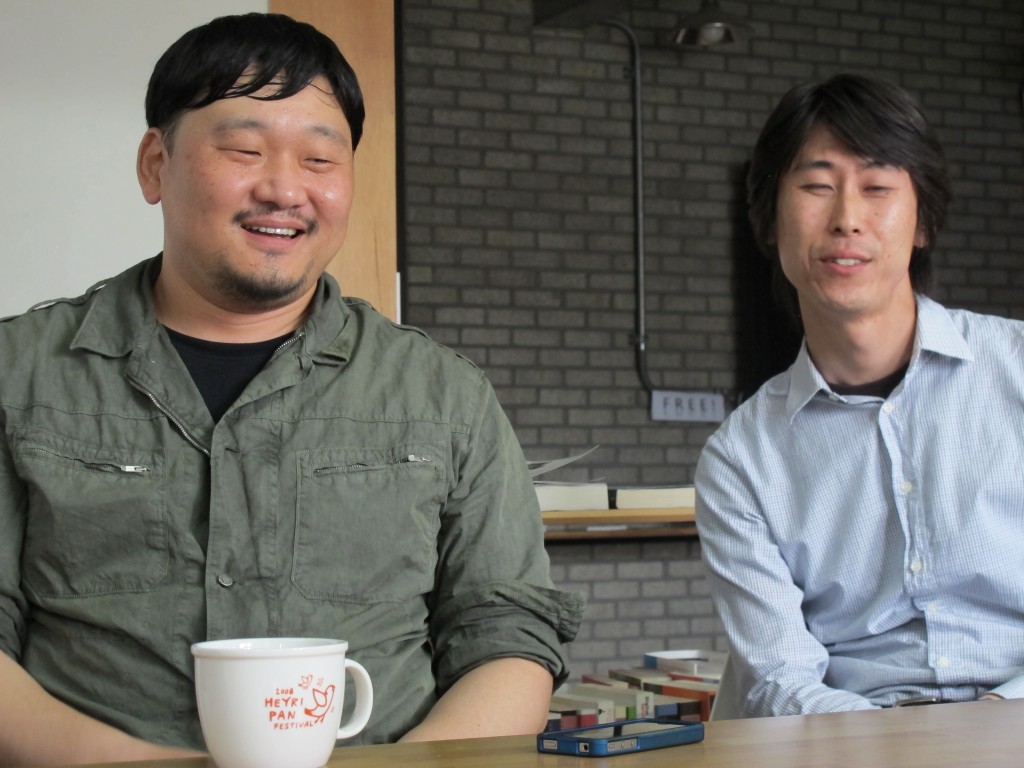 Balloon’s earned his name. He’s a six-foot-two barrel of a man with a voice that booms. He’s a giant among Koreans. A gentle giant with a wide, open face. The day is hot. His brow drips when he gets excited. Bo Yeon brings him a tissue. Bo Yeon brings water and coffee. She brings a bandaid. She watches everything with a hopeful half-smile on her full moon-face. Hyung Seok sits between them. He has a long expressive face landscaped by a strata of old scars. His hands are delicate and when he talks his fingers make tiny sculptures in the air.
  Letters from Ausland by Louis Armand
 This Floating World by Libby Hart
 Family Room by Yasuhiro Yotsumoto
 Ashes in the Air by Ali Alizadeh
 Out to Lunch by Andy Kissane
 Apocrypha: Texts Collected and Translated by William O’Shaunessy by Peter Boyle






