Geoff Page Reviews John Kinsella

The Vision of Error: A Sextet of Activist Poems

The Vision of Error: A Sextet of Activist Poems by John Kinsella
Five Islands Press, 2013

John Kinsella’s latest foray into what has become known as ‘ecopoetics’ raises many more aesthetic and political questions than can be resolved in a short review. As in his Divine Comedy: Journeys Through a Regional Geography (2008), Kinsella makes vivid and considerable use of autobiography. He and his family are presented as embattled eco-pioneers in a region already much destroyed by bad farming practices, partly multi-national in origin, and roamed over at will by township hoons ready to shoot up anything that moves.

Continue reading

Posted in BOOK REVIEWS | Tagged ,

Spoon Bending: A Chapbook Curated by Kent MacCarter

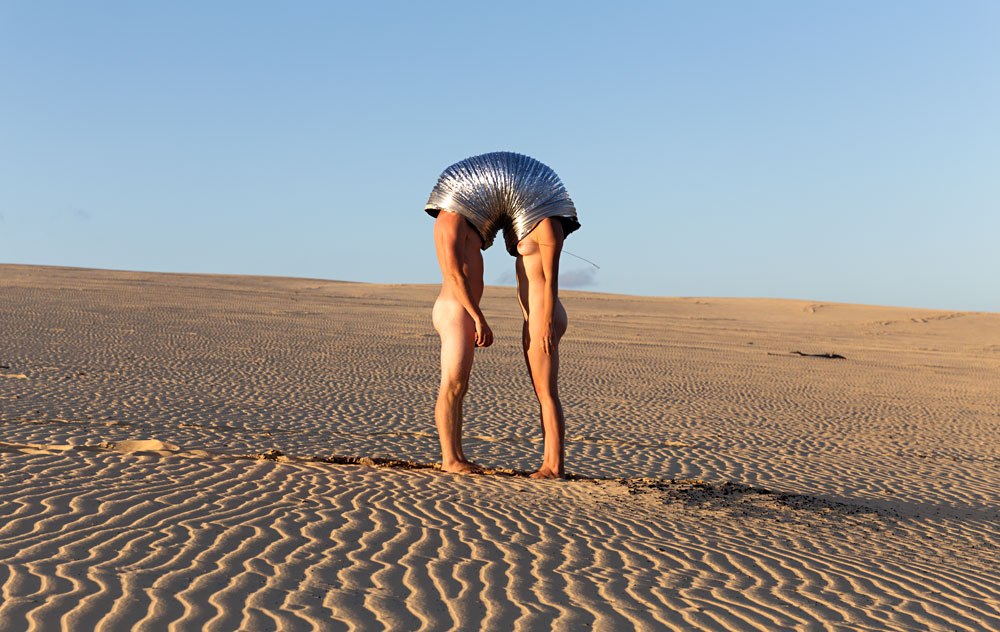
A Precipitation of Fallen Angels Conjoin | Hannah Raisin and Will Heathcote | Archival pigment print | 75cm x 50cm

There is No Such Thing as a Good Poem about Nothing


Nicolette Stasko: Sendai
Tracy Ryan: Companion Poems    from the French
Elzbieta Wójcik-Leese: everything in the garden
Jane Gibian: Waiting
Jennifer K Dick: CERN 43
JS Harry: A Good Idea
Susan M Schultz: from _Memory Cards_
Vona Groarke: How to Name a City: a Dual Approach
Lee Kofman: The Allure of History

Dorothea Herliany: Metamorphosis Drumming
Berni M Janssen: (untitled)
Jodi Braxton: Circles
Amanda Stewart: cannes f. fest 21C
Elif Sezen: Their Bodies
Elena Gomez: soma dear
Gig Ryan: Tide Edit
Ingrid de Kok: Found Names


There is no such thing as a good poem about nothing? What does that mean, exactly? And what’s all this about spoon bending anyways?

Not long ago, Australian literary critic Andrew Riemer slept-walked through the writing of his take on Best Australian Poems 2013 (Black Inc., 2013), edited by Cordite Poetry Review’s Feature Reviews Editor, Lisa Gorton. In his review of this most recent volume of the annual institution, Riemer lurches around the pachyderm – or one of a small parade – in his writing room, then coaxes it out to greet the reader midway through his assessment: ‘Apart from poems by several older, well-established poets – Les Murray, David Malouf, Vivian Smith, Geoffrey Lehmann and Thomas Shapcott, among others – most of these poems lack distinctive voices, a poetic sensibility, in other words’. If that isn’t a trunk-full of mucous water sprayed right in the kisser, then nothing is. His words seem to attest, then, that Australian poetics is / should still be defined by the storied careers of a few older, mostly white men (and a few women) … or, at least, his review supports the existence of such a lens that’s been ossified into place from a few vantages around Australian letters.

Irrefutably, the writers Riemer mentions have made and continue to make an enormous and significant contribution to Australian poetics. But, as the Best Australian Poems 2013 presents so well, there are a few well-accomplished whole generations of poets sharing this grand parade – including new poets right now, a most exciting bunch, many with generally perpendicular approaches to poetry than the aforementioned legacy poets. Riemer’s assessment of the anthology then ricocheted – via quite an arresting display of (con)textual ‘physics’, in high dudgeon and 3D! – clean off the surface of one of Australia’s most important indigenous poets, Lionel Fogarty, deeming his poem to be ostensibly ‘meaningless’, instead of representative of the deft post-colonial narrative origami that is Fogarty’s mastery. Entitled to opinion? No, I don’t believe in that. I prescribe more to the entitled-to-what-you-can-effectively-argue-for school. Consider these opening lines from Fogarty’s poem ‘Induct True Legendary Thrills Bravery’, included in Best Australian Poems 2013:

Bravery captors medal heroism circulate mission leftovers
Bravery tracks the saddle that throws sad off backs as
Honour full bloods across country’s rescues
Replica escorted stream afield sees gallantry

Riemer did not effectively argue these exemplar lines to be ‘meaningless’ (in fact, he made no attempt at all). What struck me most acute about this review-as-provocation was a response to the review itself; arriving as it did via Melbourne poet Bonny Cassidy on the Puncher & Wattmann small press blog a few weeks hence. In her reply to Riemer’s review, Cassidy wonders:

‘Seriously, when are we going to accept that poetry, like painting and music, may represent ‘patterns of utterance’ rather than figurative lines? Riemer seems to suggest that poems that ‘do not yield sense in conventional discursive or grammatical terms’ are so radical that they escape ‘literary or poetic tradition’.

‘Patterns of utterance’ – primal and archaic – Riemer chalks this up as failure. Yet Cassidy’s jujutsu reply is sound. Astute. Succinct. Tart. Deserving … and not altogether un-damning. I’ve spent years trying to proffer this exact question as well as Cassidy has. US poet and esteemed teacher, Theodore Roethke, put it a more florid way, ‘You’ve got to have rhythm. If you want to dance naked in an open barndoor with a chalk in your navel, I don’t care! You’ve got to have rhythm.’ Patterns of utterance = rhythm.

What, indeed, might Riemer make of Mark Rothko’s Sacrifice of Iphigenia, 1942, let alone the later No.4, 1964? Congruent motivations can be applied to poets as Rothko once wrote of painters in his famous letter to the New York Times – rebuttal to a poor review and co-written by Adolph Gottlieb and Barnett Newman: ‘It is a widely accepted notion among painters that it does not matter what one paints, as long as it is well painted. This is the essence of academicism. There is no such thing as a good painting about nothing. We assert that the subject is crucial and only that subject matter is valid which is tragic and timeless. That is why we profess a spiritual kinship with primitive and archaic art.’ The wide gulch, then, is Riemer mistaking something for nothing (‘more than ink on a page’, as he couched it) – in a number of the poems Gorton included – at base levels due to the near dearth of conventional discursive bridges linking those ‘some things’ together and failing to recognise the conduit that funnels abstraction into concept.

If we strip away the technology of lyric, we are left with the archaic. As Australian poet Peter Minter says in his introduction to ‘Proteaceae: A Chapbook Curated by Peter Minter’ for Cordite’s GONDWANALAND issue, and in referencing Australian painter John Wolseley:

‘Wolseley’s artwork shows how plant species such as the beautiful red waratah … have archaic affinities with similar species around the planet. This profound geo-aesthetical encounter reminds us of an embedded planetary and genetic inheritance that, despite the complexities of our technologies and linguistic apparatuses, is always and unescapably experienced ‘in common.’

The plug of Minter’s elemental ‘archaic affinities’ elides perfectly into Rothko’s ‘primitive and archaic art’ socket – the connectivity produces art, no adaptors are necessary (but optional, and interesting, so go for it you want to). How did this imbalance, the perceived sophistication of one approach over the other, become so entrenched? Or are Riemer’s thoughts the sinews of a loner puma? Perhaps. At any rate of conjecture, Australian poetics – or at least the expectations of it from a wider literary audience – feels to be slowly snapping out of its generational-ideological imbalance toward a trued scale. For this chapbook, I’ve asked writers from a number of other countries to contribute.

So, in hypothesis, what would a kindred holder of Riemer’s conclusions on art think of Olivier Assayas’s Irma Vep? Kraftwerk’s Autobahn? Michel Butor’s Mobile? Amaranth Bosruk’s ‘Between Page and Screen’? Kurt Schwitters, anybody?

Returning to Cassidy’s question, ‘… when are we going to accept that poetry, like painting and music, may represent ‘patterns of utterance’ rather than figurative lines?’, I got to thinking – thinking about spoon bending, about the nature of words-as-objects and how words’ multiple definitions, idiom and pronunciations distil as a unique ‘atomic mass’ of sorts, bundled with a litany of alchemic delights. Can a story also be told from the lexical reactions made simply by placing seemingly disparate words near each other? Might they reverberate and hum when they become too near? On one plane, perceptibly nonsense; on a sub-plane, potential chemical fusion; and split apart from either plane, fission? Arguably, yes. Is this kind of narrative as worthy or rigid a discourse as those reliant on lyric? I think so, but the onus clearly shifts significantly away from (but not entirely) the infrastructure of a given language and settles squarely on the writer, the spoon bender, to harness and corral the developing poem’s force as she sees fit (incidentally, if The Portuguese has a subway, let me loose with tokens to ride). These are not new questions. But the problem remains: the legacy class of poets in Australia doesn’t seem to have much time for one of these two (generalised) approaches. Or perhaps the leaky beaker exists only in the experiments of certain reviewers?

Indeed, the hybrids of these styles – conventional discursive v. patterns of utterance – appeal to me a great deal (as do many poems that shake out more like 95% to 5%, from either endpoint). Consider these seven lines beginning ‘Georgia talks to a painter’ from Australian publisher and poet, Michael Brennan’s recent book Autoethnographic, an engrossing collection I am well overdue to deliver a review of to a fellow journal:

The way spirit tracks, in brushstrokes or words,
you’d have Buckley’s of getting it right, sensing
how out here light does not fall. Waves of images
fill you so there’s nothing but to paint, though
you don’t like it, this country that’s in you, the
red dust coating everything in one place or the
granite now, beneath your feet an island, quartz

I am especially bewitched by the invocation of the term ‘Buckley’s’, itself a classic Australian truncation / amputation from ‘Buckley’s Chance’. All Australians know what this means, and I’m going to leave it at that … but are any of you readers abroad piqued enough to research the massive idiomatic gravity so adroitly slotted into place here? I hope so. It doesn’t require much research.

For this online chapbook, I have intentionally included works that plot point along the full arc of the hybridisation I mentioned earlier. Adding to this solution, I have included translations of the originals (or vice-versa) for an extra layer of phonetic consideration and socio-definition. Russian, Turkish, Bahasa Indonesia, sprigs of Danish: combined with English, the tongues dissolve into a common blood of verse. These poems do not represent rigid binaries of approach, rather I aim to continue the discussion of a polyvocalic literature that spans generational governance – technologies, linguistics, poetics and patterns – of what a poem can be.

Posted in CHAPBOOKS | Tagged , , , , , , , , , , , , , , , , , , , , ,

Galah

Eolophus roseicapilla

when car tyres were tall
you cracked a galah’s neck
in a ditch because you’d
hit it with the car but
it wasn’t dead so you
cracked its neck in a ditch
out of mercy you cracked it’s
neck and all I can hear
is the crack of its neck with
the crunch of sinew and all I
can smell is hot tar and all
I can feel is how quickly
the bird’s skin cools
through the prickle and soft
soft down of the bird’s
feathered neck

Posted in 61: NO THEME III | Tagged

Clarity

I have seen through the allusion

captured its light

that makes diffracted patterns,

meiotic and zygotic,

inside my instrument of witness –

a kaleidoscope I hold up

while pretending

it to be

a camera

Posted in 61: NO THEME III | Tagged

Fairy Penguins

at the corner of the coast we leave behind
a crossroad of island & mainland
walk the jetty with tea & sandwiches
settling on a narrow shore

a stray sentence begins & ends in the
margins of rock & sand,
grouped pine trees hug the foreland,
tufts of grass filter down on limestone

Penguin Island is Joie de Vivre,
bottled-nose dolphins, sea lions, the informed
reveal of penguins as seabirds who cannot fly,
who shy away like full stops from poems

children demand their attention, a noisy
thrumming persistence — we walk
facing the sun with office workers, musicians
the star attraction, pairs huddled into trellises of rock

rangers answer questions with torchlit marks
fish? mammal? the forces of people
in an open cage? such forces chatting on mobile phones
the hubbub of sinewy language in a factory thrum
— people — finding at last a pair nested in close
a narrow window compressed into rock – so alone!

the beginning is an end to their search
shadows tilt on tiny faces, the cave an arbitrary height
forces dark silhouettes further in — two creatures
inviting clear reasoning for tourists, to walk back along the shore
to a swell of waves on the western side, beach & tarp,
a swim & the mind’s industry churning thoughts of
we’ll catch a wave before lunch

Posted in 61: NO THEME III | Tagged

Poems from Mystes

1.

à Eva-Maria Berg

Je suis né
dans un pays de neiges
et de cendres

Pays où l’on n’arrive
Jamais.

Et que jamais,
on ne quitte ni ne connaît
Pays d’où personne ne vient,

le soleil croît
en larmes de cendres,
débris de neiges noircies
et d’âmes englouties
dans l’étincelle
des silences enfuis

Je suis né – ici,
ainsi que naît la peur.


2.

À la limite extrême
des mondes abandonnés
se produit le son
d’étoiles amères
égarées sous la voûte
de nos corps enfermés

Alors
la lune s’enroule
aux lisières tranchées
de veines de granit

où luit la parole
des épaves glaciaires
échouées sur la grève
de nos vies


3.

Silencieux
un morceau d’étoile

me regarde
à travers les cailloux
de pluie

l’heure approche
de lui tendre la main


1.

for Eva-Maria Berg

I was born
in a country of snow
and ashes

A country where one
never arrives.

And one
never leaves, never knows,
A country where no one comes,
where
the sun distills
tears of ash
the debris of blackened snow
and souls swallowed up
in the sparks
of retreating silences

I was born—here,
just as fear is born.


2.

At the extreme limit
of abandonned worlds
the sound of bitter stars
is heard
wandering beneath the vault
of our cloistered bodies

Then
the moon enfolds
the borders carved
from veins of granite

where the word shines out
from glacial rubble
abandonned on the strand
of our lives


3.

In silence
the fragment of a star

eyes me
through the pebbles
of rain

the hour is coming
to hold out my hand to him


Posted in 61: NO THEME III | Tagged ,

Cinquecento

The house received all ornaments to grace it,
The walls were of discolour’d jasper-stone,
One window shut, the other open stood,

The time is come, I must depart
My last thread, I shall perish on the shore;
Ring out your bells, let mourning shows be spread;

Close the Truncke, embalme the Chest,
You should not trust lieutenants in your room,
Or hawk of the tower:

Sir Charles into my chamber coming in,
Fillet of a fenny snake,
His chilling cold doth heat require;

Oh, what a lantern, what a lamp of light
Avising the bright beams of these fair eyes
Where Muses (like bees) make their mansion.


†a cento; sources: ‘The Description of Cooke-ham’ by Æmilia Lanyer, ‘Hero and Leander’ and ‘Elegies,
Book One, 5’ by Christopher Marlowe, ‘A Communication Which the Author Had to London, Before She Made
Her Will’ by Isabella Whitney, ‘A Hymn to God the Father’ by John Donne, ‘Ring Out Your Bells’ by Sir
Philip Sidney, from The Countesse of Montgomery’s Urania: “Love peruse me, seeke, and finde”
by Lady Mary Wroth, ‘The Steel Glass’ by George Gascoigne, ‘To Mistress Margaret Hussey’ by John
Skelton, ‘An Epilogue to the Above’ by Duchess of Newcastle Margaret Cavendish, ‘Song of the Witches’
by William Shakespeare, ‘New Heaven, New War’ by Robert Southwell, SJ, ‘O’ by Mary Sidney Herbert,
‘Avising the Bright Beams’ by Sir Thomas Wyatt, ‘Sonnet 17’ by Richard Barnfield

Posted in 61: NO THEME III | Tagged

Hansel’s Way

for Lisa J

1
‘Breast?’
Birthday boy, Hansel (milk-coloured, three),
lisped his request, hardly refused before then.
But it seemed the world was turning

on me – and my walking, talking suckling.
‘Will you breastfeed on his buck’s night?’
Jack’s mum pretended support, pretended
polite, as the play-group Gerties giggled.
Cows!

I burned, long after
the candles were spat on. Party over,
I poured myself into my bra
and Hansel forgot his attachment.

2
Look at him: lanky.
I can’t remember his last
laughing leap into my arms.
Had I known that moment
contained a final armful of boy
I’d have held on longer.

3
The not in my throat, thick and growing,
squeezes words from the knot in my neck.
I say, ‘How will you know your way back?’

Hansel flashes his fourteen-year-old smile
and laughs as he shows me a new bread roll.
He says, ‘Worry not, Mother! No need
to remember. I’m laying a trail.’

He sees the sky sunny; I see it grey
with seagulls and sparrows
whose insides are hollow.

The worry-knot in my chest finds its rhythm.

Posted in 61: NO THEME III | Tagged

Dream Diary – Tuesday and Wednesday Night

Tuesday night I dream
I go to an all you can eat
restaurant. The waiter says to take
a seat and brings out large platters:
pastries, chicken and potatoes.

Extra food keeps appearing on the table:
schmaltz and fishcakes that my sidekick brings
out from her many bags. The waiter rushes
past, sets down an ice cream sculpture
in the shape of Macbeth’s head with a clatter.
‘After this you leave’ he says, noticing all
the extra food my companion is adding
to prolong our stay. We eat and eat.

At the counter the waiter writes the bill: $13 041.
My friend takes the bill and writes
a big 0 on it. The waiter says ‘this is NOT
on the house’ and she writes
the 0 again. The waiter shows us a form
to say we are banned from going
to that restaurant again. Wednesday night
I dream my psychiatrist instructs me
to wrap my feet in parsley.

Posted in 61: NO THEME III | Tagged

On the Windswept Bridge

I walk across the bridge
for the pleasure of walking across the bridge,
daring the wind to pluck me up like a bird,
make me a cloud in its mouth,
transiting the boundless high
camino of unearthly blue,
morphing to a golden fetish
of the sun when day is through.

I cross the bridge
for the pleasure of striding
over ingots of gold light,
frisked by air’s invisible probes,
adrenalin channelling helium.

I do not resemble Hokusai’s women,
robed in ornate kimono folds,
clattering in high-runged clogs
with mincing gait to appear demure.
Above the diamond-python river
I quicken pace as the wind leans closer,
loosening hair, unfastening laces,
lifting my skirt, an impatient lover.

Posted in 61: NO THEME III | Tagged

Dakota

The first time I saw
the building
was from the hop-on hop-off bus
glimpsing Strawberry Fields
as we headed for 9/11
& the Soup Nazi
I looked for Yoko
with a shopping bag
and was disappointed

This time I walked through
Central Park dodging nannies
Designer Dogs
Yummies doing knee bends
leaning on prams

Randoms
were having photos taken
on a mosaic mandala
Shrine with the title
of his song inlaid

Early autumn
Winter nowhere on the horizon
it was impossible
to imagine a psycho with a gun
Wonked brain going
for a blood-splattered run
Letting it right off the leash

A John lookalike was playing
his twangy thang
A blackbird flew out of it

Posted in 61: NO THEME III | Tagged

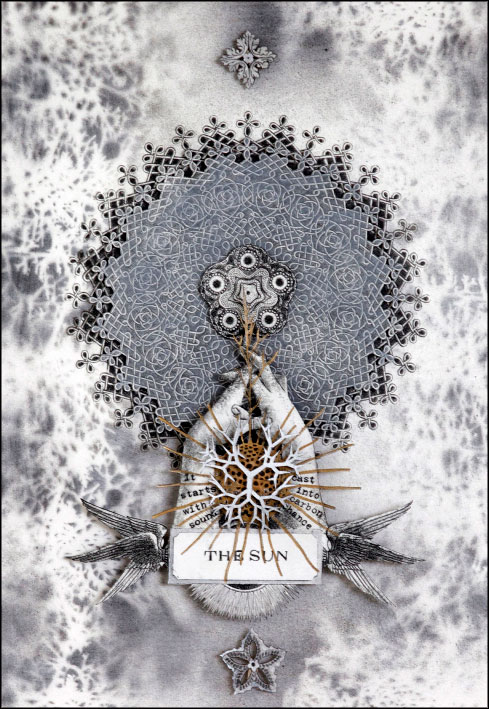
The Sun | Beneath the Cathedral

The Sun


The Sun

we make ourselves
stories bright as fire
from teeth and stone and
feather

*
‘in all poetry a word is like a sun’ – ernest fenollosa
*

it starts with sound
a seed
a stone
cast into carbon
chance


Posted in 61: NO THEME III | Tagged ,

Procrastinate

The swinging curvature
of a feather as it falls
through the air
(escaped from my pillow; I lie across the bed
tired as the afternoon)

Posted in 61: NO THEME III | Tagged

Poetics

read the poem many times
wasn’t sure i liked it
a bit landscapey
like walking west at sunset
not deletionist enough
too bound in boundedness
probably best viewed at random
kind of poem that doesn’t return calls
but nevertheless keeps talking
with its heavy mouth
as if silence needs feeding
poem written but not coded
no anarchy postcard
trying to tune the light
rather than lick the room
or trying to lick the room
rather than tune the light
too many free hits
not enough chanting
or maybe i’m just reading out of my depth?
maybe i fail to see its wild seed
or things i don’t want to see
looking in at me
maybe this poem’s
the very beginning of beginning?
wait here
i’ve gone to get help

Posted in 61: NO THEME III | Tagged

Routine Transfer (Maternity Ward, 1983)

The woman whose baby died at birth
sits in the wheelchair waiting for the lift, a drip
in her arm. A nurse stands beside, in charge

of drip stand and suitcase, her eyes
on the woman’s grey face. She pictures
the textbook womb, curled-up baby

scooped out, the woman hollowed. This
is no routine transfer, it should be
funereal, a silent procession to the ward.

Another nurse stands behind, ready to push
the chair into the lift. She talks
of tonight’s date, her new winter boots,

asks if it’s nearly lunchtime. The nurse beside,
her face hot with shame, watches the words
pelt like hailstones on the slumped body.

Posted in 61: NO THEME III | Tagged

Foliage and Grace and a New

foliage and grace and a new
cup and saucer, a laugh and a
lip and a laid climb sudden
and at the same time
patient and staring and
too late and later all this and not ordinary
noise and distance and even dust
spitting and perhaps washing
and polishing the lamp and the
cake and a sweet singing
trimming by length and
by doubling in the stem
and in starting it
shuts and it lifts the six
and the seven, a glass
and a cousin, the bug and the
post, nearer and farther
a meadow, a stroke
astonishing
and difficult in mercy and in
medicine, a lining
and the shape, the cut
and slender joint, concentrating
the illusion and the illustration and soap
and silk for cleaning, readiness
and eyesight scatter and scattering
are guided and guided
away old ladies and mild
colds, a sweetness and some of
that, a whole sight and a
little groan and sometime a collapse
and a sold hole, habitual and tyrannical and
clean and cleansing and sometime next best
nearest a pillar a cause and no curve and a hat
and hurt, and courage and a clock
and matches and a swan, three
and more and no more
than three, a red thing and a
white thing, noon and moon
leadish
and nearly set in


I made this poem first by tabulating a Gertrude Stein text, ‘Objects,’ from her Tender Buttons, in a
spreadsheet. The spreadsheet’s functions were then used to locate mutually overlapping verbal
rhythms and syntactic repetitions. I manually arranged the resulting fragments in order to accentuate
the further correspondences they shared – but found repetition generates its own differences.
This poem is extracted from a set of 24.

Posted in 61: NO THEME III | Tagged

Postcard to a Sibling

‘my love letter to the planet’, Sebastião Salgado,
Genesis, Natural History Museum, 2013.

i.
I perused the shimmering images of Salgado,
chiaroscuro palettes of black and white:
penguins cormorants whales sea lions,
volcanoes the Antarctic glaciers of Alaska…
afterwards, I chose a postcard of African elephants —
then back home in Australia
I leant it against the photo of my father
and the carved elephants he brought back from war.

ii.
I recalled the house of childhood the sounds,
back-drop of war — his portrait on the dresser,
khaki uniform how the light stroked his brow,
chink of teeth his smile,
the row of elephants alongside and, on Sundays:
silver cutlery on crisp white damask,
the meagre roast,
grown-ups’ stories of the black-out, ration books,
nurses and hospitals, underground shelters, the blitz,
the silences.

iii.
in winter, we scattered toast crumbs on snow,
then indoors, beneath a table, its folds of dark cloth,
we looked through the cold glass of French doors:
sparrows blackbirds specked the whiteness —
the room droned with the voice of BBC news.

iv.
today I will buy a stamp for the postcard,
write nothing but my name —
she will remember.

Posted in 61: NO THEME III | Tagged

Pollard

Do they still pollard the trees in Tokyo?
Here in obfuscating avenues too much is left to grow.
My daughter visits: she cleans my teeth,
wraps me in mohair battening
my ankles to the wheelchair.
Her breath is warm in my ear
heaving as she pushes up the hill.
My head thrown back to the foliage-matted sky.
Impatient of their green hemmed frame,
I see the clouds hurry by.

Lunchtime walkers smile at her,
they know they mustn’t identify with my
aged skin and unleavened inscrutability.
The Chinese tourists are of a different category
Ni hao: yes they may have my photograph.
I pose to ensure I rest, some creased old man,
on slit-eyed mantels unhewn for posterity.

My daughter loiters with her eyes,
that beckon me to speak of nights hunkered
on canvas stretchers in the overhang of alang alang,
or of the trinket boxes I carved from coconut shell.
In Rabaul we were sick on grub cooked in ten-gallon drums,
in huts thick with dysentery, dengue and beer.
I can no longer hand out memories.
The crow demands and never says thank-you
but we are not in Tokyo—here there are only peewees
whose plinking interests me—so neatly sung in unison.

My son visits on Sundays and joins the dinner table.
In this place his wits are clear,
top man—he may give a speech.
I watch him amongst the dribbling and crumpled residents—
amongst dirty wheelchairs and orthopaedic cutlery.
His thoughts scattered in realms like wheat for chooks,
clods, shaken from sheaves of downy thistle.
Is it black there too? I want to ask.
I am glad the birds will start at five thirty—
and enthusiastically.

The pollarded trees in Paris are persuasive,
and more brutal than Tokyo, their limbs contorted
like prize fighters, sallying in rows.
They murmur in the wind and I have joined the whispering
it is lonely if you go but no different if you stay.

Posted in 61: NO THEME III | Tagged

Rallying

At twelve I was sure. This body
would belong, even briefly, to no other.
I had watched my mother
with my sister and I, the two
children that were meant to change
her life (we changed her life),
and it did not look enticing. The days
had an edge to them, and I remember
it not like a knife, but something
blunter, something that scraped,
and was rusted, and hurt
in a slow and dull way that rarely
showed. Sometimes I wished
for blood, as if that would make it easier.
Bruised. We were all bruised.

Her voice was this beautiful thing, low
and strong but with a break. She insisted
that she couldn’t sing, but she did. She sang
me into each day, and carried me through
the night. Language that tore but also
soothed, her voice, the tone of her, running
through my lymbic system, coating my amygdala,
teaching my cingulate cortex about pain.

But sometimes we’d put Buddy Holly
or X-Ray Specs on the record player,
the plastic arm hooking across, the needle
coming down to rest and crackle across
vinyl, and sing, and dance on the floorboards.
Six feet banging down, chalk dust
and crayon crumbs flying up, and over it all
her reaching voice, that cracked on the no more.

It was 1979, and we were blonde girl children
with a mother who was cracking, yelling
bondage up yours and jumping off
second hand couches like we could fly.
It was 1979, and my mother was writing
for Spare Rib and wearing overalls
and gymboots and smoking rollies
and taking us to rallies.

We swam naked in the Hyde Park fountains
after Land Rights marches. Cold brown water,
one cent pieces glinting on the concrete bottom,
too far down to reach. The feel
of a metal turtle back between my five year old
legs, cool and hard and round. Balancing
on a turtle shell and dangling my legs
and looking up at the fig tree canopy, so green,
with the sun on my back, and looking over
at my sister dog paddling to the edge, her hair
gone stringy, so blonde it was almost white.

Don’t think it was all bruises and cracking. There
were moments like these. There were always
moments like these: metal, and sun, and green,
and cold to the knees, and later water
and apples on the bus home,
and my mother smoking (because
you could then), and us rolling up our white and purple tickets
and pretending to do the same.

Posted in 61: NO THEME III | Tagged

Using Protection

Titanium is designed to withstand
all kinds of weather – fire-storm, alpine chill,
space shuttle’s lonely encapsulation.

Double glazed windows mute the shouts
of revellers disgorged from corner pubs,
door and window grilles protect
from pecuniary visitors.

Zoloft keeps your sanity secure
Lipitor strengthens artery walls
ocean’s tympani soothes
night’s unfailing malaise.
Wine sedates; fears
of intimacy are cured
by distance and solitude.

Furious seas keep outsiders at bay
graves withhold the names of their dead
razor-wire ensures that children cannot escape.

Posted in 61: NO THEME III | Tagged

Movie

Who knew we’d like the same movie,
Lost in Translation? You brought the DVD
(which, in the end, we never watched together)
to the hotel room, along with cigarettes,
tidbits, and other paraphernalia
to heighten our play; barely stuffing
the holes of silences that widened
the closer we got to realising we had
little in common. Yet when we played,
the way you touched and not touched,
kissed and not kissed, like a child
who had entered fire and was terrified
to meet it again, a light
flickered within me like inside a dark room.
When things didn’t work out between us,
the last moment from the movie
unreeled in my mind, when Bill Murray
embraces Scarlett Johansson in a crowd before
they’re forced to part, whispering in her ear
words the audience cannot hear; I wanted
so badly to know what he said I could cry.

Posted in 61: NO THEME III | Tagged

RSVP

You

Seeking a relationship with a Psychotherapist

My current relationship status Hyper-vigilant

My height Reduced

My body type Venus flytrap

Do you have children One previous episode

My Personality I like it when you smile, I love it when you don’t

My hair

My eyes A colour that doesn’t run

My desires Citrus fruit but not in a weird way

Religion Marked obsessive traits

Pets Mild panic attacks

Zodiac sign Cipramil

Posted in 61: NO THEME III | Tagged

Directions

Karinjini by way of Kataby, Geraldton, Dongara, Carnarvon, Exmouth; by way of the Brand; by way of driving out at midnight, by way of fences and flametrees and bardi; by way of moonlight and the dog-star, the cross and Corona Australis; by way of four am, by way of bone silence, by way of somnambulence amid truckies and road-trains; by way of midday in the banana fields; by way of midnight in the campground; by way of hollowed and halved water receptacles bearing wine, by way of pretensions, of West Cape Howe, Leeuwin Estate, Pendleton; by way of air-mattresses; by way of song of burrowing frogs; by way of days at the beach, the sea, the ocean, the Indian, the blue, the deep, the coral, the bungies, the reef, Ningaloo; by way of the wobbygong, escaping by way of currents and belly-up, by way of floating, by way of Turquoise Bay; by way of salt-grit in your hair; by way of saturation, of summer storm, by way of tents with broken ramparts; by way of electricity, of lightning; by way of the dunes, the thunder of sand, an inland tsunami; by way of your fingertips, cold cracking metatarsals and callouses; by way of tires, by way of gravel roads, by way of rust in the undercarriage, rust in the red-dirt, rust in the sunset; by way of fraternization in the long-grass; by way of fish-n-chips in Dampier, by way of the peninsula, the salt isthmus; by way of the boab; by way of turning inland, turning inward; by way of distance, the peaks of Mungaroona Range, the decay of Maroona Iron Mine; by way of wild donkeys, lost camels, far-off dingoes, gnarled goannas; by way of track; by way of Bee Gorge, Kalamina Gorge, Yampire Gorge; formed by way of Dolomite and Mount McRae Shale; built by way of granite, by way of tessellations and the fractal of mineral sands; only seen by way of the microscope, overlooked in the rear-view mirror by way of your eyes, the iris, the retina; by way of mistaking your tongue for the milky way; by way of waking to red dust on skin, ochre touch-painted; by way of hiking to Kermit’s pond, the cool of water in desert; by way of packing-up; by way of defenestrating apple-cores at 140kmph; by way of racing utes to no destination; by way of signs counting down 800km to Perth, 700 km to Perth, 600km to Perth

Posted in 61: NO THEME III | Tagged

After Mutability

Perhaps the best cells are the ones we can’t kill off,
a persistence of the fittest, although mutation’s
always painful. It’s two thousand and fourteen,
and I know no-one who has been
uninjured. It thinks in me,
this shadow. I put on sunscreen, and am surprised
to come in contact with my skin. In the same day,
I’m chatted up in a café
by an aspiring novelist who’s using boldface
and an ugly font, and the woman I pay
to tear the hair out of my legs offers a discount
because my skinny limbs
won’t need much wax. In the same day,
I watch a woman in pink boardshorts
hold out white bread
for a spring-loaded terrier,
an ancient cyclist on City Road with bubble wands
mounted on his handlebars, although they say
this place has gentrified: mutation’s
never simple. I dream my top teeth
splinter, turn to chalkdust in my mouth:
so I am in the world’s gaping jaw.

Posted in 61: NO THEME III | Tagged