Stormy Night

I think of you like a storm remembered—a marker in my life
Stalking my dreams and my memories like a phantom
Your neck a young brown sapling dancing in the wind
The wind-tossed fury of your hair
Your laughter, the swollen burst of flowing streams
Your smile, the silver lining of a dark day.
Still, my heart thunders with your name
Your face flashes in my mind, your body extended
like a branch of light in the bleakness of my life.
You for whom my heart yearns
Like a warm blanket under stormy skies,
You for whom I sigh myself to sleep
at night beneath the sheets
And when the storm clouds burst
You for whom I weep.
Posted in 81: NEW CARIBBEAN | Tagged

Beyond the River Road

(On observing artists Ras Akyem Ramsay and Ras Ishi Butcher in a van stand)

You had to look close, as close as yuh hand.
And you had to look way beyond to see them.

They not resembling any kind of Lord: Time, a-leaping or otherwise—yet they strode dimensions. You had to see them tekking on the River Road, shaving its edges; throwing all comers, all goers into shade—the homeward-bound, the outward and unbound, stragglers, strays; quieting the flippant pigeons and the flapping flightlessness of school-chil’run, mudda’s milk still dripping roun’ dey open, force-ripe mouths. They smoothed the blurred lines of tourists, smiles as taut as budget strings, and quelled the van men failing (yet again) to mind their own backsides, looking to scale a fuss up to a fight—mista policeman nowhere in sight—and the sun, badman at his own fete, stirring up the cuss and spite. Like he following a script.

One a dem carried a stick, carved—or maybe it was a length of cane. Yuh had to look good to see the heads angled in reasoning; reckoning. And they moved as one across that jukking stage, locs melding into torsos, melding into arms and legs: Two bred’ren dred with ways and means crammed into their backpacks; African Jedi, black Samurai striding straight out of their own secrets and dreams. And they looked like they were plotting. And it looked like the plotting of a tearing down of walls. But it looked like the urgent erection, first, of those fated walls; or before that, the planting of trees to meet beneath to wage campaigns to fire the bricks to build those self-same walls. And it looked like a bleeding. And it looked like a tidal wave of river-sea-ocean-stream. And it looked like flashes of forgotten forest and distant hill and vanishing field; and a mix-up, mix-up of earth and clay and coral limestone and sand and skin. And it looked like the crisp, Falernum light of dawn or the badman rant of a sun in a van stand gone midday; the thick mauby of afternoon. It looked like flaming sunsets and a sacrament of blood moons and blue moons and no moon and midnights—all of it, leeching into the streets to pigment the winds. And they looked like they were ready. And it looked like they were poised to lore themselves into the soil before our very eyes.

But you had to look good because they did not linger. They moved like apparitions of blood, of flesh, of sinew. They did not steal the foreground, just owned it for a moment, threw the rest of us some shade and placed the stand on mute. One of them carried a stick. Carved it was. Or maybe just a piece of cane, for wielding. Weaving spells. Or shaving edges. Hard to tell with that loose, unhurried stride, not looking, as they did, like lords of time or thievers of spotlight, or bringers of cool, coned silence to ice the sun. We won’t know …

’cause we ain’t seeing so good up close
and even less beyond the River Road.

Posted in 81: NEW CARIBBEAN | Tagged

Crystal Chandeliers

The name of Country and Western song by Charlie Pride my father used to woo my mother.

This Sunday I came to his house that smells of death,
a spread of mannish water, fried sprat and curried goat,
just to say hello; the windows closed hold time

so no spirits may pass the round black wine holder holds
different rums. All that’s missing are glasses and an ice holder.

At my home my mother keeps her sterling
silver ice bucket and prongs hidden
to be laid out only on Ralph Lauren
table cloths with good plates. Crystal
glasses on Sundays are held with pinkies out

My father said I reminded him of her
I belong to her need for acquisition from his decay
there’re no similarities between he and I save for big toe and name.

I take a bottle of rum, and leave. Later I will call his name
and tilt a drop to him from mother’s crystal glass.

Posted in 81: NEW CARIBBEAN | Tagged

Anointing

Perhaps
when he came to the house
she said – Boy these two girls
up here growing wild
like grass.

And he would have answered
with some farming reference,
like Girl you don’t know
you have to pull out dem wild weed
in the bud.

Perhaps this was when
she invited him to be father.

In that head filled with frothing
water
left behind in the jar
from which wilting week-old
anthuriums have been lifted

“Father” was not a clean or singular thing.
Not the first time that word has been churned up
in a mind of mud—

How close female flesh to wet dirt, how
little muscle-heave
to cleave open the tender
core of them two yellow-heart
breadfruit
.

What she didn’t realise was
What she had done was
reached up and placed a crown on
his head.

But she wanted to make him
comfortable
She wanted
him to know
there was a place for him.

And he would bring into that house
tilting like a fishingboat
a type of steadying.

What she didn’t realise was
before him
the world had been a soft green thing
asleep in a shell.

But you cannot keep a man apart
who silvers dry evenings
with the glistening skin
of enormous cavalli.

True, she couldn’t know
the thing she was dealing with
the bullion-weight
of that word she had just pronounced
not breathless
but with two d’s sitting down
in the middle of it.

She couldn’t know what
he would do to
those two girls how he would use
the slick machine of his imagination
and the dark breadth of his wit.

She didn’t know that she had suddenly
made him
irretrievably rich.

Posted in 81: NEW CARIBBEAN | Tagged

Exorcism / Freeport

when I was eight, a priest came and flicked holy water
into the four corners of this wooden house

that kept my parents, two sons, a daughter,
and a darkening forest in its mouth.

The priest muttered in Latin, crossed us all
with odorous oils, his thumb pausing on

on the bottom of each cross, on the small
space of our foreheads where Christ was hung from.

but the spirits came every night until
my father opened the fowl’s throat like a bible,

the glint of metal washed away in blood,
a beating of black, white and red feather

his hands, the knife, performed their own recital
to feed with one hand, with the other, kill.

Posted in 81: NEW CARIBBEAN | Tagged

Straight

The tourist stops for uphill directions
Through British transplants
Strawberry Hill, Irish Town, Newcastle

Don’t turn off, keep straight straight
The woman tells him
One hand a lateral plumbline
Along a road of 300 corners legend
Bob Marley took upwards, fleeing bullets
Descended with song to become both
– legend and fugitive

They smile Jamaican
He aping comprehension
She in the local’s sheer satisfaction
Of setting foreigner on the narrow and winding

For straight only is not of sufficient rigidity
To channel these drivers from lands
Of broad tarmac with lanes enough
To be hell bent on destruction

They need a double
A repetition spell check would highlight for deletion
For Microsoft Word knows not our once
Much less twice spoken ways

cabba cabba
chaka chaka
dibby dibby
goody goody
back back
lay lay
meke meke
placka placka
panka panka
sawka sawka
jukky jukky
pyay pyay
fee fee
weddy weddy
passa passa
fool fool
dege dege
I an I
blabba blabba
puny puny
good up good up
one one
kreng kreng
wetty wetty
pum pum

For we are a plural society
Literally, reading a dancehall posters
Achieving ignition with a matches
Nursing the ache of a back teeth
Soothing a bees bite
Begging a smalls
Claiming a customers
Declaring singular possession
Dis is mines

We do not imitate English
In descriptive degrees
Of very and extremely
But pronounce doubles

slim slim
fat fat
white white
black black
reverse back
Loving bad bad
Even unto death

So straight straight means
There are more temptations than accustomed
To turn aside
The traveller must be steadfast
An Argonaut, deaf to siren song
Looking neither left nor right
As would be sojourners inside the US Embassy are
Unlike Lot’s wife and her sodium ways
A pillar of salt looking back at Sodom

High blood pressure has long been our affliction

We learnt under hot tents, on open lands
With calves brushing hard pews
Hemlines swaying
To be steadfast
See and blind, hear and deaf
For it is easier for the camel
To go through the eye of the needle
Than a rich man to enter Zion
Yeah, wanty wanty cyaa get e
An getty getty no want e

If the tourist goes just straight
He might yield to temptation at the first left
And get to a US state, Maryland
Beyond that return to Britain at Cambridge

For the road into the hills doubles back onto itself
Like our colonial masters
And our tongues, interrupting our song
To forward it back

All this she tells the tourist
With a smile, traffic barrier of an arm
Emphasis on two words
In the same exact way
Her sharp mind tells him to mind sharp
And blesses in parting
Have a good good day

Posted in 81: NEW CARIBBEAN | Tagged

College Degree in Tourism and Service

Sunshine is on the house. Rum and cola,
two for one. My mouth is sweet water.
I am faithful. I am your favorite.
I don’t spit in the food. I lick it good.
I will bring it to you on a platter
flecked with skin. Ice cubes in the water
encasing a strand of my curly hair.
I will play steel pan with my wrists if it’s
your birthday. But my hips are not polite.
Platitudes come free with the diploma.
Set the stick on fire. Move out the way.
I demonstrate the bending. Backward.
Good morning, sir. Have a nice stay,
mam. Welcome to my beautiful island.

Posted in 81: NEW CARIBBEAN | Tagged

Under the Tamarind

I remember mornings when my father sat
under the tamarind tree trimming
feathers, as he whistled

Sunday tunes coming from inside.
On those mornings I would look
through frosted louvre panes

as he nursed those fowls
in ways only a doting parent
could. And I would think

my mother right.
That man love those animals
more than his own children.

I remember him feeding them
things I’d never seen and examining
every inch of their reddening bodies

making marks and bruises go away
with iodine and a gentle rub,
which he never did for us.

But for all the time he spent
with them and not with us,
for all the care he showed them,

I never blamed him.
I learnt somewhere
that each man had his love.

He loved those animals.
I loved books, and him.

Posted in 81: NEW CARIBBEAN | Tagged

Norene’s Laugh

Norene’s laugh
echoes through my window
on a Saturday morning
reaching every room
filling them with sunshine

At once
I am transported
to a congregation of aunts
Nennen’s toothless smile
Granny lifts her skirt high
before plunging them back between her thighs
and a laugh from deep within bellows joy
Another aunt tears streaming from her face
thumps a table and gasps for air
and a laugh escapes
peeling sorrow away from the wooden walls
of the house
in Salem

Today on that same street
Norene laughs and fills my heart with joy
and memories
of family
and brown women in madras head ties
and clicking sliver bracelets
Norene’s laugh is snow cone
ginger stick and sugar cake
And every time
it touches me it fills me up
it is Glory!
It is Hallelujah
it is a blessing
when Norene laughs.

Posted in 81: NEW CARIBBEAN | Tagged

“We the Dirt”

We are the dirt

Divine earth

We are the trampled upon

Sampled and drawn from the direction of the dawn
To build empires on which the sun was never supposed to set
We were never supposed to get
Only begotten
Sons and daughters forgotten

by Heaven

We are the dirt

That covered the floors of hell
And protected the demon’s feet from the heat
Of their own sins
We are the dirt that they could not wash from their skins
We are the mud they rolled in
To wash and rinse

Left to dry

We are the dirt that still carries the blood stains they left behind

Benign brown earth

Our worth long under valued
Volcanic earth
From our core
Love and light like lava
Flow
We are the fertile soil where new life refuses to not grow
God refuses to not sow
Seeds in us
We are the dirt that will never turn to dust
We
Come to together
Coalesce
Convene in mounds
And rise
As mountains
Serene and stable
High tables prepared in the midst of enemies
Cups running over with energy
Plates cleared of enmity

Even though scorched by the slash and burn techniques
We are the dirt
The earth’s sweat
Sweet dew
And we will have our due
Long overdue
We the earth lay in waiting
Making preparations for the coming of the crop
We the dirt that form the blocks that build the citadel on hardest hill’s top

Posted in 81: NEW CARIBBEAN | Tagged

Finishing Your Work

for Rickoy ‘Shim’ Graham

In this bush bend, an unfinished dream
rises two storeys high. Moss gathers
at the meeting place for blocks,
naked steel disrupting air
howling through the rooms.

They are finishing your work.

With your tools, technique and memory
issuing music and rum to water the vibe,
to cultivate laughter where cement
might make of us
rivers.

Finishing your work.

She flashes the wall,
smooths the gray enchantment.
Like you,
neat.
precise.
level.

Posted in 81: NEW CARIBBEAN | Tagged

The Day He Got It

Samuel use to tell the girls tings.
Would put his finger in the fellas face
and say, “smell”. A salty sour stink
was on it and sweat and fresh.
He would tell the girls the tings
he would do them, how he would stretch
them open like elastic band, open
their legs like clothes
peg and stick his ting in theirs.
He ain’t studying his learnin’ but
he know how to make a hole
with index and thumb and stick
a finger on the next hand, thick,
into it. He would go on the wall and
show them how he would jouk
it the day he got it.

The day
he got it, the day he beat drums
on the desk when the teacher
stepped out to the office, the day
he shouted “Raaeeeeeee” like a Deejay
and start dancing,
the day Carla come,
pull up her puff-pants under her skirt,
and push-back on Samuel, push
him back-back against the wall, and
give Samuel the sweetness he
was pining after. The boys remember
that salt smell like a blade sliding along
their noses, seeing Samuel
inconsolable and crying against the wall; Carla bamsy
hard and rough against his crotch, like a too
heavily answered prayer.

Posted in 81: NEW CARIBBEAN | Tagged

Poem for a Gunman

If I close my eyes—you appear.
Crawling behind twitchy eyelids,
slow walk solid calf muscles nutmeg flesh
marinating in Rasta oil.
An opened upright blade,
slight bounce, like you steady hearing
Bounty Killer in your head.

Plenty chat, telling me
’bout your third-eye
and what it sees.
Your body learnt to shutter
its want, buried snugly beyond
the breastbone. Watching me lift
your shirt away, feel
the marbled ridges of your spine.

Tongue tasting the scar
etched into your skin,
above your lip. Press your
still open mouth against mine.
I try to steal your breath,
suck earlobes and neck,
split you open like a ripe coconut,
catch and drink the bits of you leaking away.

Beautiful man, you are
the ocean churning inside a skull. Every cuss
a broken piece of bottle. You never left
the island but long to. Fingertips smelling
of tobacco or herb, always ready
to fight someone or something.
Thrusting a gun finger
into the air, rigid—
a brown beacon; I will you
to life: fuse sinew, blood
tendons, bones, memories.

When your hands wrapped
across my stalk of throat to feel
me writhe beneath you, you could have
picked me up if you wanted to, crumple me,
throw me away, watch me dissipate
in the warm air around you.

I licked your sweat
from kicking a ball up
and down a closed street,
four concrete blocks
for goal posts. Wet clothes tangled beneath
us, kisses like darting hummingbirds.
You splayed me open,
taught me a language
of bite and bruise and sweet.
Dis is how yuh make a wound,
dis is how yuh heal it.

A version of this poem appeared in Black Renaissance Noire.

Posted in 81: NEW CARIBBEAN | Tagged

Mama River

This river is not my mother.


My mother is the red knot in my eye

My mother is this necklace of beads and bone

My mother is lichen, moss and undergrowth

My mother is salt, tide and undertow

My mother is an unstitched tear, an echo chamber

My mother is the place where my son is not

My mother is the absence of my father

She is named in the image of God.

Posted in 81: NEW CARIBBEAN | Tagged

Deadlines

The day my father threatened to kill me—
mother forbade me to see him.

When I was twelve, I passed the exam
everyone expected I’d have failed.

Ecstatic, I found father in Negril.
I hadn’t seen him in years. He took me
to his neighbours and called me son.

In Sav–la–Mar, he bought textbooks
and uniforms, crammed receipts into my pocket,

said he has never spent as much
on any of his children.

Some nights I dream of Sav—
of father drawing deadlines

on the Styrofoam box:

the year he expected me to repay;
the consequence if I did not.

Posted in 81: NEW CARIBBEAN | Tagged

Penny Kill Shilling

De man no dead but slave master bury him.
No matter how him holler, “Massa me no dead yet,”
Massa answer, “Carry him go ‘long.”
What do we call that? Some call it profit.
Some call it wickedness.

“I am the last in the line of the man Massa bury.
My great- grandmother run to the hills
same day, with Papa in her belly. Papa
was a wild one, kill plenty backra. Each time
he kill one him say, ‘Massa me no dead yet.’”

Now we sing ole song and tell ole stories,
we remember white man named Dunbar
who act as spy for Maroons, tek him mek warning,
all who come for ‘Science,’ never double spy.
Maroon tek action. Penny kill shilling.

Posted in 81: NEW CARIBBEAN | Tagged

Clink Clink

When you were young, you learned to keep out of the bar.
This kept you decent.
You had scrubbed knees, a moon face, two hairplaits like black rope,
thick as pregnant pit vipers with red ribbon tongues.

At nine, you bled.

At twelve, you listened to your nani when she said –
Stand by the Carib fridge and stay still.
Don’t look into the bar. Don’t smile. Don’t move.
Prashant uncle want to see how big you get.

You counted sixteen cold Carib.
A Green Shandy.
Eleven Stag.
The icepick forgotten from the last defrost.
A basin of scotch bonnet, waiting for pepper sauce.
You drew a smiley face on the condensation.
You were grinding dhal, and there was yellow dust on your legs.
You never forget the shortpants you had on.

In truth, you still don’t know any man named Prashant.

All you recall
is a bar fridge reflection, a haze of chest hair, a flash of platinum bera.
A clink, to say you wasn’t ugly.
A clink clink, to say you was real nice.

After that day,
you stood outside the bar window, counting everything in sight.

Posted in 81: NEW CARIBBEAN | Tagged

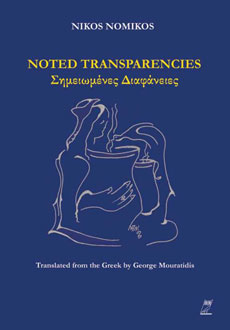
Review Short: Nikos Nomikos’s Noted Transparencies

Noted Transparencies by Nikos Nomikos
Trans. George Mouratidis
Owl Publishing, 2016


These events told by, the pen of my life, are personal transparencies
that note, the deep voice of the heart, as the years roll by, beneath the 
light of divine economy.

Honest and intimate, transparency is the term and practice giving Nikos Nomikos’s Noted Transparency (or Σημειωμένες Διαφάνειες, pronounced ‘Simiomenes Diafaneies’) its immediate impact. Born in Alexandria, Egypt in 1934, Nomikos has published nine poetry collections, with Noted Transparencies the later work of a mature artist. The maturity invoked creates a sense of life lived, of a past haunting a present. The collection contains 30 poetic vignettes, all, with one exception, revealed and written ‘in the mute hours’ of a single night. Out of these night surges the remembrance of a formative childhood moment on the edge of the Nile. Published bilingually by Owl Publishing, its original Greek has been placed parallel to its translated English, marking the first time Nomikos’s work has been available in English, while emphasising that what is being read is a mediated reconstruction of Nomikos’s vision. It has been collaboratively translated by George Mouratidis to convey storytelling over the rhythm.

It moves between dualisms, revealing them to be encompassing each other in paradox: youth and age, liminality and transcendence, memory and reality, creation and destruction, a lifetime held within a single night. The simplicity of Nomikos’s language opens up to a religious enrichment and complex worldly knowledge. Mysticism is contained within the corporeal world. Absence becomes a presence, nostalgia for an imagined past a pleasurable punishment. The ‘rosy coloured springtime’ carries ‘the winter of Persephone’: life and its end mutually constituting forces, not discrete entities.

Nomikos’s work is one of return: to childhood, to that moment on the Nile, to faraway times, teachers, possibilities and homelands he has never experienced, and ultimately to God. Nomikos belongs to two prominent writing traditions: Alexandrian-Greek poetry, and ‘first-generation’ Greek-Australian migrant writing. The experience of migration and diaspora is integral to his ultimate concept of return, written as a fragmentary and self-alienating process that needs to be addressed and reconciled.

In any case, no matter whom I asked, nobody knew to tell me, why
they invited us, to this different land.

One process Nomikos offers for reconciliation is through religion. Figures, practices and symbols from Greek Orthodoxy suture the fragments. Central to Nomikos’s vision is the figure of a ‘towering lord-like man, with a parchment spread across his chest.’ Although this figure makes him feel like an ‘ant,’ bringing with him the unknown sublime and ungraspable ‘old, happy world to which (Nomikos) once belonged,’ this figure is not intrinsically negative. This ambivalent figure promises finitude, connection, reassurance and an end to material desire. In this vision, all are moving towards an apocalypse. But even this apocalypse becomes a potential point of return and shared connection between humankind.
While faith is integral to Nomikos’s experience of the world, he acknowledges that the self shifts with time, the world, and chance:

It might have been different, my days’
journey, and subsequently my life might also have been, at
a different course, but due to the war of
1940, and its tragic events, I had put to great trouble
my personal lifeguard, bless him.

Here, religion, myth, and memory create and centre a very personal world, inventing and interpreting both the past and present. While some use these narratives to console and protect, others, as shown in one of his more striking fragments, use them to excuse and conceal:

With the unjustifiable War, for commonplace morality, against
the former Paradise, of Mesopotamia, Iraq,
I felt the same pain, which blackens the hearts of
people, as they run to hide, from the salvational
bombings, and of course in the name of God, as
the great criminals usually tell us.

One way of overcoming selfish inhumanity is offered through self-renunciation. Quoting Nikos Karouzos, another Greek poet Nomikos chanced to meet, ‘I have nothing and I am free,’ Nomikos’s highlights his practice of worldly asceticism, which permeates the pieces. Contemplating ‘at which height is a human being able to / reach his stature, amidst the blows lovingly proffered to him by his good / fortune,’ perhaps Nomikos speculates that it is only with self-imposed limitations on the self that ‘self’ can truly be revealed and given the space to roam free in ‘the decency of spiritual light.’ This is encapsulated in the physicality of his study-room: ‘three by three, / but with vast ascetic dimensions, / full of fires and passions.’

Protagoras’s ‘Man is the measure of all things,’ a humanist standpoint of individual, not absolute truth, is the second tenet of Nomikos’s poetry and worldview. Nomikos is respectful of the ‘permanent binoculars’ (29) through which life is viewed, ‘everywhere and always, within the boundaries of my own/world.’ This leads to accountability and the ethical ability to read the self. The wisdom and classically refined lines of Nomikos make for a beautiful reading experience. Efforts such as these of Owl Press should be made to retain Nomikos’s original Greek, but it would be a welcome joy to see more of this poet’s experiential work become available to a wider audience through translation.

Posted in BOOK REVIEWS | Tagged , ,

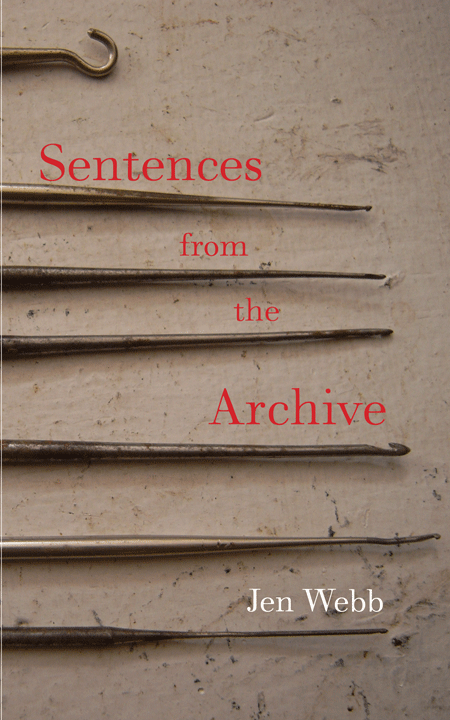
Review Short: Jen Webb’s Sentences from the Archive

Sentences from the Archive by Jen Webb
Recent Work Press, 2016


In 2011, Ginninderra Press released The Indigo Book of Australian Prose Poems, edited by Canberra writer Michael Byrne. While many of the country’s most accomplished poets were represented there, the book’s reception was somewhat muted. Indeed, prose poetry invites a certain amount of suspicion. While we’re happy to concede that many devices and techniques which would have been definitional of poetry a couple of centuries ago no longer do so, we’re reluctant to jettison lineation.

Yet it could be argued that prose poetry is poetry in its purest form. When lineation becomes optional, we’re left with writing that stands tenuously on the poetic impulse for its existence. Prose poetry skirts the pyrotechnics of poetic technique and device to nakedly rely on the essential quality of poetry – succinct, resonant language.

Jen Webb’s small volume, Sentences from the Archive shows the sorts of things well-executed prose poems can and should do. Webb’s prose poems feel like they’re written in one long line, the rhythm lilting like everyday speech, then catching in the throat when the implications of an observation reveal themselves to their creator. They exploit colloquial language, but disarm the reader with a sudden, heightened image, then casually change tack and tread softly into metaphysics. Above all, their appearance of conversation is deceptive – while they appear to address us ‘off the cuff’, they are carefully crafted and attenuated.

Take, for instance, the fourth section, Des que le soleil:

Your ridiculous hair, my spray-on dress, my blood, your sunsets. You, who can’t distinguish green from blue; you, who calls orange red: you have claimed this hour. When the sun begins its fall you open the windows, belt out the aria from The Pearl Fishers, and the sun crash-lands behind the Brindabellas, and you sing on. The evening rises to meet us, and I have almost forgiven you. Three streets over there’s a siren calling off-key, B flat to your C, and if memory could speak it would say lock it in, Eddie, lock it in

The language here is conversational, the tone casual, the affection between speaker and her subject (presumably an ex-lover) is palpable, but the whole domestic recollection is underlined by an almost belligerent rhythm and a series of beautifully realised images that lend the poem a sense of something fraught – the juxtaposition of the image of the calamitous ending of the day (the sun ‘crash-lands’ after its fall towards darkness) with the seemingly unrelated assessment that ‘I have almost [but not quite] forgiven you’. The tenuous nature of a relationship that appears to be dying with the day. This is further reinforced by the two songs that weave through the poem’s later stages – the lover’s ‘belt[ed] out’ aria from The Pearl Fishers and the tortured ‘off-key’ song of the siren in the distance, knitting the soul and the world together. There’s nothing sentimental about this, but the sense of sadness is deeply moving.

The apostrophe of the poem’s opening, emphasised by the repeated ‘you’, ‘your’ and ‘my’, hints at both a sense of frailty and a kind of growing resentment. While the lovers initially seem quite exquisitely balanced, ‘you’ tends to dominate at the poem progresses, the semi-colons holding this balance until the more determinate colon takes over and the narrator realises ‘you [not me, not us] have claimed this hour’, even in the space of her own memory.

Borrowed from a TV quiz show, Webb’s last line is haunting. In lesser hands it could trivialise, but it doesn’t. It reiterates the domestic nature of the scene and with a wry smile locks a seemingly mundane observation into the treasures of memory. It’s clear-eyed but affecting; it resonates without a hint of self-pity.

There are many such satisfying pieces in Sentences from the Archives – I think of ‘In the eye of the storm’, the series ‘Waiting for the bus’ and the final ‘Da capo’. The latter’s final image to both poem and book is a sensuous and evocative summation of the tone and subject matter of the entire volume: ‘You pass out drinks and comfort the cat, and calm comes in with the evening light, and the sun sets, perfectly, and night curls itself around the house.’ As with the previously discussed poem, the particular and wider worlds blend seamlessly in the image.

If I have a reservation about the book, it’s an unease at some of the endings of these poems. Too often, Webb displays a tendency to go one sentence too far, either diluting a resonant ending or ‘spelling out’ the point of the poem a little too explicitly. In ‘Tarte au citron’ for example, she concludes, ‘Never go back, they say. I never have’. The final sentence, it seems to me, is implicit in the penultimate one, and doesn’t need to be articulated. Similarly, in concluding the eighth and final section of ‘Waiting for the bus’, Webb writes, ‘Sure your lover will be temporarily bereft, but someone else will chair the meeting, play the ball. It will all go on, while you will not, while you drift like smoke into history.’ The final sentence, for this reader, forces a kind of wider significance on the poem, and the image that threads it isn’t particularly striking or original.

But this is a small reservation. In all, Sentences from the Archives is a delight. For both aficionados of the prose poem and lovers of poetry in general, it provides many moments of pleasure and insight. I look forward to Webb’s further excursions into prose poetry.

Posted in BOOK REVIEWS | Tagged ,

Submission to Cordite 83: MATHEMATICS

Mathematics
Photograph by Tim Grey

Poetry for Cordite 83: MATHEMATICS is guest-edited by Fiona Hile.

The invention of transfinite set theory by the 19th Century German mathematician, Georg Cantor, hinges the romantic conception of a boundless infinite to a post-Cantorian description of an infinity of infinities. As Christopher Norris writes, ‘thinkers all the way from Aristotle to Hegel denied the very possibility of a ‘completed’ or ‘positive’ infinite … Cantor’s realization that the scandal of the infinite – of a part that must somehow be conceived as equal to the whole – could in fact serve as its very definition or distinguishing mark’ reconfigured mathematics, and offered new ways for philosophy to think about Being and Truth.

The call for poems for this issue, MATHEMATICS, is therefore at once as finite and as infinite as it gets. If you’ve been writing poems about the universal or the particular, or whatever lies between, I’d like to read them.


Submit poems (prose, comics, visual, concrete) or works of microfiction (500 words maximum). Read more about submitting to Cordite Poetry Review. Please note:

1. We will only read submissions sent during our official submission periods.

2. Cordite maintains a hybrid submissions policy. This means that the guest editor may invite five (5) Australian and five (5) overseas authors directly to submit to the issue. In addition, the guest-editor will anonymously select an additional 30-35 works from Australian authors and use their discretion to select further overseas works. For each issue, the guest editor does not know the identities of the online contributors (via Submittable) until after the final selections have been made.

3. Simultaneous submissions or previously published material will not be considered. This includes works published in print and web journals but does not apply to material first published on personal blogs.

4. Please place up to three (3) poems in one (1) Word, RTF or PDF document (unless specifically noted otherwise for special issues), with no identifying details in the document itself.

5. We are not able to offer feedback on individual poems.

6. Submissions will only be accepted via Submittable …

submit


Posted in GUNCOTTON | Tagged , ,

NO THEME VI Editorial

No Theme vi

It was a great privilege, if a little overwhelming (I had about 1,800 poems to read), to edit this edition of Cordite Poetry Review and, as it is not themed, I had the luxury of choosing poems on various subjects. I have tried to make the issue varied but also unified by my aesthetic principles. I am one of those poets who believe aesthetics are important, that an over-heated experimental or exploratory approach, or a poetics that privileges linguistic flux over emotional stability or response, can take us away from the deep connection that language has with the body. This is one reason why I have an affection for the lyric, and I do not hold to the assumption that the poet does not exist, or that the movement inwards, towards subjectivity, is innately problematic. From the body we get idiosyncrasies of rhythm, music, voice, sensual knowledge, syntactical deportment, emotion and ideas. No-one who writes a poem is ever disembodied, though sometimes it can seem as if they are, given the overabundance of abstraction and linguistic imprecision that occurred in many of the poems I read for this issue.

The poems I finally chose were those in which the poet had put imaginative pressure on their language to give rise to a unique reality. These poems are silvered with sensual imagery, with a precision of language and technique that skilfully reflects and takes us to the heart of the matters at hand.

Todd Turner’s poem ‘The Fall’, about a girl’s sudden spill from her horse, recreates vividly the panic and horror of her plight. The language is steeped in visceral description, the suspense and drama constantly heightened by the details, but the master stroke in this poem is the way the language is worked at the end, giving it metaphorical import and twist: ‘I thought of how lucky you were and despite/ the risks, remembered your overriding words, / “It’s in my blood,” and how every bone/ within you has been marrowed by what it loves.’ The word ‘marrowed’ hits home with undeniable force. I would also alert readers to Omar Sakr’s ‘Brothers’ which makes a similar leap of brilliance in the final line, the phrase ‘the crack of dawn’ acquiring great power when read in context with the way that ‘crack’ is used elsewhere in the poem.

Another poem which illuminates a very direct physical encounter is Anthony Lawrence’s ‘Cobber’. This poem is also literally steeped in flesh and blood. It describes a child’s need to get close to animal life, in this case with a goat. ‘When it put its face to mine in a gesture I saw as curiosity / and welcome, its eyes contained black slashes, as though identical / cuts were still healing, then it stepped back and chewed sideways // before my head was printed and opened by twin mounds / of horn.’ This poem is rich with physical detail, the language grounded, and when the reader learns that the goat is later to be dinner for a team of cricketers, such phrases as ‘that eaten down world’ and ‘the shape of my mouth’ acquire much resonance.

In Andy Kissane’s ‘The Book of Screams’, the reader discovers, to their horror, who and what is causing the protracted screaming in a hospital ward. The poem has a deftly controlled narrative, it is suspenseful and dramatic, the imagery is arresting and memorable: ‘Her body is/ no more than a diaphanous veil hanging / between this world and the next.’

In choosing for this issue, I looked for poems which I felt some sort of energy leap out from them. Don Paterson, in his essay ‘The Dark Art of Poetry’1 says: ‘Poetry is a form of magic, because it tries to change the way we perceive the world, that is to say that it aims to make the texture of our perception malleable.’ Jane Hirshfield says a similar thing: ‘A good poem goes beyond its own well-madeness … Having read a poem that matters, the person who holds the page is different than he or she was before.’2

Mona Attamimi’s richly braided ‘The Message’, had my head reeling with its redolent imagery and exotic narrative. Look how the body is evoked in these lines as she describes the messenger: ‘New wealth had lengthened his neck, swanning him / to the point of oblivion, his heart roasted in the sweet tannin // of brewed grapes, and the rose coloured blood on his tongue / craved more.’ The lush, luxuriant rhythms enact, amplify and enhance this poem.

I noticed that my selection also contains poems that delight in play, or have as their operating mechanisms surprise, slippage, juxtaposition, compressive and associative power. Julie Chevalier’s poem ‘Shadow’ has some of the charm of the American Russell Edson as she follows the escapades in Bondi and Venice of Big Elephant and Little Elephant. Simon Patton in ‘Thirteen Swifties’ magically manoeuvres meaning and image into new, recharged contexts. ‘Requiem for a War, with Refrain’ by New Zealand poet Siobhan Harvey, keeps reinventing and intensifying the political content by repetition and word pairing. Nathan Curnow’s ‘Hook’ shows the close alignment poetry has with pleasure and play as he has slips his words into cheeky, linguistic alignments. Joanne Burns in ‘sting-along’ uses enterprising, imaginative phrases and images which stitch ideas and affections together. I love the hilarity of the first line: ‘there’s no point to owning a country / if you can’t look after your own hair’.

I have also chosen some formal poems which are remarkably well-executed. Mark Macrossan’s sestina ‘The Einsteinian Qualities of Distance’ doesn’t trip up or seem over-extended, instead it has an ease and a naturalness which adds to the poem’s elegance and cohesion. Rod Usher’s ‘Yesterdays’ employs a surefooted structure and rhyme scheme which add to the poem’s sense of loss and nostalgia – the recurring sounds re-enforcing the speaker’s regret at time passing. James Lucas’s villanelle ‘At Western Plains’ seems an excellent formal choice for a poem which is about sound and its repetition.

The American poet Robert Bly has said that ‘the image makes a poem moist’ and I think of this when I read Carol Jenkins’s highly sensuous ‘Barns in Charlevoix’ which has impressive descriptive poise, and a sumptuousness of image that leads to such lines as; ‘… a sudden shaft / of afternoon pouring like honey into dark tea’. Diana Bridge, another New Zealand poet, presents the reader with a wonderfully affective meditation on a landscape represented by a painting on a book cover in ‘Cover reflections’. This poem is full of finely nuanced, delicately sensed moments of perception. ‘But the sand catches fire, there is light coming off / the sea and even the sky looks ready to ignite, / were it not for those earth-coloured bands / that marry with the scene, holding the present steady.’ Eileen Chong, in ‘Haar’, works water imagery marvellously so that sensation becomes cognition. Jill Jones has one of those endings that are to die for in ‘The Storm’, a poem full of refractions and tonal shifts juxtaposed and interwoven, as is exemplified in the final sentence, ‘The leaves make a noise almost as if / I was waiting for someone.’

There are so many other fine poems of which I don’t have the space to comment on, but I’m sure readers will enjoy these poems which value and celebrate both the large and the ordinary, travelling outwards into politics, history and culture, yet coming back to the everyday personal worlds of love, suffering and injustice. Each poet defines a world and it is important for us as readers to be exposed to as many of these differing worlds as we can. My thanks to the poets for these distinctive poems.

Posted in ESSAYS | Tagged

‘We can wake up if we wish’: Autumn Royal Interviews Cecilia Vicuña


Image courtesy of La Tercera Edición Impresa

Cecilia Vicuña is a multidisciplinary Chilean artist who describes her practice as dwelling in the not yet. Vicuña forms and disentangles meaning with poetry, oral performances, filmmaking, criticism and activism. Throughout the dimensions of her work since the 1960s, Vicuña has continuously engaged in poetics and what she terms as ‘ancient spiritual technologies’ to generate liminal spaces with the hope of inciting change and social resistance.

Vicuña first visited Australia as an artist for the 2012 Sydney Biennale. She returned to Australia in 2016 to partake in Liquid Architecture’s ‘Why Listen to Animals’, an experimental series offering aural reconsiderations of John Berger’s 1980 seminal essay ‘Why Look at Animals’. During her time in Melbourne, Vicuña also presented her versioning of a lecture entitled ‘The Artist as … Poet’ at the Bella Union in Carlton on October 6, 2016. Vicuña’s lecture was a part of the series The Artist As … co-presented by the Institute of Modern Art Brisbane and Curatorial Practice at Monash Art Design and Architecture.

To experience one of Vicuña’s oral performances is to both feel and hear the chasms of all your previous understandings gently opening as she threads physical gestures, singing, chants and vocalisations of multiple languages into a space; a poem. As Rosa Alcalá explains in her introduction of Spit Temple: The Selected Performances of Cecilia Vicuña:

Although Vicuna is focused on oral performance, hers is no romantic idea of a pristine orality. It is one fully cognizant of the intervention of print, and is concerned mainly with the interplay between poetic texts and the vocalization and improvisation of those texts.

The morning after Vicuña’s performance she and I discussed her approaches to poetry, specifically with regards to Latin American and oral traditions, the social responses poetry may provoke and the influence that archival processes have on informing cultural memories and understandings. This transcript is a marking of our exchanges, as Vicuña states ‘to respond is to offer again’.

Autumn Royal: During your performance of ‘The Artist as … Poet’ you read Oodgeroo Noonuccal’s poem ‘We are Going’. The duality of the title and last line, ‘we are going’, expresses both the loss of Aboriginal people but also a resistance against colonisation. The line ‘we are going’ reminded me of your philosophy to ‘dwell in the not yet’. How did you encounter that poem?

Cecilia Vicuña: Just the day before my partner, the poet James O’Hern, sent it to me from New York. He couldn’t come with me on this journey so he’s been travelling with me in spirit. He’s been reading Aboriginal poetry – including Indigenous Australian poetry – and has also been to Australia and visited the ancient art of the caves of the communities many times, so he’s familiar with the universe of Aboriginal poetics. It was such a lovely gift to receive that poem because it’s true. My reading of the line ‘we are going’ is that it doesn’t just refer to the Indigenous people of Australia, it also refers to the whole of humanity. The Indigenous Australians have lived there for 70,000 years with extraordinary wisdom and resilience, creating some of the most amazing art in the world in the process. If they’re erased, if they’re eliminated, it’s a sign of our own self-destruction and so the poem is very prophetic in that it says that we are nature. Every living thing is nature. I mean, why are we on this suicidal move, and why is it that people refuse to see what we are doing to the environment even though we all feel it? That is the real question for our times. Why are we indifferent to our own death?

AR: Do you think Noonuccal’s poem spoke to you so strongly because of the way you approach your own work because and how it ends on a note of continuation, of what is yet to happen?

CV: If you read it as a warning, the warning includes the idea that we can wake up if we wish. If we connect to that terrible pain then there is a chance, and I believe that there is still a chance. But we don’t have a lot of time. We have this particular decade to take responsibility, and if we don’t do it now it’s going to be too late. It’s already happening, destruction has already sped up intensely in every place and so we say ‘look: what’s going on with the melting of ice, with the rising of the oceans?’ and that loop has already been set in motion. We don’t know what it’s going to be like in five years, in ten years. Originally, people were claiming that these environmental disasters were going to be in 100 years, but we know now that that’s not the case. It’s already happening for a lot of people, it’s not a matter of prophecy any more.

AR: Do you think that a form of denial about environmental destruction is by believing that a lot of the warnings and messages are treated as just a prophecy rather than a reality?

CV: Absolutely. The ways of pushing away a reality are infinite, and they are all embedded in a worldview which has been studied by many people. There is a Cuban poet that I admire and mentioned a few times last night, his name is José Lezama Lima. He says that it is the power of the image that creates the foundation of history. So history responds to an image, an image, in this case, means a worldview. If people are brought up in the Christian-western idea that nature is to be controlled and dominated, then to destroy it is meaningless. You see, it’s all dependent on what most people believe: that science will come up with a solution. That is another form of denial. Science is not oriented towards looking for a solution, science is oriented towards profit. That is the condition of economy. If scientists don’t work for profit, they don’t have money for research, so the research is not oriented towards the survival of humanity. The desire not to see is driving this denial.

AR: Is this one of the reasons why you’ve pursued poetry and art? By making works and giving performances that can’t be contained and the awareness of how art and poetry can communicate certain ideas about what is possible?

CV: Yes, I began art and poetry as a very young girl, and my family always made fun of me. They said ‘Cecilia was born with a little pencil in her hand’, or my brothers would say ‘Cecilia is a factory of madness’ because I was constantly creating this or that form which is formless at the same time. Therefore, my art sort of seeps under, even though it has been censored and marginalised for so many decades – 40 years or so. I would say, somehow, my work finds a way to percolate, to go under and surface in another place. That’s not my doing, it’s the energy of what’s inside the poems, inside the images; they have a life, a life that connects it to other life forms.

AR: I appreciate the way you describe your work, Cloud-Net, during your performance last night. It speaks to the energy that you were just referring to. I haven’t seen a physical copy of Cloud-Net – only the images and I’ve listened to your references to it – but I feel like I’ve already encountered it in a sense. One of the things I admire about your work is that you speak philosophically about things in a way that’s inclusive and that doesn’t alienate.

CV: The most powerful images are always elemental images, like a cloud-basket. That is something that most people can picture. You’re lying on the ground and you’re looking up right now under the clouds and we can see these things.

Posted in INTERVIEWS | Tagged ,

Lee Cataldi: New Poems with an Introduction by Joanne Burns


Courtesy of the author

In this selection of poems, Lee Cataldi writes in a spare, lean, direct way, steered by an aesthetic of restraint. She often uses internal spacing and short stanzas to re-enforce her measure. A sense of loss inhabits a number of the poems. Cataldi has worked as a teacher and linguist in Indigenous communities in the Northern Territory and Western Australia. In ‘the opening of the children’s centre in Balgo’ the language centre seems to have gone

                                the kukatja books
into which we put
our black and white lives have become
art works no-one can read

these days Balgo is a picture

and for sale'

In ‘mourning is women’s business’ [for Tjama] she writes with clarity

now the funerals string together
narratives of loss
                                            how hard it is
to think any more of forever

She imagines in ‘on breaking things’ the larger effects when the handle of a blown glass puja bell is broken. The poem impresses with its reverberations.

Poets also feature in this selection. In the opening poem c’est l’homme [for John Forbes] Cataldi addresses Forbes directly in a forceful assessment/homage of sorts regarding the poet’s desire and struggle to achieve poetic/stylistic excellence

despite all the stumbling about in the bushes
the stubbed toes     the dirt     the broken fingernails

The poem ends with a climax that is dazzling, implosive, and well, Forbesian! And as Cataldi says, in a one line stanza, ‘perfect’.

Translations of poems by Michelangelo and Mallarmé complete the selection. In these translations Cataldi pares back the emotive and passionate and eliminates rhyme schemes to achieve a more contemporary tone and texture: a kind of poetic de-cluttering. Michelangelo’s three poems of passion and rejection are trim and sharp:

your eyes meet his
don't hang around    I thought
I could have him
any way I wanted    now

see what I am

In Mallarmé’s almost sirenic ‘Brise marine’ the title becomes ‘sea change’. Cataldi removes Mallarmé’s many exclamatory statements. She breaks up the poetic intensity of the sonnet with a varied form of stanzas. The second poem’s title ‘Le vierge, le vivace et le bel aujourd’hui’ becomes ‘innocent breathless beautiful day’. In this poem of the swan trapped in ice Cataldi effectively employs the short line stanza form and internal spacing. She creates a withering final note

a transparent ghost the swan
has distilled himself
into this place and freezes
into a dream of being
misunderstood    his

exile is useless

Here there is a sense of the arrival of the bleakly existential – the late 19th Century turns away from the transcendental – which is suitably unsettling. And no flames from a burning Mini Cooper in this scenario.


Lee Cataldi: c’est l’homme
Lee Cataldi: mourning is women’s business
Lee Cataldi: the opening of the children’s centre in Balgo
Lee Cataldi: hereafter
Lee Cataldi: the sky is falling in
Lee Cataldi: on breaking things
Lee Cataldi: seventy
Lee Cataldi: michelangelo 27
Lee Cataldi: michelangelo 107
Lee Cataldi: michelangelo 143
Lee Cataldi: mallarme: sea change
Lee Cataldi: mallarme: innocent breathless beautiful day

Posted in CHAPBOOKS | Tagged ,

Ainslie Templeton Interviews Christopher (Loma) Soto


Image courtesy of Jess X Chen

Christopher Soto (aka Loma) is a Brooklyn-based poet who has received several awards for his writing and activism. Most notably, he is the author of the chapbook Sad Girl Poems, which discusses his experiences with domestic violence and queer youth homelessness. Born in Los Angeles, Soto relocated to pursue and receive an MFA from New York Univeristy. Since, he’s had a pronounced effect on the literary world. He is the editor of Nepantla: A Journal Dedicated to Queer Poets of Color, founded at the Lambda Literary Foundation and will be published by Nightboat Books in 2018. He is also the cofounder of the Undocupoets Campaign, working to create grants for undocumented writers in the United States. I corresponded with Soto before he began his most recent tour, discussing his life and work in literary activism and what it is to be a poet in the incipient days of the Trump presidency.

Ainslie Templeton: Thanks for taking the time to talk with us, Loma. I saw that you were recently nominated for the ‘Freedom Plow Award for Poetry and Activism’. Congratulations. Can you tell us about the future of literary activism for you?

Christopher Soto: Thank you. I’m excited about that nomination, to be alongside Francisco Aragon and J P Howard who are friends of mine (and Andrea Assaf whose work I am just discovering now). There are so many people doing literary activist work so it feels special to be recognised.

As for the next steps I want to take within my literary and activist explorations; I want to finish my first full-length manuscript and finish editing the Nepantla anthology with Nightboat Books. Other small projects, such as the Trump Tower protest I hosted, will likely come along the way.

AT: Can you tell us more about the Trump Tower protest?

CS: Yes, I worked with Kyle Dacuyan and Brittany Michelle Dennison to host a ‘Poets Vigil for the NEA’ outside of Trump Tower. People gathered to mourn the proposed loss of the National Endowment for the Arts, to read poems and to yell at Trump. The NEA’s annual budget is approximately $150 million (or below $0.50 per person annually). The proposed defunding of the arts is not about saving a budget but rather it is about stifling the creative and intellectual communities in America.

AT: Did your literary activist endeavours start with you first chapbook Sad Girl Poems? I know that you brought this chapbook on a ‘National Tour To End Queer Youth Homelessness’, can you tell us about that?

CS: I’ve been protesting for over a decade now. My first day of high school I ditched sixth period to go protest President Bush and the wars in the Middle East, when he came to speak in my hometown. Also, in those days I would host large poetry events as fundraisers for various causes. I would bring in poets, rappers, drumline, breakdancers, everyone would come together in their arts for a particular cause. In high school, I was speaking about Darfur. Now, my politics have continued to grow and shift and the projects that I am organising are even more developed. One such project is the ‘National Tour to End Queer Youth Homelessness’, which I started after my chapbook launch. That started in part because I was on the verge of homelessness again myself at that time.

AT: I was really taken by your poem ‘Transactional Sex with Satan’, and found myself rereading it a few times. In it you write:

Bound & bruised // I’ve become the siren & shipwreck // synonyms for lonely.

My sex is // melancholic terrorism // or // witchcraft in // the Catholic Church.

What’s your relationship with the confessional (poem) and how that relates to innocence?

CS: Rachel Zucker was my professor and taught me about contemporary American confessional poetry. Yet, I still have a hard time understanding what that means outside of white girls like Anne Sexton and Sylvia Plath sometimes.

My poems are not direct translations of my lived experiences. I’m not sure what a direct translation of my lived experiences would mean either? All poems being a process of omission? Maybe in a way my poems are skewed confessionals.

Pertaining to innocence. I’m not interested in a narrator who is ‘innocent’. I believe that narrators need to evaluate themselves and maybe even incriminate themselves in a way that isn’t always heroic. Or at least, that’s the writing I find interesting. I like a vulnerable narrator and not the facade of a hero.

AT: You have been so deliberate in framing your work and tying it in with your activism, which I think is surprisingly rare in the publishing world. I see a lot of poets, writers, artists – and often young people – making their work and sort of just sending it out into the world and hoping for the best. Can you talk about pushing back on capitalist, white supremacist, and queer-fetishising structures of receiving your work and your voice?

CS: I speak up when I feel something needs to be said and I write about what’s important to me. I talk to the people (often poets) of shared experience and don’t talk to people who are not open to critical and creative conversations. I think my experiences in writing and publishing poetry, as far as who I have attracted to me, has been contingent upon my needs as a person in this world. My activism is built upon my needs for this world.

Posted in INTERVIEWS | Tagged , ,