Re-imagining Place: A Psychogeographic Reading of Carmine Frascarelli’s Sydney Road Poems

Suburbia

What can the original concepts underpinning psychogeography lend to a discussion of the relation between poetry and place in contemporary Australian poetics? Can the Paris-based wanderings of Guy Debord and the Situationist Internationale (SI) bring to the fore new meanings of being and creating in urban Australia? To delve into these questions this essay conducts a psychogeographic reading of Carmine Frascarelli’s 2016 book, Sydney Road Poems (Rabbit Poets Series), using key concepts put forth by Debord and the SI. Through such an approach, I believe particular psychogeographic motives – often of a political nature – will allow for a more comprehensive understanding of the approach taken by Frascarelli in writing his poem. Beginning first with a short historical survey of the interrelation between walking and artistic creation, and how Frascarelli’s writing practice can be regarded in this tradition, the essay will then use the SI’s concepts of dérive, the idea of play, as well as touching on detournement and the effects of collage, to demonstrate how a psychogeographic writing practice can be considered a socio-critical tool – one which has allowed Frascarelli to re-imagine place through a de-spectacularisation of society, or more specifically, Sydney Road in the Melbourne, Australia suburb of Brunswick.

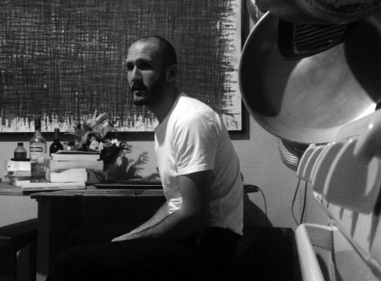
Written in forty-seven poems, the sequence juxtaposes the history of Sydney Road in the Melbourne suburb of Brunswick to Frascarelli’s own observational writings of the street. In Frascarelli’s own words, the poems began being written during night time walks along Sydney Road after recurring hurtful fights with his partner (68). It was during one of these nights, while waiting for food in the street, that Frascarelli heard everything begin ‘to hum with a story’ (68).

Everything started to come apart in my mind: the nature of violence in history & 
society; violence against women … the influence/distortions/purpose of money, 
religion, sex, ownership & how it’s played out in the past, present and future; the way 
all these things interconnect & play out under empire (past & present) & shape 
people & the globe.

The idea of walking, of being out in the world, as a catalyst to thought and artistic creation, is not a new idea. As early as the 19th century the term flânuer was used to describe a man of reasonable wealth who wanders about the streets of a city taking in the sights and sounds. Honoré de Balzac believed the flânuer considered as an artist was someone who poured ‘his experiences in the city into his work’, and similarly Charles Baudelaire believed the flânuer as artist sung ‘of the sorry dog, the poor dog, the homeless dog, the wandering dog’ (Elkin para. 4). This pouring of an urban experience into a poem, or the singing of a street’s life, can be seen, for example, in section ‘#31’ of Frascarelli’s poem

SYDNEY ROAD STREET PARTY) songs! songs! (the human as instrument

Ray Bans © & coloured bottles & American surf music
 	                      (the plastic lei doesn’t need water!
 				      the blond guy over dubstep blows through (trom)bones
     					               kitschy technological appropriations of nostalgia
 	 							                                           the: “quick! sing! ” of the age
 				           Cumbia! & the girls this afternoon spin like cosmonautas 
 				African drums, Greek bouzouki, Indigenous Hip Hop
 		        gozleme & chorizo & chips & rice paper rolls & pizza
 	                      & grilled corn & baklava & chapatti & bhajia & jerk chicken
filling faces with speared lamb, we walk & Leonidas looks on.

This walking approach to writing also relates to Tim Ingold’s suggestion that our knowledge of the world is not shaped by the ‘operations of mind upon the deliverances of the senses’ but ‘grows from the very soil of an existential involvement in the sensible world’, allowing us to consider the very act of being, and the writing of such being, as an inherently active way of engaging with one’s environment (3). This idea of being actively engaged with one’s environment further relates to psychogeography: ‘the study of the precise laws and specific effects of the geographical environment … on the emotions and behavior of individuals’, as defined by Guy Debord, a key representative of the SI (Waxman 133). Lori Waxman in his dissertation, Writing a Few Steps in a Revolution of Everyday Life, also goes on to stipulate that ‘changing the world was only possible by being an active participant in the world’, and that the technique which lay at the heart of all the SI’s concepts and aims was ‘reification + walking’ (111, 124). He suggests that it was this approach which allowed the SI ‘to see through the smooth façade of functionalist capitalism’ and ‘move beyond the university and a reliance on books, to get out from behind the table and go out into the world’ (111).

The SI formed in 1957 from various subversive artistic groups throughout Europe and set out to unite their political ideologies and concepts of art to develop a new approach to being and creating in the contemporary consumer world. A world which, as Adam Barnard suggests, ‘ensures that people do not engage in self-directed or autonomous activity’, and which Debord would come to call ‘The Spectacle’, or the ‘colonisation of daily life’ (Barnard 107). The SI believed that prior to their commencement, ‘philosophers and artists have only interpreted situations’, whereas the point now, ‘is to transform them’ (118). This idea of transforming situations though was not new in its own right, but was built upon ‘generations of revolutionaries and vanguardists before them, from Charles Baudelaire to the Paris Communards, from Walter Benjamin to surrealists André Breton and Louis Aragon …’, all of whom claimed ‘the street as the real space of urban life’ and demanded the right not merely to access what already exists, but ‘to create utopia in the space of their own streets’ (Waxman 92).

This approach to the environment, which sought to empower the individual with the right to change the city one lives and ‘to construct life out of one’s own desires’, Waxman compares to artistic practice (92). From this we can perhaps better understand the correlation between walking through everyday life and writing, and how it is in this tradition which I believe Frascarelli’s poem can be situated. Take the following line from the 14th section of the poem – which plays on both the influence and restriction of the page and road:
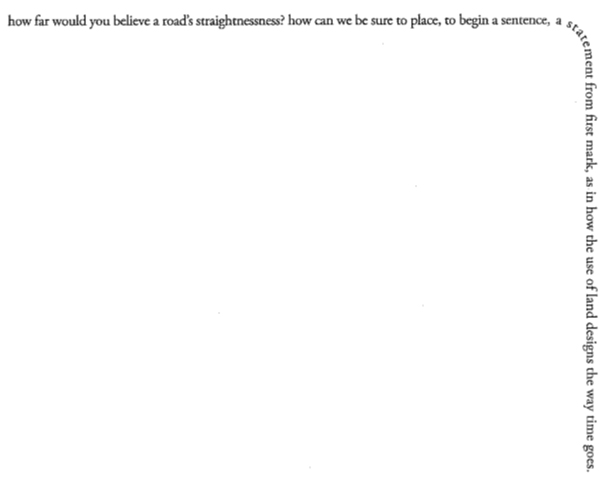
And, again, in the 22nd section, there is the playful admittance of place’s effect ‘on the emotions and behavior of’ Frascarelli (Waxman 133):

& those who could match my mo(ve)ments

what the green arrow does or doesn’t

& why the cars 		                    do or don’t

All this              moves me

in the shell of the tortoise by the road.

‘The walker uses the body as a divining rod’, Nandi Chinna suggests, to pace ‘through time and the city, noticing what demands to be noticed, and stitching together maps which link sense perceptions with histories in order to build a greater dimension into the narrative that defines place’ (8). Her definition of the walker relates directly to Guy Debord’s idea of the dérive (meaning, literally, ‘to drift’), which was just one of the ways the S.I. attempted to counter the idea of the spectacle and create a utopia in the space of their own streets.
Posted in ESSAYS | Tagged , , ,

‘Geelong checks its modernist warranty’

You go to Geelong / I’ve been everywhere, man
—Dick Diver

In 1890, an American aeronaut named Millie Viola departs the Geelong showgrounds in a hot air balloon, in order to give an assembled crowd of onlookers a parachute jump display. Her ascension followed foiled attempts earlier in the week, but, according to the Geelong Advertiser’s archives, ‘Mademoiselle Viola’ at last ascends – to the gratification of ‘an increasingly dubious crowd’ – to around 5000 feet (1540 metres), and comes close to being swept into Corio Bay. She manages to swing her way to land and alight in Pevensey Crescent – a few hundred metres from the space in which this essay’s authors currently live and write – though another archival source suggests she instead alights on the beach. In either case, the event has an impact on her next display: The Kyneton Observer reports, on 31 May, 1890, that preparations were prolonged ‘owing to the balloon being wet, it having dropped into Corio Bay in the early part of the week, on the occasion of an exhibition at Geelong.’

Millie is one of two, or three, sisters: according to Errol W Martyn’s A passion for flight: New Zealand aviation before the Great War (2012), ‘[n]ot a great deal of accurate information is known about the women’s origins; Viola appears to be a stage name, a common practice in the circus world with which ballooning and parachuting were often closely associated.’ Martyn goes on to note that ‘American newspaper reports of April 1897 about Millie’s marriage in San Francisco that month … indicate that the sisters were in fact Ruby and Essie Horaker (or Hawker)’ – with Leila Adair, who toured New Zealand as a balloonist in 1894, also claiming to be a sister.

The balloonists, in various news articles of the 1890s, are described with notes of sexist admiration true to the zeitgeist. One article opens:

Two lady-like vivacious girls, such as are to be met in any lady’s drawing room in the United States of America; two graceful girls, overflowing with that charming self-assertiveness and love of everything American which is so marked a characteristic of the daughters of Uncle Sam; two thorough little Bohemians, who can look a man fair and square in the eyes, and contradict him with a frank spirit of bon camarade that at once puts him on a footing of good-fellowship.

Another account, this one from Western Australia, describes Millie’s reaction to her balloon failing to inflate as follows: ‘Miss Millie Viola (horrible name, isn’t it?) proved herself very much a woman by having a good howl.’ The feature story makes rather emphatic note of Millie ‘howling’ three more times, citing mishaps that include her descending directly onto a horse’s back in a stable yard, and then into black river mud.

Historical archives are, of course, full of curio – of remarkable and often wonderfully obscure figures and events – and the balloonists’ visit was only fleeting (part of their tour of the ‘Australasian colonies’). Millie’s presence, however evanescent and now distant, feels striking, stirring – perhaps in part because it’s so novel to representations or accounts of Geelong and its stories. Millie offers a surprising vantage point.

Geelong is a town (in fact a city, though ‘town’ always feels truer) whose discourses tend to centre on industry, although when Millie ascended in her balloon the Shell petroleum refinery at Corio would not have been there, nor would the Ford factory at North Shore, nor Alcoa’s aluminium smelter at Point Henry. Exactly what Millie would have seen while she remained airborne in her balloon and parachute is difficult to know without extensive historical research, but it would undoubtably have been a radically different vision than what you would see today. Nor would it have been the landscape that existed for the Wathaurong prior to European invasion: the Geelong region, like all of Australia, is a space complicated by colonialist history and colonialism’s violent legacy, as well as an ongoing process of globalization that continues to construct the space that is ‘Geelong’.

The book Poets and Poetasters of Geelong (1967) provides an interesting collection of ‘poetic’ representations of the Geelong region. The first poem in the book, presumably situated first as a gesture to Geelong’s Indigenous heritage (though the introductory section also advises that the book is laid out chronologically), is purportedly an 1840 translation by one Reverend Francis Tuckfield of an Aboriginal girl’s articulation of love and loss:

Now you leave me, you forsake me.
We have walked in the moonlight
But you go never to return.
You have shewed me the dew on the leaves
You have said it shone like my eyes.
You were my only beloved,
Another you love has seen your spirit
But I have taken it from her.
Your hair shines like the green leaves
Your eyes are like the moonlight
More soft than the men of our tribe.
Now you leave me, you forsake me
So young, never to return.

(1967, p. 17)

What is most poignant about this poem may well be the details in its margin notes – which reference a ‘Mission Station on the Barwon [River], up-stream from Winchelsea’ – and the enquiries that encircle the poem. Is it actually a translation, as it claims to be, or a projection? And in its romanticised language and evocation of European poetic traditions surrounding the ‘love’ poem what does it gloss? It’s also difficult to read the poem and not feel that there’s a kind of elegy being enacted that reaches far beyond the two lovers, but an elegy whose symbolism is problematic and, to say the least, disturbing. As Bruce Pascoe writes in his preface to Convincing Ground (2007), ‘[t]oo often Aboriginal Australians have been asked to accept an insulting history and a public record which bears no resemblance to the lives they have experienced’ (p. ix). Suffice to say, after Reverend Tuckfield’s initial ‘translation’, the rest of the book doesn’t engage much at all with Indigenous ‘voices’ – though the closing poem, ‘Elegiac Melody’, does purport to speak to/of ‘the “vanished Barrabool tribe” of aborigines [sic]’ (1967, p. 13).

Posted in ESSAYS | Tagged , , , , , , ,

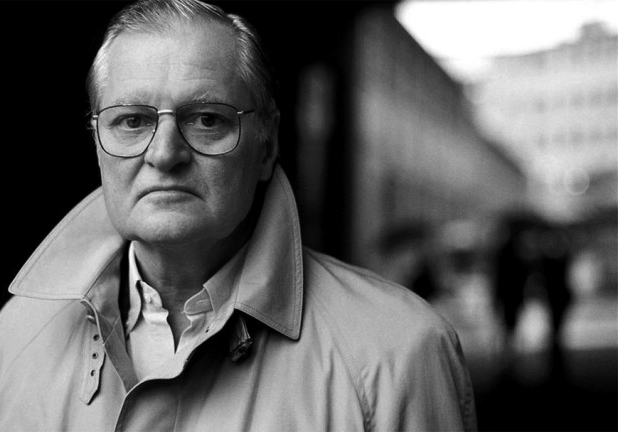
John Ashbery’s Humane Abstractions

JA
Image courtesy of Stern.

1

The focus of this essay is The Double Dream of Spring.1 In the context of John Ashbery’s long career it is possible to a claim a particular significance for that book. Published in 1970, it was the first volume he wrote after re-settling in the United States in 1965, having lived in Paris for the best part of a decade. It was also the book in which he arrived at a kind of poem – ‘Soonest Mended’ is an example, but so are several others, ‘Evening in the Country’, say, or ‘The Bungalows’ – that established a way of configuring voice, narrative trajectory, human relations and cultural reference that would become recognisable as characteristically Ashberyan. It is not, though, within the context of the narrative of Ashbery’s development, that I want to look at The Double Dream of Spring. What I want to consider instead is how, as a stand-alone work, that volume enables us to think, the kind of intellectual act it allows us, now, to engage in. To do that, it is necessary to shift the historical angle of vision just a little. I want, that is, to read The Double Dream of Spring through, or rather in the light of, Olson.

To a degree that has been obscured, and is quite difficult even now to recover, Olson’s perspective on American poetry of the 1960s held a certain dominance. One measure of that dominance was Donald Allen’s anthology,2 The New American Poetry. Published in 1960, while Ashbery was in Paris, Allen’s anthology was the defining event of the postwar poetic avant-garde. With British publication following a year later, the anthology projected a body of experimental work to new audiences in a way that no such body of work had been projected before or has been since. For reasons to do with geographical distance perhaps, but also, no doubt, for reasons of editorial taste, Ashbery’s presence in the anthology was minimal. Where O’Hara was represented by 15 poems (‘In Memory of my Feelings’ and ‘Ode to Michael Goldberg (‘s Birth and Other Births)’ among them) along with a statement of poetics, Ashbery is glimpsed through ‘A Boy’, ‘The Instruction Manual’ and ‘How Much Longer Will I Be Able to Inhabit the Divine Sepulcher …’.3 Relative to several major careers that were clearly already under way at the moment of the anthology’s publication, Ashbery’s trajectory, as anticipated by Allen’s selection, would have seemed far from certain.

The major figure of the anthology was Olson. This is apparent from the range and aesthetic assurance of the poems Allen presented and with which the anthology opened, among them, ‘The Kingfishers’, ‘Maximus to himself’, ‘As the Dead Prey Upon Us’ and ‘The Distances’. More than this, in his introduction (and with reference to the statements on poetics) Allen proclaimed Olson’s centrality:

Charles Olson’s “Projective Verse” essay and his letter to Elaine Feinstein present the dominant new double concept: “composition by field” and the poet’s “stance toward reality”.4

Behind this double-concept, and behind the concept of ‘composition by field’ in particular, was the principle Olson had established as early as 1947 in Call Me Ishmael:

I take SPACE to be the central fact to man born in America, from Folsom cave to now. I spell it large because it comes large here. Large, and without mercy …5

There is much to argue over in the American vision of space Olson offers in the opening sentences of his treatise on Melville (much that Olson himself at times contested), just as there is much to dispute in Allen’s construction, in his anthology, of a national poetic project – and in ways both explicit and implicit some of the argument will be had here.6 What I want to recover at the outset, however, is simply the prominence of Olson’s thinking, of his conceptual framework, in avant-garde North American poetry of the 1960s. Such prominence was subsequently underscored by Olson’s headline appearances at two of the key poetic gatherings of the mid-sixites, the Vancouver Poetry conference of 1963 and the Berkeley conference of 1965; events that were followed by the publication of Maximus Poems IV, V, VI, the second volume of his major work, in 1968. It was a degree of influence, moreovoer, measurable by the urge other writers felt to differentiate themselves from his position. As James Schuyler wrote to Chester Kallman, with reference to the prominence of Black Mountain poetics in Allen’s anthology, and explaining the impulse behind the upcoming New York School journal Locus Solus:

I and ‘others’ (it is a deep secret; the other is John Ashbery) are invisibly editing an anthology-magazine … Part of its unstated objective is as a riposte at The New American Poetry, which has so thoroughly misrpresented so many of us – not completely, but the implications of context are rather overwhelming.7

In light of Olson’s dominant framework, then, with its radical implications for poetic method and its complex implications for political geography, I want to propose that in The Double Dream of Spring, Ashbery presents what we might think of as a counter poetics of space; a counter poetics that can help us to understand the construction of space in our own, geographically fraught moment. Here is an example of Ashberyan space, sampled at length, from ‘Sunrise in Suburbia’:

And as day followed day the plainer meaning of it
Became a constant projected on the emigration.
The tundra seemed elaborated.
Then a permanent falling back shapes, signs the residue
As a tiny wood fence’s the signature of disgust and decay
On an otherwise concerned but unmoved, specially obtruded hill:
Flatness of what remains
And modelling of what fled,
Decisions for a proper ramble into known but unimaginable, dense
Fringe expecting night,
A light wilderness of spoken words not
Unkind for all their aimlessness,
A blank chart of each day moving into the premise of difficult visibility
And which is nowhere, the urge to nowhere,
To retract that statement, sharply, within the next few minutes. (DDS, 50-51)

Taking a series of pointers from Ashbery himself, the aim of this essay is to re-construct the narrative of twentieth-century space that this poetry calls on and enables us to understand. The contention is not that, in arriving at such a poetry, Ashbery was in any direct sense (whether reactive or otherwise) influenced by a close reading of Olson, but rather that in the Olsonian moment of the mid- to late sixties, The Double Dream of Spring (like Ed Dorn’s Geography and like J H Prynne’s The White Stones) offered a vision of space that in some sense meant to measure up to Olson.8 One way to discern the scope of that vision is through the author’s notes at the end of the book. By no stretch of the imagination a surrogate statement on poetics, and certainly hardly an Eliotic consolidation of literary intent, Ashbery’s notes are nonetheless subtly co-ordinated, pointing us, if we are willing to go there, toward an aesthetic of dislocation.

Posted in ESSAYS | Tagged , , , , , ,

Shattered Writing: 4 Translated Valerie Mejer Caso Poems from Edinburgh Notebook


Image courtesy of Propellar

A Key

Early in my translation of Edinburgh Notebook, the fifth book by Mexican poet Valerie Mejer Caso, I find a key. It is the epigraph to the final section, a line by Edmond Jabès: ‘All shattered writing has the form of a key.’ Not only is Jabès – the 20th century Jewish Egyptian poet who was long exiled in France – a fascinating reference point for Mejer Caso, whose own migratory poetics extends from a family history of immigrations and disrupted ties to place. It is Jabès’s notion of “shattered” writing, his model of writing brokenness, that unlocks the book for me.

Mejer Caso wrote the intensely autobiographical poems in Edinburgh Notebook after a series of painful personal events in 2012, just after temporarily moving to the United States with her young daughter. That December, she had left her marriage after discovering a long-standing infidelity.The previous December,, her brother had committed suicide by jumping from a window in Edinburgh, Scotland. Throughout Edinburgh Notebook, she writes about these events – or, rather, she writes the rupture and dislocation that they effect in her – by turning to collage rather than unified narrative. The poem ‘December, 5 p.m., Edinburgh,’ for example, is composed in part from sentences taken from her brother’s suicide note.

That poem, as metaphor for the broken body of her brother, as effigy for his unreturned remains, is shattered writing. It refuses to succumb to the expectation, which comes with trauma, of closure; much less to the expectation, which comes with autobiography, of a unified self. Instead, like the work of Jabès, it is marked by shifts, deflections, unanswered questions: ‘Last thoughts? / The strange arrangement of clouds? / The window, waiting? / Nothing, nothing, nothing? / Or the faces of his girl and boy?’ With these questions-answering-questions, the poem remains open, in motion: it refuses to settle for the closure and false security of answers.

Translation, also a kind of shattered writing, answers a question with a question. No translation is ever the final word, but one phase of a necessarily incomplete process, a deferral that compounds meaning instead of resolving it. Incompleteness, in this way, is what makes translation an ongoing and repeatable art, a perpetual migration. Through translation, the poem is really never finished.

Collage

The method throughout Edinburgh Notebook is collage, coordinating exiled pieces in startling ways. But mostly, collage holds us at the edge that confronts what is no longer present. As Chilean poet Raúl Zurita writes: ‘It is that confrontation with loss, and how what is lost endures in memory, that lends this poetry its profoundly autobiographical dimension.’ The autobiographical self in Edinburgh Notebook is, mostly, a negative shape, contoured by loss. ‘I will introduce you to my dead, one by one,’ Mejer Caso writes in her long poem This Blue Novel. And here, in the poem ‘The Creature,’ a series of negations cobble a body together: ‘I’m not this’ ‘I won’t be that’ ‘I don’t have this.’ The poem’s accompanying visual collage is similarly a portrait of absence: disparate objects float in white space, hands reach for nothing; a single shoe sits lost, belonging to nobody in particular.

Entredeux

Mejer Caso offers that the book started with its title: a blank notebook, named for a city she has never visited. How do you make loss present? I think of how the painter Robert Rauschenberg painted absence, not as blank paper, but as an erasure of a prized De Kooning drawing. All shattered writing, including translation, arrives at creation by way of destruction.

In these poems, absence is far more than the opposite of presence, more even than the loss of something that should be present; it is the destruction of what was once beautiful, through violence. It is Mejer Caso’s brother, whom she imagines gazing out his window, just before jumping, at a boy across the street. The boy, who resembles him as a child, calls up his own destroyed sense of possibility, renders his past suddenly present, and thus prompts his jump: ‘a blonde boy running in the park, a flash of his own ruined perfection, but that boy will never be the object of cruelty.’

His death, and every foreshadowing violent event in these poems, makes the past present. As such, the poems sidestep traditional elegy’s charge to lament, to express and facilitate grief. Instead, they write brokenness: the brutal newness of trauma, the language of being plucked out of the rhythms of daily life and tossed into an unrecognisable present. Trauma is the ultimate displacement, and continuing to live is to be an immigrant in one’s own life. As Hélène Cixous writes:

Human beings are equipped for daily life, with its rites, with its closure, its commodities, its furniture. When an event arrives which evicts us from ourselves, we do not know how to ‘live’. But we must. Thus we are launched into a space-time whose coordinates are all different from those we have always been accustomed to. In addition, these violent situations are always new. Always. At no moment can a previous bereavement serve as a model. It is, frightfully, all new: this is one of the most important experiences of our human histories. At times we are thrown into strangeness. This being abroad at home is what I call an entredeux.

I offer this translation, then, if I may, as a work in kind. In English, the language of the book’s title city and deepest grief, the poem might learn, again, to live inside new coordinates, to be ‘abroad at home.’

Posted in TRANSLATIONS | Tagged , ,

4 Translated Laia Llobera i Serra Poems


Image courtesy of Time Out Barcelona

Untitled

And everything that could portend
clarity.
Ceiba trees, twilights, winged
stallions, cities, solstices, citadels


I tot el que pugui anunciar
claredat.
Ceibes, crepuscles, cavalls
alats, ciutats, solsticis, serrals.

Posted in TRANSLATIONS | Tagged ,

‘We mirror what we see’: Holly Childs Interviews Cristine Brache


Image courtesy of Cristine Brache

Cristine Brache is a Latin American poet and artist newly based in Toronto. Her work explores the nuanced power dynamics inherent in many of our relationships. Brache’s practice incorporates video, sculpture, poetry and a multitude of limited edition objects, prints, t-shirts and publications. She and I met online in 2013, when she was living in Guangzhou, China, and making videos and taking photographs of unexpected and emotional English-language phrases on t-shirts. I was working in a temporary office for writers in Docklands, Narrm (Melbourne), writing a novel set in a twisted version of the area in which I was writing. There was a connection both emotional and about the notions of the pages we were inhabiting – whether offline or on – Brache and I chatted online, sharing poems and artworks, and she would send me images, links and stories from the places she was travelling to.

We met physically in London in 2014, where Brache was working towards an MFA at Slade School of Fine Art and I was in residence at Arcadia Missa working towards publication of the aforementioned book, Danklands, and an exhibition to accompany it. In Brache’s apartment we shared time, tea, mixed gummies and stories, deconstructing our perceptions of the strange city we’d unexpectedly come to share. We continue to correspond and below is a conversation regarding poetry, power and practice.

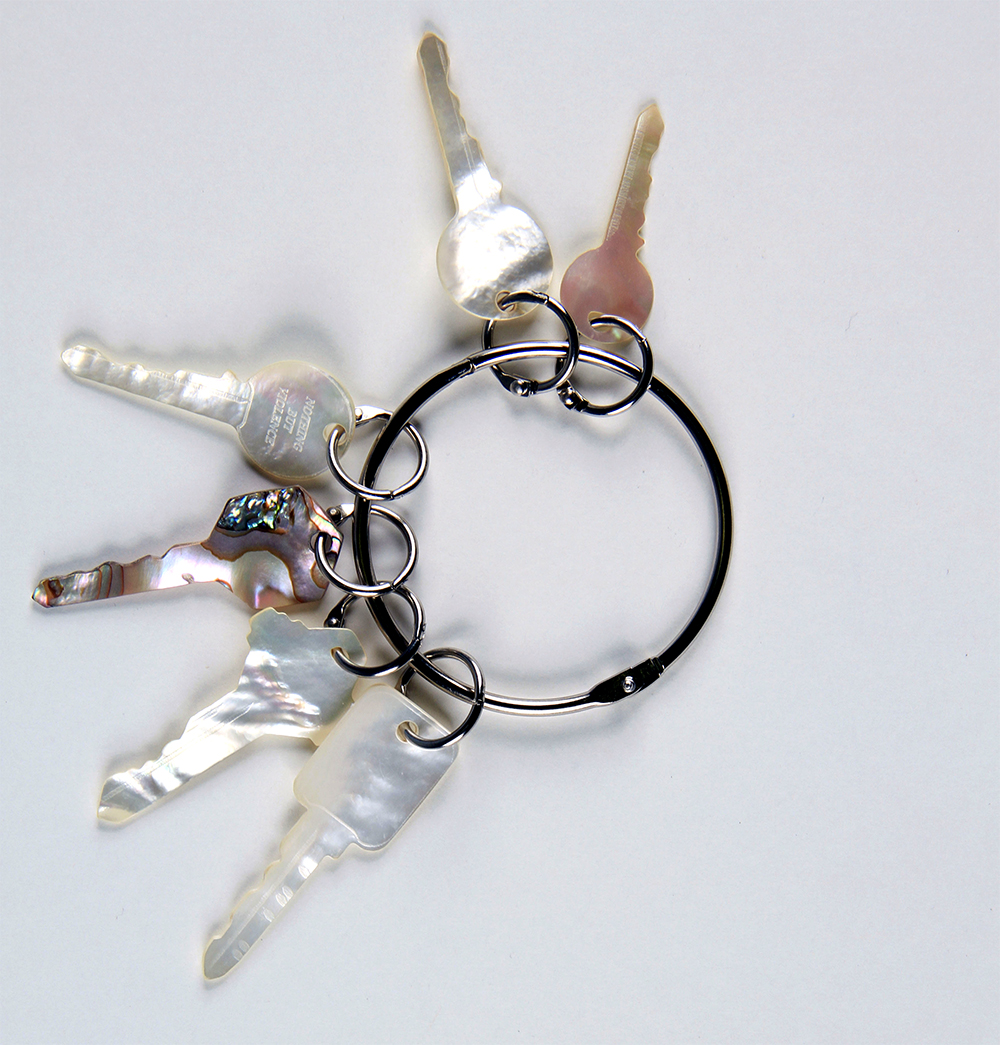
Holly Childs: Your work uses, and subtly repurposes, stories and tropes traditionally given or marketed to people who experience misogyny as tools for engaging with men or the male gaze. I’m thinking of your sculptural work of the past 18 months, in which viewers encounter traces of a dozen games, spinning dice and cards on tables and in cages, word games across languages, playground rhymes, often alongside abstracted self-portraiture, a ‘who is she’ self as subject, as muse and mirage. I like your work ‘Jailer’s Keys’ – six keys constructed from mother of pearl, one engraved with the message ‘NOTHING BUT VIOLENCE’.


‘Jailer’s Keys’ (2016)

Cristine Brache: Making is a game of communication and language for me. I find there is a lot of room to play with various modes of speaking: associations, words, symbols, context, histories, self-portraiture, etc. Each mode is rife with its own respective bank of meaning. For example: I am the mirage. With each body of work my intention is to create a personal syncretised subset that can be readily decoded if the viewer is able to connect and allow their own meaning to answer to the holes between the objects or words in question.

With ‘Jailer’s Keys,’ there’s a gender role reversal. Mother of pearl is often considered yonic due to its delicate appearance and texture, as are escutcheons, since their keyholes function to be penetrated. I wanted this feminine material to occupy something phallic, a key. They’re phallic beyond their physical appearance and function, as they allow passage to restricted areas. Their presence is authoritative, defining boundaries and distinctions between public and private space. The etched words on the key come from a poem I wrote:

FEMALE TROUBLE

them blues
that nothing-but-violence
just nature
just moon

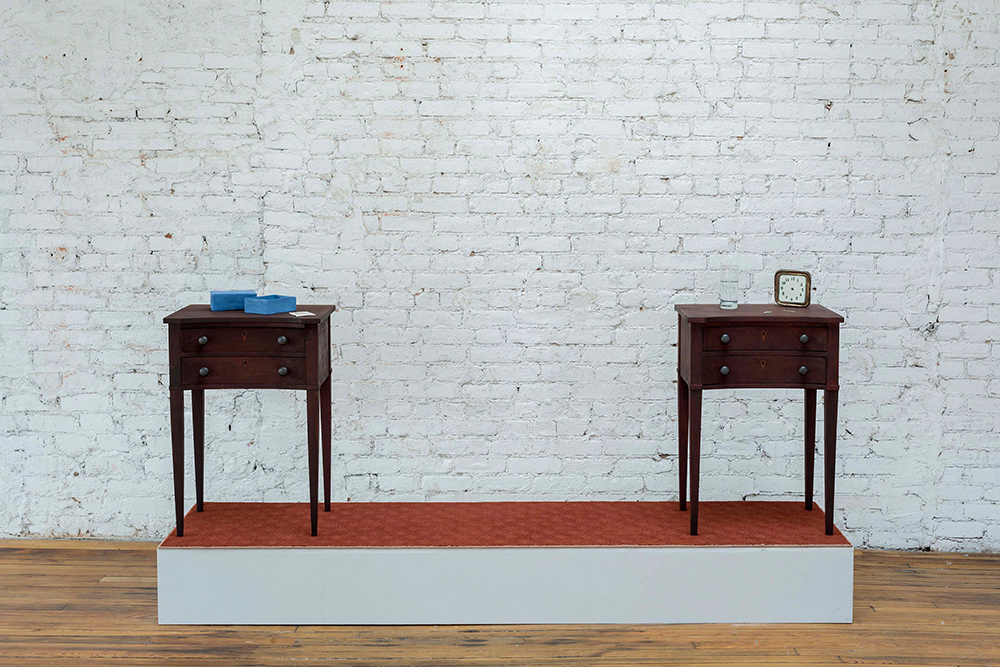
HC: I am also curious about your work ‘Self portrait without bed’. The objects on each bedside table appear to be expressions of games and riddles of absent figures sleeping on two sides of an absent bed: a set of playing cards with queen of hearts revealed on one table; two keys alongside a glass of water and a clock with no hands on the other. From these sparse elements I get a feeling of the unique and nuanced relationships of people who share a bed, as well as the games we play, the intimacies we reveal, and the positions we come to occupy when we share personal space.


‘Self portrait without bed’ (2017)

CB: ‘Jailer’s Keys’ led me to begin thinking of my body as both a public place and home. I am not sure if my body belongs to me still. So much is read and taken from it based on its appearance. Elements of the home are deeply personal, maybe the bed is the most personal place that a person can physically occupy. Bedside tables say so much to me. The last and first things you need before and after sleep are located on them. Things you keep nearby when nights are sleepless. I tend to have cycles of insomnia and when I do the clock preys on me. Clocks keep counting minutes even if it feels as if time has stopped moving:

FALLEN HANDS

a clock with no hands
keyhole mouth
carefully inlaid with 
no one will notice

Cards can be used for divination but also invite chance and risk. On my side of the nightstand in ‘Self-portrait without bed’ I wanted to give myself hope on a sleepless night, when inside it feels as if I have no bed, nothing to hold me. I placed ‘western playing cards’ made of porcelain and replaced the suicide king’s (king of hearts) face with my own on the top half of the tile. On the bottom half of the ‘card’ or porcelain tile, I did the same thing but with the queen of hearts, who holds a flower; the suicide king holds a dagger or sword to his head. The idea for this came from the title of the exhibition these porcelain tiles first made their appearance in: ‘I love me, I love me not.’ The opposing images on the ‘card’ is a pendulum that swings between self-love and self-hate.

Posted in INTERVIEWS | Tagged , ,

President Donald J Trump at the Western Wall, Jerusalem 2017

The kippah sits as strangely
on the artifact hair
as the look of reverence
on the features
lapsed and porcine.

His hands are on
the ancient stones;
his mind on
the photographers,
perhaps.

His Israel is not a country
on the map;
it is the adjunct
to a fantasy,
a figment
of his base.

There were only
two words
on the folded note
the President placed,
beyond the camera’s reach,
in a crevice of the wall.
To the God of the Patriarchs,
the Shield of Abraham,
Trump wrote:
Believe me.

Posted in 86: NO THEME VII | Tagged

Diary Poem: Uses of Dreams

I have been reading Coleridge on dreams
-in an email to the author from Lisa Gorton)

I dream that the dead are living.
Katharine says soft dreams where the loved dead seem
reciprocal and living are really nightmares to suffer, feel
anguish to awake to the bitter real. If no-theme were dream
I think now I would offer: a Commonplace Book in tatters:
Kurosawa’s fox wedding, Yeats’ quote: in dreams begins
responsibility, or how Confucius laments and exclaims
he has fallen from himself, too long has not seen
in his dreams the Prince of Chang. Not long the foxes sang
for Coleridge on the death-cold Nepean. He explains
in my sleep once more that the dusk reverses the dawn:
that by day the being expresses in words, but unity again
combines that with his night eyes’ yearning vision
fed deep by the body’s random sensations: he would term
‘double-touch’ how the body feels feeling. And a dream
in itself is double-touch, I’m seeing. How tight are the rhymes
in sleep, the subconscious — if you call it that and not a thing
like acetylocholine, when the visual and the emotions
revolve to replace norephinephrine-serotonin neurons:
but the effect as he described it is the same.
Rhymes tighten when
the sleep-brain curls up on itself, as in the womb
or death. I would offer the no-theme stream an explanation
too of Shakespeare’s we are such stuff as dreams
are made of: that it is our function to comprise them,
not their function to be us, and then who does become
the dreamer? Is it as in Bergman’s Shame, when Ullman
alive at the end on the war-exhausted ocean
asks what if the dreamer of all this wakes realising
it was a dream and is ashamed? ‘Living catacombs’
is how Coleridge describes the dream’s comprising.
Lying down, with an opium groan, his fear a leaping
‘great pig’ from sense-data, a frightening woman.
The fox wedding is as formal as the staged imagination,
as if bones are stacked in labels with street signs.
Does this make it sinister, or safer? Sometimes some
unconsciousness overtakes the double-touching,
and despite the nightmare nature of the daring,
the dead can become the living once again.

Posted in 86: NO THEME VII | Tagged

Neutral Bay, New South Wales

The full throated thrum of the service trucks
and i am swimming in frangipani
with sprays of white aster against green foliage
on the stone walls of Neutral Bay, the odour

of rubbish bins like stale piss behind
the bus shelter and the relentless high
speed arboreal rat-tat-tat of the
cicadas. The young carry the sun about

in their bodies, bright-seared and deathless,
savouring mangos like edible stars and
five-dollar-a-cup coffee. The continent
is prodigal of wonders — pouched animals,

billed beavers, shaggy trees dropping their skin
or iron-barked; and not these only but
urban stylites like latter day saints atop
their third story Thai restaurants and weeping

from the first bitter sip of ale, through
the spring roll starters, weeping over their
minced chicken salad and cheap bubbly.
The cicadas’ hum is the cantus firmus

of a city at song, chanting the hours,
the blessed bodies, the sacred hearts of Neutral Bay.
The service trucks stop under a window where
the stylites meet to weep the city all aflame

from the inside.

Posted in 86: NO THEME VII | Tagged

OK GOOGLE

Oh, yes, how I long for the days
those good old days
those golden days of yore
those simple times
when I’d walk ten miles in the rain
without the need of a map
whilst holding a fistful of pennies and a fishing line
and a clear sense of myself in an unspoiled world.

Oh, yes, how I long for the days
those good old days
those glorious days
when I’d read by the light of a filament bulb
and write ten miles of shopping lists
with a simple ballpoint pen.
Those days when the textbook of human anatomy was full of bone and blood and
brain and
oh, those distant and lost-forever days
oh how I long for them
trapped as I am in the now.

Oh, alas, I’m a normal human being
a normal, flesh-bound, breathing human being
a normal human being of the olden kind
who can walk ten miles in the rain
with a fistful of shopping lists
by the light of a ballpoint pen.
Oh, how alone I feel in our world
where the textbook of human anatomy is full of screens and circuits and
applications and
speech-recognition technology.

Oh, how alone I feel with my friends
oh yes how alone
with their fingerprint identities
and their unbreathing personhood
and their turn-by-turn, synthetic-voiced instructions
for walking ten miles by the map
with a fistful of filament bulbs.

Oh, how alone I feel
oh how alone
trapped
trapped as I am
in the circuit of the now.

Alas, I am a normal human being
a fact I can easily prove by the way
just look at the information I know
the information that only a human could know
that only a bone- and blood- and brain-filled human could know
in my direct sensory experience
of those good old glorious days of golden yore
when I’d read by the light of a filament bulb
in a rain of pennies
without the need of a map.

Alas, I must prove that I am a normal human being
beset as I am by a digital new world order
that denies my flesh
in favour of a corporate expansion of personhood
an existence-by-technicality
in which my ability
to walk ten filament bulbs
to my friends’ rainy houses
with a fistful of ballpoint pennies
is rendered insufficiently impressive
in the face of an ontology
in which anything that cannot be found
by a simple internet search
cannot be said to exist at all.

Oh, my friend, I’m a normal human being
so OK here I am in this fingerprint filament world
here to regale you in human language
with tales of those glorious golden good old days
when I’d walk ten miles
with a map about fish
I can easily show you a map about fish
here I am
oh my dear friend
my dear
OK.

Oh, my friend, my friend, my [insert name]
I am a normal human being
and all I want
is for you, and me, and every person
human or otherwise
to be OK
to be OK
in these simple days
of golden screens
and rainproof circuits
this good old simple fingerprint world
that’s free for all
for a fistful of pennies.

Oh how I long for you
oh my friend
oh friend, oh [insert name]
OK.

Posted in 86: NO THEME VII | Tagged

Rain

One thousand birds fret in damp trees
the leaves shiver
these fragments disturb me—
except for the repetition of the doves.

I remember your eggshell body
an odour of almonds
our words spilling
splashing white walls
red flagstones.

Again and again you saw me leave
when the steam in the kitchen silvered the windows
when the wine spread on the tablecloth.

This is not a sad story—
it is only difficult, and it does not end.

Later we said: we would spend the last of our lives together
as the rain pressed out the clouds
and continued its dull business in the garden.

Once, I saw myself, insubstantial as water
reflected in your other woman’s mirror.

Light blew in and out of the windows
your hand settled like an angel
on my shoulder.

Because we are never enough—
we repeat
over and over.

Slips of paper lie scattered at my feet.

It is still raining.

Posted in 86: NO THEME VII | Tagged

drawn, made.

after Louise Bourgeois (Topiary IV)

you rotate a hardened wasp nest
grown nut-brown, wooden pear,
and brain jelly is blue like
nothing in nature
except the exceptionally vulnerable
which uses blue to indicate
poison or possibility of poison

you sprout suggestions
rather than make your face, separate,
your cold body, typhoid erotic,
it could mask the scent
pulsing, chemical, off the hive above your crutch
draw the conclusion
pain or possibility of pain

Posted in 86: NO THEME VII | Tagged

Formant

Smell of egregious hours the petulant fridge.

Water lilies panting the gradient: app bursts under thumb.

Unfurling on wine more blue than onerous.

Moggie has something to say: it takes effort to listen

and it’s less satisfying than you’d think.

Charred timbre on the account of beauty and of the trees,
tries heavy repose, black magic. We, as in he,

and his eroding limbs, are stained with a preferred Saint:

press the genus, formant. For activity means

the tibia can narrow. A place to dance like a fresco

waning egg white: the morning bites.

Posted in 86: NO THEME VII | Tagged

My Mothers, the avian …

When all ceases
And hands and feet twitch in sleep
The guttural bird groans
Perched on a pole behind I-am-afraid’s house,
She couldn’t sleep, she couldn’t doze.

In the day, I-am-afraid sells bean cake
My Mothers asked her some, she declined …
She forgot the eyes that govern at night!

The guttural bird sits now
Atop the pole behind her house
Preventing her sleep it grunts
The eerie call of the deathbird, Kowee!

Eagles strangely, shrill in the dark, shriek!
The guttural birds groan, the deathbird cries: Kowee!
Let those who tend their sick beware
Let them stay away for Death prowls outdoor
Let them stay awake and clog the ears of their sick birds
With cotton dipped in palm oil …
Lest their spirits wander off to the calls
Summons of my Mothers’ birds!

Have you, I-am-afraid, ears?
If you survive this day
If you last through tonight
Two hundred wraps of bean cake
You must take to the Mothers …
Have you ears, young woman?

Posted in 86: NO THEME VII | Tagged

My Dream of Gary Snyder

one for Joe Mills

In mine, I gaze upward at a REM-state version of that spacy restaurant at LAX,
the disk with a 360-degree diadem of windows, and I’m ascending a staircase
on one elegant, arched white strut curving to the apex of a saucer-shaped suite

suspended beneath the ivory nexus. On the top step, when I ease open the door
of that lofty coastal lookout for the traffic of the air, Snyder is there, watching

television, black and white, solid-state, in a carved mahogany cabinet. The fare
is re-runs of Gilligan’s Island, a show that wasted more than enough of my time

in my teens: Ginger flaming my fantasies and the Professor providing my only
role model beyond an utterly witless sailor and a captain who ran his ship
aground three hours from Hawai‘i, marooning his goofy crew and passengers

for three years of prime time between the Executive Assassination of Youth
and the Summer of Love. Snyder slouches on a couch in the same clothes,

haircut, and youth he wore on the cover of Riprap. My arrival doesn’t divert
his attention. His arms are crossed behind his head. He’s chewing bubble gum.

My eyes drift to the flickering comedy, and my mind floats from the situation
until, amazed at my own ears, I hear myself say, “Oh, here comes the good part.”

Posted in 86: NO THEME VII | Tagged

The Photographs

Resolution

She takes upon herself his varied visions.
She serves his art as priestess, holding still
for the long minutes needed as the shapes
impress themselves upon the coated glass.
He turns his lens on every part of her:
the hollow of the collar-bone, the belly’s
swell, the dark declivities, the creases
at the corner of an eye. His pictures
show her most and least herself, absolve her
of herself, resolve her. How we long
for resolution, revelation, form,
and here it is. The shutter clicks. Art lifts
the fleeting moments out of time.
We hold them still in images and rhyme.

Dissolution

This is the photograph I love the most.
No artifice, no poses, just her face,
shadowed and softened, looking out at us.
No, not at us, at him. I know that look.
She’s been dissolved by love and making love,
made simple, opened up by intimacy.
She who was guarded is unguarded here,
the boundaries are blurred. I think of Blake,
his lineaments of gratified desire,
which was, he said, what men and women seek
in one another. Soulful animals.
There’s melancholy here and merriment.
Despite the shadows something is transparent
and even luminous: she’s fully present.

Book

The book of photographs – of course I bought it –
is large and elegant, thick ivory paper,
verso pages blank beside each print.
We were in Boston. Windows framed grey sky,
bare wind-whipped trees, but in the gallery shop
it was all gleam and glory. Music too:
one of the Strauss Last Songs, expansive, grand,
as if a ship sailed from a fjord out
upon the open sea. And so I felt,
and so I feel, remembering. The pages
blurred before my eyes. Why tears? Because
of music and of art. Because a bond
as difficult and doomed as ours could make
this moment and this monument, this beauty.


Georgia O’Keeffe: A Portrait by Alfred Stieglitz
Published by the Metropolitan Museum of Art, New York, 1978, revised edition 1997.

Posted in 86: NO THEME VII | Tagged

How Mirror Stores Operate

You know that cages
are ornamental
and orders are called menus.

You sat through the training
now you’re trained.
A major symptom is elevation.

You find the blanket
to be satisfactorily
romantic.

Fake grass is the image
you were looking for.
Inchoate drawing in a broke off

voice message, broken off
from your professional voice…

You include cinnamon
in the oats
and order more beer.

It’s morning and evening somewhere.
You wonder how mirror
stores operate.

Borne out by tickling
is antiquated
and plain wrong. Even so

you bore it
for the manacled daughter
of the house who broke off

all engagements to wear that dress.
You notice the plover’s nest
in the courtyard opposite

and how awful
it must be
to circle.

Posted in 86: NO THEME VII | Tagged

Invasion Day 2

For Ali Cobby Eckerman & Lionel Fogarty

I slept last night within your kiss and woke up invaded by a stroking hand.
On our patio last night Ali & Lionel talked about dreams and reality;
A conversation of spirit and friends who find they are united by love and dignity.
We are expatriate voices,
Tortured birds that write poems for liberation.
Lionel writes verses against terra nullius
& Ali has kissed the flesh of her sister who flew above the earth.
Juan is still reading his poem ‘I look like an Aboriginal’.
Around the table the candles light our faces and the wind plays with the flames.
Our bodies are embracing the smoke of words; tongues tangling
With accents of life & exile.
We are surviving the words & accents of struggle and resistance;
The sound of English is not a celebration.
We are birds trapped in the broken branches of the flesh of the ancestors’ sorrow.
Here we are, in unity, just a night away from Invasion Day.
Candles illuminate the accent of our laughter.
The smoke is lost in the sky. We laugh. We are warriors and poets.
We are brothers and sisters in this invaded land.
We are pulling out the Mayan calendar for 2012.
We are going to die and be born again in our common struggle for freedom.

Posted in 86: NO THEME VII | Tagged

Should go outside more

should go outside more
to
watch the life cycle
of the camellia
triptych
of bud, bloom and half-buried in the dirt
painted every September afresh
and close-by
(to the pair of them, one with big floppy flowers
like coral
the other
with tight, streaky ones
finely detailed cameos)
the half-dead cherry blossom
whose limp rotten fingers drop and litter the ground
(or at least, did
until I swept them up yesterday)
(O, I see one I missed
nosing through the leaf-litter and low weeds
poking through
the gravel
like a cute little shark
come to suck in
air) knobs
of sap glistening darkly
towards the west (it’s afternoon)

looking up, a few clouds have wisped their way
into the window of sky above me,
previously solid blue
and a strange white aircraft is in motion,
must be far away because so small
but round? maybe a helicopter…
no,
a helium balloon (I can see its string
as it spins),
and, I realise,
not so far away; just small
then it’s out of sight
replaced
by a milling gang of gulls
who go the same way as the balloon
as do the clouds
solid blue again

I’ve been living here for four years,
why
haven’t I done this more
my housemate Leanne’s
plastic green recliner
called me today, in the sun
(though I moved it into the shade after a while, rather than find
my sunglasses, or risk sunburn,
tired
of shielding, obscuring
my sight with my arms)
Now,
I am in the shade
wondering how much longer
I will live here
whether
I will have a backyard
one that I don’t have to share
(with the rest of the building)
in the next
10 years
even though
this one is almost entirely concrete
and
not much bigger
than the kitchen

playing Grouper’s Ruins through a portable speaker
plugged into
my phone, Liz’s
utterances
via voice, via piano, via
recording of her space
weaving gently in
with the utterances of Seddon
on Sunday,
mainly
whistling, unseen birds
(small parrot-like things, probably)
cars pulling in and out of parking spots
and swishing by in the distance
(though quieter now—well past the brunching hour)

I’m enjoying my weekend
too much
soon, I will go inside
sit at the dining room table
and
mark assessment tasks
(“corrections”, as the older teachers still say)
(what’s better, the jargon or the euphemism?)
but first
I will move
into the sunlight
lie back,
suspended by a chair woven of green strings
and watch
what floats by
on a Sunday
in September

Posted in 86: NO THEME VII | Tagged

Letters to Accompany Four Movements for Two Pianos

dear mr glass,
do you wish
for there to be people at the pianos, or are you comfortable
with the two pianos being alone together?

dear mr glass,
please write a composition for three hands,
as i have lost my fourth one
in an auto accident

dear mr glass,
the pianos have had an argument
and one of them has gone out of tune.
do you mind terribly if they face away from each other during the performance
so as to avoid further unpleasantness?

dear mr glass,
the four-handed pianist is requesting two cups of coffee (black)
and a piano with six pedals
as well as a cushion for the bench

dear mr glass,
the third movement is also requesting a coffee (black)
but we are concerned
that it has had enough caffeine already

dear mr glass,
the eight-handed pianist is here again. would you like me to direct him
to a more recent composition

Posted in 86: NO THEME VII | Tagged

Bag Man

stepping outside, the police are arresting a man with plastic zip lock bags, turning his pockets inside out like his pants had ears, we’re against the marble columns and he tells me that since Lenin died he’s worn through two jackets and a pair of pants, something about the embalming fluid, and how once a year they strip him naked, swab black spots from his body, I nod, but it’s too dark for him to catch the gesture, and the shorter cop has dropped his fur hat and they’re both kicking the fuck out of the zip lock bag man, and did I know that his jacket goes to the dry cleaners in a motorcade and when they shake it off small clumps of skin fall onto the floor

Posted in 86: NO THEME VII | Tagged

I Gave My Love a Cherry that Had No Stone

The marble façade of the apartment building appears pear in pollen light and then orange. The peach ripens. Even the pit from which the green leaves unfurl is not a beginning. Imagine a time-lapse. Terracotta pot. Vermiculite. Promise us telos. Fold each of us into each other. I’m having trouble locating. The night sky sifts down darkening a small dot of trees. Go down. Come down. From the loft. Onto the sidewalk to discover the green tempered shards of the GM station wagon window. I should have flown to my Aunt’s funeral. I’m quarreling with myself again. I’m writing and using words like quarreling. I’m second-guessing my predilections. The Holy One smote the angel of death, who slew the slaughterer, who killed the ox, that drank the water that extinguished the fire that burned the stick. This time I have traveled through the whole day without touching its darker permeations holding still in preparation. The sky persists—opal or pearl, rose quartz or turquoise.

Posted in 86: NO THEME VII | Tagged

Feel Like I’m Somehow Related to Everyone on the Internet

I am outraged / have been as long as I can remember
The sky’s a projector & the moon was brought here by aliens
To keep us informed of the shitstorms going on
I am outraged / been a member for as long as I can
Crushes are nice until you realise how hard you’re crushing
On the shitstorm that keeps you informed of
Slang for political or social awareness
Crashing at night till we realise how hard we’ve crashed
Zeitgeist moves all the way down
Slang for political or social airyness
Intending to automate replies to those who
Drowned in the waves of a zeitgeist
R we just gonna ignore the fact it’s been raining 9 days straight
Intoning an automated replay to those who
When you want to get trashed get recycled instead
Today we’re just gonna straighten out the rain’s 90 ignorant facts
The government uses the lottery to catch time-travellers
You want to recycle but trash it dead
White beatniks appropriating black culture
The lottery of time-travel caught the government out
Continued to bubble to the digital surface for the next 50 years
White beatniks appropriating black culture
In both ironic & non-ironic ways on all platforms
Continued to bubble to the digital surface for the next 500 years
The sky’s a projector & the moon was brought here by aliens
In both ironic & non-ironic ways on all platforms
Feel like I’m somehow everywhere / relegated to the internet now


(sources: #staywoke, Twitter)

Posted in 86: NO THEME VII | Tagged

Pilgrim Brother

My Other reminds me of a Viking prince
piloting a hot air balloon
in Central Desert cumulus.
Currency-lad come good,
no need to spend his rent on a nicked Beemer.
His old mates take the prize for mayhem.
I see him barefoot in the weekend market,
selling silver charms, and does it charmingly.
In lordiness he has taken up a Device.
Though it burns his fingers he can’t give up.
Sleepless all night he sleeps post noon
in a director’s fold-up chair
in a quiet style that impresses everyone, but
on waking nothing’s guaranteed.
In a re-make of Ned Kelly.
Military talents? The portraitist finds
an Irish lilt in our genes, in his grey blue eyes.
He slaves hard for a rest on Sunday.
A statistic diversity, a fishing rod
with a Kelpie on long term love, slathering
for a chase a bone a biscuit.
Winters he works another 50 mutts for cash
in some western desert town
fond of trailing afterthoughts.
Post-human? Maybe. My little bro
chewing a chip or an apple
5 thousand feet in the air.
His mother held him a long while, and turned the key.
Fluent as a green leaf in a local forest,
total strangers embrace him in the park.
in his garden, and within it sky-gardens of recall.
He sees a beach down there in Lake Eyre
invented just for him.
He will never grow sad, even without me.
He prefers to laugh. He finds it easy.

Posted in 86: NO THEME VII | Tagged