‘We’re masters at taking the way we speak and communicate’: L-FRESH The LION in Conversation with Simone Amelia Jordan


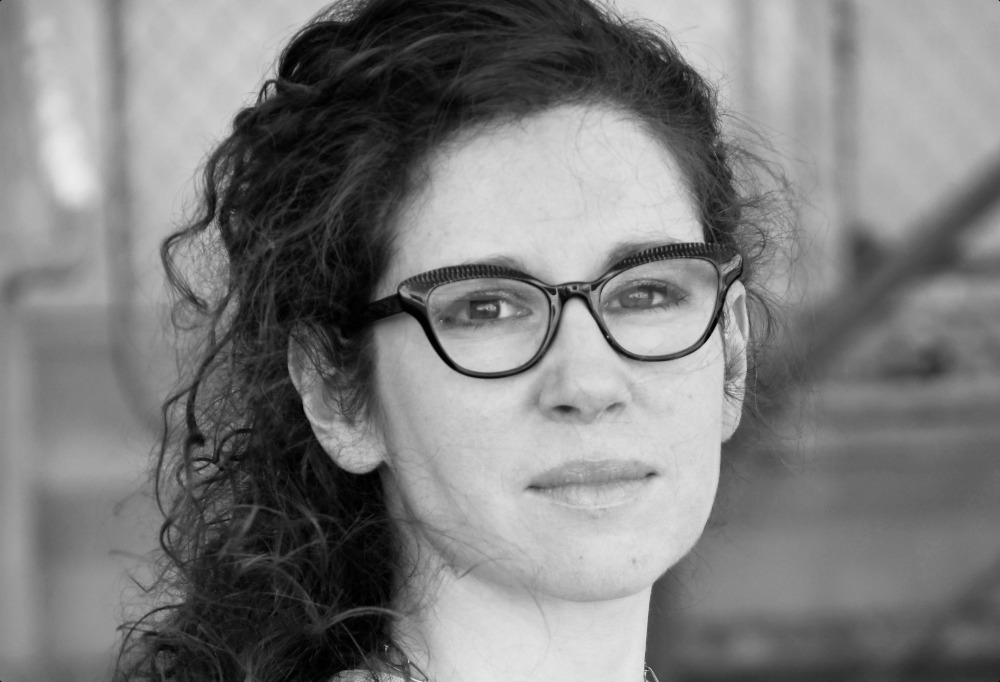
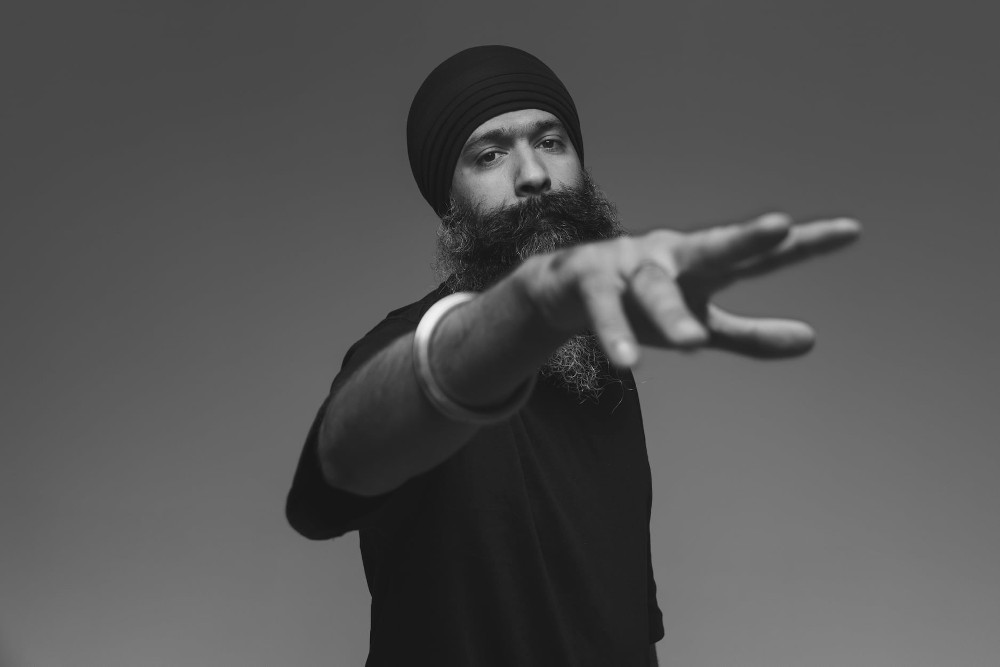
Image courtesy of L-FRESH The LION.

When I first heard of Simone Amelia Jordan, she was editing The Source magazine, the world’s longest-running rap periodical. I remember reading her articles covering emerging hip hop artists from Australia, exposing them to an international audience who have become accustomed to having their taste in music crafted by The Source. ‘She’s from here’, my friends would tell me. She’s one of our own.

From Burwood in Western Sydney to New York City, the birthplace and capital of hip hop, Simone Amelia Jordan has pioneered a pathway for music journalists from the most unlikely of places. We sat down to chat about our own individual journeys into hip hop and to share our love and passion for the music and culture that has shaped our lives.

L-FRESH The LION: In my eyes, you are a pioneer of hip hop culture in Australia. The work you’ve done as a journalist has taken you from writing about the small yet exciting and emerging scene in Sydney and Australia, more broadly, to landing one of the most coveted editorial roles in hip hop at the culture and genre’s home of New York City. However, before we talk about the barriers you had to break to get there, I want to start at the beginning. Can you talk about where you grew up and what drew you to hip hop culture?

Simone Amelia Jordan: I grew up in the Inner West and Western Sydney. I was born and raised there. I come from Lebanese and Greek Cypriot immigrants. My Lebanese family were one of the first Lebanese families to come from their village in Lebanon, so we’ve been here a very long time. I hung out in Burwood my whole life, that’s the hood that I claim. It’s changed a little now but 20-30 years ago, it was different. I also spent a lot of time hanging out across other parts of Western Sydney too, as many of us did in those days as teenagers of the mid-’90s.

I honestly gravitated towards hip hop from the moment I understood I was listening to music. And at that point, which was late ’80s when I was like eight or nine years old, that was when hip hop and R&B really married. And so, I came of age, I guess, as a music listener when new jack swing was huge and the two genres, rap and R&B, which had been quite separate up until then, came together. I was privy to seeing those genres marry and the magic that they made. I came upon artists like Mary J. Blige, like Heavy D & the Boyz, and all of those classic new jack swing artists like Father MC, Joe C, the Uptown Record vibe of Andre Harrell and Puffy. That was my entry into the music and it was just such an incredible entry.

LFtL: There’s nothing else like that synergy in the fusion of rap and R&B. I’m a generation or two removed from seeing that happen in real time but with that said, so many of my favourite songs when I was a teenager were of that fusion like Fabolous and Ashanti, the many rap tracks with the queen of choruses Mary J. Blige, Lauryn Hill and The Fugees. The list goes on. What excited me was the fusion of the melodies with the word play of the lyrics and the rhythm and style of the rap verses. And most importantly for me, the story telling drew me in. The songs I was listening to inspired me to become more than a fan by getting involved in the culture, and for me, that was through writing songs and making beats. I felt compelled to share my story through music. What was it that motivated you dive in and become actively involved as a participant in hip hop?

SAJ: I was writing raps at about eight, nine years old. I remember the first time I wrote rap lyrics was when my family and I lived for two years on the Central Coast, between 1989 and 1990. We were whisked away from the cultural melting pot of Sydney into this very homogenous lily-white environment. We lived in a suburb called Point Clare on the Central Coast and we were called ‘wog’ every five seconds. My sister started kindergarten there. The other kids called her ‘poo eyes’. My mum was a barmaid. She got a job in a pub up there and one man at the bar asked her: ‘what do you people eat?’ She turned around and said: ‘rocks, my boy.’ So against that backdrop of feeling very different, and coming into my own, and loving hip hop and R&B music, I started writing rhymes.
LFtL: Do you remember what your first rhymes were about?

Posted in INTERVIEWS | Tagged ,

YEARN MALLEY

THE END OF MY PUBLIC LIFE

I always thought beauty was important.
I always hated anecdotes. I only ever cared
for power, how I might
take it in my hand. I never want to write
about my mother. I love you, and one day
you’ll die. That’s the right approach.
Landscape of my affections,
It’s the thought
That counts, or the contour of it,
It’s your vagueness I admire.
I could drop a coin in your brain and it would bounce.
I’m sick of aphorisms too, but what else is there?
Short, high-pitched sounds,
Tram accidents of the heart. Pain is just an expression,
A way to survive this sharp spike
in sentiment. How many angels
dance on the pin
of your head? It’s unjust
how many guys are up there,
in heaven. I’m a
robber of dead men, a ‘delight’. It’s dreamy,
like a dream is a trick. What the mind conceals
the soul will out

Posted in CHAPBOOKS | Tagged

Portrait, Lyric, Code: Reading the Face Before and After Laura Riding Jackson’s Body’s Head

HAIR

1506
A young woman sits partially side-on. Her right hand is wrapped lightly around her left wrist.
She wears no necklace, no rings. She sits against a blue sky. Pale blue, with a sort of smudge. But sometimes it can also appear grey, depending on who is looking. Her clothes are dark and unexceptional, enfolded by her long brown hair like a shawl. Or is her hair red? Cast in different colours, it takes on different forms. Some say: ‘Her hair is clearly red.’ Her hair, some say, is anything but. Her hair, whatever its colour, sits loosely around her shoulders. It fades in parts, dissolving almost imperceptibly into her head. Scans have revealed that she was originally painted with her hair tied back. A controversial 16th century Italian myth. Her surroundings stretch seventy-seven centimetres high and fifty-three centimetres wide. About the size of a wall calendar. About the size of a building tile. When most people see her for the first time, they’re surprised at just how ordinary she is. They expected something bigger, brighter, more animated perhaps. If it weren’t for the perpetual crowd who shove and nudge one another in front of her to get a closer look, you might be forgiven for unknowingly walking right past. But you’d probably stop and look. And you’d wonder about her hair. You’d think to yourself: what colour is her hair?

1925
Separate and silk,
A scarf unwoven,
Thin enough to strain the sun,
Thick enough to keep a little of it—
A little less brown the earth would be
If rain changed from silver to gold—
Lean out anxiously over my forehead,
Trembling and giddy and falling
At the top of skyscraper me.1

2022
‘In January 2021, OpenAI introduced DALL·E. One year later, our newest system, DALL·E 2, generates more realistic and accurate images with 4x greater resolution.’2

Posted in ESSAYS | Tagged , , , ,

NO THEME XI Editorial

A lot happened over the months we spent working on this issue, from November when we published our playful, hyperactive call-out, to now, the beginning of winter, a date that marks a shift in the year’s trajectory. It’s time to take a breath and then what …

Our call-out sought to find poems that would energise us. We wanted some acknowledgement of the time that has passed, that is passing; we asked how you were going. We recognised instinctively that to gather a group of writers and poems together at this post-not-really pandemic juncture was to realise a new flux of tendencies and concerns, to recognise, collectively, the textures of change that have been revealed to us.

Editing this issue was pleasurable and intense. The Cordite Poetry Review selection process is famously anonymous and we surprised ourselves repeatedly in what we accepted and what we turned down. Each of us had our peccadillos, for sure. And as a ‘we’ we were emboldened by the opportunity to cast aside our routine tendencies and scripts. Most of all, we remembered how needy we are, beside a poem. How much we need the work of poetry and its sublime, strange tenterhooks.

We looked for thumbprints, for poems with purchase, a little give. We read each poem affectionately, amid the bluster of our daily lives, the only way possible. The sheer volume of works submitted to us meant we searched imperfectly, yet the selection here, in the final revision, is complete in itself, and we thank each contributor dearly for their effort.

It’s hard for us to bring to mind an individual poem without recalling its echoes and juxtapositions; our brains have thoroughly woven what we’ve gathered. At a certain point, the poems we chose merged together to become the singular long poem NO THEME 11, in all its variety and facets. On this windy morning, this is our offering. A collective poem, born in time.

Posted in ESSAYS | Tagged ,

On Kinds of Aunts, Dorothy Porter’s Barbaroi and the Head of a Gorgon


This essay his essay was developed during a Next Chapter Varuna Residency.

My youngest aunt, Irene, has a dream which she recounts to me, one unremarkable morning, when I am reading to my father over the phone. It centres on a relative, now dead (and about whom, with great generosity of spirit, Irene later remarks had some finer qualities) and although I call it a dream, what she describes is most certainly a nightmare, structured around her subconscious familiarity with Greek mythology (a universe of gods to which our own family has some slight genealogical connection), and her interpolation of this relative’s head onto that of a Gorgon.

Though the Gorgon (and Medusa particularly) formed a central focus of post-modern theorisation pertaining to the female gaze and the reclamation of tropes, such as in Angela Carter’s Bloody Chamber – where a biological mother (elsewhere scant in her work) erupts like a geyser of staggering precision, to spume destructive fury against a voracious and violent husband while simultaneously snatching her daughter from his maw – this is not (I suspect) the intention of my aunt’s subconscious mind in conjuring this unbidden metaphor to her attention. Rather, what appears to her resembles the herpetophobia which is presupposed by the reptilian dimension of swathed snakes in the place of Medusa’s hair.

It is quite by chance that my aunt has this dream at a moment of consonance with the work I am reading my father, which touches in part on the role that cinema takes in his childhood and also Irene’s, these two youngest children of refugees who, also evangelists, are thus quite censorious of the easy consumption of popular culture. It is in large part owing to this mentality, combined with the exigencies of poverty and the decade they are children in, that theirs is a childhood which features very few films, so few that compared to perhaps you or I, the two youngest children remember each one, its name and who took them, because they are only permitted a trip to the cinema with trusted friends and family members, which had less connection to the feature proposed as to the perceived moral character of the chaperones.

For example, the first film my father recalls is Disney’s Old Yeller, in which the feature (quite mawkish) is no more significant to Dad than the women who took him, Mrs Livermore and Mrs Lindsay, both near neighbours of his parents and members of the Williamstown Gospel Mission on Electra Street. Dad remembers quite a lot about their families and business enterprises, one who had an adult child that never left home and died quite young, and who would only serve refreshments to my grandmother Ellen, because, (as he was unabashed to report in the lounge room of guests), she was the only one who was nice to him. The other woman ran a small shop in a shed at the front (or was it the back) of her property, which was not even the size of a milk bar, nor rightly called one, and which later burnt down. Dad recounts to me what he describes as the ‘Livermore smell’, a dubious distinction resurrected by this recollection, (and which I think must have tempered the pleasure of a trip to the cinema), to be engulfed in the darkened theatre beside a woman whose face you can’t quite remember, but whose indelible smell has hung across more than half-a-century, to catch you at moments like when you’re recounting a story about a long forgotten film.

There are naturally things one might say of the dead which can still hurt the living, and I will not recount to you the more vivid dimensions of Irene’s dream other than to say it impresses upon her a similar feeling to that, which I imagine, is impressed on both her and my father as still small children, when the woman who will become their sister-in-law takes them to a screening of Exodus. Dad and Irene are so marooned by this story (which is dismissive of who they know themselves to be) that rather than drawing strength from one another’s presence that day, it lays waste to their memory, and each now confirms with the other (and with aching hesitancy) that six-decades since they both sat in the cinema together, like two bits of driftwood, shipwrecked against the blatant fabrications of Exodus. Yet it is some testament to the inherent strength of their parents, or perhaps to the lateral bonds in families, that these two Palestinian children (who did not, so far as I know, conceive of themselves as political), experience this film then, and now again in their memory, as the insult it is to all Palestinians and which is now characterised, if it was not then, as a ‘Zionist epic’. And somewhere, in the two-hundred and eight minutes of the screening, these two youngest children both form a view of their soon-to-be sister-in-law that is impressionistic, but like any good impression captures an accurate shape of how things will be over the next five-and-a-half decades, (but they are also children, and they keep it to themselves).

Posted in ESSAYS | Tagged ,

17 Works by Sary Zananiri


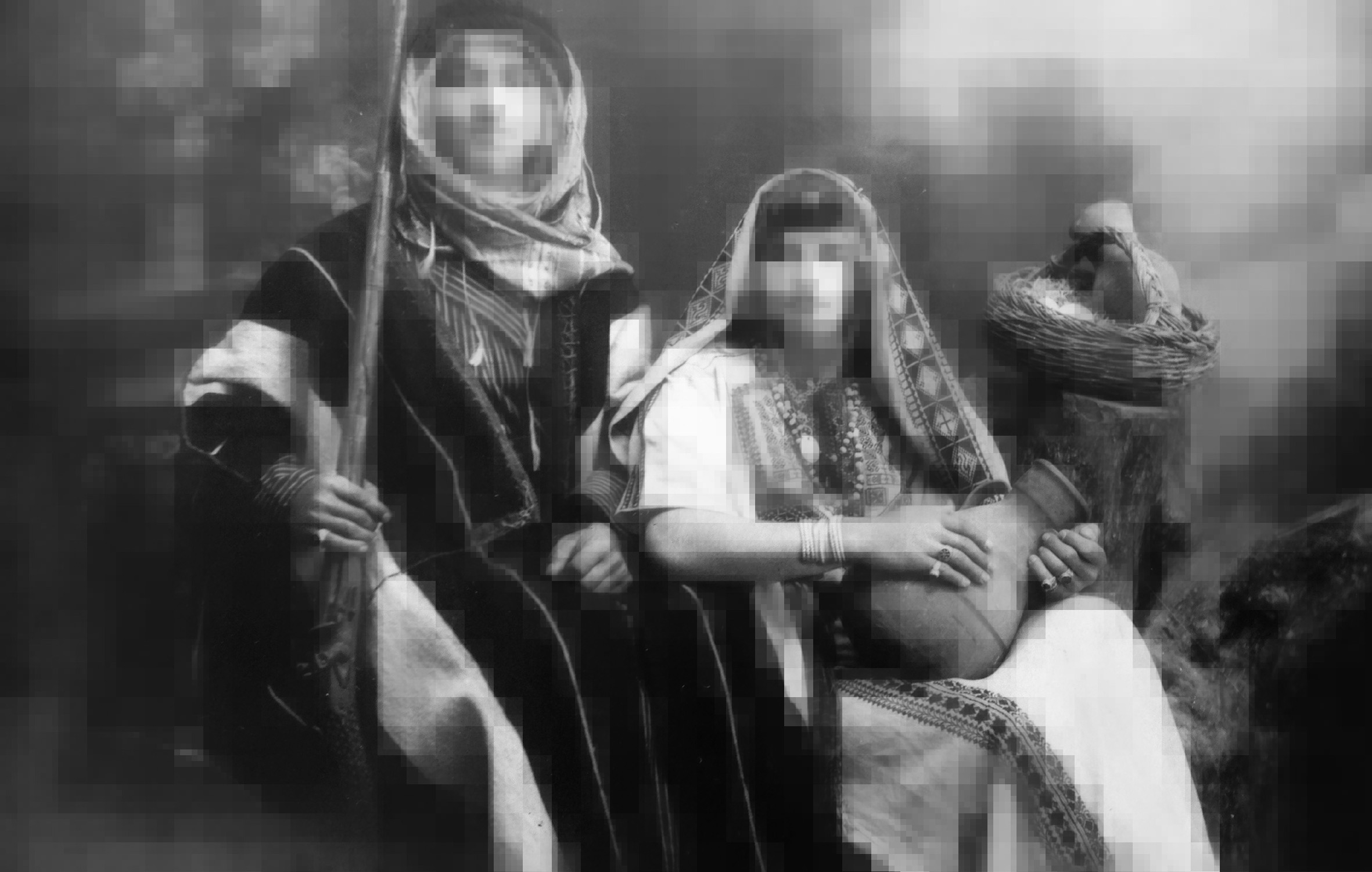
Sary Zananiri | Performing self, performing other #1 (2020) | Edition of 15 + 1 AP | Manipulated photographic postcard sourced from Palestinian family archives | 20 x 12.5 cm

From around the late 19th century a number of studio photographers in Jerusalem, Jaffa and other cities began to offer portraits in what was couched as ‘traditional’ costumes, provided by the studio. The phenomenon has been described as ‘cultural cross dressing’ and analysed primarily as an Orientalist phenomenon targeted at Western tourists and visitors to the region. Significantly less attention has been paid to participation in the practice by local Arab and Armenian populations.

The act of donning ‘traditional’ clothing for urban Palestinians was in fact a transgressive act, not so much culturally as with their western counterparts, but rather in terms of class. The misconstrual of such images today as authentic documents speaks to the lack of understanding of the modern urban middle classes who commissioned such photos. Indeed, a matrix of class and modernity distanced these urban middle class Palestinians from such costumes that – by this period – were seen as the purvey of the rural or the working classes.

Working with images drawn from Palestinian family photo albums, this series explores questions of identity and authenticity in images of ‘cultural cross dressing’. What emerges in these photos is the ways in which urban Palestinians related to their rural compatriots, the perceived authenticity of fellah identity, and a very modern process of reconstructing the past in line with the nationalism of the Nahda.

The pixilation of figures in this series disrupts the act of spectatorship, obscuring faces and bodies, but also intentionally references mosaics. With the growth of archaeological institutes in the region in the late 19th and early 20th century, a series of debates arose about the re-laying of Byzantine mosaics in churches in the West Bank and Jordan to remove human figures with the beginning of Umayyad rule. Western scholars argued that churches were forced to remove human figures in deference to Islamic proscription. Such theses were later debunked given that much of Umayyad visual culture included human figures. More recent scholarship has argued that the re-laid mosaics are likely an outcome of cultural syncretism as process of conversion took place in the early Islamic period. By conjuring the mosaics through pixilation, this series attempts to draw longitudinal correlation between Palestinian bodies, their effacement and periods of rapid cultural change.

Posted in ARTWORKS | Tagged , , , , ,

The melancholy of the inverted

A gilt-framed painting of Strawberry Hill, seraphs
carved in stone, chatelaines and belts, velvet, sad
little notes ‘for the jaded decadent to wonder at,’
the boy at the loom, presentation copies, gifts of
any kind, a monody, the telegram: ‘burn my letters,’
a white surplice, his photos of the Acropolis, a
polaroid stuck in a book, embroidery, an envelope
edged in black, burning eyes beneath the veil, an
antique scalpel, sonnets painted on a wall, a bedsit,
a cathedral, the dream of a seafarer, typescript in
boxes, a portrait of the king, rain on Magdalen
Bridge, fieldfares, a child’s play staged in a garden,
a hand mirror, a comb, an illustration of the proposal,
fleur-de-lis, a bone in the throat, a curved frame with
a spindle back, videotape, an ancient pose, white
embossed card, buttresses, eyes across a gangway,
an impression made in wax, brocade, a postcard from
Menton, the son of a judge, plovers’ eggs, violet ink,
a record of her condition, a ticket, the sensation of
falling, a motion picture, an index, a fire on the hill.

Posted in 105: NO THEME 11 | Tagged

Where did my brain go? Oh, it’s there again

After Camp Hill

When I see Felice I feel
the urge to write. Isn’t that funny felice?
I feel the urge. Maybe
you knew me in another life or
maybe you remind me of my life’s work
or that thing they call passion ‘find what it is
that you love and you’ll never work a day
in your life.’ how trite. like a trifle. like the meat trifle
rachel made in that thanksgiving episode of the cursed TV
show (already the subject of a poem called Monica so let’s not go
into it felice, okay?). I can’t find what i love as i love my
cats and i love bad poems and
i love using ‘bad’ words at the end of the line
the enjambment is more meaningful when you have to think
about it. think: why did you put that there, tracy brimhall?
why there, sinead morrissey? when someone says to me they love
poetry i say oh yes? My being coy
doesn’t help here because, according
to the five years i spent at university, only certain poems
are poems. the words have ruined me for other poems.
all i write now are: lists; letters; notes to self; journal entries.
journal entries. and according to michael e. gerber, weirdo, the turn-key
model changed the world but universities are not built
on keys and neither are poems. when i’m at Queens
the poets in tenure tell me my poems are too sparse and ask why
but at home in brisbane what is sparse is better—distil it Felice.
but whatever you do don’t write a bad poem and don’t
end the line in a conjunction, definite article or other useless thing. Occasionally
i write sondheim lyrics or recite
flight of the conchords—not to pretend anything—but
to harken to joy or at least to try. Felice
tell me, have you heard Meleika speak. no? well
you’re missing out.

Posted in 105: NO THEME 11 | Tagged

Flight

My first kite was a black garbage bag with strings. Not a red diamond crucifix made friendly with storybook bows – no. Jenny Porter’s mum made them for the school fete: cheap, replicable, repairable when the wind would inevitably claim one or a tree would claw at its face. Small slits in the plastic allowed the air            to vent making a pfffft sound as if the kite was just as careless as I was. Flight was only permitted on the flank of park by the sea – no powerlines. Electrocution sharks and perves were high on our risk list but there was joy in setting plastic storm clouds with their shocks of crepe-paper lightning against the sky.
Posted in 105: NO THEME 11 | Tagged

Chicken Bones

My widowed mother at lunch
plucks filaments of flesh
from near-naked chicken bones.
She splinters each twig-leg,
vacuums the slurry of marrow:
They used to hit me.
Με χτύπησαν. Me Htipisan,

masticates a small voice
I’ve never heard before.

She hunches over the fowl’s remains,
rounded shoulders, arms over breasts
ball into a child’s shield.
Her head twitches like a sparrow’s;
left, right, her brown eyes flick up, flick down;
her plastic cataract lenses flash
the phantom of a chthonic hunger;

They used to hit me. Με χτύπησαν. Me Htipisan.
When I went to rock the baby, during the war, they hit me.
They didn’t give me much to eat. I starved,

mewls this babyish voice again,
now from the back seat of my car,
as I chauffeur her from doctor to doctor.

My knuckles whiten on the wheel
like a mottled backbone,
like the mountain range
that splits her island – Karpathos,
as this famishment spools
a spillage of secrets
so late in life,
like the small, silent histories
of unaccompanied minors,
refugees and war infants;
countless children.

Posted in 105: NO THEME 11 | Tagged

the notes I took on my phone when V Barratt took me on a tour of their garden and asked me to water everything while they’d be away in NSW

Hose/by hand
Jane’s garden
Water Andy’s “L”
And sunflowers along here
Succulents above
Sun hits at 7am, so before that
If it’s really hot, water also when the temp drops
Experiments on the bench, make sure they’re not dry
I’m trying to strike them
Lemon tree, water,
Do the 3 little plants left of lemon tree,
Tree behind, a little bit of water
New sunflowers in the cornflowers
Baby next to it, keep it watered
Watering the zucchinis, and the tomatoes
Water little things under the illawarra flame tree
Clear the pond
Pansies, petunias
Around the base of the babies, keep them free of humus
The native lotus in the high baskets with succulents
Water, water, water,
Behind the broccoli, an indigenous apple, should climb up the wall, so try to make it climb “bush
tucker” label, doesn’t need a lot of water
Little seaweed succulents on the wall also behind the broccoli/cauliflowers
And various bits of rhubarb
Erimophela in front of the cauliflower, it’s happy when it’s hot
Baskets in front of Tony’s place, sage, blueberry in top 10 trees pot
Compost behind, there in the willow bin
And how to turn it over with
5-6 enzyme sprays, add torn newspaper, egg carton and leaves otherwise it’ll get too wet
Another hose on that side
Succulents along toward the front door
Left of the front door, these will die off, new little natives there are happy in the sun
Styrofoam box, tomatoes
Butterfly net/shade: zucchini, eggplant, old broccoli in there and some parsley and maybe garlic, a
good water every day
New little tree, in front of the bay tree
Wild passion fruit vibe,
Pink flowers,
Marigold, chard, chilli, rosemary, water the purple flower tag, and orange tree
Darryl does around the lemon tree, we sometimes double water it
Don’t worry about Darryl’s herb garden
Leslie’s little garden area, V usually waters
Orange in the white pot is important and vine over Leslie’s structure are important
Happy wanderers and little natives need water,
And around near the car there’s another hose,
Natives, lamb’s tongues, and flower garden next to the white car and fig tree

Christine is caring for the ones along the wall
And upstairs…
Don’t worry about Christine’s
V’s are near the stairs
Watermelon in a pot
Tragic looking zucchini, pansy and calendula pot, and the frangipani,
Everlasting daisies that are just sprouting
Strawberries in styrofoam box behind the chair
On windy days, close it and tie it up (umbrella)
Some water in each pot by the bathroom door
Little zinnia flowers and a little lavender
Black tomatoes can be eaten when they go brown or reddish
Citrus needs extra attention
Jacaranda
And paper flower cut and turned upside-down
Baby lemon and curry tree below
If it’s gonna be really hot, get the shrouds out and cover things up
They’re in the plastic greenhouse and peg them over things on the deck
Greenhouse plants need water and are always covered up
Power feed: a capful in a whole watering can with everything
Do it once with the watering can upstairs
Don’t do it before a heatwave
And there’s diatomaceous earth and eggshells if you suspect snails
Gloves and seeds and clips for the shrouds in the drawers by the back door
A tiny bit of water in the tray of the monstera every 3 days
Experimentally pollinating the zucchinis by hand

Posted in 105: NO THEME 11 | Tagged ,

THE FOUR EIGHT HORSEMEN FRIENDS OF THE APOCALYPSE NEW NORMAL

1.
mia (reverse centaur)
walks backward
into a fire station
eats most of a curtain
and all of two moths
that got in the way

2.
foiseach (one-toed, hoofed)
bolts face first through
a pizza hut window (ouch)
dies from injuries
at the salad bar (sad)

3.
ash (extant subspecies of equus ferus)
tosses a frisbee from his mouth
(there is no remarkable sound)
the disc takes silence with it
caught in the jaws of angela

4.
angela (of the family equidae)
(fixing a midnight sandwich)
is imperceptible in the light-hungry kitchen
(she didn’t even know you were home)
when you flick on the light

5.
cluain (equine-related concept)
eats a wallet they found
on the dance floor (amusing)
you don’t clock them chewing
on account of the deep house

6.
sylvie (equivalent of the human fingertip)
canoes into the centre of the internet
and begins the evacuation
by convincing a family of whales
to beach themselves

7.
aduantas (no foot, no horse)
licks both sides of a dvd
and reviews: one side is sweeter
but now I must disappear inside
the forest yelling about money

8.
evening (205 bones)
kicks a broken link (502 bad gateway)
into the side of a moving bus
and a passenger hisses
back with increasing urgency
and politeness: my tongue! it is
not unlike the fossil! of an unexploded
bonbon! remember this!
warmly!

Posted in 105: NO THEME 11 | Tagged

What even are we?

I remember calling you Donkey Kong
because it matched your initials.
And, you called me “Ate” (ah-teh) –
big sister in tagalog
because our culture is big on respect,
big on our titles for those older,
but I’m not sure what else.

As your older cousin
I did a poor job, didn’t I?
When I showed that hand, our family magic.
(I didn’t know it was a secret, but
I’ve learnt intentions don’t really matter).
That flashy crystal my mum used to love
to parade around on school day drives and shopping trips,
“Your uncle is addicted to methamphetamines,
Tsk, always asking your grandma for money”.

I laughed the way she did when I casually
mentioned your dad’s time on ice
not knowing how inappropriate until
I saw you blank
then blink
and say,”Oh.
…I didn’t know.”
You recounted how he would disappear for months;
no one ever told you, or your brother, anything.
Sometimes he’d show up only to leave.
You thanked me, you finally knew why.

We said we’d meet again
and we waved each other off.
I stared at the sky blurred with periwinkle blue
and delicate white
as I replayed the day on my way home.
I had finally seen you for the first time in years.

My dad messaged me
saying to leave your family alone
as if I had stuffed you all in a box
and shaken the whole goddamn thing.

Your dad took over your phone
telling me he would get me.
How he knew someone who worked at the
Roads and Maritime Service;
he’d get my address.
How I’ll never see you again.
How my father was no angel;
he had done it too.
But, here’s the difference:
I knew.
Not that he had dabbled in meth
but had smoke shrouding him all the time
or maybe I just didn’t have any expectations.
So, I didn’t care. I always tried not to.

Perhaps our fathers,
being immigrants, were easy enough prey
to the helplessly sweet caress
of a seemingly endless haze,
a glass full
of always happy
or perhaps it was a self-aware hesitation
toward the direction they were running.

I don’t know when it started
but I hate being Filipino.
Everyone is always loud
but not about things that actually matter.
Everyone always cares
but only so they can talk about you later.
Everyone always wants to sing.
Have you noticed at every Filipino party
there is always a karaoke machine?

I spoke to my therapist of my sudden urges to sing,
And he said it was a release: a way to gather oxygen,
and blow out the stale emotions.
Who knows if it’s true –
God? He doesn’t bother me anymore.

Maybe, all of us are a muscle, drumming though
and navigating this mapless, dusty,
copper landscape with song.

Maybe, it’s a shared subconscious trying to clear
and make way for something better than the past.

Or maybe we’re all just so traumatised,
don’t recognise it
and just keep belting tune after tune.
Everything hidden under layers of
of loudness and oily, fatty, delicious, fried food.

You and I, we should be careful,
heart attacks pulse through our family.
It’s the leading cause of death in The Phils
it transverses oceans
and is grasping to find
another rhythm.

Posted in 105: NO THEME 11 | Tagged

Chameleon

She al-ways said
I was a good
one—shape shif-ter child
heart like a spider web
guess it makes sense.

Surviv-al is adapt-at-ion and old
Black Hood has been at my heels since birth
yellowed forehead squalling
under humid-icrib lights.
Too-soon, too-small, couldn’t
hold me for days
maybe why I still hit the deck
inside hospit-als.

Can’t list-en to heart-beats
not mine, or any
one else ’s.
One Eas-ter she hid
a live rabbit inside
my back-pack its shock puls-ing
through ribs into my hands

I could n’t bear to hold it
can’t ever rest
my head on a lover ’s chest;
haunted by palpit-a-tions.

Posted in 105: NO THEME 11 | Tagged

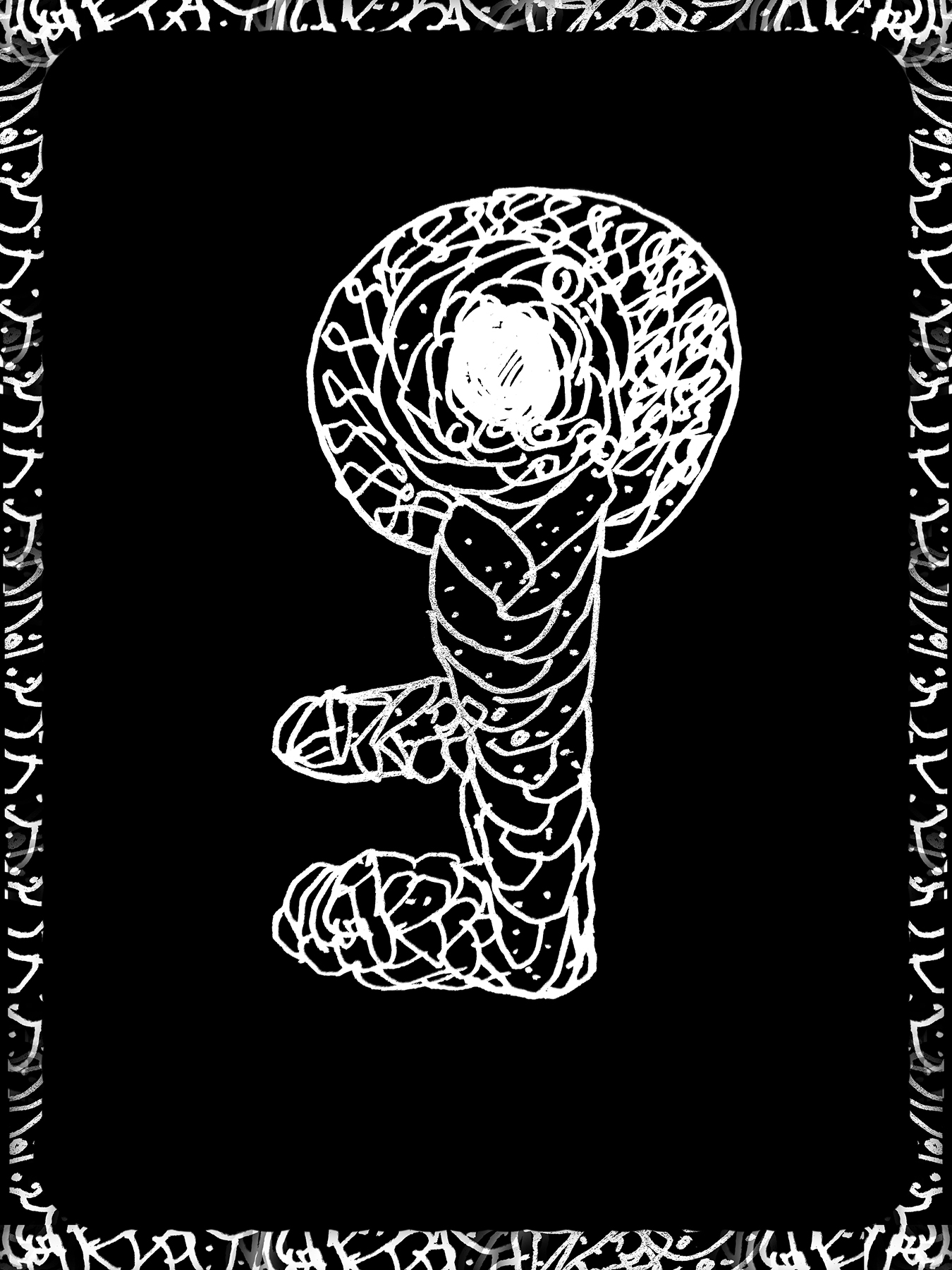
Shlissel Challah

                    I don’t have all the ingredients
          to make Shlissel Challah
                              on the first Shabbat after Passover
a challah baked     
in a key’s               
shape, to turn     
blessings upon   
our home.          
Baker’s yeast—
unavailable
during
pandemic
times. Instead
I knead flour
with vanilla,
sugar, oil, egg.
Roll three strands
to braid into the stem.
A circular donut for the bow.
A prong for the bit. I do not bake
a key inside. Instead, I make a second
challah, bury toffee-coloured dates, brush
with egg, sugar-sprinkled. While it bakes
at 170 degrees for half an hour, I make
challah a third time over with words.
This time, I leave a key.


Posted in 105: NO THEME 11 | Tagged

W.o.W

I attend the girlies night at Wet on Wellington for research purposes. Mimi comes with me because
she supports me, and has a thing for watching people be intimate in 25m lap pools.

We avoid the video lounges because we’ve both sworn off porn in the new year. Mimi wants to spend
time in the sauna but I decline because of La Niña. Do viruses spread faster in the heat, or does it kill them?

There is nothing more abject
than contracting COVID-19
at the gay sauna.

Lately, I’m obsessed with going out into the world. It’s because I’m reading Delany’s Times Square
Red, Times Square Blue, which posits that a healthy community depends on interclass encounters
(contacts), like the kind that happen in Times Square’s pornographic theatres. Gay sex is just
another nuance of urban life, and I’m wondering, where are the porn theatres for the girlies? And do
we even want them?

Mimi and I fuck in one of the private rooms upstairs. Mid-session, she does a bump of coke. I don’t,
because I’m driving. There’s a certain kind of privacy that being on drugs affords her. I’m jealous, I
whine. She says nothing, and sucks on my earlobe.

To quote Lauren Berlant: There is nothing more public than having sex in a private room at W.o.W.

With three of Mimi’s fingers inside of my vagina, it occurs to me that the sex act shielded by the
zone of privacy is the affectional nimbus heterosexual culture seeks to protect, and perhaps our
decision to fuck in one of the private rooms upstairs is not very gay of us.

Sometimes
it feels like everything
is always about
fucking.

The sex ends when Mimi notices I’m distracted. We get dressed and go downstairs. At the bar, she
gets a Sprite and I get a Coke with a paper straw. We slow dance to Sinéad O’Connor’s Nothing
Compares 2 U
with the other lesbians.

When my paper straw gets soggy and I can no longer use it to drink my Coke, we decide to leave.
While making our way out, one of Mimi’s rings falls off her finger and into the pool. A group of
three girlies canoodling in the corner stop canoodling momentarily to search for the ring. One of
them finds it, passes it up to Mimi, and importunes us to join them.

Three lesbians
sailing toward
a single destination
— pleasure.

Mimi declines their offer, and tells me she prefers to live life with one other person at a time. This is
why she doesn’t want group-sex.

On the way home we share a Filet-O-Fish from McDonald’s. Mimi says she’s extra horny in the
summertime and I tell her it’s because of the rising average global temperature and that soon, it will
be too hot to have any sex at all.

Posted in 105: NO THEME 11 | Tagged

Terniator 2

Fan poem for the artists in the zine program at Arts Project Australia where I work.

What is happening in the room… let’s see

Painstaking concentration, faithful representation secretly abstracted
Little red riding hood etched in stained prismacolour glass
Fastidious detail, noting every single stitch
Laser printing at a glacial pace

Sexy winking NFTs
Mix’n’match looks
Algorithmically selected

Bad lockdown monster defeated by ripped magpie & svelte shark on legs
Breathtaking perspective rendered without reference
Plucked from the complex depths of the artists’ minds eye

Helping with your Bachelor application and your MAFs application
Facilitating fantasy; 2 girlfriends, many phones
Clone stamping hair, cloning whole self
Sending in drones to steal decorating ideas
Intimate bath scene in every. single. zine
Number 3s mean it’s time to go somewhere

You singing along to thong song as my new ringtone
Making fun of actors volumes 1 through 5
The lowest of impact sickest of burns
Electric hues decorating wrestlers
Volcanic paper storm of endless puns

Full paint pen spectrum arranged in a square
Methodical dots, countless colour schemes
Mamma Mia cap, Moulin Rouge just viewed

Lite’n’easy
Shapes snack pack
Golden crunch microwave crinkle cut
Cascading crumbs
Detergent-green cordial

Comic featuring bloopers in which the princess flips off the agent
Soundtrack: Savin’ Me by Nickelback
Jeans with sneakers, black leather pants
Aaahh (angrily) we will not be squashing the piggies!

Relentless torture followed by relentless romance
Particularly between Rose & Jack
OK, strictly between Rose & Jack
“I love torture it’s so cute”
Toxicly hot colour combinations
How can something so wrong feel so right
Addiction to a moment in time (1997)

Momentum through collaboration
Everything glows like gory bubblegum
Remembering the shape of sea foam

Machine club meter maid
Rocky Horror Rocky Balboa
Bisexual gayness
Vivid texta

K-pop sensation in Spiderman suit
Dangling upside down blowing a kiss

Power range, Art Attack
Extreme close ups of online shopping for office supplies
Blossoming fondness between Jin & Jun
A proposal nobody expected: Will you be my mother?
The odd sunset here and there
Breaking up the action
LOVE ME LOVE ME LOVE ME
HARDER HARDER HARDER
OooooOOOooOOOooooOOOoOOooOOooOo
LOVE ME LOVE ME LOVE ME

Merger with Mythbusters
Now we all work at Mythbusters with the Mythbusters crew
The company car is an old rust bucket
In keeping with the signage

Anyway apologies for bootlegging your thoughts
I know you don’t like it when I steal your thoughts
It’s because on the most-part I love your thoughts
And when you do them out loud they become my thoughts too

Posted in 105: NO THEME 11 | Tagged

glass poem

after Adrienne Rich’s ‘Song’


with waves in it
the voice
sounds softly
caged

now we are in the apartment
twenty two
hours of each day
i am noticing the drip of white paint
like a long unfinished cry
on the window pane
instead of the view

wind inverts
the moreton bay figs
so the matte olive underbelly
replaces high gloss
and the whole tree points
southward,
is a cone

two hours of summer
on the princes park loop
scrapes underfoot
kicks up
in our eyes

two hours of
winter, clay
we come along
quiet
later
muddy

all the times
mum was a batshit sculptor

for example
the morning
a sharp loud crack rang
through the lounge room
and pressed into
every corner
of the house
a split appeared in the picture window
running from top left
to the centre
like a lightening bolt
a builder said
the whole
left side of the house
had shifted a
fraction
down the hill
on account of
poor drainage
water seeping through
the foundations
mum superglued
flat glass marbles
the fish tank kind
along the crack
making
an ornament
of waiting
i stopped
bringing friends to the house
so i would not have to explain her craft

first we will get a new bookshelf
and sell the current bookshelf
the table, another foot to the wall
brings new satisfaction
avoiding wood
for the fire

yesterday
the plane over the roof
carved its way
from the left jamb to the right
first in memory
yes, i’m lonely

the voyagers have left the heliosphere
i read that they experienced a chill
and a new density of plasma
‘interstellar space is here’
they beamed back faintly to a 70 metre dish
the solar wind is not fading
as some thought
says voyager 1
it is up against a boundary
unimaginably massive
but, says voyager 2
the boundary is sharp, thin, sudden and
impossibly spherical

they keep moving
away from us
and each other
their arc and
fall
into the silence of space
will be longer than the earth can quake

old windows
are thickest at the bottom
and sometimes warp their frames
i imagine it
still a timeless liquid
drop by
look in
be still the curtain

a small plastic bag
which carried oranges, nuts, lettuce
or perhaps some lollies
for about half an hour
waits silently
10,975 metres deep in the mariana trench
a retired naval officer
dived all the way down
to see it twinkling
in the headlights of his submarine
does life give out its secret?

each night
the moon auditions
but this is
no show
we have a gift for watching

an animal on the ground
looking skyward
is still
an animal
on the ground

Posted in 105: NO THEME 11 | Tagged

Oranges

Oranges were charged this morning. Last night I read
a famous poem about oranges and this morning you shrugged
a cluster of them over your shoulder
as if they were a sack of gifts or coal burning
through their netted bag as the orange in the poet’s hand
did at the end of the famous orange poem. Yesterday too
I ate oranges in bed.
Over your shoulder the oranges went while
you insisted they be my contribution
to Naughty Santa at a Christmas Party
I was planning to attend with many guests
I’d never met and worried would be lawyerly
types which S misheard as loyally types
thinking I was anxious over how fiercely
they may defend one another
and not how they may scorn, prosecute or delight in
my bag of oranges which, in writing this, I will now
have to bring to the game and perhaps,
after a series of swaps and steals
land the oranges in their rightful lap,
have to justify why a bag of them is
incalculably valuable, how they glow
in poems and on the tree in my yard
which I’m very far away from now,
meaning they glow in the mind also,
how they can be juiced or cut into wedges that fit along
the teeth once the flesh is bitten out,
how they can be tossed
in salad, gorged on at half-time or sizzle
into perfume when the oily skin is condemned
to fire, how in the famous poem
the poet even makes up for the disparity
in the change they are carrying and the price
of a chocolate bar they want to buy
for their girlfriend with an orange, how
he pays with an orange, which is not to demean the gift
of oranges by suggesting they are valuable because
they can be used as currency since oranges
are only ever born
not asked into that cruel ordering
of the world, how there is a video of Louise
Bourgeois peeling an orange while reciting
a story about her father
who made a cruel joke by telling dinner guests he would
produce a portrait of his daughter from an orange
and proceeded to cut a figure from the peel, carefully aligning the genitals
with the hard bark-like nub where the orange was once attached
to its tree, a belly-button of a kind, scarred connection to another
life, which, when inverted, protrudes in a series of woven white
fibres the same substance as the white fibres
surrounding the peeled fruit, so that when he flipped
his cutout, which he gendered a woman by its lack
of any protrusion, the effigy bore a large erection, how Louise
cooly dismisses her father, his crassness, how the peel she cut
in the video to demonstrate his party trick is now under glass
dry, curling and brownish,
its female body, according to him, facing out to the world,
how we decided to drop roughly skinned orange halves
in a blender making a thick orange mash we poured
through a sieve into glasses while your daughter, my friend,
scooped the pulp into her mouth,
how all our hands were sticky
and the water we washed them in was warm, how my colleague
at a high school where we worked as caretakers
would peel an orange every morning on our break
with a small knife into a perfect unbroken spiral
and every day our friend who worked there also would attempt
the same spiral and never achieve it, how we knew it
to be a skill made all the more wondrous by our clumsiness
or ineptitude or lack of practice, how in one telling
it’s a complicated way of peeling
an orange and in another it’s the story of a life,
how whenever you moved you were moved by others, manoeuvred
until you resembled something unbelievable, a spiral hewn
from a sphere, how it was, at times, sweet,
aromatic and bright, bright, bright.

Posted in 105: NO THEME 11 | Tagged

double distance

doped up on hills
tableaux of
four pencil pines in santa hats
which someone stood on a ladder to install
red nails on a manicule
handpainted on the truck’s cab door
red handprints at Phyllis Frost
traceries of lightning in Yorta Yorta country
from a passenger window
too much vision ‘at speed’
low band of horizon light
cracking the stereo open for the last 120
pulse entry outside time
but fanging thru it

Posted in 105: NO THEME 11 | Tagged

Time Loop

Back to bar soap
back to air drying
back to lying
on our backs with our hands on our abdomens
breathing in for four, holding for four
breathing out for four, then holding, empty, for four

Time is looping
“Strange things are afoot at the Circle K”
mourning dove, tell me again how time is a symptom of love
my friends and I keep making jokes about shame
and how we need it this Shame Month
“Happy shame!” the teenage actress will write
to help me to manifest it
but it’s been collecting from nowhere
bundles of dust held together by hair
that just appear on my laminate floor

The future enables the past, time is a billiard ball hitting itself
someone tattooed the moon on my arm after looking
up the phases and practicing one or
two times on an orange and

I would be lying if I said I didn’t think every night
about something, like the way you whimpered once
or the way your mouth looked sleeping

Posted in 105: NO THEME 11 | Tagged

on holding / on being held / being / etc

hold me like you hold
yourself together

holding where fruit
will grow
(held for ripeness)


thumb holding edge of plum
holding fuzzy cheek
in shoulder

earth holding body
as breadroll
on dinnerplate


how held did you feel when you were held


there are methods
of holding
with / around / in / of


empty space
holding against
whoever may enter

(when you’re ready)


in light disappearing
softness enveloping softness


cup face in glove

torso foams around jawbone


curling around each other
brush arm of feathers

drifting forward
to have held you
in my warmth


lift body
with thumb and forefinger

into open palm
close hand

in a fullest of holding


holding the same

for each other


refresh stale space
for new potentials
furnish new world
through points of contact


space for being
space for staying


can move you
if you’re still


please hold
softly through the exhale
(softly through the inhale)


can let go of you
whenever you want

Posted in 105: NO THEME 11 | Tagged

On the Rise

All morning, the brothers work
their father. They break him—he leaves
his odd jobs undone and drives them to the tennis club.

White cloud banks avalanche. Wasps cloud the drink taps. Summer heat rubbers
the air treacly with the wattle
lancing the court fence, fingers gold

as the kangaroo on the little brother’s racquet throat.
The northerly swirls the ball—its ballpoint. Neither brother
can middle it. This proppy error

spray, heatstroke, herringbone soles scoring
parched en tout cas into gags
of pink dust. Their father, who’s removed his shirt, feeds them

drill sequences, opportunities—take it
early, take it on the rise, Agassi it, never let it come to you,
go out and meet it. Play your way in.
But against the graffitiing

wind, strokes prove reactive, countermeasures,
impotent and shocking and depthless, the way the little brother
that holiday tried to punch waves back to the mid-ocean.

They run out of balls. Their father gathers them in the basket,
squeezing the pressurised rubber through the metal slats.
Wattle in his pockets, the older brother

watches the little brother run at speed
towards their father whose back is turned, racquet
aglow, as if the graphite has yet to harden,

as if the graphite that meets their father’s
spine, between the shoulder blades, were a molten
cast, beginning to set.

Posted in 105: NO THEME 11 | Tagged

Cloud glory

Grey swathes of salt bush
pulling at the wind,
the earth curves here
wide and empty as it is.
Small towns pinned like mistakes,
like smudges on red rocks.
The blunt hours and hours of the car,
the driving,
the engine.

Leaving is on repeat
over and over,
a fear
at the back
of my mind.

At the coast,
my sister tells me
the ocean has a memory.
It holds remembering
in its moving mass.

The slip of sand,
shells under my feet
and the bird that drifts on the wind,
just out of reach.

Here at the earth’s edge,
my sister tells me it’s alright
and we watch the clouds
as they lift our eyes up,
to the point
so far in the distance
it becomes something
I can hope for.

Posted in 105: NO THEME 11 | Tagged