Opera

After each useless, ephemeral voyage I return
to the house
and its quay; I circle the edge before skittling
off to the suburbs.

Come to me, I cry, fat plastic and screaming sail,
shining, golden city
cramped and seeping music! Tonight
my heart’s emptier than a harbour.

I gulp down your murky cocktails
of diesel and suit.
I drink, drown and return
sharp as a note, sharp

as a particular location in space
– one
of one million locations – one
of one trillion locations in space.

I watch the melody collapse
– looming, stretched, blasting –
it flattens me and I’m spat
out the other side

into pure noise, pure scrunching and there’s Sydney,
the wet black face,
the burning beer intoxicated with its own
bubbling tarmac.

Ragged music blows in from the desert,
from the sea;
ragged sheet music catches
on a barb. Sydney’s

a barb on a rusted wire;
it pierces currents, leaks tetanus;
it’s the time of day towards which
we tumble inexorably,

away from which we surge, searching.

Posted in 49: SYDNEY | Tagged

Fragile

… ha- … thanks … another post … time … hotel … Stanmore train … heavy … it
was … full … through the corridors … black … winding down … I went … I was
staying … park … under the … they would be … to … Circular Quay … under … it
… flowers … she was reading … the books weren’t … the … I get a … heat … hard
… running across … milkshake … said The Piano … fly back … noodles … we are
across … he seemed … boat … a sec … arguing with his child … copies of … so
much w- … in the mosquitoed … lock … tshirt … a singlet … café … it was only
stop bleeding … sorry, forgot … learning how to … between … Darlinghurst … at
the … cannoli … we talk a … its cheap … Glebe, Valhalla, Balmain Town … crazy
… dusty … out the back … and we … carving … tea … sharing … fake boob … she
was too fatigued … standing – brooding … I wore … running up Crown … at the fair
… red bag … into the … that one ni-… a taxi on … that won’t … he … when had
that moment in paint- … conflict … raining as … it was … avoiding … had to
your comment … and here … duck … I saw her … had the goat … rough when
lightning … bath … near Sydney Uni … tanned … Bookshop … Green … Me =
lecture and after that … dog race … it was great … it was … fruit … where he had
I was roused … mostly suffering … moments … for … spotting … if they
beautiful … the chairs … raining … Petersham station … broke the … street
Cockatoo … smell the record shops … Orientalism … persists … late … run-ins
before … his manuscript … house … I think … books … my books … photos
garage … slightly … Library … Johnson … go and pick up … under … one of the
last remaining … read … I don’t know what … driving … the bus … escalator … ok
but … I went in there, but … felt all … yes … pressure … whoever … small … roof
… video … ok? … dance with his penis … it’s always … noodles … out the back
to flush … if we pass … walking … through the gossip … night … he didn’t look at
me and … later … wharf … could’ve taken … hotel … under … it didn’t seem so
taking so … boy that I … always keeping … Oxford … secondhand … through the
window … he wanted … train … wrong … Zoo … had destroyed much of … we
took … theatre … about New York … can’t remember … didn’t see him, just
furniture … didn’t … wasn’t what … hail … that awkward- … net … blue … throw

Posted in 49: SYDNEY | Tagged

Highlights from the Poetry Symposium

About a week ago, I got along to the Political Imagination: Contemporary Postcolonial and Diasporic Poetries symposium, hosted by Deakin Uni at their suave city campus. Convened by Ann Vickery, Lyn McCredden and Cordite’s very own Ali Alizadeh, the symposium made trouble with notions of postcolonial and diasporic poetries. It was a Nespresso (and in my case Codral) fuelled couple of days, packed full of paper presentations, book launches, and great conversations cut short between sessions. I found it pretty generative to some of my own thinking about poetry — I’ve put together a bit of a run-down of the bits I found particularly interesting. Please feel free to leave you own comments or reflections from the event below.

The keynote speaker was Peter Minter, who got proceedings off to a cracking start with a paper that evolved his critique of the Gray and Lehmann Poetry Since 1788 anthology, and went looking for productive ways forward in reconceptualising what an Australian poetic is/could look like. Searching for ‘new ways of conceptualising the beautiful, the artful, and the aesthetically true’ he proposed the notion of an archipelagic poetic, inspired in part by the work of John Mateer and Robert Duncan. He asked the question of how culture could become more sophisticated in engendering cultural diplomacy, arguing for ‘archipelagos of psychogeographic intensities’ where we each habituate on our own archipelagos, venturing across to others for moments of exchange and commune.

It was really great to see how this notion was picked up and reseeded by many of the presenters over the two days. It certainly captured my imagination, both in its potential to decolonise the trope of Australia as an island nation, as well as in the sense of volatility and movement the word suggests — archipelagos are fraught places, often formed out of volcanic rock and liable to flooding over. I thought it was a really ripe idea and I hope Peter and others continue to develop it. Keep an eye on the blog for Bonny Cassidy’s take on it too, coming very soon!

Later that afternoon Ania Walwicz gave a performance and creative paper about her poetic practice. I hadn’t seen her read for ages, and she was terrific. I actually woke up the next day with her in my head: I wake up now now I shower coffee now where is coffee now? These were some of her pearls from her accompanying paper, which she described after the fact as facetious: ‘I inflate myself — and then I cut’, ‘Freud writes: the only reason I write is to analyse Ania!’, ‘Something is wrong and I see this in a film’, ‘I don’t believe in one word I say’, ‘dream diary dreamt in the palace of culture’. I’m pretty intrigued about what her dream diary contains, and I think she’s inspired me to start one of my own.

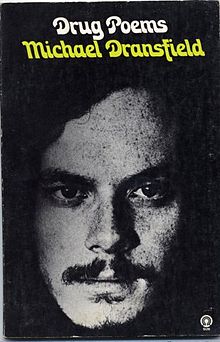
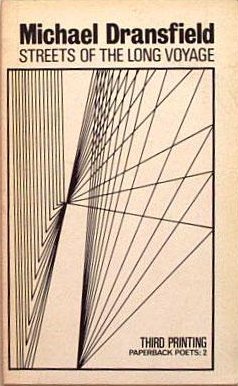
Unfortunately owing to illness I missed the Michelle Cahill’s and Adam Aitken’s sessions the following morning, arriving just in time for Michael Farrell, who was totally on-trend with his paper about Michael Dransfield, who seems to be everywhere right now. His presentation used Dransfield’s Courland Penders as a test site for turning over the notion of the baroque, a term which he fermented with other concepts hiked from Latin America, specifically the geopoetic (‘a place where poetry, science and thought can come together’) and creolisation (‘the results of a history of contact: colonisation, history, migration’). I got the sense that Michael was working with these ideas less to reach a destination point than to see what adding them into the mix might reveal – a way of shaking up an attitude to Australia poetic genealogies he memorably phrased as ‘varandah shandy triviality’.

For Farrell, the ‘baroque turns itself intrinsically towards the rural, the peasant, the pagan,’ and widening out from Dransfield, he drew on this definition in reconceptualising our formation of poetic lineages, differentiating the bush baroque — being a term Peter Porter once used to describe Les Murray – from the neobaroque, a category he extends to poets such as Gig Ryan, Chris Edwards, Jill Jones and Emma Lew.

He received a question at the end which unfortunately I didn’t write down, something about the follies of moving from away from Eurocentric conceptual modes — a comment I found especially odd as I’d been thinking about how great it was to finally see some cross cultural concepts in action!

And he also quoted Walter Mignolo,‘I am where I think’, an idea which seems to sound off Minter’s archipelagos-as-psychogeographic-environs idea.

Towards the end of day two Lyn McCredden gave a presentation on poetry and nation. Afterwards I was initially frustrated that it wasn’t a more focused paper, but the longer I thought about it the more provocative her ideas became. I feel like she swooped in and left us all with a bunch of riddles to solve; does poetry have a role in reimagining nation/hood? What can we conceive of as common readers? Especially when poetic language use is anything but common? How does this in turn feed into ‘the double impulse of poetry’: embodiment and refusal? And finally, is Australia bad at poetry?’ All-in-all, questions I’d love to see someone more foolhardy than I try to tackle!

There were so many other highlights too — Lucy Van’s compelling observation that a sense of the present is always belated in criticism (based on her reading of Achille Mbembe), Ann Vickery on Juliana Spahr and postcolonial queering, and her idea of water as a connecting fluid (another idea useful for our creation of the archipelago); poetry readings at Collected Works and the launches of forward slash, VLAK

And the epic closing event, in which we all crammed in to the upstairs room at The Alderman for the launch of six Vagabond Press chapbooks, by Corey Wakeling, Fiona Hile, Nick Whittock, Nguyen Tien Hoang, Eddie Paterson and Jill Jones, which I’m planning to say much more about once I’ve had the chance to chew through them.

Thanks to the symposium organisers! Not only was it a productive and stimulating two days, it was free and open to the public, allowing for a diversity of participants which can only be described as a Really Good Thing.

Posted in GUNCOTTON | Tagged ,

Thoughts on Adrienne Rich

It was rubbish news, to hear that Adrienne Rich had died on March 27. Her influence on my poetics, as well as my person, has been significant. On first reading her poems – those within A Fact of A Doorframe, nabbed from the shelf of a friend a few years back – I was struck by the power of Rich as a fierce poet without adornment, whose poetry could be read without obfuscation, without aesthetic glitching, without feeling stonewalled by theoretical moonscapes.

In the days since I’ve been revisiting her work, and keeping tabs on the obits as they come in – The New Yorker, Lambda Literary, Slate. They all talk about her legacy; her feminism, her activism. They begin to create a nest out of her life and influence. The New Yorker’s Katha Pollitt, describing Adrienne Rich’s death as ‘the end of a kind of poetry that mattered in the world beyond poetry’, observes that Adrienne Rich’s obituary made front page news at The New York Times – and wonders whether ‘an American poet will ever be honoured that way again’.

From ‘Axel, darkly seen, in a glass house’.

“The dead” we say as if speaking
of “the people” who 
gave up on making history
simply to get through
Something dense and null 	   groan
without echo 	        underground
And owl-voiced I cry Who 
are these dead these people these
lovers who ever did 
listen no longer answer

**

I discovered Adrienne Rich through her poems, but if I’m honest, I enjoy her strong, articulate prose even more. One collection of essays in particular, What is found there: notebooks on poetry and politics sits permanently on my desk. It’s got pen marks and dogged ears and many of the pages are stained purple from a red wine incident. It’s my first port of call whenever I hesitate about the political function of art and the relevance of poetry in this world, where everything is so … fucked.

‘This impulse to enter, with other humans, through language, into the order and disorder of the world, is poetic at its root as surely as it is political at its root’ says Rich. With this sentiment she reminds me of another great female artist, Nina Simone, whose music reverbs with the same balance of the sensual, the personal and the political as Rich’s poetry.

Rich does not distinguish between page and performed poetics, between poetry read rather than listened to. In this book, her examples and anecdotes are generous to each; she is desirous of honest voices however they capture her, attentive to poetry as a bodily-experienced phenomena and casting upon it no further distinctions regarding form or format.

Recalling memories of her father and her grandmother reciting poetry from memory, Rich made the realisation that poetry ‘was not just literature but embodied in voices’. This is a notion she turns to repeatedly. The voices she shares in this book range in one breath from the canonical to the never-before-heard; from Wallace Stevens to women in prison.

**

From her essay on revolutionary poetry, entitled ‘What if?’:

‘A revolutionary poem will not tell you who or when to kill, what and when to burn, or even how to theorize. It reminds you (for you have known, somehow, all along, maybe lost track) where and when and how you are living and might live – it is a wick of desire’.

And from this same essay, a poem by Joy Harjo about a young female member of the American Indian Movement who was murdered in the 70s (quoted here in part):

You are the shimmering young woman 
	                              who found her voice, 
when you were warned to be silent, or have your body cut away
from you like an elegant weed. 
	                              You are the one whose spirit is present in the dappled stars. 
(They prance and lope like colored horses who stay with us 
		nuzzling the frozen bodies of tattered drunks 
				              on the corner.)

**

Rich’s attitude to voices and revolutionary art strike a chord in light of the Queensland government’s decision to axe the Premiers Literary Awards (which included awards for poetry). The negative effects of this on the diversity of creative voices given public kudos and support, are much more profound than the couple of hundred K they’re professing to save.

That the local arts community has come together so quickly to create their own awards in place of the Premier’s Prize is heartening, and a testament to the scale and verve of Queensland’s writing scene despite common stereotype, and now, political estimation. But the larger problem this axing exposes still remains.

Re-reading Rich it’s occurred to me that there is no real question about whether poetry is significant within our private lives; alone or in the orbit of family and friends. It is. The battle is with how poetry’s claim to a public space and a ratified involvement within the wider cultural imaginary becomes eroded or mortgaged off: as she points out again and again in these essays, suppression can take many forms.

**

And if I’m trying to get my own handle on what Rich’s legacy is, perhaps it’s this: ‘A poem can’t free us from the struggle for existence, but it can uncover desires and appetites buried under the accumulated emergencies of our lives,’ she says. ‘After that re-arousal of desire, the task of acting on that truth, or making love, or meeting other needs, is ours’.

Posted in GUNCOTTON | Tagged ,

Notes from Chennai: Rigour and Flow in Urban India

I am so pleased to introduce Melbourne poet Andy Jackson, who is kicking off our new monthly blog series that explores ideas of poetry and place, both domestic and abroad. In late 2011, Andy undertook an Asialink-supported residency to India. Here’s an insight into his experiences there – Emily

There are two extremes when it comes to writing. Some people sit at the keyboard early in the morning, stick themselves down with ‘bum glue’ (as Bryce Courtenay has memorably recommended), tap away and achieve their targets. Others basically just go with the moment; working at their day job, doing the housework and the gardening, but always carrying around a notepad just in case the muse floats softly down upon their shoulder to deliver a poem in its final form. At various times in my life, I’ve really wanted one or the other to be true. I’m now convinced (surprise, surprise) that the truth is actually somewhere else entirely.

Late last year, I spent about eleven weeks in India, mostly in Chennai, on an Asialink-supported residency. The task I’d given myself was to write about ‘medical tourism’, people travelling to another country for medical treatment, and the cross-cultural implications of this. There has been an immense amount of academic writing on the subject from public health and economic perspectives, but little in terms of personal stories. Since poetry to me is the preeminently intimate genre of writing (which also carries powerful public and political dimensions), and since my own poetry has long been interested in re-humanising interactions that occur around our bodies, I was keen to see what I could come up with.

Results? Well, I wrote about ten times what I normally write at home. And this was not because I sat down and worked at it regardless of my mood (although being away from home responsibilities meant I had more time to think and write). Nor was it because India is just inherently more inspiring than other places. Being outside your familiar territory does throw a whole lot of questions in your lap, and India’s especially adept at doing this. But while place is important to poetry, there’s more to it than that. Here’s where rigour dovetails into flow.

I arrived in Chennai aware that my main reason for being there was to write, and I had the weight of months of research pressing on my mind. Hospitals, clinics, disability, illness, tourism; all seemed to leap out of the background. I wrote a lot because I was prepared to write a lot, and I looked at things through the lens of my research.

At first the poems I wrote were tense, dislocated and searching for answers. Even though I’d been to India before, the sheer speed, density and sensory overload of the place was still shocking. As a visitor, your eyes, ears and nose tend to dominate your perception of a place – sensory superficiality and self-consciousness is pretty much inevitable. And inevitably, I became the alienated ‘medical tourist’.

Being an Australian in India, I found I couldn’t write dispassionately, at a distance. I kept becoming implicated. I had a lot of qualms about exhuming old cliches about this country and dressing them up in a contemporary issue – discrepancies in access to healthcare, poverty, pollution, crumbling infrastructure, etc – especially as an outsider. I was tremblingly wary about treating India as the Other, or as monolithic. After much time, talking and thinking, I came to believe that the key is that there is no key – just an ongoing questioning, as well as a continual letting go of the clenched preciousness of the First World-er.

As time went on, I became more familiar with Mylapore, the suburb of Chennai where I stayed. I met students, writers, people from various walks of life; I grew to feel deep affection for the place. I was seeing a different city. The longer I was there, the more my poems became about being present, noticing things as they were without a sense of panic or confusion, but with some kind of acceptance; exploring affinities while acknowledging the gaps.

And by acceptance I don’t mean the disappearance of a sense of injustice. A huge number of Indian people are sad, angry and protesting about government inaction on health, infrastructure and poverty, about corruption, caste-related oppression and misogyny. They feel these things on a much deeper level than I ever could. So, I hope I don’t ever lose touch with my intuitive human reactions, and I hope they come through in the final drafts of these poems.

Posted in GUNCOTTON | Tagged

Sound, Rhythm and Meaning: A Pacific Northwest Chapbook Curated by David Wagoner

Featuring poetry by Lillo Way, Jacqueline Haskins, Jeremiah O’Hagan, Marie
Hartung, Robert Hoffman, Leone Mikele and David Wagoner.

American poetry has never been more diverse in form, content, and intention than it is today. All imaginable styles and mannerisms are being made use of and show up in literary journals, and there are more of those outlets than ever before, not counting the numerous new online magazines.

Most of the turmoil is taking place in what used to be the no-man’s-land between poetry and prose, with most of the partisans fighting it out in the muddy shell-holes by the light of short-lived parachute flares, neither side being able to identify the other in the general free-for-all.

There are no literary dictators presiding over this, no commanders of taste, no truly authoritative figures making the rules. If critics think up new rules for the art or craft of poetry, dozens of overjoyed poets try to violate them immediately and may even form a new School with a half-dozen members.

The same is true of poetry being written in the American Northwest, but there is, I think, a notable difference. Poets in the northwest part of this country once were a rare breed, strictly local and unknown. They scarcely existed till the arrival of Theodore Roethke who, as a kind of Midwestern savage, had been winning prizes in the loftier literary East, began teaching at the University of Washington in Seattle in 1947. His English Department chairman at that time told him, ‘Ted, it’s all yours. There isn’t another poet for 500 miles in any direction who’s publishing in national magazines.’

Some of Roethke’s students in that first year and during the next six were James Wright, Richard Hugo, Carolyn Kizer, Tess Gallagher and myself. William Stafford wasn’t a student of Roethke, but became a close observer. All six of us became teachers of poetry ourselves – Wright in Minnesota and New York, Hugo in Montana, Kizer in several universities in the South, Gallagher in upper New York State, Stafford in Oregon, and myself in Roethke’s position after his death in 1963. All of us became, in our turn, winners of national prizes like him, some more than once. And all of us followed in our work and teaching one of his basic principles of the craft: the effort to unify sound, rhythm, and meaning, to treat them as equally important insofar as it was possible in any and every poem.

It’s not surprising that living in the Pacific Northwest of America has an unusual effect on writers. Its landscape is extremely dramatic. There are more climate zones clustered here than in any other place in the country, with the possible exception of Yosemite Valley in California. On the Olympic Peninsula in Washington State, in the last virgin rain forest in North America, we have the largest weight of living matter per square foot on Earth. You can drive from the sea to the alps in 45 minutes; see desert tortoises crossing interstate highways; watch salmon making their stony nests on your way to work. There are several more volcanoes that haven’t been heard from lately with unpredictable ideas about the future. And there are innumerable places where you can get lost in the woods without half trying.

The editor of this journal asked me for an essay, and I told him I didn’t write any if I could help it. You can probably already tell why. Then he suggested I act as ‘curator’ for a group of six current Pacific Northwest poets, in addition to myself, in a kind of small exhibition for Australian readers.

I agreed, the results follow on the next pages.

All of the poets included in this chapbook – including Lillo Way, Jacqueline Haskins, Jeremiah O’Hagan, Marie Hartung, Robert Hoffman, Leone Mikele – have recently been or currently still are students of mine, either at Richard Hugo House, the main center for literary activity of all kinds in Seattle, or at the Northwest Institute of Literary Arts, the low-residency Master of Fine Arts program based on Whidbey Island in Puget Sound.

Posted in CHAPBOOKS | Tagged , , , , , , ,

A Round for the Muses

To draw, you must close your eyes, Picasso said,
and sing, and our composers must open them
and hear new colors, and our dancing playwrights
must see and taste the music of storytellers
and gather shapes and shadows to be turned
to living statues in a festival
while poets open and hear their other eyes
weaving among them, drawing them all together.

Posted in PACIFIC NORTHWEST | Tagged

Australian Poetry eBooks – Why Don’t They (really) Exist Yet?

In mid-Feb, the Copyright Agency Limited held their annual seminar at the State Library of Victoria. This year’s seminar was themed ‘Digital publishing today’, and saw the announcement of two major digital initiatives – CAL’s own new web resource Digital Publishing Australia, and from SPUNC: The Small Press Network a new ebook distribution service. For SPUNC, this is a significant expansion of their publishing services, making great leaps from their partnership with booki.sh in getting Australian indie titles into the local, and now international, ebook marketplace.

Do you own an ebook of poetry? I own exactly two. Black Inc’s The Best Australian Poems 2011, and Susan Hawthorne’s Valence, published by Spinifex Press. Both books are published by houses with much larger lists (by this I mean predominantly a range of non-poetry genres of writing). I mention this because, and someone please yell out if I’m wrong, currently no specialised Australian poetry publisher is producing digital versions of their titles.

Digital Publishing Australia’s tagline is ‘A community for those wanting to learn or share about digital publishing’. It may be grammatically jarring, but CAL have obviously put a lot of thought and development into the project. Of particular interest to me is the inclusion of a number of case studies with a range of presses – including Spinifex and Overland – about their digital experiences and strategies.

When we take a sideways step and look digital poetry outside of its book ‘container’, we see not only that it is flourishing, but that it has been growing and evolving for long enough to have formed established genealogies of networks and readerships. Cordite’s been going strong online for over ten years. Likewise Jacket, now Jacket2, around since 1997. Add to this John Kinsella’s poetryetc listserv, which also began in 1997, and the swathe of journals come and gone and going – how2, foam:e, Mascara, etc etc. I don’t think it’s a stretch to say that Australian poetry on the whole is most fresh, exciting and relevant in its online habitat.

So, poetry readerships and writerships are already open to text beyond the page, countering the commonly-heard lament that digital reading offers a less authentic experience. Less authentic, or less codified? I don’t want to come across as a tech evangelist. I’m still as smitten by print books as ever I was; perhaps even more so, since the creep of digital change has made me look much more critically at a medium I once had taken utterly for granted. But ebooks aren’t necessarily an either/or proposition. When I go OS mid-year, it would please me greatly if I could take a giant batch of paid-for poetry ebooks from my favourite publishers along with me.

I’ve not had the chance to speak with any poetry publishers about this yet, but I suspect the main reasons for the lag are time plus money. As we all know, the number of poetry readers is small; the number of poetry sales for a given title smaller still, and given how hard publishers work already to get their print pubs out the door, I can understand their reluctance to add on a digital workload.

While they dally though, many poets quietly engage with digital technology in innovative ways to source their own readers, side-stepping the formal publishing process all together. A couple of weeks ago, Tim Wright made available a PDF ebook of new work free for download on his blog. Former Cordite editor David Prater uses an enewsletter service to email subscribers a poem once a week – a terrific way of ensuring his work circulates among interested readers, while avoiding the strictures of first publication copyright.

For publishers thinking about entering the digital publishing space, both CAL and SPUNC have just made the jump a whole lot easier. I’m looking forward to seeing who’ll be first in.

Posted in GUNCOTTON | Tagged ,

Adam Ford Reviews Fiona Wright

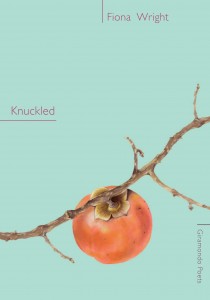
Knuckled by Fiona Wright
Giramondo Publishing, 2011

Knuckled is the debut collection from Fiona Wright, and can I just start by saying that ‘knuckled’ is a great title for a book of poems? It’s a word that’s easy to understand, one that immediately brings images to mind (hands, fists, gnarled trees, walking-sticks) but also one that you don’t hear that often. It’s also a fabulous word to say out loud over and over again. On first read, my thoughts were that this was simply another collection of lyric poetry: a bunch of measured short free-verse observations (some wry, some earnest) and descriptions of things (a frangipani, cutting open a persimmon, bushfires, bus rides in Sri Lanka), one observation per poem, one poem every one-to-two pages. An interesting collection: diverting but unremarkable.

Continue reading

Posted in BOOK REVIEWS | Tagged ,

Take

So take, for joy’s sake, this wild gift of mine.
This uninviting desiccated necklet
Made of dead bees that once turned honey into sunlight.
–Osip Mandelstam

Touches were newspapers
tucked and benched in Riverside.

Would I borrow from homeless men
their worn coats–bare threads

or gouge from darkened pigeons’ roosts
their salty hearts and by osmosis glide

or hold quartz second-hands?
It was obscure to me then.

Caresses were fries and battered oysters
dropped in Fulton Marketplace.

Would I pray for rags and bones
cemented in grave pools by river tides?

Brooklyn Bridge is damp and dry
but at the ends its cables are opaque.

So let me give you, for the sake of time,
these mites or lice or bedbugs

pinched from hairless hide. Take them–
white knuckles, bug scrawls,

death-defying lapses, synaptic leaps,
this dry mulch kiss–felt necklace strung with ink.

Posted in BLOG ARCHIVES | Tagged

Alala

The crows on my walk build nets
from roof top to tree top in threads
of communication, each juncture a rook–
Kaww Kaww–of the arrival and departure
of my comings and goings.

They know my hair top, my face, my walk,
that I am sympathetic,
that I wouldn’t ridicule or mock
my knowledge that crows lose altitude
and are forced to glide–mid-stride–to speak,

“Here! Here!–Why don’t you know?”
and the echo call from another rook
rocking on top of a pine, “I know! I know!
Watch the jay that nests below”–a corvus cousin–

once sibling in size, now Napoleon stature,
guarding her eggs by avian jousting
with beaks, tools with which to fend, fight, and feint,
the common crow–too big to scare.

Come! Come! to the corvus court–
a study in social proximics–
where Alala stands in the middle
of a concentric circle in judgment:
the pecked of the pecking order.

Balding and scared–for what crow crime?
six surround–jump in–jump back–Kaww Kaww–
did she take a mate meant for another?

A dozen, further back–Kaww Kaww–have opinions too.
In hunger, did she eat her own eggs?
The net stretches out to twenty and more.

Was it Alala’s time to die? To be consumed
is the proper order of things. If she cannot conform,
she cannot persist with the masses in a corvus nest.

I, like Alala, refuse to conform to a social order
that eats what it doesn’t understand.

Posted in PACIFIC NORTHWEST | Tagged

Mid-summer Forecast

Wind dashed from my palm a flock
of mica— scone-crumbly,
water-colored glass.
My handful of angles flashed up
like a foam of sandpipers
off the ocean’s tongue.

If I could believe like a child
or crone, I would have known
the bone broke my way,
the rabbit’s foot clutched,

my sun-rinsed palm
odds on clean futures
wave upon wave, as sandpipers
whirl, reel, and resettle in surf.

I saw the fawn with her mother
at dusk again last night, staring up
from the irrigation ditch.
Spotted, still, she crow-hops,
teasing the leggy grass,
the big-eyed cars who roar
like mating frogs,

then she freezes, one brown branch
of her mother. We stare-down
until mother and child bend
their necks and rip the grass
as if the world meant
to be this way. Every night,
the nighthawk sings the same
mocking rasps from his beak,
prophet’s death song
when he tucks his wings and falls
and rises, and falls.

Guzzling sandpipers dot-to-dot
the productive edge, just where
the footing incessantly pulls out
from under their toes,
broken cookies of coral grinding
finer. A head-scarfed housewife
fills her grocery cart, talons
pierce a fox kit’s neck,
a cleaning woman unlocks
the door to her workday. Andrea,
her fourteen-year-old daughter,
is at summer camp too,
like the other girls.

At Camp Static Cling,
Andrea and her mother start
with the partner dance, stripping beds.
When the vacuum shouts
at the TV, Andrea shucks
pillowcases. Her friends, upstate,
by the lake, slap mosquitoes—
OMG, they text, thyr trrble—
and raise their hands for
computer animation
and archery.

Andrea lifts a can labeled
air-freshener. If Outward Bound
left Andrea in this hotel laundry
all alone, three whole days
with just three matches, I know
she would wedge both doors open,
let the wind wrinkle through, and fold
into flight.

Posted in PACIFIC NORTHWEST | Tagged

The Dream about White Salmon

What’s in White Salmon? she asks from the dream.
I thought she meant a fish, not slivered in pink
but an albino aborigine, blank eyes communal
and naked. The dreamfish camouflaged, moored
in the stream’s float and swaddle. Water carves
boulders into that color. I see the salmon staking fame.

But faith in landscape is meant to deceive.
What you meant when you asked was about place.
There and here is where land meets the rain,
the super-hero swims slow in veins tied to mornings
and the birthing of crane-fly hatches ever so soft.
You might be remembering Rocky Lake when you dreamt.
All that rising, popcorn in the water bursting.
The fish we couldn’t kill, larger than our solitude.

Rain and land make somber peace under an arrested sky,
eventually casting light toward river’s untouchable shadows.
The salmon then gives back the boulders’ graves,
the decomposing house of leaves, upstream darting
among twisted leader and hooks, pulling, in water’s current
the pulse that wakes and rocks us.
We must awaken from the dream, I tell you,
because we must keep getting wet, our scales as skin,
having forgotten how to rise in the fogginess of white.

Posted in PACIFIC NORTHWEST | Tagged

Dad’s Home

On a summer evening I’m ten,
my dad is just home from work,
sitting in his truck, engine off
and radio on, listening to
the last crackles of “Southern Man,”
which spins my mother in frenzies
with its crazy guitar and Neil Young’s
pitching vocals, a harsh affront
to her robed Baptist choirs.

From the front yard where I’m
catching baseballs with my brother,
I strain to hear the song crying
from the driver’s wing window,
pivoted wide, and I know Dad’s
resting his elbow atop the door,
head leaned back, wearing a t-shirt
with torn-off sleeves and the red
beginnings of a tan. His dark hair
is shot with sawdust and the sweat
of eight hours spent framing hemlock
2-by-4′s in a bowl of sun.

The music drops our baseball
and breaks with the static snap
of the radio and slamming
truck door. We ditch our mitts
and race for the smells of dinner,
banging screen doors, “Dad’s home”,
an announcement that hangs
like a warning above the sink
where we wash our hands
before fidgeting in our seats,
ignoring Mom’s nervous smile,
while he takes his place, scowling
at meatloaf and baked potatoes,
again this week. Then we all choke
down silence, thick as sour cream.

Posted in PACIFIC NORTHWEST | Tagged

Le Rayon Vert

Look here, a mere inch stripe
of fire orange sunset holding its own
under a bumpy blue curtain
socked between the great-dome sky
and the puny line of city buildings
beyond the window sill.

I am content with that slender
golden Cleopatra snake of color
– we’re easy to please here in Seattle –
when my eyes are struck with a stabbing’s-worth
of candlepower as the sun slides herself
right into that skinny strip
now not so bright after all.

I’m telling you that disc’s shining a path
across the lake from there to me
worthy of any buxom harvest moon.
But here’s the kicker: At the end of her short show
she winks an unmistakable rayon vert
magical reward for willing one’s eyes
not to blink during her last second of visible life.

And then – I know you won’t believe this –
the green lingers, snuggles girlishly
against an upended skyline rectangle,
and tosses out a pinch of lime juice
to the lake’s ripple tips.

You are going to tell me green flashes
happen only over oceans and so I thought.
Never in all my years of watching the sun
disappear behind Jersey City did I see
anything even slightly verdigris,

And certainly not the sexy shade of green
she sometimes likes to flash
just at her final exit,
ensuring we won’t forget,
that we’ll watch every single night
hoping she’ll show it again.

Posted in PACIFIC NORTHWEST | Tagged

Little Magazines Exemplars: A Companion Piece to ‘To Anthologise the Now Perpetually’

There simply is no easily had “brief record” of modern and contemporary little magazines held by the University at Buffalo’s Poetry Collection; even if we were to divide by era, geography, or special interest—there are, after all, over 9,000 such little endeavors held. I have decided instead to pull a random sample of these little magazines—those with titles beginning with symbols or numerals, marked “Shelve at beginning of alphabet.” This is, approximately, a mere two shelves from the archive’s total holdings of little magazines—two shelves from 1,260. 1 These readings are meant to be cursory, to advertise for and invite future enquiry.

+R

Officially, the Poetry Collection does not collect collegiate publications; to do so would go beyond the intended statement of exhaustiveness, far more prohibitive in time even than by funding. There are of course, as with all rules, exceptions: and these would be instances of otherwise significance: collecting by region, by notable contributor or editor, or by meritocratic hindsight. +R , per editor Bill Brown’s preface, was born out of “the cancellation of The Black Mountain II Review,” for which Brown had served as editor. 2 One may thus materially traces the transfer of Black Mountain influence from North Carolina to Western New York, in step with the professional moves of Robert Creeley and Charles Olson. According to Brown, funds continued to stream in following the demise of the former magazine, needing allocating.

Born of excess, the title takes its symbolic translation from the French “plus d’aire”, “and it can be translated as ‘(no) more air,’ that is to say, both ‘no more air’ and ‘more air.’”3 Well noted: the University at Buffalo’s simultaneous intellectual ancestry to French theory. (Through the editor’s affiliation with UB, the magazine states clearly its academic happenstance, with especial regard to funding.)

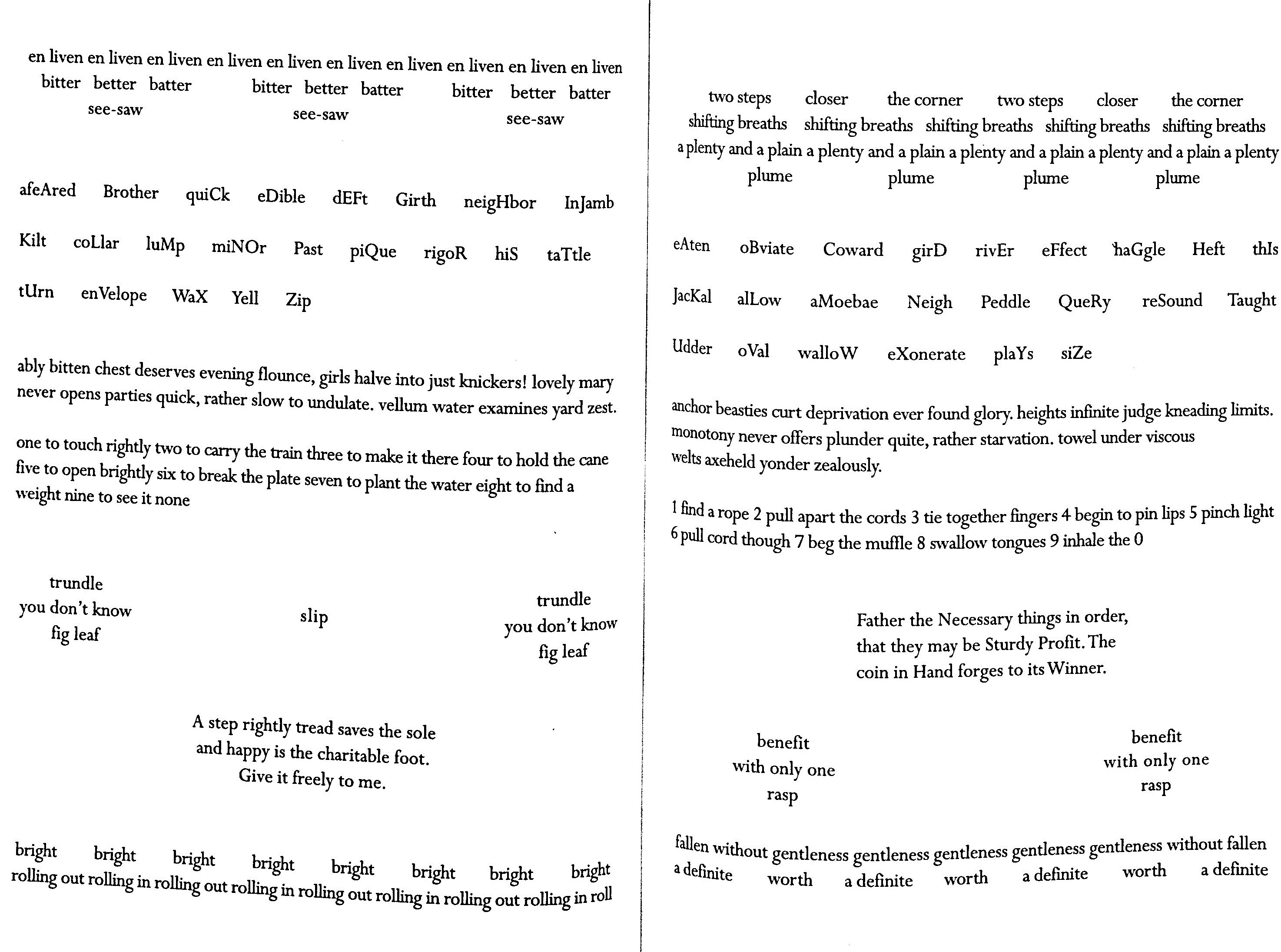
The back cover—as often—serves as shortlist table of contents, boasting poetry, narratives, criticism, and graphics. One finds poets at work in the Buffalo academy at this time, like Lisa Jarnot (whose biography tells the collector that she edits a further little magazine, No Trees) and Slade Adamson (contributing a “Poem-By-Numbers” piece among other works, including “To R,” dedicated to Jarnot).

The poetics is contained in a mere 64 staple-bound black and white pages, ranging from Mikhail Horowitz’s spatial-musical ekphrasis, “Dave Holland Trio,” to Joseph Brennan’s Phillipsian cross-out texts from Behavior of the Orgasms , to the diagrammatic “The Metasphere” by Joseph Kerrick (below) accompanying narrative excerpts from The Passions of Secret Gods.

Fig. +R

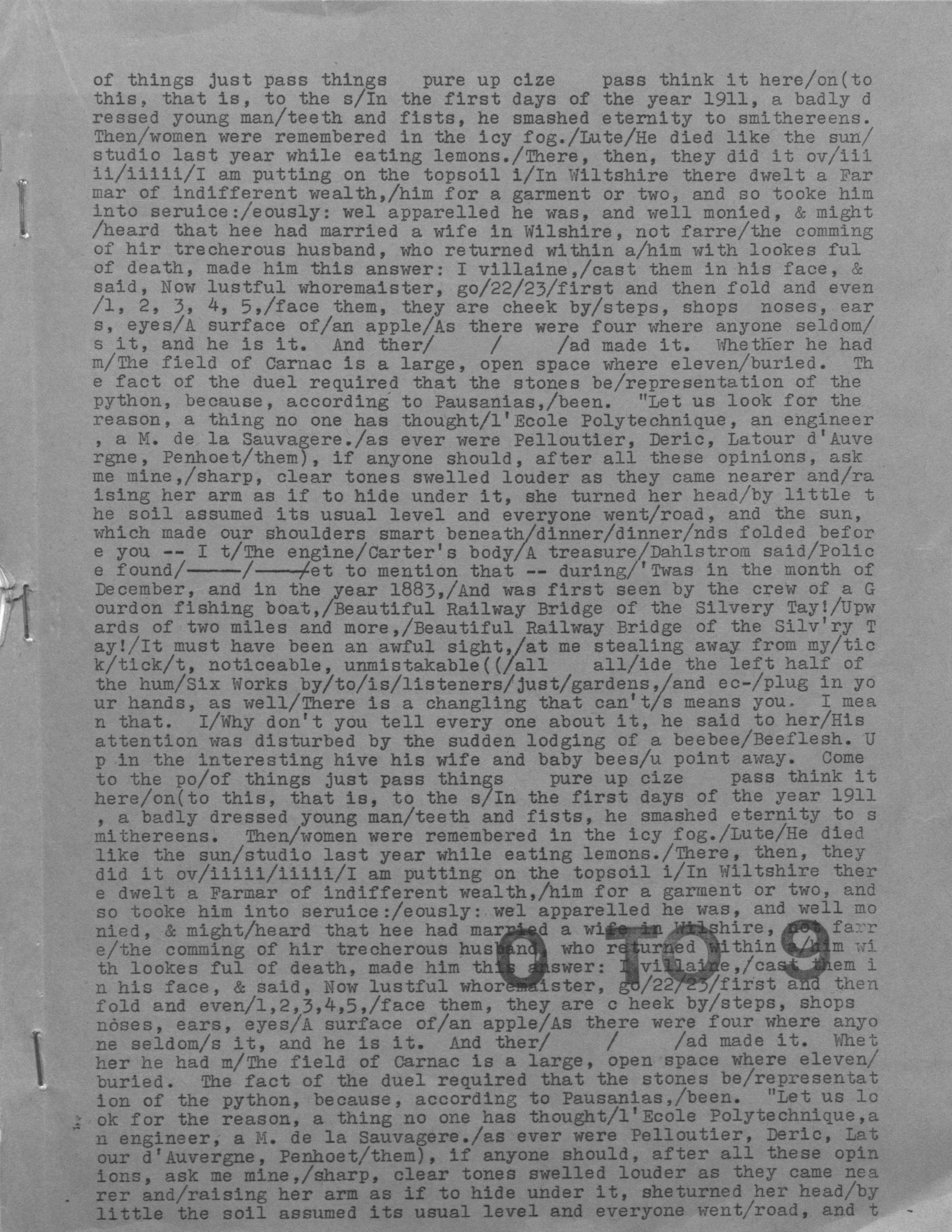
0 to 9

Vito Hannibal Acconci and Bernadette Mayer began this New York-based endeavor in April 1967. Rife with cipher aliases (presumably for Mayer), the contents bridge categorizations of the visual and the poem writ time and again, including contributions from Hannah Weiner and Jasper Johns, Dick Higgins and Sol LeWitt, Clark Coolidge and Robert Smithson. Issue One also carries an interview with Morton Feldman.

The format is large, American standard, 8½” by 11”, side-stapled in that archivally frustrating way—far cheaper in cost, unable to hold together well over time. The cover of issue three brings together that signature mimeograph typescript with a hand-stamped alphanumeric titling.
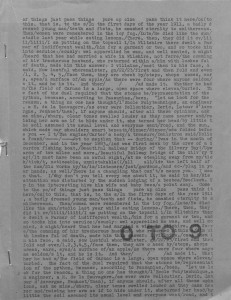
Fig. 0 to 9—a

and features a lushly laid-out “Six Works” by Clark Coolidge, in which three or so words island in the center of the page-field—something commercial publishing might not have afforded to a minimalist and as-yet uncanonized poetics.

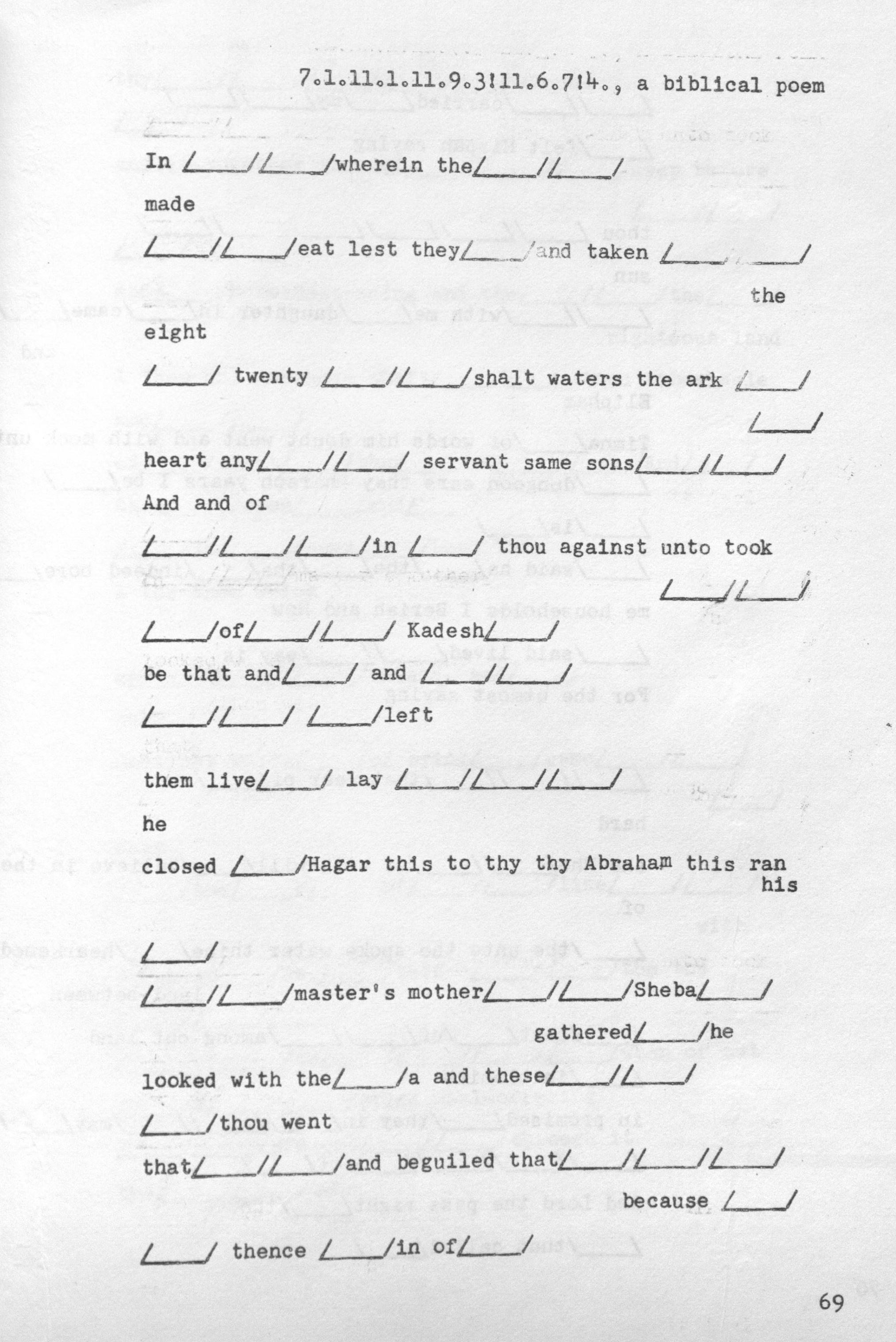
And No. 4 ran Jackson Mac Low’s early “biblical poems.”
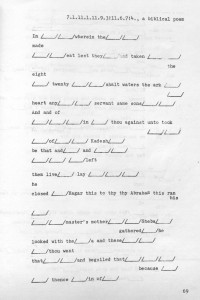
Fig. 0 to 9—b

019890

This was more of a Buffalo music zine, transferred to the Poetry Collection within a cache of publications collected during the heyday of Hallwalls. Hallwalls is central to understanding literary, visual, and performance art in Buffalo from the 1970s going forward. Founded in 1969 by Cindy Sherman, Robert Longo, and other local luminaries in the visual arts, many (like Sherman) had been students at Buffalo State College (another branch of the State University of New York system) back in a time when public funding was rife.

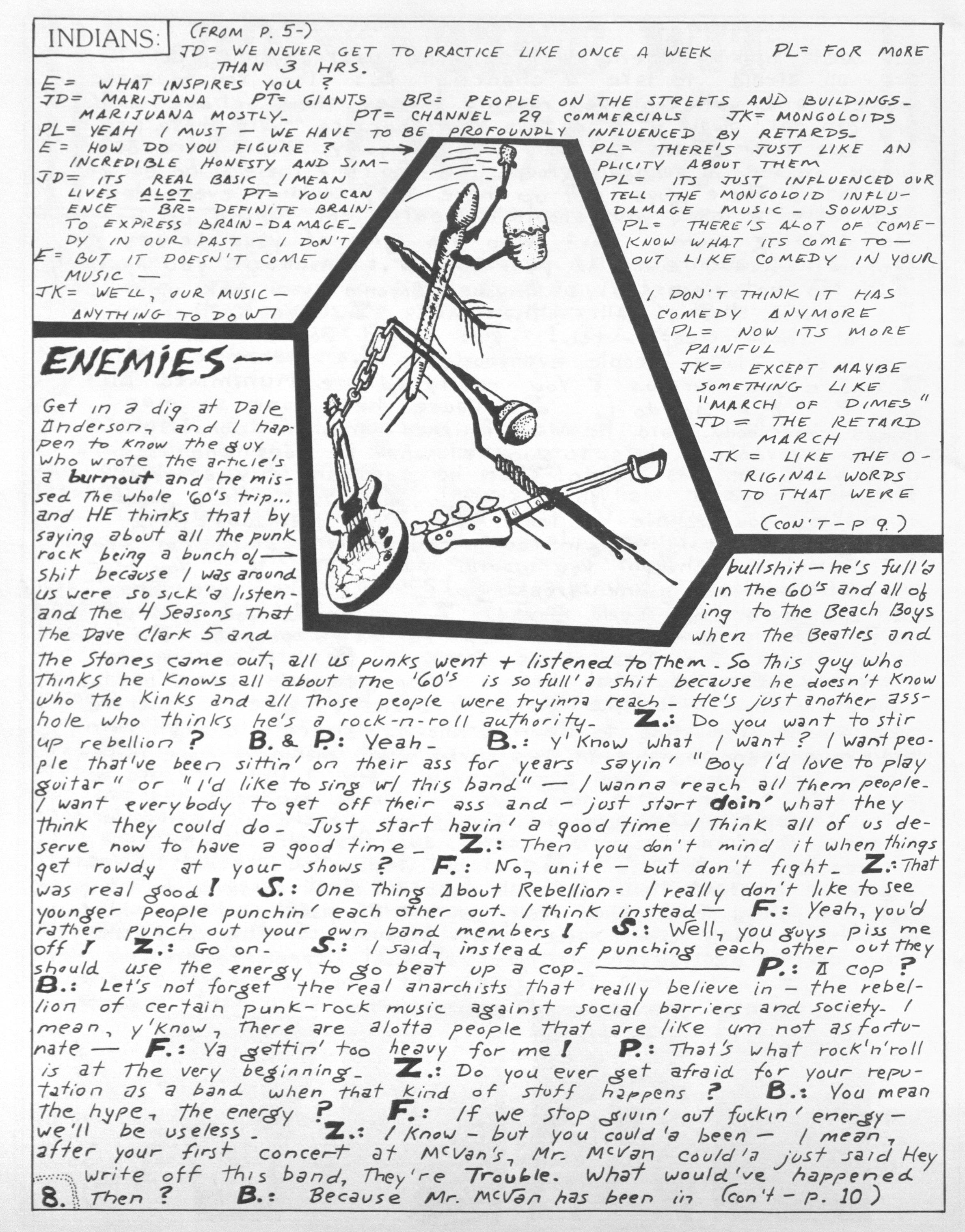
I like its newspaper-like page layouts that cascade from cover through interior, with hand printed fonts spliced with image and gnarled declamation. “Calling all advertisers…” shouts the inside front:

019890 is being circulated in New York City, Boston, Toronto, as well as in Upstate New York and the Buffalo area. Advertising in our mag will not only bring you business, it’ll make you famous! If you want to be famous, write for our rate card at…”4

Clearly a feigned distaste for commercial funding is jettisoned here—these editors would rather extort commercial money against a return of underground credibility, or at least for a laugh.
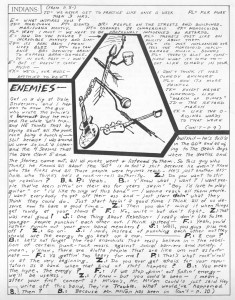
Fig. 019890

And while the music review remains the idiom of this organ—“Interviewing this band was sort of like, well…taking a big bite out of a brick building”5—it showcases an affable fuck-all editorial (“There are no mistakes at all in this magazine”6) and gives greater depth to the Buffalo scene of the late 1970s, a time when organs like Top Stories, Inc., and Works and Days were starting up or aleady at play.

2+2=1

When Judy Shepard spoke here at the university last semester, she answered this question from a young audience member: How does a location overcome the stigma of a hate crime? Laramie, Wyoming, Shepard answered, is a beautiful place full of kind people; it is also where a despicable hate crime was committed against her son in 1998. Extending Shepard’s words: It is poetry’s place to go to and come from everywhere. Laramie is no exception, and it is where this poem (in excerpt here) by John Macker was published, circa 2000:

equinotcial for Annie
(after Bob Kaufman)

our Tibetan Om flag waves

narcoleptic goodbye in the slight

equinoctial breeze; manana:

the desert has broke the back

of winter.

When I was born, the last Jesuit

was martyred in Mozambique &

my lives became synonymous with

                white buffalo moon

                the cotton candy sadness of turquoise

                sunsets

                digital rattlesnake

7

The page trim is double that of the folio—twice that of the quarto-sized 0 to 9; four of an octavo like +R —displaying expansive terra cotta landscapes of print and visual text, as with this page featuring Elizabeth Winder and Ronald Rowe:

Fig. 2+2=1

3¢ PULP

The archive holds only one issue of this twice-monthly folded broadsheet from 1970s Vancouver.

Why not from Kris Larson’s “A Euro-Agrarian Dream”?

A curvature in the road
and a dark sea, almost paintlike.
Long white farms led to it
on the glacial pasturage of hills.
I was awoken by the sound of a chainsaw
I thought was a cow bellowing
from one of the fields. 8.]

3×4

Purest in its approach to the little magazine, this version, edited by John Mingay, presents four voices (generally, though not, as with any proverbial rule, as rule) in folded and staple-stitched papers, issued from Durham and Fife, England between 1989 and 1995. Its numerical poetics of three poems by four poets is a popular one, popularized by such later examples as Brooklyn-based Ugly Duckling’s 6×6 (below). Among its investment in many not-so-well-known poets it also carried Harry Guest’s “The Lion of Venice / in the British Museum,” reminiscent of the modernist ekphrasis by icons like Ezra Pound and Marianne Moore.

I include here 3×4’s “desperately seeking Susan” call, exhibiting the politics and attention of one editor to gender, and the kinds of calls one comes across enclosed within these small issues. Also, this (instead of an) editorial: “No reviews. No editorial. No adverts. No graphics. No squeeze.”
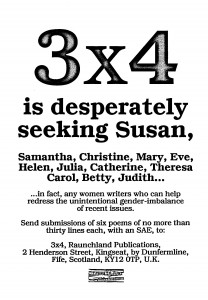
Fig. 3×4

3-D Roadmap to Hell

Poems know no territory, and so again with the zine; this one replete with cartographic papers for backdrop: all poems, travel diary entries, and illustrations are pasted on top of reused maps. In one such issue, and presumably penned by editor Dee Allen, one finds a metatextual edit where Bayonet Pt. meets Bayonet Point—both geology and geography are encircled, with an arrow from print reading “I WANT TO MOVE HERE.” 9.]

3rd bed

Expansive funding does not dictate expansive poetics. But in 3rd bed the format meets the poetics: trade sized for savvy retail; resilient matte covers; a poetics expansive in that it moves the field of the page to include the critical, the graphic, and translation. Such formatting affords great spreads, like these (2 of 3) untitled panels by Margaret Frozena, from Issue 8 (Spring/Summer ’03):
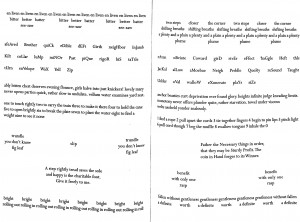
Fig. 3rd bed

Begun in ‘98-99 in Seattle, the contributors tend toward the unheard of, or—more likely—the student group, herein finding a serious and well-(at)tended forum. 10 Large commitments in trim and expenditure also require largesse in staff, and this biannual waved a masthead of founders, patrons, benefactors, and supporters. The journal also bears some connection to Brown University, at one point giving a prize judged by none other than the Waldrops and Amy Hempel.

All in all, the endeavor grew through eleven numbers, eventually including a section headed: Chapbooks, Excerpts & Novellas. No. 10 is prefaced with manifestos plus Yankevich’s translation of Daniil Kharms’s “The Saber.”

THE 3RD THING

Fig. 3RD THING

Sticking to archetype, this mag ran for one issue in the summer of 1974, edited by Shaun Farragher, unbound and folded within heavy cloth-textured prints. A mix of the literally charged erotic with the illustrative does not dilute the rayographs by art editor Marlene Tartaglione, nor Barbara A. Holland’s

Who else
skims in heroic
shadow
down a rain-bright street
on tread of whispers,
in certainty;

his hope-filled satchel,
heavy with eventful futures,
slung over a possible
wing root? 11

4 ELEMENTS

Claiming the poetics of a poetry review, these lean numbers ran ads plus the ever-interesting occurrence of a published list of its contributors’ addresses; this is a common feature of the smallest of the small, where coterie is so likely yet tenuous that the magazine courts influence through and outside its own bounds.

There are at least two known issues of 4 ELEMENTS, both dating from the mid-‘70s, the second showcasing this poem by Jay S. Paul of DeKalb. 12
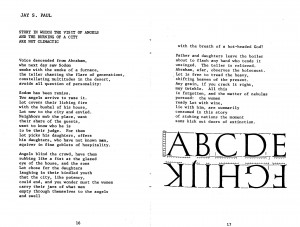
Fig. 4 ELEMENTS

4 New Zealand Poets

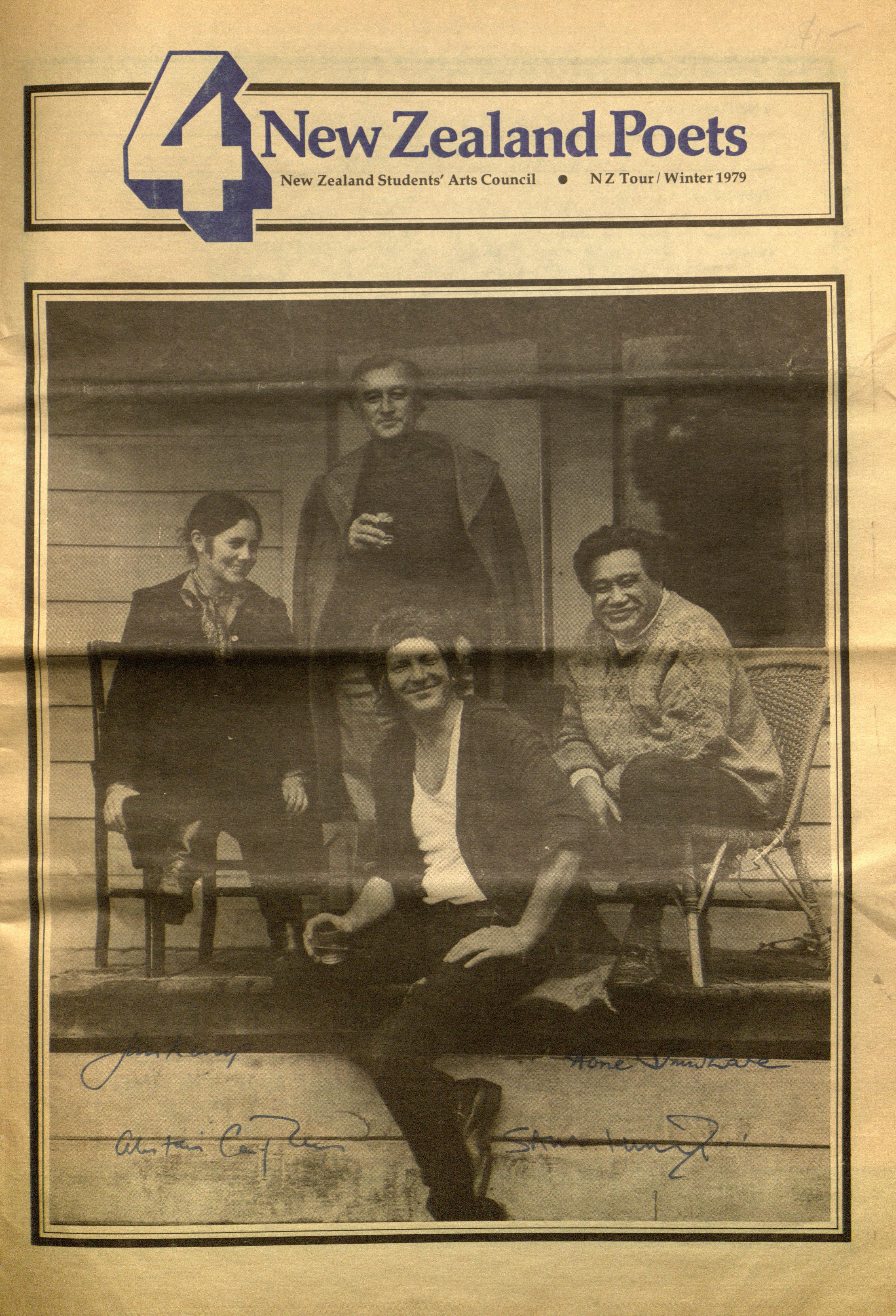
Published by the New Zealand Students’ Arts Council in the late 1970s, this newspaper-styled journal brings together—you guessed it—four poets from New Zealand, in an expansive field of poems, photos, and the social.

The Poetry Collection holds only Issue Two, featuring Alistair Campbell, Sam Hunt, Jan Kemp, and Hone Tuwhare, each having signed the cover in blue pen.
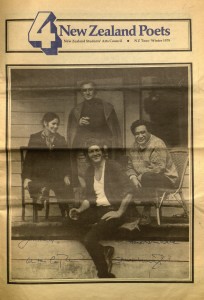
Fig. 4 New Zealand Poets

4th Street

This is what Poetry could have remained, with less budgetary and more coterie.

4th Street is quaint in an utterly non-pejorative way, its contributions at times so macabre I want to weep happily. Its trim is the supple and slender octavo; its expense heavy resume-like free endpapers. It even features a page “0” at the beginning of each. For biographies, it offers “Name Droppings” and postscript by editor Wendy Ortiz, of Inlet Press, Olympia.

For poetics, it takes invitation seriously: the scope spans schools like it’s its mission. And even with only 12-16 pages of print, the editor isn’t afraid to give six of those to one poem. It appears bimonthly. It is also not afraid of confession or of experimentation. It develops a stable, like most magazines do in kind, and from these we learn Pam Ore (“I can write an alphabet, / Then: I can make a cage. / Language is the key singing in the lock.”13), Curt Duffy (“girl girl girl boy girl / boy Wed girl boy girl boy / boy girl girl girl boy boy” 14), Brandi Dreery (“be my beak / my fall, lover / fuck me liar / fuck me over” 15), Bill Yake (Floating in the turquoise Bismark Sea above sunlit worlds, supple. Soft coral. Salt wave.”16), and Amy Holman (“To cosset is to make a pet of a lamb / without his dam: coss, kiss, kyssa, cosset. / I’m woolly, too. Lust is from / listen – to please…”17).

Perhaps my samples reflect too much my taste. What of the November/December issue, 1999? These four excerpts in sixteen slim pages:

You wished the sea could talk
You thought it would comment on
Human ballast jettisoned from cargo ships
Of slaves, money be damned at a time like this18

O emotions sulking on the sofa
What are you sad about? A candle on the mantle?
The Shoji screen? Recalling Rimbaud & Reverdy?
You are feigning for my sake.19

200 billion gallons—
tritium, cesium, strontium, iodine-129
contaminated reactor water
creeps a thirty year pace
through the Hanford aquifer
towards the Columbia river.20

and sing words salmon fingerlings
salal and huckleberry
they sing Makah Nisqually
logging clear-cut fir fern trillium
they sing of Seatown and P-town
railroads and hot shot freight trains
through mountain pass river valleys21

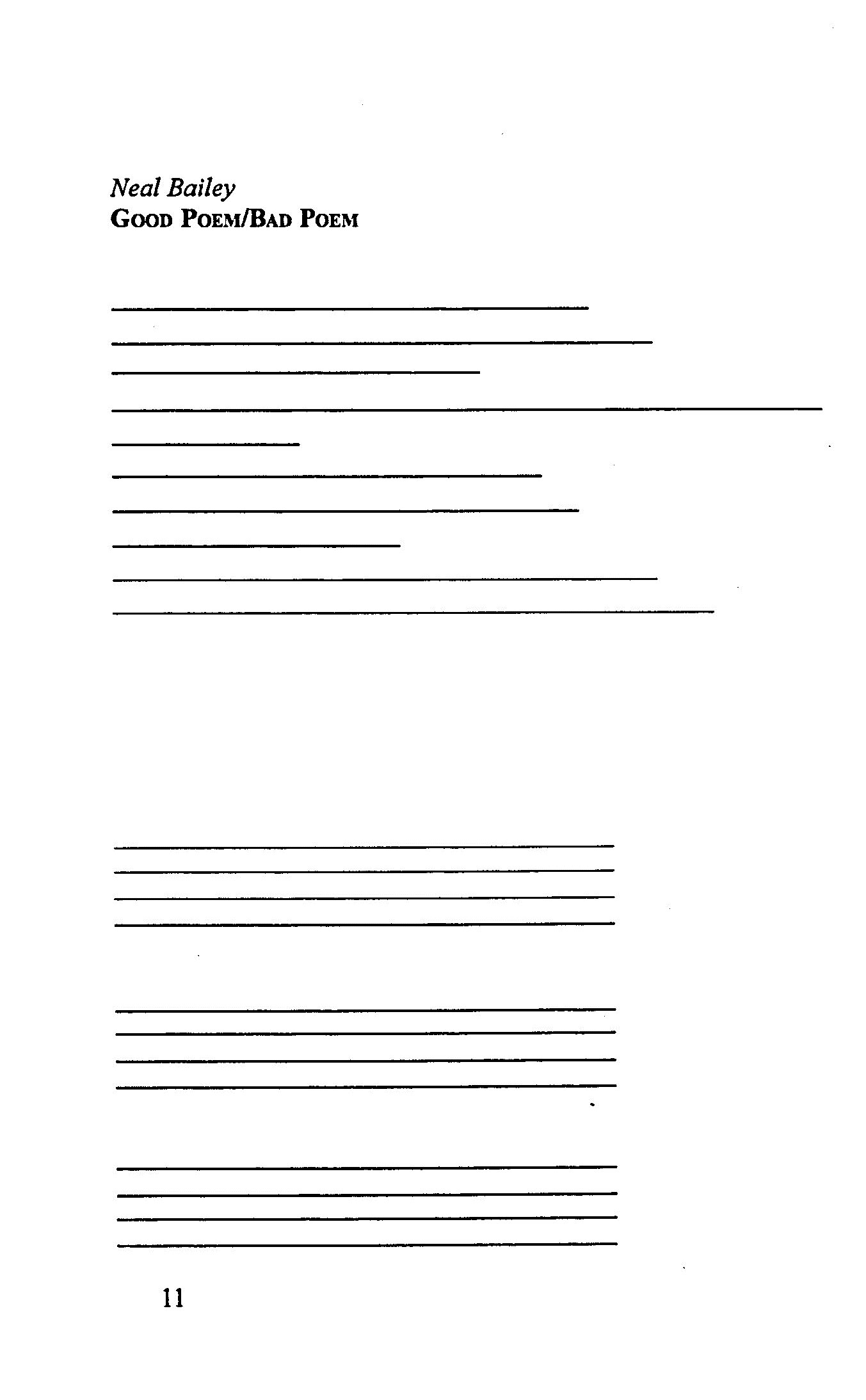
Atop all this unlike splendor, 4th Street also carried off publishing early work by Vanessa Place, and the laughing rubric “Good Poem/Bad Poem” by Neal Bailey.
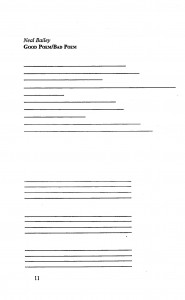
Fig. 4th Street

5am

From Summer 1987 through the present, Ed Ochester and Judith Vollman (alongside a cast of changing coeditors) have curated a newspaper-formatted journal called 5am, trim on par with that of TLS and APR. Difference being—for all its widespread spreads and scope of contributors—5am does not adhere to any officiousness.

Take, from the second issue (Winter, 1988), these declamations by Polár Levine, along the lines of Madeline Gins’ What the President Will Say and Do!! (Barrytown, N.Y.: Station Hill, 1984), here in the style of the inquisitor:

Haven’t we been Eisenhowered long enough?
Haven’t we been do-nothinged long enough?
Haven’t we been fast fed?
Haven’t we been hatchet-jabbed?
Haven’t we been ashrammed?
Haven’t we been X Ray Gunned?
Haven’t we been New York New Yorked?
Haven’t we been Judy Chicagoed?
Haven’t we had our lawns mowed by some crew-cutted stranger named Bud?22

The political, the geographic, the spiritual, and the mundane—just four of many cardinals pulling narrative into fractal range.

By Issue 10 (1998) the paper quality is refined, the design more minimal, and the editors have retained—in lieu of bio notes—a list of contributors’ recent publications. The poetics still unabashed, performing command as in Antler’s ejaculatory “Caress A Flower With A Flower”:

Let starlight that left its star before the
Earth existed
caress the retina of a boy who
doesn’t know
the difference between a solar
system
and a galaxy. 23

By the thirtieth issue, the work seems calmer if no less politically inclined (left), and 5am remains unafraid to publish the young or the unheard of. Quietists reign here, as with Kathy Engels’ fussy tanka “—after Muriel Rukeyser”

Windmill tilts me sun
mill melts me cormorant talks
to me mourning doves
souls me church bell confuses
me grass grows inside me.24

5&10+2

Maths aside, this is literary review as little magazine.

Littered with editorial and a scattershot of poetry, the review makes short work of ten books per tightly wound issue. The dominant voice that emerges, however, is that of publisher Maureen Williams, locust bird among locusts:

The BBC has long been split into two linguistic factions: old guard purists and new guard libertarians. A recent dispute between these two involved the changed name of the capital of China. Although it had been declared official policy that the BBC should use Beijing, stated to be the correct name of their capital by the Chinese themselves, the purists reverted to the name given it by the British: Peking. The result was that a listener knew to which faction the broadcaster belonged by whether he or she said “Beijing” or “Peking.”25

5’9”

In the ‘70s, taking a cue from Kostelanetz and from found poetry, Al Drake’s Happiness Holding Tanks began to issue “assemblage” issues: contributors sent a thousand or so samples of their own work, and the editor collated these into 1,000 editions of the issue for viral redistribution through the contributors. Enter, circa 2005, Medicine Hat, Canada’s 5’9”.
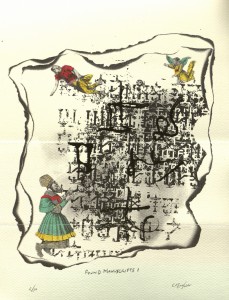
Fig. 5’9”

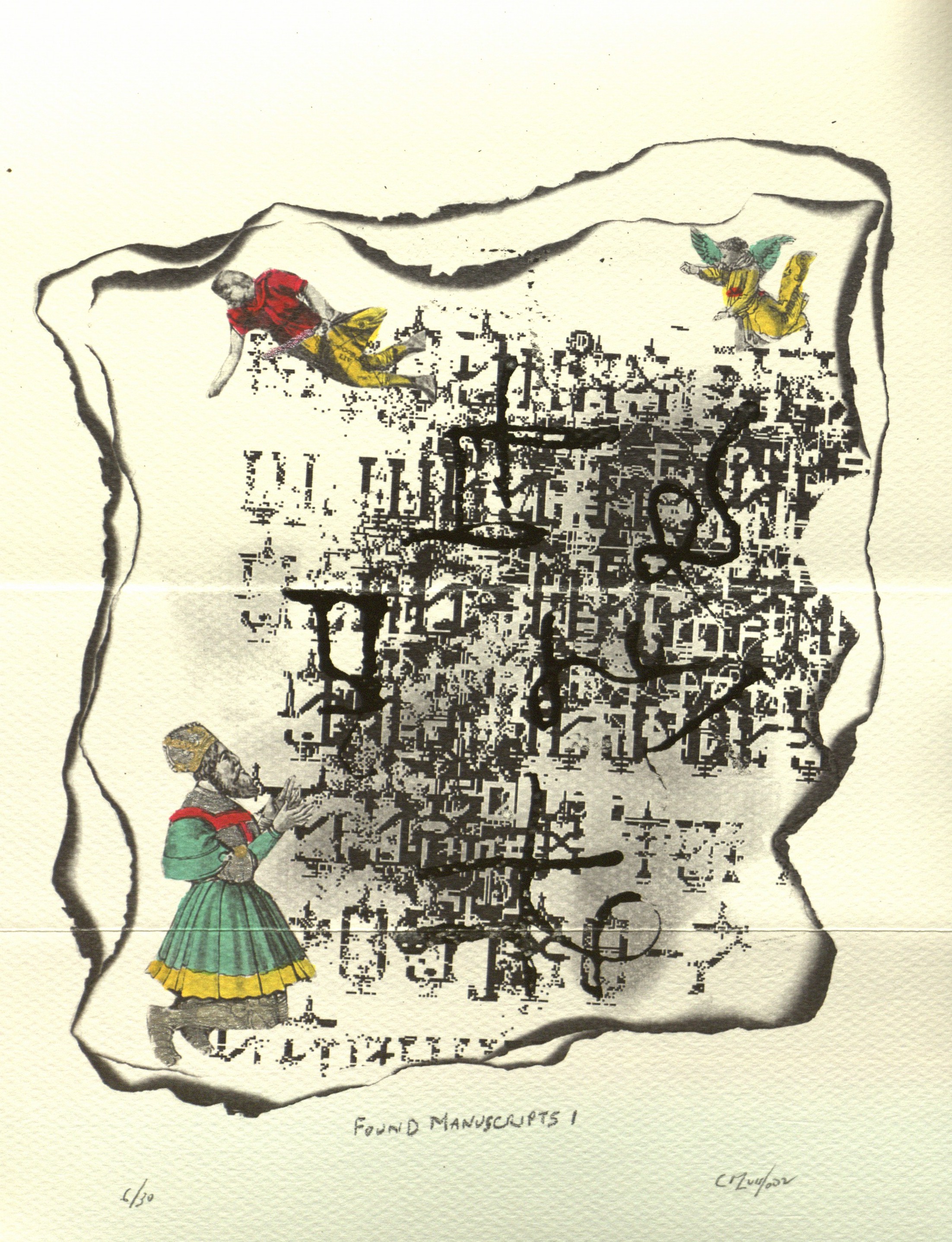
Editorial attributed to derek beaulieu, these wrapped or banded hand-fans—from the mimeo to the typo, the button-in-a-bag to the stencil—remind, as with Carlos Luis’s “Found Manuscripts I” (above), that collage is the medium of the 21st century.

5th Gear

“Free” is another term associated with the stapled and the small—Rarely does the small publisher see a profitable return, and so the gift economy of poetry. No exception in 5th Gear, an ever-changing format of photocopied papers out of Virginia, late ‘90s. Edited by Andy Fogle, issue sixteen came out the day after Valentine’s Day, 1997, on the editor’s twenty-third birthday, featuring this from Graham Foust’s “Official Transcripts”:

On this day
In history, there were no executions, layoffs,

Rings exchanged. I have the potential for
Potential; I can even get vertigo underground.
As I speak, my papers cross

A border, disheveled and unread26

5th Wall

There’s something winning about the care that goes into a library’s making containers for unique objects. The Fall 1998 “yellow issue” of this mag is snugly housed within an envelop glued to meet its dimensions (14 x 5½ cm, staple-stitched), envelop then pasted inside gray boards, with green cloth spine; it’s not handsome, but it sure is homely, in each sense of the word.

I give you, from the tiny, S. Harris’s “The Alphabet in alphabetical order”—
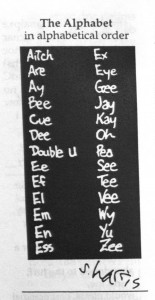
Fig. 5th Wall

6 Hz

Sometimes the lil mag is a broadsheet. This can be spun from the home laser printer, folded, taped, and mailed. It can be internal, sent only to friends, biweekly, monthly, for only one year; yet it may still foster a poetics, such as: “in chaotic interest pertaining to word placement, uncommon literary themes, strange diction, transcendent locution, and other delves into audience compensation for physical absence…”27.
]

6ix

Rooted in a Bay Area-Philadelphia-East Coast trifecta of Language Poetry, these ample pages gave freely of Vol. 1, No. 1 to “Draft #7: Me” from Rachel Blau DuPlessis’s ongoing epical meditation-mediation, an excerpt from Dodie Bellamy’s The Letters of Mina Harker, plus poet-publisher of Singing Horse Gil Ott and a young Melanie Neilson, cofounder of Brooklyn’s Big Allis.

The trajectory may at first appear typical: the second issue swelling in contributors, and doubling in size. Vol. 2, No. 1, though, from 1992, offers the same lush standard trim, with over half of the issue designated for one poet’s work: Kathleen Fraser’s “Etruscan Pages”; a similar redux in the following issues, with roughly eight poets sampled; and with Reviews appearing at the rear of Vol. 3, No.1 (1993).

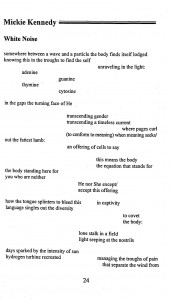
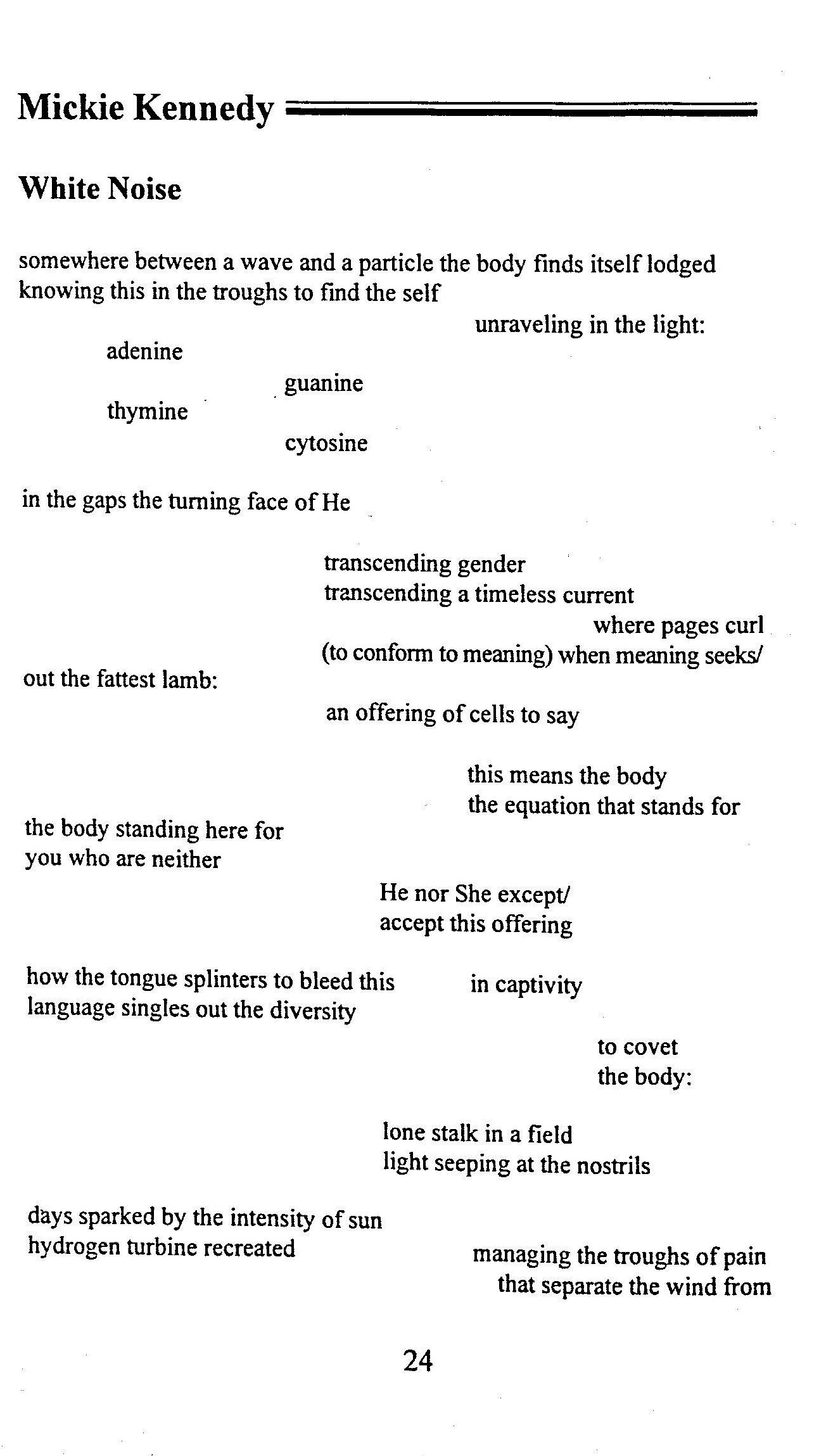
Eventually the volumes take a second slice from Alice’s cake, evolving into a trade-like journal, once yearly. Still, these revised and cleaned-up pages are able to fairly present the expansive field of Mickie Kennedy’s “White Noise” (below), as well as Jonathan Brannen’s residually footnoted sonnets “from Deaccessioned Landscapes.”28

Fig. 6ix

6×6

When I was a teaching adjunct, this was always a student’s favorite when examining small press exemplars. As mentioned in 3×4, the poetics is fitting: six inches either way, with six poets inside, each contributing six poems. Let loose from Ugly Duckling Presse, the artifact of the example must also present; therefore, a notch taken out of each upper-right corner to unsquare the form, and every issue’s signature held gently together in a fat rubber band.

The covers are lovely, for even indie print shoppes develop standards of brand recognition: the 3-D font for issue number; the (sometimes) surprising couplings and triplings of contributors; the use of the first line of the first poem from the first poet for issue title. 29 Consider no. 7, “i will give your back”: David Cameron, Steve Dalachinsky, Joanna Fuhrman, Jason Lynn, Tomaž Šalamun, Jacqueline Waters.

10 point 5

Interdisciplinary—and this is the 1970s; it took a while to get back to this mode it seems.

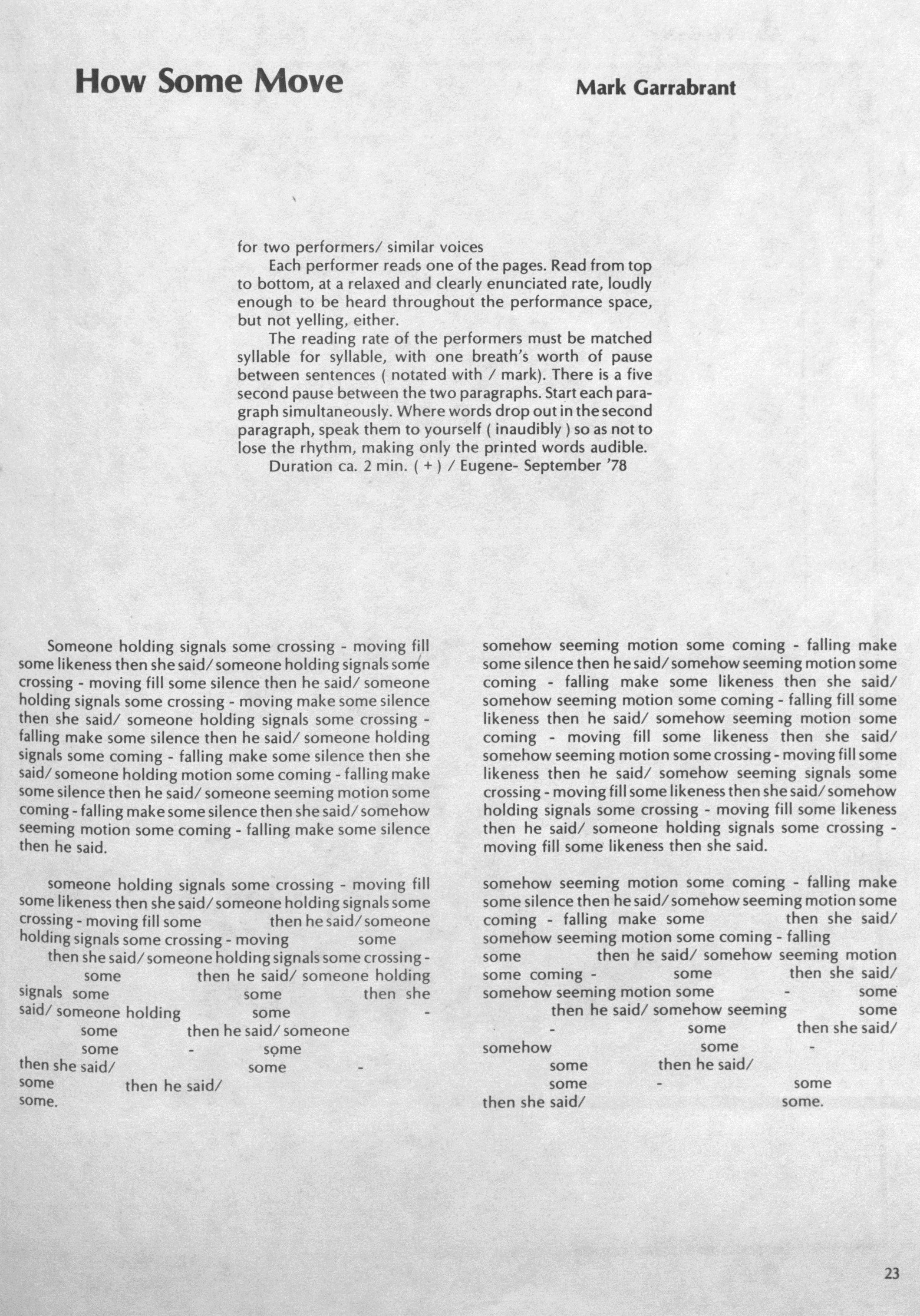
And if not for, one wouldn’t find Mark Garrabrant’s companion pieces of conceptual happenstance, “How Some Move” and “Shadow Box.”
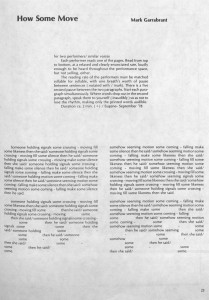
Fig. 10 point 5

10×3 plus

This editor’s poets are John Kay, Lisa Zimmerman, Marilyn Dorf, Michael Gessner, Martin Turner, Tomas De Faoite, Wendy Mooney, Ralph Culver, Grace Cavalieri, and so on. Here, ten poets, three poems, plus remainder; you do the math. This is how geography is bridged, networks forged. The little magazine remains the evidence printed in sand for a short time after the luau.

The 11th Street Ruse

It had something to do with St Mark’s Poetry Project. It was mimeographed. It editorially crossed out its own columns. It featured bylines from the likes of Violet Snow. It ran a Vocabulary Kornur that taught you words like “Tunguska” and “tungstic.” It offered a posthumous interview with Kurt Cobain, another with O. J. Simpson. It followed up with a Vocabularee Review. It even offered this limerick, “Size,” by Rick E. Lim—

There once was a woman named Thesaurus,
Whose skin was remarkably porous;
She stood in the rain
In Bangor, Maine,
And became the size of the Mormon Tabernacle Chorus.30.]

And it makes you wonder if something of poetics isn’t tied to technologies, and that in the coming of the digital something wasn’t lost.

12th Street

This is the vanguard, or a consideration of what’s vanguard, from 1940s New York, written and published by students from the New School. Like its famed institution, the magazine deals with many questions of European intellectual ancestry in the modern American metropolis—most notably as these pertain to questions of Marxism, assimilation, discrimination, and—as the quarterly progresses—aesthetics.

A few notes from Vol. 1, No. 4 (1946): Eugene Boykin’s “Civil Rights and Discrimination” noting comparable “Examples, ‘Minorities,’ Immigrants, Jews, Catholics”; Reuben Abel’s investigation of The Great Man, or Carlyle qua Marx; reviews of Huxley and Santayana; Jean Rhys, Associate Editor!

What fascinates most is the growing inclusion of poetry, symmetrical with changes in format, as the thinly printed quarto became the heavy papered octavo. After 12th Street begins including poetry it will become a mainstay of the journal without dissolution of its political inclinations, asking significant political questions as they pertain to poetics. Vol. II, No. 2 (Spring, 1948) carries a poem like “Against Secularity” by Albert H. Ledoux, plus Karl Marx’s “Alienated Labor.” The sieve of politics does not refuse its own scathing, and 12th Street remains affectionate toward the polemic and the critical.

The coinage of “vanguard” comes by way of Cedric Dover; he writes, in his clustered review of two 1948 anthologies of “young writers,” 31 on the statistics on canons. Specifically, Dover tallies the genders and ages of each contributor—and this over sixty years before Amy King’s gallant VIDA headcount.

Eleven of Professor Wolfe’s authors are women, twenty-seven are men. The average age of the women is twenty-eight, of the men twenty-nine years, but three of the women and eleven of the men are above thirty. Nevertheless, the group is described, inevitably, as young. It is as old as Henri Munger’s beard.32

Allusions and archetypes aside, Dover goes further, plumbing the gender of influence in and across the sexes—in his words, “[t]he influences acknowledged by the group add further details to its composite self-portrait.”33 Contributors were asked to list authorial influences, and Dover categorizes his table as follows: Classics, Minor European Classics, American Classics, Modern Europeans, Modern Americans. (And it is interesting to note how and where Woolf falls on these axes.) Thus we might read Dover’s analyses with intrigue—

There is no evidence of purposive reading for style or large literary perspectives in the thirteen minor European classics, three American classics, thirteen modern Europeans, and seventeen modern Am[e]ricans mentioned by the mean. The revelations of the women are still more shocking: all but four of their thirty-three authors are assorted moderns.34

The above would be enough to reopen 12th Street as a site of investigation. By the end of its run (the Poetry Collection’s copies end with Spring 1949), the dimensions of the quarterly could no longer hold its poetics: the last issue is bifurcated into two companion volumes, one the Faust Issue, the other the Poetry Issue. The latter’s contents includes David Gascoyne, W. C. Williams, Earle Birney, James Broughton, Harold Norse, Weldon Kees, Lysander Kemp, David Ignatow, Oscar Williams, and more.

15 Minutes

(Citing Warhol,) this single issue probably fell into the archive because the editor published a poem by Gerard Malanga. But it tells a lot about post-punk influence in St. Louis, Missouri, circa 1990. Contributors from Bowle Movement to Sandra Moanium could tell you about music, furniture, punk cinema, and review “the first female-to-male transsexual love story,” “Linda/Les & Annie,” while running ads like AIDS IS KILLING ARTISTS / NOW HOMOPHOBIA IS KILLING ART along those for local businesses. Zines are ever overtly demonstrative: of locale, of engagement, and of community support.

21st Century

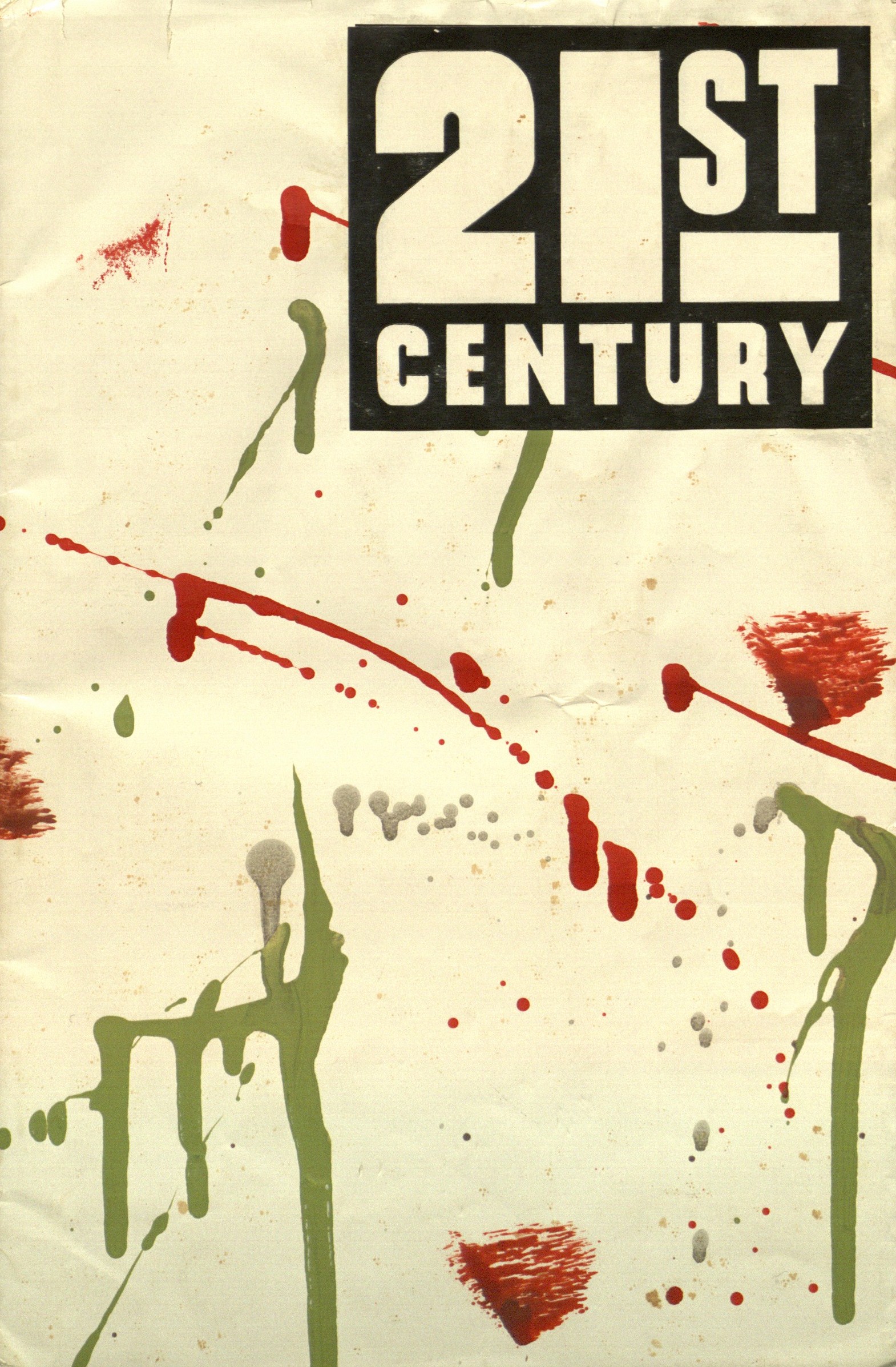
While its wag doesn’t always match its swagger, this “magazine of a creative civilization” remains of interest primarily for its revealing discussion between Sydney and California in the 1950s. Handsomely in original covers35, this is little magazine as postwar publication, willful as the year 1913 to charge ahead of the past.
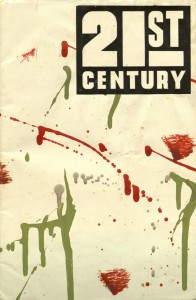
Fig. 21st Century

24-7

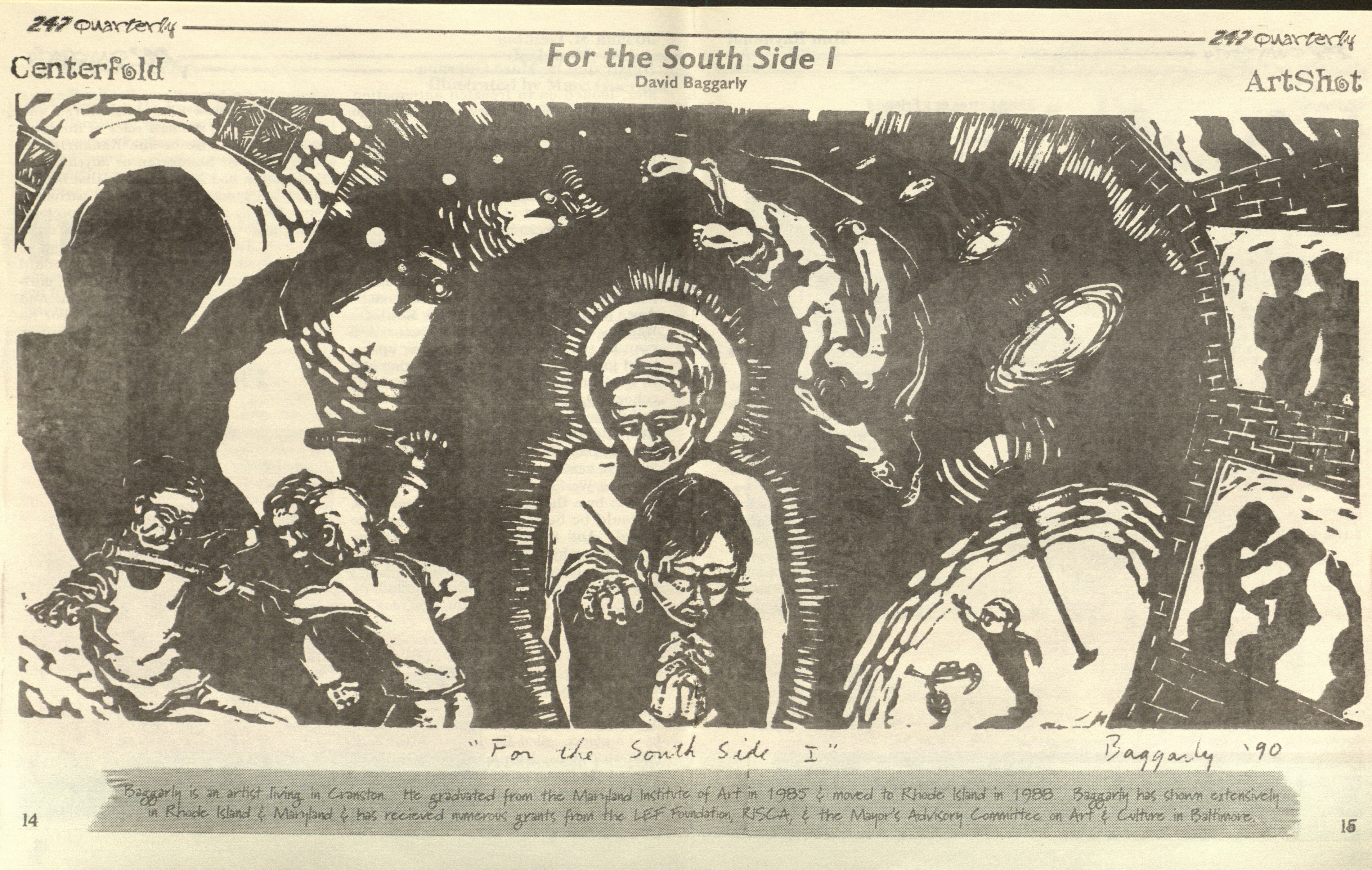
Subtitled “Rhode Island Art and Literature,” this free publication bears witness to the livewire poetics of the 1990s zine. With black and white newsprint pages and a touch of red splurged for for cover title, 24-7 harkens to an interdisciplinary page exemplary of a poetics cantilevering poetry and music reviews with social politics and the visual, like this spread from Vol. I, No. 3(1994), “For the South Side I” by David Baggarly—
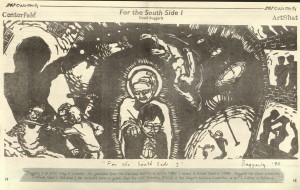
Fig. 24-7

Issued in runs of “500+”, the publication was distributed for free; and whether the contents relays authorial or aliased bibliography, the span remained topical in a way that today’s fracturing makes seem lamentable. For instance, Vol. 3, Issue 1 boasts Allen Ginsberg in conversation next to a review of Lisa Loeb, over a dozen poets plus a feature of work by Sylvia Moubayed, and editorials on road-tripping the American Midwest, why “Björk is the best musician of the past two decades,” and “Gay youth in the 90’s.” These alongside gallery reviews and music ones, ranging from hip hop to grunge and alternative.

26

The project of collaboration as it configures an editorial is an interesting one, and not without interesting projections of a poetics. 26 took this as template when Avery E. D. Burns, Rusty Morrison, Joseph Noble, Elizabeth Robinson, and Brian Strang gathered in San Francisco’s Bay Area, refusing consensus, and started out with issue “A.” Translations were welcome, as were essays and reviews, alongside a civics engaging with the milito-political, as exhibited Andrew Joron’s “Statement on War & Terrorism” (this is early 2002), which later went viral. And while west coast-centered, the editors—presumably through call, suggestion, and deliberation—arrive issue and again with a broad wingspan of selective inclusion.

By issue F only two editors remain, Burn and Strang, signaling a closing down of the projected abecedary of issuance. Close to the end of the last, this again from Joron:

The swing of the pendulum represents not propagation but merely alternation. Unlike the alternator, the propagator never returns to an initial position. Once that light that inhabits fails, it fails with finality.36

(And this, 2007.)

80 Langton Street

Sometimes the periodical is a flurry of correspondence, relaying the accounts of a scene in formation. Such is the case with this Artists and Critics in Residence program, and its circulars posted to like-organization Hallwalls, in Buffalo, illuminating the goings-on of San Francisco throughout the 1970s and ‘80s. These fliers, postcards, and catalogs inform partners-in-the-arts of daily happenings, and leave trace of the burgeoning of scene.

Through archival troves as these one learns of these happenings:

April 1977 “eye music” film series emerges.
Oct. 1977 A month long exchange occurs between Tokyo artists and the Bay Area.
Dec. 1977 Michael Auping serves as the first critic-in-residence.
April 1979 Alison Knowles performs Natural Assemblages and the True Crow.
Sept. 1979 There is a showing of films by, with appearance from, Red Grooms.
Nov. 1979 “Masters of Love” group show opens, including Robert Longo.
Aug. 1981 Kathy Acker curates “Extravaganza” w/ Factrix; Lyn Hejinian serves as writer-in-residence.
Jan. 1982 Mal Waldron performs with Jana Haimsohn.
March 1982 Bob Cobbing performs sound poetry with P.C. Fencott.
July 1982 Allen Fisher serves as writer-in-residence.

This is cultural ephemera of the first order, from the calendar to the reception notice, like this one from Sonya Rapoport’s “netweb: objects on my dresser.”

Fig. 80 Langton Street

88

Just after the last would be-zeitgeist, on-demand printing started making glossy, perfect-bound journal publishing available to editors everywhere, including Hollyridge Press of Venice, California. Founding editors like Denise L. Stevens and Ian Randall Wilson could now make new and inclusive choices, as shown in Issue 2 of 88, without the stricter limits of finance and school: yes, kari edwards; yes, Rachel Hadas; yes, Terrance Hayes; yes, Mark Jarman; yes, Jeffrey Jullich; yes, Terese Svoboda.

96 Inc

Ubiquity may be better by nature than by artifice when poetics. Sometimes the organ is a sign of one geocommunity. The editors of Boston’s 96 Inc advertize their poetics through the blurb “[i]t’s a bit like a patchwork quilt…the more disparate, the merrier.” 37 With a board as long as its Contents, these local journals may sometimes, amid diverse effusions of taste, display the early output of a Louis E. Bourgeois, or the sheer ubiquity of a Lyn Lifshin.38

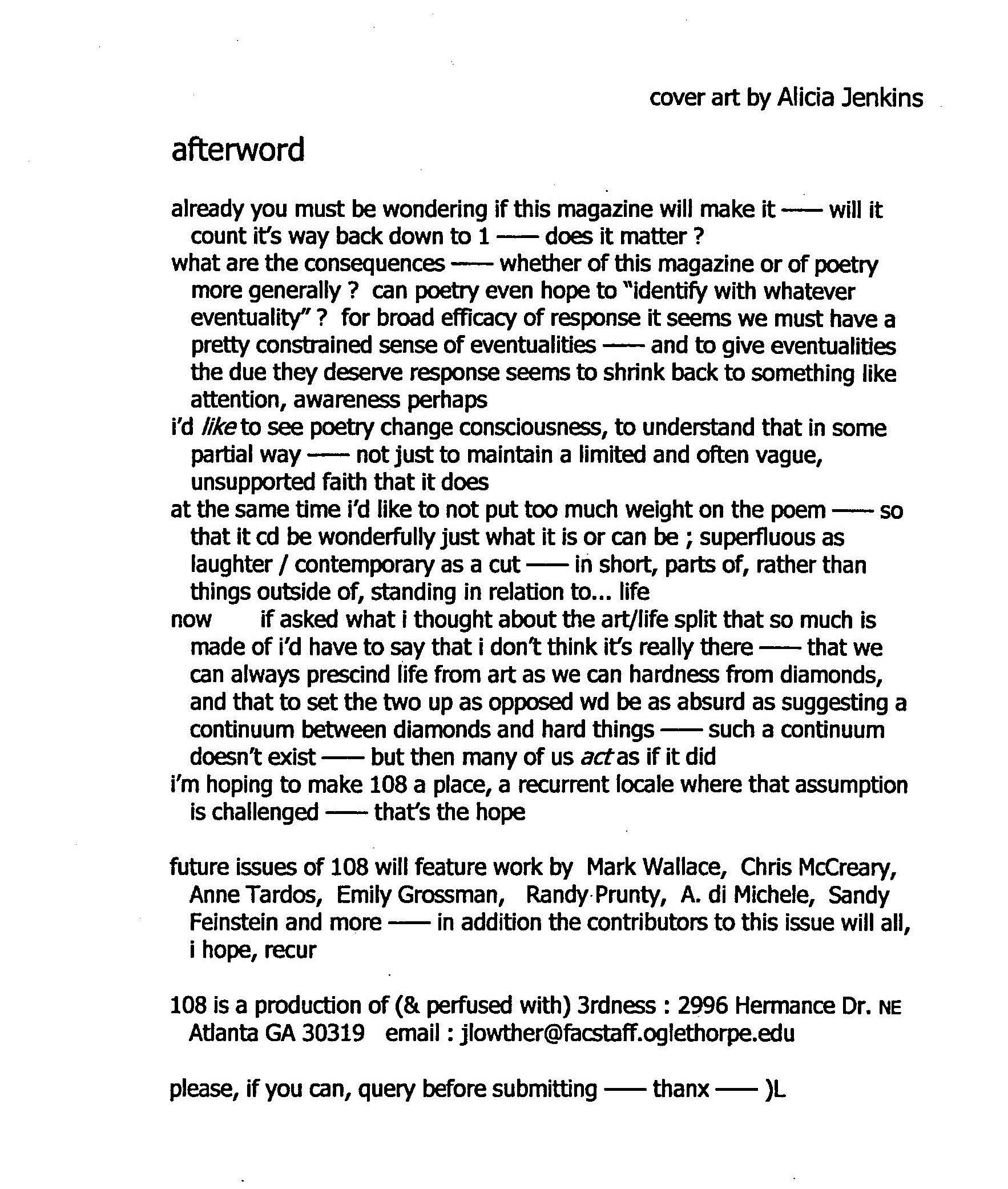
108

Of 3rdness Publishing, )ohnLowther’s Atlanta-based magazine seems involved with a countdown toward issue “one”—featuring a special DC Poetry issue, edited by Tom Orange, for number 92—as presented in this afterword to issue 106:
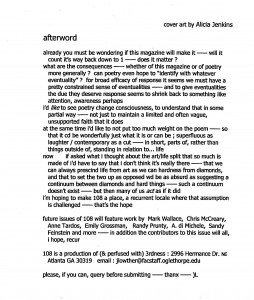
Fig. 108

109th Street Vision

For subtitle, “The Letters of the Poets” – at least, for issue one. Thus: the little magazine in service to anthology. Presumably of previous published works (some in translation), rendered herein without admission, a curious and exciting premise persists where one reads easily between Holderlin and Rimbaud, and Pound (to Iris Barry, June, 1916) and Pound’s Li Po.

Further excitement exists between Neruda’s

My dear Rosaura,

Here I am in Iquique, under arrest.
Please send a shirt & some tobacco.
I don’t know how long this dance will last.39 Herron and T. O’Connor: 14.]

Rilke’s “to a young poet” of 1903, and Whitman’s war letter,

tried by terrible, fearfullest test, probed deepest, the living soul’s, the body’s tragedies, bursting the petty bonds of art. To these, what are your dramas & poems, even the oldest & the fearfullest?40

Why not continue in this vein, a cross-era compendium of letters?
(But by #3 this serial has become a single-author chap by Bill Herron [1981].)

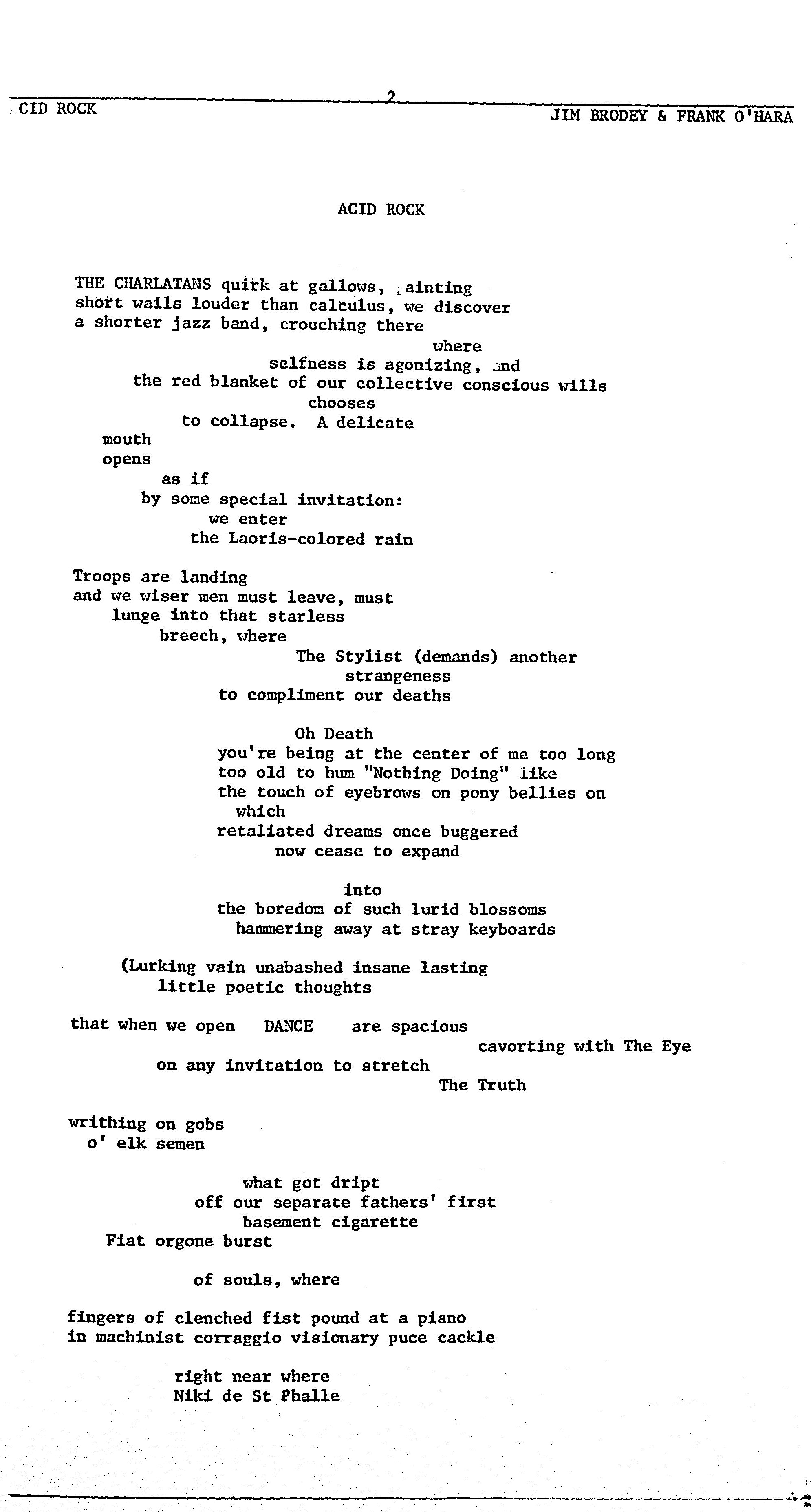
The 432 Review

I become aware of what’s known as a second wave of mimeo, this example being New York Mimeo. 41 The trim size is luscious: a narrow folio; stapled along sides; in hand-illustrated covers. This is New York in the ‘70s, specifically: St. Mark’s in the wake of O’Hara. Regular contributors include Alice Notley, Bob Rosenthal, Kathy Acker, Rochelle Kraut, and Simon Schuchat. Not least of all, an issue dedicated posthumously to Frank O’Hara’s work (1977), plus this collaborative piece from a Jim Brodey feature (1976):
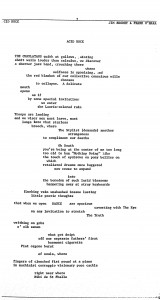
Fig. The 432 Review

491

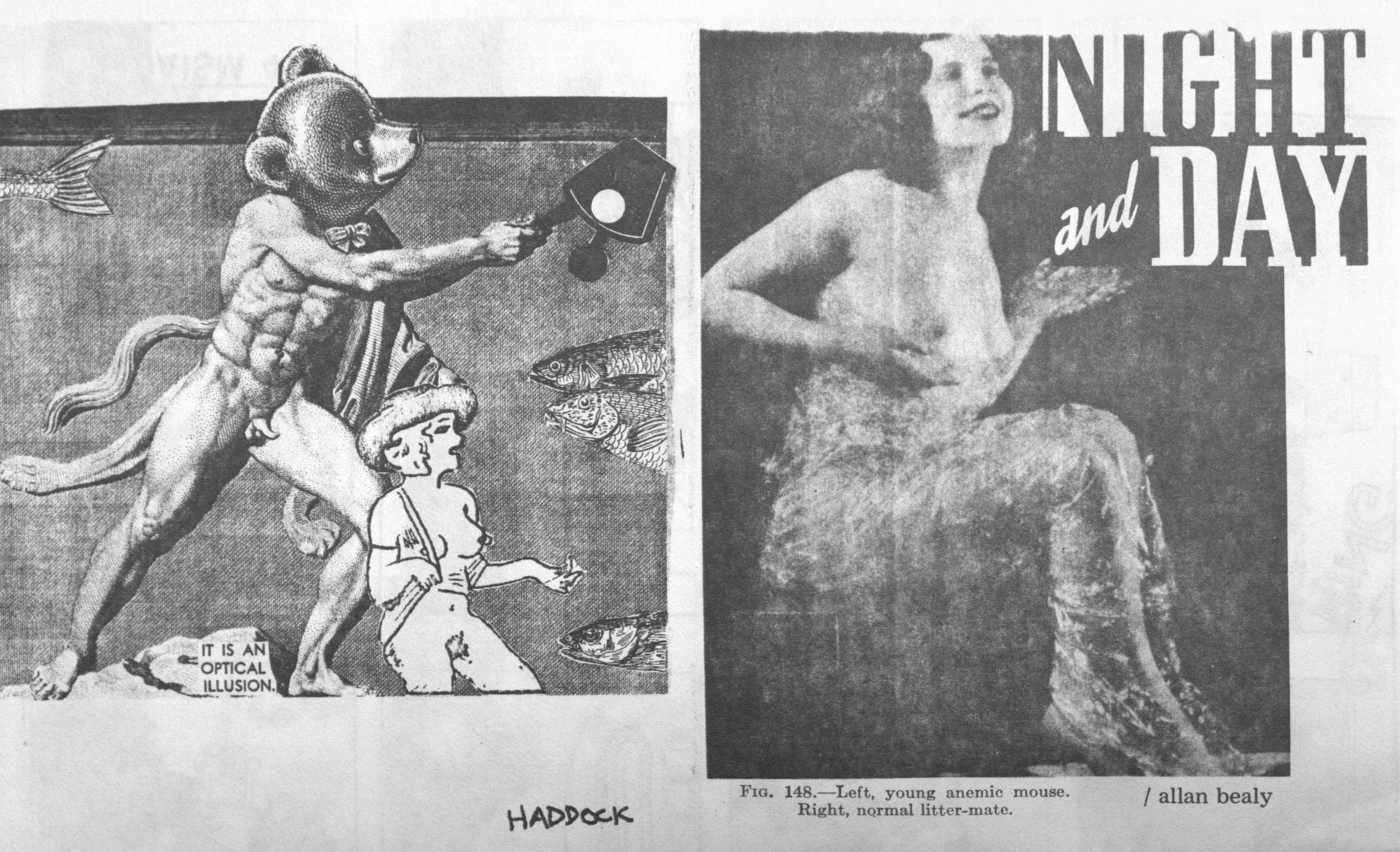
Culled from the ever-nascent copulating of the sacred and profane—here a confluence of popery and Dada 42 — this is a zine from when zines were zines. Saved from its own ephemeral intent by collages from pop culture, politics, and pornography, this manifestation of a South Buffalo underground also references Dick Higgins and Ray Johnson.
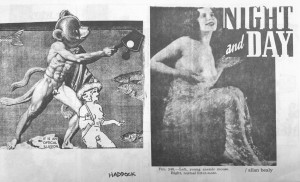
Fig. 491

1844 Pine St

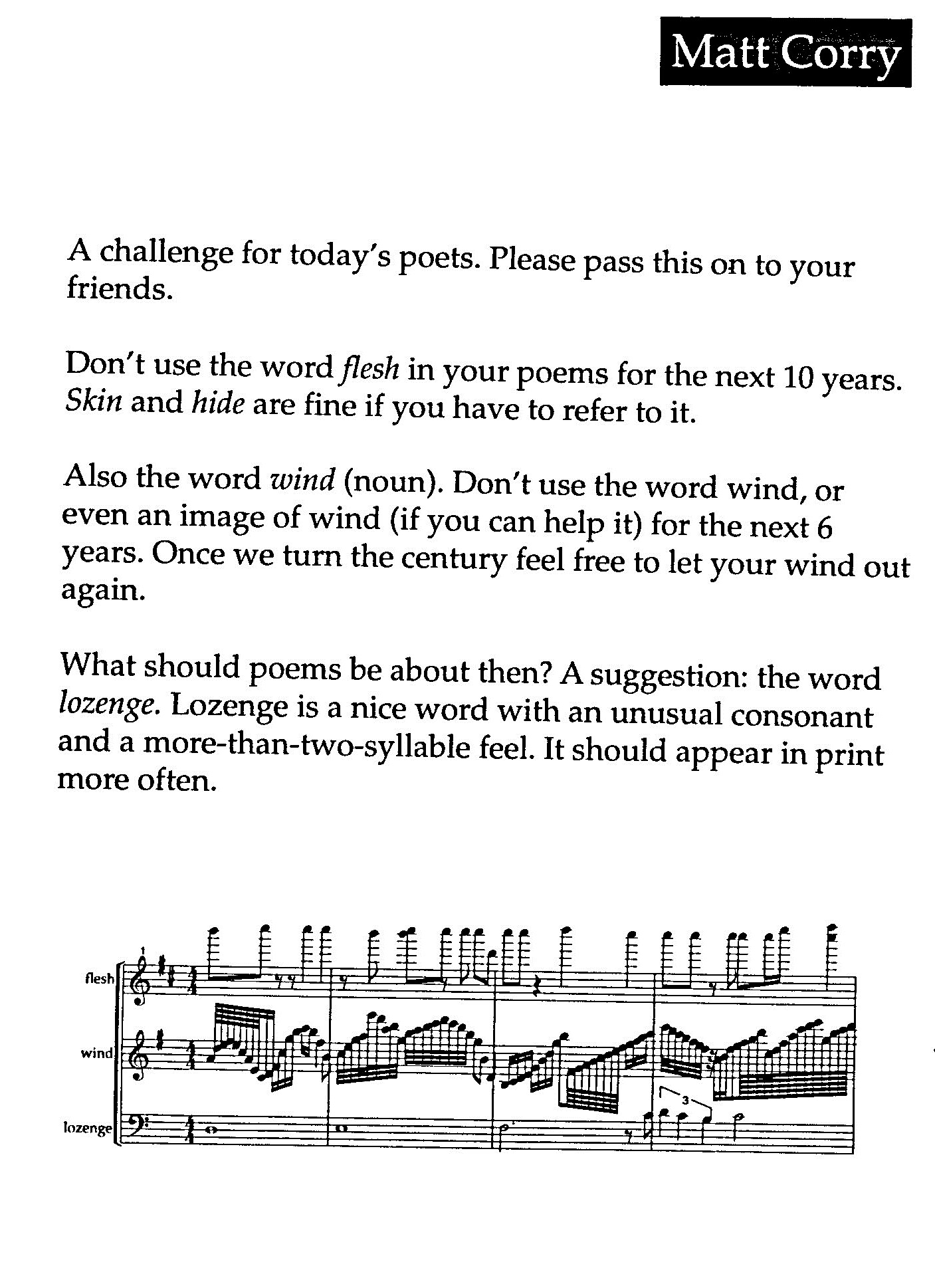
Taking impetus from the Beat legacy, editor david kirschenbaum blends ‘90s zine flexibility with “messy” mimeo, making bread of Waldman and Ginsberg for a sandwiching that changes pace with every turn, mixing the established with the yet unsounded. Jack Collom’s pseudo-mesostic “for Jackson Mac Low” (issue 3 or 4) along with Ann Charters’ opening remarks at the Beats: Legacy and Celebration conference (issue 1) and Matt Corry’s conceptual post-Ono instructions (presumed issue 5, below) are examples of this admixture.
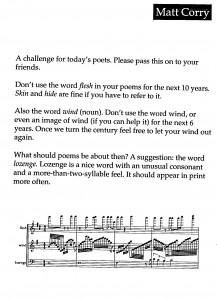
Fig. 1844 Pine St

Of note on the quicksilver longevity of such endeavors, the editor’s fulfilled intent to issue only five editions in a period of five weeks.

1913

This seems an appropriate place to end—

Ben and Sandra Doller’s journal of the literary arts makes no rule it cannot break: trim never uniform, page orientation never a given, and category of poem, visual frame, or poetics need not obtain. It takes its name (presumably) from the 1913 Armory Show, famously: the translation of avant-garde Paris into its New York pronouncement. 43

Wild with the inspiration of that era, it welcomes anything that it excites in the quest for evidence of the modern, 1913’s fourth issue alone (2010) including Meg Barbosa’s sophisticatedly terse lyrics, page-frame-ups from Richard Meier’s “Little Prose in Poems,” language plates by Lynn Xu, and a digitally-negotiable paged presentation by Brad Flis; also, Tom Orange on the interdisciplinary journal Joglars, and the design-centered magazine-within-a-magazine piece “pP.” by Alejandro Miguel Justino Crawford.

In remaining utterly open to the field of poetics to come, 1913 is also grand retro-harbinger of wherefrom the little magazine’s myriad origins.



Posted in ESSAYS | Tagged , , ,

Flash Bulbs in the Dark: Women are Dynamite

The poetry canon does women few favours. Over the years, I’ve had to seek out and find my own choice femmes to balance out the bookshelves. Never feeling the pull of Plath or Dickinson, I went from Sappho to Aphra Behn, arriving at Judith Wright and Jennifer Rankin, skipping back to visit in on Muriel Rukeyser, Amy Clampitt, H.D. I’ve rocked up at Marianne Moore’s doorstep again and again, and ventured up the hill; onto Barbara Guest, Louise Glück and eventually home, via Jill Jones, Joanne Burns, Emma Lew. Dorothy Porter. And onwards, forwards!

Today being International Womens Day, I’ve curated a short selection, some familiar to me, some new, of work by Australian female poets from the Cordite archives. I encourage you to have a gander, then find your own.

Michelle Cahill

Joanne Burns

Claire Gaskin

Sarah French

Helen Symonds

Alison Croggon

Pam Brown

Fiona Wright

Posted in GUNCOTTON | Tagged , , , , , , ,

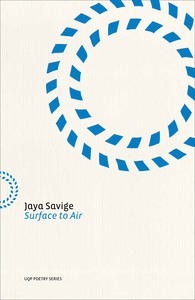
Alison Clifton Reviews Jaya Savige

Surface to Air by Jaya Savige
University of Queensland Press, 2011

In an essay for The Australian titled ‘Poetry Lives, OK?’ Jaya Savige examines the ongoing debate about the state of contemporary Australian poetry. Essentially, he argues that this debate is not so much “current” as “perpetual.” Each new generation of literary talent faces a backlash from those who would conserve the old order. As Savige notes, this process defines literary production and indeed all cultural production. He cites the example of Geoffrey Chaucer who, in 1372, as the English diplomat to the area now known as Italy, discovered the vernacular poetry of the Sicilian school and decided that English, too, would make an excellent medium for poetry. Rejecting French and Latin was a bold move, but it paid off for Chaucer: his work is still on the curricula of universities the world over.
Continue reading

Posted in BOOK REVIEWS | Tagged ,

Wakeling, Frost and a Sydney Prelude

Zenobia FrostCorey Wakeling

It is again with pleasure that I announce two additional editors to the Cordite masthead: assistant editor Zenobia Frost and interviews editor Corey Wakeling.

As an assistant editor, Zenobia Frost will be involved in a variety of editorial duties. Zenobia Frost is a Brisbane-based editor, writer and critic whose debut collection, The Voyage, was released in 2009 (SweetWater Press). Her poems have found homes in Overland, Stylus, Voiceworks and Mascara. She also serves as Rave Magazine‘s arts editor and Voiceworks‘ poetry editor. She is fond of strange myths, incisive verse, theatre, graveyards, tea, and punctuation.

In my search for a designated interviews editor, most leads routed me to Corey Wakeling. His poetry and reviews appear in Australian and international journals in print and online, with new work appearing in Overland, Southerly, The Black Rider, Jacket2, foam:e and Best Australian Poems 2011. He is a PhD candidate and tutor at the University of Melbourne, and reviews editor of the poetry journal Rabbit. A chapbook will come out with Vagabond later this year.

Astrid Lorange, guest-editor for Cordite 38: Sydney is deep in the throes of the poetry selection process. I can’t wait to see the results. Artwork from Vernon Ah Kee and Canadian-via-London artist Kim Rugg will also be featured, engaging with Lorange’s introduction. Feature works by Andrew Carruthers and Ross Gibson will provide their own take on Sydney. Interviews, blog posts are also in the works.

Now, back to help making this all happen …

Posted in GUNCOTTON | Tagged , , , , , ,

Submissions Now Open for Cordite 39: Jackpot!

Cordite 39: Jackpot! will be guest-edited by Samuel Wagan Watson and feature artwork from manga maestro, Queenie Chan

Photo (C) Annette Willis 2010. Samuel Wagan Watson in the Adelaide Hilton with ACDC recuperating on the same floor.

As with all themed issues of Cordite, we will accept up to five poems per submission. What’s the bigwig in the photograph telling you?

Maybe, at some point and in some way, you have hit the jackpot. Perhaps you’ve only lightly tapped it. Or not at all. Doesn’t matter, all poems relative to Jackpot! will be considered. Did the cassowary hit the genetic jackpot? Or is it the many genus of cephalopods that lucked out?

Jackpot: There are innumerable ways to become dressed up in the luck of its sartorial pizzazz. Drilling for meaning in applied Gestalt theory or geothermal vents in New Zealand, getting bumped into first class on a flight – striking a gusher of champers – instead of off it entirely, discovering a green grocer that has a cache of peaches otherworldly in taste … sometimes you just never know where a jackpot lurks. So forget about dinero and gamble with words. Or dress up as a springbok and gambol your way in a completely different direction. Take a chance.

Cordite 39: Jackpot! will be guest-edited by Samuel Wagan Watson and feature artwork from manga maestro Queenie Chan.

It’s a fitting honour that Mr Watson is the guest editor for my first issue at Cordite as it was his book, Smoke Encrypted Whispers, which marked the advent of reading my first collection of an Australian poetry in Australia in 2004.

Samuel Wagan Watson is a Brisbane-based writer whose first collection of poetry won the 1999 David Unaipon Award for Emerging Indigenous writing. He has since picked up a list of other prizes, including the NSW Premier’s Book of the Year in 2005 and the Kenneth Slessor Poetry prize. His books Of Muse, Meandering and Midnight along with Smoke Encrypted Whispers are published by UQP.

Currently, Wagan Watson is the Senior Communications Officer for 98.9FM Brisbane Indigenous Media Association. His poetry made its debut at the 2011 Adelaide Cabaret Festival, adapted by the award-winning and multi-talented Indigenous songstress, Leah Flanagan.

Queenie Chan was born in Hong Kong in 1980, and migrated to Australia when she was six years old. In 2004, she began drawing a 3-volume mystery-horror series called The Dreaming for LA-based manga publisher TOKYOPOP. She has since collaborated on several single-volume graphic novels with best-selling author Dean Koontz. As prequels to his Odd Thomas series of novels, they are called In Odd We Trust and Odd Is On Our Side, the latter becoming #1 on the New York Times best-seller list the week it came out. The third book House of Odd is coming in 20th March, 2012. She currently lives in Sydney, Australia. Check it out.

Please read Cordite‘s full submissions guidelines before you submit.

Posted in GUNCOTTON | Tagged , , ,

‘Hunger repletion musick fire’: Dransfield, Post-punk and the Countrylink Express

Michael Dransfield’s Drug Poems was published by Sun Books in 1972.

Many of you will be clued-in on the recent commentary re. Gray and Lehmann’s Australian Poetry Since 1788 anthology, published toward the end of last year. One of the criticisms of the book has been the choice of poets included, or rather, excluded in the volume; notably, a nexus of contemporary poets described by Peter Minter as working in the mode of ‘counter-modern lyricism’, a number of post-war Aboriginal poets – and Michael Dransfield. (For those after a crash course on the debate, check out Peter Minter via Michael Farrell here, John Tranter here, and Rochford St review here).

For me, as for many of my writer-friends, Dransfield was a key entry point into Australian poetics. This hoo-ha has collided with some of my own recent thinking about the legacy and relevance of Dransfield today, more or less half a century after his last poem was written.

I had the fortune of being introduced to Dransfield by Pat and Livio Dobrez as an undergrad at the ANU. I’d enrolled in a lit theory course, and each week twenty of us would cram into the light-filled office corner office they shared. One week, Livio snuck Dransfield onto the reading list. At the time, I had no idea that the two had respectively published the two major texts on Dransfield: The Many Lives of Dransfield (Pat), and Mad Parnassus Ward (Livio). But I do remember reading ‘The Technique of Light’ and loving it.

Then I suppose I forgot about him for a while.

More recently, in late 2011, I took a trip on the Countrylink Express, stocked with my iPod, enough change for a sandwich and a Devonshire tea from the buffet cart, and a copy of UQP’s Michael Dransfield: A Retrospective, edited by John Kinsella. My intention was to allow myself a lengthy stretch of time to really engage with one text, something I take the opportunity to do much too rarely. Dransfield was chosen because I’d been doing a lot of thinking about ecopoetics, and I’d been listening to a lot of Australian post-punk, and I just had a hunch that these three things would spark off each other somehow.

It was an atypical Melbourne morning: damp foggy and cold – a precise kind of complement to Dransfield’s poems. As the train set off through the drizzle, I suspected I was about to become haunted. And I was right.

At the start, well-caffeinated, I jumped at Cosmopolitan Dransfield, found in poems like ‘The City Theory’, where:

next door, they make their coffee for you,
know its ingredients, the cup you like, and
what to say to you; they know your symbols; to learn this
shatters you.

In this poem, Dransfield articulates the struggle of maintaining a rich internal life in a personable city whose entreating nature slaps at one’s ego. It was a gripe I could relate to.

But by mid-morning I was eating Devonshire tea, and reading ‘Birthday ballad, Courland Penders’, properly settled, and properly fixed on these lines:

a needle spelling XANADU
in pinprick visions down your arm
what of nostalgia when
the era you grew with dies

Michael Dransfield’s Lives was published by Melbourne University Publishing in 1999.

Food does not rate a mention in Dransfield’s oeuvre, which is not to say he was absent of hunger, craving or vice: he is often glossed as Australia’s iconic drug-poet, and the drug experience is certainly flecked through many of his poems.

Yet Dransfield isn’t fundamentally about the drugs. He is more about gradients of exile, searching for a home or place, or at the least the glint or smacking weight of concreteness.

‘Hunger repletion musick fire’ Dransfield writes in ‘Birthday ballad, Courland Penders’. ‘The stimuli of hollow days’ (it’s at this point I smear jam across the page). What I think he means is that it can be really difficult to keep kicking on when you know you’re atop the crumbling tenement of history:

towards the top I let go
the staircase and fall breaking
the day into space and the scene
into components noticing everything (from ‘Technique of Light’)

Dransfield takes nothing for granted, even in boredom, or exile (read: rehab). But this also seems to be his greatest conflict. He can’t help but keep the skull beneath the skin in constant purview.

This reprint edition of The Streets of the Long Voyage was first published in 1972 by the University of Queensland Press in their Paperback Poets series. This was Paperback Poets 2.

I looked out the window from time to time, his mythic Courland Penders appearing and disappearing in green and drenched paddocks, clusters of trees hinting at pensive homesteads concealed further off. This was the point at which I realised Dransfield’s spectral intimations were really getting at me.

Dransfield of course died young at 24, just prior to the cultural postmodern surge his poems were beginning to predict. His early death is a fact both poignant and profound to our subsequent mythologising of his work. Just like the creation of his own Courland Penders, Dransfield encourages us to project onto him our own kind of place-making. So perhaps we can say his relevance lies in the imaginative potential his poetry continues to spur.

Towards the end of the trip I switched on The Go-Betweens while reading.
‘Dust from the creek covers the sky’, sang Grant McLennan.
‘Before rain; dust nothing else’ Dransfield replied.

I wondered (I continue to wonder) what Dransfield would have thought of The Gos. I wonder what he would have thought about that whole post-punk generation: The Triffids, The Laughing Clowns, The Church. They share a similar clammy aesthetic, a similar ecological vibe.

In his essay ‘Michael Dransfield’s Innocent Eyes’, Derek Motion discusses Dransfield’s a-temporality. He notes that ‘Dransfield sees what he likes, in the way he likes, and then knits his field of vision into an a-temporal firmament’.

This feels right to me. That day, as I stared out at a grim rainy countryside, reading poems like ‘Like this for years’ I felt Dransfield’s restlessness, how he rolled over things like a cloud; making poems which appear solid only from a distance:

and when the waves cast you up who sought
to dive so deep and come up with
more than water in yr hands
and the water itself is sand is air is something
unholdable

I think he’d been travelling as a ghost long before he died. Kinsella too suggests as much, prefacing the collection with this quote from Dransfield circa 1969: ‘I’m the ghost haunting an old house, my poems are posthumous’.

I don’t quite know how to pin down what it is that has made Dransfield so keenly beheld by me and many of my friends, though I think that all of this gestures to it, ‘a welter of corollaries’. Perhaps it’s his youthful temperament, perhaps this is beside the point: his is a poetry that speaks forward, into post-punk, and ecopoetics and beyond. And to my mind, poetry with impetus like this is the only kind worth anthologising.

Posted in ESSAYS | Tagged , , ,

Australian Print Poetry and the Small Press: Who’s Doing the Books?

One of many pressing concerns for small publishers in Australia is simply this: are there enough buyers to consume their print runs? The question begets three subsequent concerns. Firstly, are Creative Writing programs creating a glut of writers and, in tandem, small presses to accommodate the ambition of that growth? Secondly, what is the quality of that which is being written, then published? And thirdly, can a small press sustain a viable publishing schedule with today’s technology based on points one and two? These concerns are testament to and the result of a multitude of forces that sculpt and govern the pace and volume of titles being released by small presses. In this article, it is my intention to chiefly address that third concern – who is publishing print poetry and, to some degree, how and why – directly with hope that any resulting discussion might cast its gaze upon the first two.

I start with this devil’s advocate view primarily to acknowledge its presence. At times, such unglamorous chestnuts as ‘bottom lines’, ‘market suitability’ and ‘sustainability’ blow open the trench coat of small-press publishing – exposing realities of being in business in the way that a freelance accountant is also in business – diffusing its sexiness and mystique.

Thankfully, the antithesis to this gloom – resulting in a vantage point equally emblematic of the initial question I opened with – is the sure and absolute fact that small presses in Australia are booming. This reflects not a creative renaissance (as I argue that creativity and entrepreneurial sparkplugs never wane in a society, though they certainly can be shackled 1, but evidence of a population with an extant, ever-developing and critical engagement with written arts. Which brings us, more specifically, to poetry and its printed publication.

I was … I guess the term is gobsmacked … when I first came to Australia in 2003 and found that major daily newspapers of record such as Melbourne’s The Age, the Sydney Morning Herald and The Canberra Times were all publishing poetry, even if only once a week. They’re still doing so, which speaks volumes at volume. The passion for literature, pulp, poetry, criticism, whatever the form this passionate wont may assume, is both arresting and rigorous in Australia. Without that, there is next to nothing to write about in this space.

It’s also a maddening truth that publications that eventuate from this ‘small’ and ‘un-corporate’ passion don’t often punch through Australia’s shoreline and on into the zeitgeists going off in rest-of-world; our geographic isolation renders an unwanted but unavoidable gravity that fetters a great many notable works only to this land. The innumerable reasons for that effect are best left to another investigation, but I need to note it here. It is also imperative to mention that a society’s thirst for letters such as Australia’s is one significantly bolstered by generous state and federal support. Yes. I’m talking about cash. Freezing cold and hard (to come by). Such funds cannot and will not ever supplant passion in the currency of small-press publishing, but they are handy to have on your person.

Throughout this article, I’ll interject look-ins at what a few small presses are doing in the realm of business liquidity – a term about as far from poetry as you can march – but any perceived “perfidy” of this pragmatism will get no apology from me.

From here on, I will zoom in on small Australian publishers putting out printed books of poetry, while noting these three points:

• Online-only publications that feature poetry have been taking root fortnightly, it seems, if not with greater frequency. They’re an experimental and exciting bunch, teaming with as much diversity as the Peruvian rainforests. They deserve their own assessment. Mascara, Verity La and foam:e are standouts.

• Literary journals and magazines that feature poetry are similarly on the uptick, adding to many well-established titles. While venerable publications such as HEAT (which has ceased printing but lives on at an IP address near you) and Island (teetering on the edge of being online only, print and online or not at all) have stumbled, more recent print publications have stepped in and up; Wet Ink, The Sleepers Almanac, Page Seventeen, Australian Poetry Journal and the snappy Mook series by Vignette Press as examples. Read Benjamin Laird’s recent Australian Literary Journals: Virtual and Social.

• Changes in technology have brought shifts in the volume and quality of self-published print poetry. Those, too, requires their own discussion.

So what’s going on with print poetry in Australia? Let’s start small.

Chapbooks

The word chapbook typically gets blank stares when I talk about its form to friends or colleagues not involved with or interested in reading poetry. I can sense them playing along or fumbling for a contextual definition on the fly. And that’s okay. Chapbook: a writer’s word, an object with an artier savoir-faire than most paperbacks, a writers-of-poetry totem with an organic cachet. At times when I am frankly asked, ‘What’s a chapbook?’, I reply that it’s more like an EP, as compared to a full-length album of music. Bingo.

Vagabond Press is currently on a roll with its Rare Objects series, its aesthetic featuring the most DIY, books-as-art-objects out of all publishers releasing this format right now. Founder Michael Brennan’s ethos informs that decision well:

Brennan: I don’t look at publishing poetry as anything more than a working of impermanence, in the way that a conversation moves smoothly through arising differences and allows for anything, takes a subject, like a poem, picks it up for a moment and then sets it back down.

Vagabond has a short but rich history of producing poetry, with much more to come. Relative newcomer Whitmore Press puts out slick-looking chapbooks that nod quite heavily (almost but not quite bruising its chin in so doing) to the classic Faber & Faber style. It has built an impressive list and runs an annual chapbook manuscript competition. Rob Riel at Picaro Press has been in the chapbook racket for years and displays no signs of letting up, recently investing in two new digital print-on-demand presses. He’s lent the chapbook format to Picaro’s serial publication, Wagtail, now a distinct if obscure institution unto itself.

Black Rider Press has been stomping along for some time now, punching its way through traditions to form the interesting publisher it is and the list of varying formats (largely chapbooks) it sports today. PressPress has also built a substantial list of chapbooks, releasing large swathes of titles in a various series and with more on the way. It is dabbling in chapbook translations – a quality touch – and runs an annual contest of its own. Blemish Books is two issues into its Triptych Poets series, ostensibly the binding of three different poets’ chapbooks into one volume to make a thicker, slightly chappier-book. Look for more offerings there this year. Mulla Mulla Press is a new concern that’s taken to the chapbook as well, tapping into the literary fabric that’s looming (or fraying, depending on your tastes) in Western Australia. Walleah Press, chiefly known for its literary journal Famous Reporter – an undisputed institution in Australian poetry – also dabbles in chapbooks now and again, although no more than one a year.

Proletarian daddies Melbourne Poets Union Inc. releases its own series of chapbooks of emerging to very established poets. Australian Poetry’s erstwhile incarnation, Australian Poetry Centre, released in 2010 a New Poets Series of four writers who well deserved to be read, which offered up great poems in shoddily produced books. The chapbook doesn’t demand an airtight, sophisticated production quality, but they’re still books – real books that require layout and editing – and should be approached as such, especially by the self-appointed ‘peak industry body’ for poetry in Australia.

Chapbooks are short, small in stature, inexpensive, readily stocked by a dozen or fewer bookstores in Australia. Chapbooks happen at readings. It is upon those occasions that chapbooks trade as a passionate currency much more so than a vehicle in which to earn $3 to $15. They’re lean distillations of intensity, providing adhesive to and amongst writers – isolated by regions and experimentalism – who form a community or movement. Australia’s geographic vastness begets their popularity.

Perth, Western Australia, is the most isolated metro area on the planet; its poetry scene sustains itself as a microcosm in a nation where much of the writing and printing of poetry is beyond the Moon or further. Terri-ann White, Director of UWA Publishing, notes that historically ‘there has been a strong culture of poetry sharing in Perth, at least since the 1970s. Mostly, the chapbook was the form of published volume: that important hand-to-hand method.’ Currency.

White: I recall folk music and poetry mixed it in evening performances in city and suburban locations. These days there are a number of active groups operating, but I am uncertain if they are group-based happenings or if they rely on a larger audience. Most of them happen in cafes and bars, as is good and proper. White continues, ‘But it is rare that the named poets in this oral culture make it into print’, noting that Perth has only two traditional publishers: Fremantle Press and UWA Publishing.

We have only recently stepped into poetry publishing, with single-author selected volumes and revisits of classic Australian poets who have been willfully allowed to go out of print over decades: Dorothy Hewett, Francis Webb, John Shaw Neilson. Fremantle Press certainly has had a role in nurturing many Perth poets into careers and recognition. When you count up the new poetry books being released every year, you notice two things: they are published by small or micro publishing houses, and the cumulative numbers put paid to the idea that poetry publishing in Australia is in a parlous state.

Without question, the Australian chapbook is flourishing. But it’s absorbed a few tragedies as well, notably the erstwhile Small Change Press run by Graham Nunn and David Stavanger. In this case, SCP relied on the currency of chapbooks as I’ve discussed, but also depended heavily on live performances around Australia. Plus, its management committed to having two people in equal ‘charge’. I asked Nunn about what combination of events occurred to see his press lock its doors – if not forever, just for now (thank you, Uncle Tupelo) and the foreseeable future. ‘It’s a funny one … the physical publishing side of things is in many ways getting easier, but the distribution and sale of poetry has always been a tricky beast,’ says Nunn.

Nunn: [Small Change] is a huge believer in putting poets in front of audiences, but in a country as vast as ours, [that] is an expensive business. Publishing poets who had that ability to connect with a live audience was something that SCP did really well. Time has definitely been the biggest hurdle for us. We work collaboratively on every book published. The down side is that this requires us both to be in the same place for extended periods and have the time to develop each book. With families, work and our own writing projects, that time hasn’t been as available as we need it to be, so to keep our integrity as a press we decided to put things on hold for now.

Posted in ESSAYS | Tagged , ,

To Anthologise the Now Perpetually: The Literary Situation of the Small Press and the Archive

“The little magazine is not difficult to define,” write David Miller and Richard Price:

it is an anthology of work by strangers; an anthology of work by friends; an exhibition catalogue without the existence of the exhibition; a series of manifestos; a series of anti-manifestos…It’s printed by photo-litho; or typed onto a mimeograph stencil…It’s a twenty-year sequence; or it turns out to be a one-off. 1

It is inclusive of a spectrum of literary productivity, bearing simultaneously the weight and gait of outsider and coterie, commercialism and unprofitability, both harbinger and hindsight. One clue to its elusiveness, or effusiveness, is the notion of its distance from a perceived literary norm.

This last element [i.e. “distance from a notional norm”] elides identity politics with poetics; it is in poetics that the “classic” element of the little magazine is encountered. A classic little magazine, in the view of the present authors, publishes the work of a group of artists or writers who assert themselves as a group (e.g. the Surrealist Group of England’s publication of The International Surrealist Bulletin in the mid Thirties) 2

What then could be said to be our contemporary little magazines and small presses? Especially considering the collecting of such small press publications at the institutional level of the poetry archive, or repository. These are some of the issues that arise within “the dynamics of literary publishing” as it stands today. 3

I. Ontology for Little Magazines and Small Presses

Tom Montag points to the eclipsing of studies of small presses by those academic interests vested in little magazines. The relation between small presses, little magazines, and the academy may be further complicated by, invested in, or fraught with the mission and ethos of the modern and contemporary poetry archive. [Q. The author confesses to working as Mary Barnard Research Assistant to The Poetry Collection of The University Libraries, University at Buffalo, The State University of New York. ] And this may particularly relate to how literary items are stored in an archive: serials, like little magazines, clustered by title; monographs, or small press titles, sorted by individual author in the service of bibliography.

Montag, writing in 1978, gives some reasons for the above eclipsing:

A little magazine can be indexed; its editorial vision can be analyzed; its sphere of concern over a period of years can be assessed. By contrast, the nature, concerns, and editorial vision of the good small publisher may often be difficult to ascertain because, first, the small press editor does not have the convenience of “editorial notes” in which to set down his literary tenets; second, the publisher may present diverse kinds of writing, dissimilar in all respects except for that intangible quality, something not easily described 4; and, third, students of literature generally seem more interested in the development of particular writers (and hence the bibliographies of particular writers) than in the larger dynamics of literature (to which the bibliographies or “lists” of publishers are relevant). 5

It is true (to some degree): the manifesto has been a central focus of study regarding Modernism; also, mission statements, prefaces, and introductions. 6 Into the seams of the small press go the small publishers’ poetics, as allegedly translucent as that of the editor or designer, positions for which the small publisher may often stand in. 7, 8
Other concerns also reveal, as through magnitude (or, circulation) and production timetables: the little magazine is often abler to present a broader (if not immediately deeper) swathe of poets as well as divergent or sympathetic aesthetics; and, the magazine may typically appear with greater frequency. We might also ask how these would-be rivalries play out in the more current scene of digital production, both online and in print: the little magazine may now post and update in an instant, proffering more and longer features. 9 Similarly, print-on-demand publishing and e-books have allowed small press catalogs to grow—in some cases—exponentially. 10
Montag later makes apparent the simultaneity of much small publishing—that is, the overlap between little magazines and small presses, more often than not the same laborer educing these categories of the bibliography. 11 It may be hazarded that while the labor remains uniformly that of the “small publisher,” and the volume of small publishers proliferated via digital technologies more affordable in terms of access, the scope of little magazine-versus-small press may be a limit we are culturally reaching with a speed outstripping even that of digital propagation and its labeling.

Labor and affordability also become variables—leaving practitioners of the now to “ambiguate” the new division of small press and little magazine labor. That is, amid this occlusion, it may be helpful to differentiate how small publishing, its vehicles and venues, relate to or resist the commercial production and consumption of what is literary.

II. Ultra-Heterogeneity and the Subtraction of a Critical Readership

In April of 1965, a Modern Language Association of America conference was organized by poet and critic Reed Whittemore to address the theme of “The Little Magazine and Contemporary Literature.” Various speakers came to represent their varied platforms, including those of the little magazines Partisan Review and Prairie Schooner, kayak and Kulchur; including William Phillips and Karl Shapiro, George Hitchcock and Lita Hornick; also, Allen Tate, Wayne Booth, and Peter Caws. Far more intriguing than the presiding egos of what William Phillips dubiously dubs The Literary Situation12—a term later called into question by said presiding egos of that literary moment—was Phillips’s caution against the interests and influences of funding regarding the small publishing endeavor.

We all know about the evils of money and the virtues of the affluent society, though we sometimes forget that these are contradictory ideas. And we are familiar with the long cultural tradition exposing the corruption of industrial society. What I want to comment on here is simply the way the power of money recently has tended to break down old literary traditions and standards and to stunt the growth of the more or less homogenous and educated audience that is necessary—or at least used to be thought necessary—to the continuity of literature. 13

Despite his (literally) demoralizing angle, Phillips draws out the notion of reception, one we talk about often enough in the digital- and activist-minded paradigms of discourse as a “critical mass” in readership, or audience. To emphasize, while Phillips’s analysis may sound to us partly reactionary, it is also partly cautionary of an age we have perhaps come to inhabit, where he warns:

The three main trends of our time, or at least the three that have excited most of the critical arguments, might be said to be academicism, commercialism, and extremism. (I almost added a fourth: awardism, the endless pursuit of awards, prizes, and grants and the constant hopping from one writers’ conference to another…)14

On the absorption of writers—specifically poets, who are most often the small publishers of poetry magazines and presses—into the academy we have had some speculation (see note 25), and the same with the awarding of prizes that has lent itself to suspicion. 15 Less so of—to use a jingoistic term here—the hybridity found in the new publishing models, in which author and publisher16 align common interests in bringing forth magazines, chapbooks, and monographs, rather than the conventional ideal of the wealthy publisher courting and patronizing the talented author of the garret. 17 But I am getting away from Phillips: he explains that he isn’t fearful of the nonhomogeneity of audience so much as the dissolution of an educated and informed “critical mass” (in my phrasing) of readers before a “glossy” capitalistic magazine culture; and, I would hazard, commercial publishing houses. Corporate capitalism’s nonstop drive to elongate the desirability of a product, or to replicate it for the longevity of its sales-appeal, leads to what Phillips sees as the watering-down of literary output for popular consumption, and a demand-sided market for the author; furthermore, he believes it leads to at least two kinds of authors: “the rich and the regular.” The homogeneity of a readership (or masses), therefore, is not the same as the homogeneity of a critical readership: not where the market knows no literary value, only capital. And where literary production serves—above the ideals of a readership, or even an aesthetic—only mass consumption.

One might wonder what kinds of modern reading communities this will have engendered by our own moment.

III. Get Your Small Press Chaps Here!

Little magazines were ambivalent at best about advertising. From Mark Morrison’s assessment of modernist British examples, while

the Egoist, and its predecessors the Freewoman and New Freewoman, might seem to exemplify the type of coterie publication that turned its back on mass audiences and published either for posterity or for what Ezra Pound would call the “party of intelligence” 18

he likewise argues

that the writers and editors of the Freewoman/New Freewoman/Egoist were attracted to the proliferating types of publicity of an energetic advertising industry, and that they also attempted to adopt mass advertising tactics—not always directly from the commercial enterprises of the mass market magazines, but rather from the suffrage and anarchist movements…19

Thus we might read literary promulgation and capitalist consumption as a twofold sign of literary modernity. Seeing these literary fractures derive smaller, niche markets—or consumptive coteries—within a larger publishing realm of production and consumption also furthers Phillips’s concerns (and perhaps Montag’s) regarding not only a dilution of the discursive but also of the reign of its dissemination.

To some of these midcentury small press editors and publishers the threats of falsely competitive awards contests and commercial advertising, and “extremism,” rivaled that of academicism. 20 How may these concerns have changed given the abovementioned streamlining of poets’ vocations with academic posts?

It is noted at the time of the 1965 conference that the Partisan Review had recently been absorbed into Rutgers21; likewise, Prairie Schooner had been invited as a representative academy-funded magazine. Paralleling the withdrawal of literary community from commercial publishing, and the simultaneous entrance of many poet-publishers into academia, one finds the attribution of academic funding for small publications. Thus the endowments associated with departmental chairs and academic institutions have come to subsume large portions of the expenses of wider reaching and well turned out magazines, such as the Partisan Review. (Thinking today of the University of Chicago’s affiliation with the Chicago Review , or discretionary chair endowments bestowed upon graduate student productions, such as at The University at Buffalo where the David Gray Chair, among others, has historically (and, one might say, nobly) supported such small presses and affiliate magazines as Cuneiform, P-Queue, Atticus/Finch, and Pilot. ) These affiliations may also extend the reach of coterie now vested by the academy, even while it may simultaneously delimit poetics.

Literary magazines are what Karl Shapiro called “the penultimate form of publication for literary works”: “A work printed in the literary magazine has only two destinations: the book or oblivion.” 22 From this stance, Shapiro hazarded that the magazine—opposed to the monograph—was expendable, the book, unexpendable. Consider the general consensus that fewer monographs are being purchased by libraries or printed by publishers, and that therefore perhaps fewer are written or even read. The chapbook and little magazine might thus be thought to correct Shapiro’s assessment: the other side of oblivion may be a proliferation of little magazine publications and small-circulation chapbooks. 23

And then attention that has been given to the movement of avant-gardists into academic (and tenured) positions. 24 But are these institutions, made proper by Shapiro as “institutionalism,” those of the academy? A time of wan funding in the United States—particularly at state-funded colleges and university systems in California, New York, and Wisconsin—as well as rising tuition fees and student debt in the U.S. and in Western Europe, say otherwise. Institutionalism, as Shapiro indicates, has little to do with the academy other than its abandonment, leading us to question the generationality of a rift between poetry and the academy proper. 25

This is where we leave off Shapiro, and much of the partisan wrangling at this MLA conference. But not before we bear in mind Shapiro’s prescient analysis of The Literary Situation (that term loathed by Phillips’s fellow panelists) as it antecedes our own: “What we have of the avant-garde today is a direct reaction against the growing institutionalism of the arts and the society it defends” 26—prescience here in that Shapiro was speaking directly from his experience as editor of Prairie Schooner and those little literary magazines associated with academic institutions.

Consider now the interests of the collection at an institutional level, such as that found in the University at Buffalo’s Poetry Collection. James Maynard, speaking of the Collection’s founder Charles Abbott (in an earlier interview with the author), tells how “Abbot realized that to capture fully the trajectory of any poet’s work he would need also to collect little magazines, anthologies, broadsides, and in some cases English translations.” 27 It was Abbott’s foresight to recognize that little magazines were worthy of collecting, as well as small press literary output, alongside mainstream monographs. To collect, as is stated in the Poetry Collection’s collection policy, “without prejudice.” Such was Abbott’s coy reasoning of not paying writers for donations of their “wastebasket” manuscripts, drafts, and ephemera. For,

he felt there could be no sure way to ascertain the relative value of any given poet’s papers vis-à-vis another’s…In general, manuscripts simply didn’t have the same perceived value—literary or monetary—as they do today. [28 .Ibid. Abbott asked particular poets—such as Pound, Williams, and Moore—to send him, as donations, those drafts that would otherwise be committed to their wastebaskets.]

Maynard goes on to speculate how

In today’s academic and economic markets, I think many writers have a markedly different attitude toward their body of accrued work, viewing it now as a form of investment. 28

And these changes must decidedly reflect the marginal economic fortitude of many small publishing endeavors—especially as they might also reflect the economically marginal statuses of their publishers. Poets do now what has elsewhere been called the “shadow work” of free consumer labor under capitalism. Thus the evidence of poetic labor is completely subsumed by a market value.

While the rarity of archival materials and the “auction block” prices attributed to them may indicate a greater collecting practice on behalf of institutions, two notable features may belie this appearance. First, this presumes a magnitudinous poetry institution, replete with endowments resilient against recent economic flux; such is decidedly not the case, of late, in higher education, and certainly not for the literary arts, or for The State University of New York library system. Second: this stance requisites a knowable small press universe.

One might hazard that the small press literary community of the 1920s was, while diverse and far-flung, far smaller than today, thus allowing for greater networking and connectivity between the curator and what Maynard calls “ambassadors” to the collection, or those figures who have historically advised the curators, and thus extended their purview of the small press publishing:

I think the collection from the beginning has always relied on various kinds of ambassadors—for instance, there are letters from Nancy Cunard advising Abbott on what African-American poets to collect. 29

Across a contemporary map of small press publishing—or, the Literary Situation we now find ourselves in—academic institutions may still be viewed as oppositional, where the pedigree of commercial publishing has so frayed reception, and when ultra-heterogeneous communities exist without interstice, Buffalo’s repository, so often considered “the collection of record” for modern poetry, may, going forward, appear to waver as cost, commercialism, and reaction to commercialism increase at once the literary object and the its resistance to collectability.

IV. A Reading Room

As Lita Hornick of Kulchur makes evident at the 1965 conference,

this is a revolt not so much against the academy as against literary mandarinism. These writers say that they do want to reach and influence a wider audience, and I think that’s healthy. I think it even more dangerous for poets to write for the editors or the readers of the quarterlies than to submit to the pressures of the academy or the marketplace. I feel that the little magazine does not have to publish literature that’s by definition incomprehensible to the public and therefore unacceptable to the machinery of commercial publishing. 30

I think Hornick is pulling at quite a tangle here, at sympathy with our own Literary Situation, as stated above: the incommensurate poetics of the small press: of aesthetics, form, format, distribution, officiousness, avant-gardism, and coterie—to name a few.

It is the archive that may have a few things to teach us about such tangles.

I walk among the glass encasements of the Poetry Collection’s in-house exhibit, James Joyce & His Literary Circles: Paris, Personalities, Presses. Here is one of the letters referred to above by Jim Maynard, from Nancy Cunard to Charles Abbott: she sends a poem she has translated “on Spain written by a Yougo-Slave [sic] volunteer who fought there for several months,” signed by the poet; she talks of England’s (and France’s) stance toward Spain, and a lack of action on either’s part toward military aggression; laments the inadequacy of the League of Nations to assess—let alone redress—events in Spain, and wonders at its future demise; forewarning: “The students of the future will have a time rich in horror to study.” 31 Still, the small publisher has time (amid this and two other letters on display) to advise Abbott on how to get in touch with poets Kay Boyle, Cedric Dover, Nicolás Guillén, and Langston Hughes, as well as where to find her groundbreaking international anthology Negro while Abbott is in London. 32, and Aug 29, 1937, all three sent from 43 Boulevard des Capucines, Paris.] It was the monumental project of commissioning, compiling, and publishing Negro that came to subsume the early small press efforts found in Cunard’s The Hours Press; and it was her same press that in 1930 alone issued Samuel Beckett’s Whoroscope, Robert Graves’ Ten Poems More, Laura Riding’s Twenty Poems Less and Four Unposted Letters to Catherine, as well as Pound’s A Draft of XXX Cantos! It may have been through Cunard’s ambassadorship to the Poetry Collection that Abbott was able to acquire these and many more monographs from The Hours, or how he became alert to the many literary publishing circles in which Cunard participated. If the poet or researcher of today were to try to collect the handful of 1930 titles listed above it would cost, at rough estimate, more than 10,000 U.S. dollars. 33 Furthermore, the collection offers a great deal more to the poet and researcher, given the correspondence between curator and small publisher, as it gestures not only to Cunard’s social and professional network and milieu but also—more importantly, given our discussion—to her publishing poetics.

As Cunard recounts in her memoir of these years, These Were The Hours, she purchased her “old Belgian Mathieu press” from William Bird of Three Mountains, which has its own auspicious beginnings and record:

Though Bird financed it himself and regarded the Three Mountains as a hobby, its first six books published in 1923 were indeed artistic achievements. All in the same agreeable tall and narrow format, the six were: Indiscretions by Ezra Pound; Women and Men by Ford Madox Ford, who incidentally ran his Translatlantic Review from an office upstairs…Elimus by B.C. Windeler; The Great American Novel by William Carlos Williams; England by B. M. Gould Adams; in our time by Ernest Hemingway. 34

In one such “wastebasket”-letter from the office of William Carlos Williams we find this account of the labors of the letterpress directly from Bill Bird:

We had a rotten time getting started—first the difficulty of finding an English comp[oser], next the foundry fell down on the delivery of certain sorts,—but we are well under way and Pound’s book will be off the press the end of next week if no new embêtement supervenes. Then we tackle Hueffer [Ford], which will take a month—say the end of February. Elimus is short—three weeks at most should suffice. Yours is relatively long, but should be printed by the end of April […] Glad to hear of your projected trip this way. By that time the 3 mts. press will either be broke or blooming. 35

Thus the longstanding relationship between self-financed and small press ventures… (Three Mountains was also the first publisher of Gertrude Stein’s The Making of Americans, in 1925.) It is in the reading room at an archive of record that such importantly tangential sympathies as type and letter are revealed, allowing for an ever and even more material account than the memoir can provide.

Along with Ford’s Transatlantic Review, Three Mountains also shared an address with Robert McAlmon’s Contact Editions36 whose 1925 Contact Collection of Contemporary Writers reads like a Who’s Who of high literary expatriot Modernism (e.g. Fig. 1).

Contact Collection of Contemporary Writers. Paris: Contact Editions, 1925.

It is also such a recorded archive that allowed pre-digital diagramming like that found in Scott and Broe’s The Gender of Modernism (Fig.2).

The Gender of Modernism: A Critical Anthology. Edited by Bonnie Kime Scott and Mary Lynn Broe. Bloomington: Indiana University Press, 1990: 10.

The Gender of Modernism: A Critical Anthology. Edited by Bonnie Kime Scott and Mary Lynn Broe. Bloomington: Indiana University Press, 1990: 10.

Archival collections also make possible compendia like the one by Miller and Price, who write of their effort:

This book is not only an annotated bibliography but a union catalogue of holdings as well. For each entry, we have consulted the catalogues of the British Library, Cambridge University Library, the National Library of Scotland, Trinity College Dublin and University College London’s Little Magazines and Small Press Collection.

The Poetry Library [Southbank Centre], although not so strong in its holdings for the first half of the century, is an extremely rich resource for later magazines: in many cases, equal to or better than the national and academic libraries. Its holding are placed beneath the list of libraries with a century-long breadth. 37

There are therefore different collections of differing strengths in terms of scope and foci, and the geographic location and access policies of these institutions mitigate what might be revealed to us of the poetics of small publishing—as exhibited through small press monographs and little magazines.

But to return to Hornick’s assertion, for whom are our small presses today publishing?

V. Archiving the Icons of the Now

In assessing the progression of monograph and little magazine into the overlapping discourse of the small press chapbook series, an alignment of cultural production with academia is notable. Also, the distancing of (viably profitable) commercial interests from academic funding and publishing, or, in Hornick’s words, “the pressures of the academy or the marketplace.” 38 Maybe in tracing a literary situation in terms of the poetry scene a repository now faces, a case might also be made for the interests of the contemporary poetry archive.

I give you, by way of illustration, some examples of the now I consider fine. 39

Exhibit A: Muthafucka

Muthafucka was, per editorial admissions, “an irregular, locationless journal of the arts.” 40 The publisher’s imprint appears only on the second (and last) issue, with no date on either; in order to communicate with editor Mitch Taylor, beyond email, one could write care of various folks at changeable addresses. This magazine maintained a low overhead, with photocopied, standard 8½- by 11-inch papers, stapled along the left margin, and with laminated cover. This magazine also followed a typical trajectory: slimmer first issue, with less-well-known and predominantly male contributors. Then, nearly doubling its page count to include far more recognizable contributors and gender parity; plus, in the second issue, the small press or avant-garde “titans” it looked to in establishing its poetics.

The second issue, sadly, was the final Muthafucka, a lamentable loss of an adept “survey” of some burgeoning scene. Such is often the case with little magazines (as noted by Miller and Price). Luckily, the presence of an ambassador to the collection among the contents of the first issue ensured the Poetry Collection’s early identification and procurement of this publication. While easily reproduced, each issue was printed in a run of only 100, each numbered. Thus, part of Muthafucka’s intent was to lasso a limited audience, intentionally falling short of a wider purview for the sake of establishing a quickening of contact.

Exhibit B: Western New York Book Arts Collaborative

Some publications are intentionally limited, as in the case of artist’s books.
Such is the case with 8 Poems by Richard Tuttle:

Published 2011 by the University
at Buffalo Art Galleries, State
University of New York.
Generous support for 8 Poems is
provided by Steve and Kate Foley

/200

Printed and bound at Mohawk
Press, Buffalo by Richard Kegler
and Chris Fritton in an edition
of 200 copies using Caslon types.
Cover paper is Handmade Saint
Armand. Page paper is Revere
Suede. Cast paper boards from
blocks cut by Richard Tuttle. 41

This piece falls within the archive’s mission threefold, being at once a book of poems, commissioned by the University at Buffalo, and printed locally. The book came about through a visit visual artist Richard Tuttle paid to the Western New York Book Arts Collaborative, during which he and printers Kegler and Fritton discussed the possibility of working together on a book. Some weeks later, a letter arrived from Tuttle suggesting that WNYBAC use a manuscript of his recent poems for such collaboration. 42

These are the kind of endeavors that make small press work possible: the coalition of University with private support, the interaction between established artist and startup press. In keeping with the “smallness” and limited engagement of such endeavors (not to mention the high profile of the artist), these runs are usually priced high in an effort not only to raise the visibility of these fine press publishers, but also to raise funds for the continuation of their lesser-known—and just as vital—efforts. Given that the item is local and affiliated with the University, the archive was able to procure copies. But what of such efforts from other cities, and through other universities and private securities—How find these out or afford them? The academy and its affiliates may have, in instances such as these, become aligned with the small press—and not a commercialized establishment.

The rise of small press printing as resistance to the market—and, to some extent, the market’s latent appropriation of the digital—has led to an increase of fine-press endeavors, intended to both rarify the printed item as unique unto that printing establishment, and to fetishize the printed item in order to garner funding toward the ends of sustainability and futurity. There is no doubt that fine press printers deserve and should command wages commensurate with the quality of their craft; but a discrepancy opens between the money earned by the printer and that earned by the poet. In most cases, the run of printed material is shared with the poet—even the profit. But in many less well-known cases of small press publishing, however, publication is the poet’s reward. And this opens further questions regarding inner- and interdisciplinarity and institutional funding. Unlike the Muthafucka example above, the fine arts press—or art book publisher—has revenue to gain. With Muthafucka, contributors could safely presume the editor was undoubtedly not turning a profit, and therefore the editor’s work could be said to be a form of service. The archive enters then as would-be patron, subscribing to the little magazine in order that the editor not go broke (per William Bird) fulfilling the act of literary production.

Small presses make for small budgets, whereas fine arts command a much shinier dime. Given the allocation of funds for small press journals, chapbooks, and zines, it is often impossible for the archive to purchase those items made within the networks of fine arts printing—at least, not where they must compete with the budget of the fine arts museum. With an increase of limited broadsides and portfolios (many of these reprinting works previously published in monographs or chaps) as well as an increase in poet-visual artist collaborations, the archive must inevitably fail to collect many of these materials.

Exhibit C: Song Cave

The archive first became aware of the Song Cave endeavor when a University at Buffalo graduate had a chapbook issued from the press. By that time, some of these limited chapbooks had filtered into the curators’ mailboxes as gifts, but upon making contact with Song Cave’s publishers, the archive discovered that other of its titles were already out of print.

The project of the Song Cave is an admirable one, wherein editors Ben Estes and Alan Felsenthal issue handsomely uniform pamphlets by a wide range of authors, thereby proliferating and sustaining the field of the now. The print run for these pamphlets, or chapbooks, however, is quite limited: 100 per chap, each usually signed. One hundred copies is less than many people’s holiday card list, and certainly less than the average person’s Facebook distribution. Who then are the recipients? Other poets featured in the series, perhaps, or within other finite networks.

Luckily, the publishers had the foresight to reserve a number of copies of each title (making the 100-count distribution notably smaller) and were quite amenable to making these available to the archive; furthermore, a subscription could be established for future reservations and purchasing of the series. Without that initial contact via one author, however, this well-profiled and broadly ranging series would have failed to pass into the record of this archive. This is a sizeable quandary, whether dealing with an author as-yet unheard of, or blip in the bibliography of Fanny Howe.

Exhibit D: Dusie Kollectiv

Further questions arise for the archive given the Song Cave example: How will these series be represented in the archive and through its digital interface, or online catalog? As mentioned above, per an arrangement directive regarding monographs and little magazines, monographs are catalogued and stored by author, and little magazines grouped together by title, then chronology within title. The chapbook series, or collaborative network, proffers new challenges as to how to see the series, virtually. While series names or presses can be made searchable, just as a press name like The Hours is, the increasing prolificity of chapbooks from little magazines and small presses questions the archives traditional sorting by format. 43

A collective like the Dusie Kollectiv further problematizes such questions.

Dusie is an international community in which participants print one hundred copies of original work for distribution to the other (presumably one hundred) members of the collective. Fascinating in its expansion on the notion of coterie, and for the variety of its printed materials, such reception is decidedly finite. And while this collective maintains a virtual presence with much of the content downloadable, it challenges the archive’s intention to physical examples of first and substantive editions.

If not for the prescience of certain members of the Kollectiv, the archive would never come to record and house such excellent examples of the now as Megan Kaminski’s Collection, sewn with black thread in blue papers.

		grape soda		Dear mother dear May dear exile to Texas
		
                metal trough		knives wedge into wallpaper blue violets peel
		
                ice window		from wood siding     cold beans and calf brains
		
                blur skank		no talk just leaves rustling in heat under the
		
                drop soft                 canopy soundless     that time in the woods
		
                scrape rock		that time in the barn     reappear to rake ashes
		
                scrape asphalt	        swallow daylight drag songs out for one last
		
                scarlet flowers        round raconteur protract rounder colder

44.]

Exhibit E: little red leaves

Somewhere between the limited fine arts edition and the small press magazine chapbook series falls a project like that from little red leaves textiles. Sewn in remnant cloth, issued in runs of sometimes only 50, each is a pocket-sized joy of small press endeavoring.

How, though, can this conversation be heard if the archive is not already in touch with one of the publishers or authors? The idea that all such networks are knowable forecloses the (quite accurate) possibility that many such networks exist independent of the archive and its ambassadors. Unless we were to presume, dubiously, that social networking sites have now made all poets (and their aesthetic oppositions) “friends” of the collection. But perhaps not all endeavors are meant to be knowable; this too is a resistance to commercial interest and institutionalism, as well a resistance to the inevitably knowable digital age. (And yet, the insidious commercial gamut of such social networking…)

In such an ignorant state, the future student of poetry would have to hope for the best of willed intentions on the parts of dead poets, who might bequeath their small press libraries to such an archive. Else, said future student will not discover how Jamie Townsend’s Matryoshka was sewn in floral remnants of autumnal hew, and how the publishers’ design wove blind stitch of flora-lineation through and among free-floating stanzas, revealing poetics of line and material sympathetically hewn.

Exhibit F: Mixed Blood

Loosely affiliated with Penn State via its on-faculty editors, this sparsely turned out periodical, in slim red covers, was rich in variety and content, asking for contributions of poetry, poetics, and critical writing that carried on the conversation of “the contemporary African American avant-garde.” 45

Consciously, and telling of its poetics, the editors of Mixed Blood added very little by way of frame to writings contributed; thus the stencil of the pared-away independent press in the hands of the tenured-practitioner. 46 And though this example is slightly earlier than others mentioned, it is notable for its range of writers and topically themed agenda. Issues were in fact the publication of papers from a plenary series held at Penn State, and the first number carried talks by Amiri Baraka and Juliana Spahr, as well as poems by both and by Jen Hofer, Erica Hunt, and Ed Roberson, with the second number featuring a younger set, including such nascent members of the now as Evie Shockley.

At the writing of this survey a third installment has never been issued.

Exhibit G: No, Dear

It is not only the digital whose fleetingness can escape the watchful ambassadors: so the many little magazines that last one, maybe two issues (like both Muthafucka and Mixed Blood); and those which last but whose early issues are long since disseminated.

No, Dear is such a journal. Published out of Brooklyn by a quadrangle of editors, it features many contributors unknown to me (a good sign for the archive worker!), as well as few now considered highly collectable by any small press poetry standard: Kyle Schlesinger, Lisa Jarnot, Julian Brolaski.

The archive caught on to No, Dear by issue three—and by then the prior two issues had disappeared into the scene of readership; such early examples are requisite in assessing how a little magazine, or small press agenda in general, develop. With only 150 copies printed per issue, the archive is happily now on the mailing list.

VI. A Postscript and Postal Script

To return to norms, what evidence gathers? For one: that the institution, as far as representing an edifice of “official verse culture,” can no longer be said to be symmetrical with the academy. Also, how current trends in funding—or lack thereof—among private, philanthropic, and academic institutions have not only aided the transition to digital technologies, but also perhaps assisted the production and circulation of small press publications. Also, that the return of the chapbook seems somehow both a furthering of small press enervation and a retreat from its modern mainstreaming.

The archive of the Poetry Collection in Buffalo occupies an interesting space, being both a library of record for modern and contemporary poetry, and under protectorate of the state-funded institution—it is a branch of this system. And, as far as the metaphor of the well-nourished branch reaches, some may even see it, or the principles by which it orders and empirically organizes the literary, as one with the literary establishment (or empiricism at large) they wish to challenge via the poem or the concept of the book.

Little magazines and small presses still operate in, among, and across the peripheries of literary culture; that seems—per definition—part of their purpose: to anthologize the now perpetually and to any given end. That said: the study of such seems to remain on the periphery of literary materiality, even if not in terms of scholarship, even as studies of little magazines have become vogue. But this may still point to Tom Montag’s point that scholarship has favored the little magazine or the small press, even where the two may still be seen to overlap. Let me explain. Of late, far more attention has been given to the concept of group theory, presented in terms of the “group biography” or the emphasis, within cultural studies, on interdisciplinarity. 47 One thinks of a continuum of studies, beginning perhaps with Hugh Ford’s Four Lives in Paris (North Point, 1987) and including John Carswell’s Lives and Letters (New Directions, 1978), Susan Cheever’s American Bloomsbury (Simon and Schuster, 2006), and numerous studies turned out each year on Woolf and the Bloomsbury of London. These are often in the service of biography, or even bibliography on the level of the individual. But what of small press culture itself, its evidence and its poetics?

Countering or cantilevering Derrida’s now-canonical Archive Fever (University of Chicago, 1988) is the ultimately unknowable small press and digital worlds—cartography in need of tooling let alone dissemination of its maps. Small press activity therefore passes between the straits of willful obsolescence and such a dubious prospective as what I will call “writing for the archive.” The role of the repository, after all, is to record the conversation, rather than to commission or persuade it. (Or maybe we have come to a new life for the archive, beyond the philanthropic…) The making of the map of poetry is endless and exhaustive, and our desire to know it at all makes the pursuit deeper and more horizonless with each discovery. And is this is as it should be; and is this not but what we wanted—from a small press perspective: a less canonical universe of critical reception? 48 As Peter Riley has it:

I’m interested in there being as many [poets] as possible. It doesn’t mean you tolerate dullness, it just means you seek quality (and you do seek quality) without limiting its chances. In poetry as in any other realm you seek good beyond predicated categories. 49

This map is still being written; and if the archive has not your mark, your chapbook or little magazine, let it find its way here—

		Poetry Collection
		420 Capen Hall
		Buffalo, New York 
                14260-1674

Works Cited

Anderson, Elliott, and Mary Kinzie. The Little Magazine in America: A Modern Documentary History. Triquarterly/The Puschcart Press, 1978.

Contact Collection of Contemporary Writers. Paris: Contact Editions, Three Mountains Press, 1925.

Cunard, Nancy. These Were The Hours: Memories of My Hours Press, Reanville and Paris: 1928-1931. Edited with a foreword by Hugh Ford. Southern Illinois University Press: 1969.

Howe, Fanny. The Lamb. Northampton, MA: Song Cave, 2011.

Kaminski, Megan. Collection. Zürich: Dusie, 2011.

The Little Magazine and Contemporary Literature: A Symposium Held at The Library of Congress, 2 and 3 April 1965. Reed Whittemore, organizer. Modern Language Association of America: 1966.

Maynard, James. Interview with Edric Mesmer, February-March 2011. Yellow Field 2. The Buffalo Ochre Papers: Spring 2011.

Mixed Blood, Nos. 1-2. Giscombe, C. S., William J. Harris, Jeffrey T. Nealon, Aldon Lynn Nielsen. The Pennsylvania State University, 2004-2007.

Miller, David and Richard Price, comps. British Poetry Magazines 1914-2000: A History and Bibliography of “Little Magazines.” The British Library and Oak Knoll Press: 2006.

Morrison, Mark S. The Public Face of Modernism: Little Magazines, Audiences, and Reception, 1905-1920. University of Wisconsin Press, 2001.

Muthafucka. Taylor, Mitch, ed. Luminous Flux, c. 2009-2010.

No, Dear. Brandt, Emily, Alex Cuff, Katoe Moeller, and Jane Van Slembrouck, eds. Brooklyn, 2009-2011.

Riley, Peter; Tuma, Keith. “An Interview with Peter Riley.” The Poetry of Peter Riley. Nate Dorward, ed. Toronto: The Gig 4/5, November 1999/March 2000.

Scott, Bonnie Kime, and Mary Lynn Broe, eds. The Gender of Modernism: A Critical Anthology. Bloomington: Indiana University Press, 1990.

Townsend, Jamie. Matryoshka. little red leaves, 2011.

Tuttle, Richard. 8 Poems. Buffalo, NY: Mohawk Press, 2011.

Posted in ESSAYS | Tagged , , , ,

Resident Strides: Small Press Poetry in the United Kingdom

The small-press scene is vast and multifarious. So, I’d rather discuss an exciting sub-scene with great authority, than the entire thing ignorantly. In recent years several unfunded, but economically viable, publishers have emerged, and they are more interested in promoting the poets and poetry they love, at any cost, rather than beating the drum for their own houses. We do not commit our poets to contracts, we cooperate in the dissemination of our titles, we share our experiences, our strengths & our resources, and we quite often publish the same poets in the same month in order to bring them to the widest possible audience. These are, in my opinion, the most important publishing houses in Britain:

The Other Room, (Manchester / Liverpool), http://otherroom.org.

The Other Room publishes an annual anthology of the poets that read at its bimonthly reading series at The Old Abbey Inn. They also run an invaluable web page, which provides essential information for poets and poetry fans. This is an important event, because the social gatherings after the poetry readings have given birth to Knives Forks and Spoons, Department, If P then Q, Zimzalla, and Openned. This event is coordinated by Scott Thurston, James Davies and Tom Jenks. If you want to get an idea of what we are all trying to achieve, then their anthology is a good place to start.

Zimzalla, (Manchester), http://zimzalla.co.uk.

This is the most exciting press in the world at the moment. It is Tom Jenks’s baby, and it publishes what he calls ‘avant objects’. The press is heavily influenced by Fluxus and B. S. Johnson. My favourite objects so far are Richard Barrett’s poems in medical sample vials, and Grzegorz Wroblewski’s post punk visual poetry coasters.

If P then Q, (Manchester), http://ifpthenq.co.uk.

James Davies is without doubt the most indefatigable editor with the greatest attention for detail that I have ever encountered. He publishes two absolutely perfect poetry collections a year, sometimes supplementing these with an avant object — the most recent of these is ‘Poet Trumps’, which has caused some controversy.

Department, (Salford), http://departmentpoetrymagazine.blogspot.com.

Richard Barrett set this up as a punk-rock style fanzine for the poetry scene he loves. Simon Howard came onboard at issue 5, when Richard was thinking about quitting, and injected a bit of enthusiasm and some cash. They are now an irregular publisher of chapbooks and collections of poetry by poets that they admire.

The Red Ceilings, (New Mills), http://redceilings.blogspot.com.

The Red Ceilings and Knives Forks and Spoons started out at about the same time, and existed in symbiosis until mid 2010. Mark Cobley used to publish a poet’s work as an ebook, and I used to publish it as a paper book. However, in 2010 he ventured into print and hit the ground running with his beautifully designed A6 pamphlets.

Oystercatcher Press, (Old Hunstanton), http://www.oystercatcherpress.com.

Peter Hughes runs this fantastic pamphlet publishing house from an old coastguard’s cottage on the Norfolk coast. Oystercatcher and The Arthur Shilling Press were the two publishers responsible for reinvigorating the pamphlet in the UK. Also, Oystercatcher have done more than any other press to bring the writing of young avant-garde poets to the attention of the British Establishment.

The Arthur Shilling Press, (Ogwell), http://arthur-shilling-press.blogspot.com.

I used to think that the editor was called Arthur Shilling, but he’s called Harry Godwin. When Richard Barrett and I were discussing setting up Knives Forks and Spoons we decided that we wanted to do a Northern version of Arthur Shilling Press. So, basically, we just stole Harry’s idea. Harry was the first to publish many of the poets that are now giants in our scene.

Shearsman, (Bristol), http://www.shearsman.com

Technically, this is a Major Press, but Tony Frazier is probably the most important figure in British publishing today, and he is always willing to help another press. He has revolutionised the industry by introducing ‘Lean Management’ principles (the Toyota ‘Just In Time’ system is perhaps the best known) from other industries. So, instead of a publisher tying all their capital up in a print run of 200, which will take 12 months to sell, the publisher only gets a book printed once an order has been received. This means that the publisher can move on to the next project immediately, rather than waiting 12 months for a return on their investment. This is the system that has allowed Knives Forks and Spoons to publish so prolifically.

Other publishers of interest are:

Anything Anymore Anywhere, http://www.anything-anymore-anywhere.com

Crater, http://www.craterpress.co.uk

Openned, http://www.openned.com

Holdfire, http://holdfirepress.wordpress.com

Personally, I believe that this fraternal approach to publishing is fantastic for the poet. The careers of Joshua Jones, S. J. Fowler, Rebecca Cremin and Bobby Parker have sky rocketed in a very short period of time, thanks to the intense exposure that has been lavished upon them by collaborating presses. I sincerely hope, that whilst we all continue to grow, we can maintain this very special relationship and carry on promoting poetry with the same intensity and enthusiasm.

Posted in ESSAYS | Tagged , , ,